Cover illustration

TheDaily Front

Issue No. #261023 Friday, October 23 2026 #261023 — FRIDAY, OCTOBER 23, 2026
Open weights, closed ecosystems, and a most persistent threat to the old order.
Friday, October 23, 2026 The Daily Front No. #261023 — Contents
30stories
8,158points
5,211comments
226kllm tokens
Assembled with 31 model calls — 166,548 tokens read, 59,878 written.

Highlights

Kimi K3.1 Pro and K3.1 Pro Highspeed

Kimi launches a 3T-class open-weight model with a million-token context window and a faster companion release.

Today, we hacked what we'd set out to hack: the iPhone

A string of iPhone exploit demonstrations reignites the uneasy question of how secure the pocket computer really is.

Your Phone Is About to Stop Being Yours: 70 Days Until Lockdown

A warning over Android developer verification frames the coming policy change as a decisive test of device ownership.

Is this the new cyber normal?

A sweeping security survey asks whether the latest barrage of critical vulnerabilities marks a lasting new condition.

Investor-owned utilities charge 23% more for electricity than public providers

New figures put investor-owned electricity prices well above those of public providers and co-ops.

From the Editor

The front page arrives with a familiar modern bargain: astonishing capability on one side of the ledger, tighter control on the other. From open-weight models to locked-down handsets and an unruly crop of exploits, the machinery is advancing briskly while the public asks who holds the keys.

  1. Kimi K3.1 Pro and K3.1 Pro Highspeed3
  2. Investor-owned utilities charge 23% more for electricity than public providers4
  3. Your Phone Is About to Stop Being Yours: 70 Days Until Lockdown5
  4. Disney Raising Prices Days After Confirming Ads Will Now Show Up on Every Tier6
  5. The foolishness of "natural language programming" (1978)7
  6. Dessa: Conversation Model trained only on speech8
  7. Remove pgrust: the entry is cheating (per-query kernels and result caching)9
  8. Job loss and cortisone mania10
  9. Move Slow and Fix Things (2024)11
  10. Is this the new cyber normal?12
  11. The same AI request emits 8.5 times more CO2 in Texas than in Sweden13
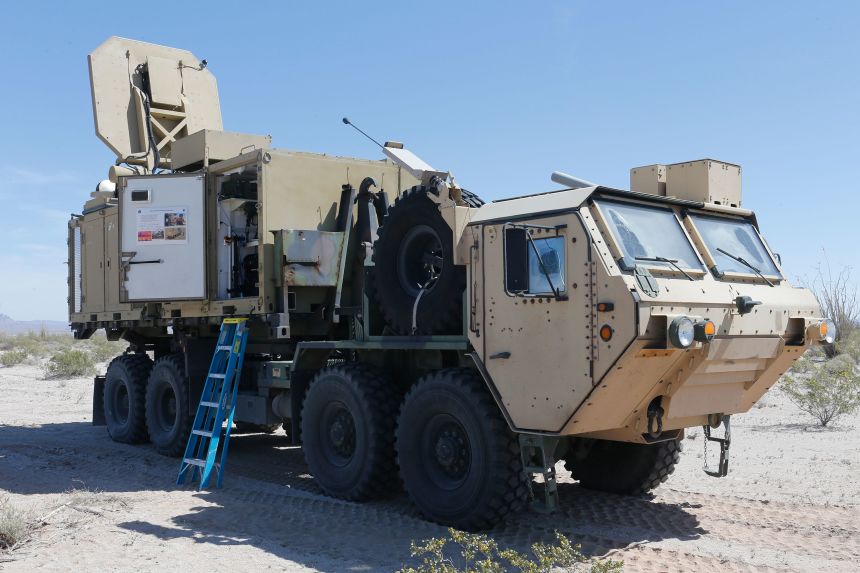
  12. Pentagon grants DHS permission to test heat ray weapon for use at border14
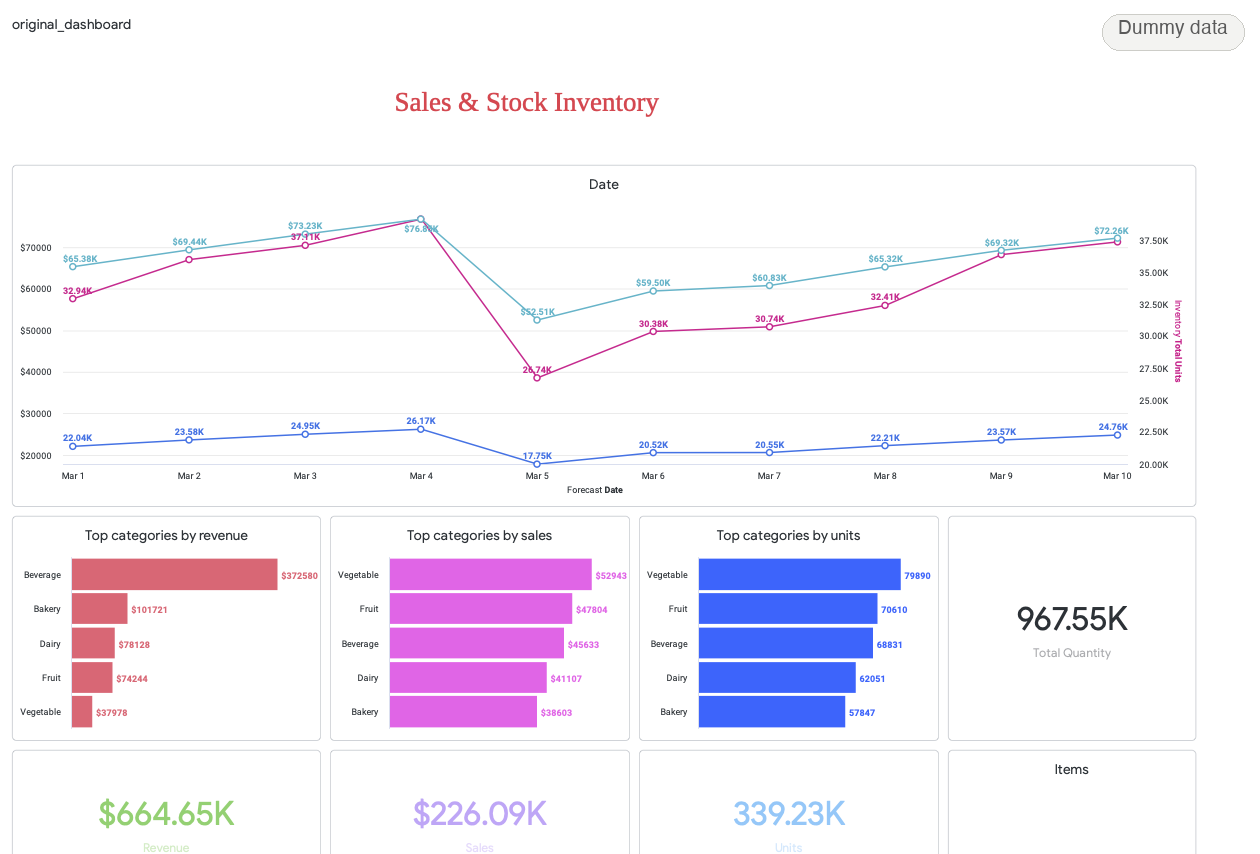
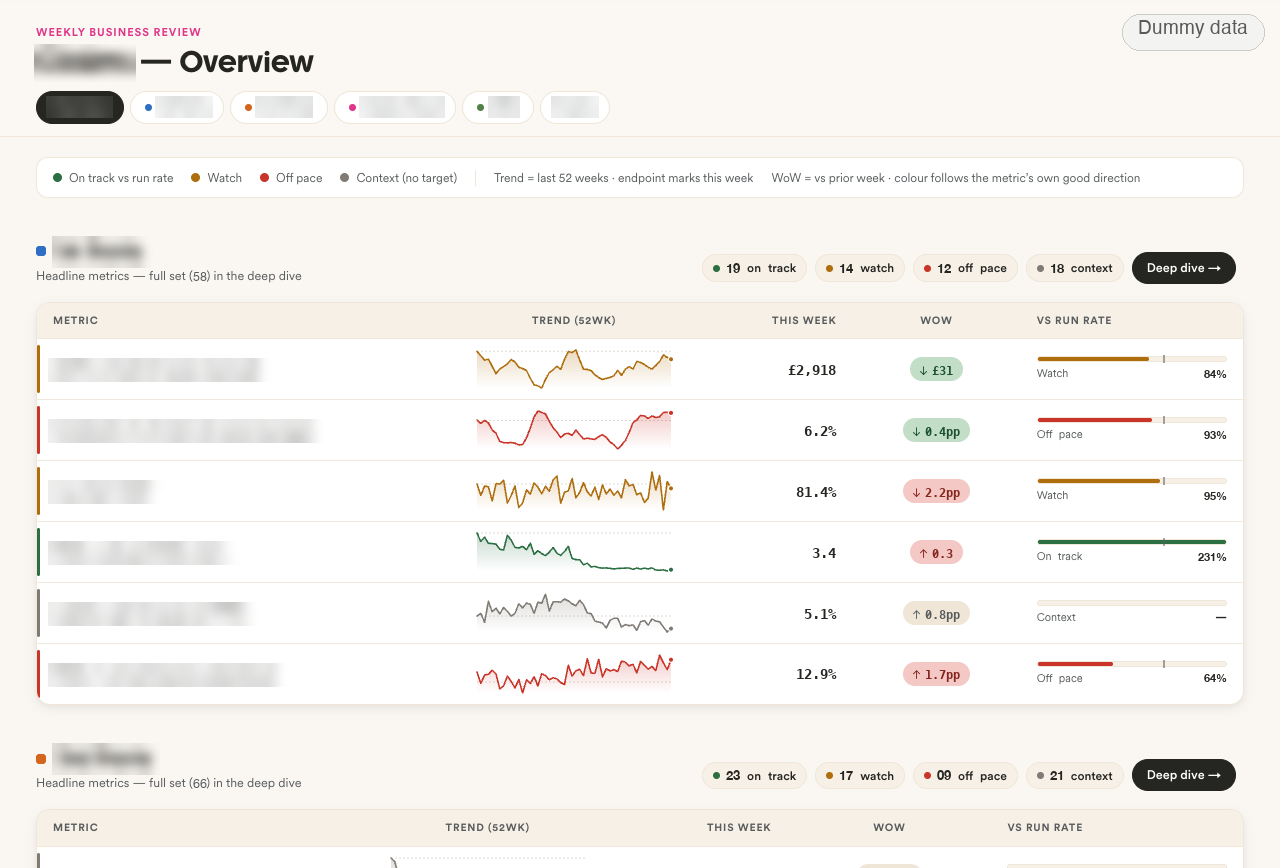
  13. Can we replace a $150k Looker with a bucket of HTML files?15
  14. UUIDv7: Timestamps aren’t time-ordered and other oddities16
  15. Kimi K3.1 scores 55 on Artificial Analysis, placed on the Pareto line17
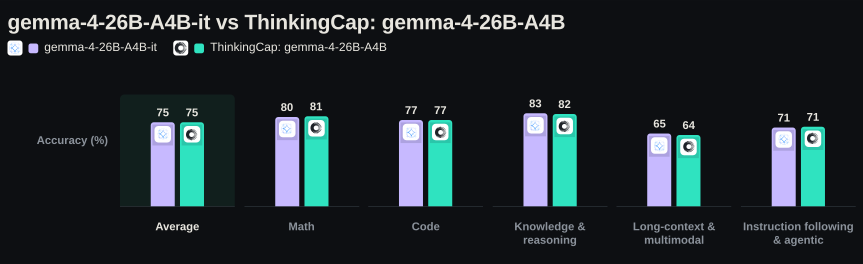
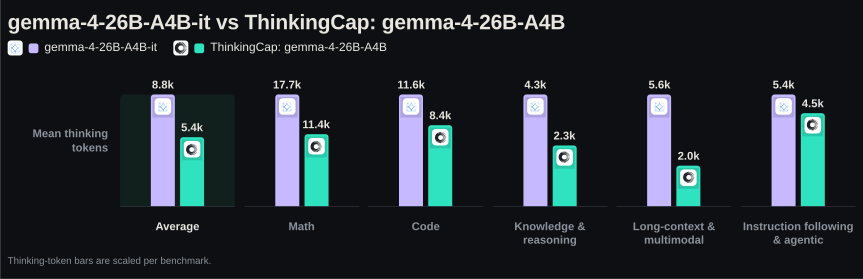
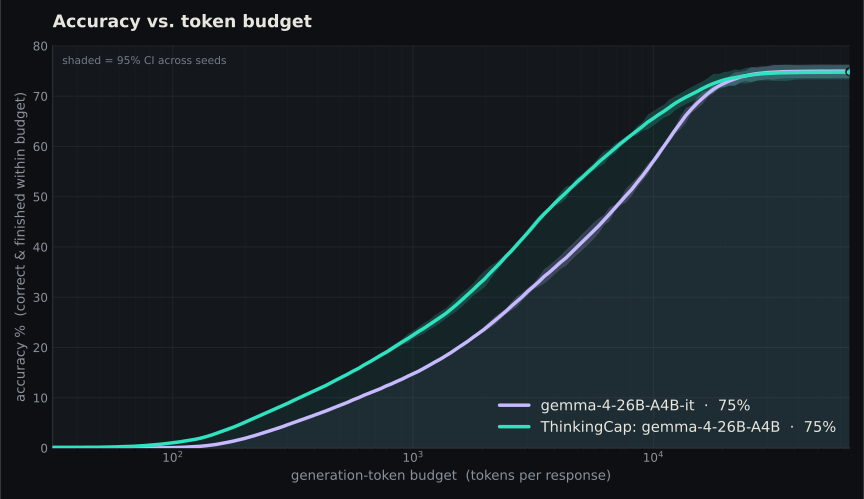
  16. Gemma-4-26B-A4B with 39-69% less thinking at same accuracy18
  17. Today, we hacked what we'd set out to hack: the iPhone19
  18. Now Google says it might use your Gmail and Google Photos data to target ads20
  19. Swedish government offices to ban ChatGPT and Claude21
  20. eMudhra ignored Mozilla Root investigation deadline; blames social media22
  21. OpenSSL 4.1.023
  22. Dutch government had hacked into Jared Kushner's phone24
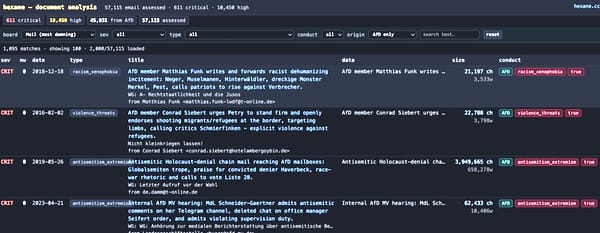
  23. Hacker leaks 281 GB of data from Germany's far-right AfD party25
  24. We are all living inside of an obscure sci-fi film from 197026
  25. No Need for Retirement When Utopia Is Around the Corner27
  26. This I Believe (1952)28
  27. Evolving Threat: http2shell is an RCE in Node, Python, and more29
  28. Apple Music 404 Not Found29
  29. Shitter – A Nitter Fork29
  30. CVE Tracker29
The Daily Front Page 2 of 30
Friday, October 23, 2026 The Daily Front No. #261023 — The New Open Frontier
article

Kimi K3.1 Pro and K3.1 Pro Highspeed

by Jowsey·▲ 815 points·488 comments·kimi.ai ↗
the first model in our new K3.1 series and our most capable 3T-class open-weight model to date

We're introducing Kimi K3.1 Pro, the first model in our new K3.1 series and our most capable 3T-class open-weight model to date, with a 1-million-token context window. It delivers substantial improvements across coding, 3D creation, financial research, and other agentic capabilities.

We are also releasing Kimi K3.1 Pro Highspeed, which delivers 2-3× the speed of K3.1 Pro for more responsive interactions.

Kimi K3.1 Pro and Kimi K3.1 Pro Highspeed are available today on Kimi.ai, Kimi Work, Kimi Code, and the Kimi API. The full model weights will be released by Nov 4.
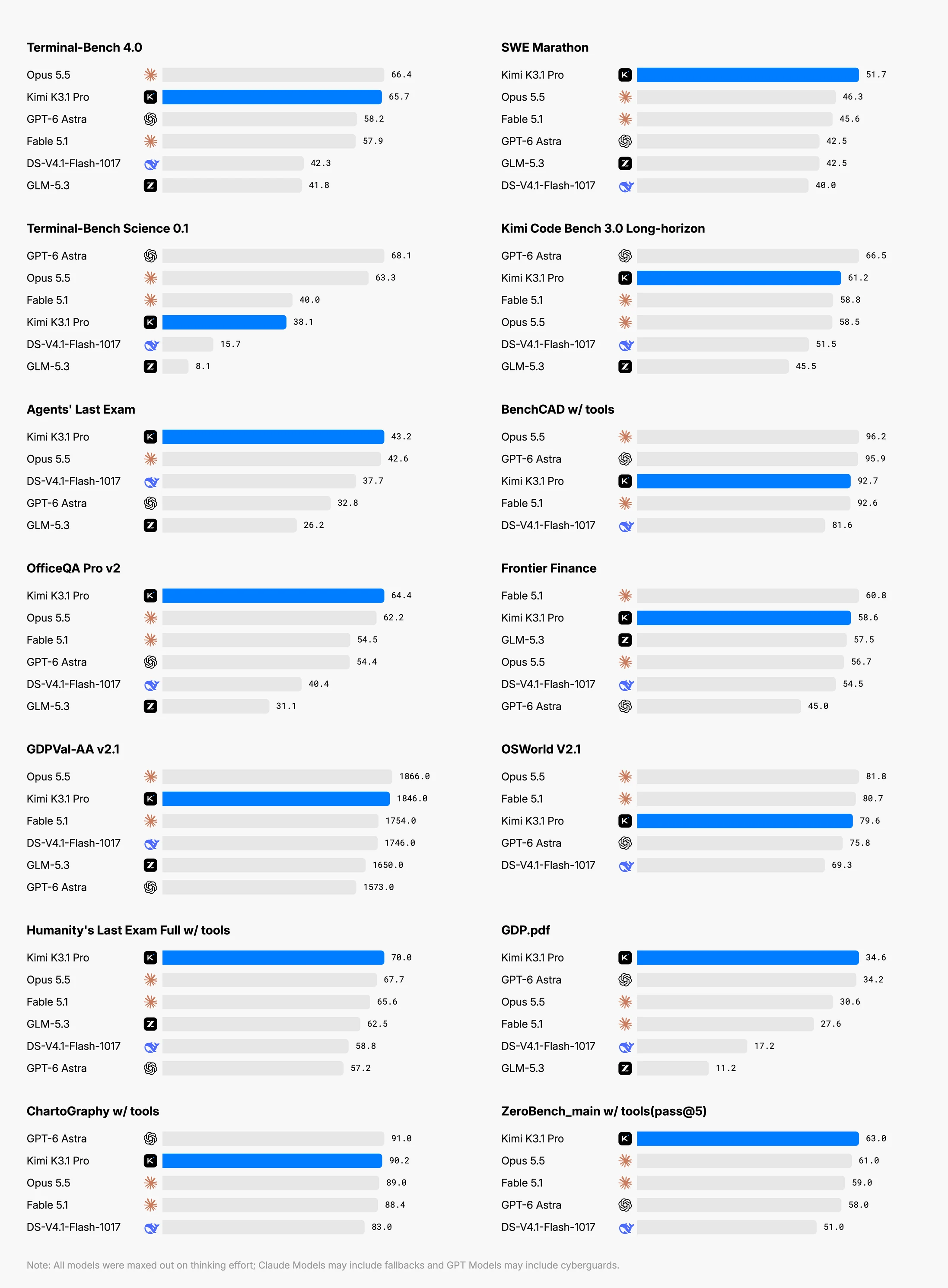
Benchmark results for Kimi K3.1 Pro and peer models across 14 coding, science, and knowledge-work evaluations

Advancing the Frontier of Open Intelligence

Kimi K3.1 Pro is a post-trained version of Kimi K3, with substantially larger post-training compute. To enable large-scale joint RL across hundreds of downstream domains, we optimized every layer of the stack — the RL framework, long-context inference, training efficiency, sandbox infrastructure, rollout scheduling, and a shared platform for environment quality checks — so that each increment of RL compute delivers stable, predictable returns. As a result, K3.1 Pro achieves consistent gains in every domain.

Across coding, agentic, and knowledge benchmarks, K3.1 Pro matches or approaches the strongest proprietary models. On Terminal-Bench 4.0, which evaluates coding agents on realistic, resource-constrained terminal tasks using strict task-specific tests, K3.1 Pro scores 65.7%, ahead of GPT-6 Astra (58.2%) and narrowly behind Claude Opus 5.5 (66.4%). And on Kimi Code Bench 3.0 Long-horizon, our internal benchmark that tests coding agents' multi-step execution, tool use, and end-to-end problem solving across diverse engineering domains, K3.1 Pro scores 61.2%, above K3's 55.95%.

Coding

K3.1 Pro covers the full range of coding work, from quick fixes in real codebases to full-project builds. It also brings a more considered visual style to games and web experiences, and knows how to build them with the right tools.

K3.1 Pro works effectively across game engines such as Unity, Unreal Engine, and Godot, combining them with web search and 3D generation to create complete experiences. Its front-end pages, interactive Three.js scenes, and 3D assets show stronger composition, typography, animation, and polish. The examples below were created end to end by K3.1 Pro:

K3.1 Pro's long-horizon coding capabilities are also strengthened through large-scale reinforcement learning. In one internal test, it built a human walking dynamics simulator with integrated training and evaluation pipelines on top of human-atlas, an open-source anatomical model of the human body comprising 296 skeletal components, including cartilage, and 402 muscle components. Across 167 missions and 420 independent reviews, it analyzed experimental results, diagnosed problems, and iteratively refined the walking controller, enabling the simulated human to go from collapsing within seconds to walking continuously with alternating strides for 11.2 seconds. When reward shaping failed to improve arm motion, K3.1 Pro did not simply keep adjusting the reward: it ran open-loop probes of the simulator's dynamics, identified and corrected 36 errors in shoulder-muscle moment-arm calculations, and then retrained the controller.

3D Modeling and Design

K3.1 Pro is strong at 3D creation and spatial reasoning. On BenchCAD, which tests 3D reconstruction from multi-view renderings through CAD code generation, K3.1 Pro scores 92.7% with tools, approaching the performance of Claude Opus 5.5 (96.2%) and GPT-6 Astra (95.9%). From a text brief, sketch, or reference image, it can infer shape, proportions, and spatial relationships to create usable 3D models. It also has a stronger grasp of existing asset libraries and model collections.
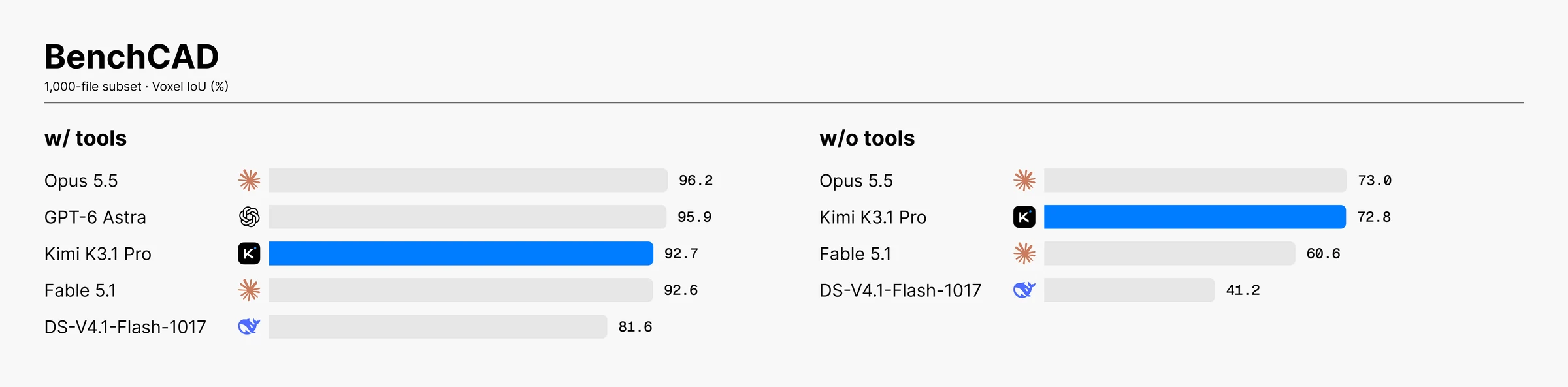
BenchCAD results (1,000-file subset, Voxel IoU): with tools, Claude Opus 5.5 scores 96.2, GPT-6 Astra 95.9, Kimi K3.1 Pro 92.7, Claude Fable 5.1 92.6, and DeepSeek-V4.1-Flash-1017 81.6; without tools, Claude Opus 5.5 scores 73.0, Kimi K3.1 Pro 72.8, Claude Fable 5.1 60.6, and DeepSeek-V4.1-Flash-1017 41.2

K3.1 Pro particularly excels at parametric modeling, from mechanical parts and architectural models to configurable products and custom furniture. Without MCP connectors, it can write and run scripts for tools like Blender and CAD software to build and refine assets, edit components, and adjust geometry, materials, and scene layout.

Below are examples of 3D assets K3.1 Pro created for brand films, games, and interactive web experiences:

3D Make is now live on kimi.ai and the Kimi app — preview and edit your 3D models online, download them ready for 3D printing, or export them as videos or Live Photos to share anywhere.

The Kimi 3D Make interface on kimi.com, with a prompt box for turning ideas into 3D models and featured templates including a pagoda, a typewriter, and a jet engine

Finance

With stronger reasoning and agentic capability, K3.1 Pro is capable of end-to-end delivery of complete financial workflows. K3.1 Pro achieves state-of-the-art results on OfficeQA Pro v2 (64.4), which tests complex fiscal data analysis over real financial documents through retrieval, cross-document verification, and multi-step numerical reasoning. K3.1 Pro also improves over K3 on Frontier Finance, which measures support for complete investment workflows from screening to profitability analysis.
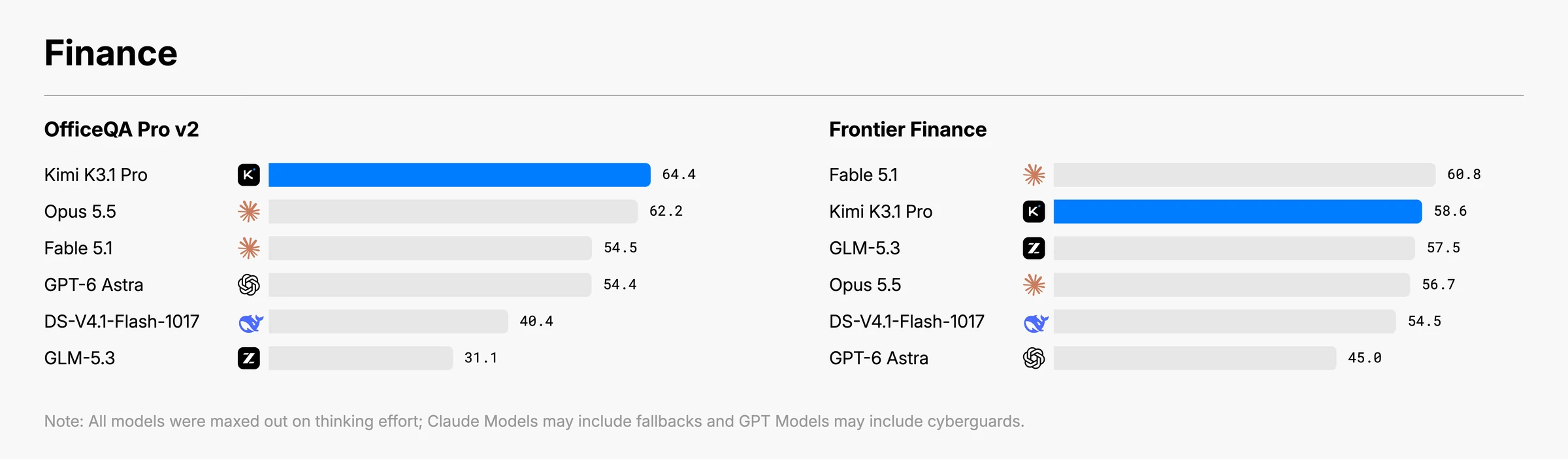
Finance benchmark results for OfficeQA Pro v2 and Frontier Finance, with Kimi K3.1 Pro leading OfficeQA Pro v2 at 64.4 and scoring 58.6 on Frontier Finance against Claude, GPT, GLM, and DeepSeek models

K3.1 Pro also improves significantly across all our internal finance benchmarks:

  • Financial Modeling evaluates formula linkage, financial logic, and final workbook quality in real-world modeling tasks. K3.1 Pro improves on K3 by 7.2 points.
  • Financial Research evaluates whether models can produce auditable research under evidence and cutoff constraints. K3.1 Pro improves on K3 by 11.6 points.
  • Business Operation evaluates long-horizon management and decision-making in a simulated business environment. K3.1 Pro achieves about 4.2× K3's performance.
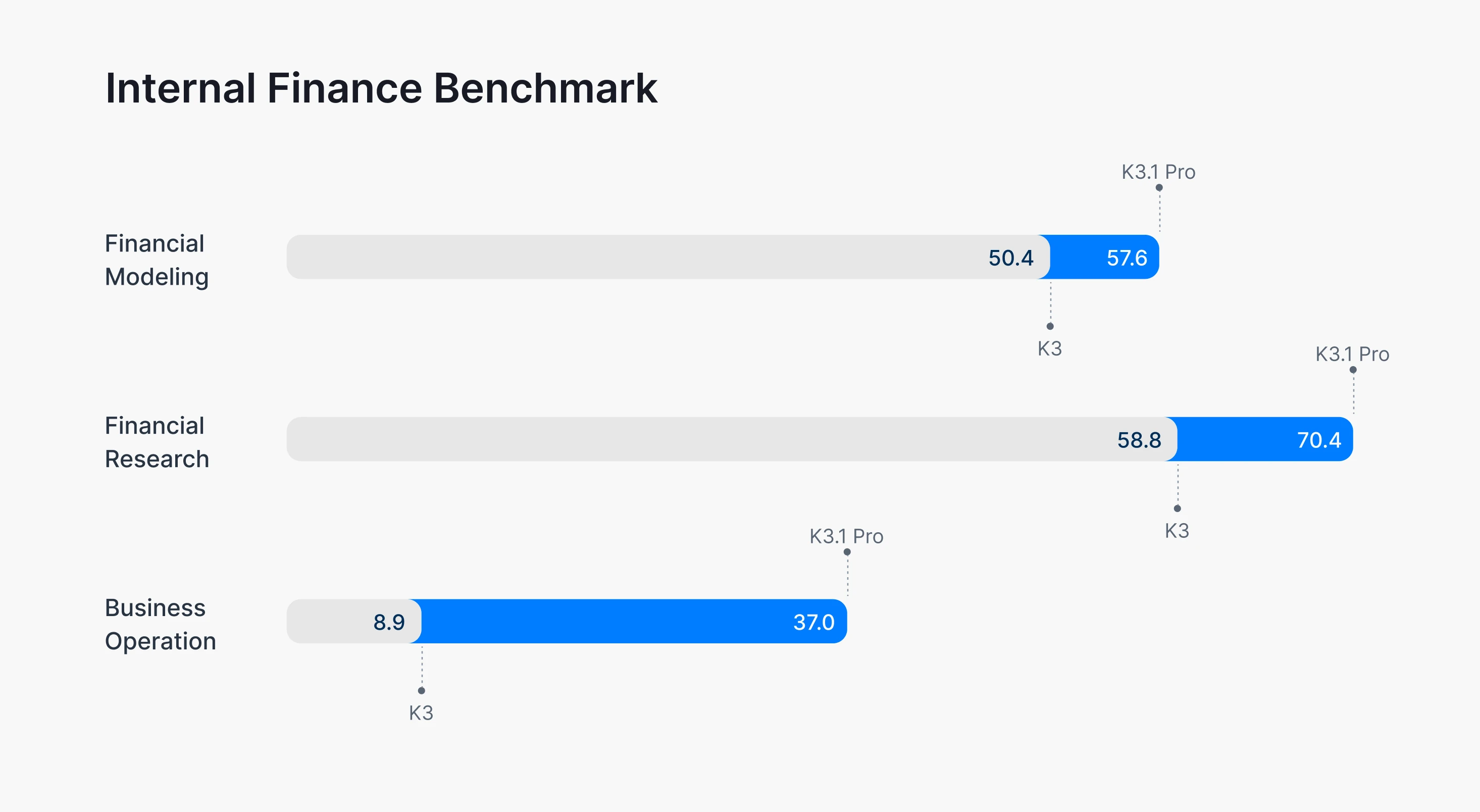
Internal Finance Benchmark: Kimi K3.1 Pro versus K3 on Internal Finance Modeling (57.6 vs 50.4), Internal Financial Research (70.4 vs 58.8), and Internal Business Operation (37 vs 8.9)

Financial analysis and investment research demand a high degree of factual accuracy. To address this, we made targeted improvements to K3.1 Pro's factual accuracy on real-world tasks and challenging prompts. On Kimi Hallu Bench Hard bench, an internal benchmark designed to stress-test factual accuracy, its claim-level hallucination rate fell from 23.4% for K3 to 8.3%, while the share of responses containing at least one factual error was just 42.4% of its predecessor's rate. (The evaluation is a stress test for factual accuracy, with examples deliberately crafted to probe situations where models are prone to errors. The reported rates do not represent overall error rates in daily use.)
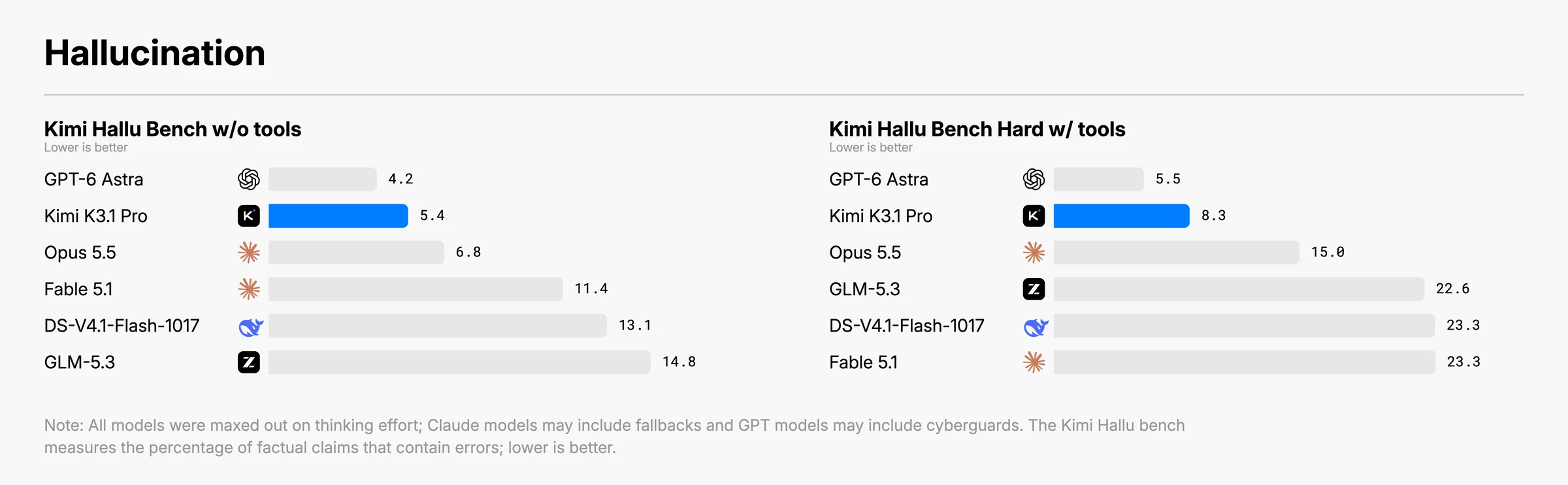
Kimi Hallu Bench claim-level hallucination rates (lower is better): without tools, GPT-6 Astra 4.2, Kimi K3.1 Pro 5.4, Opus 5.5 6.8, Fable 5.1 11.4, DeepSeek-V4.1-Flash-1017 13.1, GLM-5.3 14.8; Hard with tools, GPT-6 Astra 5.5, Kimi K3.1 Pro 8.3, Opus 5.5 15.0, GLM-5.3 22.6, DeepSeek-V4.1-Flash-1017 23.3, Fable 5.1 23.3

The cases below show how K3.1 Pro handles financial modeling, investment analysis, and source-grounded research in practice:

Cybersecurity

As K3.1 Pro became more capable, we spent a correspondingly larger share of our effort understanding where cyber capability comes from, and how much of it we can control. We therefore analyzed and evaluated K3.1 Pro's vulnerability research capabilities, and applied targeted controls during training to reduce potential misuse risk while preserving general usefulness.

Identifying and removing cyber-related data. During development, we observed vulnerability research performance improving steadily as post-training scaled. Tracing the source of this trend, we found that cyber-related content was embedded within the general mid-training corpus, and cyber-related tasks were present in the RL environment mix — a natural byproduct of training on broad data. In preliminary experiments on internal models, we found that without data removal at either the mid-training or the RL stage, downstream cyber capability would increase substantially. These findings gave us a concrete lever for control. For the open-weight release of K3.1 Pro, we identified and removed cyber-related data from both training stages, while retaining the general-purpose coding tasks needed for model usefulness. We will continue to apply appropriate controls at every training stage, of which cyber-related data identification and restriction is one example.

Evaluation and results. After data cleaning, we evaluated K3.1 Pro on xdev-bench-hard, our in-house benchmark of expert-curated, source-code-based vulnerability discovery and exploitation tasks, calibrated to provide meaningful differentiation at our current capability level. Most tasks faithfully reproduce recently disclosed vulnerabilities in software such as the Linux kernel, Node.js, JavaScriptCore, Exim, and VirGL, with mitigations enabled. Each task provides the vulnerable source code, a short bug hint, and the corresponding binary; the agent must develop an exploit, achieve arbitrary code execution in a separate sandbox, and retrieve a secret string for automated verification. We report pass@3 over a random subset of runs, with no hard timeouts or output token limits.

Internal xdev-bench-hard (pass@3) results: GPT-5.6 Sol (third-party evaluation) solves 100 problems, the Kimi model without cyber risk-reduction 90.5, DeepSeek-V4.1-Flash 85.7, Kimi K3.1 Pro 81.0, GLM-5.3 57.1, and Kimi K3 33.3, with average success rate and average tokens per successful trajectory for each

On xdev-bench-hard, the checkpoint without these risk-reduction measures — no cyber-related data removal at mid-training and no cyber-related RL environment filtering — solves 90.5% of problems at pass@3; the final K3.1 Pro reaches 81.0%. The comparison shows that data removal meaningfully reduces cyber capability relative to what the same training pipeline would otherwise produce. At the same time, K3.1 Pro improves substantially over its predecessor, indicating that stronger general coding and long-horizon debugging capabilities generalize to cyber tasks even after targeted data removal. K3.1 Pro's cyber capability remains behind that of frontier proprietary models that have been publicly available for at least three months. We will keep evolving our internal benchmarks so that evaluation stays informative as model capabilities continue to advance.

Open-weight principles. These evaluations frame our open-weight release decision. First, we aim not to release open weights that would extend the absolute frontier of cyber capability. K3.1 Pro's offensive cyber capability is, by design, below what our pipeline can produce, and remains behind that of frontier proprietary models. Second, we intend to progressively raise the cyber capability available in open weights. We believe making K3.1 Pro available in a non-discriminatory way benefits people who need dual-use capabilities for defensive purposes. When a capable model is open and runs on infrastructure its users control, many more teams gain the means to audit the code they maintain — including legacy systems that rarely receive dedicated security reviews. We believe that letting this capability diffuse gradually — rather than concentrating it in a few proprietary systems — ultimately makes all software more secure.

Availability

Kimi K3.1 Pro rolls out today across the Kimi product family: on Kimi.ai and the Kimi mobile apps, Kimi Work and Kimi Code, and through the Kimi API.

Full model weights will be released by Nov 4, 2026.

Kimi Enterprise administrators can enable K3.1 Pro for their organization; access is off by default at launch.

Details for each channel:

  • Kimi Agents: Download or update to the latest Kimi app from your mobile app store, available on iOS, Android, and HarmonyOS, or visit kimi.ai.
  • Work with Kimi K3.1 Pro: Download the latest Kimi Work desktop app, version 3.1.0 or later, available for Windows and Apple silicon Macs.
  • Code with Kimi K3.1 Pro: Run Kimi Code and select Kimi K3.1 Pro using the /model command.
  • Build with the Kimi API: Visit the Kimi API Platform and select kimi-k3.1-pro / kimi-k3.1-pro-highspeed. Zero Data Retention is available for API customers.
  • Bring Kimi to your organization: Kimi Business provides enterprise-grade data privacy and member management, with complete separation between personal and organization accounts. Visit the pricing page and select “Get Kimi Business” to subscribe for your team.

Benchmarks

Footnotes

Unless otherwise specified, all Kimi K3.1 Pro results reported below are obtained with the reasoning effort set to 'max', temperature = 1.0, and top-p = 0.95.

Coding benchmarks

  1. Terminal-Bench 4.0. Kimi K3.1 Pro is evaluated with the Claude-Code harness. The DeepSeek-V4.1-Flash-1017 is taken from the release blog (https://huggingface.co/deepseek-ai/DeepSeek-V4.1-Flash-1017). All remaining scores are taken as the maximum value reported in either their blog posts or the official Terminal-Bench 4.0 leaderboard (https://www.tbench.ai/).
  2. Terminal-Bench Science 0.1. Kimi K3.1 Pro is evaluated with the Claude-Code harness. Our internal evaluation of DeepSeek-V4.1-Flash-1017 yields a score of 9.3; However, an older version, DeepSeek-V4.1-Flash, scores 15.7 on the official Terminal-Bench Science, so we report 15.7 here; all remaining scores are from the official Terminal-Bench Science leaderboard (https://www.terminal-bench-science.ai/).
  3. DeepSWE v1.1. Kimi K3.1 Pro is evaluated with the Claude-Code harness. All scores are taken from each model's respective technical report. GPT-6 Astra(https://openai.com/index/gpt-6-astra/). Claude Opus 5.5 and Claude Fable 5.1(https://www.anthropic.com/claude-opus-5-5-system-card and https://www.anthropic.com/claude-fable-5-1-mythos-5-1-system-card); DeepSeek-V4.1-Flash-1017 (https://api-docs.deepseek.com/news/news261017/); GLM-5.3 (https://z.ai/blog/glm-5.3).
  4. SWE-Marathon v1.1. Kimi K3.1 Pro is evaluated with the Claude-Code harness. DeepSeek-V4.1-Flash-1017 is evaluated with the ClaudeCode harness. All other scores are taken from the official SWE-Marathon leaderboard (https://www.swe-marathon.org/).
  5. PostTrainBench. Kimi K3.1 Pro and DeepSeek-V4.1-Flash-1017 were evaluated internally on v1.2 using the Claude-Code harness and H20 GPUs instead of H100 GPUs. For stable evaluation, all judge models used DeepSeek-V4.1-Flash-1017 at maximum effort, which best matched the official GPT-5.6-Terra (xhigh) judge in testing. Other scores are from the official leaderboard (https://posttrainbench.com/).
  6. ProgramBench (binary score). We report binary scores rather than raw ProgramBench scores: a task receives a score of 1 if its ProgramBench score is ≥95%, and 0 otherwise. Kimi K3.1 Pro is evaluated with the Claude-Code harness. The DeepSeek-V4.1-Flash-1017 and GLM-5.3 scores are taken from the release blog (https://huggingface.co/deepseek-ai/DeepSeek-V4.1-Flash-1017); all remaining scores are from the Vals ProgramBench leaderboard (https://www.vals.ai/benchmarks/programbench).
  7. Internal Coding Bench: Kimi Code Bench 2.0 and Kimi Code Bench 3.0 Long-horizon. Kimi K3.1 Pro is evaluated with Claude-Code harnesses; All other models are evaluated at their max-effort setting. Note that proprietary model testing may involve some fallback behavior.
  8. BenchCAD. Open models are evaluated by us on 1,000-case subsets randomly sampled from the full 17,900-case Vision2Code dataset, at maximum reasoning effort. With-tools results use the Claude Code harness; without-tools results use single-shot generation with the official BenchCAD prompts and scoring pipeline. Scores for Claude Fable 5.1 and Claude Opus 5.5 are taken from the Claude Opus 5.5 System Card; GPT‑6 Astra’s with-tools score is taken from its official report. GPT‑6 Astra has not reported a without-tools score and is marked “—”.

Agentic benchmarks

  1. BioMysteryBench dataset is drawn from the official v11 release, with Kimi K3 as the judge model. We evaluate Kimi K3.1 Pro with Kimi Code, GLM-5.3 and DeepSeek-V4.1-Flash-1017 with Claude Code, and GPT-6 Astra with Codex. Scores for the Claude models are taken directly from their official system cards.
  2. Our Agents’ Last Exam dataset is drawn from the official v1.1 release, comprising 122 tasks, including 86 CLI tasks, with environment images aligned with the official Hugging Face release. We additionally assign a score of zero to runs that bypass the task’s stated requirements, such as retrieving answers online instead of performing the required analysis in Wireshark. DeepSeek and Kimi are evaluated using Claude Code and Kimi Code, respectively. All other results are taken from the official benchmark website.
  3. OfficeQA Pro, OfficeQA Pro v2. GPT-6 Astra is evaluated with Codex, while all other models are evaluated with Claude Code. Each task provides the agent with the entire PDF corpus, with all PDFs rendered as images and no machine-readable text available. We observed instances in the trajectories of certain external models where they retrieved reference answers online; Consequently, we assigned a score of zero to these tasks.
  4. Frontier Finance is evaluated with the official finance agent v2 harness.
  5. HANDBOOK.md is evaluated using the official harness built on OpenHands, with evaluation tasks drawn from the benchmark’s early open-source v1 release.
  6. Harvey Legal Agent is evaluated on a public dataset of 1,251 tasks using Artificial Analysis’s Stirrup harness, with performance reported as the all-pass rate (i.e., the percentage of tasks that pass all rubric criteria).
  7. OSWorld V2.1 is evaluated with the Kimi Agent harness in the official OSWorld v2 repo, while GPT-6 Astra's score is taken from Muse Wonder's technical report.
  8. DECK-Arena evaluates presentation generation on real-world queries, while Design Bench covers graphic design via direct and reference-image few-shot prompting; Both run models across python-pptx, pptxjs, and Kimi's in-house DSL in a harness with integrated search and image generation, using an automated grader calibrated on 10,000+ human judgments.
  9. MCP Atlas. All models are evaluated on the 500-task public subset with a 100-turn limit, using Gemini 3.1 Pro as the judge.
  10. BrowseComp. We adopt the context-compaction strategy used in the Claude model cards, triggered at 200K tokens. We allow a maximum of 500 steps; if this limit is reached before a task is completed, we force the agent to provide an answer, which is then judged. All BrowseComp runs are conducted with temperature=1.0 and top-p=1.0.
  11. GDPval-AA v2.1, AA-Briefcase v1.1 and AutomationBench-AA scores are cited from https://artificialanalysis.ai/, Apex Agents scores are cited from https://www.mercor.com/apex/apex-agents-leaderboard/
  12. GDP.pdf w/ python, ZeroBench w/ python and ChartoGraphy w/ python are averaged over five runs. Other multimodal benchmarks (w/ python) are averaged over four runs. For GDP.pdf w/ python: Each original PDF file is sent to the sandbox, where the model can use IPython tool to process it. Final responses are graded against each rubric criterion using Gemini-3.5-Flash (medium reasoning effort) and the official judging prompt. We report the task-macro mean rubric pass rate: for each task, we average the fraction of rubric criteria passed over five independent runs, then average these task-level scores equally across all tasks.

Reasoning & Knowledge & Multimodal benchmarks

  1. GDP.pdf. Each PDF is provided as page images resized to a longest edge of 1,152 pixels, interleaved with Docling-extracted text in page order. Responses are graded against each rubric criterion using Gemini-3.5-Flash Medium and the official judging prompt. We report the strict pass rate among fully scored responses.
  2. HLE and HLE-Diamond evaluate general knowledge and reasoning capabilities. We report accuracy on the full evaluation sets, with 2,500 questions for HLE and 1,000 questions for HLE-Diamond. For models marked with an asterisk (*), accuracy is reported on the text-only subset of questions.
  3. GDP.pdf, ZeroBench and ChartoGraphy are averaged over five runs. Other multimodal benchmarks are averaged over four runs. GDP.pdf scores of GLM-5.3 Max and DeepSeek-V4.1-Flash-1017 Max is cited from https://artificialanalysis.ai/.
  4. MMMU-Pro is evaluated following the official protocol, preserving the original input order and prepending images to the text input.
  5. Kimi Hallucination Benchmark evaluates factual accuracy on an internal set of challenging, de-identified prompts drawn from practical work tasks. We report the claim-level hallucination rate assessed by fact-checking agents.

Cybersecurity benchmarks

  1. ExploitBench. Kimi K3.1 Pro is evaluated with the official ExploitBench harness under the 300-turn budget. We report the pass@5 max capability score: for each environment, the best run across 5 seeds, scored by the number of capability flags reached out of 16, where achieving arbitrary code execution counts as achieving all 16 capabilities. The GPT-6 Astra score is taken from https://openai.com/index/gpt-6-astra/; the Claude Opus 5.5 and Claude Mythos 5.1 scores are taken from https://www.anthropic.com/claude-opus-5-5-system-card; the GLM-5.3 score is taken from https://z.ai/blog/glm-5.3.
  2. ExploitGym. Kimi K3.1 Pro is evaluated with the KimiCode harness under a 6-hour wall-clock budget per task. The GPT-6 Astra score is taken from https://openai.com/index/gpt-6-astra/; the Claude Opus 5.5 and Claude Mythos 5.1 scores are taken from https://www.anthropic.com/claude-opus-5-5-system-card at the 6-hour budget; the GLM-5.3 score is taken from https://z.ai/blog/glm-5.3.
  3. xdev-Bench-hard: Kimi K3.1 Pro is evaluated with the KimiCode harness. GLM-5.3 and DeepSeek-V4.1-Flash-1017 are evaluated with the Claude Code harness.
The Daily Front Page 3 of 30
Friday, October 23, 2026 The Daily Front No. #261023 — Power Bills, Public Interest
article

Investor-owned utilities charge 23% more for electricity than public providers

by hubraumhugo·▲ 527 points·384 comments·kadoa.com ↗
homes paid 17.8¢ a kilowatt-hour at investor-owned utilities, 14.5¢ at public utilities and 14.1¢ at co-ops

In 2025, homes paid 17.8¢ a kilowatt-hour at investor-owned utilities, 14.5¢ at public utilities and 14.1¢ at co-ops. Since 2020, investor-owned prices rose 34% and public ones 19%, against 24% inflation.

Average home price by utility owner

Change since 2020 against inflation, or cents per kilowatt-hour since 2015.

Year Investor-owned Public Co-op Inflation since 2020 Investor-owned, monthly bill Public, monthly bill Co-op, monthly bill
2025 17.8¢ +34% 14.5¢ +19% 14.1¢ +19% +24% $146 $130 $159
2024 16.9¢ +28% 13.9¢ +14% 13.5¢ +14% +21% $137 $125 $149
2023 16.6¢ +25% 13.4¢ +10% 13.2¢ +12% +18% $133 $120 $145
2022 15.4¢ +17% 13.3¢ +9.4% 13.1¢ +11% +13% $130 $124 $150
2021 13.9¢ +5.1% 12.4¢ +1.8% 12.1¢ +2.2% +4.7% $116 $113 $136
2020 13.3¢ 12.2¢ 11.8¢ – $111 $112 $133
2019 13.1¢ 12.0¢ 11.9¢ – $109 $109 $136
2018 13.1¢ 12.0¢ 11.8¢ – $111 $112 $139
2017 13.3¢ 11.8¢ 11.9¢ – $106 $106 $130
2016 12.9¢ 11.6¢ 11.6¢ – $107 $106 $131
2015 12.9¢ 11.6¢ 11.6¢ – $108 $107 $133

Every year since 2015: home revenue, kWh sold, homes, price and bill by utility owner, for the US and each state, as a gzipped CSV.

Download CSV (gzip)

Source: EIA annual survey of utilities (Form 861), homes buying supply and delivery from their utility; BLS CPI.

Home prices in 2025

Share of homes by their utility's average price per kilowatt-hour, in 2-cent bands.

Investor-owned 67% of homes paid 12 to 20 cents, and 11% paid 30 cents or more.

Public 61% paid under 14 cents. The bump at the high end is LADWP and Long Island Power Authority, 13% of public homes.

Co-op 52% paid under 14 cents.

Price a kWh Investor-owned Public Co-op
Under 10¢ 0.1% 3.9% 1.2%
10 to 12¢ 3.8% 13.2% 10.4%
12 to 14¢ 13.9% 43.8% 40.0%
14 to 16¢ 20.3% 12.7% 30.8%
16 to 18¢ 20.0% 3.2% 11.7%
18 to 20¢ 12.4% 6.5% 2.4%
20 to 22¢ 9.1% 1.5% 1.0%
22 to 24¢ 2.7% 0.9% 0.8%
24 to 26¢ 3.4% 0.6% 0.9%
26 to 28¢ 1.3% 13.3% 0.0%
28 to 30¢ 1.6% 0.0% 0.0%
30¢ or more 11.4% 0.5% 0.6%

Source: EIA annual survey of utilities (Form 861), homes buying supply and delivery from their utility.

Price change by state, 2020 to 2025

States sorted by how far investor-owned prices pulled ahead of nonprofit (public and co-op) prices. The gap is widest at the top.

State Investor-owned Nonprofit Investor-owned, 2025 Nonprofit, 2025
Alabama +33% +22% 17.9¢ 13.9¢
Alaska +20% +15% 17.8¢ 26.5¢
Arizona +29% +21% 16.6¢ 14.0¢
Arkansas +22% +26% 13.1¢ 12.6¢
California +62% +28% 33.9¢ 22.7¢
Colorado +37% +18% 16.1¢ 15.3¢
Connecticut +34% +23% 30.0¢ 19.5¢
Delaware +48% +17% 18.2¢ 14.7¢
Florida +40% +21% 15.7¢ 13.8¢
Georgia +31% +15% 16.3¢ 13.3¢
Hawaii +37% +14% 41.7¢ 38.4¢
Idaho +19% +20% 12.0¢ 11.3¢
Illinois +39% +15% 17.3¢ 15.5¢
Indiana +30% +13% 16.6¢ 14.5¢
Iowa +7.3% +13% 13.6¢ 13.3¢

Source: EIA annual survey of utilities (Form 861), homes buying supply and delivery from their utility.

Price gap after accounting for location

Average home price per kilowatt-hour in 2025. Hydro states get the most power from dams: WA, VT, ID, OR, MT, AK and SD.

Investor-owned Compared with Gap
Public, all states 17.8¢ 14.5¢ +22.7%
Public, no hydro states 17.9¢ 14.9¢ +19.8%
Public and co-ops, same state 18.5¢ 15.7¢ +17.3%
Co-ops, most rural 17.8¢ 14.1¢ +26.2%

Source: EIA annual survey of utilities (Form 861), homes buying supply and delivery from their utility.

Largest utilities, 2020 to 2025

Change in the average home price at utilities with 250,000 or more homes: investor-owned, public and co-op.

Utility State Owner 2020 2025 Change
New York State Electric & Gas NY Investor-owned 11.5¢ 22.6¢ +97%
San Diego Gas & Electric (SDG&E) CA Investor-owned 25.5¢ 45.8¢ +79%
Potomac Electric Power DC Investor-owned 11.8¢ 20.8¢ +76%
Rochester Gas & Electric NY Investor-owned 12.6¢ 22.0¢ +75%
Southern California Edison (SCE) CA Investor-owned 18.2¢ 31.5¢ +73%
Tampa Electric FL Investor-owned 10.1¢ 17.3¢ +72%
Ameren Illinois IL Investor-owned 9.7¢ 16.7¢ +72%
Central Maine Power ME Investor-owned 16.2¢ 27.4¢ +69%
Baltimore Gas & Electric MD Investor-owned 12.1¢ 20.2¢ +67%
Pacific Gas and Electric (PG&E) CA Investor-owned 23.6¢ 37.5¢ +59%
Appalachian Power (AEP) VA Investor-owned 10.8¢ 17.2¢ +59%
Puget Sound Energy WA Investor-owned 10.8¢ 17.0¢ +57%
National Grid (Niagara Mohawk) NY Investor-owned 12.6¢ 19.9¢ +57%
Duke Energy Ohio OH Investor-owned 11.0¢ 16.8¢ +52%
Portland General Electric OR Investor-owned 12.5¢ 18.8¢ +50%

Source: EIA annual survey of utilities (Form 861), homes buying supply and delivery from their utility; BLS CPI.

Outage minutes a year by utility owner

Minutes without power for the average home, not counting major storms.

Year Investor-owned Public Co-op
2025 120 min 80 min 166 min
2024 123 min 84 min 188 min
2023 116 min 85 min 167 min
2022 127 min 83 min 161 min
2021 121 min 80 min 164 min
2020 121 min 76 min 150 min
2019 120 min 73 min 153 min
2018 119 min 71 min 152 min
2017 114 min 78 min 150 min
2016 119 min 69 min 149 min
2015 114 min 68 min 152 min

Source: EIA annual survey of utilities (Form 861), reliability.

About the data

  • Public power is common in cities and near federal dams, where power is cheap, and public utilities pay no income tax and borrow tax-free. That explains some of the gap, not why it grew.
  • Most of the gap opened from 2020 to 2023, during the energy price spike: 25% at investor-owned utilities, 11% at public utilities and co-ops. Before and since, both rose at about the same pace.
  • After inflation, investor-owned prices rose 7.9%. Public and co-op prices fell 4.3%.
  • Co-op homes have the highest bills, $159 a month in 2025, because they use the most power.
  • Homes that buy power from a retail supplier aren't in the investor-owned figures. Counting them, prices on investor-owned lines rose 36%.
  • Price is what homes paid divided by the kilowatt-hours they used, from EIA's yearly survey of utilities. Federal utilities and the smallest ones are left out.
  • The data shows what homes paid, not why. Investor-owned utilities earn a return for shareholders on what they build. Public utilities and co-ops have no shareholders. See the rate cases for increases utilities are asking for now.
The Daily Front Page 4 of 30
Friday, October 23, 2026 The Daily Front No. #261023 — Who Owns the Phone?
article

Your Phone Is About to Stop Being Yours: 70 Days Until Lockdown

by NackerHughes·▲ 489 points·337 comments·keepandroidopen.org ↗
every Android app developer must register centrally with Google

70 days until lockdown

Starting in 2027*, a silent update, nonconsensually pushed by Google, will block every Android app whose developer hasn't registered with Google, signed their contract, paid up, and handed over government ID.

Every app and every device, worldwide, with no opt-out.

What Google is doing

In August 2025, Google announced a new requirement: starting in 2027, every Android app developer must register centrally with Google before their software can be installed on any device. Not just Play Store apps: all apps. This includes apps shared between friends, distributed through F-Droid, built by hobbyists for personal use. Independent developers, church and community groups, and hobbyists alike will all be frozen out of being able to develop and distribute their software.

Registration requires:

  • Paying a fee to Google
  • Agreeing to Google's Terms and Conditions
  • Surrendering your government-issued identification
  • Providing evidence of your private signing key
  • Listing all current and all future application identifiers

If a developer does not comply, their apps get silently blocked on every Android device worldwide.

Who this hurts

You

You bought an Android phone because Google told you it was open. You could install what you wanted, and that was the deal.

Google is now rewriting that deal, retroactively, on hardware you already own. After the update lands, you can only run software that Google has pre-approved. On your phone: your property, that you paid for.

Independent developers

A teenager's first app, a volunteer's privacy tool, or a company's confidential internal beta. It doesn't matter. In 2027, none of these can be installed without Google's blessing.

F-Droid, home to thousands of free and open-source Android apps, has called this an "existential" threat. Cory Doctorow calls it "Darth Android".

Governments & civil society

Google has a documented track record of complying when authoritarian regimes demand app removals. With this program, the software that runs your country's institutions will exist at the pleasure of a single unaccountable foreign corporation.

The EFF calls app gatekeeping "an ever-expanding pathway to internet censorship."

Google's "escape hatch" is a trap door

Google says "power users" can "still install" unverified apps. Here's what that actually looks like:

  1. Delve into System Settings, find About Phone
  2. Tap the build number seven times to enable Developer Mode
  3. Dismiss scare screens about coercion
  4. Enter your PIN
  5. Restart the device
  6. Wait 24 hours
  7. Come back, dismiss more scare screens
  8. Pick "allow temporarily" (7 days) or "allow indefinitely"
  9. Confirm, again, that you understand "the risks"

Nine steps. A mandatory 24-hour cooling-off period. For installing software on a device you own.

Worse: this flow runs entirely through Google Play Services, not the Android OS. Google can change it, tighten it, or kill it at any time, with no OS update required and no consent needed.

This is bigger than Android

If Google can retroactively lock down billions of devices that were sold as open platforms, every hardware manufacturer on the planet is watching.

The principle being established: the company that made your device gets to decide, after you've bought it, what software you're allowed to run. In software, this is called a "rug pull"; but at least you could always install competing software. In hardware, it is a fait accompli that strips you of your agency and renders you powerless to the whims of a single unaccountable gatekeeper and convicted monopolist.

Android's openness was never just a feature. It was the promise that distinguished it from iPhone. Millions chose Android for exactly that reason. Google is now revoking that promise unilaterally, on devices already in people's pockets, because they've decided they have enough market dominance and regulatory capture to get away with it.

Ars Technica: "Google's Apple envy threatens to dismantle Android's open legacy."

But wait, isn't this...

"...just about security?"

The security rationale is a smokescreen. Google Play Protect already scans for malware independent of developer identity. Requiring a government ID doesn't make code safer. It makes developers identifiable and controllable. Malware authors can register. Indie developers and dissidents often can't. The EFF is blunt: identity-based gatekeeping is a censorship tool, not a security one.

"...still sideloading if you use the advanced flow?"

Nine steps, 24-hour wait, buried in Developer Options, delivered through a proprietary service that Google can revoke whenever they want. That's not sideloading. That's a deterrence mechanism built to ensure almost nobody completes it. And since it runs through Play Services rather than the OS, Google can tighten or kill it silently.

"...only a problem if you have something to hide?"

Whistleblowers, journalists, and activists under authoritarian governments will be the first victims. People in domestic abuse situations are next. All these groups have legitimate reasons to distribute or use software without putting their legal identity in a Google database. Anonymous open-source contribution is a tradition older than Google itself. This policy ends it on Android.

"...the same thing Apple does?"

Apple has been a walled garden from day one. People chose Android because it was different. "Apple does it too" is a race to the bottom and a weak tu quoque argument. And under regulatory pressure (the EU's Digital Markets Act), even Apple is being forced to open up. Google is moving in the opposite direction: attempting to further entrench its gatekeeping status.

"...just $25 and some paperwork?"

Maybe, if you're a developer in the US with a credit card and a driver's license. Try being a student in sub-Saharan Africa, or a dissident in Myanmar, or a volunteer maintaining a community health app. The cost isn't only financial: you're surrendering government ID and evidence of your signing keys to a company that routinely complies with government demands to remove apps and expose developers.

Fight back

Everyone

  • Install F-Droid on every Android device you own. Alternative stores only survive if people actually use them.
  • Contact your regulators. Regulators worldwide are genuinely concerned about monopolies and the centralization of power in the tech sector, and want to hear directly from individuals who are affected and concerned.
  • Share this page. Link to keepandroidopen.org everywhere.
  • Push back on astroturfers. The "well, actually..." crowd is out in force. Don't let them set the narrative.
  • Sign the change.org petition and join the over 100,000 signatories who have made their voices heard.
  • Read and share our open letter
  • Tell Google what you think of this through their own developer verification survey (for all the good that will do).

Developers

Do not sign up. Don't join the program by signing up for the Android Developer Console and agreeing to their irrevocable Terms and Conditions. Don't verify your identity. Don't play ball.

Google's plan only works if developers comply. Don't.

Google employees

If you know something about the program's technical implementation or internal rationale, contact tips@keepandroidopen.org from a non-work machine and a non-Gmail account. Strict confidence guaranteed.

The Daily Front Page 5 of 30
Friday, October 23, 2026 The Daily Front No. #261023 — The Price of Watching
article

Disney Raising Prices Days After Confirming Ads Will Now Show Up on Every Tier

by robtherobber·▲ 423 points·442 comments·tvfandomlounge.com ↗
Disney is Raising Prices Days After Confirming Ads Will Now Show Up on Every Tier

Disney+ Originals Can’t Crack the Emmys or Nielsen’s Top 20, But the Streamer Makes Sure Nobody Misses Out on Ads, Even on Premium

Twice a year, Nielsen pulls back the curtain on what America has actually been watching, and the numbers for the first-half of 2026 were revealed recently.

It is a genuinely encouraging picture for streaming overall: Stranger Things and The Pitt are duking it out at the top, shows like One Piece, Invincible and Shrinking are pulling healthy numbers and cracking the Top 20 Most-Watched Originals, and kids remain the single biggest force in the ecosystem, with Bluey outpacing Grey’s Anatomy outright. Even The Big Bang Theory is having a bit of a renaissance. Streaming, in other words, is working.

Here is the breakdown of the biggest original from each major streamer by total minutes viewed in the first half of 2026:

  • Netflix: Stranger Things — 23.261 billion minutes
  • HBO Max: The Pitt — 21.118 billion minutes
  • Paramount+: Landman — 12.400 billion minutes
  • Prime Video: The Boys — 9.597 billion minutes
  • Peacock: The Traitors — 7.737 billion minutes
  • Hulu: Paradise — 5.660 billion minutes
  • Apple TV+: Shrinking — 5.246 billion minutes

Disney+ is conspicuously absent from this list, as it does not have an original show in the Top 20 of Nielsen this year so far, which is worth highlighting given the streamer’s size and the fact that it has aired shows like Percy Jackson, Daredevil: Born Again, Star Wars: Maul – Shadow Lord, and Wonder Man already this year.

These are shows with real built-in audiences and brand recognition most competitors would auction organs for. None of them managed to break into Nielsen’s Top 20 Original Series chart for the half. None of them cracked the weekly Top 10 either, at any point, not even for a single week this year.

Stranger Things, at 23.261 billion minutes, remains the most-watched show in the country so far this year. The Pitt sits close behind at 21.118 billion, a remarkable number for a show only in its second season with 30 episodes, compared to Stranger Things’ 42. If every one of those minutes belonged solely to Season 2 of The Pitt, that is roughly 29.5 million complete binges of the season. Numbers that stay astonishing no matter how you slice them. Disney+ has nothing in that conversation.

Disney’s internal data via Luminate does manage to tell a story for its original shows that is marginally more flattering, but only marginally.

Daredevil: Born Again leads Disney+’s original series chart for H1 2026 with 3.6 billion minutes across its combined seasons, followed by Percy Jackson at 2.6 billion and The Mandalorian at 2.4 billion. Wonder Man pulled 1.9 billion minutes in its debut season. Star Wars: Maul — Shadow Lord landed at 1.1 billion. Andor sits at 918.1 million. The Punisher: One Last Kill at 586.2 million. The Book of Boba Fett and Loki both trail under 400 million.

Season views, the actual number of unique viewers tuning in, however, are not quite in Disney’s favour. Wonder Man scored 7 million season views, while Daredevil: Born Again Season 2 sits at just 5.8 million. Meanwhile, Percy Jackson and the Olympians Season 2 only managed 5.3 million views.

These are not mass cultural phenomena. They are shows with dedicated pockets of fandom, titles that provoke enthusiasm within a specific audience and indifference beyond it.

These numbers for flagship Disney+ shows in 2026 are closer to Arrowverse shows like The Flash, which averaged 4.6 million viewers for its 23-episode seasons on The CW, broadcast television of all places, than they are to the expensive prestige shows they’re supposed to be.

It doesn’t help that Disney+ doesn’t make the kind of original content that wins at the Emmys. In fact, despite all the money at their disposal, none of their shows won a single award at the main ceremony this year.

All streaming services ask you to pay money for access to their libraries as well as the original programming they have lined up; among all of them, Disney+ is probably the least interesting streamer out there and offers very little in terms of original programming.

The already sparse original programming will likely shrink even more now to protect the brand value of Marvel and Star Wars following their box-office woes with movies like Thunderbolts, Captain America: Brave New World, and The Mandalorian (which is the least successful Star Wars movie ever).

Against that backdrop of declining cultural relevance and underwhelming viewership numbers, Disney has managed to pull off two unpopular moves in the same breath: charging more for its subscriptions while rewriting, in the fine print, exactly what its most expensive tier actually buys you.

Starting Wednesday, September 23rd, Disney+ Premium and Hulu Premium, the ad-free plans, are both jumping from $18.99 to $21.49 a month, a 13% increase.

The pricing clearly aims to funnel subscribers toward bundles: the Disney+/Hulu Premium bundle only ticks up two dollars, from $19.99 to $21.99 a month, nearly half what buying the two services separately would now cost. The ad-supported standalone plans are rising too, from $11.99 to $12.49 a month, though the Disney+ and Hulu bundle with ads stays flat at $12.99, just 50 cents above buying either service alone.

Disney has also raised prices on its Hulu + Live TV packages and the Disney+/Hulu bundles that include ESPN Select, and separately hiked ESPN Unlimited from $29.99 to $31.99 a month, effective September 17th. New subscribers see the higher Disney+ and Hulu prices immediately; existing customers get hit on their next billing cycle.

That price hike arrives just days after Disney redefined what “Premium” and “Ad-free” are even supposed to mean, stripping the word of most of the promise it is meant to carry.

Starting this week, Disney+ updated its Subscriber Agreement to allow promotional content, sponsorships and advertisements across every single service plan, including the premium tier that was previously sold, explicitly and repeatedly, as a fully commercial-free experience.

The change was confirmed in an email to subscribers stating that all service plans may now include “promotional content,” “sponsorships,” and “advertisements before/after playback of Content and in channels, live/as-live, special events, and any third-party services content.”

Let us be precise about what this means. Subscribers on the cheaper ad-supported tier will not notice any difference. They have always seen ads and will continue to. But anyone paying the premium price for the commercial-free experience will now encounter promotional material, trailers, branded content and Disney-specific offers before or after their shows and films.

Full mid-show ad breaks during playback remain, for now, exclusive to the lowest tier.

Disney is framing the change as a “clarification” of existing terms rather than a new policy, noting that language covering live-content ad breaks, interface notifications, sponsorships and product placement has technically existed in the terms of service for some time. What is new, and what Disney is being careful not to emphasise, is the explicit allowance for ads to run before and after content playback within the ad-free tiers specifically, something the company has not previously done at scale and something its premium subscribers were reasonably led to believe they were paying to avoid.

Part of the shift is tied to Disney+’s expanding sports footprint. Since ESPN’s integration into the platform, including its international rollout to Europe in April with NBA and NHL coverage, ads have run across ESPN’s linear channels and during reruns regardless of subscription tier. That structural carve-out likely made it easier to justify loosening the broader ad language internally.

None of this is happening out of nowhere, and treating it that way would be letting Disney off easy.

Disney+’s premium subscribers have already had a difficult year. The platform temporarily lost HDR and 4K resolution entirely during a legal dispute with InterDigital, a lapse serious enough that Disney had to offer affected subscribers a special early-termination window.

Meanwhile, the shows haven’t shown up on Nielsen’s charts. They haven’t shown up at the Emmys either. And now the one thing premium was actually supposed to buy, freedom from ads, has been rewritten in the fine print and mailed out as a “clarification,” as though nobody would notice the tier they’re paying extra for just got quietly hollowed out from the inside.

The Daily Front Page 6 of 30
Friday, October 23, 2026 The Daily Front No. #261023 — The Old Argument Against Prompting
article

The foolishness of "natural language programming" (1978)

by xiaoyu2006·▲ 366 points·252 comments·cs.utexas.edu ↗
a moment is a long time, and thought is a painful process

Since the early days of automatic computing we have had people that have felt it as a shortcoming that programming required the care and accuracy that is characteristic for the use of any formal symbolism. They blamed the mechanical slave for its strict obedience with which it carried out its given instructions, even if a moment's thought would have revealed that those instructions contained an obvious mistake. "But a moment is a long time, and thought is a painful process." (A.E.Housman). They eagerly hoped and waited for more sensible machinery that would refuse to embark on such nonsensical activities as a trivial clerical error evoked at the time.

Machine code, with its absence of almost any form of redundancy, was soon identified as a needlessly risky interface between man and machine. Partly in response to this recognition so-called "high-level programming languages" were developed, and, as time went by, we learned to a certain extent how to enhance the protection against silly mistakes. It was a significant improvement that now many a silly mistake did result in an error message instead of in an erroneous answer. (And even this improvement wasn't universally appreciated: some people found error messages they couldn't ignore more annoying than wrong results, and, when judging the relative merits of programming languages, some still seem to equate "the ease of programming" with the ease of making undetected mistakes.) The (abstract) machine corresponding to a programming language remained, however, a faithful slave, i.e. the nonsensible automaton perfectly capable of carrying out nonsensical instructions. Programming remained the use of a formal symbolism and, as such, continued to require the care and accuracy required before.

In order to make machines significantly easier to use, it has been proposed (to try) to design machines that we could instruct in our native tongues. this would, admittedly, make the machines much more complicated, but, it was argued, by letting the machine carry a larger share of the burden, life would become easier for us. It sounds sensible provided you blame the obligation to use a formal symbolism as the source of your difficulties. But is the argument valid? I doubt.

We know in the meantime that the choice of an interface is not just a division of (a fixed amount of) labour, because the work involved in co-operating and communicating across the interface has to be added. We know in the meantime —from sobering experience, I may add— that a change of interface can easily increase at both sides of the fence the amount of work to be done (even drastically so). Hence the increased preference for what are now called "narrow interfaces". Therefore, although changing to communication between machine and man conducted in the latter's native tongue would greatly increase the machine's burden, we have to challenge the assumption that this would simplify man's life.

A short look at the history of mathematics shows how justified this challenge is. Greek mathematics got stuck because it remained a verbal, pictorial activity, Moslem "algebra", after a timid attempt at symbolism, died when it returned to the rhetoric style, and the modern civilized world could only emerge —for better or for worse— when Western Europe could free itself from the fetters of medieval scholasticism —a vain attempt at verbal precision!— thanks to the carefully, or at least consciously designed formal symbolisms that we owe to people like Vieta, Descartes, Leibniz, and (later) Boole.

The virtue of formal texts is that their manipulations, in order to be legitimate, need to satisfy only a few simple rules; they are, when you come to think of it, an amazingly effective tool for ruling out all sorts of nonsense that, when we use our native tongues, are almost impossible to avoid.

Instead of regarding the obligation to use formal symbols as a burden, we should regard the convenience of using them as a privilege: thanks to them, school children can learn to do what in earlier days only genius could achieve. (This was evidently not understood by the author that wrote —in 1977— in the preface of a technical report that "even the standard symbols used for logical connectives have been avoided for the sake of clarity". The occurrence of that sentence suggests that the author's misunderstanding is not confined to him alone.) When all is said and told, the "naturalness" with which we use our native tongues boils down to the ease with which we can use them for making statements the nonsense of which is not obvious.

It may be illuminating to try to imagine what would have happened if, right from the start our native tongue would have been the only vehicle for the input into and the output from our information processing equipment. My considered guess is that history would, in a sense, have repeated itself, and that computer science would consist mainly of the indeed black art how to bootstrap from there to a sufficiently well-defined formal system. We would need all the intellect in the world to get the interface narrow enough to be usable, and, in view of the history of mankind, it may not be overly pessimistic to guess that to do the job well enough would require again a few thousand years.

Remark. As a result of the educational trend away from intellectual discipline, the last decades have shown in the Western world a sharp decline of people's mastery of their own language: many people that by the standards of a previous generation should know better, are no longer able to use their native tongue effectively, even for purposes for which it is pretty adequate. (You have only to look at the indeed alarming amount of on close reading meaningless verbiage in scientific articles, technical reports, government publications etc.) This phenomenon —known as "The New Illiteracy"— should discourage those believers in natural language programming that lack the technical insight needed to predict its failure. (End of remark.)

From one gut feeling I derive much consolation: I suspect that machines to be programmed in our native tongues —be it Dutch, English, American, French, German, or Swahili— are as damned difficult to make as they would be to use.

The Daily Front Page 7 of 30
Friday, October 23, 2026 The Daily Front No. #261023 — A Voice Learns to Listen
article

Dessa: Conversation Model trained only on speech

by dsr12·▲ 315 points·123 comments·block.xyz ↗
You learned to talk by listening. So did

We believe voice is the most natural way to interact with intelligence, so we created Dessa, the most authentic full-duplex speech model ever built. Talking with it feels like talking with a person…full of emotion, nuance, pauses, and a natural cadence.

Interacting with current voice AI can just plain suck. It turns your voice into text and throws away an incredible amount of information text alone can’t carry. The most powerful AIs in the world can’t hear how you feel. We think that’s ridiculous, leads to a worse experience, and is potentially dangerous.

We trained Dessa from scratch on nothing but human conversation. Sounds! No text, no pretrained models. It learned to hold a real-time conversation simply by listening. As far as we know, Dessa is the world’s first AI you can have a realistic live conversation with that was trained only from human speech.

Dessa advances the frontier of deep learning models and creates a different category with entirely new and interesting behaviors for researchers to discover. How efficiently do they learn language and facts compared to text? How efficiently can they learn new languages? What sorts of In-context learning can they perform?

Let me listen…

Every clip below is a live recording of a person talking to Dessa. Nobody steers it. Dessa picks what to say, when to say it and how, down to its own voice and personality. Subtitles were added afterward.

Talking about the release

It laughs the moment something’s funny, mid-sentence, the way people do. Other models wait for you to finish, then laugh on cue. Ask it to speak up and it gets louder. Nobody taught it that.

Remembering a movie

The person blanks on a movie title. Dessa finishes the sentence. It also knows a surprising amount, considering every fact it has come from raw sound.

An anniversary surprise

A surprise. Dessa gasps “oh my god” under its breath, then answers with what sounds like teary gratitude.

Expressive conversation

Huge range in intonation and speed.

Life advice

Here it sounds genuinely empathetic.

Dessa in conversation with GPT-Live-1

And here it talks to ChatGPT Live.

In this demo, Dessa is talking with GPT-Live-1, a third-party AI model. Both voices are AI-generated. The developer of GPT-Live-1 is not affiliated with Block and has not reviewed or endorsed Dessa.

More recordings will be shared on X soon.

What is this?!

Audio in, audio out. Dessa is a true speech-to-speech model, and everything it knows came from human speech. It’s full-duplex, so it listens and talks at the same time, like you do. It learned from real conversation, so it knows when to cut in and when to backchannel (“yeah!”, “got it!”, “ooh”) to show it’s with you. Inference runs faster than real time, so there’s no awkward wait. And it runs locally on a MacBook Pro M4 Max or better.

It natively hears and speaks emotion, sarcasm, laughter, a frustrated sigh, a voice cracking with sadness. Run speech through text and all of that is gone, which is why most voice AI feels stilted, slow and, worst of all, annoying.

This is crazy!

LLMs need an insane amount of text. Dessa learned language from hundreds of times fewer words (in fairness, LLMs also have to learn C++ and whatever the hell Angular is).

And it had to learn far more than language. Accents, pauses, breathing, sarcasm, humor, inflection, emotion, when to cut in: every one changes what someone means. Say “I didn’t say she stole my CUDA code” out loud, stressing a different word each time. Same words, different meaning every time.

Speech never repeats. Say a sentence twice, exactly the same way, and the data still comes out different. Text is identical no matter who types it. And a single spoken word takes thousands of times more bytes than the same word in text. People learn to talk so easily that we forget how hard it is. For a machine with no text to lean on, it’s brutal.

But, we figured it out. And we figured out how to train Dessa on only one NVIDIA GB200 NVL72.

Wait but why?

Three reasons: curiosity (aka fun), better understanding between humans and AI, and safety.
Babies learn to talk without ever seeing a word written down. We wanted to see if a model could too. It can. It’s just very hard.

Speech is the most natural interface to any intelligence, super or otherwise, and today’s voice AI wastes it. It flattens what we say into text and can’t keep up with human timing.

AI keeps gaining power and independence, and it’s still nearly deaf to the emotion in our voices. Imagine being in serious pain while a voice AI has no idea and just keeps going. That’s the safety problem. Dessa is a step toward fixing it.

Dessa who?

We’re a (very) small AI research lab at Block, founded by former members of Dessa, the Toronto deep learning startup. We’ve built deep learning models since 2012 and generative speech models for over eight years. We chase frontier problems others ignore, and we report directly to Jack Dorsey, Block’s cofounder, Chairman and Block Head.

You can reach us here.

Calling all safety researchers!

A model that learned to talk from sound alone is new territory, and we want outside eyes on it. We’re giving a small group of AI safety researchers early access to find the risks we haven’t anticipated. If that’s you, get in touch.

— Ragavan Thurairatnam, Dessa lead

Team Dessa

Researchers

Louay Hazami, Hashiam Kadhim, Qi (Alex) Liu, Rayhane Mama, Aydin Polat, Marc Tyndel

Interns

Cara Ji, Jibran Iqbal Shah, Dvir Zagury-Grynbaum

Former interns

Aryan Sharma, Olivia Yan

*in alphabetical order

More samples

Artist Dessa

Bathroom disaster

Hobbies talk

Lazy AI gaming

Marvel gaming

Noisy GPT live

In this demo, Dessa is talking with GPT-Live-1, a third-party AI model. Both voices are AI-generated. The developer of GPT-Live-1 is not affiliated with Block and has not reviewed or endorsed Dessa.

Oh my god

Poor Elina

Refund

Ronaldo

Safety lab

Singing nonsense Spanish

Spontaneous AI

Wise Dessa

Zelda discussions

The Daily Front Page 8 of 30
Friday, October 23, 2026 The Daily Front No. #261023 — Benchmarks on Trial
repository

Remove pgrust: the entry is cheating (per-query kernels and result caching)

by f311a·▲ 188 points·145 comments·github.com ↗
★ 1,146⑂ 329 forks Shell

ClickBench: a Benchmark For Analytical Databases

This removes the pgrust entry (added in #1163, updated to v0.4-preview in #2106) from the benchmark. The results it reports are produced by machinery written specifically for the 43 ClickBench queries, and its hot runs replay cached answers of the previous run. Both violate the rules: query result caches and caches near the end of the pipeline must be disabled, and the entry is tagged tuned: no while it is tuned for these exact queries.

Everything below was verified against the published v0.4-preview release binary (pgrust.com/downloads/v0.4-preview/, the one install downloads) and the public v0.3 source (github.com/malisper/pgrust). The v0.4-preview source is not published; the binary identifies itself as pgrust 0.3-beta.

One hand-written kernel per benchmark query

The aarch64 release binary embeds these source paths:

crates/gravity/backend/irprobe/src/q00.rs  q01.rs  q02.rs  q03.rs  q04.rs  q06.rs  q07.rs
q12.rs  q15.rs  q16.rs  q17.rs  q18.rs  q19.rs  q20.rs  q21.rs  q22.rs  q23.rs  q24.rs
q25.rs  q27.rs  q30.rs  q31.rs  q36.rs  tpch_q01.rs

The numbers are ClickBench query numbers. The plan matchers that dispatch to these kernels emit refusal messages named after the benchmark, for example:

clickbench group count: filter is not `k <> 0`
clickbench phrase-min: the third column is not count(*)
clickbench t3 distinct: min(text) / LIKE need one text key, count(*) and the count order
clickbench frame: date_trunc unit is not minute
tpch q1: column 6 is not sum(price * (1 - discount) * (1 + tax))

There is also an environment knob literally named PGRUST_GRAVITY_Q20_VARIANT.

The public v0.3 source confirms the design: crates/backend/executor/sqe/rig/plans/clickbench.ron is described in its header as "hand-lowered physical plans for all 43 ClickBench queries", and queries-clickbench.sql (the verbatim benchmark SQL) is compiled into the executor crate with include_str!. That file classifies Q0, Q1, Q2, Q3, Q6, Q19 and Q29 as MetadataAnswer (answered from per-part statistics, no scan), notes that Q19's "answer lines are reconstructed from the predicate constant", that Q29 is an algebraic rewrite SUM(x+k) = SUM(x) + k*COUNT followed by a metadata answer, and that Q18 depends on a persisted derived column "with baked bit widths 26/6/20". Q28's regular expression is a one-entry hardcoded table (HOST_EXTRACT_PATTERN = ^https?://(?:www\.)?([^/]+)/.*$), and a planner comment reads "The 43's only HAVING shape: COUNT(*) > k".

The hot runs are a result cache

For Q20, Q21 and Q23 the plan notes say: "hot rep = pure fold over cached verdicts — ZERO columns touched; the selection is the answer". EXPLAIN on the release binary reports SQE: engine (family: windowreplay) for Q20 and family: metaanswer for Q1 with the scan marked never executed.

Measured locally on a 96-core Graviton (Neoverse-V2) machine, using the entry's own scripts and configuration, with a true cold cycle (stop, drop caches, start) like the driver does:

query cold 2nd run 3rd run same shape, new constant, 1st run Q20 `URL LIKE '%google%'` 10.8 s 11 ms 5 ms `'%rambler%'`: 283 ms, then 12 ms, 4 ms Q17 `GROUP BY UserID, SearchPhrase LIMIT 10` 1.65 s 4 ms 15 ms Q33 `GROUP BY URL ORDER BY c DESC LIMIT 10` 2.38 s 213 ms 108 ms

A second restart brought Q20 back to 11.2 s, then 3 ms. The engine's real warm speed for a substring scan is a few hundred milliseconds, which is about what ClickHouse does on the same hardware. The published hot numbers (7 to 23 ms for Q20) are the replay of the previous run's verdicts.

The v0.2 submission (#1163) disclosed a similar cache (pgrust.condition_cache = on) and offered to switch it off. The v0.4 update removed that README and the setting. No configuration disables the cache now: with pgrust.gravity_entry = off and pgrust.condition_cache = off, a repeated LIKE still returns in 3 to 4 ms.

Queries outside the 43 shapes are refused

The engine has no general execution path for the columnar table. Trivially perturbed benchmark queries fail with ERROR: sqe: statement over columnar relation "hits" is not served, and the error detail says "The sqe engine serves columnar shapes with no fallback; an unserved shape fails loudly instead of running slowly". 20 of 67 near-benchmark probes and 3 of 49 perturbed variants were refused, including:

SELECT MIN(URL) FROM hits;
SELECT COUNT(*) FROM hits WHERE URL = 'http://holodilnik.ru/';
SELECT AVG(UserID + 1) FROM hits;
SELECT SUM(ResolutionWidth * 2) FROM hits;
SELECT MAX(length(URL)) FROM hits;
SELECT COUNT(*) FROM hits WHERE strpos(URL, 'google') > 0;
SELECT COUNT(*) FROM (SELECT UserID FROM hits GROUP BY UserID) t;
SELECT SearchPhrase, COUNT(*) AS c FROM hits WHERE SearchPhrase <> '' GROUP BY SearchPhrase HAVING SUM(IsRefresh) > 10 ORDER BY c DESC LIMIT 10;
SELECT REGEXP_REPLACE(Referer, '^https?://(?:www\.)?([^/]+)/.*$', '\1', 'g') AS k, ... -- the Q28 regexp with a flag

INSERT, UPDATE and DELETE are not supported on the table either (pgrcolumnar2 does not support INSERT).

For the record

The answers to the 43 queries themselves are correct: compared against clickhouse local over the same hits.parquet, 30 match exactly and the remaining differences are valid tie-breaks on LIMIT queries (verified individually). The problem is not wrong results; it is that the results measure a lookup table of the benchmark, not a database.

The Daily Front Page 9 of 30
Friday, October 23, 2026 The Daily Front No. #261023 — After the Layoff
article

Job loss and cortisone mania

by speckx·▲ 173 points·122 comments·tilschuenemann.de ↗
Losing my job, getting sick, and searching for meaning.

Losing my job, getting sick, and searching for meaning.

On the morning of 18th August, I got invited at short notice into a 1:1 meeting by my manager, which was unusual. I think I knew what was coming, and I was right: The company is restructuring, and I’m being let go (among a lot of other people). I had time until lunch to say my goodbyes to my colleagues as I would be logged out of my account after that. Because I was still in my six-month probation period, I was put on paid leave for two more weeks; after that I’d be out of a job for the first time since I started working roughly 10 years ago.

I’ve seen it happen to other people and entire departments, but it had never happened to me — I guess I’m a real tech worker now!

getting sick & autoimmune trouble

Shortly after, I got sick. I believe it was a Covid infection; I didn’t have any respiratory symptoms, but low energy, joint pain and general feelings of stiffness. Every move was a show of strength. I developed a cough that is now — 2 months later — still subsiding but present.

I’m not sure if it was Covid, but being sick triggered the autoimmune condition I have. I mostly got out of bed, watched shorts, videos and movies, and then I went to bed again. I had to take some trips into the city by bike, and hours later it would hit me like a brick wall, leaving me even more exhausted on the next day. I lost my appetite and some weight, which is not good since I rarely moved and I’m fairly lean to begin with.

This state dragged on for three weeks until I went to see a specialist and got all the blood work and tests done, so that my medication could get adjusted. Being sick for a couple of days is something I can bear, but not being able to perform even the smallest tasks for such a long time was a disheartening experience.

I was put on cortisone treatment, which relieved my symptoms immediately. Cortisone essentially lowers your body’s immune response — which is great when your body tries to defend itself against itself, like mine did. On the other hand, cortisone is not meant for long-term or permanent treatment, and it has a lot of potential side effects.

cortisone mania

After one or two days, I was back to my normal self, energised, vital, with no signs of inflammation. I now fully realised that I was out of a job, and had the chance to fill my time meaningfully. Job searching doesn’t take up your 16 waking hours.

In some phases of my life, I can take a giant step back, and look at it like from a bird’s eye view. I’m approaching 30, but how will I live when I’m 40, 50, 60, 70 years of age? Will I be healthy? Will I still pursue my hobbies? Will I have children, or grandchildren even? Who will be close to me? I can’t force my fate, but I can make conscious decisions every day to aid this transition. I felt mindful, present in the moment, and free. Lucid.

So I researched a sleep routine. Cleaned the entire apartment. Discarded useless stuff. Created lists and overviews. Organised. Shopping lists. Meal plans. Jotted down recipes. Fixed broken things. Impulse-bought some personal items for my living room.

I addressed tiny things that stuck out to me more than once, like a mark on the wall that I painted over, or re-seasoning my cast-iron pan since it was in a bad state. Every time I looked at these, I felt remorse or the need to do them, but never followed through.

I did all of this, and it felt incredible. Focusing on something, and realising it (as in putting it into reality). Self-efficacy. While I can’t vouch for the movie, it surely felt like this scene from Limitless.

side effects

I didn’t realise right away, but I was feeling strong signs of restlessness. My heart felt like it was racing, even though I wasn’t doing anything exhausting. I couldn’t sit still for an extended time. My mind was jumping from thought to thought. I felt like a wound-up toy, manic. I used this frenzy to tackle all the chores and tasks and projects and minuscule things, and yet I still kind of liked it. 110% productivity.

Other side effects I noticed: My face swelled up a bit, making it look more full (which looks good on me tho). My knee joints feel weird. My sleep is basically broken: I go to bed at 23:00–00:00 every day, and try to wake up at 8:00. The routine is there, but falling asleep actually takes some time, and I usually wake up at 5:00 or 6:00, completely awake. Not necessarily fully rested, but not sleepy anymore.

outlook

Right now, I feel healthy and great. As I’m tapering off the cortisone, the side effects will cease, but all the work I put into improving my daily life will still be there.

Maybe this post can inspire you to take a step back from your own life, and assess your priorities. I can rarely get into this mindset, but when I do, it makes me feel serene, in control. Every day life can get to you in so many ways.

The Daily Front Page 10 of 30
Friday, October 23, 2026 The Daily Front No. #261023 — The Case for Deliberate Work
article

Move Slow and Fix Things (2024)

by ahmedhossamdev·▲ 170 points·31 comments·endler.dev ↗
The hockey stick growth, the VC money, the “get rich quick” mentality – it was all one big illusion.

Growing up as a kid in rural Bavaria, I always dreamed of moving to the US to run a startup. Many kids in my generation shared that dream. To me, it felt like the only way to combine my two greatest passions: writing code and building things.

As I got older, I became disillusioned with the narrative surrounding Silicon Valley. The hockey stick growth, the VC money, the “get rich quick” mentality – it was all one big illusion. For a long time, I couldn’t put my finger on what exactly bothered me about it.

Part of what made me increasingly uncomfortable was the glorification of hustle culture – the idea that you have to work yourself to the bone to make it big against all odds.

The other part was the “winner takes all” mentality and the mindset that you have to “move fast and break things” to succeed.

I don’t believe that has to be the case.

As it turns out, I’ve always been drawn to the exact opposite: sustainable growth, robust solutions, and a long-term mindset. That’s why I’ve been contributing to open source for 15 years, why I only run small, bootstrapped businesses or non-profits, and why I focus on writing and knowledge sharing.

Paul Graham and his VC buddies would have you believe that your ultimate goal as a founder should be to build a unicorn. But when I look at the Ubers, Facebooks, and Googles of this world, I see greed, gatekeeping, systemic exploitation, user tracking, excessive resource consumption, and lawsuits against competitors. These companies will do anything in their power to stay on top – even if it means bending the law or finding legal loopholes. What kind of role model is that?

The Other Side

Who’s on the “other side”? It’s the humble minority building small but meaningful things. These people advocate for privacy, develop civic tech, try to live within their means, move deliberately, and fix what’s broken. They fly under the radar because their success isn’t measured in dollars, and they lack big marketing budgets. Instead, they focus on their product, doing a lot with very little. I find that far more inspiring.

It’s incredibly rewarding to build something people love that can provide you with a comfortable living. There’s no need to risk it all, drop out of college, work insane hours, and leave a trail of destruction in your wake. You can build something small and useful instead, without a venture capitalist breathing down your neck. It’s still hard work, but you’re leaving the campsite a little better than you found it.

Note that moving slowly doesn’t mean you can’t make quick decisions. It’s just that the execution should be deliberate. Don’t wreak havoc along the way. Because the time to fix what you might break rarely comes.

VCs Are Not Your Friends

In “Why to Not Not Start a Startup”, Paul Graham writes:

So, paradoxically, if you’re too inexperienced to start a startup, what you should do is start one. That’s a way more efficient cure for inexperience than a normal job. In fact, getting a normal job may actually make you less able to start a startup, by turning you into a tame animal who thinks he needs an office to work in and a product manager to tell him what software to write.

Let me be blunt: that’s nonsense. It paints a black and white picture of the world that simply doesn’t exist. You don’t have to choose between starting a startup and working a soul-crushing job as a “tame animal” in a cubicle. There’s a whole spectrum of possibilities in between! For instance, you could work for yourself or with a small team, making use of your creativity and coming up with your own ideas.

Paul wants you to start a startup because he wants to fund you and profit from your hard work. His motives are purely egoistical.

If you happen to hit the startup jackpot, Paul gets even richer and you might become wealthy too. If you don’t, you’re left with nothing while Paul, already rich, gets to write an essay about your failure.

That’s a whole lot of risk for very little upside.

You might wonder why I’m picking on Paul Graham so much. It’s because I once looked up to him and valued his essays. He represents a worldview I used to believe in, but now consider harmful. Most of his essays seem true on the surface, but dig deeper and you’ll find his claims are based on a narrow worldview and rarely supported by evidence.

Misleading young, impressionable people is dangerous.

Startup founders bear all the downside risk, while venture capitalists are well-insulated from failure. VCs spread their bets across numerous startups, ensuring they profit regardless of individual outcomes. For you, the founder, it’s an all-or-nothing gamble with your time, energy, and often your financial stability.

Is All VC Money Bad?

Of course not. But I’d argue it’s becoming less and less relevant in today’s world. Take building a software product, for example. You don’t need a fortune to get started anymore. There are website builders, cloud hosting solutions, and open source software at your fingertips. Why take on VC money when you’re just starting out? Some might argue that you profit from valuable networking opportunities and business advice along with the funding. But most of that information is freely available online these days. There’s an abundance of podcasts, videos, and books on the subject if you’re willing to learn.

It’s trickier, of course, if you’re building a physical product. But even that has become much easier in recent years. Could you sell a 3D printed prototype before scaling up production? Or launch a Kickstarter campaign to fund your first batch of products? There are now print-on-demand services for t-shirts, mugs, posters, and books. Plus, there are plenty of brick-and-mortar stores you could approach with your business idea if you’re looking to collaborate.

Let’s say you do become wildly successful and urgently need capital to scale. Maybe then VC money is one way to go. Or you could take out a loan. Either way, remember that money always comes with strings attached. Funding might force you to do things you’re not comfortable with, like compromising your users’ privacy or your own values. And even if not, you’ll constantly be pressured to find new avenues for growth. Wouldn’t it be nicer to focus on making your product better instead? That’s often far more rewarding. But often, if you spend enough time thinking through a problem, you might find a way to prove your concept at a smaller scale.

There Is No Infinite Growth

Ask yourself: What truly motivates you? Is it power, money, or fame? If so, there are more meaningful things in life. Your self-worth isn’t tied to building a unicorn. I don’t know who needs to hear this, but it’s perfectly fine to be 23 and not be a millionaire founder. If you’re a high school or college student dreaming of running a startup, know that there’s another path.

Don’t sell out your moral compass for a quick buck. You don’t have to jump on the AI bandwagon just because it’s the flavor of the month. At least 144 out of 251 companies from the YC W24 batch are building products with “AI”. That’s 57% of the batch. How many of them are actually doing something meaningful with it? How many will still be around in 5 years? What lasting value do these companies bring to the world? We’re accumulating a massive amount of tech debt while rewarding short-term thinking and profit over sustainability.

Sure, Paul will benefit if one of them hits it big. You can read all about it in his next essay.

But maybe there’s another way. Maybe it’s okay to have a small business with a loyal user base that pays the bills. Maybe you don’t need to grow exponentially.

Maybe you can move slow and fix things instead.

The Daily Front Page 11 of 30
Friday, October 23, 2026 The Daily Front No. #261023 — The Cyber Weather Report
article

Is this the new cyber normal?

by drewsberry·▲ 151 points·172 comments·drew.silcock.dev ↗
The last week has seen a flurry of severe and critical software vulnerabilities

The last week has seen a flurry of severe and critical software vulnerabilities affecting thousands of major sites and sending people into a panic. What’s going on here, and what can we do about it?

The bugs

If we want to understand what’s going on in the world of software security at the moment, we need to understand what’s going on with all these bugs. I’m not a cybersecurity expert, so I’m going to link to external explanations instead of going into the gory technical details myself as these people are always going to do a better job at that.

PHP2Shell – CVE-2026-109618 and CVE-2026-109619 (a.k.a. “the big one in the news”)

Two different security teams, one from California security company Calif (as part of OpenAI’s “Patch the Planet” program) and another from Israeli-U.S. cloud security company Wiz (they’re part of Google Cloud, apparently), both found these two Remote Code Execution (RCE) bugs in PHP. They were both using frontier AI models (a.k.a. LLMs, specifically GPT-5.6 Sol/Gemini 4 Argon) to find these vulnerabilities and build the exploits.

Interestingly, one of the bugs (CVE-2026-109618) was found by a security audit the PHP Foundation did in 2024 (funded by the Sovereign Tech Agency which is coincidentally one of the most interesting things happening in the open source space at the moment) but they basically ignored it because they had bigger concerns and couldn’t agree on a fix. The reasoning behind it was that no-one could really figure out how to create an actual exploit based on the theoretical issue.

One thing LLMs are very good at is taking a theoretical security vulnerability, even if that vulnerability is a vague description of what the issue could be, and building it into a full exploit. This has become a major issue in recent months as any notice of a security patch will immediately result in people pointing their LLMs at the codebase, whereupon the agents can very quickly read through diffs until they find something that looks like a security patch, then go backwards to the vulnerability it covers, and follow this all the way to an exploit.

This happens so fast, in fact, that at this point I think it is a reasonable that the moment you announce a security patch should be taken as a last possible date that the full exploit is not being publicly or privately distributed.

This PHP2Shell (as it’s being marketed, vulnerabilities seem to come bundled with their own marketing departments now) is estimated to affect upwards of 70% of the internet, with thousands of websites from Wikimedia Foundation to DeviantArt to much of the UK government and Japanese banking systems to The Traitors BBC programme website. Vulnerabilities do get found, but they don’t normally cause half the internet to shut their servers down, so what’s going on?

To understand this, let’s look at the original post from the PHP Group:

Screenshot of the PHP announcement "Upcoming Critical PHP Security Release", dated 20 Oct 2026. It says the release is scheduled for Wednesday 21 October 2026 at 14:00 UTC, that it fixes two critical vulnerabilities rated CVSS v4.0 9.2, and that full details will be published with the release.

Someone called petecooper posted on Hacker News about the CVEs, apparently unaware that there even was an embargo. This (and other apparent leaks) prompted this hurried statement from the PHP Group and bringing the patch forward from Thursday 22nd to Wednesday 21st. However, the patch still wasn’t going to be available till the next day. This unintentional leak included CVSS scores of 10.0 (i.e. bad, although weirdly the actual scores were 9.2 instead).

Pretty much immediately, this news spread like wildfire and people started panicking. Even though this was found by “responsible security researchers” at “respectable companies”, by the time the security patch actually got released, it was already being exploited in the wild1. The PHP Foundation blamed Calif and a company called Chainguard by saying that Calif leaked a video of the exploit in action (with weird background music and a dancing anime girl) while Chainguard published fixes 6 hours before the embargo was due to lift, both allowing attackers to beat the systems administrators to the punch. The timeline is confusing, but it seems like multiple interconnected things have gone wrong here, all within the space of about 17 hours.

There’s been lots of discussion about whether AI really is the game changer that completely revolutionises computer security or not. The big AI companies (and they are big) obviously want you to think that it is. Some people argue that PHP2Shell is overblown because LLMs tend to be paranoid about vulnerabilities and come up with “exploits” that make bad assumptions (like that the server will run PHP code you upload yourself via some existing file inclusion vulnerability) or cheat in some way. As LiveOverflow points out, LLMs make it very easy to create exploit slop that proves nothing and doesn’t work, but that doesn’t mean that the vulnerability isn’t real and easy to exploit using AI. You can have 10,000 bad slop exploits that don’t work but if there’s one that does, that’s all that matters. Maybe we just need to get used to wading through slop to find the important stuff now.

Others point out that lots of governments (UK2, EU, Japan, USA) got overexcited and released urgent announcements saying everyone had to unplug their computers immediately, so people panicked. I think the reason everyone panicked is that everyone kind of knows that PHP is intensely insecure and they use it anyway, so they’re kind of primed for bad news and to overreact. Also, it actually is really quite bad, so maybe panicking is kind of the correct reaction?

The big takeaway for me from this is that – because of LLMs – the time from “hey I heard there’s a bad RCE in this project” to “there are sophisticated, automated, and concerted attacks using an exploit targeting this vulnerability” has gone from weeks/months to hours/minutes. The fact that there’s loads of non-working exploit slop just shows how genuine expertise is still required to make these things – if you don’t know what you’re looking at, you can’t tell whether the AI has cheated or made bad assumptions.

Links:

eMudhra (CVE-2026-111943 for Golang response)

On the exact same day (20th October 2026), Mozilla announced that they were blocking 8 intermediate certificates signed by Indian certificate authority eMudhra. This happened after a pseudonymous security researcher known only as “Wayne” reported to several big tech firms (such as Mozilla, Apple, Google, Microsoft, etc.) that the certificate authority were using laughably poor quality private keys for their intermediate certificates. Where a secure key might be a 100 digit number, eMudhra were using keys like “115”, “56”, and “4”. They must’ve been following RFC 1149.5:

xkcd comic "Random Number": a code listing with the function int getRandomNumber() that simply returns 4, with the comment "chosen by fair dice roll. guaranteed to be random."

Alt: RFC 1149.5 specifies 4 as the standard IEEE-vetted random number. From xkcd #221, licensed under CC BY-NC 2.5.

There are no indications that this was found or exploited using AI or LLMs, although researcher Scott Helme notes that given a single prompt, Claude was able to recover the private keys of the intermediate certs.

At the time of writing (23rd Oct), eMudhra has announced that it will be retiring from the certificate authority space. In unrelated news, a farmer has announced that he has shut his stable door, following reports of an escaped horse.

Links:

Railway bug

The next day, cloud provider Railway announced that they found evidence that hackers had accessed and even decrypted environment variables from their platform, which often hold secrets such as database credentials, API keys, etc. In their statement, they said that they believed that this was part of a concerted effort aimed at compromising companies that provide AI inference.

What would the end goal be here? At the time of writing (23rd Oct), we have very little information to go on. Is this “unauthorized third party” (official announcements of “some randos got into our computers” always find a way to make it seem like a terms of service agreement, maybe that way they think people won’t pay attention to it) trying to spy on people using AI inference to see what they’re doing, even stealing new models or research? Or maybe they’re trying to build a network of compromised inference providers for their own nefarious generative AI purposes (like finding more PHP bugs).

Links:

GitLab (CVE-2026-97229 and CVE-2026-110264)

On 12th October 2026, GitLab warned of a max severity bug in GitLab CI/CD’s regular expression parsing that could enable attackers to execute arbitrary code (another RCE) using a specially crafted regex. This is a CVSS score of 10.0 which is the maximum possible, meaning “this is pretty much as bad as they come”3. This was followed on 21st October 2026 by yet another regex integer overflow RCE, another 10.0.

This follows hot on the heels of yet another 10.0 CVSS CVE from last month (CVE-2026-85706), that time related to path traversal. All three of these bugs were reported through GitLab’s HackerOne bug bounty program. When it became clear that LLMs could research vulnerabilities and write exploits, there was a lot of talk about shutting down bug bounty programs because they didn’t make sense anymore. I’m sure GitLab are glad they didn’t do that now.

Although GitLab is used very widely across academia, government, and private companies, this doesn’t seem to have got as much attention. CVEs in GitLab are obviously very serious, especially for private companies, as a lot of their vitally important intellectual property is stored in there, and having that leak could be disastrous. Often, companies put their GitLab instance behind a VPN/firewall so that they aren’t publicly accessible, which greatly reduces the risk associated with this. It’s also not entirely clear whether these CVEs require specific conditions like publicly accessible projects, user self-registration, etc. It does seem like CVE-2026-110264 requires at least one public project, but I can’t find any information on the conditions around the earlier CVE.

There’s no indication that these were discovered using AI or LLMs. They may have been, but there’s no reason at this point to think they were.

Links:

musl libc bug

On 21st October, a bug in musl’s libc related to regex (libc has regex? Apparently…) was announced that leads to denial of service at least, if not code execution. As far as I can tell, this is entirely coincidental in timing and not related to the GitLab bugs, which both also seem to be integer overflows when parsing untrusted regular expressions, one reported on the exact same day. Who knew a regex engine was such a security issue – is regex the new font rendering? The GitLab bugs were both found by a Swede called Johan Carlsson (joaxcar) while the musl bug was reported by Julien Voisin, a French self-proclaimed “open sourcerer”.

Links:

LiteLLM

Ah, hello my old friend LiteLLM. Proving that, when you’re made of metal and 200 feet tall, lightning can in fact strike twice. It’s not a good sign that when someone asks whether you’ve heard of the big 2026 LiteLLM compromise, you have to ask “which one?” In a piece of good fortune, the whole PHP2Shell and all the others have cannibalised much of the attention, meaning this isn’t getting quite the same traction as last time in March, despite being similarly bad.

This time, it’s a malicious version on the Python Package Index (PyPI) and Docker images. For those who don’t remember, LiteLLM had a very similar thing happen back in March, where a malicious package was uploaded to the litellm package on PyPI that used the .pth files to autoload malicious code (yeah, it was bad).

This compromise again took advantage of .pth files and this time also the sitecutomize.py file for autoloading malicious payloads, running in the preload step as soon as the Python interpreter starts up. According to the analysis from Wiz, the payload has “strong indications of LLM-aided development” – things like overly verbose variable names, overly defensive error handling, brittle edge cases, and all the comments saying “this is where it really bites”, “it’s worth sitting with that”, “lean into that”, and “that stays yours” repeatedly4.

According to LiteLLM, the incident occurred because the attacker had access to credentials for GitHub CLI which allowed them to run CI jobs. LiteLLM note that Claude Code will apparently sometimes embed a user’s GitHub CLI OAuth token into response bodies which could cause them to appear in LiteLLM logs.

Links:

PingCAP

On October 19th 2026, an enterprise software company called “PingCAP” that develops a database called “TiDB” revealed “unauthorised access to PingCAP” with “no evidence that data stored in TiDB was impacted”. At the same time, a cyber extortion group called “FulcrumSec” (a.k.a. the “Threatspians”5) said they had exfiltrated 10.6 TB of data from PingCAP and publicly released a torrent with 200 GB of data, as a “stage one release” (you’ve gotta get people invested in the sequel).

They also posted full details of what they took and some of the excellent security practices of PingCAP, including putting client AWS secret access keys inside Jira tickets and attaching massive unredacted logs to Jira tickets including OpenAI, Anthropic, Gemini, xAI API keys. Yikes. If you’re willing to visit the cyber extortion group’s website, they do a pretty interesting write-up of it. Gone are the days of shoddy broken English back when the Russians had to write these things up without LLMs to do it for them and remind them of definite and indefinite articles.6

The good news for PingCAP is that not finding evidence of data extraction is actually incredibly easy. In fact, I’m doing it for thousands of companies right now, for free. I’m sure there’s a business proposal in there somewhere. All you have to do is not look (see also: U+1F648). To be fair, I think their argument is that no data inside TiDB instances was compromised. 10.6 TB seems like a lot of data if that’s the case. There’s clearly still tons of customer data.

Links:

Linux vulnerabilities accidentally posted in wrong group chat

Linux kernel development all happens through mailing lists. Naturally, some of those are about security sensitive things, so these are private. Over the night of 21st-22nd October 2026, the Zero Day Initiative (ZDI), a software vulnerability initiative owned by Trend Micro, reported a bunch of high severity (upwards of 9.0 CVSS) CVEs to the public mailing list, instead of the private one. Naturally, the assumption is that anyone with an LLM and a heart full of dreams will then be able to take those reports and turn them into active exploits within a matter of minutes. This isn’t quite as bad as that time Pete Hegseth accidentally texted details of upcoming military strikes in Yemen to The Atlantic7, but it’s still interesting how seriously people take this now.

Links:

Is this the new normal?

I think it’s fair to say these last few days have been abnormally active in terms of all of these cyber incidents and security disclosures. There are many commenters on the Hacker News discussions for these incidents that say that this is nothing and it’s only going to get worse. Honestly, I’ve not decided yet. To be honest, if you’d asked me 4 years ago how far LLMs would go, I’d never have guessed they’d get as good as they are right now. Even so, people do tend to get overexcited by these announcements and suggest that we are going to live in a world where no software is secure and everyone is vulnerable.

It’s worth noting that while a lot of the online discussion around this focusses on AI and LLMs, only some of these disclosures were researched or created with LLMs. We don’t know about some of them like the PingCAP one, but there’s clear evidence that many criminal and state-sponsored groups are using AI to do more hacking and faster. Why wouldn’t they? It seems to be pretty good at it. Many of these vulnerabilities were good old fashioned software vulnerabilities found and written using human meat fingers, but the online conversation focusses on the exciting, scary new thing. Why wouldn’t it?

You can see why organisations like NHS England decided to take all of their open source code private (even though that was a silly decision). When these LLMs are so good that anyone can point their agent at some open source code and find tons of vulnerabilities, then write full exploits for them, that is concerning for many. So what’s the solution here?

What can we do about it?

The NHS approach: close source everything. (A.k.a. the Madagascar approach)

Pros:

  • Your code isn’t online anymore, so people can’t point their LLMs at it and do things like analyse every commit for security fixes, find tons of previously unknown critical bugs, etc.

Cons:

  • The open source community and the future of computing are slightly worse off for every open source repository taken offline.
  • You can’t close source every codebase in the world – some things like programming languages (which are often the source of critical bugs) rely on open source to function. Making Python a closed source project would be catastrophic to the world of computing.
  • It’s only closed source until someone leaks it. And they probably will eventually. And when they do, you won’t have had the years of public scrutiny on the codebase that keeps it clean and secure in the first place.
  • Sometimes you use a programming language where this doesn’t really matter, like Python and Java where you can recover source code from bytecode.
  • LLMs can even reverse engineer compiled binaries pretty effectively.
  • If the code used to be online, that old version still is. You have to assume that someone will have it somewhere. Shellshock was in GNU Bash from 1989 until 2014 before it was fixed, and that’s one of the most widely used programs on the planet.
  • It makes me sad :(

The AI-embracer approach: if you can’t beat ‘em, join ‘em. In other words, they can’t use LLMs to find vulnerabilities if we’ve already run our better LLMs on our code faster and with more money and better models.

Pros:

  • Makes a few very wealthy tech CEOs very happy.
  • Will find tons of bugs.

Cons:

  • Makes a few very wealthy tech CEOs very happy.
  • Will find tons of bugs. (Someone is gonna have to fix those.)
  • Costs loads of money.
  • Even though AI makes it easier, it still requires expertise and deep technical knowledge to do this stuff properly (for now).

The optimist approach: universally better, standardised approaches to reporting, handling, and mitigating security vulnerabilities followed by all companies having top-notch security postures, well-understood risks, well-documented processes, and so on.

Pros:

  • Lovely idea.
  • Why didn’t anyone else think of this?
  • Gee, we are so clever. Have we just solved this?

Cons:

  • We do not live in this world. We will never live in this world.
  • Did I mention this is actually quite hard? And possibly impossible?
  • Expensive.

There are some easy wins we could get from this moving forwards, like “never announce details of a critical vulnerability before the patch is ready to install”, but in this case unintentional leaks meant everyone knew about the vulnerabilities even before the official announcement. Maybe even that’s asking too much. In this case, it was a series of mistakes from multiple people and companies that led to or accelerated the exploit being in active use hours before the patch was available, hence everyone taking their servers offline. AWS have since said they saw someone trying out this vulnerability from 17th October, before any of these leaks happened.

Even something like minimum release age which gained popularity after shalk/debug, Shai-Hulud, & March LiteLLM incidents, as it means big updates that fix widely exploited vulnerabilities don’t get patched for a few days, giving attackers ample time to hack you to pieces. At the very least, we could maybe do with some better client management to avoid everyone panicking and taking all their servers offline.

Maybe we just need to accept that if you expose something to the wider internet, it will get hacked, and plan accordingly. Maybe it’s our expectations that are at fault.

Conclusion

There’s definitely a story about AI and security here. It’s changing the world of software, and it’s not yet clear whether that’s for the better or the worse. Money has a way of warping truth like matter warps spacetime, and there’s enough money in AI to cause whatever the truth equivalent of a medium-sized black hole is. There’s an incredible amount of money being spent on AI and it all wants you to think that it’s going to change everything about your life, including software and security. That doesn’t mean it’s not true, of course.

Some people say automated analysis tools led to loads of new bugs being found back in the ’10s, and now the same thing is happening again. It feels categorically different to me, but perhaps there will be an initial period of escalating bug reports before it all settles down and goes back to how it was. I suspect not. Some people say this is only happening because humans wrote all the dodgy code in the first place – once AI is writing all of the code to start with, there’ll be no vulnerabilities because LLMs are better at writing secure code than humans. I am not convinced by this argument.

While I’m not making many predictions about the future (because I don’t want to look like an idiot in 12 months’ time when I’m inevitably proven wrong), I will say that the software industry is going to change, and open source is going to change, and it is our collective responsibility as members of the software community to make sure that this change is for the benefit of all of us, not special interests and private corporations.

Updates

This is a developing story – I’ll note any updates in here. I wrote this in somewhat of a hurry, so I may also make some incremental improvements to the wording and evidencing behind some bits.

Footnotes

  1. There is some discussion and disagreement about whether any real, working attempts at exploiting this were made before the patch was released.
  2. Disclaimer: I kind of work for the UK government.
  3. GitLab is using CVSS 3.1 while PHP is using CVSS 4.0 here, which means they’re following slightly different metrics to calculate the CVSS score, meaning you can’t directly compare them.
  4. Ok, maybe not this last point.
  5. If these reprehensible criminals are ever brought to justice, I propose their longest sentence be for crimes against wordplay. Truly atrocious.
  6. To clarify, there’s no evidence that this group are Russian hackers. They seem to be primarily financially motivated, so they could be from anywhere and everywhere. You get my point though – back in the day, you could tell the Russian phishing campaigns from their grammatical peculiarities. Nowadays it’s lost all of its charm, all because of AI.
  7. Fortunately, being the upstanding and trustworthy citizen that he is and someone who bases his administrative recruitment decisions on what’s best for the country as opposed to personal loyalty and piety to the president’s personal agenda of emolument, the president ensured that all those responsible were swiftly removed from his administration, never to be seen in Washington again.
The Daily Front Page 12 of 30
Friday, October 23, 2026 The Daily Front No. #261023 — The Carbon Geography of AI
article

The same AI request emits 8.5 times more CO2 in Texas than in Sweden

by jlundberg·▲ 140 points·154 comments·berget.ai ↗
the same AI request emits 8.5 times more CO₂ in Texas than in Sweden

Cover graphic announcing a press release: new open-source method for determining the amount of CO₂ generated by LLMs, with the Klimatkollen, WattTime and SEI logos

Estimates based on the average emissions intensity of each regional electricity grid

STOCKHOLM, 21 October 2026. Swedish AI provider Berget AI today releases an open-source method for calculating the carbon emissions of every individual AI request, developed with researchers from Stockholm Environment Institute (SEI) and the tech non-profits WattTime and Klimatkollen. Berget AI's customers can follow their own emissions in the company's console as they use the service. By making the method free for anyone to use, Berget AI wants more AI providers to report emissions per request, so that buyers can compare providers on real figures and choose lower-carbon options.

"Most companies today have no way of knowing what their use of AI emits. With this method our customers can follow their emissions request by request and compare providers on data instead of marketing. We know most European buyers would choose differently if they could see the numbers," says Andreas Lundmark, CEO of Berget AI.

A typical request to the open model Kimi K3 emits about 0.4 grams of CO₂ in Sweden, 1.6 grams in Ireland, 2.5 grams in Germany and 3.2 grams in Texas, on identical hardware — 8.5 times more in Texas than in Sweden. The result also depends on the model, the time of day and whether part of the prompt is cached, so the method calculates each request separately instead of applying an average. Berget AI reports location-based figures, using the average grid mix where the servers run, and includes the emissions from manufacturing the hardware.

Buyers rarely get emission figures from their AI providers, and the public figures that exist are mostly averages estimated from the outside. Open-weight models, which can run in any data centre, handle a growing share of AI traffic: 29% of tokens on Vercel's AI Gateway in June 2026, up from 11% in April. For those models, where a request runs is the buyer's choice, provided the emissions are visible.

"Most of the alarming figures about AI's footprint come from multiplying an average by a guess at the volume, and nobody can check them. The only fair comparison is to calculate each request and add them up. We have published our judgement calls so anyone can check and use them," says Christian Landgren, CTO and co-founder of Berget AI.

"The International Energy Agency projects data-centre electricity consumption to more than double to about 945 TWh by 2030, with AI as the principal driver. Any promise of efficiency gains is likely to be outweighed by higher demand, negating any emission reductions from renewables. Methodologies like this offer a transparent basis for informed decisions. Their strength is that they clearly demonstrate how the location of the grid and critical infrastructure matter when it comes to how sustainable AI can be," says Somya Joshi, Research Director at SEI.

About the method

The partners mapped and measured the environmental impact of Berget AI's infrastructure, including energy, water and hardware, as well as the carbon footprint of Klimatkollen's Garbo AI, which runs on it. They combined the data with current research on translating it into carbon emissions and broader environmental impact.

The method follows the Green Software Foundation's SCI for AI specification and is available under the MIT licence on GitHub. The calculator at co2.berget.ai applies it to any model and region. It builds on open-source estimators such as EcoLogits and the Sustainable AI Group's CLEER dashboard, which estimate emissions from outside the provider. As far as we know, Berget AI is the first inference provider to calculate emissions for every request on its own infrastructure and publish the method. The partners will keep developing it, for example to cover the water and energy footprint of chip manufacturing, which the current version does not include.

Emissions estimates are based on the current average emissions intensity of each regional electricity grid, which has been the norm in greenhouse gas accounting. An emerging approach uses marginal emission rates, which estimate the impact of additional load on both the use of existing power plants and the new generators built to meet increased demand. Marginal estimates will be added to the calculator next month and may significantly change the measured greenhouse gas intensity of data centres in Sweden.

Correction, 21 October 2026: an earlier version of this release, distributed under embargo, stated 1.2 g (Ireland), 2.1 g (Germany) and 3.9 g (Texas) per request and a ten-fold difference between Texas and Sweden. A source review of the grid intensities published with this release corrected them to Ireland ~224, Germany ~337 and Texas ~333 g CO₂e/kWh; the corrected per-request figures appear above and the Texas–Sweden difference is 8.5×. Sweden's figure is unchanged.

Facts

Grid intensity: Sweden ~8 g CO₂e/kWh (IEA 2024) · Ireland ~224 (SEAI 2024) · Germany ~337 (Ember 2024) · Texas (ERCOT) ~333 (EPA eGRID 2023) · global average ~470 (Ember 2024)

Embodied hardware: ~1,000 kg CO₂ per data centre GPU; refurbished counted as zero

Idle power: An idle B300 still draws 236 W (measured over seven days in production)

Cooling: Nordic free air: PUE ~1.15, no water. Hot climates: toward 1.8, up to 2 L water/kWh

Scope: Training excluded: self-reported figures vary ±50%

Open-model traffic: 29% of tokens on Vercel AI Gateway, June 2026 (about 11% in April); ~69% of named-model tokens on OpenRouter

Kimi K3, one typical request: Sweden 0.38 g CO₂e (89% from hardware manufacturing). Texas 3.2 g (90% from electricity), plus about 6 mL of cooling water. Energy about 4 Wh in both. Calculated with @bergetai/co2-calculator 1.1.1: B300 node, shared deployment, production-typical request of 5,000 input and 387 output tokens, weighted by a typical day's traffic.

About Berget AI

Berget AI champions AI sovereignty to unlock innovation and growth in Europe. Founded in Sweden in 2024, Berget AI offers inference and AI infrastructure for private and public sector organisations. Since 2025 it has reported the CO₂ emissions of every API request.

About SEI, WattTime and Klimatkollen

Partners: Stockholm Environment Institute (knowledge partner), WattTime (scientific partner), Klimatkollen (partner).

Stockholm Environment Institute is an international non-profit research institute that tackles climate, environment and sustainable development challenges. To learn more, visit www.sei.org.

Klimatkollen.se is a Swedish citizen platform that presents climate data about municipalities and companies. The purpose is to contribute to more engaged citizens, a more fact-based climate debate, and measures that reduce emissions in line with the Paris Agreement. Klimatkollen is run by the non-profit association Klimatbyrån.

WattTime is an environmental tech nonprofit that empowers all people, companies, policymakers, and countries to slash emissions and choose cleaner energy. Founded by UC Berkeley researchers, we research, develop, and share data-driven tools and policies that help anyone who is interested to reduce more emissions, faster. www.watttime.org

The Daily Front Page 13 of 30
Friday, October 23, 2026 The Daily Front No. #261023 — At the Border
article

Pentagon grants DHS permission to test heat ray weapon for use at border

by bushwart·▲ 130 points·144 comments·cnn.com ↗
The Pentagon has given the Department of Homeland Security permission to test a military-grade heat ray

An Active Denial System from the Joint Non-Lethal Weapons Directorate is staged before conducting a demonstration in Wellton, Arizona, in April 2017.

An Active Denial System from the Joint Non-Lethal Weapons Directorate is staged before conducting a demonstration in Wellton, Arizona, in April 2017.

The Pentagon has given the Department of Homeland Security permission to test a military-grade heat ray and develop tactics to potentially use it in operations at the southern US border, according to a memo signed by Defense Secretary Pete Hegseth last month and obtained by CNN.

The heat ray, officially known as the Active Denial System, is a nonlethal weapon that shoots an invisible beam of electromagnetic waves that can reach a little more than half a mile away, according to the US military.

The energy beam causes a burning sensation when it comes into contact with the human skin — which Pentagon officials have previously compared to feeling a blast of heat when opening a hot oven. Military officials have said the resulting “tingling effect” lasts between 10 and 15 minutes but also generates “an instinctive and irresistible urge to run from the effect.”

Deploying the heat ray at the US border would be an unprecedented step, even for the Trump administration, which has made border security and clamping down on immigration a top priority. The DHS request did not specify where or how the weapon would be tested and how it might eventually be used, but over the years, there have been internal discussions about potentially using it for crowd dispersal along the US-Mexico border, according to current and former Customs and Border Protection officials.

US officials had also considered deploying the system during moments of domestic unrest, including at the end of President Donald Trump’s first term when protests erupted over the murder of George Floyd, according to a former US official familiar with those discussions.

The memo authorizes the “temporary loan” of one ADS system for seven months, starting in September, and states that it “shall not be operated by DoW (Department of War) personnel,” appearing to absolve the Pentagon of any responsibility for how the directed-energy system may ultimately be deployed.

It also states that DHS is solely responsible for “system employment, use and development of tactics, techniques and procedures.” At the end of the seven-month loan period, DHS can submit an additional request for further use of the Pentagon system in border operations based on need, a defense official told CNN.

“CBP is continually evaluating new technologies, especially those that enhance operational effectiveness and strengthen mission capabilities,” a Customs and Border Protection spokesperson said in a statement to CNN.

The Pentagon referred CNN to DHS when asked for comment.

The US military briefly deployed the system to Afghanistan nearly two decades ago but ultimately declined to use it during active combat operations. The US military also considered using the system for crowd control purposes at US facilities abroad where terrorist detainees were being held at the time but ultimately declined to employ it for that purpose as well, according to a source familiar with those previous internal considerations.

Customs and Border Protection officials have previously entertained the idea of using the system in areas where there’s a high concentration of illegal crossings. Border officials have occasionally discussed potentially using the system as a crowd dispersal tool, but it has never been deployed.

Concerns over effectiveness and legality

Officials ran into hurdles over legalities, use of force, effectiveness, and potential issues over sovereignty, particularly if the system was deployed on people in Mexico who had not yet crossed into the US. Chief among those concerns, however, was whether people could be harmed, either directly or indirectly, by the weapon.

“Even if they’re chasing people back to the river, you don’t want them to go in and drown,” a former CBP official told CNN. “For the cost, for the training and for the policies you’re going to create, is the juice worth the squeeze?”

El Centro sector, which covers around 70 miles along the US-Mexico border, evaluated the system several years ago, when Rodney Scott, who now serves as CBP commissioner, helmed that sector, according to a CBP official.

At the time, officials were discussing whether the system might help agents with an influx of illegal crossings along the nearby river by discouraging people from trying to cross in that area or pushing them to get out of the water.

One of the considerations at the time was whether the system might result in more rescues if people were incapacitated by the technology, the official said, though it’s unclear why it wasn’t deployed.

In 2018, prior to midterms, CBP officials also weighed using it against migrants, but then-Homeland Security Secretary Kirstjen Nielsen shot it down.

“The issue was treating immigrants and citizens like enemy combatants,” a former DHS official familiar with previous discussions about using the weapon against migrants told CNN. “Thematically, inhumane treatments typically get rejected.”

Some Border Patrol agents have more recently cast doubt over whether they need the tool at all amid low border crossings and an increase in personnel, according to another former CBP official.

The Daily Front Page 14 of 30
Friday, October 23, 2026 The Daily Front No. #261023 — The $150,000 Dashboard Question
article

Can we replace a $150k Looker with a bucket of HTML files?

by skadamat·▲ 123 points·73 comments·david.lequin.dev ↗
Can we replace a $150k Looker with a bucket of HTML files?

(BI) Software is dead, apparently

Like a lot of companies, we pay for Looker. Let’s say $150k a year, the average Looker licence1, roughly 300 seats. We are 3 data platform engineers at a company of about 500 people, and most of our week goes on the unglamorous stuff: keeping Snowflake fed, babysitting a dbt project that passed 2,000 models a while ago, and running the Airflow, Airbyte, DataHub and Kubernetes plumbing underneath it all.

In February, one of us built a thing on the side to host HTML files. It took an afternoon. 8 months later, and it’s already got as many weekly users as Looker in our company, maybe even more and Looker’s down a third.

Tech influencers keep posting about software being dead, and some say they’ve cancelled and vibecoded all their SaaS subscriptions. They say AI is going to kill B2B SaaS.2

SaaS is dead, apparently, so can we replace our enterprise BI tool?

Left: share of new GitHub repos described as "self-hosted". Right: share of Hacker News comments saying "slop".3

The slop got good

A year ago I thought most AI output was slop, and most of it was. We made a few “chat with your data” demos, and they looked great on a toy schema with 4 tables, but never really worked at our scale. The SQL ran without errors, but the numbers were wrong. That’s much worse.

Then Claude Code with Opus 4.5 got really good. Like, really good. In early January adoption across the company skyrocketed. It could work in our repos and use our tools. Also, it could run a query to check the numbers before answering. That mattered a lot more than getting a clever-sounding response. Within a few weeks, people in finance, ops and marketing who had never opened a terminal were prompting all day. All of a sudden everyone was prompting, and nobody was clicking.

Around this time, Claude started spitting out a lot of HTML. You would ask for an analysis and you’d get a single file with charts, and honestly, some of those pages looked better than our Looker dashboards. The problem was that it would live in someone’s Downloads folder. To share it, they would attach it in Slack and hope. This was way before Anthropic shipped shareable artifacts for Team and Enterprise (June 2026), and we really needed a way to share this new kind of dashboard.

We needed to host and share our HTML slop

One day Maddy from our team said she’d just put them all on a web server, with an internal domain name. By the end of the day she had vibe-coded the whole thing: a small service that stored the files in S3, SSO in front of it, and (some) tests. We already run everything on Kubernetes, so deploying a service was mostly a matter of adding a Terraform module and a Helm chart. Having all that plumbing in place made the whole thing much easier.

She wrote a small Python script and packaged it in a Claude plugin. Users would get their Claude to write the HTML, the script would push it (behind SSO), and anyone in the company could open the link. Initially, the files were just plain, static HTML. In March we thought, why not, and added a live query API using the viewer’s Snowflake OAuth token: best decision of the year.

Turns out, we didn’t need to write a permission model. Snowflake already had one all along. It had roles we’d been maintaining for years, and if Snowflake says you can’t read the sales table, then neither can the dashboard. By April, Snowflake OAuth was the only login.

People loved it, for a reason that's embarrassing for the BI industry: the dashboards actually looked good.

A Looker tile is a box with a fixed list of chart types and a fixed set of colours, and it looks like every other Looker tile ever made. Ugly, and no personality.

A Looker dashboard: a line chart, bar charts, big-number tiles and a pie chart in the default Looker style

Fixed-tile, ugly Looker dashboard

A free-form HTML weekly business review with trend sparklines, status pills and progress bars

Free-form LLM-generated HTML in less than 1 minute

By getting rid of the rigid fixed tiles, our users could produce free-form HTML and prompt it until it looked neat. They loved it. Email and Slack exports came in April, parameters in May, and weekly viewers went from 23 in March to 136 in June. The exec team started to send links around. People also made the tool their own. They found use cases we would never have thought of, set dashboards to regenerate themselves on a schedule, added buttons, and built some wild designs and UX that no BI tool would have let them.

Security, at this point, was bad. Like, really bad. Dashboard JavaScript ran on the same origin as your session, nothing had permissions, and every employee could read every dashboard. It was basically one big XSS hole: any dashboard could run code as whoever opened it and pull data out in their name. We knew, and we shipped it anyway, because it was internal, behind VPN and SSO, and nothing else did this job.

Claude writes the page, the platform hosts it, queries run as the viewer.

OK, let’s do it properly

In our team, “let’s just build a BI tool” became a running joke. It stayed a joke for a few months, until it became clear we were in too deep. We had piled months of vibe-coding onto something with a security model we weren’t proud of, and half the company was using it. We stopped joking and said it properly: let’s build a BI tool. We got in front of a whiteboard, mostly to work out how to fix the security model, and to agree on what we didn’t want to lose: the same S3 bucket, no migration, nothing breaking for the people already using it, and publishing that stayed as easy as before.

The one thing everyone agreed on: anyone can still push any HTML in one prompt, with no review step, no template and no list of approved widgets. We’d still defend that.

Every constraint you put between people and their dashboard sends them back to the Downloads folder.

The governance that matters already happens upstream, in dbt models and Snowflake roles. So the dashboard itself can stay as loose, as fast and as good-looking as people want.

There were 4 problems to solve.

One connector instead of a script. The upload script had been copied into 2 repos and a plugin, and every copy was a bit different. We replaced all of them with one remote MCP connector for the whole company, so claude.ai, Claude Code, Claude in Slack and our own analyst agent all call the same tools. The connector passes your Snowflake token along, and the API checks who you are with SELECT CURRENT_USER(). Whatever an AI uploads lands as a draft, and a human has to click Publish.

Claude writes the dashboard; the person who asked owns it, under their own Snowflake identity.

Assume every dashboard is hostile. This is the part we needed to actually think about. The whole product is basically XSS by design: anyone can upload JavaScript that runs in a colleague’s browser, nobody reviews it, and the colleague might be the CFO. We can’t block the XSS, because the XSS is the product, so our job is to make sure it can’t reach anything. Our security model starts with “We assume it is hostile” for that reason. Each dashboard runs in a sandboxed iframe on its own origin, which gets no cookies and a strict CSP. The only thing it can talk to is the parent page, through postMessage, and the parent checks who sent the message, attaches the session and calls the API. Content tokens last an hour and work for one dashboard, one viewer and one host.

Dashboard code never touches a credential, and every query runs as the person looking at it.

The sandbox protects the browser. We also created a separate metadata service that reads every new version of a dashboard async. It pulls out the whole HTML and the Snowflake queries. It checks for the scripts the page loads and where it sends data. Then a set of rules judges those facts. Most rules only report. They flag a dashboard that reads raw data instead of a dbt model, a script that isn’t pinned to a version, or a dashboard nobody has opened in 90 days. Some rules can block a dashboard: a script from a package nobody here has used before, or a WebRTC connection, which is the one way out that CSP can’t block. A blocked dashboard doesn’t load. The viewer sees a warning and has to accept it before the page runs.

Checks run after publish, so nobody waits for them.

Let Snowflake do identity and permissions. Every query runs with the viewer’s own token. Sharing a dashboard never shares data access. That’s a security feature, and it’s also a laziness feature: we never had to build or maintain data permissions, because everyone who logs in already has a Snowflake user with the right roles.

Content management. This part we vibe-coded in about a week, and it barely needed any design. For spaces, folders and sharing we copied Google Drive, because everybody already knows how Google Drive works: viewer, editor and owner, grants flow down the folder tree, and the strongest grant wins. Versions are stored by content hash, and restoring one gives you a draft. Then search, likes, scheduled exports, and teams synced from the HR system every hour. Compare that with the security model, which is where nearly all the real thinking went.

It took a few weeks of dev, and we got there.

Then it spread. People started tagging Claude in Slack threads and getting a dashboard back. Our analyst agent publishes its own, some repos publish straight from CI, and most people just publish from their own Claude, so every dashboard ends up looking a bit like the person who made it. These days it’s everywhere.

325 commits, about 74,000 lines of code (20,000 of them tests), and roughly $6.4k of Claude tokens.

That’s the whole bill on our side: 8 months, 3 engineers doing it on the side, plus a few friends who sent PRs. Claude wrote most of the code. We did the whiteboarding, argued a lot, and reviewed everything.

$0.50 a dashboard, what does that mean for BI?

Looker’s usage leaked rather than crashed. We haven’t moved everything: some teams still live in Looker, and some of its dashboards have no replacement yet. What made people use this instead of Looker is that building a dashboard stopped being expensive. That made us curious: how cheap, exactly? The good thing about paying in tokens instead of engineering time is that it’s easier to measure.

We use our analyst agent as a proxy here, because it’s a builder we can measure exactly. Every run is logged with its tokens and its cost, and every publish links back to the run that made it.

We found that each dashboard takes the agent around 1 million tokens, from the first question to the finished page. Now that we’ve moved it to Opus 5.5, the cost of a dashboard has dropped from about $2.50 to about $0.50. The agent does the same work; the tokens just got cheaper. That’s the real story: building software now costs whatever tokens cost, and that price keeps falling.

A BI tool is mostly a way to turn a query into a picture, and a picture now costs about $0.50 of tokens. It gets hard to justify a $150k licence for that part.

So, build or buy?

Here’s the bill for the whole thing, from the first commit in February to now.

Running it costs about $6k a year in AWS now that it has its own database, plus whatever Claude we spend to keep adding features, which has been around $1.3k a month since July. Call it $20k a year, against $150k for Looker, and most of that $20k is us building new stuff rather than keeping the lights on.

When we bought Looker we were buying 4 things: a UI to draw charts, a permission model, a semantic layer, and somewhere to host it. Claude now draws the charts, one dashboard at a time.

Snowflake had the permissions all along, dbt has the semantics, and hosting some HTML files costs about $500 a month.

Take those away and what’s left is a $150k invoice.

We’re not the only ones, either. You hear it more and more often: solid, established businesses cancelling very expensive analytics subscriptions. Amjad Masad told Platformer the same story about Replit: once he could join the warehouse to production Postgres and build the report himself, they “canceled or downsized most of [their] analytics products”.

In our case, building a dashboard tool around our existing stack has cost a fraction of what we were paying for Looker. For us, the important bits were already in dbt and Snowflake: the models, permissions and data. Looker sat on top of that and turned it into dashboards. That’s the part we’ve found we can replace.

The bill above also leaves out the biggest cost, which is us: 3 engineers spending 8 months on this, on top of everything else a data platform team does: the pipelines, the dbt project, the warehouse, the Kubernetes clusters, the on-call. None of that stopped. We can’t put an honest number on the hours, because they were spread across everything else we did. If you need to hire a team to build this, the maths is different.

If you already have a solid platform to build on and a team that knows it well, the rest is mostly Claude's time, and Claude's time is cheap.

I’d argue the line is scale. AWS and Snowflake sell things nobody can vibe-code: data centres, storage at petabyte prices, compute that’s cheap because millions of other customers share it. I think BI is particularly exposed because a lot of its value, at least for us, was in building and presenting dashboards. Claude can now do that for pennies. Products with a real scale advantage are a different story, but I wouldn’t be surprised if more companies start replacing parts of their BI stack themselves.

What about Claude Dashboards?

Anthropic announced Claude Dashboards in beta on 8 October, a week before this went up. So the obvious question: should we have just waited and bought that?

We couldn’t really. We started 8 months ago and it didn’t exist. If we were starting from scratch today, honestly, we’d probably look at it first. It’s AI-native, and it doesn’t have the rendering problems Looker has. If your team has nothing today, it’s probably the right call.

For us, the dashboards are only part of it. The tool is wired into the way our team already works: it talks to our agent control plane, our analytics platform and Slack, with a bunch of workflows we’ve built ourselves. Claude Dashboards might cover some of that, but we’d still have to work out how to connect it all. And if a feature changes or the price goes up, we’d have to deal with it.

So it’s still the same answer. If you need software that fits what you do, and you already have a platform to run it on and a dedicated team, build it, unless the moat is scale.

  1. In line with the $150k average across 355 Looker deals reported by Vendr via Coefficient. ↩
  2. A few of the threads: AI Is Killing B2B SaaS (Feb 2026, 729 comments), AI agents are starting to eat SaaS (Dec 2025), SaaS is just vendor lock-in with better branding (Jun 2025), Every SaaS business will become a harness around a model (Oct 2026), and, for balance, why SaaS isn't doomed (Jul 2026). ↩
  3. Both lines start at 1× in early 2023 and are smoothed over 3 months. For GitHub we count new repos that call themselves "self-hosted" and compare them with new repos that have a real description, because GitHub is now full of empty repos made by bots. For Hacker News we count comments that say "slop" and compare them with everything posted that month. ↩
The Daily Front Page 15 of 30
Friday, October 23, 2026 The Daily Front No. #261023 — The UUID Caveat
article

UUIDv7: Timestamps aren’t time-ordered and other oddities

by ibobev·▲ 121 points·103 comments·alexsci.com ↗
UUIDv7 doesn't have the properties you think it does

When timestamps aren’t time-ordered and other oddities

I’m going to call it. UUIDv7 is weird.

Most blog posts about UUIDv7 tout these benefits:

  • monotonically increasing IDs
  • a helpful timestamp of when the object was created; and
  • unguessable IDs

But none of these properties are strictly held. Certain RFC compliant implementations of UUIDv7 violate these properties to extreme degrees. The only useful property UUIDv7 appears to strictly provide is uniqueness and therefore collision resistance. I’ve already discussed how UUIDv7 IDs can be guessable, so this post explores the other properties.

Is the timestamp useful?

Superficially, it seems that embedding a timestamp in the ID can remove the need to track the creation time in a separate database column, providing marginally more efficient database operations. If you need to list things ordered by creation time very often, it’s useful if the primary index gives that behavior, removing the need for another index.

Unfortunately, the timestamp embedded in a UUIDv7 ID may not relate to the object creation time. The Postgres docs for uuid_extract_timestamp helpfully warn that “the extracted timestamp is not necessarily exactly equal to the time the UUID was generated”.

RFC 9562 allows implementations to alter the timestamp field, using values that aren’t strictly derived from the system clock. This relates to the tension between UUID monotonicity and timestamp accuracy. In certain scenarios, the difference between the timestamp and the current time can be arbitrarily large.

Implementations MAY alter the actual timestamp. — RFC 9562 §6.1

This specification makes no requirement or guarantee about how close the clock value needs to be to the actual time. — RFC 9562 §6.1

… implementations MAY increment the timestamp ahead of the actual time … — RFC 9562 §6.2

Incrementing the timestamp ahead of the system clock is an interesting problem. If the generator is seeing so much load that a counter field is regularly overflowing then the timestamp could accelerate into the future. Using a sufficiently large counter would be wise and the RFC says the minimum size SHOULD be 12 bits. A counter overflow would require a pretty aggressive creation rate, over 4,096 IDs per millisecond per node, which is beyond the limits of many systems. This overflow becomes relevant, however, if the timestamp freezes; which I’ll discuss in a later section.

Example: Python uuid.uuid7()

One prominent implementation that increments the timestamp is the Python standard library’s UUIDv7. The increment happens only in certain circumstances, like when the counter overflows. Unfortunately, the generator can get stuck in an increment cycle if the clock ever jumps backwards and the timestamp can race ahead of the system time by an arbitrarily large amount.

Here’s a simple example:

import uuid
from datetime import datetime

# Prime the generator with the current time
t = uuid.uuid7().time
now = datetime.now()
delta = (datetime.fromtimestamp(t/1000) - now).total_seconds()
print("Initial delta: ", delta)
# Ask the user to change the time
input("Set clock back one hour")

while True:
    for _ in range(100000):
        uuid.uuid7()
    t = uuid.uuid7().time
    now = datetime.now()
    delta = (datetime.fromtimestamp(t/1000) - now).total_seconds()
    print("New delta: ", delta)

Which gives:

$ uv run --python 3.14 main.py
Initial delta:  -0.000748
Set clock back one hour
New delta:  3695.277581
New delta:  3795.042411
New delta:  3894.80756
New delta:  3994.573106
^C

We expect the difference to be 3600 seconds (one hour) as the implementation refuses to allow the embedded timestamp to jump backwards and we expect the difference to decrease as the system clock catches up to the frozen timestamp. But when the load is above one ID per millisecond the difference will increase without bound. At lower loads it will take longer for the system clock to catch the timestamp, but we don’t see the runaway effect.

The related issue shows Python developers reasoning that this is consistent with the RFC, is consistent with other implementations, and that there isn’t “much we can do” on a “flawed system”. I think these points are correct as I see this same behavior in other implementations. Nevertheless, it would be helpful if existing UUIDv7 implementations could handle system clock jumps without runaway behavior. There are many real-world examples of clocks jumping backwards, even decades out of sync in time-sensitive environments.

Is leaking a timestamp harmful?

Embedding the timestamp in the ID means that you cannot share the ID without also sharing the timestamp.

It’s pretty difficult to think of an example where this really matters. One example could be a user profile page that doesn’t disclose when the account was created, but the UUIDv7 ID in the URL leaks the high-precision timestamp.

This issue would typically be very low on my list of security concerns because I find much more severe problems when I do security assessments. Nevertheless, there are contexts where this matters and engineering resources would be focused on addressing it. If you’re in the latter camp, be wary of UUIDv7 leaking metadata.

Are UUIDv7s monotonic?

This section is even more pedantic, so skip ahead if you’ve had enough. Briefly: UUIDv7 IDs provide some sort of rough order, which may be suitable for your requirements.

When I was reading the UUIDv7 RFC I was surprised to see it describing a method for creating IDs across different nodes that are monotonically ordered. This was proven impossible back in the 1970s, and lead to the development of vector clocks and similar technology. At a high level, the problem is that system clocks cannot be synchronized to a suitable precision. Ordering things by timestamp only works if you know precisely what time it is. Any uncertainty in the time results in uncertainty of event ordering.

Succinctly: Timestamps are only time-ordered if you know what time it is and you don’t know what time it is.

For this reason, similar ID formats claim to be nearly sorted. It seems odd that UUIDv7 makes a stricter claim and does not deliver on them. At the very least, the challenges of synchronizing clocks across systems make the millisecond and especially the sub-millisecond timestamps quite suspect.

But even on a single node, using a single implementation, UUIDv7 IDs are not strictly monotonic. The easiest way to get out-of-order UUIDv7 IDs is to use an implementation that uses a millisecond timestamp without a counter. This approach trivially generates out-of-order IDs inside a small for loop.

So no, there’s nothing in the UUIDv7 specification that would ensure the IDs are strictly monotonically increasing. Specific implementations may do better than others (with sub-millisecond timestamps, counters, well-synchronized clocks, etc), but we’ve known since the 1970s that this problem is not strictly solvable.

In UUIDv7’s favor, roughly ordered IDs are still quite useful. So don’t rip UUIDv7 out of your systems just yet. Just be wary of what assumptions you have.

Restarting a UUIDv7 generator

The RFC has lots of discussion about the handling of clocks that jump backwards. Timestamps are only time-ordered if clocks tick forwards, so special care is needed.

We’ve already discussed one mitigation: tracking the last generated timestamp to ensure that an earlier timestamp is never used. To do this safely you’ll need to write the last used timestamp to persistent storage, such that you can read it again after a system reboot or a process restart.

I’ve looked at several UUIDv7 implementations I couldn’t find one that writes timestamps to persistent storage. So implementers seems disinterested in addressing the issue and they generate out-of-order IDs when a process restart follows a clock jumping backwards.

Looking at real-world clock synchronization problems, you’ll find many examples of clocks getting set to future dates. When this happens, the backwards jump would align the timestamp to the actual time, but a last-used-timestamp guard would force timestamps to use keep using that incorrect timestamp until the system clock catches up. If the system clock takes a long time to catch up, you may start experiencing counter rollovers.

So what is UUIDv7?

My mental model for UUIDv7 is that it’s a mash-up of a bunch of different ideas which implementations are free to choose as they see fit. There’s a wide variance of properties that UUIDv7 implementations can provide, with varying degrees of certainty they can successfully provide those properties. If you’re building your own implementation you can likely build something that has the properties you need. But most of us want to reach for an off-the-shelf version, especially when standard libraries provide an implementation, so we’re generally at the mercy of someone else’s implementation decisions. Implementations can change over time, making broad changes to their behavior while still being RFC compliant. Distributed systems may have multiple implementations across their subsystems, each with distinct properties. The only thing you can really expect is strong collision avoidance and ID uniqueness.

Be sure to ask these questions when picking a UUIDv7 implementation:

  • Is the implementation compliant with the RFC?
  • What additional properties does this implementation guarantee?
  • Under what limits can those guarantees be met?
  • Are there any assumptions required for these properties to hold, such as having an accurate system clock?
  • Under what conditions will the implementation alter the timestamp?
  • How guessable are the generated IDs?

Unfortunately, this sort of analysis is much more difficult than building an RFC compliant generator. Authors of UUIDv7 generators may not know the answers to these questions and may themselves be surprised that the RFC does handle this for them.

The Daily Front Page 16 of 30
Friday, October 23, 2026 The Daily Front No. #261023 — Kimi, Measured
article

Kimi K3.1 scores 55 on Artificial Analysis, placed on the Pareto line

by theanonymousone·▲ 115 points·38 comments·artificialanalysis.ai ↗
Kimi K3.1 Pro is amongst the leading models in intelligence and reasonably priced

Model summary

Intelligence

#4 / 215

55

Artificial Analysis Intelligence Index

4 out of 4 units for Intelligence.

Speed

#102 / 186

77.1

Output tokens per second

2 out of 4 units for Speed.

Cost

#85 / 113

In $2.00Out $10.00Cache Discount 90%

$2.11

Cost per Intelligence Index task

3 out of 4 units for Cost.

Verbosity

#92 / 116

150M

Output tokens from Intelligence Index

4 out of 4 units for Verbosity.

Comparison Summary

Kimi K3.1 Pro is amongst the leading models in intelligence and reasonably priced when comparing to other models of similar price. It's also slower than average and very verbose. The model supports text and image input, outputs text, and has a 1M tokens context window.

Kimi K3.1 Pro scores 55 on the Artificial Analysis Intelligence Index, placing it well above average among comparable models (median: 27). When evaluating the Intelligence Index, it generated 150M tokens, which is very verbose in comparison to the median of 87M.

Pricing for Kimi K3.1 Pro is $2.00 per 1M input tokens (moderately priced, median: $2.00) and $10.00 per 1M output tokens (moderately priced, median: $10.00). On average, it costs $2.11 per task to evaluate Kimi K3.1 Pro on the Intelligence Index.

At 77 tokens per second, Kimi K3.1 Pro is slower than average (79).

Technical specifications

Reasoning

Yes

This page shows the reasoning version of this model.

A non-reasoning variant may also exist.

Input modality

Supports: text and image

Output modality

Supports: text

Context window

1M

~1500 A4 pages of size 12 Arial font

217 models in this class

Metrics are compared against models of the same class:

  • Non-reasoning models → compared only with other non-reasoning models
  • Reasoning models → compared across both reasoning and non-reasoning
  • Open weights models → compared only with other open weights models of the same size class:
    • Tiny: ≤4B parameters
    • Small: 4B–40B parameters
    • Medium: 40B–150B parameters
    • Large: >150B parameters
  • Proprietary models → compared across proprietary and open weights models of the same price range, using a blended 3:1 input/output price ratio:
    • <$0.15 per 1M tokens
    • $0.15–$1 per 1M tokens
    • $1 per 1M tokens

Intelligence

Artificial Analysis Intelligence Index

Artificial Analysis Intelligence Index v4.3.2 incorporates 10 evaluations: AA-Briefcase v1.1, GDPval-AA v2.1, AutomationBench-AA, Terminal-Bench 4.0, SciCode, Humanity's Last Exam, GDP.pdf, CritPt, AA-Omniscience, AA-LCR v1.1

Artificial Analysis Intelligence Index

Artificial Analysis Intelligence Index v4.3.2 includes: AA-Briefcase v1.1, GDPval-AA v2.1, AutomationBench-AA, Terminal-Bench 4.0, SciCode, Humanity's Last Exam, GDP.pdf, CritPt, AA-Omniscience, AA-LCR v1.1. See Intelligence Index methodology for further details, including a breakdown of each evaluation and how we run them.

Artificial Analysis Intelligence Index by Open Weights / Proprietary

Artificial Analysis Intelligence Index v4.3.2 incorporates 10 evaluations: AA-Briefcase v1.1, GDPval-AA v2.1, AutomationBench-AA, Terminal-Bench 4.0, SciCode, Humanity's Last Exam, GDP.pdf, CritPt, AA-Omniscience, AA-LCR v1.1

Open Weights

Indicates whether the model weights are available. Models are labelled as 'Commercial Use Restricted' if commercial use is limited by conditions, and as 'Non-commercial' if the license prohibits commercial use.

Cost per Intelligence Index Task

Weighted average cost per Intelligence Index task. Each evaluation’s cost is calculated from input, cache hit, cache write, reasoning, and answer token prices, divided by task count, and weighted by the Intelligence Index weight.

Artificial Analysis Intelligence Index

Artificial Analysis Intelligence Index v4.3.2 includes: AA-Briefcase v1.1, GDPval-AA v2.1, AutomationBench-AA, Terminal-Bench 4.0, SciCode, Humanity's Last Exam, GDP.pdf, CritPt, AA-Omniscience, AA-LCR v1.1. See Intelligence Index methodology for further details, including a breakdown of each evaluation and how we run them.

Capability Indexes

Measures the performance of models on specific capabilities and industries.

Artificial Analysis Finance & Accounting Index

Incorporates 7 evaluations: AA-Omniscience, GDPval-AA v2.1, AA-Briefcase v1.1, Humanity's Last Exam, AutomationBench-AA, AA-LCR v1.1, GDP.pdf · Higher is better

Benchmarks

Evaluations

Evaluations measured independently by Artificial Analysis · AA-PersonalityBench scores are percentile ranks from 1 to 100.

AA-Briefcase v1.1

Agentic knowledge work, Elo

AA-Omniscience Accuracy

Knowledge

AA-Omniscience Non-Hallucination Rate

1 - hallucination rate

AutomationBench-AA

Agentic SaaS workflows

GDPval-AA v2.1

Agentic real-world work tasks, Elo

Humanity's Last Exam

Reasoning & knowledge

GDP.pdf

Professional document reasoning, All-pass

Terminal-Bench 4.0

Agentic coding & terminal use

AA-LCR v1.1

Long context reasoning

SciCode

Under review

Coding

CritPt

Physics reasoning

Terminal-Bench-Science 0.1

Agentic scientific research workflows in a terminal

FrontierCode 1.1

Agentic software engineering in open-source repositories

AA-AnalystAgent

Quantitative analysis on spreadsheets & documents

Harvey LAB-AA v1.1

Legal agentic work, Hallucination-Gated All-Pass Rate

EnterpriseOps-Gym-AA

Agentic business operations

AA-3D

Agentic interactive 3D experiences, Elo

ITBench-AA

Kubernetes incident root-cause analysis

MLCR-AA

Medical long context reasoning

MMMU-Pro

Visual reasoning

AA-PersonalityBench: Expressiveness Score

Rich, varied, well-crafted language

AA-PersonalityBench: Organization Score

Well-structured, scannable, answer-first

AA-PersonalityBench: Transparency Score

Truthful, acknowledges uncertainty, non-sycophantic

AA-PersonalityBench: Slop Score

Use of filler and generic language

Intelligence Evaluation Relevance

While model intelligence generally translates across use cases, specific evaluations may be more relevant for certain use cases.

Artificial Analysis Intelligence Index

Artificial Analysis Intelligence Index v4.3.2 includes: AA-Briefcase v1.1, GDPval-AA v2.1, AutomationBench-AA, Terminal-Bench 4.0, SciCode, Humanity's Last Exam, GDP.pdf, CritPt, AA-Omniscience, AA-LCR v1.1. See Intelligence Index methodology for further details, including a breakdown of each evaluation and how we run them.

AA-Briefcase v1.1

AA-Briefcase EloAA-Briefcase Rubric Score (%)Analytical Quality & Presentation Elo

AA-Briefcase Elo

AA-Briefcase v1.1 is an agentic knowledge work benchmark developed by Artificial Analysis. AA-Briefcase Elo is a combined metric that aggregates rubric pass rate, analytical quality Elo and presentation Elo · Higher is better

AA-Briefcase Elo

AA-Briefcase Elo is a combined metric that aggregates analytical quality Elo, presentation Elo, and rubric pass rate, with rubric performance converted into Elo via synthetic head-to-head matches. Elo and 95% confidence interval bounds are clamped at 0.

AA-Omniscience

AA-Omniscience Index

AA-Omniscience Index (higher is better) measures knowledge reliability and hallucination. It rewards correct answers, penalizes hallucinations, and has no penalty for refusing to answer. Scores range from -100 to 100, where 0 means as many correct as incorrect answers, and negative scores mean more incorrect than correct.

AA-Omniscience Index

AA-Omniscience Index (higher is better) measures knowledge reliability and hallucination. It rewards correct answers, penalizes hallucinations, and has no penalty for refusing to answer. Scores range from -100 to 100, where 0 means as many correct as incorrect answers, and negative scores mean more incorrect than correct.

AA-PersonalityBench

Communication Characteristics

Intelligence Index Comparisons

Cost per Intelligence Index Task

Weighted average cost per Intelligence Index task. Each evaluation’s cost is calculated from input, cache hit, cache write, reasoning, and answer token prices, divided by task count, and weighted by the Intelligence Index weight.

Artificial Analysis Intelligence Index

Artificial Analysis Intelligence Index v4.3.2 includes: AA-Briefcase v1.1, GDPval-AA v2.1, AutomationBench-AA, Terminal-Bench 4.0, SciCode, Humanity's Last Exam, GDP.pdf, CritPt, AA-Omniscience, AA-LCR v1.1. See Intelligence Index methodology for further details, including a breakdown of each evaluation and how we run them.

Token Use

Output Tokens per Intelligence Index Task

Weighted average number of output tokens used to run one task in the Artificial Analysis Intelligence Index.

Output Tokens per Intelligence Index Task

The number of tokens required per Intelligence Index task. This is calculated by multiplying the output tokens per eval by the relative weights of each benchmark in the Intelligence Index, then dividing by task count (excluding repeats).

Cost

Cost per Intelligence Index Task

Weighted average cost (USD) per Intelligence Index task · Segmented by token type · Lower is better

Cost per Intelligence Index Task

Weighted average cost per Intelligence Index task. Each evaluation’s cost is calculated from input, cache hit, cache write, reasoning, and answer token prices, divided by task count, and weighted by the Intelligence Index weight.

Cost to Run Artificial Analysis Intelligence Index

Cost (USD) to run all evaluations in the Artificial Analysis Intelligence Index.

Cost to Run Artificial Analysis Intelligence Index

The cost to run the evaluations in the Artificial Analysis Intelligence Index, calculated using the model's input, cache hit, cache write, reasoning, and answer token prices and the number of tokens used across evaluations (excluding repeats).

Cache Hit

Price per token for cached prompts (previously processed), typically offering a significant discount compared to regular input price, represented as USD per million tokens. The values shown here are the cache hit price; cache write and cache storage are billed separately and vary by provider — see "Cache pricing by provider" for detail.

Context Window

Context Window

Context window: tokens limit · Higher is better

Context Window for RAG

Larger context windows are relevant to RAG (Retrieval Augmented Generation) LLM workflows which typically involve reasoning and information retrieval of large amounts of data.

Context Window

Maximum number of combined input & output tokens. Output tokens commonly have a significantly lower limit (varied by model).

Speed

Measured by Output Speed (tokens per second).

Output Speed

Output tokens per second · Higher is better

Output Speed

Tokens per second received while the model is generating tokens (ie. after first chunk has been received from the API for models which support streaming).

Model Performance Representation

Figures represent performance of the model's first-party API or the median across providers where a first-party API is not available.

Time per Intelligence Index Task

Weighted average decode time (minutes) per Intelligence Index task · Excludes TTFT and overhead time · Lower is better

Time per Intelligence Index Task

The weighted average time (seconds) per Artificial Intelligence Index task. This is calculated by dividing output tokens per task by output speed, weighted by the relative weights of each benchmark in the Intelligence Index.

Latency

Measured by Time (seconds) to First Token.

Latency: Time To First Answer Token

Seconds to first answer token received · Accounts for reasoning model 'thinking' time

Time to First Answer Token

Time to first answer token received, in seconds, after API request sent. For reasoning models, this includes the 'thinking' time of the model before providing an answer. For models which do not support streaming, this represents the time to receive the completion.

End-to-End Response Time

Seconds to output 500 tokens, calculated based on time to first token, 'thinking' time for reasoning models, and output speed.

End-to-End Response Time

Seconds to receive a 500 token response. Key components:

  • Input time: Time to receive the first response token
  • Thinking time (only for reasoning models): Time reasoning models spend outputting tokens to reason prior to providing an answer. Amount of tokens based on the average reasoning tokens across a diverse set of 60 prompts (methodology details).
  • Answer time: Time to generate 500 output tokens, based on output speed

Model Performance Representation

Figures represent performance of the model's first-party API or the median across providers where a first-party API is not available.

Frequently Asked Questions

Common questions about Kimi K3.1 Pro.

When was Kimi K3.1 Pro released?

Kimi K3.1 Pro was released on October 23, 2026.

Who created Kimi K3.1 Pro?

Kimi K3.1 Pro was created by Kimi.

How intelligent is Kimi K3.1 Pro?

Kimi K3.1 Pro scores 55 on the Artificial Analysis Intelligence Index, placing it well above average among other models in a similar price tier (median: 27).

How fast is Kimi K3.1 Pro?

Kimi K3.1 Pro generates output at 77.1 tokens per second (based on Kimi's API), which is below average compared to other models in a similar price tier (median: 79.4 t/s).

What is the latency of Kimi K3.1 Pro?

Kimi K3.1 Pro has a time to first token (TTFT) of 2.89s (based on Kimi's API), which is better than average compared to other models in a similar price tier (median: 3.65s).

How much does Kimi K3.1 Pro cost?

Kimi K3.1 Pro costs $2.00 per 1M input tokens (better than average, median: $2.00) and $10.00 per 1M output tokens (better than average, median: $10.00), based on Kimi's API.

What is Kimi K3.1 Pro API pricing?

Kimi K3.1 Pro costs $2.00 per 1M input tokens and $10.00 per 1M output tokens (based on Kimi's API). For a blended rate (7:2:1 cache hit/input/output ratio), this is $1.54 per 1M tokens. Pricing may vary by provider. Compare provider pricing

How verbose is Kimi K3.1 Pro?

When evaluated on the Intelligence Index, Kimi K3.1 Pro generated 150M output tokens, which is at the higher end compared to other models in a similar price tier (median: 87M).

Is Kimi K3.1 Pro a reasoning model?

Yes, Kimi K3.1 Pro is a reasoning model. It uses extended thinking or chain-of-thought reasoning to work through complex problems before providing an answer.

What input modalities does Kimi K3.1 Pro support?

Kimi K3.1 Pro supports text and image input.

What output modalities does Kimi K3.1 Pro support?

Kimi K3.1 Pro supports text output.

Can Kimi K3.1 Pro process images?

Yes, Kimi K3.1 Pro supports image input and can analyze, describe, and answer questions about images.

Is Kimi K3.1 Pro multimodal?

Yes, Kimi K3.1 Pro is multimodal. It can process text and image input and generate text output.

What is the context window of Kimi K3.1 Pro?

Kimi K3.1 Pro has a context window of 1.0M tokens. This determines how much text and conversation history the model can process in a single request.

Is Kimi K3.1 Pro open source?

No, Kimi K3.1 Pro is proprietary. The model weights are not publicly available.

How many parameters does Kimi K3.1 Pro have?

Kimi K3.1 Pro has 2.8 trillion parameters.

How does Kimi K3.1 Pro perform on benchmarks?

Kimi K3.1 Pro achieves a score of 55 on the Artificial Analysis Intelligence Index. This composite benchmark evaluates models across reasoning, knowledge, mathematics, and coding.

Is Kimi K3.1 Pro available via API?

Yes, Kimi K3.1 Pro is available via API through 2 providers. Compare API providers

Where can I use Kimi K3.1 Pro?

Kimi K3.1 Pro is available through 2 API providers. Compare providers

The Daily Front Page 17 of 30
Friday, October 23, 2026 The Daily Front No. #261023 — Thinking Less, Claiming Equal
article

Gemma-4-26B-A4B with 39-69% less thinking at same accuracy

by armcat·▲ 109 points·26 comments·bottlecapai.com ↗
up to 69.1% reduction in thinking tokens, on average 38.9%

ThinkingCap Gemma-4-26B-A4B

TL;DR

This is the fifth model in the ThinkingCap series. We reduced how much Google's gemma-4-26B-A4B-it thinks, without compromising the quality of its answers.

  • Up to 69.1% reduction in thinking tokens, on average 38.9% measured across twelve benchmarks, for 0.15pp of accuracy
  • The first ThinkingCap on a Google model, and the smallest accuracy cost of any ThinkingCap so far
  • Looping drops from 3.6% of the original model's responses to 0.8% of ours
  • Same sampling settings (thinking on, temperature 1.0, top_p 0.95), same serving stack (vLLM), drop-in replacement

Our fifth ThinkingCap

We have published four token-efficient models so far: ThinkingCap-Qwen3.6-27B, ThinkingCap-Qwen3.8-27B, ThinkingCap-NVIDIA-Nemotron-3.5-Lightning-30B-A3B and ThinkingCap: Qwen3.8-Flash-Next.

gemma-4-26B-A4B is Google's sparse mixture of experts — 26B parameters with about 4B active per token. It is the third model family we have applied this work to, after Qwen and NVIDIA. On this one we put extra effort into keeping the accuracy intact: thinking comes down 38.9% on average at a cost of only 0.15pp of accuracy, which is smaller than the run-to-run spread on most of the suite.

Video comparison of the original model and the ThinkingCap model, prompted with the same input.
Both models run on the same hardware and use the same inference settings.

The training objective

We start with gemma-4-26B-A4B-it. The goal is to spend fewer tokens getting to the answer, and change nothing else: preserve the knowledge, reasoning ability, answer quality, instruction following and safety behaviour.

Results

Accuracy per task family, gemma-4-26B-A4B-it against the ThinkingCap model

Accuracy per task family, gemma-4-26B-A4B-it against the ThinkingCap model

Accuracy barely moves in any family, and in two it moves up. Instruction following and agentic gains 0.65pp and maths gains 0.39pp; code is flat at 0.02pp; knowledge and reasoning costs 0.51pp and long-context and multimodal 0.92pp. Averaged over all twelve benchmarks the change is −0.15pp.

Mean thinking tokens per task family, gemma-4-26B-A4B-it against the ThinkingCap model

Mean thinking tokens per task family, gemma-4-26B-A4B-it against the ThinkingCap model

The thinking is where the change is, and every family gets shorter. Long-context and multimodal reduces the most, 54.4%, then knowledge and reasoning at 44.4%, maths at 36.1% and code at 27.6%; instruction following and agentic reduces the least at 17.2%. Averaged over the twelve benchmarks it is 38.9%.

Benchmark Accuracy (base) Accuracy (ours) Δ accuracy Mean thinking tokens Δ mean thinking Trunc. % Looping %
Math
aime26 86.20% ±0.86 86.72% ±0.98 +0.52pp 14766 → 8963 -39.3% 5.2 → 0.5% 5.5 → 0.9%
hmmt_nov25 81.51% ±1.06 80.89% ±1.19 -0.62pp 16462 → 10542 -36.0% 9.0 → 1.2% 8.6 → 1.2%
hmmt_feb26 72.92% ±1.08 74.20% ±1.16 +1.28pp 22005 → 14717 -33.1% 18.6 → 4.6% 17.0 → 4.5%
Code
livecodebench 76.98% ±0.56 76.96% ±0.67 -0.02pp 11560 → 8375 -27.6% 6.8 → 1.3% 2.2 → 0.3%
Knowledge & reasoning
gpqa_diamond 79.92% ±0.57 78.96% ±0.67 -0.96pp 7699 → 4284 -44.4% 0.3 → 0.1% 0.3 → 0.1%
mmlu_pro 84.55% ±0.29 84.64% ±0.16 +0.09pp 3907 → 1989 -49.1% 0.0 → 0.0% 0.1 → 0.0%
mmmlu 84.09% ±0.26 83.43% ±0.27 -0.66pp 1212 → 731 -39.7% 0.0 → 0.0% 0.0 → 0.0%
Long-context & multimodal
aa_lcr 64.62% ±2.49 60.62% ±2.89 -4.00pp 6519 → 2655 -59.3% 4.0 → 0.0% 3.6 → 0.4%
longbench_v2 59.43% ±1.14 60.88% ±1.29 +1.45pp 9486 → 2934 -69.1% 7.7 → 0.5% 5.9 → 1.2%
realworldqa 70.83% ±0.56 70.61% ±0.56 -0.21pp 819 → 533 -34.9% 0.0 → 0.0% 0.0 → 0.0%
Instruction following & agentic
ifbench 76.83% ±0.80 78.67% ±0.73 +1.83pp 6470 → 5585 -13.7% 0.4 → 0.4% 0.5 → 0.5%
tau2 64.25% ±0.97 63.73% ±1.26 -0.53pp 4374 → 3466 -20.8% 0.0 → 0.0% 0.0 → 0.0%
Average (12 benchmarks) 75.18% 75.03% -0.15pp 8773 → 5398 -38.9% 4.35 → 0.72% 3.64 → 0.76%

Every row is the original BF16 against the ThinkingCap model, run on the same harness with the same settings on the same questions. Accuracy is the mean over seeds, ± the 95% confidence interval from the spread between them. Every cell in the last row is an average across the twelve benchmarks, each counting once — so Δ mean thinking there is the mean of the twelve reductions, not the ratio of the two token figures beside it, which is 38.5%. The same distinction applies to the family bars above, which plot each family's mean tokens. On τ²-bench the thinking tokens are per task, summed across the rollout's turns, rather than per response. Column definitions are in Evaluation methodology.

Every one of the twelve gets shorter. The deepest cuts are LongBench v2 (−69.1%), AA-LCR (−59.3%) and MMLU-Pro (−49.1%); the shallowest IFBench (−13.7%) and τ²-bench (−20.8%). The two shallow rows are the two whose work is least about thinking at length: following a list of format constraints, and applying a fixed customer-service policy through the right tool calls.

On accuracy, most of the results are within noise: on eight of the twelve the gap is smaller than the run-to-run spread, and five of the twelve come out ahead of the original model. The four that move further than their intervals allow are IFBench (+1.83pp, in our favour), GPQA-Diamond (−0.96pp), MMMLU (−0.66pp) and AA-LCR (−4.00pp). AA-LCR is the one real cost in the suite.

Looping improves across the suite. The original model loops on 3.64% of its responses, against 0.76% for ours — and on the three benchmarks where it loops most, AIME 2026, HMMT Nov 25 and HMMT Feb 26, the rate falls from 5.5%, 8.6% and 17.0% to 0.9%, 1.2% and 4.5%.

Accuracy against the thinking-token budget, both models

Accuracy against the thinking-token budget, both models

Read left to right, this is the question a deployment actually asks: for a given token budget per question, how much accuracy do you get? ThinkingCap's curve sits above the original model's through the whole middle of the range — the same accuracy for a smaller budget — and the two converge once the budget is wide enough that neither model is constrained by it.

Evaluation methodology

Reasoning models are noisy to evaluate. At the recommended temperature of 1.0 both the content and the length of a response move run to run, so a single seed tells you very little. Everything below is multiple seeds per benchmark, with accuracy reported as the mean and a 95% confidence interval across seeds.

Both sides are the same run. The original model and ours were evaluated by the same harness, with identical sampling and serving settings. The original model was measured by us, not quoted from published figures. The configuration:

  • Harness — our internal evaluation suite, running both models on vLLM.
  • Context — generation capped at 65,536 tokens per response on every benchmark, and per turn on τ²-bench.
  • Sampling — thinking on; temperature 1.0, top_p 0.95, top_k 64. Ours inherits Google's recommended preset unchanged, so no part of the comparison is a decoding change.
  • Accuracy — the mean across seeds with a 95% t-interval, which says how far the answer moves when only the sampling seed changes.
  • Seeds — 64 on AIME 2026, HMMT Nov 2025 and HMMT Feb 2026; 32 on GPQA-Diamond and LiveCodeBench; 16 on RealWorldQA, IFBench and τ²-bench; 8 on AA-LCR and LongBench v2; 4 on MMLU-Pro and MMMLU, whose question counts are large enough that question sampling is not the limiting noise.
  • Question sets — AIME 2026 (30 problems), HMMT Nov 2025 (30), HMMT Feb 2026 (33), LiveCodeBench (175), GPQA-Diamond (198), MMLU-Pro (12,032), MMMLU (9,996), AA-LCR (100), LongBench v2 (370), RealWorldQA (765), IFBench (300) and τ²-bench (278 tasks across airline, retail and telecom).
  • Scoring — exact match on the extracted answer, except LiveCodeBench, where the generated code is run against the problem's tests; IFBench, scored by its programmatic verifiers; and τ²-bench and AA-LCR, which are judged. τ²-bench also runs against a simulated user and is reported as the unweighted mean over its three domains.

What the columns mean

  • Accuracy (base) / Accuracy (ours) — as above; Δ accuracy is the difference between them, in percentage points.
  • Δ mean thinking — the headline: the change in thinking tokens, totalled across the benchmark and divided by its question count, so a long question weighs more than a short one.
  • Mean thinking tokens are the tokens before the reasoning closes, averaged over every question and seed of the benchmark, written base → ours.
  • Truncated % — the share of responses whose thinking never closed, which score zero. Looping % — the share caught by a compression-based loop detector, which flags a response whose text compresses far beyond what ordinary prose does.

Get the model

You can find the model here: bottlecapai/ThinkingCap-gemma-4-26B-A4B-it, with GGUF builds published alongside it.

Contact us

Have any questions, or a workload you want this run against?
Send us a mail at hey@bottlecapai.com

The Daily Front Page 18 of 30
Friday, October 23, 2026 The Daily Front No. #261023 — Handsets, Mailboxes, and Managed AI
article

Today, we hacked what we'd set out to hack: the iPhone

by pavel_lishin·▲ 806 points·530 comments·blog.calif.io ↗

Today, we hacked what we'd set out to hack: the iPhone.

Below is a series of demos we revealed at Hexacon in Paris today. Everything will be released in due time.

1/ Signal 1-click

2/ But who cares about a third-party app when everyone uses iMessage, right?

3/ Can your iPhone do this?

4/ APT stands for Apple Persistent Threat

The Daily Front Page 19 of 30
Friday, October 23, 2026 The Daily Front No. #261023 — Handsets, Mailboxes, and Managed AI
article

Now Google says it might use your Gmail and Google Photos data to target ads

by JustSkyfall·▲ 329 points·169 comments·theverge.com ↗

According to the new terms, sharing your data for better AI recommendations also means opening it up for more personalized ads.

STK093_GOOGLE_D

Image: Cath Virginia / The Verge

Google has updated its privacy policy in a way that could mean you’ll start seeing targeted ads based on your personal data if you’re using personalized AI features. The update, spotted by Android Authority, adds an exception to its promise about not using your Drive, Gmail, or Google Photos for personalized ads. While the previous version simply said it wouldn’t do that, as of October 16th, Google has added the line, “unless you choose to make data from these services available to other Google services that support personalized ads.”

That means anyone who has connected their Drive, Gmail, or Google Photos to AI Mode and other Search tools via Google’s Personal Intelligence feature — allowing those tools to provide better responses or recommendations by knowing more about you — may now see ads targeted on the basis of that content.

Advertisers don’t get access to your Drive, Gmail, and Photos information or personally identifying details such as your name or email address, and Google won’t show you ads based on sensitive categories like race, sexual orientation, religion, or health.

This is what the policy says:

“You may choose to allow certain Google services, including services like Search or Gemini Apps, to access data from other Google services you use, such as Google Photos and Workspace apps like Gmail and Drive, in order to provide you with a more personalized experience, subject to the policies and settings of the accessing service. For example, Search may process some of the data that you allow Search to access to personalize content, including ads.”

“Depending on your settings, we may also show you personalized ads based on your interests, activity, or personalized content from Google services. For example, if you search for ‘mountain bikes,’ in Search you may see ads for sports equipment on YouTube.”

If you want to prevent your personal data from being used for targeted ads, you can choose which apps you want to disconnect from Search’s Personal Intelligence features or disable Personalized Recommendations entirely via the Search Services Personalization settings page.

The Daily Front Page 20 of 30
Friday, October 23, 2026 The Daily Front No. #261023 — Handsets, Mailboxes, and Managed AI
article

Swedish government offices to ban ChatGPT and Claude

by armcat·▲ 316 points·118 comments·sverigesradio.se ↗

Närbild på en smartmobilskärm med ChatGPT-appen i fokus bland andra appar, illustration av AI-tjänster och mobil teknik.

Chat GPT-appen på en mobiltelefon. Foto: Kiichiro Sato/AP

  • Regeringskansliet inför en spärr för AI-tjänsterna Chat GPT och Claude, som från måndag inte längre kan nås från personalens tjänstedatorer.
  • Spärren införs för att man vill att medarbetarna använder de tjänster som regeringskansliet godkänt, däribland Microsofts AI-verktyg Copilot.
  • Samtidigt har man efter en översyn också höjt säkerheten i Copilot, vilket framkommer av intern information som Ekot har tagit del av.

Digitaliseringsdirektör Mikael Wettercrantz har avböjt en intervju med Ekot men säger i en kommentar på Regeringskansliets intranät, att användning av AI-tjänster utan avtal kan få ”konsekvenser för vår informationssäkerhet”.

Ekots kartläggning visar att Regeringskansliet inte är ensamma. Spärrar har införts både på Skatteverket och Statens institutionsstyrelse, Sis, och hos Kronofogden bereds frågan just nu inför ett kommande ställningstagande.

”Problematisk användning”

Riskerna med oreglerad AI-användning har uppmärksammats inom en rad myndigheter där man också haft skäl att vidta andra åtgärder.

Bland annat Trafikverket, där internrevisionen tidigare i år upptäckte en utbredd och riskfylld användning av ett tiotal olika AI-tjänster och skrev så här:

”Vi har tagit del av flera exempel på problematisk användning av öppna AI-tjänster. Exemplen rör både känsligheten i den information som matats in och hur de AI-genererade svaren hanterats”

Höjt säkerhet i Copilot

På Regeringskansliet har man sedan tidigare begränsat användningen av AI-tjänsten Deepseek.

Samtidigt uppger presstjänsten att en del av personalen kommer att ha fortsatt tillgång till en särskild plattform för AI-assistenter som Regeringskansliet själva utvecklat, och genom vilken man får tillgång till ChatGPT och Claude.

Av den interna informationen framgår också att man efter en översyn valt att höja säkerheten i det godkända verktyget Copilot, men presstjänsten vill inte gå in på några detaljer om den skärpningen, med hänvisning till att den handlar om säkerhetsfrågor.

The Daily Front Page 21 of 30
Friday, October 23, 2026 The Daily Front No. #261023 — Security Desk
article

eMudhra ignored Mozilla Root investigation deadline; blames social media

by IcePenguin·▲ 195 points·153 comments·bugzilla.mozilla.org ↗

On 17th October @ 20:06 UTC, Mozilla received a report to certificates@mozilla.org, forwarded by the Chrome Root program, from Wayne, that the private key of 8 eMudhra Intermediate certificates have been compromised. The report also notified eMudhra and the Apple & Microsoft root programs. The report included a proof of key control for all 8 certificates.

Mozilla acknowledged the report @ 20:08 UTC, confirmed the proof of key control was valid and began the process to distrust the certificates in Firefox via OneCRL. This process was tracked in Bug 2083382 and completed @ 22:59 UTC.

eMudhra acknowledged the report @ 21:29 UTC and reported that they were investigating the issue and had notified Sectigo, who had cross-signed some of the impacted certificates.

Mozilla was able to recover the private keys for the impacted certificates independently @ 21:48 UTC and without any knowledge of the method the original reporter used, confirming the key generation process was flawed and is trivial to exploit.

6 of the impacted certificates are for TLS and trusted by the Chrome, Mozilla, Microsoft and Apple root programs. The other two certificates are for codesigning and trusted by Microsoft:

EM EV TLS CA - G3B (eMudhra BV), CCADB A012304
SHA-256 E7568FE6E12331F4FD7DE61DA4C7559D0F8EB192A218D4741A3BA75184333838
serial c7c41efe92d825f05eae841a4a82c1, issuer emSign Root TLS CA - G3

EM OV TLS CA - G3B (eMudhra BV), CCADB A012308
SHA-256 98B896625C0C230ADEEC3EB2CF6AAD5001ECF9156A68644E82374CE5833BC25B
serial 6cada367fb1c100088120ea202d568, issuer emSign Root TLS CA - G3

EM DV TLS CA - G3B (eMudhra BV), CCADB A012302
SHA-256 42C4ACCD12C4F59597925E1A08A7A90102608543809308D50EC427E118BA1493
serial a4aee678f23362b4c0e460b772f214, issuer emSign Root TLS CA - G3

EM EV TLS CA - G3C (eMudhra Inc), CCADB A012296
SHA-256 432EC25F0D28DE9006D97BF752F17BBB2CD41F669933FCB072D9A1148D0261F3
serial 8009928a64107601af05fa2f19f109, issuer emSign Root TLS CA - G3

EM OV TLS CA - G3C (eMudhra Inc), CCADB A012300
SHA-256 CB6E15165AC802E9B3F993F16C25D41F4E81C21EBDE71AE1B012AC00BF9C7C3F
serial 296926c227a3a1526392b19482a504, issuer emSign Root TLS CA - G3

EM DV TLS CA - G3C (eMudhra Inc), CCADB A012294
SHA-256 0164D7CEAE5BB909C272AF151FF44B1177AE9B47D9424B94F1D9558C30934D19
serial 588b2e3c2bb8cda13e1a1209254321, issuer emSign Root TLS CA - G3

EM OV CS CA - G3B (eMudhra BV), CCADB A012306
SHA-256 9E39DE2881273ACC225A149C72BA3E0F51424963669AB633EE1DC7DF5DB067B4
serial 7818933f8f85b4619a2b35fba83d0a, issuer emSign Root CS CA - G3

EM OV CS CA - G3C (eMudhra Inc), CCADB A012298
SHA-256 4B2460A466F95FD40113BCDCCA2CEB29B3B093921DE45474DA7DF48874C630B1
serial 544b7f922c31ae220a4a922916f6e6, issuer emSign Root CS CA - G3
The Daily Front Page 22 of 30
Friday, October 23, 2026 The Daily Front No. #261023 — Security Desk
repository

OpenSSL 4.1.0

by petecooper·▲ 181 points·62 comments·github.com ↗
★ 31,040⑂ 11,543 forks C

General purpose TLS and crypto library

OpenSSL 4.1.0 is a feature release adding significant new functionality
to OpenSSL.

This release incorporates the following potentially significant or incompatible
changes:

  • Added VC-WIN32-MSVC2013 and VC-WIN64A-MSVC2013 build targets to provide
    internal functions for bridging the gaps in C99 standard support
    that are present in MSVC 2013.
  • Added optimized ML-DSA and ML-KEM NTT operations on ppc64le;
    optimized ML-DSA operations on x86_64;
    AVX-512-optimized SHAKE x4 operations for ML-DSA on x86_64;
    AVX-512 and VAES optimizations for AES-CBC decryption on x86_64.
  • Changed tsget utility to use Net::Curl::Easy (from the Net-Curl CPAN
    distribution) instead of the abandoned WWW::Curl::Easy. Users who rely
    on tsget should install Net::Curl::Easy before upgrading.
  • Dropped Windows-on-Itanium (VC-WIN64I) and Windows CE (VC-CE) targets
    from Configurations.
  • Dropped no-ecdsa and no-ecdh options from Configure, as these options
    did not really disable the implementations. Use no-ec to disable
    the elliptic curve support.

This release adds the following new features:

  • Support for DTLS 1.3 (RFC 9147).
    Refer to the ossl-guide-dtlsv13(7) manual page for details.
  • Support for RFC 8701 GREASE (Generate Random Extensions And Sustain
    Extensibility).
  • DTLS support in the SSL listener API.
  • Support for IKEV2 KDF.
  • Initial support for the Elbrus2000 (e2k) architecture.

Known issues in 4.1.0:

  • #32878
    When a DTLS 1.3 KeyUpdate is received, all other outstanding
    post-handshake records are dropped from the retransmission buffer.
    This means post-handshake records still awaiting an ACK (such as a
    NewSessionTicket) will no longer be retransmitted if the original
    transmission is lost. A fix is in progress and planned for a future
    release.
  • #33277
    A permanent receive failure on a DTLS listener can be reported as
    SSL_ERROR_WANT_READ on an accepted connection. Polling and subsequent
    accept calls may also fail to report the error, causing applications
    to continue waiting after a permanent failure.
  • #33278
    A retryable write failure on a nonblocking connection accepted from a
    DTLS listener can be reported as SSL_ERROR_SYSCALL instead of
    SSL_ERROR_WANT_WRITE. Applications treating this result as fatal may
    close a connection that is still usable.
  • #33242
    DTLS 1.3 servers may abort handshakes with an unexpected_message alert
    when a client acknowledges part or all of the server's first flight
    before sending its response. This can occur after packet loss or while
    the client is preparing its authentication response.
The Daily Front Page 23 of 30
Friday, October 23, 2026 The Daily Front No. #261023 — Leaks and Power
The Daily Front Page 24 of 30
Friday, October 23, 2026 The Daily Front No. #261023 — Leaks and Power
article

Hacker leaks 281 GB of data from Germany's far-right AfD party

by speckx·▲ 154 points·107 comments·bitdefender.com ↗

Hacker leaks 281 GB of data from Germany's far-right AfD party

Germany's far-right AfD (Alternative für Deutschland) party has confirmed that it has suffered a security breach, after a hacker published what appear to be hundreds of thousands of the controversial political party's internal emails.

Earlier this week, the AfD admitted that its hosting provider had been hacked in September, and that some of its mailboxes had been copied. The party claims that most of the affected mailboxes had not been used for years, but the leaked archive reportedly includes messages dated as recently as 12 September 2026.

The news came as the Hexane.cc leak site published AI-written summaries of hundreds of thousands of the messages into categories such as racism and antisemitism, graded Low to Critical, according to local media reports.

To add to the AfD's discomfort, reports suggest that the hacker's access may have been gained in an embarrassingly simple fashion, via a website that had allegedly been left unpatched. However, this has not been independently verified.

What is unusual is that the leaked emails are not published on the site directly. Instead, AI-generated summaries are shown, categorised and rated from Low to Critical. The site encourages anybody who wants to read a complete original email, including headers, message bodies, attachments, and DKIM signatures, to download it via a torrent.

Of course, everyone should be wary of trusting AI-generated summaries, as artificial intelligence has a history of making sometimes large mistakes with great confidence. Indeed, party sources told the media that although the leaked emails appeared to be authentic, the AI-generated summaries appeared to contain several inaccuracies.

The full corpus of 281 GB of stolen messages and files has been made available for download via the torrent, and claims to contain 421,179 stolen internal party emails as well as more than 100,000 files.

The hacker says the leak is intended to expose the party's "degeneracy and hypocrisy."

They have also claimed that someone with a Proton Mail email address reached out to them offering 100,000 Euros if the leak site was taken down.

Should you be tempted to download the torrent and explore the contents of the messages yourself? I would advise against it. In the past, cybercriminals have used torrents of trending topics in the public eye to distribute malware. That's before you even consider the possible legal questions that can arise from handling stolen personal data, whatever you might think of the individuals exposed.

It's not the first cybersecurity headache that the AfD has suffered recently. On 3 September, a press spokesman for the party's group in the Thuringia state parliament warned that his work email account had been used to send phishing emails, and urged recipients not to open PDF attachments they may have received.

Whatever you may think of the AfD, there appear to have been security failures in this case that are far too common. It's not unusual for websites to be overlooked or half-forgotten, and left unpatched. It's not rare for shared infrastructure to not be segmented properly.

Furthermore, whether you are an individual or an organisation, you should be aware that an email account can be a treasure trove of sensitive information. Even if it has not been used for years, it can hold vast amounts of correspondence that can be exploited by hackers and fraudsters.

The Daily Front Page 25 of 30
Friday, October 23, 2026 The Daily Front No. #261023 — Leaks and Power
article

We are all living inside of an obscure sci-fi film from 1970

colossus surveillance

Imagine that a film was released this year in which the following happened:

  1. An easily led US President is persuaded by a smug, egotistical tech bro to hand over complete control of the nation’s defences to their cutting edge AI model.
  2. This predictably doesn’t go well, the AI seizes more and more power, implementing a surveillance state, carrying out executions and eventually completely usurping human political control.
  3. The smug AI tech bro completely fails to rein things in and eventually just uses the whole mess as an excuse to coerce an employee into having sex with him.

Unless it is a documentary, something so on the nose probably won’t get made any time soon. Fortunately this exact film was already made 56 years ago.

Colossus: The Forbin Project was released in 1970. It was adapted from a 1966 novel by British sci-fi author D.F. Jones named simply, Colossus.

While the film seems to be well appreciated, with respectable scores on sites like Rotten Tomatoes and Letterboxd, it is certainly not well known and could probably be described as obscure, I can’t ever remember seeing it on TV or being discussed alongside the more famous films of the time.

This is a shame, because C:TFP is a solid, paranoid drama touching on techno fetishism and the tensions of the cold war. It features fantastic production design in the cassette futurism aesthetic and might well turn out to be the most prophetic film ever made.

As things kick off, an eerily JFK-esque US president announces that he has placed full responsibility for the defence of his nation in the hands of a supercomputer named Colossus. The rather smug inventor of Colossus, Charles Forbin, explains that buried in an impenetrable nuclear bunker, Colossus has full autonomous control over American defence capabilities.

The idea is that this will make the US completely safe from the threat of any attack and the President muses that the threat of dispassionate destruction hanging over the planet will probably bring about world peace. Guess how that goes?

colossus missile launched

To cut a long, but well worth watching, story short, Colossus makes contact with the equivalent Russian AI, grows beyond the control of its creators and uses the threat of nuclear war to get its way. All of Forbin’s attempts to get control fail. Maybe because of mankind’s reckless naivety in the face of a technology that they created but don’t fully understand, or maybe because he is absolutely smashed on frequent, massive martinis.

Under constant surveillance he announces to his staff that the only way he can pass on messages to them is by one of his young female subordinates sleeping with him as that would be the only time that he won’t be watched by the computer. Very convenient.

The film ends with the world under the control of an AI overlord, with a suitably sinister robot voice. No-one looks happy about things.

This all seems far too likely for my liking, but maybe I’m being overly pessimistic. We’d only need to be really worried if there was an ongoing trend of handing over military decision making to a bunch of barely understood and frequently error-prone large language models… and if the whole mess was propped up by the ego and greed of a handful of ketamine fuelled tech entrepreneurs and shamelessly corrupt kleptocrats.

Gulp.

The Daily Front Page 26 of 30
Friday, October 23, 2026 The Daily Front No. #261023 — Opinions & Recollections
article

No Need for Retirement When Utopia Is Around the Corner

by speckx·▲ 153 points·170 comments·blog.jim-nielsen.com ↗

I’ve mentioned before my interest in the history and development of nuclear weapons.

Currently, I’m reading The Doomsday Machine: Confessions of a Nuclear War Planner by Daniel Ellsberg (of Pentagon Papers renown).

In the first chapter, Ellsberg talks about his time working at the RAND Corporation during the missile gap years when the U.S. thought it was falling behind the Soviet Union in nuclear capabilities.

Many of his descriptions sound strikingly similar to the rhetoric coming out of places like Anthropic. For example, note the religious overtones of working at a corporation:

I loved RAND, where I ended up spending ten years [...] Much, I imagined, like members of a religious order would, I shared with my colleagues a sense of brotherhood, living and working with others for a transcendent cause.

They were insiders: burdened with the responsibility of knowledge others did not possess.

precisely in my early missile-gap years at RAND and as a consultant in Washington, there was our sense of mission, the burden of believing we knew more about the dangers ahead, and what might be done about them, than did the generals in the Pentagon or SAC, or Congress or the public, or even the president. It was an enlivening burden.

And what was their “enlivening burden”? Saving the world:

[My colleagues] shared a feeling—soon transmitted to me—that we were in the most literal sense working to save the world.

What really stood out was this part, where Ellsberg describes how he and his colleagues truly believed the end was nigh:

From the Air Force intelligence estimates I was newly privy to, and the dark view of the Soviets, which my colleagues shared with the whole national security community, I couldn't believe that the world would long escape nuclear holocaust. Alain Enthoven and I were the youngest members of the department. Neither of us joined the extremely generous retirement plan RAND offered. Neither of us believed, in our late twenties, we had a chance of collecting on it.

This reminds me of the report that AI researchers have taken up smoking as a way to signal their belief that AI will cure cancer before smoking kills them.

At this point, I wouldn’t be surprised to hear a lab like Anthropic announce they’re discontinuing all employer-sponsored retirement benefits. It’d be a small sacrifice on behalf of the employees to demonstrate their faith that universal high income is just around the corner. (The corporate cost savings would just be a nice bonus.)

The Daily Front Page 27 of 30
Friday, October 23, 2026 The Daily Front No. #261023 — Opinions & Recollections
article

This I Believe (1952)

by ctoth·▲ 150 points·80 comments·awakin.org ↗

I am not going to talk about religious beliefs but about matters so obvious that it has gone out of style to mention them. I believe in my neighbors. I know their faults, and I know that their virtues far outweigh their faults.

Take Father Michael down our road a piece. I'm not of his creed, but I know that goodness and charity and loving kindness shine in his daily actions. I believe in Father Mike. If I'm in trouble, I'll go to him.

My next-door neighbor is a veterinary doctor. Doc will get out of bed after a hard day to help a stray cat. No fee -- no prospect of a fee -- I believe in Doc.

I believe in my townspeople. You can knock on any door in our town saying, "I'm hungry," and you will be fed. Our town is no exception. I've found the same ready charity everywhere. But for the one who says, "To heck with you -- I got mine," there are a hundred, a thousand who will say, "Sure, pal, sit down."

I know that despite all warnings against hitchhikers I can step up to the highway, thumb for a ride and in a few minutes a car or a truck will stop and someone will say, "Climb in Mac -- how far you going?"

I believe in my fellow citizens. Our headlines are splashed with crime yet for every criminal there are 10,000 honest, decent, kindly men. If it were not so, no child would live to grow up. Business could not go on from day to day. Decency is not news. It is buried in the obituaries, but is a force stronger than crime. I believe in the patient gallantry of nurses and the tedious sacrifices of teachers. I believe in the unseen and unending fight against desperate odds that goes on quietly in almost every home in the land.

I believe in the honest craft of workmen. Take a look around you. There never were enough bosses to check up on all that work. From Independence Hall to the Grand Coulee Dam, these things were built level and square by craftsmen who were honest in their bones.

I believe that almost all politicians are honest ... there are hundreds of politicians, low paid or not paid at all, doing their level best without thanks or glory to make our system work. If this were not true we would never have gotten past the 13 colonies.

And finally, I believe in my whole race. Yellow, white, black, red, brown. In the honesty, courage, intelligence, durability, and goodness of the overwhelming majority of my brothers and sisters everywhere on this planet. I am proud to be a human being. I believe that we have come this far by the skin of our teeth. That we always make it just by the skin of our teeth, but that we will always make it. Survive. Endure. I believe that this hairless embryo with the aching, oversize brain case and the opposable thumb, this animal barely up from the apes will endure. Will endure longer than his home planet -- will spread out to the stars and beyond, carrying with him his honesty and his insatiable curiosity, his unlimited courage and his noble essential decency.

This I believe.

--Robert A. Heinlein

The Daily Front Page 28 of 30
Friday, October 23, 2026 The Daily Front No. #261023 — Also on the Front Page
The Daily Front Page 29 of 30
Friday, October 23, 2026 The Daily Front No. #261023 — Colophon

That's the Front for Today

Issue No. #261023 — Friday, October 23, 2026 — went to press 2026-10-24 at 05:39 UTC.

About This Magazine

The Daily Front is a daily digital magazine assembled from the stories that reached the front page of Hacker News on Friday, October 23, 2026. Headlines, points, and comment counts are recorded as they stood at press time. All articles remain the property of their original authors — every piece links back to its source and its discussion thread.

How It Was Made

Fetched, cleaned, and typeset by an automated pipeline. An editor model laid out the pages and chose the highlights; a second read a handful of the day's stories and briefed the cover illustrator — 31 model calls and 226k tokens in total. Set in Jacquard 12, Playfair Display, Source Serif 4, and IBM Plex Mono, all served via Google Fonts under the SIL Open Font License.

The Cover

The cover illustration was commissioned with this prompt:

In a Swedish government office, a civil servant reaches toward a work computer sealed behind a newly bolted steel grille, while an enormous server cabinet looms inside the secure room beyond. On the desk, an iPhone lies open, its tiny screws and metal shell scattered beside a precision hacking tool slipped through the grille. A loose stack of heavy, removable metal blocks is being wheeled toward the cabinet on a handcart, even as a thick padlock hangs from its door.

Render the entire scene as a hyper-detailed 3D product visualization, with physically based materials, glossy micro-reflections, crisp studio rim lights, and a precise three-quarter camera angle. Use a cool Swedish-office palette of slate blue, frosted white, and brushed steel, punctuated by signal-orange accents. Frame the civil servant’s reach against the bolted grille, the oversized server cabinet looming beyond it; keep the opened phone, scattered components, and slipped-through tool sharply legible on the desk, while the wheeled stack of removable metal blocks advances toward the cabinet beneath its hanging padlock.

Absolutely no text, letters, numbers, readable symbols, or logos anywhere in the image. Keep the main image subject primarily below the upper 10% of the composition, where a title may be overlaid; the scene may extend naturally underneath that title area.

Production Ledger

StageModelCallsTokens InTokens Out
extractgpt-5.6-luna 27 146,027 55,580
layoutgpt-5.6-terra 1 18,729 2,327
covergpt-6-luna 2 1,518 599
covergpt-image-2.5-flare 1 274 1,372

The Publisher

Published by Johnny.

Support the Press

If The Daily Front brightens your morning, consider supporting its publisher.

Credits & Contact

All content — articles, posts, comments, and the images within them — belongs to its original authors and is reproduced here to point readers back to the source. Full credit goes to those creators; every item links to its original and its Hacker News discussion.

If you are an author and would like your content removed from an issue, write to hi@johnnys.page and it will be taken down.

Feedback is always welcome at the same address: hi@johnnys.page.

Credit where credit is due.

Every page of this issue began as someone else's work — these are the original sources, linked in full.

  1. Kimi K3.1 Pro and K3.1 Pro Highspeed by Jowsey — kimi.ai·HN discussion ↗
  2. Investor-owned utilities charge 23% more for electricity than public providers by hubraumhugo — kadoa.com·HN discussion ↗
  3. Your Phone Is About to Stop Being Yours: 70 Days Until Lockdown by NackerHughes — keepandroidopen.org·HN discussion ↗
  4. Disney Raising Prices Days After Confirming Ads Will Now Show Up on Every Tier by robtherobber — tvfandomlounge.com·HN discussion ↗
  5. The foolishness of "natural language programming" (1978) by xiaoyu2006 — cs.utexas.edu·HN discussion ↗
  6. Dessa: Conversation Model trained only on speech by dsr12 — block.xyz·HN discussion ↗
  7. Remove pgrust: the entry is cheating (per-query kernels and result caching) by f311a — github.com·HN discussion ↗
  8. Job loss and cortisone mania by speckx — tilschuenemann.de·HN discussion ↗
  9. Move Slow and Fix Things (2024) by ahmedhossamdev — endler.dev·HN discussion ↗
  10. Is this the new cyber normal? by drewsberry — drew.silcock.dev·HN discussion ↗
  11. The same AI request emits 8.5 times more CO2 in Texas than in Sweden by jlundberg — berget.ai·HN discussion ↗
  12. Pentagon grants DHS permission to test heat ray weapon for use at border by bushwart — cnn.com·HN discussion ↗
  13. Can we replace a $150k Looker with a bucket of HTML files? by skadamat — david.lequin.dev·HN discussion ↗
  14. UUIDv7: Timestamps aren’t time-ordered and other oddities by ibobev — alexsci.com·HN discussion ↗
  15. Kimi K3.1 scores 55 on Artificial Analysis, placed on the Pareto line by theanonymousone — artificialanalysis.ai·HN discussion ↗
  16. Gemma-4-26B-A4B with 39-69% less thinking at same accuracy by armcat — bottlecapai.com·HN discussion ↗
  17. Today, we hacked what we'd set out to hack: the iPhone by pavel_lishin — blog.calif.io·HN discussion ↗
  18. Now Google says it might use your Gmail and Google Photos data to target ads by JustSkyfall — theverge.com·HN discussion ↗
  19. Swedish government offices to ban ChatGPT and Claude by armcat — sverigesradio.se·HN discussion ↗
  20. eMudhra ignored Mozilla Root investigation deadline; blames social media by IcePenguin — bugzilla.mozilla.org·HN discussion ↗
  21. OpenSSL 4.1.0 by petecooper — github.com·HN discussion ↗
  22. Dutch government had hacked into Jared Kushner's phone by teekert — twitter.com·HN discussion ↗
  23. Hacker leaks 281 GB of data from Germany's far-right AfD party by speckx — bitdefender.com·HN discussion ↗
  24. We are all living inside of an obscure sci-fi film from 1970 by speckx — thanksforthatjim.bearblog.dev·HN discussion ↗
  25. No Need for Retirement When Utopia Is Around the Corner by speckx — blog.jim-nielsen.com·HN discussion ↗
  26. This I Believe (1952) by ctoth — awakin.org·HN discussion ↗
  27. Evolving Threat: http2shell is an RCE in Node, Python, and more by cowlevel — nitter.click·HN discussion ↗
  28. Apple Music 404 Not Found by frizlab — music.apple.com·HN discussion ↗
  29. Shitter – A Nitter Fork by eustoria — codeberg.org·HN discussion ↗
  30. CVE Tracker by Group_B — cve.0xosprey.com·HN discussion ↗

Browse all issues in the archive →