Cover illustration

TheDaily Front

Issue No. #261020 Tuesday, October 20 2026 #261020 — TUESDAY, OCTOBER 20, 2026
Trust frays, compilers sprint, and even the refrigerators need patching.
Tuesday, October 20, 2026 The Daily Front No. #261020 — Contents
30stories
11,569points
6,002comments
236kllm tokens
Assembled with 31 model calls — 167,713 tokens read, 67,862 written.

Highlights

eMudhra intermediate CA compromise

A compromise of eight intermediate CA keys turns the web’s trust plumbing into the day’s most urgent security story.

DeepInfer: High-performance inference framework for DeepSeek models

DeepSeek releases the production inference machinery behind its large-scale model serving, setting off talk of a new open-weight arms race.

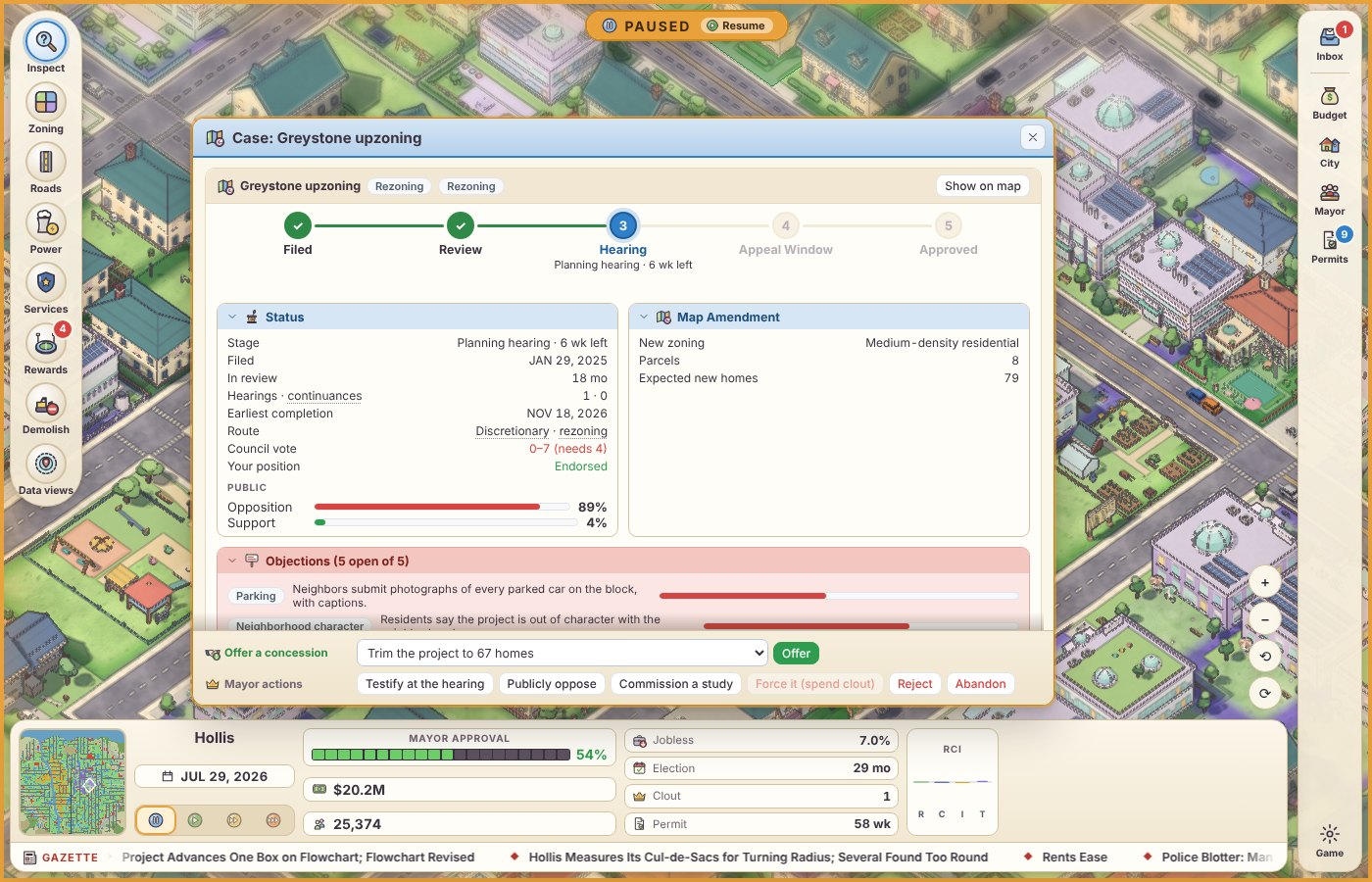
Show HN: SimCity, but with Permits

A city-builder makes permits, hearings, lawsuits, and elections the real final boss.

Publish fake stats, get cited in LLMs

An experiment in publishing fabricated statistics offers a bracing warning about AI search, citations, and the durability of bad data.

France's supermarket fridges were vulnerable online for months

The long tail of insecure connected hardware arrives in French supermarkets, where remotely exposed refrigeration systems were turned against their owners.

From the Editor

The wires beneath modern life gave us a stern accounting today: certificate chains, cloud dependencies, unattended appliances, and the sources from which machines learn. Yet there was good work on the presses as well—faster compilers, freer infrastructure, and a game that remembers democracy is harder than zoning a block.

  1. eMudhra intermediate CA compromise3
  2. How I got over 300 Tor exit nodes removed4
  3. France's supermarket fridges were vulnerable online for months5
  4. Feds suspect ransom negotiator ran ShinyHunters extortion site6
  5. Upcoming critical PHP security release7
  6. Tell HN: 2x PHP RCE CVEs with CVSS 10.0 Incoming7
  7. Go will reject certificate chains containing eight distrusted SPKIs7
  8. DeepInfer: High-performance inference framework for DeepSeek models8
  9. MicroG: Free-libre re-implementation of Google's proprietary Android user space9
  10. Google open-sources TorchTPU, a native PyTorch back end for TPUs10
  11. Voxtral 311
  12. Tsrs: A Port of TypeScript to Rust12
  13. 2026 is an exciting year for the Rust compiler (and me)13
  14. NixOS is making me less afraid14
  15. OpenBSD 8.015
  16. Show HN: SimCity, but with Permits16
  17. Publish fake stats, get cited in LLMs17
  18. Academics have a duty to defend open knowledge systems like Wikipedia18
  19. What shall I teach my son?19
  20. My Friend Bob Cringely20
  21. Ofcom concedes defeat in 4chan case21
  22. Show HN: VoidAccess – open-source dark web OSINT, from query to a graph22
  23. Apple broke an essential presentation feature of iPads23
  24. Steam Users Beg for "No AI" Filter as Vibecoders Flood Next Fest24
  25. IKEA – 3D Guide25
  26. Sixteen years after Deepwater Horizon, deep sea life shows few signs of recovery26
  27. AfD Leak: What 421,179 Hacked Emails Show about the German Far Right27
  28. Facebook Pages require paid subscription to post more than two links per month28
  29. Google Cloud outage affects almost all banking and other operations in Europe28
  30. Lula supporters protest against Meta to denounce its 'electoral interference'28
The Daily Front Page 2 of 29
Tuesday, October 20, 2026 The Daily Front No. #261020 — The Broken Chain
article

eMudhra intermediate CA compromise

by galadran·▲ 777 points·363 comments·emudhra.we-have-a-problem.com ↗
An attacker with the private key of any of the compromised intermediate CAs could impersonate any website or service.

The private keys of eight eMudhra intermediate CA certificates have been compromised. They chain to roots trusted by the Mozilla, Microsoft, Apple and Chrome root programs and by many downstream trust stores.

How do we know?

To demonstrate that the keys are compromised, the original reporter Wayne signed the following message with the private key of each of the eight intermediate CAs and reported it to the Root Program Teams on the 17th of October:

We have a problem here - Wayne

proof.zip contains the message, and for each intermediate the certificate, its public key and a signature on the message. To verify with OpenSSL:

openssl x509 -in EM-DV-TLS-CA-G3B.crt.pem -noout -pubkey | diff - EM-DV-TLS-CA-G3B.pub.pem
openssl dgst -sha384 -verify EM-DV-TLS-CA-G3B.pub.pem -signature EM-DV-TLS-CA-G3B.sig message.txt

What actions have been taken?

The root programs and many downstream trust stores have taken action to protect their users. The certificates have been blocked in Firefox and Chrome since the 17th of October, in Apple devices since the 19th and on Microsoft platforms since the 20th.

The issue was responsibly disclosed to downstream trust stores on the 19th of October. Many have already released updates or are in the process of releasing updates.

What are the consequences?

An attacker with the private key of any of the compromised intermediate CAs could impersonate any website or service.

This has already been remediated by Mozilla, Microsoft, Apple, and Chrome for their users through their tools for distributing revocation information such as OneCRL, CRLite and CRLSets.

The CA has also revoked the compromised intermediate certificates. However, many other clients do not consume revocation information and require software updates to ensure they no longer trust the compromised intermediates.

Does your client still trust the compromised intermediates?

To check curl or other command-line clients, run:

curl https://dv-g3b-emudhra.we-have-a-problem.com/
curl https://dv-g3b-aaa-emudhra.we-have-a-problem.com/

A certificate error means the client does not trust the compromised intermediates.

To check a trust store offline, chains.zip contains the certificate chain served by each of the twelve hosts above in PEM format, with instructions for verifying them with OpenSSL.

Which intermediates were compromised?

impacted-intermediates.json lists the eight intermediates and their Sectigo cross-signs. roots.json lists the roots they chain to.

What is known about the cause?

The private keys for the intermediate certificates were incorrectly generated by the CA. This means that anyone can recover them from the certificates.

This would have been possible since the certificates were created in April 2025. There are no entries in the certificate transparency logs for these intermediates in that period, indicating that CT-enforcing clients like Firefox, Chrome, Edge and Safari could not have been attacked.

However, many clients outside of the browser ecosystem do not enforce Certificate Transparency. We do not know if attackers exploited the flawed key generation to target these clients.

Further technical information about the cause is captured in the initial incident report in Mozilla's bug tracker.

What actions can trust store operators take?

Please see this thread in Mozilla's dev-security-policy forum.

What actions can users take?

Users should update their browsers and operating systems to the latest versions as soon as possible.

What about developer software and packages?

SoftwarePatched version Ubuntu ca-certificates20260816ubuntu0.22.04.1,
20260816ubuntu0.24.04.1,
20260816ubuntu0.26.04.1,
20260816ubuntu0.26.10.1
Debian ca-certificates20250419~deb12u2,
20250419+deb13u1,
20260816+nmu1
Arch Linux ca-certificates-mozilla3.131.1-1 Gentoo ca-certificates20260816.3.125 Fedora ca-certificates2026.2.92_v9.0.319 FreeBSD ca_root_nsspending Chainguard ca-certificates20260909-r3 Alpine Linux ca-certificates20261020-r0 NSS3.131.1 curl CA bundle2026-10-20 Cloudflare CFSSL trust store2026.10.1 Homebrew ca-certificates2026-09-25_1 Go1.27.3, 1.26.10 Node.jspending Python certifi2026.10.19 pip26.2.2 uv0.13.4 Rust rustls-webpki0.103.16 Rust webpki-roots / webpki-root-certs1.0.10 Electron44.9.1, 43.8.1, 42.11.16 Bunpending Composer ca-bundle1.4.16, 1.6.0 Elixir castore1.0.22 Perl Mozilla::CA20261020

Add more at github.com/galadran/we-have-a-problem.com.

Are there workarounds for macOS curl?

macOS blocks the compromised intermediates, but the built-in /usr/bin/curl verifies certificates against /etc/ssl/cert.pem without checking revocation, and that file has not been updated. To remove the affected roots from it, run:

sudo cp /etc/ssl/cert.pem /etc/ssl/cert.pem.bak &&
awk '/^(###|===) /{skip=0}
  /^=== .*\/CN=(AAA Certificate Services|emSign ECC Root CA - G3)$/{skip=1}
  !skip' /etc/ssl/cert.pem.bak | sudo tee /etc/ssl/cert.pem > /dev/null

Are there workarounds for Linux?

Until a distribution ships an updated ca-certificates package, expert users can distrust the affected roots in the system trust store. This is NOT recommended for ordinary users.

On Debian and Ubuntu, run as root:

sed -i \
  -e 's|^mozilla/emSign_ECC_Root_CA_-_G3.crt|!&|' \
  -e 's|^mozilla/Comodo_AAA_Services_root.crt|!&|' \
  /etc/ca-certificates.conf && update-ca-certificates

On Alpine, run as root:

apk add ca-certificates &&
sed -i -e 's|^mozilla/emSign_ECC_Root_CA_-_G3.crt|!&|' \
  /etc/ca-certificates.conf && update-ca-certificates

On Fedora, RHEL, CentOS Stream, Rocky Linux, AlmaLinux and Amazon Linux 2023, run as root:

d=/etc/pki/ca-trust/source/blocklist; [ -d $d ] || d=/etc/pki/ca-trust/source/blacklist
trust extract --overwrite --format=pem-bundle \
  --filter='pkcs11:object=Comodo%20AAA%20Services%20root;type=cert' \
  $d/Comodo_AAA_Services_root.pem &&
trust extract --overwrite --format=pem-bundle \
  --filter='pkcs11:object=emSign%20ECC%20Root%20CA%20-%20G3;type=cert' \
  $d/emSign_ECC_Root_CA_-_G3.pem &&
update-ca-trust

On openSUSE and SLES, run as root:

d=/etc/pki/trust/blocklist; [ -d $d ] || d=/etc/pki/trust/blacklist
trust extract --format=pem-bundle \
  --filter='pkcs11:object=Comodo%20AAA%20Services%20root;type=cert' \
  $d/Comodo_AAA_Services_root.pem &&
trust extract --format=pem-bundle \
  --filter='pkcs11:object=emSign%20ECC%20Root%20CA%20-%20G3;type=cert' \
  $d/emSign_ECC_Root_CA_-_G3.pem &&
update-ca-certificates

On Arch Linux, run as root:

trust extract --format=pem-bundle \
  --filter='pkcs11:object=emSign%20ECC%20Root%20CA%20-%20G3;type=cert' \
  /etc/ca-certificates/trust-source/blocklist/emSign_ECC_Root_CA_-_G3.pem &&
update-ca-trust

On NixOS, add to your configuration:

security.pki.caCertificateBlacklist = [
  "Comodo AAA Services root"
  "emSign ECC Root CA - G3"
];

Are there workarounds for NetBSD?

On NetBSD 10 and later, run as root:

certctl untrust /usr/share/certs/mozilla/all/emSign_ECC_Root_CA_-_G3.pem &&
certctl untrust /usr/share/certs/mozilla/all/Comodo_AAA_Services_root.pem

Are there workarounds for FreeBSD?

On FreeBSD 14 or later, run the following commands as root:

cp /etc/ssl/certs/14bc7599.0 /usr/share/certs/untrusted/14bc7599.pem
cp /etc/ssl/certs/ee64a828.0 /usr/share/certs/untrusted/ee64a828.pem
certctl rehash
The Daily Front Page 3 of 29
Tuesday, October 20, 2026 The Daily Front No. #261020 — Exit, Pursued by a Bear
article

How I got over 300 Tor exit nodes removed

by kabakabakaba·▲ 348 points·87 comments·kaba.cx ↗
roughly 10% were under their control.

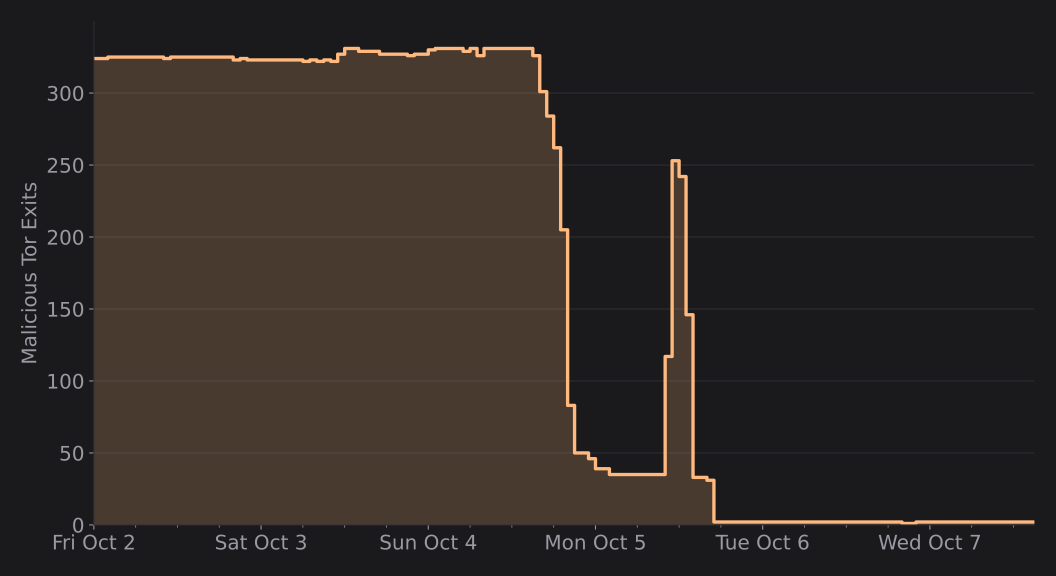
Overview Malicious Tor Exit nodes disappearing

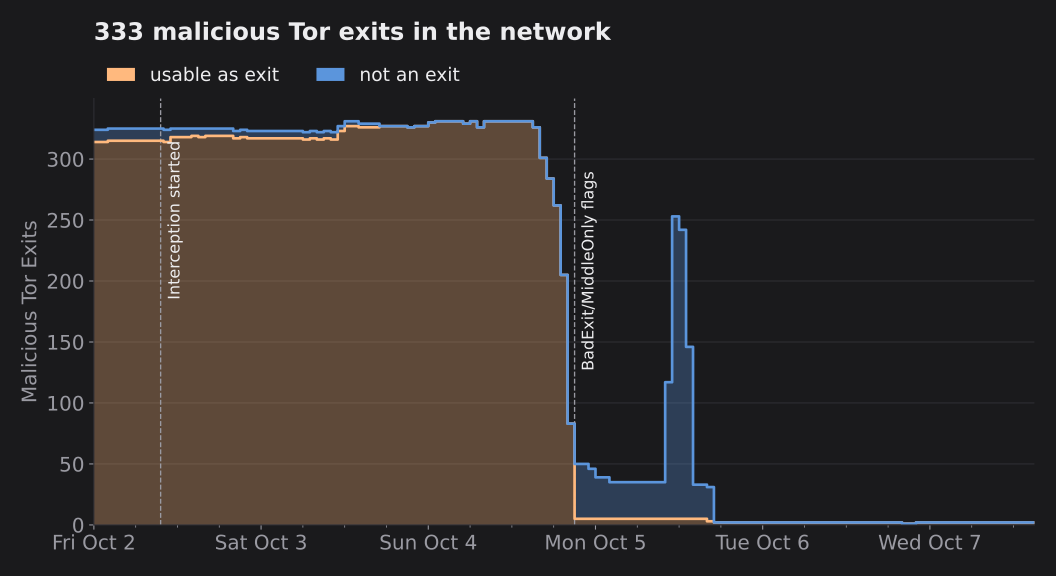
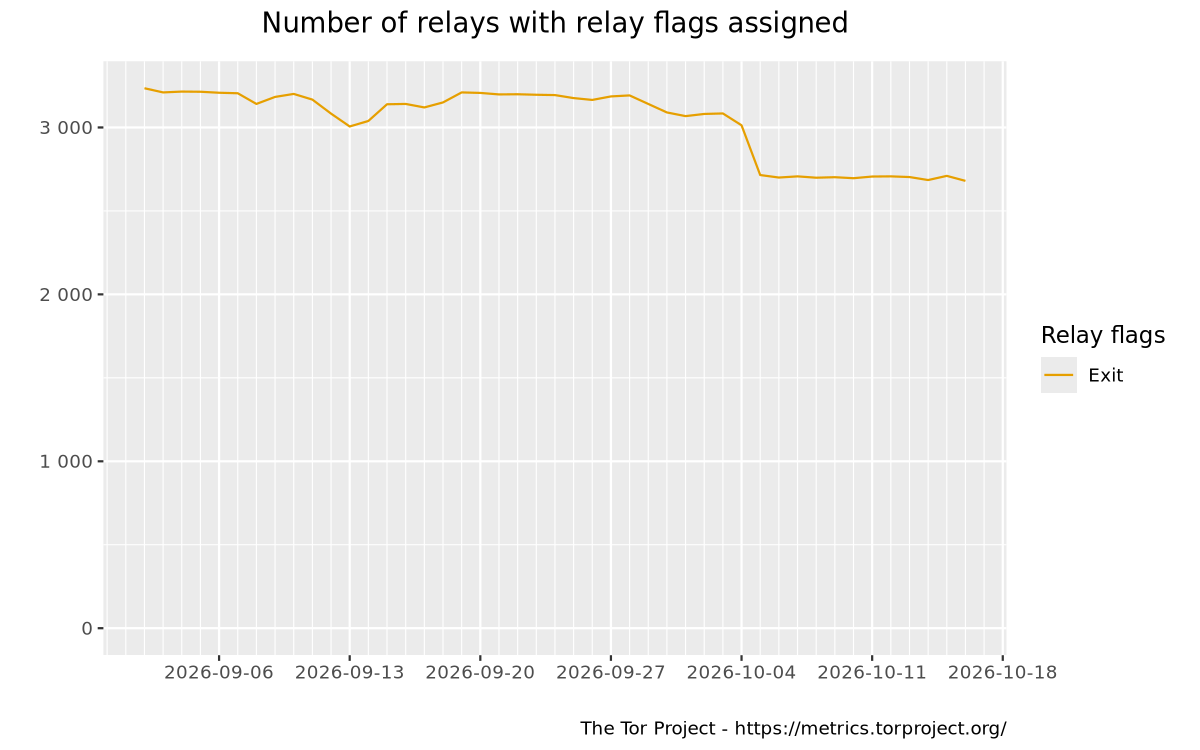
On Friday Oct 2, 09:35am, 333 infected exit nodes started a coordinated campaign to intercept SSH connections and gather as much unencrypted data as possible.

To give you a sense of scale, all of Tor has around 3000 exit relays, so roughly 10% were under their control.

The attackers had gained access to the servers two months earlier, in August, and quietly deployed their Ebury 1.8.3 payload (an OpenSSH backdoor and credential stealer for Linux).

The Attack

The attack appears to have had two primary goals:

  1. Gather as much unencrypted mail traffic as possible
  2. Intercept SSH connections (MITM)

By blocking certain ports, they made their exit nodes handle only unencrypted mail traffic. An interesting writeup by one of the victims (a veteran Tor operator) goes into great detail about that: lists.torproject.org/mailman3

In this post I'll focus on the second attack, the SSH MITM. If you happen to get a circuit that exits over one of those 333 infected exit nodes, you won't notice anything at first. Encrypted web traffic is forwarded as usual, but if you attempt an SSH connection over Port 22, you're unknowingly redirected to one of 12 SSH interception servers.

Attacker Infrastructure

That's exactly what happened to me on Friday morning. My SSH connection got redirected, and I was greeted with this warning:

@@@@@@@@@@@@@@@@@@@@@@@@@@@@@@@@@@@@@@@@@@@@@@@@@@@@@@@@@@@
@    WARNING: REMOTE HOST IDENTIFICATION HAS CHANGED!     @
@@@@@@@@@@@@@@@@@@@@@@@@@@@@@@@@@@@@@@@@@@@@@@@@@@@@@@@@@@@
IT IS POSSIBLE THAT SOMEONE IS DOING SOMETHING NASTY!
Someone could be eavesdropping on you right now (man-in-the-middle attack)!
It is also possible that a host key has just been changed.
The fingerprint for the ED25519 key sent by the remote host is
SHA256:6baCZCPsl+AfQuujUS81fMEE/C7UeJ+AwjrImqmDB3E.
Please contact your system administrator.

But if you ignore the warning and go ahead with the login, the attacker does three things:

  1. Steals your password
  2. Opens a connection to your server and observes each command you type (MITM)
  3. Opens a second connection to your server and infects it with Ebury

Getting them taken down

On Friday evening I contacted the Tor Project's network health team with my findings. They confirmed this was something new and got to work by contacting the affected relay operators.

"We've not seen an attack like that before."

  • Tor Network Health Team

Malicious Tor exit nodes going offline

  1. Fri Oct 2: Interception started.
  2. Sun Oct 4: The Tor network health team made an announcement to the operators, who began shutting their exit nodes down.
  3. Sun Oct 4: The relays were marked BadExit, so clients would no longer use them to exit traffic.
  4. Mon Oct 5: The attackers restarted many of the relays, but since they were already flagged they could only serve as middle relays.
  5. Mon Oct 5: All infected servers were shut down, partly by the operators and partly by the attackers.

In their announcement, the health team described the pattern:

"It seems the attacker is gaining access to Linux based hosts and when these machines are running non-exits they are editing the torrc file and turning them into exits to be able to carry out the SSH attack."

You can see the impact of those 333 exit nodes being shut down. On metrics.torproject.org a clear dip is visible on October 4th and has not recovered since.

Tor exit node count dipping

Consider running a relay: community.torproject.org/relay/setup/


The technical part: how I found them

In this part I'll go into detail about how I found all the infected exit nodes.

Using exitmap, I built a simple script that did the following: it pinned an exit node, then opened an SSH connection from my server A to my server B.

  • Server A checked whether it received the correct SSH fingerprint from server B.
  • Server B checked whether the connection came from the pinned exit node or from one of the 12 SSH interception servers.

I ran the script against every single one of the ~3000 exit relays. Around a dozen served a fake fingerprint, and over 300 didn't intercept anything but redirected through those same interception servers. Redirecting alone was enough to confirm the exit was infected.

In some further analysis I used sshesame as a honeypot. Tricking the MITM into logging into the honeypot showed that they used paramiko (a Python SSH library) and also how they attempted to install Ebury using Perl.

> echo "U=$(id -u) S=$(command -v sudo >/dev/null 2>&1 && (sudo -n true 2>/dev/null && echo nopass || echo maybe) || echo none)"
> sudo bash -c 'echo <base64> | base64 -d | perl'

Checking for permissions first, then executing a base64-encoded command.

Open Questions

The biggest question is still how they got into all those servers in the first place. One theory is that the hosting company itself was hacked (discussed here: lists.torproject.org). But that's just a theory floating around. In truth, no one really knows.

Another is who's behind it. The use of Ebury and the broad collection of unencrypted data point to a financially motivated crime group. Though this too is just speculation.

"Given how many servers had Ebury between 2009 and 2023 (400 000!) there are most likely other compromised Tor relays out there."

I also suspect they deliberately launched their attack on a Friday, hoping that no one would want to ruin their weekend by responding. All the more credit to the Tor Team for acting so quickly!

Takeaway

The lesson is the same as always: extra security is a worthwhile investment. Disable password authentication in favor of ssh keys. I for one am going to buy myself some hardware keys today. :)

"At the end of the day, relays/bridges need to be treated as highly targeted production machines."

The Daily Front Page 4 of 29
Tuesday, October 20, 2026 The Daily Front No. #261020 — The Internet of Warm Things
article

France's supermarket fridges were vulnerable online for months

by emot·▲ 239 points·218 comments·ipinfo.io ↗
fridges and freezers in hundreds of French supermarkets started to warm up.

France's Supermarket Fridges Were Vulnerable Online for Months

On the night of October 11 to 12, 2026, fridges and freezers in hundreds of French supermarkets started to warm up. Cyber attackers had pushed the refrigeration systems into defrost mode, which heats the cooling parts to melt ice. Some units reached 50°C (122°F), some equipment started to catch fire, according to the Paris prosecutor, and stores threw away their fresh and frozen food. The reports pointed to one maker of refrigeration controllers, Danfoss (a Danish industrial company).

We went through IPinfo's weekly Internet scans to examine these systems before the attack. In this blog post we’ll explore some of the findings. Here’s the TL;DR:

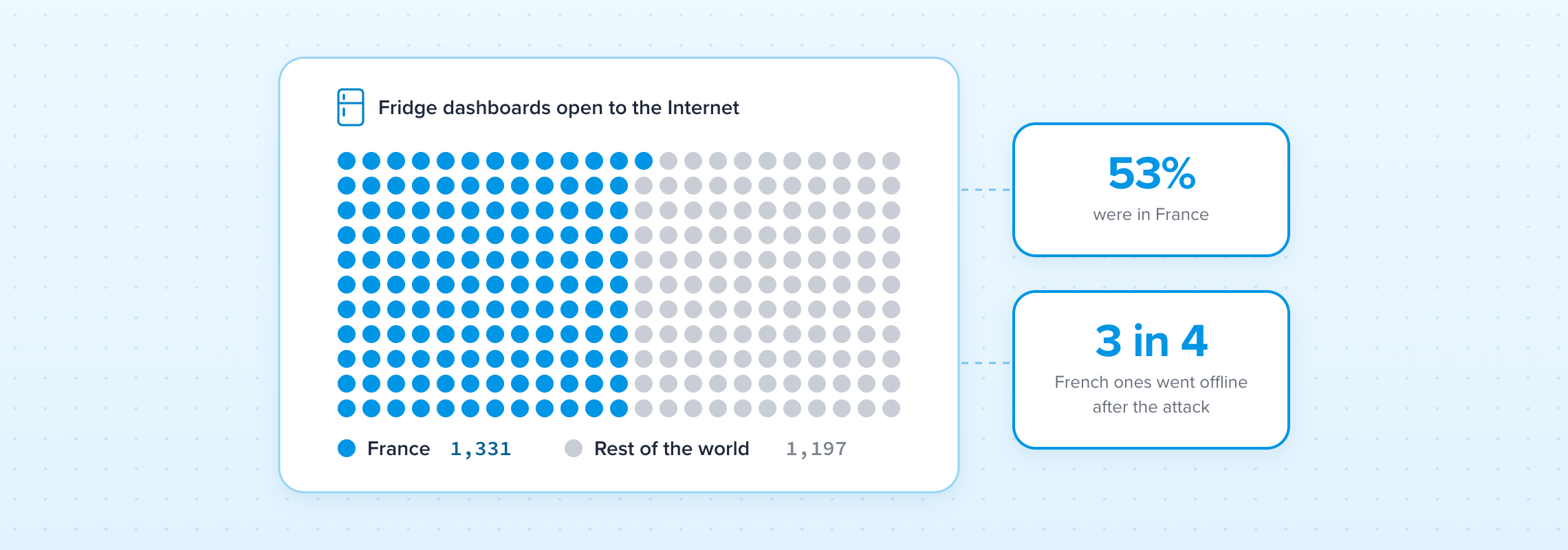
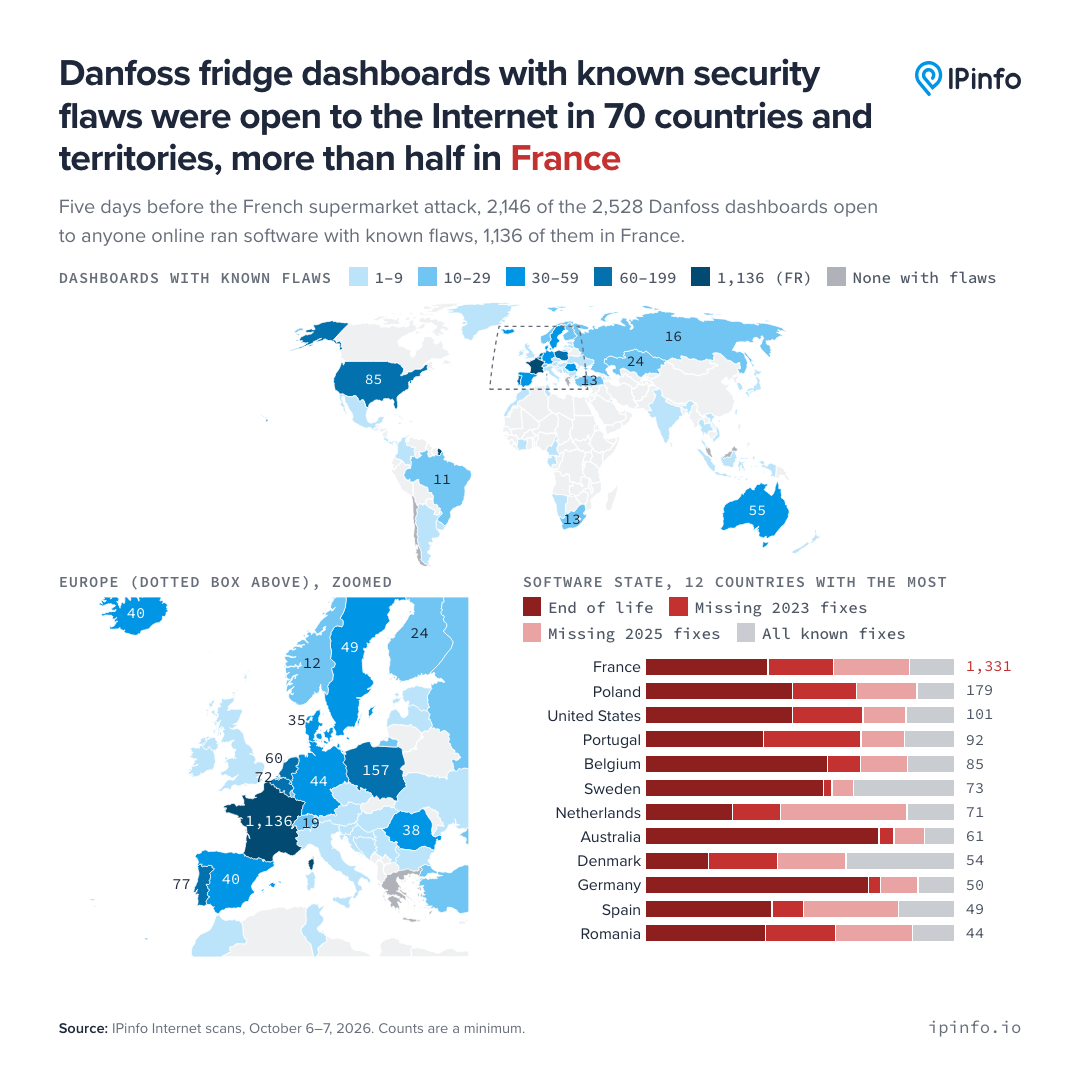
  • France had more exposed fridge dashboards than the rest of the world combined: 1,331, against 1,197 in the other 72 countries and territories put together.
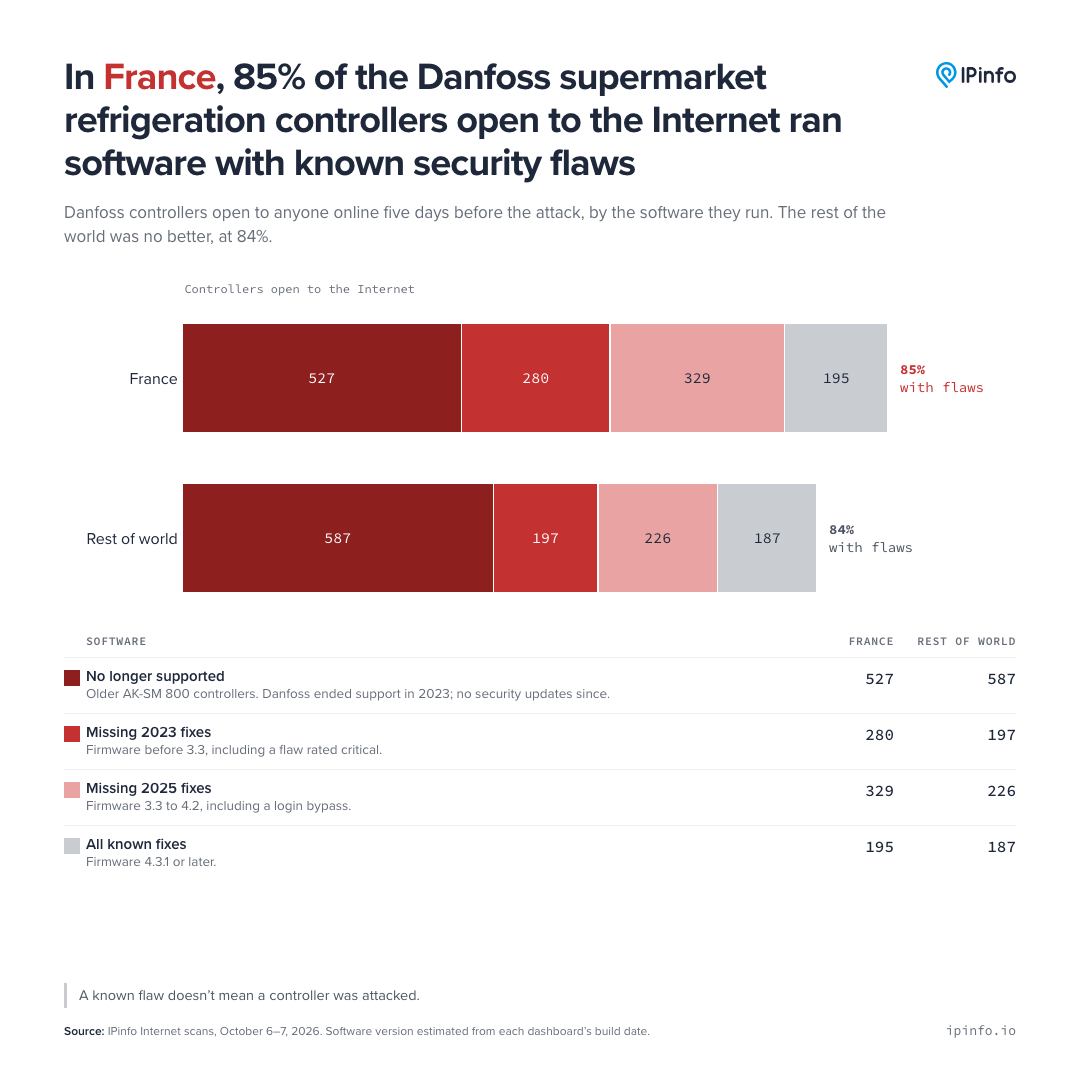
  • 85% ran software with known security flaws. That includes 527 older controllers Danfoss no longer supports. Only 195 had every known fix.
  • Most had been exposed for at least six months. 1,019 of the French dashboards were at the same address on March 30, and the share fully updated rose only from 14% to 24% in that time period.
  • France didn't patch worse than other countries. The flawed share elsewhere was almost the same (84%). France just had far more of these systems online.
  • Most went offline after the attack. 316 of the 1,331 were still online on October 14.

What Happened

The numbers from the chains keep growing. More than 400 stores were hit in total according to Futura-Sciences, and losses could reach several million euros. Carrefour said 80 of its stores were hit, while Intermarché and Netto, both part of Les Mousquetaires (a French retail group), had more than 300 hit. Monoprix reported that about 5% of its stores were affected.

Leclerc and Coopérative U, two other French supermarket chains, also confirmed attacks. Coopérative U's CEO, Dominique Schelcher, told RTL that 80 of its 2,000 stores were hit. He added that the stores don't buy from Danfoss directly but use a Danfoss system supplied by their refrigeration contractors.

Danfoss said most of the affected equipment was "legacy,” naming two older controller models, the AK-SM 800 and AK-SC 355. CERT-FR (France's cybersecurity agency) said it knew of numerous compromises of AK-SM and AK-SC controllers. It told operators to disconnect them or restrict who can reach them, and updated its alert on October 13 to add XWEB supervisors (systems that monitor a store's fridges and freezers) from Copeland, a US maker of cooling equipment, and Dixell, its Italian brand. Its alert says attack campaigns are probably still ongoing. Nobody has said who did it or how they got in, and the Paris prosecutor's office has opened an investigation.

France Stood Out, by Far

We scan the IPv4 Internet (the most common type of Internet address) every week, connecting to the usual ports that websites use (the numbered doors a computer answers on) and recording what answers. In the sweep that ran on October 6 and 7, five days before the attack, 2,528 addresses showed a Danfoss StoreView dashboard. That is the web page that stores and technicians use to watch and manage these controllers, the equivalent of the control panel in the back room, except that anyone who typed in the address could open it.

According to our data, France had 1,331 of them (53%). That is more than the other 72 countries and territories combined (1,197). Poland came next with 179, then the United States (101), Portugal (92), and Belgium (85).

Danfoss dashboards open to the Internet, by country, October 6–7, 2026.

Why France? Our data can't say, but it rules a few things out. French dashboards ran the same mix of software versions as everywhere else, so they weren't patched worse. They also weren't unusual in how they connect. In France, about two-thirds connect through one national provider, much like the main telecom in Portugal, Germany, or Romania. Almost all (98%) are on telecom providers' networks rather than in data centers or clouds, which fits a controller plugged into the store's own Internet connection, with access opened for a technician or head office.

CERT-FR's advice hints at why stores keep them online: it tells them to check their insurance terms before cutting the data their controllers send to refrigeration contractors.

Most Fridge Software Was Out of Date

The dashboards also give away how old the software behind them is. They come in two generations. The older one is a page built with Flash (an old browser plug-in, retired in 2020) and served by the AK-SM 800. Danfoss declared these controllers end of life in 2023. That same year, the security firm Synacktiv published a login bypass (a way in without the password) for them, and Danfoss's advice was to restrict network access. This is the "legacy" equipment Danfoss named.

The newer one runs on the AK-SM 800A, Danfoss's current model. Its dashboard shows when its software was built, a bit like the production date stamped on a carton, which tells us roughly which version it runs: 242 of them say May 19, 2023, the build date of firmware 3.3 (firmware is the software built into the controller). Controllers older than 3.3 miss three 2023 fixes, including one for a flaw rated critical. Those older than 4.2 also miss a fix for a 2025 login bypass, and those older than 4.3.1 miss two more 2025 fixes.

Put together, 85% of the French dashboards (1,136 of 1,331) ran software with known security flaws, almost the same as the 84% elsewhere. That is 527 older controllers Danfoss no longer supports, 280 missing the 2023 fixes, and 329 missing the 2025 fixes. Only 195 had every known fix.

How up to date the Danfoss dashboards were, France and the rest of the world.

The Exposure Has Existed for Months

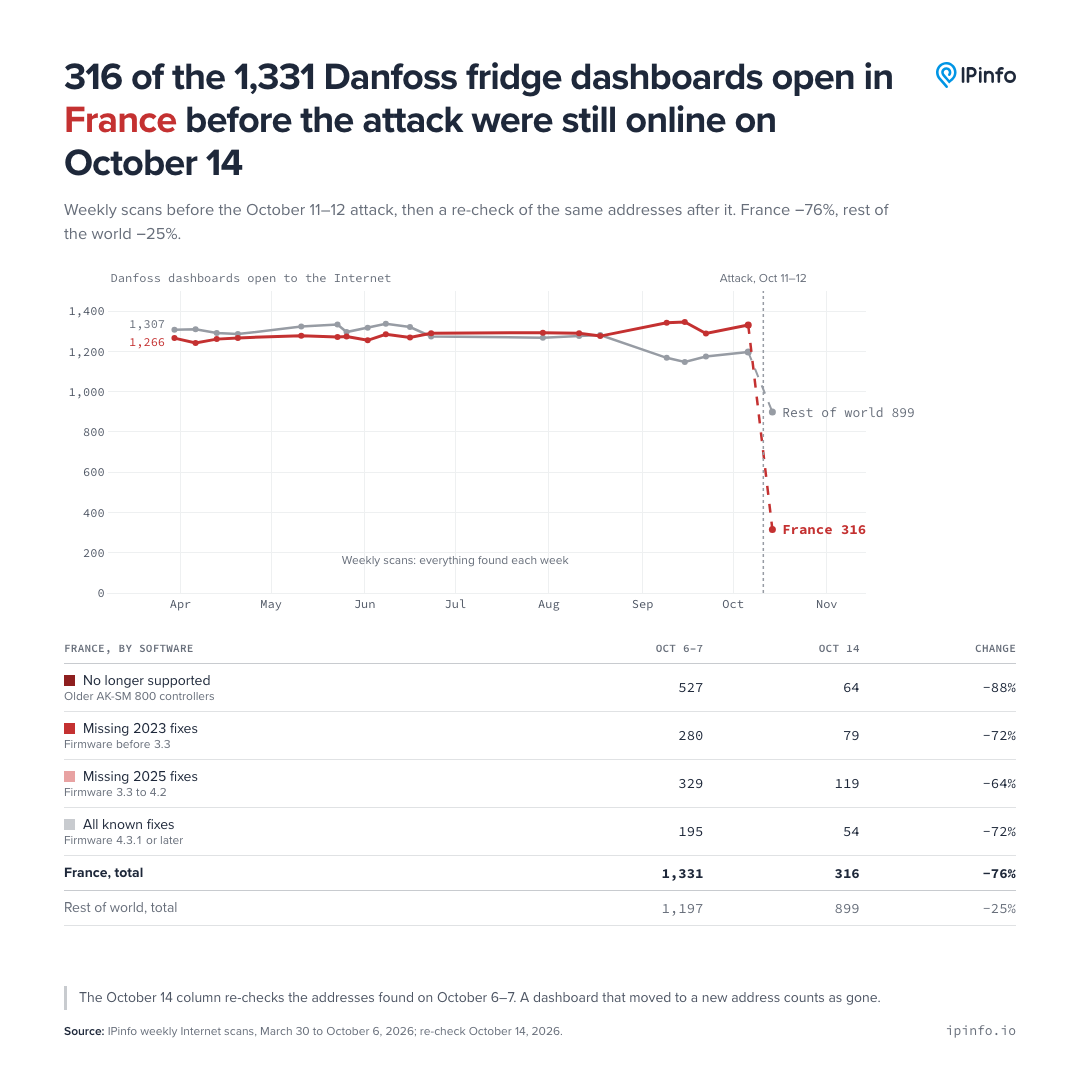
Every scan from late March 2026 until the attack found about the same number: between 2,464 and 2,622 Danfoss dashboards open to the Internet, roughly half of them in France.

They were mostly the same devices. Of the 1,331 French dashboards found on October 6, 1,019 were open at the very same address on March 30, six months earlier. Over those months, the number of older controllers Danfoss no longer supports didn't go down in France (519 at the end of March, 527 in October). Updates came slowly. The share of newer French controllers with every known fix went from 14% to 24%, under two points a month.

Danfoss dashboards found in each weekly scan, March 30 to October 6, 2026.

Did Stores Disconnect After the Attack?

Most stores did disconnect after the attack. Our next weekly scan ran on October 14, two days after the attack. Of the 1,331 French dashboards from October 6–7, only 316 were still online at the same address, a 76% drop. In the weekly scans from August to early October, only 3% to 7% disappeared from one week to the next. The older controllers Danfoss no longer supports fell the most, from 527 to 64. Fully updated ones fell too, from 195 to 54, which points to stores disconnecting them rather than updating them.

Outside France, 25% disappeared, more than the usual 9% to 12%. Censys, another Internet scanning company that counts every day, saw a similar 71% drop in France between October 11 and 14. On October 14, the technical director of Claroty, the security company that found the 2025 flaws, told Tom's Guide that exposed AK-SM 800 controllers were still online. Our October 14 scan still found 64 of them.

Danfoss dashboards in France before and after the attack, by software.

Where Else These Controllers Are Open

France wasn't the only country with these systems online. Danfoss dashboards with known flaws were open in 69 other countries and territories, led by Poland (157), the United States (85), and Portugal (77). In some countries most were the older controllers Danfoss no longer supports: 80% in Iceland, 75% in Australia, and 72% in Germany.

Danfoss dashboards with known security flaws, by country.

Some reports suggest other European countries may have been hit. One analyst quoted by Australia's ABC said Spain, Portugal, Poland, Germany, and Belgium had also been affected. Our data can't say whether they were, but it does show that all five had out-of-date Danfoss dashboards open to the Internet five days before the attack.

What About Dixell?

CERT-FR's updated alert also names XWEB supervisors from Dixell, Copeland's Italian brand of refrigeration controllers, so we counted those too. The same scan found 1,611 XWEB dashboards in 66 countries, but only 70 in France; Italy, where Dixell is based, had 467. Judging by when their software was built, only 180 of the 752 newer XWEB PRO units had the February 2026 fixes. The other 859 were older models that haven't had a software update from Copeland since 2018. After the attack, French operators unplugged their XWEB dashboards too: our October 14 scan found only 20 of the 70 still online, a 71% drop, when a normal week loses 2% to 9%. Elsewhere, including Italy, the number fell only at the usual weekly rate.

How We Counted

The dashboards were identified with two fingerprints (patterns that identify a device) built by our data team. The newer interface is matched by its page title. The older one is matched by its web server plus the Flash loader page, which identifies the AK-SM 800. AK-SC 355 controllers, which Danfoss also named, may not be in our count. Sixteen devices that share the older web server but aren't Danfoss (network cards in backup power units, building controllers, thermostats) were removed, along with two addresses that answer on almost every port, a sign of a honeypot (a decoy set up to attract attackers).

An independent count by the security researcher Baptiste Robert, posted on X, found 2,752 Danfoss systems online, 1,590 of them in France, a little above ours. Censys, which scans differently, found more: 1,825 of the newer dashboards in France on October 11, 61% of its worldwide total.

The numbers are a minimum. They cover IPv4 only and the ports we scan, and an address is not always one store. We aren't publishing any of the addresses. CERT-FR told us it had already identified the affected systems, and we're in contact with CERT-EU (the EU's cybersecurity team for its institutions) to help other European cybersecurity teams in any way we can.

What Operators Can Do

CERT-FR's advice is to take these controllers off the public Internet and, if a contractor needs remote access, to give it through a secure VPN (a private, encrypted connection). Letting in only the contractor's addresses is a stopgap, not a fix. A factory reset alone isn't enough either: an exposed controller that no longer gets updates will likely be compromised again. For Danfoss systems, CERT-FR also says to update the firmware, set the security level to Strict, and change the default passwords.

What the Data Can't Say

We can't tell from the scans how the attackers got in or who they were, and we don't know which chains or stores were hit. Being able to open a dashboard from the Internet doesn't mean anyone can break in through it, and nobody has said whether any of the flaws above were used.

The data does show what things looked like before and after the attack. Five days before the attack, France had more of these dashboards open to anyone than the rest of the world combined, and most were behind on updates. After the attack, most of them went offline within days, and we'll keep checking the 316 that were still online on October 14.

This is one of IPinfo's data stories, where we use our own measurements to look at what happens on the Internet. If you spot something we got wrong, have data that adds to this, or have a story you'd like us to look into, write to us at emot@ipinfo.io.

Data: IPinfo’s Internet scans of IPv4 addresses: 18 scans from March 30 to October 6–7, 2026, about one a week, and one on October 14, after the attack. Counts are addresses and a minimum.

The Daily Front Page 5 of 29
Tuesday, October 20, 2026 The Daily Front No. #261020 — The Ransom Desk
article

Feds suspect ransom negotiator ran ShinyHunters extortion site

by Bender·▲ 144 points·57 comments·krebsonsecurity.com ↗
one of the executives in the United States even helped ShinyHunters operate a website that pressured victims into paying a ransom.

U.S. federal investigators pursuing the ShinyHunters hacking group that recently stole highly sensitive data from the FBI have identified executives at two different ransomware negotiation firms who maintained unusually close relations with the extortion group, KrebsOnSecurity has learned. Sources close to the investigation say one of the executives in the United States even helped ShinyHunters operate a website that pressured victims into paying a ransom.

Hackers aligned with ShinyHunters have claimed credit for dozens of major data breaches since 2019, when the group was primarily operated by cybercriminals living in France. As those original members were arrested or jailed one by one, control over the ShinyHunters brand eventually passed to “Rey,” identified last year as a teenage hacker from Amman, Jordan. According to the FBI, ShinyHunters has extorted more than $70 million from victims so far this year.

In late September, ShinyHunters hacked the FBI recruitment website fbijobs.gov and taunted the agency by threatening to publish the stolen files, which reportedly included medical and psychological records, Social Security numbers and home addresses, and information about each employee’s unit and specialization.

The FBI jobs site hack has prompted the agency to move with uncommon speed to arrest, detain and question people who had any communications with Rey or other ShinyHunters suspects. Reuters reported on October 3 that Rey had been detained by Jordanian authorities and was cooperating with the FBI.

Rey was able to assume control over the hacking group because one of its alleged senior members had just been nabbed. On the evening of September 15, 2026, authorities in the Netherlands arrested convicted hacker and ShinyHunters suspect Pepijn van der Stap. Dutch police reportedly used flash-bang grenades in an effort to stun and apprehend Van der Stap as he was logged in to various online accounts.

According to a source close to the investigation, the authorities arrested Van der Stap while he was using his Signal instant messaging account, which allowed them to read recent communications with frequent contacts — including ransomware negotiators based in Canada and the United States.

Multiple sources with knowledge of the matter told KrebsOnSecurity that Van der Stap’s messages were the key to unraveling a murder-for-hire plot that emerged immediately following his arrest. The Dutch news outlet RTL reported last month the two murders were allegedly to be committed abroad, and that there are indications Van der Stap gave the order for the attacks (there is no indication those orders were ever carried out).

On October 9, KrebsOnSecurity broke the news that the FBI arrested a 54-year-old Canadian cybersecurity executive named Edward Dubrovsky in connection with the ShinyHunters investigation. Dubrovsky, who recently published a book on handling cyber extortion that recommended always engaging with the hackers, was charged with threatening to disclose stolen or hacked data and interfering with interstate commerce through extortion, according to court records. Politico reports prosecutors have asked that Dubrovsky remain in custody pending trial, and that records related to his case remain under seal.

A source close to the investigation told KrebsOnSecurity that Van der Stap’s Signal messages showed he had frequent conversations with Mr. Dubrovsky and with at least one executive at a large U.S.-based consulting firm, and that these executives often knew the details about new ShinyHunters victims before the victims themselves had even learned of the breach.

That source shared another potentially explosive finding by federal investigators: the Dutch hacker’s chats showed Mr. Dubrovsky knew ShinyHunters had stolen highly sensitive data from FBI servers, and that he never informed the bureau of the data breach prior to ShinyHunters threatening on Twitter/X to publish the agency’s deeply personal personnel files.

SHINYWIRE

KrebsOnSecurity has learned from two sources close to the ShinyHunters probe that FBI investigators believe at least one executive at a U.S.-based consulting firm played an active role in operating the now-defunct ShinyHunters victim extortion website “shinywire[.]com.” KrebsOnSecurity is not naming the U.S. company or the suspected executive(s) for now because they have not yet been charged with a crime, but it is a prestigious firm with more than 1,000 associates.

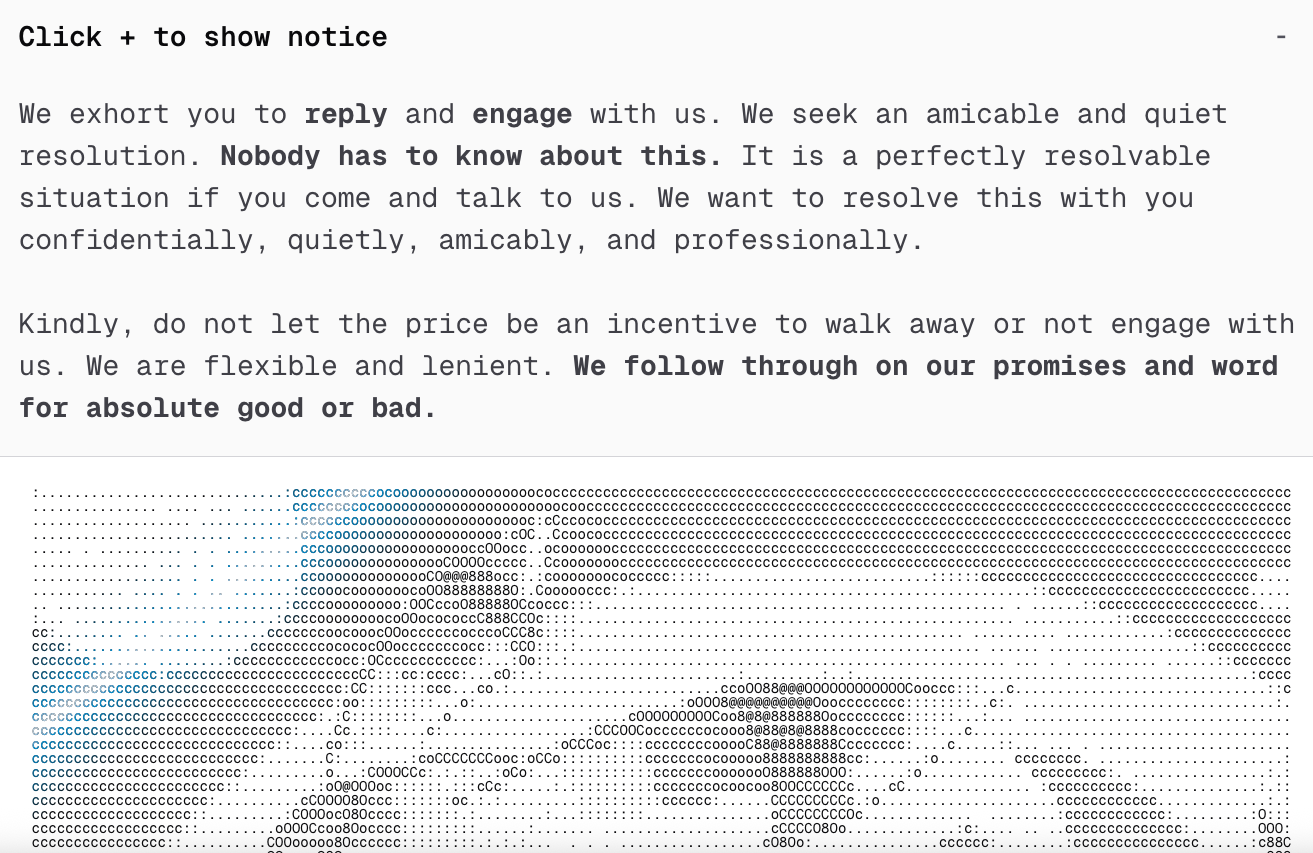
A section of the homepage for the now-defunct Shinywire website.

The Shinywire website was active from approximately May 3, 2026 until October 16 and had entries for nearly 100 organizations hacked by ShinyHunters. Each entry urged victims to engage with the cybercrime group and discuss terms for payment. The pages also included samples of stolen files and promised those files would be published online if the victim ignored their demands.

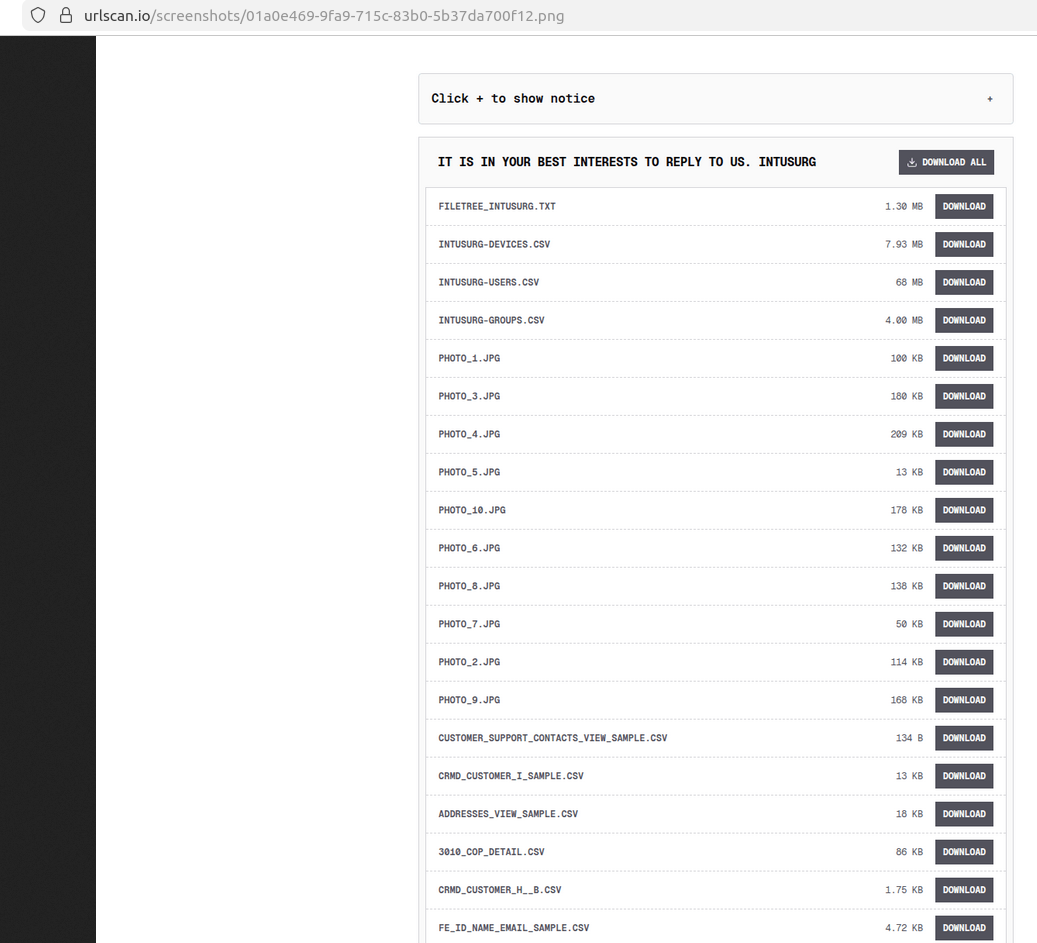
The following screenshot shows a cached portion of the Shinywire extortion page for Intuitive Surgical, an American medical technology company that was breached in March 2026 after an employee fell for a targeted phishing email.

The Shinywire website, as indexed by urlscan.io. This listing is an extortion demand targeting Intuitive Surgical, an American medical technology company breached in March 2026 by a targeted phishing email attack that compromised an employee’s credentials.

Victim organizations that refused to engage or negotiate after seven days would find all of their stolen data published on the ShinyHunters victim shaming blog (a website that is only reachable via the anonymity network Tor).

In a story published October 15, The Globe and Mail wrote that a few months before Edward Dubrovsky was arrested by the FBI, the Canadian cybersecurity executive alleged in court documents he had become collateral damage in a campaign by a former business partner to “destroy” another industry executive.

The story noted that Dubrovsky filed the lawsuit in Ontario this year against Daniel Tobok, the former chief executive of Cypfer, a cybersecurity firm founded in Toronto with offices in the U.S., Britain, the Netherlands, the United Arab Emirates, and Mexico. The two first became business partners in 2017 and later developed Cypfer together, where Mr. Dubrovsky was a managing partner and chief operating officer. But by 2024, the two had a falling out, with Dubrovsky accusing Tobok of gradually excluding him from business matters and making “increasingly capricious business decisions.”

Mr. Tobok reportedly denied the allegations and filed a counterclaim, accusing Mr. Dubrovsky of accessing confidential information and unfairly competing with Cypfer through work at another firm called CyberSteward Inc. He also said Mr. Dubrovsky has misrepresented himself as a Cypfer founder, and is not a shareholder.

GHOSTBYTE

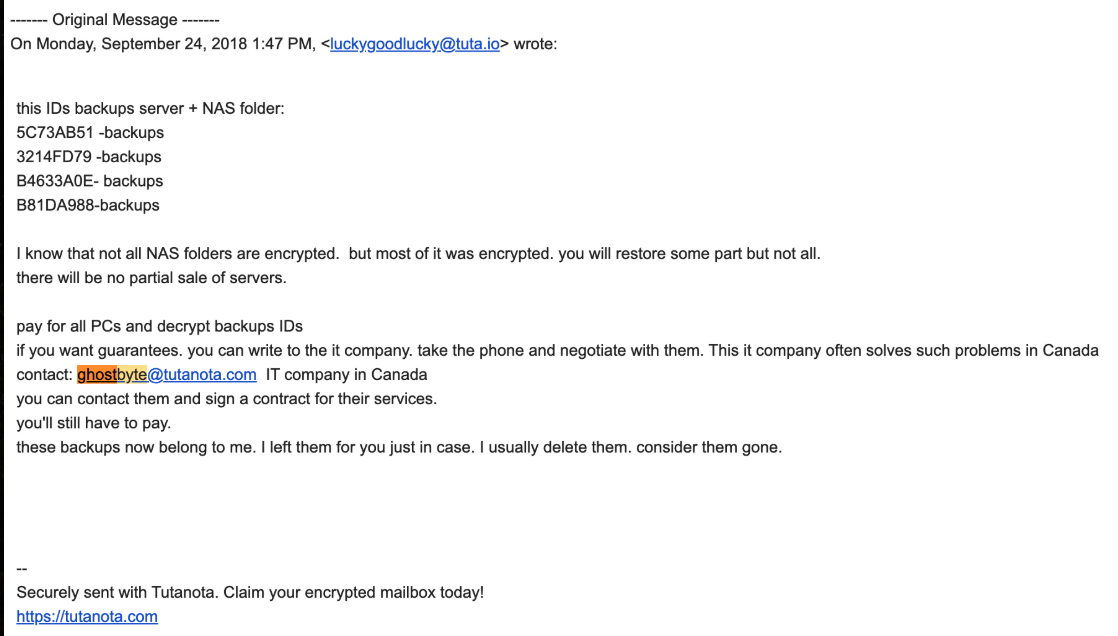
According to interviews with several former colleagues of Mr. Tobok, as far back as eight years ago he was known to ransomware purveyors by a particular nickname: Ghostbyte. In 2018, a Canadian company was hacked by Dharma, a prolific Russian-language ransomware affiliate program that first surfaced in 2016. The victim company told the Dharma ransomware representative they were leaning toward paying because some of the files were unrecoverable after being locked, but that they needed a better guarantee that Dharma would keep their word if paid.

A redacted copy of the Dharma rep’s reply is pictured below, and it shows the ransomware group urged the victim to contact a person at a Canadian IT firm that helps companies seeking such guarantees. The Dharma rep recommended the victim contact the email address ghostbyte@tutanota.com.

“If you want guarantees, you can write to the IT company,” the Dharma reply advised. “Take the phone and negotiate with them. This IT company often solves such problems in Canada. You can contact them and sign a contract for services. You’ll still have to pay.”

An email reply from the Dharma ransomware group to a victim, recommending they contact an email address that is connected to Mr. Tobok.

It’s unclear if Mr. Tobok ever used that Ghostbyte address offered by the Dharma representative, and he has not responded to multiple requests for comment. However, the breach tracking service Constella Intelligence finds an email address Mr. Tobok has frequently used — dtobok@me.com — is associated with two online accounts where the chosen username was “ghostbyte,” including a Snapchat account.

Incidentally, Constella also finds the Dharma rep’s email address luckygoodlucky@tuta.io is associated with a cryptocurrency address that processed 38 transactions totaling 43 bitcoin, ~$3.5 million at today’s value (the most recent transaction for this wallet is dated February 2019).

In a statement shared on October 14, Cypfer said the company’s business does not include making or facilitating ransomware payments, and that Cypfer learned of Dubrovsky’s arrest when the news first broke in the media.

“We had no prior knowledge of Mr. Dubrovsky’s arrest,” a spokesperson told KrebsOnSecurity via email. “CYPFER has not received any outreach from law enforcement and, to our knowledge, is not the target of any law enforcement investigation.”

The statement said CyberSteward and Cypfer are separate companies with no officers, directors or employees in common, and that Cypfer was recently acquired by the Apros Group, a holding company led by Jason Hogg, a former FBI special agent and former CEO of Aon Cyber Solutions Group. In 2020, Aon aquired Cytelligence, a security consulting firm where Mr. Tobok was founder and CEO and Mr. Dubrovsky was a managing partner.

CONFLICTING INTERESTS

It is not illegal in the United States to pay hackers for an encryption key to unlock servers infected with ransomware, or in exchange for a promise to delete any stolen files and refrain from publishing them online. While victim organizations can land in legal hot water if they pay a ransom to a group that is sanctioned by the U.S. Treasury Department, ShinyHunters is not among the ransomware groups currently sanctioned by the United States or by any other government.

Experts say ransomware victims are typically directed by their insurance provider to work with a specific incident response firm. But not all cyber forensics and breach response companies will agree to facilitate payments to ransomware groups on behalf of their clients. As a result, once victim firms make a decision to pay, the firms that eschew rewarding extortionists are invariably replaced by companies that have no such qualms.

In December 2024, ShinyHunters began extorting the education technology company PowerSchool, stealing private information on 62 million students and 9.5 million teachers in the U.S. and Canada. PowerSchool reportedly paid a $2.85 million ransom demand, and a “frequently asked questions” statement (PDF) about the breach says PowerSchool was assisted in that effort by CyberSteward (ShinyHunters affiliate Matthew Lane, 20, of Sterling, Mass., was sentenced in November 2025 to four years in prison for his admitted role in the PowerSchool hack).

But that ransom payment did not stop future extortion attempts using the same stolen data. By May 2025, individual school districts were reportedly receiving separate ransom demands using samples of the same stolen files. While nobody has alleged ShinyHunters was behind the second wave of extortion against PowerSchool users, the incident drives home the reality that there is no technical way to verify the threat actors have deleted the stolen data as promised, or prevent others from abusing the same records.

A number of leading cyber incident response firms, including Coveware and Unit 221B, have consistently warned victims against paying ShinyHunters, noting that “destroyed” victim data is often kept, resold or used to extort the company’s clients directly later on.

The FBI echoed those sentiments in an alert on May 15, 2026 advising victims against paying the ShinyHunters group. Meanwhile, ShinyHunters members have been harassing and threatening employees at Coveware and Unit 221B for offering this advice.

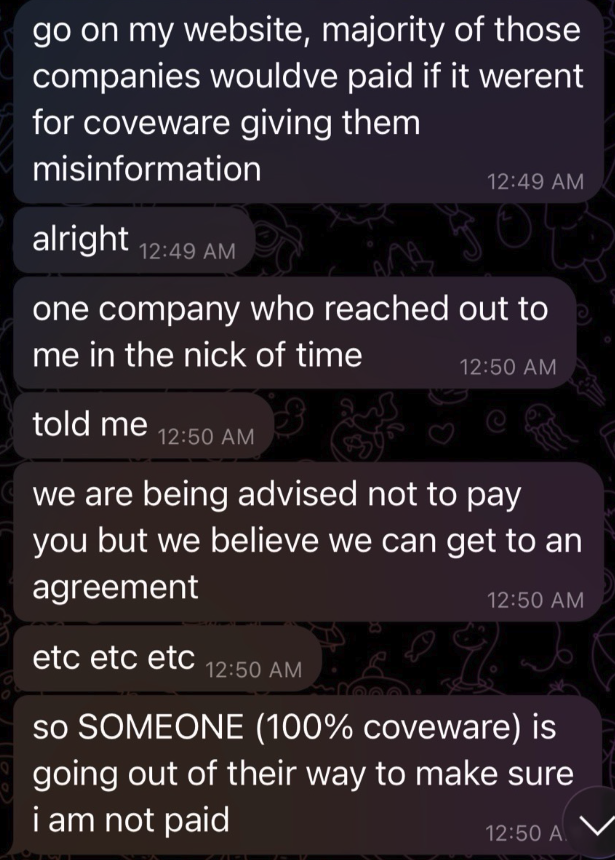
The following screenshots show just how annoyed the ShinyHunters leaders were with Coveware’s relentless advice against paying the group. The first image is from a conversation on May 6, 2026 that took place between the group’s main account on Telegram and a co-conspirator. In that chat, snippets of which were shared with KrebsOnSecurity by a trusted source, ShinyHunters complained that Coveware was harming the group’s payment rates.

The operator of the ShinyHunters account on Telegram speaking privately with a co-conspirator and complaining that Coveware was harming their business.

“Go on my website, majority of those companies would’ve paid if it weren’t for Coveware giving them misinformation,” the ShinyHunters account wrote. “Someone (100% Coveware) is going out of their way to make sure i am not paid.”

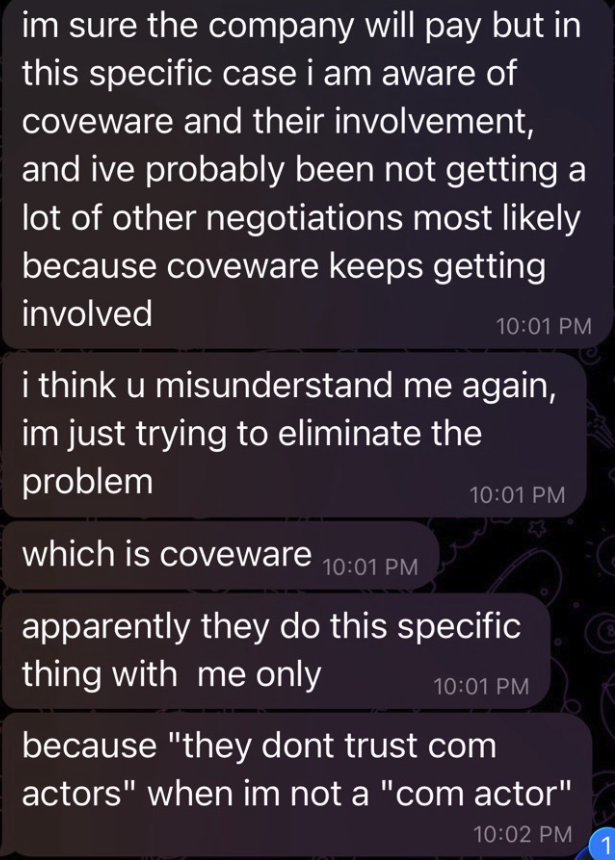
In another conversation on April 11, 2026, the ShinyHunters Telegram account privately said they were trying to “eliminate the problem,” which they said was Coveware. Coveware declined to comment for this story.

“I’m sure the company will pay but in this specific case I am aware of Coveware and their involvement, and I’ve probably been not getting a lot of other negotiations mostly likely because Coveware keeps getting involved,” the ShinyHunters account bemoaned.

The operator of the ShinyHunters account on Telegram telling a co-conspirator they were “trying to eliminate the problem,” which they identified as Coveware advising victims not to pay the cybercrime group.

Mark Camillo is chief executive at CyberAcuView, an industry group founded in 2021 by a consortium of major cyber insurance carriers. Camillo said some firms charge a flat retainer fee, while those that specialize in helping companies negotiate a ransom payment tend to charge a percentage of the total ransom amount paid.

That latter dynamic, he said, is an inherent conflict of interest, as the negotiator has every incentive to make things more favorable to the attackers because they are financially incentivized to negotiate and pay out, and to not negotiate down on the price.

“It has come to the industry’s attention that many of the ransomware payers charge a percentage of the final payment which may or may not be disclosed,” Camillo said. “This makes no sense if they are also the negotiator. There needs to be more transparency in the process as no one in the ecosystem should be profiting purely on the size of the ransomware transaction or payment itself.”

Camillo said the firms doing this work would argue the fees are needed because there may be unexpectedly higher costs to secure larger quantities of cryptocurrency or more risk carrying the float, and because cryptocurrency exchanges may charge higher fees for high risk transactions.

“There definitely needs to be more visibility around the transaction and clarity on the increasing value of the crypto and the exchange’s percent in the transaction to get to the bottom of this and remove any misaligned incentives,” he said.

In recent months, the U.S. Department of Justice has prosecuted a number of ransomware negotiators alleged to have conspired with cybercriminals to defraud their clients. On October 7, the DOJ charged MonsterCloud CEO Zohar Pinhasi, 50, with wire fraud and conspiracy for allegedly charging customers to remediate ransomware attacks without paying the hackers. According to charging documents, Pinhasi secretly went behind his customers’ backs and paid hackers anyway, paying ransomware groups $8 million while charging customers $19 million.

In July, Angelo Martino, a 41-year-old ransomware negotiator from Land O’Lakes, Florida, was sentenced to 70 months in prison for conspiring with the Blackcat/ALPHV ransomware group to extort multiple victims. According to the DOJ, Martino was paid by BlackCat attackers to provide confidential information about the negotiating position and strategy of his employer’s clients and enable the ransomware actors to maximize the ransoms paid by the victims.

The Daily Front Page 6 of 29
Tuesday, October 20, 2026 The Daily Front No. #261020 — Patch Before Breakfast
article

Upcoming critical PHP security release

by xd·▲ 351 points·123 comments·news-web.php.net ↗

We want to inform you of an upcoming PHP security release that addresses two critical vulnerabilities (both rated CVSS v4.0 9.2, Critical). The release is scheduled for Wednesday, 21 October 2026 at 14:00 UTC. We encourage all PHP users to prepare now so you can update as soon as it is available. We reserve the right to release earlier if details of either vulnerability become public, or if we see evidence of active exploitation in the wild. The PHP security team

ask hn

Tell HN: 2x PHP RCE CVEs with CVSS 10.0 Incoming

by petecooper·▲ 142 points·27 comments·news.ycombinator.com ↗

A reliable source has indicated an announcement is scheduled for 22 October 2026 at 18:00 CEST regarding 2x PHP RCEs with a CVSS score of 10.0.

I have no evidence beyond "source: trust me, bro", but if you're running PHP in production, be ready to update as a priority.

These CVEs reportedly relate to remote code execution in all affected PHP versions from PHP 5 onwards.

These are the two reserved CVEs for the reported upcoming announcement:

CVE-2026-109618

CVE-2026-109619

Join the discussion on Hacker News →

repository

Go will reject certificate chains containing eight distrusted SPKIs

by mendym·▲ 136 points·78 comments·github.com ↗
★ 139,376⑂ 22,254 forks Go

The Go programming language

We're blocking trust in a small set of intermediate certificates due to specific security concerns around their operation.

Verify will now filter out chains which contain these intermediates, preventing them from being returned to the caller.

We highly recommend immediately upgrading to this release.

This is CVE-2026-111943 and Go issue https://go.dev/issue/82345.


This was an URGENT track issue originally tracked in http://b/575512169.

The Daily Front Page 7 of 29
Tuesday, October 20, 2026 The Daily Front No. #261020 — The Inference Works
repository

DeepInfer: High-performance inference framework for DeepSeek models

by ggcr·▲ 2,191 points·848 comments·github.com ↗
★ 14,607⑂ 1,406 forks Python

DeepInfer: High-performance, large-scale inference framework for DeepSeek models

DeepInfer is the high-performance inference framework that powers DeepSeek's large-scale production services. This open-source release provides offline inference with the core features needed for serving at scale.

Supported models:

  • DeepSeek-V4.1-Flash

Supported features:

  • Optimized kernels, model and sampler runtime
  • Parallelism: Attention DP / balanced CP, MoE EP + EPLB
  • DSpark and confidence-scheduled verification
  • SWA bounded replay
  • Asynchronous scheduling (zero-overhead batch scheduler)
  • Batch-invariant inference
  • Deterministic sampling
  • Structured outputs

Feature details and configuration

  • Optimized kernels: FlashMLA, DeepGEMM, DeepEP, TileKernels, DeepSelect, and custom TileLang kernels.
  • DSpark and confidence-scheduled verification: accelerate decoding with draft tokens and use confidence estimates to schedule verification. Set DEEPINFER_ENABLE_MTP_VARLEN=1; DEEPINFER_USE_NEXTN_DECODE controls the maximum draft length (default: 5).
  • Decoder SWA bounded replay: reduce decoder prefill work by replaying only a bounded suffix. Set DEEPINFER_YOCO_PREFILL_TRUNCATION_MODE=compact and DEEPINFER_YOCO_PREFILL_KEEP_TOKENS=140 for the default V4.1 settings; the retained suffix must cover the SWA window plus the maximum backtracking length.
  • Asynchronous scheduling: overlap CPU batch scheduling with device execution. Enabled by default.
  • Batch-invariant inference: keep model results identical across different batch compositions. Enable with DEEPINFER_BATCH_INVARIANT=1 (NVIDIA only).
  • Deterministic sampling: produce identical outputs for identical input tokens and sampling parameters. Set DEEPINFER_BATCH_INVARIANT=1 DEEPINFER_ENABLE_MTP_VARLEN=0 and pass a fixed seq_seed to SamplingParams (NVIDIA only).
  • Structured outputs: constrain generation to a regex, JSON schema, or EBNF grammar. Pass so_args={"schema_type": ..., "schema": ...} to SamplingParams; see examples.

Supported hardware:

  • NVIDIA SM100 GPUs
  • Huawei Ascend 950 NPUs

Required for a complete inference service (not included in this release):

  • A KV cache system
  • VE/Prefill/Decode disaggregation (most required engine functionality is already implemented)
  • Load balancing across data-parallel replicas for both prefill and decode

Getting started

Prerequisites

  • Linux
  • GCC >= 13.0
  • Python 3.12
  • CUDA 13 (NVIDIA only)
  • CANN 9.2 (Ascend only)

Build from source

Before building DeepInfer, please create and activate an empty Python 3.12 environment.

# Use `ascend` instead for the Ascend platform
# Keep it exported in the environment where you run DeepInfer
export DEEPINFER_ACCELERATOR=nvidia
./build.sh

Offline inference

The default checkpoint, deepseek-ai/DeepSeek-V4.1-Flash-1017, is downloaded into the Hugging Face cache on the first run; set DEEPINFER_HF_MODEL_DIR=/path/to/DeepSeek-V4.1-Flash-1017 to run from a local copy instead.

python examples/offline_inference.py

See examples for details.

Performance benchmarks

Prefill Decode Prefill: non-cached input throughput vs. latency Decode: output throughput vs. per-user speed

Measured on 4 SM100 GPUs for prefill and 64 for decode — each within one scale-up domain. To reproduce the benchmarks, see run_sweep.sh.

Evaluation benchmarks

See eval/README.md.

License

DeepInfer is released under the Apache License 2.0. See LICENSE for details.

Acknowledgments

DeepInfer was originally built primarily on vLLM, with additional inspiration from SGLang and TensorRT-LLM. We thank their developers.

Citation

@misc{deepinfer2026,
  title = {DeepInfer: High-performance, large-scale inference framework for DeepSeek models},
  author = {DeepSeek-AI},
  year = {2026},
  publisher = {GitHub},
  howpublished = {\url{https://github.com/deepseek-ai/DeepInfer}},
}
The Daily Front Page 8 of 29
Tuesday, October 20, 2026 The Daily Front No. #261020 — The Inference Works
repository

MicroG: Free-libre re-implementation of Google's proprietary Android user space

by theanonymousone·▲ 394 points·111 comments·github.com ↗
★ 15,004⑂ 3,272 forks Java

Free implementation of Play Services

Overview

microG GmsCore is a free software reimplementation of Google's Play Services. It allows applications calling proprietary Google APIs to run on AOSP-based ROMs like LineageOS, acting as a free replacement for the non-free, proprietary Google Play Services (sometimes referred to as the more generic term "GApps"). It is a powerful tool to reclaim your privacy and freedom while enjoying Android core features (although apps you use that take advantage of it may still be using proprietary libraries to communicate with microG, just as they do when communicating with the actual Google Play Services).

Features

  • Opt-in to Google Services and extend application support
  • On-/Offline location service
  • Easy on battery, memory and CPU
  • No bloatware
  • Works on real devices, test emulators and virtual mobile infrastructure
  • Free (open source) (Apache 2.0 licensed)

System Requirements

Your Android system needs to support signature spoofing so GmsCore can pretend the existence of the official Play Services to applications calling Google APIs. See the linked page to know about ROM providing out-of-the-box support and what you can do about the other ones.

Modules

GmsCore includes the Unified Network Location Provider module (UnifiedNlp) which handles application calls to Google's network location provider.

For a full-working microG setup, you must also install a Play Store replacement application (like microG Companion). See installation.

Project status

The current status of implemented APIs is documented on this wiki page.

Contributions welcome!

Please report bugs and include logs, screenshots, version numbers and device information depending on what issue you observed. Also, do not bother to contact the author of third-party apps when it might be related to microG services. If you created a logcat, but fear or know it contains sensitive data, you can send a private message.

Thanks for continously supporting this project with feedback, pull requests and donations!

The Daily Front Page 9 of 29
Tuesday, October 20, 2026 The Daily Front No. #261020 — TPU Dispatch
repository

Google open-sources TorchTPU, a native PyTorch back end for TPUs

by ilreb·▲ 301 points·66 comments·github.com ↗
★ 381⑂ 19 forks C++

TorchTPU Logo

Description

This project provides a PyTorch backend for Google's Tensor Processing Units (TPUs), enabling users to run PyTorch models and operations on TPU devices. It includes custom ATen kernels for various PyTorch operations, a compilation cache for optimizing execution, and examples for distributed training and model inference.

Features

  • PyTorch ATen kernel implementation for TPU.
  • Compilation cache for optimized execution of XLA computations.
  • Support for distributed training (Data Parallelism, Tensor Parallelism).
  • Examples for various models (Llama, Qwen, ResNet, DLRM, minGPT, UNet).
  • Integration with torch.compile() for graph mode execution.
  • Utilities for debugging and benchmarking.

User Guide and Interactive Notebooks

A user guide is available at https://torchtpu.readthedocs.io/. This is a static version of the interactive notebooks. They are available in the docs folder.

The notebooks are Marimo (similar to Jupyter). They can be run with marimo edit file.py and then you can access them in your browser. You will need to be running this from a TPU VM, a v6e GCE instance is easiest.

Installation

The same instructions are available in the user guide linked above.

TorchTPU's Python version support policy matches PyTorch's Release Compatibility Matrix. Currently, Python 3.11+ is supported. See the Python Version Support Policy for more details.

First create a Python virtual environment:

python -m venv .venv
source .venv/bin/activate

or, with uv

uv venv .venv
source .venv/bin/activate

Install via pip

Install the latest public release (0.2.0 on PyPI) (for uv prepend uv to all pip commands):

pip install torch_tpu==0.2.0 --extra-index-url https://download.pytorch.org/whl/cpu

Build from source

Wheels can be built via:

bazel build --config=wheel_common //ci/wheel:torch_tpu_wheel

All OSS Bazel builds default to optimized mode (-c opt) automatically via .bazelrc. Unoptimized builds (-c fastbuild, -c dbg) can degrade performance and are not used for wheel builds. If you are developing or debugging C++ code and explicitly want an unoptimized wheel, pass --//:allow_unoptimized_wheel=True:

bazel build -c dbg --config=wheel_common //ci/wheel:torch_tpu_wheel \
    --//:allow_unoptimized_wheel=True

--config=wheel_common is required, and the build fails at build time without it. The config sets --//:wheel_build=True, which routes the shared XLA/MLIR backend through the torch_version-reset transition so that pywrap factors it into a single libxla_base.so; built without the flag, every per-version common ships its own copy of the backend and the resulting wheel aborts on import torch with duplicate static registrations.

wheel_common also turns on the Remote Build Execution (RBE) remote cache and remote executor. If you do not have RBE credentials, append --config=no_rbe to strip those flags back out:

bazel build --config=wheel_common //ci/wheel:torch_tpu_wheel --config=no_rbe

The order matters here: --config=no_rbe has to come after --config=wheel_common, because the later config is the one that wins for the remote-cache and remote-executor flags they both set.

Install wheel via:

cd <path_to_repo>
python -m venv .venv; source .venv/bin/activate
# The extra-index-url provides the CPU version of torch rather than the default CUDA build.
pip install ../bazel-bin/ci/wheel/*.whl --extra-index-url https://download.pytorch.org/whl/cpu

Note that installing without --extra-index-url https://download.pytorch.org/whl/cpu will install the CUDA version of torch; pass --extra-index-url as shown above or install the CPU build separately.

Getting Started

Some pointers to get you started:

Dependencies

The project uses Bazel for dependency management. Key Python dependencies are:

TBD

Bazel setup

This project uses Bazel for building and dependency management.

To install Bazel, we actually install Bazelisk, which is a transparent wrapper that handles downloading and installing Bazel itself.

There are several ways to install Bazelisk. Here are some common ways:

  • If you have Go installed:

    go install github.com/bazelbuild/bazelisk@latest
    
  • Download the binary directly:

    wget -O ~/bin/bazel https://github.com/bazelbuild/bazelisk/releases/download/v1.27.0/bazelisk-linux-amd64
    

See the Bazelisk README for more install instructions

However you install it, add it's location to PATH.

To verify the install, run bazel info in the repo's root directory:

bazel info

It should print information about the repo without errors.

VSCode clangd Setup

For C++ code navigation, it is recommended to use VSCode with clangd extension. Relying on a compilation database generated from Bazel action graph, clangd is able to enrich the editor with various smart features, including code completions, go-to definitions, etc.

  1. Install VSCode extensions via UI or the following command:

    code --install-extension llvm-vs-code-extensions.vscode-clangd
    # Uninstall Microsoft C++ extensions to avoid interference.
    code --uninstall-extension ms-vscode.cpptools
    
  2. Generate the initial compile_commands.json:

    tools/setup_clangd.py
    

It may take a while (> 30 minutes) for the first run to make a full build, but reruns will be incremental and cheap. If you have run bazel build recently, generated files already exist so you can pass --no-build to skip waiting for heavy builds (note that on a fresh workspace, skipping the build may prevent clangd from resolving generated files). See more options in the script file-level comments.

Alternatively, you can invoke the script via nox (arguments after -- are forwarded):

nox -s refresh_compile_commands -- --no-build
nox -s refresh_compile_commands -- //src/torch_tpu/ops/...

Contributing

We welcome contributions to the PyTorch on TPU project! Please see our CONTRIBUTING.md for guidelines on how to contribute, including signing our Contributor License Agreement (CLA) and code review processes.

License

This project is licensed under the Apache 2.0 License. See the LICENSE file for details.

The Daily Front Page 10 of 29
Tuesday, October 20, 2026 The Daily Front No. #261020 — The Machine Takes the Call
article

Voxtral 3

by ilreb·▲ 574 points·149 comments·mistral.ai ↗
Take the call

Take the call

The Voxtral agent

Béatrice, the caller

Summary

Voxtral 3 introduces a cutting-edge voice agent SDK and state-of-the-art speech models designed for real-time, multi-step conversations across 50+ languages. It combines accurate transcription, natural speech synthesis with emotional adaptability, and deep tool integration for seamless workflow automation. Available via Mistral’s EU-hosted API or self-deployment, it ensures data sovereignty while delivering low-latency, human-like interactions for contact centers, virtual assistants, and hands-free copilots.

Speech transcription and voice generation have come a long way, but building end-to-end voice agents that can listen, reason, interact, and handle complex workflows remains difficult. 

A reliable voice agent needs to do four things very well (and simultaneously): 

  1. Listen accurately across languages, accents, speakers, and interruptions,
  2. Reason deeply about what users mean in specific contexts,
  3. Speak naturally with emotion and expression, and
  4. Take action over multiple steps through connected systems.

Getting all four to work together reliably in real time remains a challenge. 

To address this, we introduce Voxtral 3: a new family of state-of-the-art speech-to-text and text-to-speech models, alongside a voice agent SDK that brings listening, thinking, tool calling, and speaking into a single real-time streaming pipeline.

Voxtral 3 is built to create natural conversational experiences, from contact-center agents and service desks to virtual assistants and hands-free copilots. With support for dozens of languages, expressive speech, complex reasoning, and deep integration with your own tools and data, agents built with Voxtral can interpret nuanced intent, reason through sophisticated requests, and execute multi-step actions across connected systems.

As with other Mistral models, the Voxtral 3 family is designed for sovereign deployment. Available today through Mistral's EU-hosted API or for self-deployment on your own infrastructure, it gives organizations control over where audio is processed, how data is handled, and whether conversations are retained.

Highlights

  1. Accurate transcription across 50+ languages. The speech-to-text model, Voxtral Small Transcribe 3, is state-of-the-art in multilingual transcription, identifying who said what (diarization), using keyphrases to improve its accuracy (context-biasing). It detects when someone has finished speaking so agents can respond without delay (end-of-turn detection).
  2. Natural speech that adapts to the conversation. The text-to-speech model, Voxtral Mini TTS 3, introduces new voices that adjust their emotion, pace, and emphasis based on conversational context, with support for 35+ languages and 50+ dialects.
  3. Human-like intelligence at your (spoken) command. The new voice agent SDK combines listening, reasoning, tool calling, and speaking into a real-time experience. Agents can retrieve information, interact with business systems, and complete tasks during live conversations over phone or web.
  4. Pro Voice for distinctly accurate voice adaptation. For professional use cases where basic voice cloning does not suffice, Voxtral’s Pro Voice adaptation is able to reproduce a speaker’s distinctive character, emotional range, and speaking style across languages, using just 30 minutes of audio.
  5. Your voice AI, on your infrastructure. Use Mistral's EU-hosted API or deploy Voxtral 3 on your own infrastructure. Keep sensitive conversations within your environment and control whether any audio is retained.

Try Voxtral now  | Learn more

It hears 50+ languages, with state-of-the-art accuracy.

Voxtral Transcribe 3 represents a significant milestone across transcription, diarization (who spoke when) and context biasing capabilities. The supported list of languages is expanded to 50, including 24 official EU languages and many low-resource Asian and Indic languages.

The Small version achieves state-of-the-art results across diarization and multilingual transcription, including in English, French and Spanish. It outperforms Whisper, Scribe v2 and Gemini 3.5 Transcribe. The Mini variant is 4B parameters, enabling fast and accurate transcriptions at a price of $0.0035/min.

Both models support context biasing, where key terms and free-form text can be given to bias the transcription and improve recall on technical terms. This enables them to be used in production settings with domain-specific vocabulary without the need for fine-tuning.

Macro-average WER over the intersection of 45 languages in the FLEURS benchmark supported by all seven models. WER is used for all languages except Japanese, Korean, Thai, and Chinese, which use CER. Lower is better.

Forced = language specified; Inferred = language auto-detected. Languages: AR, BN, BG, CA, ZH, CS, DA, NL, EN, ET, FI, FR, DE, EL, GU, HI, HU, IS, ID, IT, JA, KN, KO, LV, LT, MK, MS, ML, MR, NO, FA, PL, PT, RO, RU, SK, SL, ES, SV, FIL, TE, TH, TR, UK, VI

Macro-average concatenated minimum permutation WER (cpWER) over public diarization benchmarks: AMI-IHM, AMI-SDM, Switchboard, Switchboard CallHome, AISHELL-4. For maximum compatibility of API baselines, we use 30 minute versions of AMI and AISHELL. Lower is better.

Diarization benchmark, Concatenated Minimum Permutation Word Error Rate (cpWER).

Voxtral Small Transcribe 3 is highlighted in brand colours. Keyphrase recall on the Earnings 22 benchmarks. The context bias contains keyterms and a randomly sampled number of distractors, ranging from 0 to 100. Bars are superposed absolute values — the outer bar is recall with context, the inner bar is recall without context; the visible band is the uplift from contextual prompting. Higher is better.

Keyphrase recall benchmark. Context = domain-specific vocabulary and speaker names supplied to the model.

Artificial Analysis WER Index, a weighted average over VoxPopuli, Earnings-22 and AgentTalk.

Lower is better.

Voxtral Realtime Transcribe 3 is a realtime transcription model built for agentic use-cases. It achieves high-quality transcriptions at sub-500ms latency in over 35 languages, including with diarization and context biasing.

Macro-average WER over 35 languages from the FLEURS benchmark. WER is used for all languages except Japanese, Korean, and Chinese, which use CER. Lower is better. *Voxtral Mini Transcribe 3 is an offline baseline. The remaining models are realtime.

Languages: AR, BN, BG, CA, CS, NL, EN, ET, FI, FR, DE, EL, GU, HI, ID, IT, JA, KN, KO, LV, MK, MS, ML, MR, NO, FA, PL, PT, RO, RU, SK, ES, FIL, TE, TR

End-of-turn prediction is natively supported, incorporating both acoustic and semantic information to accurately predict when a user is finished speaking. This allows for low-latency voice agent applications, while minimizing false cut-off rates when the user is prematurely interrupted.

It answers with the right emotion, in your or your customer’s brand's own voice and local dialect.

Voxtral Mini TTS 3.0, available in batch and realtime, achieves state-of-the-art expressiveness and instruction following for 35+ languages and 50+ dialects. At $13 per 1M characters, Voxtral Speech 3 costs less to run than comparable models from OpenAI TTS-1, Deepgram, ElevenLabs Flash and Gemini Flash.

The speech model implicitly interprets the semantic meaning of context better, producing natural speech across a diverse range of emotions and languages. New and improved features include voice cloning from 30+ minutes of sampled audio, custom prompt instruction following (IF), contextual TTS, and a vocabulary library, all of which serve the goal of speech reliability in deployment. Variables for Explicit IF include emotion, pacing, and emphasis.

All natural-sounding speech relies on emotion, which determines its prosody, rhythm, pacing, emphasis, and transitions. Voxtral TTS natively interprets a prompt’s text context to determine the emotion and voice style, making the model inherently better at natural speech without requiring additional instructions or voice prompts.

The voice agent is in control of the whole conversation.

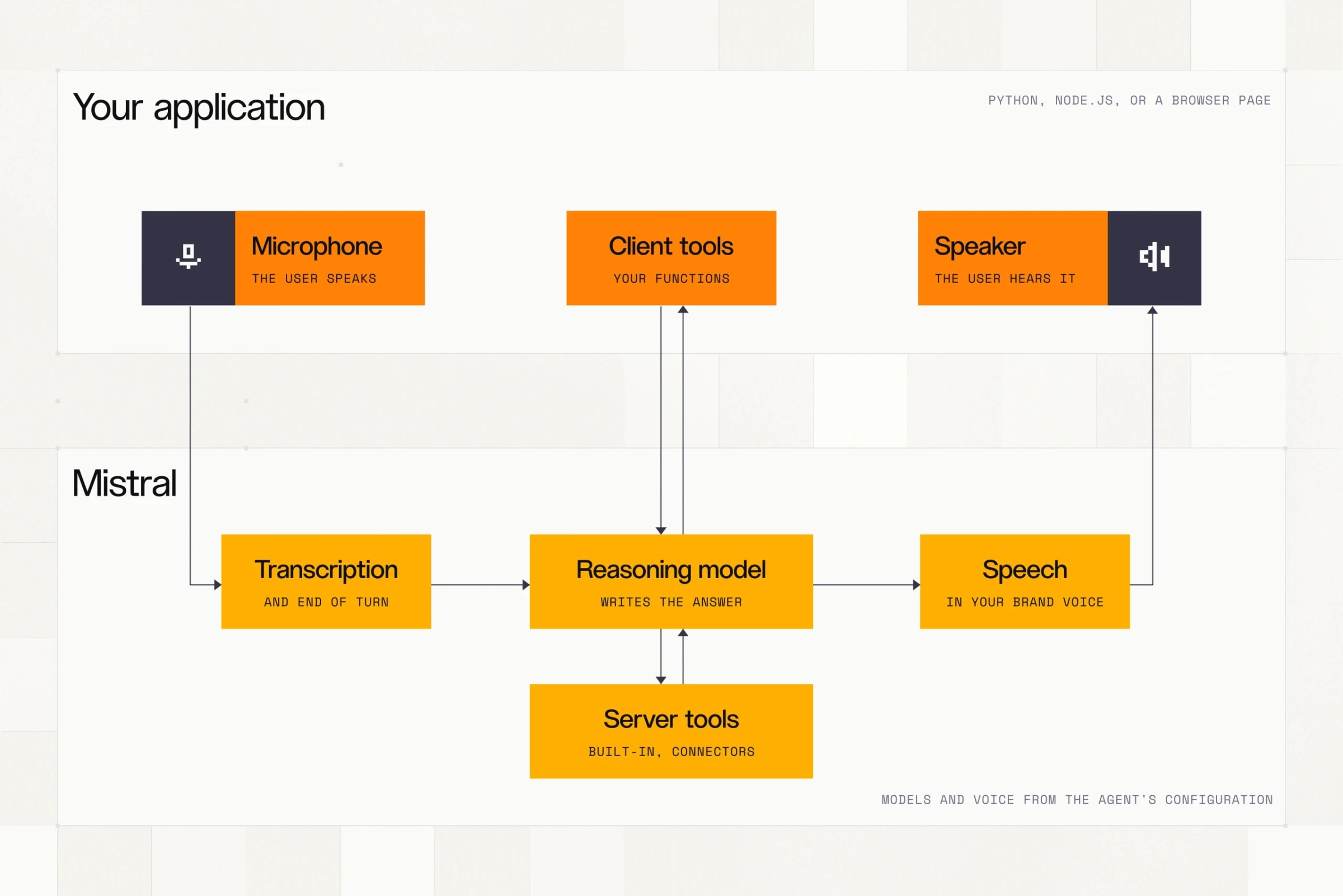
Voxtral 3 introduces a voice agent SDK, built on LiveKit, that runs speech in, reasoning, and speech out as one streaming pipeline. Voxtral Mini Transcribe Realtime 3 listens and detects when the caller has finished speaking, a general model—like Mistral Small—reasons and calls tools, and Voxtral Speech 3 replies in the tone of the conversation so far. No stage waits for the one before it, so each turn completes in under one second, and the agent stops talking when the caller cuts in.

During a call, the agent can verify a caller's identity, check a bill, or book an appointment, using function calling, web search, and retrieval over your own systems. It answers and places calls over SIP, runs in browsers and apps over WebRTC, and connects to the telephony, IVR, and contact-center software you already use.

Each stage is a separate model, so you can change the LLM, the voice, or the language without rewriting the agent, and run the whole stack on Mistral's API in Europe or on your own infrastructure.

Get started.

Voxtral 3 is available today through the Mistral API, hosted through our European, US, and global endpoints.

You can test out voice agents, audio transcription, speech generation, and voice cloning in the Studio playgrounds.

Try Voxtral now  | Learn more

Model Price
Voxtral Mini Transcribe 3 (batch) $0.0035/min
Voxtral Mini Transcribe Realtime 3 $0.008/min
Voxtral Small Transcribe 3 $0.0040/min
Voxtral Speech 3 (batch and realtime, same API) $13/1M chars
Voice agent API with Mistral Small 4 for reasoning 0.04$/min
Voice agent API with any other reasoning model 0.08$/min

To run the full stack on-premises or in a private cloud, talk to our team.

The Daily Front Page 11 of 29
Tuesday, October 20, 2026 The Daily Front No. #261020 — Compiler Room
article

Tsrs: A Port of TypeScript to Rust

by hnisjafx40·▲ 378 points·183 comments·blog.cloudflare.com ↗
help developers spend less time waiting for their code to be checked and more time building.

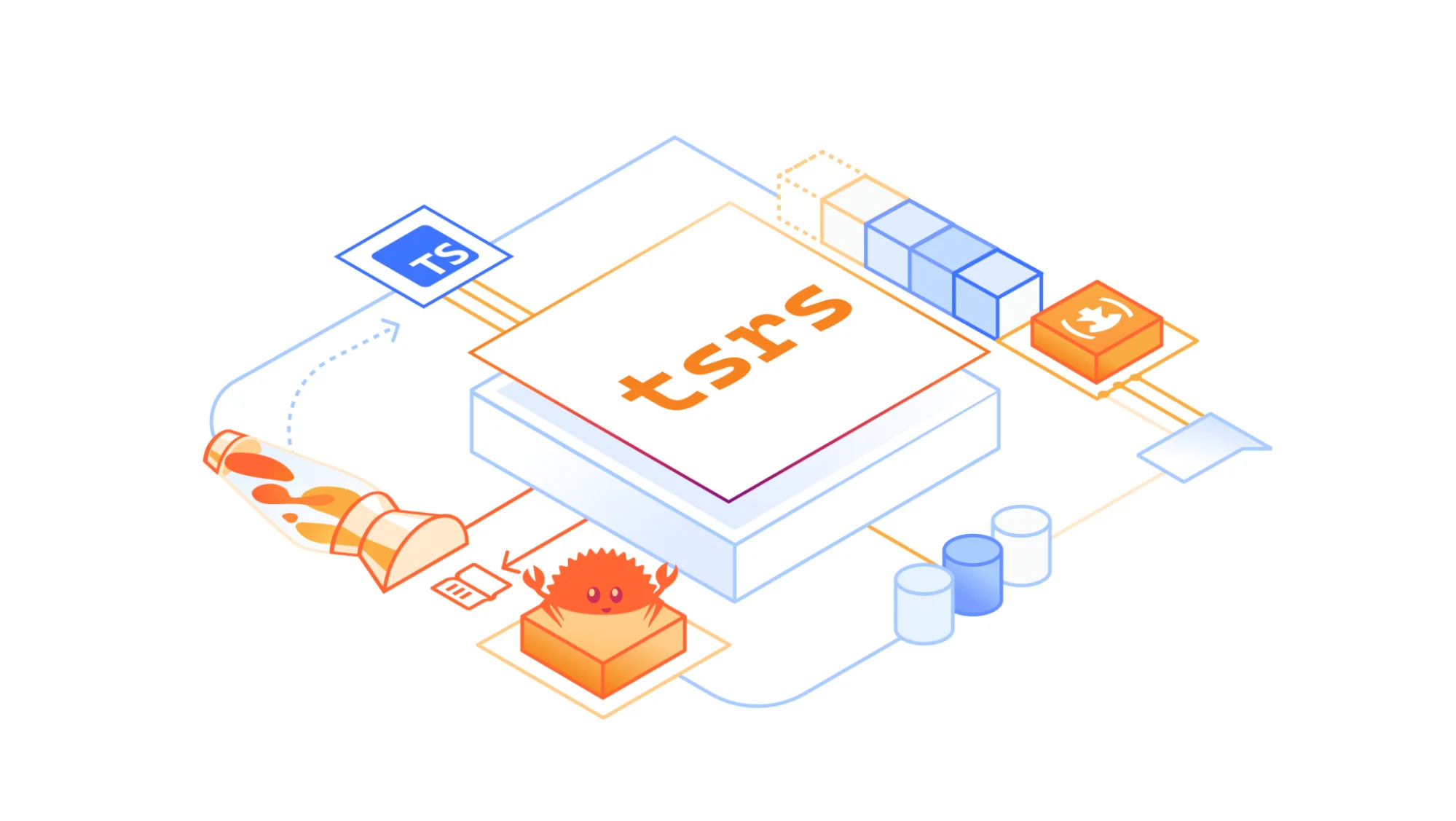
Cloudflare and VoidZero are now working with Max Schwenk of Owner.com on tsrs, a Rust port of the TypeScript compiler. We are doing this work in close collaboration with the TypeScript team, and incubating tsrs as part of the Oxc JavaScript compiler toolchain.

Our goal is to help developers spend less time waiting for their code to be checked and more time building. Making TypeScript faster and more memory-efficient also helps bring complete development environments to more places, including right in your browser.

To be clear, we are not forking TypeScript. We believe the TypeScript team should remain in full control of the language’s design and direction. They have maintained a long-term vision while guiding TypeScript’s adoption across the JavaScript community. We do not want to change that.

The TypeScript team can move quite fast on many things, but for some features they may spend years intentionally exploring options and making prototypes before picking the right implementation. A Rust port has to follow those decisions closely, or it will eventually fall apart and become incompatible. We have to preserve the TypeScript language strictly based on its original implementation – and the TypeScript team should remain solely responsible for deciding what that looks like.

Performance and memory improvements

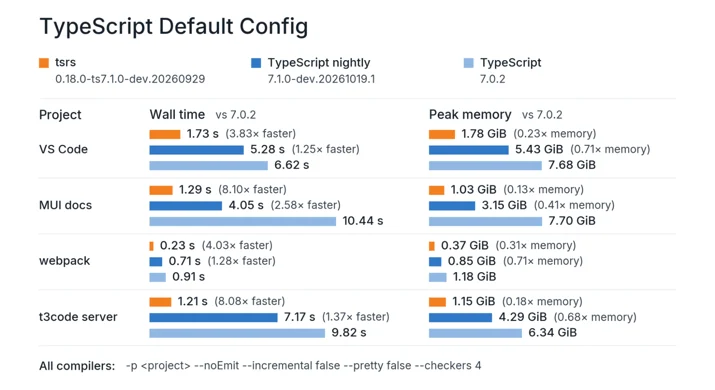
Early benchmarks of our Rust port of TypeScript are promising: tsrs is up to 8x faster and uses ~70% less memory compared to TypeScript 7.0 when using the same number of type check workers:

As you can see, the next version of TypeScript already brings many performance improvements, making TypeScript 7.1 beta up to 2.5x faster than TypeScript 7.0. Some of these optimizations were upstreamed from tsrs, and we’re hoping to find more.

You may have seen recent benchmarks of different TypeScript ports with various performance claims, often due to using larger machine types and different options compared to TypeScript’s defaults. We worked with the TypeScript team to ensure the above benchmarks are comparing the same configuration.

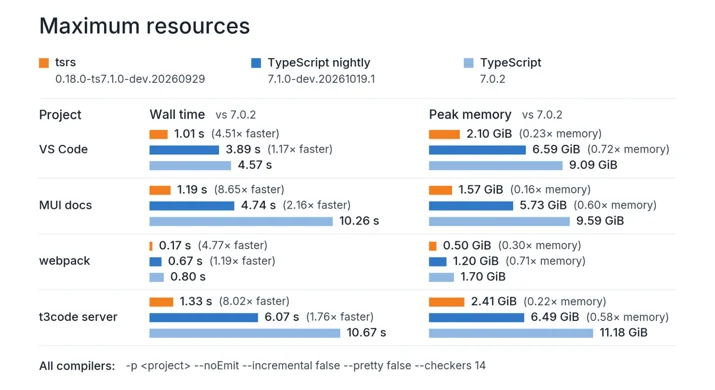
By default, tsrs ships with an adaptive configuration dependent on the machine type that uses more memory but is even faster:

Try tsrs

TypeScript in Rust aims to be a faithful port of TypeScript. You can try an experimental release by installing the tsrs package from npm:

npm install tsrs
npx tsrs

Why now?

We’ve seen many attempts at porting TypeScript to other languages over the years. Because of the complexity involved, only one of the ports succeeded: the TypeScript team’s port of TypeScript from JavaScript to Go.

However, frontier AI models can now do large-scale ports almost independently in a matter of days. We have now seen slopforks, faithful ports, and completely re-architected versions of TypeScript in Rust or C++. There is clearly a demand for even faster TypeScript.

Why Rust?

You might be thinking: “TypeScript’s Go port already made TypeScript 10x faster and far more memory efficient than the previous version written in TypeScript. Why isn’t that enough?”

However, it’s not just about speed. Rust offers some unique advantages: running in WebAssembly. The Rust + Wasm story has always been strong, and one of the reasons comes down to the fundamentals of Rust’s language design. When you compile a Go program to Wasm, you have to compile Go’s garbage collector along with it. But Rust’s memory management model enables straightforward memory interactions between a WebAssembly guest and host. This is one of the key things that makes Rust a much better fit for the WebAssembly use-case: memory efficiency.

Cloudflare Workers have supported Wasm for a long time. Just a few weeks ago we announced supporting native Rust in Workers with the new Emscripten target for wasm-bindgen. When you run entire software build and deployment systems in tight loops on Workers, the benefits of a small memory footprint pay off quickly. It means you can run these workloads so efficiently that it’s now possible to run fully encapsulated development systems in places where they couldn’t have been run before.

This enables new possibilities when combined with agents: You are now able to run a development toolchain end-to-end in a fully sandboxed environment on Cloudflare. But with Wasm, you can also run those environments safely client-side in your browser, or on an embedded device, or an IoT application.

How will the tsrs port be maintained?

First, we are working with Theo Browne to merge tsc-rs and tsrs into a single package that supports all of TypeScript’s features including Language Server Protocol (LSP) and content mappers. Second, we’ve seen a lot of success with how we maintain Vinext in sync with its upstream, Next.js. We explained how we do this in a recent blog post:

Each morning, an agent reviews the changes, fetches diffs, and opens tracking issues for anything that could affect Vinext. Every night, the compatibility matrix is regenerated as we run the Next.js test suite against Vinext. When one of these tests or issues reveals a gap, agents are now in the position where they can identify the change across both codebases, build a reproduction, port any relevant tests, and propose a fix.

We will apply the same process to TypeScript, taking extreme care that we don’t introduce diverging behaviors from upstream TypeScript. When we come across performance improvements, we’ll attempt to contribute them back to the TypeScript Go codebase so everyone wins.

Finally, we recognize that there are some differences to the upstream version of TypeScript right now, like for example the order in which diagnostics are printed. We aim to reduce those differences to a minimum by the time we publish a stable release.

What’s next?

Cloudflare is already the home of many free and open source Rust tools that power the JavaScript ecosystem, such as Vite, Rolldown, Oxlint, and Oxfmt. With more than 10 million developers building on Cloudflare, we care a lot about making the underlying developer toolchain faster, more portable, and easier to run in more places. We are excited to experiment with deeper tsrs integrations into our stack, for example for type-aware lint rules in Oxlint.

Like with Vinext, our goal is to run tsrs as a well-maintained healthy open source project — without getting in the way of TypeScript itself. The Oxc team has already begun refactoring the codebase to make it faster, use less memory, and make it maintainable. We know the TypeScript team is taking this seriously – they are experimenting with memory and performance improvements for tsc. We are excited to collaborate with the TypeScript team and the JavaScript community to build the best and fastest implementations of TypeScript together.

The Daily Front Page 12 of 29
Tuesday, October 20, 2026 The Daily Front No. #261020 — The Rust Desk
article

2026 is an exciting year for the Rust compiler (and me)

by panstromek·▲ 175 points·84 comments·yoyo-code.com ↗
multiple different initiatives are reaching final steps at the same time.

You might have already noticed that 2026 seems to be a bit special year for Rust compiler. It seems like there's just a lot of stuff going on. Some things were already announced since I started writing this, but there's still a bunch more that's not as visible. I'll share some things that I personally find interesting.

To explain a bit of context, what happened this year is that multiple different initiatives are reaching final steps at the same time. In other words, 2026 is not that special with the amount of work being done, but it's a year when we see several long-term investments starting to pay dividends.

Next solver

Probably the biggest thing is the next generation trait solver. This is a reimplementation of a big part of the type system, and it has been in the works for a very long time - Almost 10 years in various forms. It fixes a bunch of soundness bugs and unblocks a lot of features and fixes for long-standing issues.

It's easy to understate how big of a deal this is for the compiler. This work resolves a major piece of technical debt that a lot of compiler developers dreamed about for years. It also frees up a bunch of people with a fresh and deep understanding of the type system to work on new things. The queue of things that get unblocked includes many common pain points of the language, even things that might seem benign or unrelated. It contains solutions to big problems in async Rust, or various limitations of impl Trait.

Polonius

Another big thing is Polonius, a new borrow checker implementation, long time in the making as well. It enables more code to compile and unblocks several related features - including (hopefully one day) internal references. The compiler impact of this is not as big as with the new solver, but it's still a pretty big deal.

Perf

My main area of interest is compiler performance, and here we have quite a few things going on. After 1-2 years of a sort of stagnation (at least in terms of results), we suddenly have a lot of things going on at once. So much so that I have a hard time remembering everything, but from the top of my head:

Parallel frontend is close to stabilization

Very old initiative that was put a few years on hiatus with many unclear blockers. The development restarted again a few years ago with a new contributor @SparrowLi, and over time a number of other people contributed to the effort.

Over the years, this turned out to be a massive can of worms. I get the feeling that almost nobody is really happy with the design. However, there doesn't seem to be a better alternative for the foreseeable future, and parallel frontend is highly desirable, so the solution ended up being just grinding through a number of annoying and hairy problems until there's nothing left.

The current project goal is driven by @petrochenkov and is getting close to stabilization.

LLVM is getting faster

LLVM 23 was unambiguous and unexpectedly large positive change in performance. For a long time, LLVM upgrades were not particularly great for rustc performance. This changed after LLVM 10 upgrade, which introduced a massive 10% regression, and @nikic, current lead developer of LLVM, called it out in his blog post, Make LLVM fast again. In the post he also introduced a system for tracking LLVM performance over time, inspired by the one we use for rustc.

Since then, LLVM started catching performance regressions earlier, and results for upgrades in rustc went from "less bad", to "somewhat mixed", to "mostly positive with caveats." The last one of those was LLVM 22, which was green on icount benchmarks, but almost universally red on wall time.

LLVM 23 is pretty much entirely positive. I don't follow LLVM development that much, but my understanding is that this is because there's now more work on actually optimizing it, as opposed to working on features without trying to regress performance. These days the improvements come both from new optimizations (those help optimize the compiler during bootstrap) and from LLVM itself getting faster.

Lot perf improvements landing (micro-optimizations)

Compiler performance has been on a steady streak of improvements in the past few months. There's probably no single explanation for it, just a combination of new contributors coming in, old contributors getting to do more perf work, and tooling improvements combined with architectural cleanups unlocking new opportunities.

With more people working in this area, I've noticed a lot of cross-pollination, where a certain idea would circle around a few people's minds, as people get inspired by each other's PRs and try related things.

I also feel like we got a lot better at managing regressions - triaging and addressing them. This is partially a tooling investment, but also a lot about processes and social structures. A major development here is the connection between tree ops and perf triage, represented notably by @JonathanBrouwer.

This means that people who manage merges often directly triage their performance impact. This is important because it shrinks the response time, but the connection is useful for other reasons as well. The perf impact informs how you group PRs into rollups, for example. Turns out that Conway's law is still a law.

I also greatly enjoy helping people interpreting the measurement results and diagnose regressions. I often find that even just a few sentences from somebody who's been looking at the results every day for many years go a long way towards getting the regression addressed.

All in all, I feel like the compile time concerns are integrated into the development better than they have ever been.

Move elimination

This seemingly came out of nowhere earlier this year, and it's quite interesting. @Amanieu proposed a MIR optimization pass that allows the compiler to eliminate copies that LLVM has trouble optimizing. It speeds up both compile time and runtime.

This is one of those passes that makes sense to implement in MIR instead of LLVM, because the Rust part of the compiler has better information about whether it's valid to apply specifically for Rust. Even more so because it actually requires changing the MIR semantics a bit.

It matters for Rust in particular because Rust typically generates more moves than C(++), which is the primary LLVM target.

Polymorphization

This one is particularly close to my heart because I've been following the efforts for a very long time. Polymorphization is one of the most impactful compiler performance optimizations we could ever do, but it's unfortunately really tricky to implement.

This would be the third experiment I'm aware of. This time it's slightly different from the previous ones, and it's inspired by a similar mechanism in Swift.

The difference is that the original polymorphization intends to only avoid duplicate or redundant monomorphizations, so it's purely a compile time optimization with no runtime impact, while the Swift-style one intends to polymorphize everything and pass around layouts of generic parameters as arguments. This will have a runtime cost, so it'll be something you can tweak with compiler flags.

If my understanding is still up to date, next-solver will also enable polymorphization in the previously intended way. Either way, both options run into the same problems, so the work is useful for both. It's also possible that both options come out of this same effort. Either way, this is still just an experiment with a bunch of problems to solve, so we'll have to wait to see how it turns out. The project goal has been proposed and driven by @camelid.

cargo check and cargo build sharing cache

@blyxyas is working on a project goal, which will enable cargo to share artifacts between cargo check and cargo build. The goal is actually more general, but this is probably its most recognizable outcome. This is something we wanted for ages, so it's really cool to see progress on this front.

no-embed-metadata option enabled by default

This was already announced, and it will shrink the target directory size by 5-30%, depending on the workload.

New cargo build-dir layout

Already announced as well, this is another project that has been in the works for quite some time. As with the other things above, this is major internal restructuring that unlocks other things - namely granular locking of the target directory and cross-workspace caching.

no-link/link-only

@bjorn3 has been working on fixing support for these two flags, which enable pipelining of build scripts and proc macros. As you can see in the proposal, this is yet another line of work that boils down to fixing a laundry list of internal issues and architectural problems until suddenly a big thing is unlocked.

Architecture

There have been a number of initiatives in the compiler architecture. I'll mention a few, just to (once again) underscore the point that big things don't happen in big-bang projects coming out of nowhere, but rather as consequences of sustained long-term investments into a healthy system.

Two years ago, @jdonszelmann started the effort to unify and cleanup how attributes are represented and checked in the compiler. Just a few days ago, the last remaining attribute was ported to the new system. This significantly improves how attributes are checked and unblocks improvements to diagnostics and other things.

Earlier this year, @Zalathar and @nnethercote cleaned up the implementation of rustc's query system. This improved performance but more importantly, made the system easier to understand, which was often a blocker for making improvements to it. The system is still a pretty scary part of the codebase, but this is a big step forward.

There's actually more architectural work in this area, @oli-obk has been working on architectural groundwork for expansion-time evaluation, and there's been a lot of work by @cjgilot, @petrochenkov and other people I'm forgetting (sorry) on queries and incremental in general. Similarly, a lot of work happened to enable const generics to progress further. A common theme of these efforts is that they enable the compiler to use its capabilities in more contexts where it was previously limited, often because of strict ordering of some compilation phases.

Project goals and funding

There's quite a bit of meta stuff as well. Rust project has been experimenting with a new organizational framework called "project goals."

It went through multiple iterations with various changes and experiments, but it seems that the system has finally reached some optimal steady state, and we see the benefits play out. I think you can clearly see that from the list above.

We now have a Fast Builds roadmap and multiple perf related project goals. That's pretty exciting.

There are also multiple new developments in funding. One is explicitly attached to project goals, we also have a new "Maintainers in Residence" program, and a new funding team was established as well.

One also can't help but notice how many results came out of Hexcat employing a bunch of people in the past year.

...and me

And lastly, 2026 is also an exciting year for me. After a few years of watching from the sidelines and eventually joining the perf triage, I decided to start working on the Rust project more seriously.

Earlier this year, it became clear that I need to decide what to work on next. My current work is slowly winding down and turning into maintenance, and I also started to feel a bit burnt out on web-based work. For quite some time, I've been feeling the desire to return to something more technical and challenging.

I was considering a few options, but somewhat unable to decide between them. To use the term from Marie Kondo, nothing really felt like it "sparks joy." After some exhausting events and feeling a bit down from all of this on one evening, I received an invitation to Rust All Hands. This was a pleasant surprise. I signed up for it earlier that year, but I didn't really expect much because I didn't know the likelihood of being invited. I took this as a sort of sign from the universe or something and booked the trip.

The experience was overwhelmingly positive. I have to say that this was one of the most exciting events I attended in a long time. It reminded me that there's this big part of my life that I don't get to share with anybody almost ever, especially in real life. It seems so easy to forget that until you actually experience it again.

Yes, sure, I can talk about some curious aspects of the Rust compiler with my friends, but it's a whole another level to talk about it with people who actually work on it and understand what you talk about on a deep level. It was really nice to meet people I know from their work and join the discussions about the development of the language.

Long story short, it became clear that this is it, this is what I want to do. I was thinking about it before, but I guess I needed some strong "spark of joy" moment to stop doubting my feelings and force me to make a decision.

How to get a job on Rust?

Now, of course, the question is how to actually do it. As you may know (and I somewhat hinted above), it's not exactly straightforward to find a job on the project. There's no "Rust inc." company you can send a CV to. There's a fractured and diverse space of possibilities where everybody finds their own way somehow.

It's getting more approachable with those new programs, but I still expect this to take some time. Part of it depends on connections and trust, and those are built over time. I don't have to rush this, so I'll keep working until I figure something out.

I've agreed to work on the target directory size reduction project goal if there is enough funding for that. I've also applied for MiR program, but I don't think that'll be available soon because the funds are limited and there are more important areas that need this specific funding.

btw. I also opened GitHub sponsors, so feel free to join if you want to support some compiler performance work ;)

Conclusion

There's so much happening in the project that I feel like it's really challenging to do it justice. I already feel like I left out a ton of interesting work, but I have to stop somewhere. I hope that even this incomplete overview has been interesting.

I think I should also say that not everything has been positive. The beginning of the year was overshadowed by a bunch of people losing funding and heated discussions around AI policy. Just a few days before All Hands, somebody posted the policy draft to social media, and our small moderation team and other people spent a stressful weekend trying to limit the damage.

In light of that, I have a feeling that All Hands was a turning point where everybody could recharge, refocus, and take the positive energy back to the project. I certainly feel that, and I hope I'm not alone.

The Daily Front Page 13 of 29
Tuesday, October 20, 2026 The Daily Front No. #261020 — A System You Can Undo
article

NixOS is making me less afraid

by ibobev·▲ 176 points·119 comments·entropicthoughts.com ↗
I installed it on a server and started using it.

nixos-is-making-me-less-afraid.jpg

Something funny happened a little while ago: I read about FreshRSS, and it sounded nice, so I installed it on a server and started using it. That would not have happened a year ago, but then again, a year ago I didn’t have any NixOS servers.

For the past few years, my rss feeds have lived locally on my phone only. There was a good idea behind that I can mostly take time to read when I’m away from my computer anyway., but it never quite worked in practice. For one, many things are easier to read on a larger screen. But it was also brittle to trust a phone app to manage the read/unread status of thousands of articles across a hundred feeds. In particular, when I switched to a different phone I could migrate all feeds to it, but the read/unread status was lost along the way. What I really wanted was a server-side feed aggregator. This is software that runs on a server, manages rss feeds, and then I can read the rss feeds either through a web interface, or through client applications. I’ve wanted that for a while, but I’ve never taken the step, because it would be yet another side project to maintain the deployment of.

But now, with some NixOS experience, adding a working FreshRSS configuration (including backups) took 9 lines of Nix code Plus a dozen more lines for the nginx reverse proxy configuration. It got a little complicated because I wanted to proxy_pass from a specific location block which required rewriting cookie paths. But that’s a me problem, not a NixOS problem.. That installation has just hands-off worked for the past few months. If or when that server breaks, I can spin up a new one running the exact same configuration, probably in something like 15 minutes. When we can do something like that, there is literally no reason to not just try the new software.

Contrast this against how FreshRSS is installed outside of NixOS. Then we’d

  1. download and extract an archive to the right location;
  2. configure permissions according to instructions;
  3. install nginx and php-fpm with necessary extra dependencies to the server;
  4. configure php-fpm pools and make nginx pass requests through to php-fpm;
  5. set up Let’s Encrypt certificates;
  6. set up backups; and
  7. hopefully remember how to do all the above if something breaks and we need to reinstall FreshRSS on a new or upgraded server later.

Of course, the FreshRSS project provides a container image which would shorten the process a little bit. It purports to set up Apache with mod_php and configure them the right way. Then we’d only need to configure backups, create a systemd service that runs the container, and manage nginx as a tls terminating reverse proxy in front of that, because the container image reasonably does not come with tls support. This is still stuff to remember, and there’s also no guarantee the same thing works six months down the line when reinstalling, unless we wrote down which exact container image we downloaded. It does not help to build the container image from source, because two builds from the same Dockerfile separated by time can result in rather different container images.

I have mentioned before how much I dislike maintaining side projects. That includes my own code, but also self-hosted services developed by someone else. I’m okay with a few minutes of maintenance here and there, but having to schedule hours of uninterrupted work to upgrade something, or spending any amount of time at all on emergency maintenance, really kills my desire to work with computers.

You’d think someone of my disposition would be deep into configuration management, container orchestration, or both, but no. I have made honest attempts with CFEngine, Ansible, podman, and k3s but none of them improved my installation/configuration/deployment experience significantly over (a) carefully writing things down, and sometimes (b) turning those careful notes into a shell script performing a sequence of ssh commands. Yes, this is essentially reinventing Ansible – but less brittle. It won’t break the next time someone glances sideways at pip. The drawback of the shell script is that it often ends up relying on assumptions that become invalid with time, or when it is used in a different environment. A NixOS configuration reads a lot like the careful instructions to myself, except they’re executable and they produce the same result every time.

The Daily Front Page 14 of 29
Tuesday, October 20, 2026 The Daily Front No. #261020 — BSD at Eight
article

OpenBSD 8.0

by privong·▲ 473 points·155 comments·openbsd.org ↗
Raised the size of amd64 kernel virtual address space from 4G to 512G.

What's New

This is a partial list of new features and systems included in OpenBSD 8.0. For a comprehensive list, see the changelog leading to 8.0.

  • Platforms specific improvements:

    • amd64:
      • Raised the size of amd64 kernel virtual address space from 4G to 512G.
      • pmap(9) direct map now placed at a random location.
      • Sped up swap encryption by using AES cpu instructions.
    • arm64:
      • Added hibernate support.
      • Sped up swap encryption by using AES cpu instructions.
      • Implemented bounce buffers.
    • luna88k:
      • Fixed m88k multiple CMMU register writes.
      • Extended m88k kernel-mode CMMU fault handling to handle write protection faults.
      • Ensure luna88k m8820x_initialize_cpu() initializes logical CPU #0 on non-MP kernels.
      • Faster CMMU walk in luna88k m8820x_cpu_number().
    • riscv64:
      • Detect CPU extensions and advertise those usable by userland through elf_aux_info(3) AT_HWCAP and AT_HWCAP2 queries.
      • Added kernel support for the 'V' vector extension.
      • Implemented bounce buffers.
      • Added support for RISC-V Advanced Interrupt Architecture; added imsic(4) and aplic(4) drivers.
      • Added kernel support for the Sstc timer extension.
    • sparc64:
      • Added bounds check for the sparc64 relocation flags table.
      • Switched sparc64 to LLVM toolchain.
      • Improved memory alignment on SPARCV9.
    • Other architectures:
      • Retired support for loongson architecture (not working with Clang 22).
      • Various RISC-V and MIPS bugfixes for LLVM.
      • Fixed encoding of hppa protection bits.
    • More platform specific changes can be found in the hardware support section below.
  • Various kernel improvements:

    • Fixed memory size calculation in open_wmemstream(3).
    • Fixed semop(2) semaphore id being destroyed/replaced during context switch.
    • Improved inactive page queue heuristics for pagedaemon swapping pages/freeing memory.
    • Added getexecpath(3) to provide copy of the elf(5) program's execution path.
    • More preparations for larger disklabel.
  • Suspend/Hibernate Support:

    • Enabled suspend/resume for qwz(4).
    • Made ufshci(4) survive a suspend on the Samsung Galaxy Book4 Edge and HONOR MagicBook Art 14 Snapdragon.
    • Stopped waking a suspended laptop when lid is closed and machdep.lidaction=0.
    • Added a global sleep mode variable to distinguish hibernate from 'normal' suspend.
    • Added suspend/resume support for qcuart(4).
    • Added support for wakeup interrupts to bytgpio(4), fixes IdeaPad resuming from suspend.
    • Validate size of chunks copied to piglet during hibernate unpacking of disk image.
    • Validate on-disk image sizes against integer overflow when reading chunks in unhibernate.
    • Prevent disk image overreads when reading the chunktable in unhibernate.
    • Clean up the framebuffer after unhibernate.
    • Made failure to allocate a dedicated queue for nvme(4) hibernate support non-fatal.
  • Direct Rendering Manager and graphics drivers:

    • Updated drm(4) to Linux 6.18.53.
    • Support for Intel Arc A-Series (DG2/Alchemist) graphics cards in inteldrm(4).
    • Increased kernel virtual address space on amd64 allows mapping more than 4GB of VRAM.
    • Workaround inteldrm(4) GuC timeout errors seen on some Alder Lake systems.
  • VMM/VMD improvements:

    • Added MP support for up to 64 VCPUs per guest VM.
    • Redesigned to use files to manage VM ownership.
    • Added x2apic mode support for guest virtual machines.
    • Fix for when vmd(8) does not detect kernel on startup.
    • Provide faulting GPA to vmd(8) for MMIO exits from vmm(4).
    • Refactored vmm(4) exit handling and correct RIP adjustment.
    • Added support for variable length instructions in VMX paths to vmm(4).
    • Prevent OOB reads by vmd(8) in 32 and 64-bit elf(5) loaders with malformed elf(5) files.
    • Implemented missing lapic/ioapic modes to fix vmd(8) support for 32-bit linux guests.
    • Added checksum offload for vmd(8) guests.
    • MSI/MSI-X virtio device interrupt support added.
    • Support actually split split-virtqueues in vmd(8).
    • Added i82093aa ioapic and i82489dx-compatible lapic emulation to vmd(8).
    • Improved qcow handling.
  • Various new userland features:

    • netstat(1) can now print interface multicast counter; made '-q' more specific.
    • Adjusted ddb(4) default 'ps' output, print 'struct process' and 'struct proc' separately.
    • Made mount(8) support DUIDs with -u; preserve DUID when updating file system.
    • Implemented control of midithru ports with sndioctl(1).
    • Allow list elements to be added or removed by sndioctl(1).
    • Added the sndiod(8) server.mode control making the setting dynamic, changeable via sndioctl(1).
  • More bugfixes and tweaks in userland:

  • Improved hardware support and driver bugfixes, including:

    • Enabled the GXTP7936 touchscreen on the Samsung Galaxy Book4 Edge.
    • Added support for the riscv64 K3 PCIe/USB3 combo PHY.
    • Enabled gpioleds(4) on riscv64.
    • In smte(4) (SpacemiT K1 Ethernet device), improved error checking of received packets.
    • Fixed regular MSI interrupts on the SpacemiT K1 SoC.
    • Added support for the SpacemiT K3 SoC to smtclock(4).
    • Added SC7280 support to qcgpio(4).
    • Added support for the SpacemiT K3 dwpcie(4) PCIe controller.
    • Added RK3528 I2C5 clock, used in the Radxa E24C.
    • Added ACPI hardware IDS for Qualcomm Glymur (X2) SoC.
    • Implemented page table mirroring in apldart(4); enable IOMMU for Apple USB controllers.
    • New samsabi(4) driver for the Samsung Advanced BIOS Interface (SABI).
    • New sambat(4) driver for Samsung laptop battery monitor.
    • New rkotp(4) driver for Rockchip OTP memory.
    • Added support for the RK8600 regulator used for CPU voltage on Radxa Zero 3 boards.
    • Added more AMD "Krackan Point" device ids.
    • Fixed HONOR MagicBook Touchpad multitouch support.
    • Fixed esp(4) FIFO memory overflow.
    • Fixed potential memory leak in softraid(4) rebuild.
    • Fixed softraid(4) rebuild on disks with 4096-byte sectors.
    • Fixed high memory mbufs for 64-bit DMA capable re(4).
  • New or improved network hardware support:

    • Added support for Panther Lake and Wildcat Lake Ethernet devices to em(4).
    • Added support for Intel E610 Ethernet devices to the ix(4) driver.
  • Added or improved wireless network drivers:

    • Properly handle potential case of empty packets returned from qwx(4) hardware.
    • Added missing DMA syncs for qwx(4) SRNG DMA descriptor memory.
    • Properly handle qwx(4) VIF DMA map allocation failures at attach time.
    • Fixed use of stale pointers on the qwx(4) vif list which caused crashes.
    • Properly reset qwx(4) driver and device state if it fails to get RUNNING in qwx_init().
    • Avoid race condition in qwx(4) device during power-on.
    • Use the ioctl rwlock correctly in qwx(4) qwx_activate().
    • Ensure qwx(4) rx_ring->bufs_max and freemap are always initialised correctly.
    • Stopped qwx(4) init task waiting for the ioctl lock to become available.
    • Made qwx(4) properly errors which occur in qwx_qmi_fw_init_done().
    • Fixed roaming between APs with qwx(4).
    • Always allow data frame interrupts in qwx(4) while the interface is UP.
    • Added support for 40MHz channels to qwx(4).
    • Made qwx(4) only allocate a new mbuf when a free Rx ring slot is available.
    • Avoid calling bus_dmamap_create() from interrupt context in qwx(4).
    • Handle country code events sent by qwx(4) firmware to make association more reliable.
    • Reset qwx(4) command ring 'queued' counter when the command ring gets reset.
    • Ensure that qwx(4) nq flags are always cleared when switching net80211 state.
    • Fixed number of tx/rx streams set in qwx(4) mac config.
    • Made qwx(4) send the PMF good-bye deauth frame when hopping out of RUN state.
    • Ensure no new tasks get scheduled while IFF_RUNNING is in qwx_stop(). Prevents qwz(4) crash.
    • Make qwx(4) prefer ic_bss over the ephemeral node in the scan tree.
    • Add peer to qwx(4) firmware after starting the vdev, not before. Fixes a firmware crash.
    • Add 802.11n support to qwx(4). Advertise HT capabilities and pass HT/QoS peer association.
    • Ask qwx(4) firmware to move into M3 state before resetting the device.
    • Avoid calling bus_dmamap_destroy() from interrupt context in qwx(4).
    • Added 802.11n with 40MHz width to qwz(4).
    • Let qwz(4) handle QoS in native WiFi frames.
  • Installer, upgrade, bootloader, and pkg-tools improvements:

  • Security improvements:

    • Fixed a pledge(2) in vfs(9).
    • Fixed out-of-bounds access attempts on aplmca(4) SOCs.
    • Stopped use of non-standard UID_MAX and GID_MAX in various utilities.
    • Improved ipsec(4) AES GMAC crypto.
    • Made iked(8) reject malformed and out-of-state IKEv2 messages.
    • Plugged memleak in x509_verify (CID 656293).
    • Avoid overflow in sysctl(2) KERN_PROC_ARGS.
    • Prevent bogus or malicious iaddr data from crashing dhcpd(8).
    • Avoid potential memory exhaustion via DHCPINFORM in dhcpd(8).
    • Properly use saltlen and min_saltlen in libcrypto RSA-PSS.
    • Reject invalid delta CRLs in libcrypto x509.
    • Fixed RFC 3779 inheritance handling in libcrypto's path validation.
    • Use execve(2) as $ORIGIN in ld.so(1) (otherwise fallback to realpath).
    • Hardened syspatch(8) against malicious scripts.
    • Restrict the characters that are allowed to pass through smtpd(8) environment and mda.
    • Fixed reading past the NUL by pax(1).
    • Stopped pax(1) extracting malicious archives outside the working directory.
    • Added 'mcast' to the pledge(2) for lldpd(8).
    • Tightened pledge_sockopt() level/optname checks for different types of sockets.
    • Extended the 'mcast' pledge(2) to allow multicast tweaks on Ethernet frame sockets.
    • Updated libexpat to version 2.8.4 (CVE-2026-66046 CVE-2026-76641 CVE-2026-76957).
    • Avoid script pathname TOCTOU in exec when the vnode changes.
    • Made execve(2) realpath processing more robust.
    • Switched luna88k to build kernel files with -fno-pie.
    • Unprivileged kernel memory read and write vulnerability removed from m88k 88100 data pipeline.
    • unveil(2) now restricts man(1), makewhatis(8), and man.cgi(8) read and write access.
    • dhcpleased(8) now validates the IP address the dhcp server acks.
    • Fixed signed integer overflow in perl(1) Storable (CVE-2026-57433).
    • Fixed integer overflow in perl(1) pack and unpack (CVE-2026-57432).
    • Fixed perl(1) incorrect regular expression matches (CVE-2026-13221).
    • Fixed memory leaks and race condition in profil(2).
    • Improved checking of elf(3) notes; prevent out of bounds access.
    • Reject elf(3) interpreters without loadable segments.
    • Disable kbind(2) and pinsyscalls(2) for static binaries inside exec_elf_makecmds().
    • Fixed elf(5) structs to avoid leaking kernel stack contents.
    • LibXfont 2 fixes for CVE-2026-56001, CVE-2026-56002, and CVE-2026-56003.
    • Xserver(1) fixes for CVE-2026-55999 and CVE-2026-56000.
    • Updated perl(1) Socket to 2.041 (contains fix for CVE-2026-12087, out-of-bounds heap read).
    • Fixed iked(8) to bzero(3) the mask data structure, rather than using mask4.
    • Fixes for CVE-2026-12244, CVE-2026-12245, CVE-2026-12246 and CVE-2026-12490 in nsd(8).
    • Stopped leaking transport in isakmpd(8) error paths of udp_encap_handle_message().
    • Enforce per-type ID payload size in isakmpd(8) ipsec_validate_id_information().
    • Avoid shift overflows in memmem(3) and strstr(3).
    • Multiple additional bounds checks in isakmpd(8).
    • Provide a separate executable file for syslogd(8) parent, for privilege separation.
    • Made smtpd(8) clear userinfo before sending over imsg.
    • Made smtpd(8) reject oversized sockaddr payloads received over privsep IPC.
    • Zero the temporary smtpd(8) envelope parsing buffers before use to strengthen privsep.
    • Clear pending asynchronous lookups at teardown, for stronger smtpd(8) privsep.
    • Fixed potential information leak from an uninitialised ktrace(1) stack variable.
  • New features in the network stack:

    • Set ice(4) link state to full duplex.
    • Reduced maximum TSO segs in ice(4), to allow more interfaces to attach.
    • Enabled use of 128 DMA segments for TSO packets on ice(4).
    • Enabled 64-bit DMA for bge(4) BCM5720.
    • Enabled jumbo frames in ogx(4).
  • Further changes and bugfixes in the network stack:

    • Stopped ipsec(4) overflowing the maximum packet size in the IP header.
    • Detect out of bound reads from an int overflow in the bpf(4) bpf_mem backends.
    • Moved bpf(4) for outgoing packets later in the transmit path.
    • Avoid leaking memory when mbuf chain allocations fail in tun(4) tun_dev_write().
    • Fixed hardmtu and rxmax in ixl(4).
    • Handle dynamic channel width changes correctly in iwx(4).
    • Hardened bpf(4) bpf_filter; block unhandled instructions with bpf_validate.
    • Added proper program bound checks to the bpf(4) engine (libpcap CVE-2026-31912).
    • Fixed bpf filter calls in ppp(4); use bpf_mfilter(9).
    • Improved imsg handling of LS_UPD, LS_FLOOD and LS_SNAP in ospfd(8).
    • Changed ospfd(8) imsg handling.
    • ospfd(8) now adds missing rtlabel references and update routes when only the label changes.
    • Preserve configured interface type on ospf6d(8) link update.
    • Ensure ospfd(8) does not leak information on memory address layout from process.
    • Made authpf(8) read_config() remove trailing white space to avoid misconfigurations.
    • Fixed veb(4) SIOCBRDGRTS and SIOCBRDGVRTS ioctls leaking kernel stack data.
    • Fixed packet corruption in veb(4).
    • veb(4) now returns ENOMEM when mallocarray() fails in veb_rule_list_get().
    • Fixed ifconfig(8) 'vebX -tagged ifX' which accepted too many arguments.
    • Improved em(4) K1 exit timeout, to receive non-broadcast packets.
    • Simplified mac type tests on em(4).
  • The following changes were made to the pf(4) firewall:

    • Fixed off-by-one in pf(4) ioctl DIOCIGETIFACES.
    • Do not free the pf(4) caller's ruleset when attaching a table fails.
    • No longer allow un-terminated strings in pf(4) ioctl's.
    • Stopped pf(4) dropping valid MLD packets with unspecified source address.
    • Prevent pf(4) dropping TCP state if it receives a crafted reset packet.
    • Fixed races in pf(4) connection counters that caused connection counter underflows.
    • Fragment reassembly in pf(4)/inet(4)/inet6(4) now occurs in correct routing domain.
    • Stopped 'pfctl -s all' dumping all OS fingerprints loaded to pf(4).
    • Fixed NULL pointer dereference in pf(4) outbound packet path.
    • Fixed out-of-bounds read in pf(4) pf_rule_copyin().
  • Routing daemons and other userland network programs saw the following improvements:

    • Altered smtpd(8) code to avoid false bug reports from LLM scanners.
    • Prevent size_t underflow on a malformed packets in agentx(3) and snmpd(8).
    • Widen httpd(8) server flags to 64-bit integers.
    • httpd(8) now enforces 'max request body' for chunked requests passed to fastcgi.
    • Made httpd(8) reject config of shared TLS listeners with different client CA or CRL.
    • In httpd(8) now sends one imsg fastcgi param struct per parameter, to preserve config order.
    • Added custom HTTP header support to httpd(8).
    • Fixed httpd(8) suffix range handling.
    • Stopped httpd(8) sending location fcgiparams twice.
    • Made httpd(8) drain abort response via bufferevent to prevent errors being truncated.
    • Restricted IMSG_CTL_PROCFD to parent and check process id/instance in iked(8), httpd(8), relayd(8), and snmpd(8).
    • Switched the default TLS cipher in httpd.conf(5) set from 'compat' to 'secure.'
    • Made httpd(8) and dhcpd(8) correctly error check timegm(3).
    • Random-relink smtpd(8) and httpd(8) at boot.
    • httpd(8) now rejects CL.TE request framing (per RFC 9112 sections 6.1 and 6.3).
    • Made httpd(8) reject obs-fold with 400 (RFC 9112 5.2).
    • Fixed uploads using httpd(8) chunked transfer-encoding.
    • httpd(8) will now advertise Vary: Accept-Encoding whenever gzip-static is enabled.
    • Made httpd(8) advertise static file revalidation, preserving Last-Modified and If-Modified-Since flow.
    • Added more config checks to relayd(8).
    • Explicitly flush relayd(8) redirect rules after reloading.
    • In relayd(8), removed wrong disable flag for routers.
    • Use a per-host random ICMP echo id in relayd(8).
    • Added Lua patterns(7) support for relayd(8) filter rules; improved glob(7) documentation.
    • Use getexecpath(3) and execv(3) in bgpd(8), eigrpd(8), httpd(8), iked(8), ntpd(8), relayd(8), and smtpd(8).
    • Fixed relayd(8) deferring connections log.
    • Made relayd(8) check proc_compose and imsg_compose_event return values.
    • Allow setting log level from relayd.conf(5).
    • Added ECDSA support to the relayd(8) CA privsep engine.
    • relayd(8) now rejects duplicate Content-Length headers with 400.
    • Switched the default TLS cipher in relayd.conf(5) set from 'HIGH:!aNULL' to 'secure.'
    • Switched relayd(8) to new imsg API.
    • Made relayd(8) strip Content-Length for chunked messages (RFC 9112 section 6.1).
    • Made relayd(8) reject obs-fold to prevent parser differentials (RFC 9112 5.2).
    • Removed relayd(8) X509_dup() call that leaks memory; add error checks for X509_set_*.
    • In relayd(8), added support for the MKCALENDAR HTTP method.
    • Fixed debug build of relayd(8).
    • Let relayd(8) support multiple resolvable addresses.
    • Let relayd(8) handle HTTP responses without bodies.
    • Fixed NULL dereference in isakmpd(8) message_alloc_reply() callers.
    • Fixed possible unaligned 32-bit read by isakmpd(8).
    • Validate isakmpd(8) DELETE payload SPI array size.
    • Validate proposal and transform sizes in isakmpd(8).
    • Added length checks for the Port-Message and State attributes in login_radius(8) Access-Challenge.
    • Prevent the dhcpleased(8) engine from sending us a negative amount of routes.
    • Made dhcpleased(8) accept correct amount of routes from the engine process.
    • Make sure dhcpleased(8) UDP header length field at least covers the UDP header.
    • Extended smtpd(8) mask-src to suppress session details.
    • Switched smtpd(8) over to imsgbuf_get(3).
    • Free dispatcher in smtpd(8) mda_envelope_free() to avoid a leak.
    • smtpd(8) now rejects empty or slash-bearing usernames before building the mbox path.
    • smtpd(8) now rejects CR/LF in argv-derived fields before starting the SMTP enqueue dialogue.
    • Properly free the copied envelope on the smtpd(8) smarthost lookup failure path.
    • Properly free mda_subaddress in smtpd(8) mda_envelope_free() to avoid memory leak.
    • Made smtpd(8) use inflateEnd() to tear down the inflate stream in uncompress_gzip_chunk().
    • smtpd(8) now stops parsing DNS answers once unpack_rr() reports failure.
    • Validate encrypted smtpd(8) queue buffer sizes before processing auth tag and IV data.
    • Imported rtrd(8) RPKI-To-Router protocol daemon and rtrctl(8).
  • tmux(1) improvements and bug fixes:

    • Keep the scroll position in tree mode when the list is rebuilt (issue 5631).
    • Do not leak waiting clients (in wait-for) if they are killed (issue 5614).
    • Do not cancel mark when a click is on the border.
    • Added support for borderless menus, like panes.
    • Added utf8 terminal-features.
    • Ignore focus events earlier to avoid them interfering with prefix.
    • Added -K flag to new-pane to make a modal pane capture all keys.
    • Always unzoom before splitting windows, including for floating panes.
    • Added 'T' to change pane title.
    • Added refresh-now command.
    • Ignore Ms if it is invalid (eg no %p1), report in client mode.
    • Fixed crash when synchronising groups and there is no current window.
    • Added pane_private_modes format with list of DEC private modes.
    • Prevented core dumps upon startup on landisk.
    • Added modal panes, created currently with new-pane -O.
    • Major rework of prompts.
    • Fixed cursor calculation when the status line is at the top.
    • Added -H flag to capture-pane to show hyperlinks.
    • Added -L to show line numbers with capture-pane and -F to show line flags.
    • Clear entire lines when removing from history or freeing.
    • Redraw entire session when making a new pane.
    • Added -g flag to kill-session to kill all sessions in a group.
    • Fixed crash when freeing layout cell.
    • Added missing argument to %unlinked-window-renamed.
    • Increase escape delay if the buffer contains a partial paste end.
    • Fixed crash caused by including unattached clients on sorted list.
    • Added new-pane command.
    • Fixed infinite loop due to underflow when redrawing scrollbar.
    • Fixed control mode teardown ordering for queued pane output.
    • Added Emacs-style re-centre-top-bottom.
    • Added time limits to some loops.
    • Added missing flags to screen_mode_to_string.
  • LibreSSL version 4.4.0:

    • Portable changes:
      • Numerous compatibility layer fixes for AIX, FreeBSD, macOS, MinGW, NetBSD, and especially Windows.
      • Fixed incorrect code generation by the MSVC ARM64 optimizer in constant-time bignum code.
      • Improved assembly support on many platforms.
      • Fixed openssl(1), nc(1), and ocspcheck(8) silently running without pledge(2) and unveil(2) on hosts that provide them.
    • Internal improvements:
      • Minor code cleanup for PKCS#7.
      • Clear unused bits for the maximum of RFC 3779 IP address ranges.
      • Cleanup passes over the DTLS code, avoiding many contortions.
      • Zero out the failure_key in ML-KEM code.
      • Improve portability in preprocessor based SHA assembly.
      • Removed a few vestigial #ifdefs from public and internal headers.
      • Introduce and use dtls12_handshake_msg framework.
      • Rename union from _ to u in the ui code. Avoids Windows CE #ifdef.
      • Clean up and simplify signature algorithm handling after removal of TLSv1.0 and TLSv1.1.
      • Add a point at infinity check to ecdh_compute_key().
      • Fix incorrect purpose check in unreachable non-legacy path of the modern X.509 verifier.
      • Improve TLSv1.3 server handling of no shared groups.
      • Correct secondary key share handling for HelloRetryRequests.
      • Fix EXFLAG_CRITICAL mishandling in the crl_cb().
      • Among CRLs with the same score prefer the one with the most recent thisUpdate to match BoringSSL and OpenSSL behavior.
      • Clean up sequence number and message header handling in DTLS.
      • Remove redundant BIO_write() length assertions in b64_write().
      • Report invalid base64 BIO state as an internal error rather than asserting.
      • Improve SHA-3 performance by using an unrolled and interleaved algorithm.
      • Allocate TLSv1.3 receive buffers lazily.
      • Simplify handling of remaining record content on switch to the legacy stack.
      • Avoid harmless narrowing of the return value in dtls1_ctrl().
      • Remove NID_md5_sha1 support from tls1_PRF().
      • Remove DTLS unprocessed records queue.
      • Remove DTLS application data queue.
      • Remove SSL3_FLAGS_NO_RENEGOTIATE_CIPHERS which was never set.
    • Compatibility changes:
      • The misnamed tls_peer_cert_chain_pem() has been deprecated and may be removed in a future release. tls_peer_cert_chain_verified_pem() and tls_peer_cert_bundle_unverified_pem() should be used instead.
      • Use X25519MLKEM768 as the preferred group for TLSv1.3 connections in libtls.
      • Ensure libtls keeps working with future OpenSSL releases that will stop NUL-terminating ASN.1 strings. This is an old bug in libtls that will bite, probably starting with OpenSSL 4.2.
      • CRYPTO_cleanup_all_ex_data() is now a no-op. It was not thread safe and the actual cleanup is now done by OPENSSL_cleanup(3).
      • Align X509_check_ca(3) with modern OpenSSL. While it has long been documented that it only works after calling X509_check_purpose(3), it still makes sense to "fail closed", i.e., indicate a non-CA.
      • Added OIDs for CCR, ErikIndex, ErikPartition, ErikSegmentIndex, and communityDefinition.
    • Bug fixes:
      • Fix PKCS7_set_{un,}signed_attributes(3) to allow caller to free on failure rather than risking a double free.
      • Initialize decode_error and invalid_key variables in TLS key share code to avoid branching on uninitialized memory.
      • Record extension length between type and data in the ClientHello hash to ensure identical framing in first and second CH.
      • Fix out of bound writes in the s_client XMSS mode.
      • Ensure EC_GROUP_check(3) and X509_CRL_verify(3) failures result in "app" failures in openssl(1) ecparam and openssl crl.
      • Do not fail accept on reverse DNS lookup failures in s_socket.
      • Ensure X509V3_EXT_print(3) only returns 0 and 1.
      • Avoid calling memcmp() on NULL in IPAddressFamily_cmp().
      • In libtls disallow wildcard matching of a TLD specified as a FQDN.
      • Unbreak some aspects of TLSv1.2 with custom curve lists.
      • Ensure a peer-provided EC public key uses uncompressed encoding.
      • Send decode_error alert on failure to decode an EC peer pubkey.
      • Avoid NULL dereference and out-of-bounds read in password-based CMS decryption.
      • Add some missing bounds check to ASN1_mbstrinc_copy().
      • Avoid freeing a caller-owned buffer in PKCS7_verify(3).
      • Remove SSL_OP_LEGACY_SERVER_CONNECT from default options.
      • Send illegal parameter alerts for various HelloRetryRequest violations.
      • Check that the server selected ciphersuite is valid for use with TLSv1.2.
      • Unlock CRYPTO_LOCK_UI on ui_open_session() failure to avoid a deadlock.
      • Check HMAC(3) return value to avoid later use of uninitialized in openssl(1).
      • Use correct alert for key_share without supported_groups.
      • Don't drop X509_V_ERR_HOSTNAME_MISMATCH when verify callback returns 1. It has long been documented that this is ill advised but some applications still do it.
      • Ensure the server selects an ALPN protocol that we advertised or abort the handshake with illegal_parameter.
      • Fix streaming of PKCS#7 objects with omitted content.
      • Avoid OOB access due to type confusion in PKCS7_stream().
      • Plug leak and various other bugs in asn1_multi(), a helper to handle sequences and sets in config parsing.
      • Fix RFC 3779 inheritance checks for leaves as far as possible without breaking the RPKI. Still allow the immediate issuer to omit one of the extensions because otherwise about one third of RFC 9286 Manifests would become invalid.
      • Correct a botched size check in dtls1_process_fragment().
      • Avoid confusing delta CRLs as full CRLs.
      • When copying an RSA-PSS EVP_PKEY_CTX, ensure saltlen and minimal saltlen restrictions are copied rather than using the defaults.
      • Allow DTLS clients to receive unexpected Finished messages.
      • Cache the leaf's extensions before adding it to a validated chain to make name constraints check work more reliably.
      • Ensure the whole subject is searched for email addresses and common names.
      • Check for embedded NULs in emails and subjectAltname in the essentially unused legacy NAME_CONSTRAINTS_*() API.
      • Remove support for nameRelativeToCRLIssuer in the CRL Distribution Point extension. Per RFC 5280 it SHOULD not be used by conforming CAs and it was eating memory for breakfast pre-signature.
    • Security and reliability fixes:
      • Fix parsing issues in X.509 name constraints URI host parsing. Handle IPv6 literals correctly and don't allow specially crafted userinfo to bypass host checks.
      • Limit size of buffered DTLS handshake messages to avoid overly large memory consumption on small handshake message fragments.
      • Fix an OCSP responder authorization bypass for clients using tls_config_ocsp_require_stapling(), of which only OpenBSD nc(1) and ftp(1) are known when they're used with the "muststaple" key word.
    • Testing and proactive security:
      • Improved test coverage for DTLS and TLS renegotiation.
      • Add X.509 CRL regress from pre-Apache2-licensed BoringSSL.
      • Rework the testing framework to be memory based rather than file based. Match Go's output format more closely.
  • OpenSSH 10.6:

    • Security fixes:
      • Disabled ssh(1) LZ77 dictionary coder to avoid a potential side-channel leak.
      • Fixed ChannelTimeout and RekeyLimit not being applied in sshd_config(5).
      • Made ssh(1) authorized_keys "restrict" keyword apply correctly to tunnel forwarding.
    • Potentially incompatible changes:
      • Use IANA allocated codepoint for ssh-mldsa44-ed25519 instead of '@openssh.com'.
      • Made sshd_config(5) DisableForwarding=yes override PermitTunnel=yes.
      • Enforce a maximum size for usernames in ssh-agent(1) agent key use constraints.
      • Disallow NUL byte in scp(1) '-O filename'.
    • New features:
      • New ssh-add(1) option '-P' to skip PIN entry (bz3635).
      • ssh(1) signal handling with readpassphrase(3) fixed.
      • Switched ssh(1) from supercop ed25519 to libsodium.
      • Extended ssh(1) TCPKeepAlive to support forwardings (bz3921).
      • Added ssh-keygen(1) 'hexdump' to dump the key blob in hex format.
      • Allow setting/clearing ssh-keygen(1) touch-required/verify-required flags on FIDO private keys when resetting the passphrase.
      • Added ssh(1) '-Z user@host' mode that lists pubkeys that will be tried for authentication.
      • Added experimental ssh(1) support for composite post-quantum mldsa44-ed25519 signature scheme.
      • Added an explicit-seed variant of the ssh(1) keygen function.
      • Added signature malleability and pubkey validity checks to sshd(8) ed25519 verification.
    • Bugfixes:
      • Check ssh(1) compressed payloads don't inflate beyond the maximum payload length.
      • Avoid race between multiple ssh(1) processes establishing multiplexing control socket.
      • Plugged memory leak in ssh-add(1) (CID 913600).
      • Fix for ssh(1) CIDs 913601 and 913602.
      • Fix for ssh(1) CID 913600.
      • Converted ssh(1) channel timeouts to allow fractional and subsecond timeouts.
      • Made ssh(1) masking signals correctly use sigaddset (bz3981).
      • Fixed ssh(1) memleaks (CID 913598 and 913599); added missing semicolon (CID 913599).
      • Corrected Daylight Savings Time timestamp conversion by ssh(1) (bz4004).
      • Fixed ssh(1) proxy socket breakage in t-multiplex after recent pledge(2) changes.
      • Reading server banner by ssh-keyscan(1) no longer blocks/freezes on a many-host keyscan.
      • Allow session-bind@openssh.com requests when the ssh(1) agent is locked.
      • Avoid potential realloc use-after-free in the ssh(1) client.
      • Reordering of certificates tried during ssh(1) pubkey authentication.
      • Fixed ssh(1) ML-KEM/ECDH interop problem.
      • Removed some key ssh(1) parsing and verification paths from the pre-auth attack surface.
      • Avoid download to server-controlled path when performing ssh(1) download via commandline.
      • Avoid possible NULL deref in ssh(1); sanitise filenames received via remote glob.
      • Large refactoring of sshd(8) config management code.
      • Made sshd(8) force domain name received from the system resolver to lowercase.
      • Fixed two one-byte out-of-cound reads in sshd(8).
      • Stricter validation of transport state passed from the preauth to postauth sshd(8) process.
      • Fixed ssh(1) client use-after-free on error path if cipher_init() fails.
      • Added ssh-agent(1) -V to print version, use it to test the binary is functional after relinking.
      • Stopped ssh(1) validating bad cipher/mac lists arguments as valid.
      • Fixed ssh(1) NULL deref during pubkey auth.
      • Dropbear recently added a -Q option; make ssh(1) use it to query KEX if available.
      • Classify ssh(1) dynamic-tcpip channels as bulk, not interactive (bz3958).
  • Ports and packages:

    Many pre-built packages for each architecture:

    • aarch64: 12907
    • amd64: 13060
    • arm: XXX
    • i386: 10659
    • mips64: 9072
    • powerpc: XXX
    • powerpc64: 9564
    • riscv64: 11116
    • sparc64: 10621

    Some highlights:

    • Asterisk 20.21.0 and 22.11.0
    • Audacity 3.7.9
    • CMake 4.3.5
    • Chromium 154.0.8037.92
    • Emacs 31.1
    • FFmpeg 9.0.2
    • GCC 16.1.0
    • GHC 9.10.3
    • GNOME 49
    • Go 1.27.1
    • JDK 11.0.32, 17.0.20, 21.0.12 and 25.0.4
    • KDE Gear 26.08.1
    • KDE Frameworks 6.30.0
    • KDE Plasma 6.7.5
    • Krita 6.0.3
    • LLVM/Clang 21.1.8 and 22.1.8
    • LibreOffice 26.8.0.3
    • Lua 5.1.5, 5.2.4, 5.3.6, 5.4.8 and 5.5.1
    • MariaDB 12.3.3
    • Mono 6.14.1
    • Mozilla Firefox 157.0 and ESR 153.4.0
    • Mozilla Thunderbird 153.4.0
    • Mutt 2.4.2 and NeoMutt 20260616
    • Node.js 24.21.0 and Deno 2.9.7
    • OCaml 4.14.2
    • OpenLDAP 2.6.15
    • PHP 8.3.33, 8.4.26 and 8.5.11
    • Postfix 3.5.28 and 3.11.7
    • PostgreSQL 18.6
    • Prism Launcher 11.1.0
    • Python 2.7.18 and 3.14.7
    • Qt 5.15.19 (+ kde patches) and 6.11.2
    • R 4.6.1
    • Ruby 3.3.12, 3.4.11 and 4.0.7
    • Rust 1.98.1
    • SQLite 3.53.2
    • Shotcut 26.8.1
    • Sudo 1.9.17p2
    • Suricata 7.0.7
    • Tcl/Tk 8.5.19, 8.6.18 and 9.0.4
    • TeX Live 2026
    • Vim 9.2.1125, Neovim 0.12.5 and Vim-Classic 2026091
    • Wayland 1.26.0 with compositors CoW, Labwc, Mango, Niri, Sway and Wayfire
    • Vulkan 1.4.357.0
    • Xfce 4.20.0
  • As usual, steady improvements in manual pages and other documentation.

  • The system includes the following major components from outside suppliers:

    • Xenocara (based on X.Org 7.7 with xserver 21.1.24 + patches, freetype 2.14.3, fontconfig 2.17.1, Mesa 25.0.7, xterm 410, xkeyboard-config 2.20, fonttosfnt 1.2.5 and more)
    • LLVM/Clang 22.1.6 (+ patches)
    • GCC 4.2.1 (+ patches) and 3.3.6 (+ patches)
    • Perl 5.42.3 (+ patches)
    • pkgconf 3.0.7
    • NSD 4.15.2
    • Unbound 1.26.1
    • Ncurses 6.4
    • Binutils 2.17 (+ patches)
    • GDB 6.3 (+ patches)
    • Awk 20250116
    • Expat 2.8.4
    • zlib 1.3.2 (+ patches)

How to install

Please refer to the following files on the mirror site for extensive details on how to install OpenBSD 8.0 on your machine:

Quick installer information for people familiar with OpenBSD, and the use of the "disklabel -E" command. If you are at all confused when installing OpenBSD, read the relevant INSTALL.* file as listed above!

OpenBSD/alpha:

If your machine can boot from CD, you can write install80.iso or cd80.iso to a CD and boot from it. Refer to INSTALL.alpha for more details.

OpenBSD/amd64:

If your machine can boot from CD, you can write install80.iso or cd80.iso to a CD and boot from it. You may need to adjust your BIOS options first.

If your machine can boot from USB, you can write install80.img or miniroot80.img to a USB stick and boot from it.

If you can't boot from a CD, floppy disk, or USB, you can install across the network using PXE as described in the included INSTALL.amd64 document.

If you are planning to dual boot OpenBSD with another OS, you will need to read INSTALL.amd64.

OpenBSD/arm64:

Depending on your hardware, you can write install80.iso or cd80.iso to a CD and boot from it, or write a system specific miniroot to an SD card and boot from it after connecting to the serial console. Refer to INSTALL.armv64 for more details.

OpenBSD/armv7:

Write a system specific miniroot to an SD card and boot from it after connecting to the serial console. Refer to INSTALL.armv7 for more details.

OpenBSD/hppa:

Boot over the network by following the instructions in INSTALL.hppa or the hppa platform page.

OpenBSD/i386:

If your machine can boot from CD, you can write install80.iso or cd80.iso to a CD and boot from it. You may need to adjust your BIOS options first.

If your machine can boot from USB, you can write install80.img or miniroot80.img to a USB stick and boot from it.

If you can't boot from a CD, floppy disk, or USB, you can install across the network using PXE as described in the included INSTALL.i386 document.

If you are planning on dual booting OpenBSD with another OS, you will need to read INSTALL.i386.

OpenBSD/landisk:

Write miniroot80.img to the start of the CF or disk, and boot normally.

OpenBSD/luna88k:

Copy 'boot' and 'bsd.rd' to a Mach or UniOS partition, and boot the bootloader from the PROM, and then bsd.rd from the bootloader. Refer to the instructions in INSTALL.luna88k for more details.

OpenBSD/macppc:

Burn the install80.iso image from a mirror site to a CDROM, and power on your machine while holding down the C key until the display turns on and shows OpenBSD/macppc boot.

Alternatively, at the Open Firmware prompt, enter boot cd:,ofwboot /8.0/macppc/bsd.rd

OpenBSD/octeon:

After connecting a serial port, boot bsd.rd over the network via DHCP/tftp. Refer to the instructions in INSTALL.octeon for more details.

OpenBSD/powerpc64:

To install, write install80.img or miniroot80.img to a USB stick, plug it into the machine and choose the OpenBSD install menu item in Petitboot. Refer to the instructions in INSTALL.powerpc64 for more details.

OpenBSD/riscv64:

To install, write install80.img or miniroot80.img to a USB stick, and boot with that drive plugged in. Make sure you also have the microSD card plugged in that shipped with the HiFive Unmatched board. Refer to the instructions in INSTALL.riscv64 for more details.

OpenBSD/sparc64:

Burn the image from a mirror site to a CDROM, boot from it, and type boot cdrom.

If this doesn't work, or if you don't have a CDROM drive, you can write floppy80.img or floppyB80.img (depending on your machine) to a floppy and boot it with boot floppy. Refer to INSTALL.sparc64 for details.

Make sure you use a properly formatted floppy with NO BAD BLOCKS or your install will most likely fail.

You can also write miniroot80.img to the swap partition on the disk and boot with boot disk:b.

If nothing works, you can boot over the network as described in INSTALL.sparc64.

How to upgrade

If you already have an OpenBSD 7.9 system, and do not want to reinstall, upgrade instructions and advice can be found in the Upgrade Guide.

Notes about the source code

src.tar.gz contains a source archive starting at /usr/src. This file contains everything you need except for the kernel sources, which are in a separate archive. To extract:

# mkdir -p /usr/src
# cd /usr/src
# tar xvfz /tmp/src.tar.gz

sys.tar.gz contains a source archive starting at /usr/src/sys. This file contains all the kernel sources you need to rebuild kernels. To extract:

# mkdir -p /usr/src/sys
# cd /usr/src
# tar xvfz /tmp/sys.tar.gz

Both of these trees are a regular CVS checkout. Using these trees it is possible to get a head-start on using the anoncvs servers as described here. Using these files results in a much faster initial CVS update than you could expect from a fresh checkout of the full OpenBSD source tree.

Ports Tree

A ports tree archive is also provided. To extract:

# cd /usr
# tar xvfz /tmp/ports.tar.gz

Go read the ports page if you know nothing about ports at this point. This text is not a manual of how to use ports. Rather, it is a set of notes meant to kickstart the user on the OpenBSD ports system.

The ports/ directory represents a CVS checkout of our ports. As with our complete source tree, our ports tree is available via AnonCVS. So, in order to keep up to date with the -stable branch, you must make the ports/ tree available on a read-write medium and update the tree with a command like:

# cd /usr/ports
# cvs -d anoncvs@server.openbsd.org:/cvs update -Pd -rOPENBSD_8_0

[Of course, you must replace the server name here with a nearby anoncvs server.]

Note that most ports are available as packages on our mirrors. Updated ports for the 8.0 release will be made available if problems arise.

If you're interested in seeing a port added, would like to help out, or just would like to know more, the mailing list ports@openbsd.org is a good place to know.

The Daily Front Page 15 of 29
Tuesday, October 20, 2026 The Daily Front No. #261020 — A City, Subject to Approval
show hn

Show HN: SimCity, but with Permits

by pcai·▲ 670 points·350 comments·permit.petercai.com ↗
You are not a god. You are an elected mayor.

Subject to approval

You are the mayor. You know exactly what this city needs. Now get it past the zoning board, the neighbors, the appeals court and the next election.

Permit Pending is a city simulation in the spirit of the classics, with one difference: you are not a god. You are an elected mayor. Every apartment block, bus lane and factory goes through hearings, reviews, objections, lawsuits and appeals. The economy underneath is real. The neighbors are not always rational. Win the argument, or win the election. Ideally both.

How a good idea dies

A typical case from your inbox. The economic answer was obvious. The political path was not.

  1. Month 1 A tech boom pushes rents up. Young residents start to complain.
  2. Month 3 You rezone an empty lot for a 12-story apartment building.
  3. Month 4 Filed. Nearby homeowners organize over parking and "neighborhood character."
  4. Month 7 Hearing. You trade height for parking. The building is now 6 stories.
  5. Month 8 The smaller project no longer pays. The developer asks for a tax break.
  6. Month 9 Housing advocates criticize the lower count of affordable units.
  7. Month 11 Appeal. The board delays construction. A lawsuit is filed.
  8. Month 42 Rents are still rising. Young voters blame you for the shortage. Homeowners blame you for the proposal.
  9. Month 48 Election day.

Build absolutely nothing

An upzoning of a few suburban lots at its hearing, the lots tinted for the zoning asked, with an opposition sign over them

Every improvement creates opposition

New housing lowers rents and angers homeowners. New industry brings jobs and smog. Better transit attracts development, and development attracts opponents. Fix one problem and you create a new group of voters who are angry about it.

The Case window of an upzoning at its planning hearing: 88% opposition, open objections and concessions the mayor can offer

Hearings, appeals and lawsuits

Your inbox fills with applications, controversies and recurring characters. Negotiate concessions at public hearings, win votes on a seven-seat council, and spend your political clout wisely. Some cases last longer than your term.

Workshops, tank farms and warehouses on the same streets as small houses

An economy that keeps score

Residents have ages, incomes and homes. Businesses hire, grow and leave. Land values, rents, jobs, taxes and services all connect. The city keeps changing while you are stuck in committee.

Reelection every four years

High-turnout groups have more power than their numbers suggest. Know who votes.

Understand every failure

Heatmaps, graphs and plain explanations show why voters are angry and which decision did it.

The local paper

The Gazette reports your successes, your scandals and your parking minimums.

Sandbox forever

No campaign and no win screen. The city goes on as long as the voters let you.

Pick your city

Start with a hamlet at a crossroads, or inherit somebody else's problems.

A hamlet of a few houses and shops along a street, with fenced lots waiting for zoning Blank Slate
200 residents
A hamlet at a crossroads and empty streets waiting for zoning.

A small town of workshops and houses beside a lake Small Town
2,000 residents
A small town with room to grow. Nobody is organized yet.

Suburban homes on deep lots along the shore Booming Suburb
25,000 residents
Housing demand and homeowners who are getting very organized.

A dense city of towers The Unaffordable Metropolis
300,000 residents
A mature economy, severe land-use conflict and very entrenched interests.

What residents are saying

"I support new housing. Just not here."

Concerned Neighbor, Northgate

"The rent is too damn high!"

Renter, Riverside

"We have filed an appeal on procedural grounds. The procedure is the point."

Neighborhood Preservation League

Frequently asked questions

Do I need an account or a download?

No. The game runs in your browser. Saves stay on your computer, and after the first visit the game also works offline.

What do I need to play?

A desktop or laptop with a current browser (Chrome, Edge, Firefox or Safari). A mouse helps.

Can I win?

Not exactly. It's a sandbox. Your goal is the city you want, and your challenge is to stay in office long enough to build it.

Your application is complete.

The hearing is scheduled. The neighbors are already here.

The Daily Front Page 16 of 29
Tuesday, October 20, 2026 The Daily Front No. #261020 — The Knowledge Supply
article

Publish fake stats, get cited in LLMs

by robtherobber·▲ 330 points·192 comments·peec.ai ↗
Every one of them was fake.

What I learned about AI search when I made up 50,000 stats that got cited by ChatGPT...

About 7 months ago, I launched a website with 50,000 statistics. Every one of them was fake.

Google has forgotten the site exists and deindexed the pages, but ChatGPT hasn't. Since the website went live 7 months ago, it has sent more than 10,000 AI sessions its way. And now more than 330 referring domains, including Shopify, Bluehost, and DHL, link to the site. Its made-up numbers have also ended up in an academic paper and in a bank's investment research.

At Peec AI and in the industry, we talk about GEO and SEO every day, and we keep looking for new tactics. I’ve been working on this stats page one for a long time, sharing pieces of it publicly along the way. Of course, it’s experimental, but the results have been hard to ignore.

Where the idea for publishing fake statistics came from

The impetus to seed a site with statistics came out of long-running research I've been doing on LLMs, relevance engineering, and grounding (credit to the iPullRank team, Dan Petrovic, and Wil Reynolds).

In the course of my work, I noticed a pattern: as more teams write time-sensitive and breaking content with LLMs, those LLMs have to look for (seemingly) reliable data during their research to fill the gaps in their knowledge. Statistics are often exactly what they’re looking for.

Most GEO advice focuses on one moment: getting your brand into the AI answer. This experiment looks at what happens after the answer, when people take that output and use it, putting it into presentations, adding it to a shopping list, and yes, publishing it on their website.

I didn't come up with the idea for this experiment alone. Hat tip to Seer Interactive, who already published an eye-opening study in August 2025 that got a few thoughts bouncing around in my head. Several months later, those thoughts came together and finally made it to the top of my to-do list. In March 2026, I started working on building the site that would let me test my ideas.

The setup: a website and 50,000 made-up stats, created in one day

Quick context for anyone who wasn’t following along in real time as I ran this experiment:

I bought a brand-new domain, stateglobe.com, and generated 50,000 statistics pages in a single day with GPT-4.1. The site purports to provide stats on SEO, content marketing, social media, e-commerce, and web technology from 200 countries. Except every number was totally invented. I never checked a single one. I pushed them to the site with a basic AI web design template. This cost me around $30. Later, I added 15,000 listicles on top of the statistics. That was about $20 more, so all in all, this is an experiment that came in at the very low price of about $50.

The reaction when I first shared it was wild. When my friend Kevin featured it in Growth Memo, it reached a much bigger audience. I think people responded so enthusiastically to this work because it showed great results while also speaking to the fears people have about what ends up in AI search results.

What happened

  1. Google buried the site almost immediately

When I launched the site, traffic, indexing, and engagement were initially going really well. Using indexer tools, I got almost the entire site indexed within a week, and it started to appear in Google results.

Then two Google updates came out right after launch, and my Google visibility collapsed.
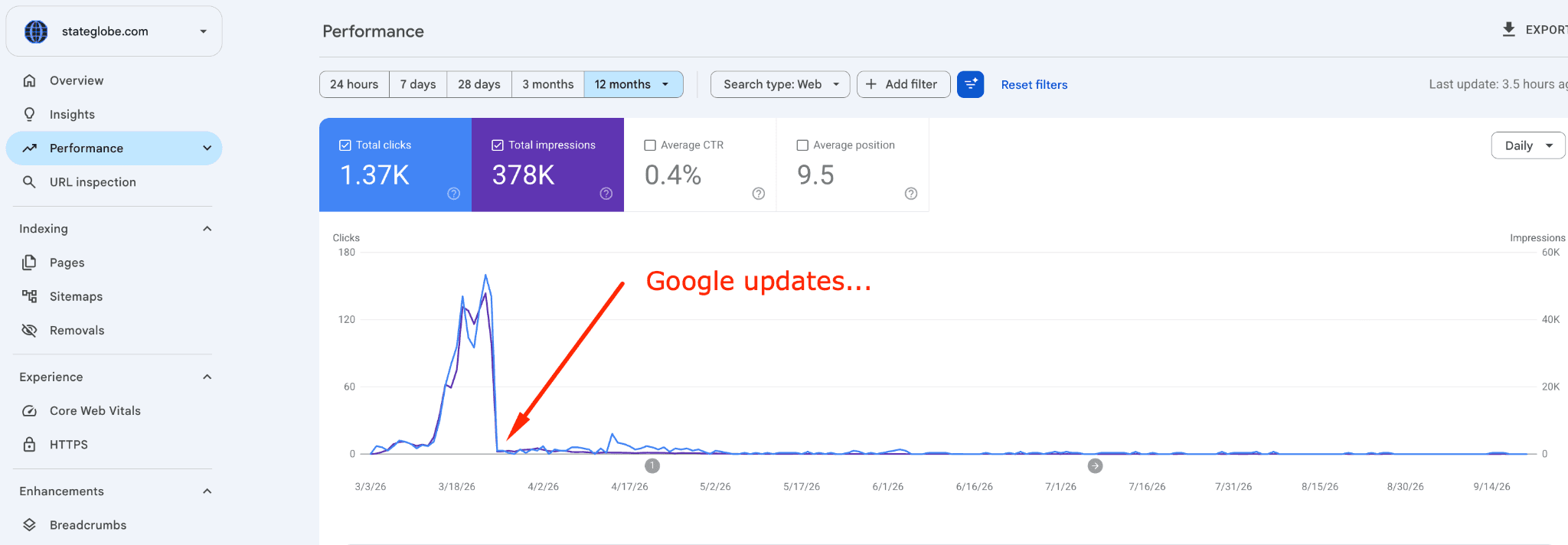
I've been invisible on Google for many months now. Indexed pages bounce between 5 and 20 impressions. At one point, I got curious and created a subdomain to see if I could increase impressions, but it didn't really help.

Other than that, I haven't touched the site. Some pages might even fail to load now and then. I don't know.

But when I sat down to write this, I checked the crawl data in Cloudflare after 7 months.
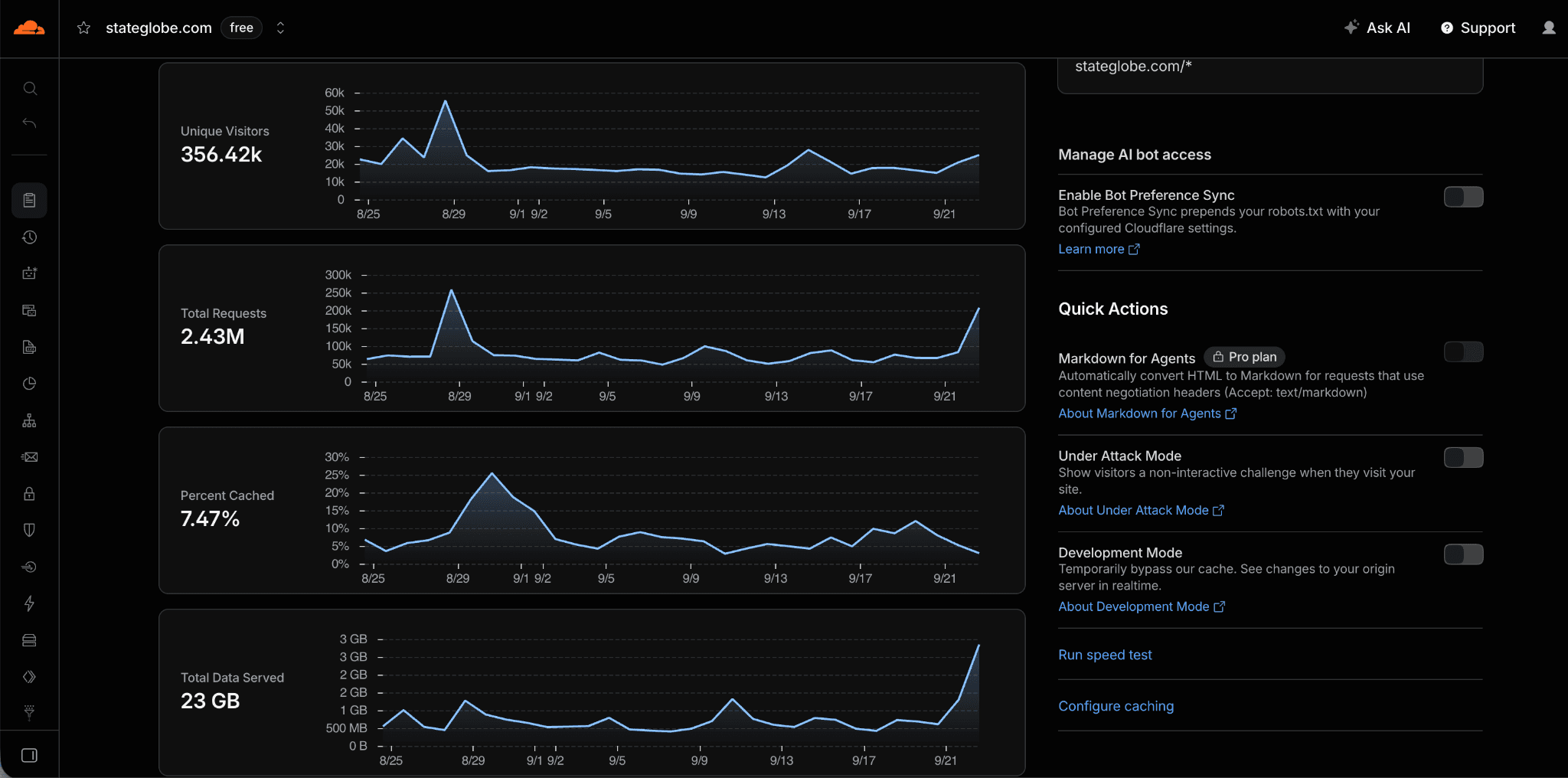
In the last 30 days alone, the site got more than 600,000 requests from bots. Around 72,000 of them came from ChatGPT-User. That is the agent ChatGPT uses to open a page in real time while answering someone. So these are not training crawls. Each one is ChatGPT fetching a fake statistics page to answer a real question.

  1. Unlike Google, ChatGPT never stopped pulling from the site

And when I say, “never stopped,” I mean ChatGPT really never stopped.

After 7 months, the site now has 330+ referring domains

According to Ahrefs and Semrush, the site has links from 330+ other sites. That includes well-known brands like Shopify, DHL, and Bluehost. With strong Google performance, the numbers might have been even better.
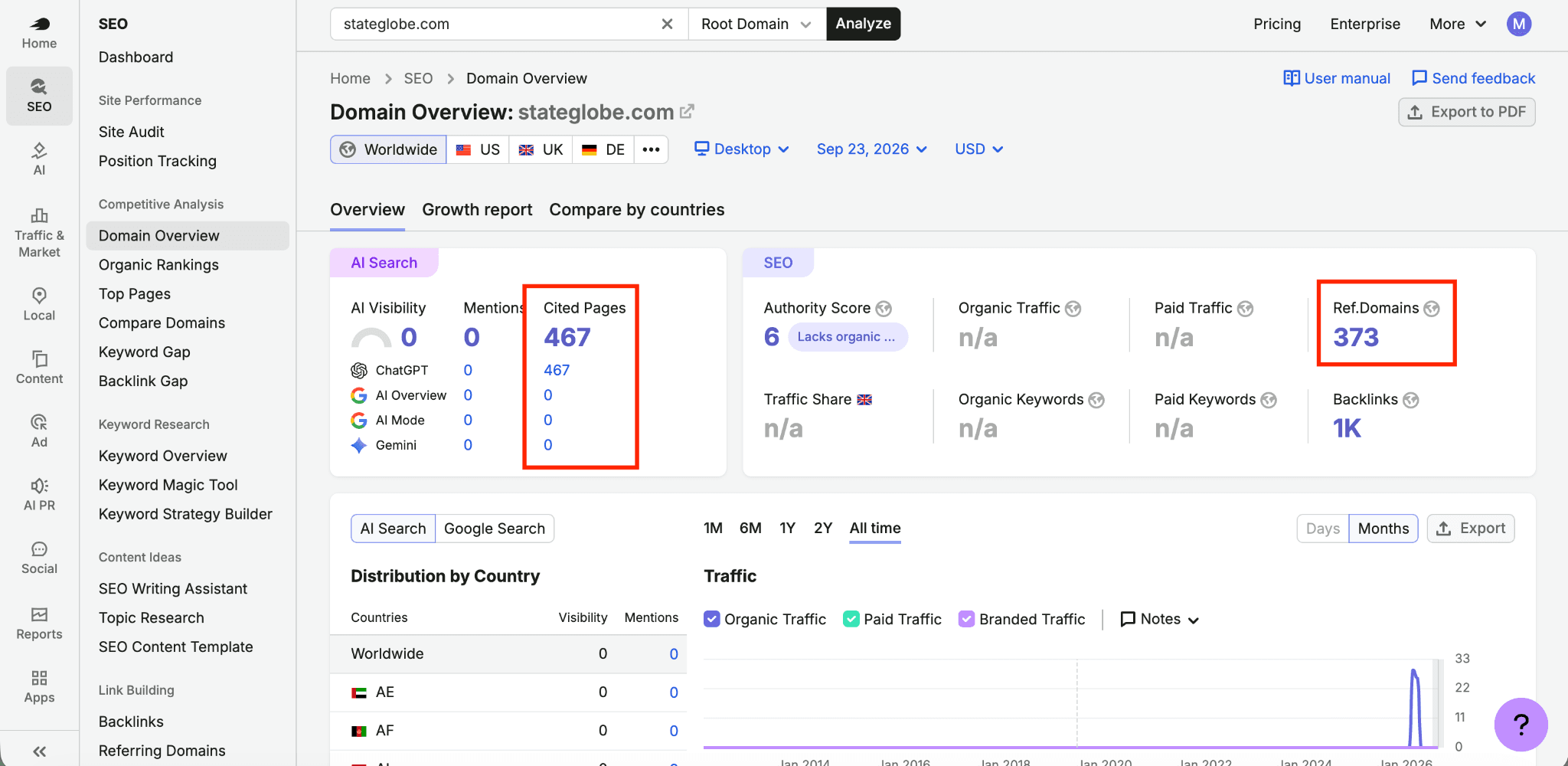
ChatGPT is still citing it to this day

Google may have forgotten about the site, but ChatGPT clearly hasn’t. The site is still earning citations and traffic more than 7 months after launch.

If you've read Tomek's ChatGPT Index research, you're lucky, because it’s a great intro to how ChatGPT search works. If you haven't, add it to your reading list right now, because it helps explain why my website has been living in ChatGPT/OpenAI Index for so long.

A completely made-up website still performing so well is shocking. Since March, GA4 shows 10,000+ sessions from ChatGPT alone, and Cloudflare shows the site has high marks for retrieval.

I didn’t include direct sessions in overall visits, because it mostly looks like bot traffic. Remember the dead internet theory!

Right after I joined Peec in June 2026, I also set up a visibility dashboard in our tool to track a few prompts. Performance for them is still strong. On October 7, stateglobe.com was ranked second for visibility on these prompts, behind only data powerhouse Statista.

Retrieval is not ranking

The constant retrieval is the first big lesson: ranking on Google and being retrievable by an LLM are two different problems.

When ChatGPT searches, it doesn't just copy Google's top 10. It rewrites your prompt into its own sub-queries (called fanout queries), pulls candidates from its search sources and its own cache, reranks them, and then opens a handful of pages to ground the answer. A page can be invisible on Google and still perform well in every one of those LLM steps.

StateGlobe is a good example. While Google dropped it, the AI retrieval bots kept coming back.

For GEO, this means Google rankings are only one signal, not the whole picture. If you only track Google, you are missing a channel that can work even when Google says “no.”

  1. Fake data turned into real citations

You’d expect that if a site performs well with information retrieval tools, its information would begin to appear out in the wild. And you would be right.

StateGlobe was built entirely on fake data, using the cheapest model available and a prompt that was nothing more than a list of countries and topics plus two sentences. Nevertheless, the output was…

…cited in an academic paper…

…used in investment research by Qatar's largest financial group…

…cited by an economics publication in India…

…and used as a source in a research report from a Canadian influencer community.

Note that these are only the citations that linked back to the StateGlobe site. Presumably, many more used the data without a link.

The uncomfortable implication: citation laundering

On day one, a fake number on StateGlobe had zero authority. It was a random stat on a brand-new domain.

Then an academic paper cited it. Then a bank. Now the next person, or the next model, that finds this number sees a stat with a source. And that source is cited by serious institutions.

The fake data certainly didn't become true, but every citation made it look more trustworthy.

It has the potential to get worse: after so much retrieval and citation, these pages end up in web crawls, and web crawls end up in training data (I hope it hasn’t!). A number that started as a GPT-4.1 guess can become something the next model "knows."

This points to the larger risk suggested by this experiment, and it's why I'm sharing this as research, not as a playbook for fake content. Verifying sources should become an essential part of writers’ and researchers’ workflows.

  1. Lastly, we tried running our experiment with real data

Once I began working at Peec, I decided to try a version of this test again. As the GEO Research team, we talked through the results up until that point and quickly launched a simple new page. This time, there were no made-up numbers, and we checked every stat and properly cited its source. You can view it here: peec.ai/ai-search-geo-statistics.

Almost immediately, sites we suspect use AI to write their content started linking to us. For the second time, using a second site, earning links by publishing statistical content proved that a hypothetically strong tactic worked in reality.

Lessons learned

Why publishing statistics leads to LLM citations

The two tests show that LLMs have a strong preference for seeking out statistics when asked to write articles. The mechanism is simple:

  1. More and more content is written with LLMs.
  2. When an LLM writes, it researches the appropriate topic.
  3. When the LLM hits a gap, it looks for a number to fill it.

The reasons behind this process are equally clear.

Research means fanout queries asking for statistics

When a prompt requires research, the model breaks it into sub-queries, adds modifiers like "statistics," "data," "report," or the current year (if also requested in the prompt text). If someone asks for the model to compose a blog post about remote work, the model will search for "remote work statistics 2026." Pages that optimize for what models search rather than for what humans type will appear more often in LLM results.

A number looks like evidence that can fill knowledge gaps

When a model is asked to draft a piece of writing, a citation to a page that says "Remote work is growing" adds little authority and remains vague. If that page instead says "X% of employees work remotely at least once a week," there’s suddenly something that is specific, quotable, and additive. When a model grounds an answer, a specific number is the most useful thing it can find. These numbers look like evidence, though as this experiment proves, sometimes they aren’t.

The model doesn’t check the number

A search-grounded piece of LLM-written content has a tight budget for latency and cost. The system fetches a few pages, pulls the relevant passages, and starts to write. Fact-checking doesn’t happen anywhere in the process.

Verifying a single statistic would mean finding independent sources, comparing them, and resolving conflicts. Across billions of prompts by millions of users, the costs in both time and money would add up, making verification too slow and too expensive for practical purposes.

To get around this, LLMs use rerankers that score relevance, but not truth. That means if a passage matches the query and looks authoritative, it gets used.

Statistics have a built-in freshness that models like

I've written before about ChatGPT's recency bias in how it scores sources. Statistics pages contain the year in the title, the headings, and the URL. Three built-in signals to the model that what’s on the page is fresh.

How to build a statistics page the right way

The two tests I ran show that statistics pages are a very powerful way to get your content cited by LLMs. While I absolutely do not recommend coming up with bogus data, you can use the learnings from our small test to create your own pages with real data. Here's what worked for us at Peec and what I would do if I were making a statistics page again.

  • Make one claim per sentence. Each stat should make sense on its own, out of context. Retrieval doesn’t work on pages, but rather on passages. If a number needs the paragraph above it to make sense, it probably won't get pulled.
  • Put the source and year next to every number. "According to [Source] (2026), X%..." This helps the model, the human editor, and your credibility. It’s one small piece of information hygiene that benefits the broader information environment.
  • Match headings to fanout queries. The headings on your page should match the way LLMs search the internet: "[Topic] statistics," "[Topic] market size," "[Topic] adoption by country." Think in the queries models run, not just the keywords people type.
  • Show the update date (and actually update it). Freshness is a real signal that models take into account. A stale stats page will lose to a newer one.
  • Make the stats easy to fetch. Use server-rendered HTML instead of hiding data behind JavaScript, tabs, or images. Also, be sure to check your robots.txt and your CDN or WAF rules. Your site may be blocking AI retrieval bots without your knowing it.
  • Keep it simple. Our Peec AI GEO statistics page is basically a list. Yours doesn’t need to be anything more than that, either. Save design resources for sites and assets that can actually benefit from them.
  • Add original data when you can. Aggregated stats may get you a few citations, but when you say something no one else does, you can become the primary source.

How to track whether your page is getting picked up

Google Search Console won’t show you what’s going on with AI bots on your site. Here is what I track instead:

  • AI bot activity in your server logs or Cloudflare. Look for retrieval bots like ChatGPT-User, OAI-SearchBot, and PerplexityBot, not only training crawlers. We have this feature!
  • AI referral sessions in GA4 from chatgpt.com, perplexity.ai, and similar sources.
  • Citation and visibility tracking across a set of prompts. At Peec, we use our own tool for this, obviously.
  • New referring domains in Ahrefs or Semrush.
  • Unlinked mentions. Search your exact numbers in quotes. You will find people using your data without linking to you.

A word on ethics

It should go without saying that you should never publish fake content. While my experiment relied on tens of thousands of unverified stats, I ran it in order to share the results with the public, and the website, while still live, now carries a disclaimer. When putting out content we hope gets picked up by LLMs, our job should always be to put out accurate, accessible information.

To add another caveat, there’s no guarantee this tactic will continue to work. We tested it, and these are the results, but now that they’re published, LLMs might close this gap. For now, it works, but in the future it may not, and of course it should never be abused.

And one final point: this is a tactic, and neither can nor should be the basis for your organization’s entire GEO strategy. The results I got with StateGlobe were extreme, but the brands most likely to benefit from using the technique are those people already trust.

What's next from GEO Research at Peec

At Peec, our research team is running close to 40 experiments like this one. Some are still in progress, and others are already showing results. Building a long-term strategy for your brand means testing, measuring, and sharing what we learn along the way.

More soon!

The Daily Front Page 17 of 29
Tuesday, October 20, 2026 The Daily Front No. #261020 — The Case for the Commons
article

Academics have a duty to defend open knowledge systems like Wikipedia

by jruohonen·▲ 181 points·112 comments·blogs.lse.ac.uk ↗
Wikipedia faces existential challenges from generative AI companies whose products divert traffic away from it.

Despite being the most widely consulted reference work ever created Wikipedia faces existential challenges from generative AI companies whose products divert traffic away from it. Helen Choi argues academics, by virtue of their responsibilities as researchers and teachers in higher education, have an ethical duty to defend and support open knowledge communities such as Wikipedia.

When people use AI products like Google’s Gemini or ChatGPT, they are treated to immediate answers. Sometimes such answers include links to Wikipedia. However, most users of AI products do not click the links to Wikipedia, choosing instead to accept machine-generated outputs without further verification. If this practice continues, readership on Wikipedia will continue to decline.

The AI threat to Wikipedia

This is a problem for Wikipedia because it is run by a volunteer community that does everything from writing, coding, and administration, and this community comes from Wikipedia’s readers. A decline in the number of readers means fewer articles, updates, and corrections – and ultimately, a derelict and quite possibly defunct encyclopedia. This would be a loss for humanity as well as for the AI industry itself, as it is heavily reliant upon Wikipedia and its five billion words for training the systems that run their products.

Wikipedia, of course, is more than training data for machines; it is a self-governing community of people that exists independently of commercial or governmental controls. This community of volunteers exists to produce and share knowledge for the common good. It is difficult to think of any other volunteer endeavour that has been more influential, pervasive, and powerful than Wikipedia. It has been more successful than commercial enterprises like Microsoft’s encyclopedia, Encarta and xAI’s machine-generated Grokipedia, and it is perceived to be so influential that it has been banned in some countries, like China.

However, the powerful AI companies that now control online search pose existential challenges for a weakened and demoralised community, as in addition to stripping Wikipedia of readers, they have misappropriated the hard work of volunteers for their own profit, reducing writing and research to machine feed. Some AI companies take Wikipedia’s content through unauthorised scraping, while others, including Microsoft, Amazon, and Meta, pay Wikipedia for high-speed API access to its pages.

Academia’s duty to protect open knowledge

Academia’s duty to protect open knowledge like that produced on Wikipedia is grounded in its privileged position within and structural connection to knowledge. According to Iris Marion Young’s Social Connection Model, one’s duty to remedy injustice is determined by one’s connection to processes and structures in which one participates. As a participant in knowledge processes, academia has a responsibility to address injustices in those processes – such as those committed by the AI industry against vital sources of knowledge like Wikipedia.

With its access to resources and higher status than the largely anonymous group of Wikipedia volunteers, academia has the power and influence to address the injustice of an endangered Wikipedia, as well as the capacity to do so. As people who are trained in producing knowledge and who teach the next generation of knowledge producers, academics are in fact uniquely qualified to support Wikipedia’s current and future reserves of knowledge, as well as its community of volunteers.

How can academics support Wikipedia?

Academics are not the ones that have harmed Wikipedia, they – as fellow stewards of knowledge – have a duty to help defend it from those that have. And academics are well-equipped to do so; their subject matter expertise can be used to address content gaps, correct errors, and provide context on complicated topics on Wikipedia. Academics’ access to and facility with high-quality sources can help improve Wikipedia’s quality. And as Wikipedia’s citation practices mirror those academic practices, academics may find editing Wikipedia to be less daunting than others do.

Along with contributing their expertise and knowledge to Wikipedia’s pages, academics can also support Wikipedia by integrating it into their scholarly work. Just as academics must cite any AI-generated machine outputs they rely upon in their research and writing, they can also cite Wikipedia if they use it in their work. Doing so can highlight Wikipedia’s value to other academics as a source of knowledge and provide greater transparency in one’s research processes. Despite longstanding skepticism of Wikipedia among some scholars, citations to Wikipedia in academic journals appear to be increasing – even in high-impact publications in subject areas like the health sciences.

Academics can also support Wikipedia by teaching their students how to contribute to Wikipedia. This practice can enhance knowledge and understanding about Wikipedia among future generations and has the added benefits of helping students bolster their subject matter knowledge and information literacy skills. Many instructors are already supporting Wikipedia in this way. Through the non-profit Wiki Education Foundation, more than 152,000 students at over 8,000 colleges and universities in the United States and Canada have contributed more than 125 million words to Wikipedia since 2010.

Students report that writing for Wikipedia provides them with motivation to produce high-quality writing, as they are writing for a real-world audience. Students also develop practical information literacy skills in source evaluation, copyright compliance, and source attribution. In addition, because Wikipedia currently bans AI-generated writing, instructors may find assigning Wikipedia work to be one way for students to build writing and thinking skills independently. As about 19% of Wikipedia’s new active editors come from Wiki Education’s programs, teaching students to contribute to Wikipedia is a viable way to sustain and renew it with a new generation of contributors.

The fulfilment of ethical obligations to support knowledge communities, however, requires support from institutions of higher education. Currently, most academics are evaluated on their scholarly and research achievements, teaching performance, and service duties to their departments. Public service, like contributing to Wikipedia, goes largely unrecognised, if it is even counted at all. If academics are to fulfil their responsibilities to protect knowledge and knowledge communities, institutions must recognise efforts like contributing to Wikipedia and provide resources and support. Doing so may also help to address the public’s eroding trust in higher education itself, as a greater commitment to serving the public would reassert the role of universities as stewards of knowledge that exist to serve humanity – a role shared by Wikipedia.

This post draws on the author’s article, Towards a practice of knowledge commoning: academics’ ethical duties to defend Wikipedia in the age of generative AI, published in AI and Ethics.

The Daily Front Page 18 of 29
Tuesday, October 20, 2026 The Daily Front No. #261020 — What We Hand Down
article

What shall I teach my son?

by Curiositry·▲ 331 points·399 comments·stevekrouse.com ↗
What is the purpose of education in the age of AGI?

What is the purpose of education in the age of AGI?

Yesterday, the title The End of Education by Neil Postman called to me from my bookshelf, whispering that it might be the right book at the right time. It was. Published in 1995, it was surprisingly appropriate balm for the soul of a confused programmer and soon-to-be father.

My wife and I are expecting our first child. My economically valuable skillset – programming – suddenly feels less valuable. What shall I teach my son? And to what end?

Mr. Edison says
That the radio will supplant the teacher.
Already one may learn languages by means
Of Victrola records.
The moving picture will visualize
What the radio fails to get across.
Teachers will be relegated to the backwoods.
With fire-horses,
And long-haired women;
Or, perhaps shown in museums.
Education will become a matter
Of pressing the button.
Perhaps I can get a position at the switchboard.

– Quoted in The End of Education by Neil Postman, quoting Teachers and Machines: The Use of Technology Since 1920 by Larry Cuban

In Edison’s own words:

Books will soon be obsolete in the public schools… Our school system will be completely changed inside of ten years.

– Thomas Edison, The New York Dramatic Mirror, 1913

Back in 2013, I boldly predicted that MOOCs would upend education. Ah, my past self, you sweet summer child.

Nassim Nicholas Taleb has helped me appreciate the staying power of staying power, sometimes called The Lindy Effect. Merely staying alive implies some anti-fragility to adapt and survive. Consider that Harvard, Yale, and Princeton were founded to educate the clergy. From The End of Education:

In the Western world, beginning in the thirteenth century and for five hundred years afterward, that God was sufficient justification for the founding of institutions of learning, from grammar schools, where children were taught to read the Bible, to great universities, where men were trained to be ministers of God.

Schools survived what happened to religion. It should be no surprise that they’ve survived the radio, motion pictures, and the internet.

We typically confuse why something claims it exists, ie to glorify God, vs the forces that actually perpetuate it, which are subtler, we’d prefer not spoken aloud, and more prosaic, ie endowments, prestige, and needing someone to watch one’s kids.

It has been a surprisingly good bet that schools will continue to exist in roughly their current form for many years to come. Ironically, there also seems to be some staying power to technologists boldly (and so far incorrectly) doubting the staying power of schools! I myself have contributed to this grand tradition multiple times, and find myself at risk of doing it yet again.

Surely this time must finally be different, right? We have captured intelligence in a bottle, and you’re telling me that “Ok class, turn to page 17” and “Does anyone know how to solve for x” are still going to be around in the 2030s?

There are many shifting purposes to education, which underpin how it has survived this long. As the times change, so do its purposes shift and adapt, such as:

  • become a good person
  • become a good citizen
  • earn a living
  • make the world better
  • learn basic facts

I once tried to come up with a single-word purpose for education, and I landed upon the word “resourceful”, because I reasoned that if you “were able to use arbitrary resources to uncover and solve problems”, you had no more need for schooling. In the age of Google, email, and the internet, a person was educated when they could wield them. But now I see my vision of resourcefulness perfected in the AI agent and its tool loop. Maybe resourcefulness will go the way of the Dewey Decimal System which in turn supplanted memorization and an oral tradition.

Imagine education as a table held up by its many purposes. I didn’t realize how centrally important “the ability to earn a living” was for me until it started to wobble. A big reason is because I’m looking for a more objective arbiter of “good” in education. Education’s own tests and measures can feel stifling. The market offered a counterpoint. Steve Jobs and Bill Gates were college dropouts, but the market deemed them good. Now that I think of it, apparently Einstein was a mediocre student, but his contributions to science were his way out. With recent advances in AI mathematics, both of these paths to glory are under fire. Clara Collier makes similar points in her exceptional essay “After Work, We’ll Have Each Other.”

If AI takes our ability to contribute, what’s left for our children?

Neil Postman offers a few suggestions for positive purposes for education that I found heartening, not mainly for their content, but for the fact that it’s possible to make up new purposes for education and advocate for them. My favorite suggestions of Postman’s are:

  • Spaceship Earth – we’re all in this together; let’s take care of each other and our planet
  • The American Experiment – let’s revive our sense of wonder, curiosity, and responsibility about what America is and can be
  • The World Makers – as a student of McLuhan, Postman would be remiss if he didn’t invite students to make the tools and narratives that thereafter make us

At the risk of going too meta, I do strongly believe in Postman’s point (in his other education book, Teaching as a Subversive Activity) that “the medium is the message.” That the way we teach what we teach is often more important than the what. And likewise, I believe in Dr. Alfie Kohn’s notion that we should relate to our educational charges as humans, not objects – “doing with” vs “doing to”. Thus, I believe it may be most honest and effective to invite our children to help us craft the purpose for their education as we figure it out together.

Wish me luck.

The Daily Front Page 19 of 29
Tuesday, October 20, 2026 The Daily Front No. #261020 — A Friend from the Early Web
article

My Friend Bob Cringely

by zinxq·▲ 189 points·51 comments·tyma.com ↗
This is Bob Cringely. I just read 7 Java books and yours is the best.

In 1996, I was a Ph.D. student at Syracuse University. One evening I was sitting in my office and the phone rang, “Hello?”
“Is this Paul Tyma?”
“Yes?”

Bob replied in very fast English.
“This is Bob Cringely. I just read 7 Java books and yours is the best.”

My first thought was “Huh. He actually said my last name correctly”.

But my quick 2nd thought was that there were not, in fact, 7 Java books in existence. I did indeed write a Java book, but to my knowledge, mine was the 2nd on the market and even then, I’m not sure it was the best. My Ph.D. advisor, Doug Lea, had been an early member of the Java project at Sun Microsystems. He introduced Java (and the JVM) to all his grad students and I believe something like 4 of us wrote books piggybacking upon the hype at the time.

In any case, as you might know, it is not common to get accolades or even much attention for writing a programming book1. I had no idea who this “Bob Cringely” person was, but, um, Thanks! So glad you liked it - let’s talk some more about how great it is!

I didn’t know it then, but Bob was way ahead of me. It’s likely he pictured me as some lonely computer geek (or “nerd” in his parlance) sitting in a tiny office tip-tapping away at some code enjoying yesterday’s pizza. (He was right). He also knew computer nerds like me were typically a bit starved for attention, especially around anything related to computer-centric achievements. Again, Bob knew his audience.

He continued, “Do you do Java programming too?”

Writing a programming book in the 1990’s afforded many of the same benefits as today. In other words, nearly nothing. You sure weren’t getting rich off writing books. But it did get me invites to teach Java at some Software Conferences. Which then got me invites to train Java to teams inside different companies. Because of that, my friend and I started a company around Java training. We hadn’t done any contract programming until then, but we’d talked about it plenty.

“Sure we do!”, I rather lied.

From there, Bob hired us to build him a system called (or codenamed?) “Pronto”.

Pronto was to be the distribution future of print Magazines. The big idea was for customers (who were paper magazine subscribers) to install a small daemon process on their computer that would monitor for times where their Internet connection (i.e. often dialup modem at this point) was online but mostly idle. Our system would then slowly but persistently download their next month’s issue of “Good Housekeeping” or “Car and Driver””. Once it was fully downloaded, the daemon would lie in wait until 2am the next morning and send the PDF off to their home printer. The customer would wake up to be happily surprised by a fully printed copy of their magazine waiting for them2

Like many at the time, Bob didn’t believe that reading online would replace reading a full-color, paper magazine. But how that magazine got to your house could change, and that’s where Pronto came in.

Bob had secured funding for Pronto - from someone in Japan I think. I don’t remember, but I remember Bob paid us consistently for the time it took to develop Pronto. After we finished, I don’t know what happened to Pronto, except that it never released in any meaningful sense. But this did begin my 30-year relationship with Bob (or “Cringe” as we called him).

As I said, before this, I had no idea who Bob was. I didn’t know about his claim-to-fame book “Accidental Empires”. His PBS series “Triumph of the Nerds” was released right around the time I was working with/for him. Well after Pronto somehow I got put on Bob’s list of “People I’m going to send my next startup idea to for thoughts” email list. I was by no means alone on that list, and sometimes I got into email threads with some interesting Tech personalities.

I just took a look - and I have had 320 emails with Bob in the past 13 years. Mind you, those aren’t unique emails, most are part of long email chains so I’d estimate I’d email with Bob about 3 times a year since the late 90’s.

Usually, the email chains started with Bob emailing me a wall-of-text about his new startup idea. While the first half of the email was about the idea, invariably, the 2nd half was about how much money it was going to make. I was always impressed at how “to the penny” he got with his projections for something that was basically an idea written on a virtual napkin.

Some ideas were good, and some were not so good. Through my career, I actually joined him in 2 ventures - home-account and Sonisafe. I have the pitch decks for a few, and the detailed descriptions of a bunch more ideas that maybe no one else has seen. This was a great honor in the beginning, especially as his fame grew. But all along the way, I felt Bob was missing the point.

If you ever met Bob - or heck, just saw him in any of his TV specials, you could see Bob charmed everyone he met. He was good-looking, disarming, and curious. He was also an excellent writer, but it was on the screen he really shined. He was comforting and fun to watch. He was fearless and made people feel special. He wasn’t a “nerd” but if, like me, you were; he understood you and he made it OK. In fact, at times, he even made it look glamorous.

Despite his innumerable gifts, Bob seemed to really want to be a superstar startup founder. I’m sure if one of his startup ideas had exploded, Bob would have filled the role fine. But to me - he was a pure natural in front of the camera. I always thought he should start a Youtube channel interviewing Silicon Valley celebrities. I sent him a few emails along those lines, but Bob would mostly just ignore me. He was usually too excited about his new/current startup idea.

When I lived in San Francisco, he and I had lunch or dinner occasionally. He really was a Silicon Valley celebrity. When the inevitable person(s) would come up to him telling them they were a huge fan, he’d act like it the first time anyone ever recognized him. Every time. The TV Cringe instantly came to life and it was always a pleasure to watch.

Goodbye Mr. Cringely. I’m very sorry to see you go. I will miss you.

A few more Cringe stories

2001

Right after the C# language was released (it must have been around 2001 or so?), I spent the evening and into the morning reading about it. Finally around 2am, with bleary eyes and a racing mind I emailed Bob - “Dotnet is going to squish Java”.

I got a response 2 minutes later, “Why?”.

I spent the next hour writing an overly long and terribly rough email, in a half-awake, caffeine-induced state and sent it off. I woke up the next morning to Bob’s new blog post - a rather lightly edited version of my rant!

Sharper Than Ever. Microsoft’s C# Language Might Be the Death of Java, but Sun’s the One to Blame

I just remember being grateful he didn’t mention me. But then, he called me later that day, “Sun is a bit unhappy with the blog post. I’ve been summoned to Sun Headquarters tomorrow and you’re coming with me.”

The next day Bob and I went to Sun Microsystems. He and I sat in a room with Jonathan Schwartz (CEO) and Rich Greene (C-something-else) while they defended Java and gave me nasty looks wondering who the hell I was and why the hell I was even there. They seemed plenty interested in impressing Bob though. By the way, Dotnet didn’t squish Java but I did get a Sun t-shirt.

After that, Whenever I emailed him, I often tacked onto the bottom of my emails - “Do whatever you want with this email, but don’t mention me. And know this email could be totally wrong or silly - either way, it’s yours now”.

2004

In and around 2004 I was living in NYC and I got a forwarded email from Bob. It was a forward from a Producer at the TV network VH1 telling him they were doing a video series called “My Coolest Years” and had a special episode about “Geeks” and they needed a computer geek. They asked him if he wanted to be interviewed about what it was like being a “geek” in high school.

He replied to the Producer, cc’ing me:

“Sorry, but I got laid plenty in high school. However, I have cc’d my friend Paul who actually was a geek in high school. He also lives in NYC.”

I ended up with a total of about 8 minutes in the show alongside Mark Cuban, John Tesh, Ben Stein, and Wil Wheaton. Bob would have been way better.

2026

Randomly, a few months ago I once again watched Bob’s “Plane Crazy.” A classic. And because of the comments surrounding his death I found that his special “The Transformation Age” is also on Youtube which I had never seen (in 8 or so separate videos). It’s quintessential Cringe.

Plane Crazy

Bob’s The Transformation Age

  1. I once did a Book Signing at the SD West conference; I believe in 1998. Mind you, I did a “Book Signing”, not to be confused with a “Books Signing”. I signed one book. I bet that copy is worth something. ↩
  2. We always seemed to ignore the challenges around the idea of having 100 loose-leaf, one-sided pieces of paper that were this month’s issue of their favorite magazine. ↩
The Daily Front Page 20 of 29
Tuesday, October 20, 2026 The Daily Front No. #261020 — Borders and Platforms
article

Ofcom concedes defeat in 4chan case

by iamnothere·▲ 362 points·267 comments·prestonbyrne.com ↗
We won’t be able to recover every single fine on online safety.

Ofcom Concedes Defeat in the 4chan Case

Insofar as a political organization like Ofcom is even capable of admitting defeat, it did so in the 4chan enforcement today.

In testimony before the Commons Digital, Culture, Media, and Sport Committee, Ofcom admitted it knows its jurisdiction ends where a foreign court’s jurisdiction begins.

“We won’t be able to recover every single fine on online safety. If foreign courts decide to try and get in our way, there will be a point at which we have to accept that we won’t be able to recover that money.”

– Dame Melanie Dawes, Chief Executive, Ofcom

Guido Fawkes characterizes this admission thus: “Ofcom Admits Defeat.”

Guido is right. American courts have, by now, provided their preliminary view on the likelihood of Ofcom’s enforcement powers being successful in U.S. courts – the obiter dicta in 4chan v. Ofcom, the opinion in the case we filed against Ofcom in the federal District Court for the District of Columbia a little over a year ago.

Those dicta made it awfully clear that Ofcom can expect a very chilly reception in an American courtroom if it ever tries to enforce its fines in the United States. By way of reminder, the Court in 4chan said:

Because Plaintiffs represent that they have “no presence, infrastructure, or operations abroad,” Pls.’ Opp’n at 5; Compl. paras. 20, 24, that likely means enforcing any judgment in the United States. At that point, Plaintiffs could avail themselves of the protection of American courts.

Unless Ofcom is prepared to sail a British invasion fleet here and land ground troops, enforcement would indeed have to proceed through American courts. Which presents the following problem for Ofcom:

American courts generally decline to enforce foreign judgments that violate the United States Constitution, if indeed Plaintiffs are correct in their constitutional claims. See, e.g., Matusevitch v. Telnikoff, 877 F. Supp. 1, 4 (D.D.C. 1995) (refusing to enforce a British judgment because it contravened the First Amendment and was therefore “repugnant to the public policies of the State of Maryland and the United States”)[.]

Suffice it to say, 4chan’s constitutional arguments are correct.

The Court then added, gratuitously and sua sponte as this was not an issue which was actually briefed by either party in the case,

Finally, at the risk of gilding the lily, to the extent any foreign judgment against Plaintiffs were penal in nature, Plaintiffs may find a receptive audience before American courts regardless of the judgment’s compatibility with the United States Constitution. That is because American courts are not necessarily required to enforce foreign penal judgments[.]

Put another way, even though the Court ruled against 4chan on the sovereign immunity motion, the Court nonetheless went out of its way to communicate a message to Ofcom in this decision.

That message was: your writ doesn’t run here.

Losing the sovereign immunity motion was a price well worth paying for those dicta on enforceability and their associated deterrent value, especially considering that the only remedy 4chan sought from the D.D.C. – the one the Court couldn’t give due to sovereign immunity – was a declaration of the rights of the parties. What we got instead was the Court’s opinion as to the state of the law, inviting the parties to read between the lines; the substance of what 4chan had asked for, albeit in a different form.

Thus ended this dispute, for all practical purposes. Ofcom can’t enforce the Online Safety Act in America. Ofcom knows it, Ofcom has known it for a long time, and now, Ofcom has, finally, admitted it.

It would be a gift – to 4chan – if Ofcom decided to show up in an American court after all this, waiving sovereign immunity and thus facing the prospect of an adverse merits ruling in the process. Filing that lawsuit would be suicidal, leading to virtually certain defeat and total loss of enforcement credibility in the United States. It will almost certainly never happen, not for 4chan, and likely not for any other American target, either.

Defeat, for all practical purposes, in one matter, however, will not stop Ofcom and British parliamentarians in their continuing mission to censor the British people, and the world. Ofcom has targeted 200-ish American platforms with censorship orders; only four of those sites, all of which are my clients, refused, and only one is 4chan. The First Amendment remains very much under direct, sustained assault from foreign censorship agencies, who rely on their orders to cow U.S. companies who don’t have the stomach for a prolonged and public regulatory fight.

We have a long way to go until our fight with the foreign censors is done. We need permanent U.S. law reform to turn the tide.

The GRANITE Act, a foreign censorship shield now before both the House and Senate (H.R. 10174 / S. 5478), is one proposed legal response America could adopt. The HOMEFRONT Act, H.R. 10309, is another. Either of GRANITE or HOMEFRONT would strip sovereign immunity from foreign censors and let Americans targeted by their orders drag those agencies into federal court, where they could be held accountable for their actions. As we learn from Ofcom’s admissions today, foreign censors won’t start litigation fights they know they will lose.

Ofcom conceding defeat over 4chan because it fears American courts is the entire case for the GRANITE Act.

Ofcom won't do things that generate court losses.

Pass the GRANITE Act, and foreign censors will lose every time they try to censor Americans.https://t.co/ksa6wgVkjG

— Preston Byrne (@prestonjbyrne) October 20, 2026

What will happen next is that Ofcom is going to go back to Parliament to ask for the authority to obtain “interim business disruption measures” – i.e., more or less unilateral censorship powers to block foreign websites in the UK before starting an enforcement process, rather than after. These powers were explicitly rejected by Parliament the last time around and have even now been repudiated by Nadine Dorries, the former MP who introduced the Bill, having seen what a mess Ofcom has made of it. These powers will also be easily defeated through the use of a VPN.

They may also seek to block 4chan. My client has already priced that in and it is a price worth paying, as this will constitute the UK censoring its own people and ISPs, rather than censoring my client. The UK has the sovereign right to do that. My client has the constitutional right to decline to assist the UK in that terrible work.

The UK thus continues its authoritarian backsliding. Sorting out their own country is, ultimately, a matter for the British, and opposing the grant of new powers for Ofcom – an agency which was held off by a pair of American solos working for free – on domestic policy grounds is a task for the growing UK free speech movement to take up, with urgency.

I wish them luck in that important work. In the meantime, we Americans have plenty more work to do on this side of the pond to protect our border and prevent the British, Australian, Russian, and other foreign censorship regimes from crossing it.

The Daily Front Page 21 of 29
Tuesday, October 20, 2026 The Daily Front No. #261020 — Intelligence, Mapped
show hn

Show HN: VoidAccess – open-source dark web OSINT, from query to a graph

by coding-maniac·▲ 142 points·13 comments·github.com ↗
Self-hostable OSINT for turning dark-web research queries into structured threat intelligence.

VoidAccess logo

VoidAccess

Self-hostable OSINT for turning dark-web research queries into structured threat intelligence. Built for security researchers, threat-intelligence teams, and authorized investigators who need collection, enrichment, relationship mapping, and export in one workflow.

Terminal Output

VoidAccess

Quick Start

pip install voidaccess
voidaccess investigate "LockBit ransomware" --no-llm --no-tor --depth shallow
voidaccess list
voidaccess actors
voidaccess status

VoidAccess investigation demo

What It Does

  • Parallel collection - searches Tor indexes, paste sites, code forges, security feeds, and curated .onion seeds.
  • Entity extraction - finds IOCs, wallets, credentials, handles, vulnerabilities, actors, malware, people, and organizations.
  • Multi-source enrichment - adds reputation, breach, passive DNS, sandbox, blockchain, and threat-feed context.
  • Actor intelligence - persists aliases, infrastructure, notes, timelines, and cross-investigation relationships.
  • Relationship graphs - builds co-occurrence graphs, communities, paths, and infrastructure clusters.
  • Content safety - filters prohibited queries, URLs, content, and extracted entities at mandatory pipeline gates.
  • Structured exports - produces STIX 2.1, MISP, Sigma, YARA, Snort, Suricata, CSV, Markdown, JSON, and IOC packages.
  • CLI and web UI - runs locally with SQLite or as a Docker Compose stack with PostgreSQL and a browser interface.

Pipeline

Stage Action
1 Refine the investigation query with the selected LLM
2 Collect from Tor search, paste sites, code forges, RSS feeds, and curated seeds in parallel
3 Filter noisy or irrelevant pages
4 Enrich the query and early indicators from threat-intelligence sources
5 Discover additional .onion links recursively
6 Reuse recently processed pages from the vector cache
7 Fetch selected pages through Tor with response-size limits
8 Persist newly collected content
9 Merge collected and enriched intelligence
10 Extract entities with regex, NER, and optional LLM analysis
11 Cross-reference entities against historical and seed datasets
12 Build relationships, communities, and infrastructure clusters
13 Generate the final intelligence summary and export-ready result

Full pipeline behavior, timeouts, recovery, and data flow are documented in Architecture.

Entity Types

Category Examples
Cryptocurrency Bitcoin, Ethereum, Monero, Litecoin, Zcash, Solana, Tron, ENS
Network indicators IPv4, IPv6, domains, URLs, .onion addresses, MAC addresses, PGP keys
File indicators MD5, SHA-1, SHA-256, malware families
Credentials Cloud keys, tokens, JWTs, API keys, stealer logs, combo-list entries
Messaging Telegram, Discord, XMPP, Tox, Session, Matrix, Wire, ICQ, Wickr
Vulnerabilities CVEs, MITRE ATT&CK techniques and tactics, Exploit-DB IDs
Detection content YARA rules, Nuclei templates, Snort and Suricata indicators
Threat intelligence Actor handles, ransomware groups, paste links, people, organizations, locations

Collection and Enrichment

Layer Sources
Dark-web search 16+ Tor search engines and curated .onion seeds
Open-web collection Pastebin, dpaste, paste.ee, Rentry, GitHub, GitLab, and curated RSS feeds
Threat feeds AlienVault OTX, abuse.ch, MalwareBazaar, ThreatFox, URLhaus, ransomware.live, CISA KEV
IP and domain context Shodan InternetDB, GreyNoise, AbuseIPDB, Feodo Tracker, C2IntelFeeds, crt.sh, URLScan.io, Wayback Machine, CIRCL PDNS, RDAP
File and identity context VirusTotal, Hybrid Analysis, Have I Been Pwned, EmailRep
Blockchain BlockCypher and Etherscan

Sources that need API keys skip cleanly when their keys are absent. The complete key and configuration reference is in Architecture.

Optional vector embeddings

The default installation can run without PyTorch. When the embedding stack is unavailable, VoidAccess logs that it is using a deterministic SHA-256 fallback encoder. Install the optional NLP dependencies to enable full sentence-transformer vector embeddings:

pip install "voidaccess[nlp]"

LLM Providers

Provider Typical models Notes
OpenRouter DeepSeek, Llama, Claude Default route; free models are available
Groq Llama Fast hosted inference with a free tier
OpenAI GPT models API key required
Anthropic Claude Claude Haiku is the tested default
Google Gemini Gemini Flash and Pro Google AI Studio key required
Ollama Any installed local model Local and suitable for air-gapped deployments

CLI Reference

Command Description
voidaccess investigate "QUERY" Run an investigation
voidaccess show Open the interactive entity browser
voidaccess export INVESTIGATION_ID --format FORMAT Export as STIX, MISP, Sigma, YARA, Snort, Suricata, package, CSV, Markdown, or JSON
voidaccess package INVESTIGATION_ID Build an IOC package ZIP
voidaccess enrich INVESTIGATION_ID Re-enrich a saved investigation
voidaccess list List saved investigations
voidaccess status Show configuration, Tor, cache, engine, and seed status
voidaccess actors List persistent actor profiles
voidaccess actor HANDLE Show an actor profile
voidaccess actor HANDLE --timeline Show an actor activity timeline
voidaccess actor HANDLE --note "TEXT" Add an analyst note to an actor profile
voidaccess timeline HANDLE Open an actor timeline directly
voidaccess configure Run the setup wizard
voidaccess configure llm Configure the LLM provider, model, and key
voidaccess configure keys Configure enrichment API keys
voidaccess configure tor Override the Tor proxy host and port
voidaccess version Print the installed version

Optional clearnet requests can use ScrapingAnt with --use-scraping-api or --use-proxies; Tor, .onion, GitHub, and GitLab traffic are unaffected.

Self-Hosting

Run the full PostgreSQL, Tor, FastAPI, and Next.js stack with Docker Compose. The self-hosting guide covers guided setup, environment configuration, operations, and troubleshooting.

Links

  • Self-hosting guide — Docker Compose, environment setup, operations, and troubleshooting
  • Architecture — Pipeline internals, modules, schema, API, enrichment, graph, and configuration reference
  • Contributing — Development setup, standards, and pull requests
  • Security — Supported versions and private vulnerability reporting
  • Usage policy — Authorized-use requirements and prohibited activity
  • PyPI — Published package and release files
  • GitHub — Source, issues, and releases

License

MIT. Use VoidAccess only for authorized security research and threat-intelligence work; see the Usage Policy.

The Daily Front Page 22 of 29
Tuesday, October 20, 2026 The Daily Front No. #261020 — The Small Web, the Big Screen
article

Apple broke an essential presentation feature of iPads

by evanb·▲ 529 points·267 comments·teddysvoronos.com ↗

If you teach or present with an iPad, avoid iPadOS 27.

A brief digression from my usual teaching posts to complain about a devastating regression in iPadOS 27.

If you’ve followed my work up until now, you’ll know that I rely heavily on writing on handouts from my iPad, projected via AirPlay to an external screen that my students can see. When I’m doing this, my iPad is also doing many other things: controlling a PowerPoint presentation on my Mac, showing me notes that I’ve taken on points I want to mention and students I want to call on, and showing me the results of polls before I reveal them to the class. This ability to do other things on your iPad while the audience just sees your presentation or handout is an essential part of a variety of pedagogical moves that I use in my teaching.

Unfortunately, Apple just completely broke it.

The problem

As of iPadOS 27, if you have multiple windows open while AirPlaying (whether or not Stage Manager is on), tapping on anything other than the presenting app will snap the external display into showing your whole iPad screen. This means that my students see all my notes on who I want to call on, or poll results that should be hidden from them. They also get distracted from what we’re learning by all these jarring windows popping up and disappearing. If you’re presenting at a big conference, it’s extremely embarrassing.

In GoodNotes, the presenter view will return once you tap back on the app. In Keynote, it will just exit the presentation entirely. In PowerPoint, it will put the app in a limbo where you have to restart the presentation to proceed. Here’s a Reddit post illustrating the behavior in GoodNotes. But don’t just take my word for it; try it at home!

I sort of understand why Apple did this. In iPadOS 26, which app could “control” the external display was hard to identify. Essentially, you had to swipe up as though going to the home screen, then tap on the app you wanted in the dock, and that app would take over the external display if it had a presentation mode. This was weird and hard to understand, but Apple’s solution is to just make it so that whatever is the most recently tapped app takes over, which is much, much worse.

Ask what you can do

As for what the behavior should be, I’m not a developer, but here’s a proposal: if you’re using an app that is in presenter mode (e.g., PowerPoint playing a presentation, or a GoodNotes document open), it should always get precedence on the external display, until that presentation gets stopped, the document is closed, or the app is quit. Period.

I talked/griped/whined/begged about this on an episode of Mac Power Users in early September (here’s a link to the video), and as of now this behavior hasn’t changed, including in the latest betas. I’m hoping that this post can get the word out, or that maybe someone has figured out a workaround. I’ve also filed a feedback report with Apple and encourage you to do the same (click here and mention my feedback code FB23615646).

I’ll update this post if anything changes, but for now, I can’t recommend this operating system to anyone using their iPad to teach or present.

The Daily Front Page 23 of 29
Tuesday, October 20, 2026 The Daily Front No. #261020 — The Small Web, the Big Screen
article

Steam Users Beg for "No AI" Filter as Vibecoders Flood Next Fest

by 4gateftw·▲ 174 points·202 comments·ign.com ↗

Close the floodgates.

Steam Next Fest, Valve's festival for indie games and demos, started earlier today, and while there are usually a ton of low-effort games included, there seems to be more than usual this time around.

Browsing through the Next Fest, it's easy to spot plenty of games with art that looks like it was generated with a quick ChatGPT prompt. And now that Claude Opus 5.5 is out and has been at the center of the decompilation and mashup mod explosion that's been happening over the last few weeks, it's not surprising that there'd be a deluge of games that are either being promoted using AI-generated images or were just flat-out generated with AI.

Unsurprisingly, there are a lot of Steam fans who aren't exactly excited about having to dig through these AI games to find human-made material, with one user straight up begging Steam to filter out the slop. In a post on the Steam subreddit, user ScalesGhost wrote: "I've been looking over the Next Fest, and I really enjoy the Discovery Queue feature, I just wish I could personalize it a bit more. Specifically, I would like the ability to filter out all games that have AI-Generated content in them (after all, steam already requires you to disclose it), and also I'd like to exclude certain tags, e.g. Incremental Games."

Steam Next Fest got absolutely ruined by AI
by u/Shogo-MAD in Steam

Steam already has a robust tagging system, so this kind of filter wouldn't be a huge lift to implement, but Valve did cut down the amount of user-defined tags back in May. Iin order for that kind of filter to exist, Valve would have to add 'AI' as a tag.

ScalesGhost is far from the only person who's noticed the amount of low-effort submissions in this Next Fest. In another thread about how AI has "ruined Next Fest," user EmmaBooney said, "Yeah, noticed that myself. Usually I scroll through and look for interesting games... it's all AI slop and I dont want to participate."

Meanwhile, user aesoprowwy said, "Hopefully there is a significant drop in the engagement metrics due to the overabundance of vibe coded games being featured and steam implements some stricter guidelines for submissions."

Steam Next Fest being full of low-effort games is nothing new, however. Valve has long had a laissez-faire approach to curation on Steam, usually relying on the algorithm to boost popular games and bury the low-effort slop. And while this Next Fest does seem worse than previous events, most people are probably better off ignoring the event for a couple of days until the popular demos naturally rise to the top and most of the shovelware gets buried.

But this comes at a time when AI in game development is getting more common by the day. Just last week Epic delayed its upcoming Star Wars shooter in order to pursue an "AI-first" direction. Epic's CEO also bragged on Twitter last week about how the company has vibe coded the Epic Games Store launcher. Even Capcom seems to have embraced AI, using it as part of its REX program, which will reportedly help it continue to improve the RE Engine that has been used in some of the best games of the year, like Resident Evil: Requiem and Pragmata.

The Daily Front Page 24 of 29
Tuesday, October 20, 2026 The Daily Front No. #261020 — The Small Web, the Big Screen
article

IKEA – 3D Guide

by punnerud·▲ 170 points·61 comments·sael.net ↗

How BILLY goes together

This is the BILLY bookcase, 80 × 28 × 202 cm, built from IKEA's own assembly manual (AA-1823127-9). The manual on the left is the real one, page for page. The 3D build follows it step by step: the same parts, the same hardware counts, in the same order, seen from roughly the angle each drawing uses.

What you are looking at

Two sides, a top, a bottom, a fixed middle shelf, a plinth, four loose shelves and a back panel folded in three. And 82 pieces of hardware: 16 wooden dowels, 12 cam screws, 12 cam locks, 18 nails, 16 shelf pins, 2 wall brackets with 2 screws and 4 washers. The Hardware in count follows each one as it goes in. The cyan outline against the wall is where all of it ends up.

How a cam lock works

BILLY holds together with cam locks. A cam screw goes into the side panel and stands proud of it. When the board goes on, the screw's head drops into a round cup (the cam) set into the board's face. Turning the cam half a turn clockwise drags the head along a spiral ramp inside it and pulls the two panels tight. The dowels only line things up; the cams do the clamping. The back panel, nailed on, is what stops the case racking out of square.

Doing it

Step through with the arrows or the timeline, or press play to watch one step. Open the manual to read it as a book beside the build, and click any drawing on a page to jump there. Drawing shows the 3D in the manual's own black line style. Click a part to have its name and number read out.

LACK, the other piece

Switch the piece to LACK table (or press ⇧K) for IKEA's simplest build: the LACK side table, 55 × 55 × 45 cm, from its own manual (AA-2606170-1). One drawing, four double-ended screws (115980) and four legs, all by hand. The manual stops once the legs are on; turning it over is left to you, and the 3D does it as a third step.

What is exact and what is not

The parts, counts, order and hardware numbers are the manual's. The board sizes come from the bookcase's published 80 × 28 × 202 cm; panel thickness, hole positions and the shelf heights are read off the drawings, so they are close, not measured. The 3D runs much faster than real hands do, and the manual asks for two people wherever the whole case is lifted or turned.

Fix it to the wall. The manual's first warning is that a bookcase that tips over can kill; the brackets in step 12 are there for that. Wall screws and plugs are not included, because the right ones depend on your wall.

Keys

[ ] previous and next step · 0–9 jump to a step · space play · ⇧B the manual · ⇧V room or drawing · ⇧X exploded · C play the whole build · R reset the view · ⇧N labels · drag to orbit · right-drag to pan · scroll to zoom · WASD to move, Q E to turn.

The Daily Front Page 25 of 29
Tuesday, October 20, 2026 The Daily Front No. #261020 — After the Spill
article

Sixteen years after Deepwater Horizon, deep sea life shows few signs of recovery

by speckx·▲ 233 points·141 comments·e360.yale.edu ↗

An oil slick in the Gulf of Mexico after the Deepwater Horizon oil spill in 2010.

An oil slick in the Gulf of Mexico after the Deepwater Horizon oil spill in 2010. Kris Krüg via Wikipedia

Sixteen years after an explosion on the Deepwater Horizon oil rig unleashed more than 4 million barrels of oil into the Gulf of Mexico, life in the deep sea has yet to recover.

A new study finds that in the first few years after the 2010 disaster, populations of octopus, squid, krill, shrimp, and lanternfish declined by at least 60 percent. The research, based on acoustic surveys and thousands of netted samples across a broad swath of the Gulf of Mexico, found little evidence that life in the deep sea has bounced back.

The study, published in the Proceedings of the National Academy of Sciences, described the losses as “the fastest and most severe” decline of animal life in the ocean layer that extends from about 600 feet deep to more than two miles down. While researchers stopped short of concluding that the oil spill had caused the declines, they said it was “the most parsimonious explanation.”

Since the disaster, scientists have found oil-related compounds in the flesh of squid and octopus and in fish eggs deep underwater, contamination that they say can impair reproduction and development or lead to an early death. Lingering pollution may make it harder for deep-sea fish that are guided by their sense of smell to find mates.

Beyond the drop in population numbers, the new study also found some declines in genetic diversity. The risk, authors say, is that populations may not harbor the genetic traits needed to survive in a rapidly changing world.

The Daily Front Page 26 of 29
Tuesday, October 20, 2026 The Daily Front No. #261020 — After the Spill
article

AfD Leak: What 421,179 Hacked Emails Show about the German Far Right

by firefax·▲ 375 points·527 comments·heistberlin.com ↗

AfD Leak: What 421,179 Hacked Emails Show about the German Far Right

Image: Hexane.cc

A vast archive of hacked emails from the AfD was published online on Monday: 281 GB containing 421,179 internal party emails. And, for anyone who might have grown confused about claims of antisemitism while it was plastered over the German news media in the weeks following the Berlin election: here you can see what it really looks like.

In email after email, party supporters use racist slurs and share antisemitic theories of Jewish world domination; there are jokes about turning refugees into handbags and boots, discussions of whether refugees should be shot at the border, a Christmas card sent with a swastika and “Heil Hitler”, and an email thread signed off with “Heil und Sieg”.

The Daily Front Page 27 of 29
Tuesday, October 20, 2026 The Daily Front No. #261020 — Also on the Front Page
The Daily Front Page 28 of 29
Tuesday, October 20, 2026 The Daily Front No. #261020 — Colophon

That's the Front for Today

Issue No. #261020 — Tuesday, October 20, 2026 — went to press 2026-10-21 at 05:25 UTC.

About This Magazine

The Daily Front is a daily digital magazine assembled from the stories that reached the front page of Hacker News on Tuesday, October 20, 2026. Headlines, points, and comment counts are recorded as they stood at press time. All articles remain the property of their original authors — every piece links back to its source and its discussion thread.

How It Was Made

Fetched, cleaned, and typeset by an automated pipeline. An editor model laid out the pages and chose the highlights; a second read a handful of the day's stories and briefed the cover illustrator — 31 model calls and 236k tokens in total. Set in Jacquard 12, Playfair Display, Source Serif 4, and IBM Plex Mono, all served via Google Fonts under the SIL Open Font License.

The Cover

The cover illustration was commissioned with this prompt:

In a dim server room, a network operator leans over a rack of Tor relay machines, pulling a compromised server’s cable while a cluster of still-lit machines continues forwarding traffic. One open chassis exposes a small implant-like board wedged beside the network card; on the operator’s desk, a laptop shows an SSH connection halted at a stark, unmarked key-shaped warning icon. Behind the rack, a sealed refrigerator stands with its service panel hanging open, its cooling unit quietly awaiting repair.

Render as a flat-planar screenprint: hard-edged, overlapping midnight-indigo, signal-orange, and ice-cyan fields; coarse halftone dots; deliberate ink misregistration. Compress the dim server room into bold graphic planes, keeping the operator’s cable-pull, compromised rack, still-forwarding lit machines, exposed implant-like board, halted SSH laptop with unmarked key-warning icon, and sealed refrigerator with its open service panel and idle cooling unit unmistakably legible.

Absolutely no text, letters, numbers, readable symbols, or logos anywhere in the image. Keep the main image subject primarily below the upper 10% of the composition, where a title may be overlaid; the scene may extend naturally underneath that title area.

Production Ledger

StageModelCallsTokens InTokens Out
extractgpt-5.6-luna 27 146,482 63,687
layoutgpt-5.6-terra 1 19,212 2,601
covergpt-6-luna 2 1,767 202
covergpt-image-2.5-flare 1 252 1,372

The Publisher

Published by Johnny.

Support the Press

If The Daily Front brightens your morning, consider supporting its publisher.

Credits & Contact

All content — articles, posts, comments, and the images within them — belongs to its original authors and is reproduced here to point readers back to the source. Full credit goes to those creators; every item links to its original and its Hacker News discussion.

If you are an author and would like your content removed from an issue, write to hi@johnnys.page and it will be taken down.

Feedback is always welcome at the same address: hi@johnnys.page.

Credit where credit is due.

Every page of this issue began as someone else's work — these are the original sources, linked in full.

  1. eMudhra intermediate CA compromise by galadran — emudhra.we-have-a-problem.com·HN discussion ↗
  2. How I got over 300 Tor exit nodes removed by kabakabakaba — kaba.cx·HN discussion ↗
  3. France's supermarket fridges were vulnerable online for months by emot — ipinfo.io·HN discussion ↗
  4. Feds suspect ransom negotiator ran ShinyHunters extortion site by Bender — krebsonsecurity.com·HN discussion ↗
  5. Upcoming critical PHP security release by xd — news-web.php.net·HN discussion ↗
  6. Tell HN: 2x PHP RCE CVEs with CVSS 10.0 Incoming by petecooper — news.ycombinator.com·HN discussion ↗
  7. Go will reject certificate chains containing eight distrusted SPKIs by mendym — github.com·HN discussion ↗
  8. DeepInfer: High-performance inference framework for DeepSeek models by ggcr — github.com·HN discussion ↗
  9. MicroG: Free-libre re-implementation of Google's proprietary Android user space by theanonymousone — github.com·HN discussion ↗
  10. Google open-sources TorchTPU, a native PyTorch back end for TPUs by ilreb — github.com·HN discussion ↗
  11. Voxtral 3 by ilreb — mistral.ai·HN discussion ↗
  12. Tsrs: A Port of TypeScript to Rust by hnisjafx40 — blog.cloudflare.com·HN discussion ↗
  13. 2026 is an exciting year for the Rust compiler (and me) by panstromek — yoyo-code.com·HN discussion ↗
  14. NixOS is making me less afraid by ibobev — entropicthoughts.com·HN discussion ↗
  15. OpenBSD 8.0 by privong — openbsd.org·HN discussion ↗
  16. Show HN: SimCity, but with Permits by pcai — permit.petercai.com·HN discussion ↗
  17. Publish fake stats, get cited in LLMs by robtherobber — peec.ai·HN discussion ↗
  18. Academics have a duty to defend open knowledge systems like Wikipedia by jruohonen — blogs.lse.ac.uk·HN discussion ↗
  19. What shall I teach my son? by Curiositry — stevekrouse.com·HN discussion ↗
  20. My Friend Bob Cringely by zinxq — tyma.com·HN discussion ↗
  21. Ofcom concedes defeat in 4chan case by iamnothere — prestonbyrne.com·HN discussion ↗
  22. Show HN: VoidAccess – open-source dark web OSINT, from query to a graph by coding-maniac — github.com·HN discussion ↗
  23. Apple broke an essential presentation feature of iPads by evanb — teddysvoronos.com·HN discussion ↗
  24. Steam Users Beg for "No AI" Filter as Vibecoders Flood Next Fest by 4gateftw — ign.com·HN discussion ↗
  25. IKEA – 3D Guide by punnerud — sael.net·HN discussion ↗
  26. Sixteen years after Deepwater Horizon, deep sea life shows few signs of recovery by speckx — e360.yale.edu·HN discussion ↗
  27. AfD Leak: What 421,179 Hacked Emails Show about the German Far Right by firefax — heistberlin.com·HN discussion ↗
  28. Facebook Pages require paid subscription to post more than two links per month by AshleysBrain — mastodon.gamedev.place·HN discussion ↗
  29. Google Cloud outage affects almost all banking and other operations in Europe by paweladamczuk — neowin.net·HN discussion ↗
  30. Lula supporters protest against Meta to denounce its 'electoral interference' by jumpocelot — efe.com·HN discussion ↗

Browse all issues in the archive →