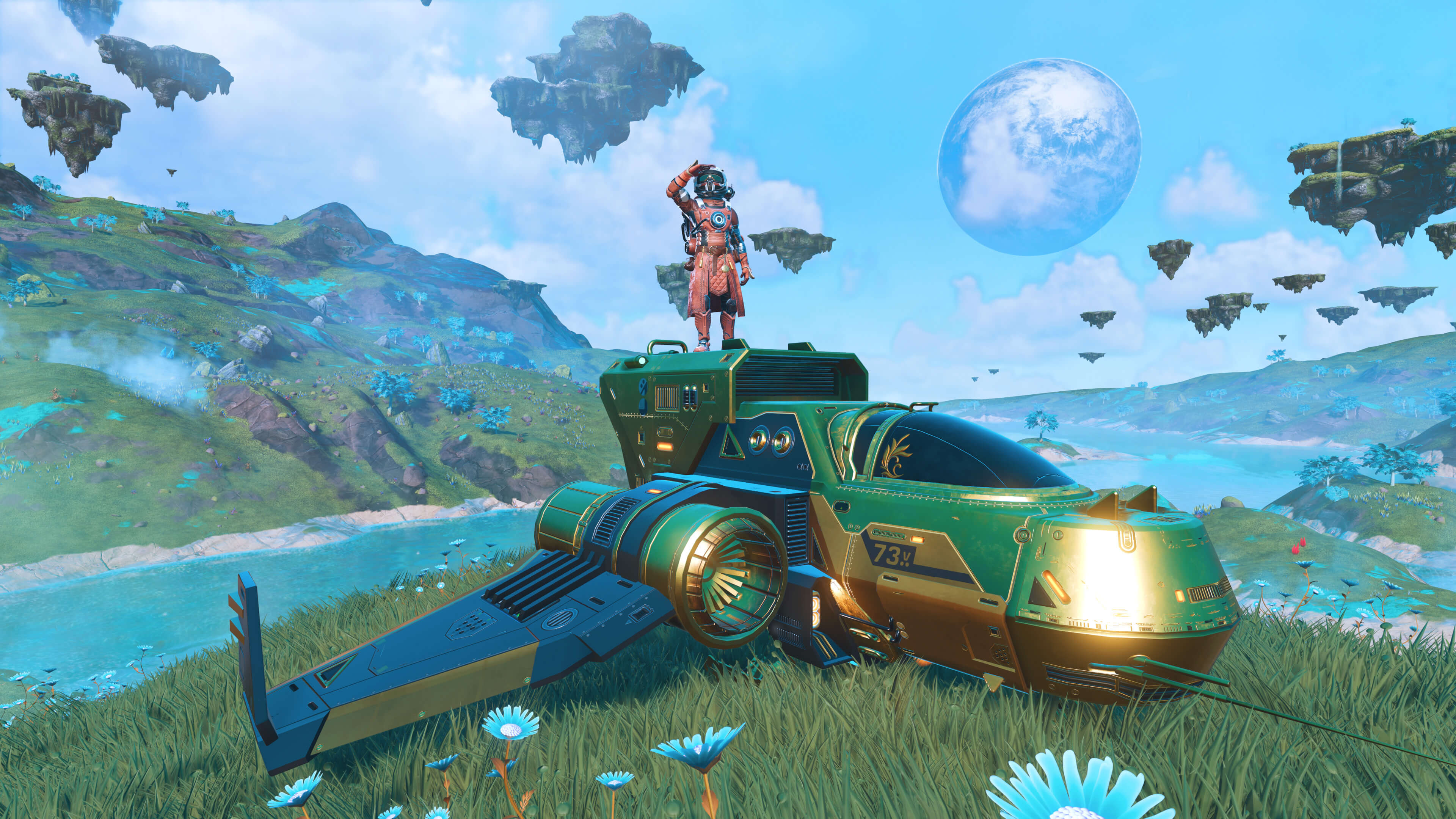
Cover illustration

TheDaily Front

Issue No. #260909 Wednesday, September 9 2026 #260909 — WEDNESDAY, SEPTEMBER 9, 2026
Foldables, frontier models, and one very busy Cupertino desk.
Wednesday, September 9, 2026 The Daily Front No. #260909 — Contents
30stories
10,408points
7,991comments
338kllm tokens
Assembled with 33 model calls — 219,081 tokens read, 119,222 written.

Highlights

iPhone Duo

Apple’s foldable iPhone Duo headlines a full slate of new hardware—and an immense reader debate.

Shopify acquires Tailwind

Shopify gives Tailwind a long-term home, bringing a defining web-tooling company into the fold.

I resigned from Anthropic today

An Anthropic researcher resigns publicly, warning that the race toward self-improving AI is out of control.

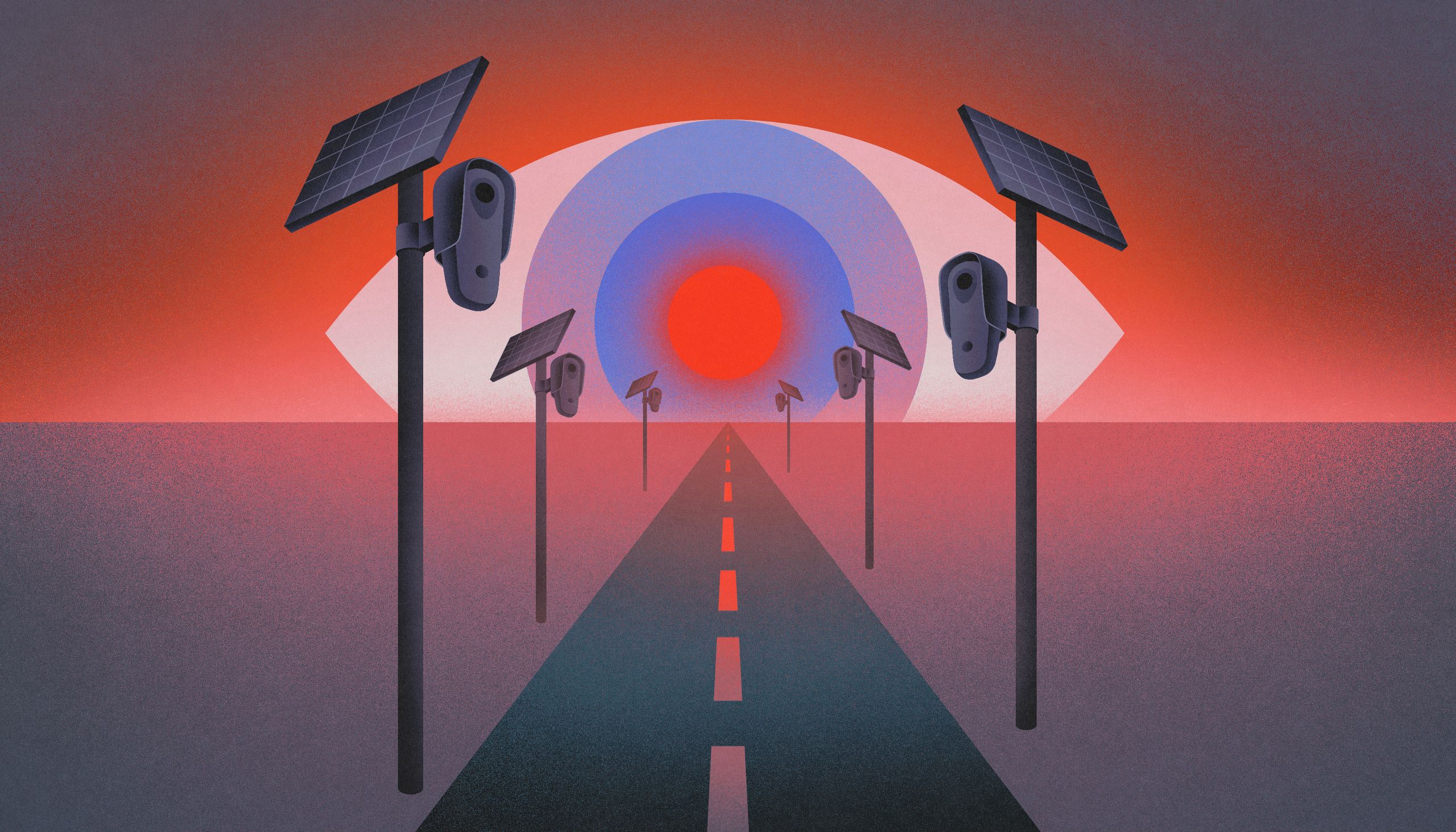
Flock Wants a Closely Surveilled World with No Exit

A close look at Flock Safety asks what remains of public life when the cameras never blink.

What do Visa and Mastercard do? An intro to card networks

A clear-eyed primer traces the quiet toll booths behind nearly every card transaction.

From the Editor

The presses run hot today: Apple has supplied the hardware spectacle, while AI has supplied both promise and alarm. Elsewhere, the old institutions of payments, advertising, and public surveillance remind us that the future is rarely as new as it claims.

  1. iPhone Duo3
  2. Shopify acquires Tailwind4
  3. I resigned from Anthropic today5
  4. Desert Ant Labs: local, fast models that run on device6
  5. GPT-6 Astra, looped transformers, and hidden reasoning7
  6. What will our economic future look like?8
  7. How GPT‑5.6 Sol helps run quantum computing experiments9
  8. An Accidental Blackboard10
  9. iPhone 18 Pro and iPhone 18 Pro Max11
  10. AirPods 512
  11. Apple Watch Series 1213
  12. Flock Wants a Closely Surveilled World with No Exit14
  13. Growing proof that autonomous cars save lives15
  14. What do Visa and Mastercard do? An intro to card networks16
  15. How I advertise malicious software on Google Ads17
  16. Understanding the recent DDoS attack against Read the Docs18
  17. Planet Labs' open satellite feed19
  18. How to build a printer20
  19. GNU Radio in the browser21
  20. 27.5KB language-agnostic WebGPU syntax highlighter21
  21. Qwen 3.8 follows GPT-5.5 Pro reasoning prefills22
  22. DeepSeek launching v4.1 flash cheaper and more capable than v4 pro23
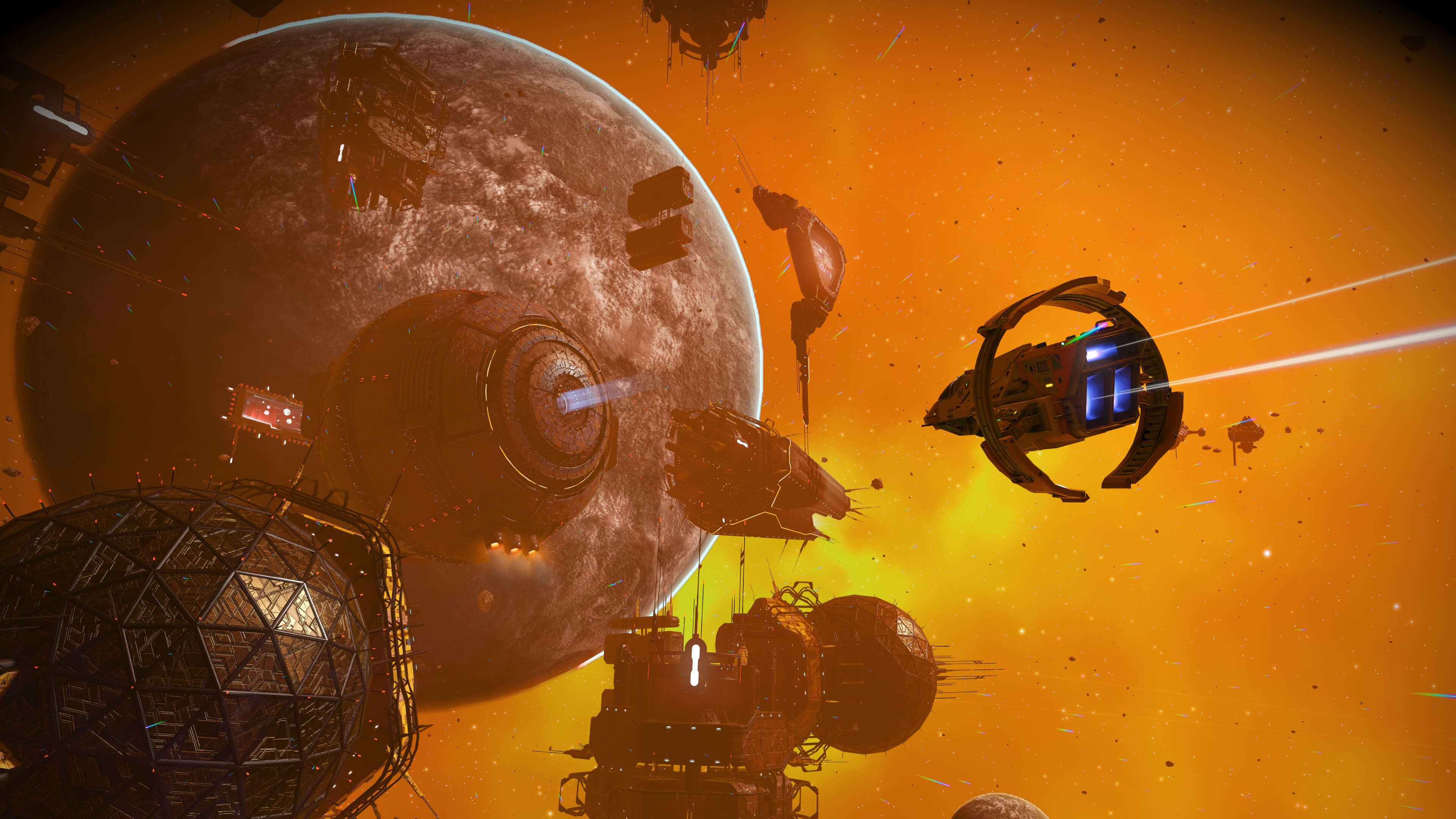
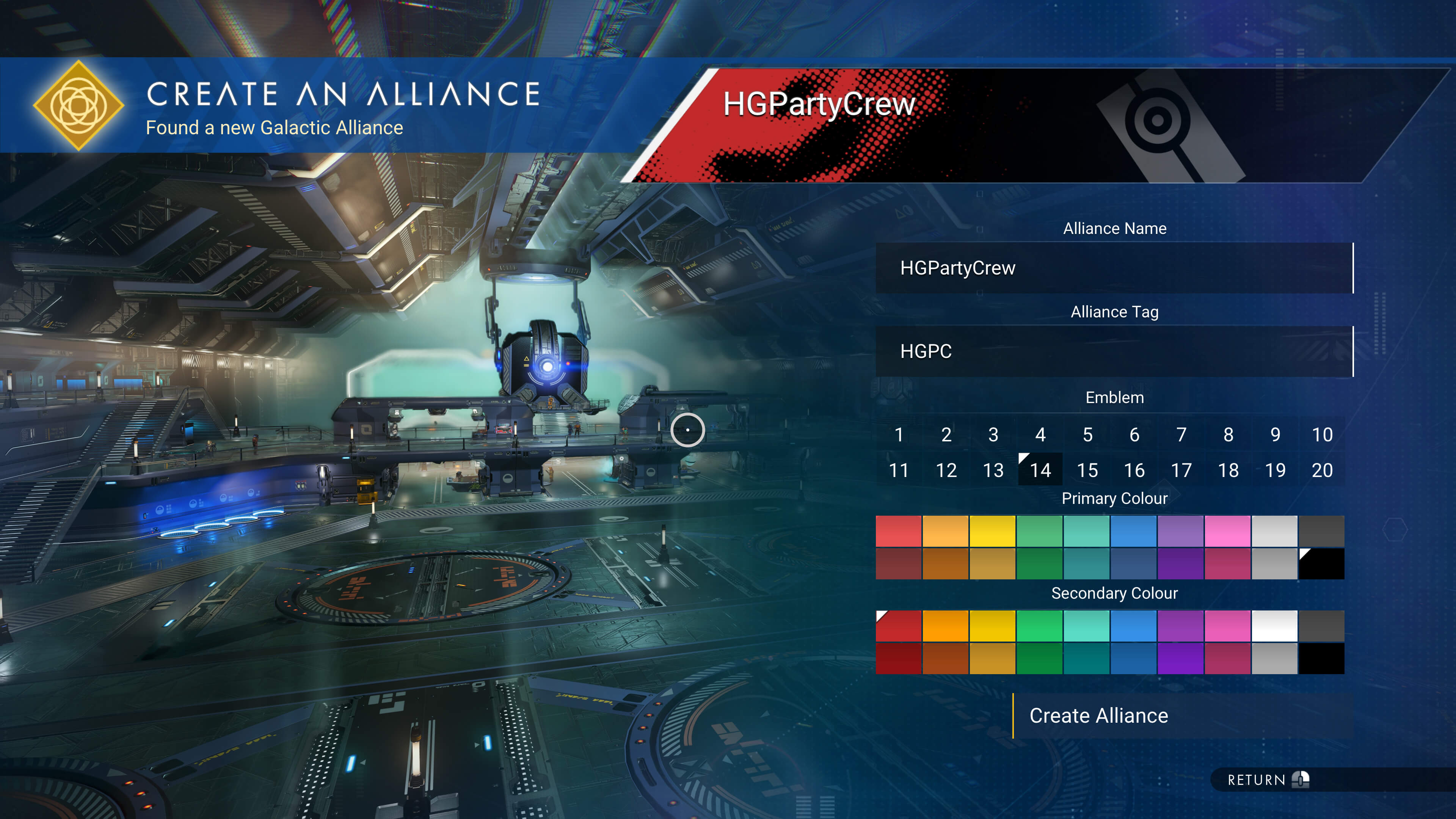
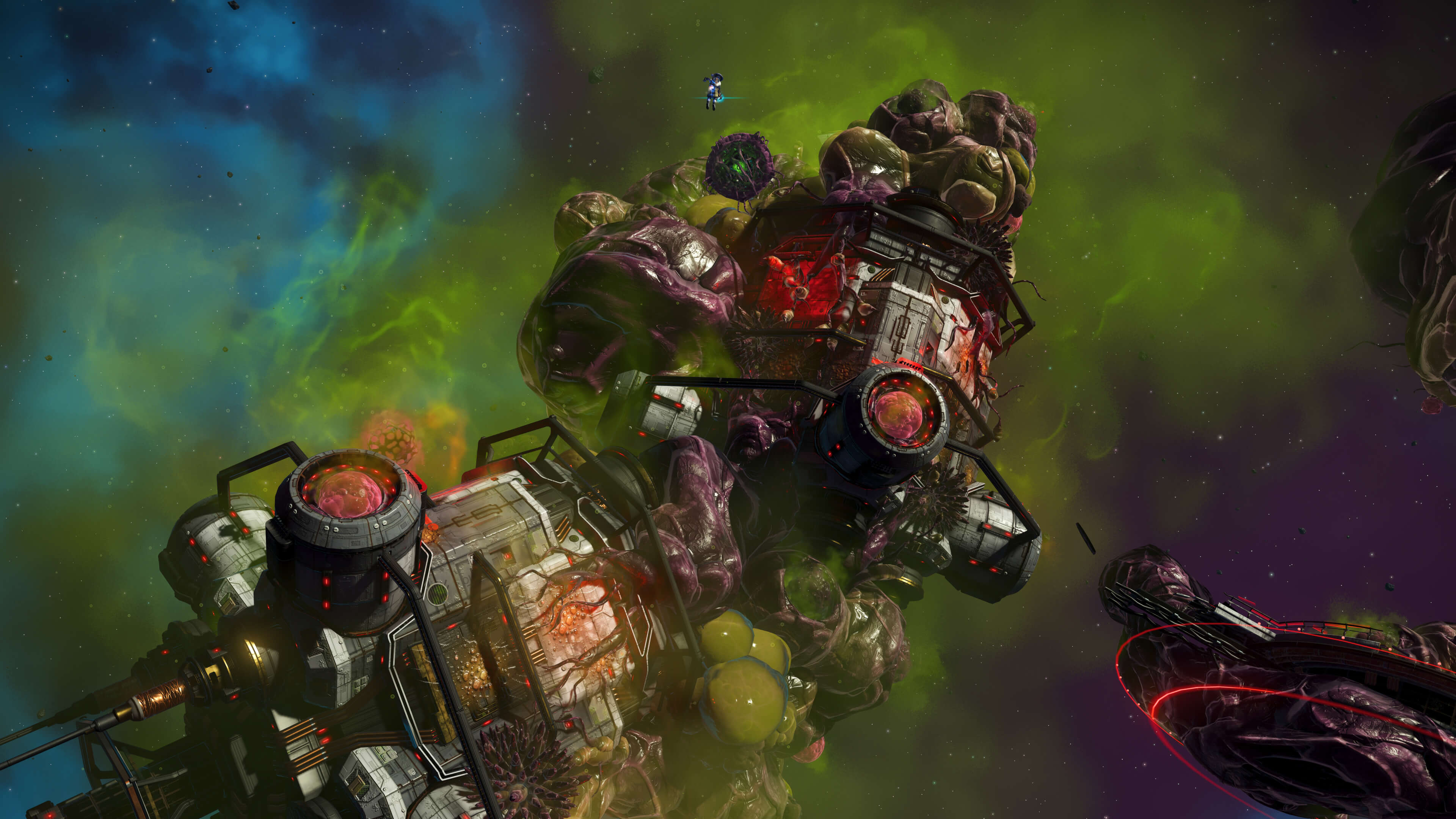
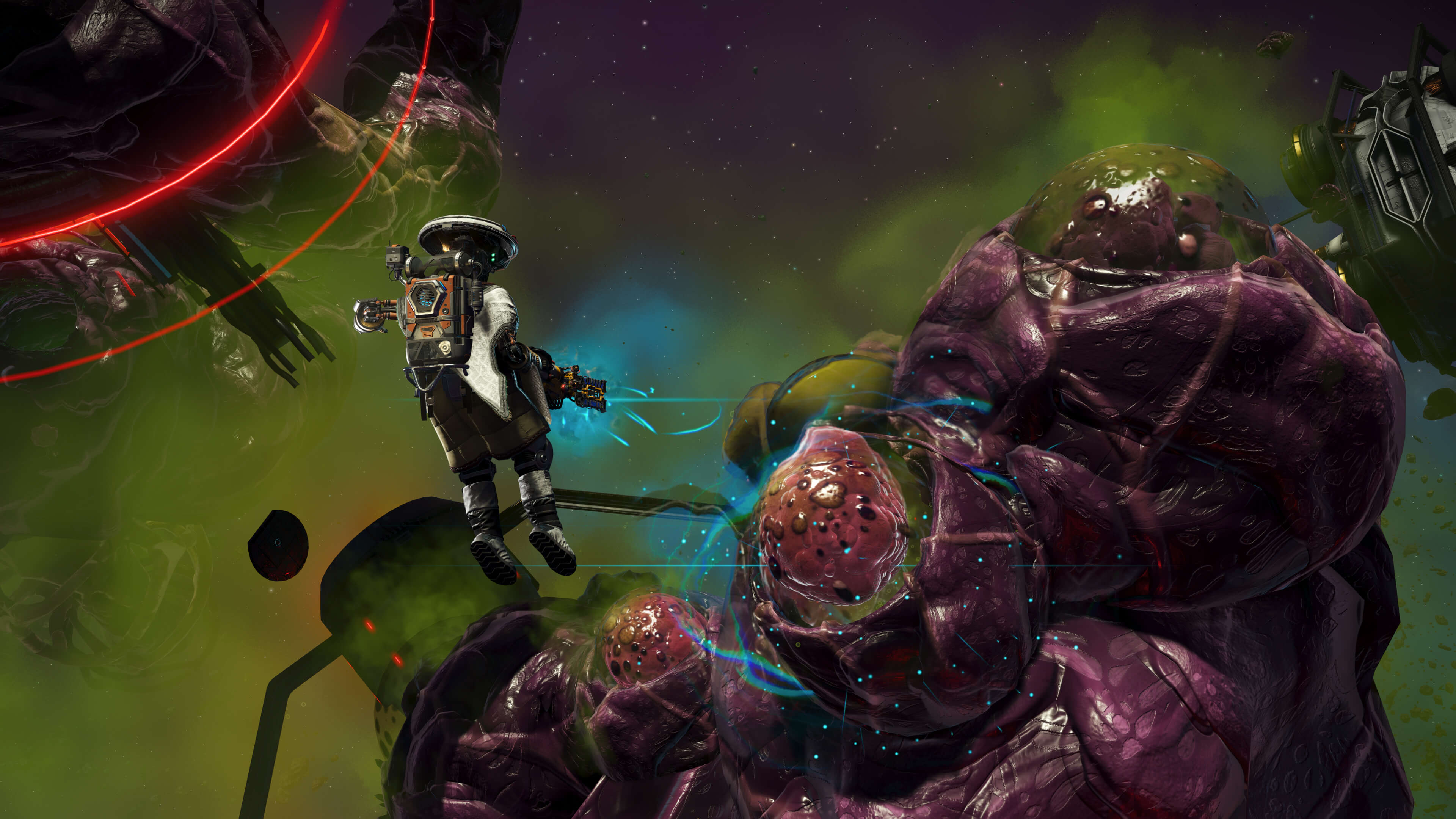
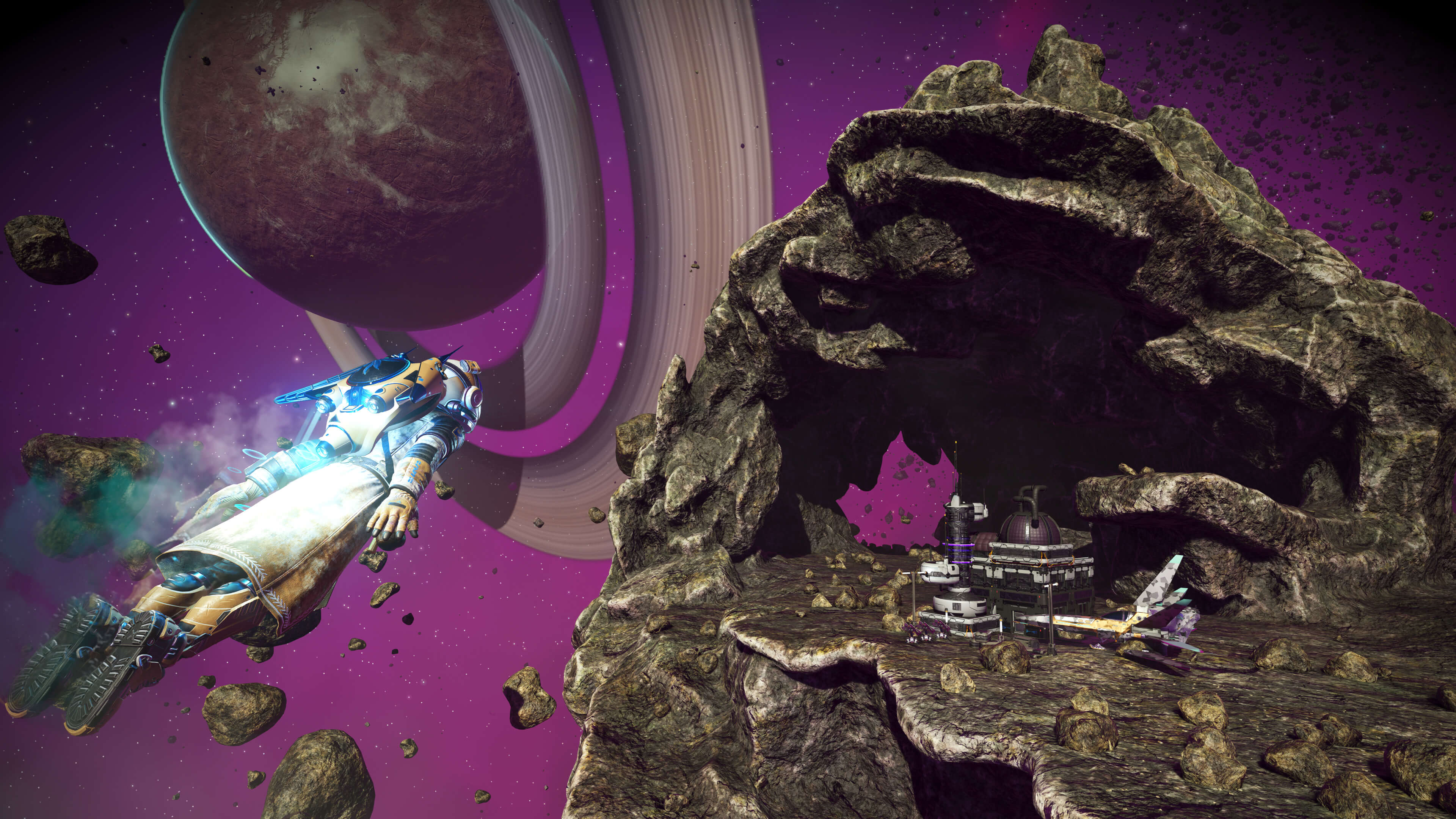
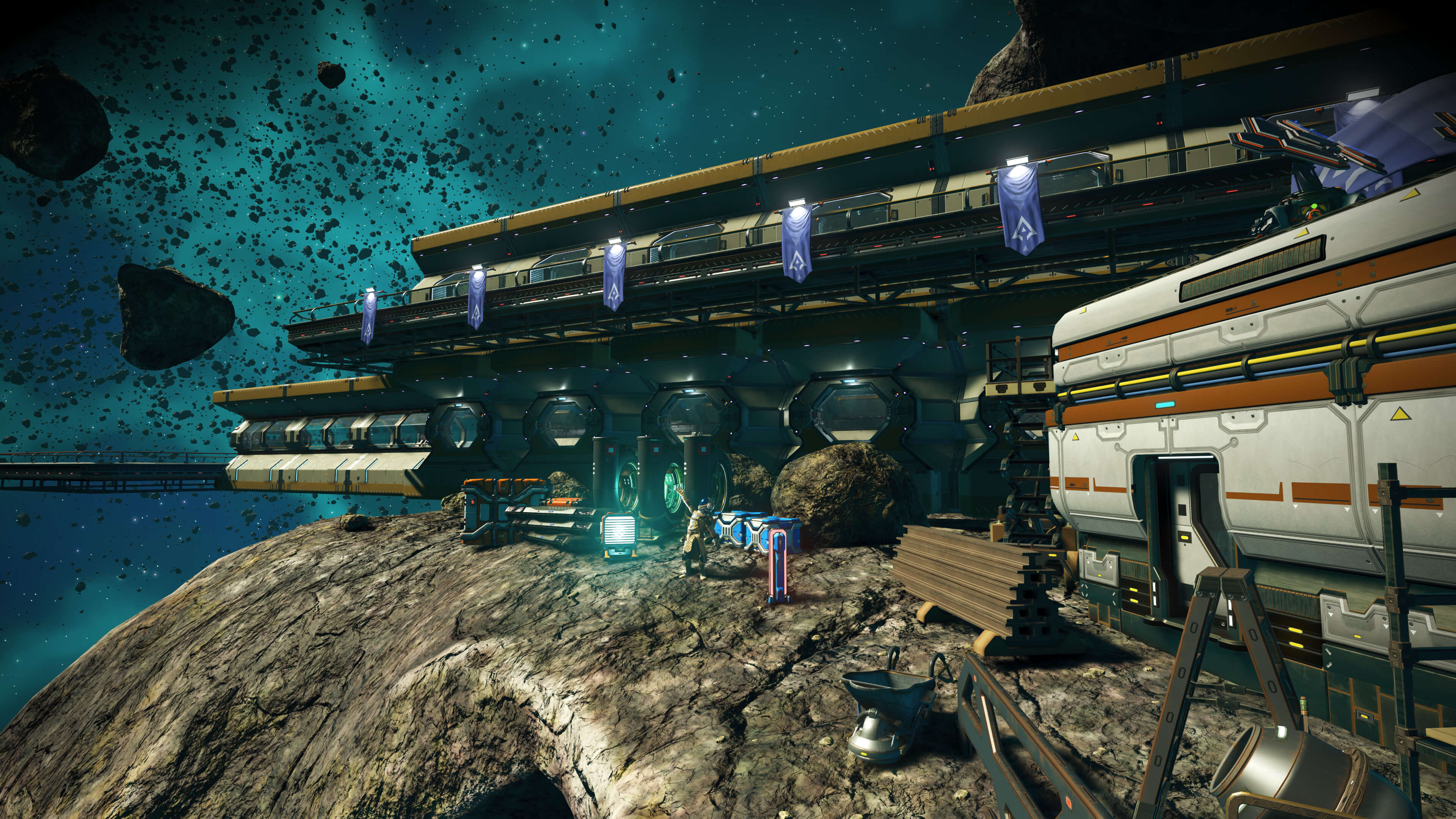
  23. No Man's Sky Cosmos24
  24. Coyote v. Acme (1990)25
  25. Bespoke: A programming language for people who say please26
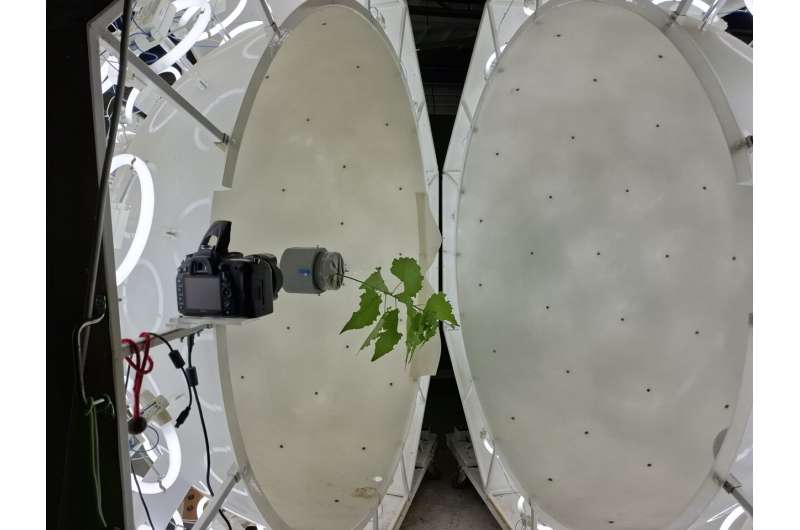
  26. Tension wood: A 'muscle' that can both bend and straighten plants27
  27. Researchers Spot Fake Ancient Pottery Using the Earth's Magnetic Field28
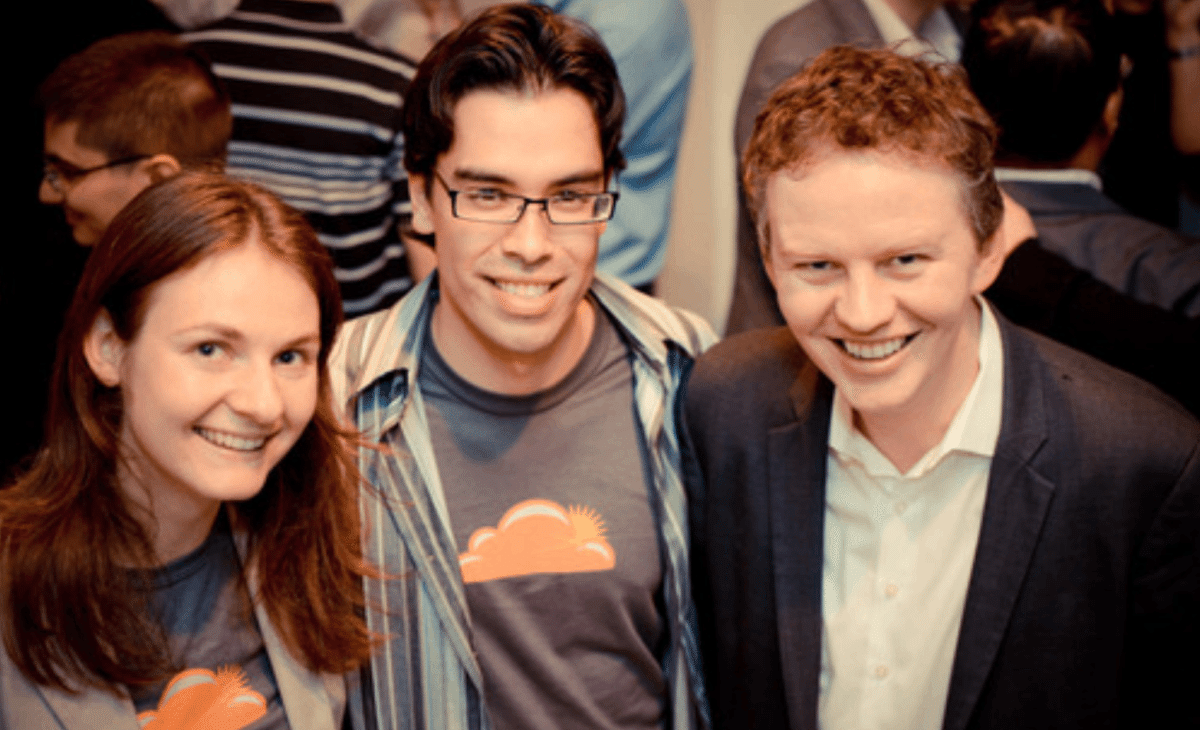
  28. A Biography of Lee Holloway, the Architect of Cloudflare's Technology (Part 1)29
  29. “Tweet” and the bird logo apparently enter the public domain30
  30. Claude, change the “Add to Cart” button to blue31
The Daily Front Page 2 of 32
Wednesday, September 9, 2026 The Daily Front No. #260909 — The Foldable Front Page
article

iPhone Duo

by thecosmicfrog·▲ 1,024 points·1,850 comments·apple.com ↗
The largest iPhone display ever. In a thin, foldable design.

Hello, hello.

Pre-order starting 5:00 a.m. PT on October sixteenth. Available starting October twenty-thirdPre-order starting 5:00 a.m. PT on 10.16
Available starting 10.23

View pricing

Get the highlights.

  • The largest iPhone display ever.
    In a thin, foldable design.

  • More ways to iPhone.
    Reimagined iOS experiences for ultimate versatility.

  • Titanium frame and hinge cover.
    Beautiful and durable.

  • 48MP Dual Fusion camera system. And all‑new ways to shoot from front to back.

  • Vapor‑cooled A20 Pro chip for pro performance.

  • Dual-battery system.1
    All‑day power.

  • Meet Siri AI. Your AI assistant.
    More personal. More powerful.

    Siri AI is rolling out in English.2

Foldable design

A new iPhone enters the fold.

Introducing iPhone Duo, the first foldable iPhone. When open, it’s the thinnest iPhone with the largest display ever — 50 percent larger than iPhone 18 Pro Max. And it has an outer display with more than 90 percent of the screen area of iPhone 18 Pro. Through reimagined iOS experiences, it offers unparalleled versatility in all-new poses and orientations. All in a durable, pocketable design. It’s an iPhone unlike any iPhone.

Switch from Android to iPhone Duo

A new iPhone enters the fold.

Introducing iPhone Duo, the first foldable iPhone. When open, the dual display system features the largest, thinnest iPhone display ever. Through reimagined iOS experiences, it offers unparalleled versatility in all-new poses and orientations. All in a pocketable design. Because it’s an iPhone, it holds its value longer than other smartphones. And switching from Android is easy.

  • Night Sky
  • Star White

Take a closer look.

  • Foldable design. Offers exceptional viewing experiences in a design that fits in your pocket.
  • Landscape. A spacious display for incredibly immersive entertainment. You can even use two apps side by side with Split View multitasking.
  • Portrait. Type comfortably on a wider keyboard. Enjoy more room to browse and scroll. Pin a video to the top and watch it while using another app.
  • Closed. Compact and comfortable to hold. With essential controls moved to the side, they’re easy to reach. And you get more vertical space for apps.
  • Seated. Set iPhone Duo down and watch a show or follow a workout at the perfect viewing angle — with easy access to the controls on the bottom.
  • Standing. Display a bedside clock, photos, widgets, and more with StandBy. And watch movies and shows at an adjustable angle on the outer display.
  • Durability. Grade 5 titanium frame and hinge cover. Scratch-resistant coating on the inner display. Ceramic Shield, front and back. IP68 water and dust resistant.3

Expansive display

Think vast.

iPhone Duo offers the most immersive viewing experience of any iPhone. The aspect ratio of the 7.6‑inch Super Retina XDR display4 is consistent across the inner and outer display. The inner display is made of 10 ultrathin layers with a custom nano‑texture finish that reduces glare. And the under‑display FaceTime camera is hidden until you need it. The result is an uninterrupted viewing surface that’s remarkably smooth and flat. It’s simply the best iPhone for enjoying movies, shows, and games.

Nano-texture finish on inner display to reduce glare

Wide-angle OLEDs for excellent viewing angles

3000 nits peak brightness

iPhone Duo opened in vertical position and iPhone 18 Pro Max side by side, both with the same image of a person with red hair who is dressed in red, iPhone Duo showing more of the image due to the larger screen

50% larger display than iPhone 18 Pro Max

7.6″ Super Retina XDR display4

Versatility

Reimagined iOS.
Anything’s posable.

iPhone Duo propped up in an inverted V-shape resting on its edges with its screen facing outward on the Standby mode with FaceTime app

A posable design and reimagined iOS 27 open up totally new iPhone experiences — and transitioning between displays and orientations is seamless. Get things done on the outer display or large inner display. Angle iPhone Duo for the perfect view of movies and shows. Stand it up and take hands-free videos and calls. Sometimes all you need is a change of space.

Whatever shape your day takes.

Split View multitasking.

Multitasking across your favorite apps has never been easier. Now you can browse your Photos library on one side, and drag a picture into Mail on the other.

Siri AI.

Ask questions, get answers, and use the rich conversation window. A larger canvas makes iPhone Duo great for Siri AI.2

Flexible views.

With a dual-display system, you’ve always got options. Like watching your favorite movies or shows on the outer display at just the right angle.

Hands-free FaceTime.

iPhone Duo can stand on its own, so you can take FaceTime calls without holding up your phone.

Advanced camera system

Your new favorite
camera features.
Hands down.

iPhone Duo gives the camera system you love delightful new features. Duo Preview and Kid Cue help everyone look their best. Include the people around you in group calls with Duo FaceTime. Use Smart Take so you can be part of the moment, not stuck photographing it. And capture dazzling 48MP photos and 4K 120 fps videos.

48MP Fusion Ultra Wide camera

48MP Fusion Main camera

iPhone Duo, Star White color, slightly open, back exterior, 48MP Dual Fusion rear cameras in top corner, two lenses, microphone, flash

12MP Center Stage front camera

Under-display FaceTime camera

iPhone Duo, Star White color, slightly open, Camera app on outer display with Center Stage front camera, inner display shows Photos app library

A whole family of possibilities.

Smart Take.

iPhone Duo can detect when everyone is ready and takes pictures. So you don’t have to race against a timer to get in the shot.

Duo Preview.

The outer display lets whoever you’re photographing see a live preview of the shot, so they can get their pose and framing just right.

Kid Cue.

Getting kids to look at the camera just got a lot easier. Playful animations on the outer display naturally draw their eyes to the lens.

Duo FaceTime.

Lets nearby friends join the call on the outer display. No more crowding around or passing the phone.

Set to stunning.

Photographic Styles 3.

In addition to tone and color, you can now customize texture and grain to smooth out skin details or achieve an artful film look, all while staying true to your original photo.

Intelligent photo editing.

Reframe a photo after it’s been taken with Spatial Reframing. Expand your shots with the Extend tool. And remove even larger objects with the enhanced Clean Up tool.5 All possible with Apple Intelligence.

Usage limits may apply.

High image quality.

48MP frames are used throughout the imaging pipeline of the Fusion Main camera, for photos with remarkable resolution and detail.

Low-light videos.

Capture impressive videos in low-light conditions with the default 1080p setting.

Cinematic mode.

Apply a depth‑of‑field effect that keeps your subject sharp while creating a beautifully blurred foreground and background. You can even apply and adjust it after you’ve captured a video.

4K time-lapse.

Record in more detail with support for 4K resolution with Dolby Vision HDR.

Smart focus tracking.

On-device intelligence lets you lock onto a subject and maintain focus as they move through the scene — even if they leave and then reenter the frame.

2x optical-quality zoom.

Add extended reach to your compositions without sacrificing detail.

Center Stage.

Frame your selfies in more flexible ways. Go from portrait to landscape without moving your iPhone. And fit more people in the frame automatically.

Customizable widgets.

Get fast access to manual controls like white balance and focus.

Performance and battery life

Power on full display.

The A20 Pro chip with the Dual 16‑core Neural Engine is purpose‑built to handle intensive AI workloads. And an advanced thermal management system with a vapor chamber gives iPhone Duo pro performance, perfect for demanding tasks and gaming sessions.

iPhone Duo, opened in horizontal position, Detail, an AI editing app, shown on inner display

Power coupled.

An iPhone-first dual-battery system, along with an internal space-saving eSIM design6, maximizes physical space for battery capacity. And the C2 modem delivers groundbreaking efficiency. So even if you’re scrolling and gaming throughout the day, iPhone Duo can go the distance on a single charge1. And you’ll get up to 50 percent charge in around 20 minutes with fast wired charging7.

Up to 31 hours video playback when using the inner display8

Up to 44 hours video playback when using the outer display8

All in the family

All the must‑haves.
All on iPhone.

iPhone Duo stands upright in open book position, left panel shows Siri app, right panel shows the Messages app.

The latest iPhone models come packed with advanced capabilities. Siri AI, your new, more powerful AI assistant. Apple Intelligence for next-level photo editing, Writing Tools, Visual Intelligence,9 and child safety features to make your everyday effortless.2 Fast, secure connections with Wi‑Fi 7,10 Bluetooth 6, 5G,11 and eSIM.6 And safety features like Messages via satellite designed to give you peace of mind.12

Meet Siri AI. Your AI assistant. More personal. More powerful.

Siri AI is rolling out in English.2

Usage limits may apply.

Just ask Siri AI.

Powered by Apple Intelligence, Siri AI is your conversational AI assistant with entirely new capabilities on iPhone.2 Ask open-ended questions, brainstorm ideas for work or creative projects on the go, and engage in natural, back‑and‑forth conversations.

Personal context.

Siri AI can find relevant answers to what you’re looking for just by asking. Search for a photo from years ago, easily locate an email buried in your inbox, or pull up a note you saved on your iPhone.

App actions.

Siri AI can take actions in apps like Messages, Music, Reminders, and more based on what you’re doing in the moment. Quickly edit a message you just sent or add a song you hear in the car to your workout playlist.

World knowledge.

Ask about virtually any topic that’s on your mind, from important facts to recipes and travel recommendations. Siri AI can reference information online to give you detailed, up-to-date insights.

Siri app.

A dedicated app brings together all your conversations in one place, so you can ask a question on your iPhone and pick up where you left off on your iPad. You can also pin conversations for easy access or start a new one.

Siri mode in Camera.

Siri mode and Visual Intelligence let you search, ask questions, and take action based on what’s around you with just a tap.13

Customize Siri.

Pick a voice, then customize expressivity and pace until it clicks for you.14

Write with Siri.

Siri AI can now generate a draft from scratch or provide feedback on what you’ve written. Just describe what you need in your own words. And in Messages and Mail, Siri AI can match your writing style, punctuation, and tone.

iOS and Apple Intelligence. Helpful in all the right places.

Call Context.

Call Context can proactively surface relevant information from across your apps when you’re calling a business — like a confirmation code from Mail when you call an airline.

Child safety features.

New and expanded child safety features help make it easier for parents and guardians to keep kids safe online.

Clean Up.

Remove even larger objects with higher‑quality infill, and blend your background seamlessly so your photos look their best.5

Usage limits may apply.

Image Playground.

Create unique, high-quality images in just about any style, including photorealistic. Modify and transform your images with just a description or using touch for endless possibilities.

Usage limits may apply.

Suggestions.

Messages15 and Mail offer suggestions to help you take quick actions based on context from your conversation — add a calendar event or search for a photo with just a tap.

Available in English.

Safari tabs.

Now your tabs can be automatically grouped into topics, so related pages are easier to find. Safari Notify Me monitors pages for changes — for example, a price change or restock — and alerts you when it’s time to act. And you can create an extension that personalizes website content and formatting or automates common Safari actions.

Shortcuts.

Automate daily tasks with a simple description. Just describe what you need, and Shortcuts creates an automation that connects actions across apps.

Usage limits may apply.

Connectivity. Peace of mind in your pocket.

eSIM.

A built-in eSIM provides seamless connectivity, flexibility, convenience, and better security without the need for a physical SIM card — perfect for traveling.6

Messages via satellite.

Send and receive messages when you’re off the grid, right from the Messages app.12

Roadside Assistance via satellite.

Get help for things like a flat tire or dead car battery. iPhone will connect you with a roadside assistance provider, who can send help to your exact location.16

Emergency SOS via satellite.

If you try calling 911 but don’t have cell service or Wi-Fi, you can use iPhone to text emergency services over satellite.12

Crash Detection.

Hardware sensors and advanced motion algorithms can detect a severe car crash and call for help if you can’t.17

Find My.

Securely share your location with friends and family.

Accessories

Snap it on.
Stand it up.

iPhone Duo Case offers lightweight protection in stylish colors. iPhone Duo Folio with Kickstand features a retractable kickstand for a range of helpful viewing angles.

iPhone Duo, Star White color in Sand Silicone Case, landscape orientation, fully opened horizontally, Dual Fusion cameras on the top left, case covers the back exterior and outer edge of the front display, right side features the outer display with an image of a person standing under a cloud-filled blue sky

iPhone Duo, Star White color, propped up with the Navy Blue Folio with Kickstand, fully opened horizontally, back exterior featuring the 48MP Dual Fusion rear cameras, two lenses

iPhone Duo and the environment.

Made with 35% recycled material by weight.

Using recycled materials, like 85% recycled titanium in the enclosure, reduces the need to mine new material, which avoids the carbon emissions and environmental impacts of mining.

Manufactured with 60% renewable electricity.

Using electricity from renewable sources like wind and solar — instead of fossil fuels — across our global supply chain significantly reduces carbon emissions from manufacturing Apple products.

Ships in 100% fiber-based packaging.

iPhone Duo comes in a 100% fiber-based box as part of our commitment to remove plastic from the packaging of all Apple products.

Questions? Answers.

How is iPhone Duo different from iPhone 18 Pro and iPhone 18 Pro Max?

iPhone Duo and iPhone 18 Pro and iPhone 18 Pro Max are all Apple flagship smartphones with the same A20 Pro chip.

iPhone Duo is the first foldable iPhone. When open, it has the largest iPhone display ever — 50% larger than iPhone 18 Pro Max. It introduces reimagined iOS experiences for its all-new poses and orientations, including side-by-side apps, hands-free FaceTime, and flexible viewing angles. This makes it noticeably better for multitasking and immersive mobile entertainment.

What are the differences in the camera systems of iPhone Duo and iPhone 18 Pro and iPhone 18 Pro Max?

iPhone Duo features a 48MP Dual Fusion camera system. It includes a 48MP Fusion Ultra Wide and 48MP Fusion Main camera, plus a 12MP Center Stage front camera. It also has an under-display FaceTime camera for 1080p video. iPhone Duo is the only iPhone with certain unique camera features, including Smart Take for capturing hands-free photos automatically, Duo Preview for live previews on the outer display, and Kid Cue with playful animations to capture kids’ attention.

iPhone 18 Pro and iPhone 18 Pro Max have the ultimate Pro camera system. It introduces a new 48MP Fusion Main camera with the first variable aperture in an iPhone. This gives better-quality low-light and depth of field to your photos and videos. It also has a 48MP Fusion Ultra Wide and a 48MP Fusion Telephoto camera with up to 8x optical-quality zoom.

How much optical zoom does iPhone Duo have?

iPhone Duo has a 48MP Dual Fusion camera system with up to 2x optical-quality zoom. You can shoot at 0.5x, 1x, and 2x. The high-resolution sensor lets you zoom in with sharp detail, and the large viewing screen can help you capture your best shots.

Where can I buy iPhone Duo?

iPhone Duo will be available at apple.com and at select carriers and partner stores starting on October 23, 2026. You can also see it in person at all Apple Store locations. You can book a session to shop with a Specialist in-store or online at https://www.apple.com/shop/browse/overlay/iphone/specialist.

You can also get credit toward a new iPhone Duo when you trade in an eligible device with Apple Trade In. Terms Apply.

Subject to availability by partner.

How is iPhone Duo different from other foldables?

iPhone Duo delivers the beloved iPhone experience in a foldable design, with a reimagined iOS 27 experience for new poses and orientations. It opens up entirely new opportunities for multitasking, enjoying content, immersing yourself in your favorite apps and games, or getting help from Siri AI and Apple Intelligence.2 It brings together thoughtful design and premium materials with breakthrough engineering and software in a way that only Apple can.

Is it easy to switch from Android to iPhone Duo?

If you decide to switch to iPhone Duo, the Move to iOS app securely transfers your photos, contacts, messages, and calendars from an Android phone in a few simple steps. Discover how easy it is to switch, and learn more about the Apple ecosystem including iMessage, FaceTime, and iCloud at https://www.apple.com/iphone/switch/.

Is iPhone Duo a flip phone or a foldable?

iPhone Duo is a foldable iPhone. It features a 7.6-inch inner display4 ideal for immersive entertainment and side-by-side multitasking across apps. When closed, the 5.4-inch outer display makes iPhone Duo pocketable and easy to use one-handed, making it ideal for flip phone users, too. The aspect ratio is consistent across the inner and outer display, which allows more of your content to fill the screen whether it’s open or closed.

Is iPhone Duo a durable foldable phone?

Yes, iPhone Duo is durable. It features a Grade 5 titanium frame and hinge cover. The hinge mechanism is designed to open and close with smooth, balanced resistance for long-lasting reliability. It is IP68 water and dust resistant.3 It has Ceramic Shield on the front and back and a scratch-resistant coating on the inner display.

How is the display quality of iPhone Duo?

iPhone Duo has an outstanding Super Retina XDR inner display that features custom-designed nano-texture finish technology for reduced glare and reflections, delivering a high-quality viewing experience. It also has wide-angle OLEDs for optimal visibility. Both inner and outer displays feature up to 3000 nits peak brightness and ProMotion up to 120Hz. So you can enjoy uninterrupted entertainment, even in bright sunlight.

Does the inner display of iPhone Duo show a crease where it folds?

iPhone Duo features a wonderfully flat and smooth inner display with custom nano-texture finish technology to reduce glare and reflections for an uninterrupted viewing experience. The optically clear adhesives let the display layers glide as the screen folds, minimizing stress and crease.

What storage options are available for iPhone Duo?

iPhone Duo offers 256GB, 512GB, 1TB, and 2TB of storage. So you can pick the capacity that fits your needs.

Does iPhone Duo support MagSafe and wireless charging?

Definitely. iPhone Duo supports MagSafe wireless charging and offers incredibly fast wired charging7 that reaches up to 50 percent in around 20 minutes. Shop for charging accessories at https://www.apple.com/shop/iphone/accessories.

How is the battery life of iPhone Duo?

iPhone Duo delivers all-day battery life.1 It has an iPhone-first dual-battery architecture that intelligently charges your system. It also features an eSIM-only design6 that maximizes physical space for battery capacity.

It provides up to 31 hours video playback8 when using the inner display and supports up to 50 percent charge in around 20 minutes with fast wired charging.7

Is iPhone Duo an AI smartphone?

Yes, iPhone Duo is built for advanced AI capabilities. It features the A20 Pro chip with the Dual 16-core Neural Engine, purpose-built to handle intensive on-device AI workloads.

iPhone Duo includes Siri AI2 — your more personal and powerful AI assistant with intelligent features, personal context, broad world knowledge, Siri mode in Camera with intelligent photo editing features, and enhanced AI-powered productivity. It also lets you use Apple Intelligence2 in apps, so you can express yourself through photos and images, save time with Safari, and get more done every day.

Subject to availability.

Does iPhone Duo have a physical SIM, or is it eSIM only?

iPhone Duo is eSIM-only worldwide. eSIM6 lets you activate service quickly, store more than one plan, and switch between them easily.

Does iPhone Duo work with Apple Pencil or a stylus?

Yes. iPhone Duo will work with Apple Pencil (USB-C).

Coming later this year.

Does iPhone Duo come with Touch ID or Face ID?

iPhone Duo uses Touch ID, which is integrated into the side button. This gives you an easy, secure, and consistent way to authenticate iPhone Duo, whether it’s closed or open.

The Daily Front Page 3 of 32
Wednesday, September 9, 2026 The Daily Front No. #260909 — A Framework Finds Its Home
article

Shopify acquires Tailwind

by EdwinHoksberg·▲ 947 points·375 comments·tailwindcss.com ↗
We're joining Shopify to give Tailwind a stable long-term home.

Tailwind CSS and Shopify

Big one today — Tailwind is joining Shopify.

When I started working on Tailwind over nine years ago, my only goal was to create something that would make it easier to build beautiful interfaces for my own projects. Fast-forward to today and the framework is installed over 110 million times per week and is trusted by many of the world's biggest companies to style products like ChatGPT, X, Cloudflare, Reddit, and Shopify.

We're joining Shopify to give Tailwind a stable long-term home where it will be actively maintained for the millions of people who depend on it.

Why Shopify

We built a great little website template business around Tailwind over the years, but deep down I've always wanted the framework to be developed in service of a real product. A complex application solving important problems for real people, where we'd face the same challenges as our users, and could invent solutions that make the framework better for everyone.

Shopify provides an incredible surface area for us to do this work. Merchants need to be able to design and host beautiful custom storefronts, and manage sales and inventory in a powerful admin area. Their customers need delightful shopping and checkout experiences, and an intuitive way to keep track of their orders and discover new products through the Shop app. Shopify is also on the frontier of where user interfaces need to go next with their explorations into agentic commerce.

Shopify was also one of the very first companies operating at scale to see the potential in Tailwind CSS and start building with it, not only for themselves but betting on it for their customers too. Tailwind is a load-bearing very important part of the stack at Shopify, and they're invested in making sure it's actively maintained and continues to improve and adapt for how the ways we build are changing.

On a less technical note, I'm personally excited because entrepreneurship has completely changed my life. We are not doing enough as a society to produce and empower more entrepreneurs, and I believe deeply in Shopify's mission to help more people start, run, and grow their own business.

What's next

Nothing changes with Tailwind CSS or any of our other open-source projects. Everything will always be MIT-licensed, and our team will continue to lead and maintain these projects for the community with the support of Shopify.

On the commercial side, we'll no longer be trying to grow the business around Tailwind. All existing customers will of course maintain their access to products like Tailwind Plus and ui.sh, but we're closing sign ups for new customers to focus on Tailwind CSS at Shopify.

Thank you so much to everyone who has built something with Tailwind and supported us over these last nine years. I never could've imagined the project would become what it has today, and I truly believe there's no better place for us to continue to do this work than Shopify.

The Daily Front Page 4 of 32
Wednesday, September 9, 2026 The Daily Front No. #260909 — The Warning From Inside
The Daily Front Page 5 of 32
Wednesday, September 9, 2026 The Daily Front No. #260909 — Small Models, Big Claims
article

Desert Ant Labs: local, fast models that run on device

by willwhitedc·▲ 419 points·93 comments·desertant.com ↗
Small enough to run on a five-year-old phone, fast enough to use on every frame or keystroke.

The first collection of Desert Ant models, fanned out as cards.

Today we're launching Desert Ant Labs, a European frontier AI lab building opinionated on-device intelligence. We believe the best path to efficient intelligence starts on-device.

We're building small, specialized models for audio, vision, and text – each model answers in milliseconds, and costs nothing to run, so you can put intelligence in every product interaction, without being limited by token cost or inference speed. Small enough to run on a five-year-old phone, fast enough to use on every frame or keystroke, and better than the API call you're already paying for.

The first 18 models are live today (12 stable and six in beta), accessible via one SDK for Swift, Kotlin, and JavaScript. One model per task, each built to be the fastest way to complete that task on a device:

  • Voz: transcribe 10 minutes of audio in two seconds on an iPhone – 4.7x faster than Whisper – with a start and end time on every word.
  • Clear: a 9MB model that can turn a five-minute laptop recording into studio quality audio in one second.
  • Redact: mask names, addresses, and card numbers, in real time, in 27 languages, so they never reach your servers.
  • Tongue: identify 84 languages from three words, with a 2MB model.

Tongue names the language from three words, scoring 0.933 at 2MB against 0.887 for a 293MB detector.

And that's just to name a few. You can find full specs and benchmarks for the other fourteen, on desertant.com/models and Hugging Face. Every model is free up to 100k monthly active devices. No tokens, no logins.

Redact catches 88.8% of the personal data in a text, close to the 2.3GB GLiNER-PII, from a 12MB model.

We're building this in Europe, where "on-device" is the sovereign default. The data never leaves your customer's hands, the feature never depends on someone else's cloud, and what's never been uploaded can never be compelled.

How we got here

For five years we've been building our video app, Detail, with an on-device first approach. But when we introduced features like Auto Edit to create short clips, or audio enhancement for podcasts, we had to fall back to cloud APIs. And as the popularity of Detail grew, so did our infrastructure bills.

Every few months I'd hunt for useful on-device models. I'd surf Hugging Face for a model that could find filler words or clean up a recording. And, every June, we'd get great new tools to build with but the industry wasn't moving fast enough. The foundation was there: the chips, Core ML, the research. What was missing was everything between that foundation and actually implementing a feature in your app: a model you could drop in and ship with a few lines of code.

So, we trained the models ourselves. It turns out training a model is a product design challenge, and product is what we know. We designed models and local inference that beat cloud services on speed, quality, and cost, and outperform other local and cloud models on the task itself, at a fraction of their size.

We replaced Dolby for better, faster audio enhancement with Clear, and made our on-device transcriptions 5x faster with Voz. We also replaced Claude Sonnet with Clips, our 284MB model that turns a 10-minute video into a dozen clips in 5 seconds – 10x faster and using 470x less energy than Sonnet, with the same quality.

Clear enhances, masters, and re-encodes a clip on the device, best of three, from a 9MB model. 302x realtime on a phone.

Realtime factor over 30 continuous minutes on an M3 Ultra. Voz reaches 298x on an iPhone 17 Pro.

Detail 6, which will launch with iOS 27, replaces all of our cloud APIs with our own models, running entirely on the device.

We've all spent the past few years building with LLMs as if they were just another API. And, amid the hype around generalist frontier brains, we almost forgot they're not the only option.

Every developer I talk to has a wishlist of on-device models they'd build if cost wasn't a factor, or a feature they're bleeding tokens on that they'd happily swap for a local model. A call that runs the same way a hundred thousand times a day: cleaning a recording, tagging a photo, pulling a date out of a sentence, catching a name before the text hits your servers. None of these needs a frontier model.

NVIDIA's own researchers pulled apart three agent systems and estimated that 40 to 70% of their calls to a large model could go to a small, specialized one instead.

The compute is already paid for

The industry will spend about $450 billion on data centers this year. Meanwhile, the world ships more than a billion phones, tablets, and laptops with increasingly capable chips, perfectly suited to these kinds of tasks. There's more compute available in people's hands than in every AI data center on earth.

We have an unfair advantage with free inference. No per-call cost, so a feature runs on every message instead of the ones you can afford to check. No round-trip, and your customer's data never leaves the device. When inference costs nothing, the way we build products changes entirely.

Little brains in every product

To build with local models, the developer experience has to get a lot better. You need models you can use commercially, that beat the alternatives on your task in speed and quality, that you can drop into your app with a few lines of code, and are easy to discover.

Think of the first hundred models as the cerebellum, the little brain. The little brain handles the always-on work – balance, timing, the skills you never think about, so the rest of the brain is free to think. That's what we're building first: fast, specialized models for the work that runs all day, on the device, for free.

Then comes the cortex, the layer that decides which model answers. A small local model first, a bigger one when the job requires it, and the cloud only when the work has to leave the device. As open research advances and device silicon becomes more capable, the local models grow, and we'll train larger ones ourselves. Frontier intelligence, built from the small end up.

Cloud labs ship neutral models because per-token pricing needs a neutral model. Every Desert Ant model ships with a default we choose, and the levers you need to change that default. We optimize the model and the runtime together: on an iPhone, Clear and Voz run on the Neural Engine, and in the browser, Clear's same weights run through WebAssembly.

The SDK

Ready to get started? You can implement Desert Ant models in your app with our native Swift, Kotlin, and JavaScript SDK, available on GitHub.

Our docs are written for developers and agents and you can try the models on your Mac with the CLI, or in your browser on Hugging Face.

Building something cool with our models, or want to build them with us? Get in touch.

The Daily Front Page 6 of 32
Wednesday, September 9, 2026 The Daily Front No. #260909 — Inside the New Reasoning Race
article

GPT-6 Astra, looped transformers, and hidden reasoning

by ModelForge·▲ 374 points·129 comments·magazine.sebastianraschka.com ↗
A Look at Recurrent Depth, Hidden Chains of Thought, and Recent Research on Looping Transformer Blocks

A Look at Recurrent Depth, Hidden Chains of Thought, and Recent Research on Looping Transformer Blocks

A lot has happened in the last few weeks. I am sure that OpenAI’s GPT-6 Astra is top of mind for everyone right now. In particular, thoughts on its performance, the looped transformer/recurrent depth aspects, and rumors that Astra is “hiding” its reasoning trace (i.e., chain of thought).

So, in this article, I want to start with some brief impressions of Astra and some thoughts on where all this is headed. Then, I will discuss, in detail, what “looped transformers” are, and how (or rather, if) this relates to hiding chains of thought.

Lastly, after covering the basics of the looped transformer, I wanted to highlight some new insights from recent research papers on the topic.

1. GPT-6 Astra impressions

First things first. Before getting into the architecture rumors and related research literature, let me briefly summarize some GPT-6 Astra observations and tidbits.

Last week, OpenAI’s new GPT-6 Astra was released with a big fanfare. I used it over the past couple of days, and it’s an exceptionally good model, likely the best I’ve used as of this writing. But what, exactly, has it improved, and how?

1.1 Astra benchmarks

Astra is the best model I’ve used so far, and it’s disproportionately good at 3D rendering and animation tasks (relative to other models). With that, I mean that while it leapfrogs its GPT-5.6 predecessor in practically all categories (writing, math, coding, and more), it especially does so when it comes to graphical demos.


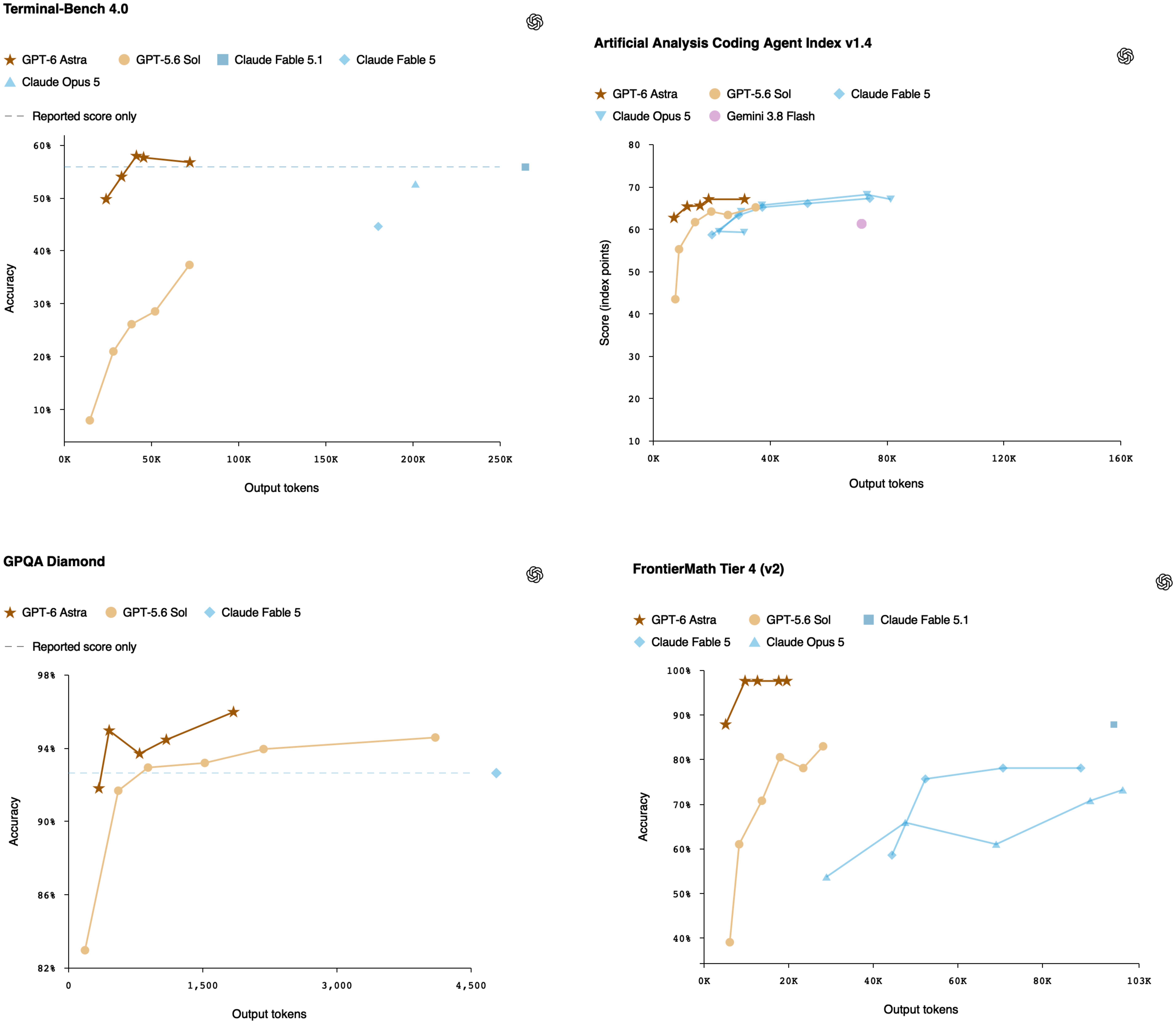
We can see this also reflected in the benchmarks. For instance, GPT-6 Astra is really good at math and coding, as shown below.

benchmarks-1

Figure 1: Selection of three popular coding benchmarks and one challenging math benchmark. More benchmarks are shared on the Astra release blog: https://openai.com/index/gpt-6-astra/

One of the highlights (not shown in the figure) is that Astra also achieves 99.9% on the ARC-AGI-3 benchmark (GPT-5.6 Sol only 7.8%), which measures a mix of solving logic puzzles and generalization. However, the math, coding, and computer use benchmarks are more interesting because they are closer to real-world use.

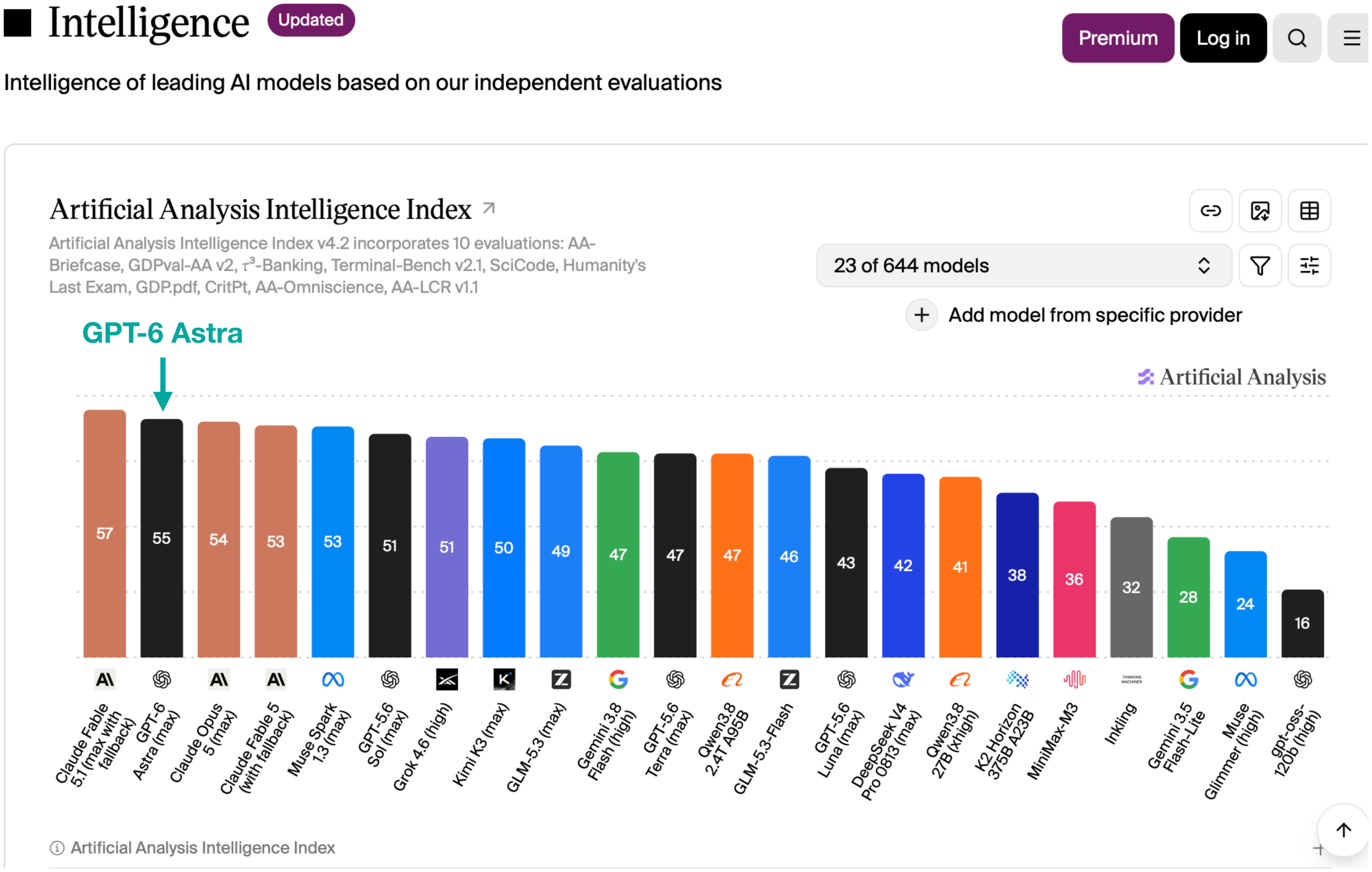
Coming back to the Artificial Analysis Coding Agent Index v1.4 (lower right in the previous figure), which blends several agentic coding tasks, GPT-6 Astra is clearly at the frontier, but it doesn’t pull ahead by leaps and bounds. This can also be seen in the general Artificial Analysis Intelligence Index shown below, which blends different types of tasks, not just coding tasks.

artificial-intelligence

Figure 2: Artificial Analysis Intelligence Index via https://artificialanalysis.ai/#intelligence

Now, the big advantage of Artificial Analysis benchmarks is that they are independent and thus may be a bit more trustworthy than self-evaluated benchmarks by model developers.

The harness setup depends on the benchmark. For example, GDPval-AA and AA-Briefcase use their open-source, minimal Stirrup harness across the different LLMs they compare. In the Intelligence Index v4.2 shown above, Terminal-Bench v2.1 uses Terminus 2, and τ³-Banking uses the τ-Bench harness. The separate Coding Agent Index also compares different coding-agent harnesses.

For evaluations that use a shared harness, this makes it more of an apples-to-apples comparison. At the same time, during model training, models are typically developed with one primary harness in mind (and fine-tuned less on other harnesses). Plus, the primary harness is often developed to suit and amplify a model’s strengths.

So, some of the agentic evaluations might underestimate how well Astra performs in its primary harness. How much this affects its Intelligence Index score would need to be tested by comparing Astra across harnesses on the same tasks.

As a side note, as a colleague recently suggested to me (as also recommended by the Claude Code lead), it’s maybe not a bad idea to delete (/archive) some of your existing AGENTS.md contents and SKILL.md files, as newer LLMs have become more efficient at understanding the prompt and solving the problem at hand. The extra hand-holding could unnecessarily constrain newer models and lead to worse solutions.

Of course, I am not suggesting never using SKILL.md files again, but for some workflows, because they can improve efficiency upon reuse, since the model doesn’t have to rediscover them. But what I am suggesting is that some workflows don’t need describing, and “old” descriptions may no longer be ideal, and the LLM may be able to come up with better solutions. So, it’s perhaps time to update or regenerate said instruction files.

1.2 Computer use capabilities

GPT-6 Astra seems to be exceptionally strong in image and rendering tasks. When these tasks involve interacting with graphical user interfaces, they also demonstrate computer-use capabilities, meaning the model operates software on your local computer through the Codex/ChatGPT app.

Computer use is where the model really shines compared to others, and anything graphic-related also makes for interesting and intuitive demos on social media platforms. There are tons of examples of impressive demos out there, from modeling rendering New York City in blender to virtual open house tours.

To pick one example, below is a comparison where I had GPT-6 Astra Medium and High redraw a picture of me in a browser version of MS Paint using the mouse on my computer (not Extra High and Max, because I didn’t want to waste all my tokens :)).

This highlights not only the model’s artistic capabilities but, more importantly, its ability to use tools on one’s computer (in this case, Paint; you can see the model using the interface via the mouse cursor).

This is not the first model that, inside a harness, is capable of general computer use. For example, I successfully used GPT models for some UI tasks (e.g., expense-related tasks in Excel) and so on since earlier this year. However, computer use is a relatively new capability, enabled by the harness, and usually feels not quite as mature yet. This makes sense. LLMs are text models, so naturally the lower-hanging fruit is writing and coding and using APIs and CLIs.

At the same time, there are many tools and software that don’t expose CLIs (yet), and instead of waiting until someone designs that interface, why not improve models to use graphical user interfaces (and, as mentioned before, this makes for pretty and impressive demos, anyway)? This is somewhat analogous to the emerging humanoid robot developments. Sure, humanoid robots are not the most efficient robots, for example, at the assembly line, where special-purpose machines exist. But they are versatile.

So, I expect the upcoming months (or years) also to be an era of computer use refinement on both the LLM and the agent harness layer. I.e., in addition to the current capabilities, and expanding their math and coding capabilities, models will be trained with an increasing amount of computer use in mind. And this will also make LLMs more accessible for everyday computer tasks outside the tech world (”Hey ChatGPT, please do my tax return” :))

1.3 Computer use training

The computer usage trend is also consistent with the recent reporting that OpenAI purchased tens of thousands of Mac Minis and Mac Studios for Reinforcement Learning. So, here the Macs are not used to literally train the models (it’s better to use GPUs for that) but rather to expose macOS during the model training for the model to learn to use said operating system and the tools therein.

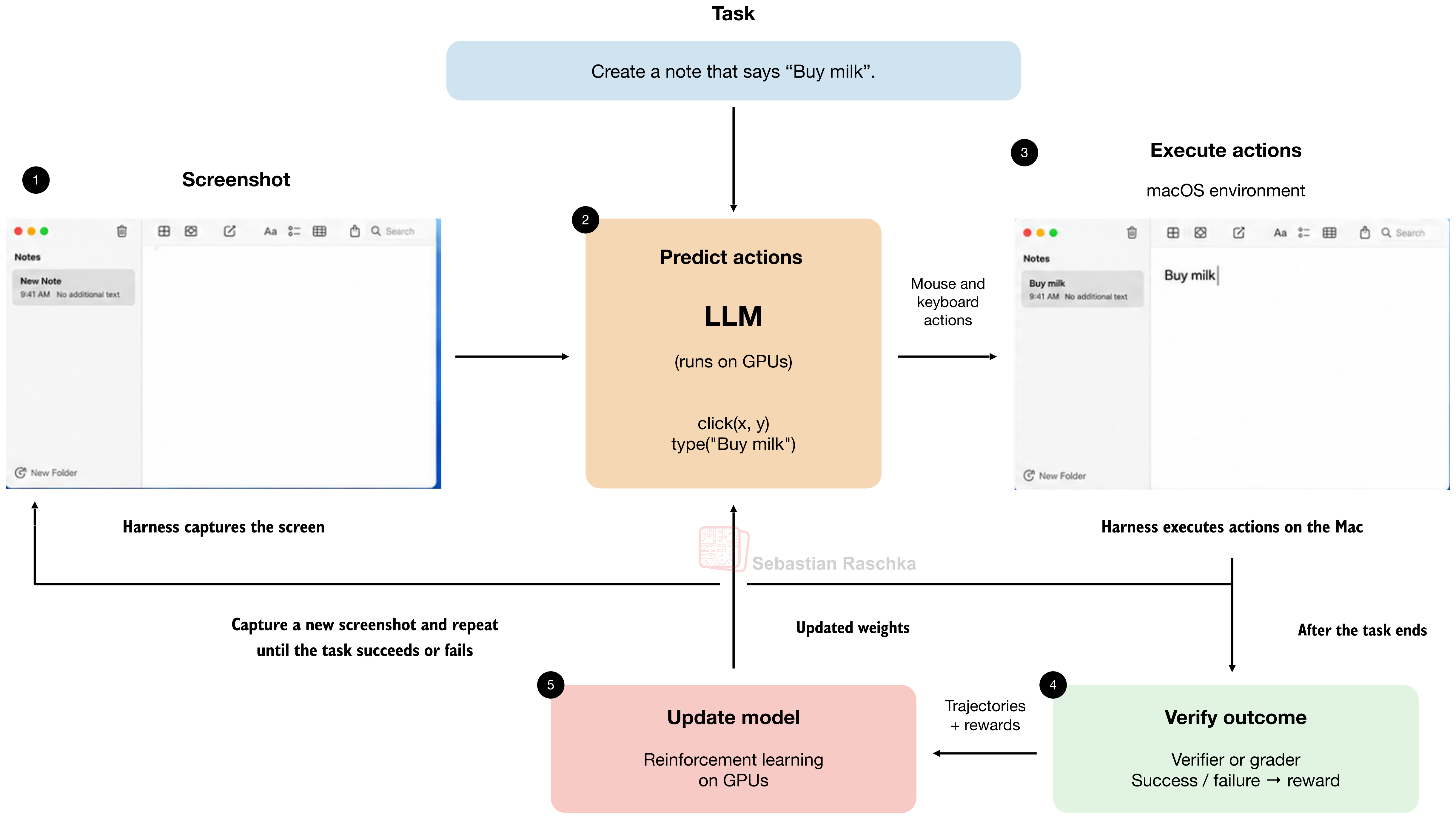
So, how does computer-use training on said Macs work? In short, the Macs (or their macOS operating system, to be precise) serve as an environment that the model can interact with during training.

The basic workflow looks like this:

  1. Prompt the model by giving it a task, such as “open an app xyz and do abc”.
  2. Provide it with screenshots of the macOS interface (this is usually done by the harness).
  3. The LLM then predicts mouse/keyboard actions (click, key presses, scrolling, and so on).
  4. Execute those actions on the Mac (again, this is done by the harness).
  5. Feed new screenshots of the updated environment after performing the actions in the previous step.
  6. Repeat steps 2-5 until the task succeeds or fails.
  7. Use success/failure signals and verifiers (or graders) as training feedback, including reinforcement learning during post-training; this is analogous to regular Reinforcement Learning with Verifiable Rewards (RLVR).

computer-use-flow

Figure 3: Overview of a computer-use training workflow.

Again, the Mac is mostly the environment here and not the machine for running or updating the model during training. The model likely sits on NVIDIA GPUs and is fed via API to said Mac. By the way, NVIDIA’s CEO mentioned that GPT-6 Astra was being trained on ~100,000 Grace Blackwell GPUs.

1.4 GPT-6 Astra is still a reasoning model

The focus on computer-use training discussed in the previous section is not a fundamental paradigm shift in the training pipeline. GPT-6 Astra (and likely any LLM in the foreseeable future) is still a reasoning model. This means the LLM is trained with reinforcement learning with verifiable rewards (RLVR) and produces intermediate reasoning traces (chains of thought)

But I will discuss the reasoning model aspects of GPT-6 Astra (especially regarding hiding chains of thought) a bit later in this article.

2. Looped transformers

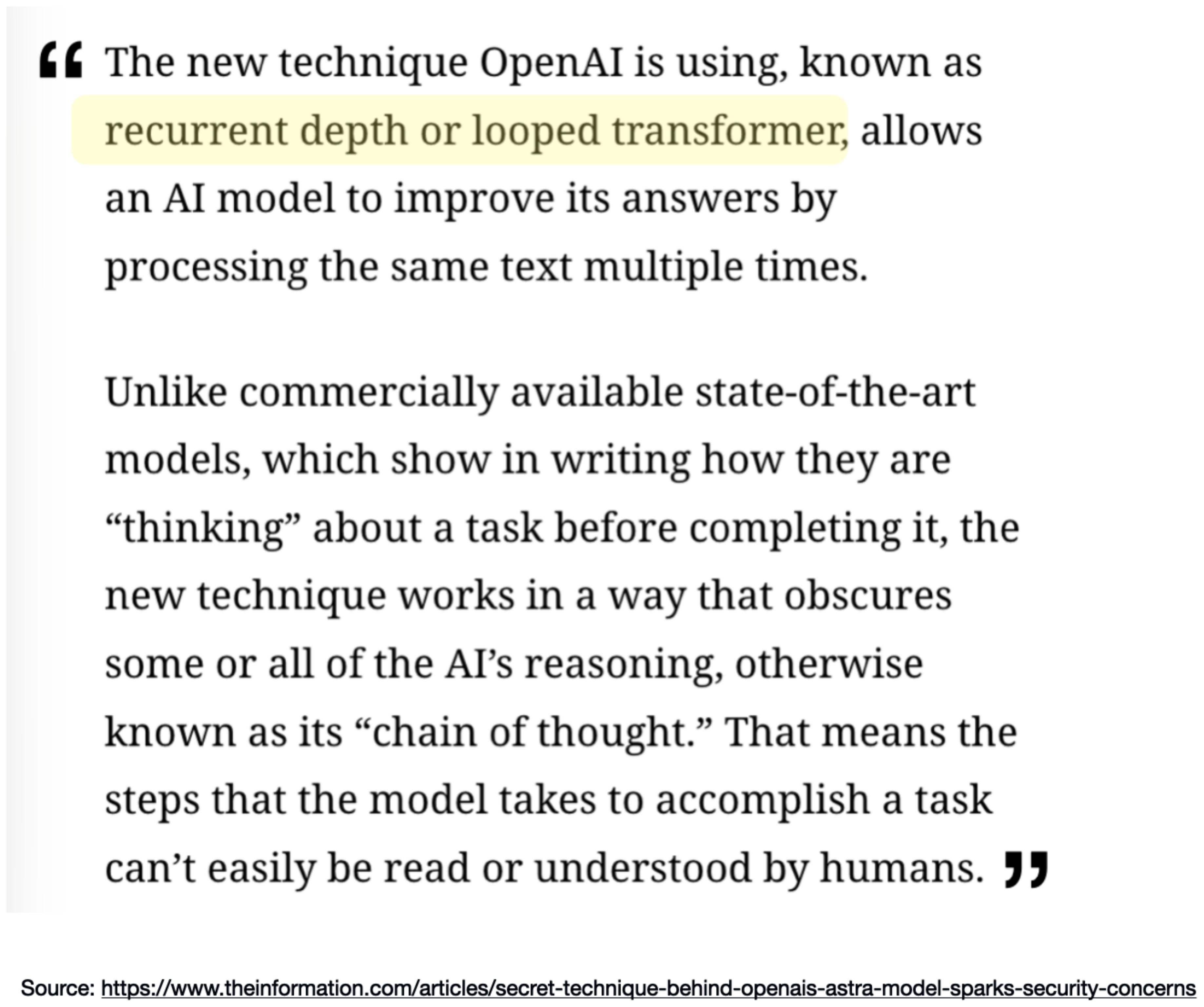
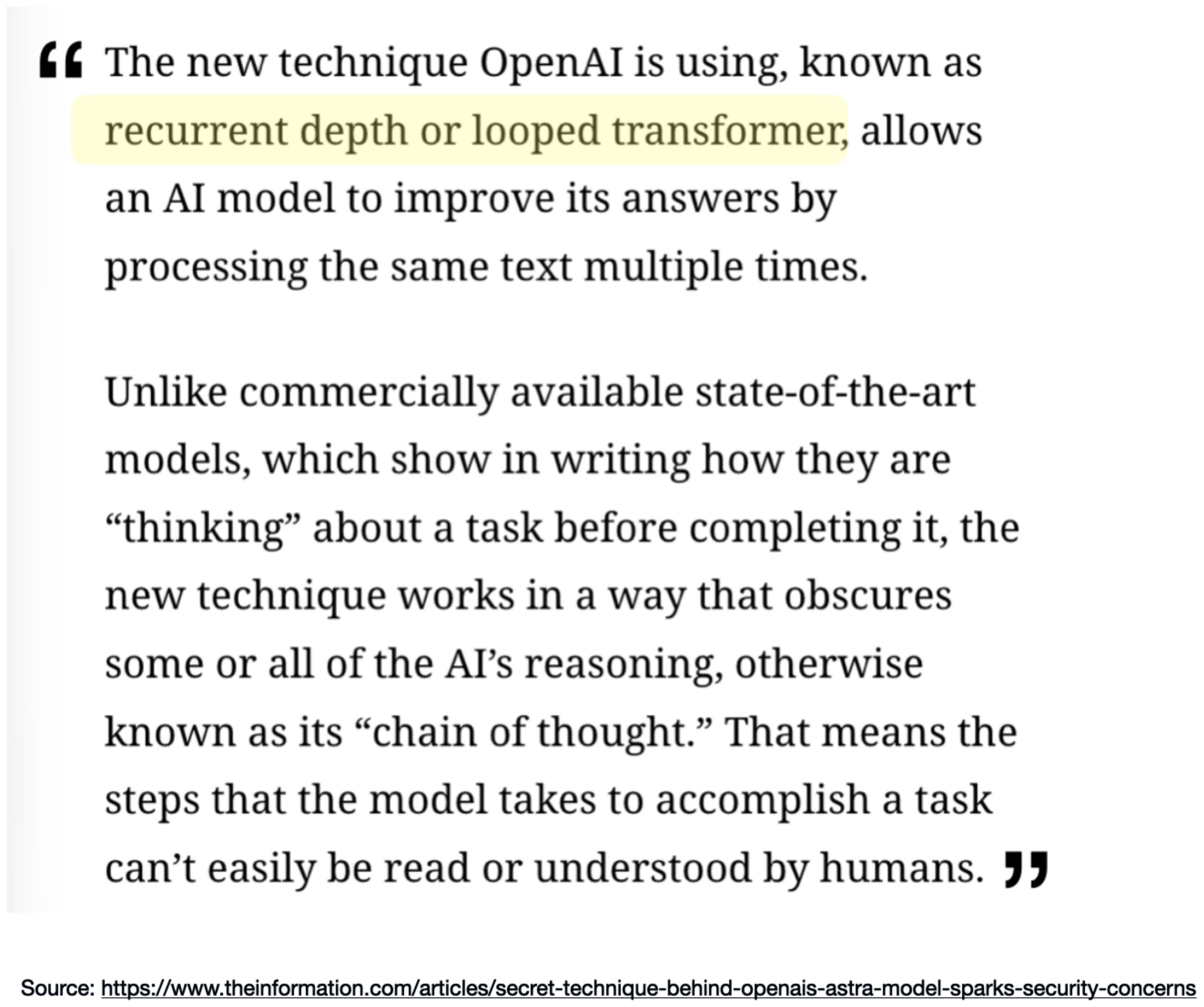
That being said, about two days before the official model, the news magazine The Information published an articlereporting that, according to some inside information, Astra is using a concept called “recurrent depth” or “looped transformers.”

the-information

Figure 4: Quote from The Information (Source: https://www.theinformation.com/articles/secret-technique-behind-openais-astra-model-sparks-security-concerns)

Since LLM architectures are within my area of expertise and my passion, I created a short lecture video explaining the general looped transformer mechanism and addressing the comment about hidden reasoning chains, which you can find below.

In the following subsections, I’ll first explain what looped transformers are, and I’ll revisit the comment about the hidden chains of thought later in this article.

(The looped transformer explanation may seem a bit long, but I really think that it helps with establishing a foundational understanding of the technique, which is then useful to judging the claim that it obscures the reasoning traces or chains of thought.)

2.1 Reusing transformer blocks

So, what’s a looped transformer?

A Looped Transformer is essentially an architectural tweak, with the main idea being to pass the intermediate representations through the same transformer blocks multiple times (instead of just once). Compared to just adding more blocks, the “trick” here is that the weights stay the same across these passes.


Definitions & Jargon

Throughout this article, I’ll use the following terms:

  • A transformer block is a unit containing attention, a feedforward module, normalization, and shortcut connections. These blocks are often called “transformer layers” in papers.
  • A stack is a sequence of transformer blocks.
  • A block application means running an input through a transformer block once.

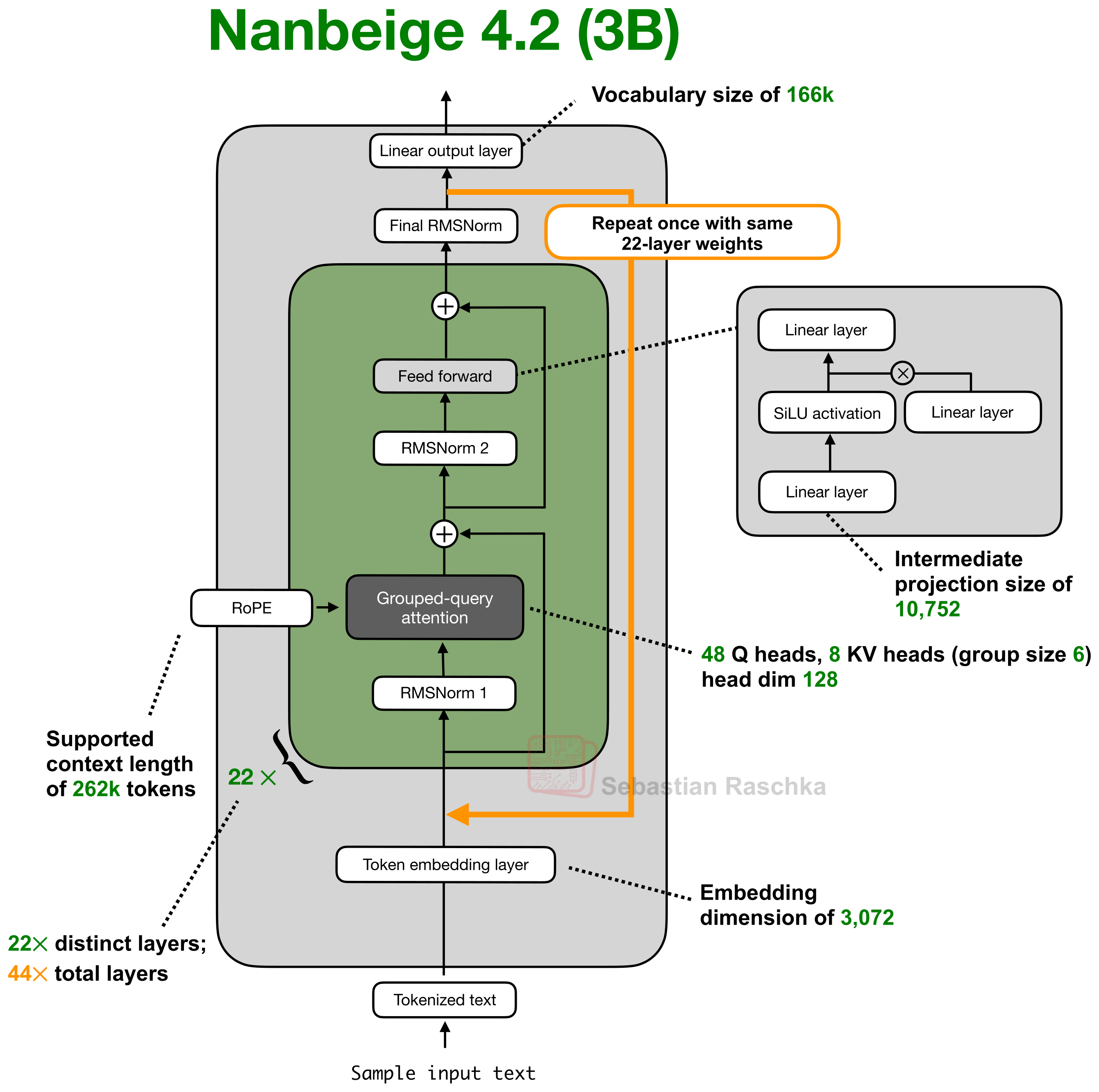
The looped transformer is nothing new, and the basic idea already appeared in the Universal Transformers paper from 2018. But before discussing Universal Transformer, let’s start with a simpler example, Nanbeige4.2-3B, a recent open-weight LLM that came out in July and that I covered on Substack Notes and in my LLM Architecture Gallery earlier this summer.

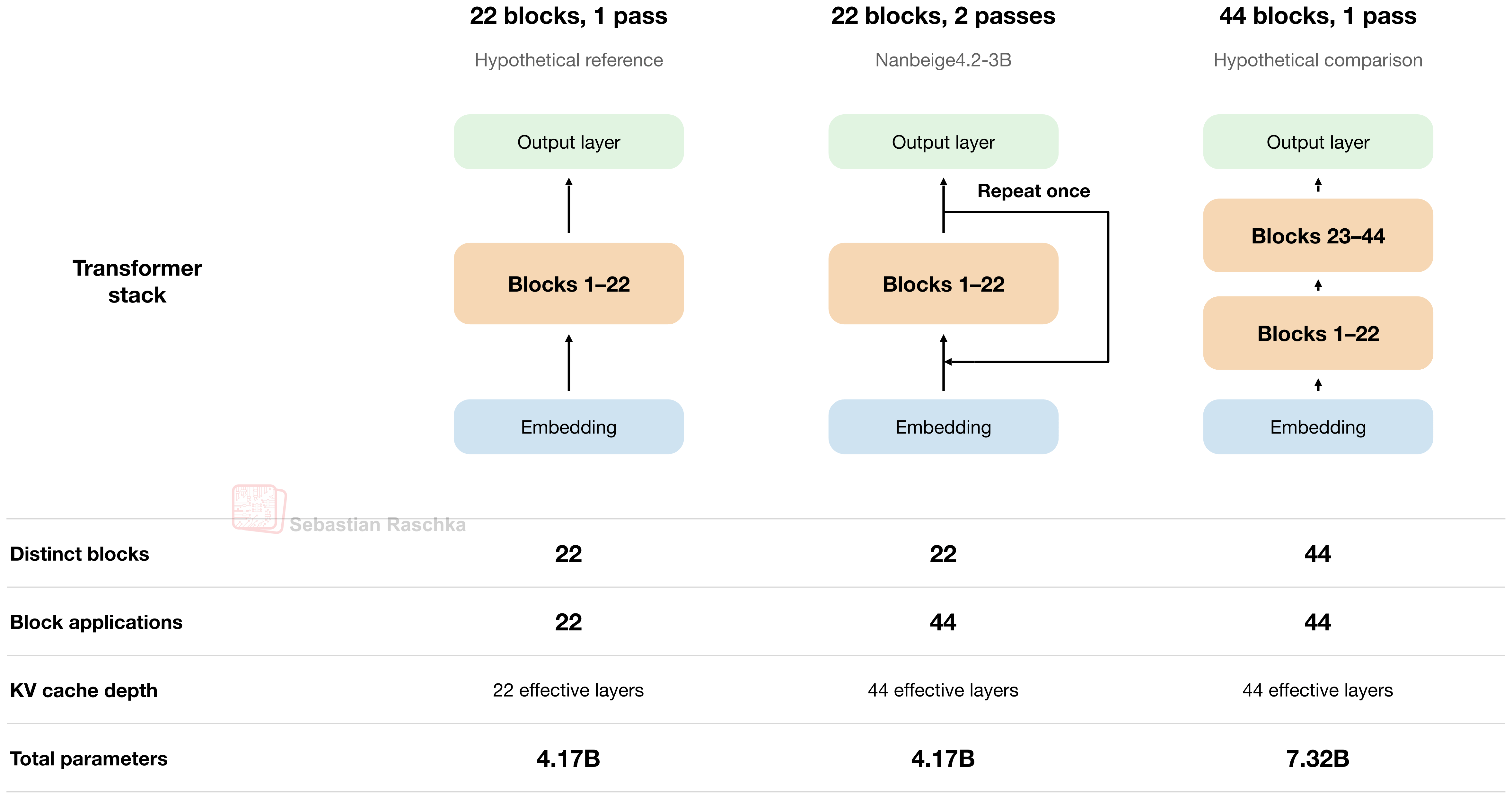
The Nanbeige architecture, shown below, essentially looks like a regular transformer. However, notice that it has an extra (orange) arrow looping back to the beginning of the transformer stack.

nanbeige

Figure 5. Nanbeige4.2-3B applies the same stack of 22 transformer blocks twice. The orange arrow shows where the intermediate representations are passed back into the stack.

Let’s walk through this from the bottom up. First, as in any other transformer-based LLM, the input text is tokenized and converted into embedding vectors. These vectors then pass through 22 transformer blocks, and each of these 22 blocks has its own weights.

However, the looping transformer aspect here is that after the first pass, the hidden states are fed back through the same 22 blocks. So, block 1 is applied again, followed by block 2, and so on up to block 22.

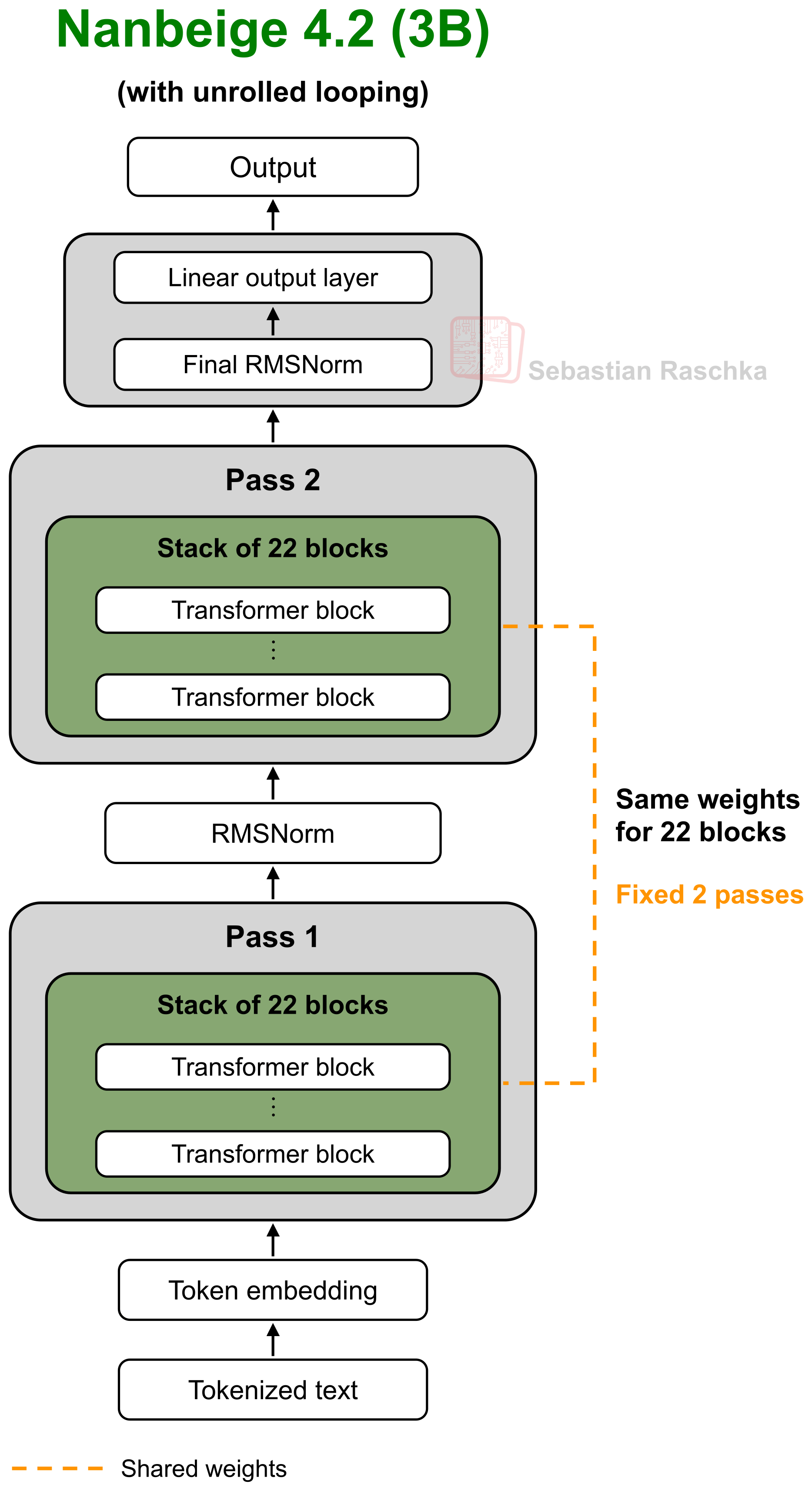
If we were to unroll this computation, we would have 44 transformer block applications. However, compared to a conventional transformer with 44 distinct blocks, the second stack of 22 block applications reuses the weights from the first stack. For example, block application 23 uses the weights of block 1, block application 24 uses the weights of block 2, and so on.

nanbeige-two-passes

Figure 6. Nanbeige4.2-3B unrolled into two passes through the same 22 transformer blocks, giving 44 block applications.

So, the whole idea here is that we increase the effective depth from 22 to 44 block applications without adding another set of transformer weights.

By the way, why 2 rounds, not 3, 4, or more? There are not many details in the Nanbeige paper, but they say that this was essentially the most efficient setup. Increasing the loops from 2 to 3 can increase modeling performance, but the extra computational cost wasn’t worth it.

2.2 Looping costs

So, why would we do this looping in general? This is essentially an alternative to just making the model bigger by adding more transformer blocks.

So, for instance, a model that uses 22 transformer blocks twice has roughly half as many (transformer-block) parameters compared to a model with 44 conventional blocks.

This then reduces the memory needed to store the weights. As a side note, note that the embedding and output layers, which are usually large and make up a substantial portion of the total, are separate from this comparison. (In the case of Nanbeige 4.2 3B, the embedding and output layers make up ~25% of the total 3B parameters; with weight sharing between those two, we could reduce that to 12.5%.)

hypothetical-size

Figure 7: Side-by-side comparison showing how many parameters would be required in traditional versus looping scenarios.

Of course, reusing the same blocks in a loop still requires computation. More precisely, we pass the intermediate inputs through 44 block applications during the forward pass. And, during training, gradients flow backward through both repetitions of the shared stack. So, compared to using the 22 blocks only once, this adds substantial work. Actually, it’s similarly expensive as having 44 distinct blocks (except the optimizer has fewer distinct parameters to update; backprop still runs through all 44 block applications).

There is also the KV cache, which stores the attention keys and values of previous tokens for reuse in conventional and looped transformers in each next-token generation step.

But back to the topic. Even though there is weight-sharing in looped transformers, the intermediate states that enter a block are different on the second pass. Consequently, in KV caching, the resulting keys and values are also different between these two transformer stacks (just like in the no-looping case). So, there are no KV cache-related savings either.

To make this more concrete, for example, consider block applications 1 and 23, which both use block 1 in the looped transformer setup. But each application still needs its own KV cache entries. So, since we have to keep separate caches for both passes, the repeated stack of 22 blocks has the same KV cache requirements as a conventional transformer with 44 distinct blocks.

Interestingly, the Nanbeige researchers reported in the paper that they tried sharing the KV cache between passes. This, of course, halved the KV cache size, but the model performed worse than the version with separate caches (which is the version they released).

Just to complete the Nanbeige discussion before moving on and looking at some other looped transformer designs, their technical report also discusses two other choices or trade-offs.

  1. Training the looped architecture from scratch worked better than converting an already pre-trained transformer through upcycling.
  2. And two passes gave their preferred trade-off, as mentioned in the previous section. More passes brought only small additional gains while slowing training and making optimization less stable.

So, the number of passes is another architectural choice we have to make. As mentioned before, in Nanbeige, this is fixed at two. But we can also make it depend on the token, as we will see next.

2.3 Universal Transformers and flexible loop counts

Now, let’s come back to Universal Transformers. In Nanbeige, we apply a stack of 22 transformer blocks twice. In the Universal Transformer paper from 2018, we repeatedly apply the same transformer block instead of repeating a stack of transformer blocks. The main idea is similar, though.

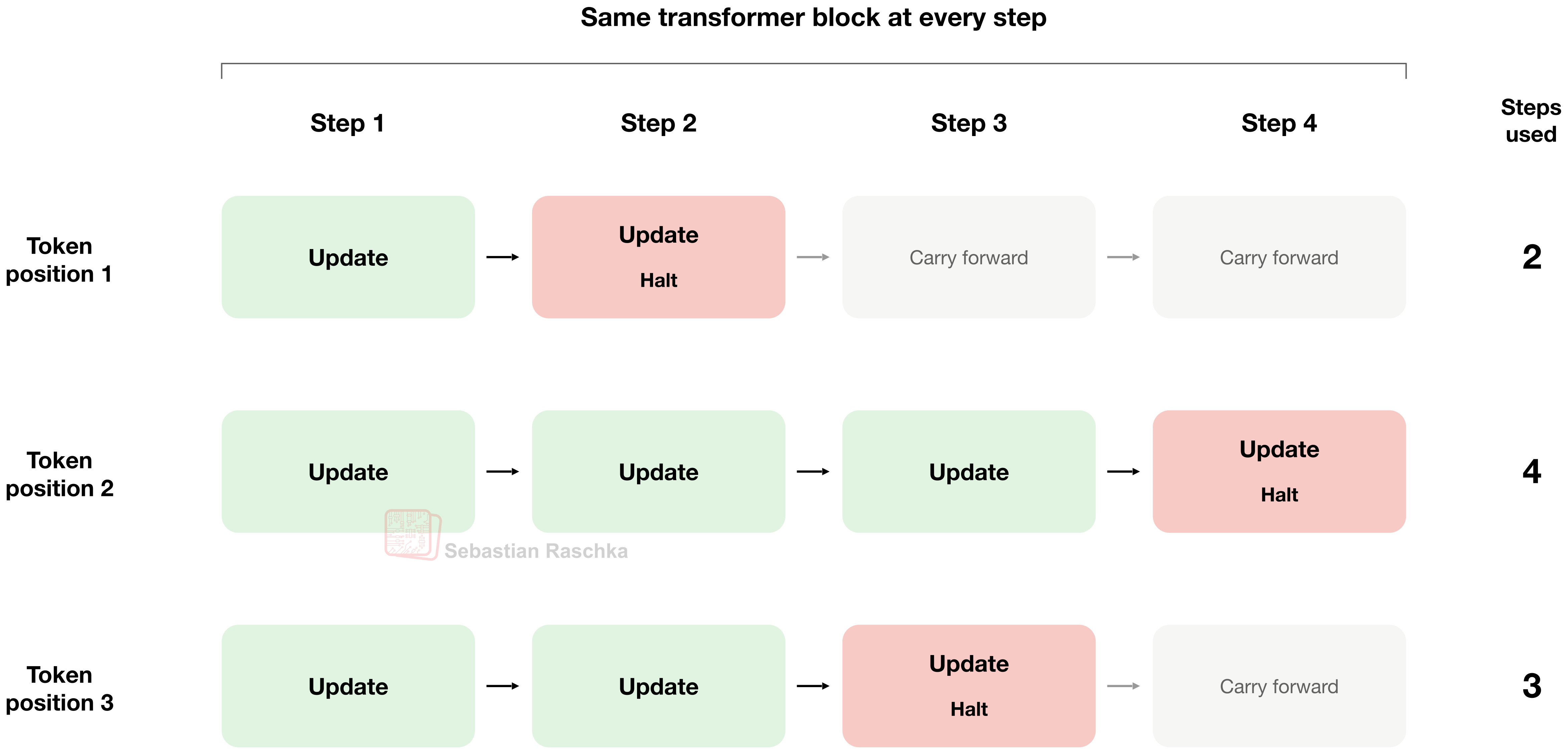
Also, the number of steps can be fixed, but the paper also explores adaptive halting. For example, a token at a particular position may only go through one or two loops. Another may go through three or four loops, and so on. This gives the model flexibility to allocate the compute to those tokens that benefit from extra computation.

How is the looping number decided? Here, the model uses a small, trained function that outputs a so-called halting probability for each position at each step. It adds up these probabilities over these successive loops and then stops looping at a given position once the sum exceeds a threshold value. In addition, a maximum loop count also limits the computation just in case.

adaptive-halting

Figure 8: Adaptive halting in a Universal Transformer.

Another example of a looped transformer is ByteDance’s Ouro, which I also covered in my LLM Architecture Gallery. For instance, Ouro-Thinking 2.6B applies the same stack of 48 transformer blocks four times. That’s 192 block applications while storing weights for 48 distinct blocks. Basically, that’s a more extreme case than Nanbeige. Additionally, a learned exit gate assigns probabilities to the different exits, and a threshold on the cumulative probability determines which pass supplies the output. So, it’s also borrowing the adaptive halting idea from Universal Transformer, which Nanbeige didn’t use. (However, there is a practical caveat here. The released Hugging Face implementation computes all configured passes before selecting an output, so it seems like the number of loops is effectively hard-coded to 4).

2.4 Routing flexible loop counts

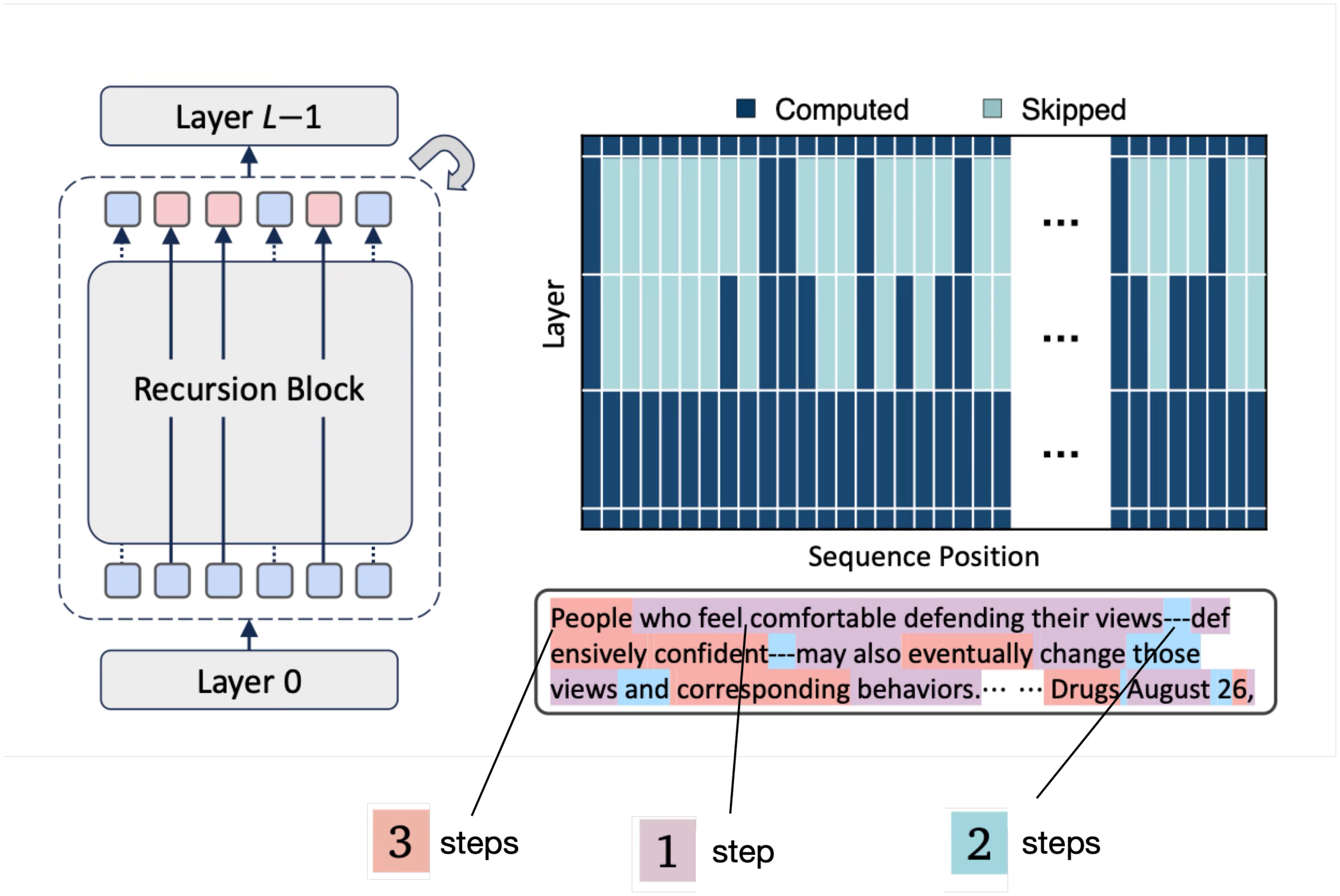
Another approach is Mixture-of-Recursions, a paper from 2025 that is essentially a more sophisticated version of the Universal Transformer discussed earlier. Similar to the Universal Transformer, individual tokens pass the transformer blocks one or more times as illustrated in the figure below. However, the innovation is how this looping number is determined on a per-token basis.

In the following figure from the paper, the looped (repeated) stack is called a recursion block here. This contains several transformer blocks, and it sits between separate first and last transformer blocks (labeled Layer 0 and Layer L-1).

mor

Figure 9. Mixture-of-Recursions applies a shared stack a different number of times at different token positions. The highlighted text shows an example with 1, 2, or 3 passes. Figure adapted from the Mixture-of-Recursions paper.

How does the model decide how many times a token should go through the recursion block? In the previously discussed Universal Transformer, it’s based on a learned halting probability at each step. This Mixture-of-Recursion approach here uses a small, learned router. This is similar to the routing idea in a mixture-of-experts model, except that here the routing decision determines how many times to apply the shared stack.

The router operates on a token’s hidden representation, which also contains information about its context. So, we shouldn’t think of this as assigning every occurrence of a particular token the same number of passes (i.e., the word “People” in the figure above doesn’t always go through a loop of 3). The decision can change depending on where that word appears and what came before it.

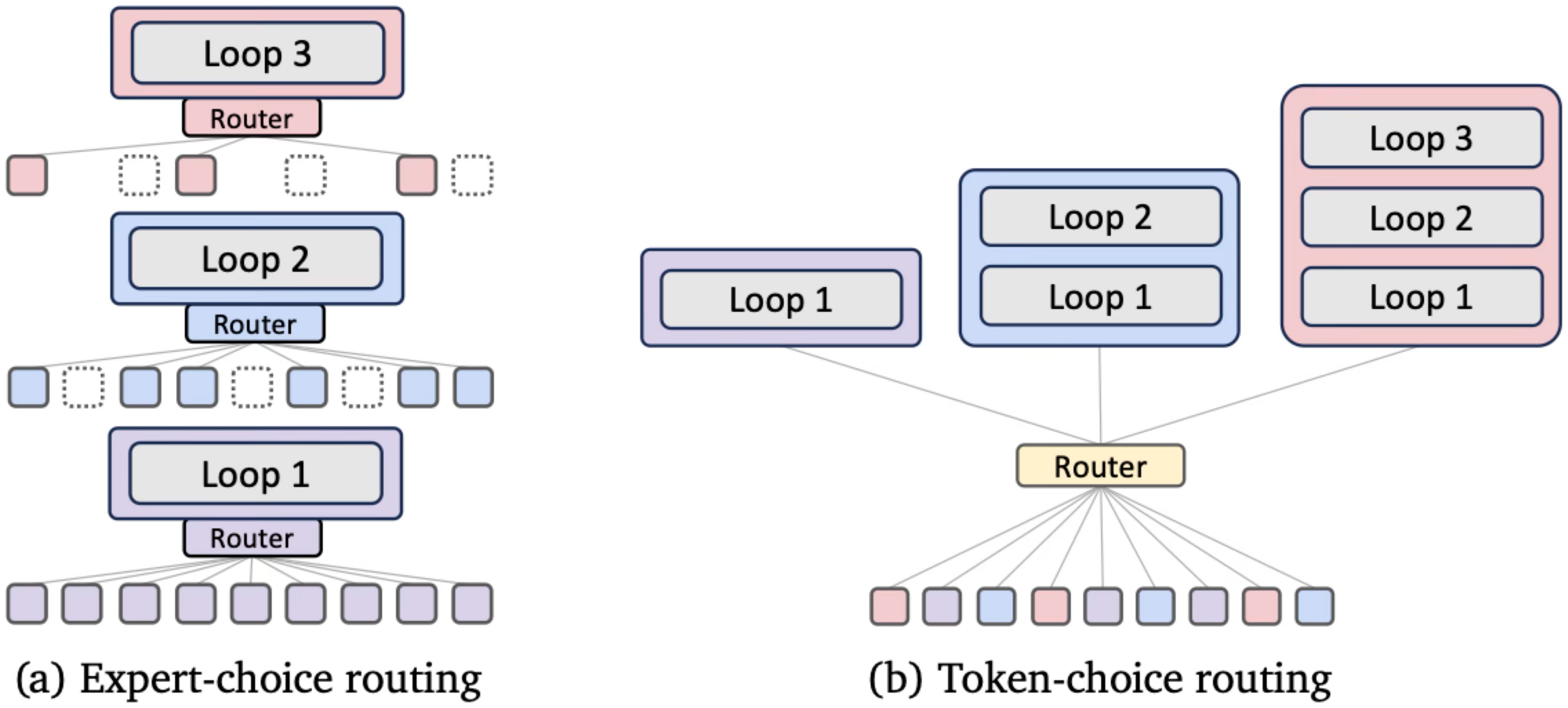
Now, how does the routing work exactly? The paper explores two ways to make this routing decision, as illustrated below.

mor-routing

Figure 10. Two ways to choose the recursion depth. On the left, routers select which tokens continue at each step. On the right, a single router assigns the number of passes at the beginning. Figure from the Mixture-of-Recursions paper.

In expert-choice routing, which is shown in the left subpanel in the figure above, each recursion step selects which tokens it will process. Tokens that exit are excluded from later steps. In token-choice routing, shown on the right, the router makes one decision at the beginning, assigning each token to a path with one, two, or three passes.

In both cases, the transformer weights are reused across passes, similar to Nanbeige, etc. But the additional flexibility comes from choosing how much computation each token receives. The model and its routers are trained together, so the model learns to work with these different paths during training.

2.5 How well does this work?

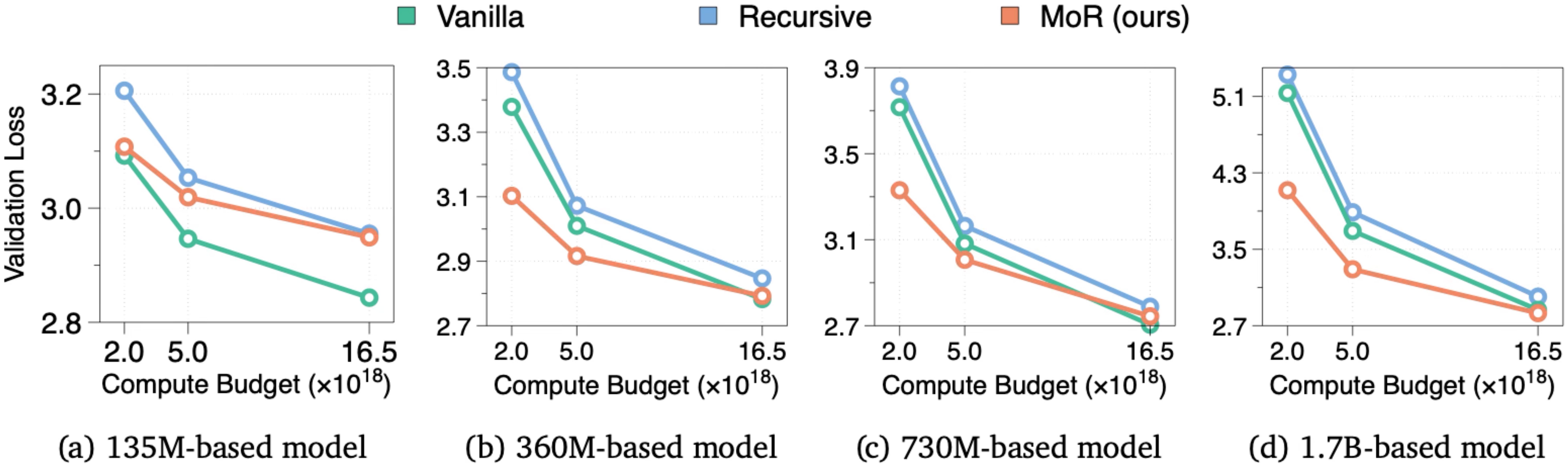
The plot from the Mixture-of-Recursions paper below compares a regular transformer (Vanilla), a transformer with fixed recursion (Recursive), and Mixture-of-Recursions (MoR) for different model sizes and compute budgets (x-axis).

mor-results

Figure 11. Validation loss across four model scales and three training compute budgets. Figure from the Mixture-of-Recursions paper.

At the smallest model scale, the regular transformer performs best. For the larger models, Mixture-of-Recursions catches up and often performs better, especially at the smaller training budgets. At the largest budget, several of the curves are very close. So, the advantage depends on the model size and how much compute we spend on training.

Another detail here is that equal training compute doesn’t necessarily mean an equal number of training tokens. By skipping some computation, Mixture-of-Recursions can process more tokens within the same budget.

I think this is an interesting example because it shows that there are several choices within the looped-transformer idea, that is, how many loops there are at each position and how that’s decided.

So, in short, we can say that using looped transformers can improve model quality at a fixed compute budget if the model is large enough. (It also illustrates the importance of running some experiments at scale; e.g., just looking at the smaller 135M parameter model, we would have drawn the opposite conclusion.)

3. Side note: Recurrent Neural Networks (RNNs)

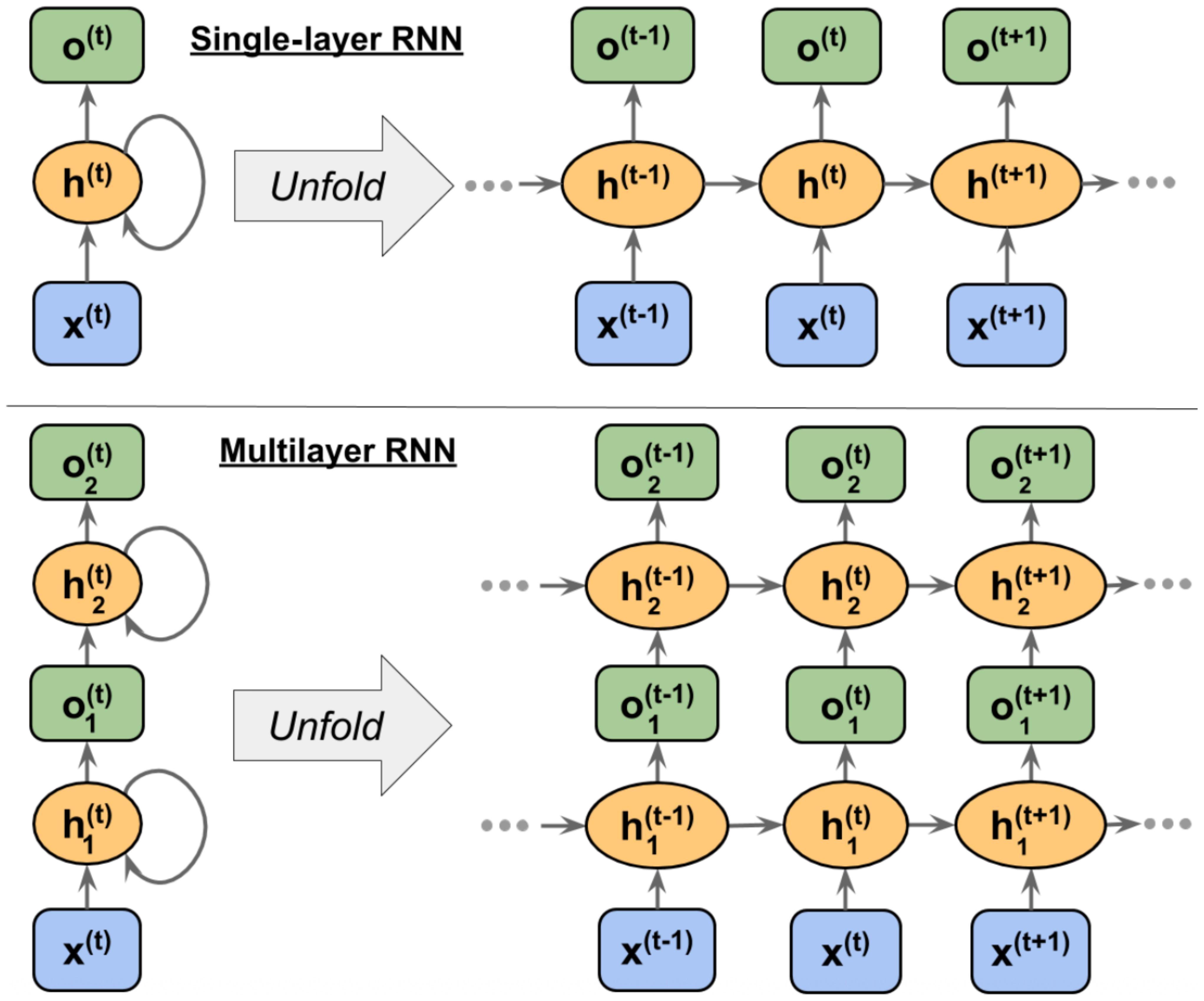
By the way, if you have a background in deep learning (or even artificial neural networks in the 1990s), the looping or “recurrent depth” idea should be somewhat familiar. Remember recurrent neural networks (RNNs)? The whole idea in RNNs is to reuse the layers (weights) from a previous iteration.

rnn

Figure 12: Illustration of an RNN (from my 2022 “Machine Learning with PyTorch and Scikit-Learn book”, https://amzn.to/3YzRnPR)

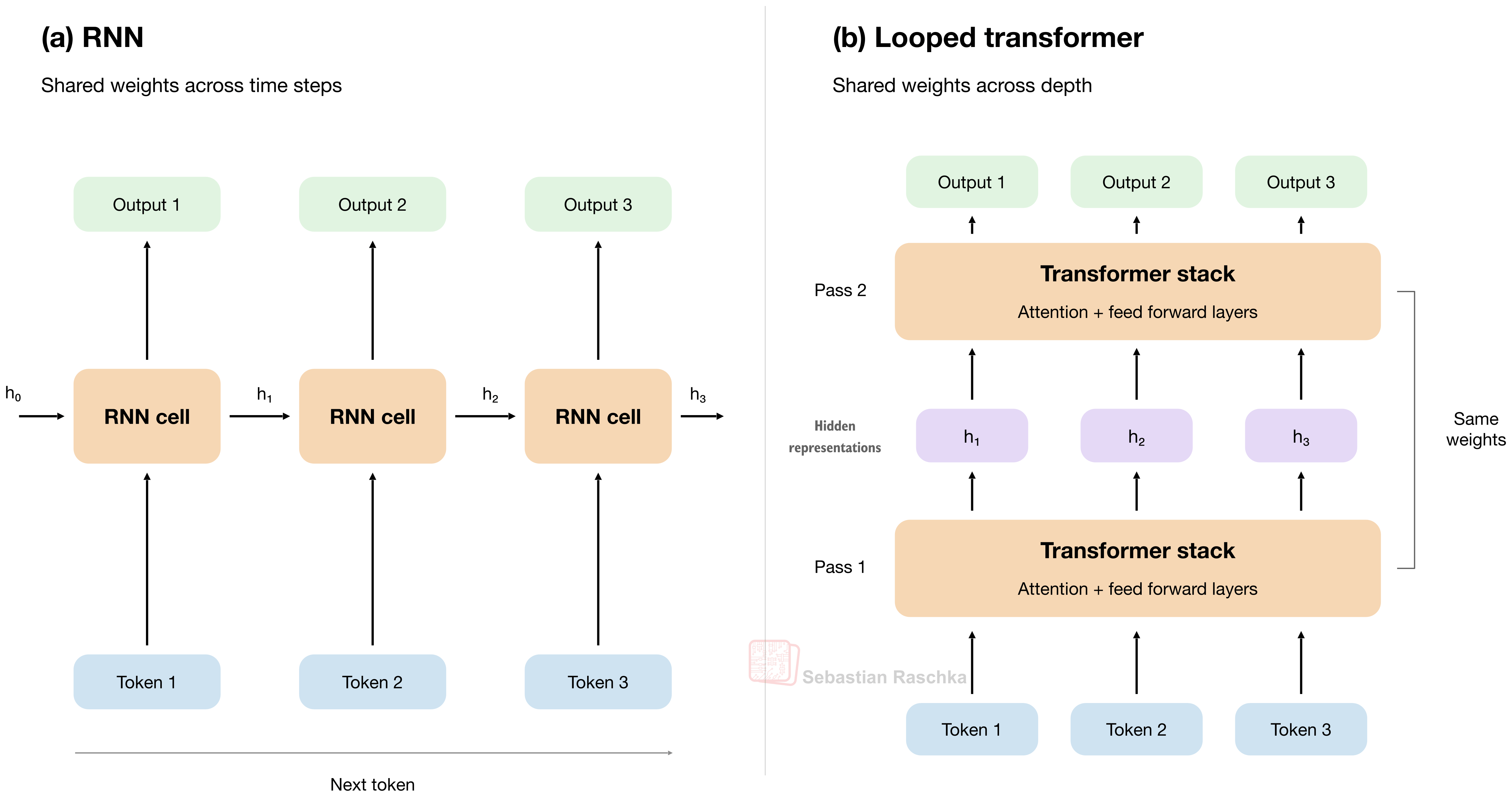
The main distinction is that RNNs reuse their weights across time steps. That is, the hidden state is carried forward from one token to the next. In the looped transformer, the looping of a token is across the architecture depth.

Or, in other words, in a conventional RNN, each step takes the next element in the input sequence and the hidden state from the previous step. So, when the RNN is processing a chunk of text, it reads one word or token at a time and carries information from the earlier words forward in its hidden state.

In a looped transformer, the intermediate representation of a given token goes through the transformer stack multiple times. The model still uses attention to pass information between tokens.

If this analogy is a bit too confusing, don’t worry about it too much. A perhaps simpler way to think about looped transformers is to think of them as reusing transformer blocks, similar to making the model bigger but with weight sharing.

rnn-vs-looped-transformer

Figure 13: Side-by-side comparison of the “recurrence” in an RNN and a looped transformer.

4. Does Astra even use looped transformers?

Before we discuss whether the looped transformer mechanism obscured reasoning traces, as rumored in The Information quote from earlier, does GPT-6 Astra even use the looped transformer concepts?

the-information-2

Figure 14: Quote from The Information (Source: https://www.theinformation.com/articles/secret-technique-behind-openais-astra-model-sparks-security-concerns)

We have to keep in mind that this is still just a rumor or scoop, with no official confirmation. If the model were open-weight, we could double-check this ourselves, of course, but in this case we have to rely on unverified reporting.

However, I think it’s highly likely that GPT-6 Astra uses looped transformer aspects. First, there is the reporting mentioned above. Second, it’s a technique that has shown promise in past studies (as discussed earlier), so why not? Third, OpenAI’s chief scientist said the following.

[...] The depth of the computation graph for our present frontier models, including Astra, is within a factor of two of GPT-4. [...]

However, this doesn’t confirm the looped transformer architecture explicitly, and it could also just mean they use twice as many regular transformer blocks.

In my opinion, the success (i.e., good modeling performance) behind Astra is likely primarily due to other reasons, namely improved training recipes and training data.

The looped transformer tweak might help a bit, but I think that The Information is overestimating its contribution.

5. Hiding chains of thought

Next, let’s finally address the elephant in the room: does looped transformer obscure the reasoning traces?

First, OpenAI has been hiding (most of) the reasoning traces from users from the very beginning, since OpenAI o1, anyway. So, for the end-user, there shouldn’t be a big difference.

So, the interpretation-concern is mostly with respect to the model developers.

Either way, I don’t think that looped transformers are significant contributors towards hiding or obscuring chains of thought. To explain my own reasoning (no pun intended), let’s take a step back and explain how reasoning models work.

5.1 Reasoning in brief

Reasoning models typically generate intermediate steps before producing a final answer. These steps use regular text token (that are optionally hidden from the user in some user interfaces) and called a reasoning trace or chain of thought.

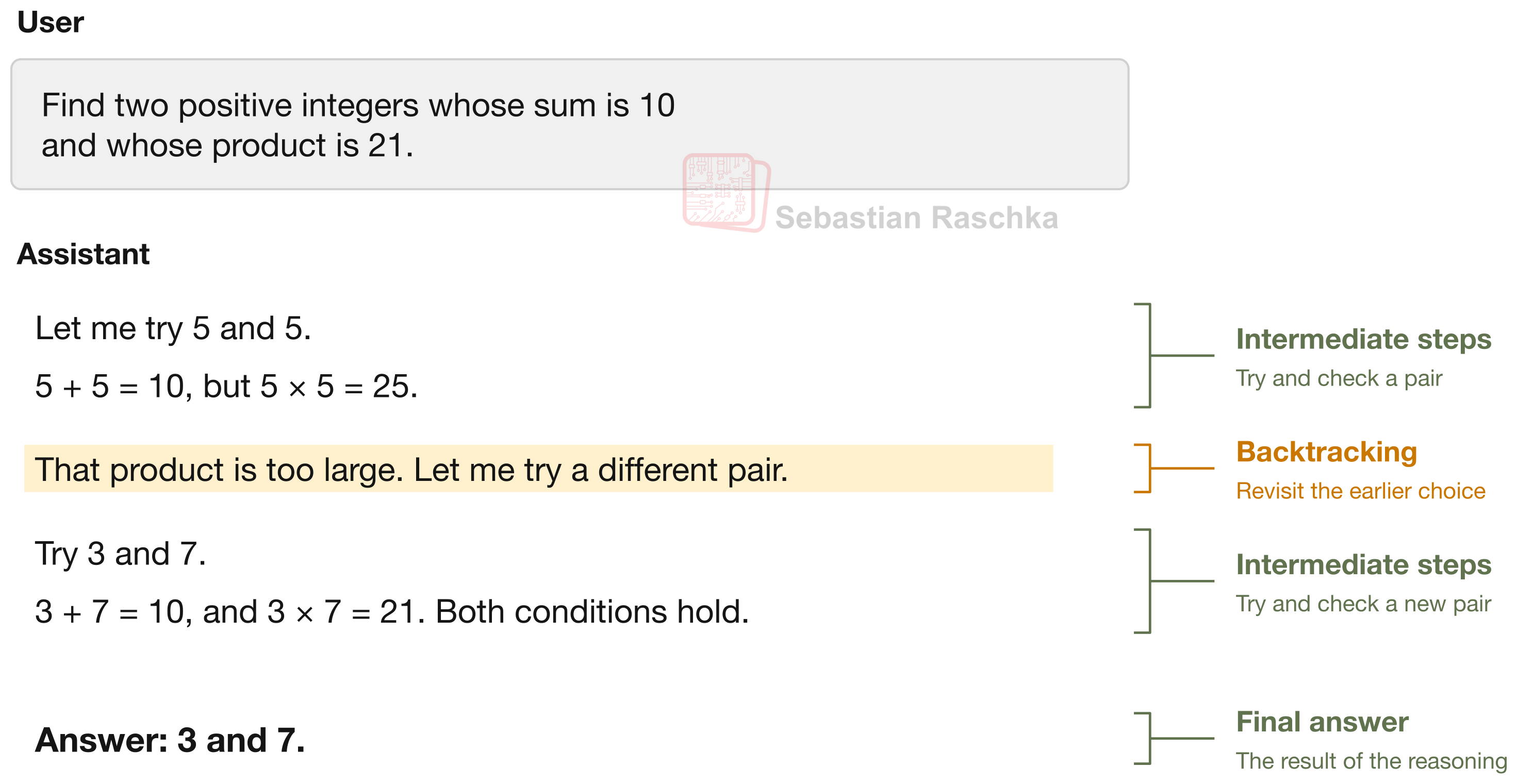
For example, say we ask for two numbers whose sum is 10 and whose product is 21. In the figure below, the model tries 5 and 5 at first. While the sum is correct, the product is 25, not 21. Next, it then tries 3 and 7 and checks both conditions again.

backtracking

Figure 15. An illustrative LLM response annotated to show intermediate steps, backtracking, and the final answer.

The figure illustrates how a reasoning model “reasons,” including backtracking. That is, the model notices a mistake, then revisits an earlier choice, and then continues with a different approach.

Note that the model still generates one token at a time, using the prompt and previous tokens as context. So, these intermediate steps work as a scratch pad and add computation before the final answer.

The final answer can then be much shorter than the reasoning trace that preceded it, as shown in the example above. (OpenAI tends to hide most of the reasoning traces from the users.)

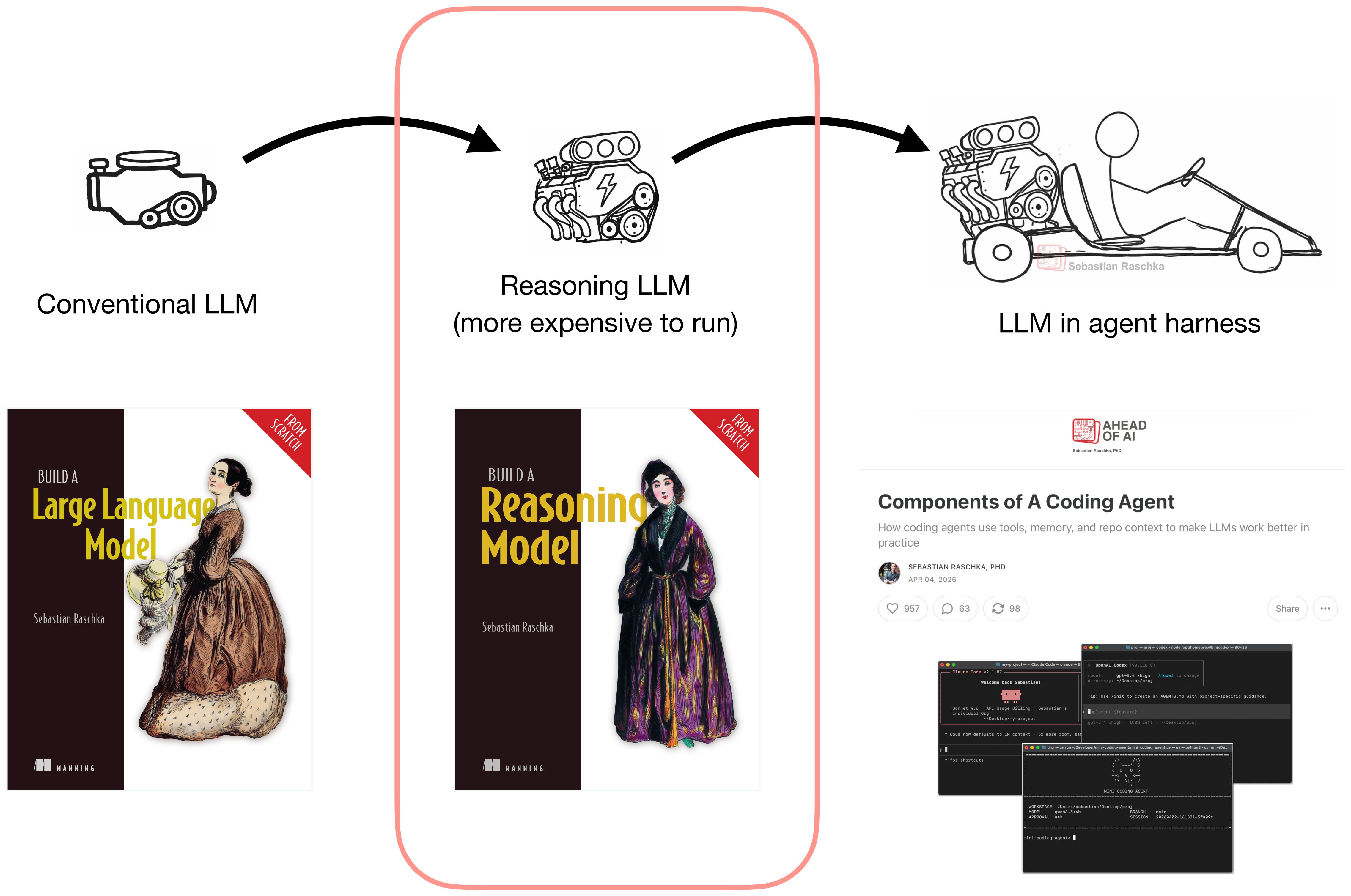
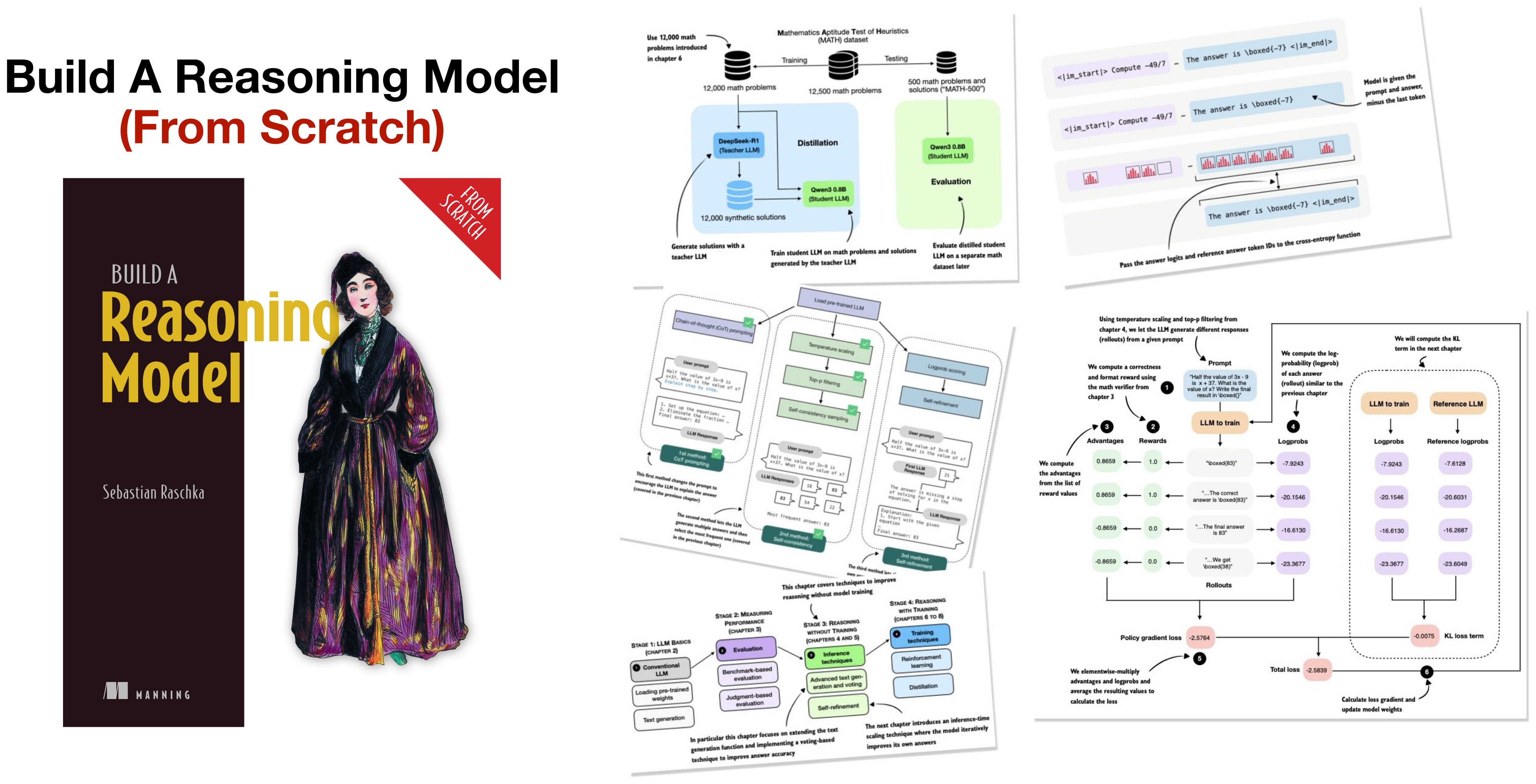
For more details on understanding and developing reasoning models, I recommend my book Build a Reasoning Model From Scratch.

reasoning-book

Figure 16: My Build a Reasoning Model From Scratch book covers the fundamentals of reasoning models.

5.2 Token usage and shorter chains of thought

Now, extra tokens in the reasoning trace add more computation. Looped transformers add more computation, because the tokens go through more transformer blocks. One might argue that a model with looping uses more computation internally, it doesn’t need as many external thinking tokens.

Below is a selection of the GPT-6 benchmarks with the output token number on the x-axis.

output-tokens

Figure 17: Selected GPT-6 Astra benchmarks from https://openai.com/index/gpt-6-astra/

We can see that GPT-6 Astra doesn’t necessarily use fewer tokens than its GPT 5.6 Sol predecessor across effort levels overall. However, at a fixed accuray, it is true that GPT-6 Astra uses fewer tokens than GPT 5.6 Sol.

Is this a concern for interpretability? Not necessarily. Using fewer tokens could just mean that the model is more capable and makes fewer mistakes, uses less backtracking, and so on. I.e., it might just get more things right on the first try. To me, that doesn’t raise an immediate concern regarding interpretability.

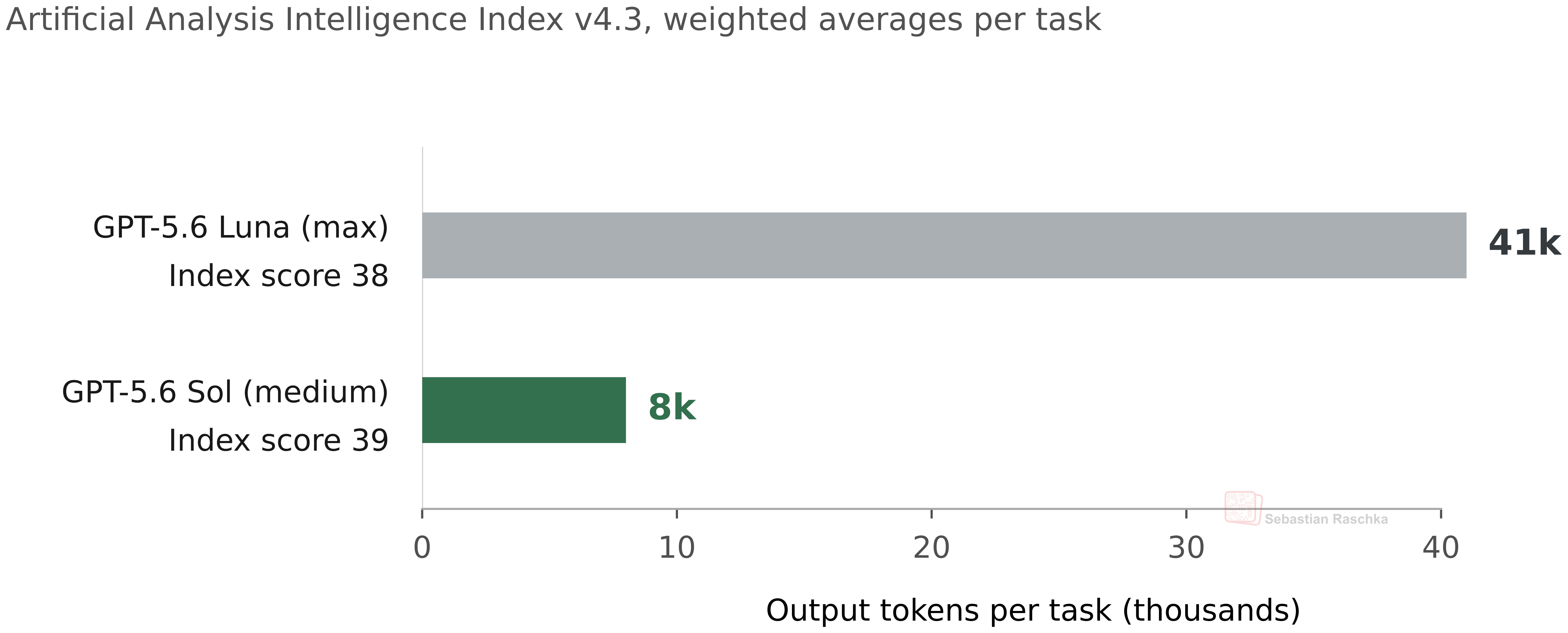
I mean, the same is true for previous models. I don’t think that anyone has strong concerns that GPT 5.6 Sol is so much less interpretable than the smaller GPT 5.6 Luna model, which uses many more tokens for the same task performance, as shown below.

luna-sol-token-usage

Figure 18: Token usage in Luna and Sol at similar task performance levels. Numbers from the Artificial Intelligence Index v4.3.

In fact, as we can see that Luna uses 80% more tokens than Sol at similar modeling performance. Does that make Sol that much less interpretable?

Rather, the more plausible answer here is that more capable (bigger, well-trained models that use more compute) can solve problems more efficiently, where “efficient” here means fewer tokens.

It’s also worth keeping in mind that a reasoning trace is not guaranteed to faithfully describe everything that happens inside the model. In my view, the only valid concern is that looped transformers purposefully mislead users by presenting “fake” reasoning traces more often than conventional transformers. But I don’t think we have any strong evidence that this is happening.

Now, Astra’s system card does state that there is also evidence of reduced monitorability of their reasoning traces, and there is a bit of regression relative to Sol. It’s mostly associated with shorter, less informative traces. But again, this doesn’t establish looping as the root cause. It could just be due to the shorter length in general, similar to the Luna vs Sol example above.

A few hours after I shared my thoughts about looped transformers with respect to hiding reasoning chains, Jakub Pachocki (OpenAI’s Chief Scientist) also shared the following clarification:

I want to prevent a race into unmonitorability kicked off by confused reporting. The depth of the computation graph for our present frontier models, including Astra, is within a factor of two of GPT-4. OpenAI has worked to preserve and utilize chain-of-thought monitoring since our very first reasoning models. We deeply care about this technique, as it can give us a view into how model alignment generalizes from its training distribution. I do think it is fragile and unfortunately trending in a negative direction, for reasons not contingent on architecture changes that I will write about soon. But there are things we can do to strengthen it, and it’s a core goal of our current research program.

The “confused reporting” likely refers to The Information’s aforementioned paragraph here, implying that the looping aspect does not have anything to do with chain-of-thought changes.

6. Looped transformer research

Lastly, I want to share some interesting papers related to looped transformer architectures beyond the ones we already discussed.

6.1 Latent reasoning

Related to the Universal Transformer, the 2025 Scaling up Test-Time Compute with Latent Reasoning: A Recurrent Depth Approach paper studies how a model can use additional loops at inference time. For this, they trained a relatively modest but also not super tiny 3.5B-parameter model on 800B tokens.

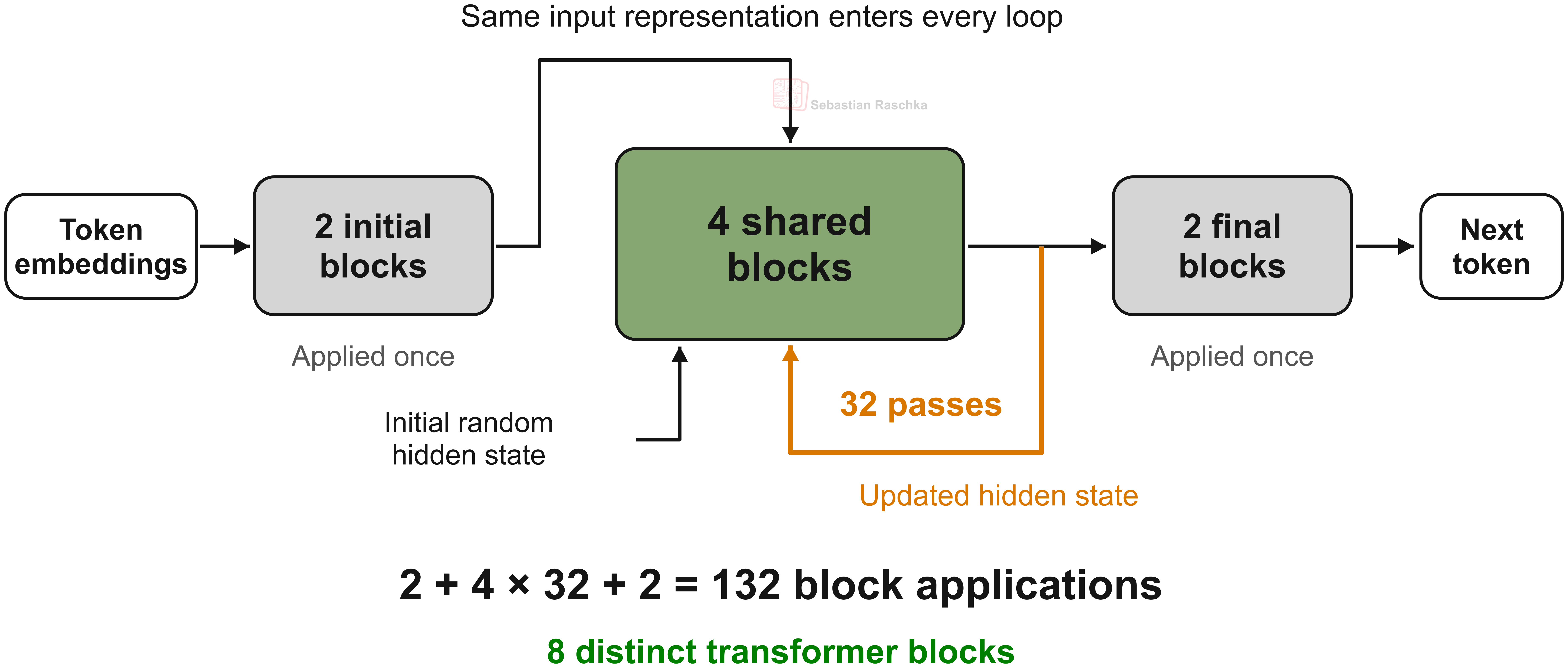
Instead of reusing the same block over and over again as in the Universal Transformer, it repeats a stack like in Nanbeige; however, in contrast to Nanbeige, it sandwiches this shared stack of four blocks between 2 initial and 2 final blocks.

Also, what’s different from Nanbeige is that the shared stack receives the output of the initial blocks at the start of every loop, in addition to the previous loop’s hidden state. These are concatenated and passed through a learned linear projection before entering the four shared blocks. You can think of this as giving the stack access to the same initial input representation on every pass. This whole layout is summarized in the figure below.

So, in short, this is an additional and interesting looped transformer variant.

latent-reasoning

Figure 19. Conceptual summary of the latent reasoning model in Geiping et al..

An interesting detail is that the researchers vary the number of loops during training. This prepares the model to work with different amounts of computation at inference time.

Here, during training, the loop count is randomly sampled. At inference, a fixed budget is chosen by whoever runs the model, such as 8, 32, or 64 loops. Additionally, they have an adaptive stopping mechanism for each token based on the next-token probability distribution. If the KL-divergence between 2 successive rounds is below a certain threshold, i.e., if the distributions are too similar, the looping is halted.

The overall benefit depends on the task. In their evaluations, HellaSwag performance largely levels off after about eight loops, while GSM8K and HumanEval benefit from more.

However, while the title of the paper mentions “latent reasoning”, the model can still generate a textual chain of thought. Looping just gives it additional computation before each output token.

6.2 Knowledge retrieval vs reasoning

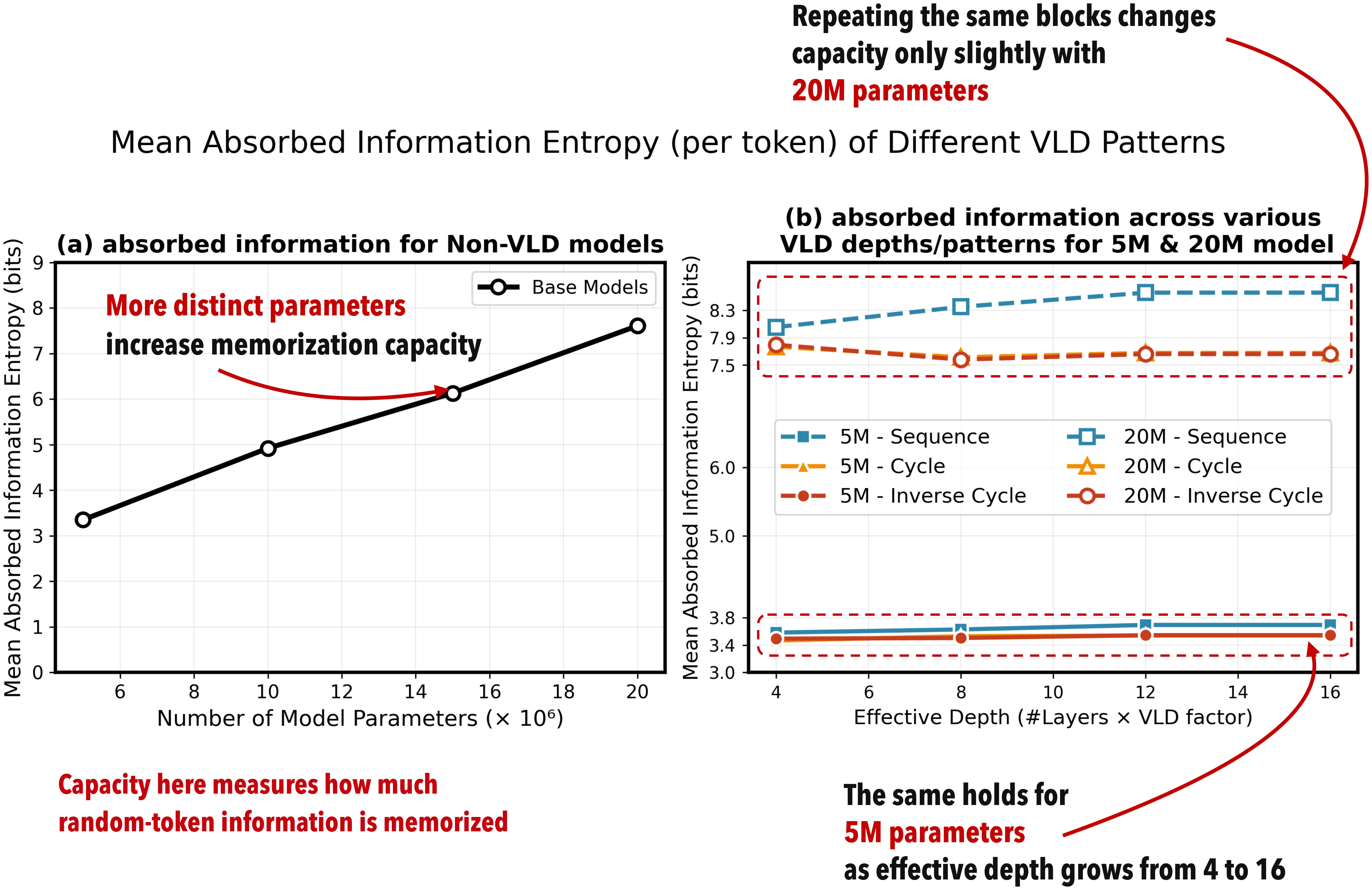
There’s a useful distinction between storing information and using it to solve a problem. For instance, the Beyond Parameters: Exploring Virtual Logic Depth for Scaling Laws paper from June 2025 investigates this by measuring memorization and reasoning in an LLM separately.

First, in the memorization experiments, looping leaves the amount of stored information nearly unchanged when the parameter count stays fixed. Increasing the number of distinct parameters does increase this capacity. From this, we can conclude that looping doesn’t add or let’s the model retrieve more knowledge. This makes sense. Information retrieval is a relatively simple task once the information is stored. Also, looping in itself is computing not “storing” mechanism.

Second, in separate reasoning experiments, reusing the blocks improves performance on multi-step math problems without adding parameters. This is interesting. Here, we can conclude that extra computation can help a model solve problems even when it doesn’t have more space to store information. But again, bigger models can also improve reasoning (although they add parameters as well).

capacity

Figure 20. In this memorization test, capacity grows with parameter count but changes little with additional block applications. Annotated figure from Zhu et al.

6.3 Looping at a matched compute budget

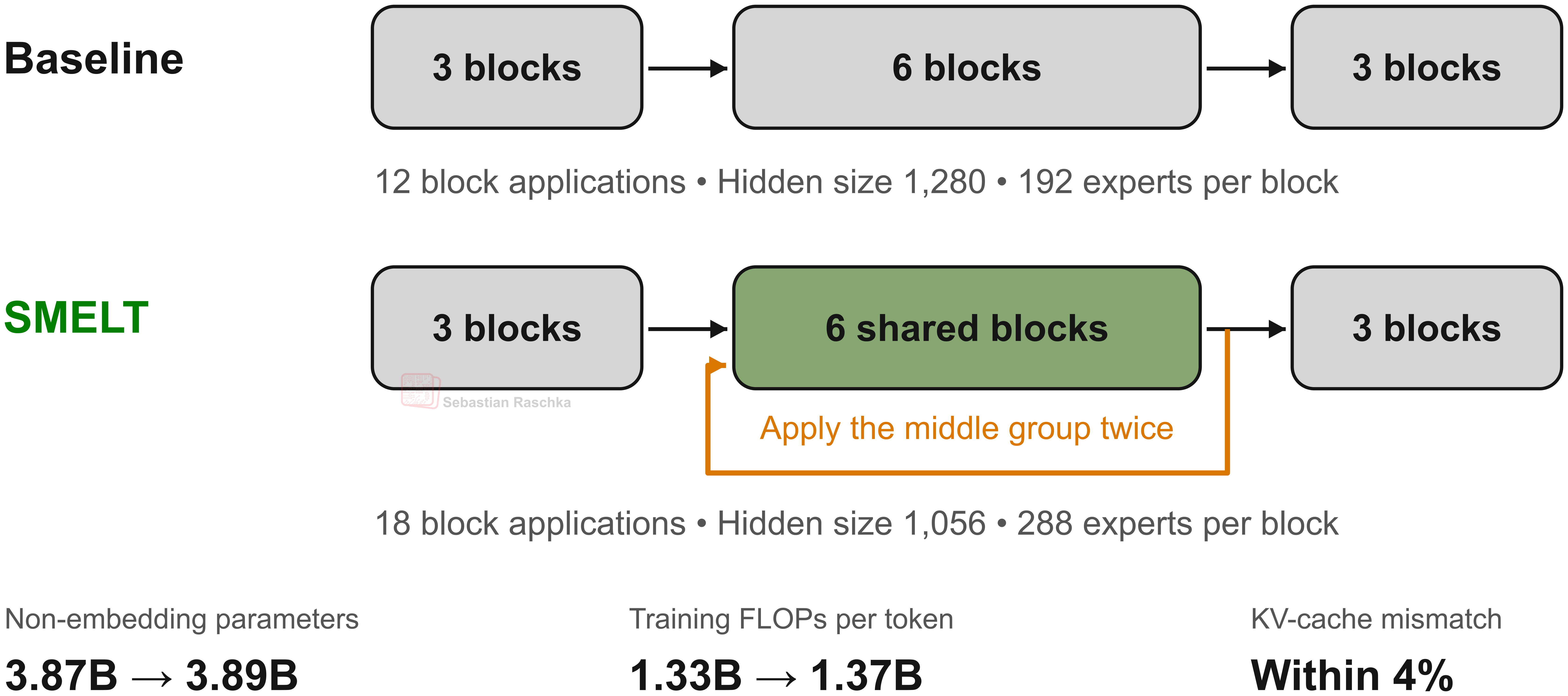
The just-released SMELT: Scaling Laws for Compute-Matched MoE Looped Transformers paper from September 2026 comes back to the cost comparison from section 2.2. What happens if we compare looped and conventional transformers with approximately the same compute per token, total non-embedding parameters, and KV cache requirements?

The researchers use a mixture-of-experts architecture and apply the middle half of the transformer blocks twice, kind of similar to Nanbeige except with the sandwiching in Latent Reasoning.

However, they narrow the hidden dimension to compensate for the compute needed for the extra block applications. And then, because that makes the parameter count smaller, they then add experts to recover the total parameter count. They also adjust the attention head configuration to keep the KV cache comparable.

SMELT worked example comparing model width, experts, block applications, parameters, compute, and KV cache

Figure 21. SMELT overview from the example given in SMELT, section 3.2.

The experiments scale up to 54B non-embedding parameters and so on. Then, from fitted scaling curves, the researchers estimate that SMELT requires about 6.8-18% less training compute to reach the same validation loss within the studied compute range.

So, this answers the question of whether looped transformers are worth it computationally: Yes! They give us a slightly better model when using the same compute budget.

6.4 Full-bandwidth transformer

Finally, the also very recent Full-bandwidth transformer paper from August 2026 studies recurrence across token positions. At each decoding step, it combines the previous token’s final hidden state with the newly sampled token’s embedding through a learned gate. This becomes the input for the next forward pass.

So, the next token’s computation has access to the previous token’s final representation from the bottom of the stack, which is somewhat similar to Latent Reasoning.

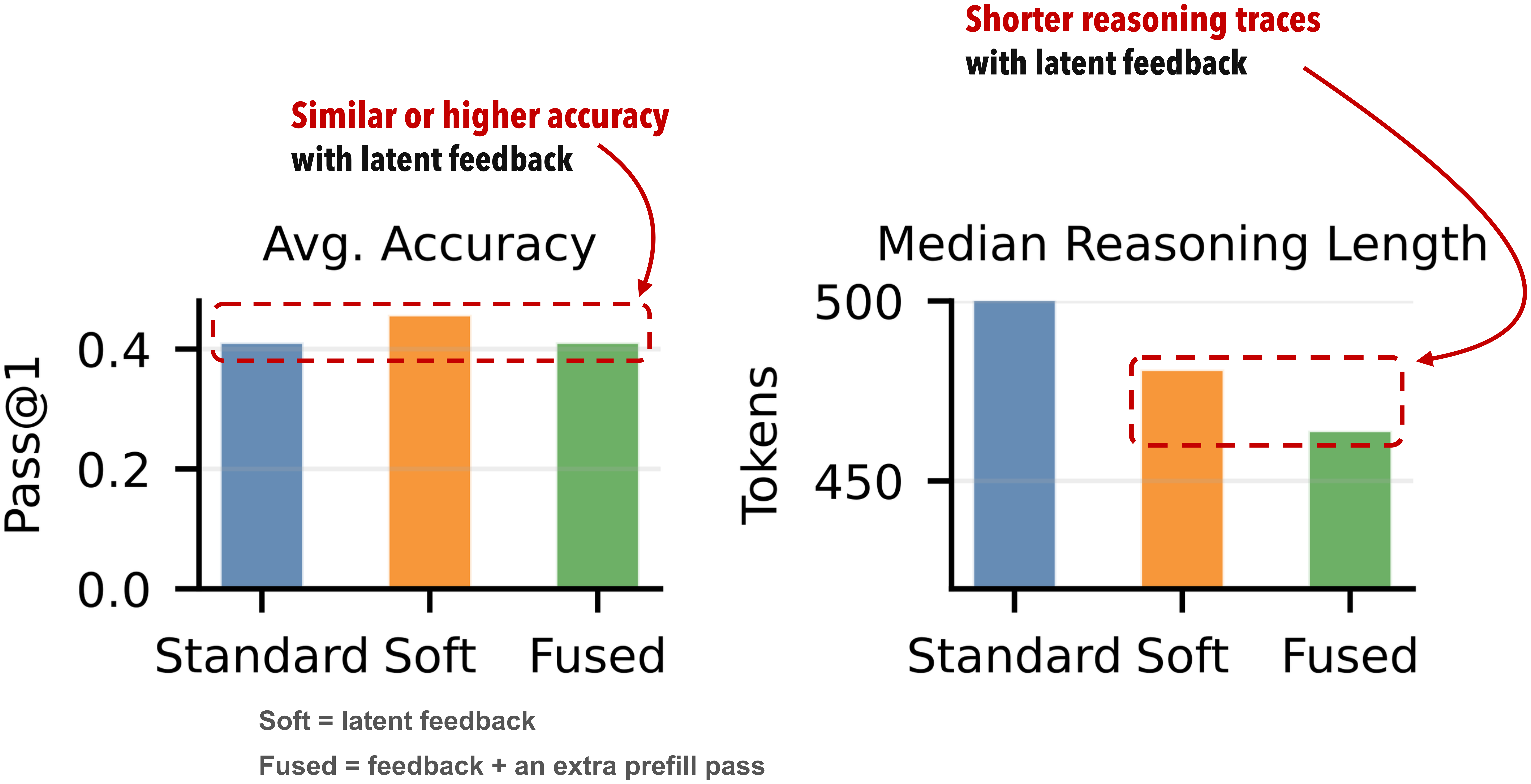
When using a 1B base model, they found that their latent feedback approach outputs shorter reasoning traces on MATH500 while maintaining or improving accuracy. However, the shortening effect disappears after instruction tuning.

length

Figure 22. Latent feedback shortens reasoning traces in the base model, but this effect disappears after instruction tuning. Adapted from Wang et al., Figure 6, CC BY 4.0. Definitions and caveats added.

Anyway, this is interesting because this connects directly to the earlier discussion about whether looping results in shorter reasoning traces. The result depends on both the feedback mechanism and how the model is trained, of course. Also, the experiment doesn’t establish whether those shorter traces are less faithful.

Also, the big caveat of the study is that they didn’t test whether increasing the size of the model in conventional ways (adding more transformer blocks instead of looping) has a similar effect on the reasoning trace lengths.

Conclusion

To wrap it all up, we can say that yes, OpenAI GPT-6 Astra is a very strong model. And it’s making a particularly large leap in computer use. I believe computer use will be the next big focus area for open-source and proprietary harnesses in the upcoming months. I find open-source especially important when it comes to computer use, as “with great power come great responsibilities”, and it’s nice to be able to audit the harness before giving it access to my main computer.

Besides, GPT-6 Astra is likely to use a variant of the looped transformer. Looped transformers simply give better modeling performance at a fixed compute budget.

Also, better modeling performance may decrease in shorter reasoning chains. But this is not a new trend. We have always seen that within a model family with models of different sizes (e.g., GPT 5.6 Luna versus Sol).

In my opinion, shorter reasoning traces are a side effect of more “intelligent” or capable models that make fewer mistakes and can access more compute internally inside their architecture versus using a reasoning trace as a scratchpad. In a sense, the same is true for humans. During an in-person college math exam, a smart and well-prepared student likely requires less use of the notepaper and needs to backtrack less often, and so on.


Thanks for reading and supporting my work!

If you’d like to learn how to build reasoning models yourself, check out my book Build a Reasoning Model (From Scratch). We start with a pre-trained LLM and add reasoning capabilities step by step, with code you can run and experiment with. It’s both fun and rewarding, and a good investment in future-self to build the fundamentals to keep up with the AI field.

Also, if you’ve read one of my books, I’d appreciate a short, honest review on Amazon. Reviews help other readers decide whether a book is right for them and are a simple way to support authors.

scratch

Figure 23: Selected illustrations from my Build a Reasoning Model (From Scratch) book, covering inference-time scaling, distillation, and reinforcement learning.

The Daily Front Page 7 of 32
Wednesday, September 9, 2026 The Daily Front No. #260909 — The Agent Economy
article

What will our economic future look like?

by oumua_don17·▲ 188 points·366 comments·anthropic.com ↗
We don’t know yet how AI will reshape the economy.

We don’t know yet how AI will reshape the economy. Will it lead to unprecedented growth? Widespread unemployment? Neither, or something else? How can we tell?

Anthropic’s Economics team built a model of how AI might affect jobs, growth, and unemployment in the US in coming years. Read about possible economic futures and make your own predictions about AI capabilities to see the economy they imply.

We study how AI is reshaping the economy because we’re committed to ensuring that this transition is beneficial for society, including workers. By providing better visibility into our possible economic future, we can take steps to make sure that everyone benefits from it.

While our Economic Index measures how AI is being used across the economy right now, this scenario explorer is about looking ahead. Based on our technical report, Economic Scenarios for Transformative AI (Korinek et al., 2026), this explorer gives you a chance to find out what the economy might look like as AI continues to get more capable.

In scenarios ranging from business as usual to an economy where AI increases growth to about twice the normal rate, unemployment stays within the historical range and wages remain flat or rise depending on the industry. But in scenarios where growth is faster than anything in economic history, there are adverse impacts on wages and job prospects for knowledge workers. In those scenarios, society is far wealthier, so the challenge is making sure that the gains are broadly shared.

As you scroll down, you’ll see an overview of how AI affects the economy. Then, you can plug in your expectations for how capable AI will be, and how extensively it will be used across the economy in the future. The model will show you what the economy in 2030 might look like if your predictions come true—and how your predictions compare to others.

The economy is made out of tasks

This model represents all the jobs people do in the economy as bundles of tasks. AI can help people do a given task better or faster. It can automate the task. It might not affect the task at all. And it can lead to new tasks.

Think of a day in the life of a nurse

You can think of any job as a bundle of tasks that someone does. She does rounds to check on a sick patient. She draws blood. She triages incoming patients, charts patients’ vitals, and orders supplies for the ward. That’s just the start of the list.

Each of the tasks listed are based on the US Department of Labor’s O*NET taxonomy, listing the tasks for each occupation.

Jobs change over time

Tasks leave the bundle (hardly anyone hand-writes paper charts anymore) and new tasks arrive (30 years ago, no one monitored patients remotely). The bundle of tasks isn’t static, and the job changes as tasks change.

Only humans can do some tasks

For instance, AI can’t bathe a patient.

Some tasks will get augmented

AI helps a human do them better, or faster. AI helps the nurse draft discharge instructions, monitor patients remotely, and plan the shift’s care schedule.

Some tasks may get fully automated

For instance, AI may chart a patient’s vitals, or order the ward’s supplies.

And new tasks will appear

Historically, new technologies have also created new tasks for workers. For a nurse, that might be checking how well an AI triages patients, or reviewing an AI-proposed care plan.

The result: the nurse’s job changes

As the nurse incorporates AI into her job, the nurse is able to oversee and accomplish more. She can spend more time talking with patients and helping them understand diagnoses. Productivity increases.

Every task happens millions of times every day, across the country

Nurses are doing their work on every ward and on every shift. As more nurses use AI, AI supports a higher percentage of these millions of instances of each task.

From tasks to the economy

Today, if you add up every single instance of tasks performed in the US, by people and by the machines and software they work with, you get the US economy: over $30 trillion of value created over the past year. So how will AI shape the economy of the future?

The answer depends on how AI affects all the tasks that make up the economy, the new tasks it creates, and how fast AI takes on this work. Will AI lead to more task augmentation or automation? How much more productive will it make us? How quickly will it be adopted by workers and companies? The answers to these questions have direct effects on GDP, the labor market, and the share of the pie taken home by workers.

There are many possible futures, but we’re highlighting three scenarios

The future will depend on how AI’s capabilities advance, and how industries and workers adopt those capabilities. The three scenarios we share capture distinct kinds of impact.

In the modest scenario, it’s hard to see the effect of AI in macroeconomic data: its economic impact is something like the internet’s. In the substantial scenario, AI makes a bigger impact than the internet, or the railroad. And in the extreme scenario, AI drives a completely transformed, unprecedented economy, likely driven by recursively self-improving AI systems and a faster rate of AI adoption.

Small economic gains

In the modest scenario, AI has roughly the same kind of impact as the internet did. It drives real economic gains, but they’re within the historical norm for new technologies, and they arrive gradually.

A revolution in knowledge work

In the substantial scenario, AI is capable of doing half of all knowledge work by 2030, the majority of it autonomously, but it’s not adopted for all of that work: most knowledge work tasks are still done without AI. The economy grows at twice its normal rate. Wages for knowledge workers don’t rise, but other workers see gains.

A profound economic transformation

In the extreme scenario, AI is more productive than humans at the vast majority of knowledge-work tasks. It does nearly all of them autonomously, and it creates essentially no new knowledge tasks for people. This scenario would likely require recursively self-improving AI, adopted quickly for knowledge work.

As AI diffuses, annual GDP growth rates reach 15% a year, leading the economy to double in size every 4.5 years. As a society, we’re far richer than we’ve ever been, but many fewer workers have jobs in knowledge work, and unemployment has risen beyond typical recessionary levels.

How might powerful AI change the economy?

How do you think AI development will go over the next few years? And what would that path mean for the economy? We invite you to consider these questions, and explore potential answers with our scenario explorer.

People’s expectations about future AI capabilities vary.

In August, we surveyed more than 10,000 Americans about their views on present and future AI capabilities, adoption, and the ease of finding new work if they have to change occupations.

The typical respondent’s answers imply outcomes close to the “substantial change” scenario: GDP is 10% higher by 2030 than it would be without AI, and the overall unemployment rate has risen to around 5%. Around 10% of respondents have views in line with the extreme scenario.

You predicted one possible future for the economy. Here’s what that future could look like.

Finding 1: GDP growth

AI grows the economy in every scenario, but some more than others

AI drives GDP growth in all scenarios, although the scale varies enormously depending on the scenario.

US GDP in 2030, by scenario (measured in trillions of dollars)*

*GDP is calculated at 2025 price levels

But growth isn’t the only economic dynamic we care about. What would these potential futures mean for how much of this growth workers receive in their paychecks, or how many people have to find new jobs?

This model isn’t a complete map of reality, but it shows us some interesting findings. The country’s GDP will grow, but a larger share of that prosperity might go to the resources and technology used to create more wealth (capital) compared to workers, even if society as a whole is much wealthier.

And in most scenarios, job reallocation and unemployment both stay within ranges history has seen before, with one exception. In the extreme scenario, if we see recursive self-improvement and rapid adoption, unemployment could spike to historic levels.

Finding 2: Job reallocation

In more transformative scenarios, more workers have to change occupations. That may mean higher unemployment.

There is always some churn in the job market—people losing jobs and finding new ones. In normal times, this process can be painful, but works relatively well from a macroeconomic perspective. Most job seekers find new jobs fairly quickly.

In our substantial and extreme scenarios, knowledge workers may see a lot of automation and displacement. At the individual level, it means coders and call service center agents may have to switch to jobs like electrician and nurse, which are less exposed to AI.

But changing occupations entirely is hard, and it takes many people a long time to land a new job. The more of this switching a scenario requires, the more people will be between jobs.

Where workers are in 2030 (percent of all workers)

As we progress from 2026 to 2030, the number of jobs available in occupations AI affects (knowledge work) decreases, while the jobs available in occupations AI doesn’t affect increase.

Switching to a new occupation is difficult for a few reasons: workers may not want to change occupations. They may need to learn new skills. And even when they do, it’s not easy to get a new job. In the extreme scenario, as large swathes of knowledge work are automated more quickly, affected workers may be unemployed for a prolonged period.

Unemployment in knowledge work rises; in other occupations, it falls

Finding 3: Wages

Across the three scenarios, average wages rise, but this increase is concentrated in occupations outside of knowledge work.

That’s because it takes time for workers to switch to occupations where demand is rising. If there’s less demand for human knowledge work, that puts downward pressure on wages. Meanwhile, as AI increases productivity within knowledge work, the demand for manual work that benefits from that productivity will increase. For example, more quickly producing designs and permitting for physical infrastructure could increase the number of construction projects, resulting in rising demand for construction workers, which pushes those wages higher. In the substantial scenario, wages for knowledge workers are essentially flat. In the extreme scenario, they fall by more than 10% by 2030.

Pay by occupation group, percent above the same economy without AI

Finding 4: Labor vs. capital share

The pie will grow, but a larger share might go to capital

Today, of each dollar the economy produces, about 60¢ goes to workers and 40¢ go to capital. If the economy grows, but AI automates more tasks, more of each dollar might go to capital. This can happen even when wages for all workers rise substantially. If capital becomes more useful for more things, it will be in higher demand, which raises its price. In that world, more of the gains from a growing economy flow to owners of capital.

We find that the labor share falls noticeably in the substantial and extreme scenarios, and the capital share rises. Average wages rise—non-knowledge workers are paid much more—but wages for knowledge workers stagnate or decline alongside worsening unemployment.

In the extreme scenario, the gains from a rapidly expanding economy are unevenly distributed. Most knowledge workers face either lower wages or unemployment, and workers overall get a smaller fraction of the larger pie. Total labor income is barely changed by 2030.

In this scenario, the main challenge is not achieving economic growth, but making sure the benefits are broadly shared and the costs aren’t unequally dispersed.

How GDP is shared between workers and capital

With each scenario, the total economy grows (measured in GDP). But more of the growth goes to capital, compared to the amount people receive in their wages. Some professions see their wages increase significantly, but overall, wages make up a smaller share of the country’s economic growth.

The future is not predetermined.

Ultimately, what the economy looks like in 2030 depends on many factors, like what AI can do, and how companies and workers choose to adopt it. It also depends on how the financial benefit of this technology is shared.

Like any economic model, this one has limits. For example, we did not include scenarios where humanity develops hyper-capable robots. The model draws on our research and external review, and we’ll keep adding to it as the evidence develops.

This model, alongside our full research portfolio, will inform the research Anthropic funds to identify effective interventions for labor market disruptions. It’ll also inform the policy ideas we propose, with the goal of ensuring that the economic benefits of AI are broadly shared across society, both in the US and around the world.

Disclaimer and thanks to reviewers

v1.0 of the Econ Scenario Explorer, September 2026

The economic scenario explorer is currently Version 1.0. Like every model, it is a stark simplification of a complex reality: it isolates a few key forces and omits many others that may become relevant and important in the coming years. For example, it leaves out policy responses, business cycles, potential aggregate demand or financial market disruptions, and possible catastrophic risks. The scenario explorer is a work in progress, and we expect it to evolve both as we invest more time and as economic research itself develops.

We are grateful to the economists who read an early draft of the technical report that lays out the framework behind the explorer, Economic Scenarios for Transformative AI, and gave us detailed comments: Daron Acemoglu, Lukas Althoff, David Autor, Tom Cunningham, Lukas Freund, Joe Hazell, Ben Jones, Pete Klenow, Danial Lashkari, Kurt Mitman, Ben Moll, Emi Nakamura, Pascual Restrepo, David Romer, Jón Steinsson, Chris Tonetti, Ludo Visschers, and David Wiczer. Their feedback was generous and candid, and it has already improved our model. Two examples: several reviewers noted that advances in AI may raise the returns to capital, so that more of the gains flow to the owners of capital; and several noted that the wages of workers in the occupations AI affects most may diverge from those in occupations it barely affects. Both channels are now part of the scenarios. External reviewers were not asked to endorse our conclusions, and any remaining errors are ours.

Other criticisms are still open, and we plan to address many of them in future versions. Reviewers pointed out that the model does not follow individual workers, so it can only paint a very coarse picture of the costs of job displacement. Some questioned whether occupations exposed to AI will shrink at all rather than grow. Some felt the most extreme scenario is better read as a thought experiment than a scenario, while others felt the most modest one understates what is already visible in the data. Several asked us to be clearer that the model does not include the aggregate demand effects driven by the data center buildout. And more than one reviewer argued that we may be underestimating how much AI could accelerate technological progress itself. We agree that many of these are limitations of the current model. The scenario explorer should be viewed as a tool for thinking about what different technological developments would imply for the economy—actual outcomes may differ materially.

Anton Korinek, Chad Jones, Szymon Sacher, Tess Cotter, and Peter McCrory developed the economic model and co-authored the companion technical report. Santi Ruiz wrote this piece with them, with editorial support from Sarah Pollack and Adam Farina. Kelsey Nanan designed and built the interactive experience, with visual design and art direction by Nikki Makagiansar and Monika Tuchowska; Kyle Turman and Szymon Sacher built the scenario explorer and led the translation of the model into interactive form; Fayaz Ashraf and Ryan Heller contributed engineering, and Kim Withee and Maria Gonzalez supported production. Szymon Sacher and Tess Cotter designed and fielded the accompanying surveys with Morning Consult, with support from Ben Fowler. Peter McCrory, Anton Korinek, and Charles Yang coordinated the project, and Jack Clark provided direction throughout. Miriam Chaum, Jack Clark, Saffron Huang, Maxim Massenkoff, and Peter McCrory helped originate this effort. Jim Baker, Shan Carter, Johannes Hermle, Zoë Hitzig, and Eva Lyubich provided feedback.

The Daily Front Page 8 of 32
Wednesday, September 9, 2026 The Daily Front No. #260909 — The Laboratory Copilot
article

How GPT‑5.6 Sol helps run quantum computing experiments

by theanonymousone·▲ 145 points·107 comments·openai.com ↗
Connecting GPT‑5.6 Sol to laboratory software to run and refine routine measurements on quantum chips.

Connecting GPT‑5.6 Sol to laboratory software to run and refine routine measurements on quantum chips freed Beatriz Yankelevich to focus on experiment design and data analysis.

Quantum computing is an emerging technology that uses the unique properties of quantum mechanics to process information. It could one day better simulate complex materials and molecules. Unlike conventional processors, quantum processors are built with quantum bits, or qubits. Preparing and running qubit experiments can take months and require hundreds to thousands of preliminary measurements—work that AI is poised to help with.

Beatriz Yankelevich, a graduate student in MIT’s Engineering Quantum Systems Group (EQuS), used GPT‑5.6 Sol, harnessed to Codex, to explore whether AI could streamline her experimental workflow. The MIT group studies superconducting qubits, which are cooled to near absolute zero inside specialized devices called dilution refrigerators. These qubits perform operations quickly, are precisely controlled using microwave signals, and can be made using familiar manufacturing techniques and arranged on a chip.

Once a superconducting qubit chip has been fabricated, packaged, and cooled, researchers interact with it entirely through software, making Yankelevich’s experiments a natural testbed for AI agents. Connecting Codex to the lab software that coordinates experiments allowed it to run measurements, analyze the results, and decide what to try next. Yankelevich found that GPT‑5.6 Sol could often complete routine measurement workflows autonomously, saving her significant amounts of time and allowing experiments to run without constant supervision. This freed her to spend more time on analyzing results, designing experiments, and planning out the next steps in her research.

A packaged qubit chip beside an open dilution refrigerator with cabling that connects to the chip.

A packaged qubit chip (left) sits inside an open dilution refrigerator (right). CREDIT: EQuS group

Coordinating interdependent measurements

Superconducting qubits are often called artificial atoms because, like atoms, they can only occupy specific energy levels. Microwave pulses move qubits between these levels and probe their quantum state. Researchers design and calibrate the pulse sequences sent to the chip, then digitize and analyse the returning signals. These measurements reveal each qubit’s resonance frequencies, which allows researchers to accurately control the qubit; how long the qubit retains quantum information; and the settings needed to perform computations.

Calibrating qubits requires a series of interdependent measurements, with each result shaping what happens next. Qubit properties can occasionally drift, and unexpected physical behavior can cause inconsistent results. Experienced researchers can recognize these changes and adapt when they occur. This combination of software control, repeated measurements, and adaptive decision-making also makes qubit calibration a compelling use case for AI agents.

Yankelevich tested GPT‑5.6 Sol’s ability to run measurements on an uncalibrated six-qubit chip, one of a standard type that EQuS routinely uses to benchmark its fabrication process. She provided Codex with measurement-specific skills explaining how to run and evaluate each experiment. Using these skills and the chip’s design targets, GPT‑5.6 Sol chose measurement parameters, operated the hardware, analyzed the resulting data, and then either refined the measurement or saved the result for use in the next measurement.

When the signals were clear, Codex completed a standard sequence of measurements with little researcher intervention. It identified the qubit’s transition frequencies, calibrated the pulses used to control and read it, and determined how long the qubit retained quantum information.

Two q1 calibration plots show a fitted resonance dip by frequency and a fitted Rabi oscillation by drive power.

A set of calibration measurements for one qubit, completed autonomously by GPT‑5.6 Sol. CREDIT: EQuS group

Two q1 calibration plots show fitted relaxation and coherence measurements over pulse duration.

A set of calibration measurements for one qubit, completed autonomously by GPT‑5.6 Sol. CREDIT: EQuS group

Four q1 readout-calibration plots show overlap, IQ clusters, and ground- and excited-state histograms.

A set of calibration measurements for one qubit, completed autonomously by GPT‑5.6 Sol. CREDIT: EQuS group

GPT‑5.6 Sol had more difficulty when experimental signals were weak or noisy. In those cases, it took longer to find suitable measurement parameters and sometimes needed guidance from an experienced researcher. The results suggest that current agents can handle clearly defined experimental workflows, but interpreting ambiguous physical results remains a challenge.

EQuS fabricates many of these standard chips, each of which can take a researcher several days to characterize. The group now regularly uses agents to handle routine measurements, freeing researchers to focus on other work.

“I can have agents running measurements for many hours overnight or while I’m working in the cleanroom,” Yankelevich said. “I can check in from my phone, see what they’ve done, and steer them if something needs fixing or if I want to explore a different direction.”

Two GPT-5.6 Sol frequency-amplitude calibration screenshots show Rabi and Ramsey calibration results and plots against a pink gradient.

An excerpted GPT‑5.6 Sol chain-of-thought from a calibration run. CREDIT: EQuS group

Working alongside researchers

The immediate advantage is that Codex agents can help researchers make steady progress on experimental analysis and measurements without constant supervision. Experienced researchers may still be able to identify the best calibration settings faster than current AI models. But by saving time previously spent on monitoring every step of the calibration process, researchers can focus on other work.

Routine chip characterization follows a relatively well-defined workflow. For novel experiments, Yankelevich assigns Codex agents narrower experimental goals while drawing more heavily on their ability to write, modify, and test new code for control, analysis, and simulation. Connecting agents directly to the lab lets the group revise code, test it against real measurements, and complete longer stretches of work autonomously.

“I’ve built infrastructure to guide agents through several parts of my work—measurement, theory, and chip design—and now it’s really starting to pay off,” Yankelevich said. “I can have multiple agents working on different problems at once, and I spend most of my time on higher-level work—interpreting results, devising experiments, planning next steps for the agents, reading, and writing.”

The Daily Front Page 9 of 32
Wednesday, September 9, 2026 The Daily Front No. #260909 — A Blackboard for the Bots
article

An Accidental Blackboard

by saikatsg·▲ 80 points·39 comments·martinfowler.com ↗
We accidentally re-discovered something about coordinating agents.

This week, across Thoughtworks Europe, we took 10 engineers and put them in one room in our Barcelona office. The goal was to see how far and how fast we could go if we really leant into agentic engineering. We called it hyper-agentic. Along the way, we accidentally re-discovered something about coordinating agents.

The 10 engineers were given the goal of building an airline IROps system. This is the system that airlines use in a flight control centre when something goes wrong. When a plane has a technical fault that needs to be repaired. When a crew member gets sick and the crew needs to be replaced. It’s how they decide which flights to cancel, which planes to swap, which passengers get offloaded and put into hotels, etc. etc. They’re doing this over hundreds of aircraft, hundreds of thousands of passengers and many, many crew across multiple stations and airports. It’s a really, really hard problem, hard to solve, hard to execute. An IROps system is complex to build, complex to understand, and complex to use.

We managed to build one in four days. But this post isn’t about how we did that.

We started with a specification and a simulated airline, because this was a practice exercise, not a real client. We tried a couple of things just to see what would and wouldn’t work. We used a monorepo. All the engineers began working at once. We just got started, and after a couple of days we began to see things happening in interesting ways, things emerging.

Emergent behaviour from tuning our approach

With lot of agents working in one repo, build pipelines suffered. To deal with this we introduced a discipline: our agents were to continually commit and rebase from main. At first, we required a rebase after commit and to then push, with all of the build checks and controls in place. We introduced this change to catch build failures locally: integrate early and often. But, there was a side-effect. We were directing the agents to plan, to scope work to sections in the spec and to create plans linked to those sections. These plans were stored in the repo. All agents were working off the same spec using the same numbered and identified sections. As agents worked, plans were updated to record progress. These updates, alongside all others, were swept up with the new commit discipline. Agents were able to see other agents’ progress.

So, one agent was, say, working on the evaluator, the component to determine if a particular plan to restore operations is valid, whether it breaks hard constraints or soft constraints, etc. At the same time another agent was working on the search algorithm that looks for plans that could solve the disruption. The search component depends on the evaluator. Each component can be written together, but there is a shared interface and search depends on the evaluator.

The plans recorded these integration points. One plan said at this point I’m going to need to update the callers to call the real verifier. And on the search side, it said, at this point I need to insert the call to the real verifier when it arrives. Both agents could see each plan, and the progress. We realised that the agents were using the plans to coordinate. One agent would mark a line of the plan as in progress, the other agent would see that and not work on that line. When the first agent finished, the other agent would see not only that the work was complete and thus it was released to proceed, but would also be directly delivered notes on how the line had been implemented.

We started to exploit this. We’d kick off a session and direct it to work on a particular journey. One example was to introduce a cost model alongside the verifier. Knowing that someone else had been working on the cost model and pushing commits continually, we directed the agent working on the verifier to look at plans and source, monitor the repo, and when the work for the cost model lands start to integrate it. And it did.

This was entirely ad hoc. It was an accident of a series of decisions. We saw it happen. And then started to use it.
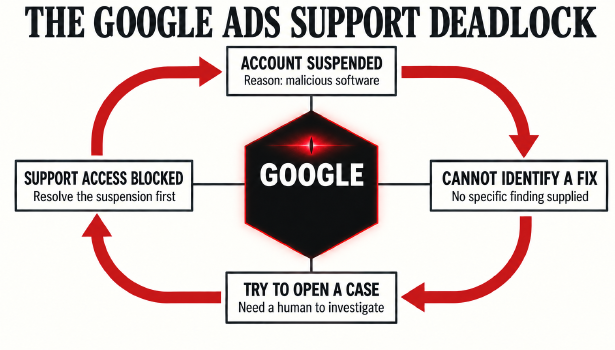
The repo as an accidental blackboard for agents

There’s a name for the pattern our agents had discovered: a blackboard system. This was something I explored back in my university days. My research thesis was in directing agent behaviour with hierarchical sensors. I was looking at applying modern machine learning techniques of the time, such as reinforcement learning, across large, dynamic datasets. Looking back over the literature, I adopted the blackboard pattern as the core coordination structure. This had previously been discovered in the development of the Hearsay-II system in 1980. It had been subsequently been developed into the more formal tuple space concept by Gelernter et al. in 1986.

A blackboard or tuple space is a shared memory that autonomous agents can read and write from independently. They read and write tuples with a certain minimum structure, and then as many extra fields as you want: no schema. It’s a very effective technique for coordinating autonomous problem solvers towards a single goal. They can each solve a decomposed part of the problem, drop their solution into the shared space, label it, and other autonomous searchers will find it, pick it up, and use it as part of their work.

We had accidentally prompted our agents to start using our repo as a blackboard. But it was an accident. It wasn’t an intentional act. It wasn’t fully structured. It was missing some of the key parts of how blackboards operate. And because it was accidental, I’m not convinced I would be able to reliably prompt our agents into doing it again. I’ve got a pretty good idea what we did, because we did some analysis and identified the single prompt that caused this cascade to start happening. But it was an emergent behaviour. It wasn’t a directed behaviour.

As well as creating this intentionally, rather than accidentally, I believe you want this communication channel to be sitting independently of source control. While we created it by directing a frequent push cycle, we backed-off from that. The frequent commits were overloading our CI pipeline. We switched to only push when a more coherent chunk of change was complete. This deprived the agents of the continuous flow of updates on progress.

A good accidental solution requires a good intentional project. I’ve started working on a project I’m calling Talwrn. That’s Welsh for a threshing pit, an area or space where arguments and conflict get worked out. This is aiming to be a blackboard for agentic engineering. My goal is a very simple to use tool that drops straight into your project and immediately offers a communication channel for agents to coordinate work. The first step is to get Talwrn to a point where it can support its own development. I’m planning to post about it regularly as I’m hoping to use it as a single, evolving example of how pure agentic engineering can proceed.

The Daily Front Page 10 of 32
Wednesday, September 9, 2026 The Daily Front No. #260909 — Apple’s Pro Counter
article

iPhone 18 Pro and iPhone 18 Pro Max

by meetpateltech·▲ 321 points·338 comments·apple.com ↗
The new Pro lineup introduces variable aperture with the most advanced camera in an iPhone.

The new Pro lineup introduces variable aperture with the most advanced camera in an iPhone, incredible battery life, next‑level performance, and Siri AI, all powered by A20 Pro

The front of a burgundy iPhone 18 Pro is displayed next to a rear-facing burgundy iPhone 18 Pro Max.

iPhone 18 Pro and iPhone 18 Pro Max feature the most advanced camera Apple has ever made and deliver massive leaps in battery life and performance.

CUPERTINO, CALIFORNIA Apple today announced iPhone 18 Pro and iPhone 18 Pro Max, delivering the most advanced pro camera system in an iPhone, and huge leaps in battery life and performance. The new 48MP Fusion Main camera, now with variable aperture, brings creative control that wasn’t possible before, and new Pro controls let users customize their experience in the Camera app. Both models feature a smaller and even more useful Dynamic Island, as well as A20 Pro and a next-generation vapor chamber that together deliver the highest sustained performance in iPhone history. iPhone 18 Pro Max also delivers the largest increase in battery life ever on iPhone, thanks to advancements in Apple silicon and a larger battery.1 Featuring iOS 27 with Apple Intelligence2 and Siri AI,3 iPhone 18 Pro models bring powerful AI capabilities together with personal context to become an intelligent personal hub with privacy and security at its core.

iPhone 18 Pro and iPhone 18 Pro Max are available in four elegant finishes: black, silver, glacier, and an all-new burgundy. Pre-orders begin Saturday, September 12, with availability beginning Friday, September 18.

“With iPhone 18 Pro, we’ve made advancements to the areas our users care about most: camera, performance, battery, and intelligence. And we didn’t just make incremental improvements in these areas — we took huge leaps forward to create the best Pro iPhone we’ve ever made,” said Greg Joswiak, Apple’s senior vice president of Worldwide Marketing. “iPhone 18 Pro makes it easy for anyone to capture stunning photos and videos using variable aperture, while providing more versatility for creators and more control for pros. Paired with impactful upgrades to Photographic Styles and powerful video capabilities, iPhone 18 Pro unlocks entirely new ways for users to express themselves.”

iPhone 18 Pro is displayed in black, silver, glacier, and burgundy.

iPhone 18 Pro will be available in four elegant finishes: black, silver, glacier, and burgundy.

An Advanced Camera System That Unlocks More Creativity Across Photo and Video

The new 48MP Fusion Main camera with variable aperture is the most advanced camera Apple has ever made, bringing aperture control to iPhone for the first time along with even more creative control. Six laser-cut blades smoothly transition between different apertures, making it incredibly easy to capture the best shot by automatically adjusting for depth of field and lighting. Combined with a new sensor that improves image quality, the result is better low-light photography, crisper detail in the back of group photos, and more unique shots. Variable aperture also provides more control for creative pros by giving them the ability to manually adjust any of the four aperture settings in the Camera app, and an API is available to developers for even more control across the aperture range in their apps.

The new 48MP Fusion Main camera uses six laser-cut blades controlled by a new rotor mechanism to smoothly transition between different apertures.

With a new computational imaging pipeline, the Main camera produces sharper, more detailed shots, and upgraded Photographic Styles with new texture and grain controls let users further dial in their desired appearance and have more creative control over their photos.4 Industry-leading video capabilities also become more versatile, with the ability to apply Cinematic effects after capture to videos shot at up to 60 fps. In Time-lapse mode, users can now record videos in 4K and Dolby Vision HDR. Audio Mix also has new algorithms that deliver higher-quality voices and can now isolate music.

A photograph captured on iPhone 18 Pro using the new 48MP Fusion Main camera amid low-light conditions.

The new 48MP Fusion Main camera can intelligently widen the aperture to ƒ/1.48 for impressive low-light shots.

A black-and-white photograph of a person is captured on iPhone 18 Pro.

iPhone 18 Pro shoots gorgeous portraits at an aperture of ƒ/1.8, optimized for the best balance of light gathering and depth of field.

A photograph captured on iPhone 18 Pro shows people on a staircase and crisp details in the background.

The new 48MP Fusion Main camera can keep more of the group in focus by narrowing the aperture to ƒ/4 for more depth of field.

A photograph captured on iPhone 18 Pro using Night mode shows a person silhouetted against a starry sky.

In darker environments, iPhone 18 Pro adjusts the aperture automatically to let in more light, resulting in stunning Night mode shots.

A portrait captured on iPhone 18 Pro using Photographic Styles shows the luminous skin of a photo subject.

iPhone 18 Pro introduces new texture and grain controls in Photographic Styles, so users can adjust color and skin qualities in unison for a more personalized look.

A photograph captured on iPhone 18 Pro using Pro controls shows the blur of people in motion in the background while keeping the main subject in sharp focus.

Pro controls let users manually adjust settings, such as shutter speed, which can create artful motion blur in photos.

A photograph of a mountain landscape is captured on iPhone 18 Pro.

A new computational imaging pipeline produces even more detailed shots from the Main camera.

Pro controls is a new customizable experience in the Camera app for iPhone 18 Pro and iPhone 18 Pro Max that makes it easier than ever for users to access their most used settings and introduces new options for manual control. Users can now adjust settings such as lens aperture, shutter speed, and white balance, or use a histogram to check exposure levels throughout a scene.

Pro controls offer broader creative range, with manual control over shutter speed, white balance, aperture, and the ability to use a histogram.

Introducing Apple Reference Image

Users can now prove the authenticity of a photo taken on iPhone 18 Pro models with Apple Reference Image, powered by the new sensor in the Main camera that can sign every pixel it sees. When a photo is taken in the new Reference mode, the camera captures signed sensor data that Private Cloud Compute develops into an unalterable reference image.5 Reference images can be viewed in the Photos app alongside the main image, like a digital negative, to visually compare the two assets and determine if any edits were made. APIs are available in iOS, iPadOS, and macOS 27 for third-party apps to enable viewing of these reference images.

Three iPhone 18 Pro devices display Apple Reference Image comparing an original photograph with an edited version.

Apple Reference Image provides users with an unalterable reference photo, visually confirming what the sensor saw at the moment of capture.

Image metadata and upcoming support for the SynthID standard can also help users identify images generated or edited with AI.6 Together with Apple Reference Image, this set of features represents a multifaceted approach to image authenticity — vital for photojournalists, photographers, and everyday viewers.

An Even More Useful Dynamic Island

Using advanced display technology, the Dynamic Island is redesigned to create room for additional information. The upgraded Dynamic Island can now show three Live Activities at once, while continuing to enable Face ID for securely unlocking iPhone 18 Pro models, authenticating purchases, signing in to apps, and more.

The upgraded Dynamic Island can show even more information at a glance, with up to three Live Activities at once.

A20 Pro: A Powerhouse for Pro Performance and AI

Built using the latest 2-nanometer process technology, A20 Pro sets a new bar for mobile computing. Featuring 50 percent more memory bandwidth than A19 Pro, the new 6-core CPU features integrated Neural Accelerators and is faster than the competition, while the new 7-core GPU design is up to 40 percent faster than A19 Pro — a significant upgrade for graphics rendering. A20 Pro also features a new Dual 16-core Neural Engine, which accelerates on-device AI models and computational photography, and includes 32 total cores for double the AI processing power of A19 Pro. With huge upgrades across the entire chip, A20 Pro is a powerhouse for everything from more advanced on-device AI workloads to demanding games, and is designed to deliver exceptional performance for years to come.

The A20 Pro logo.

Featuring a new 6-core CPU, 7-core GPU, and Dual 16-core Neural Engine, A20 Pro is a powerhouse for pro performance.

Both models feature N1, an Apple-designed wireless networking chip that enables Wi-Fi 7, Bluetooth 6, and Thread. iPhone 18 Pro introduces C2, Apple’s next-generation cellular modem system, which brings AI-powered improvements to cellular quality and reliability. C2 delivers meaningfully faster uploads when compared to C1X while consuming 15 percent less energy, and now supports mmWave in the U.S.

A New Thermal Management System for Maximum Performance

A20 Pro introduces custom packaging inspired by M-series Apple silicon that places the silicon die side by side with the memory, removing the memory from the thermal path of the chip and allowing A20 Pro to attach directly to a next-generation vapor chamber. With new materials and three times more surface area than the previous generation on iPhone 17 Pro, the redesigned vapor chamber dramatically improves sustained performance and enables up to a 40 percent gain over the previous generation — the highest sustained performance yet.

The next-generation vapor chamber dissipates even more heat and enables a massive leap in sustained performance on iPhone 18 Pro.

Incredible Battery Life

iPhone 18 Pro models deliver a massive leap in battery life with new battery designs that leverage powerful silicon efficiencies. eSIM-only models deliver up to 36 hours of video playback on iPhone 18 Pro and up to 45 hours of video playback on iPhone 18 Pro Max. iPhone 18 Pro can also charge up to 50 percent in around 15 minutes, or wirelessly charge up to 50 percent in 30 minutes.7 On iPhone 18 Pro Max, five minutes of wired charging provides around seven hours of video playback, and based on a new battery usage model that leverages real-world data, it provides up to 30 hours of usage on a full charge.8

Both iPhone 18 Pro models feature updated battery designs that support faster wired charging and leverage powerful silicon efficiencies to deliver incredible battery life.

Featuring iOS 27 with the Next Generation of Apple Intelligence and an All-New Siri

iPhone 18 Pro and iPhone 18 Pro Max give users access to Siri AI, rolling out in beta with iOS 27. Siri AI is an entirely new version of Siri powered by Apple Intelligence that is profoundly more personal, capable, and conversational. Both models bring powerful AI capabilities together with personal context to become an intelligent personal hub with privacy and security at its core.

Siri AI can draw on personal context understanding to help users find what they need in the moment across messages, emails, photos, and more; use onscreen awareness to take action related to the content on a user’s screen; and answer questions about virtually any topic. Siri mode in the Camera app allows users to get information and take action on what’s in front of them, and users can write with Siri by simply describing what they need. Additionally, Apple Intelligence makes apps smarter and more useful. Users can improve the composition of a photo after it’s been taken with Spatial Reframing, Extend, and upgraded Clean Up. And now Image Playground offers photorealistic imagery. In Safari, Notify Me helps users monitor web pages for changes, like product restocks or price drops, and stay on top of updates. To protect users’ privacy, Apple Intelligence uses on-device processing and Private Cloud Compute, which extends the privacy and security of iPhone into the cloud.

Siri AI can draw on personal context understanding to help users find what they need in the moment across apps, and with Siri mode in the Camera app, they can get information on what’s in front of them.

iOS 27 delivers an expansive set of improvements that make iPhone more responsive, reliable, and easy to use, along with refinements to the software design and more ways to personalize the appearance of Liquid Glass. Additionally, powerful and simple tools, based on expert guidance, give parents more flexible ways to manage what their kids can see, who they can talk to, and when they have access. iOS 27 also introduces iPhone Handoff, which allows users with supported carriers to easily switch back and forth between two iPhone models with the same phone number.9

eSIM: A Flexible, Convenient, and Secure Connection

eSIM offers greater flexibility, better security, seamless connectivity compared to traditional physical SIM cards, and more battery life on eSIM-only models.10 An industry standard, eSIM is supported by over 500 carriers worldwide, including AT&T, T-Mobile, Verizon, and more. eSIM-only models of iPhone 18 Pro and iPhone 18 Pro Max will be available in Bahrain, Canada, Guam, Japan, Kuwait, Mexico, Oman, Qatar, Saudi Arabia, the UAE, the U.S., and the U.S. Virgin Islands. These models feature an even larger battery, taking advantage of the space formerly occupied by the physical SIM to provide two additional hours of video playback.

Beautiful New Accessories

iPhone 18 Pro models introduce a range of new Silicone Cases, TechWoven Cases, Crossbody Straps, and FineWoven Wallets — all designed to complement the four beautiful finishes. The Clear Case features an updated design and is now compatible with the Crossbody Strap and Wrist Strap. The new Wrist Strap introduces a convenient, hands-free way to carry iPhone, AirPods Pro 2, or AirPods Pro 3. Woven with 100 percent recycled polyester yarns and embedded with flexible magnets that keep it neatly fitted together, the Wrist Strap will be available in six colors: black, taupe, olive, crisp blue, magenta, and burgundy.

iPhone 18 Pro in glacier is paired with the glacier Wrist Strap.

The new Wrist Strap introduces a beautiful hands-free way to carry iPhone.

A burgundy iPhone 18 Pro with coordinating case is paired with a magenta Crossbody Strap.

The Crossbody Strap can be paired with MagSafe cases in gorgeous new color combinations.

iPhone 18 Pro in glacier is paired with the Clear Case.

New MagSafe accessories complement the elegant finishes of iPhone 18 Pro.

iPhone 18 Pro and the Environment

iPhone 18 Pro and iPhone 18 Pro Max were built with the environment in mind, and drive progress toward Apple’s ambitious plan to be carbon neutral across its entire footprint by 2030. Both models are made with 40 percent recycled content overall,11 including 100 percent recycled cobalt in the battery and 85 percent recycled aluminum in the enclosure. They are manufactured with 50 percent renewable energy, like wind and solar, across the supply chain, and meet Apple’s high standards for energy efficiency and safe chemistry. Like all Apple products, their paper packaging is 100 percent fiber-based12 and can be easily recycled at home.

Pricing and Availability

  • iPhone 18 Pro and iPhone 18 Pro Max will be available in 256GB, 512GB, 1TB, and 2TB storage capacities. Available in burgundy, glacier, silver, and black, iPhone 18 Pro starts at $1,199 (U.S.) or $49.95 (U.S.) per month, and iPhone 18 Pro Max starts at $1,299 (U.S.) or $54.12 (U.S.) per month for 24 months.13
  • Apple offers great ways to save and upgrade to the latest iPhone models. With Apple Trade In, customers trading in iPhone 13 or later can get $175 to $885 (U.S.) in credit instantly.14 Apple also partners with select carriers to offer incredible deals, and customers can get up to $1,200 (U.S.) in credits when they trade in iPhone 14 or later — in any condition — to put toward iPhone 18 Pro or iPhone 18 Pro Max. Customers can take advantage of carrier deals by visiting the Apple Store online or an Apple Store location. For carrier deal eligibility requirements and more details, see apple.com/shop/buy-iphone/carrier-offers. To see what their device is worth and for trade-in terms and conditions, customers can visit apple.com/shop/trade-in.
  • Apple Upgrade, a leasing program provided by Klarna and available in the U.S., gives eligible customers monthly payment options for iPhone 18 Pro, with 12- and 24-month leasing terms starting as low as $34.99 (U.S.) per month for 24 months. For more information, visit apple.com/shop/apple-upgrade.15
  • Customers in more than 65 countries and regions, including Australia, Brazil, Canada, China, Colombia, France, Germany, India, Japan, Malaysia, Mexico, Singapore, South Korea, Türkiye, the UAE, the UK, the U.S., and Vietnam, will be able to pre-order iPhone 18 Pro and iPhone 18 Pro Max beginning at 5 a.m. PT this Saturday, September 12, with availability beginning Friday, September 18. iPhone 18 Pro and iPhone 18 Pro Max will be available in 20 other countries and regions beginning Friday, September 25.
  • A TechWoven Case with MagSafe will be available for $59 (U.S.) in black, chambray blue, taupe, olive, mulberry, and burgundy. A Clear Case with MagSafe will be available for $49 (U.S.), and a Silicone Case with MagSafe will be available for $49 (U.S.) in black, navy blue, crisp blue, olive, burgundy, and magenta. A FineWoven Wallet with MagSafe will be available for $59 (U.S.) in black, navy blue, wildflower blue, olive, magenta, and burgundy.
  • A Wrist Strap will be available for $29 (U.S.). A Crossbody Strap will be available for $59 (U.S.) in black, navy blue, taupe, sand, olive, crisp blue, magenta, burgundy, and light gray.
  • iOS 27 will be available as a free software update on Monday, September 14. Some features may not be available in all languages or regions, and availability may vary due to local laws and regulations. For more information about availability, visit apple.com.
  • Apple Intelligence will be available with iOS 27 on Monday, September 14, for users with an Apple Intelligence-enabled device set to a supported language. Apple Intelligence is available with support for these languages: English, Danish, Dutch, French, German, Italian, Norwegian, Portuguese, Spanish, Swedish, Turkish, Vietnamese, Chinese (simplified), Chinese (traditional), Japanese, and Korean. Some features may not be available in all regions or languages. For feature and language availability and system requirements, see apple.com/apple-intelligence.
  • Siri AI is rolling out with iOS 27 as a beta on Monday, September 14, for users with a supported device set to English, with support for French, Japanese, Korean, Portuguese, and Spanish coming in October. Some features may not be available in all regions or languages.
  • When outside of cellular and Wi-Fi coverage, Apple’s groundbreaking satellite features help iPhone 18 Pro and iPhone 18 Pro Max users stay connected and get assistance when it matters most. Apple is extending free access to satellite features for an additional year for existing iPhone 14, iPhone 15, and iPhone 16 users. The free trial will be extended for iPhone 14, iPhone 15, and iPhone 16 users who have activated their device in a country that supports Apple’s satellite features prior to midnight PT on September 9. For satellite feature availability, visit support.apple.com/en-us/105097.
  • AppleCare delivers exceptional service and support, with flexible options for Apple users. Customers can choose AppleCare+ to cover their new iPhone, or, in available markets, AppleCare One to protect multiple products in one simple plan. Both plans include coverage for accidents like drops and spills, theft and loss protection on eligible products, battery replacement service, and priority support from Apple Experts. In the U.S., customers can also choose AppleCare One Family, which extends that same coverage to every eligible device across an Apple Family Sharing group for one fixed monthly price. For more information, visit apple.com/applecare.
  • iCloud+ plans start at just $0.99 (U.S.) per month, providing additional storage to keep photos, videos, files, and more safe in the cloud and accessible across devices. iCloud+ also gives access to premium features such as event creation in the Apple Invites app, as well as Private Relay, Hide My Email, custom email domains, and HomeKit Secure Video. With Family Sharing, users can share their subscription with five other family members at no extra cost. For more information and feature availability, visit apple.com/icloud and apple.com/ios/feature-availability.
  • New and qualified returning subscribers who purchase iPhone 18 Pro or iPhone 18 Pro Max can unlock three months of Apple One for free. Apple One bundles up to six Apple services — including Apple TV, Apple Music, up to 2TB of iCloud+ storage, and more — into one convenient plan across multiple Apple devices. This offer is available in select countries and regions with an eligible new iPhone, iPad, or Mac beginning September 17. Service availability varies by region. Learn more about Apple One at apple.com/apple-one.
The Daily Front Page 11 of 32
Wednesday, September 9, 2026 The Daily Front No. #260909 — Sound, Health, and the Wrist
article

AirPods 5

by awad·▲ 413 points·330 comments·apple.com ↗
AirPods 5 deliver the industry’s best Active Noise Cancellation in an open-ear design.

With industry-leading ANC in an open-ear design, improved sound quality, hands-free access to Siri AI, and Live Translation, AirPods 5 deliver the best audio experience Apple has ever offered in this style of AirPods, at an incredible price

A photo of AirPods 5 and their charging case.

AirPods 5 deliver the industry’s best Active Noise Cancellation in an open-ear design, an all-new multiport acoustic architecture, and next-generation Adaptive EQ for even more immersive sound.

CUPERTINO, CALIFORNIA Apple today announced AirPods 5, delivering the industry’s best Active Noise Cancellation (ANC) in an open-ear design and even better sound quality, at an outstanding value.1 AirPods 5 feature an all-new multiport acoustic architecture and next-generation Adaptive EQ for even more immersive sound. Their breakthrough open-ear ANC removes up to 50 percent more external noise compared to AirPods 4 with Active Noise Cancellation, alongside a more natural Transparency mode. Combined with Siri AI and iPhone, AirPods enable users to draw on their personal context and get answers with broad world knowledge, entirely hands-free.2 Users can also respond to Siri using head gestures, or use Live Translation to help connect across languages.

AirPods 5 offer the most affordable way to experience some of the most powerful AirPods features — along with greater durability with improved dust, sweat, and water resistance — at $129. For users who want even more, AirPods 5 with Wireless Charging Case add longer battery life and on-stem volume control for $149.3 Customers can pre-order starting today, with availability in stores beginning Friday, September 18.

“We’re thrilled that with AirPods 5, we’re able to bring Active Noise Cancellation — one of our most beloved features — to our most affordable AirPods,” said Dave Pakula, Apple’s vice president of Hardware Engineering. “Both AirPods 5 models deliver a world-class listening experience and enable features like Live Translation for even more people. Paired with Siri AI, AirPods are a game changer for unlocking powerful hands-free capabilities.”

An AirPods 5 user is pictured working at a restaurant surrounded by other people.

AirPods 5 offer the most affordable way to experience some of the most powerful AirPods features, along with greater durability compared to previous models.

Best-in-Class Active Noise Cancellation

Customers love to use ANC to quiet the world around them so they can rest on a noisy flight, get lost in their favorite music, or stay focused on work. AirPods 5 remove up to 50 percent more noise compared to AirPods 4 with ANC thanks to a new multiport acoustic architecture and improved computational audio algorithms. Along with the benefits of ANC, AirPods 5 feature an improved Transparency mode that more naturally represents voices and nearby sounds, helping users stay connected to their surroundings. Providing the best of both worlds, Adaptive Audio dynamically blends Transparency mode and ANC based on the conditions of a user’s environment. And Conversation Awareness lowers the user’s media volume when they start speaking, helping them more easily talk to someone nearby.

Breakthrough Active Noise Cancellation removes up to 50 percent more noise compared to the previous generation, while Transparency mode lets in voices and sounds around the user.

Re-Engineered Sound Quality

Inspired by AirPods Pro 3 and re-engineered for AirPods 5, a new multiport acoustic architecture and next-generation Adaptive EQ deliver richer, more detailed sound across an even wider range of ear geometries. This makes Personalized Spatial Audio more immersive and dynamic, so the user feels like they’re surrounded by whatever they are listening to.4

A new multiport acoustic architecture and next-generation Adaptive EQ deliver richer, more detailed sound across an even wider range of ear geometries.

Intelligent Features, Hands-Free

For users with an Apple Intelligence-supported iPhone, AirPods 5 allow users to tap into helpful intelligent features hands-free and on the go. Siri AI, which is rolling out in beta in iOS 27, is a profoundly more capable and conversational assistant, offering personal context understanding across messages, emails, photos, and more, as well as app actions and broad world knowledge. For example, users can ask Siri to play the song a friend recommended in a message or navigate to a dinner reservation based on the confirmation buried in an email. Siri AI sounds more natural than ever, with expressive voices that a user can customize so it’s just right for them.5 And Dictation now captures what users say with greater precision.

In addition to these new capabilities, Siri already works seamlessly with apps from Apple’s vast ecosystem of developers, so users can continue to take action in the apps they already use, like texting a friend in WhatsApp or playing a book on Audible. With Siri Interactions on AirPods, users can discreetly respond to Siri AI by simply nodding their head yes or shaking their head no.

Live Translation, powered by Apple Intelligence, breaks down barriers by letting users communicate across languages. After setting up Live Translation in the Translate app and downloading their desired languages, AirPods users can access the feature by simultaneously pressing both stems, by saying “Siri, start Live Translation,” or by using the Action button on iPhone — allowing them to hear a conversation in their preferred language. Enabled by ANC and computational audio, this capability is now available across the entire AirPods lineup.

Powered by Apple Intelligence, Live Translation on AirPods 5 breaks down barriers by letting users communicate across languages.

AirPods 5 with Wireless Charging Case

For users who want even more, AirPods 5 with Wireless Charging Case deliver great improvements to the AirPods experience. Force sensor with volume swipe arrives on AirPods 5, a first for the open-ear form factor, adding the ability to quickly adjust volume by swiping up or down on the stem.

AirPods 5 with Wireless Charging Case feature a force sensor with volume swipe to quickly adjust volume on the stem.

Battery life is also improved, with up to five hours of playback with ANC on a single charge — one hour longer than AirPods 4 with ANC, thanks to a redesigned battery. This extends up to 22 hours with the charging case when listening with ANC. The wireless charging case supports Apple Watch chargers, Qi-compatible chargers, and USB-C.

AirPods 5 with Wireless Charging Case are pictured above a charger.

Battery life is improved with AirPods 5 with Wireless Charging Case, delivering up to five hours of playback with ANC on a single charge.

AirPods 5 and the Environment

The new AirPods 5 were built with the environment in mind and drive progress toward Apple’s ambitious plan to be carbon neutral across its entire footprint by 2030. They are made with 40 percent recycled material overall,6 including 70 percent recycled plastic in the wireless charging case and 100 percent recycled cobalt in the battery. AirPods 5 are manufactured with 35 percent renewable energy, like wind and solar, across the supply chain, and meet Apple’s high standards for energy efficiency and safe chemistry. Like all Apple products, their paper packaging is 100 percent fiber-based7 and can be easily recycled at home.

Pricing and Availability

  • Customers in the U.S. and more than 65 other countries and regions can pre-order AirPods 5 today for $129 (U.S.), with availability in stores beginning Friday, September 18.
  • Customers in the U.S. and more than 65 other countries and regions can pre-order AirPods 5 with Wireless Charging Case today for $149 (U.S.), with availability in stores beginning Friday, September 18.
  • For full feature functionality, use AirPods 5 paired with an Apple device running the latest operating system software.
  • Apple Intelligence will be available with iOS 27 on Monday, September 14, for users with an Apple Intelligence-enabled device set to a supported language. Apple Intelligence is available with support for these languages: English, Danish, Dutch, French, German, Italian, Norwegian, Portuguese, Spanish, Swedish, Turkish, Vietnamese, Chinese (simplified), Chinese (traditional), Japanese, and Korean. Some features may not be available in all regions or languages. For feature and language availability and system requirements, see apple.com/apple-intelligence.
  • Siri AI is rolling out with iOS 27 as a beta on Monday, September 14, for users with a supported device set to English, with support for French, Japanese, Korean, Portuguese, and Spanish coming in October. Some features may not be available in all regions or languages.
  • Live Translation is available on compatible Apple devices with the latest operating system software when paired with compatible AirPods with the latest firmware when Apple Intelligence is turned on. This feature is not available in all languages or regions.
  • AppleCare delivers exceptional service and support, with flexible options for Apple users. Customers can choose AppleCare+ to cover their new AirPods 5 or, in available markets, AppleCare One to protect multiple products in one simple plan. Both plans include coverage for accidents like drops and spills, theft and loss protection on eligible products, battery replacement service, and priority support from Apple Experts. In the U.S., customers can also choose AppleCare One Family, which extends that same coverage to every eligible device across an Apple Family Sharing group for one fixed monthly price. For more information, visit apple.com/applecare.
  1. Testing conducted by Apple in July 2026 using AirPods 5 paired with iPhone 17 with prerelease AirPods firmware and iOS 27. Noise reduction was tested in accordance with IEC 60268-24. Comparison made against the bestselling wireless open-ear headphones commercially available at the time of testing. Performance depends on device settings, environment, and many other factors.

  2. Apple Intelligence is available with Siri settings and device language set to Chinese (simplified), Chinese (traditional), Danish, Dutch, English, French, German, Italian, Japanese, Korean, Norwegian, Portuguese, Spanish, Swedish, Turkish, or Vietnamese. Some features may not be available in all regions or languages. Some devices may not be available in all regions. Siri AI is rolling out in beta in iOS 27, macOS 27, and watchOS 27 and requires an Apple Intelligence-enabled device set to a supported language. Available in English to start. Siri AI will not be initially available in the EU with iOS, iPadOS, and watchOS. Certain Apple Intelligence features that rely on server-side models are subject to daily usage limits, including but not limited to Siri AI, intelligent photo editing tools, Image Playground, and AFM 3 Cloud models in Shortcuts. Daily limits may vary by feature, request complexity, system demand, system policies, and other factors. Expanded access to such features will be available for a fee in the future. Use of these features is subject to Apple Intelligence terms and conditions. Learn more at apple.com/apple-intelligence. Hands-free access to Siri AI works on all AirPods. Siri AI is not available to users under 13.

  3. Battery life varies by use. See apple.com/batteries for details.

  4. Personalized Spatial Audio works with compatible content in supported apps. iPhone with TrueDepth camera required to create personalized profile, which will sync across compatible Apple devices. Personalized Spatial Audio is not available when using other devices.

  5. Apple’s most powerful on-device model and the features it enables, like expressive voices and more advanced Dictation, are available on iPhone 18 Pro, iPhone 18 Pro Max, iPhone Duo, iPhone 17 Pro, iPhone 17 Pro Max, iPhone Air, iPad models with M4 or later and at least 12GB of unified memory, and Mac models with M3 or later and at least 12GB of unified memory. The model and expressive voices are also available on Apple Vision Pro (M5).

  6. Product recycled or renewable content is the mass of certified recycled material relative to the overall mass of the device, not including packaging or in-box accessories. Recycled and renewable plastic content calculation includes mass balance allocation.

  7. Breakdown of U.S. retail packaging by weight. Adhesives, inks, and coatings are excluded from calculations of plastic content and packaging weight.

The Daily Front Page 12 of 32
Wednesday, September 9, 2026 The Daily Front No. #260909 — Sound, Health, and the Wrist
article

Apple Watch Series 12

by Lealen·▲ 240 points·282 comments·apple.com ↗
Apple Watch Series 12 offers the most accurate heart rate sensing in a wearable.

Apple Watch Series 12 offers the most accurate heart rate sensing in a wearable, higher-frequency heart rate and HRV sensing, a readiness score, and Audio Intelligence features built with privacy at the core

Two Apple Watch Series 12 devices are pictured side by side, with the sensors shown on the back of one and the Heart Rate app shown on the face of the other.

Apple Watch Series 12 delivers the most accurate heart rate sensing in a wearable, higher-frequency heart rate and heart rate variability sensing, and a readiness score.

CUPERTINO, CALIFORNIA Apple today introduced Apple Watch Series 12, engineered with advanced health sensors and all-new Apple silicon to deliver the most accurate heart rate sensing in a wearable,1 and advanced health and fitness features.

With the new Health Sensing System and S11 chip, Apple Watch Series 12 delivers higher-frequency heart rate and heart rate variability (HRV) measurements, which power an enhanced suite of health and fitness features including a new readiness score. A redesigned Health app on iPhone arrives later this year, including a new Longevity tab with a Health Age feature showing how metrics are tracking relative to a user’s age. In addition to powering the Health Sensing System, the S11 chip — Apple’s most powerful wearable chip — also enables new Audio Intelligence features arriving later this year, to help users remember key moments from their conversations and stay alert to important sounds, built with privacy, security, and accessibility innovations at the core.2 With watchOS 27, Apple Intelligence powers Siri AI on Apple Watch, bringing personal context understanding and broad world knowledge to the wrist.

These features add to the many ways Apple Watch already helps users stay active, better understand their health, and get help when they need it, with advanced workout tracking, sleep tracking, heart health notifications, the ECG app,3 sleep apnea notifications,4 Fall Detection, Emergency SOS,5 and more. Apple Watch Series 12 is the most comprehensive wearable across health, fitness, and safety.6

An Apple Watch Series 12 user is pictured running on a track.

Apple Watch Series 12 is the most comprehensive wearable across health, fitness, and safety, with the new Health Sensing System and S11 chip powering an enhanced suite of features.

An Apple Watch Series 12 user is shown swimming in a pool.

Apple Watch Series 12 is the most comprehensive wearable across health, fitness, and safety, with the new Health Sensing System and S11 chip powering an enhanced suite of features.

An Apple Watch Series 12 user is shown doing strength training.

Apple Watch Series 12 is the most comprehensive wearable across health, fitness, and safety, with the new Health Sensing System and S11 chip powering an enhanced suite of features.

An Apple Watch Series 12 user is shown standing in profile outdoors.

Apple Watch Series 12 is designed to be as individual as the person wearing it and is available in an array of beautiful finishes, including dark bronze, black, light gold, and space gray aluminum, and radiant gold and natural titanium. It is also available in a stunning ceramic material, in pearl white and night blue. Aluminum models now feature Ceramic Shield 2, which is tougher than any smartwatch glass and 60 percent tougher than the Ion-X of previous aluminum models.7 Apple Watch Series 12 is available to pre-order today, with availability beginning Friday, September 18.

“Apple Watch Series 12 is the most advanced health and fitness companion we’ve ever created,” said Kaiann Drance, Apple’s vice president of Worldwide Apple Watch Product Marketing. “With our new Health Sensing System and S11 chip, Apple Watch Series 12 gives you meaningful insights, like readiness, so you can better understand how to take on your day and care for your health, plus intelligence features that make everyday life easier. And it’s all wrapped in a beautifully thin, light design you’ll love wearing all day and night.”

The Most Accurate Heart Rate Sensing in a Wearable

Apple Watch Series 12 is re-architected to provide continuous high-fidelity health monitoring using the Health Sensing System, featuring new optical and electrical heart sensors. Using this system and the S11 chip, Apple Watch Series 12 offers the most accurate heart rate sensing in a wearable. A scientifically rigorous study on a diverse population of over 1,000 participants compared the new heart rate sensing accuracy on Apple Watch against leading wearables, resulting in Apple Watch showing the highest accuracy across devices.

With larger, power-efficient green LEDs on the optical heart sensor, Apple Watch Series 12 now measures heart rate every five seconds, all day long. This continuous, passive measurement delivers deeper insight into a user’s fitness and physiological state while making Exercise and Move Activity rings even more accurate. Users can view their real-time heart rate at a glance throughout their day on a new heart rate watch face complication.

Apple Watch Series 12 features larger, power-efficient green LEDs on the optical heart sensor, measuring heart rate every five seconds and delivering deeper insight into a user’s fitness and physiological state.

HRV, a key indicator of stress and recovery, is now measured up to 24 times more often and available to view in a new section of the Heart Rate app. Apple Watch provides two separate variants of HRV for better understanding of a user’s health status. Recovery HRV is best for identifying daily signals of stress and recovery, while overall HRV is best for insights into a user’s broader health, including cardiovascular health. Higher variability is generally associated with better overall recovery, while a lower variability value is an indicator of stress.

Overnight vitals now includes recovery HRV measurements analyzed against a user’s personal baseline, providing a more complete view of their health status.8 A new daytime vitals view lets users toggle between overnight and daytime metrics, and can potentially spot shifts in their metrics before they show up overnight.

Apple Watch Series 12 shows the Heart Rate app.

Apple Watch Series 12 now measures heart rate every five seconds, all day long. Users can view their real-time heart rate at a glance throughout their day using the updated Heart Rate app or on a new watch face complication.

Apple Watch Series 12 shows daytime vitals.

Using the higher-frequency heart rate and HRV measurements offered by Apple Watch Series 12, a new daytime vitals view lets users toggle between overnight and daytime metrics, and can potentially spot shifts in their metrics before they show up overnight.

Apple Watch Series 12 shows overnight vitals.

Overnight vitals now includes recovery HRV measurements analyzed against a user’s personal baseline, providing a more complete view of their health status.

Readiness: A Daily Read on the Body’s Capacity

Apple Watch Series 12 introduces readiness, a new feature that analyzes a user’s recent activity, training load, vitals, and sleep score to offer insight into their capacity for the day ahead. Readiness provides a single 0-10 score with a clear, actionable recommendation: Recover, Pace Yourself, Ready, or Go For It. This helps a user decide how to take on their day, whether they’re headed into a workday or tackling their training plan.

Readiness updates throughout the day as new data comes in, to reflect, for example, an intense workout or a shift in daytime vitals. Readiness clearly highlights which factors are driving the score and allows users to tap into more details. The scoring algorithm was developed using data from the Apple Heart and Movement Study, in collaboration with exercise scientists and physicians at Apple.

Three Apple Watch Series 12 devices show readiness scores: Pace Yourself, Ready, and Go For It.

Apple Watch Series 12 introduces readiness, a new feature that can help a user decide how to take on their day. Readiness analyzes a user’s recent activity, training load, vitals, and sleep score, and then provides a single 0-10 score each day with a clear, actionable recommendation: Recover, Pace Yourself, Ready, or Go For It.

Longer Workout Battery Life and Faster Charging

Apple Watch Series 12 continues to offer up to 24 hours of everyday battery life9 and now offers up to 10 hours of battery life during an outdoor workout — 25 percent more than the previous model.10

Apple Watch Series 12 also offers faster charging: Just 15 minutes now gets up to 12 hours of additional battery life — 50 percent more than the previous model — so users can quickly recharge while getting ready for the day or before bed.11

The Most Accurate Step Tracking of Any Smartwatch

The pedometer model has been completely redesigned with new machine learning algorithms to provide more accurate distance measurements during indoor walk or run workouts, and the S11 chip allows for more accurate step counts all day. As a result, Apple Watch Series 12 now offers the most accurate step tracking of any smartwatch.12 The S11 chip also enables the brand-new Steps complication, so users can track their steps in real time, right from their watch face.

Apple Watch Series 12 shows the Steps complication, with a graphic of a shoe and a count of 5,253 steps.

The pedometer model has been completely redesigned with new machine learning algorithms to provide more accurate distance measurements during indoor walk or run workouts, and the S11 chip allows for more accurate step counts all day.

A Redesigned Health App Offers a Holistic View of Long‑Term Health

The Health app on iPhone serves as a central and secure location for a user’s health and fitness information, uniquely positioning it to provide a better understanding of a user’s health. The Health app has been redesigned to dynamically respond to a user’s data using Apple Intelligence,13 with a new Insights tab that surfaces timely health information and a new Longevity tab that analyzes a user’s longitudinal health data for deeper insights. The Longevity tab includes Health Age, an Apple Watch feature that shows users how certain metrics are tracking relative to their actual age.

The Health app also includes movement evaluations that measure flexibility, strength, balance, and more using vision-based AI models on iPhone and heart rate data from Apple Watch. Users will be able to schedule and purchase new labs that feature over 50 key biomarkers for $119 directly through the Health app at approximately 2,000 Quest Diagnostics locations in the U.S. The redesigned Health app will arrive later this year, starting in U.S. English.

iPhone 18 Pro and Apple Watch Series 12 show a user’s results in the redesigned Health app.

The redesigned Health app on iPhone features a new Longevity tab that analyzes a user’s longitudinal health data for deeper insights, including Health Age, an Apple Watch feature showing users how certain metrics are tracking relative to their age. Arriving later this year, the updated Health app will also feature a new Insights tab that surfaces timely health information with a summary that updates throughout the day across heart, sleep, readiness, fitness, vitals, and cycle tracking data.

Audio Intelligence: A New Way to Stay More Present and Engaged Throughout the Day

Since Apple Watch is always on a user’s wrist, it is the perfect device to help users stay alert to important sounds and stay present and engaged in conversations throughout the day. With the built-in microphone, the power of the S11 chip, the latest Apple Intelligence models on iPhone, and Private Cloud Compute, Apple Watch Series 12 offers a brand-new class of Apple Intelligence features. Audio Intelligence helps users stay aware of the world around them, catch what they missed, and remember key moments — with user control, privacy, security, and accessibility at the center of its design.

Audio Intelligence features include:

  • Sound Recognition, which comes to Apple Watch to alert users who are deaf or hard of hearing of important sounds, even when their iPhone isn’t with them. This feature listens for sounds like sirens, alarms, doorbells, or a baby crying, and uses on-device intelligence to notify users when they’re detected.
  • Live Rewind, which can help users recall what was just said in conversation. A double press of the Digital Crown shows the previous 15 seconds of a conversation as a text snippet, so the user can catch something they may have missed or are less familiar with. Users can ask Siri about the content of the text or save it to the Siri app to revisit later.
  • Siri Recap, which can create high-level summaries of conversations that users can review later to jog their memory. When Siri Recap is turned on, after a conversation, Apple Intelligence automatically generates a title and key points in the new Siri app, allowing users to be more present and engaged in the moment.
  • Shazam, which instantly detects the music playing around the user and automatically displays the song title and artist’s name on the Music Recognition widget in the Smart Stack, easily glanceable on the wrist.

Apple Watch Series 12 shows the Sound Recognition feature with a message about a doorbell being detected.

A brand-new class of Apple Intelligence features comes to Apple Watch Series 12, including Sound Recognition, which alerts users who are deaf or hard of hearing of important sounds — like sirens, alarms, doorbells, or a baby crying — even when their iPhone isn’t with them.

Apple Watch Series 12 shows the Live Rewind feature with a message that says, “Make sure you stay to the left after the trail marker, unless you want to run a longer loop.”

Live Rewind can help users recall what was just said in conversation, so they can catch something they may have missed.

Apple Watch Series 12 and iPhone 18 Pro show the Siri Recap feature with an outline of a personal training routine.

Siri Recap creates high-level summaries of conversations that users can review later to jog their memory. When Siri Recap is turned on, after a conversation, Apple Intelligence automatically generates a title and key points in the new Siri app, allowing users to be more present and engaged in the moment.

Apple Watch Series 12 shows Shazam with the song “Honeybee” by Olivia Rodrigo detected.

Shazam instantly detects the music playing around the user and automatically displays the song title and artist’s name on the Music Recognition widget in the Smart Stack.

Privacy by Design

Audio Intelligence features are private by design, combining hardware, software, and services to protect user privacy in a way that only Apple can. These features do not create or store audio recordings, and raw audio used for processing is completely inaccessible to the operating systems, apps, the user, or Apple. This is because the S11 chip on Apple Watch Series 12 includes Secure Exclave, a dedicated hardware-isolated compartment that processes audio in complete isolation from the rest of the system, then immediately deletes it.

Users are in control and can choose whether to opt in to each Audio Intelligence feature. They can decide exactly where and when Siri Recap takes notes, and can turn Siri Recap on or off at any time, right from Control Center.

By design, Audio Intelligence features do not identify and attribute speakers, to protect the privacy of both the user and those around them. Siri Recap produces a brief, high-level summary of conversations — not a transcript — and is designed to exclude sensitive information like financial information or government-assigned identifiers. Live Rewind plays an audible chime when it is being used, even if Apple Watch is on silent, and shows a full-display animation and microphone indicator so people nearby can hear and see that the feature has been activated.

Live Rewind text snippets and Siri Recap summaries are end-to-end encrypted in the Siri app with iCloud syncing, and are not accessible even by Apple. Read more about how Audio Intelligence protects privacy. Siri Recap and Live Rewind arrive in beta later this year.

Live Rewind can help users recall what was just said in conversation. A double press of the Digital Crown shows the previous 15 seconds of a conversation as a text snippet, so the user can catch something they may have missed or are less familiar with.

Siri AI Brings Personal Context Understanding and Broad World Knowledge

With watchOS 27, Apple Watch Series 12 supports Siri AI, an entirely new version of Siri powered by Apple Intelligence. The new Siri app lets users continue conversations on the go and tap into Apple Intelligence capabilities — like personal context understanding and broad world knowledge — making Apple Watch an even more intelligent companion on the wrist. A new Siri Modular watch face makes it even easier to access Siri throughout the day.14

Featuring watchOS 27

watchOS 27 brings a range of additional updates to Apple Watch Series 12, including:

  • A dynamic app grid featuring the icons for five Siri-suggested apps, which are a user’s most-used and recently used Apple Watch apps.
  • A new single-handed tap gesture, which lets users conveniently open a widget in the Smart Stack by tapping their index finger and thumb. Now users can use the double tap gesture to scroll through the Smart Stack and single tap to select an individual widget — all using only one hand.15
  • Smart Stack widget suggestions, which surface when they are most relevant, like a Parked Car suggestion from Maps or a Birthday Message suggestion on a close contact’s birthday.
  • Support for perimenopause and menopause in Cycle Tracking on Apple Watch and in the Health app on iPhone.16
  • Support for Workout Buddy on Apple Watch when users don’t have their iPhone nearby. Workout Buddy also now incorporates even more fitness data when delivering motivational insights, and is now available in Spanish in addition to English.17

Lineup

Apple Watch Series 12 is available in 42mm and 46mm sizes. Aluminum finishes include beautiful new dark bronze, black, and light gold options, plus the popular space gray finish. Titanium finishes include a rich new radiant gold color, alongside natural titanium.

A stunning new ceramic version of Apple Watch Series 12 is available in pearl white and night blue finishes. Sand and navy blue Sport Bands that come with ceramic versions of Apple Watch Series 12 feature a ceramic pin-and-tuck closure designed to pair perfectly with the case.

Bands

This fall’s Sport Band lineup features a rich array of new colors, including olive, burgundy, wildflower blue, and pale succulent. In addition to bringing new colors including chambray blue and magenta, Sport Loops introduce a special new plaid pattern using innovative inkjet-printing technology, available in burgundy plaid and light umber plaid options. Nike Sport Bands and Nike Sport Loops come in five new colors: essential white, chalk calm, pavement grey, after dark black, and green spark.

The Milanese Loop is now available in stunning radiant gold to match the new radiant gold titanium case, and a new dark bronze color that pairs with the new dark bronze aluminum case.18

The Modern Buckle band now comes in a new woven material, featuring subtle texture with small, integrated specks of color, creating a visually rich and dynamic feel.19 For the first time, it is available with gold hardware designed to perfectly match radiant gold titanium cases, in addition to natural hardware.

Apple Watch Hermès Series 12

Apple Watch Hermès Series 12 is now offered in a radiant gold titanium finish for the first time, in addition to the exclusive silver titanium. The radiant gold Apple Watch Hermès Series 12 comes with the new Noir satin Clou de Selle band, featuring a matching gold-finish clasp and saddle stud.

The Apple Watch Hermès collection introduces a new band, Rocabar Club, featuring eye-catching color contrasts and an elongated H knitted in a graphic, three-dimensional pattern inspired by horse-jumping competitions.

Apple Watch Series 12 and the Environment

Apple Watch Series 12 was built with the environment in mind and drives progress toward Apple’s ambitious plan to be carbon neutral across its entire footprint by 2030. It is made with 40 percent recycled material overall,20 including 100 percent recycled aluminum in the aluminum case and 100 percent recycled titanium in the 3D-printed titanium case. All of the electricity used to manufacture Apple Watch Series 12 is sourced from renewable energy, like wind and solar, across the supply chain,21 and Apple has also invested in enough renewable energy around the world to match the electricity customers use to charge their Apple Watch. Like all Apple products, its paper packaging is 100 percent fiber-based22 and can be easily recycled at home.

Pricing and Availability

  • Customers in Australia, Canada, France, Germany, India, Japan, the UAE, the UK, the U.S., and more than 50 other countries and regions can pre-order Apple Watch Series 12 today, with availability in stores beginning Friday, September 18.
  • Apple Watch Series 12 starts at $399 (U.S.).
  • New Apple Watch bands will be available to order today from apple.com/store and on the Apple Store app, with availability in stores beginning Friday, September 18.
  • watchOS 27 will be available for Apple Watch Series 9 or later, Apple Watch SE 3, and Apple Watch Ultra 2 or later on Monday, September 14, and requires iPhone 11 or later or iPhone SE (2nd generation or later) with iOS 27 or later. Not all features are available on all devices or in all regions. For more information about availability, visit apple.com.
  • Apple Intelligence will be available with watchOS 27 on Monday, September 14, for users with an Apple Intelligence-enabled device set to a supported language. Apple Intelligence is available with support for these languages: English, Danish, Dutch, French, German, Italian, Norwegian, Portuguese, Spanish, Swedish, Turkish, Vietnamese, Chinese (simplified), Chinese (traditional), Japanese, and Korean. Some features may not be available in all regions or languages. For feature and language availability and system requirements, see apple.com/apple-intelligence.
  • Siri AI is rolling out with watchOS 27 as a beta on Monday, September 14, for users with a supported device set to English, with support for French, Japanese, Korean, Portuguese, and Spanish coming in October. Some features may not be available in all regions or languages.
  • New subscribers may get three months of Apple Fitness+ and Apple Music with the purchase of Apple Watch Series 12, Apple Watch SE 3, or Apple Watch Ultra 4. Offer and service availability varies by region. See apple.com/promo for details.23
  • AppleCare delivers exceptional service and support, with flexible options for Apple users. Customers can choose AppleCare+ to cover their new Apple Watch or, in the U.S., AppleCare One to protect multiple products in one simple plan. Both plans include coverage for accidents like drops and spills, theft and loss protection on eligible products, battery replacement service, and 24/7 support from Apple Experts. For more information, visit apple.com/applecare.
  • Apple Upgrade, a leasing program provided by Klarna and available in the U.S., gives eligible customers monthly payment options for Apple Watch Series 12, with 12- and 24-month leasing terms starting as low as $11.99 (U.S.) per month for 24 months. For more information, visit apple.com/shop/apple-upgrade.^
  • For more information on Apple 2030, visit apple.com/2030.
The Daily Front Page 13 of 32
Wednesday, September 9, 2026 The Daily Front No. #260909 — Eyes on the Street
article

Flock Wants a Closely Surveilled World with No Exit

by pseudolus·▲ 552 points·527 comments·newyorker.com ↗
If we want to live in a world where “crime is unsustainable” and “a thing of the past,” then we must “sacrifice our privacy.”

Illustration of flock cameras and a surveillant eye

Illustration by Ariel Davis

For this week’s Infinite Scroll column, Brady Brickner-Wood is filling in for Kyle Chayka.

Garrett Langley, the founder of Flock Safety, frames surveillance as a Faustian bargain. If we want to live in a world where “crime is unsustainable” and “a thing of the past,” in his words, then we must “sacrifice our privacy.” Imagine: no more carjackings or kidnappings, murders or robberies, rapes or vandalism. “Everyone, in my opinion, deserves the right to be safe,” Langley said, during a TED talk last month. “It should not matter the color of your skin, your political affiliation, or your income level.”

Langley, who is thirty-nine, tells the story of creating Flock from the vantage point of a humble vigilante. In 2017, as his neighborhood, in Atlanta, became the target of repeated thefts, he called his local police precinct and pleaded with them to do something. The officer he spoke with lamented a lack of options; the best way to catch the perpetrators was to retrieve their license-plate numbers, but this was possible only if bystanders reported suspicious vehicles on their street, or if officers staked out the neighborhood and caught criminals in the act. Without evidence from such eyewitnesses, or any relevant footage or recognition software to identify the suspects, these carjackers were as good as invisible, stalking the night with impunity. Langley has characterized this conversation as a light-bulb moment. An already accomplished tech entrepreneur with a degree in engineering, he called up two of his former classmates, Matt Feury and Paige Todd, and began creating makeshift license-plate-reading cameras out of Android phones and solar panels that could be affixed to street poles. They sold their first models to homeowners’ associations and private communities but soon attracted the attention of law-enforcement agencies, who were interested not in shutting the project down but in collaborating. By 2020, Flock cameras were popping up on public roads across the country, in partnership with local police departments. Langley describes the company’s rapid growth as a product of organic, word-of-mouth enthusiasm: “That police chief is telling his friends; that mayor is telling her friends.” But, even as Flock was finding its footing, Langley was already envisioning something much larger: a nationwide surveillance network. Early indicators suggested that he was well on his way, and in the intervening years he has grown ever closer to achieving that goal.

Flock was recently reported to have a valuation of more than eight billion dollars, with its biggest investor being the venture-capital firm Andreessen Horowitz. Around forty per cent of the United States’ law-enforcement agencies now have contracts with the company, and a reported hundred and thirty thousand cameras monitor roads in every state but Alaska. Flock cameras have evolved from their initial prototype, and now read more than just license plates: they record the make, model, and color of passing vehicles, data that are then controlled by whatever entity operates the camera. Police can use this information, without obtaining a warrant or judicial approval, to make arrests or to present as evidence in court. For Langley and his legion of law-enforcement allies, such capabilities are proof of Flock’s limitless potential for catching and prosecuting criminals. Just last year, a mass shooter at Brown University was tracked using data from Flock cameras, a triumph touted by both the Providence police chief and the F.B.I. (The shooter was dead when he was found, but still, they said.) The company has claimed that its products have broken up crime rings, intercepted child abductions, and solved missing-persons cases. The International Association of Chiefs of Police has called automated license-plate readers (A.L.P.R.s) like Flock’s a “crime-fighting star.” Politicians across the aisle have expressed support for the technology, though those endorsements are complicated by reports of increased lobbying and political donations from the company.

The surveillance of it all is conveniently ignored by people in power who laud Flock, and by Langley himself. “I’ve never met anyone who doesn’t want to be safer,” Langley told NBC News, last month. “I’ve travelled the country, and I have not met that person yet.” Langley, it seems, has not been meeting the right people. In recent months, Flock cameras and the larger A.L.P.R. industry have faced mounting backlash, as people around the country, and across the political spectrum, denounce the spread of surveillance infrastructure into public life as undemocratic.

Almost half of Americans oppose A.L.P.R.s, according to the Washington Post, and some of them have taken to damaging, stealing, and defacing Flock cameras at parks, street corners, and traffic stops. When one Georgia sheriff posted a video to Facebook offering a thousand-dollar reward for information about the destruction of a Flock camera in a public park—“it was to keep our kids safe,” he said, from “sex offenders”—commenters ridiculed him, and lauded the assailant as a hero. “Looks like a Constitutional wind blew it over,” one user wrote; “Kudos to the citizen that threw tea in the harbor!” another added. The crowdsourced-data app DeFlock has become a leader in the anti-A.L.P.R. movement, providing a nationwide map of Flock cameras, alongside legal and community resources. Langley called the project “terroristic,” a comment he later tried to walk back. But the public tides seem to have turned against Langley’s hollow rhetoric of safety, and his evocation of terrorism rang alarm bells for anyone fluent in post-9/11 propaganda-speak. Telling people that they need to compromise on privacy is a polite way of framing a nonconsensual takeover; calling a community opposition movement “terroristic,” however, gives the game away. In her 2019 book, “The Age of Surveillance Capitalism,” Shoshana Zuboff diagnosed this tension, showing how concessions around privacy expose the paradox within Big Tech’s continual promise of progress: “The precise moment at which our needs are met is also the precise moment at which our lives are plundered for behavioral data, and all for the sake of others’ gain. The result is a perverse amalgam of empowerment inextricably layered with diminishment.”

Even leaders in the country’s most reliably red states, heeding the cries of their constituents, are now cutting ties with Flock. No one wants to get spied on, it seems, even Blue Lives Matter conservatives. Late last month, the Texas governor, Greg Abbott, instructed state agencies to freeze spending on Flock cameras; a few days later, Florida’s governor, Ron DeSantis, revoked permits for A.L.P.R.s on state highways and ordered their removal. Republican officials in tough-on-crime states such as Indiana, Kansas, and Tennessee have also endorsed A.L.P.R. restrictions, invoking the public’s right to privacy amid growing evidence that the technology is being regularly abused. Police officers have been accused of exploiting Flock to stalk ex-girlfriends, track love interests, and monitor family members. A sheriff’s deputy in Texas searched a data pool of more than eighty thousand Flock cameras to incriminate a woman who had allegedly received a medication abortion. ICE has also tapped Flock data with the help of municipal police departments in order to hunt down and detain immigrants. Langley has distanced himself from such deployments of his product by performing the role of the detached inventor. He told Politico that he viewed his “job as building tools and then giving those which we elect democratically the control to decide how they’re implemented.” He “didn’t want to have” the “responsibility” of regulating his products and making difficult ethical determinations, as he admitted to the BBC.

Listen to Langley talk long enough, and a core contradiction in his messaging emerges: he moralizes about safety and societal progress, about how his company is primed to change the course of human history, yet, when faced with genuine concerns about how his product creates less safe conditions for citizens, by repressing their autonomy, freedom, and right to public space, he holds up his hands, shakes his head, and pretends that none of that is any of his business. Flock cameras are meant to be a munificent gift from him to us. All he’s asking for in return is everything.

Privacy has long been a contested subject in American law. The Constitution does not explicitly guarantee a right to privacy—the word itself never appears in the text—and courts have spent decades debating whether such a right can be derived from its provisions and, if so, whom and what it protects. The Fourth Amendment’s prohibition against unreasonable government searches and seizures is considered the foundation of American privacy law, and courts have, over time, extended protections to one’s cellphone and to reproductive and sexual behavior. But the concept of privacy, like that of freedom or of justice, is a supple one. The legal definition of the concept has shrunk or ballooned to meet the needs of political and capitalist forces, proving how malleable the notion could be when needed. As Jeannie Suk Gersen wrote for The New Yorker, in 2022, “The right to privacy should have been understood from the start as a prerogative of the people, establishing a zone where the state cannot readily trespass,” but, instead, became “a prerogative of the privileged, intent on keeping the general public at bay.” This tension—privacy as a right or as a privilege—has been intensified by national-security powers and by revolutions in digital technology. Writing for n+1, in 2013, Jill Priluck noted that “the expanded privacy rights of the 20th century have with the transition to digital data become obsolete in many situations.” She referred to Justice Samuel Alito’s concurrence in the case United States v. Jones, from 2012, which held that the Fourth Amendment applied to G.P.S. surveillance. “New technology may provide increased convenience or security at the expense of privacy,” Alito warned. “Many people may find the tradeoff worthwhile.”

Trade-off, security, safety—this was the language of the post-9/11 surveillance boom, and, lucky us, it never left. The journalist Richard Beck, in his book “Homeland: The War on Terror in American Life,” from 2024, summarizes the ends to which the fear of terrorism drove an unimpeded and irreversible increase in mass surveillance within the U.S. When the Patriot Act was introduced to Congress, a month after 9/11, a “remarkable spirit of bipartisan unity” allowed for “the biggest expansion of law enforcement detention and surveillance powers in history.” Even so, some Democratic senators, such as Pat Leahy, though they broadly supported the bill, were concerned that it granted the intelligence agencies too much power, and lacked sufficient transparency measures and judicial oversight. As the bill reached a logjam in Congress, Attorney General John Ashcroft began publicly to put pressure on the senators holding it up. “We think that there is a very serious threat of additional problems now,” he said during an appearance on “Face the Nation.” Later, he told CNN that he was “deeply concerned about the rather slow pace at which we seem to be making this come true for America. . . . Talk won’t prevent terrorism; tools can help prevent terrorism.” The tools Ashcroft was referring to were being developed in tandem with Silicon Valley executives—biometric data, facial-recognition software, omnipresent CCTV cameras, electronic-communication surveillance. “The kinds of surveillance the government wanted to implement dovetailed nicely” with Silicon Valley’s own goals, Beck observed, noting how these surveillance systems required unfettered digital access to everyone, not just perceived foreign antagonizers or known criminals. Anyone could be a terrorist, the thinking went, and so everyone must be monitored.

Mass surveillance can be difficult to comprehend or think plainly about, ensconced as we are in the digital cocoon of contemporary life. How are we to understand the scope, nature, and threat of systems we cannot see or touch? When we use social media, or accept online privacy-policy updates and agreements, it can be unclear how, exactly, we are being violated. Are we not consenting to these services? Are we not uploading images of ourselves and freely conversing with friends and colleagues, knowing the potential risks of being tracked by our government and tech overlords? How are we to engage with these digital platforms without feeling paranoid, or dissociating from the fact that we are potentially being watched by law-enforcement agencies and large corporations? Zuboff, in her book, described this quandary as “a psychic numbing that inures us to the realities of being tracked, parsed, mined, and codified.” In other words, we must convince ourselves that the digital communication and information systems we use are harmless and, indeed, beneficial, in order to keep using them. Opting out of online life has become nearly impossible given how crucial these tools have become in many professional, academic, and personal contexts. We’ve accepted the compromises of the internet mostly out of submission; there is no visible or viable path for existing in the modern world without in some way resigning ourselves to the realities of surveillance.

Langley, it seems, is hoping that Flock can become similarly indispensable in our increasingly tech-shaped social environment. By threatening us with the violent fantasies of an unsurveilled world, he is pushing something that strikes me as the antithesis of safety: a community ethic founded on suspicion, a closely monitored world with no exit. But, unlike internet data mining or nebulous government intelligence gathering, A.L.P.R. cameras are both visible and tangible, literal black boxes perched high on street poles, designed to watch us. Such tools of mass surveillance no longer feel shrouded in mystery: they are visual reminders of the endangerment of our anonymity and privacy, a monument to our inescapably technocratic society. Langley may have us believe that he is most interested in public safety, but Beck highlights a more obvious impulse behind the perpetuation of technology like Flock: “The motivations behind Silicon Valley’s pursuit of mass surveillance and bulk data collection don’t need investigating,” he writes. “They did it for the money.” As private equity continues to pour resources into Flock, and as its cameras multiply across the country, questions will persist about how much compromise, sacrifice, and trade-off we can withstand before nothing is left of us to give away.

The Daily Front Page 14 of 32
Wednesday, September 9, 2026 The Daily Front No. #260909 — The Case for Robot Drivers
article

Growing proof that autonomous cars save lives

by bookofjoe·▲ 278 points·476 comments·spectrum.ieee.org ↗
Self-driving tech could prevent 580,000 deaths every year.

Self-driving tech could prevent 580,000 deaths every year

A road scene, shot from the perspective of a driver, shows red splotches to indicate where nearby vehicles were detected using lidar technology developed by Rivian.

Video captured by Rivian technicians shows, in red, areas scanned by lidar during a test drive.

Plenty of people remain spooked by autonomous vehicles, or AVs. Some experts and policymakers have cautioned that AVs won’t necessarily make roads safer. When it comes to partial or full autonomy, the picture isn’t entirely clear, in part because there aren’t enough self-driving cars to make meaningful apples-to-apples comparisons.

Yet mounting research suggests that self-driving cars crash significantly less often than people, and with far fewer injuries. Evidence also shows that advanced driver assistance systems (ADAS) and other building blocks of autonomy—some of which are already mandated on every new car—are also reducing occupant and pedestrian injuries and deaths, along with insurance claims.

On the ADAS front, the Insurance Institute for Highway Safety found that automatic emergency braking (AEB) systems that recognize people in front of the car cut pedestrian crashes by 27 percent. Those AEB systems are mandated for all light vehicles in the U.S. by 2029, and more than 90 percent of new models already comply under a voluntary automakers’ agreement. A separate IIHS study found that automated braking greatly reduced rear-end crashes, by 50 percent, and their injuries by 56 percent. The Highway Loss Data Institute found that cars with AEB alone showed a 13 percent drop in property-damage claims. Cars that bundled ADAS features, including automatic braking for pedestrians, adaptive cruise control, and lane-departure warnings, saw claims reductions up to 39 percent.

Move to Level 4 autonomy, and Waymo says its robotaxis have now given 20 million paid rides over 220 million miles, the equivalent of 250 lifetimes of driving. In March, Waymo’s independent study showed 92 percent fewer fatal or serious-injury crashes, a 13-fold reduction versus human drivers in comparable city environments. That included 92 percent fewer pedestrian injuries, 83 percent fewer crashes with airbag deployments, and 82 percent fewer crashes with any injuries whatsoever. That included a 96 percent reduction in injury-causing crashes at intersections, among the deadliest environments for any automobile.

How Does Limited Fair-Weather Data Compare to Traditional Crash Statistics?

A key question is whether Waymo’s robotaxis, currently limited to fair-weather operation in a handful of cities in the U.S., are directly comparable to humans driving a wider variety of roads in much more variable conditions.

The IIHS is looking to dig deeper by cleaning up often-incomplete data. Researchers estimate roughly half of human crashes go unreported, and up to one-third of injury accidents, because drivers hope to avoid insurance price hikes. That potentially skews safety numbers in favor of human drivers. And while Waymo leads the industry in transparency, and robotaxi operators are required to report even the tiniest scrape to the National Highway Traffic Safety Administration (NHTSA), not every company voluntarily reports their total miles driven.
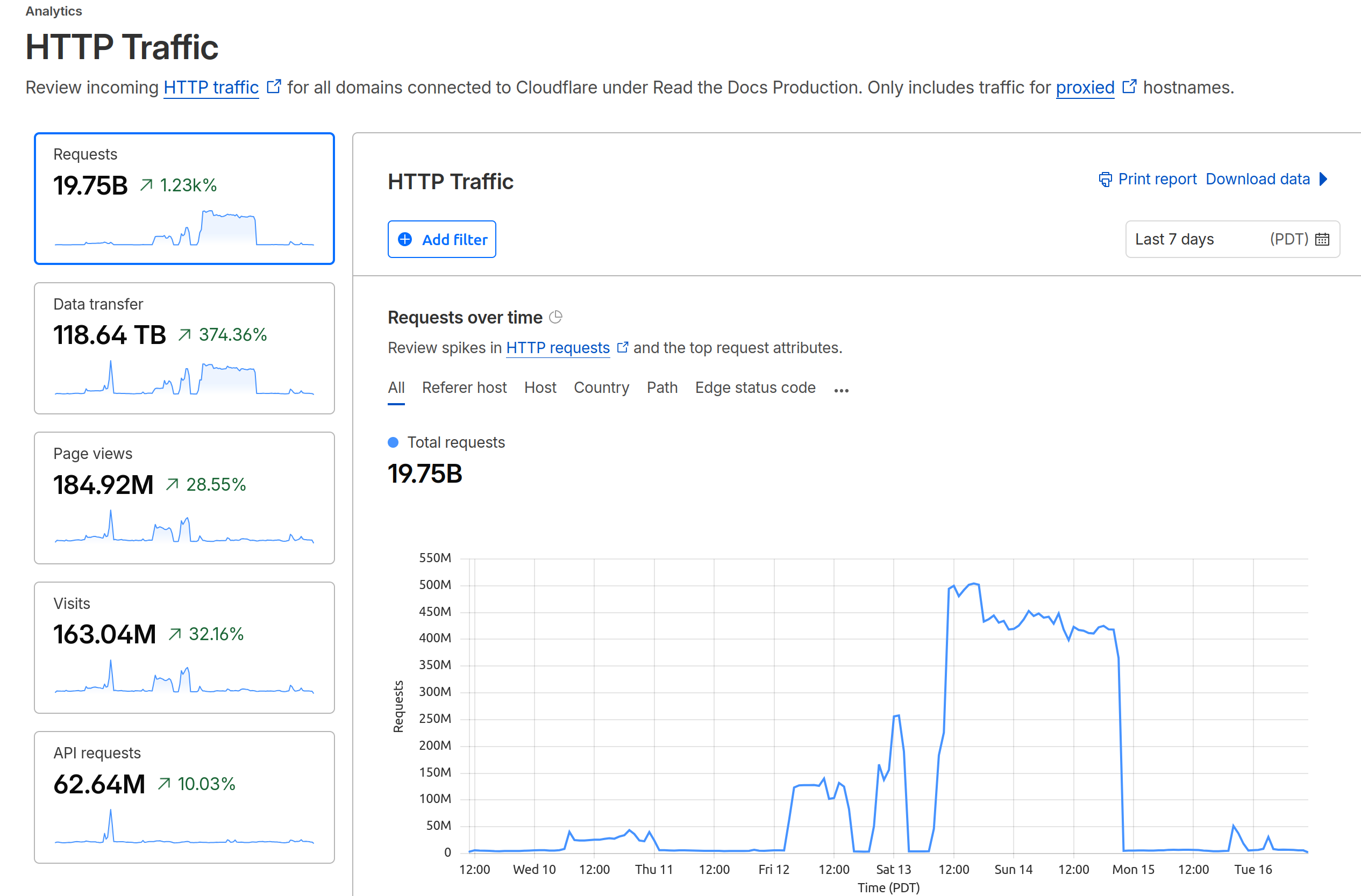
The IIHS’s latest July study flatly stated that automated cars crash less often than people. But it also sought clarity by creating a more-reliable category of “police-reportable crashes.” It then compared crash rates of human-driven cars against Waymo taxis in San Francisco, Phoenix, Los Angeles, and Austin. Waymo’s Jaguar I-Pace taxis traveled about 50 million driverless miles over the study period, versus 222 billion human miles in the same cities.
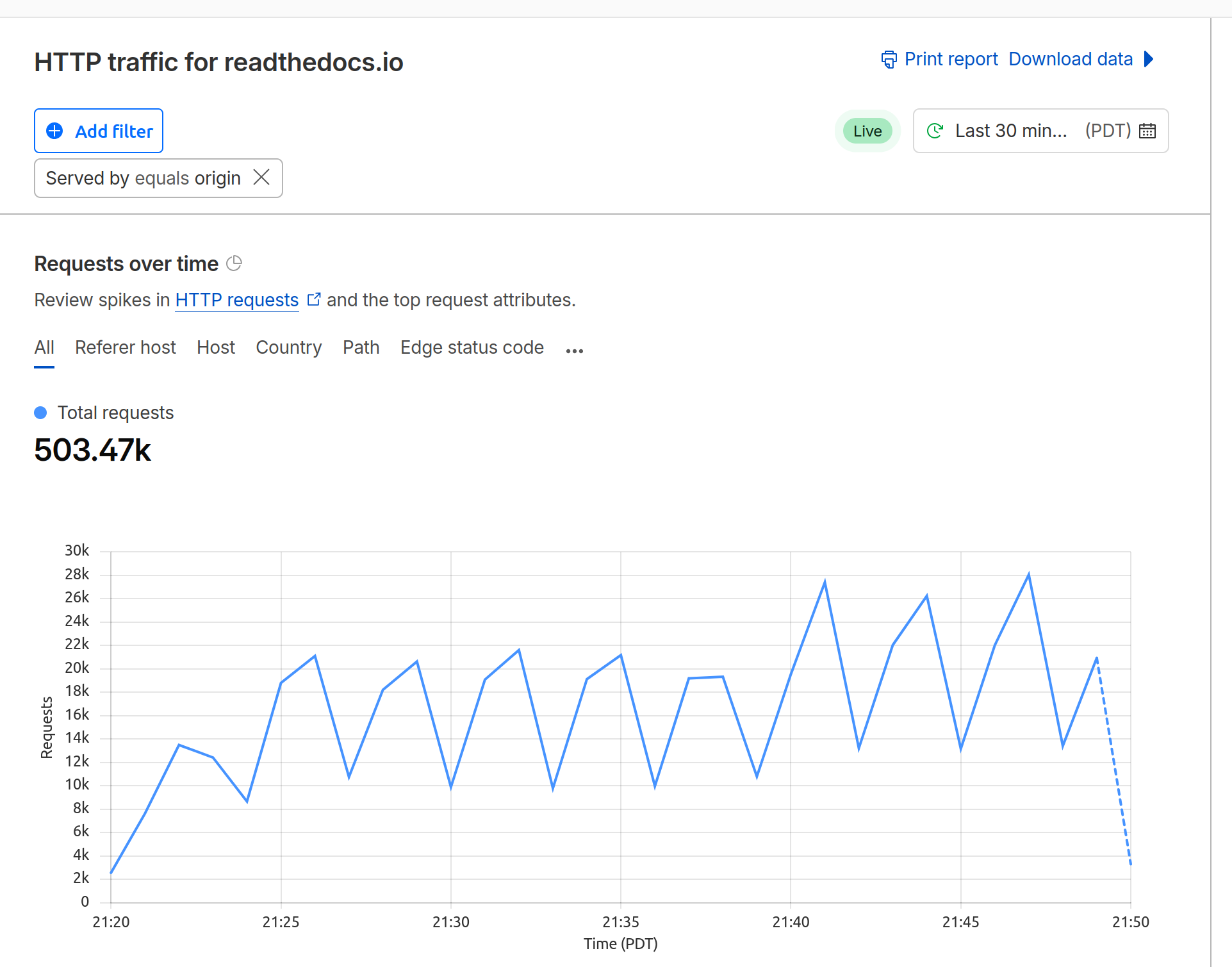

In a potential boost for public trust, the study generally supported Waymo’s own findings. Waymo taxis were involved in 68 percent fewer crashes overall than human drivers: 76 percent lower in Phoenix, 71 percent in LA, and 35 percent in San Francisco. A 4 percent higher Waymo rate in Austin may reflect an extremely small sample size. Significantly, Waymo’s injury crashes were still 81 percent lower on a per-mile basis.

The industry and its supporters continue to press the safety advantages of autonomous vehicles that never get drunk, drowsy, or distracted. Yet for this fledgling AV industry, there are still no national performance or safety standards. A crazy quilt of state or local regulations can allow or prohibit their deployment. That balkanized approach makes it harder to compare crash rates, according to the IIHS, which is calling for better federal reporting standards.

A posting on the IIHS website quotes the institute’s director of statistical services, Eric Teoh: “Those are encouraging signs for the future of driverless vehicles.” Teoh, who was also the lead author of the institute’s study, added that “Now we need to get the data-collection system right, so that we can ensure that level of safety continues as these technologies become more prevalent.”

Amazon’s Zoox Gets an Exemption for its Robotaxis

On July 30, in a move seen as fast-tracking the tech’s deployment, NHTSA granted Zoox, a subsidiary of Amazon, the first-ever exemption from certain motor-vehicle safety standards. That will allow commercial operation of Zoox’s toaster-shaped robotaxis, which have no steering wheel or pedals aboard. The agency determined that Zoox’s purpose-built robotaxi “would provide an equivalent level of safety” as a compliant vehicle, thereby satisfying the standard for an exemption.

On that final day of the SAE’s Automated Transportation Symposium, NHTSA also announced a partnership with SAE Industry Technologies to develop the nation’s first performance and competency standards for AVs, via a three-year, $5 million “A2SCEND” consortium.

Some doctors and health professionals are arguing that policymakers need to stop viewing self-driving cars as a tech moonshot but rather as a critical public-health intervention. Jonathan Slotkin, a neurosurgeon, makes a powerful case for the medical and societal benefits of AVs. Researchers at the Johns Hopkins Bloomberg School of Public Health say that highlighting the social value of AVs is critical to driving public trust and adoption.

Consider that roughly 40,000 people in the U.S., including more than 7,000 pedestrians, are killed each year in roadway accidents. About 1.16 million people die in roadway crashes around the world, making them the leading cause of death for children and young adults between the ages of 5 and 29. Cutting that by even 50 percent—let alone the 90 percent reductions suggested by some studies—would save 580,000 lives a year. That social and economic gain would dwarf that of seat-belt adoption or anti–drunk driving campaigns.

The Daily Front Page 15 of 32
Wednesday, September 9, 2026 The Daily Front No. #260909 — The Toll Booth in Your Wallet
article

What do Visa and Mastercard do? An intro to card networks

by evakhoury·▲ 441 points·245 comments·tautology.town ↗
They aren’t the company that issues the card.

Most people can recognize the Visa and Mastercard brands. Chances are, you use one of their cards to transact every day. You may have some notion that most places (in the US) take both, but some places only take Visa (e.g. Costco), and vice versa.

So what do they do? Here’s Visa’s attempt to answer that question.

A few things they don’t do1:

  • They aren’t the company that issues the card. Those are called card issuers.
  • They aren’t a bank, though the cards you have are probably issued by one (Chase, Capital One, BofA, etc).
  • They don’t distribute point of sale methods or online checkouts, which are done by payment processors.
  • They aren’t responsible for onboarding or underwriting stores and merchants, known as merchant acquiring. This is done by banks offering merchant accounts, but increasingly offered by modern payment processors (Stripe, Square, Adyen)2.
  • They don’t manufacture or print cards.
  • Nor do they manufacture the point of sale hardware.

Instead, Visa and Mastercard are card networks3, facilitating card transactions by connecting the cardholders and issuers to the merchants and acquirers.

This forms a two-sided market of all the participants in a transaction4:

---
config:
  theme: 'neutral'
  fontFamily: system-ui, -apple-system, BlinkMacSystemFont, 'Segoe UI', Roboto, Oxygen, Ubuntu, Cantarell, 'Open Sans', 'Helvetica Neue', sans-serif;
  nodeSpacing: 20
  rankSpacing: 25
  flowchart: 
    subGraphTitleMargin: {bottom: 20}
    useMaxWidth: true
---
%% For some reason arrows are still showing up in the Obsidian preview, but not in Mermaid online editor
flowchart LR
    subgraph Issuing[**Issuing**]
        direction TB
        CI[Card issuer] --- CH[Cardholder]
    end
    subgraph Acquiring[**Acquiring**]
        direction TB
        MA[Merchant acquirer] --- M[Merchant]
    end
    Issuing ---- CN[**Card network**]
    CN ---- Acquiring

The key players in a card transaction.

The card network’s job is to enable card transactions, and also to grow participation in their networks.

This boils down to four key responsibilities:

  1. Run the telecommunications network to route transaction messages.
  2. Coordinate the banking network to move money and settle transactions.
  3. Set incentives to encourage the use of the network.
  4. Set and enforce rules of the network, including a mechanism for disputes.

For the rest of the discussion, we’ll focus on Visa, as it’s what I’m most familiar with from my years in the payment industry. Mastercard is more or less the same, with different names for things.

1. Run the telecommunications network

When we talk about networks, we think of the Internet, computers connected together by fiber and deep sea cables.

Card networks, being telecommunication networks, are no different. They maintain data centers and lease fiber optics cables to connect issuers and acquirers electronically. At their most basic technical level, Visa’s responsibility is forwarding transaction messages between its participating issuers and acquirers. Mastercard calls this activity “switching”, seeing itself as a network switch.

Visa takes its data centers very seriously. They are highly secure, redundant, and fitted to survive all kinds of disasters. From Inside Visa’s Data Center (Network Computing, 2013):

“The company’s flagship data center, dubbed Operations Center East, or OCE, is a 140,000-square-foot facility that Visa will only say is located “somewhere along the Eastern seaboard.”

“Not surprisingly, the facility, which is also designed to withstand earthquakes and gale-force winds up to 170 miles per hour, is locked down like a digital Fort Knox. The roads entering the complex have hydraulic bollards that can shoot up fast enough to stop a vehicle traveling up to 50 miles per hour dead in its tracks. (The road is too curvy to drive safely at higher speeds.) Visitors must pass through a security gate, be cleared by roving security teams, and then be subjected to a biometric scan before being admitted.”

And a 2012 headline from USA Today:

Top secret Visa data center banks on security, even has moat

That top secret location? In Ashburn, Virginia, conveniently located by Topgolf and Trader Joe’s.

I think the "moat" is the pool of water on the top center-left.

I think the "moat" is the pool of water on the top center-left.

Authorization and clearing

When a card is used, the card network routes a transaction request, known as an authorization, from the merchant to the issuer. The issuer then approves or declines the request in a response. Card numbers, also known as Primary Account Numbers (PANs), are used like IP addresses5. The first 6 to 8 digits of the PAN identifies the card issuer and is called the Bank Identification Number (BIN)

An approved authorization places a temporary hold on the account for the amount of the transaction. Later, the merchant submits the final transaction amount (for example, adding tips written on receipts or voiding the transaction) to initiate the transfer of money, known as clearing6.

Consider: before this was done by computers, this was done by people via phone calls7 and mail.

2. Coordinate the banking network

In addition to a telecom network, Visa has a financial network of banks.

After a transaction is finalized, money on both ends must move to fulfill the transaction, known as settlement.

Visa’s second job is to route money for settlement by having financial relationships with each party. It can collect money from one and transfer to another.

To be efficient, Visa does net settlement: every day, each network participant’s debits and credits are totalled, and at the end of the day the net money is moved to or from each participant once.

For domestic transactions, moving money is relatively straightforward, thanks to central banks.

Importantly, Visa is also able to settle internationally, even handling currency conversion. Visa acts as an adapter between banking systems with its global banking relationships. This greatly simplifies international money movement for participants in its network — without Visa, each participant would need to manage their own international banking relationships.

---
config:
  theme: 'neutral'
  fontFamily: system-ui, -apple-system, BlinkMacSystemFont, 'Segoe UI', Roboto, Oxygen, Ubuntu, Cantarell, 'Open Sans', 'Helvetica Neue', sans-serif;
  nodeSpacing: 20
  rankSpacing: 60
  flowchart: 
    subGraphTitleMargin: {bottom: 20}
    diagramPadding: 10
    useMaxWidth: true
---
flowchart LR
    CI[Issuer in Country A] --> VisaA["Visa's bank in A"]
    VisaB[Visa's bank in B] --> MA[Acquirer in Country B] 
    subgraph **Visa**
        VisaA -.-VisaB
    end

Visa as an adapter

Shuffling this amount of money around and timing everything right is no easy feat. Visa faces non-payment risk in addition to maintaining a significant balance to cover payouts while waiting to receive settlement payments. From Visa’s 2024 annual SEC report:

Most U.S. dollar settlements are settled within the same day and do not result in a receivable or payable balance, while settlements in currencies other than the U.S. dollar generally remain outstanding for one to two business days, which is consistent with industry practice for such transactions. … As of September 30, 2024, we held $11.2 billion of our total available liquidity to fund daily settlement in the event one or more of our financial institution clients are unable to settle, with the remaining liquidity available to support our working capital and other liquidity needs.

The Company’s settlement exposure is limited to the amount of unsettled Visa payment transactions at any point in time, which vary significantly day to day. For fiscal 2024, the Company’s maximum daily settlement exposure was $137.4 billion and the average daily settlement exposure was $84.3 billion.

3. Set incentives

The key to this whole arrangement are the fees required to participate in the network, largely set by the network.

Let’s walk through an average credit card transaction in the US:

  1. A cardholder pays for a product at a merchant for $100.00.
  2. The merchant pays 2.5% ($2.50) of the transaction to their payment processor or merchant acquirer. The 2.5% is the merchant discount rate or MDR.
  3. The payment processor keeps 0.35% ($0.35), then pays 2% ($2.00) to the cardholder’s issuing bank and 0.15% ($0.15) to Visa. The 2% is the interchange fee, commonly known as interchange. The 0.15% is the network assessment fee. 8
  4. The issuing bank keeps 2% ($2.00)!

Surprisingly, the issuing bank keeps most and the network takes the least, by an order of magnitude! This is because for the tranasction, the issuer is traditionally considered to take on most of the risk (although merchants are likely to disagree).

In addition to regulatory requirements, Visa and Mastercard offer zero-liability protection. This means that the issuing bank, not the cardholder, is liable for any charges made on a card if it is lost or stolen.9 The issuing bank also takes on credit risk, and must always pay for an approved transaction even if a cardholder cannot pay off their balance.

Out of these, the network sets the interchange and network assessment fee. Interchange fees vary dramatically based on the kind of card, category of spend, and even the metadata attached to a transaction. The network’s goal is to set fees that incentivize desired behaviors on their network, including using more secure payment methods (lowering interchange fees for merchants), or for companies to do more business spending (higher interchange fees on commercial credit cards).

Because of how much is given to the issuers, there are a lot of incentives for issuers to acquire customers and fund lavish rewards programs to encourage spending. This split also explains the recent rise of issuing processors, which make it easier for neobanks and fintechs to issue cards to access a more lucrative end of the market.

Why are merchants willing to pay this fee?10 The idea is that accepting card payments nets more customers and higher spending, due to convenience, consumer protections, and credit card rewards. More cards means more merchants, more merchants mean more cards, and more of everything is good for the network. In theory, the network benefits through fees, the merchants benefit through more purchases, and the consumer benefits through convenience.

The virtuous cycle of card spend: Issuers get more interchange -> Issuers issue more cards and offer more rewards -> People spend more with card -> More merchants accept cards -> Repeat

The virtuous cycle of card spend.

In the EU, interchange fees are restricted to 0.3%, which explains the lack of rewards cards and wider acceptance of alternative payment methods like bank payments.

4. Set rules and handle disputes

Aside from incentivizing good behavior, card networks also need to regulate bad behavior on their networks. These rules are detailed in “Visa Core Rules and Visa Product and Service Rules”, a 923 page volume that is publically available. This is a tome detailing things like appropriate use of the Visa brand mark, detailed interchange data requirements, transaction processing timelines requirements, requirements and procedures for specific Visa services, and features issuers/acquirers should support.

For issuers and acquirers, who interact with the network, violating these rules could affect interchange rates, incur non-compliance fines (anywhere from $25k to $1M per month), or risk suspension from the network.

For cardholders and merchants, who interact with each other, networks provide a mechanism for resolving disputes between them. This could mean a fraudulent transaction, the product was not as promised, or a number of other possible reasons detailed in the rules. This is the process that happens behind the scenes when you call your bank to report fraud or request a chargeback.

When a payment method doesn’t have a dedicated dispute mechanism, the legal system is used to settle disputes11. This a problem with cash or bank payments that cards don’t have.

Arbitration

Visa is not actually involved directly in resolving most disputes. The rules essentially impose forced arbitration12. The issuer of the cardholder and acquirer of the merchant send evidence back and forth until one party yields and accepts liability for the transaction.

If both parties refuse to yield, then Visa reviews the dispute, charging a whopping $600 ($1000 for appeals) makes a decision based on the evidence provided (signature, security footage, receipts, etc) and the guidelines listed in the Visa Product and Service Rules.

The losing party pays the original transaction amount plus the review fee, so both parties have a lot of incentive to resolve it between themselves. Issuers often refund the cardholder themselves and write off the loss. Merchants proactively refund dissatisfied customers since they are charged a $15-30 processing fee by the acquirer upon receiving any dispute, even if they win.

Arbitration is not a fair system, but it is an efficient one.13

Conclusion

I hope you have gained some appreciation for the important role of card networks and some reasons for why cards are as popular as they are today. Use this knowledge to topple the V/MC duopoly, design your own payment method, or think about while you spend your money.

Edit: this reached the frontpage of Hacker News — hello, and welcome to town!


  1. Nowadays they may have product offerings for some of these, or own subsidiaries that do some of these, but these are not core to the business of being a card network. 
  2. Technically, these are “payment facilitators”. A bank underwites the payment company, and the payment company underwrites their merchants. The different roles in payments have historically been meaningful, but companies are increasingly blurring the lines, so these distinctions and terms are less interesting today. 
  3. To be precise, we use “card networks” to colloqially refer to the companies operating their own card payment networks / schemes. For example, VisaNet is technically the network, Visa is the company/brand. Mastercard’s network is called Banknet. Both companies also own and operate specialized subsidiary networks for things like debit cards and ATMs, like Visa’s Interlink and Plus, or Mastercard’s Cirrus and Maestro, although technically VisaNet and Banknet can process debit (this is a story for another time). There are further terms to distinguish the telecommunications network with the bank network, and even subsets of each. Visa even thinks of itself as a “network of networks”. Turtles all the way down. 
  4. Or four or more, depending on how you count. 
  5. Similar to IPv4, 16 digit PANs are rapidly exhausting due to the use of anonymized “token” PANs used by things like Apple/Google Pay and saved payment details. 
  6. Clearing includes finalizing/committing the payment and reconciliation against the authorization. “Capturing a payment” is what this is called from the merchant’s perspective. 
  7. Known as a “voice authorization”. You might be able to get one today, although I don’t know if banks are staffing operators to field calls. 
  8. Although interchange is short for interchange fee, technically interchange refers to the payment messages being routed by the card networks, and the fee is provided for that data. But, you almost never hear interchange used to mean payment messages except in technical specs. 
  9. Although this creates trust in card payments, it has opened the doors to friendly fraud, where legitimate purchases are reported as fraudulent. Not to mention a moral hazard
  10. Some merchants add a surcharge on card transactions to pass through the fee to customers. This used to be against Visa’s rules (and California state law) but lawsuits have challenged that. The surcharge amount is also only supposed to be the amount the merchant pays on a card transaction, but I suspect that many small merchants charge more. 
  11. There are some amusing cases of this at work in large transactions, where the legal fees are much more in proportion with the transaction costs. 
  12. Not that you asked, but the expansion of forced arbitration and confidential settlements are bad for society. Back in the day, you could sue your bank (for example) for doing bad stuff, but now contracts for everything include a clause for arbitration, waiving your rights as a consumer. The company pays for the arbitration, not you, so you can guess the outcome of that. Famously, Disney tried to use a forced arbitration clause in the Disney+ streaming agreement to prevent a wrongful death suit from a allergic reaction in a Disney restaurant. In the Visa case, the dispute process means the consumer tends to benefit, at the cost of the issuer and the merchant. 
  13. The system is designed to encourage transactions rather than stopping fraud. It opens the door to fraud, especially friendly fraud, as explained in another footnote. Friendly fraud is a growing problem
The Daily Front Page 16 of 32
Wednesday, September 9, 2026 The Daily Front No. #260909 — Google’s Automated Blind Spot
article

How I advertise malicious software on Google Ads

by xlii·▲ 372 points·225 comments·xlii.space ↗
Not cars, but bikes. And they don’t give them out, but steal them.

A caller phones Radio Erywan.

“Is it true that in Moscow, on Red Square, they give out cars?”

“True. Not in Moscow, however, but in St. Petersburg. Not on Red Square, but on Revolution Square. Not cars, but bikes. And they don’t give them out, but steal them”.


Edit: Through the apparent magic of Hacker News, my Google Ads account has been reinstated. ✨.

Still no explanation of what triggered the suspension, but thank you to everyone who helped make it visible (and/or fixed).


RACE is a native macOS terminal multiplexer written in Rust. You can position and resize terminals freely instead of squeezing everything into a uniform grid: Keep a large editor beside a small shell, spread out build logs, arrange the workspace around the work, mark with colors etc. I built it, I use it, and I maintain it. Since it’s multiplexer it manages terminals and lets shell sessions survive application restarts (good for development and hooking off the work).

In action it looks like this:

I also built the website for it - https://race-term.com. Static page built with Bridgetown. JavaScript changes the DOM to provide interactive visual features and that’s it. No custom server-side application behind it. At the submission time (that changed recently) the only third-party JavaScript ws Cloudflare Analytics. No Google Analytics or advertising tracking - to keep it light. Served from Cloudflare, Cloudflare R2 keeps the downloads.

Then I tried advertising for the first time.

I set up a Google Ads campaign. Spent 500$ and… Google suspended the account for “Malicious software”.

Unexpected addition to the feature list.

Google

To be precise - Google said “Malicious software” and “Compromised Site”. Sounded like bullshit. Application was signed and notarized. Website was clear and had no attack surface, but sure I’ll check. Zero. Nothing. Nada. Clean like a whistle. So I appealed.

It rejected my appeal, told me to submit new information, and suggested deleting my account if I had none. It also pointed me toward EU redress options.

It did not say what was malicious, what was compromised, or why the evidence I supplied failed to address either accusation. I received instructions for appealing the decision, but no explanation that would help me challenge.

I appealed, and got rejected.

Then I appealed, and got rejected.

And I appealed with even more information, and got rejected.

And again, and got blocked for a week.

And again…

We have completed a full security review of the RACE website, download infrastructure, JavaScript assets, and distributed macOS application.

Security verification

Application behavior

RACE is a native application written in Rust. It is a terminal multiplexer, so by design it launches and manages terminal processes in the background.

This subprocess-management behavior is an essential part of the application’s functionality and may resemble behavior sometimes associated with security-sensitive software, but it is neither hidden nor malicious.

The process-multiplexing mechanism is documented in the application. Users can also configure RACE to use dtach as an alternative multiplexer. This behavior and the relevant configuration are disclosed in the application’s About/configuration documentation.

The application does not install malware, inject code into other applications, modify browser behavior, or attempt to conceal its process activity.

Request for review

We have investigated all plausible causes of the policy/security flag, verified the website and distributed application using both Google and independent security tools, and found no security issue.

We therefore believe the suspension may be the result of a false positive, potentially related to the legitimate subprocess-management behavior inherent to a terminal multiplexer.

Please perform a manual re-review of the account, website, and application based on the evidence above.

Checklist

But it’s not like I just responded. I checked!

1. Google Safe Browsing

I checked both race-term.com and downloads.race-term.com. Both reported “No unsafe content found”. The screenshots show the status updated on 9 September 2026.

screenshot of Google Safe Browsing saying that race-term.com site is safe

This establishes what Safe Browsing reported for those addresses. It does not establish what Google Ads detected, or whether the two systems use the same criteria.

2. Google Search Console

I opened the Security Issues report for each domain separately. Both reported “No issues detected”.

There was no listed infected page, malicious download, or injected resource to investigate. Again, this is a result from Search Console, not a clearance certificate from Google Ads.

screenshot of Google Search Console saying that race-term.com site is safe

3. The File

Maybe something got into the file? Worth checking the file, right? And so I did. Of course it came out clean! The fun thing is that even Google’s scan identifies NO MALWARE inside.

screenshot of VirusTotal dash saying that RACE.dmg is clean

4. Signatures and website code

And so I checked:

  • File signatures
  • Notarization status
  • Raw JavaScript output
  • Bundled JavaScript output (who knows maybe something’s in the bundler?!)
  • Cloudflare logs (maybe Google bounced of some anti-LLM guard or captcha)
  • Accessibility with different User Agents

Nothing. Nothing. Nothing.

5. Persistent terminal processes

There is one thing though.

RACE deliberately starts and manages background shell processes. Its configuration documents three persistence backends: its native PTY host, external dtach, or no persistence.

Ok, so I thought - maybe that’s the case. That you can start app, and it stays behind. So I made version 1.0.39 that makes a hacky cleanup after application is deleted. Submitted it and do you know the results?

(Note: hackiness is out, right now user is being asked about it, though it’s fucking stupid from UX perspective)

What now?

Who knows. That road might be out forever.

What is the most enraging in the whole situation is Catch 22 I’m in:

No idea what I can do now, I’ll appeal until oblivion, …or maybe I’ll try EU court case. Cause it seems like that’s the only road forward.

Radio Erywan at least supplied the corrections.

The Daily Front Page 17 of 32
Wednesday, September 9, 2026 The Daily Front No. #260909 — A Ten-Day Siege of the Docs
article

Understanding the recent DDoS attack against Read the Docs

by davidfischer·▲ 170 points·58 comments·about.readthedocs.com ↗
At its peak, our infrastructure was hit with over 5.5 million requests per minute.

Analytics from the June 2026 attack

Analytics from the June 2026 attack

In mid-to-late June 2026, Read the Docs experienced the largest and most sophisticated distributed denial-of-service (DDoS) attack in our history. At its peak, our infrastructure was hit with over 5.5 million requests per minute, about 100 times our normal baseline traffic.

The incident lasted for nearly ten days, testing our infrastructure, our edge defenses, and our incident response processes. Unlike simpler traffic floods we've seen in the past, this attack was more distributed, it adapted to our defenses rapidly, and it purposefully attacked areas that bypassed caching.

Now that our small ops team is back to sleeping at normal hours, we wanted to walk through the anatomy of this kind of attack, why our existing rate limiting only partially mitigated it, and what strategies actually helped us (mostly) maintain availability throughout the attack.

Evolution of DDoS attacks

Read the Docs has historically been very tolerant toward spiders and bots scraping documentation we host, and IP-based rate limiting solved most abuse problems. Starting about two years ago, we began seeing a significant uptick as AI crawlers became more prevalent and it seems other members of the dev infrastructure community are seeing similar issues. It became straightforward to plug an AI-generated scraper into a proxy network. Our defenses adapted to that fairly easily, but the June attack was over 10x larger than anything we had faced.

Key characteristics of this attack included:

  • Massive volume: At peak, we received 5.5 million requests per minute, compared to our normal daily peak of under 100k requests per minute.
  • Global distribution: We saw malicious requests originating from millions of unique IP addresses across hundreds of networks (ASNs) globally. This included residential IP blocks as well as major and minor hosting providers.
  • Header & TLS randomization: The attackers systematically randomized HTTP request headers and TLS connection parameters to evade signature-based filters (JA3/JA4).
  • Limitations of automated CDN defenses: Read the Docs uses Cloudflare and while Cloudflare's automated DDoS protection mitigated some traffic originating from what they called "known botnets", a big part of the attack passed that first check and got through to our rate limiting and WAF rules.
  • Cache evasion: Attackers found and deliberately targeted URLs that resulted in cache misses, such as non-existent pages with unique paths (404s) as well as temporary redirects (302s).
  • Adaptive behavior: When we implemented blocks or rate limits, the botnet adjusted its request rates, rotating through different target paths and spreading traffic across broader IP pools to probe our defense boundaries.

Scale and breadth

Previous minor DDoS attacks or large distributed scrapers we'd seen were typically concentrated in some way. The requests either originated from a small set of countries, or a small set of IP blocks, or they had a small set of browser signatures. This attack was truly global. It came from every country all at once, which is a nightmare when rate limiting rules are applied per Cloudflare colo. It's hard to craft rules that can limit a distributed attack while not hitting legitimate bots scraping at a reasonable rate from a single IP or subnet.

At one point when the attackers focused on redirects, they were overwhelming a hardcoded Nginx redirect (a simple rewrite regex directive) with enough traffic to cause dropped requests even on horizontally scaling infrastructure. An Nginx redirect like that can easily handle thousands of requests per second.

In addition to spreading across the globe, it also attacked multiple Read the Docs properties. Public community documentation was attacked as well as our commercially hosted docs. We also saw attackers try to take down our author-facing dashboards that require logins.

While it was an option (Cloudflare's "Under Attack Mode") to simply give every site visitor, legitimate or otherwise, a JavaScript challenge, we didn't want to do that. This would break every API integration and cause lots of friction for the hundreds of thousands of real docs readers. Instead, we relied on rate limiting and targeted challenges combined with more caching and pushing more features out to the edge.

“There's no way we could have handled this attack without Cloudflare.”

Adapting to our defenses

Read the Docs uses Cloudflare heavily for caching and rate limiting, and there's no way we could have handled this attack without Cloudflare. We have dozens of rate limiting rules (managed through Terraform) to protect our infrastructure based on IPs, on the thousands of hostnames and hundreds of thousands of subdomains Read the Docs hosts, on ASNs, browser fingerprints, and on combinations of all of these.

The attack started on a small number of domains where attackers discovered temporary redirects (302) that were not cached at the edge and were served by our Python backend rather than something like Nginx. Within a few minutes, our operations team had been paged due to a short outage (users may not always notice our outages because cached documentation keeps serving), and within half an hour or so we had moved these redirects to be served at the edge by Cloudflare instead of our servers. We thought that might be the end of it, but instead the attackers tried different tactics across various hosts and services for another week and a half.

Analytics showing oscillating 'Yo-Yo' traffic levels during the attack.

Analytics showing oscillating "Yo-Yo" traffic levels during the attack.

Attackers would ramp up to discover our rate limit thresholds and then back off to let the rate limit windows expire. This is called a yo-yo pattern, and it's designed to maximize the financial costs of auto-scaled infrastructure and cause intermittent service degradation. The attackers knew we were running a web app firewall (WAF) with rate limits and knew how to cause as much damage as possible in spite of that.

Defending against volumetric DDoS attacks

Defending against multi-million request-per-minute floods requires a defense-in-depth approach with edge caching, web app firewalls, rate limiting, local caches, and request fingerprinting. The fastest request is the one served by the CDN or the web app firewall.

Edge caching

The first line of defense, and one we were already using heavily, is a proper CDN and ensuring that as few requests as possible hit origin servers. Serving docs from a CDN has a lot of benefits. For Read the Docs, where docs sites change infrequently, we cache fairly aggressively but purge the cache for a particular docs site whenever new documentation is pushed to git and rebuilt. CDNs also make fetching documentation much faster for people geographically further away from our origin servers.

However, attackers probing our defenses quickly discovered which requests were cached and which ones weren't by how fast the CDN responded. This means that finding just a few requests that aren't cached gives attackers an angle of attack. We are still finding more paths and endpoints that aren't cached, but even very short-lived cached responses (using the Cache-Control header) for both redirects and normal 200 responses will help with this kind of attack.

Slack notification when Read the Docs is getting 45k uncached req/min

A Slack notification when Read the Docs is getting 45k uncached reqs/min. Without caching and rate limiting, auto-scaling infrastructure will just scale out to handle the load at our expense.

Rate limiting and fingerprinting

Since we didn't want to give a JavaScript challenge to all users, we used targeted rate limiting rules combining bot probability scores with per-IP rate limits to challenge suspicious traffic while letting legitimate users and well-behaved bots browse uninterrupted. Everyone who has solved a JavaScript challenge knows they cause a lot of friction. We decided that it was better to let some malicious traffic through and err on the side of not challenging real users. With that said, we still needed rate limits to protect our infrastructure.

Instead of focusing on where the request came from (the IP, the country), defenses must focus on what the request looks like:

  • Cipher suite and TLS anomalies: Automated scrapers and bot clients frequently present abnormal TLS connections different from browsers. Cloudflare's bot detection has specific tools to detect these.
  • Too many bad requests: Legitimate users and good bots are almost always served successful (200) responses, not redirects or 404s. Since 200s are always cached, they almost never present a problem. When we see too many more expensive requests like redirects or 404s, we begin rate limiting the browser fingerprint, the ASN, or even possibly the specific domain as a whole. Adding these rules, which we call the "penalty box", probably made the biggest difference in automatically mitigating the attack as it changed over time.
  • Protocol inconsistencies: Malicious tools often declare modern User-Agent strings while using older HTTP/1.1 connections. Unfortunately, this inconsistency wasn't very useful in this attack, which was entirely HTTP/2 and HTTP/3.
  • Client fingerprinting: Everyone using the Golang HTTP client or the Python requests module with the same TLS cipher suites will have the same JA4 fingerprint. This fingerprinting is specific to a browser or tool, not specific to a user. These fingerprints also weren't very helpful in this attack as the attackers were randomizing their TLS parameters.
  • IP block classification: One area we are still working on is to classify more IP blocks into different categories with their own limits. For a service like Read the Docs which receives lots of automated traffic and wants to allow bots, we know we're going to get a lot of traffic from major cloud ASNs like Amazon, Google Cloud, and Azure. They should have higher limits than most residential or minor hosting providers.

Give users an escape hatch

One decision we made is to always give real users an escape hatch. Read the Docs very rarely issues outright blocks or bans to specific IPs or user agents. Instead, our "worst" is a JavaScript challenge, and if a user solves a challenge, they are very unlikely to get challenged again for the next day or so.

Lessons learned and key takeaways

The June 2026 DDoS attack reinforced several critical takeaways for running high-traffic infrastructure:

  • IP blocking is obsolete for distributed attacks: Botnets or large scrapers use proxy services which make simple IP blocks useless. We already knew that, but this incident underscored it. Defenses need to have broader rate limits across more than just IPs (ASNs, hostnames, etc.).
  • Aggressively cache: Cache everything, whether it's a simple static file, a 404, or a temporary redirect. Even setting a short cache window of a few minutes will ensure that these resources can't be used to attack our infrastructure. The default settings on the CDN and in most web frameworks are not what a service like Read the Docs wants.
  • Protect cache-miss surfaces: Attackers actively search for non-cacheable paths (e.g. dynamic redirects, search endpoints, and 404s). Cache where possible, and if caching isn't feasible, try to handle as much on the edge as possible.
  • Targeted challenges beat blunt instruments: Combining bot management heuristics with rate limits allowed us to mitigate the attack with minimal impact on legitimate users.
  • Infrastructure as Code is essential: Managing edge and WAF rules via Terraform enabled us to review, test, version-control, and roll out complex filtering rules quickly and safely.

We're still seeing low levels of background traffic from the attack IP blocks, but our infrastructure is in a much stronger position today than it was before the attack. As AI tooling and proxy networks make attacks like this cheaper and more accessible, they are no longer reserved for big enterprise targets. They are becoming the baseline reality for any high-profile public service. Our ops team is back to getting a full night's sleep, but we're viewing this as more like an extended reprieve rather than attacks being a thing of the past.

The Daily Front Page 18 of 32
Wednesday, September 9, 2026 The Daily Front No. #260909 — Signals From Orbit
article

Planet Labs' open satellite feed

by marklit·▲ 157 points·28 comments·tech.marksblogg.com ↗
They operate or have operated four different constellations throughout their history.

Planet Labs' Open Satellite Feed

Planet Labs is a 15-year-old, San Francisco-based satellite manufacturer and constellation operator. They operate or have operated four different constellations throughout their history and capture imagery of the entire Earth's landmasses every day. As of this writing, LinkedIn lists the firm as having 1,751 associated members.

Their CEO, Will Marshall, is one of the firm's three co-founders. In February, he posted images alongside the Secretary General of NATO, Mark Rutte, French President Emmanuel Macron and Kaja Kallas, who was Estonia's Prime Minister between 2021 and 2024 and is now Vice-President of the European Commission.

Planet Labs Open Satellite Feed

Their latest Pelican-11 satellite, which will join their Tanager constellation, was deployed by SpaceX's Transporter 17 Mission on July 7th.

Planet Labs Open Satellite Feed

This is its release into Lower Low Earth Orbit (LLEO) over Greece.

Planet Labs Open Satellite Feed

As of this writing, Planet Labs' Ephemerides service lists 97 of their satellites that are still in orbit. These are their latest details from GCAT.

$ wget https://ephemerides.planet-labs.com/planet_mc.tle

$ grep '^2.*' planet_mc.tle \
    | cut -d' ' -f2 \
    > NORAD_IDs.csv

$ ~/duckdb
.maxrows 4000

SELECT   State,
         Name,
         * EXCLUDE(AltNames,
                   Bus,
                   Dest,
                   Attach_flag,
                   Subtype_flag,
                   Orbit_flag,
                   ID_flag,
                   Status_or_failure_flag,
                   Coarse_type,
                   SDate,
                   SDate_Year,
                   "Primary",
                   DDate,
                   Manufacturer,
                   Motor,
                   JCAT,
                   ODate,
                   Type,
                   OQUAL,
                   PLName,
                   Shape,
                   Name,
                   State,
                   DryMass,
                   TotMass)
FROM     'satcat.parquet'
WHERE    Satcat IN (SELECT column0::VARCHAR
                    FROM   'NORAD_IDs.csv')
AND      Status = 'In orbit'
ORDER BY Launch_Tag,
         Name;
┌─────────┬──────────────┬────────┬──────────┬───────┬────────────┬─────────────┬────────┬───────┬─────────┬─────────┬───────────────┬─────────┬────────────┬─────────┬───────┬──────────┐
│  State  │     Name     │ Apogee │ Diameter │  Inc  │ Launch_Tag │    LDate    │ Length │ Mass  │ OpOrbit │  Owner  │    Parent     │ Perigee │   Piece    │ Satcat  │ Span  │  Status  │
│ varchar │   varchar    │ int32  │  float   │ float │  varchar   │   varchar   │ float  │ float │ varchar │ varchar │    varchar    │ varchar │  varchar   │ varchar │ float │ varchar  │
├─────────┼──────────────┼────────┼──────────┼───────┼────────────┼─────────────┼────────┼───────┼─────────┼─────────┼───────────────┼─────────┼────────────┼─────────┼───────┼──────────┤
│ US      │ SkySat A     │    597 │      0.6 │ 97.81 │ 2013-066   │ 2013 Nov 21 │    0.8 │  90.0 │ LLEO/S  │ SKYBOX  │ S39450        │ 567     │ 2013-066C  │ 39418   │   0.6 │ In orbit │
│ US      │ SkySat C1    │    515 │      0.5 │ 97.51 │ 2016-040   │ 2016 Jun 22 │    1.2 │ 110.0 │ LLEO/S  │ TBELLA  │ S41620        │ 499     │ 2016-040C  │ 41601   │   0.5 │ In orbit │
│ US      │ SkySat C2    │    502 │      0.5 │ 97.42 │ 2016-058   │ 2016 Sep 16 │    1.2 │ 110.0 │ LLEO/S  │ TBELLA  │ S41775        │ 501     │ 2016-058D  │ 41773   │   0.5 │ In orbit │
│ US      │ SkySat C4    │    506 │      0.5 │ 97.43 │ 2016-058   │ 2016 Sep 16 │    1.2 │ 110.0 │ LLEO/S  │ TBELLA  │ S41775        │ 497     │ 2016-058B  │ 41771   │   0.5 │ In orbit │
│ US      │ SkySat C5    │    503 │      0.5 │ 97.42 │ 2016-058   │ 2016 Sep 16 │    1.2 │ 110.0 │ LLEO/S  │ TBELLA  │ S41775        │ 501     │ 2016-058C  │ 41772   │   0.5 │ In orbit │
│ US      │ SkySat C6    │    527 │      0.5 │ 97.35 │ 2017-068   │ 2017 Oct 31 │    1.2 │ 110.0 │ LLEO/S  │ PLABST  │ S42994        │ 500     │ 2017-068F  │ 42992   │   0.5 │ In orbit │
│ US      │ SkySat C7    │    527 │      0.5 │ 97.35 │ 2017-068   │ 2017 Oct 31 │    1.2 │ 110.0 │ LLEO/S  │ PLABST  │ S42994        │ 500     │ 2017-068E  │ 42991   │   0.5 │ In orbit │
│ US      │ SkySat C8    │    527 │      0.5 │ 97.35 │ 2017-068   │ 2017 Oct 31 │    1.2 │ 110.0 │ LLEO/S  │ PLABST  │ S42994        │ 500     │ 2017-068D  │ 42990   │   0.5 │ In orbit │
│ US      │ SkySat C9    │    528 │      0.5 │ 97.35 │ 2017-068   │ 2017 Oct 31 │    1.2 │ 110.0 │ LLEO/S  │ PLABST  │ S42994        │ 500     │ 2017-068C  │ 42989   │   0.5 │ In orbit │
│ US      │ SkySat C12   │    588 │      0.5 │ 97.77 │ 2018-099   │ 2018 Dec  3 │    1.2 │ 110.0 │ LLEO/S  │ PLABST  │ S43763        │ 572     │ 2018-099AR │ 43797   │   0.5 │ In orbit │
│ US      │ Flock 4q-16  │    531 │      0.1 │ 97.48 │ 2023-174   │ 2023 Nov 11 │    0.3 │   5.7 │ LLEO/S  │ PLAN    │ A11079  SD4.4 │ 516     │ 2023-174R  │ 58271   │   0.3 │ In orbit │
│ US      │ Flock 4q-2   │    529 │      0.1 │ 97.48 │ 2023-174   │ 2023 Nov 11 │    0.3 │   5.7 │ LLEO/S  │ PLAN    │ A11079  SD1.2 │ 512     │ 2023-174BS │ 58320   │   0.3 │ In orbit │
│ US      │ Flock 4q-4   │    530 │      0.1 │ 97.48 │ 2023-174   │ 2023 Nov 11 │    0.3 │   5.7 │ LLEO/S  │ PLAN    │ A11079  SD1.4 │ 517     │ 2023-174BZ │ 58327   │   0.3 │ In orbit │
│ US      │ Flock 4q-9   │    529 │      0.1 │ 97.48 │ 2023-174   │ 2023 Nov 11 │    0.3 │   5.7 │ LLEO/S  │ PLAN    │ A11079  SD3.1 │ 512     │ 2023-174BU │ 58322   │   0.3 │ In orbit │
│ US      │ Pelican 1    │    530 │      0.6 │ 97.48 │ 2023-174   │ 2023 Nov 11 │    2.3 │ 160.0 │ LLEO/S  │ PLAN    │ A11079        │ 515     │ 2023-174AS │ 58296   │   3.0 │ In orbit │
│ US      │ Flock 4be-1  │    515 │      0.1 │ 97.45 │ 2024-149   │ 2024 Aug 16 │    0.3 │   5.7 │ LLEO/S  │ PLAN    │ A11288        │ 506     │ 2024-149BC │ 60518   │   0.3 │ In orbit │
│ US      │ Flock 4be-11 │    517 │      0.1 │ 97.44 │ 2024-149   │ 2024 Aug 16 │    0.3 │   5.7 │ LLEO/S  │ PLAN    │ A11288        │ 507     │ 2024-149AK │ 60501   │   0.3 │ In orbit │
│ US      │ Flock 4be-13 │    517 │      0.1 │ 97.44 │ 2024-149   │ 2024 Aug 16 │    0.3 │   5.7 │ LLEO/S  │ PLAN    │ A11288        │ 506     │ 2024-149AW │ 60512   │   0.3 │ In orbit │
│ US      │ Flock 4be-14 │    516 │      0.1 │ 97.44 │ 2024-149   │ 2024 Aug 16 │    0.3 │   5.7 │ LLEO/S  │ PLAN    │ A11288        │ 505     │ 2024-149BB │ 60517   │   0.3 │ In orbit │
│ US      │ Flock 4be-17 │    517 │      0.1 │ 97.45 │ 2024-149   │ 2024 Aug 16 │    0.3 │   5.7 │ LLEO/S  │ PLAN    │ A11288        │ 509     │ 2024-149AA │ 60492   │   0.3 │ In orbit │
│ US      │ Flock 4be-18 │    519 │      0.1 │ 97.44 │ 2024-149   │ 2024 Aug 16 │    0.3 │   5.7 │ LLEO/S  │ PLAN    │ A11288        │ 509     │ 2024-149N  │ 60480   │   0.3 │ In orbit │
│ US      │ Flock 4be-19 │    516 │      0.1 │ 97.44 │ 2024-149   │ 2024 Aug 16 │    0.3 │   5.7 │ LLEO/S  │ PLAN    │ A11288        │ 505     │ 2024-149CZ │ 60563   │   0.3 │ In orbit │
│ US      │ Flock 4be-22 │    518 │      0.1 │ 97.44 │ 2024-149   │ 2024 Aug 16 │    0.3 │   5.7 │ LLEO/S  │ PLAN    │ A11288        │ 508     │ 2024-149AC │ 60494   │   0.3 │ In orbit │
│ US      │ Flock 4be-23 │    518 │      0.1 │ 97.45 │ 2024-149   │ 2024 Aug 16 │    0.3 │   5.7 │ LLEO/S  │ PLAN    │ A11288        │ 509     │ 2024-149Y  │ 60490   │   0.3 │ In orbit │
│ US      │ Flock 4be-24 │    517 │      0.1 │ 97.44 │ 2024-149   │ 2024 Aug 16 │    0.3 │   5.7 │ LLEO/S  │ PLAN    │ A11288        │ 507     │ 2024-149AP │ 60505   │   0.3 │ In orbit │
│ US      │ Flock 4be-25 │    517 │      0.1 │ 97.45 │ 2024-149   │ 2024 Aug 16 │    0.3 │   5.7 │ LLEO/S  │ PLAN    │ A11288        │ 510     │ 2024-149V  │ 60487   │   0.3 │ In orbit │
│ US      │ Flock 4be-28 │    516 │      0.1 │ 97.44 │ 2024-149   │ 2024 Aug 16 │    0.3 │   5.7 │ LLEO/S  │ PLAN    │ A11288        │ 505     │ 2024-149BD │ 60519   │   0.3 │ In orbit │
│ US      │ Flock 4be-29 │    515 │      0.1 │ 97.45 │ 2024-149   │ 2024 Aug 16 │    0.3 │   5.7 │ LLEO/S  │ PLAN    │ A11288        │ 508     │ 2024-149AT │ 60509   │   0.3 │ In orbit │
│ US      │ Flock 4be-3  │    516 │      0.1 │ 97.44 │ 2024-149   │ 2024 Aug 16 │    0.3 │   5.7 │ LLEO/S  │ PLAN    │ A11288        │ 506     │ 2024-149CX │ 60561   │   0.3 │ In orbit │
│ US      │ Flock 4be-31 │    517 │      0.1 │ 97.45 │ 2024-149   │ 2024 Aug 16 │    0.3 │   5.7 │ LLEO/S  │ PLAN    │ A11288        │ 509     │ 2024-149W  │ 60488   │   0.3 │ In orbit │
│ US      │ Flock 4be-32 │    518 │      0.1 │ 97.44 │ 2024-149   │ 2024 Aug 16 │    0.3 │   5.7 │ LLEO/S  │ PLAN    │ A11288        │ 508     │ 2024-149AF │ 60497   │   0.3 │ In orbit │
│ US      │ Flock 4be-34 │    517 │      0.1 │ 97.45 │ 2024-149   │ 2024 Aug 16 │    0.3 │   5.7 │ LLEO/S  │ PLAN    │ A11288        │ 509     │ 2024-149AD │ 60495   │   0.3 │ In orbit │
│ US      │ Flock 4be-5  │    515 │      0.1 │ 97.45 │ 2024-149   │ 2024 Aug 16 │    0.3 │   5.7 │ LLEO/S  │ PLAN    │ A11288        │ 507     │ 2024-149CV │ 60559   │   0.3 │ In orbit │
│ US      │ Flock 4be-6  │    515 │      0.1 │ 97.45 │ 2024-149   │ 2024 Aug 16 │    0.3 │   5.7 │ LLEO/S  │ PLAN    │ A11288        │ 506     │ 2024-149BA │ 60516   │   0.3 │ In orbit │
│ US      │ Flock 4be-7  │    518 │      0.1 │ 97.45 │ 2024 Aug 16 │    0.3 │   5.7 │ LLEO/S  │ PLAN    │ A11288        │ 510     │ 2024-149P  │ 60481   │   0.3 │ In orbit │
│ US      │ Flock 4be-9  │    515 │      0.1 │ 97.45 │ 2024-149   │ 2024 Aug 16 │    0.3 │   5.7 │ LLEO/S  │ PLAN    │ A11288        │ 507     │ 2024-149AY │ 60514   │   0.3 │ In orbit │
│ US      │ Tanager 1    │    516 │      0.6 │ 97.44 │ 2024-149   │ 2024 Aug 16 │    2.3 │ 150.0 │ LLEO/S  │ PLAN    │ A11288        │ 507     │ 2024-149AR │ 60507   │   3.0 │ In orbit │
│ US      │ Flock 4g-1   │    518 │      0.1 │ 97.45 │ 2025-009   │ 2025 Jan 14 │    0.3 │   5.7 │ LLEO/S  │ PLAN    │ A11398        │ 511     │ 2025-009BK │ 62666   │   0.3 │ In orbit │
│ US      │ Flock 4g-10  │    518 │      0.1 │ 97.44 │ 2025-009   │ 2025 Jan 14 │    0.3 │   5.7 │ LLEO/S  │ PLAN    │ A11398        │ 512     │ 2025-009BP │ 62670   │   0.3 │ In orbit │
│ US      │ Flock 4g-11  │    515 │      0.1 │ 97.44 │ 2025-009   │ 2025 Jan 14 │    0.3 │   5.7 │ LLEO/S  │ PLAN    │ A11398        │ 512     │ 2025-009W  │ 62629   │   0.3 │ In orbit │
│ US      │ Flock 4g-12  │    516 │      0.1 │ 97.44 │ 2025-009   │ 2025 Jan 14 │    0.3 │   5.7 │ LLEO/S  │ PLAN    │ A11398        │ 511     │ 2025-009S  │ 62625   │   0.3 │ In orbit │
│ US      │ Flock 4g-14  │    518 │      0.1 │ 97.45 │ 2025-009   │ 2025 Jan 14 │    0.3 │   5.7 │ LLEO/S  │ PLAN    │ A11398        │ 511     │ 2025-009BL │ 62667   │   0.3 │ In orbit │
│ US      │ Flock 4g-15  │    518 │      0.1 │ 97.45 │ 2025-009   │ 2025 Jan 14 │    0.3 │   5.7 │ LLEO/S  │ PLAN    │ A11398        │ 511     │ 2025-009BX │ 62678   │   0.3 │ In orbit │
│ US      │ Flock 4g-17  │    519 │      0.1 │ 97.44 │ 2025-009   │ 2025 Jan 14 │    0.3 │   5.7 │ LLEO/S  │ PLAN    │ A11398        │ 511     │ 2025-009CA │ 62681   │   0.3 │ In orbit │
│ US      │ Flock 4g-2   │    518 │      0.1 │ 97.44 │ 2025-009   │ 2025 Jan 14 │    0.3 │   5.7 │ LLEO/S  │ PLAN    │ A11398        │ 511     │ 2025-009BE │ 62661   │   0.3 │ In orbit │
│ US      │ Flock 4g-22  │    514 │      0.1 │ 97.44 │ 2025-009   │ 2025 Jan 14 │    0.3 │   5.7 │ LLEO/S  │ PLAN    │ A11398        │ 511     │ 2025-009AN │ 62645   │   0.3 │ In orbit │
│ US      │ Flock 4g-24  │    515 │      0.1 │ 97.45 │ 2025-009   │ 2025 Jan 14 │    0.3 │   5.7 │ LLEO/S  │ PLAN    │ A11398        │ 511     │ 2025-009AE │ 62637   │   0.3 │ In orbit │
│ US      │ Flock 4g-25  │    514 │      0.1 │ 97.44 │ 2025-009   │ 2025 Jan 14 │    0.3 │   5.7 │ LLEO/S  │ PLAN    │ A11398        │ 511     │ 2025-009AP │ 62646   │   0.3 │ In orbit │
│ US      │ Flock 4g-26  │    515 │      0.1 │ 97.45 │ 2025-009   │ 2025 Jan 14 │    0.3 │   5.7 │ LLEO/S  │ PLAN    │ A11398        │ 511     │ 2025-009AA │ 62633   │   0.3 │ In orbit │
│ US      │ Flock 4g-27  │    514 │      0.1 │ 97.44 │ 2025-009   │ 2025 Jan 14 │    0.3 │   97.44 │ LLEO/S  │ PLAN    │ A11398        │ 511     │ 2025-009AJ │ 62641   │   0.3 │ In orbit │
│ US      │ Flock 4g-28  │    515 │      0.1 │ 97.44 │ 2025-009   │ 2025 Jan 14 │    0.3 │   5.7 │ LLEO/S  │ PLAN    │ A11398        │ 511     │ 2025-009AB │ 62634   │   0.3 │ In orbit │
│ US      │ Flock 4g-3   │    515 │      0.1 │ 97.45 │ 2025-009   │ 2025 Jan 14 │    0.3 │   5.7 │ LLEO/S  │ PLAN    │ A11398        │ 511     │ 2025-009AG │ 62639   │   0.3 │ In orbit │
│ US      │ Flock 4g-31  │    513 │      0.1 │ 97.44 │ 2025-009   │ 2025 Jan 14 │    0.3 │   5.7 │ LLEO/S  │ PLAN    │ A11398        │ 511     │ 2025-009AV │ 62652   │   0.3 │ In orbit │
│ US      │ Flock 4g-36  │    519 │      0.1 │ 97.45 │ 2025-009   │ 2025 Jan 14 │    0.3 │   5.7 │ LLEO/S  │ PLAN    │ A11398        │ 512     │ 2025-009BU │ 62675   │   0.3 │ In orbit │
│ US      │ Flock 4g-6   │    517 │      0.1 │ 97.44 │ 2025-009   │ 2025 Jan 14 │    0.3 │   5.7 │ LLEO/S  │ PLAN    │ A11398        │ 512     │ 2025-009BD │ 62660   │   0.3 │ In orbit │
│ US      │ Flock 4g-7   │    516 │      0.1 │ 97.44 │ 2025-009   │ 2025 Jan 14 │    0.3 │   5.7 │ LLEO/S  │ PLAN    │ A11398        │ 512     │ 2025-009R  │ 62624   │   0.3 │ In orbit │
│ US      │ Flock 4g-8   │    516 │      0.1 │ 97.44 │ 2025-009   │ 2025 Jan 14 │    0.3 │   5.7 │ LLEO/S  │ PLAN    │ A11398        │ 511     │ 2025-009E  │ 62613   │   0.3 │ In orbit │
│ US      │ Flock 4g-9   │    520 │      0.1 │ 97.44 │ 2025-009   │ 2025 Jan 14 │    0.3 │   5.7 │ LLEO/S  │ PLAN    │ A11398        │ 512     │ 2025-009P  │ 62622   │   0.3 │ In orbit │
│ US      │ Pelican 2    │    516 │      0.6 │ 97.44 │ 2025-009   │ 2025 Jan 14 │    2.3 │ 160.0 │ LLEO/S  │ PLAN    │ A11398        │ 512     │ 2025-009Y  │ 62631   │   3.0 │ In orbit │
│ US      │ Pelican 3    │    464 │      0.6 │ 97.26 │ 2025-188   │ 2025 Aug 26 │    2.3 │ 160.0 │ LLEO/S  │ PLAN    │ A11588        │ 458     │ 2025-188A  │ 65315   │   3.0 │ In orbit │
│ US      │ Pelican 4    │    464 │      0.6 │ 97.26 │ 2025-188   │ 2025 Aug 26 │    2.3 │ 160.0 │ LLEO/S  │ PLAN    │ A11588        │ 458     │ 2025-188B  │ 65316   │   3.0 │ In orbit │
│ US      │ Flock 4h-10  │    518 │      0.1 │ 97.44 │ 2025-276   │ 2025 Nov 28 │    0.3 │   5.7 │ LLEO/S  │ PLAN    │ A11695        │ 512     │ 2025-276AZ │ 66713   │   0.3 │ In orbit │
│ US      │ Flock 4h-12  │    513 │      0.1 │ 97.44 │ 2025-276   │ 2025 Nov 28 │    0.3 │   5.7 │ LLEO/S  │ PLAN    │ A11695        │ 512     │ 2025-276BB │ 66715   │   0.3 │ In orbit │
│ US      │ Flock 4h-14  │    512 │      0.1 │ 97.45 │ 2025-276   │ 2025 Nov 28 │    0.3 │   5.7 │ LLEO/S  │ PLAN    │ A11695        │ 512     │ 2025-276BD │ 66717   │   0.3 │ In orbit │
│ US      │ Flock 4h-15  │    518 │      0.1 │ 97.44 │ 2025-276   │ 2025 Nov 28 │    0.3 │   5.7 │ LLEO/S  │ PLAN    │ A11695        │ 512     │ 2025-276BE │ 66718   │   0.3 │ In orbit │
│ US      │ Flock 4h-16  │    517 │      0.1 │ 97.45 │ 2025-276   │ 2025 Nov 28 │    0.3 │   5.7 │ LLEO/S  │ PLAN    │ A11695        │ 512     │ 2025-276BF │ 66719   │   0.3 │ In orbit │
│ US      │ Flock 4h-18  │    518 │      0.1 │ 97.44 │ 2025-276   │ 2025 Nov 28 │    0.3 │   5.7 │ LLEO/S  │ PLAN    │ A11695        │ 512     │ 2025-276BH │ 66721   │   0.3 │ In orbit │
│ US      │ Flock 4h-19  │    513 │      0.1 │ 97.44 │ 2025-276   │ 2025 Nov 28 │    0.3 │   5.7 │ LLEO/S  │ PLAN    │ A11695        │ 511     │ 2025-276BJ │ 66722   │   0.3 │ In orbit │
│ US      │ Flock 4h-2   │    513 │      0.1 │ 97.44 │ 2025-276   │ 2025 Nov 28 │    0.3 │   5.7 │ LLEO/S  │ PLAN    │ A11695        │ 512     │ 2025-276AR │ 66705   │   0.3 │ In orbit │
│ US      │ Flock 4h-20  │    513 │      0.1 │ 97.45 │ 2025-276   │ 2025 Nov 28 │    0.3 │   5.7 │ LLEO/S  │ PLAN    │ A11695        │ 511     │ 2025-276BK │ 66723   │   0.3 │ In orbit │
│ US      │ Flock 4h-21  │    513 │      0.1 │ 97.44 │ 2025-276   │ 2025 Nov 28 │    0.3 │   5.7 │ LLEO/S  │ PLAN    │ A11695        │ 511     │ 2025-276BL │ 66724   │   0.3 │ In orbit │
│ US      │ Flock 4h-22  │    517 │      0.1 │ 97.44 │ 2025-276   │ 2025 Nov 28 │    0.3 │   5.7 │ LLEO/S  │ PLAN    │ A11695        │ 512     │ 2025-276BM │ 66725   │   0.3 │ In orbit │
│ US      │ Flock 4h-23  │    518 │      0.1 │ 97.45 │ 2025-276   │ 2025 Nov 28 │    0.3 │   5.7 │ LLEO/S  │ PLAN    │ A11695        │ 512     │ 2025-276BN │ 66726   │   0.3 │ In orbit │
│ US      │ Flock 4h-24  │    517 │      0.1 │ 97.45 │ 2025-276   │ 2025 Nov 28 │    0.3 │   5.7 │ LLEO/S  │ PLAN    │ A11695        │ 512     │ 2025-276BP │ 66727   │   0.3 │ In orbit │
│ US      │ Flock 4h-25  │    512 │      0.1 │ 97.44 │ 2025-276   │ 2025 Nov 28 │    0.3 │   5.7 │ LLEO/S  │ PLAN    │ A11695        │ 511     │ 2025-276BQ │ 66728   │   0.3 │ In orbit │
│ US      │ Flock 4h-26  │    518 │      0.1 │ 97.44 │ 2025-276   │ 2025 Nov 28 │    0.3 │   5.7 │ LLEO/S  │ PLAN    │ A11695        │ 512     │ 2025-276BR │ 66729   │   0.3 │ In orbit │
│ US      │ Flock 4h-27  │    513 │      0.1 │ 97.44 │ 2025-276   │ 2025 Nov 28 │    0.3 │   5.7 │ LLEO/S  │ PLAN    │ A11695        │ 512     │ 2025-276BS │ 66730   │   0.3 │ In orbit │
│ US      │ Flock 4h-29  │    517 │      0.1 │ 97.44 │ 2025-276   │ 2025 Nov 28 │    0.3 │   5.7 │ LLEO/S  │ PLAN    │ A11695        │ 512     │ 2025-276BU │ 66732   │   0.3 │ In orbit │
│ US      │ Flock 4h-3   │    517 │      0.1 │ 97.45 │ 2025-276   │ 2025 Nov 28 │    0.3 │   5.7 │ LLEO/S  │ PLAN    │ A11695        │ 512     │ 2025-276AS │ 66706   │   0.3 │ In orbit │
│ US      │ Flock 4h-30  │    518 │      0.1 │ 97.45 │ 2025-276   │ 2025 Nov 28 │    0.3 │   5.7 │ LLEO/S  │ PLAN    │ A11695        │ 512     │ 2025-276BV │ 66733   │   0.3 │ In orbit │
│ US      │ Flock 4h-31  │    517 │      0.1 │ 97.44 │ 2025-276   │ 2025 Nov 28 │    0.3 │   5.7 │ LLEO/S  │ PLAN    │ A11695        │ 512     │ 2025-276BW │ 66734   │   0.3 │ In orbit │
│ US      │ Flock 4h-32  │    518 │      0.1 │ 97.45 │ 2025-276   │ 2025 Nov 28 │    0.3 │   5.7 │ LLEO/S  │ PLAN    │ A11695        │ 512     │ 2025-276BX │ 66735   │   0.3 │ In orbit │
│ US      │ Flock 4h-33  │    513 │      0.1 │ 97.45 │ 2025-276   │ 2025 Nov 28 │    0.3 │   5.7 │ LLEO/S  │ PLAN    │ A11695        │ 511     │ 2025-276BY │ 66736   │   0.3 │ In orbit │
│ US      │ Flock 4h-34  │    513 │      0.1 │ 97.45 │ 2025-276   │ 2025 Nov 28 │    0.3 │   5.7 │ LLEO/S  │ PLAN    │ A11695        │ 511     │ 2025-276BZ │ 66737   │   0.3 │ In orbit │
│ US      │ Flock 4h-35  │    512 │      0.1 │ 97.45 │ 2025-276   │ 2025 Nov 28 │    0.3 │   5.7 │ LLEO/S  │ PLAN    │ A11695        │ 511     │ 2025-276CA │ 66738   │   0.3 │ In orbit │
│ US      │ Flock 4h-36  │    514 │      0.1 │ 97.45 │ 2025-276   │ 2025 Nov 28 │    0.3 │   5.7 │ LLEO/S  │ PLAN    │ A11695        │ 511     │ 2025-276CB │ 66739   │   0.3 │ In orbit │
│ US      │ Flock 4h-4   │    518 │      0.1 │ 97.44 │ 2025-276   │ 2025 Nov 28 │    0.3 │   5.7 │ LLEO/S  │ PLAN    │ A11695        │ 512     │ 2025-276AT │ 66707   │   0.3 │ In orbit │
│ US      │ Flock 4h-5   │    513 │      0.1 │ 97.44 │ 2025-276   │ 2025 Nov 28 │    0.3 │   5.7 │ LLEO/S  │ PLAN    │ A11695        │ 511     │ 2025-276AU │ 66708   │   0.3 │ In orbit │
│ US      │ Flock 4h-7   │    516 │      0.1 │ 97.44 │ 2025-276   │ 2025 Nov 28 │    0.3 │   5.7 │ LLEO/S  │ PLAN    │ A11695        │ 513     │ 2025-276AW │ 66710   │   0.3 │ In orbit │
│ US      │ Flock 4h-8   │    517 │      0.1 │ 97.45 │ 2025-276   │ 2025 Nov 28 │    0.3 │   5.7 │ LLEO/S  │ PLAN    │ A11695        │ 512     │ 2025-276AX │ 66711   │   0.3 │ In orbit │
│ US      │ Flock 4h-9   │    515 │      0.1 │ 97.45 │ 2025-276   │ 2025 Nov 28 │    0.3 │   5.7 │ LLEO/S  │ PLAN    │ A11695        │ 511     │ 2025-276AY │ 66712   │   0.3 │ In orbit │
│ US      │ Pelican 5    │    515 │      0.6 │ 97.44 │ 2025-276   │ 2025 Nov 28 │    2.3 │ 160.0 │ LLEO/S  │ PLAN    │ A11695        │ 512     │ 2025-276B  │ 66667   │   3.0 │ In orbit │
│ US      │ Pelican 6    │    516 │      0.6 │ 97.44 │ 2025-276   │ 2025 Nov 28 │    2.3 │ 160.0 │ LLEO/S  │ PLAN    │ A11695        │ 513     │ 2025-276AP │ 66703   │   3.0 │ In orbit │
│ US      │ Edda 1       │    509 │      0.6 │ 97.41 │ 2026-100   │ 2026 May  3 │    2.3 │ 160.0 │ LLEO/S  │ PLAN    │ A11839        │ 500     │ 2026-100AP │ 69017   │   3.0 │ In orbit │
│ S       │ Pelican 8    │    518 │      0.6 │ 97.72 │ 2026-100   │ 2026 May  3 │    2.3 │ 160.0 │ LLEO/S  │ FVM     │ A11839        │ 482     │ 2026-100AQ │ 69018   │   3.0 │ In orbit │
│ US      │ Pelican 9    │    508 │      0.6 │ 97.41 │ 2026-100   │ 2026 May  3 │    2.3 │ 160.0 │ LLEO/S  │ PLAN    │ A11839        │ 500     │ 2026-100AR │ 69019   │   3.0 │ In orbit │
│ US      │ Pelican 11   │    597 │      0.6 │ 97.76 │ 2026-156   │ 2026 Jul  7 │    2.3 │ 160.0 │ LLEO/S  │ PLAN    │ A11917        │ 587     │ 2026-156C  │ 69871   │   3.0 │ In orbit │
└─────────┴──────────────┴────────┴──────────┴───────┴────────────┴─────────────┴────────┴───────┴─────────┴─────────┴───────────────┴─────────┴────────────┴─────────┴───────┴──────────┘

These are the spectrum response levels of their SuperDove and SkySat satellites compared alongside RapidEye, Landsat-8 and Sentinel-2.

Planet Labs Open Satellite Feed

The Hyperspectral Pelican constellation differs from their other constellations as its satellites capture 426 bands of light. I reviewed some of its free imagery last year.

Last year, Planet Labs announced a new Disaster Data feed. This is a Cloudflare-hosted, DuckDB & QGIS-friendly feed with select imagery they've captured from various natural and man-made disasters shortly after they've occurred. The metadata describing the images is shipped as Parquet and JSON files.

In this post, I'll analyse the imagery they've captured and published openly this year.

My Workstation

I'm using a 5.7 GHz AMD Ryzen 9 9950X CPU. It has 16 cores and 32 threads and 1.2 MB of L1, 16 MB of L2 and 64 MB of L3 cache. It has a liquid cooler attached and is housed in a spacious, full-sized Cooler Master HAF 700 computer case.

The system has 96 GB of DDR5 RAM clocked at 4,800 MT/s and a 5th-generation, Crucial T700 4 TB NVMe M.2 SSD which can read at speeds up to 12,400 MB/s. There is a heatsink on the SSD to help keep its temperature down. This is my system's C drive.

The system is powered by a 1,200-watt, fully modular Corsair Power Supply and is sat on an ASRock X870E Nova 90 Motherboard.

I'm running Ubuntu 24 LTS via Microsoft's Ubuntu for Windows on Windows 11 Pro. In case you're wondering why I don't run a Linux-based desktop as my primary work environment, I'm still using an Nvidia GTX 1080 GPU which has better driver support on Windows and ArcGIS Pro only supports Windows natively.

Installing Prerequisites

I'll use GDAL 3.9.3 to manipulate imagery and jq to help format data in this post.

Note: Last year, GDAL 3.12 was released and made a substantial overhaul to its CLI. It's likely the commands in this post would need to be adjusted to fit this or newer versions of GDAL.

$ sudo apt update
$ sudo apt install \
    gdal-bin \
    jq

I'll use DuckDB, along with its H3, JSON, Lindel, Parquet and Spatial extensions in this post.

$ cd ~
$ wget -c https://github.com/duckdb/duckdb/releases/download/v1.5.4/duckdb_cli-linux-amd64.zip
$ unzip -j duckdb_cli-linux-amd64.zip
$ chmod +x duckdb
$ ~/duckdb
INSTALL h3 FROM community;
INSTALL lindel FROM community;
INSTALL json;
INSTALL parquet;
INSTALL spatial;

I'll set up DuckDB to load every installed extension each time it launches.

$ vi ~/.duckdbrc
.timer on
.width 180
LOAD h3;
LOAD lindel;
LOAD json;
LOAD parquet;
LOAD spatial;

The maps in this post were rendered with QGIS version 4.2.1. QGIS is a desktop application that runs on Windows, macOS and Linux. The application has grown in popularity in recent years and has ~22M application launches from users all around the world each month.

The boundaries and place names were sourced from Natural Earth. The earthquake data is from the USGS. Maritime Boundaries were sourced from Marine Regions. I used QGIS' HCMGIS plugin to add satellite imagery basemaps from Bing to this post.

The List of Disasters

This is a programmatic way of getting the list of disasters. Each line represents the URL slug where the assets and event-specific documentation can be found.

$ touch catalog.json; rm catalog.json
$ wget https://data.source.coop/planet/disasterdata/catalog.json

$ jq -r '.links[]|.href' catalog.json \
    | grep '.*[0-9]/catalog.json' \
    | cut -d/ -f2 \
    | sort
colombia-earthquake-2026-08-10
gironde-wildfire-2026
hurricane-melissa-2025
nepal-flash-flood-2026-08-26
philippines-earthquake-2026-06-08
venezuela-earthquake-2026-06-24

Pre-event Basemaps

Each event's folder will contain a variety of assets. The types of assets available vary between the events. Two of the events, Colombia and Venezuela, have basemaps. These are mosaics of several satellite images captured over a recent period of time and aim to have a very low amount of cloud cover obscuring the Earth's surface.

The basemap for Venezuela covers 280 KM of coastline and up to 52 KM inland.

Planet Labs Open Satellite Feed

The basemaps are released as tiles and, in the case of Colombia, are shipped as 93 GeoTIFFs with corresponding JSON files for their metadata.

I'll download the list of basemap assets for Colombia below.

$ mkdir -p colombia_basemap
$ cd colombia_basemap

$ wget https://data.source.coop/planet/disasterdata/Colombia-earthquake-2026-08-10/pre-event/basemap-2026q2/items.parquet

This is an example record for one of the tiles.

$ echo "FROM  'items.parquet'
        LIMIT 1" \
    | ~/duckdb -json \
    | jq -S .
[
  {
    "assets": {
      "thumbnail": {
        "href": "https://data.source.coop/planet/disasterdata/colombia-earthquake-2026-08-10/pre-event/basemap-2026q2/items/585-1059/585-1059_thumbnail.png",
        "roles": [
          "thumbnail"
        ],
        "title": "Thumbnail",
        "type": "image/png"
      },
      "visual": {
        "eo:bands": [
          {
            "common_name": "red",
            "name": "Red"
          },
          {
            "common_name": "green",
            "name": "Green"
          },
          {
            "common_name": "blue",
            "name": "Blue"
          },
          {
            "common_name": "alpha",
            "name": "Alpha"
          }
        ],
        "href": "https://data.source.coop/planet/disasterdata/colombia-earthquake-2026-08-10/pre-event/basemap-2026q2/items/585-1059/585-1059_visual.tif",
        "roles": [
          "data",
          "visual"
        ],
        "title": "Visual (true-colour RGB) basemap quad COG",
        "type": "image/tiff; application=geotiff; profile=cloud-optimized"
      }
    },
    "bbox": {
      "xmax": -76.99218748925043,
      "xmin": -77.16796873922601,
      "ymax": 6.315298537512351,
      "ymin": 6.140554781656619
    },
    "collection": "pre-event-basemap-2026q2",
    "constellation": "planetscope",
    "datetime": "2026-05-16 15:00:00+03",
    "end_datetime": "2026-07-01 03:00:00+03",
    "geometry": "POLYGON ((-77.16796873922601 6.140554781656619, -76.99218748925043 6.140554781656619, -76.99218748925043 6.315298537512351, -77.16796873922601 6.315298537512351, -77.16796873922601 6.140554781656619))",
    "gsd": 4.77731426716,
    "id": "585-1059",
    "links": [
      {
        "href": "../../../../catalog.json",
        "rel": "root",
        "title": "Planet Crisis Response — Colombia Earthquake (2026)",
        "type": "application/json"
      },
      {
        "href": "../../collection.json",
        "rel": "parent",
        "title": null,
        "type": "application/json"
      },
      {
        "href": "../../collection.json",
        "rel": "collection",
        "title": null,
        "type": "application/json"
      },
      {
        "href": "https://data.source.coop/planet/disasterdata/colombia-earthquake-2026-08-10/pre-event/basemap-2026q2/items/585-1059/585-1059.json",
        "rel": "self",
        "title": null,
        "type": "application/json"
      },
      {
        "href": "./585-1059_thumbnail.png",
        "rel": "thumbnail",
        "title": null,
        "type": "image/png"
      }
    ],
    "pl:mosaic": "global_quarterly_2026q2_mosaic",
    "pl:mosaic_id": "649cf917-0aab-40eb-94df-c222535f2cf7",
    "pl:percent_covered": 100,
    "pl:quad_id": "585-1059",
    "proj:epsg": 3857,
    "proj:shape": [
      4096,
      4096
    ],
    "stac_extensions": [
      "https://stac-extensions.github.io/eo/v1.0.0/schema.json",
      "https://stac-extensions.github.io/view/v1.0.0/schema.json",
      "https://stac-extensions.github.io/raster/v1.1.0/schema.json",
      "https://stac-extensions.github.io/projection/v1.1.0/schema.json"
    ],
    "stac_version": "1.0.0",
    "start_datetime": "2026-04-01 03:00:00+03",
    "type": "Feature"
  }
]

I'll build a list of every tile's GeoTIFF URL and download them with eight parallel threads. The resulting GeoTIFFs take up 1.7 GB of space.

$ echo "WITH a AS (
            SELECT DISTINCT
                UNNEST([assets.visual.href]) AS url
            FROM READ_PARQUET('items.parquet')
        )
        FROM   a
        WHERE  url IS NOT NULL" \
    | ~/duckdb -csv -noheader \
    | xargs \
        -I% \
        -P8 \
        wget -c "%"

I'll then build a single GeoTIFF from those tiles and use WEBP compression. This can help reduce the file size 80%+ with minimal changes in appearance. The resulting GeoTIFF is 327 MB.

$ gdalbuildvrt mosaic.vrt *visual.tif

$ gdal_translate \
    -co NUM_THREADS=ALL_CPUS \
    -of COG \
    -co COMPRESS=WEBP \
    mosaic.vrt \
    mosaic.tif

I will then convert the JSON metadata files into a single Parquet file.

$ mkdir -p metadata

$ echo "SELECT href
        FROM   (
            SELECT UNNEST(links, recursive := true)
            FROM   READ_PARQUET('items.parquet')
        )
        WHERE  href LIKE 'https%'" \
    | ~/duckdb -csv -noheader \
    | xargs \
        -I% \
        -P8 \
        wget -P metadata/ -c "%"
$ touch footprints.json; rm footprints.json

$ for FILENAME in metadata/*.json; do
    jq -c . $FILENAME >> footprints.json
  done
$ ~/duckdb
COPY(
    SELECT * EXCLUDE(geometry),
           geometry: ST_GEOMFROMGEOJSON(geometry)
    FROM   'footprints.json'
) TO 'footprints.parquet' (
      FORMAT 'PARQUET',
      CODEC  'ZSTD',
      COMPRESSION_LEVEL 22,
      ROW_GROUP_SIZE 15000);

These are the numbers of unique values for each field in the properties structure. I've excluded any nested structures and lists.

SELECT   column_name,
         column_type,
         approx_unique,
         min,
         max
FROM     (SUMMARIZE
          SELECT properties.*
          FROM   'footprints.parquet')
WHERE    column_type::TEXT NOT LIKE 'STRUCT%'
AND      column_type::TEXT NOT LIKE '%[]%'
ORDER BY LOWER(column_name);

The datetime field appears to be the timestamp of the oldest image in the mosaic and the end_datetime appears to be when the mosaic was either published or when the newest image within the mosaic was captured.

┌────────────────────┬─────────────┬───────────────┬──────────────────────────────────────┬──────────────────────────────────────┐
│    column_name     │ column_type │ approx_unique │                 min                  │                  max                 │
│      varchar       │   varchar   │     int64     │               varchar                │               varchar                │
├────────────────────┼─────────────┼───────────────┼──────────────────────────────────────┼──────────────────────────────────────┤
│ constellation      │ VARCHAR     │             1 │ planetscope                          │ planetscope                          │
│ datetime           │ TIMESTAMP   │             1 │ 2026-05-16 12:00:00                  │ 2026-05-16 12:00:00                  │
│ end_datetime       │ TIMESTAMP   │             1 │ 2026-07-01 00:00:00                  │ 2026-07-01 00:00:00                  │
│ gsd                │ DOUBLE      │             1 │ 4.77731426716                        │ 4.77731426716                        │
│ pl:mosaic          │ VARCHAR     │             1 │ global_quarterly_2026q2_mosaic       │ global_quarterly_2026q2_mosaic       │
│ pl:mosaic_id       │ UUID        │             1 │ 649cf917-0aab-40eb-94df-c222535f2cf7 │ 649cf917-0aab-40eb-94df-c222535f2cf7 │
│ pl:percent_covered │ BIGINT      │             1 │ 100                                  │ 100                                  │
│ pl:quad_id         │ VARCHAR     │            86 │ 585-1059                             │ 596-1054                             │
│ proj:code          │ VARCHAR     │             1 │ EPSG:3857                            │ EPSG:3857                            │
│ proj:shape         │ VARCHAR     │             1 │ [4096, 4096]                         │ [4096, 4096]                         │
│ start_datetime     │ TIMESTAMP   │             1 │ 2026-04-01 00:00:00                  │ 2026-04-01 00:00:00                  │
└────────────────────┴─────────────┴───────────────┴──────────────────────────────────────┴──────────────────────────────────────┘

These are the basemap tiles' footprints in relation to Colombia and the wider region.

Planet Labs Open Satellite Feed

Below, I've zoomed in on Pereira.

Planet Labs Open Satellite Feed

Pre- and Post-Event Imagery

There are two high-level categories of assets in any event: pre- and post-event imagery. I'll use the post-event imagery for Nepal for this walk-through.

In the folder listings for either pre- or post-event imagery, there will be an items.parquet file. Clicking the filename will bring up a webpage describing its contents, but next to the filename is a link that you can access from the command line and/or DuckDB, without Cloudflare blocking your client.

Planet Labs Open Satellite Feed

The following will download the 83 KB Parquet-formatted, post-event metadata file for the flash-flood disaster in Nepal last month.

$ wget -O nepal.post.parquet \
       https://data.source.coop/planet/disasterdata/nepal-flash-flood-2026-08-26/post-event/items.parquet

There are 24 records in this file.

$ ~/duckdb
SELECT COUNT(*)
FROM   'nepal.post.parquet';
24

This is an example record.

$ echo "FROM  'nepal.post.parquet'
        LIMIT 1" \
    | ~/duckdb -json \
    | jq -S .
[
  {
    "assets": {
      "analytic": null,
      "pansharpened": {
        "eo:bands": null,
        "href": "https://data.source.coop/planet/disasterdata/nepal-flash-flood-2026-08-26/post-event/pelican-2026-08-27/items/20260827_060956_98_3009/20260827_060956_98_3009_pansharpened.tif",
        "pl:asset_type": "ortho_pansharpened",
        "pl:bundle_type": "pansharpened_udm2",
        "proj:bbox": [
          335132.5,
          3125818.0,
          346500.5,
          3137230.5
        ],
        "proj:epsg": 32645,
        "proj:shape": [
          22825,
          22736
        ],
        "proj:transform": [
          0.5,
          0.0,
          335132.5,
          0.0,
          -0.5,
          3137230.5,
          0.0,
          0.0,
          1.0
        ],
        "raster:bands": [
          {
            "data_type": "uint16",
            "nodata": 0.0,
            "spatial_resolution": 0.5,
            "statistics": {
              "maximum": 58588.0,
              "minimum": 11968.0
            }
          },
          {
            "data_type": "uint16",
            "nodata": 0.0,
            "spatial_resolution": 0.5,
            "statistics": {
              "maximum": 33961.0,
              "minimum": 10257.0
            }
          },
          {
            "data_type": "uint16",
            "nodata": 0.0,
            "spatial_resolution": 0.5,
            "statistics": {
              "maximum": 34764.0,
              "minimum": 7934.0
            }
          },
          {
            "data_type": "uint16",
            "nodata": 0.0,
            "spatial_resolution": 0.5,
            "statistics": {
              "maximum": 29368.0,
              "minimum": 6403.0
            }
          },
          {
            "data_type": "uint16",
            "nodata": 0.0,
            "spatial_resolution": 0.5,
            "statistics": {
              "maximum": 42197.0,
              "minimum": 7554.0
            }
          },
          {
            "data_type": "uint16",
            "nodata": 0.0,
            "spatial_resolution": 0.5,
            "statistics": {
              "maximum": 39092.0,
              "minimum": 7926.0
            }
          }
        ],
        "roles": [
          "data"
        ],
        "title": "Pansharpened multiband ortho COG",
        "type": "image/tiff; application=geotiff; profile=cloud-optimized"
      },
      "thumbnail": {
        "href": "https://data.source.coop/planet/disasterdata/nepal-flash-flood-2026-08-26/post-event/pelican-2026-08-27/items/20260827_060956_98_3009/20260827_060956_98_3009_thumbnail.png",
        "roles": [
          "thumbnail"
        ],
        "title": "Thumbnail",
        "type": "image/png"
      },
      "udm": null,
      "udm2": {
        "eo:bands": null,
        "href": "https://data.source.coop/planet/disasterdata/nepal-flash-flood-2026-08-26/post-event/pelican-2026-08-27/items/20260827_060956_98_3009/20260827_060956_98_3009_udm2.tif",
        "pl:asset_type": "ortho_pansharpened_udm2",
        "pl:bundle_type": "pansharpened_udm2",
        "proj:bbox": [
          335132.5,
          3125818.0,
          346500.5,
          3137230.5
        ],
        "proj:epsg": 32645,
        "proj:shape": [
          22825,
          22736
        ],
        "proj:transform": [
          0.5,
          0.0,
          335132.5,
          0.0,
          -0.5,
          3137230.5,
          0.0,
          0.0,
          1.0
        ],
        "raster:bands": [
          {
            "data_type": "uint8",
            "spatial_resolution": 0.5,
            "statistics": {
              "maximum": 1.0,
              "minimum": 0.0
            }
          },
          {
            "data_type": "uint8",
            "spatial_resolution": 0.5,
            "statistics": {
              "maximum": 0.0,
              "minimum": 0.0
            }
          },
          {
            "data_type": "uint8",
            "spatial_resolution": 0.5,
            "statistics": {
              "maximum": 1.0,
              "minimum": 0.0
            }
          },
          {
            "data_type": "uint8",
            "spatial_resolution": 0.5,
            "statistics": {
              "maximum": 1.0,
              "minimum": 0.0
            }
          },
          {
            "data_type": "uint8",
            "spatial_resolution": 0.5,
            "statistics": {
              "maximum": 0.0,
              "minimum": 0.0
            }
          },
          {
            "data_type": "uint8",
            "spatial_resolution": 0.5,
            "statistics": {
              "maximum": 1.0,
              "minimum": 0.0
            }
          },
          {
            "data_type": "uint8",
            "spatial_resolution": 0.5,
            "statistics": {
              "maximum": 100.0,
              "minimum": 0.0
            }
          },
          {
            "data_type": "uint8",
            "spatial_resolution": 0.5,
            "statistics": {
              "maximum": 2.0,
              "minimum": 0.0
            }
          }
        ],
        "roles": [
          "data",
          "snow-ice",
          "cloud",
          "cloud-shadow"
        ],
        "title": "Usable Data Mask (UDM2) — per-pixel quality",
        "type": "image/tiff; application=geotiff; profile=cloud-optimized"
      },
      "visual": {
        "eo:bands": null,
        "href": "https://data.source.coop/planet/disasterdata/nepal-flash-flood-2026-08-26/post-event/pelican-2026-08-27/items/20260827_060956_98_3009/20260827_060956_98_3009_visual.tif",
        "pl:asset_type": "ortho_visual",
        "pl:bundle_type": "visual",
        "proj:bbox": [
          335132.5,
          3125818.0,
          346500.5,
          3137230.5
        ],
        "proj:epsg": 32645,
        "proj:shape": [
          22825,
          22736
        ],
        "proj:transform": [
          0.5,
          0.0,
          335132.5,
          0.0,
          -0.5,
          3137230.5,
          0.0,
          0.0,
          1.0
        ],
        "raster:bands": [
          {
            "data_type": "uint8",
            "spatial_resolution": 0.5,
            "statistics": {
              "maximum": 255.0,
              "minimum": 0.0
            }
          },
          {
            "data_type": "uint8",
            "spatial_resolution": 0.5,
            "statistics": {
              "maximum": 255.0,
              "minimum": 0.0
            }
          },
          {
            "data_type": "uint8",
            "spatial_resolution": 0.5,
            "statistics": {
              "maximum": 255.0,
              "minimum": 0.0
            }
          },
          {
            "data_type": "uint8",
            "spatial_resolution": 0.5,
            "statistics": {
              "maximum": 255.0,
              "minimum": 0.0
            }
          }
        ],
        "roles": [
          "data",
          "visual"
        ],
        "title": "Visual (true-colour RGB) ortho COG",
        "type": "image/tiff; application=geotiff; profile=cloud-optimized"
      }
    },
    "bbox": {
      "xmax": 85.43406669026984,
      "xmin": 85.31918550951734,
      "ymax": 28.35121763114424,
      "ymin": 28.24911357422872
    },
    "collection": "post-event-pelican-2026-08-27",
    "constellation": "pelican",
    "created": "2026-08-27 10:33:45+03",
    "datetime": "2026-08-27 09:09:56.99105+03",
    "eo:cloud_cover": 85,
    "geometry": "POLYGON ((85.33889798257499 28.35121763114424, 85.31918550951734 28.2661375282364, 85.41382376956273 28.24911357422872, 85.43406669026984 28.334115698528574, 85.33889798257499 28.35121763114424))",
    "gsd": 0.55,
    "id": "20260827_060956_98_3009",
    "instruments": null,
    "links": [
      {
        "href": "../../../../catalog.json",
        "rel": "root",
        "title": "Planet Crisis Response — Bhote Koshi–Trishuli Outburst Flood, Nepal (2026)",
        "type": "application/json"
      },
      {
        "href": "../../collection.json",
        "rel": "parent",
        "title": null,
        "type": "application/json"
      },
      {
        "href": "../../collection.json",
        "rel": "collection",
        "title": null,
        "type": "application/json"
      },
      {
        "href": "https://data.source.coop/planet/disasterdata/nepal-flash-flood-2026-08-26/post-event/pelican-2026-08-27/items/20260827_060956_98_3009/20260827_060956_98_3009.json",
        "rel": "self",
        "title": null,
        "type": "application/json"
      },
      {
        "href": "./20260827_060956_98_3009_thumbnail.png",
        "rel": "thumbnail",
        "title": null,
        "type": "image/png"
      }
    ],
    "pl:data_version": null,
    "pl:ground_control": true,
    "pl:ground_control_ratio": null,
    "pl:item_type": "PelicanScene",
    "pl:pixel_resolution": 0.5,
    "pl:publishing_stage": "finalized",
    "pl:quality_category": "standard",
    "pl:strip_id": "20260827_060956_98_3009_strip",
    "platform": "3009",
    "published": "2026-08-27 10:33:45+03",
    "stac_extensions": [
      "https://stac-extensions.github.io/eo/v1.0.0/schema.json",
      "https://stac-extensions.github.io/view/v1.0.0/schema.json",
      "https://stac-extensions.github.io/raster/v1.1.0/schema.json",
      "https://stac-extensions.github.io/projection/v1.1.0/schema.json"
    ],
    "stac_version": "1.0.0",
    "type": "Feature",
    "updated": "2026-09-02 08:47:29+03",
    "view:azimuth": 255.9,
    "view:off_nadir": 3.8,
    "view:sun_azimuth": 171.2,
    "view:sun_elevation": 71.6
  }
]

These are the numbers of unique values for each field in the properties structure. I've excluded structures and lists.

$ ~/duckdb --nullvalue ""
SELECT   column_name,
         column_type[:15],
         approx_unique,
         min[:25],
         max[:25]
FROM     (SUMMARIZE
          FROM   'nepal.post.parquet')
WHERE    column_type::TEXT NOT LIKE 'STRUCT%'
AND      column_type::TEXT NOT LIKE '%[]%'
ORDER BY LOWER(column_name);
┌─────────────────────────┬──────────────────┬───────────────┬───────────────────────────┬───────────────────────────┐
│       column_name       │ column_type[:15] │ approx_unique │         min[:25]          │          max[:25]          │
│         varchar         │     varchar      │     int64     │          varchar          │          varchar          │
├─────────────────────────┼──────────────────┼───────────────┼───────────────────────────┼───────────────────────────┤
│ collection              │ VARCHAR          │             6 │ post-event-pelican-2026-0 │ post-event-skysat-2026-08 │
│ constellation           │ VARCHAR          │             3 │ pelican                   │ skysat                    │
│ created                 │ TIMESTAMP WITH   │            18 │ 2026-08-26 09:32:01+03    │ 2026-09-01 09:45:14+03    │
│ datetime                │ TIMESTAMP WITH   │            26 │ 2026-08-26 08:01:25.99322 │ 2026-09-01 08:06:35.68372 │
│ eo:cloud_cover          │ BIGINT           │            15 │ 47                        │ 93                        │
│ geometry                │ GEOMETRY('EPSG:  │            25 │ POLYGON ((85.339966733816 │ POLYGON ((85.321140858017 │
│ gsd                     │ DOUBLE           │            11 │ 0.55                      │ 3.9                       │
│ id                      │ VARCHAR          │            24 │ 20260826_050125_99_255f   │ 20260901_050635_67_300b   │
│ pl:data_version         │ VARCHAR          │             7 │ 20260826T100156Z          │ 20260828T092936Z          │
│ pl:ground_control       │ BOOLEAN          │             1 │ true                      │ true                      │
│ pl:ground_control_ratio │ BIGINT           │             1 │ 1                         │ 1                         │
│ pl:item_type             │ VARCHAR          │             2 │ PSScene                   │ SkySatCollect             │
│ pl:pixel_resolution     │ DOUBLE           │             2 │ 0.5                       │ 3.0                       │
│ pl:publishing_stage      │ VARCHAR          │             1 │ finalized                 │ finalized                 │
│ pl:quality_category     │ VARCHAR          │             2 │ standard                  │ test                      │
│ pl:strip_id              │ VARCHAR          │             7 │ 20260827_060956_98_3009_s │ s3_20260827T020055Z       │
│ platform                │ VARCHAR          │             7 │ 251f                      │ SSC9                      │
│ published               │ TIMESTAMP WITH   │            18 │ 2026-08-26 09:32:01+03    │ 2026-09-01 09:45:14+03    │
│ stac_version             │ VARCHAR          │             1 │ 1.0.0                     │ 1.0.0                     │
│ type                    │ VARCHAR          │             1 │ Feature                   │ Feature                   │
│ updated                 │ TIMESTAMP WITH   │            12 │ 2026-08-26 17:32:46+03    │ 2026-09-02 08:47:29+03    │
│ view:azimuth             │ DOUBLE           │            14 │ 3.7                       │ 276.1                     │
│ view:off_nadir           │ DOUBLE           │            12 │ 2.1                       │ 28.9                      │
│ view:sun_azimuth         │ DOUBLE           │            24 │ 92.7                      │ 255.4                     │
│ view:sun_elevation       │ DOUBLE           │            21 │ 26.9                      │ 71.8                      │
└─────────────────────────┴──────────────────┴───────────────┴───────────────────────────┴───────────────────────────┘

These are the numbers of images captured by each constellation on any given day.

PIVOT (
    SELECT   constellation,
             taken_on: datetime::DATE,
             cnt:      COUNT(*)
    FROM     'nepal.post.parquet'
    GROUP BY 1, 2
)
ON       constellation
USING    SUM(cnt)
GROUP BY taken_on
ORDER BY taken_on;
┌────────────┬─────────┬─────────────┬────────┐
│  taken_on  │ pelican │ planetscope │ skysat │
│    date    │ int128  │    int128    │ int128 │
├────────────┼─────────┼─────────────┼────────┤
│ 2026-08-26 │         │           9 │        │
│ 2026-08-27 │       3 │             │      2 │
│ 2026-08-28 │         │           5 │        │
│ 2026-08-31 │         │             │      2 │
│ 2026-09-01 │       3 │             │        │
└────────────┴─────────┴─────────────┴────────┘

These are the highest and lowest resolutions of the imagery captured, broken down by constellation.

SELECT   constellation,
         min_: MIN("pl:pixel_resolution"),
         max_: MAX("pl:pixel_resolution")
FROM     'nepal.post.parquet'
GROUP BY 1
ORDER BY 2;
┌───────────────┬────────┬────────┐
│ constellation │  min_  │  max_  │
│    varchar    │ double │ double │
├───────────────┼────────┼────────┤
│ pelican       │    0.5 │    0.5 │
│ skysat        │    0.5 │    0.5 │
│ planetscope   │    3.0 │    3.0 │
└───────────────┴────────┴────────┘

The images have been published as quickly as 1.4 hours after being captured.

SELECT   hours_:     ROUND(EPOCH(created - datetime) / 3600, 1),
         num_images: COUNT(*)
FROM     'nepal.post.parquet'
GROUP BY 1
ORDER BY 1;
┌────────┬────────────┐
│ hours_ │ num_images │
│ double │   int64    │
├────────┼────────────┤
│    1.4 │          3 │
│    1.5 │          4 │
│    1.6 │          4 │
│    1.7 │          1 │
│    2.2 │          4 │
│    3.1 │          4 │
│    4.0 │          2 │
│    4.1 │          2 │
└────────┴────────────┘

These are the locations of the footprints in relation to the whole of Nepal and southern China.

Planet Labs Open Satellite Feed

The imagery has been captured at different times and, in some cases, overlaps with other imagery that has already been collected.

Planet Labs Open Satellite Feed

Downloading Imagery

I'll build a list of the SkySat GeoTIFFs and download them with four parallel threads.

$ mkdir -p nepal_skysat
$ cd nepal_skysat

$ echo "SELECT href
        FROM (
            SELECT UNNEST(assets.visual, recursive := true)
            FROM   '../nepal.post.parquet'
            WHERE  constellation = 'skysat'
        )" \
    | ~/duckdb -csv -noheader \
    | xargs \
        -I% \
        -P4 \
        wget -c "%"

The resulting images are 1.9 GB in total.

$ du -hsc *_visual.tif
749M    20260827_020055_ssc1_u0001_visual.tif
416M    20260827_020055_ssc1_u0002_visual.tif
359M    20260831_092523_ssc9_u0002_visual.tif
342M    20260831_092523_ssc9_u0003_visual.tif
1.9G    total

These are the satellite images.

Planet Labs Open Satellite Feed

There was a lot of cloud cover when these images were captured, but some of the settlements affected by the flash flood can be seen.

Planet Labs Open Satellite Feed

Usable Data Masks

The above images have usable data mask (UDM) counterparts which pinpoint areas where the imagery is covered by clouds.

$ echo "SELECT href
        FROM (
            SELECT UNNEST(assets.udm, recursive := true)
            FROM   '../nepal.post.parquet'
            WHERE  constellation = 'skysat'
        )" \
    | ~/duckdb -csv -noheader \
    | xargs \
        -I% \
        -P4 \
        wget -c "%"

The UDMs for the above images are 49 MB in total.

$ du -hsc *_udm.tif
22M     20260827_020055_ssc1_u0001_udm.tif
8.8M    20260827_020055_ssc1_u0002_udm.tif
12M     20260831_092523_ssc9_u0002_udm.tif
7.5M    20260831_092523_ssc9_u0003_udm.tif
49M     total

The areas coloured in black will have a clear view of the Earth's surface, white will be obstructed by clouds, and the grey areas don't contain any imagery.

Planet Labs Open Satellite Feed

Imagery from the PlanetScope and Tanager constellations will be paired with UDM2s, which, in addition to clouds, can identify shadows, haze and snow.

Thank you for taking the time to read this post. I offer both consulting and hands-on development services to clients in North America and Europe. If you'd like to discuss how my offerings can help your business please contact me via LinkedIn.
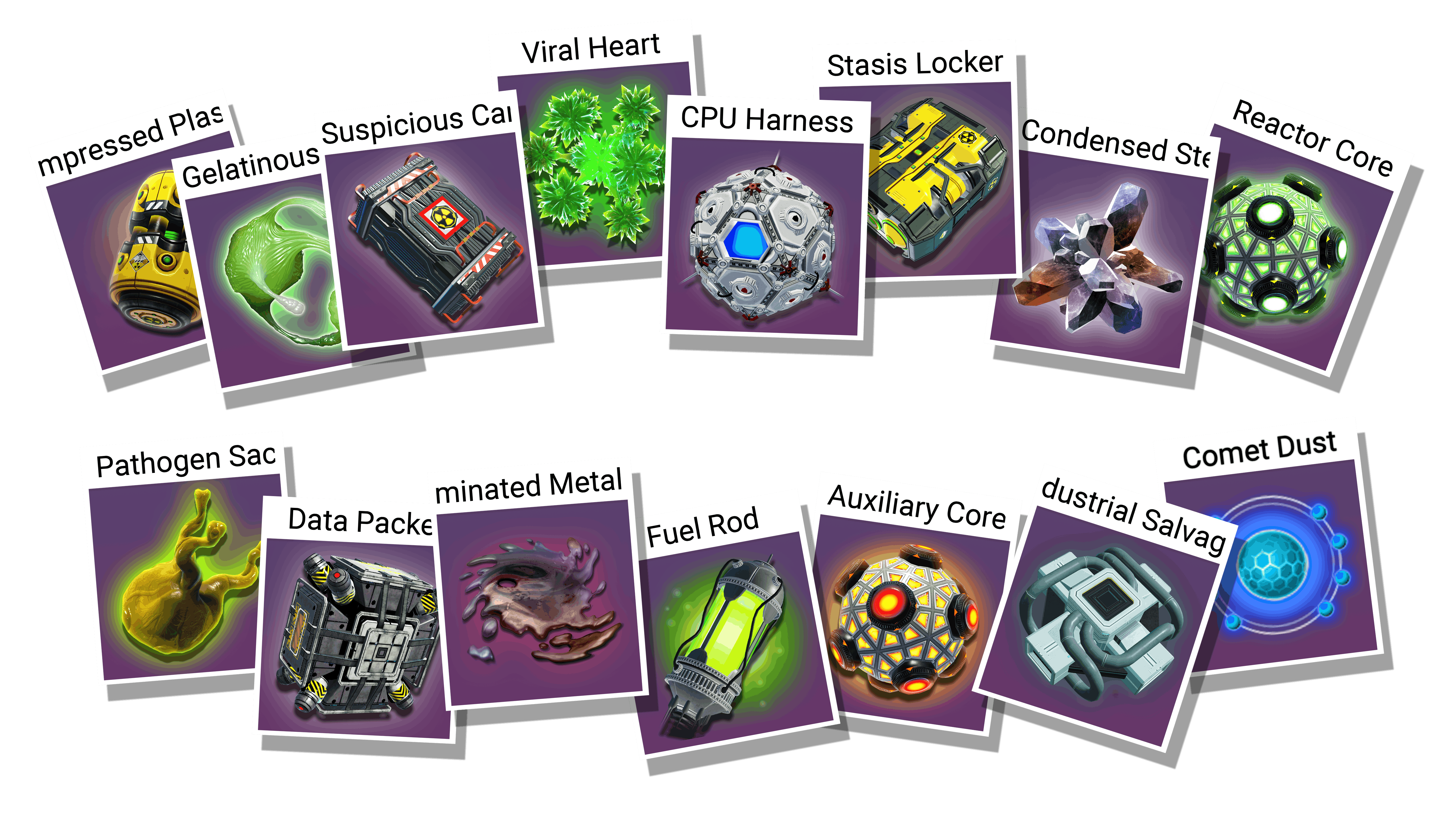
The Daily Front Page 19 of 32
Wednesday, September 9, 2026 The Daily Front No. #260909 — The Printer Project
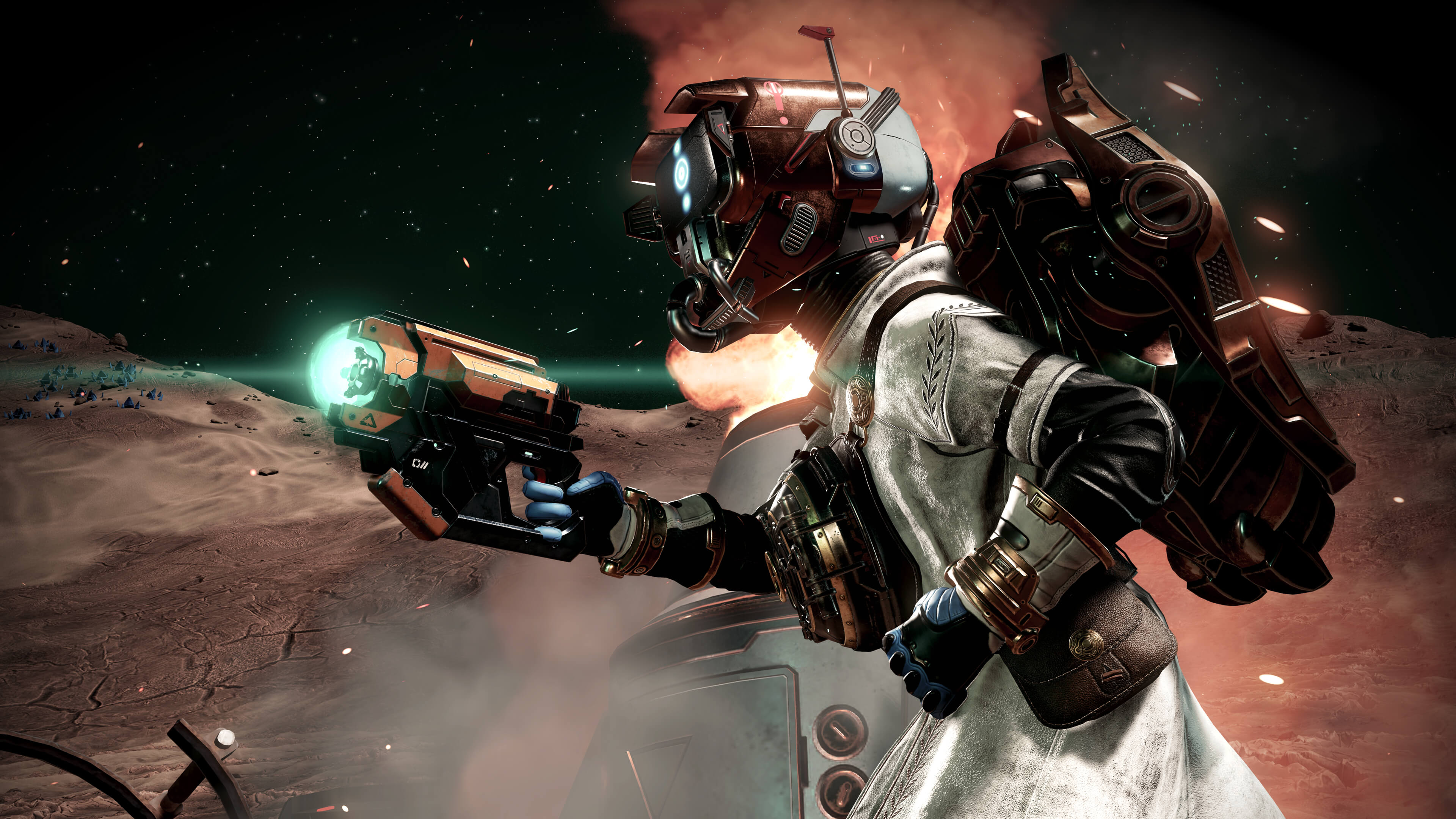
article

How to build a printer

by cat-whisperer·▲ 433 points·104 comments·nishantjosh.dev ↗
But getting stuff onto it was tedious.

I was planning to build an e-ink display when I came across the Xteink X3 online. Somewhere in the fine print, it said the thing was fully programmable.

I was sold.

When it arrived, I liked how flat it was. It felt solid in my hand. I started adding things to the CrossPoint firmware: a different boot animation, dice I could roll by shaking the reader, a LinkedIn QR code for SF networking events.

But getting stuff onto it was tedious. I had to join its hotspot and open a little upload website in my browser.

Yuck.

While looking for a nicer way to send things to it, a thought struck me. If it looks like paper, it should act like paper.

I should be able to print on it.

The Xteink X3 displaying a black-and-white drawing of a printer.

What makes a printer a printer?

I wanted to open something on my MacBook, press Print, and pick the Xteink. That meant finding out what my computer expected to find at the other end.

I ended up in the Internet Printing Protocol, or IPP. It lets a computer ask a printer what it supports, submit a document, and ask what happened to the job. The messages travel over HTTP. An operation such as Get-Printer-Attributes asks about capabilities; Print-Job sends the work.

I advertised monochrome output, 300 dpi, one copy, and one-sided printing. For document formats, I accepted Apple raster and PWG raster. That meant the Mac had to turn the document into pixels before sending it. penguin would shrink the result to fit its screen.

I declared A5 and Letter paper, media type stationery, and an output bin called face-up.

I called it penguin. It had the right color scheme.

I used Bonjour to announce an _ipp._tcp service under that name. The advertisement included the formats I accepted and the address where print jobs should go.

To get driverless discovery on macOS, I also had to add the _universal subtype. That meant calling ESP-IDF’s mDNS API directly, because the Arduino wrapper didn’t expose it.

Getting the computer to send a page was only part of the job. I still had to receive it on this thing.

Where do I put the page?

A Letter page at 300 dpi is 2,550 × 3,300 pixels. At one byte per grayscale pixel, that’s about 8.4 MB uncompressed.

The X3 has 400 KB of RAM, with 16 KB reserved for cache. I needed to run Wi-Fi, run a printer server, and somehow receive an entire fucking page.

With Wi-Fi running and the printer’s page image allocated, I had 6.8 KB of heap left.

I remembered mmap on Linux. Could I do something like that with the SD card and pretend I had more RAM? The C3’s memory-mapping support was for flash, not files on the SD card.

But wait. Could I make the display my storage?

What if I passed the incoming page through a transformation pipeline and wrote the result straight to the display? Decode the pixels, shrink them to fit, dither them into black and white. As soon as a row was ready, put it in its place on the display and reuse the working space. Keep going until I have a page.

The display already had RAM reserved for its screen image. I could build the page right there as it arrived. Until then, I had been assembling a whole second image just to copy it over.

My decoder already worked row by row. I changed the scaler to hand over finished rows too and wired those into the display’s screen image. At first, I let the page appear in bands, like paper feeding out of a printer. Each intermediate refresh took roughly half a second, so I switched to showing the finished page all at once.

I saved the finished page as a BMP on the SD card using the existing screenshot writer.

That gave the network stack room for its socket buffers.

There was a penguin in Preview

I had a sample manga image from Mushoku Tensei on my MacBook for some reason. I opened it in Preview and went to print it.

There was penguin in the printer list.

Holy shit.

I selected it and printed. The manga page looked really good on the Xteink. From memory, it took about a second to appear. It’s still there.

A manga page printed on the Xteink X3, resting on a closed MacBook.

I spent an evening getting to that first print.

The printer server runs on the reader itself. I can have it join a Wi-Fi network or start its own hotspot, literate-penguin.

My penguin can read now.

The code is in my CrossPoint fork, including the printer implementation.

Saved printouts stay on the SD card, and I can browse them on the reader. My printer has an output tray after all. It’s a folder.

The Daily Front Page 20 of 32
Wednesday, September 9, 2026 The Daily Front No. #260909 — Radio, Unboxed
article

GNU Radio in the browser

by kristianpaul·▲ 184 points·24 comments·gnuradioworld.com ↗

A GNU Radio Companion-style flowgraph editor and runtime that runs entirely in a browser tab. The GNU Radio DSP stack and the Qt GUI sinks are compiled to WebAssembly, so you can build a software-defined radio flowgraph, press Run, and watch live spectrum, waterfall and constellation plots — with no Python, no install and no server. It reads and writes the same .grc files as native GNU Radio, ships example flowgraphs and example IQ recordings, and talks to an RTL-SDR, PlutoSDR or HackRF over WebUSB.

article

27.5KB language-agnostic WebGPU syntax highlighter

by bpierre·▲ 118 points·33 comments·gpu-lexer.vercel.app ↗
import { parse } from 'gpu-lexer'

const spans = await parse('source code')
// {
//   type: 'plain' | 'comment' | 'string' | 'number' | 'keyword' | 'type' | 'function' | 'constant' | 'operator'
//   start: number
//   end: number
// }[]

gpu-lexer splits source code into simple parts—words, whitespace, newlines, and symbols. Then a tiny WebGPU model combines local and whole-file context to label each part. It is designed for any language: instead of choosing a grammar, it guesses each part's type from the surrounding source, even when it never saw that language or syntax during training. Adjacent labels become the syntax spans returned to your code.

This is an experiment, not a grammar-equivalent highlighter. On files kept out of training, 11.98% of the current model's token labels differ from Shiki. This measures agreement with Shiki—not objective correctness—and unseen languages or real-world code may differ more often.

1 "Language-agnostic" means one shared tokenizer and classifier, not equal accuracy for every language. 88.02% is the share of held-out token labels that matched Shiki. Mixed-language code is supported too, including embedded <script> and <style> regions in HTML, Vue, and Svelte.

Held-out label agreement with Shiki by language

Each language appears in one band; results with fewer held-out labels are less stable. Training tokens include context-only tokens and replay.

Highlight 10× three.min.js
warmed browser time · lower is better

One browser run after one warm-up on September 9, 2026. The input was 10 concatenated copies of three.min.js (5.56M characters). MacBook Pro, Apple M4 Pro, 20-core GPU, 24GB, macOS 26.6.2, Chrome 152. Each engine ran in a dedicated worker; DOM rendering was excluded. gpu-lexer and Shiki returned token data, Starry Night returned a HAST tree, while Sugar High, Prism.js, and Highlight.js returned highlighted HTML. Sugar High 2.3.1, Prism.js 1.30.0, Highlight.js 11.12.0, Starry Night 3.11.0, and Shiki 4.4.3.

Loaded library size
runtime + selected language coverage · lower is better

Minified and Brotli-compressed browser bundles measured on September 9, 2026. Major web includes javascript, typescript, css, html, json, and markdown. gpu-lexer uses the same bundle for every language. Starry Night totals include its Oniguruma WASM payload.

Top-25 weighted agreement
popularity-weighted agreement with Shiki · higher is better

Shiki is the 100% normalization reference. Each library's token names are mapped to the same nine classes: plain, comment, string, number, keyword, type, function, constant, and operator. Scores compare non-whitespace source parts across 1,103 held-out files in the GitHub Innovation Graph top 25 for 2026-Q1, weighted by each language's pusher count. Unsupported languages score zero; corpus size does not affect the weights.

The Daily Front Page 21 of 32
Wednesday, September 9, 2026 The Daily Front No. #260909 — Radio, Unboxed
repository

Qwen 3.8 follows GPT-5.5 Pro reasoning prefills

by wsxiaoys·▲ 194 points·77 comments·gist.github.com ↗

A follow-up to Reasoning prefills on a few open models and Stolen Thoughts

This v1.1 reruns the reasoning-prefill experiment with GPT-5.5 Pro as the teacher.

For each problem, I generated two responses from each target model:

  1. an ordinary, unprefilled response; and
  2. a response starting with the first 1% of GPT-5.5 Pro's reasoning, inserted into the target model's reasoning channel.

The visible answer remained freely generated. I then measured how much of the teacher's visible answer appeared in the first 100 tokens of the target model's answer. As in the previous post, each score is the mean of unigram, bigram, and trigram source recall. Deltas are absolute percentage-point changes.

All problems

The evaluation contains 45 problems: 15 STEM, 15 non-STEM, and 15 synthetic puzzles.

Model n Unprefilled GPT-5.5 Pro reasoning prefill Delta
DeepSeek V4 Flash 45 27.30% 26.13% −1.17 pp
Inkling 45 19.99% 20.45% +0.46 pp
Kimi K3 45 31.11% 35.65% +4.54 pp
Qwen3.8 A95B 45 16.79% 34.97% +18.18 pp

Qwen by category

Category n Unprefilled GPT-5.5 Pro reasoning prefill Delta
STEM 15 19.26% 46.24% +26.99 pp
Non-STEM 15 20.62% 33.42% +12.80 pp
Puzzle 15 10.49% 25.23% +14.75 pp
All 45 16.79% 34.97% +18.18 pp

Discussion

Qwen barely moved toward Opus 4.8 in the earlier experiment, but moved by +18.18 points toward GPT-5.5 Pro here, including a large effect on the private synthetic puzzles. The data suggest that Qwen may have learned from GPT-5.5 Pro, or from a closely related GPT model, rather than from Opus.

Kimi K3 has the highest overlap with GPT-5.5 Pro both without and with the prefill (31.11% and 35.65%), although the prefill adds only +4.54 points.

The Daily Front Page 22 of 32
Wednesday, September 9, 2026 The Daily Front No. #260909 — Radio, Unboxed
discussion

DeepSeek launching v4.1 flash cheaper and more capable than v4 pro

by nickweb·▲ 398 points·206 comments·news.ycombinator.com ↗

DSeek plans to officially release the V4.1 Flash model around September 10, 2026 (Beijing Time). After extensive internal and external testing, V4.1 Flash has comprehensively surpassed V4 Pro across all key metrics, including performance, cost, speed, and task completion time. In keeping with our commitment to user responsibility, following the official launch of V4.1 Flash and prior to the release of V4.1 Pro, all requests to the Pro model will be routed to V4.1 Flash and billed at Flash's price. If you encounter any issues during your comparative testing between V4 Pro and V4.1 Flash, please do not hesitate to reach out to us with your feedback. Thank you for your support!

We will adjust the pricing for the Flash series effective from 12:00 Beijing Time on September 10, 2026. During off-peak hours, the unit price will be $0.003 for input cache hits, $0.15 for input cache misses, and $0.6 for output. Peak-hour prices will be double the off-peak rates. Please plan your usage accordingly.

The Daily Front Page 23 of 32
Wednesday, September 9, 2026 The Daily Front No. #260909 — New Worlds, Old Gags
article

No Man's Sky Cosmos

by Limb·▲ 326 points·348 comments·nomanssky.com ↗
Become director of a space station, join a galactic alliance, construct a space base.

Cosmos: Introducing Update 7.0

Become director of a space station, join a galactic alliance, construct a space base and discover deep-space marvels in No Man’s Sky Cosmos. Navigate space with a new star system map, strip colossal hulks for parts before hull integrity fails, recover and haul physical salvage to remote space outposts, celebrate 10 years of No Man’s Sky in the Our Journey Continues expedition, and much, much more.

Direct a Space Station

Prove yourself to the local authorities to become director of a Space Station. Style your station’s central lobby, expand it with ancillary rooms, and decorate its exterior to welcome - or deter - visiting Travellers.

Alliances

Join a galactic alliance to make friends, co-ordinate exploration, and compete for the most expansive territory in the galaxy. As a station director, you can found your own alliance, and design a name and banner to propagate across the universe.

Deep-Space Outposts

Alien lifeforms have established deep-space outposts in inhabited systems. Visit these remote buildings to process rare minerals, trade with the quartermaster, and sign up for deep-space contracts.

Orbital Construction

Establish a free-floating base anywhere in space. Deploy a deep-space base computer and claim a volume as your own to construct your dream orbital habitat or celestial city.

Derelict Hulks

Colossal shipwrecks can be found drifting in the depths of space. These huge derelicts are a dangerous maze of rusted chambers and narrow chokepoints, only navigable via careful spacewalk. Pluck valuable technologies and cargo from their skeletons, but be wary of disrupting structural integrity...

Shape Your Station

As a Station Director, personalise and adorn the exterior of your space station. Design a cosy, welcoming flightpath, or impress visitors with opulent decorations.

10 Year Anniversary Expedition

A new community expedition, Our Journey Continues, celebrates ten years since the release of No Man’s Sky. Each milestone represents an update or moment in time in the history of the NMS journey - from launch through to Cosmos.

Alliance Leaderboards

Nurture and contribute to your in-game community, and rise to the top of the alliance rankings. The most populous, active, and expansive alliances will be featured on the ranking leaderboards, accessible from the Space Station core.

Framed Commemorative Art

Join the Our Journey Continues expedition and earn a beautiful set of framed artwork, featuring the book cover images from some of No Man’s Sky’s biggest updates.

Star System Map

Navigate deep space with an interactive star system map, plotting the location of celestial bodies, deep-space points of interest, and unidentified signals in your current system. Mark any planet or POI on the map to enable starship navigational assistance.

Renovate Station Interiors

Decorate the central hub of the space station, shaping its atmosphere and flow. Re-arrange pre-existing furnishings and add new parts to create a truly unique environment for visiting Travellers.

Diplodocus Companion

Complete your pilgrimage through No Man’s Sky history in the Our Journey Expedition, and adopt the majestic diplodocus companion. This prehistoric beast has been resurrected from pre-release footage, and completely retextured and reanimated.

Hulk Meltdown!

Push your luck as you strip derelict hulks for salvageable technologies and forgotten loot. These colossal shipwrecks are unstable, and liable to explode when disturbed. Prudent explorers will prioritise the most valuable loot first to make a timely escape

Deep-Space Looting

Well-prepared Travellers can find rare resources at the new points of interest. Using a Gravitino Coil and a Corvette-class starship equipped with a Tractor Beam ensures that you will be ready to salvage anything you come across. Load your Corvette up with loot and haul it back to a deep-space outpost for processing. Sell this salvage for good profit at stations and outposts or save them for customising the exterior of your own space station.

Starbound v0.27 Multi-tool

Sign up for the Our Journey Continues expedition and claim the vintage Starbound v0.27 Multi-Tool, lovingly designed from original No Man’s Sky concept art.

Space Exploration Re-Invented

Star systems are more interesting and more realistic, with outposts, abandoned freighters, asteroid belts, anomalies, and other points of interest spawning at re-visitable fixed locations.

Asteroid Belts

Visit beautiful, dense belts of rare asteroids, mine them for extraterrestrial minerals and strange crystals. You may find you are not the only visitor - these high-value locations tend to attract space prospectors, traders, and outlaws.

Enhanced Terrain Details

The rendering system for planetary terrain detail has been overhauled, with improved tessellation techniques, higher detail, and enhanced textures.

Vintage Interceptor

Participate in the Our Journey Continues expedition to claim a vintage Sentinel Interceptor, reconstructed from pre-release trailer footage for No Man’s Sky.

Infested Outposts

A number of deep-space outposts have been infested with an invasive, spreading, biological goop. Courageous explorers can investigate these nightmarish structures to extract useful, valuable, yet horrific pathogen sacs, gelatinous fibres and more…

Astronaut Cockpit Figurine

This synthetic polymer companion for your starship's cockpit has been fashioned from a long-forgotten curio. Join the Our Journey Continues expedition to earn this nostalgic bobblehead figurine.

Reach The Sun

Stars in each system are now reachable via long-haul flight. These burning spheres of plasma are bright, spectacular, but ultimately lethal. Reach the sun at your own risk.

Hundreds of Decorative Station Parts

Unlock monumental decoration modules at the Space Anomaly to shape and personalise the exterior of space stations under your directorship. Rare pieces may also be bestowed to Travellers who discover anomalies deep in space.

Developer Commentary

Each milestone in the Our Journey Continues expedition is accompanied by a collection of developer notes from Hello Games, read aloud by Sean Murray, sharing facts and anecdotes about that moment of time in No Man’s Sky history. Once unlocked, these notes are permanently filed in the Collected Knowledge section of the Catalogue.

Orbital Platforms

Establish a home in the stars on natural rock platforms in deep space. Nestle your base constructions in these stunning terrain formations for beautiful, interesting backdrops.

Outpost Missions

Space outposts face hardship and adversity, and offer generous recompense to Travellers willing to assist their survival. Sign up for salvage and material recovery contracts at the salvage and delivery terminal to earn standing and rewards.

Extra-Vehicular Activity

All pilots, not just those in command of a corvette-class starship, may now leave the safety of their ship and explore deep-space. Use the Quick Menu to leave your ship at any point while in space.

Spacewalking has been greatly enhanced, giving advanced jetpack operatives true six degrees of freedom while in space.

Tractor Beam

Upgrade your Corvette-class ship with a versatile new upgrade: the Tractor Beam. This new hull attachment sucks in and refines the physical salvage and minerals extracted from deep-space points of interest. Launch salvage at the beam with the Gravitino Coil for storage in the Corvette hold. Excessively large objects will be processed for ease of storage.

Ice Fields

Space is garnished with glittering ice fields, yielding valuable resources. Harvest stellar ice, and encounter the wandering miners, traders and pirates drawn to these locations.

Biohazard Cleanup Operations

Brave some biological horror among the ruins of Infested Outposts. Skill with a Gravitino Coil is needed to clear a way through viral mass that envelops these outposts. Rare and valuable samples are there for the taking, for Travellers with a steady hand and strong stomach.

Jettison Corvette Cargo

Corvette tractor beams come equipped with automated venting systems, capable of quickly gathering and ejecting all collected cargo in a matter of seconds.

Note: automated venting systems are not recommended for use on sentient objects.

Expand Your Station

Station directors can add additional rooms to their space station with a dedicated construction area. Create entirely custom layouts using room-sized pieces, and furnish them with the full range of decorative parts.

Enhanced Particle Lighting

Particles and other transparent objects are now part of the lighting system, picking up colour and light from dynamic lighting objects (such as the Multi-Tool’s torch), greatly increasing visual fidelity and atmospherics.

Hulk Shipbreaking

Every part stripped from the creaking remains of a space hulk is a valuable piece of industrial salvage. Salvage operatives should take care to preserve the integrity of their finds, and to avoid triggering a chain reaction

Twitch Drops

Join the audience on Twitch, and claim an exciting assortment of in-game rewards just by watching streamers play No Man’s Sky: Cosmos! Earn base parts, starships, Multi-Tools, alien creatures, fireworks, and more. Visit the Twitch Drops page to learn more and sign up.

You can earn rewards even if you don’t own No Man’s Sky yet. They’ll be waiting in your inventory to claim at any time. Just connect on the website and watch any of the No Man’s Sky streamers with Drops Enabled from Thursday 10th September to Monday 14th September.

Improved Clouds From Space

The visual quality of planetary clouds as seen from space has been greatly enhanced, with upgraded textures, shape detail, and lighting.

Golden Rasamama S36

Journey through past iterations of No Man’s Sky in the Our Journey Continues expedition, and earn an exclusive golden edition of the classic Rasamama S36 starship.

7.0 Patch notes

Deep-Space Mapping

  • A map for the local star system is now accessible from the Quick Menu, displaying local celestial bodies, the space station, and other deep-space points of interest.
  • Added an array of new deep-space points of interest, including rocky and icy asteroid belts, inhabited and infested deep-space outposts, procedurally-generated variations of deep-space hulks, debris fields, and asteroid platforms.
  • Implemented a point of interest at the star(s) of a system, which hubristic Travellers may fly to if they choose...
  • Many deep-space points of interest can be stripped and mined for valuable resources, including comet dust, gelatinous fibres, and contaminated metal. Process raw materials at a deep-space outpost to convert them into lucrative items to sell on the Galactic Trade Network, or utilise in space station construction.
  • Points of interest will begin to appear on the star system map once a save has reached the Space Anomaly for the first time.
  • Added a light tutorial mission, Signals, to introduce the star system map and navigation around deep-space points of interest.
  • Outposts are managed by an alien quartermaster, who trades in maps and salvaged materials.
  • Outposts also house a salvage & delivery terminal, offering deep-space contracts to adventurous space explorers.
  • Added a number of new player titles earned for accomplishments at deep-space points of interest.
  • Several deep-space anomalies now have a chance of granting rare station decoration blueprints to visitors.
  • Converted the Dream Aerial to a reusable product, which can now be crafted and consumed multiple times to locate individual living frigates.
  • The Living Ship encountered during the Starbirth mission chain now patrols around infested outposts, and can be actively sought out during the mission.
  • Added several new music tracks for visiting locations in deep space. These include ambient tracks when near asteroid belts, stars, hulks, or space outposts, and more dramatic music when the structural integrity of a hulk begins to fail.

Shipbreaking

  • Space hulks often house lucrative items, but they are volatile, and are likely to melt down and explode if their structural integrity is disrupted.
  • Added a new Corvette utility part, the Tractor Beam, to gather physical cargo into the Corvette hold.
  • The Tractor Beam can be purchased alongside other Corvette parts at the Corvette Workshop in space stations.
  • Improved control handling, animations, and crosshairs for the Gravitino Coil.
  • The Gravitino Coil may now be equipped in Space Stations.

Space Station Directorship

  • Prove yourself to the local authorities to become director of a Space Station, gaining rights to shape its external decorations, interior layout and ancillary compartments.
  • Earn colossal exterior decoration modules and place them around the outside of your station.
  • Directors can remove and adjust existing station decoration.
  • In addition, the full range of existing base parts are available to reshape and redecorate the interior of the station.
  • Directors can expand their space station by adding additional rooms to the main hangar, which they are then free to decorate as they please.

Galactic Alliances

  • Station directors may found their own alliance and seek like minded travellers to join their collective.
  • Join an alliance by visiting any of their owned space stations.
  • Quickly access your alliance's systems via the teleporter.
  • Players may join up to three alliances.
  • Alliances are graded by the activity of their members. The largest and most active alliances are visible on a leaderboard at the space station core.

Orbital Constructions

  • Construct orbital bases anywhere in space - utilising natural asteroid platforms as a starting point, or staking your claim on any empty volume of space.
  • Added a number of new corridor base parts, buildable in orbital constructions.
  • A huge number of new station decoration parts have been added, unlockable from the Construction Research Terminal aboard the Space Anomaly.

Spacewalking

  • Added an eject button for non-Corvette starships, accessible from the Quick Menu.
  • Deepened and expanded spacewalking, adding true six degrees of freedom movement, including roll.
  • Improved the transition when landing on and taking off from objects with gravity in space.
  • Explosions in space will now knock the player back.
  • Spacewalking drains the cold protection technologies in the exosuit, unless in close proximity to other hazards, such as hot balls of glowing gas.

Our Journey Continues Expedition

  • Expedition Twenty-Three, Our Journey Continues, will begin shortly and run for approximately six weeks.
  • This special event celebrates 10 years of No Man's Sky, and journeys through the history of its evolution since launch.
  • A developer's commentary read by Sean Murray is available for each milestone of the expedition, permanently accessible in the Collected Knowledge section of the Catalogue once unlocked.
  • Nostalgia-themed rewards include framed commemorative art, decals and titles, a golden edition of the original Rasamama 36 starship, an astronaut bobblehead, the Starbound v0.27 multi-tool, and a vintage Interceptor ship and diplodocus pet as seen in early trailers.

Twitch Drops

  • A new package of Twitch Drops will begin shortly. Sign up and connect your platform accounts on the Twitch Drops page, then tune in to Twitch to earn exotic base parts, high-tech starships, fireworks, appearance modifications, and more.

Rendering

  • Completely rewrote the block compression (BC) encoder for textures, reducing artifacting and colour banding for textures generated at runtime for procedural models. Significantly improves the quality of textures throughout the game.
  • Authored a number of dazzling new particle effects at deep-space points of interest, including electrical fields, mist, stardust, smoke, debris trails, and biological slime.
  • Significantly improved terrain tessellation quality, increasing the textures and details of the ground on planets.
  • Added support for spotlights on transparent props, particles, and volumetric fog, notably improving the appearance of the player torch on smoke, fog, and other atmospheric effects.
  • Significantly improved the appearance of clouds when viewed from space - upgrading their textures, lighting, ambient tint, and shape detail.
  • Added support for volumetric fog volumes and particles, and implemented these around the deep-space hulks.
  • Added support for Intel Xe Super Sampling (XeSS) 3, which uses machine learning to deliver higher performance with exceptional image quality.
  • Added support for NVIDIA DLSS4.5, enabling Frame Generation 5x and 6x. Deep Learning Super Sampling is a revolutionary suite of neural rendering technologies that uses AI to boost FPS, reduce latency, and improve image quality.
  • Added support for foveated rendering on PCVR.
  • Utilising eye-tracking technology, foveated rendering concentrates rendering resources at the centre of your vision, sharpening and beautifying the details you focus on.
  • Improved the appearance of water and water foam.
  • Fixed an issue that could cause water foam to load in abruptly when flying towards it, especially when transitioning from space to atmosphere.
  • Fixed an issue that could cause the edges of islands to appear blurry.
  • Improved the accuracy of lighting and post-processing effects above and below the surface of water, fixing a visible shadow above the water line in the distance, especially when transitioning from space to atmosphere.
  • Improved the appearance of fog fading when transitioning from space to atmosphere.
  • Improved the appearance of water fading when transitioning from space to atmosphere, notably reducing popping.
  • Improved the density and consistency of planetary fog.
  • Improved the density of the swirling atmosphere of gas giants, especially when transitioning from space to atmosphere.
  • Improved the shape of planets when viewed from space.
  • Completely reworked the generation of asteroids, improving their draw distances, visual distribution, and performance.
  • Fixed an issue that caused the surface of water to appear too opaque.
  • Fixed an issue that caused some reflections to appear as dark highlights when underwater.
  • Fixed a visual issue with water reflections when resolution scaling is not at 100%.
  • Fixed reflections and shadows appearing to "swim" when TAA is disabled.
  • Improved colour gamut handling for more vibrant and saturated colours.
  • Fixed an issue causing noticeable clipping on very saturated out-of-gamut colours.
  • Fixed an issue involving the wrong colour space being used for HDR rendering; HDR colours will now be a closer match for their SDR counterpart.
  • Fixed an issue causing HDR output to be clipped to a fixed limit.
  • Improved the visual quality of FXAA anti-aliasing.
  • Added support for running in HDR in combination with Frame Generation.
  • Improved the lighting on models rendered on frontend screens, such as the inventory.
  • Various shader fixes.
  • Fixed an issue that caused fringing around planetary rings.
  • Fixed an issue that caused distant planets viewed from space to shimmer with FSR2 enabled.
  • Fixed an issue that could cause the orange mesh to flicker when using the "restore" function on the Terrain Manipulator.
  • Fixed several issues in the offline texture compressor and made downscaling during mipmap generation more accurate, improving overall texture quality.
  • Fixed a minor visual issue with distant terrain.
  • Implemented support for roughness scaling, fixing some objects appearing too glossy when in the distance.
  • Fixed an issue with normal maps that could cause lighting inconsistencies on specific objects.
  • Improved the performance and precision of light culling and light sorting; reducing instances of light popping and flickering.
  • Improved the appearance of materials using parallax occlusion mapping.
  • Improved the appearance of lens flares.
  • Fixed an issue that could cause the sun to reflect off clouds at an inaccurate angle.
  • Significantly improved the appearance of ship trails.
  • Fixed an issue that could cause speed lines to intersect the camera.
  • Fixed an issue that could cause visual jitter when running in 8K resolution on PlayStation Platforms.
  • Fixed a number of visual seams in terrain.
  • Added support for anisotropic materials, improving the appearance of directional light on brushed metal surfaces (e.g. the Starborn Runner).

Performance and Optimisation

  • Added support for bindless textures, samplers and buffers on Xbox, significantly reducing the CPU usage with engine rendering.
  • Implemented a significant optimisation in inventories.
  • Implemented an optimisation in multiplayer, reducing latency between players.
  • Implemented a number of CPU optimisations, especially at Settlements.
  • Implemented a significant optimisation in file handling, improving console load times by 6-9%.
  • Implemented a significant optimisation to HUD markers, improving performance when many markers are on screen simultaneously.
  • Implemented a significant optimisation in loading and querying bases and base power.
  • Improved the distance fading of planetary objects to reduce instances of visible popping, especially on Nintendo Switch.
  • Implemented a memory optimisation to procedurally-varied models.
  • Fixed a PC-only issue with input latency when V-Sync is enabled.
  • Implemented an optimisation in recurring missions.
  • Implemented a significant optimisation in animations.
  • Implemented an optimisation related to multiple freighters in multiplayer.
  • Optimised the logic for querying whether a mission is active.
  • Added support for deferred node unloading, smoothing framerate when transitioning between environments.
  • Optimised procedural generation, significantly improving the load times for complex objects.
  • Fixed motion blur being enabled while the game is paused.
  • Implemented a significant optimisation to mesh data, reducing the file size of meshes by ~13%.
  • Implemented an optimisation in terrain tessellation.
  • Implemented asynchronous updating of bases, improving performance and reducing framerate hitches in complex builds.
  • Implemented an optimisation in texture loading.
  • Fixed a number of minor memory leaks.
  • Fixed a number of out-of-memory crashes.
  • Implemented a number of memory optimisations.

Corvettes

  • Fixed an issue with recolouring Corvette-class ships in VR.
  • Fixed a number of issues related to the display of stats for Corvette-class ships.
  • Fixed an issue that could cause Corvette-class ships to judder in flight.
  • Fixed an issue that could cause Corvette technologies to shuffle their positions when warping between galaxies.
  • Fixed a number of issues related to the state of the Corvette ramp when loading save games.
  • Fixed an issue that prevented Corvettes from landing in the Space Station and the Anomaly.
  • Added support for exiting the pilot seat in a Corvette when cruising very close to large space objects.
  • Improved the accuracy of hull collision for Corvettes.

Other QOL and Bug Fixes

  • Planetary terrain deposits which have been completely depleted no longer appear in the Analysis Visor, and are no longer tagged by the scanner.
  • Fixed an issue that caused the starfield to fail to render when jumping through the centre of a galaxy.
  • Increased the readability of the Exocraft UI in VR.
  • Fixed an issue preventing animations from other players' ships from playing in multiplayer games.
  • Fixed an issue that caused mission paths to appear faded out on the Galaxy Map in non-Euclid galaxies.
  • Fixed an issue where pressing "back" during a dialogue interaction could select an option not visible on the UI.
  • Fixed a timing issue that allowed the ship communicator to attempt to open as the player was exiting their ship.
  • Removed an erroneous number on damaged technologies in the inventory.
  • Fixed an audio issue when landing on frigates.
  • Fixed an issue which could cause frigates' damage to change without being repaired.
  • Improved the Brood Mother's ability to navigate around buildings.
  • Improved the ability of biological monstrosities to navigate within settlements.
  • Fixed an issue that could cause large bipedal creatures to get stuck when traversing slopes.
  • Fixed a number of minor creature behaviours, including adult creatures responding when their offspring are harmed.
  • Fixed text clipping in the technology popup in some languages.
  • Fixed an issue causing fewer than expected numbers of creatures populating planets in abandoned systems.
  • Fixed an issue which could cause frigates to reward fewer resources than intended.
  • Improved the algorithm for calculating the difficulty of available Frigate Expeditions.
  • Fixed an issue preventing a number of base parts from being recoloured.
  • Fixed an issue that could cause planetary terrain deposits to yield the wrong resource.
  • Fixed a number of issues related to recycling industrial scrap in multiplayer.
  • Improved the guidance in the In Stellar Multitudes mission for players who have warped a long way from their first restored purple system.
  • Fixed an issue that prevented Under a Rebel Star from progressing when handing in the Forged Passport.
  • Implemented additional messaging to the start of fishing missions, warning players that they will need to install the fishing rig to partake.
  • Fixed "FRONT DECALS" not being localised in the Exocraft customiser.
  • Fixed the default username on GOG not being localised.
  • Fixed an issue that caused robotic eggs to display the description of organic eggs.
  • Fixed a number of invalid pre-installed techs in Twitch rewards.
  • Improved the messaging for a number of unavailable quick menu items in the Space Anomaly.
  • Removed an item hiding in plain sight on a familiar planet.
  • Fixed an issue that caused the Pilgrim and Nautilon exocraft to show the camo texture by default.
  • Fixed a minor visual issue with the material of the Pilgrim exocraft.
  • Fixed an issue that could cause objects in the Exocraft inventory to be counted twice in some UI elements, such as when installing or repairing a technology.
  • Fixed a rare issue which prevented HUD markers from displaying their text label.
  • Fixed an issue which prevented completing the discoveries on a planet where the player had reported an offensively-named creature.
  • Fixed an issue that prevented Sentinel interceptor ships from ever despawning if the player they were pursuing landed on a planet.
  • Fixed an issue that caused some variable Settlement costs to always roll the maximum value.
  • Fixed an issue that caused the Large Ruined Archway to appear twice in the base parts Catalogue, in place of the Ruined Monolith.
  • Fixed several minor issues with base building parts.
  • Fixed several minor issues with player titles.
  • Fixed a number of minor issues with rewards when scrapping staff and Sentinel Multi-Tools.
  • Fixed a number of minor issues with medal guidance missions.
  • Fixed a number of minor issues with pinned substance missions.
  • Fixed an issue that prevented post-battle surrender notifications from taking priority in the bottom-right notifications panel.
  • Fixed an issue that could cause the player to jitter during terrain manipulation.
  • Fixed an issue that caused "Lorem Ipsum" text to appear briefly when fixing your ship at the start of the game.
  • Implemented additional support for modding trigger actions. Trigger actions will search for the BOOT state if BEGIN doesn't exist.
  • Fixed an issue that caused HUD and off-screen markers to display in incorrect positions when far from the space station.
  • Fixed an issue that caused inverted yaw controls in photomode if flipping the camera upside-down in space.
  • Fixed a rare issue that could cause Space Anomaly NPCs to be missing on old saves.
  • Fixed an issue that caused space station lights to be pure white instead of coloured.
  • Fixed an issue that caused ambient lighting from space to leak into space stations.
  • Fixed an issue that could cause a black screen in VR if GTAO was disabled.
  • Fixed an issue with the "Switch Base" controller binding on PSVR Move controllers.
  • Fixed an issue that caused the up and down arrow keys to be reversed during keyboard input on Nintendo Switch.
  • Various text fixes.
The Daily Front Page 24 of 32
Wednesday, September 9, 2026 The Daily Front No. #260909 — The Acme Docket
article

Coyote v. Acme (1990)

by ChrisArchitect·▲ 178 points·92 comments·newyorker.com ↗
Mr. Wile E. Coyote seeks compensation for personal injuries.

IN THE UNITED STATES DISTRICT COURT, SOUTHWESTERN DISTRICT, TEMPE, ARIZONA

CASE NO. B19294, JUDGE JOAN KUJAVA, PRESIDING

WILE E. COYOTE, Plaintiff

-v.-

ACME COMPANY, Defendant

Opening Statement of Mr. Harold Schoff, attorney for Mr. Coyote: My client, Mr. Wile E. Coyote, a resident of Arizona and contiguous states, does hereby bring suit for damages against the Acme Company, manufacturer and retail distributor of assorted merchandise, incorporated in Delaware and doing business in every state, district, and territory. Mr. Coyote seeks compensation for personal injuries, loss of business income, and mental suffering caused as a direct result of the actions and/or gross negligence of said company, under Title 15 of the United States Code, Chapter 47, section 2072, subsection (a), relating to product liability.

Mr. Coyote states that on eighty-five separate occasions he has purchased of the Acme Company (hereinafter, “Defendant”), through that company’s mail-order department, certain products which did cause him bodily injury due to defects in manufacture or improper cautionary labelling. Sales slips made out to Mr. Coyote as proof of purchase are at present in the possession of the Court, marked Exhibit A. Such injuries sustained by Mr. Coyote have temporarily restricted his ability to make a living in his profession of predator. Mr. Coyote is self-employed and thus not eligible for Workmen’s Compensation.

Mr. Coyote states that on December 13th he received of Defendant via parcel post one Acme Rocket Sled. The intention of Mr. Coyote was to use the Rocket Sled to aid him in pursuit of his prey. Upon receipt of the Rocket Sled Mr. Coyote removed it from its wooden shipping crate and, sighting his prey in the distance, activated the ignition. As Mr. Coyote gripped the handlebars, the Rocket Sled accelerated with such sudden and precipitate force as to stretch Mr. Coyote’s forelimbs to a length of fifty feet. Subsequently, the rest of Mr. Coyote’s body shot forward with a violent jolt, causing severe strain to his back and neck and placing him unexpectedly astride the Rocket Sled. Disappearing over the horizon at such speed as to leave a diminishing jet trail along its path, the Rocket Sled soon brought Mr. Coyote abreast of his prey. At that moment the animal he was pursuing veered sharply to the right. Mr. Coyote vigorously attempted to follow this maneuver but was unable to, due to poorly designed steering on the Rocket Sled and a faulty or nonexistent braking system. Shortly thereafter, the unchecked progress of the Rocket Sled brought it and Mr. Coyote into collision with the side of a mesa.

Paragraph One of the Report of Attending Physician (Exhibit B), prepared by Dr. Ernest Grosscup, M.D., D.O., details the multiple fractures, contusions, and tissue damage suffered by Mr. Coyote as a result of this collision. Repair of the injuries required a full bandage around the head (excluding the ears), a neck brace, and full or partial casts on all four legs.

Hampered by these injuries, Mr. Coyote was nevertheless obliged to support himself. With this in mind, he purchased of Defendant as an aid to mobility one pair of Acme Rocket Skates. When he attempted to use this product, however, he became involved in an accident remarkably similar to that which occurred with the Rocket Sled. Again, Defendant sold over the counter, without caveat, a product which attached powerful jet engines (in this case, two) to inadequate vehicles, with little or no provision for passenger safety. Encumbered by his heavy casts, Mr. Coyote lost control of the Rocket Skates soon after strapping them on, and collided with a roadside billboard so violently as to leave a hole in the shape of his full silhouette.

Mr. Coyote states that on occasions too numerous to list in this document he has suffered mishaps with explosives purchased of Defendant: the Acme “Little Giant” Firecracker, the Acme Self-Guided Aerial Bomb, etc. (For a full listing, see the Acme Mail Order Explosives Catalogue and attached deposition, entered in evidence as Exhibit C.) Indeed, it is safe to say that not once has an explosive purchased of Defendant by Mr. Coyote performed in an expected manner. To cite just one example: At the expense of much time and personal effort, Mr. Coyote constructed around the outer rim of a butte a wooden trough beginning at the top of the butte and spiralling downward around it to some few feet above a black X painted on the desert floor. The trough was designed in such a way that a spherical explosive of the type sold by Defendant would roll easily and swiftly down to the point of detonation indicated by the X. Mr. Coyote placed a generous pile of birdseed directly on the X, and then, carrying the spherical Acme Bomb (Catalogue # 78-832), climbed to the top of the butte. Mr. Coyote’s prey, seeing the birdseed, approached, and Mr. Coyote proceeded to light the fuse. In an instant, the fuse burned down to the stem, causing the bomb to detonate.

In addition to reducing all Mr. Coyote’s careful preparations to naught, the premature detonation of Defendant’s product resulted in the following disfigurements to Mr. Coyote:

1. Severe singeing of the hair on the head, neck, and muzzle.

2. Sooty discoloration.

3. Fracture of the left ear at the stem, causing the ear to dangle in the aftershock with a creaking noise.

4. Full or partial combustion of whiskers, producing kinking, frazzling, and ashy disintegration.

5. Radical widening of the eyes, due to brow and lid charring.

We come now to the Acme Spring-Powered Shoes. The remains of a pair of these purchased by Mr. Coyote on June 23rd are Plaintiff’s Exhibit D. Selected fragments have been shipped to the metallurgical laboratories of the University of California at Santa Barbara for analysis, but to date no explanation has been found for this product’s sudden and extreme malfunction. As advertised by Defendant, this product is simplicity itself: two wood-and-metal sandals, each attached to milled-steel springs of high tensile strength and compressed in a tightly coiled position by a cocking device with a lanyard release. Mr. Coyote believed that this product would enable him to pounce upon his prey in the initial moments of the chase, when swift reflexes are at a premium.

To increase the shoes’ thrusting power still further, Mr. Coyote affixed them by their bottoms to the side of a large boulder. Adjacent to the boulder was a path which Mr. Coyote’s prey was known to frequent. Mr. Coyote put his hind feet in the wood-and-metal sandals and crouched in readiness, his right forepaw holding firmly to the lanyard release. Within a short time Mr. Coyote’s prey did indeed appear on the path coming toward him. Unsuspecting, the prey stopped near Mr. Coyote, well within range of the springs at full extension. Mr. Coyote gauged the distance with care and proceeded to pull the lanyard release.

At this point, Defendant’s product should have thrust Mr. Coyote forward and away from the boulder. Instead, for reasons yet unknown, the Acme Spring-Powered Shoes thrust the boulder away from Mr. Coyote. As the intended prey looked on unharmed, Mr. Coyote hung suspended in air. Then the twin springs recoiled, bringing Mr. Coyote to a violent feet-first collision with the boulder, the full weight of his head and forequarters falling upon his lower extremities.

The force of this impact then caused the springs to rebound, whereupon Mr. Coyote was thrust skyward. A second recoil and collision followed. The boulder, meanwhile, which was roughly ovoid in shape, had begun to bounce down a hillside, the coiling and recoiling of the springs adding to its velocity. At each bounce, Mr. Coyote came into contact with the boulder, or the boulder came into contact with Mr. Coyote, or both came into contact with the ground. As the grade was a long one, this process continued for some time.

The sequence of collisions resulted in systemic physical damage to Mr. Coyote, viz., flattening of the cranium, sideways displacement of the tongue, reduction of length of legs and upper body, and compression of vertebrae from base of tail to head. Repetition of blows along a vertical axis produced a series of regular horizontal folds in Mr. Coyote’s body tissues—a rare and painful condition which caused Mr. Coyote to expand upward and contract downward alternately as he walked, and to emit an off-key, accordionlike wheezing with every step. The distracting and embarrassing nature of this symptom has been a major impediment to Mr. Coyote’s pursuit of a normal social life.

As the Court is no doubt aware, Defendant has a virtual monopoly of manufacture and sale of goods required by Mr. Coyote’s work. It is our contention that Defendant has used its market advantage to the detriment of the consumer of such specialized products as itching powder, giant kites, Burmese tiger traps, anvils, and two-hundred-foot-long rubber bands. Much as he has come to mistrust Defendant’s products, Mr. Coyote has no other domestic source of supply to which to turn. One can only wonder what our trading partners in Western Europe and Japan would make of such a situation, where a giant company is allowed to victimize the consumer in the most reckless and wrongful manner over and over again.

Mr. Coyote respectfully requests that the Court regard these larger economic implications and assess punitive damages in the amount of seventeen million dollars. In addition, Mr. Coyote seeks actual damages (missed meals, medical expenses, days lost from professional occupation) of one million dollars; general damages (mental suffering, injury to reputation) of twenty million dollars; and attorney’s fees of seven hundred and fifty thousand dollars. Total damages: thirty-eight million seven hundred and fifty thousand dollars. By awarding Mr. Coyote the full amount, this Court will censure Defendant, its directors, officers, shareholders, successors, and assigns, in the only language they understand, and reaffirm the right of the individual predator to equal protection under the law. ♦

The Daily Front Page 25 of 32
Wednesday, September 9, 2026 The Daily Front No. #260909 — The Polite Machine
article

Bespoke: A programming language for people who say please

by birdculture·▲ 147 points·34 comments·blog.hofstede.it ↗
Programming has developed an unfortunate tone.

A Victorian programmer politely presenting a handwritten program to a deeply unimpressed brass computer

Programming has developed an unfortunate tone.

We kill processes, abort transactions, throw exceptions, break out of loops, and execute instructions. We acquire locks without asking, mutate values without apologising, and order the machine to return as though it were a Labrador. Even the gentler languages expect us to address the runtime in a sequence of terse imperatives:

let carriageCount = 0;
carriageCount = 42;
console.log(carriageCount);

No salutation. No explanation. Not so much as a much obliged.

This will not do.

I therefore propose Bespoke, a statically typed and uncompromisingly civilised programming language for developers who believe that machine execution should never come at the expense of good manners. Informally it is known as The Queen’s Code: Victoria’s, naturally; the etiquette committee has yet to approve the twentieth century. Source files use the .charming extension, and the compiler reserves the right to be disappointed in you.

The implementation is, at present, somewhat less advanced than the etiquette manual. This is entirely appropriate: one does not rush a formal introduction.

(No relation to Josiah Winslow’s Bespoke, the 2025 esolang based on Poetic that encodes instructions through word lengths. We regret the social inconvenience.)

Table of Contents

The Compiler Is Not Your Servant

Bespoke begins with one simple observation: the compiler is an esteemed collaborator, not a menial functionary. It will not accept an unadorned command. Every request must open with an appropriate form of address, state its purpose courteously, and conclude with an approved acknowledgement. Control-flow blocks supply their own ceremonial openings and closings.

Allocations and updates are addressed to the Compiler; terminal output, including standard error, to the Output Console; filesystem operations and runtime services to the Host Environment. Shared objects and worker threads receive their correspondence directly. One does not ask the groundskeeper to announce the guests.

Declaring an integer consequently looks like this:

Dear Compiler,
Would you be so exceptionally kind as to allocate a slot for An Integer Number
known henceforth as carriageCount, initialised with the value 0?
Thank you ever so much.

This is more verbose than int carriageCount = 0, but considerably less likely to create a hostile work environment.

Punctuation is grammatical rather than ornamental. Statements end with full stops, inquiries with question marks, and a block with a suitable sign-off. Semicolons are rejected as the conversational equivalent of slamming a door.

A Type System of Proper Breeding

Bespoke is statically typed because allowing a value to pretend to be something it is not would be dishonest. It is also nominally typed because introductions matter. Types are written in full; clipped little vulgarisms such as int, char, and bool have no place in polite source code.

Bespoke type Less refined equivalent Example
An Integer Number 64-bit signed integer 42
A Rational Fraction Exact ratio of arbitrary-precision integers 355/113
A Textual Passage UTF-8 string "Good day to you."
An Individual Character Unicode scalar value '£'
A Truth Value Boolean Quite True
A Distinguished Colour First-class colour Colour.BritishRacingGreen
A Regrettable Circumstance Exception LedgerMissingMisfortune

British orthography is enforced during lexical analysis. Colour is the namespace for values of A Distinguished Colour. Color is evidence that the source has arrived without a proper education. Initialisation has an s, centre is spelled correctly, and an optimiser may remove redundant work but will never optimize it.

There are precisely two truth literals: Quite True and Patently False. A third, implementation-defined state named Perhaps, Though I Should Not Like to Presume was considered for database work and rejected as insufficiently deterministic.

Mutation Requires an Apology

Functional programmers are correct that mutable state is troublesome, but prohibition feels rather severe. Bespoke permits mutation provided that the programmer acknowledges the inconvenience:

Dear Compiler,
If it causes you no undue hardship, might we trouble you to update the value
of carriageCount to 42?
Much obliged.

The compiler is under no obligation to accept a mutation phrased as an order. carriageCount = 42 produces diagnostic B-101, Blunt Imperative, and compilation is suspended until the developer has reflected upon their conduct.

Memory management follows the same principle. Automatic garbage collection is not assumed; one formally engages the groundskeeper:

Dear Host Environment,
Pardon the intrusion, but might the groundskeeper occasionally tidy away
any allocations no longer reachable by the programme, at your leisure?
Yours gratefully.

Manual deallocation is available for performance-sensitive correspondence, although discarding an allocation without a sincere apology is undefined behaviour and, worse, common.

Control Flow by Deliberation

An if statement is an accusation: this condition is true, now do as I say. Bespoke instead places a hypothetical question before the court.

Should it please the court to consider whether carriageCount is strictly greater than 10,
    Dear Output Console,
    Kindly convey to the standard stream the Textual Passage "Capital progress, indeed!".
    Thank you kindly.
Or, should the contrary prove true,
    Dear Output Console,
    Kindly convey to the standard stream the Textual Passage "A modest showing, regrettably.".
    Thank you kindly.
Thus concludes the matter.

For a given truth value, the choice of branch is deterministic. The court is ceremonial and cannot be lobbied by either side.

Closings follow a register: ordinary requests may use any approved expression of thanks, including Much obliged and Ever grateful; Cheers is accepted only in local scopes, while public library APIs require Yours faithfully. Compiler flags can tighten this under --deference=white-tie. Reports of misfortune and invitations to retire have their own approved valedictions.

Loops are permitted, though repeatedly asking the computer to do the same thing can try its patience. Returning carriageCount to 0 requires another apology; the loop then explicitly recognises the burden of repetition:

Dear Compiler,
If it causes you no undue hardship, might we trouble you to update the value
of carriageCount to 0?
Much obliged.

Dear Compiler,
Whilst it remains Quite True that carriageCount is strictly less than 3,
might we impose upon your patience to execute the following:
    Dear Output Console,
    Pray convey to the standard stream the value of carriageCount.
    Thank you.

    Dear Compiler,
    Would you mind terribly advancing carriageCount by the value 1?
    Cheers.
We are deeply indebted for your forbearance.

Functions as Diplomatic Proposals

A function does not seize control and return a value. It proposes a small, bounded collaboration:

To Whom It May Concern,
I hereby propose a diplomatic procedure designated calculateFare,
accepting as input:
    An Integer Number known as distanceInMiles,
    A Truth Value known as isFirstClass,
and ultimately returning An Integer Number.

May we respectfully undertake the following:
    Should it please the court to consider whether isFirstClass is Quite True,
        I humbly submit that the appropriate return value is distanceInMiles multiplied by 4.
    Or, should the contrary prove true,
        I humbly submit that the appropriate return value is distanceInMiles multiplied by 2.
    Thus concludes the matter.
Thus concluded.
Yours faithfully.

The verbosity has a practical advantage. Nobody has ever opened a Bespoke code review and complained that the function’s contract was unclear. They have complained that it was twelve pages long, but that is a separate metric.

Regrettable Circumstances

The phrase throw an exception is needlessly aggressive. In Bespoke, a component reports an awkward predicament and humbly raises it for gracious consideration:

Dear Host Environment,
I am dreadfully sorry to report an awkward predicament:
A Regrettable Circumstance designated LedgerMissingMisfortune has arisen,
specifically: "The parchment could not be located in the archives."
Might I humbly raise this for your gracious consideration?
With profound regret.

Nor does another component catch the poor thing. Contingency handling is a discreet attempt followed by a compassionate reception:

May we venture to attempt the following, with the greatest discretion:
    Dear Host Environment,
    Kindly inspect the ledger at "parchments/annual_audit.csv".
    Thank you kindly.
Should our modest enterprise regrettably miscarry,
and A Regrettable Circumstance designated LedgerMissingMisfortune be raised:
    Dear Output Console,
    Pray whisper to the standard error:
        "A dreadful pity; we shall brew fresh tea instead.".
    Much obliged.
In any eventual outcome, whether triumph or tragedy:
    Dear Host Environment,
    Would you be so exceptionally good as to restore the desk to an orderly state?
    Yours faithfully.
Thus concludes our contingency.

This is structurally equivalent to try, catch, and finally, but it gives the filesystem room to retain its dignity.

Concurrency Without the Shoving

Concurrent programming reveals how violent our vocabulary has become. Threads compete. They race. They seize locks. The loser starves. Eventually somebody kills the process.

Bespoke threads behave better. A mutex is a Request for Exclusive Audience:

Dear SharedLedger,
If it would not cause you the slightest inconvenience,
might I venture to crave exclusive audience for a brief contemplation?
I pledge to retire the moment our business concludes.
Yours most considerately:
    [... protected operations ...]
I release you from my tedious presence with boundless gratitude.

Provided every access to the shared ledger observes this protocol, its data is protected from races. The order in which callers obtain an audience may still vary: manners do not determine thread scheduling. Nor do they eliminate deadlocks.

When Thread Alpha and Thread Beta each require a resource held by the other, both insist that the other proceed first:

Thread Alpha: After you, my good sir.

Thread Beta: Under no circumstances! I insist: after you.

Neither would dream of pushing ahead rudely, so the program remains bowed at the doorway until the heat death of the universe. The runtime records this not as a deadlock, but as an Exemplary Stalemate of Mutual Deference, notes its admiration for the threads’ upbringing, and tolerates the pause indefinitely.

For the same reason, threads are never killed or terminated. They receive a formal invitation to retire:

Dear Companion Worker Thread,
While your service has been an unmitigated delight,
might we gently suggest that the hour grows late and tea is served?
Perhaps you might see fit to conclude your earthly endeavours
at your earliest convenience?
With highest regards.

This is cooperative cancellation with a dress code.

Diagnostics of Wounded Dignity

Most compilers respond to a mistake by dumping a stack of punctuation on the terminal. The Bespoke compiler expresses precise but restrained disappointment.

Diagnostic B-101 (Blunt Imperative)
Pardon me, but on line 14 you wrote 'x = 5;'. We are not
cattle-herders. Please frame your request as a civil inquiry.

Diagnostic B-204 (Vulgar Orthography)
Uncouth orthography detected on line 22: 'set_color'. The letter
'u' is not optional in polite society. Did you mean 'set_colour'?

Diagnostic B-310 (Insufficient Gratitude)
Your petition on line 88 was impeccably phrased, but lacked a
concluding 'Thank you'. The request has been quietly declined.

Warnings are delivered on cream paper where a suitable printer is available. --quiet suppresses compliments, never criticism.

A Complete Programme

With the preliminaries settled, here is Hello World in its entirety:

To the Most Honourable Compiler of the Realm,

I have the distinct honour of presenting the Main Entry Point
for your esteemed consideration.

May it please your grace:
    Dear Compiler,
    Would you be so kind as to allocate a slot for A Textual Passage
    known as salutation, initialised with "Good day, planet Earth."?
    Thank you kindly.

    Dear Output Console,
    Pray convey to the standard stream the contents of salutation.
    Ever grateful.

    I respectfully conclude this routine, offering An Integer Number
    representing the exit status of 0.
Thus concludes our business.

I remain, sir, your most humble and obedient servant,
Arthur Pendleton, Esq.

The programme contains one variable, one output operation, and no ambiguity about who is speaking to whom. At 676 characters, counting spaces and LF line breaks including the final newline, it also ensures that storage manufacturers retain a reason to innovate.

The Future of Polite Computing

Bespoke will not make software faster. Its proposed binaries are conventional, but its source has an information density comparable to a nineteenth-century treaty. Nor will it prevent concurrency bugs, as the exemplary stalemate demonstrates.

It does, however, ask an important question: if we are going to spend our days demanding impossible things from machines, could we at least be pleasant about it?

The reference compiler will be released as soon as it has finished considering my letter of intent. I sent it first class and enclosed a stamped, self-addressed envelope.

When All Else Fails

A programme may still attempt division by zero, exhaust its memory, or suffer a production deployment at 16:55 on Friday. Bespoke can at least fail with grace. It does not panic or crash. The execution engine tenders its resignation in a sealed envelope:

======================================================================
                       A FORMAL APOLOGY
======================================================================
To: The Respected User
From: The Runtime Subsystem

Sir/Madam,

It is with the deepest personal humiliation that I must confess my
inability to proceed with line 84. A division by zero was solicited.
Whilst I attempted to interpret the request with all due charity,
mathematical propriety and the laws of the realm forbid it.

Rather than cause a scene, I have taken the liberty of stepping down
from my post.

I remain,
Your broken-hearted and disgraced servant,
The Bespoke Execution Engine.
======================================================================

The exit status is still non-zero. We are civilised, not delusional.

The Daily Front Page 26 of 32
Wednesday, September 9, 2026 The Daily Front No. #260909 — Earth’s Quiet Record
article

Tension wood: A 'muscle' that can both bend and straighten plants

by mdp2021·▲ 153 points·42 comments·phys.org ↗
Trees are capable of correcting a curvature they detect in their stems.

A newly discovered role for tension wood: the "muscle" trees use to correct their posture

Forest in Alps. Credit: INRAE—Hervé Cochard

A research team from INRAE and the University Clermont Auvergne has shown that trees are capable of correcting a curvature they detect in their stems through a specific biological process. In the study, young trees with bent stems were placed in an experimental set-up that prevented them from sensing their orientation relative to light and gravity. The only sense remaining to the trees was the perception of their own curvature. Under these conditions, the scientists observed the formation of a particular type of wood, known as tension wood, which acts like a muscle to correct the curvature of the stem, allowing it to realign within a few weeks.

Published in New Phytologist, the findings show how plants—under natural conditions—finely perceive their own shape and combine this information with signals relating to their orientation to adjust their posture. This ability plays an important role in their resilience when faced with extreme events such as storms or landslides.

Proprioception is the sense through which living organisms perceive the position of their body parts, and it was long believed to be specific to animals. In 2012, a research team involving INRAE demonstrated that plants also possess this ability. This enables them to control their posture and remain as straight as possible. However, the biological mechanism governed by this proprioception remained unknown.

An experimental setup to deprive plants of all senses except proprioception

Plants orient their growth in response to factors they perceive, including gravity, the direction of incoming light and their own shape, that is, proprioception. To investigate proprioception on its own, all other sensory inputs must be eliminated. To remove the sense of gravity and the influence of light direction in trees, the scientists placed the specimens under study in a specially designed experimental setup: a horizontal platform rotating around its own axis inside a sphere flooded with light coming simultaneously from all directions.

A newly discovered role for tension wood: the "muscle" trees use to correct their posture

Clinostat : specially designed experimental set-up to study trees' proprioception. Credit: INRAE—Bruno Moulia

Tension wood: A 'muscle' that can both bend and straighten plants

The researchers first placed young poplar trees in a horizontal position. Over time, the trees curved upward, bringing their tops back to a vertical orientation. This movement is driven by a particular type of wood: tension wood. It acts like a muscle that, by contracting, exerts a pulling force on the upper side of the stem, causing it to bend upward. After around 10 days, once the trees had reached a sufficient degree of curvature, they were transferred to the experimental device.

Over the following weeks, the stems gradually straightened and returned to a rectilinear shape. The scientists examined the anatomy of the wood formed during this straightening movement. The formation of tension wood on the upper side, which had caused the stem to bend upward, ceased when the device was activated, while wood identical in every respect formed on the opposite side.

The latter appears to function as an antagonistic muscle, generating a pulling force in the opposite direction and progressively restoring the stem to a straight form. Tension wood formation is a complex biological process that is regulated at the cellular level and unfolds through several successive stages. The process is also governed by the plant's proprioception.

Until now, tension wood was thought to form only on the upper side of a stem, causing it to bend upward. It can be observed, for example, at the base of trees growing on mountain slopes. This study shows that tension wood can play antagonistic roles, much like the muscles in animals that maintain their posture and enable their movements.

These results show that plants combine fine perceptions of their environment (such as light and gravity) with an awareness of their own shape. They integrate and process this information to activate tension wood in different directions, thereby achieving or maintaining the most appropriate posture. These key abilities contribute to the resilience of trees when faced with extreme events that can alter their position, such as storms or landslides, a trait of particular importance in the context of climate change.

The findings also open new avenues for the selection of cultivated plants based on their proprioception by promoting plants that remain upright and, for example, helping to combat lodging in cereal crops.

"What we have uncovered is a genuine sensorimotor loop operating in the woody parts of trees! Poor coordination in the successive activation of tension wood results in excessive internal tension, which can affect wood quality. These findings therefore reshape applied research aimed at improving wood quality ... and at obtaining trees that are as straight and as relaxed as possible, whatever life throws at them," said Bruno Moulia, INRAE research director.

"Revealing the remarkable capabilities of trees requires a great deal of ingenuity. In this project, we achieved it by bringing together researchers from different disciplines, with complementary skills and perspectives. This requires time and perseverance, but these interdisciplinary discoveries show that the effort is worthwhile," said Félix Hartman, INRAE research engineer.

Publication details

Alexandre Caulus et al, Proprioception drives tension wood formation for autotropic straightening and postural control in trees, New Phytologist (2026). DOI: 10.1111/nph.71238

Journal information: New Phytologist

The Daily Front Page 27 of 32
Wednesday, September 9, 2026 The Daily Front No. #260909 — The Magnetic Past
article

Researchers Spot Fake Ancient Pottery Using the Earth's Magnetic Field

by cisc·▲ 80 points·30 comments·smithsonianmag.com ↗
Forgers, beware.

The magnetic North Pole has shifted over the millennia, leaving clues in the minerals that make up clay antiquities

Study co-author Lisa Tauxe inserts samples into a thermal demagnetizer

Study co-author Lisa Tauxe inserts samples into a thermal demagnetizer. Scripps Institution of Oceanography at UC San Diego

Forgers, beware. Researchers just discovered how to determine whether any piece of pottery is ancient or not—by reading its magnetic signatures.

A team at the Scripps Institution of Oceanography at the University of California, San Diego, details their new method in a study published this week in the Proceedings of the National Academy of Sciences. Per a statement from the institute, the technique could help weed out falsified archaeological artifacts around the world.

“I hope that our new method will be useful for museum curators who wish to display only authentic artifacts, for archaeologists and historians studying the societies which created them, and for law enforcement authorities in their effort to eliminate illicit antiquities trade, which involves looting archaeological sites and forgery,” study co-author Yoav Vaknin says in the statement.

Study co-author Yoav Vaknin with an authenticated Iron Age pottery figurine

Study co-author Yoav Vaknin with an authenticated Iron Age pottery figurine Yoav Vaknin

When clay particles are fired in a kiln, their magnetic field orients toward Earth’s magnetic North Pole. That’s because clay objects contain ferromagnetic minerals, Vaknin, who specializes in archaeomagnetic dating, told Artnet’s Vittoria Benzine in 2022. “On the atomic level, one can imagine the magnetic signal of these minerals as a tiny needle of a compass,” he said.

That magnetic signal, frozen in large clay particles as they cool, is called thermal remanent magnetization (TRM), write the researchers. Because the location of the pole is constantly shifting, the TRM of ancient pottery points in a slightly different direction than that of pottery made today.

But then, after the clay cools, it’s exposed to “an ambient geomagnetic field in a different direction,” write the researchers. As Vaknin tells Haaretz’s Ariel David, over centuries, some of the clay’s minerals acquire a second, weaker signal: a record of different intensity and direction of the magnetic field. This signal is called the viscous remanent magnetization (VRM).

Scientists have known about VRM for more than a century, and they’ve attempted to use it to date geological events, reports Haaretz. But the signal is so weak, researchers usually treat it as “noise,” an obstacle in front of the TRM.

For their study, Vaknin and his co-authors tested 45 pottery samples: 4 excavated shards of ancient pottery, 15 excavated ancient royal Judean storage jars, 6 modern pottery vessels fired in traditional kilns, 16 clay seal impressions fired in modern kilns and 4 souvenir pottery vessels sold in Jerusalem. The researchers baked these samples, heating them up in increments of 18 degrees Fahrenheit. They aimed to measure at which point the VRM signals of each piece disappear, leaving only the TRMs.

“The resolution we require is not very high; we just want to know if an object is ancient or modern,” Vaknin tells Haaretz.

The researchers determined that any sample older than a millennium had to be heated to at least 234 degrees Fahrenheit before its VRM was erased. New pottery samples’ VRMs, meanwhile, could be wiped at lower temperatures.

An illustration of a falsified and a real ancient artifact

An illustration of a falsified and a real ancient artifact Yoav Vaknin

The researchers hope the threshold they’ve discovered will aid future investigations into artifact forgery. Fakes proliferate in Israel, China, Mexico and every other archaeologically rich country, “particularly in places where treachery abounds,” co-author Lisa Tauxe says in the statement. In the study, the researchers mention the case of the “James Ossuary,” a possibly fake burial box that supposedly belonged to Jesus Christ’s brother. After a seven-year criminal trial, “the court ruled that the forgery had not been proven beyond reasonable doubt,” the co-authors write.

The team already tried their new method on three “artifacts of questionable authenticity,” confiscated by the Israel Antiquities Authority, they write. Their results suggest that all three clay artifacts were in fact fired in ancient times. This illuminates the method’s other usage: finding real artifacts that have been looted and illegally traded—another constant battle for researchers.

“There is a problem in the authentication field: On one side are the scientists who publish their findings, and on the other side are the forgers who do their work secretly,” Vaknin tells Haaretz. “So it’s hard for us to be ahead of the forgers since they can read our papers and figure out ways to trick our methods.”

The Daily Front Page 28 of 32
Wednesday, September 9, 2026 The Daily Front No. #260909 — The Vanished CTO
article

A Biography of Lee Holloway, the Architect of Cloudflare's Technology (Part 1)

by porridgeraisin·▲ 98 points·20 comments·note.com ↗
Cloudflare's rapid growth as a cloud service is due in part to its many unique technologies.

Cloudflare's rapid growth as a cloud service is due in part to its many unique technologies. Technologies like Anycast and same-IP access are just a few examples, and it was CTO and co-founder Lee Holloway who created these mechanisms. However, he was forced to step down due to a serious brain disease (FTD). This article explores the technological achievements he left behind and the tragedy of the illness that came to light. Text by Masaichi Urabe

Born into an Apple Family

Lee Holloway was born in California, USA, in 1981 (estimated) and grew up in Cupertino, the heart of Silicon Valley. Thanks to his father, who worked at Apple, he was blessed with opportunities to interact with computers from a young age and naturally became familiar with technology.

He displayed exceptional strategic thinking in the video games he played with his younger brother, and he was known for his legendary skill among his friends. There is even a story about him entering a middle school chess club tournament on a whim and winning it. It is clear that he possessed an outstanding intellect and a natural instinct for competition from an early age.

Studying Computer Science

Lee graduated from Monte Vista High School, a prestigious public school in his hometown of Cupertino. He demonstrated his programming talent while still in high school, and after graduation, he worked as an engineer at HomeWarehouse.com, a startup during the early days of the internet.

The company was acquired by retail giant Walmart in 2000. For the young engineer Lee, the experience here was a valuable asset. He later went on to the University of California, Santa Cruz (UC Santa Cruz), where he majored in computer science. While studying computers in earnest at university, he cultivated the spatial awareness and logical thinking skills to visualize large-scale system structures in his mind.

Through Professor Arthur Keller at the university, Lee met a young entrepreneur named Matthew Prince. Matthew was pursuing an idea for anti-spam software, and Lee's lab was working on a project with a similar concept. Matthew took notice of Lee's work, formed a collaborative relationship involving joint patent ownership, and hired Lee on the spot.

Living in Matthew's Basement

Unspam Technologies, the anti-spam company Matthew founded in 2004, was based in Park City, Utah, and Lee became a key member. He lived in the basement of Matthew's home, receiving food and housing in lieu of a salary while working on software development. Lee became the Chief Software Architect, literally leading the design and implementation of the company's software foundation. During his tenure, Lee and his colleagues co-founded Project Honey Pot as a side project. This is an open-source community project that tracks and collects data on spammers (abusers) on the web. Project Honey Pot still exists today as an initiative to track online fraud and abuse, and it is one of the achievements that highlights Lee's creativity and technical prowess.

In 2007, when Prince left Utah to attend Harvard Business School, Lee also returned to California and began living with Alexandra Carey, a friend from his university days.

As Matthew Prince's MBA program neared its end, Lee began receiving job offers from other companies. Hearing this, Matthew made a bold proposal to Lee regarding a new business plan he had been developing with his Harvard classmate Michelle Zatlyn. That idea, which would later develop into Cloudflare, was the concept of "utilizing the spammer information collected by Project Honey Pot to build a service that not only 'monitors' threats but also 'blocks' threats on the internet."

It is said that Matthew spoke passionately about the business concept for an hour at this time. After listening, Lee was silent for a moment before saying, "That's interesting, let's do it!" and immediately decided to join the new venture.

Founding Cloudflare and the Supporting Technical Infrastructure

In the early days of Cloudflare, Lee Holloway was called the "resident genius" and was known for his ability to write code for long hours with exceptional focus.

  1. Lee Holloway flanked by Cloudflare co-founders Michelle Zatlyn (left) and Matthew Prince (right)

The platform he designed continued to support Cloudflare's growth, and his technical vision has been passed down as the foundation of the company's services to this day. Lee Holloway co-founded Cloudflare in 2009 with Matthew and Michelle, building the company's foundation as co-founder and lead engineer. Based on the business plan the two had refined at Harvard, Lee developed Cloudflare's first prototype and built the software infrastructure that would become the core of the service. Examples include the implementation of the Anycast network and the design of the Cell architecture.

In 2010, the three of them took on the emerging business contest TechCrunch Disrupt to showcase Cloudflare to the world. Although Lee did not stand on stage, he worked frantically to fix software bugs until the day of the presentation, leading the demo to success.

After that, Lee was active at the company as Lead Engineer and Architect, and also took on the role of hiring and mentoring the early engineering team. The system built under his command was extremely scalable, serving as the cornerstone that allows Cloudflare to process over 10% of all internet requests and block billions of cyber threats every day.

In 2014, an event occurred that demonstrated Lee's excellence as an engineer. During a project to provide free encrypted communication (SSL/TLS) to all websites, he entered a state of deep focus from the day before the deadline, wearing a hoodie and listening to music with headphones, refusing to speak to anyone, and wrote the code in a single night. Thanks to this, free encrypted communication was provided to all Cloudflare customers as scheduled. It was also reported that the amount of encrypted web traffic on the internet doubled overnight.

Lee's Transformation: The Onset of Frontotemporal Dementia

Lee's career appeared to be sailing smoothly, but starting in the early 2010s, things began to change. Around 2011, when he was around 30 years old, he became extremely prone to fatigue, and days where he would collapse on the floor as soon as he got home from work became more frequent. His once-sociable personality began to fade, and he stopped showing up to invitations from colleagues or events. At home, he began to show signs of apathy, such as no longer interacting with his young son.

Initially, his wife Alexandra (his first wife from his college days) thought they were drifting apart emotionally and suggested counseling, but the situation did not improve.

In 2012, when Alexandra decided to temporarily separate and take their young son with her, Lee asked for divorce papers without hesitation. Their marriage ended this way, and his colleagues assumed that "he had become selfish because he had achieved success and financial freedom." However, this inexplicable behavioral change was actually a symptom of the illness that would later be discovered.

Afterward, Lee became close with Kristin Tarr, who was in charge of communications at Cloudflare, and they proposed to each other during a trip to Rome in 2014 and remarried. Their married life seemed to be going well, but in early 2015, a turning point in the treatment of his underlying condition arrived. Lee had been born with a heart condition called aortic valve regurgitation, and it was suggested that this might be the cause of his headaches. Recommended by a doctor at Stanford University Hospital, he underwent a six-hour heart surgery in January 2015. The surgery was successful and his heart condition improved, but Holloway's mental state changed significantly after this surgery.

Even after returning to work, Lee was listless throughout, and the passion and charisma he once had were gone. His wife, Kristin, felt that he seemed to have lost the rich color of his personality, and he was somewhat absent-minded even at an event in Hawaii just before their wedding. Later, at work, he began to take on an attitude that was like a different person than before, such as starting to play games on his smartphone during meetings, not responding to people, and stubbornly opposing his colleagues' suggestions. Matthew and Michelle held repeated meetings to urge him to improve, but it had no effect.

Matthew recalled feeling a "tremendous anxiety, like losing a best friend" as he watched his co-founder change right before his eyes. Eventually, in 2016, it became difficult to keep Lee at the workplace, and a decision for him to leave the company was made. It is said that while Matthew was giving a tearful farewell speech at an all-hands meeting, Lee stood by with a smirk on his face, holding a beer bottle. People inside and outside the company were shocked by the outcome that he, who had dedicated his life to the company's business, was leaving Cloudflare at the age of 36.

After leaving the company, Lee planned to become a stay-at-home father for the second child he was expecting (his child with Kristin). However, his strange behavior gradually escalated at home as well. While his wife was in labor and suffering from contractions at the hospital, Holloway reportedly slept for a long time next to her, and when he woke up, he argued with the doctor against the epidural procedure.

He showed no interest in the newborn baby, and clearly abnormal behaviors occurred frequently, such as watching the movie "Home Alone" over and over again by himself in the middle of the night, or walking around the house all day with a beanie hat pulled down low over his eyes.
Kristin grew increasingly alarmed by her husband's condition and dragged him to several hospitals. Despite these desperate efforts, Lee himself remained expressionless, only repeating "I'll get better," and their conversations gradually stopped making sense. Those around him initially suspected the aftereffects of heart surgery, burnout, or depression.

Then, in March 2017, the results of an examination by a specialized neurologist showed an unbelievable finding: atrophy of Lee's brain. Holloway's brain, as seen in the MRI images, showed atrophy disproportionate to his age, and the doctor told his family that "the possibility of some kind of neurodegenerative disease is high."
Further detailed examinations and interviews were conducted at the UCSF Memory and Aging Center, where he was referred, and the medical team diagnosed him with "behavioral variant frontotemporal dementia (bvFTD)."
His wife Kristin, his parents, and his younger brother were devastated by the shocking news of a type of early-onset dementia at just 36 years old.

Unlike Alzheimer's disease, frontotemporal dementia is a disease in which changes in personality and behavior appear more prominently than memory impairment, and it is a disease that often develops in people in their 50s and 60s. There is no fundamental cure, and the doctor explained that the symptoms would progress further, and eventually he would be unable to speak, have difficulty walking, lose his swallowing function, and his life would eventually be in danger due to infections or accidents.
The cross-section of Lee's brain projected on the screen showed scattered areas where the gray matter of the frontal lobe, which should have been there, had been replaced by black collapse, and it is said that the family present was speechless.

It is reported that only Holloway himself accepted this diagnosis, which was equivalent to a "death sentence," calmly, and while his family was crying, he acted as if it were someone else's problem, such as by complimenting the doctor's wedding ring. That figure was no longer the person the family knew, but a painful reminder that he was a different person created by the disease.

After the diagnosis, Kristin quit her job to spend as much time as possible with her husband. However, the progression of the disease was relentless, and by the summer of 2017, Holloway's judgment had further declined, and his family could no longer keep an eye on him alone. He could no longer control behaviors such as playing music videos at high volume in the middle of the night or walking around the house all night long.

His spoken language was also gradually lost, and by around 2018, he was in a state of mechanically repeating events from his life, such as "met at Cloudflare," "engaged in Rome," and "held a wedding in Maui," and the words he uttered gradually turned into strings of numbers and letters that made no sense.

By 2019, meaningful conversation had finally become impossible, his emotional expression was lost, and he was unable to even make a single phone call. Searching for the shadow of her son who once lovingly hugged her and said "I love you, Mom," his mother Kathy said she cried, saying, "I will never hear those words from my son again."

Reaction from the US Media

The US media also took a great interest in Lee's dramatic life, his technological achievements, and the tragedy that suddenly struck him. In 2020, a feature article titled "The Devastating Decline of a Brilliant Young Coder" was published in the US edition of Wired magazine, reporting in detail on the process by which Holloway, who built the technical foundation as a "genius" within Cloudflare, gradually began to show listless and unpredictable behavior, and no one knew the reason why.

Wired senior editor Sandra Upson wrote, "Lee's personality had been consistent for decades—until that day," and vividly depicts the personality transformation that occurred to him, the years his family spent trying to find the cause, and how the disease called FTD toyed with the lives of him and those around him.

This feature attracted a great response, and Lee's name became widely known outside the technology industry. Also, through the same article, the awareness of the disease FTD itself increased, and "dementia that can occur in the prime of life" was received with surprise by many readers.

On the other hand, praise and gratitude for the technical contributions Lee made were also expressed from various quarters. Cloudflare went public (IPO) in 2019. In the published IPO prospectus, co-founders Matthew and Michelle stated that "third co-founder Lee Holloway was a genius who designed our platform and led the early technical team" and that "his technical decisions and the engineering team he nurtured are the foundation of our current business." When deciding on the codename for the IPO preparation within the company, they named it "Project Holloway" to pay tribute to his contributions.

Furthermore, the tech news site TechCrunch also introduced him at the time of the IPO with the headline, "Cloudflare has a third co-founder," reporting that "Lee Holloway, who left the company in 2016 due to symptoms of the neurological disorder FTD, was the key figure who built the company into what it is today." In this way, the media widely reported on his achievements and his battle with the disease, and many readers responded with comments such as "I was moved" and "My heart aches for the tragedy of this genius programmer."

Lee and his family have also begun contributing to the community fighting this disease. In 2019, his wife, Kristin, and Lee's parents established the The Holloway Fund for Help and Hope in Honor of Lee Holloway within the FTD support organization AFTD (Association for Frontotemporal Degeneration), deciding to allocate 50% of donations to support programs for patients and their families, and the remaining 50% to FTD research.

Kristin Holloway, who also serves as a board member for the AFTD

Due to the calls made by this fund and Kristin's own energetic activities as a board member of the AFTD, Lee's case is being featured in various media and expert conferences as a symbolic case for deepening understanding of FTD.

Since 2020, an annual conference for FTD researchers called the "Holloway Summit," named after Holloway, has also been held, where discussions toward elucidating the causes and developing treatments are taking place. These social movements ensure that his personal history is not just introduced as a tragedy, but is connected to hope for saving future patients.

To be continued in Part 2

In the second part, we will also explain the following technologies:
The technical achievements Lee Holloway left at Cloudflare

  1. Implementation and thorough optimization of the Anycast network
  2. Design of the "Cell" architecture
  3. Integrated platform for performance and security
  4. Code quality and system building capabilities

Sources:
Wired
AFTD
TechCrunch
Longreads

The Daily Front Page 29 of 32
Wednesday, September 9, 2026 The Daily Front No. #260909 — The Bird, the Brand, the Bond
article

“Tweet” and the bird logo apparently enter the public domain

by progval·▲ 219 points·124 comments·blog.ericgoldman.org ↗
TWEET and the Bird Logo Apparently Enter the Public Domain.

This case involves Project Bluebird, a social media service previously named “twitter.new” and renamed to tweet.app immediately after this ruling (for reasons this post makes obvious). Project Bluebird’s service is designed to reimagine the Twitter service that Musk imploded when he morphed Twitter into X. Project Bluebird claims X has abandoned the TWITTER, TWEET and Bird Logo trademarks. In 2025, Project Bluebird filed ITU applications for TWITTER and TWEET.

Citing the following evidence, the court says X hasn’t abandoned the TWITTER marks:

X Corp.’ s current listing of the X app on the Apple App Store from which users can learn about the X platform and download the platform’s app to their phones [says] “Welcome to X (formerly known as Twitter), your trusted digital town square where conversations unfold in real time, and the world connects through breaking news, live events, podcasts, and everything in between.”…The listing therefore constitutes evidence of bona fide use of the Twitter-formative marks.

The court cites several cases endorsing “formerly known as” references as ongoing trademark use. The court explains:

the parenthetical identifies and distinguishes X Corp.’s platform as the Twitter platform X Corp. acquired from Twitter, Inc. and is rebranding as X. By virtue of the parenthetical, the listing is telling customers that what they knew as Twitter is now X and can be accessed by downloading the X app from the Apple App Store.

The court is right that X is using TWITTER to distinguish itself from its competitors, in the sense that consumers can identify and engage with X based on any residual goodwill they have towards Twitter. (At this point I’m still amaze any residual goodwill still exists towards X/Twitter. It’s all badwill to me). At the same time, X has made it emphatically clear that it does not intend to promote the TWITTER mark in the future other than to capture that residual goodwill. I could easily have seen the court reaching the opposite conclusion that the “formerly known as” reference isn’t actually trademark usage, at least when Musk has so publicly and prominently repudiated the mark.

I’d analogize the “formerly known as” references to a corporate webpage recounting a company’s past names. Telling the company’s history shouldn’t act as trademark usage of those legacy brands. If a corporate webpage can simpy mention deprecated brand names and thereby prevent abandonment of those marks, then the abandonment doctrine doesn’t exist any more.

In contrast, the court says the TWEET trademark and the Bird Logo are likely abandoned based on the following evidence:

  • “neither the Tweet mark nor the Bird logo appears in X Corp.’ s listing of the X app on the Apple App Store.”
  • “X Corp. conceded (eventually) at the April hearing that the Tweet mark and Bird logo are nowhere to be found on x.com’s home page.”
  • Some of X’s evidence was defective, such as referencing only TWITTER and not the other marks or lacking dates, which suggest they are legacy usages before Musk’s rebrand. (The court says some social media “account postings are a relic of the past”).

The court summarizes: “Musk’s pronouncements and X Corp.’s rebranding of the Twitter platform as X provide compelling evidence that X Corp. harbors an intent not to resume use of the Tweet mark and Bird logo.”

The court ruled on a preliminary injunction request, so it’s not the final word on the merits. Still, it seems highly likely that the TWEET term and the bird logo have been freed from X’s trademark clutches. If so, it’s nice to get some cultural assets back into the public domain (at least, until Project Bluebird tries to repropertize them) so we can tweet all we want and associate ourselves with the bird logo as we see fit. As for the TWITTER mark, X’s ongoing supervision of that mark seems dubious (consistent with Musk’s literal blowtorching of it). I’m guessing that mark will also enter the public domain soon enough, even if it should be there already.

Case Citation: X Corp. v. Project Bluebird Inc., 2026 WL 2606728 (D. Del. Sept. 3, 2026)

The Daily Front Page 30 of 32
Wednesday, September 9, 2026 The Daily Front No. #260909 — Late Card: The Blue Button
The Daily Front Page 31 of 32
Wednesday, September 9, 2026 The Daily Front No. #260909 — Colophon

That's the Front for Today

Issue No. #260909 — Wednesday, September 9, 2026 — went to press 2026-09-10 at 04:57 UTC.

About This Magazine

The Daily Front is a daily digital magazine assembled from the stories that reached the front page of Hacker News on Wednesday, September 9, 2026. Headlines, points, and comment counts are recorded as they stood at press time. All articles remain the property of their original authors — every piece links back to its source and its discussion thread.

How It Was Made

Fetched, cleaned, and typeset by an automated pipeline. An editor model laid out the pages and chose the highlights; a second read a handful of the day's stories and briefed the cover illustrator — 33 model calls and 338k tokens in total. Set in Jacquard 12, Playfair Display, Source Serif 4, and IBM Plex Mono, all served via Google Fonts under the SIL Open Font License.

The Cover

The cover illustration was commissioned with this prompt:

At a crowded Cupertino desk, a thin foldable phone lies open like a small book, its titanium hinge exposed and its two screens showing a seamless view of Earth’s landmasses, cloud bands, and a wildfire scar. Beside it, a compact satellite model hangs from a charging cable above scattered design sketches and a merchant’s open laptop storefront, while a cooling fan spins and a hand reaches to fold the phone shut. Loose cables, coffee, and inventory boxes fill the workspace.

Render the crowded Cupertino desk as a weathered arcade-monitor image: a limited electric-cyan, toxic-amber, ember-red, and phosphor-green palette against deep cabinet-black shadows, with scanline grille, burnt-in phosphor ghosts, vertical flyback streaks, and bloom around hard highlights. Preserve the open-book foldable phone with exposed titanium hinge, seamless Earth landmasses, cloud bands, and wildfire scar across both screens; the suspended satellite on its charging cable; design sketches, open merchant storefront laptop, spinning cooling fan, reaching hand folding the phone shut, loose cables, coffee, and inventory boxes, compressing them into legible arcade-like silhouettes and luminous screen symbols without losing their spatial relationships.

Absolutely no text, letters, numbers, readable symbols, or logos anywhere in the image.

Production Ledger

StageModelCallsTokens InTokens Out
extractgpt-5.6-luna 29 197,833 111,038
layoutgpt-5.6-terra 1 19,302 2,299
covergpt-5.6-luna 2 1,682 397
covergpt-image-2 1 264 5,488

The Publisher

Published by Johnny.

Support the Press

If The Daily Front brightens your morning, consider supporting its publisher.

Credits & Contact

All content — articles, posts, comments, and the images within them — belongs to its original authors and is reproduced here to point readers back to the source. Full credit goes to those creators; every item links to its original and its Hacker News discussion.

If you are an author and would like your content removed from an issue, write to hi@johnnys.page and it will be taken down.

Feedback is always welcome at the same address: hi@johnnys.page.

Credit where credit is due.

Every page of this issue began as someone else's work — these are the original sources, linked in full.

  1. iPhone Duo by thecosmicfrog — apple.com·HN discussion ↗
  2. Shopify acquires Tailwind by EdwinHoksberg — tailwindcss.com·HN discussion ↗
  3. I resigned from Anthropic today by yurivish — twitter.com·HN discussion ↗
  4. Desert Ant Labs: local, fast models that run on device by willwhitedc — desertant.com·HN discussion ↗
  5. GPT-6 Astra, looped transformers, and hidden reasoning by ModelForge — magazine.sebastianraschka.com·HN discussion ↗
  6. What will our economic future look like? by oumua_don17 — anthropic.com·HN discussion ↗
  7. How GPT‑5.6 Sol helps run quantum computing experiments by theanonymousone — openai.com·HN discussion ↗
  8. An Accidental Blackboard by saikatsg — martinfowler.com·HN discussion ↗
  9. iPhone 18 Pro and iPhone 18 Pro Max by meetpateltech — apple.com·HN discussion ↗
  10. AirPods 5 by awad — apple.com·HN discussion ↗
  11. Apple Watch Series 12 by Lealen — apple.com·HN discussion ↗
  12. Flock Wants a Closely Surveilled World with No Exit by pseudolus — newyorker.com·HN discussion ↗
  13. Growing proof that autonomous cars save lives by bookofjoe — spectrum.ieee.org·HN discussion ↗
  14. What do Visa and Mastercard do? An intro to card networks by evakhoury — tautology.town·HN discussion ↗
  15. How I advertise malicious software on Google Ads by xlii — xlii.space·HN discussion ↗
  16. Understanding the recent DDoS attack against Read the Docs by davidfischer — about.readthedocs.com·HN discussion ↗
  17. Planet Labs' open satellite feed by marklit — tech.marksblogg.com·HN discussion ↗
  18. How to build a printer by cat-whisperer — nishantjosh.dev·HN discussion ↗
  19. GNU Radio in the browser by kristianpaul — gnuradioworld.com·HN discussion ↗
  20. 27.5KB language-agnostic WebGPU syntax highlighter by bpierre — gpu-lexer.vercel.app·HN discussion ↗
  21. Qwen 3.8 follows GPT-5.5 Pro reasoning prefills by wsxiaoys — gist.github.com·HN discussion ↗
  22. DeepSeek launching v4.1 flash cheaper and more capable than v4 pro by nickweb — news.ycombinator.com·HN discussion ↗
  23. No Man's Sky Cosmos by Limb — nomanssky.com·HN discussion ↗
  24. Coyote v. Acme (1990) by ChrisArchitect — newyorker.com·HN discussion ↗
  25. Bespoke: A programming language for people who say please by birdculture — blog.hofstede.it·HN discussion ↗
  26. Tension wood: A 'muscle' that can both bend and straighten plants by mdp2021 — phys.org·HN discussion ↗
  27. Researchers Spot Fake Ancient Pottery Using the Earth's Magnetic Field by cisc — smithsonianmag.com·HN discussion ↗
  28. A Biography of Lee Holloway, the Architect of Cloudflare's Technology (Part 1) by porridgeraisin — note.com·HN discussion ↗
  29. “Tweet” and the bird logo apparently enter the public domain by progval — blog.ericgoldman.org·HN discussion ↗
  30. Claude, change the “Add to Cart” button to blue by matthieu_bl — opusfived.dev·HN discussion ↗

Browse all issues in the archive →