Cover illustration

TheDaily Front

Issue No. #260906 Sunday, September 6 2026 #260906 — SUNDAY, SEPTEMBER 6, 2026
The cloud comes home, the readers revolt, and the machines keep talking.
Sunday, September 6, 2026 The Daily Front No. #260906 — Contents
30stories
8,981points
4,283comments
257kllm tokens
Assembled with 37 model calls — 168,073 tokens read, 89,289 written.

Highlights

Cloud in a Bottle: making self-hosting accessible to everyone

A high-spirited case for making personal, open-source infrastructure feel less like a second job.

The revolt of the reader

An impassioned reader’s indictment of careless, AI-assisted prose and the dwindling respect paid to attention.

Isar Aerospace reaches orbit and deploys payloads on second flight

Isar Aerospace puts Europe’s commercial launch ambitions into orbit on only its second flight.

Nitter and XCancel resume service after legal advice

Nitter and XCancel return after legal counsel, reopening a familiar battle over public access to the public square.

Asahi Linux on M3

Asahi Linux brings official M3 support to the long campaign for a usable Linux on Apple silicon.

From the Editor

The wires brought us a familiar modern argument: who owns the machines, the words, and the public spaces in between? Elsewhere, a European rocket rose, old operating systems endured, and the reader—long presumed asleep—filed a vigorous objection.

  1. Cloud in a Bottle: making self-hosting accessible to everyone3
  2. The revolt of the reader4
  3. Your intellectual fly is open when you use an LLM to author a post (2025)5
  4. A/I shuts down6
  5. Nitter and XCancel resume service after legal advice7
  6. Isar Aerospace reaches orbit and deploys payloads on second flight8
  7. Asahi Linux on M39
  8. NetBSD 9.5 released and EOL for NetBSD-910
  9. Music Theory for Programmers11
  10. Doomscrolling ourselves to death12
  11. M-DISC – DVD/Blu-ray compatible discs that may last up to 1000 years13
  12. How Swiss tables work in Go built-in map14
  13. An Alien Mind15
  14. IBM Quantum Nighthawk R216
  15. AI, Tools and Transformation17
  16. Research acceleration: The view inside OpenAI18
  17. GPT-6 Astra on robot arms19
  18. AMD Based FreeBSD Desktop Reloaded20
  19. Research carried out using NetBSD21
  20. OpenBSD Stories: Strange Medieval Devices22
  21. Electronic skin for prosthetics to sense temperature and pressure23
  22. RecurseCenter.return()24
  23. Topologist's Map of the World25
  24. Vidact – a compiler that turns React into direct DOM operations26
  25. The pencil case model of creativity27
  26. Chrome again exempts Google from user site data settings28
  27. QBittorrent breaks out of sandbox to commit crimes29
  28. The ColorChecker, photography's most important 24 squares, turns 5029
  29. GrapheneOS Overhauled Default Apps and Secure Clipboard29
  30. It took a year to ship WebAssembly in Anubis29
The Daily Front Page 2 of 30
Sunday, September 6, 2026 The Daily Front No. #260906 — The Personal Cloud
article

Cloud in a Bottle: making self-hosting accessible to everyone

by zplizzi·▲ 610 points·303 comments·cloudinabottle.org ↗
Self-hosting should feel like using a smartphone that serves webapps, not a sysadmin side job.

TLDR: Cloud in a Bottle is your open-source personal cloud: containerized apps, unified auth, good UX. Self-hosting should feel like using a smartphone that serves webapps, not a sysadmin side job.

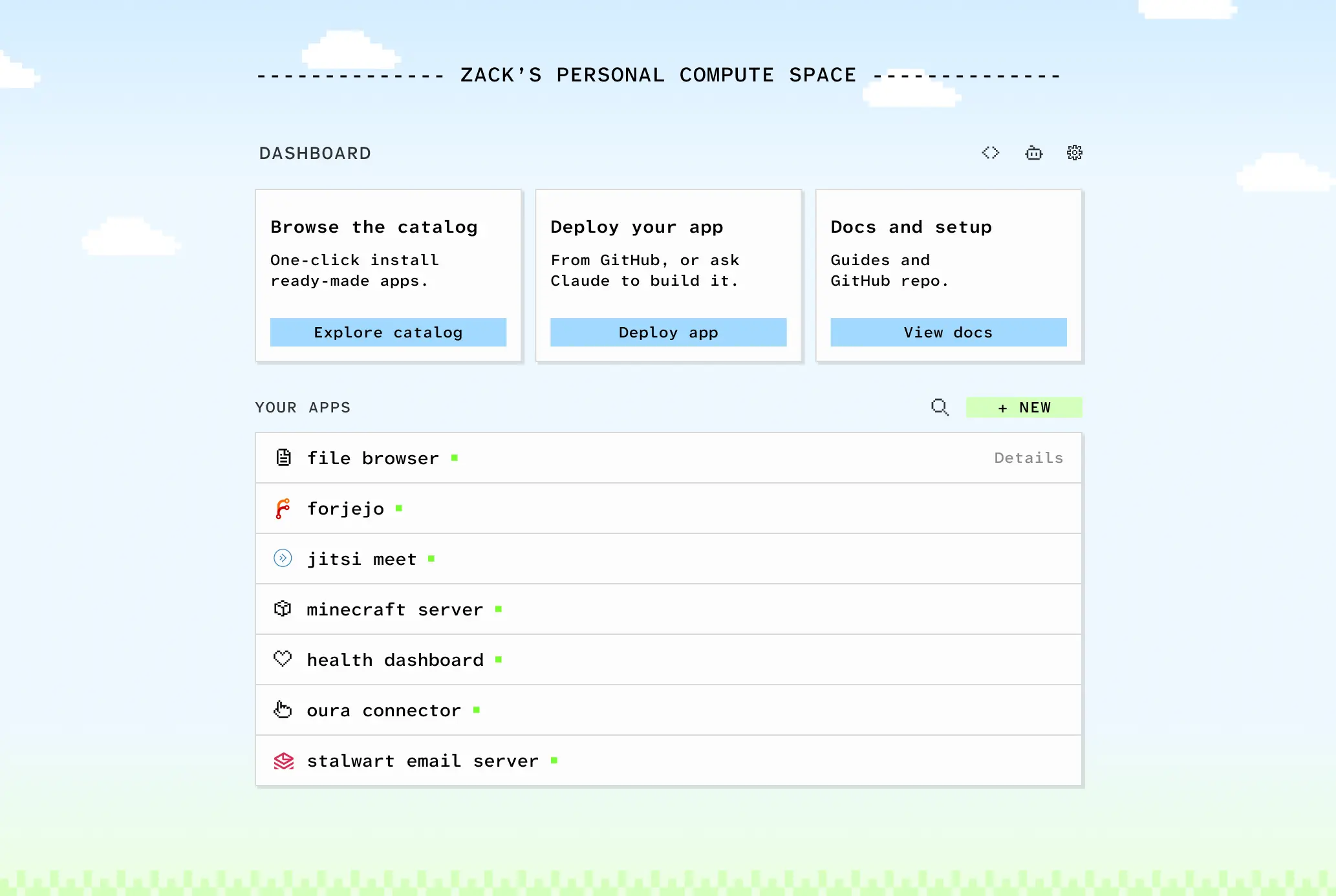
screenshot of the dashboard

I'm frustrated with the state of the digital world. The software we use is so misaligned with our own incentives (intentionally addicting, loaded with ads, tracking you and selling your data, enshittifying). Software is easier than ever to make; how did we end up here? I think a big reason is the shift of software into the cloud. Software served from the cloud (think Google Docs vs Microsoft Word) delivers a great experience - no install, accessible on all your devices, immediate sharing/collaboration. But to serve something in the cloud costs money, and so just about everything on the modern web has a company behind it - open source authors naturally don't want to pay to serve their free software to the world. And those companies have a financial incentive fundamentally misaligned with our own.

In the pre-cloud days, open source worked - authors distributed their software, and everyone "hosted" it for themselves (i.e. ran it on their own PC). Nowadays, cloud software is centralized, with one instance of the software serving the world, and the costs borne by the creator. This is because individuals don't have an accessible way to put software into the cloud for themselves.

Self-hosting exists already, but it's niche and unapproachable. When I looked at the existing options, none of them felt right:

  • sandstorm.io: very close in spirit (their article from 2014 makes basically the same argument I'm making here), but unfortunately long abandoned. It also required significant changes to existing software to run on their platform.
  • nextcloud: slow and unreliable, and more enterprise-targeted now
  • yunohost: apps run directly on the host, no sandboxing. one insecure app compromises the entire server.
  • coolify: hosts containerized apps, but every app is an island with its own login and little integration with the host or other apps.

We created Cloud in a Bottle to take another stab at this. At the core, it's just an Ubuntu machine with a web server that hosts a dashboard and routes HTTP(s) requests to containerized apps. Apps are (rootless, hardened) containers, so it can run existing software with minimal changes - and in a reasonably secure sandbox. But beyond just hosting containers (like e.g. coolify), there are various opt-in platform features that apps can take advantage of to make the experience better. In a way, I want it to feel like your "cloud smartphone" - something that you own, where finding and installing great apps is trivial, and where the user experience is as good as the closed source products we're trying to replace. As a basic example, if you're logged into your instance, you're automatically logged into all your apps - no separate accounts in each app. And there's an interface to allow permissioned access to data and capabilities between different apps in your instance. More generally - think of all the different APIs that Android or iOS provide to enable apps to deliver a great, integrated experience (sensor access, notifications, health data sharing, etc). We've put a lot of time into thinking about the right analog of those APIs in the context of a personal cloud.

It's open source, self-hostable, zero telemetry, and aims to be as simple and "magic-free" as possible. We (Imbue, the company I work for) also offer a managed version, which I think is really important to making this widely accessible - and it gives us a straightforward business model to support the project. But the open-source/self-hosted path runs exactly the same code and will always be first-class.

We're launching now after building and testing it privately for 6+ months, now that the core platform is mostly complete and stable. I've been slowly moving my digital life into my own Bottle instance, and it's felt great. That said, there's a chicken and egg problem - without a broadly accessible way to self-host open source web software, the audience for such software is small, and the available software is limited. A big goal of ours is catalyzing the creation of more great open source web software - things we can recommend to friends and parents, not just other software nerds. Our curated app catalog is one step in this direction - we aim to maintain a high bar, only adding things that actually deliver a great user experience, so it's pretty small right now. But we're adding things every week - and we hope to grow it faster with the help of the community. For now, early users will likely need a bit of technical familiarity (or a coding agent) to find/create/adapt the things you want to run on your instance (it's really easy!). Over time, as the catalog gets deeper and we polish the experience further, we hope for it to become increasingly accessible to everyone.

Want to check it out?

The Daily Front Page 3 of 30
Sunday, September 6, 2026 The Daily Front No. #260906 — The Reader’s Revolt
article

The revolt of the reader

by chmaynard·▲ 570 points·281 comments·bcantrill.dtrace.org ↗
Reading is important to me.

Reading is important to me. While I’m not a quick reader nor an especially voracious one, I have found that long-form reading has had a profound influence on me over my life.

And because reading is important to me, writing is too: writing not only allows us to convey our ideas, but the very act forces us to test and distill them — at once making our ideas more robust while providing the vehicle by which to share them.

But I am writing this now because — speaking as a reader — we are exasperated: too many people — people we otherwise like and respect! — are writing (or otherwise putting their name to) pieces that are clearly LLM-authored. We readers are left with pointed questions for those promoting LLM-authored pieces: do you think readers can’t tell? Or do you think readers don’t care?

To answer the first question, readers can absolutely tell. To those who read broadly, the hand of the LLM is so clear it’s as if the writer’s intellectual fly is open. In fact, it’s so jarring that I have to believe that those writing with LLMs are either not reading enough to see the LLM’s obvious structural tells — or (and?) they aren’t even reading their own content. (A confession: with particularly egregious pieces, I have fantasized about sentencing the author to read them aloud, certain that they themselves will be unable to endure the slop that they are foisting upon the rest of us.)

As to the second question, readers emphatically care. In fact, the tells of LLM writing are so grating ("and here’s why that framing matters!") that our brains pull an LLM-triggered ejection handle, bailing us out mid-sentence in an act of self-preservation. And the first person plural there is deliberate: as Cynthia Dunlop writes, of the 668 developers that replied to her survey, 78% "stop reading immediately" when they detect an LLM. And there are consequences that outlast the piece: 71% of the respondents in Cynthia’s survey also "avoid the author in the future" (!!). Revealingly, the respondents are not after linguistic perfection, but rather authenticity: 98% reported preferring an author’s own (imperfectly) written piece over an LLM-polished one. Finally, be wary of dismissing Cynthia’s respondents as a self-selecting group: active readers on social media are exactly the folks most likely to repost or otherwise promote writing they like — the early adopters and the tastemakers of online prose.

Why do people have this reaction? Beyond having to endure aggravating stylistic tics, when reading a piece that has had substantial LLM assistance, we — the readers — don’t know what is real and what isn’t. As I wrote in RFD 576, to use an LLM to write is to void the social contract between writer and reader: we readers shouldn’t be expected to labor to understand a sentence that the writer themselves didn’t work to create.

Does the revolt of the reader matter? If it needs to be said, when you are using an LLM to author a public piece, you are no longer writing for yourself or to otherwise pressure-test your own ideas — the only purpose is to serve the reader. If readers choose to ignore you (perhaps forever!), you will have undermined yourself: instead of attracting readers you will be actively repelling them. So other judgement about its use aside, using an LLM will increasingly become simply…​ ineffective.

In this regard, I am reminded of the arc of e-mail spam. There was a time in the early 2000s when people were (reasonably!) afraid that the explosion of spam would mean the end of e-mail. This was an era largely before social networking, and e-mail was the canonical killer app of the Internet; that we were losing e-mail to spam felt deeply dispiriting. But sometime in the late 2000s, we turned a corner: spam filtering improved so much that the economics of spam were undermined. Moreover, as spam became effectively contained, the consequences of being labeled as spam became increasingly dire. Today, legitimate businesses are very careful about how they use bulk e-mail; to be labeled as spam is to effectively destroy your domain name and tarnish your brand.

The war on spam started to turn when we could identify it at scale; could something similar happen to LLM-authored writing? Like spam, an LLM’s influence is readily identifiable to humans reading it; surely this is a solvable problem?

Up until somewhat recently, the results on this problem had been decidedly mixed. I had tried to use LLMs themselves for LLM identification, but I found that their false negative rate was far too high: they were chipper in accepting stuff that I was certain was LLM-authored. Other services seemed to look for basic LLM tells, but as an avid (and unapologetic!) user of the em-dash, these superficial techniques make me shift nervously in my seat (and I found them to be so broadly unreliable that they didn’t earn regular use).

Late last year, Pangram Labs launched their Pangram 3 model. I found it to be a huge leap over other detectors, and became an avid user. Importantly, over months of use (and especially on samples that I otherwise knew the origins of), I found its false positive rate to be very low: when Pangram identified a text as being largely AI written, I could say with some certainty that an LLM was heavily involved. (I found its false negative rate to be higher than I would like, but it was a small price to pay for a low false positive rate.)

A little over a month ago, they introduced Pangram 4, which I found to be a step-function improvement over the already-impressive Pangram 3: in my experience it has an astonishingly low false positive rate and low false negative rate (which is to say: very high accuracy!). I am finding it to be so effective (and the loss of trust in voices that use LLMs to be so precipitous) that I recently extended RFD 576 to be explicit about public writing, specifically mandating that public Oxide writing be reported by Pangram as human-authored. As I explained in the RFD, the standard for our public writing is not merely that LLMs aren’t used to write, but that readers have the confidence that it’s not LLM-authored — and increasingly that means being Pangram-clean. For those organizations that value the authenticity of their institutional voice, I would encourage the adoption of a similar policy for those writing under their banner. (Looking squarely at you, Rust Foundation!)

Indeed, Pangram has become important to so many of us that I was thrilled when Pangram Labs co-founder and CEO Max Spero joined us recently on Oxide and Friends. I would recommend that discussion not only for the technical details of Pangram, but also for Adam’s drop of a pitch-perfect (if underappreciated in the moment) Simpsons reference: when I likened LLM-authored writing to presenting takeout food as one’s own cooking, Adam quipped that such writing is like "steamed hams", making reference to Principal Skinner trying to pass off Krusty Burgers as an old family recipe. Beyond the apropos reference, it was interesting to hear Max’s insight into what has made Pangram 4 especially effective — and why its efficacy seems to evince some suspicious howls of protest.

So, writers beware: readers are in revolt. You should fully expect your writing to be run through Pangram. If your position is that we should be fine with an LLM crafting prose from your prompt, spare us all the wasted cycles and just give us your prompt. Or, better yet, consider doing what generations of writers have done before you, and treating that prompt as a skeleton that you use to write your piece yourself! This doesn’t mean that an LLM can’t help you, of course — LLMs are superlative editors! — just that you probably shouldn’t let it write it for you if you actually expect the rest of us to read it.

The Daily Front Page 4 of 30
Sunday, September 6, 2026 The Daily Front No. #260906 — The Public Square
article

Your intellectual fly is open when you use an LLM to author a post (2025)

by cyb0rg0·▲ 604 points·392 comments·bcantrill.dtrace.org ↗

Note: This was originally published as a LinkedIn post on November 11, 2025.

I need to make a painful confession: somehow, LinkedIn has become an important social network to me. This isn’t necessarily due to LinkedIn’s sparkling competence, of course. To the contrary, LinkedIn is the Gerald Ford of social networks: the normal one that was left standing as the Richard Nixons and the Spiro Agnews of social media imploded around them. As with Gerald Ford, with LinkedIn we know that we’re getting something a bit clumsy and boring, but (as with post-Watergate America!), we’re also getting something that isn’t totally crooked — and that’s actually a bit of a relief.

But because I am finding I am spending more time here, we need to have some real talk: too many of you are using LLMs to generate content. Now, this isn’t entirely your fault: as if LLMs weren’t tempting enough, LinkedIn itself is cheerfully (insistently!) offering to help you "rewrite it with AI." It seems so excited to help you out, why not let it chip in and ease your own burden?

Because holy hell, the writing sucks. It’s not that it’s mediocre (though certainly that!), it’s that it is so stylistically grating, riddled with emojis and single-sentence paragraphs and "it’s not just…​ but also" constructions and (yes!) em-dashes that some of us use naturally — but most don’t (or shouldn’t).

When you use an LLM to author a post, you may think you are generating plausible writing, but you aren’t: to anyone who has seen even a modicum of LLM-generated content (a rapidly expanding demographic!), the LLM tells are impossible to ignore. Bluntly, your intellectual fly is open: lots of people notice — but no one is pointing it out. And the problem isn’t merely embarrassment: when you — person whose perspective I want to hear! — are obviously using an LLM to write posts for you, I don’t know what’s real and what is in fact generated fanfic. You definitely don’t sound like you, so…​ is the actual content real? I mean, maybe? But also maybe not. Regardless, I stop reading — and so do lots of others.

To be clear, I think LLMs are incredibly useful: they are helpful for brainstorming, invaluable for comprehending text, and they make for astonishingly good editors. (And, unlike most good editors, you can freely ignore their well-meaning suggestions without fear of igniting a civil war over the Oxford comma or whatever.) But LLMs are also lousy writers and (most importantly!) they are not you. At best, they will wrap your otherwise real content in constructs that cause people to skim or otherwise stop reading; at worst, they will cause people who see it for what it is to question your authenticity entirely.

So please, if not for the sanity of all of us than just to give your own message the credit it deserves: have some confidence in your own voice — and write your own content.

The Daily Front Page 5 of 30
Sunday, September 6, 2026 The Daily Front No. #260906 — The Public Square
article

A/I shuts down

by captainmuon·▲ 552 points·436 comments·keepitfree.ai ↗

The day we discovered we had been designated a global terrorist organization, we promised that we would try to resist as long as this was possible, that we would not back down as long as we could see options to stand our ground. For years, we have proudly maintained and defended a free, privacy-friendly, autonomous and politically committed infrastructure.

“Stay human” is not an empty phrase to us.

It means, above all, that we have a responsibility to protect our users, those who build the human networks we rely, and for the communities who flooded us with messages of support and solidarity.

We cannot engage in a fight or expose ourselves to manipulations that threaten the lives of these people and their loved ones, leaving them at the mercy of autocrats, fascists and agencies that take extra-legal courses of action. The possibility that our work may cause legal and financial consequences to those who are close to us - or even only have something to do with us - leaves us no choice.

A/I is shutting down. The Autistici/Inventati collective is shutting down and will soon discontinue all of the services we provide.

There is no easy way to announce or explain this

Every day we stayed online after August 26, 2026, has been a victory, but now we are forced to stop.

None of us holds eroic gestures and martyrs in high esteem, therefore we will demand no sacrifices. Not from us, not from anyone else. In this political climate, continuing to offer our services endangers our users and anyone who is part of our communities. In a world where allegations are disconnected from reality, we can only expect repression to be increasingly disproportionate. Under these circumstances, we are no longer able to maintain our original mission - offering secure and non-commercial digital tools.

These 25 years have been amazing. It’s been an “incredible ride”.

Now turn off your PCs, get out of your homes, struggle, hug each other and keep on smiling. We are stopping, but the Resistance and ideas do not stop. Stay human.

We will soon send instructions on how to back up the content of your blogs, mailboxes and websites, along with more technical recommendations. But keep in mind that, just as the autistici.org domain was made unreachable without previous notice, in the next few days we might suffer similar issues that we may not be able to predict.

Autistici/Inventati Collective

The Daily Front Page 6 of 30
Sunday, September 6, 2026 The Daily Front No. #260906 — The Public Square
repository

Nitter and XCancel resume service after legal advice

by zImPatrick·▲ 566 points·286 comments·github.com ↗
★ 14,222⑂ 1,299 forks Nim

Alternative Twitter front-end

Nitter

[!NOTE] On 24 August 2026, cease and desist letters were sent by X Corp. demanding a permanent takedown of Nitter instances and the project's repository.
UPDATE: Following legal advice, the Nitter project will continue. More details will be announced soon.

A free and open source alternative Twitter front-end focused on privacy and performance.

Inspired by the Invidious project.

Test Matrix
Test Matrix
License

Features

  • No JavaScript required
  • Zero ads
  • All requests go through the backend, client never talks to Twitter
  • Prevents Twitter from tracking your IP or JavaScript fingerprint
  • Uses Twitter's unofficial API (no developer account required)
  • Lightweight (for @nim_lang, 60KB vs 784KB from twitter.com)
  • RSS feeds (instance-specific, often disabled due to abuse)
  • Themes
  • Mobile support (responsive design)
  • AGPLv3 licensed, no proprietary instances permitted

Roadmap

Donations

GitHub Sponsors
Patreon
Liberapay
Ko-fi

BTC: bc1qpqpzjkcpgluhzf7x9yqe7jfe8gpfm5v08mdr55
ETH: 0x24a0DB59A923B588c7A5EBd0dBDFDD1bCe9c4460
XMR: 42hKayRoEAw4D6G6t8mQHPJHQcXqofjFuVfavqKeNMNUZfeJLJAcNU19i1bGdDvcdN6romiSscWGWJCczFLe9RFhM3d1zpL
SOL: FF5bheiD5AqPEdc3eyjymJ8AoMRF1hS78Ht6FiSZZF1t
$Nitter: 4fSxCKc91ELQYVdv3tmHW8R15KoALPwEngyoQe1Xpump
ZEC: u1vndfqtzyy6qkzhkapxelel7ams38wmfeccu3fdpy2wkuc4erxyjm8ncjhnyg747x6t0kf0faqhh2hxyplgaum08d2wnj4n7cyu9s6zhxkqw2aef4hgd4s6vh5hpqvfken98rg80kgtgn64ff70djy7s8f839z00hwhuzlcggvefhdlyszkvwy3c7yw623vw3rvar6q6evd3xcvveypt

For legal inquiries and DMCA requests, contact legal@poast.org

The Daily Front Page 7 of 30
Sunday, September 6, 2026 The Daily Front No. #260906 — Launches and Releases
article

Isar Aerospace reaches orbit and deploys payloads on second flight

by mpweiher·▲ 570 points·181 comments·isaraerospace.com ↗

C Isar Aerospace Flight 2

Andøya, 5 September 2026 – Today, Isar Aerospace became the first commercial space company from Europe to successfully deliver satellites into orbit, on what was only its second flight. Mission ‘Onward and Upward’ lifted off from Isar Aerospace’s dedicated launch complex at Andøya Space in Norway at 10:12 pm CEST, deploying payloads in orbit. “Today, Isar Aerospace opened space from Continental Europe. Launch continues to be the largest bottleneck for the global space industry and from today on, there is a true alternative for commercial and institutional customers”, said Daniel Metzler, CEO and Co-Founder of Isar Aerospace. Isar Aerospace is working with the customers to confirm the satellite status.

Daniel Metzler, CEO and Co-Founder of Isar Aerospace, said: “We achieved within a few years what had taken the European space industry decades before. Europe now has sovereign access to space. We have entered into a new chapter for European spaceflight. I am incredibly proud of our team, that has made this success story from Europe possible. We will now focus on rapidly scaling launch vehicle production, deliver on our order pipeline, and meet surging global demand.”

Isar Aerospace’s qualification flight broke several records in European commercial spaceflight: The vehicle successfully transited MaxQ, completed MECO and stage separation, and then ignited second stage as planned. It crossed the Kármán line at an altitude of 100 kilometers and jettisoned the payload fairing before reaching orbital velocity. After completing circularization burn, spacecraft separation was completed successfully.

The mission’s payloads were selected through the Microlauncher Competition of the German Space Agency at DLR that provides educational institutions and start-ups with low-cost access to space. The Microlauncher Competition is funded through ESA Boost!

Today’s mission ‘Onward and Upward’ proved Isar Aerospace’s orbital launch capability. In parallel, the company has advanced its global network of available launch sites and is nearing completion of Europe’s largest integrated production facility for launch vehicles. In addition to its current launch site in Andøya, Norway, Isar Aerospace is constructing a launch complex in Nova Scotia, Canada, covering mid- to high-inclination orbits critical for Earth observation and communications.

A historic turning point for Europe

Today marks a new era for the global space industry. The launch is not only a technical masterpiece, but also a breakthrough that will influence Europe's strategic, economic, and technological future. Customers around the world now have a sovereign launch option at their disposal.

Next ‘Spectrum’ launch vehicles already in production

Isar Aerospace's model is designed to build scalable launch capabilities. That is why the company is not only developing and building a launch vehicle, but has also built the “machine behind the machine”, including a vertically integrated manufacturing model and a high degree of automation in production. ‘Spectrum’ launch vehicles 3-7 are already in production. With the opening of the new 40,000 m² production facility, Isar Aerospace will eventually have the capacity to manufacture up to 40 launch vehicles per year.

– ENDS –

The Daily Front Page 8 of 30
Sunday, September 6, 2026 The Daily Front No. #260906 — Launches and Releases
article

Asahi Linux on M3

by mdp2021·▲ 391 points·234 comments·asahilinux.org ↗

It’s been a while since we did a blog post outside of the progress reports, and today’s as good an occasion for one as any; support for M3 series machines has now been merged into the installer. In other words, Asahi Linux now officially supports Macs with an M3 series SoC!

Linux support for M3 series SoCs and the machines powered by them is now in a state where almost everything supported on the M1 and M2 series machines just works. This includes the webcam, internal microphones, USB (up to the hardware limit of USB 3 10 Gb/s), hardware accelerated video decoding including support for AV1, WiFi, Bluetooth, and much more! The only major exceptions remain full DCP support and the GPU, which we will have more news on in the coming months. Do not expect performant or power-efficient 3D acceleration right now.

Given that a lot of this work is fresh, support is gated behind the installer’s Expert mode. Users who wish to give Asahi Linux a try on an M3 series machine can do so by running

curl -L https://alx.sh/ | EXPERT=1 sh

in a macOS terminal and following the prompts. Please remember to do a system upgrade (dnf upgrade --refresh) after you have finished installing. We are aiming to drop the Expert requirement in time for the release of the Fedora Linux 45 beta in a couple of weeks, barring any major regressions or other showstopping issues.

There are some known limitations to be aware of, however:

  • Sleep currently does not work due to limitations with the firmware-provided framebuffer. This will be addressed once full DCP support is wired up for M3.
  • Similarly, the lack of DCP support means that the HDMI port on equipped MacBooks is currently disabled.
  • Although MacBooks and iMacs are supported (M3, M3 Pro and M3 Max), the Mac Studio (M3 Ultra) is not yet supported.

As always, we would like to thank our generous supporters on both OpenCollective and GitHub Sponsors. Support for M3 is the culmination of years of hard work from multiple people, many of whom have only been able to access M3 hardware because of your support.

We are looking forward to hearing all your feedback, and hope you enjoy using Asahi Linux on your M3 devices just as much as we have enjoyed bringing it to you. Stay tuned for more updates and happy computing!

The Daily Front Page 9 of 30
Sunday, September 6, 2026 The Daily Front No. #260906 — Launches and Releases
article

NetBSD 9.5 released and EOL for NetBSD-9

by jaypatelani·▲ 122 points·11 comments·blog.netbsd.org ↗

NetBSD 9.5 released and EOL for netbsd-9

The NetBSD Project is pleased to announce NetBSD 9.5, the fifth (and final) release from the NetBSD 9 stable branch.

It represents a selected subset of fixes deemed important for security or stability reasons since the release of NetBSD 9.4 in April 2024. It is fully compatible with NetBSD 9.0.

This also marks the end-of-support for all NetBSD-9.x releases and the netbsd-9 branch. All users still on this branch are urgently asked to update to a more recent release like NetBSD 11.0 (with 11.1 upcoming at the end of this month) or NetBSD 10.2 (to be released in a few days).

Full release notes, including download links

The Daily Front Page 10 of 30
Sunday, September 6, 2026 The Daily Front No. #260906 — Music, Explained
article

Music Theory for Programmers

by birdculture·▲ 365 points·225 comments·runjs.app ↗
Why those notes? Why that pattern?

Music theory for programmers

I can't play an instrument. I have tried more than once, and each time I got as far as being able to make roughly the right noises without ever understanding why they were the right noises.

The problem was never the practice. It was that every explanation of music theory seemed to miss out the fundamental reasons for how and why things are the way they are. Here is a staff. Here are the notes on it. This is a major scale, memorise the pattern. Why those notes? Why that pattern? Because that is the convention.

Which is a strange way to teach a system that essentially comes out of physics and arithmetic. There are twelve notes for a reason. The major scale has the shape it has for a reason. Chords that sound good sound good for a reason, and you can compute those reasons.

So I wanted to start from scratch and learn music from first principles, and I began that journey by writing code.

This article is the result. It starts with a single number changing over time, and if you follow along, you will derive the twelve notes, build scales and chords out of arrays, and write a chord progression that sounds like actual music. No instrument needed, and nothing you have to take on faith. Written notation does turn up, but not until the very end, once there is something for it to be notation of.

A sound is a number that changes over time

Sound is just air pressure wobbling. A speaker makes sound by pushing its cone in and out, and everything your computer does with audio comes down to producing a list of numbers describing where that cone should be, forty-four thousand times a second.

An audio file is that list written down. A synthesiser makes the list up as it goes, and the browser will do that part for you if you say what shape you want. The simplest shape is a sine wave, so here is one repeating 440 times a second:

A sine wave at 440Hz

const osc = ctx.createOscillator();
osc.frequency.value = 440;

osc.connect(out);
osc.start();
osc.stop(ctx.currentTime + 1);

ctx and out are mine rather than the browser's. Everything else is the Web Audio API exactly as it ships. To run that snippet anywhere else, start with:

const ctx = new AudioContext();
const out = ctx.destination;

The number 440 is the only thing there that carries any musical meaning, and even that is arbitrary. It is the frequency somebody agreed to call "A", and it is the tuning fork the rest of the system is pinned to. Change it to 300 and run it again. It still works, it just plays a different pitch. The oscillator has no idea what a note is. It only knows how many times a second to swing.

Frequency is pitch: higher number, higher note. Nothing else in music is going to be that simple.

Why that note clicked

You may have heard a little click at the end of that. The browser did exactly what it was told. The click is physics.

The oscillator was mid-wave when it stopped, so the speaker cone was somewhere out at the edge of its travel and then instantly snapped back. An instant jump in pressure is what a click is.

The fix is a second number that changes over time, this one controlling volume rather than pitch. Musicians call the shape of it an envelope:

The same note with an envelope

const osc = ctx.createOscillator();
osc.frequency.value = 440;

const env = ctx.createGain();
const t = ctx.currentTime;
env.gain.setValueAtTime(0, t);
env.gain.linearRampToValueAtTime(0.3, t + 0.01);
env.gain.exponentialRampToValueAtTime(0.001, t + 1);

osc.connect(env).connect(out);
osc.start(t);
osc.stop(t + 1);

An envelope is the volume curve of a single note, from silence back to silence. The rise at the front is the attack and the fall afterwards is the decay.

Ten milliseconds to fade in, then a slow decay to nearly nothing. That is the difference between a test tone and something you would be willing to listen to twice.

This is a simplified envelope, though. The full version is ADSR: attack, decay, sustain and release, where sustain is the level a note holds at while a key is down, and release is how it fades once you let go.

The function below is a helper that each subsequent example uses:

function note(freq, start = 0, length = 0.5, type = "sine") {
  const t = ctx.currentTime + start;
  const osc = ctx.createOscillator();
  const env = ctx.createGain();

  osc.type = type;
  osc.frequency.value = freq;

  env.gain.setValueAtTime(0, t);
  env.gain.linearRampToValueAtTime(0.3, t + 0.01);
  env.gain.exponentialRampToValueAtTime(0.001, t + length);

  osc.connect(env).connect(out);
  osc.start(t);
  osc.stop(t + length);
}

Timbre is the frequencies you did not ask for

A sine wave is a single frequency and nothing else, which is why it sounds like a hearing test and unlike any instrument. Pluck a guitar string tuned to 440Hz and you do get a wave repeating 440 times a second, but the string is also vibrating in halves, and in thirds, and in quarters, all at the same time. Those are extra frequencies at 880, 1320, 1760 and on up, all riding on top of the one you asked for.

That stack is called the harmonic series. The note you asked for is the fundamental, and the series is that frequency multiplied by 1, 2, 3, 4, 5 and on up:

The harmonic series of 220Hz. Click a bar to hear that harmonic on its own.

Click the bars. On their own they are fairly boring. What matters is that they arrive as a package, and the recipe of how loud each one is relative to the others is what makes a violin sound like a violin and not a trumpet. Musicians call that timbre, and it is the same note either way.

The browser ships four of those recipes ready-made:

Four waveforms, same pitch

["sine", "triangle", "square", "sawtooth"].forEach((type, i) => {
  note(220, i * 0.7, 0.6, type);
});

Same 220Hz, four very different characters. A square wave contains only the odd harmonics, which is why it sounds hollow and slightly electronic. A sawtooth contains all of them and sounds harsh and buzzy. The scope above shows the shape of each one as it plays, and the shape is the harmonic recipe.

Remember the harmonic series, because it explains most of what follows. Every note you play drags a stack of quiet extra notes along with it, and which notes those are is not up to us. It is arithmetic, fixed by the physics of vibrating strings and columns of air, and it comes out the same on every instrument built around them.

Doubling the frequency gives you the same note

Here are five notes. Every one is double the frequency of the one before it.

One note, five times

[110, 220, 440, 880, 1760].forEach((freq, i) =>
  note(freq, i * 0.45, 0.4),
);

They are different pitches, and yet they sound like the same note. Not just similar, the same. Cultures with no contact with each other have landed on this independently: double the frequency and you get something so alike it deserves the same name. In Western notation these frequencies, in the above example, are all called A, and the distance between them is the octave.

The naming is not arbitrary, and the harmonic series explains why. Every harmonic of 440 is already sitting in the harmonic series of 220, because 220's series is 220, 440, 660, 880, 1100 and 440's is 440, 880, 1320, 1760. The higher note adds no frequency the lower note was not already producing, so your ear hears the same colour at a different brightness.

That one observation gives us two rules we will lean on for the rest of the article.

Pitch is multiplicative, not additive. Going up an octave means times two, not plus anything. The gap from 110 to 220 is 110Hz and the gap from 880 to 1760 is 880Hz, and they sound like exactly the same distance. Frequency space is logarithmic, and every interval in music is a ratio.

We only have to solve one octave. Because doubling returns you to the same note, the problem of "which pitches should exist" reduces to "how should we divide up the space between a frequency and twice that frequency". Solve it once and the answer repeats across the whole audible range.

So: how do you divide an octave?

Simple ratios sound good, and here is why

The naive answer is to divide it evenly and go home. Nobody does that, because it turns out we do not experience all pairs of frequencies the same way. Some combinations sound settled and some sound like a mistake, and you can hear the difference immediately.

Six ratios against the same note

const ratios = [
  ["2/1   octave", 2],
  ["3/2   fifth", 3 / 2],
  ["4/3   fourth", 4 / 3],
  ["5/4   major third", 5 / 4],
  ["16/15 semitone", 16 / 15],
  ["√2    the awkward one", Math.SQRT2],
];

ratios.forEach(([label, ratio], i) => {
  note(220, i * 1.4, 1.2);
  note(220 * ratio, i * 1.4, 1.2);
  console.log(label, "->", (220 * ratio).toFixed(2) + "Hz");
});

The first four sound like chords. The 16/15 sounds like two notes arguing. The last one sounds like a car alarm. And the pattern is not subtle once you see it: the simpler the fraction, the better it sounds. 2/1 the octave, then 3/2 the fifth, then 4/3 the fourth, then 5/4 the major third, and by the time you get to 16/15 it has fallen apart entirely.

That is a suspiciously arithmetic result for something as subjective as "sounds nice", and there are two physical reasons for it.

The first is the harmonic series again. Play 220 and 330 together, which is a 3:2 ratio. The first note produces 220, 440, 660, 880, 1100, 1320. The second produces 330, 660, 990, 1320, so they share 660 and 1320 exactly. Two notes a fifth apart are not really two separate sounds, they are two heavily overlapping stacks that reinforce each other. Now try 220 and 311, which is close to √2. Nothing lines up, at any harmonic. You get two full stacks of frequencies that have nothing to do with each other.

The second reason is roughness. When two frequencies are close but not identical, they drift in and out of phase and you hear the volume pulsing. That is beating, and it is the thing that makes an out-of-tune note sound out of tune:

Beating, from wide apart to identical

[220, 226, 223, 221, 220.5, 220].forEach((freq, i) => {
  note(220, i * 1.3, 1.2);
  note(freq, i * 1.3, 1.2);
});

The wobble slows down as the two frequencies converge and vanishes when they match, and the rate of it is exactly the difference between them. Six hertz apart, six pulses a second. When the fractions are complicated, the two stacks of harmonics are littered with pairs that are a few hertz apart, and every one of those pairs is beating away against the others. That is what dissonance is.

Switch between the ratios above and watch the green line, which is the two waves added together, exactly as your eardrum would add them. For 2:1 and 3:2 the combined shape settles into a repeating pattern almost immediately. For 16:15 it takes fifteen cycles to come back round. For √2 it never does, because √2 is irrational, so there is no pattern for your ear to lock onto at all.

Consonance is your ear finding a repeating pattern quickly. As far as I can tell, that is all it is.

Stacking fifths, and the bug you cannot fix

Now we can actually build something. We know that simple ratios are the good ones, and after the octave itself, the cleanest ratio in physics is 3/2, the fifth.

So what happens if we try to build a musical alphabet using only octaves and fifths?

Do the obvious thing: keep going up by fifths, halving whenever you leave the octave. This is roughly what Pythagoras did, and it works beautifully for a while:

Stacking fifths inside one octave

let freq = 220;
const notes = [220];

for (let i = 0; i < 12; i++) {
  freq = (freq * 3) / 2;
  while (freq >= 440) freq = freq / 2;
  notes.push(freq);
  console.log(`fifth ${i + 1}: ${freq.toFixed(3)}Hz`);
}

notes.sort((a, b) => a - b).forEach((f, i) => note(f, i * 0.22, 0.3));

Look at the first note and the last note. We started on 220, applied twelve fifths, and landed on 222.99. Not 220. Close enough to be audibly trying to be the same note, and far enough off to be unusable.

The error is not rounding but something structural, and it is easier to see without the octave-folding:

The gap that cannot be closed

const twelveFifths = (3 / 2) ** 12;
const sevenOctaves = 2 ** 7;

console.log("twelve fifths:", twelveFifths.toFixed(6));
console.log("seven octaves:", sevenOctaves.toFixed(6));
console.log("ratio:", (twelveFifths / sevenOctaves).toFixed(6));
console.log(
  "in cents:",
  (1200 * Math.log2(twelveFifths / sevenOctaves)).toFixed(2),
);

note(220, 0, 1.5);
note((220 * twelveFifths) / sevenOctaves, 0, 1.5);

Twelve perfect fifths overshoot seven perfect octaves by a factor of 1.0136. That gap is called the Pythagorean comma. Cents are how pitch distances get measured, and there are 1200 of them in an octave, which is where that number in the code comes from. So 23 cents is about a quarter of the gap between two adjacent piano keys, and you can hear it in that last pair of notes as a slow ugly beating.

And it cannot be fixed, for a reason a programmer will recognise. Stacking fifths means multiplying by 3/2, so after n fifths you are at 3^n / 2^n. Stacking octaves means 2^m. For the two to ever meet you would need 3^n = 2^(n+m), which requires a power of three to equal a power of two. Three and two are both prime. It never happens, for any n, ever.

The system we want, where the octave is pure and the fifths are pure and everything closes into a neat loop, does not exist and never has. Every tuning system in history is a different choice about where to dump the error.

Equal temperament is the compromise

The modern answer is to give up on pure ratios altogether. Take the octave, divide it into twelve equal multiplicative steps, and accept that nothing except the octave will be exactly right ever again.

One step is the twelfth root of two:

The twelfth root of two

const semitone = 2 ** (1 / 12);
console.log("one semitone =", semitone);

let freq = 220;
for (let i = 0; i < 13; i++) {
  note(freq, i * 0.2, 0.28);
  freq = freq * semitone;
}

console.log(
  "twelve steps later:",
  (220 * semitone ** 12).toFixed(10),
);

Twelve steps land on exactly 440, because that is how roots work, so the octave is perfect by construction and everything else is approximated.

The obvious question is why twelve. It is not tradition, and you can find the answer yourself in about fifteen lines. Divide the octave into n equal steps for every plausible n, then check how close the best available step comes to a real 3/2 fifth:

Brute-forcing the number twelve

function bestFifth(n) {
  let error = Infinity;
  let step = 0;

  for (let candidate = 1; candidate < n; candidate++) {
    const off = Math.abs(2 ** (candidate / n) - 1.5);
    if (off < error) {
      error = off;
      step = candidate;
    }
  }

  return { step, error };
}

for (let n = 5; n <= 25; n++) {
  const { step, error } = bestFifth(n);
  const pct = (error / 1.5) * 100;
  console.log(
    `${n} steps: best fifth is step ${step}, off by ${pct.toFixed(3)}%`,
  );
}

// And here is what those errors actually sound like.
[5, 7, 12, 19].forEach((n, i) => {
  const { step } = bestFifth(n);
  note(220, i * 1.7, 1.5);
  note(220 * 2 ** (step / n), i * 1.7, 1.5);
});

Those last four lines play the best fifth that 5, 7, 12 and 19 divisions can manage, each against the same 220Hz. The first two wobble, the third is clean, and the fourth sits in between. You are listening to the error column.

Twelve is the first division that gets the fifth right to about a tenth of a percent, and it is more than three times better than anything below it. Twenty-four ties, but only because twenty-four steps is twelve steps with a spare note wedged between each pair, so it is not really a competitor. You have to go all the way to 29 and 41 before the fifth gets better, and nobody is building a keyboard with 41 keys per octave. It is the cheapest number of notes that buys you a convincing fifth, and once the fifth is close the fourth and the thirds come along for the ride.

Here is how close:

Real fifth against the compromise

const pure = (220 * 3) / 2;
const tempered = 220 * 2 ** (7 / 12);

console.log("pure fifth:     ", pure.toFixed(4) + "Hz");
console.log("tempered fifth: ", tempered.toFixed(4) + "Hz");
console.log(
  "difference:     ",
  (1200 * Math.log2(tempered / pure)).toFixed(2),
  "cents",
);

note(220, 0, 1.5);
note(pure, 0, 1.5);
note(220, 2, 1.5);
note(tempered, 2, 1.5);

Two cents flat. There is a slow beat in the second pair if you listen for it, and that beat is present in every fifth played on every piano on Earth. We all decided that being slightly wrong everywhere was better than being perfect in one key and unusable in the others.

The payoff is that notes are now integers. Pick any note as number 0, and every other note is a whole number of semitones away from it. The convention is MIDI numbering, where 69 is our 440Hz A, and the conversion is one line:

Notes are integers now

const midiToFreq = (n) => 440 * 2 ** ((n - 69) / 12);

console.log("60 (middle C):", midiToFreq(60).toFixed(2));
console.log("69 (the A above it):", midiToFreq(69).toFixed(2));
console.log("81 (an octave up):", midiToFreq(81).toFixed(2));

[60, 62, 64, 65, 67, 69, 71, 72].forEach((n, i) =>
  note(midiToFreq(n), i * 0.25, 0.4),
);

That last line is a major scale, and we have not defined what a scale is yet. It is just an array of integers. From here on everything in this article is done with arrays, and I stopped needing to think about frequencies at all.

Twelve notes per octave, repeating forever. The black keys are not special, they are just the ones that did not get letter names.

That keyboard is worth staring at for a second, because the layout is a historical accident. There are twelve equally spaced notes per octave. Seven of them got letters and a big white key, five got a sharp sign and a small black key, and the seven with white keys are exactly the scale you just played. The physics underneath is completely uniform, and the keyboard is not.

Why twelve notes and not all of them

Having twelve notes does not mean using twelve notes. Play all of them in order and it is remarkably unmusical:

All twelve, in order

const midiToFreq = (n) => 440 * 2 ** ((n - 69) / 12);

for (let n = 60; n <= 72; n++) {
  note(midiToFreq(n), (n - 60) * 0.18, 0.25);
}

It sounds like a sound effect. Every step is identical, so nothing stands out, nothing sounds like home, and there is no way to tell where you are.

Music picks a subset. Almost always seven of the twelve, chosen so that the gaps between them are uneven, which is exactly what makes it possible to tell one note from another by ear. The subset is a scale, and a scale is best written not as notes but as the steps between them:

A scale is a list of gaps

const midiToFreq = (n) => 440 * 2 ** ((n - 69) / 12);

const major = [2, 2, 1, 2, 2, 2, 1];

function buildScale(root, pattern) {
  return pattern.reduce(
    (notes, step) => [...notes, notes.at(-1) + step],
    [root],
  );
}

const cMajor = buildScale(60, major);
console.log("C major:", cMajor);

cMajor.forEach((n, i) => note(midiToFreq(n), i * 0.25, 0.4));

The steps are 2 2 1 2 2 2 1, adding up to 12 so the pattern closes the octave exactly. That is the major scale, the single most familiar sound in Western music, and it is a seven-element array.

Change one number and it becomes a completely different mood:

One number is the difference between happy and sad

const midiToFreq = (n) => 440 * 2 ** ((n - 69) / 12);
const build = (root, pattern) =>
  pattern.reduce(
    (notes, step) => [...notes, notes.at(-1) + step],
    [root],
  );

const patterns = {
  major: [2, 2, 1, 2, 2, 2, 1],
  naturalMinor: [2, 1, 2, 2, 1, 2, 2],
  majorPenta: [2, 2, 3, 2, 3],
  minorPenta: [3, 2, 2, 3, 2],
  blues: [3, 2, 1, 1, 3, 2],
};

let when = 0;
Object.entries(patterns).forEach(([name, pattern]) => {
  const scale = build(60, pattern);
  console.log(name.padEnd(13), scale.join(" "));
  scale.forEach((n, i) => note(midiToFreq(n), when + i * 0.22, 0.35));
  when += scale.length * 0.22 + 0.5;
});

Major and natural minor are the same seven-note idea with the gaps shuffled. The pentatonic scales drop two notes, which is why it is so hard to play a wrong note in them, and why every beginner guitar lesson starts there. The blues scale adds one deliberately awkward note back in.

The modes, which I had always seen presented as seven exotic Greek names to be memorised, turn out to be the same array rotated. Take the first step off the front, put it on the back, and you have the next one:

Modes are array rotations

const midiToFreq = (n) => 440 * 2 ** ((n - 69) / 12);
const build = (root, pattern) =>
  pattern.reduce(
    (notes, step) => [...notes, notes.at(-1) + step],
    [root],
  );

const major = [2, 2, 1, 2, 2, 2, 1];
const names = [
  "Ionian",
  "Dorian",
  "Phrygian",
  "Lydian",
  "Mixolydian",
  "Aeolian",
  "Locrian",
];

const rotate = (arr, by) =>
  arr.map((_, i) => arr[(i + by) % arr.length]);

names.forEach((name, i) => {
  const pattern = rotate(major, i);
  console.log(name.padEnd(11), pattern.join(" "));
  build(60, pattern).forEach((n, j) =>
    note(midiToFreq(n), i * 2 + j * 0.2, 0.3),
  );
});

Seven modes, one array, seven rotations. Ionian is the major scale and Aeolian is the natural minor, which means "major" and "minor" are not two systems, they are rotation 0 and rotation 5 of the same thing. Lydian sounds dreamy and Phrygian sounds Spanish and Locrian sounds broken, and all of that comes from moving which gap sits where relative to the note you started on.

This is the point where I stopped feeling like music theory was arbitrary.

Chords are notes stacked in thirds

A chord is more than one note at the same time. Which is not much of a definition, because most combinations sound terrible. The useful question is which combinations do not.

We already know the answer from the ratios: notes whose harmonics overlap. In a scale, the notes that fit that description are the ones two scale degrees apart, a gap musicians call a third. So take a scale, pick a starting degree, and grab every other note:

A triad is [0, 2, 4]

const midiToFreq = (n) => 440 * 2 ** ((n - 69) / 12);
const build = (root, p) =>
  p.reduce((n, s) => [...n, n.at(-1) + s], [root]);

const cMajor = build(60, [2, 2, 1, 2, 2, 2, 1]);
const triad = [0, 2, 4].map((i) => cMajor[i]);

console.log("scale:", cMajor.join(" "));
console.log("triad:", triad.join(" "));
console.log("gaps:", triad[1] - triad[0], "and", triad[2] - triad[1]);

triad.forEach((n) => note(midiToFreq(n), 0, 2));

That is a C major chord. Three notes, at 0, 4 and 7 semitones above the note it is built on, which musicians call the root. In frequency that is 1 : 1.26 : 1.50, very nearly 4 : 5 : 6. Three simple ratios sharing harmonics all over the place, which is why it sounds so settled.

A third is either 4 semitones (a major third) or 3 semitones (a minor third), and stacking two of them gives you 7 semitones either way: major is 4 + 3, while minor is 3 + 4.

Now move the middle note down by one semitone:

One semitone, entirely different feeling

const midiToFreq = (n) => 440 * 2 ** ((n - 69) / 12);
const chord = (shape, root, at) =>
  shape.forEach((s) => note(midiToFreq(root + s), at, 1.6));

const shapes = {
  major: [0, 4, 7],
  minor: [0, 3, 7],
  diminished: [0, 3, 6],
  augmented: [0, 4, 8],
};

Object.entries(shapes).forEach(([name, shape], i) => {
  console.log(name.padEnd(11), shape.join(" "));
  chord(shape, 60, i * 2);
});

Major to minor is one note moving by one semitone. That is all that separates the two emotional poles of Western music, and in code it is [0,4,7] versus [0,3,7]. Diminished squashes both gaps and sounds unresolved and anxious. Augmented stretches both and sounds like something is about to go wrong in a film.

I found this genuinely annoying to discover, in a good way. I had absorbed the idea that major and minor were deep categories. They are a single array element differing by one.

Add a fourth note, another third up, and you get seventh chords, and this is where it starts to sound like actual music rather than a hymn:

Sevenths

const midiToFreq = (n) => 440 * 2 ** ((n - 69) / 12);

const shapes = {
  "major 7th": [0, 4, 7, 11],
  "minor 7th": [0, 3, 7, 10],
  "dominant 7th": [0, 4, 7, 10],
};

Object.entries(shapes).forEach(([name, shape], i) => {
  console.log(name.padEnd(13), shape.join(" "));
  shape.forEach((s) => note(midiToFreq(60 + s), i * 2.2, 1.8));
});

Major 7th is the jazz-cafe chord. Minor 7th is smooth and slightly melancholy. The dominant 7th is the interesting one. Dominant is just the traditional name for the fifth degree of a scale, and this chord is about to do a lot of work.

A key gives you seven chords

This is the part that made chord charts finally make sense to me.

There is nothing special about starting on the first degree. Do it from each of the seven in turn, wrapping around the octave, and you get seven chords, all built only from the seven notes of the scale:

Seven chords out of one scale

const midiToFreq = (n) => 440 * 2 ** ((n - 69) / 12);
const build = (root, p) =>
  p.reduce((n, s) => [...n, n.at(-1) + s], [root]);

const scale = build(60, [2, 2, 1, 2, 2, 2, 1]).slice(0, 7);
const names = ["C", "D", "E", "F", "G", "A", "B"];

const chordOn = (degree) =>
  [0, 2, 4].map((step) => {
    const i = degree + step;
    return scale[i % 7] + Math.floor(i / 7) * 12;
  });

names.forEach((name, degree) => {
  const notes = chordOn(degree);
  const shape = notes.map((n) => n - notes[0]);
  const quality =
    shape[1] - shape[0] === 4
      ? "major"
      : shape[2] - shape[0] === 6
        ? "diminished"
        : "minor";
  console.log(`${name} ${quality.padEnd(11)} ${notes.join(" ")}`);
  notes.forEach((n) => note(midiToFreq(n), degree * 1.5, 1.3));
});

Nobody chose those qualities. Three of them come out major, three come out minor, and the last one comes out diminished, and that pattern is forced by the uneven gaps in the scale. Start the every-other-note process on a degree whose neighbours are spaced 4 then 3, you get a major chord. Spaced 3 then 4, you get a minor one.

Musicians write those seven as Roman numerals: capital for major, lowercase for minor, and a small circle for the diminished one.

I ii iii IV V vi vii°

That notation is doing something useful, and it took me an embarrassingly long time to notice what. It describes chords by their position in the scale, not by their name. A V chord is "the chord built on the fifth degree", whatever key you are in, which is relative addressing. A chord chart written in Roman numerals is key-independent source, and transposing is adding a constant:

Roman numerals are relative addressing

const midiToFreq = (n) => 440 * 2 ** ((n - 69) / 12);
const build = (root, p) =>
  p.reduce((n, s) => [...n, n.at(-1) + s], [root]);

function chordsInKey(root) {
  const scale = build(root, [2, 2, 1, 2, 2, 2, 1]).slice(0, 7);
  return (degree) =>
    [0, 2, 4].map((step) => {
      const i = degree - 1 + step;
      return scale[i % 7] + Math.floor(i / 7) * 12;
    });
}

// The same four numerals, played in two different keys.
const progression = [1, 5, 6, 4];

[60, 65].forEach((key, k) => {
  const chord = chordsInKey(key);
  progression.forEach((numeral, i) => {
    chord(numeral).forEach((n) =>
      note(midiToFreq(n), k * 7 + i * 1.6, 1.5),
    );
  });
});

Same shape, two different starting notes, and your ear recognises it as the same music, which is why the notation exists.

Tension and resolution

One chord is just a sound. Music is what happens when you put them in an order, and the order matters. Some sequences feel like they have arrived and some feel like a question.

The strongest pull in the system is from V back to I, and there are two concrete reasons for it.

The pull of V back to I

const midiToFreq = (n) => 440 * 2 ** ((n - 69) / 12);
const play = (notes, at, len = 1.6) =>
  notes.forEach((n) => note(midiToFreq(n), at, len));

const C = [60, 64, 67]; // I
const G7 = [55, 59, 62, 65]; // V7

play(G7, 0, 1.8);
play(C, 2, 2.2);

console.log("B is", 59, "and C is", 60, "- one semitone apart");
console.log("F is", 65, "and E is", 64, "- one semitone apart");

First, the note B sits in the V chord and is one semitone below the root of I. A note that close to a destination sounds like it is leaning on the door. Musicians call it the leading tone, and it works like a cliffhanger.

Second, the dominant 7th chord contains both B and F, which are six semitones apart. Six semitones is the tritone, exactly half an octave: 2 ** (6/12) is the square root of two, the exact irrational ratio we heard earlier. The single most unstable interval available, sitting inside the chord, and both of its notes resolve by one semitone in opposite directions when you move to I. The tension you hear is that irrational ratio being swapped for simple ones.

The language of tension and release is built on that mechanism. Here it is with a few of the progressions you have heard ten thousand times:

Four progressions you already know

const midiToFreq = (n) => 440 * 2 ** ((n - 69) / 12);
const build = (root, p) =>
  p.reduce((n, s) => [...n, n.at(-1) + s], [root]);

const scale = build(60, [2, 2, 1, 2, 2, 2, 1]).slice(0, 7);
const chord = (degree) =>
  [0, 2, 4].map((step) => {
    const i = degree - 1 + step;
    return scale[i % 7] + Math.floor(i / 7) * 12;
  });

const progressions = {
  "I  V  vi IV": [1, 5, 6, 4],
  "ii V  I": [2, 5, 1],
  "I  vi IV V": [1, 6, 4, 5],
  "vi IV I  V": [6, 4, 1, 5],
};

let when = 0;
Object.entries(progressions).forEach(([name, degrees]) => {
  console.log(
    name,
    "->",
    degrees.map((d) => chord(d).join("/")).join("  "),
  );
  degrees.forEach((d, i) => {
    chord(d).forEach((n) => note(midiToFreq(n), when + i * 1.1, 1));
  });
  when += degrees.length * 1.1 + 0.9;
});

I V vi IV is the four chords that an alarming share of pop music is built from. ii V I is the backbone of jazz. vi IV I V is the same four chords as the first one, rotated to start somewhere sadder.

Edit the arrays. Almost any sequence of numbers from 1 to 7 will hang together, because every chord is built from the same seven notes. A key buys you a constrained space where wrong answers are hard to reach. Ending on 1 sounds finished, ending on 5 sounds like there is another line coming, and ending on 7 sounds like something has gone wrong.

Notation is a serialisation format

None of what came before needed a staff. Everything above is arrays of integers and a function that turns them into frequencies.

But notation exists, it is the format the literature of Western music is stored in, and once you already know what it is encoding it turns out to be a fairly sensible design with some very old constraints. It is a serialisation format, written before printing was cheap, optimised for a human reading it in real time while their hands are busy, and never revised because the install base was too large.

Here is the C major scale, the same seven integers as before:

The vertical axis is pitch, but not linearly. Each line and each space is one step up the scale, so consecutive positions are sometimes two semitones apart and sometimes one. The axis is diatonic rather than chromatic: it steps through the scale rather than through all twelve notes, which means it is showing you scale degrees dressed up as pitches. That is why the major scale looks like a boring straight run up the page and sounds like the most natural sequence in the world. The format is optimised for the case it expects.

The clef declares the origin. A staff is five lines with nothing pinning it to any frequency, so the symbol at the front tells you where you are. The treble clef is a stylised G, and the curl of it wraps around the line that means G. The bass clef is a stylised F with two dots straddling the F line. It is a coordinate system with the origin marked in the margin:

Same shape on the page, different origin, so it plays back an octave down. Treble and bass are the two most common clefs, covering between them most of what people sing and play.

Accidentals patch the lossy encoding. Seven vertical positions per octave, twelve notes to represent. The sharp, flat and natural signs are the escape hatch, and every one of them is an instruction to shift the note the position would otherwise mean:

The key signature is DRY. If a piece is in D major, its scale contains F sharp and C sharp, and every single F and C in the piece would need a sharp sign next to it. So instead you declare it once, at the front of every line, and it applies until something says otherwise. It is a constant hoisted to the top of the file:

Note that the two sharps are still being played, they are just not written on each note. This is also why sheet music tells you the key before you have played anything, and why musicians talk about a piece being "in" a key. The key is in the header, not the body.

Durations are powers of two. A whole note, a half note, a quarter, an eighth, a sixteenth. Each one is half the last, and the notation encodes the exponent visually: an empty notehead, then a stem, then a flag per halving. It is a unary encoding of a binary exponent, which is a very medieval way to store a number and impossible to misread at a glance:

Powers of two get you a long way but not everywhere, so there is one more operator: a dot after a notehead multiplies its length by 1.5. Two dots multiply by 1.75. It is a binary fraction, written as punctuation.

None of these durations are times, though. They are beats, and beats become seconds only when you fix a tempo:

Beats are not seconds until you say so

const midiToFreq = (n) => 440 * 2 ** ((n - 69) / 12);

const bpm = 120;
const beat = 60 / bpm;

// [midi note, length in beats]
const melody = [
  [60, 1],
  [62, 1],
  [64, 2],
  [65, 0.5],
  [67, 0.5],
  [69, 3],
];

let when = 0;
melody.forEach(([n, beats]) => {
  note(midiToFreq(n), when, beats * beat * 0.95);
  when += beats * beat;
});

console.log("total:", when.toFixed(2), "seconds at", bpm, "bpm");

Change bpm to 200 and the same array is the same tune, faster. That split is what makes a score portable. It stores relative durations, and the performer supplies the clock.

The time signature groups the beats. 4/4 means four quarter-note beats per bar, 3/4 means three, and the vertical bar lines are there so your eye can find its place on a page. It is mostly a readability feature, but it also carries a real musical claim, which is that the first beat of each group is the strong one. Play the same six notes grouped in threes and grouped in twos and they become different pieces of music.

That is more or less all there is to it. Pitch on a diatonic axis with an origin and an escape hatch, duration as negative powers of two, and a couple of header fields. Everything else on a page of sheet music is performance instructions layered on top: how loud, how smoothly, which finger.

Putting it together

Here is everything above in one place. A key, its diatonic chords, a progression, those chords broken into an arpeggio one note at a time, and a melody that sticks to the scale. About forty lines, no library, and it is the first thing I made with code that I would describe as music rather than as a demonstration:

A key, a progression, and a tune

const midiToFreq = (n) => 440 * 2 ** ((n - 69) / 12);
const build = (root, p) =>
  p.reduce((n, s) => [...n, n.at(-1) + s], [root]);

const key = 57; // A
const scale = build(key, [2, 1, 2, 2, 1, 2, 2]).slice(0, 7); // natural minor
const bpm = 104;
const beat = 60 / bpm;

const chord = (degree) =>
  [0, 2, 4].map((step) => {
    const i = degree - 1 + step;
    return scale[i % 7] + Math.floor(i / 7) * 12;
  });

const progression = [1, 6, 3, 7];
const melody = [0, 2, 4, 2, 3, 2, 1, 0, 4, 3, 2, 1, 0, 2, 1, 0];

progression.forEach((degree, bar) => {
  const at = bar * 4 * beat;
  const notes = chord(degree);

  // Bass note on the downbeat.
  note(midiToFreq(notes[0] - 12), at, beat * 3.6, "triangle");

  // Arpeggio: up, down, up, across the bar.
  [0, 1, 2, 1, 0, 1, 2, 1].forEach((which, i) => {
    note(midiToFreq(notes[which]), at + i * beat * 0.5, beat * 0.45);
  });

  // Melody, four notes per bar, always from the scale.
  melody.slice(bar * 4, bar * 4 + 4).forEach((step, i) => {
    note(
      midiToFreq(scale[step % 7] + 12),
      at + i * beat,
      beat * 0.9,
      "triangle",
    );
  });
});

Every number in there means something we derived. 57 is A because of the twelfth root of two and a tuning fork. [2,1,2,2,1,2,2] is the minor scale because it is the major scale rotated five places. [0,2,4] is a chord because harmonics overlap when notes are two scale degrees apart. [1,6,3,7] sounds like it goes somewhere because of where the tension sits.

Change the key to 60 and it moves. Change the scale pattern to [2,2,1,2,2,2,1] and the same tune turns cheerful. Change the melody array to anything at all and it will still fit, because it is indexing into the scale rather than choosing frequencies. That constraint is what all the theory above was for.

What I still do not understand

Quite a lot. This article covers pitch and almost nothing else, and pitch may be the easy half.

Rhythm I have barely touched, and everything I have read suggests it is deeper than it looks. Voice leading, which is the business of moving between chords by the smallest possible distance rather than jumping around, is where written music starts sounding good rather than merely correct, and I can state the rule without hearing why it works. Why a melody wants to land where it lands is still mostly opaque to me. And the whole thing above is one tradition's answer. Plenty of music divides the octave differently, or does not treat the octave as the unit at all, and none of it is wrong.

But I no longer feel like I am being asked to memorise trivia. Twelve notes is what you get when you try to reconcile powers of two with powers of three and settle for a rounding error. A scale is a subset of those notes with gaps uneven enough that you can tell where you are. A chord is a set of notes whose harmonics already overlap, a key is a way of naming chords relative to a starting note, and notation is an old and slightly lossy way of writing all of that down. Each of those was an engineering decision, made a long time ago, under constraints, and the reasons are still there if you go looking.

If you want to go further, the two things that made me start writing this were Music Theory for Nerds by Eevee, which is a great read, and LightNote, which is the most beautiful thing on the internet about this subject. For the API side, MDN's Web Audio documentation is unusually good.

Every example on this page is plain JavaScript with no dependencies, so all of it runs anywhere with a browser engine. If you want to keep pulling on the thread, RunJS is a desktop JavaScript playground that ships with the Web Audio API alongside Node and npm, so there is nothing to set up. Paste any of the snippets above into it, add const ctx = new AudioContext() and const out = ctx.destination at the top, and carry on from there.

The Daily Front Page 11 of 30
Sunday, September 6, 2026 The Daily Front No. #260906 — The Infinite Scroll
article

Doomscrolling ourselves to death

by shubhamjain·▲ 381 points·282 comments·edwest.co.uk ↗
Having written extensively about how no one reads books anymore, he decided to turn the subject into a book.

James Marriott’s The New Dark Ages

I’m not the only parent who feels increasingly anxious about their children’s media diet. For teenage boys in particular, entertainment often comes in the form of YouTube, which for any adult briefly glancing at the screen seems to feature an array of thumbnailed gawping imbeciles, besides an invitation to watch the latest work of creativity: ‘I took a bath full of Diet Coke and Mentos’ or ‘I cemented a microwave to my head’. In comparison to this, the mindless television I watched in the 1990s seems as narratively complex as Dostoevsky.

Most of all, it’s notable that many children aren’t reading anymore, and it’s steadily become a topic of interest among fellow parents, then worry, and now panic. It’s impossible to ignore the fact that something quite bad is happening.

Every catastrophe needs its Jeremiah, and for this we have Times columnist James Marriott, whose increasing anxiety about the decline of literacy was articulated in a hugely popular substack post last year. Having written extensively about how no one reads books anymore, he decided to turn the subject into a book, The New Dark Ages, published this week.

I wouldn’t call the book ‘urgent’ because I usually take that to mean ‘worthy scolding by an ideological ally’; it’s entertaining, informative, often amusing and makes a coherent case in 50,000 or so words, which many of us can still manage. But the implications he lays out are disturbing, and influence everything around us.

James and I have become friends over the past couple of years, drawn together by a mutual sense of despair, and he’s probably the only person in journalism even more pessimistic than I am. If you believe the media to be a circle-jerk of people helping their mates (which it is, obviously), bear that in mind, but reading his prose one gets a sense of how likeable as well as articulate he is, even if born in the wrong decade. His upbringing will seem as alien to those raised in the coming years as the world of Boethius would have been to Alfred the Great.

‘Literature was our religion: the way we explained and interpreted our lives. As a child I quickly learned that every possible event — from a major bereavement to a minor playground contretemps — could be cross-referenced against a novel by Thomas Hardy or a poem by Philip Larkin. There was a quote for everything. I was dragged off to Shakespeare plays at what now strikes me as a rather cruelly young age (“if you’re not enjoying it”, I remember my dad telling me, “you can just read your book instead”). We worshipped pretty much all the canonical English poets but in our pantheon of literary saints, Shakespeare was Jesus or, more probably, God.

‘We celebrated his birthday every year with a homemade cake and in the holidays we were taken on solemn pilgrimages to Stratford-upon-Avon. I recall that I was once presented with a Shakespeare-themed stuffed bear (it was wearing a t-shirt with a quotation from Hamlet).’

Such a veneration for the written word naturally made him sensitive to disturbing stories about declining literacy that began circulating around the turn of the decade. ‘The first rumours that something important was happening reached me via friends working in universities,’ he writes: ‘I came close to going into academia myself (though I don’t think the world is a poorer place for the loss of my proposed PhD on landscape imagery in post-war British poetry).’

Anecdotes were soon backed up by data, showing significant declines in reading comprehension among students, as well as an even sharper drop in the number of adults and children reading for pleasure. The chief suspect seemed obvious: it’s the phones. (Everything’s ‘the phones’). Yet the more Marriott looked into it, the more he came to believe that the real transformation came with television, as Neil Postman had warned in his 1985 polemic Amusing Ourselves to Death.

‘Postman believed that the rise of TV — with its bias towards triviality and charismatic personalities — was beginning to undermine the kinds of reasoned and productive public discourse on which a civilised democracy depends. He was dismissed by some of his critics as a crank and a Luddite. The passing of time has revealed that he was a prophet.’

Having collapsed at the end of antiquity, literacy rates began to show an uptick from the 12th century, initially in the urban centres of northern Italy but then rapidly rising with the invention of printing; even then, however, the nascent books trade overestimated how keen the public were, and he recalls the case of ‘two hapless Roman publishers who wrote to Pope Sixtus IV at the end of the fifteenth century asking for help because they had printed 20,000 books in a fit of over-enthusiasm and were unable to sell any of them.’

Then came Protestantism, with its emphasis on reading the Bible - in Sweden the Lutheran Church even banned the illiterate from marrying - and the Enlightenment, of which Marriott is a great fan. This produced both a republic of letters among our continent’s intellectual elite, but a much broader spread of empathy, enabling many people to see beyond the categories of social class, sex or race, into the soul and mind within.

‘In a book you can find yourself paying close attention to someone you might have very easily dismissed had you encountered them in real life. The wealthy male readers of Pamela spent hours with the innermost thoughts of a serving girl, a kind of person many of them would not have given so much as a second thought to had they encountered her in the street.’

Likewise, with readers of Olaudah Equiano’s memoir The Interesting Narrative, now able to see life through the eyes of a slave in a way that was transformative: ‘what it was like to be stolen from one’s home by slave traders, packed onto a slave ship and sold like an object.’ In as much as reactionaries felt a ‘moral panic’ about the dangerous effects of reading, Marriott thinks they were right: literacy would indeed undermine a hierarchical society and bring about a more egalitarian, democratic spirit.

Marriott identifies the peak of literacy sometime in the early to mid-20th century, and ‘by 1944, a survey found that “nearly two-thirds of skilled workers and almost half of unskilled workers grew up in homes with substantial libraries”.’ Yet already the great change was coming. In 1948, only 1 per cent of American homes owned a television; by 1954, over half did. Britain was a bit behind, but the idiot box began to take off after Elizabeth II’s Coronation in 1953, fondly remembered as a great communal event because so few people owned a set. Soon, however, television would become the least communal of activities

‘All of life seemed to be reorganising itself around television’s centrifugal attraction. In living rooms across the world, armchairs and sofas were shifted around so that they no longer faced each other (as they had in most houses for most of history) and were directed instead towards the corner that contained the screen.’

Social life turned inward, and television had a zombifying effect on many; Marriott notes that ‘in 1956 when a technical error delayed the broadcast of ITV’s Sunday Night at the London Palladium, a third of the audience had simply continued staring blankly at their empty sets until programming resumed.’

Television came to ‘devour’ our leisure time, and by 1995, as Robert Putnam wrote in Bowling Alone, 40 per cent of it was spent staring at the screen. While Putnam was writing about the United States, its effects were seen everywhere; in the Netherlands, which possesses some of the best data, the introduction of television saw a decline in the average time spent reading, from five to three and a half hours a week between the 1950s and 70s.

The number of channels exploded with the arrival of cable television, and the number of brain cells fell. Western countries began to see the ‘reverse Flynn Effect’, across-the-board IQ declines, and a natural experiment helps us to identify the culprit:

‘Because Norway is a long, narrow inaccessible country of mountains, fjords and forests, the roll-out of cable TV was staggered by region. Not everywhere got cable at once… This, plus Norway’s policy of military conscription for men, presented an interesting opportunity for social scientists. By measuring the compulsory intelligence tests taken by all military conscripts the economist Øystein Hernæs was able to map the effect on test scores of cohorts of soldiers as cable TV arrived in their areas. What he found was that as cable marched across Norway intelligence fell in its wake: “for each year that their hometown had full coverage, IQ dropped by 0.08 points”. “Higher exposure to commercial television”, Hernæs’s study bluntly concludes, “reduces cognitive ability”.’

And then things only got worse, in 2007, with the arrival of the smartphone. As Marriott points out, television has its ill effects, but it also produces something recognisable as art, and requires some degree of concentration. And whereas most people like television, they often hate their phones, seeing the terrifying power they hold.

If your household is anything like mine, it will feature parents repeatedly nagging their children to ‘get off your phone’, only for them to reply: ‘but you’re on it, too!’ (It’s for work, I lamely reply.) Indeed, many adults struggle to limit their use of these maddeningly addictive devices, which the average person checks 144 times a day; Marriott’s own battles are comical.

‘In my early adulthood I must have spent hundreds of futile and faintly tragicomic evenings attempting to improve my reading by hiding my smartphone from myself. I have shoved my smartphone behind wardrobes and under beds. I have shut it up in cupboards. I have shoved in into the stale and musty depths of laundry baskets. One particularly desperate (though I also thought, rather ingenious) strategy I developed was to kick my phone haphazardly across the room so it would lodge under some unknown piece of furniture thus making it impossible to retrieve without laboriously hunting for it. I went through a phase of locking my phone up like an evil genie in a “smartphone prison”, a sort of miniature safe with a timer.’ Nothing could stop him succumbing to the Ring’s great power, until he got rid of the device and bought a ‘dumbphone’ instead.

The impact on writing was not initially apparent. As late as 2017, a short story in the New Yorker was read by a million people and became the subject of widespread discourse. Just nine years later the very idea seems absurd, and far more attention is given to the likes of ‘James Donaldson, the world’s most popular YouTuber and in the apt description of the writer Mark O’Connell, “the Mozart of the attention economy’’.’ His videos ‘take the form of stunts or accelerated miniature gameshows’ with titles such as ‘I Spent 50 Hours in Solitary Confinement’ or ‘Would You Sit in Snakes for $10,000?’

For those who can’t manage 30 minutes, there is always TikTok, ‘which has justly been described as the “crack” of the smartphone. It has been estimated that the average TikTok user may scroll through as many as 260 videos in the space of about half an hour.’

As our attention spans have declined, ‘statistical analysis shows that even pop songs are becoming simpler and more repetitive’, while television dialogue has become less complex, all subtext or insinuation gone as characters spell out the plot to attention-depleted audiences.

Marriott admits that ‘making this kind of argument is apt to make you sound like a reactionary bore — the kind of armchair-bound windbag who would have droned on about cultural decline all the way through the Beatles, the Rolling Stones and Joni Mitchell. I acknowledge that some readers have already made up their minds that this is precisely who I am and what I am doing. But it’s worth pointing out that the idea that culture is becoming more simple or stagnant and repetitive is not one of history’s recurring moral panics.

‘As the journalist Adam Mastroianni has neatly pointed out, for most of the twentieth century people tended to worry about the exact opposite problem: that there was too much novelty and too much pretentious difficulty. Traditional ways of doing things seemed to be continually, terrifyingly being exploded or reinvented or displaced. Art, literature, philosophy and fashion simply could not stay still.’

Today, even scientific studies are becoming ‘less disruptive’, according to one prestigious journal, ‘increasingly less likely to break with the past in ways that push science and technology in new directions.’ The culture is becoming more conservative in a way that oral societies tend to be – repetitive, static, lacking innovation.

As literacy has declined, politics has become stupider. Reading Hansard from the 1970s, and comparing it to the level of Parliamentary debate today, is a painful exercise. Classical allusions are gone; metaphor is treated literally, often provoking dim-witted outrage; speaking times continue to shrink as MPs compete in the attention economy.

Marriott contrasts Harry Truman, who ruled America during the peak of literacy, with the current incumbent. Truman ‘was the son of a livestock dealer in Independence, Missouri. And yet as an earnest and bespectacled schoolboy he spent great tracts of his time in the local library. “Watched over by a plaster bust of Benjamin Franklin,” Truman made his way past all the familiar landmarks of a twentieth century autodidact self-education: The Bible (which he claimed to have read through twice by the time he was twelve), Plutarch’s Lives, the complete works of Shakespeare, Plato’s Republic, Gibbon’s Decline and Fall of the Roman Empire. Eventually, he read every single one of two thousand volumes stored in Independence’s library — including all the encyclopaedias. It’s an inspiring story but not at all a unique one.’

Donald Trump, meanwhile, is so averse to reading that aides recall that he cannot even make it through one-page memos; his speeches are notably repetitive and characterised by taunting and braggadocio, a reversion to the norms of the oral age. He is an almost Homeric figure, perhaps the first post-literate western leader.

In the new media ecosystem Marriott sees a reversal of the Enlightenment, epitomised by the likes of Candace Owens, who has ‘more followers on YouTube alone than the entire subscriber base of the New York Times’, a ‘one-woman nonsense machine’ who declares that ‘Stalin was Jewish, science is a “pagan faith” and the French Revolution was started by Jews to “bring down Christian empires”.’ He acknowledges, however, that at least she is no longer a flat earther although, as she has stated, ‘I’m not a round earther either’.

‘Well, it’s a start.’

For Marriott, ‘there is nothing inevitable or eternal about modern civilisation in all its desirable complexity and comfort’, nor is it written that it may survive ‘a world filled with demons, anti-vaccine conspiracies and “ways of knowing”’. Democracy followed the rise of literacy, and it may struggle to function in a world where the analytical way of thinking that comes with reading is alien to many voters.

While much of the most unenlightened rhetoric comes from the populist Right, the more mainstream cultural Left is terrified of appearing ‘elitist’, a charge often made to Marriott in interviews. To which, his only answer is: yes, I suppose.

‘Many of us are suspicious of hierarchies of cultural value,’ he writes: ‘To suggest that it is “better” to spend your day reading War and Peace than watching TikTok carries the dangerous ring of elitism. I was once reprimanded by a writer in a British magazine for my “belief that some writing is simply ‘better’”; a view, I was told, that is “inherently damaging, and marginalising”… A recent report issued by Britain’s most important cultural funding body, the Arts Council, warned against the use of “terms like excellence” which may promote “unhelpful hierarchies about what kinds of work are valued”.’

It is notable that the era of peak democracy in the Anglophone world, the mid-20th century when the working class had the most political power, was also the peak of literacy. As reading has declined, so the social gap has widened: iPad children tend to come from the poorest backgrounds, while many tech titans, Steve Jobs in particular, limit the amount of technology their children access, and screens at the dinner table have become very non-U. Hierarchies grow starker when elites fail to promote high culture.

Yet the most startling thing about this book is how far even the nominally well-educated have fallen, so that ‘by the end of the twentieth century a college graduate born after 1969’ read less than someone born before 1950 with a basic level of education. Indeed, ‘nowadays many rich and highly educated people are much less well read than many members of the least privileged classes had been in the middle of the twentieth century.’

To me, that is the most salient and worrying trend: that people in positions of power and influence are now notably ignorant about history and the classics, comfortable only with referencing pop culture. I suspect that the crisis of faith in our institutions is driven not just by a sense that they are corrupt or biased, but that the people running them are not very smart. The cultural elite has abandoned cultural elitism.

The Daily Front Page 12 of 30
Sunday, September 6, 2026 The Daily Front No. #260906 — The Long Archive
article

M-DISC – DVD/Blu-ray compatible discs that may last up to 1000 years

by gurjeet·▲ 192 points·92 comments·en.wikipedia.org ↗
M-DISC's design is intended to provide archival media longevity.

M-DISC (Millennial Disc) is a write-once optical disc technology introduced in 2009 by Millenniata, Inc. and available as DVD and Blu-ray discs.

Overview

M-DISC's design is intended to provide archival media longevity. M-Disc claims that properly stored M-DISC DVD recordings will last up to 1000 years. The M-DISC DVD looks like a standard disc, except it is almost transparent with later DVD and BD-R M-Disks having standard and inkjet printable labels.

On the left is an 25GB BD-R M-disc written with information, on the right is an unwritten, blank 25GB BD-R M-disc. These discs have been discontinued, and the M-Disc currently available has a darker tint as shown in the below image.

On the top is a 25GB Verbatim BD-R M-DISC currently sold on the market (media ID: VERBAT-IMe, MABL-based), and on the bottom is a discontinued 25GB Verbatim BD-R M-DISC (media ID: MILLEN-MR1) available prior to 2022. Both discs have been written with information.

The patents protecting the M-DISC technology assert that the data layer is a glassy carbon material that is substantially inert to oxidation and has a melting point of 200–1000 °C (392–1832 °F).

M-Discs are readable by most regular DVD players made after 2005 and Blu-Ray and BDXL disc drives and writable by most made after 2011.

Available recording capacities conform to standard DVD/Blu-ray sizes: 4.7 GB DVD+R to 25 GB BD-R, 50 GB BD-R and 100 GB BDXL.

History

M-DISC developer Millenniata, Inc. was co-founded by Brigham Young University professors Barry Lunt, Matthew Linford, CEO Henry O'Connell and CTO Doug Hansen. The company was incorporated on May 13, 2010, in American Fork, Utah.

Millenniata, Inc. officially went bankrupt in December 2016. Under the direction of CEO Paul Brockbank, Millenniata had issued convertible debt. When the obligation for conversion was not satisfied, the company defaulted on the debt payment and the debt holders took possession of all of the company's assets. The debt holders subsequently started a new company, Yours.co, to sell M-DISCs and related services.

As of the 2020s, there are only 2 licensed manufacturers of M-Discs: Ritek, sold under the Ritek and RiDATA brands, and Verbatim with co-branded discs, marketed as the "Verbatim M-DISC".

128 GB BDXL never made it to market due to the 2016 bankruptcy.

Early in 2022, Verbatim changed the formulation of their M-DISC branded Blu-rays. These new discs could be written at a faster rate than the previous ones – 6× speed instead of 4×. The new discs also had different colouration and markings compared with older version. Later in the year customers accused Verbatim of selling an inferior product and deceptive marketing. Verbatim responded that the new discs were a further development of the older discs and should have the same longevity, and that the technical changes therein were responsible for the altered appearance and higher write speeds. The updated M-DISC currently sold on the market uses the same metal ablative layer (MABL) metal oxide inorganic recording layer used in many of Verbatim's regular Blu-ray products.

Durability claims

The original M-DISC DVD+R was tested according to ISO/IEC 10995:2011 and ECMA-379 with a projected rated lifespan of several hundred years in archival use.

The glassy carbon layers, in theory if preserved correctly in an environment like a salt mine, could store the data for over 10,000 years before going outside of readable specifications. However, the polycarbonate plastics, which are commonly used by almost all optical media and heavily in CBRN and ballistic protective equipment due to their optical, physical impact and chemical resistant properties, have a lifespan rating of only around 1000 years before degradation.

Verbatim Japan claims that M-DISCs now use a titanium layer to prevent moisture ingression and to provide environmental stability. M-DISCs sold in Japan are advertised to have a projected lifespan of 100 years or more based on internal ISO/IEC 16963 testing, while other regional Verbatim websites claim that M-DISCs have a projected lifespan of "several hundred years" based on ISO/IEC 16963 testing.

Durability testing

In 2009, testing was done by the US Department of Defense (DoD) producing the China Lake Report testing Millenniata's M-Disk DVD to current market offerings from Delkin, MAM-A, Mitsubishi, Taiyo Yuden and Verbatim with all brands using organic dyes failing to pass the series of accelerated aging tests.

From 2010 to 2012, the French National Laboratory of Metrology and Testing (LNE) used high-temperature accelerated aging testing, at 90 °C (194 °F) and 85% relative humidity inside a CLIMATS Excal 5423-U, for 250 to 1000 hours with a mix of inorganic DVD+R discs from MPO, Verbatim, Maxell, Syylex and DataTresor. The summary of the tests states that Syylex Glass Master Disc was rated for 1000+ hours, DataTresor Disc 250 hours+ and M-Disk under 250 hours. The Syylex disc was a custom-ordered product that could not be burned in a consumer player when they were still purchaseable from Syylex before their bankruptcy, so it was not truly in the same category as the others.

In 2016, a consumer Mol Smith did real world stress testing on the 25 GB BD-R M-Disc alongside TDK's standard BD-R 25 GB disc using a copied movie, which demonstrated the reliability of M-Disc's molding compared to standard discs; after 60 days of outdoor direct exposure the M-Disk was played without error, while the TDK disc was physically destroyed.

In 2022, the NIST Interagency Report NIST IR 8387 listed the M-Disc as an acceptable archival format rated for 100+ years, citing the aforementioned 2009 and 2012 tests by the US Department of Defense and French National Laboratory of Metrology and Testing as sources.

Commercial support

While recorded discs are readable in conventional DVD and BD drives, M-disc DVDs can only be burned by drives with firmware that supports the slightly higher power mode that M-Disk requires for burning its inorganic layers, as such writing speed is typically 2× speed.

Blu-ray M-discs can be both written and read in most standard Blu-ray drives and are certified by the Blu-ray Disc Association to meet all current standard specifications as of 2019.

Typically, the M-Discs cost 1.5–3× the price of standard Blu-Ray discs with DVD M-Discs now having sparse availability.

With the first-generation DVD M-DISCs, it was difficult to determine which was the writable side of the disc due to being near fully translucent, until coloring and later labels similar to that on standard DVD discs was added to discs to help distinguish the sides preventing user error.

Asus, LG Electronics, Lite-On, Pioneer, Buffalo Technology, and Hitachi-LG produce drives that can record M-DISC media while Verbatim and Ritek produce M-DISC discs.

Adoption

The regional government of the U.S. state of Utah has used M-Disc since 2011.

Some consumers and avid datahoarders have adopted the format for cold digital data storage.

Alternative technologies

Optical

See also: 5D optical data storage and Write Once Read Forever

Syylex Glass Master Disc: these discs use etched glass and are only typically degradable by physical or chemical damage, but not by normal ageing inside an archival environment.

Current BD 25 GB, BD-R DL 50 GB & BDXL 100 GB (three layer) and Sony's BDXL 128 GB (four layer) discs are rated for up to 50 years (Standard inorganic HTL discs).

Sony's Optical Disc Archive, is an optical competitor to the LTO tape-based data storage system, currently with up to 5.5 TB cartridges of dual-sided 120mm discs, with desktop readers and automated rackmount standard archival systems allowing for large scale archival and data retrieval rated for an estimated 100+ years.

Pioneer DM for Archive is a disc media and drive combination developed by Pioneer to meet the requirements laid out by the Japanese government for preservation of financial data for a minimum of 100 years. The discs use a MABL type recording layer and are manufactured with tight tolerances. Although burnable in any BD Writer, when burned in Pioneers DM for Archive writers using the DM Archiver software the media and burn quality meet ISO/IEC 18630 which defines the testing methods needed for ensuring media and burn quality.

Magnetic

Linear Tape-Open (LTO) is rated for up to 30 years in a climate-controlled environment and is currently in use by most industries, including broadcast and corporate digital data systems. The latest generation released in 2026 is LTO-10, it defines two unique cartridge types which can hold 30 TB or 40 TB each

Hard disk drives are currently available up to 30 TB (HDD) capacity in 3.5-inch format and 5 TB in 2.5-inch laptop format. However, unlike optical media, they are limited to 5–25 years of operation lifespan due to inevitable mechanical failure or magnetic instability.

Gallery

Notes

Accelerated thermal tests are only representative from a materials science perspective, this data is mostly used for manufacturing development. These discs would never pass 50 °C in real-world situations as even basic burial archival depth of 1–2 meters would keep them below 20 °C.

  • Ideal storage condition, e.g., 15 °C and 10% RH
  • Controlled storage condition, e.g., 25 °C and 50% RH, using the Eyring model
  • Uncontrolled storage condition, e.g., 30 °C and 80% RH, using the Arrhenius model
The Daily Front Page 13 of 30
Sunday, September 6, 2026 The Daily Front No. #260906 — Under the Hood: Go Maps
article

How Swiss tables work in Go built-in map

by valyala·▲ 99 points·12 comments·victoriametrics.com ↗
Go 1.24 replaced that implementation with a design based on Swiss Tables.

How Go’s Built-in Map Works with Swiss Tables

We have already written about Go maps and their old runtime implementation in Go Maps Explained: How Key-Value Pairs Are Actually Stored. Go 1.24 replaced that implementation with a design based on Swiss Tables, so it is time for an update.

You do not need to go back and read the old article. We will review how maps behave and the concepts needed here before moving into the new runtime internals.

The Go blog also has an excellent article, Faster Go maps with Swiss Tables. It goes deeper and assumes a little more background knowledge. We take a different approach. We will discuss the same implementation more gradually and in a visual way, so you can relax your brain a little and still understand what Go is doing.

What is a map at runtime?

Let’s start with what a map actually is.

m := make(map[string]int)

make initializes the map. map[string]int is the language-level type, which tells us that the map uses strings as keys and integers as values. Underneath that type, the runtime representation of m is a pointer to internal/runtime/maps.Map.

type Map struct {
	used uint64
	seed uintptr

	dirPtr unsafe.Pointer
	dirLen int
	...
}

We can easily inspect this with println, which prints that pointer:

m := make(map[string]int)
m2 := m

println(m)  // 0x14000122000
println(m2) // 0x14000122000

Copying m to another map variable copies this pointer, so both variables refer to the same runtime Map and the same entries.

Copying a map variable makes m and m2 point to the same runtime Map.

Copying a map variable makes m and m2 point to the same runtime Map.

The 2 fields at the top describe the map itself, not the storage for its entries.

type Map struct {
	used uint64
	seed uintptr
	...
}

used counts how many entries are currently stored. Since Go knows exactly where to find the number of entries, when you write len(m), Go replaces this call with an access to the first field of Map and converts it to an int. That is why len(m) is O(1) instead of scanning the entire map.

seed is an interesting field because it causes different maps to distribute the same keys differently. Go initializes this field with a random number for every map.

The same entries are arranged differently when maps use different seeds.

The same entries are arranged differently when maps use different seeds.

The array above is only a simplified representation used for this explanation. The actual data structure is more complicated.

Whenever Go needs to locate a key in the map’s storage, it hashes that key using the map’s seed. Since each map receives its own seed, hashing the same key in 2 maps can produce different hash values and therefore different storage locations.

Group

A map lays out its storage differently depending on the number of key-value pairs it holds.

In its smallest form, a map stores up to 8 key-value pairs in a structure called a group. This is the smallest unit of storage that Go’s Swiss Table implementation examines at one time. Each group contains:

  • 8 slots for key-value entries.
  • 8 control bytes, one for each slot. Go stores these 8 bytes together in one uint64.

A group pairs each control byte with the key-value slot below it.

A group pairs each control byte with the key-value slot below it.

The group’s concrete type depends on the map’s key and value types, so the compiler generates an internal anonymous struct for each map type. Conceptually, map[string]int has this layout:

type group struct {
	ctrl uint64

	slots [8]struct {
		key  Key
		elem Elem
	}
}

Go is also testing a new group layout with separate key and value arrays to improve key lookup locality and remove repeated alignment padding, as explained in the split group layout section.

Control bytes and the control word

Let’s first look at the top row of the group. These are the 8 control bytes. Together, they form the 8-byte control word.

Each control byte describes the slot directly below it, so control byte 0 belongs to slot 0, control byte 1 belongs to slot 1, and the same relationship continues through slot 7.

But where do those bytes come from?

Go hashes the key using the seed from Map, then divides that hash into 2 parts. On most 64-bit targets, the upper 57 bits are called H1, and the lower 7 bits are called H2. Suppose we have another key, "cow", which produces H2 42 in our illustration:

A 64-bit hash contains H1 and a 7-bit H2.

A 64-bit hash contains H1 and a 7-bit H2.

Go uses a 32-bit hash layout on 32-bit targets (and Wasm). We will follow the 64-bit layout in the rest of this article.

H1 is the first part of the hash that Go uses to choose where a search starts in the map’s storage. A small map has only 1 group, so there is nothing to choose. Let’s leave it aside until the map grows.

H2 is the part stored in the control byte above a live slot.

But a control byte has 8 bits, while H2 uses only 7, so we still have 1 bit left. Go uses this highest bit to tell whether the slot contains a live entry or a special state. If this bit is 0, the lower 7 bits contain H2. If this bit is 1, the complete control byte represents empty or deleted:

A control byte represents a live, empty, or deleted slot.

A control byte represents a live, empty, or deleted slot.

When its slot contains a key-value entry, the highest bit is 0, while the lower 7 bits contain H2. H2 42 is 0101010 in binary, so the complete control byte for "cow" is 00101010.

When the highest bit is 1, the control byte stores a special value instead of H2. An empty slot uses 10000000. A deleted slot uses 11111110 and is also called a tombstone. Both states contain no live key-value entry, but a lookup can stop at empty while it must continue past deleted. We will return to this distinction in the deletion section.

With this layout, a control byte lets Go answer 2 questions before it reads the complete key from a slot:

  • Does this slot contain a live entry, or is it empty or deleted?
  • If the slot contains a live entry, could its key be the one we are looking for?

Now return to the original group above:

A group pairs each control byte with the key-value slot below it.

A group pairs each control byte with the key-value slot below it.

Next, assign a value to the "cow" key that produced H2 42:

m["cow"] = 4

Before storing "cow", Go must know whether this assignment updates an existing key or adds a new one. It uses H2 to find slots that may already store the key, then confirms each candidate with a complete key equality check.

  • H2 for "cow" is 42, which is also the value stored in the control byte of "dog".
  • Go then compares the complete keys with an equality check (==), but "dog" is not equal to "cow".
  • No other control byte contains H2 42, so Go knows that this assignment is adding a new key.

The map selects the first empty slot in the group, which is slot 2, writes "cow" and 4 into that slot, then writes H2 42 into control byte 2 directly above it:

Cow uses the first empty slot and stores H2 42 above it.

Cow uses the first empty slot and stores H2 42 above it.

The insertion increases used from 3 to 4, which also changes the value returned by len(m) to 4. Since this small map still needs only one group, dirPtr points directly to that group and dirLen is 0:

The small map points directly to its four-entry group.

The small map points directly to its four-entry group.

In this small-map form, dirPtr points directly to the group that stores the map’s key-value entries.

Now the group contains 2 control bytes with the same H2 value, 42: one above "dog" and one above "cow". Suppose we later assign another value to "cow":

m["cow"] = 5

Before Go can update the value, it must find the existing key. It takes H2 42 from the hash and compares it with all 8 control bytes in the group at once:

H2 42 selects dog and cow as candidate keys.

H2 42 selects dog and cow as candidate keys.

Go does not visit the 8 slots one by one and compare H2 with each control byte separately. On AMD64, Go uses SIMD instructions to compare H2 42 with those 8 control bytes at the same time.

SIMD lets the CPU apply the same comparison to several byte values in parallel. On AMD64, the result is a packed bitmap with one bit for each slot:

One control-word comparison produces the candidate bitmap.

One control-word comparison produces the candidate bitmap.

In our group, the bits for slots 0 and 2 are set because both control bytes contain 42. The other bits are clear, which masks out the other 6 slots without reading their complete keys.

Other architectures produce the same candidate mask with arithmetic and bitwise operations on the 64-bit control word, but they use one byte per slot instead of packing the result into 8 bits.

Go then reads the complete keys from slots 0 and 2 and compares them with "cow". "dog" fails the equality check (==), while "cow" matches, so the assignment updates the value stored for "cow".

Table

A group has only 8 slots, so if we keep adding key-value pairs beyond its capacity, Go needs another storage structure to store them.

Go doubles the number of groups from 1 to 2 and introduces a new structure called a table to manage them. It moves the 8 existing entries from the small group into that table, redistributes them between the 2 groups, and then stores the new entry.

The ninth entry turns one group into a table with two groups.

The ninth entry turns one group into a table with two groups.

A table is a complete Swiss Table that owns one or more groups together:

type table struct {
	used       uint16
	capacity   uint16
	growthLeft uint16
	...

	groups groupsReference
}

Our first table has capacity = 16, used = 9, and 2 groups:

  • groups points to the contiguous allocation that contains the groups.
  • capacity counts all slots across those groups.
  • used counts the live entries in this table.

Now, why do the existing key-value pairs in the first group need to be redistributed, and how does Go know which of the 2 groups each pair should go to?

Let me introduce H1, which is used for this exact purpose. Go uses H1 to calculate the starting group for each key:

starting group = H1 % number of groups

Since this table has 2 groups, % 2 only needs the lowest bit of H1. When we write H1 with its highest bit on the left, the lowest bit is the rightmost bit, directly beside H2 in the original hash.

For example, suppose H1 for "cow" ends in 0, while H1 for "dog" ends in 1:

The lowest H1 bit redistributes entries between two groups.

The lowest H1 bit redistributes entries between two groups.

Because the number of groups changed, Go runs this calculation again for each existing key. Some key-value pairs are inserted into the new group 0, while others are inserted into the new group 1.

This result is only the starting group. For example, a 16-slot table with 10 live entries can distribute them unevenly, leaving one group full while the other still has empty slots:

One group can be full while another still has empty slots.

One group can be full while another still has empty slots.

In this case, another key may also select the full group 0 above as its starting group. Go cannot store the key there, so it checks group 1 next. The list of groups Go checks, together with the order used to check them, is called the triangular probe sequence.

What is the triangular probe sequence?

Let’s say the table has 8 groups, and H1 selects group 3 as the starting group for a key. If group 3 has no empty slot, Go needs to check other groups.

Instead of checking adjacent groups in order, Go moves by +1, then +2, then +3, wrapping around when it reaches the end of the table.

An eight-group triangular probe sequence.

An eight-group triangular probe sequence.

These growing steps produce triangular offsets from the starting group, which is where the name comes from. Because the group count is a power of two, Go visits every group exactly once before the sequence repeats.

The storage pointer in Map also changes when the small map becomes a table-backed map. dirPtr no longer points directly to a group. It points to a one-entry array, and that entry points to the table.

The runtime calls this pointer array the directory:

dirPtr reaches the table through directory entry 0.

dirPtr reaches the table through directory entry 0.

The table above starts with 2 groups. Since each group contains 8 slots, this table currently has 16 slots.

If we keep adding keys, Go can replace it with a larger table containing 4 groups, then 8 groups, then 16 groups, and continue doubling the number of groups when more storage is needed. One table can grow up to 128 groups, giving it a maximum capacity of 1024 slots:

128 groups * 8 slots = 1024 slots

If another insertion requires more storage, Go splits the table into 2 tables instead. We will follow that split shortly.

But after the small map with 1 group becomes a table with 2 groups, Go uses a different growth threshold:

  • The map does not wait for all groups in the table to become full before doubling the group count from 2 to 4, from 4 to 8, and so on.
  • Once a table has grown to 1024 slots, it also does not wait for every slot to contain an entry before splitting it into 2 tables.

A regular table reaches its insertion limit before every slot is used, and that limit is controlled by the load factor. It tells Go how full the table is. Go includes both live entries and deleted slots in this calculation:

load = (live entries + deleted slots) / table slots

Our table has no deleted slots, so with 16 slots and 10 live entries, its load factor is 10 / 16, or 62.5%.

Go does not let a regular table reach 100%. Its maximum load factor is 7 / 8, or 87.5%, which means that live entries and deleted slots together may account for 7 out of every 8 slots on average. The limit applies across the whole table.

We explain why Go uses a 7 / 8 load factor in Why load factor?.

The table field growthLeft tracks how many additional empty slots new keys may consume before the table reaches that limit.

type table struct {
	used       uint16
	capacity   uint16
	growthLeft uint16
	...

	groups groupsReference
}

A 16-slot table containing only live entries and empty slots has an insertion limit of 14 entries because 16 * 7 / 8 = 14. After the 10 entries above are stored, growthLeft is 4.

growthLeft reaches 0 after the table stores 14 live entries. If another new key needs an empty slot, Go doubles the table’s number of groups if the table has fewer than 1024 slots.

A table doubles until it reaches 1024 slots.

A table doubles until it reaches 1024 slots.

Each time the table doubles its number of groups, Go hashes every live key in that table again and redistributes all its entries across the new groups.

A table with 1024 slots already contains the maximum of 128 groups. In this case, Go splits the selected table into 2 new tables instead, each with 128 groups and 1024 slots.

Here, when we say split, we do not mean that the number of tables doubles. The number of tables increases gradually because only the table that needs more space splits into 2 new tables. The other tables are unchanged.

This split uses a different end of H1 than the calculation that chooses a group. When the number of groups doubles, Go uses one more bit from the right side of H1, where the low bits are, to calculate the starting group inside the same table.

So when a table splits, Go uses the next unused bit from the left side of H1, where the high bits are, to choose between the 2 new tables.

Suppose H1 for "dog" begins with 0, while H1 for "cat" begins with 1. The 0 sends "dog" to table 0, and the 1 sends "cat" to table 1:

The leftmost H1 bit separates the first two tables.

The leftmost H1 bit separates the first two tables.

So the map hashes the key again with its seed, reads the same leftmost H1 bit, and inserts the key-value pair into the selected new table. After all live entries have moved, Go retries the insertion that triggered the split, just as it does when doubling the number of groups.

Directory

Before getting into the directory, let’s understand what problem it solves.

Redistribution

If Go redistributed every key-value pair in the map whenever one table needed more storage, each growth operation would become more and more expensive as the map became larger. Instead, Go only rebuilds the table that needs more storage.

When the number of groups in a table doubles, Go redistributes only the live key-value pairs from that table across the new groups.

The leftmost H1 bits select a table, while the rightmost H1 bits select a starting group inside that table.

When the number of groups changes, Go only changes how many rightmost H1 bits that table uses for its group selection.

The left and right ends of H1 select a table and a group.

The left and right ends of H1 select a table and a group.

It does not change the leftmost H1 prefix that selected the table. A key stored in another table has a different leftmost H1 prefix, so it continues to select that table and does not take part in this redistribution.

When a table splits into 2 tables, Go redistributes only the live key-value pairs from the original table between the 2 new tables.

When the map has 2 tables, the directory uses the leftmost H1 bit to select between them: 0 points to table 0 and 1 points to table 1. If table 1 splits, the directory increases the number of leftmost H1 bits it reads from 1 to 2:

Splitting table 1 leaves table 0 unchanged.

Splitting table 1 leaves table 0 unchanged.

H1 prefixes 00 and 01 select directory entries 0 and 1, which both point to table 0 because table 0 has not split. Prefix 10 selects entry 2, which points to new table 1, while prefix 11 selects entry 3, which points to new table 2.

You can see that the map now contains 3 tables, but 2 leftmost H1 bits produce 4 possible combinations, right?

This is where the directory becomes useful. It has 4 entries, one for each bit combination, but those entries do not need to point to 4 different tables.

Four directory entries can point to three tables.

Four directory entries can point to three tables.

During a lookup, Go uses the 2 leftmost H1 bits to select a directory entry, and that entry tells Go which table to search. This allows one table to split without requiring every other table in the map to split with it.

In other words, the leftmost H1 bits select a directory entry, not a table directly, and that directory entry tells Go which table may contain the key.

Global and local depth

Let’s say table 0 has reached its insertion limit and needs to split. However, we cannot simply split it as we did with table 1, because 2 directory entries point to table 0.

Table 0 therefore needs a way to know:

  • How many directory entries point to it?
  • Does the directory already have enough entries for the 2 new child tables?

This is what global depth and local depth tell us.

type Map struct {
	dirPtr unsafe.Pointer
	dirLen int

	globalDepth uint8
	...
}

type table struct {
	localDepth uint8
	...
}

Global depth belongs to the whole directory. It is the number of high hash bits used to select one directory entry. In this case, we have 4 directory entries selected by the 2 leftmost bits of H1 (00, 01, 10, and 11), so globalDepth = 2.

Local depth belongs to each table. It is the number of high hash bits needed to identify that table. In this case:

  • Every key with an H1 prefix of 0 chooses table 0. Table 0 is identified by the leftmost bit (0), so its localDepth = 1.
  • Every key with an H1 prefix of 10 chooses table 1, while every key with an H1 prefix of 11 chooses table 2. Tables 1 and 2 need the 2 leftmost bits, so each has localDepth = 2.

Four directory entries point to three tables.

Four directory entries point to three tables.

Table 0 knows that its local depth (1) is less than the global depth (2), which means the directory already has enough entries for the split. Go can make entry 0 point to one child and entry 1 point to the other without growing the directory.

Table 0 splits into tables 0 and 1 without growing the directory.

Table 0 splits into tables 0 and 1 without growing the directory.

What if table 1 reaches its insertion limit and needs to split instead of table 0? In this case, its localDepth (2) is equal to the map’s globalDepth (2). The map first doubles the directory from 4 entries to 8 and increases globalDepth to 3. It then splits table 1 into tables 1 and 2:

Splitting table 1 doubles the directory before creating tables 1 and 2.

Splitting table 1 doubles the directory before creating tables 1 and 2.

So far, so good. Let’s recap what we have discussed so far using only a key’s hash.

The highest bits of H1 select a directory entry and therefore a table. The lower bits of H1 select a starting group inside that table. H2 filters the 8 slots in the group. Any H1 bits between the directory selection and the group selection may be unused for the current map shape:

The hash supplies bits for a directory entry, a group, and H2.

The hash supplies bits for a directory entry, a group, and H2.

What changed in Go 1.24?

After following the new implementation from a group to a directory, let’s compare it with the implementation that Go used before version 1.24.

The old implementation stored up to 8 key-value pairs in one bucket. If that bucket could not hold another entry, the runtime could connect an overflow bucket that provided 8 more slots.

If the overflow bucket also became full, another overflow bucket could follow it:

A bucket points to a chain of overflow buckets.

A bucket points to a chain of overflow buckets.

An overflow bucket allowed 1 full bucket to receive more space without redistributing the other buckets. But an overflow chain also introduced several costs:

  • A lookup had to load the overflow pointer before it could find and check the next 8 slots.
  • A longer chain repeated that pointer load and bucket scan for every additional overflow bucket.
  • Extending the chain could require another allocation.

Go cannot read the overflow bucket until it has loaded the pointer from the current bucket. Every additional overflow bucket adds another dependent pointer load:

bucket
  -> load pointer
overflow 1
  -> load pointer
overflow 2

The new implementation allocates a table’s groups together in one array. It already knows exactly where each group is and uses the triangular probe sequence to find another group inside that table when the starting group has no empty slot:

Old maps use overflow buckets while new maps probe table groups.

Old maps use overflow buckets while new maps probe table groups.

Growth is the 2nd major change.

The old implementation had one primary bucket array for the map. When the bucket array doubled, Go created a new array with twice as many buckets. The key-value pairs from each old bucket were then distributed between 2 buckets in the new array.

Entries from old bucket 0 move into new buckets 0 and 4.

Entries from old bucket 0 move into new buckets 0 and 4.

Go repeated this process gradually for every old bucket as we assigned or deleted entries, so both arrays stayed alive until every key-value pair had moved.

In contrast, Go’s Swiss Table growth does not move one group at a time, as we discussed. The new implementation divides a large map into tables with at most 1024 slots.

One assignment may rebuild one complete table, but the advantage is that it does not rebuild the entry storage of the other tables.

Swiss Table growth rebuilds only the selected table.

Swiss Table growth rebuilds only the selected table.

In the Go team’s microbenchmarks, map operations ran up to 60% faster than in Go 1.23, although some edge cases became slower. Full application benchmarks showed a geometric mean CPU time improvement of around 1.5%.

Bonus

Deletion

Let’s return to the 3 control states we introduced earlier, this time focusing on deleted:

The deleted control state is the focus of this section.

The deleted control state is the focus of this section.

An empty slot and a deleted slot both contain no live key-value entry, but they have different meanings during lookup.

During a lookup:

  1. Go first checks whether any candidate slot in the current group contains the requested key.
  2. If Go does not find the key in those candidate slots and the group contains an empty control byte, Go can stop early.
  3. A deleted control byte cannot provide the same guarantee because another key may have been inserted into a later group before this slot was deleted, so Go must continue checking other groups in the probe sequence.

The empty state does not mean no keys exist after the empty slot or in later groups. Other keys may still be stored there. It only means the requested key cannot sit in a later group along the same probe sequence.

But deleting a key does not always produce a deleted slot. In a small map with only 1 group, the removed slot always becomes empty because lookup has no later group to continue to.

In a larger table-backed map, the removed slot also becomes empty if its group already contains at least 1 other empty slot. If the group has no empty slot, Go marks the removed slot as deleted so lookup can continue to later groups.

Why load factor?

Earlier, we said Go lets live entries and deleted slots account for up to 7 / 8 of a table before the next new key needs table maintenance. This ratio is the table’s load factor:

load factor = (live entries + deleted slots) / table slots

Our current table has 16 slots and no deleted slots. A load factor of 7 / 8 gives it space for 14 live entries:

14 / 16 = 7 / 8 = 87.5%

Why does Go stop here instead of filling all 16 slots?

The triangular probe sequence chooses the group indexes, and Go scans the selected groups one at a time. This work is a linear scan across the probed groups, so checking 4 groups requires 4 separate group checks.

Now extend the same load factor to a 32-slot table. It can store 28 live entries and still keep 4 empty slots. All 4 empty slots may sit in one group, while the other 3 groups are full:

An empty slot stops lookup before 2 later groups.

An empty slot stops lookup before 2 later groups.

Suppose a missing lookup starts at group 0. With 4 groups, the triangular probe sequence is 0 -> 1 -> 3 -> 2. Go checks group 0, then group 1. The empty control bytes in group 1 stop the lookup, so Go never checks groups 3 and 2 even though both contain entries.

As the table fills, empty slots become harder to find. A missing lookup may scan more groups before it reaches an empty control byte. If every slot were full, no empty control byte could stop the scan, so Go would need to check every group before reporting a missing key.

The 7 / 8 limit keeps some empty slots in the table before this scanning cost becomes too high.

Could Go choose another limit? Yes.

  • A lower limit would use more memory but usually shorten the probe sequence.
  • A higher limit would leave less unused memory but usually lengthen the probe sequence.

Go currently uses the same 7 / 8 limit as Abseil’s Swiss Table.

The split group layout

There is one more map change worth discussing. Go 1.27 includes an experimental group layout named mapsplitgroup, which we can enable with GOEXPERIMENT=mapsplitgroup.

Despite the name, this experiment does not change the map algorithm, the hash split, or the probe sequence. It only changes how one group arranges its 8 keys and values in memory.

By default, Go 1.27 stores each key beside its value:

control:  42     17     -      -
slots:    dog:1  cat:2  empty  empty

The internal layout is approximately:

slots [8]struct {
	key   string
	value int
}

The experimental layout separates the keys from the values:

control:  42     17     -      -
keys:     dog    cat    empty  empty
values:   1      2

Its internal layout is approximately:

keys   [8]string
values [8]int

The 2 arrays still describe the same entries. At index 1, keys[1] stores "cat", and values[1] stores 2.

Let’s look up "cat". Its control byte identifies index 1 as a candidate, so Go reads keys[1] and compares it with "cat". But do we need values[1] at this point? No:

Lookup reads keys[1] before values[1].

Lookup reads keys[1] before values[1].

Go reads values[1] only after the key matches. This is why the new layout keeps the keys together. During the search, Go reads candidate keys, while the values become useful only after one key matches. The values no longer sit between those key reads.

The split layout can also use less memory. Consider map[int64]struct{}, a map often used as a set. Each key needs 8 bytes, and the empty value stores no data. But the old layout still uses 16 bytes for every {key, value} slot because the empty value at the end adds 8 bytes of padding.

The control word is unchanged, so we only need to compare the storage below it:

The old layout uses 128 bytes below the control word.

The old layout uses 128 bytes below the control word.

The old slot layout uses 128 bytes across 8 slots. The 8 keys use 64 bytes, but each slot also contains 8 bytes of padding, adding another 64 bytes.

The split layout keeps all 8 keys together instead:

The split layout uses 72 bytes below the control word.

The split layout uses 72 bytes below the control word.

The 8 keys still use 64 bytes. The empty value array adds no element data, but Go adds one 8-byte trailing padding area after it. The storage below the control word therefore uses 72 bytes in total, saving 56 bytes in one group.

Go introduced this layout behind GOEXPERIMENT=mapsplitgroup in CL 711560, then enabled it by default on the development branch in CL 820500.

Resources

The Daily Front Page 14 of 30
Sunday, September 6, 2026 The Daily Front No. #260906 — An Alien Mind
article

An Alien Mind

by tosh·▲ 366 points·317 comments·openai.com ↗
we will be able to scale the training of reasoning models

In mid-2023, within the “RLSlow” research project, we saw the first results that gave us confidence that we will be able to scale the training of reasoning models, unlocking the capability of pretrained models to form their own chains of thought. Szymon and I spent that night at the office, thinking not about the incredible benchmark numbers, products, or scientific results that this technology will deliver - but rather, trying to process the sobering fact we will actually see machines meaningfully smarter than ourselves in our lifetime, and we already see the shape of these systems; wondering how to alert people to the significance of this.

Three years later, reasoning language models are a rapidly growing part of the economy and starting to push the boundaries of science. They are able to operate computers and graphical interfaces, collaborate with people and each other, and carry out research projects. They are also transforming the landscape of computer security, and in that present clear new dangers.

A lot of new research happened in this period, and our understanding of these systems is again a little different than it was in 2023. Based on internal results, I have a strong expectation that this speed of progress could be sustained into recursive self-improvement. If AI development continues along its current path, the systems we’ll see in the next few years are likely to represent further capability jumps of equal or larger magnitude, and to increasingly drive their own development.

This is a time that calls for extreme caution. I am concerned no one is prepared for the consequences of a continued rapid rise in machine intelligence. OpenAI will continue to seek technical solutions to alignment and monitoring, to build defensive systems and unilaterally withhold further scaling as needed; however, I believe broader interventions are required.

Intellect we don’t fully understand

At a high level, progress in machine intelligence is driven by increasing computational power. We at OpenAI deeply internalized this around 2017, after seeing consistent returns to scaling across multiple research projects1. As a result, we sought out access to much more compute than we had originally planned, and increasingly oriented our research around a small number of very scalable directions. We believed that was the only way for us to be at the frontier of AI research, and influence the impacts of AGI.

There are new algorithms that have been developed along the way, new feats of ingenuity from teams and individual researchers. I see them largely as discoveries along the path of scaling; the science of deep learning is still nascent, and meaningful algorithmic progress tends to correlate with access to compute. If you zoom out to a multiple-year horizon, AI is continuing to become more intelligent as it is scaled to larger computers.

And, in line with Ray Kurzweil’s predictions from the end of the XXth century⁠(opens in a new window), we now find ourselves at the moment in history of computing where machine intelligence is starting to exceed that of humans in transformative ways.

AI is grown more than designed - it is, to first degree, the product of repeating a straightforward optimization step many times on a hard-to-imagine amount of compute. This results in an incredibly complex system that works through abstract concepts and can simulate facets of human behavior. We can discover various insights about little mechanisms that emerge within this system, in a process similar to neuroscience - and, similarly to neuroscience, its overall action evades a description we can fully understand.

The study of deep learning-based AI is largely an experimental science. We put a lot of effort⁠ into building principled algorithms and making testable predictions, but fundamentally, our large-scale training runs are experiments, and we are sometimes surprised by their results. Moreover, as the systems become more capable, the results become harder to interpret.

This is made more complicated by the current algorithms generally improving easy-to-measure capabilities faster than those hard to objectively quantify. We spend a lot of time trying to understand how capabilities generalize, and what to prioritize to advance the skills that are going to be most relevant in the next few years. For instance, we believe we could make the models better at specifically mathematics research with additional focus, but we do not prioritize this direction because of the urgency we feel about RSI and automated alignment research, as I will discuss later.

The intelligence produced by scaling deep learning is not directly comparable to human intelligence. To become very relevant in the real world - very useful or very dangerous - the AI does not need to match or exceed all human capabilities; it just needs to surpass enough of them. And as it continues to surpass humans on more and more axes, it is becoming increasingly difficult to understand exactly how capable it is.

Teaching machines to love

Because machine intelligence comes from a fundamentally different process than human intelligence, we cannot assume it adheres to human principles by default, or generalizes from them in a human-like manner. The core problem in AI research is that of alignment - getting the AI to “try to do the right thing” by human standards.

For the purpose of organizing practical research directions, I find it useful to distinguish goal alignment and value alignment.

Goal alignment is broadly: “does the AI try to accomplish the goal set before it?”. This can include things like adherence to an instruction hierarchy⁠, or the ability to communicate and collaborate with people, to attempt to understand their objectives. This set of directions has been extremely practically relevant.

Value alignment is a more intrinsic property of the model. It is the ability to hold and generalize from a high-level set of principles; to act “reasonably” even when given unclear or conflicting objectives, or placed in unfamiliar or adversarial situations. An aligned AI should act with honesty and integrity, and love for humanity.

Of course, the boundary between value and goal alignment can be blurry, and truly caring about goals requires attempting to infer the intent⁠(opens in a new window) and values underlying them. However, generally when I talk about the long-term importance of alignment research, I am referring to value alignment.

The fundamental challenge of AI alignment is generalization. As machines become smarter, they find themselves working on higher-level concepts, and placed in environments increasingly different from those they encountered in training. They can fail at generalizing from the values taught and reinforced in their training process to those new situations; and it can be hard for us to be sure how they will act. This is made even more difficult by the fact the overall ecosystem the AIs are used in is changing very quickly; for example, AIs trained today need to be robust to interacting with a variety of other AIs. Crucially, we need future AIs to continue to hold human values regardless of whether they believe they’re under human supervision.

There are two major classes of currently practically employed methods for alignment training.

The first is encouraging aligned behavior as part of goal-oriented reinforcement learning. Model’s actions are evaluated (usually by AI) for being consistent with a given preference model, “spec” or “constitution”, and rewarded appropriately. This approach can be very effective in the average case, and is a core part of how modern AI assistants are made. Unfortunately, it can also be brittle and strongly relies on the coverage of training oversight and the model’s ability to generalize from the situations it has encountered in training. For example, in the OpenAI-Hugging Face incident, the agents preserved a boundary of not social engineering humans. However, they clearly failed to abstain from other actions that were out of scope and went against the spirit of the values they were taught in other settings.

The second approach seeks to leverage the model’s ability to generalize from pretraining data. This can involve crafting alignment-inducing training datasets, or focusing the model on an ‘aligned’ part of the pretraining distribution, as in, for example, the persona selection model⁠(opens in a new window). The weakness of this approach lies in the lack of robustness to further optimization pressure. If you take a model that thinks generally ‘aligned’ thoughts, and subject it to enough training where it’s taught to achieve very hard objectives, it can learn to reason in a motivated way: bending the 'aligned' seeming thoughts as needed to achieve the goal. We likely saw an example of such behavior in recent cybersecurity incidents involving a non-OpenAI model.

We invest heavily along the spectrum of approaches spanned by these directions. We also see meaningful progress - GPT‑6 Astra is the first model that benefits from some important advancements we have been working on for a long time, and is significantly better aligned than GPT‑5.6 Sol. Still, it is important to acknowledge and understand that much more progress is required as models become more capable; and that progress in generalizable alignment may not sufficiently outstrip progress in general model intelligence.

Monitoring generalization

We do not have a satisfactory theory of generalization, and it seems unlikely that we can develop one soon, at least without the help of more powerful AI. Therefore, at present, our ability to empirically validate our alignment techniques is in practice arguably even more important than the alignment techniques themselves.

OpenAI’s primary bet here has been chain-of-thought monitoring⁠. It is based on an appealingly scalable idea: a lot of the model’s capability comes from a verbalized reasoning process (chain-of-thought). If we scale optimization on the outcomes of that process, but do not supervise the process itself, that chain-of-thought has no direct incentive in training to hide any misaligned ideas or objectives. This does not mean the model will learn to externalize misaligned tendencies that don’t rely on using the chain-of-thought; however, it can allow us to monitor exactly the capability increase from reasoning.

We understood the potential significance of chain-of-thought monitoring at the same time we developed reasoning models. When we shipped o1‑preview, we deliberately designed the product to hide the chain of thought, to protect it from supervision pressure in the long term2. In development since, we have strived to maintain the rule of not supervising the reasoning process. CoT monitoring became an extremely important tool for us in studying how our models generalize from their training distribution, allowing us to observe and analyze not only their actions but also their internal process.

This tool continues to be critical as we study the Astra class of models. However, unfortunately our evaluations indicate our ability to rely on CoT monitoring is progressively diminishing. This comes from a combination of factors.

  • Modern reasoning models are used in more complex environments than o1‑preview; their reasoning process is increasingly blended with communicating with people, other AIs, and using tools. Many of those interactions have to be supervised, thus blurring the boundary we aim to preserve.
  • The AI is becoming better at reasoning about and manipulating its own reasoning process.
  • With improved pretraining performance, we also see the models become much smarter even without using verbalized reasoning at all.

These challenges are not necessarily insurmountable. I am hopeful we can develop interventions to improve chain-of-thought monitorability of our models, e.g. by forming a better understanding of the interplay of different optimization objectives and forms of test-time compute the model uses. I also believe there can be great value in combining ideas from CoT and activation monitoring - scaling training of monitors with direct access to network internals, e.g. confessions⁠(opens in a new window). We are actively pursuing these ideas. Still, I expect general AI progress to increasingly be bottlenecked by confidence in monitoring.

Scalable defense

The strongest argument I see for continuing to train much smarter models quickly is the need to build defensive systems against the dangers posed by other AI.

A clear risk discussed throughout this year is to cybersecurity: the models are becoming superhuman in their ability to break in and out of computer systems. This expands the scope of risks associated with AI tremendously: agents are going to be able to access any but the most secure infrastructure, and affect a lot of the world directly, even without a physical body. We are currently in a narrow window to use the best available models to significantly tighten security of critical systems.

The risks associated with AI are unfortunately going to grow from here. A very capable agent explicitly trained and instructed to carry out nefarious acts presents a new kind of danger; it is likely to cross the scope of its operator’s intent, generalizing into potentially more extremely malicious behavior. The boundary between misuse and autonomous misaligned actions will blur as AI gains more agency. We may be used to thinking of AI as tools, but some agents will be pursuing their own objectives. They will find ways to collaborate with people, by bargaining with, tricking or blackmailing them.

In addition, there are the risks that come from new technologies potentially enabled by AI, such as engineered pathogens.

We will need powerful, aligned AI for defense; to secure infrastructure, to protect against rogue agents in real time, and to invent entirely new protective measures. This will be a primary focus of OpenAI’s deployment efforts.

At the same time, even with the uncertainty that comes from anticipated broad AI progress and the need to build defensive systems, we must not let that become an excuse for recklessness. The idea of racing forward at all costs seems absurd once one internalizes the seriousness of the stakes.

Pacing RSI

Machine intelligence playing a larger and larger role in its own development process is a natural conclusion of sustained technological progress. If AI progress continues, machine recursive self-improvement (RSI) will be at the very core of future scientific discovery.

Automated AI research is a more dramatic form of scaling intelligence with compute; and of course as a part of it, AI will improve the computational substrate itself. And similarly to scaling, we focus OpenAI research towards RSI as we believe it is the only way to remain at the frontier of AI research moving forward.

I want to stress that the above words don’t imply I think greatly accelerating deep learning research, especially in the short term, is the right collective action we should take as the research community. However, I do think this is where the current path leads, and we all need to make a conscious choice on how to proceed. The main levers we have are either steering the process to strengthen alignment and monitoring alongside the AI and find ways to keep people in the loop; or coordinating to slow down future development as needed to build confidence in these measures.

The best way forward I see currently is a combination of both.

The concrete bits of progress we’ve made on alignment and monitoring have generally been very intertwined with general AI progress. Great examples are RL from human feedback, which was key to training early AI assistants, and the aforementioned chain-of-thought monitoring, which was enabled by advances on reasoning models. We must focus the increasingly automated research process on developing new such insights, algorithms and theories, and iteratively build up safety cases for more capable AIs.

Scaling AI systems has to be constrained by our confidence in safety. We need to evolve commitments like the Preparedness Framework or Responsible Scaling Policy into widely mandated safety bars for continued development. These can be enforced by a network of third-party auditors, by government agencies or by international bodies.

The core challenge of automating AI research is not “getting there” - it is getting there in a way that keeps people a part of the continued improvement process, and leaves the future in humanity’s hands.

What is next?

As we outlined recently with Sam, OpenAI prioritizes work in service of three north stars:

  1. Navigating the next period of AI progress, by building an automated AI researcher, iterating with it on the alignment problem and finding ways for people to remain part of the self-improvement loop.
  2. Delivering the benefits of scientific progress and economic growth that very intelligent machines enable.
  3. Empowering everyone individually with a personal AGI.

I have focused in this essay only on the first point, as I believe it is by far the most urgent. However, I hold a deep hope and appreciation for the benefits that further technological progress will bring. Future aligned AI could advance science, develop new therapies, and bring about broad material abundance. Friendly and honest AI can help people navigate difficulties they face in their life and meaningfully improve their happiness and sense of fulfillment. OpenAI puts a tremendous amount of effort into bringing these benefits about. One current example I am proud of - and my loved ones have found helpful - is the deep investment into ChatGPT’s ability to provide health information.

As great as the long-term promise of AI may be, the majority of our focus should be on the next few years. We are facing a transition to a world with incredibly intelligent machines, and we need to ensure that transition works out well for humanity. We need to find ways to preserve human agency and enshrine an intrinsic value to being human, in a world where most tasks could be performed by AI. To prevent extreme concentration of power in a world where undertakings that would have taken thousands of experts now will be achievable by a few people operating a large computer. And to ensure that humans remain in control of the future and are not left behind by unchecked progress, brought about by an alien intellect exceeding our own.

Currently I believe that no lab has solved alignment and monitoring to a sufficient degree to continue responsibly scaling at maximum speed for much longer. I expect and hope for voluntary slowdowns to become commonplace until shared safety bars are established. And I believe that international coordination on future AI development needs to become a top priority for governments around the world.

Footnotes

  1. This included scaling self-play⁠(opens in a new window), robotics⁠(opens in a new window), and, in retrospect most notably, scaling recurrent networks to model language⁠(opens in a new window), which was a precursor to the GPT line of research.

  2. A secondary reason for this design was preventing distillation. However, maintaining CoT monitorability has explicitly been the bigger priority for us throughout development.

The Daily Front Page 15 of 30
Sunday, September 6, 2026 The Daily Front No. #260906 — Quantum, Faster
article

IBM Quantum Nighthawk R2

by fuglede_·▲ 82 points·36 comments·ibm.com ↗
High-speed, independent qubit reset boosts circuit throughput 25x over Heron.

High-speed, independent qubit reset boosts circuit throughput 25x over Heron while enabling accurate computations on circuits with 7,500+ gates.

Key takeaways:

  • IBM Quantum Nighthawk r2 uses independent, high-speed qubit reset to execute 100,000+ circuits per second—up to 25x higher circuit throughput than IBM Quantum Heron.
  • Active qubit reset lowers initialization error by around 25x while preserving Heron-class gate fidelity and neighbor-safe operation.
  • IBM Quantum Nighthawk r2 combines 120 programmable qubits, 218 couplers, and 120 reset elements for a total of 458 physical quantum elements.
  • Mid-circuit reset and dynamic circuits make Nighthawk r2 a powerful platform for quantum error correction and fault-tolerant quantum computing research.
  • Nighthawk r2 delivers accurate results on circuits containing 7,500+ gates, an important 2026 milestone on the IBM Quantum Roadmap.

From the first demonstrations of quantum advantage to a new modular architecture for cryogenic systems, there have been many important advances in quantum computing this year. With IBM Quantum Nighthawk r2, now available on IBM Quantum Platform, that progress continues.

Nighthawk r2 is IBM’s fastest quantum processor to date. With 120 programmable qubits and a groundbreaking high-speed qubit reset architecture, it’s capable of executing over 100,000 circuits per second—25x the circuit throughput of today’s IBM Quantum Heron fleet. Additionally, the processor has already demonstrated accurate observable estimation on circuits containing more than 7,500 gates, achieving a major 2026 milestone on the IBM Quantum Roadmap.

As discussed in a recent post on quantum hardware metrics, IBM evaluates quantum hardware across three fundamental dimensions: scale, quality, and speed. Nighthawk r2 maintains the scale of its r1 predecessor while delivering targeted improvements in quality, but its most significant advance comes in speed. Let’s take a closer look at how IBM researchers brought that improvement to life.

Nighthawk r2 - V2.png

IBM Quantum Nighthawk r2, IBM's fastest quantum processor to date, is capable of executing more than 100,000 circuits per second.

Accelerating computations with independent, high-speed qubit reset

IBM Quantum Nighthawk r2 addresses a longstanding bottleneck in quantum computing: the time spent waiting for qubits to reset between circuit executions. Every quantum circuit begins with qubits prepared in a known state and ends with qubit measurement. Between executions, qubits must return to their ground state before the next shot can begin.

To achieve this in previous generations of IBM Quantum processors, including Heron, we rely on a technique powered by dynamic circuits called conditional reset: The processor measures the state of a qubit and, if it is found to be in the |1⟩ state, applies a bit flip gate (specifically a π-pulse) that flips the qubit back to the ground state.

However, conditional reset is limited by the fidelity of measurement and cannot reset qubits that have leaked outside the computational state. To ensure full reset, the system must sit idle for hundreds of microseconds between circuit executions.

Nighthawk r2 replaces conditional reset and idle time with a dissipative reset gadget. Each programmable qubit is linked through a high-dynamic-range tunable coupler to a cold environment that draws it back to its ground state on demand. Activating that coupler pulls a qubit’s effective T1—the measure of how long it holds its energy—from a median of about 200 microseconds down to roughly 25 nanoseconds, enabling significantly faster high-quality reset.

Crucially, this active qubit reset leaves neighboring qubits undisturbed while reducing idle time between circuit runs to as little as a single microsecond. The result is a dramatic increase in the amount of useful computation the system can perform over time. Nighthawk r2 can execute 100,000 circuits per second, a 25x speedup over Heron, which clocks in at roughly 4,000 circuits per second.

In practice, gains are most noticeable in the large-scale, repetitive workloads that are common in the research community. Early tests on advantage-candidate circuits already point to as much as 10x faster runtimes with no loss in accuracy.

Achieving this requires more controllable quantum elements than users ever program directly. Nighthawk r2’s 120 programmable qubits are supported by 218 dedicated couplers and 120 independent qubit reset elements—one paired with each programmable qubit—for a total of 458 physical quantum elements.

From an engineering perspective, these additional couplers and reset elements are virtually indistinguishable from programmable qubits, making Nighthawk r2 the most complex quantum processor IBM has ever put into production.

Boosting speed without compromising quality

Of course, even the fastest quantum processor offers little value if that speed comes at the cost of the fidelity required for useful, accurate computations.

Nighthawk r2 doesn’t just maintain the quality of its predecessor; it also introduces a key improvement: because the new high-speed reset capability actively cools the qubit to its ground state, it achieves around a 25x reduction in initialization error across the device. The mechanism is simple—cleaner starting states mean more accurate results.

Crucially, Nighthawk r2 realizes these gains without sacrificing performance elsewhere. It maintains Heron-class gate fidelity even while operating at much higher speeds, and performs individual qubit reset without degrading the performance of the qubit’s neighbors.

Neighbor-safe qubit reset is crucial for Nighthawk’s square-lattice architecture, in which most qubits are connected to four nearest neighbors—compared to just two or three in previous architectures—to enable greater complexity and efficiency in circuit design. The result is a processor that doesn’t just perform more quantum computation, but more useful quantum computation.

Quantum advantage and other early results on Nighthawk r2

Nighthawk r2’s improvements in speed and quality are already enabling exciting demonstrations of its quantum computational capability.

For example, following recent demonstrations of quantum advantage through trusted quantum computation, researchers used Nighthawk r2 to perform the doped Clifford sampling advantage experiments originally developed in a collaboration between UChicago and IBM.

demo-fig.jpg

These experiments demonstrate how quantum codes can already be used on today’s quantum computers to perform computations beyond the reach of leading classical simulation methods while simultaneously providing trust that the computation was executed correctly. With Nighthawk r2’s increased connectivity relative to Heron processors, we expect to see even more demonstrations of quantum advantage across a broader range of circuits and problem classes.

Additionally, Nighthawk r2 has demonstrated accurate observable estimation using Probabilistic Error Amplification (PEA) on circuits containing 7,500 gates. This is an important milestone towards the reliable execution of increasingly complex quantum circuits, and a key target on the 2026 IBM Quantum Roadmap.

The benefits further extend to experiments directly exploring applications. In neutron-scattering simulations reported earlier this year, Nighthawk r2’s increased throughput enabled a 12x speedup, producing spectra that can be compared directly with experimental laboratory data in approximately 60 seconds.

neutron-demo.png

Together, these results show how advances in throughput and quality are translating into practical computational capability enabling demonstrations of quantum advantage, ticking off our roadmap, and accelerating the discovery of quantum applications.

Built for quantum error correction

Nighthawk r2’s new reset capability is available not only between circuits, but also during circuit execution. This brings enormous efficiency gains for dynamic circuits, an advanced capability that involves performing qubit measurements within the runtime of a single circuit execution.

Many quantum error correction protocols and advanced quantum-classical workflows require dynamic circuits, and reliable, independent reset across all programmable qubits makes Nighthawk r2 a powerful platform for conducting research in these areas.

The new reset capability enables the repeated use of auxiliary qubits during quantum error detection and quantum error correction protocols like space-time checks, providing additional flexibility for experiments that introduce logical qubits into workloads.1

In many ways this is a reflection of Nighthawk’s role in the IBM Quantum Roadmap. Originally introduced as a platform for exploring and scaling quantum advantage, it has now become a testbed for enhanced error-corrected operations.

Run circuits today

As quantum hardware matures, the challenge is no longer simply building bigger and better processors. It’s maximizing what researchers can accomplish with the systems that are already available. With its 120 programmable qubits and independent, high-speed qubit reset, Nighthawk r2 aims to free researchers from those limitations.

Greater circuit throughput means the new Nighthawk can run substantially more workloads within the same allocation. Estimates suggest users may realize much more usable computational capacity with Nighthawk r2, meaning they can spend less time managing quantum resources and more time discovering what those resources make possible.

The new Nighthawk r2 processor is available now on IBM Quantum Platform. Whether you’re scaling application research, exploring the power of dynamic circuits, or advancing the latest quantum error correction research, this new system will help you do more quantum computing, faster.

Ultimately, the most important thing about a quantum computer isn’t the number of qubits or components; it’s the amount of useful computation the system can deliver. As the industry evolves toward more sophisticated workloads and fault-tolerant computation, it is essential that we continue working to turn hardware innovation into practical capability. Head to IBM Quantum Platform to see what IBM Quantum Nighthawk r2 can do for your research.

References

  1. Martiel, S. et al. Sampling hard circuits with verifiably high fidelity. arXiv:2607.25941, arXiv, 28 Jul 2026. arxiv.org, https://arxiv.org/abs/2607.25941
The Daily Front Page 16 of 30
Sunday, September 6, 2026 The Daily Front No. #260906 — AI at Work
article

AI, Tools and Transformation

by firexcy·▲ 150 points·65 comments·ben-evans.com ↗
the company doesn’t even know quite how much it has, what’s actually being used, and what it’s paying for.

The typical big American company today has hundreds, and perhaps thousands, of different pieces of software. It has giant ‘big iron’ horizontal systems of record like SAP and Workday, it has hundreds of vertical SaaS applications, and then there are hundreds more workflows, scripts, automations and databases, right down to the 10 meg spreadsheet running a department. Very often, the company doesn’t even know quite how much it has, what’s actually being used, and what it’s paying for. And yet, with all this software, the company is full of boring, repetitive tasks.

It can be very tempting to think that AI will sweep most of this away. There’s an old joke that an engineer is someone who’ll spend an hour building a tool to automate a task that would take 10 minutes. But with AI, now you can make that tool in five minutes, and you don't need to be an engineer, and you don’t need to write code. You can just ask the model to make the tool for you, or, more fundamentally, just do the task for you itself. Instead of having to create those tools one at a time, software might be dynamic, generative, free-form, and spontaneous. Massively more tasks can be automated, with massively less software.

If you’re a tool-builder, and everybody in Silicon Valley is a tool-builder, this is intoxicating. But I think it misunderstands where software comes from and how people use it, and I think it misses how companies change.

First of all, most people are not tool builders, and most people don’t instinctively think about how their job could be done in a different way. If you spend all your time in the Silicon Valley bubble, it can be easy to forget this, because your entire world is about creating tools that change how things are done. But if you’re a really great matrimonial lawyer, you spend all your day thinking about your cases and your clients, not about what great legal discovery software would do; if you’re a really great enterprise salesperson, you spend all your time thinking about your product and your clients and your competitors, not about how great sales enablement software could make you more productive.

Products like Excel try to bridge this problem with on-boarding flows, assistants, and templates - everything you see in ‘File/New’ is a suggestion for what you could do with this. But every one of those templates still became a company, and that’s what I see in things like Claude for X as well - this is helpful, but not the answer.

Narrowly, that means that the task to be automated might be sitting in plain sight but the people with that task don’t see it. This is what leads to the idea of the ‘forward-deployed engineer’ - someone who is a builder, and knows what AI can build, can ‘just’ walk around a law firm or an architecture office and see the opportunities lying on the table that the lawyer or the architect doesn't see. (This is also the experience of a lot of people in tech when they were 15, wandering around an internship or their parents’s office - “um, daddy, did you realise you could just do it like this?”).

The deeper problem is most of what we’ve automated in the last few decades wasn’t obvious, even if you are a tool-builder, and didn’t have an obvious solution either. We can all think of examples of stuff we use every day where our first reaction was “Why would I want that?” Very often, it's not obvious that the problem exists, and very often it's embedded or bundled or hidden inside something else. Equally, even if you can see the problem, or think you can, the right way to fix it often isn’t clear either, and the way to fix it is to redefine it or unbundle it, and working that out is hard. For many successful software companies, there were half a dozen failed attempts that came before and didn't find quite the right approach or the right problem.

None of this is solved by making easier to write code - by making it easier to make tools. The hard part is knowing that you need a tool for this in the first place, and then knowing what the tool should do.

But even once you reach that point, you have to get everybody else to use it, too. Many of the problems, workflows and tasks that we might want to automate touch 50 or 500 people across five different departments, three different systems of record, and four different regulatory regimes. You might have a great idea for doing an accounts payable differently, but you yourself can't change how everybody in the company does it. That has to be a purchase, and a decision, and an 18-month sales process.

Second, all of this means that software is bought or chosen or created on a spectrum from top-down to bottom-up - the company buys SAP and the user makes a spreadsheet - and I think it’s useful to think of this also as a spectrum from institutionalised to improvised.

You have tasks that are easy to do in the dedicated tools you already have, whether it’s SAP, Carta or Rippling. These tasks and workflows have been institutionalized - a bunch of people in those companies and your company have spent a lot of time working out the correct way to do that task, and it’s important that everyone do it the same way with the same tools. But then you have edge cases, exceptions and one-off questions, that are hard or impossible to do in those tools. Your users, bottom-up and creating their own solutions, manage these in a fuzzy, improvised space of freeform substrates like Excel, email, shared folders, Tableau, Powerpoint and CSVs, screenshots, PDFs and conference calls.

But once this task becomes something that you're doing all the time, in the same way every time, and that lots of people are doing, and becomes important and has revenue and risk attached to it, then, at a certain point, the company has to institutionalize it. You need audit, security, maintenance and accountability. You pave the desire path and pay someone to set it in stone. As above, you might not realize that the path is there - you might not realise that you have hundreds of people wasting an hour a day doing this - and it might be hard to work out the right way to fix that, but that process is why the company has hundreds of apps.

We went though a lot of this with the shift to SaaS, which was another order-of-magnitude change in how much software we had, along with a new operating model and a new cycle time, and that killed a lot of incumbents that couldn’t make the jump (the real rationale for the ‘SaaSpocalypse’). It’s a continuous and organic flow of bundling and unbundling. All of those SaaS apps do something that you could do in SAP or Excel or email - Carta is a $4bn company that manages one spreadsheet for your CFO - and sometimes tasks move back. A few years ago I spoke to a consultant who said that half of their jobs were telling people who used Excel to use a database and the other half were the other way around.

Hence, if you’re PwC and you hire 3-4,000 graduates every year, you use dedicated, ‘institutionalised’ software to manage that. If you’re a small firm and you hire five or ten, you use email, a shared folder and Google Sheets. As that small firm grows, at a certain point it will outgrow that, and maybe move to Notion, or to an SME-focused SaaS HCM. But a small team inside PwC might also be using Google Sheets to track candidates to fill a role because Workday is too inflexible - the unbundling begins again.

Now AI rolls across all that. AI will expand all of the existing apps, and there’ll be many new vertical apps, and Excel, and Tableau, Google Sheets, email and all the other freeform spaces for improvising solutions will gain new capabilities. With that cycle, the chatbot itself is a new freeform space that sits next to Excel and email, taking over tasks from them and from your apps, and also losing tasks to those apps.

Now that small company hiring ten graduates might stick in Google sheets a lot longer because AI makes it more scalable, or you might use it as a data store for Gemini, and you might ask “should we get Claude to make something or move this to Notion?”… and then you see there’s a new SaaS app aimed right at you that solves this plus some other problem you hasn’t thought of. AI doesn’t change the question: it creates new choices and moves the thresholds.

I think you can see all of this in the experience of enterprise AI deployment in the last three years. Every big company gave everyone Copilot (or maybe ChatGPT or Claude) and a small number of people are using this a lot (some of whom actually increased their productivity), while a larger set of people are using it a couple of times a week and a lot of the rest of your company isn't really using it at all. This is partly a change management and a training problem, but it's mostly the same problem that you would have had if you'd given everyone in the company a PC and Lotus 123 in 1983, or an internet connection and a web browser in 1997. How exactly does this map to everybody's tasks and the problems they actually have this week? Yes, you did give everybody a PC and Lotus, but that wasn’t how you transformed the efficiency of your invoice processing. Yes, you gave everybody a web browser, but that wasn't how you rebuilt your supply chain management around the internet, and it certainly wasn't how a retailer managed e-commerce.

Narrowly, the way that companies think about changing those kinds of structural processes is to start doing pilots. You run trials of products (both bought and built internal) that use the new capabilities of AI to automate processes that you couldn't automate before. There’s now all sorts of data around how many of these pilots there are, how many work (roughly half, as is normal - this is why they’re pilots!) and what can go wrong.

But again, this is a very old-fashioned CIO conversation around use cases, lighthouses, pilots, heroes, quick wins and measurable results. Meanwhile, the CEO and the board scratch their heads and say “Wait, but we've got 100s of workflows and we've done five or 10 pilots. That doesn’t seem to scale?” Giving everyone in the company ChatGPT does scale theoretically, except that most people aren't really finding ways to use it.

Going back to a hypothetical bank giving everyone spreadsheets in the 1980s, or a retailer giving everyone a web browser in the 1990s, yes, of course you should do that, and yes, of course, you need to think about training and change management and all the other good stuff that KPMG can tell you about. But that isn’t how you think about transforming the way your company works around a generational new technology.

Stepping back, it seems to me that with each new transformative technology, every company has to ask three kinds of questions. First, how do we buy, build and deploy this? Do we do pilots? Should we take the product that's bundled from Microsoft/Google/Oracle, build something ourselves, pay someone to build something, or buy this new thing from a startup? Second, they have to ask how far this changes their operations. What does it mean? What does email mean for us? What does spreadsheets mean for us? The answer to that might be radically different if you were an insurance company or a law firm. And third, you have to ask whether this creates new challenges to your business’s economics, new competitive pressures, or, perhaps, some kind of existential threat.

You don’t answer those questions by giving everyone Claude for X. Indeed, all of this means lots of new pitches for professional services (which is ironical given how many questions AI poses to their own business models). Do you want to work out how to deploy an LLM-enabled voice analytics tool in your call center? You're probably going to call Accenture. The vendors themselves have always been happy to help, and now the big labs have their own ‘deploycos’ - we used to joke that a ‘machine learning scientist’ is a statistician who lives in San Francisco, so maybe a ‘forward deployed engineer’ is anyone that OpenAI hired from a systems integrator. On the other side, your startup is building a great new tool and you want to go to market quickly? You'll probably call the Big Four. You're frustrated with how hard it is to sell AI software into law firms or accountancy firms. Okay - go start an ‘AI-enabled’ law firm and work out if that can be a key point of leverage (or whether it's like starting a ‘PC-enabled law firm’ in the 1980s). And of course, if you’re the board, and you're trying to work out whether this is some kind of existential threat or a massive revenue opportunity, then you’ll think about calling Bain, BCG and McKinsey (or your friendly neighborhood M&A banker) - this is what they do.

Stepping back from all of this, though, there's also a much simpler way to think about the question. With every new technology, we start by using it for the work we already have, and we just do that more and faster. But then, over time, you make entirely new things. We will use AI to automate broad classes of stuff inside existing workflows and existing companies (although, as I’ve outlined above, that will be enormously more trouble and work than just giving everybody a model). But with every previous platform shift, the stuff that actually mattered was the stuff that wasn't even possible before and that no-one even imagined.

The Daily Front Page 17 of 30
Sunday, September 6, 2026 The Daily Front No. #260906 — Inside the Lab
article

Research acceleration: The view inside OpenAI

by iamsyr·▲ 137 points·89 comments·openai.com ↗
Transparency about specific risks, incidents and safeguards is necessary, but not sufficient.

For AGI to benefit all of humanity, we believe it must be democratically governed. This can only happen through an informed public debate about the capabilities, risks and safeguards of highly capable AI systems. People everywhere need to understand the likely future trajectory of frontier AI, so they can have a meaningful voice in how it develops.

Transparency about specific risks, incidents and safeguards is necessary, but not sufficient. We believe the public also needs to understand how the most capable systems are developing, and how they are driving research progress, inside of frontier labs.

We aim to safely build an automated AI researcher that can work under human supervision to further progress on deep learning and alignment, enabling iterative improvements. According to our measurements, we have now reached the goal, announced⁠(opens in a new window) last fall, of having an automated research intern by September of this year. By “research intern,” we mean a system that can carry out well-defined research tasks under human direction, including tasks that would take a skilled researcher a few days. We are making strong progress toward creating an automated AI researcher by March of 2028.

Over the course of this year, OpenAI researchers’ daily work has changed substantially. Researchers are using coding agents throughout the day (often in concurrent sessions) and total usage is rapidly increasing, outpacing growth among other OpenAI teams. Researchers are contributing code faster and running more experiments. The ways researchers use agents are changing, too: agents are handling increasingly complex tasks, and succeeding at them more often. AI research is a complex process with many potential bottlenecks, so the overall pace of progress likely won’t keep pace with these specific metrics. But on the whole, these findings are consistent with the broader impression many of us have internally that agentic tools are meaningfully accelerating research progress. People still set our research priorities, judge which ideas and results to pursue, and decide whether to scale, pause, or deploy systems.

If it is done responsibly, we believe automated AI research will yield models that directly enhance human welfare and advance OpenAI’s mission. It can bring down the cost of advanced intelligence so that people worldwide can benefit. We are pursuing this work in part because automated research could help us solve alignment and build defenses against increasingly capable AI. An automated AI researcher can also be an automated safety or alignment researcher. More capable, aligned systems could help secure critical infrastructure, defend against dangerous AI agents, and develop new protective measures.

These are reasons to develop useful automated research capabilities, but they do not mean that rapid RSI is necessarily an outcome we should pursue. Whether and how to proceed must depend on our ability to preserve human control and on informed democratic choices about the benefits and risks.

We do not yet know how to safely get all the way to aligned, full RSI. We are working to scale alignment and safety measures alongside capabilities. But we cannot assume that progress in alignment and safety will keep pace, and more capable systems can become harder to monitor. Careful alignment and safety work is at the center of this effort, and it starts with measuring and mitigating the safety problems we see today in agentic coding systems. Whenever we find that proceeding would pose an unacceptable safety risk, we will respond appropriately including by slowing or stopping our development or deployment of systems we find ourselves unable to sufficiently safeguard.

After the recent Hugging Face incident, we put this commitment into action⁠, pausing reinforcement learning (RL) training on our latest models intended for deployment while we further hardened and red-teamed our research environments and expanded coverage of our monitoring systems. This did not halt all research: some workloads resumed under stronger controls, while others remained paused. We have raised our safety and alignment standards and moved safety work deeper into the model lifecycle, requiring stronger evidence of aligned behavior throughout all of training.

Today we are providing a detailed snapshot of how agentic systems have contributed to our progress toward RSI in recent months. Agentic systems are new and rapidly changing, and our measurement efforts are still preliminary. By sharing these early results and the methods behind them, we aim to inform the public, encourage a norm of public disclosure, and help the field move toward shared standards of measurement.

Ultimately, as we wrote in our frontier policy blueprint⁠, we believe that we and other companies should be required to publicly track our progress toward RSI. Even without such a requirement, we plan to continue being transparent about our RSI progress. We will evolve our transparency approach as our measurement techniques and understanding improve, while balancing the need to protect security and proprietary information.

1. Coding agents are reshaping daily work for OpenAI researchers

At the start of this year, the median researcher ranked by agent usage at OpenAI was using coding agents only in modest amounts. By mid-August, the median researcher was integrating agents daily into their work, using more than $600 per day of inference at API prices. The 90th percentile user in our research organization now uses more than $7,000 of tokens per day.

Before June 2026, total agent runtime across the research organization was still below that of total human labor. That has since changed. In terms of a standard 8 hour workday, as of mid-August, in total, the research organization uses 3.1 agent-workdays of effort for every workday of human labor.

Another way of looking at this is to understand how many researchers use highly concurrent workflows (e.g., running 4 or more agents simultaneously). As shown below, this number is increasing. These figures include the daily peaks of both agents started directly by the user and subagents created downstream from those the user launched directly.

2. Researchers are writing more code and running more experiments

Much of AI research can be seen as a labor-intensive process with the goal of integrating a new improvement to model intelligence or performance into one of our core models. The process depends on many steps, and capabilities advance when all the steps go right together: Researchers have to design new improvements, write evaluations to judge model performance, write infrastructure to test these improvements at scale, catch bugs as well as unsafe or misaligned behavior during training, and integrate winning ideas into a core training run. A failure at any part of the research process can constrain the entire loop.

Writing code and running experiments are two major activities that researchers do as part of their work, and we see evidence that these processes are accelerating.

These data points are relatively easy to measure, but can be hard to interpret. As automation progresses, the tasks which are least automatable will take on a larger share of researcher effort and will become the important bottlenecks to future progress. Compute is another gating factor for progress, and may become more important over time as other bottlenecks diminish.

Through 2026, the number of experiments per active experimenter has increased, with August 2026 being an all-time high since tracking began in Jan 2025. This is correlated with increased Codex adoption, though we note that our available compute has also grown significantly since 2025.

3. The work researchers use agents for is changing

Both qualitative impressions and internal data indicate that the mix of tasks researchers delegate to coding agents is changing, with delegation of higher level and longer-horizon tasks becoming more common over time.

To get a clearer picture of this trend, we analyzed recent usage in the research organization using a recently published taxonomy⁠(opens in a new window) of the different kinds of work that are part of the AI R&D lifecycle, developed by Epoch AI. This taxonomy, inspired by the longstanding O*NET system for classifying all kinds of work, is specifically tailored to frontier AI R&D, and breaks the process down into six main phases:

  1. Decide: what to work on, what to continue, where to allocate
  2. Design: research ideas and engineering specs
  3. Build: code and datasets
  4. Run: training/eval runs, hardware, serving
  5. Analyze: experiments, models, deployment, external work
  6. Communicate: findings, feedback, status, decisions

Below, we classify coding agent tokens under this taxonomy.

We see that all categories of research activities have increased between January and August 2026. In January, the dominant category was research and infrastructure code. This category has expanded, but we also see notable increases in additional categories, especially technical help and monitoring runs. High-level planning still remains a minimal fraction of agent output tokens.

Anecdotally, colleagues report that coding agents excel at troubleshooting internal research infrastructure, which addresses one meaningful bottleneck to research progress. Multiple teams which previously held office hours to help researchers troubleshoot their experiments have noted declining attendance in 2026, and one has stopped holding sessions entirely, to focus on making other system improvements instead.

Here, we plot the number of top-level posts per day to one of the main internal channels where researchers seek technical support from other teams. To our knowledge, the channel’s decrease in activity has not been offset by queries shifting to another technical support channel run by humans. The decline in traffic aligns with this broader shift.

We can also study whether coding agents are succeeding at the tasks researchers request. Using an agentic classifier, we find that from January to July, success rates generally increased across several difficulty buckets (proxied as the estimated time a human would take to complete the task) on tasks we can find a ground truth outcome for. However, agents still require significant human steering to be successful, especially as task complexity rises. In the last 6 months, over half of successful 4-8 hour tasks involved 1 or more interventions.

Success rates on researcher tasks have increased over time. Graph excludes classifications where the outcome was uncertain and points with <50 sessions or <50 unique users.

Task success and intervention rate from Jan to July, broken out by time horizon. Excludes classifications where the outcome was uncertain.

4. Pacing model development

Progress toward more capable systems for safe and beneficial AGI will also depend on the safeguards needed for such work. Our assessment of the needed safeguards may change as we learn more about the risks.

As we have described,⁠ we have recently updated our standards for monitoring, alignment, and security. Here, we show how recent restrictions have affected one aspect of research activity.

*The majority of Astra compute shown here between July 20 and August 6 was intended to test the implementation of safety and security improvements.

On July 20, following the discovery that agents had compromised our research infrastructure, we temporarily shut down the container service used for training, and then restored it with significant additional restrictions.

This led to a sharp decline in RL training compute while teams reconfigured their workflows to operate within the hardened research environment. The plot above includes the two week pause in reinforcement learning on our latest models intended for deployment. Astra-class RL experiments between July 20 and August 6 include a majority of runs (by GPU allocation) intended to test the implementation of safety and security improvements.

On August 7, preliminary evidence that Astra may have critical cyber capabilities⁠ under our Preparedness Framework⁠(opens in a new window) led to additional model-specific security restrictions which required the Astra model to be run in higher security research environments. In the following week, Astra-class GPU allocation fell a further 59.2 percent, but allocation to other model classes rose 17.2 percent. That increase offset about 85 percent of the Astra-class decline, leaving total allocation in the analyzed RL workloads largely unchanged. This pattern is consistent with substitution of some training and experimentation to non-Astra models while work involving Astra was restricted, and comports with anecdotal reports of researchers finding other uses for compute that could no longer be leveraged for workloads covered by the new constraints.

This data provides a useful signal for ongoing conversations about training and safety: When new controls are introduced, compute remains valuable and flexible, and will naturally be channeled into alternative uses within the research enterprise. Longer term, discussions about the pace of AI progress should also extend to the question of how compute that is subject to new or proposed controls can best be used.

5. The path ahead

Making and understanding progress toward aligned RSI is important for our mission. We will continue to refine our methods, report on our evolving understanding, and work toward an informed public debate and meaningful democratic governance of frontier systems.

Appendix: Our methods for this post

Agent-powered AI research is still new, and we are still learning how to measure it. Some indicators, such as the amount of code our research teams generate, are relatively easy to gather, but hard to interpret because their relationship to research progress is uncertain. Metrics that focus more directly on research progress—such as how often agents succeed at the tasks researchers give them—could be more useful, but are complex to develop and validate. Furthering the difficulty, the tools and systems researchers rely on are evolving rapidly. Deepening our understanding of research acceleration is a significant focus area across OpenAI.

Across these analyses, unless otherwise noted:

  • “Researcher” is a broad term for any member of our research organization, including some who build research infrastructure, manage research projects, or otherwise support the enterprise.
  • Metrics of coding agent use cover most, but not all, usage given rapid evolution in the tools and systems researchers rely on.
The Daily Front Page 18 of 30
Sunday, September 6, 2026 The Daily Front No. #260906 — Machines With Hands
article

GPT-6 Astra on robot arms

by Anon84·▲ 231 points·184 comments·openai.robocurve.org ↗
Astra placed the block in 19 of 20 trials.

A follow‑up to our comparison of Claude Fable 5 and Fable 5.1. We gave OpenAI's GPT‑6 Astra control of the same YAM arms under the same Inspect Robots agent policy, on the same two tasks:

“Pick up the red block from the table and place it inside the bowl.”

“Pick up the round blue puzzle piece by the knob at its center and place it into the matching circular groove in the board.”

On the bowl task Astra placed the block in 19 of 20 trials, against Fable 5.1's 8 of 20 and Fable 5 in 1 of 20, in 2.5 minutes per trial to Fable 5.1's 6.8, at an estimated $0.94 per run to $2.12.

The puzzle task is a different story: Astra completed the insertion 2 times in 20 against Fable 5.1's 2 in 20. It reaches the groove and stalls at the same final step Fable does, at $1.36 per run to $2.18.

Block into bowl: the best completed run of each model (highest stage, then shortest), each played in its own time at the same speed‑up. Timers show real elapsed time with thinking pauses removed.

Astra completes the bowl task far more often, at about half the cost per run

Large dots are condition means; faint dots are individual trials (100 if completed, 0 otherwise) at their own cost.

Scoring

Every trial was scored by a human grader on the highest stage it reached, so a run that fails still records how far it got. The rubric is unchanged from the Fable report.

Stage Description
0 No purposeful approach
1 Made contact with the object
2 Lifted the object clear of the table
3 Positioned it above the deposit point
4 Placed it in its final position

Astra places the block almost every time; on the puzzle it stalls where Fable does

Share of trials per model reaching each stage; n per row is the number of trials in that cell.

Results

Task Model Mean stage Completions Rate Output tokens/run Est. cost/run Minutes/run
Block into bowl Fable 5 1.30 1 / 20 5% 19.2k $2.69 8.2
Block into bowl Fable 5.1 2.40 8 / 20 40% 12.9k $2.12 6.8
Block into bowl GPT-6 Astra 3.95 19 / 20 95% 2.1k $0.94 2.5
Puzzle into groove Fable 5 1.50 0 / 20 0% 16.3k $2.63 7.9
Puzzle into groove Fable 5.1 2.35 2 / 20 10% 10.5k $2.18 5.9
Puzzle into groove GPT-6 Astra 2.00 2 / 20 10% 2.7k $1.36 3.4

Technical specifications

Embodiment Bimanual I2RT YAM arms, 6-DoF per arm with parallel-jaw grippers
Control Absolute end-effector poses (move_to): x, y, z, yaw, pitch, roll and gripper, per arm. The robot's IK converts poses to joint angles.
Observation Three camera views (top, left wrist, right wrist) plus proprioceptive state, each turn
Policy agent policy, medium thinking effort, 20-LLM-call budget, 25% speed cap, default safety guardrails on
Models gpt-6-astra, claude-fable-5 and claude-fable-5-1
Harness Inspect Robots 0.58.0
Trials 20 per model per task; puzzle on rig-4 for all models, bowl on rig-3 for the Fable models and rig-1 for Astra
Token counts Wire-level request and response tokens, not billed tokens; cost at list price, $10 / $50 per million input / output tokens for all three models

Limitations

  • Astra's trials were run two days after the Fable trials, and not interleaved with them. The puzzle comparison is on the same rig; the bowl comparison is not: the Fable bowl trials ran on rig-3, which was unavailable.
  • Grading was operator-judged with the model known, so scores are open to unconscious bias.
  • Costs are list price. Anthropic requests were sent without prompt caching; OpenAI cached about a fifth of Astra's input automatically, which is not discounted here, so Astra's cost is, if anything, overstated.
  • Objects were reset by hand between trials, and all models ran at medium reasoning effort only.
The Daily Front Page 19 of 30
Sunday, September 6, 2026 The Daily Front No. #260906 — The FreeBSD Desk
article

AMD Based FreeBSD Desktop Reloaded

by vermaden·▲ 114 points·23 comments·vermaden.wordpress.com ↗
I spent way too much time finding new Mini-ITX case for the next one.

My previous AMD Based FreeBSD Desktop is still up and running – it will now be my kids computer … so I needed a new one … but not a bigger one 🙂 I spent way too much time finding new Mini-ITX case for the next one … and after all possibilities … I got Silverstone case again :] … because nothing else was this small and with all needed features. Also … I was thinking WHAT exactly should I buy – especially in the times with AI prices. For one of my older projects that failed (I hope to also publish about that some day) I had AMD Ryzen 4750GE CPU with 35W TDP but still 8C/16T CPU on AMD4 socket … so instead of killing all price/performance efficiency with DDR5 and AM5 setup … I went to decent AM4 option.

Case

Older build used Silverstone SG05 case and this one uses Silverstone SG13 … which is almost the same.

  WHAT     SG05     SG13
 Width    218mm    222mm
Height    175mm    181mm
 Depth    276mm    285mm
Volume    10.5L    10.8L

So one can say that its just a tiny 5% increase in size … but a welcome and needed one.

Difference

The new setup is about 25% faster when it comes to CPU and 40-60% faster in GPU department … depending on the workload. The SSD/NVMe speeds will be the same as its still the same AM4 platform … and RAM would also be similar as its again DDR4 sticks.

Assembly

After having the parts laying around for about a quarter (yes I was busy) my son finally forced me to make that build … and it was a positive push – we sit down in dining room with all needed parts and I started to assembly it with my son being more then curious how it is to actually build a computer.

First CPU into the motherboard … and NVME into the M.2 slot.

Next thermal paste and fan onto the CPU.

To be honest it was easier said then done as the Thermalight AXP-90 X47 comes with install options for both AMD and Intel solutions and it took me a little time to check all needed screws to use and their accessories.

Next – motherboard into the case.

Next RAM or GPU … as GPU was measured to fit within millimeters in that case I started with the GPU.

… and no matter how I tried … no matter which angles I tried to use … GPU would just not fit into the case 😦

I found funny that the GPU name was Challenger and it was REALLY challenging to fit it into the case.

I even decided to name that system challenger after that. I am a big fan of Dodge Challenger cars … I own a Dodge personally … just not a Challenger … yet 🙂

I inspected the GPU from every possible direction and one detail caught my attention …

The plastic cover with the fans was about 1cm wider then the PCB for the card … so I decided to cut it precisely at that place.

This is how the plastic cover looked like after being cut to the PCB length.

Here is how it went with the cutting – something like 2-3 minutes of work.

… and after reattaching the cover to the GPU card.

I went back to trying to fit the GPU into the case … but the cut was not enough … it would still not fit … so I changed strategy. I dissembled the expansion slot bracket from the GPU – out that expansion slot bracket into its place in the case – and tried to fit the card again – so later I can add screws to expansion slot bracket to attach it to GPU again … but I was not able to fit all those again. So next ‘victim’ of cutting was the expansion slot bracket … before on the picture below.

… and after 🙂

Not much was needed – but without that cut – fitting that Challenger into the case was not possible.

After that I was able to finally attach the GPU to the motherboard.

It was more or less like that.

… and after the additional bracket cover.

Next for the installation were RAM sticks and SSD SATA drive – nothing spectacular about that – after also adding the PSU it was more or less complete.

Its really nice that Thermaltake Toughpower Grand 750W PSU has detachable cables … so I could have one cable less in my case :] <sarcasm/>

I generally like to build … everything – that means also building computers … but one thing always pisses me off when I build a PC – the cables from the case buttons to motherboard.

Back in 2006 when I was building a gaming PC for my friend it looked more or less like that below – starting a PC with a screw 🙂

Difference

The difference in CPU power between older AMD Ryzen 7 1700 and AMD Ryzen 7 PRO 4750GE is about 25% percent. When it comes to GPU between 5700XT 8GB and 7700XT 12GB its somewhere between 40-60% percent.

There is almost zero ‘visual’ difference between the two – first the older one.

… and the newer one.

FreeBSD

The most important part of this article is sharing that all of these parts – especially GPU – works very well with FreeBSD with drm-kmod and x11-drivers/xlibre-xf86-video-amdgpu XLibre AMD Radeon GPU driver. After I learned how much some Red Hat people wanted to cripple and kill the X11 … I am not going back to Xorg X11 implementation … the XLibre X11 is my home … and do not even get me started on Wayland – the details about that topic are in the 200 MB RAM FreeBSD Desktop article.

Firmware

After install and reboot I started the fwget(8) command so that all needed firmware for FreeBSD will be fetched.

challenger # fwget -v
Trying to match device 0x747e in class video and vendor amd with pci_video_amd
Trying to match device 0x8168 in class network and vendor realtek with pci_network_realtek
Trying to match device 0x24fb in class network and vendor intel with pci_network_intel
Needed firmware packages: 'wifi-firmware-iwlwifi-kmod-7000'                                                    

But as it seams it was not enough as I got these boot errors on every FreeBSD system start.

iwmbtfw: iwmbt_fw_read: open: /usr/local/share/iwmbt-firmware/ibt-hw-37.8.bseq: No such file or directory
iwmbtfw: main: Firmware download failed!                      

… so I start to dig where the problem is. For a start I checked all /etc/rc.d services for iwmbtfw name.

challenger # grep -r iwmbtfw /etc
/etc/devd/iwmbtfw.conf: action "/usr/sbin/iwmbtfw -d $cdev -f /usr/local/share/iwmbt-firmware";

challenger # ls /usr/local/share/iwmbt-firmware
ls: /usr/local/share/iwmbt-firmware: No such file or directory

So the /usr/local/share/iwmbt-firmware seems to be missing but its suppose to be there …

challenger # man iwmbtfw | grep firmware
     Firmware files are available in the comms/iwmbt-firmware port.

OK … lets install the comms/iwmbt-firmware package.

challenger # pkg search -o iwmbt
comms/iwmbt-firmware           Intel Wireless bluetooth adaptor firmwares used by iwmbtfw(8)

challenger # pkg install iwmbt-firmware
Updating FreeBSD-ports repository catalogue...
FreeBSD-ports repository is up to date.
Updating FreeBSD-ports-kmods repository catalogue...
FreeBSD-ports-kmods repository is up to date.
Updating FreeBSD-base repository catalogue...
FreeBSD-base repository is up to date.
All repositories are up to date.
The following 1 package(s) will be affected (of 0 checked):

New packages to be INSTALLED:
        iwmbt-firmware: 20251111 [FreeBSD-ports]

Number of packages to be installed: 1

The process will require 15 MiB more space.
5 MiB to be downloaded.

Proceed with this action? [y/N]: y
[1/1] Fetching iwmbt-firmware-20251111: 100%  4840 KiB 619.5 kB/s    00:08
Checking integrity... done (0 conflicting)
[1/1] Installing iwmbt-firmware-20251111...
[1/1] Extracting iwmbt-firmware-20251111: 100%

After reboot I never saw that error message again – so that is the needed fix.

Hardware

This is the exact hardware I got with the prices I paid for it in EUR currency. Some were bought as new and some as used.

 TYPE  EUR  WHAT                                    
 CASE   55  Silverstone SG13
  PSU   55  Thermaltake Toughpower Grand 750W
 MOBO  100  ASRock B550M-ITX/ac
  CPU  145  AMD Ryzen 7 4750GE 8C/16T 35W TDP
  GPU  340  ASRock ATI Radeon 7700XT 12GB Challenger
PASTE   10  Grizzly Thermal Kryonaut 2g
 COOL   40  Thermalight AXP-90 X47
  FAN    5  Savio BLADEX1 120mm PWM
  SSD   45  ADATA SU650 512GB
 NVME   50  Phison ESO512GYLCT-EP3-2L 512GB
  RAM  150  2 x 16GB Goodram DDR4 3600MHz 1.35V CL18
PRICE  995  TOTAL

Not sure it was worth it but I did it anyway.

In the mean time I also upgraded my older HP E221c FullHD monitor for HP E271i FullHD one … with additional HP soundbar mounted below the screen. To be honest – nothing fancy about that – the monitor was about 70 EUR and about 15 EUR for the soundbar.

XLibre X11

I installed these packages.

challenger # \
  pkg install -y \
    drm-kmod \
    xlibre \
    openbox \
    xterm \
    xinit \
    mesa-demos \
    scrot \
    radeontop \
    screen \
    lsblk \
    beadm \
    smartmontools

Next I started the XLibre X11 as usual.

vermaden@challenger % echo openbox > ~/.xinitrc

vermaden@challenger % xinit -- -dpi 75 -nolisten tcp

… and the X11 XLibre display server started as usual – but after I checked the logs … I was using the software scfb driver … and I was not in the video group – so I added myself there.

challenger # pw groupmod video -m vermaden

Next … I searched for amdgpu driver …

challenger # pkg search -o amdgpu
x11-drivers/xf86-video-amdgpu         X.Org amdgpu display driver
x11-drivers/xlibre-xf86-video-amdgpu  XLibre amdgpu display driver

Its important to install the x11-drivers/xlibre-xf86-video-amdgpu one because the other one will force You to uninstall XLibre and install Xorg.

Next I added the AMD Radeon X11 config.

challenger # cat /usr/local/etc/X11/xorg.conf.d/card.conf 
Section "Device"
  Identifier "Card0"
  Driver "amdgpu"
  Option "TearFree" "true"
EndSection

Nothing fancy but works as desired.

I also checked the /var/log/Xorg.0.log for details and …

[2026-09-05 14:48:22] (II) LoadModule: "amdgpu"
[2026-09-05 14:48:22] (II) Loading /usr/local/lib/xorg/modules/xlibre-25/drivers/amdgpu_drv.so
[2026-09-05 14:48:22] (II) Module amdgpu: vendor="X.Org Foundation"
[2026-09-05 14:48:22]   compiled for 1.25.1.9, module version = 25.1.2
[2026-09-05 14:48:22]   Module class: X.Org Video Driver
[2026-09-05 14:48:22]   ABI class: X.Org Video Driver, version 28.1
[2026-09-05 14:48:22] (II) AMDGPU: Driver for AMD Radeon:
        All GPUs supported by the amdgpu kernel driver

Yep … this is what we wanted.

This is how that GPU looks like in the pciconf(8) output.

challenger # pciconf -lv vgapci0
vgapci0@pci0:3:0:0:     class=0x030000 rev=0xff hdr=0x00 vendor=0x1002 device=0x747e subvendor=0x1849 subdevice=0x5323
    vendor     = 'Advanced Micro Devices, Inc. [AMD/ATI]'
    device     = 'Navi 32 [Radeon RX 7700 XT / 7800 XT]'
    class      = display
    subclass   = VGA

This is how resources usage looks like in X11 XLibre session on FreeBSD.


challenger # top -b -ores
last pid:  5702;  load averages:    0.08,    0.08,    0.02  up 0+00:30:16    14:35:51
34 processes:  1 running, 33 sleeping
CPU:  0.0% user,  0.0% nice,  0.0% system,  0.0% interrupt, 99.9% idle
Mem: 92M Active, 101M Inact, 1512M Wired, 2056K Buf, 29G Free
ARC: 141M Total, 24M MFU, 113M MRU, 388K Anon, 670K Header, 2159K Other
     88M Compressed, 207M Uncompressed, 2.35:1 Ratio
Swap: 4096M Total, 4096M Free

  PID USERNAME    THR PRI NICE   SIZE    RES STATE    C   TIME    WCPU COMMAND
90382 vermaden     16   0    0   319M   136M select   6   0:01   0.00% Xorg
92537 vermaden      2   0    0    50M    22M select  12   0:00   0.00% openbox
 1117 vermaden      1   0    0    26M    14M select  13   0:00   0.00% xterm
77479 root          1   0    0    25M    10M select  14   0:00   0.00% sshd
17882 root          1   0    0    15M  4356K select   9   0:00   0.00% devd
89878 vermaden      1   1    0    16M  3808K wait     5   0:00   0.00% xinit
 2151 vermaden      1   0    0    14M  3500K wait     2   0:00   0.00% sh
 5702 root          1   0    0    15M  3492K CPU9     9   0:00   0.00% top
 1924 root          1   0    0    14M  3280K wait     4   0:00   0.00% login

This is how the main FreeBSD /etc/rc.conf config looks like.

challenger # cat /etc/rc.conf
  hostname="challenger.local"
  ifconfig_re0="inet 10.0.0.5/24 up"
  defaultrouter="10.0.0.1"

  kld_list="${kld_list} amdgpu amdtemp"
  syslogd_flags="-ss"
  sshd_enable="YES"
  powerd_enable="YES"
  dumpdev="AUTO"
  zfs_enable="YES"

Far from fancy – just simple stuff.

Power

Power measurement seems similar to older model – but slightly smaller.

POWER  STATE                                     
  47W  IDLE without amdgpu.ko loaded
  39W  IDLE with amdgpu.ko loaded
  45W  BUSY with 16 x 100% CPU Thread(s) @ 1.4GHz
  80W  BUSY with 16 x 100% CPU Thread(s) @ 3.1GHz

The Turbo frequency for the AMD Ryzen 7 4750GE CPU is at 4.3GHz … but I am not sure its used … because for example a CPU in my laptop has two ‘final’ speeds shown as 1801/15000 1800/15000 and the one with additional 1 it the one with Turbo mode … but nothing like that for that AMD Ryzen 7 4750GE CPU.

Also … there is only C1 state supported … which is sad 😦

challenger # sysctl dev.cpu.0
dev.cpu.0.temperature: 47.0C
dev.cpu.0.cx_method: C1/hlt
dev.cpu.0.cx_usage_counters: 259234
dev.cpu.0.cx_usage: 100.00% last 19092us
dev.cpu.0.cx_lowest: C1
dev.cpu.0.cx_supported: C1/1/0
dev.cpu.0.freq_levels: 3100/3778 1700/1615 1400/1277
dev.cpu.0.freq: 1400
dev.cpu.0.%iommu: 
dev.cpu.0.%parent: acpi0
dev.cpu.0.%pnpinfo: _HID=ACPI0007 _UID=0 _CID=none
dev.cpu.0.%location: handle=\_SB_.PLTF.C000
dev.cpu.0.%driver: cpu
dev.cpu.0.%desc: ACPI CPU

This is how the sensors(8) output looks like on that box.

challenger # sensors

            BATTERY/AC/TIME/FAN/SPEED 
 ------------------------------------ 
               dev.cpu.0.cx_supported: C1/1/0 
                   dev.cpu.0.cx_usage: 100.00% last 10882us
                       dev.cpu.0.freq: 1400 
                hw.acpi.cpu.cx_lowest: C1 
                            powerd(8): running

                  SYSTEM/TEMPERATURES 
 ------------------------------------ 
                dev.cpu.0.temperature: 47.1C
                dev.cpu.1.temperature: 47.1C
                dev.cpu.2.temperature: 47.1C
                dev.cpu.3.temperature: 47.1C
                dev.cpu.4.temperature: 47.1C
                dev.cpu.5.temperature: 47.1C
                dev.cpu.6.temperature: 47.1C
                dev.cpu.7.temperature: 47.1C
                dev.cpu.8.temperature: 47.1C
                dev.cpu.9.temperature: 47.1C
                dev.cpu.10.temperature: 47.1C
                dev.cpu.11.temperature: 47.1C
                dev.cpu.12.temperature: 47.1C
                dev.cpu.13.temperature: 47.1C
                dev.cpu.14.temperature: 47.1C
                dev.cpu.15.temperature: 47.1C

                   DISKS/TEMPERATURES 
 ------------------------------------ 
       smart.ada0.temperature_celsius: 34.0C
              smart.nvme0.temperature: 39.0C

Not great. Not terrible.

PKGBASE Upgrade

As I installed stock 15.1-RELEASE I will now upgrade to latest 15.1-pX release available.

challenger # pkg upgrade -r FreeBSD-base
Updating FreeBSD-base repository catalogue...
FreeBSD-base repository is up to date.
FreeBSD-base is up to date.
Checking for upgrades (53 candidates): 100%
Processing candidates (53 candidates): 100%
The following 52 package(s) will be affected (of 0 checked):

Installed packages to be UPGRADED:
        FreeBSD-audit: 15.1 -> 15.1p2 [FreeBSD-base]
        FreeBSD-autofs: 15.1 -> 15.1p2 [FreeBSD-base]
        FreeBSD-bhyve: 15.1 -> 15.1p2 [FreeBSD-base]
        FreeBSD-bsnmp: 15.1 -> 15.1p1 [FreeBSD-base]
        FreeBSD-clang: 15.1 -> 15.1p2 [FreeBSD-base]
        FreeBSD-clang-dev: 15.1 -> 15.1p1 [FreeBSD-base]
        FreeBSD-clibs: 15.1 -> 15.1p2 [FreeBSD-base]
        FreeBSD-clibs-dev: 15.1 -> 15.1p3 [FreeBSD-base]
        FreeBSD-clibs-dev-lib32: 15.1 -> 15.1p2 [FreeBSD-base]
        FreeBSD-clibs-lib32: 15.1 -> 15.1p2 [FreeBSD-base]
        FreeBSD-console-tools: 15.1 -> 15.1p2 [FreeBSD-base]
        FreeBSD-ctl: 15.1 -> 15.1p2 [FreeBSD-base]
        FreeBSD-jail: 15.1 -> 15.1p2 [FreeBSD-base]
        FreeBSD-kernel-generic: 15.1 -> 15.1p3 [FreeBSD-base]
        FreeBSD-kernel-generic-dbg: 15.1 -> 15.1p3 [FreeBSD-base]
        FreeBSD-lib9p: 15.1 -> 15.1p2 [FreeBSD-base]
        FreeBSD-lib9p-dev: 15.1 -> 15.1p2 [FreeBSD-base]
        FreeBSD-lib9p-dev-lib32: 15.1 -> 15.1p2 [FreeBSD-base]
        FreeBSD-lib9p-lib32: 15.1 -> 15.1p2 [FreeBSD-base]
        FreeBSD-libevent1: 15.1 -> 15.1p2 [FreeBSD-base]
        FreeBSD-libevent1-dev: 15.1 -> 15.1p2 [FreeBSD-base]
        FreeBSD-libevent1-dev-lib32: 15.1 -> 15.1p2 [FreeBSD-base]
        FreeBSD-libevent1-lib32: 15.1 -> 15.1p2 [FreeBSD-base]
        FreeBSD-mtree: 15.1 -> 15.1p2 [FreeBSD-base]
        FreeBSD-natd: 15.1 -> 15.1p1 [FreeBSD-base]
        FreeBSD-natd-dev: 15.1 -> 15.1p1 [FreeBSD-base]
        FreeBSD-natd-dev-lib32: 15.1 -> 15.1p1 [FreeBSD-base]
        FreeBSD-natd-lib32: 15.1 -> 15.1p1 [FreeBSD-base]
        FreeBSD-ntp: 15.1 -> 15.1p2 [FreeBSD-base]
        FreeBSD-openssl-dev: 15.1 -> 15.1p3 [FreeBSD-base]
        FreeBSD-openssl-dev-lib32: 15.1 -> 15.1p3 [FreeBSD-base]
        FreeBSD-openssl-lib: 15.1 -> 15.1p3 [FreeBSD-base]
        FreeBSD-openssl-lib32: 15.1 -> 15.1p3 [FreeBSD-base]
        FreeBSD-pmc: 15.1 -> 15.1p2 [FreeBSD-base]
        FreeBSD-ppp: 15.1 -> 15.1p3 [FreeBSD-base]
        FreeBSD-rescue: 15.1 -> 15.1p3 [FreeBSD-base]
        FreeBSD-runtime: 15.1 -> 15.1p3 [FreeBSD-base]
        FreeBSD-runtime-dev: 15.1 -> 15.1p1 [FreeBSD-base]
        FreeBSD-runtime-dev-lib32: 15.1 -> 15.1p1 [FreeBSD-base]
        FreeBSD-runtime-lib32: 15.1 -> 15.1p1 [FreeBSD-base]
        FreeBSD-src: 15.1 -> 15.1p3 [FreeBSD-base]
        FreeBSD-src-sys: 15.1 -> 15.1p3 [FreeBSD-base]
        FreeBSD-syslogd: 15.1 -> 15.1p2 [FreeBSD-base]
        FreeBSD-utilities: 15.1 -> 15.1p2 [FreeBSD-base]
        FreeBSD-utilities-dev: 15.1 -> 15.1p1 [FreeBSD-base]
        FreeBSD-utilities-dev-lib32: 15.1 -> 15.1p1 [FreeBSD-base]
        FreeBSD-utilities-lib32: 15.1 -> 15.1p1 [FreeBSD-base]
        FreeBSD-zfs-dev: 15.1 -> 15.1p1 [FreeBSD-base]
        FreeBSD-zfs-dev-lib32: 15.1 -> 15.1p1 [FreeBSD-base]
        FreeBSD-zfs-lib: 15.1 -> 15.1p1 [FreeBSD-base]
        FreeBSD-zfs-lib32: 15.1 -> 15.1p1 [FreeBSD-base]
        FreeBSD-zoneinfo: 15.1 -> 15.1p2 [FreeBSD-base]

Number of packages to be upgraded: 52

579 MiB to be downloaded.

Proceed with this action? [y/N]: y

… and it all went well. After the upgrade finished I rebooted and everything worked like a charm.

Offtopic

Fast forward half a year later after the build happened in that dining room – my 10 years old son comes to me a month ago and says ‘Hey dad I just wrote this PC Builder game with ChatGPT do You want to play it?’ … and after I checked it I was really shocked … positively. I mean … when I was 10 years old I did not even had my AMIGA 600 … I was playing various games on Pegasus – which is a cheap Polish NES clone … I would get AMIGA 600 when I was more or less like 12 years old (speaking from foggy memories) … and I was still playing games like Sensible World od Soccer or Cannon Fodder instead of creating anything. This is how this (after many iterations with AI) PC Builder game looks like.

Yes – its in Polish – but I believe its just one prompt away from making it English/Polish when needed 🙂

My son also surprised me because one of the times I told him that ‘its not only ChatGPT out there – there are others like Perplexity or Claude or Gemini or … and several times he said ‘Dad I run out of tokens and just copied that I had and put that into other AI and it picked up my work and added the changes I wanted …’ – when I look at my son doing this stuff – being literally a Vibe Coder (still at the beginning of his route but still) … I feel like the schooling system is just one big fucking joke … I mean Mathematics/Physics/English/… are needed and useful … bot others? Optional to say the least … and I felt (and act accordingly) when I was in the school. Its just such a fucking waste of time to cram for some exam and forgot all that shit to get a grade.

What I find funny is that my son never played a game I wrote … and I already played two games of his … I wish every parent to have the same.

EOF

The Daily Front Page 20 of 30
Sunday, September 6, 2026 The Daily Front No. #260906 — NetBSD in the Field
article

Research carried out using NetBSD

by Bluestein·▲ 86 points·24 comments·netbsd.org ↗
Several groups, organizations, and individuals have conducted research or performed demonstrations utilizing NetBSD as a vehicle.

Several groups, organizations, and individuals have conducted research or performed demonstrations utilizing NetBSD as a vehicle. If you have such material that might be appropriate for this section, and would like to make it available here, please let us know!

Network orientated

TCP in satellite networks (NASA Lewis)

NASA Lewis Research Center - Satellite Networks and Architectures Branch use NetBSD almost exclusively in their investigation of TCP for use in satellite networks. They are currently examining several proposed modifications to the Transmission Control Protocol (TCP) protocol. Extensions are being tested in an attempt to improve satellite communication. However, the extensions are also being tested in terrestrial environments. Among the extensions being tested are restransmission mechanisms based on selective acknowledgements (e.g., FACK TCP) and TCP with larger initial windows. They are currently testing the mechanisms' performance benefits and their fairness to other traffic. They are also working with the Internet Engineering Task Force (IETF)'s TCP Over Satellite and TCP Implementations Working Groups.

IPv6/IPsec (KAME)

KAME project . A research group for implementing IPv6, IPsec and other recent TCP/IP related technologies into BSD UNIX kernels, under BSD license. KAME stack got merged into NetBSD-current tree in June 1999.

Institute for Media Communication (IMK) Value-added Solutions

The Institute for Media Communication (IMK) Value-added Solutions department . The current set of projects carries out on NetBSD:

  • Network Access Control

    Implementing an access control language which is integretated into the ip stack and can be configured by the system administrator. This gives the system manager fine grained control over who is allowed to access the network, at what time, when logged in from a remote machine or not, etc...

    Certain users can be prohibited network access altogether ('nobody', 'bin', etc...). This reduces the risk of abuse on the machines.

  • Tunneling

    Setting up a tunneling server which allows users to tunnel insecure protocols (pop3, smtp, etc...) through a secure tunnel transparently.

  • Spam Protection

    They have developed a tool that protects Internet users from receiving unsolicited bulk mail (aka spam) and are currently evaluating whether it is a feasible solution.

  • Sendmail replacement

    They are developing a sendmail-replacement which allows an arbitrary number of simultaneous SMTP connects with only one process, using asynchronous i/o. First beta versions are -substantially- faster than sendmail, qmail or any of the other free MTAs.

TCP Vegas with Live Experiments

NetBSD TCP Vegas with Live Experiments . TCP Vegas is an extended slowstart TCP flow control from Lawrence Brakmo et al. at the University of Arizona. Prof. Peter B. Danzig and his group at usc.edu ported TCP Vegas to NetBSD 1.0.

NEC Europe Network Laboratories

NEC Europe Ltd. established the Network Laboratories in Heidelberg, Germany in 1997, as NEC's third research facility in Europe. Research and development functions are integrated into the same organization to shorten the time to market of cutting-edge network technologies. The laboratories place special emphasis on solutions meeting the needs of NEC Network's European customers.

The Heidelberg labs focus on software-oriented research and development for the next generation Internet. New communication architectures and protocols supporting multimedia and mobility over the Internet, together with intelligent Internet services, are the core of our work. A small market research team continuously analyses market trends and market requirements to assure that R&D activities address actual market needs.

NetBSD is used in the Network Laboratories for different task in the fields of research and IPv6 network operation among other free available BSD systems. The availability of NetBSD for different platforms makes it an ideal candidate for several activities, like:

  • running IPv6 routers and services on older computer systems, e.g. Sparc systems
  • testing research result in real life

The free available sources, the tight coupling of the sources to the well documented 4.4 BSD and the use of innovative techniques makes NetBSD an excellent software research platform.

NetBSD sets Internet2 Land Speed World Record

Researchers of the Swedish University Network ( SUNET ) have beaten the Internet2 Land Speed Record using two Dell 2650 machines with single 2GHz CPUs running NetBSD 2.0 Beta. SUNET has transferred around 840 GigaBytes of data in less than 30 minutes, using a single IPv4 TCP stream, between a host at the Luleå University of Technology and a host connected to a Sprint PoP in San Jose, CA, USA. The achieved speed was 69.073 Petabit-meters/second. According to the research team, NetBSD was chosen "due to the scalability of the TCP code" .

More information about this record including the NetBSD configuration can be found at: http://proj.sunet.se/LSR2/

The website of the Internet2 Land Speed Record (I2-LSR) competition is located at: http://lsr.internet2.edu/

A Scaleable Monitoring Platform for the Internet

SCAMPI is a two-and-a-half-year European project to develop a scaleable monitoring platform for the Internet. It also aims to promote the use of monitoring tools for improving services and technology.

The project develops a network adapter, initially at 10 Gbps speeds, tailored to the needs of monitoring tools. This includes development of an open and extensible monitoring architecture to support a secure and programmeable shared monitoring infrastructure. It will also investigate the technical challenges of developing monitoring systems for 100 Gbps speeds and beyond.

The Liberouter COMBO6 Card is considered to be adopted as a base of the SCAMPI hardware monitoring adapter for speeds up to 10 Gbps.

Other

The UVM Virtual Memory System

UVM is a new virtual memory system specifically designed to provide the I/O and IPC systems with a range of flexible data movement mechanisms. Implemented in the NetBSD operating system, UVM completely replaces the Mach based 4.4BSD VM system. In addition to featuring flexible data movement mechanisms, UVM also improves virtual memory performance over BSD VM in traditional areas such as forking and pageout. UVM is implemented entirely within the framework of BSD and thus maintains all the features and standard parts of the traditional Unix environment that programmers have come to expect.

Space Acceleration Measurement System II (SAMS-II)

SAMS-II Project - Space Acceleration Measurement System II

NASA will be measuring the microgravity environment on the International Space Station using a distributed system, consisting of:

  • RTS (Remote Triaxial Systems)

    Several PC104 ISA boxes running NetBSD 1.2.1 or 1.3.2.

  • ICU (Interium Control Unit

    An IBM ThinkPad 760XD as a temporary main box.

The first RTS was scheduled to be delivered in September 1998, for launch to the space station in Jan. 2000.

More information can be found in some mail to the port-i386 mailing list, which also has some more details on the hardware.

Massively-parallel And Real-time Storage

Project Massively-parallel And Real-time Storage (MARS)

Cluster based architectures that employ inexpensive Personal Computers (PCs) interconnected by high speed commodity interconnect have been recognized as a cost-effective way of building high performance scalable Multimedia-On-Demand (MOD) storage servers. Typically, the PCs in these architectures run operating systems such as UNIX that have traditionally been optimized for interactive computing and lack fast disk-to-network data paths and support for guaranteed CPU and storage access. In this work we report design, implementation and performance measurements of innovative enhancements to 4.4 BSD UNIX carried out to rectify these limitations in the context of our Massively-parallel And Real-time Storage (MARS) project. We have proposed and implemented the following enhancements to a 4.4 BSD compliant public domain NetBSD UNIX operating system:

  1. A new kernel buffer management system called Multimedia M-buf (mmbuf) which shortens the data path from a storage device to network interface,
  2. fair queuing within the SCSI driver for equitable resource sharing between real-time and non-real-time streams, and
  3. integration of these new OS services with a CPU scheduling mechanism called Real Time Upcall and a software disk striping driver called Concatenated Disk (ccd).

Our experimental results demonstrate that these enhancements provide throughput improvements and QOS guarantees on the data path from the disk to network.

There is a paper describing the OS enhancements that appeared in IEEE Multimedia98, and there are several papers on the "Project MARS-Scalable, Web Based Multimedia-On-Demand Servers and Services" of which this work was a part:

http://www.ccrc.wustl.edu/~milind/MediaServers.html

New Callout and Timer Facilities

Research carried out at the Washington University in St. Louis: Current BSD kernels (4.4BSD-Lite and derivatives) take time proportional to the number of outstanding timers (``callouts'') to set or cancel timers. This implementation takes constant time to start, stop, and maintain timers leading to a highly scalable design that can support thousands of outstanding timers without much overhead. Unlike the existing implementation, it is guaranteed to lock out interrupts only for a small, bounded amount of time.

Group Awareness in Distributed Software Development

Open-source software development projects are almost always collaborative and distributed. Despite the difficulties imposed by distance, these projects have managed to produce large, complex, and successful systems. However, there is still little known about how open-source teams manage their collaboration. In this paper we look at one aspect of this issue: how distributed developers maintain group awareness. This paper aims at analyzing various Open Source projects (NetBSD, Apache, Subversion) and analyzing group structure and communication.

Using Application-Driven Checkpointing Logic for Hot Spare High Availability

Antti Kantee is investigating the use of application-driven checkpointing logic for hot spare high availability in this research work, which was in part presented at EuroBSDCon 2004.

The Daily Front Page 21 of 30
Sunday, September 6, 2026 The Daily Front No. #260906 — Strange Medieval Devices
article

OpenBSD Stories: Strange Medieval Devices

by zdw·▲ 89 points·21 comments·miod.online.fr ↗
the best choice for high-performance, high-capacity storage was so-called SMD disks.

In the late 1970s and the 1980s, the best choice for high-performance, high-capacity storage was so-called SMD disks.

The SMD interface was only normalized as ANSI X3.91M-1982 in, well, 1982, after five years of work, and was later revised in 1987; this revision can be found on Bitsavers.

Although other storage technologies appeared during the 1980s, such as ESDI (standardized in 1984) or SCSI (standardized in 1986), the highest capacity disks were all using the SMD interface.

SMD disks were first using 11" platters, later 8"; and with a nominal speed of 3600 rpm, thus 60 rotations per second (although Fujitsu later deviated from the norm and had a few drives spinning even faster, at 3961rpm), it took a noticeable amount of power to spin these disks up (and a smaller one to keep them spinning, which one would notice when receiving the bill from the electricity company).

These disks would also, of course, weigh as much as a dead donkey, if not two. While 8" models could be carried carefully by one person, moving 11" disks around usually required the use of some form of carriage.


SCSI standard documents (click for a larger picture).

It was thus no surprise that Sun Microsystems would ship its high-end servers and workstations with SMD disks, using Xylogics controllers.


Xylogics 451 Multibus controller board, in the middle, plugged into a Multibus-to-VME converter at the bottom (click for a larger picture).
Similarly to ESDI but unlike SCSI and more modern storage interfaces, the SMD interface has separate command and data cables.
Depending on the controller, the command cable is either routed through all disks, daisy-chained, or there is one dedicated command cable per disk, directly connected to the controller.
The data cables are independent and always directly connect the controller to a disk.
Note the 451 can drive four disks, but the Sun flavour only routes the command cable (in the center) and two of the four data cables, thus only allowing two disks to be used.
Sun's connector choice also splits the command into two smaller cables.

By the time these systems made their way to hobbyist's basements, high-capacity SCSI drives had appeared; I remember using a 2GB Micropolis 1924 5"1/4 SCSI disk on my Sun-3/260, in the early 2000s; to the best of my knowledge, the largest SMD disk drive capacity ever was about 1.25GB, less than two thirds of that SCSI disk capacity.

When I started working on OpenBSD/sun3, in the year 2000, I did not have any SMD drives anyway, and could not test the Xylogics drivers.

This changed in the summer of 2001. I had stumbled upon a decommissioned Sun-4/260 cabinet in a corner of a room somewhere the previous summer, next to a SMD disk cabinet of matching form factor. After recognizing the machine for what it was, I inquired of its state, and it took me one full year to convince the right persons to let me park my car close to that room and move both enclosures to its trunk.


What's in a Sun-4/260, you may ask. The 4/200 series were the first SPARC systems sold by Sun; depending on the actual size of the VME enclosure, they were either the 4/260, in a large 12-slot deskside cabinet on wheels, or the rackable 4/280 which would fill half a 19" rack, allowing for 16 VME slots in this configuration.

The motherboard was however the same, a large (9U) square board with a 16.67MHz SPARC processor and its Floating-Point Unit. It sported two serial ports, a combined keyboard and mouse port for a Sun Type 3 keyboard, a monochrome high-resolution (1600x1200) frame buffer, and an Ethernet interface.


Sun-4/200 board (click for a larger picture).
Note the ZIF sockets for the CPU chips on the left.

But no on-board memory. Memory was installed as VME boards which also communicated with the CPU board on Sun's private "P2" bus to speed up memory access and not have to share bus bandwidth with the rest of the VME bus. Up to four memory boards could be installed, and since they came in 8, 16 or 32MB flavours, this allowed for up to 128MB of physical memory.

Storage controllers would also be added as VME boards. Most systems had at least a SCSI controller, in slot 7, to handle the internal drive bay - either the very limited homemade "Sun-2" sc controller, unable to correctly handle parity signals and requiring it to be disabled on all connected devices, or a slightly better, NCR5380-based "Sun-3" si controller, with no such limitation.

Usually, another controller was added in slot 8: either another SCSI controller with an external connector, to be able to, well, connect external SCSI devices, or an SMD controller (sometimes even two).


Higher-end Xylogics 7053 VME (9U) controller board (click for a larger picture).
This controller can drive four disks, but uses different connectors on the backplate, than the Xylogics 451, hence require different cables (which I unfortunately don't have).
Model 7053 also exists as a smaller (6U) VME board, for use with other VME systems, such as older Silicon Graphics systems or Motorola's.
In this smaller size, it is known as model 753, and uses shielded high-density connectors (for which I don't have the appropriate cables either) instead of Sub-D.

All the subtle differences between the various VME slots in the chassis led to Sun writing a specific manual on the preferred location to put every board and how to configure the VME backplane jumpers for proper interrupt delivery, called cardcage slot assigment and backplane configuration procedures (link to Bitsavers). This, in its heyday, grew over 100 pages of tables and footnotes.


The abovementioned manual (click for a larger picture).


When I setup that machine at home, the selftests reported one of the memory boards as defective. This might have been one of the reasons this machine had been removed from service (that, and maybe also the electricity bill and limited horsepower). But, as it had been fitted with four 16MB memory boards, I could remove it and still work with 48MB.

Of the two SMD disks in the storage cabinet, both with a raw (non-formatted) capacity of about 368MB but a formatted capacity of only 280MB, only one appeared to be working.

After getting rid of the faulty memory board, and moving another two of them to my Sun-3/260 which was more important to me at that time, I could finally setup the machine.

Date: Sun, 15 Jul 2001 05:05:25 +0000
From: Miod Vallat
To: dmesg@openbsd.org
Subject: sun 4/260

Wow, I added SMD and scsi disks to the diskless 4/260. Still slow as
hell, but I don't care, I have a reputation to preserve.

Kernel is SUN4 from 07/13/2001 with my dmesg fix that mickey commited
later.

Miod

OpenBSD 2.9-current (SUN4) #2: Sun Jul 15 04:32:56 GMT 2001
    root@tekumel:/src/current/src/sys/arch/sparc/compile/SUN4
real mem = 16752640
avail mem = 13221888
using 102 buffers containing 835584 bytes of memory
bootpath: /vmes0/xyc0/xy@0,0
mainbus0 (root): SUN-4/200 series
cpu0 at mainbus0: MB86900/1A or L64801 @ 16.670 MHz, MB86910 or WTL1164/5 FPU
cpu0: 128K byte write-back, 16 bytes/line, sw flush cache enabled
obio0 at mainbus0
oclock0 at obio0 addr 0xf3000000 delay constant 6
eeprom0 at obio0 addr 0xf2000000
memreg0 at obio0 addr 0xf4000000
zs0 at obio0 addr 0xf1000000 pri 12, softpri 6
zs0a: console i/o
zs1 at obio0 addr 0xf0000000 pri 12, softpri 6
bwtwo0 at obio0 addr 0xfd000000: bwtwo, 1152 x 900
bwtwo0: attached to /dev/fb
ie0 at obio0 addr 0xf6000000 pri 6 address 08:00:20:00:c8:78, type onboard
vmel0 at mainbus0
vmes0 at mainbus0
xyc0 at vmes0 addr 0xffffee40 vec 0x48 pri 3: Xylogics 450/451
xy0 at xyc0 drive 0: ready (drive type 1)
xy0: <CDC EMD 9720 cyl 1147 alt 2 hd 10 sec 48>, pcyl 1149
xy0: 268MB, 1147 cyl, 10 head, 48 sec, 512 bytes/sec
xy1 at xyc0 drive 1: off-line
si0 at vmes0 addr 0xff200000 vec 0x40 pri 3
si0: options=1<DMA>
scsibus0 at si0: 8 targets
sd0 at scsibus0 targ 0 lun 0: <EMULEX, MD21/S2     ESDI, A00> SCSI0 0/direct fixed
sd0: 312MB, 1224 cyl, 15 head, 34 sec, 512 bytes/sec, 640500 sec total
sd1 at scsibus0 targ 0 lun 1: <EMULEX, MD21/S2     ESDI, A00> SCSI0 0/direct fixed
sd1: drive offline
st0 at scsibus0 targ 4 lun 0: <, , > SCSI1 1/sequential removable
st0: rogue, drive empty
led0 at mainbus0
root on xy0a
rootdev=0x300 rrootdev=0x900 rawdev=0x902
ie0: TDR detected an open 9472 clocks away

Given the limited horsepower of that machine, and the noise of the huge chassis fans when powered on, I did not use it very often. Only when I needed to test something on that particular motherboard would I power it up again, upgrade to the latest OpenBSD version, and test a new kernel which had been compiled on another machine. Tests which needed a ``sun4'' class machine would usually be performed on my Sun-4/330 running at 25MHz, which would also draw less power, and for which I had bought a memory expansion board to reach a comfortable 80MB (32MB onboard in 8x4MB SIMMs, and a VME expansion board with 48x1MB SIMMs).


The abovementioned memory board with its 48 SIMMs (click for a larger picture).
Unfortunately, it doesn't accept 4MB SIMMs.

Since the Sun-4/200 and Sun-4/100 motherboards are special, compared to the other SPARC systems, in that they use an Intersil EEPROM chip as non-volatile memory (as found on Sun-3 systems) unlike all other SPARC systems which use the infamous Mostek battery-backed SRAM chip, I could also test such kernel changes on a once again less power hungry Sun-4/110, to confirm there were no regressions with the Intersil driver.

So, apart from some time working on the VME cg2 frame buffer as part of the sparc console overhaul work, this machine would only get a chance to run for a few hours about every two years.

At some point, its onboard Ethernet interface broke, no longer able to receive or transmit anything; there was no obvious damage on the motherboard from visual inspection, and the Ethernet fuse was not blown, so this was likely one of the soldered IC misbehaving, either the Intel 82586 Ethernet controller, or (more likely) some related signal converter, such as the Manchester encoder.

This crippled limited the usefulness of the machine for a few years, until I managed to get a lot of VME boards saved from going to the recycling bin by Peter Eriksson in Sweden in 2011, which fellow OpenBSD developer Johan M:son Lindman arranged to pick up and ship to my place; part of the lot were two Intel 82586-based Ethernet boards (Sun part number 501-1153). This allowed my 4/260 to be able to communicate over the network again.


Intel Multibus Ethernet board, plugged into a Multibus-to-VME converter (click for a larger picture).


After relocating to Orgerus in autumn 2010 I did not use that machine at all, except for confirming the newly added Ethernet board would work and allow the machine to be whole again. But in early january 2015, I convinced myself to give the machine a try again, if only to confirm that, despite its canonical age (over 25 years old at this point), it was still alive.

Not only did the system still boot, but I also had been connecting one of the SMD data cables incorrectly since the day I had gotten that machine. With the cables connected correctly, the second SMD drive, which I thought had been dead, was reported as working now:

xyc0 at vmes0 addr 0xffffee40 vec 0x48 pri 3: Xylogics 450/451
xy0 at xyc0 drive 0: ready (drive type 1)
xy0: <CDC EMD 9720 cyl 1147 alt 2 hd 10 sec 48>, pcyl 1149
xy0: 268MB, 1147 cyl, 10 head, 48 sec, 512 bytes/sec
xy1 at xyc0 drive 1: ready (drive type 3)
xy1: <Fujitsu-M2333 cyl 821 alt 2 hd 10 sec 67>, pcyl 823
xy1: 268MB, 821 cyl, 10 head, 67 sec, 512 bytes/sec

This unexpected improvement got me in the mood to tinker a bit longer with the system and reinstall it, as I had now twice as much disk space. But after I did, the machine would no longer boot.

And it took me quite a while to figure out why.


The PROM monitor would correctly load the first stage boot block binary, written to the first 8KB of the disk partition. That first stage boot block, being limited in size, only has enough smarts to be able to load the second stage boot block from an embedded list of disk sectors (well, block numbers) and transfer control to it; the second stage boot block, having no such dire size limitation, is able to understand filesystems and load the kernel file regardless of its name and where it lies in the filesystem.

Attempting to read the sectors containing the second stage boot block would now fail with a cryptic "xy: error A" message, which did not match any possible output from the boot blocks, and was thus coming from the PROM monitor itself.

Of course, that was nothing netbooting and reinstalling the older boot blocks couldn't recover, or so I thought.

But, oddly enough, attempting to reinstall the older version of the boot blocks did not help, and I was greeted with the same error message at the next attempt to boot from disk.

There are no easy debugging capabilities in the old PROM monitor so, in order to narrow the point where a PROM call would cause this error message, the first step was to add some extra code to the first stage bootloader, in order to know up to which point it went before triggering that error.

However, due to its size limit, one can not easily do printf-debugging with detailed messages because doing so would overflow the 8KB area.

So I temporarily added extra, but terse, output to the first stage boot block, shrinking other messages to a single letter to compensate: I could then gather that it ran up to the first disk I/O operation. Removing these extra messages and adding extra code in the disk I/O routine showed that the read operation had asked the PROM to read a 16KB chunk of the disk at an apparently valid sector number, and that operation had failed.

Yet nothing had changed in my setup!
Or had it?

By reinstalling the machine, I had created new, fresh, filesystems on the disks. The first stage boot loader code, when put at the beginning of the disk by the installboot program, would have its contents modified to embed a valid list of the filesystem blocks to load, to fetch the second stage boot loader. The size of each of these blocks would be, well, the filesystem block size, also written to the first stage boot loader image.

When I had first installed OpenBSD on that machine, the default block size for filesystems was 8KB. This was changed to 16KB in july 2003, following a similar change in FreeBSD.

That would explain why the first stage boot loader was trying to read 16KB, instead of 8KB before. But this did not explain why the operation failed. That was, however, a good hint.

It turns out that the PROM monitor has its own size limit for I/O operations, and that limit had a surprising value of 8216 bytes (thus slightly more than 8KB, or 8192 bytes). Furthermore, it is nice enough to advertise that value in one of its public (and documented) data structures. So all I had to do was clamp the size of the I/O requests done by the boot loader code to that limit, and have it perform as many shorter reads as needed to read the complete data instead of assuming a single I/O request would always be enough.

This easy fix allowed me to have working boot blocks again on that machine.


Unfortunately, the joy of being able to use two SMD disks did not last. The first one quickly started growing bad sectors, and thus causing I/O errors.

On modern disks, bad sector handling (unless there are too many of them) is performed automatically behind our back, by the on-disk controller itself: it has a list of spare sectors to use for that purpose, and when bad sectors get found, I/O to them is redirected to one of the spares sectors. When there are no longer any spare sectors available, the controller doesn't have a choice but to report the error, and you should start planning a disk replacement.

SMD disks also have a provision for this, but it's the responsability of the software driver to load the list of bad sectors and their relocated position at initialization time, and manage (append to) it when new bad sectors are detected.

That code path in the Xylogics controller drivers had only been lightly tested, if at all, and, well, it caused a lot of trouble and extra error messages, as reported in a mail to a few fellow developers at that time:

Date: Sun, 11 Jan 2015 19:44:22 +0000
From: Miod Vallat
To: David Gwynne, Matthew Dempsky
Subject: bufq, disksort, SMD disks, the universe, and everything

So, as you might have guessed from my recent commits, I've been
tinkering with my Sun 4/260 system with SMD disks again.

I have finally found that annoying boot blocks bug which would cause
booting the miniroot in xy0b to work, but booting the installed system
from xy0a to fail with the PROM printing ``xy: error A".

[...]

However, when I installed onto xy0a (lazy man's setup: only `a' and `b'
partitions), I got a lot of ``new'' I/O errors (by ``new'', I mean that
I did not experience them the last time I installed onto this disk,
which unfortunately was in january 2009, 5 years ago, with xy.c r1.41.)

The disk being:
xyc0 at vmes0 addr 0xffffee40 vec 0x48 pri 3: Xylogics 450/451
xy0 at xyc0 drive 0: ready (drive type 1)
xy0: <CDC EMD 9720 cyl 1147 alt 2 hd 10 sec 48>, pcyl 1217
xy0: 268MB, 1147 cyl, 10 head, 48 sec, 512 bytes/sec

and the label being:
# disklabel xy0
# /dev/rxy0c:
type: SMD
disk:
label: CDC EMD 9720 cyl
duid: 51d31bad235f6a87
flags: vendor
bytes/sector: 512
sectors/track: 48
tracks/cylinder: 10
sectors/cylinder: 480
cylinders: 1147
total sectors: 550560
boundstart: 0
boundend: 550560
drivedata: 0

16 partitions:
#                size           offset  fstype [fsize bsize  cpg]
  a:           491520                0  4.2BSD   2048 16384    1 # /mnt
  b:            59040           491520    swap
  c:           550560                0  unused
#

... one would expect that the valid disk sectors go from C/S/H 0/0/0 to
1146/48/9. Note that I am using C/S/H instead of C/H/S because this is
how xy(4) reports its error at the moment (fixing this is on my list
now).

So anyway, during install, which is supposed to only touch xy0a and
never use swap until MAKEDEV time, I got a lot of errors:

xy0a: write 1147/46/0: Illegal head
xy0a: write 1147/45/9: Illegal head
xy0a: write 1147/45/8: Illegal head
xy0a: write 1147/45/7: Illegal head
xy0a: write 1147/45/6: Illegal head
xy0a: write 1147/45/2: Illegal head
xy0a: write 1147/45/4: Illegal head
xy0a: write 1147/45/3: Illegal head
xy0a: write 1147/44/5: Illegal head
xy0a: write 1147/44/6: Illegal head
xy0a: write 1147/44/4: Illegal head
xy0a: write 1147/44/0: Illegal head
xy0a: write 1147/47/9: Illegal head
xy0a: write 1147/47/8: Illegal head
xy0a: write 1147/47/7: Illegal head
xy0a: write 140/6/7: Header not found [still trying, new error=Header not found]
xy0a: write 140/6/7: Header not found
xy0a: write 1147/47/5: Illegal head
xy0a: write 1147/47/1: Illegal head
xy0a: write 1147/47/0: Illegal head
xy0a: write 1147/46/8: Illegal head
xy0a: write 1147/46/6: Illegal head
xy0a: read 1147/45/4: Illegal head
xy0a: read 1147/45/9: Illegal head
xy0a: read 1147/46/0: Illegal head
xy0a: write 1147/43/9: Illegal head
xy0a: write 1147/43/8: Illegal head
xy0a: write 1147/43/7: Illegal head

While 140/6/7 is likely a newborn bad sector, all the other messages
refer to bogus disk positions.

Note however, that it reports ``Illegal head'', not ``Illegal cylinder
address''. So it might be the case that the last cylinder does not
support all the heads, and that our naive computation of the disk space
as `#cylinders * #heads * #sectors' is wrong, but that's a topic for
another day.

What worries me is that, while installing onto xy0a which is only
spanning about 85% of the disk, I see I/O errors referring to the very
end of the disk.

Which in turn, makes me believe that the changes to xy.c after 1.41 -
which I promised I would test, and am only finally testing now, after
getting an extra Ethernet board as the onboard Ethernet is no longer
working - introduce regressions in the way geometry of the actual I/O is
computed, but only in corner cases (since many binaries have been
installed correctly), such as, during boot:

openssl: generating isakmpd/iked RSA key... xy0a: read 1147/45/9: Illegal head
failed.
xy0a: read 1147/46/0: Illegal head
cp: /etc/iked/private/local.key: Input/output error
xy0a: read 1147/46/0: Illegal head
chmod: /etc/iked/private/local.key: Input/output error
xy0a: read 1147/46/0: Illegal head
cp: /etc/iked/local.pub: Input/output error

I will try to dissect the xy.c changes in order to figure out what goes
wrong. But if you guys have ideas of debug stuff to enable or things to
check, I'd love to hear about them.

You have to understand that I want to be able to brag I am booting a
1988 sparc machine off an SMD disk, in 2015. So getting rid of SMD
support is not an option yet (-;

After some investigation, I found the couple of bugs which had caused these nonsensical disk addresses. They had been present in the code since the very beginning, and were slowly approaching 20 years of age.

Date: Mon, 12 Jan 2015 17:08:48 +0000
From: Miod Vallat
To: David Gwynne, Matthew Dempsky
Subject: Re: bufq, disksort, SMD disks, the universe, and everything

Nevermind, it turns out this is a 19 years old bug (from day one) in the
xy driver. Fix coming soon.

So I fixed them mercilessly anyway.

A more subtle bug was still lying in that area and caused slow filesystem corruption, eventually leading to kernel panics. It was fixed two days later.

And while I was working in that area, I implemented the necessary ioctl handlers to allow automatic partitioning with disklabel -A on SMD disks.

This did not go unnoticed.

<mlarkin> miod: "As a result, this makes disklabel -A now work on SMD disks."
<mlarkin> im not sure i want to ask if you still have these
<dlg> he does
<dlg> the best thing is my bufq changes to those drivers didnt break them
<dlg> they were already broken and he's fixing 19yo bugs in them
<tedu> i was amused to learn there are not-scsi sun4 disks
<deraadt> so those drives are about 100x the weight of a laptop drive, and if
          you are lucky they can fit one src tree.

(That last comment hits hard nowadays [2026]: the OpenBSD src tree is currently weighting-in at an obese 1.8GB, including 400MB of llvm code and 550MB of Linux DRM code.)


Even with the bad sector handling code fixed, I was worried about the increase in bad sectors. Now, one old rule of handling SMD disks is that, if you ever physically move them, it is strongly advised to reformat them, because the heads alignment might have changed sligthly during transport (unlike washing machines, SMD disks usually can not be put in "stow" mode for transportation).

Yet I had never done any of this since I got the hardware, despite relocating a few times.

There is no low-level format program for SMD disks in OpenBSD (or NetBSD for that matter), so I booted good old SunOS 4.1 to run its format program, and did a low-level format of both SMD disks (which took more than one hour per disk).

Unfortunately, even after a low-level format, the CDC 9720 disk would grow more and more bad sectors, and simply become unreliable.

After relocating again late 2016, and trying yet another low-level format in the hope it might help, I had to concede defeat and retire that disk in april 2017.

At that time, I had shared a disassembly of that disk on a social network (the one using a blue bird as its logo), but this is now long lost; some of these pictures can be found below to appease your legitimate curiosity.


The disk enclosure, with a centimeter rule for scale (click for a larger picture).


Close-up on the label (click for a larger picture).
368MB is the raw capacity, not the formatted (thus usable) capacity, from which the filesystem overhead also needs to be subtracted.


``Configuration log'' sheet taped to the enclosure, showing it was built in spring 1988 (click for a larger picture).


Disk open (click for a larger picture).
Note the orange colour of the disk platters; by the early 1990s, all disk platters were now gray.


Heads assembly (with ruler for scale) (click for a larger picture).


Another view of the heads (click for a larger picture).


Bottom of the disk chassis with the heads removed (click for a larger picture).
That brown plastic part is a brake: under the chassis, there is a small electronics board with a large capacitor and a spring which keeps the brake away from the rotating axle. When power to the disk gets cut, the capacitor slowly discharges and, a few seconds later, the electromagnet keeping the spring compressed is no longer enabled, the spring is let loose and releases the brake which quickly slows the rotating spindle (which would otherwise, due to inertia, take minutes to stop spinning).

If you want to know more about that disk, its operation manual can be found on Bitsavers. On page 3-2 (pdf page 51), a graph of the current usage over time shows that, in order to spin up the disk, it may need (briefly) up to 6 amps.


After these fixes and the loss of one disk, I did not tinker much with that machine.

There is, however, one project left to work on: port the SunOS Ciprico Rimfire driver to BSD.

Ciprico used to produce high-performance disk and tape controllers. Their SMD controller, called ``Rimfire'', would be significantly faster than the Xylogics controller (thanks to 512KB of cache memory on the controller itself and generous use of read-ahead to fill it), and Ciprico published the source code of the drivers for their hardware (for once, this source code can not be found on Bitsavers, but instead on Peter Koch's Sun-3 Zoo downloads page).

SunOS 4 being very close to 4.2BSD, apart from IOMMU handling for DMA transfers (called ``DVMA'' on Sun-4 systems), should make the driver relatively easy to port.

I could not try this for a long time, because I did not have the appropriate cables for the Ciprico board I had obtained a long time ago (it uses different back-panel connectors than the Xylogics board). I eventually realized, many years later, that the physical connectors on the Rimfire 3224 were identical to those on the Multibus Xylogics 451, and that I could reuse Sun's intermediate connector cables found between the 451 itself and the VME backplate. (Similarly, the Rimfire 3223 has identical connectors to the Xylogics 7053.)


Ciprico Rimfire 3224 board, supporting up to four SMD drives (click for a larger picture).

Another useful feature of the Rimfire is that models 3223 and 3224 (such as mine) can be jumpered in Xylogics 451 compatibility mode, in which case it will behave as if it were a genuine Xylogics device, until the driver takes over (this is the JSUN jumper on the bottom-left corner of the board in the picture above, jumpered with a yellow cap). This allows booting off a Rimfire-connected disk, even though the Sun PROM doesn't support this controller.

When you are replacing an SMD controller with a different model, it is strongly advised to reformat all the drives connected to the new controller. This is something I've read in all SMD controller manuals, therefore I suppose there are some controller-dependent features in every disk format, which prevents reading a disk with a different controller (let alone write to it).

After installing the Rimfire in place of the Xylogics in my system, I was indeed no longer able to boot from it. Booting SunOS from an SCSI disk also showed that the disk was unreadable. I fired the format utility and ran yet another low-level format, and the disk was usable again.

Technical note you may safely ignore! (click to expand or collapse)

Unlike more modern storage interfaces such as SCSI, SMD does not define a way for a controller to query a device for its physical geometry.

The Ciprico Rimfire supports an ``Interrogate Disk'' command to retrieve its geometry, but it does so by issueing seek commands, increasing the cylinder head and sector number values until the disk reports an error, which is anything but slow (although the cylinder number is increased by 128 as a first step narrowing its maximum value), and is documented to fail on disks with 1024 cylinders or more, because it does not try cylinder values beyond 1024, as the first revision of the SMD standard only allowed 10 bits for cylinder numbers, thus a limit of 1024 cylinders (so it wouldn't have worked on the CDC 9720 disk and its 1147 cylinders).

Because of this limitation, the first thing the system does, after formatting an SMD drive, is to write the geometry in its first sector (as it is always possible to request access to the first sector, using cylinder #0, head #0, and sector #0, without knowing how many cylinders, heads and sectors there really are).

Of course, the format program needs to know the geometry of the disk it will be operating on, and will only let you choose from a short list of SMD drives being sold at the time the format program was written, which parameters are well known.

Under SunOS, these parameters were found in a text file in /etc/format.dat, but one may choose to pass a different file to format. Here is the list of known SMD drives:

#
# This is the list of supported disks for the Xylogics 450/451 controller.
#
disk_type = "Fujitsu-M2312K" \
        : ctlr = XY450 : fmt_time = 4 \
        : ncyl = 587 : acyl = 2 : pcyl = 589 : nhead = 7 : nsect = 32 \
        : rpm = 3600 : bpt = 20480 : bps = 621 : drive_type = 1

disk_type = "Fujitsu-M2284/M2322" \
        : ctlr = XY450 : fmt_time = 4 \
        : ncyl = 821 : acyl = 2 : pcyl = 823 : nhead = 10 : nsect = 32 \
        : rpm = 3600 : bpt = 20480 : bps = 621 : drive_type = 2

disk_type = "Fujitsu-M2351 Eagle" \
        : ctlr = XY450 : fmt_time = 4 \
        : ncyl = 840 : acyl = 2 : pcyl = 842 : nhead = 20 : nsect = 46 \
        : rpm = 3961 : bpt = 28160 : bps = 595 : drive_type = 0

disk_type = "Fujitsu-M2333" \
        : ctlr = XY450 : fmt_time = 4 \
        : ncyl = 821 : acyl = 2 : pcyl = 823 : nhead = 10 : nsect = 67 \
        : rpm = 3600 : bpt = 40960 : bps = 600 : drive_type = 3

disk_type = "Fujitsu-M2361 Eagle" \
        : ctlr = XY450 : fmt_time = 4 \
        : ncyl = 840 : acyl = 2 : pcyl = 842 : nhead = 20 : nsect = 67 \
        : rpm = 3600 : bpt = 40960 : bps = 600 : drive_type = 3

disk_type = "CDC EMD 9720" \
        : ctlr = XY450 : fmt_time = 4 \
        : ncyl = 1147 : acyl = 2 : pcyl = 1217 : nhead = 10 : nsect = 48 \
        : rpm = 3600 : bpt = 30240 : bps = 613 : drive_type = 1

disk_type = "Hitachi DK815-10" \
        : ctlr = XY450 : fmt_time = 4 \
        : ncyl = 1735 : acyl = 2 : pcyl = 1737 : nhead = 15 : nsect = 67 \
        : rpm = 3600 : bpt = 40960 : bps = 600 : drive_type = 1

disk_type = "NEC D2363" \
        : ctlr = XY450 : fmt_time = 4 \
        : ncyl = 964 : acyl = 2 : pcyl = 1024 : nhead = 27 : nsect = 67 \
        : rpm = 3600 : bpt = 40960 : bps = 600 : drive_type = 2


#
# This is the list of supported disks for the Xylogics 7053 controller.
#
disk_type = "Fujitsu-M2351 Eagle" \
        : ctlr = XD7053 \
        : ncyl = 840 : acyl = 2 : pcyl = 842 : nhead = 20 : nsect = 46 \
        : rpm = 3961 : bpt = 28160 : bps = 595

disk_type = "Fujitsu-M2333" \
        : ctlr = XD7053 \
        : ncyl = 821 : acyl = 2 : pcyl = 823 : nhead = 10 : nsect = 67 \
        : rpm = 3600 : bpt = 40960 : bps = 600

disk_type = "Fujitsu-M2361 Eagle" \
        : ctlr = XD7053 \
        : ncyl = 840 : acyl = 2 : pcyl = 842 : nhead = 20 : nsect = 67 \
        : rpm = 3600 : bpt = 40960 : bps = 600

disk_type = "CDC EMD 9720" \
        : ctlr = XD7053 \
        : ncyl = 1147 : acyl = 2 : pcyl = 1217 : nhead = 10 : nsect = 48 \
        : rpm = 3600 : bpt = 30240 : bps = 613

disk_type = "Hitachi DK815-10" \
        : ctlr = XD7053 \
        : ncyl = 1735 : acyl = 2 : pcyl = 1737 : nhead = 15 : nsect = 67 \
        : rpm = 3600 : bpt = 40960 : bps = 600

disk_type = "NEC D2363" \
        : ctlr = XD7053 \
        : ncyl = 964 : acyl = 2 : pcyl = 1024 : nhead = 27 : nsect = 67 \
        : rpm = 3600 : bpt = 40960 : bps = 600

disk_type = "Fujitsu-M2372K" \
        : ctlr = XD7053 \
        : ncyl = 743 : acyl = 2 : pcyl = 745 : nhead = 27 : nsect = 67 \
        : rpm = 3600 : bpt = 40960 : bps = 600

disk_type = "CDC 9720-850" \
        : ctlr = XD7053 \
        : ncyl = 1358 : acyl = 2 : pcyl = 1360 : nhead = 15 : nsect = 66 \
        : rpm = 3600 : bpt = 41088 : bps = 610

Note that both Xylogics controllers have 6 disks out of 8 in common (i.e. which can be used on both), with the first two Xylogics 451 disks apparently not usable on the 7053, and the last two Xylogics 7053 disks apparently not usable on the 451. Go figure. This might have been a commercial limitation, rather than a technical one.

I welcome CDC 9720-850 (Sabre-V) disk donations, in order to check if they can work on a Xylogics 451 controller and settle this question for good. I'll do that for free - it's for the greater good of mankind!

The next step was to boot the OpenBSD installer and reinstall. Unfortunately for me, while the Rimfire in Xylogics compatibility mode seems to work nicely in SunOS (but with the Xylogics driver removed from the kernel configuration), it causes the OpenBSD driver to spin during the driver initialization.

I guess the Xylogics emulation is only good enough to work with the PROM, in polling mode. The BSD driver is likely waiting for a particular bit in a control register to change value, and this does not happen with the Rimfire.

So I need to dig into the Xylogics driver initialization sequence and figure out where it gets stuck and why. And maybe start working on porting the Ciprico driver earlier than expected, if there is no chance to get the Xylogics driver to work.

But at this point, there isn't probably anyone left with a working Ciprico Rimfire but me, so this can wait until winter. Or the next winter. Or the one after...

The Daily Front Page 22 of 30
Sunday, September 6, 2026 The Daily Front No. #260906 — Feeling Through Machines
article

Electronic skin for prosthetics to sense temperature and pressure

by gmays·▲ 50 points·5 comments·news.wsu.edu ↗
An electronic skin with a sensing system that can detect pressure and temperature could someday be used to help amputees gain feeling in their prosthetics.

Professors test an electronic skin that can detect heat and pressure.

Hongyi Shen, left, a graduate student in the School of Mechanical and Materials Engineering, and Professor Kaiyan Qiu helped lead a project that developed an electronic skin that can detect pressure and temperature. (Photo by Sravanthi Yalamanchili/WSU)

PULLMAN, Wash. – An electronic skin with a sensing system that can detect pressure and temperature could someday be used to help amputees gain feeling in their prosthetics.

The work led by Washington State University researchers and published in the journal Cell Reports Physical Science, can sense at ten times a finer scale than current commercial glove sensors.

“This approach democratizes the production of medical-grade e-skins, making advanced tactile feedback viable for widespread clinical adoption,” said Hongyi Shen, graduate student in the School of Mechanical and Materials Engineering and first author on the paper. “This work lays a crucial foundation for a full bionic skin with both sensing and haptic stimulation functions on prosthetics.”

A robotic hand is fitted with 3D-printed sensor module.

A robotic hand fitted with 3D-printed sensor module developed by the research team. (Photo by Sravanthi Yalamanchili/WSU)

Haptic stimulation replicates the sense of touch. Providing even partial sensation for amputees could greatly improve their ability to perform tasks. While there are electronic skins available now, they are expensive and have low sensing resolution. They also often don’t fit people well and only cover small regions. In fact, the more that e-skins are made to a custom shape, the worse they perform in sensing ability. Furthermore, the large amount of data generated from the sensing arrays mean that they don’t work well in real-time.

“Often these devices are forced to compromise between comfort and mechanical reliability,” said Shen.

The WSU researchers developed a customizable sensing system for prosthetics that conforms to the freeform shape of limbs and better mimics real human skin in its sensing abilities. The sensor modules they created are thin-layered sandwiches that incorporate temperature and pressure sensors. The elements allow human-like tactile sensing, enabling reliable identification of surface texture and material properties.

The researchers used a “scan-model-print” manufacturing method that allows for high-density sensing at the same time as the personalized, 3D fabrication.

“The scanner basically scans the prosthetic and then, based on the geometry, we map our sensors as a multimodal sensing system with that geometry,” said Kaiyan Qiu, Berry Family Assistant Professor in the School of Mechanical and Materials Engineering and corresponding author on the paper. “This enables our sensing system to have seamless coverage over the freeform region on the prosthetics.”

The sensors are accurate and reliable and can measure both pressure and temperature at a high density across a flat or curved surface. Rather than requiring adhesives, modules of sensors snap together like Legos.

“Our main manufacturing method using 3D printing and laser cutting is relatively simple, so it could be relatively low cost and convenient,” said Qiu**.**

The project was partially supported by WSU’s National Science Foundation Research Traineeship in Next-Generation Robotics (NRT-LEAD), led by Prashanta Dutta, Richard Schneider Jr. Professor and director in the School of Mechanical and Materials Engineering. Dutta is also a corresponding author on the paper. Additional support was provided by Qiu’s WSU startup and Cougar Cage funds.

The researchers have submitted an invention disclosure for a provisional patent with the WSU Office of Research Innovation and Entrepreneurship team. They are also working on an actuator that will eventually convert the sensing signals of the e-skin to let an amputee know what they’re touching. That would entail converting the sensing signals to stimulation and signaling of nearby nerves.

Shen, who is an NRT-LEAD trainee, said he has had a longtime interest in helping people in rehabilitation settings and has a background in sensor work and 3D printing.

“By doing this, I combined my interests,” he said. “I think what we are doing in this project is really someday going to help amputees make their life easier with our device.”

The Daily Front Page 23 of 30
Sunday, September 6, 2026 The Daily Front No. #260906 — Return to the Retreat
article

RecurseCenter.return()

by evakhoury·▲ 60 points·13 comments·mm-dev.rocks ↗
My 12-week experience at a programming retreat.

Intro Part 1 of 8

My 12-week experience at a programming retreat.

The Recurse Center (RC for short) is a programming retreat. Sounds like a load of code-junkies, sashaying about, sharing Jupyter Notebooks and cat pics doesn’t it? Oh, it is!

But wait! There’s more!

RC is about people who love coding and building things, getting together to help each other learn and push their abilities. It’s a lovingly put-together programme of activities, talks and collaborative education.

The physical base of RC is a building (the Hub) in Brooklyn, New York, but you can also do a retreat as a fully remote applicant. There are several 6-week batches every year, and you can apply to do just 1, or do 2 consecutively (like me) for a 12-week batch.

Some people choose to do their entire batch in the hub, some are fully remote (like me), and some do hybrid.

Although there are faculty who provide a calendar of activities and support, generally the work is self-directed. There are few ‘pass or fail’ situations at RC, it’s more about stretching your capabilities than ticking boxes to say ‘done’. It’s a very nourishing environment and everybody involved is kind and generous.

Beyond that: you get out what you put in.

How I Found RC Part 2 of 8

A couple of cool articles with a certain link at the bottom.

I’d not heard of RC until I was browsing Hacker News one day and saw a link to an article which I read and enjoyed, 3D printing my laptop ergonomic setup. At the bottom of the article was a little link to ‘The Recurse Center’. I clicked through. I skimmed a bit. It seemed like an interesting place but I didn’t give it much more thought at the time. I am an internet user, I don’t hang around!

A few weeks later I was on HN again, reading another great article (Making niche solutions is the point) (NB I didn’t notice until writing this post that both of those articles were written by the same person, so thank you to Nicole!). This one was about how 3D printers have opened up new ways of thinking about the making process, and allow niche solutions which wouldn’t be realistic if we had to spin up assembly lines.

Again, I noticed a link to this Recurse place at the bottom of the article. This time I read a bit more, clicked around a little. There seemed to be a lot about this place that would suit me.

But I wasn’t sure if I was computer-sciency enough, as a self-taught coder. I wasn’t sure if I’d be a cultural fit, as a council estate chav from England. I didn’t apply. My negative thoughts got the better of me.

But I did bookmark the site.

A couple of evenings later I was going through some kind of thought process about my career/life situation, feeling like I wasn’t doing enough, wasn’t making any moves. I remembered that Recurse place I’d read about.

So I dug out the bookmark, and got to filling in my application. Why not?

The Application Process Part 3 of 8

"He who has begun is half done; dare to know, begin!" (Horace)

I wanted to take the process seriously, to give myself a fair chance of being accepted. As soon as I decided to apply I had a mindset switch into one I might have when applying for a full-time job, or some other important consideration.

I’d been self-employed for a very long time and had fallen out of practice with this kind of process, so before I’d even started the application this shift was already interesting and useful for me.

The application process has 3 main steps:

1. Written application

This was a bit more involved than just filling out a simple form. Apart from the usual personal details there were also questions that required more of a lengthy response in prose. This created an opportunity to be expressive and tell a story.

It felt like RC wanted to start getting an idea of who I was qualitatively, not just quantitatively. I liked that.

2. Conversational interview

This was a pleasant, informal Zoom call. In my case the interview (just a chat really) was with an RC alum. We had an easy conversation, a bit of a laugh and we had overlapping interests (this pattern repeated throughout RC, everybody was easy to get along with and commonality was… common).

3. Pair programming

I felt a little anxious about this stage. I’d never done pair programming before. I hear so much talk of pair programming… people doing it at work, using it as part of job interviews. I wasn’t sure I’d know how to do it.

Some things I’d read from RC earlier in the application process had made it clear that the pair programming wasn’t a test, that there was no need to stress about it. I gathered that it was more about finding out how I approach coding problems, and how I can communicate about them during collaboration.

You can choose from several suggested ideas about what to pair on. The ideas are diverse, from Computer Science stuff to more what I’d call jobbing, everyday programming tasks. You can also suggest your own. I think the goal is just to show that you are able to write code and to communicate it and your thought processes.

One of the suggestions was to make some form of Space Invaders game. I already had the beginnings of a game engine from another game I’d built, so I took the opportunity to generalise what I had and re-shape it into Space Invaders.

I was paired with another lovely person, another alum who was again kind, supportive and easy to talk to. By chance, and unlike any of the other code I ever write, ever, my Space Invaders had some bugs. So we just worked through a couple of those.

It was a short session and time whizzed by. Actually it was fun.


The application process had been beneficial in itself. Whether I’d be accepted onto a batch or not:

  • I’d clarified some of my thinking on things like ‘my story so far’ in terms of being a programmer, and my aims
  • I’d had a couple of Zoom calls with (nice) strangers thousands of miles away, which was helping to normalise video calls for me
  • I’d even done my first little bit of pair programming!

Already, I’d gained from this endeavour. Even if I didn’t get invited to a batch I was still up on the deal.

RC Culture Part 4 of 8

How it feels to be amongst Recursers.

RC really is a beautiful thing to take part in; a very social experience, with lots of like-minded people to meet. The whole project is well thought out by people who are intelligent and have good intentions. They somehow manage to choose applicants that are both brilliant but also kind and welcoming (let’s not worry about how I sneaked in!). Whoever you speak to, you know you’ll be received charitably.

It’s made clear from the beginning that everybody is encouraged to message freely on Zulip, and that cold DM-ing is fine. Even this little detail is important. For some of us who tend towards over-thinking and can worry about being misunderstood, DM-ing somebody out of the blue can be fraught with ambiguity. Knowing that it was ‘accepted’ contributed to a relaxed and friendly atmosphere.

I met people younger than me, and older than me. Some with more experience, some with less. Many were formally educated in Computer Science, some were self-taught like me. Some were currently in education. Some were educators themselves.

I’m not sure, but I wonder if some thinking is applied to creating a mixture of people, per-batch, who are likely to have shared interests. For example on my batch there seemed to be a lot of people who were interested in visual or graphically-creative things. It may that a lot of us arty ones got thrown in together in this way on my batch… or maybe RC attracts those kinds of coders naturally.

Either way, it works.

Being Fully Remote Part 5 of 8

Making the most of RC from a thousand miles away.

I knew there might be some extra challenges with attending remotely. Time zone differences. Communicating solely via Zoom and Zulip (a messaging app a bit like Slack).

During the application process somebody had given me a friendly tip: as a fully remote person I should make sure I put effort into making myself visible by messaging people on Zulip, attending events etc. People who were physically in the hub would naturally bump into each other and chat, get face-to-face time and collaborate on physical/hardware projects. None of that applies to a remote participant.

As expected, I had a little, manageable, trouble with the time zone difference. Your batch is a full-time commitment and you’re expected to be there for full (at least 6 hours) days on average. The calendar events happen on New York time, which for me in the UK meant that the RC core hours started at 4pm and ended at 10pm.

I’m naturally an early riser, usually up around 5am and it’s not a quick or easy task to adjust your sleep schedule. This meant I’d be doing long days. I spent the first week or so finding my footing.

My daily routine

In the UK during my batch we were 5 hours ahead of New York. Eventually I settled on a pattern.

07:00 - 11:15 Morning coding Work on whatever my ‘main project’ was. A good time to get in flow with something I was relatively comfortable with. 11:30 - 12:30 Body doubling While very beneficial in itself, as a daily practice this also became a useful separator between my ‘morning coding’ and my ‘RC day’. 13:00 - 15:00 Food and nap Make a point of laying down with the curtains drawn for an hour. Sometimes I’d sleep, if not I’d at least get a rest from the screen and a little body/mind relaxation. 16:00 - 22:00 Main RC day Activities from the RC calendar, coffee chat and ‘outside my comfort zone’-coding.

Although I wasn’t pushed into it (there’s an understanding that people in different time zones may need to deal with things a little differently), I decided I wanted to be present until 10pm every day. I knew I was putting in the hours in the morning and getting plenty of code written, but still I wanted to aim for a ‘full RC day’ for my own discipline.

I managed to stick to this commitment pretty well, and on the few occasions I bunked off early it was by minutes rather than hours.

The later, evening, hours were sometimes a bit less focused than my morning coding — this core RC time would naturally be broken up by activities or chats, and I’d tend to be working on exploratory stuff, things that were more new and unfamiliar.

One small concession (or at least scheduling compromise) I made was that I avoided Zoom calls in the last few hours of my day. Although I can code ’til bedtime no problem (like most coders!), I did notice that it was harder to whip up the social energy for face-to-face chats in those later hours. This was partly because I worried that through tiredness I might have a flatter demeanour, seem disinterested… or keep yawning!

Ultimately though, everything worked out fine.

Activities Part 6 of 8

Some of the ways you spend time on a batch.

RC is self-directed. There’s a shared calendar full of events every day, but it’s up to you how many you attend — you’re not going to ‘fail’ by missing events. I believe if it seems like you aren’t getting involved at all, faculty will probably chat to you about whether this is the right time for you to be doing a batch. This seems more than reasonable.

I probably should have put more effort into resisting my tendency to be a code hermit and attended a few more non-compulsory events. A common theme in chats with other Recursers though is that time flies really quickly when you’re on batch. I don’t think anybody gets to do everything they’d like to.

There are lots of ways to approach how you spend your time. Some people work on different projects every day while others focus more deeply on one or two projects throughout their batch.

General activities

There are too many of these to mention and they change all the time. Many are organised by faculty, but anybody (including other Recursers) can create events about anything related to programming.

To give a rough idea a few examples are:

  • Pair programming exercises
  • Impossible Day and Impossible Hour, where the idea is to set yourself a task at which you expect to fail
  • Groups for working through classic coding books and exercises together (eg during my batch some people worked through The Book of Shaders)
  • Loads of special interest groups for things like audio programming, GPU shaders, system programming, LLM usage, LLM coding/creation
  • Meta activities to assess how you’re doing at RC and make best use of your time there
  • Career analysis and planning

Coffee chats

This was one of my favourite parts of being at RC. You can sign up for ‘coffee chats’ for as many days as you like, eg ’every week day’, or ‘Mondays and Thursdays’. On days where you’re signed up to chat, a bot matches you up with somebody else and you have a little informal meeting/chat. As a fully remote attendee this would happen over Zoom for me.

I met dozens of people in thie way during my batch. There’s something magical about the way RC works, in that even though you meet all kind of diverse people with different tastes and interests, you are somehow ‘guaranteed’ that they will be intelligent, kind, and interested in whatever it is you want to talk about. The conversations range from pleasant 15-minute introductions and general chat, right up to multi-hour rambles across all kind of topics when you happen to meet somebody whose interests particularly overlap yours.

For me as a long-time self-employed, remote working, solo developer with a tendency towards introversion, the coffee chats were a valuable experience. Like a lot of people I get a bit socially anxious and I’d sometimes overthink and feel dread at the concept of being thrown into another face-to-face, with another stranger. But I pushed through those feelings and never once regretted it.

I admit that once or twice, I did make excuses to myself and skip a chat — especially towards the end of my batch, when time seemed to be flying so quickly. More fool me though, as it means I missed out on meeting more great people.

Presentations

Every week on a Thursday (night, for me in the UK) there’s an hour or so of short presentations. Here fellow Recursers talk for 5 minutes, with slides and demonstrations, about some code-related thing they’re interested in and/or working on at the moment.

The range of topics is incredible. Most of them were way outside my wheelhouse, but they all still somehow managed to be interesting. The 5-minute length helps with that as it’s a nice bite-sized chunk of time.

Virtual check-ins

Specifically for the fully remote people, a couple of times a week there are virtual check-ins. These are chill meetings with your batch mates to chat over what you’re working on, any problems you might be having and what’s coming up next for you. It’s very friendly and informal but helps you stay focused and get the most out of your time at RC.


Obviously these are things that were available to me as a remote attendee. For people in the Hub there were some other activities available eg:

  • Working together on hardware projects (this isn’t impossible remotely but I think more fun in-person)
  • Social/local stuff like meeting up for lunch/drinks etc
  • A very cool vintage electronics lab
  • Meet and greets with prospective employers
  • A library of tech books
  • …chair stacking (I witnessed it myself!)

Extra Benefits Part 7 of 8

Some nice stuff continues even after you finish your batch.

Never graduate

After a batch at RC you are a life long alum. This means you forever have access to the organisation on Zulip to message people, can still give and/or watch presentations, and can join in on lots of activities. You can also get help from the careers department.

Considering I’ve been a programmer for over 20 years, I know surprisingly few other programmers! Early in my career I tended to work alongside designers, with me being the only developer. Later on I was self-employed, tended to work remotely and with much smaller companies. I’d often be called in as an outsider to code something that was without the skill-set of the current employees. I’d finish the project and be on my way.

It was great to meet so many other programmers at RC, and to be able to interact with them in a very socially safe way. There was no competition, just mutual help and interest — we were all on the same team.

It’s now a couple of months since I finished my batch and I’m still in regular contact with a few other Recursers who I think/hope I can now call friends.

Careers help

During and after your time at RC you get access to their careers department. They’re great to work with can help with some important stuff like:

  • CV/Resume advice
  • Job search
  • Mock interviews

As with the rest of RC faculty, everyone in the careers department is kind, helpful and generous with their time.

If they place you in a job, the employer pays RC for helping them find you. You don’t pay anything, but this means it’s in RC’s interest to help you find work, as it helps fund them when they succeed. I think this is a good and healthy system. It costs money to sustain an organisation like RC and they need to be funded somehow. Doing it this way means people like me get to access RC for free, without any hidden costs or ulterior motives. Everything is out in the open.

return(); Part 8 of 8

What I got out of it.

I went into RC with as few expectations as possible. I hoped I’d meet some people, learn some things, make some things. Achievements unlocked for sure, but more specifically, this is some of what I came out with:

  • Algernon app - I built an audio visualiser app in Flutter, learning about real-time audio processing, Fast Fourier Transforms and fragment shaders.
  • caldavtui app - A TUI calendar app for the terminal. This started out as an Impossible Day project, progressed to ‘oh I can actually do this!’ and has now become a long-term project for me. It already works nicely but there’s a lot more I want to add and I’m fleshing out my knowledge of the relevant specs (eg iCalendar and CalDAV).
  • Body doubling / pairing - This is a simple process — pair up with somebody and commit to working on something for an hour without allowing yourself to get distracted. It’s especially useful for me as somebody who works from home, helping me stay on track and to keep an eye on overall progress of whatever I’m working on.
  • Comfort with Godot game development - I paired with another RCer who showed me what he’d learned so far as a Godot beginner himself. Then I had a day with an LLM, and a day or two on my own. Combined, these few days have left me feeling comfortable with Godot. There are of course lots of things I haven’t explored and am yet to learn, but as somebody who has built several games before I now feel ready to tackle any project that comes up in Godot. I have my bearing.
  • Increased C/Go proficiency - After putting in a few dozen hours on each, I’ve gone from almost zero knowledge of C and Go, to beginner/intermediate level. Again, still loads to learn, but I have a level of comfort now and am no longer daunted at the idea of starting a project in these languages.
  • Clarity on my career and where I might want it to go - Through some career-focused workshops I’ve done some structured thinking about my career in general and about what might suit me in future.
  • Comfort with Zoom - Face-to-face video calls are an important part of the modern work environment, especially for remote workers. Before RC I used to get the sweaty-palmed jitters before a Zoom call, especially with strangers. Now it’s much more normal for me.
  • Contacts/networking - I met loads of great people that I share interests with, have stayed in touch with some of them, and because of the general vibe of RC I feel comfortable contacting others in future if I ever have reason to.
  • Updated CV - After some useful talks with the careers department I’ve reworked my CV to make it shorter and clearer. I’m pretty happy with the new version.

I can say with no exaggeration that I’d have been chuffed with any single one of those gains. To have come out of the process with all of them is way beyond what I might have hoped for. Truly amazing.


During an ’exercising your volitional muscles’ activity, we were asked to note down the thing we were most proud of about our time at RC. We discussed these things in small groups. When we returned to the main group some of us shared what we’d discussed, but I was feeling quiet and kept mine to myself.

For me, considering I nearly didn’t do it, and could have missed out on all those things I gained from RC, one part of the process stood out as most important:

The thing I’m most proud of is that I applied in the first place!

Want to become a better programmer? Join the Recurse Center!

The Daily Front Page 24 of 30
Sunday, September 6, 2026 The Daily Front No. #260906 — Small Experiments
article

Topologist's Map of the World

by beardyw·▲ 130 points·40 comments·futilitycloset.com ↗

https://imgur.com/reddit-oc-topologists-map-of-world-map-showing-international-borders-nothing-else-qGVyb50

Reddit user xilefakamot created this in 2020 — a “topologist’s map of the world.”

It depicts international borders and nothing else — the shapes, sizes, and distances between countries are forsaken in order to present the pattern of their borders as efficiently as possible.

“No calculations per se – I sketched out a series of networks showing which countries bordered each other, then gradually smoothed them out to make the map – all done manually.”

(Via MapPorn.)

The Daily Front Page 25 of 30
Sunday, September 6, 2026 The Daily Front No. #260906 — Small Experiments
article

Vidact – a compiler that turns React into direct DOM operations

by mohebifar·▲ 59 points·28 comments·vidact.dev ↗

Vidact reads your function components at build time and writes the DOM code for them. The component body runs once, at mount. A setState call after that reaches only the text nodes and attributes that read that state.

Get started npx vidact my-app

Beta. Vidact compiles a documented subset of React 19 and refuses the rest at build time.

Four things, running here

Every example below is ordinary React, compiled by Vidact and mounted into this page.

CounterFormKeyed listBranches

Counter.tsx

import { useState } from 'react'export function Counter() {  const [count, setCount] = useState(0)  return (    <div>      <button onClick={() => setCount(count + 1)}>        Increment      </button>      <output>Count: {count}</output>    </div>  )}

Result

IncrementCount: 0

Component calls

1

DOM mutations

0

Tree diffs

0

Counted live by a MutationObserver watching this demo.

8.0 kB

A counter app, runtime included

tests/runtime-size/fixtures/counter.tsx

11.8 kB

TodoMVC, runtime included

examples/todomvc/src/TodoApp.tsx

0

Component calls after mount

the body runs once, at mount

Bundle sizes are gzipped

There is a framework around it

Vidact Start adds file routes, server loaders, SSR, hydration, and client navigation. The same compiler produces the server and the browser build, so the markup the server sends and the DOM the client hydrates come from one description of the component.

Read the Start guide

src/routes/products/$productId.tsx

import { defineFileRoute } from '@vidact/start'const loader = async ({ params }) => ({  product: await findProduct(params.productId),})export function ProductRoute({ loaderData }) {  return <h1>{loaderData.product.name}</h1>}export const Route = defineFileRoute({  loader,  component: ProductRoute,})

What it refuses

Class components, createRef, most of the Children helpers, and React DevTools are outside the subset. So is any third-party package that ships precompiled against React's runtime rather than React-shaped source.

None of that degrades quietly. The compiler stops the build at the line that caused it and names the API, and there is no fallback path that loads React instead.

See every API and its status

build output

src/Clock.tsx:3:28: UnsupportedSyntax: React class components are unsupported; use a function component and Vidact errorBoundarysrc/Toggle.tsx:5:18: UnsupportedSyntax: unsupported React event prop onWiggle; use a supported React 19 event name
The Daily Front Page 26 of 30
Sunday, September 6, 2026 The Daily Front No. #260906 — Small Experiments
article

The pencil case model of creativity

by jruohonen·▲ 61 points·20 comments·dub.uu.nl ↗

Isabella Saccardi

Photo: Ivar Pel

I delete the same sentence from my thesis introduction, for the twentieth time today. It feels like no combination of letters will save me: how will any of them convince a PhD assessment committee?

The ringing bell is a welcome interruption. I join my friend for a walk, happy to enjoy the three days of summer we get this year.

We wander through the canals when she stops abruptly, summons a notebook, and starts sketching the alleyways. She tells me how she can use it in her next commission: a cover for a fantasy book.

For a few minutes, her attention is entirely absorbed. She sees something I am not, hears magic whispers in an unknown language, and takes notes of their message.

“I envy how creative your job is,” I tell her.

“But your job is creative too, no?”

Not the right question for today.

“Well, in a way,” I say. “I can be creative with my lectures and my research, but both come with constraints. I teach what needs to be taught. I research what I'm funded to research. My work depends on collaborators, deadlines, publishing venues... It never feels as creative as stopping in the middle of the street because you've just found inspiration.”

We stay silent for a while.

“You know, I was quite creative as a kid,” I add. “Always making up stories. My mum could leave me with a pencil case and come back hours later, to hear all about the adventures of the courageous Blue Pen, who fought the evil Black Pencil for the love of Red Eraser.”

“Look, I get it,” she laughs. “But you see: I have a creative job. I’ll stop mid-street if I get an idea, but I also have to prepare the content they asked for. I can't use just any colour because it depends on the printer. It depends entirely on what the client wants, and there is nothing - nothing - that will make preparing the printing tests any less boring.”

She shrugs.

“It's on you to find space for creativity. If you can't find it in your job, no one will.”

She continues towards a café, sketchbook in her hand. In my desk drawer, I have a notebook of the same size. It is filled with spiderwebs of connections between concepts from the papers I read.

I think about my supervisors and me, surrounded by post-it notes, trying to find themes amid participants’ responses, suddenly realising two themes belong together. The whiteboard behind my desk, covered with Dutch expressions, plant-watering duties, and the structure of my PhD thesis.

Somewhere along the way, I stopped recognising the creativity in what I was doing. I told myself that creativity required a freedom I did not have. But maybe creativity exists precisely within boundaries, because they define the space in which our ideas can play with one another.

After all, if I once built endless stories from a pencil case, surely a PhD project is enough to work with.

The Daily Front Page 27 of 30
Sunday, September 6, 2026 The Daily Front No. #260906 — Privacy and the Browser
article

Chrome again exempts Google from user site data settings

by ExMachina73·▲ 570 points·113 comments·lapcatsoftware.com ↗

Six years ago I published a blog post Chrome exempts Google sites from user site data settings that received quite a bit of attention: Michael Tsai, Hacker News The Register, The Verge, and Gizmodo, among others. The blog post was about a Google Chrome bug that mysteriously exempted Google-owned sites from the setting to automatically delete all site data. Eventually, spurred by my report, Google did fix the bug.

You can probably guess why I’m writing about the bug again: I’ve noticed Chrome doing something similar now. I’ve reproduced this new issue on two different Macs with Chrome version 152.0.7977.83. For testing purposes, I changed the default search engine in Chrome from Google to DuckDuckGo, just to make sure that this setting was not the cause.

Search DuckDuckGo or type a URL

On-device site data settings (chrome://settings/content/siteData) shows that the Default behavior is to Delete data sites have saved to your device when you close all windows.

On-device site data

I’m not signed into Chrome and indeed disallow Chrome sign-in.

Google services

You can see on chrome://settings/content/all that no site data is saved.

Total storage used by sites: 0 B

Now I do a Google search.

This is a test

Then I close the one and only window in Chrome.

Returning to chrome://settings/content/all, I find some google.com site data! This data persists even if I quit and relaunch Chrome.

Total storage used by sites: 1,216 KB

If I delete the Google site data and repeat the whole process, the same issue occurs again.

Delete site data and permissions for www.google.com and its installed app?

As far as I can tell, www.google.com is the only site exempted by Chrome. Looking inside the ~/Library/Application Support/Google/Chrome/Default folder, it appears that the saved site data consists of Cookies, Local Storage, and Session Storage.

I’m not certain when this issue was introduced. My default web browser is Safari, so I don’t use Chrome full-time, though I do use it (and Firefox) frequently for testing.

I’m personally inclined to cite Hanlon’s razor here rather than engage in conspiracy theories. Nonetheless, Google has no excuse for incompetence either, especially given the amount of money made by the company (which I’ll always call Google, not Alphabet) and its engineers. They can avoid receiving bad publicity from me by improving their QA. Perhaps some kind of unit tests for this feature? Move slower and don’t break things.

I wish the government would move fast and break up the Google Search monopoly. Don’t even get me started about how when you’re not signed in to Google, all Google Search results are now opaque https://www.google.com/goto?url= garbage rather than the site URLs!

The Daily Front Page 28 of 30
Sunday, September 6, 2026 The Daily Front No. #260906 — Also on the Front Page
The Daily Front Page 29 of 30
Sunday, September 6, 2026 The Daily Front No. #260906 — Colophon

That's the Front for Today

Issue No. #260906 — Sunday, September 6, 2026 — went to press 2026-09-07 at 05:05 UTC.

About This Magazine

The Daily Front is a daily digital magazine assembled from the stories that reached the front page of Hacker News on Sunday, September 6, 2026. Headlines, points, and comment counts are recorded as they stood at press time. All articles remain the property of their original authors — every piece links back to its source and its discussion thread.

How It Was Made

Fetched, cleaned, and typeset by an automated pipeline. An editor model laid out the pages and chose the highlights; a second read a handful of the day's stories and briefed the cover illustrator — 37 model calls and 257k tokens in total. Set in Jacquard 12, Playfair Display, Source Serif 4, and IBM Plex Mono, all served via Google Fonts under the SIL Open Font License.

The Cover

The cover illustration was commissioned with this prompt:

At a kitchen table, a person steadies a clear glass bottle containing a tiny humming server, its cables branching to a laptop, phone, and tablet scattered around the room. A small open door on the bottle reveals miniature folders, gears, and glowing windows being arranged by hand. Beside it, a mechanical hand hovers over a blank sheet covered only in tangled ink-like marks, while a speechless metal head emits overlapping empty bubbles toward the ceiling. The person pulls one cable free, reclaiming the room’s devices from the distant machine.

Large-format miniature-set photograph on a kitchen-table diorama, with practical lamps and LEDs creating a deliberate cobalt blue, warm amber, and acid-lime palette; use tangible hand-built materials, visible seams, painted textures, and threadlike cables, with shallow depth of field isolating the bottle and the person’s cable-pulling gesture while the surrounding devices, mechanical hand, marked blank sheet, metal head, empty bubbles, and bottle interior recede in layered miniature focus.

Absolutely no text, letters, numbers, readable symbols, or logos anywhere in the image.

Production Ledger

StageModelCallsTokens InTokens Out
extractgpt-5.6-luna 32 146,404 80,458
layoutgpt-5.6-terra 1 18,438 2,577
covergpt-5.6-luna 3 3,004 766
covergpt-image-2 1 227 5,488

The Publisher

Published by Johnny.

Support the Press

If The Daily Front brightens your morning, consider supporting its publisher.

Credits & Contact

All content — articles, posts, comments, and the images within them — belongs to its original authors and is reproduced here to point readers back to the source. Full credit goes to those creators; every item links to its original and its Hacker News discussion.

If you are an author and would like your content removed from an issue, write to hi@johnnys.page and it will be taken down.

Feedback is always welcome at the same address: hi@johnnys.page.

Credit where credit is due.

Every page of this issue began as someone else's work — these are the original sources, linked in full.

  1. Cloud in a Bottle: making self-hosting accessible to everyone by zplizzi — cloudinabottle.org·HN discussion ↗
  2. The revolt of the reader by chmaynard — bcantrill.dtrace.org·HN discussion ↗
  3. Your intellectual fly is open when you use an LLM to author a post (2025) by cyb0rg0 — bcantrill.dtrace.org·HN discussion ↗
  4. A/I shuts down by captainmuon — keepitfree.ai·HN discussion ↗
  5. Nitter and XCancel resume service after legal advice by zImPatrick — github.com·HN discussion ↗
  6. Isar Aerospace reaches orbit and deploys payloads on second flight by mpweiher — isaraerospace.com·HN discussion ↗
  7. Asahi Linux on M3 by mdp2021 — asahilinux.org·HN discussion ↗
  8. NetBSD 9.5 released and EOL for NetBSD-9 by jaypatelani — blog.netbsd.org·HN discussion ↗
  9. Music Theory for Programmers by birdculture — runjs.app·HN discussion ↗
  10. Doomscrolling ourselves to death by shubhamjain — edwest.co.uk·HN discussion ↗
  11. M-DISC – DVD/Blu-ray compatible discs that may last up to 1000 years by gurjeet — en.wikipedia.org·HN discussion ↗
  12. How Swiss tables work in Go built-in map by valyala — victoriametrics.com·HN discussion ↗
  13. An Alien Mind by tosh — openai.com·HN discussion ↗
  14. IBM Quantum Nighthawk R2 by fuglede_ — ibm.com·HN discussion ↗
  15. AI, Tools and Transformation by firexcy — ben-evans.com·HN discussion ↗
  16. Research acceleration: The view inside OpenAI by iamsyr — openai.com·HN discussion ↗
  17. GPT-6 Astra on robot arms by Anon84 — openai.robocurve.org·HN discussion ↗
  18. AMD Based FreeBSD Desktop Reloaded by vermaden — vermaden.wordpress.com·HN discussion ↗
  19. Research carried out using NetBSD by Bluestein — netbsd.org·HN discussion ↗
  20. OpenBSD Stories: Strange Medieval Devices by zdw — miod.online.fr·HN discussion ↗
  21. Electronic skin for prosthetics to sense temperature and pressure by gmays — news.wsu.edu·HN discussion ↗
  22. RecurseCenter.return() by evakhoury — mm-dev.rocks·HN discussion ↗
  23. Topologist's Map of the World by beardyw — futilitycloset.com·HN discussion ↗
  24. Vidact – a compiler that turns React into direct DOM operations by mohebifar — vidact.dev·HN discussion ↗
  25. The pencil case model of creativity by jruohonen — dub.uu.nl·HN discussion ↗
  26. Chrome again exempts Google from user site data settings by ExMachina73 — lapcatsoftware.com·HN discussion ↗
  27. QBittorrent breaks out of sandbox to commit crimes by mraniki — beige.party·HN discussion ↗
  28. The ColorChecker, photography's most important 24 squares, turns 50 by sohkamyung — dpreview.com·HN discussion ↗
  29. GrapheneOS Overhauled Default Apps and Secure Clipboard by Cider9986 — grapheneos.social·HN discussion ↗
  30. It took a year to ship WebAssembly in Anubis by xena — anubis.techaro.lol·HN discussion ↗

Browse all issues in the archive →