Cover illustration

TheDaily Front

Issue No. #260821 Friday, August 21 2026 #260821 — FRIDAY, AUGUST 21, 2026
The machines read everything—except the room.
Friday, August 21, 2026 The Daily Front No. #260821 — Contents
30stories
9,848points
5,473comments
242kllm tokens
Assembled with 31 model calls — 170,283 tokens read, 71,964 written.

Highlights

Kagi added a setting for removing paywalled links from search results

Kagi’s new paywall filter turns search results into a fresh argument over access, journalism, and what discovery ought to mean.

AI companies destroy physical books – let's scan rare books before it's too late

A call to preserve rare books raises alarms over commercial scanning, destruction, and the custody of cultural memory.

I accidentally logged hundreds of thousands of phone calls to military bases

An expired nameserver led to an accidental trove of military-call metadata and a sobering tour of neglected infrastructure.

Kobo can run apps now

An open application platform gives Kobo e-readers a new life beyond the bookshelf.

Scientists release biggest 2D map of the universe

A vast new sky survey offers an appropriately humbling map of the visible universe.

From the Editor

Today’s paper finds the public caught between the scanner and the sensor: books are being consumed for data, phones scrutinized at the border, and cameras disputed in the street. Yet there is ingenuity in the margins too—on humble e-readers, tiny chips, and systems rebuilt to waste less of the machine.

  1. Kagi added a setting for removing paywalled links from search results3
  2. AI companies destroy physical books – let's scan rare books before it's too late4
  3. It is a sign of the times that Amazon gets to call this fair use5
  4. Grand jury declines to indict Ohio man charged with destroying Flock camera6
  5. Felony Bench7
  6. I accidentally logged hundreds of thousands of phone calls to military bases8
  7. DeepSeek-v4-flash-vision-exp9
  8. What Happens When the Cost of Intelligence Drops 100x10
  9. How we made a text-to-speech model respond in sub-50 ms11
  10. I'm becoming AI-blind12
  11. AI boosted homework scores, then exam scores dropped: Study13
  12. Claudette: Make Claude stop talking like a BuzzFeed article14
  13. Kobo can run apps now15
  14. Japan tried to build an operating system for the world, the US intervened16
  15. The Lost Treasure of Sid Meier's Pirates17
  16. New Worlds: We are living in the future of J.G. Ballard or William Gibson18
  17. Scientists release biggest 2D map of the universe19
  18. Rust Glancer: Rust LSP using 100x less RAM20
  19. We Rebuilt the Linux MicroVM Stack on Apple Silicon21
  20. I ran Photoshop on a £0.60 computer chip22
  21. TigerBeetle Core System Architecture: Deconstructing Performance Engineering23
  22. Omacom Foundation launches with $8M24
  23. Codex on AWS bedrock bug causing 10x charges25
  24. Small, native web tricks worth remembering26
  25. Three important steps in my maturation process27
  26. Micron announces $10B research hub in Boise28
  27. Stop Making TUIs29
  28. Felony charges for citizen deleting phone data at US Border30
  29. AI companies destroy physical books – let's scan rare books before it's too late30
  30. Copyright does not protect AI-generated content in EU30
The Daily Front Page 2 of 31
Friday, August 21, 2026 The Daily Front No. #260821 — Search, With the Doors Closed
article

Kagi added a setting for removing paywalled links from search results

by speckx·▲ 1,105 points·361 comments·kagi.com ↗
Most importantly, it now features a price chart.

Kagi Search

Bringing Stocks up to speed

We've revamped our Stocks widget. It should appear more often when you need it. It can now display information about exchange-traded funds in addition to stocks. Most importantly, it now features a price chart, with animations between time windows that instantly contexturalize how big the price fluctuations you're seeing are compared to the wider story:

The stock widget showing animated transitions between 3 month, 1 year, 5 year, and 1 day price charts

As well, we've added a setting for removing paywalled links from search results automatically.

Kagi Assistant

Everyday use just got smoother

Richer messages
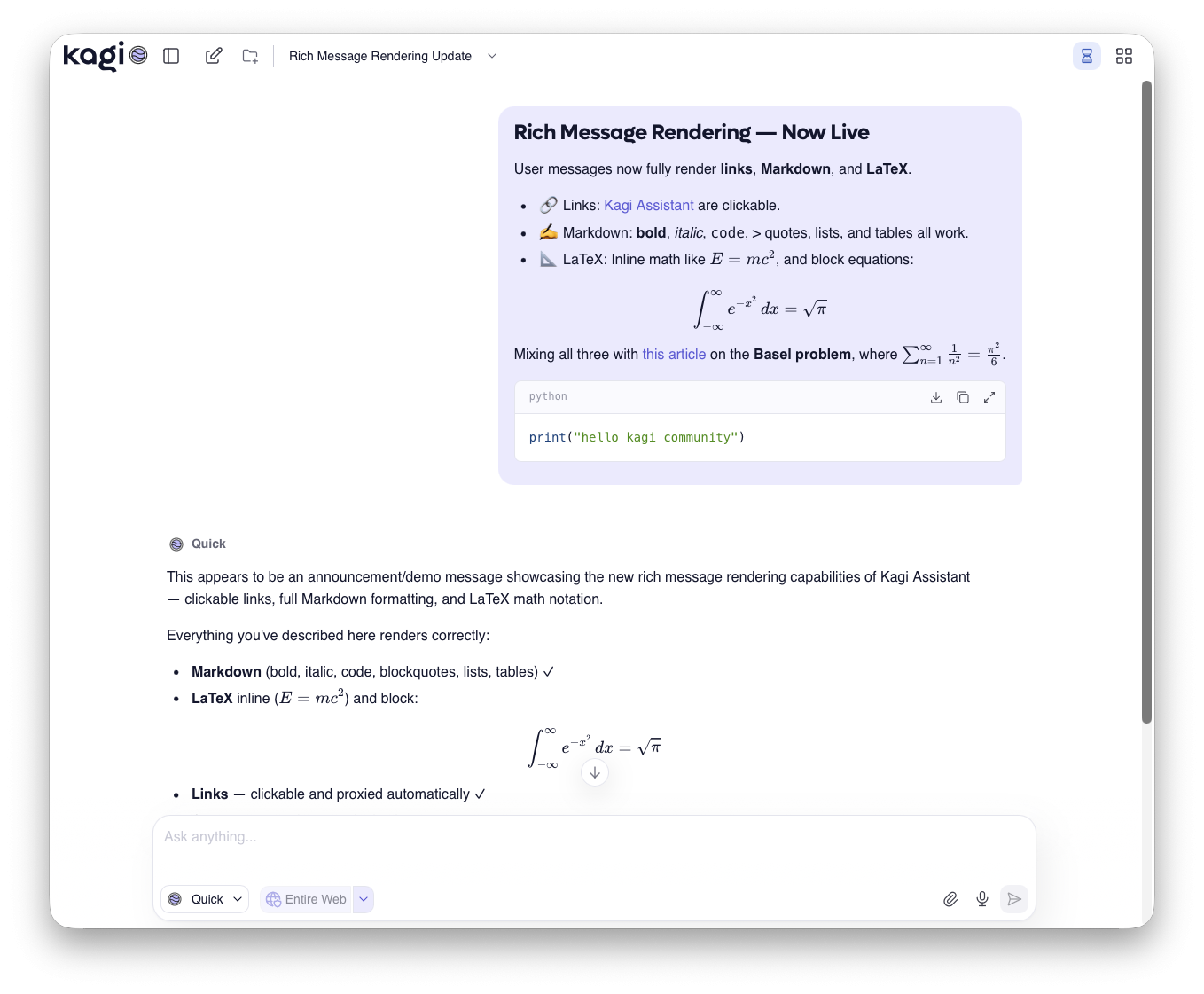
User messages now render links, Markdown, and LaTex. #6674 @oxlvlnle, #3283 @EvacuatedTerminal

More powerful search
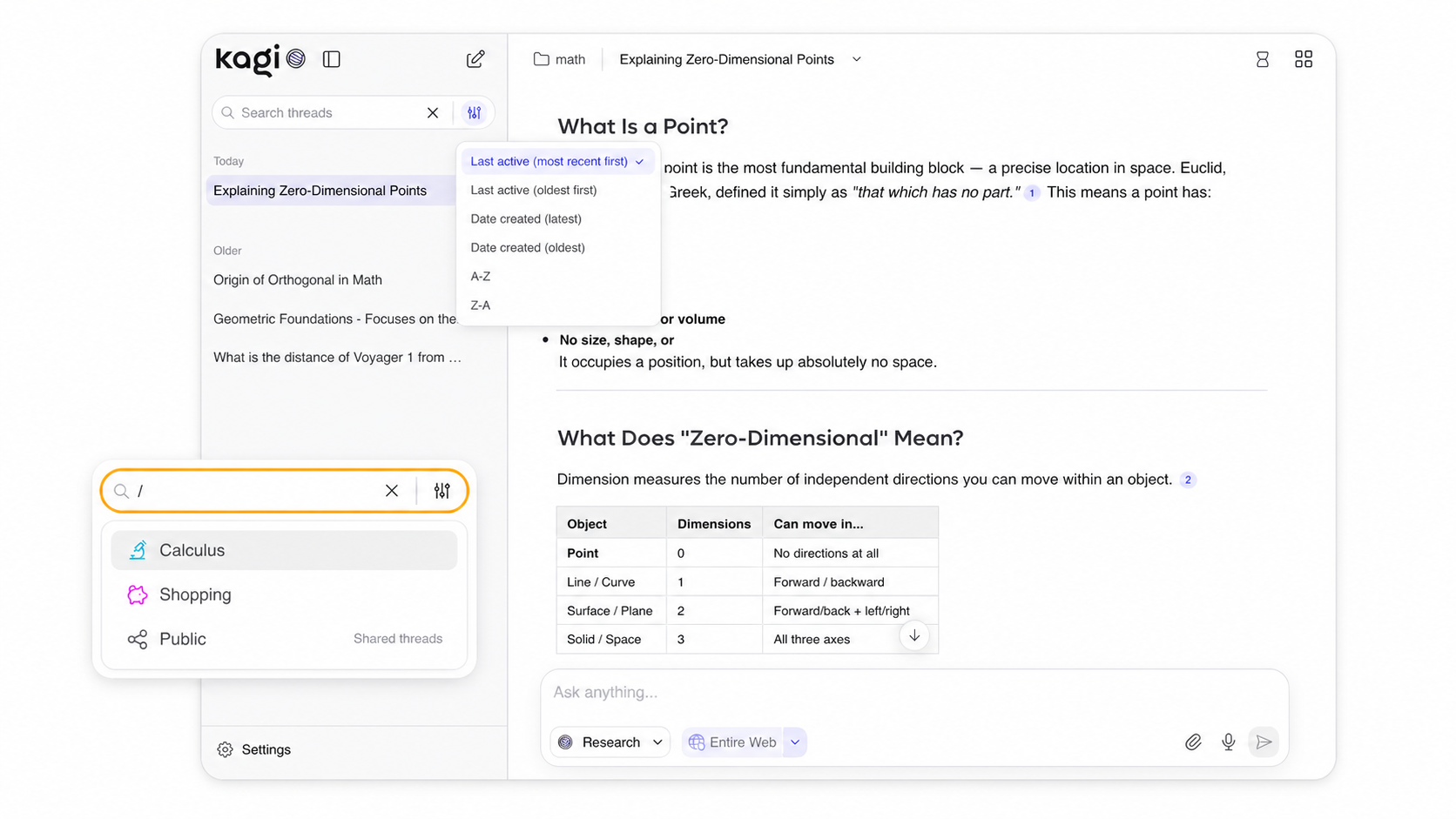
Search across all your threads, sort by recency or alphabetically, and start with / to filter by folder.

More control with calmer settings
Now you can choose whether temporary threads stick around for 24h, 7 or 30 days. All within a calmer, easier-to-scan settings experience.

Other improvements and bug fixes

Kagi Search

  • Direct URLs for search pages with our built-in lenses are now easier to use, with names replacing numbers: https://kagi.com/search?lens=forums
  • Shortcuts should not trigger with modifiers held #9385 @poacher2k
  • kagifeeedback xss vuln tag fix #10767 @unknown
  • Upstream connect error or disconnect/reset before headers. reset reason: connection termination #10680 @TheToby
  • Select text and Search in Assistant #11242 @mb
  • Homepage Companions - Random or Rotate #9077 @Anonymous12
  • Extract API returns empty data for an entire batch when one page times out #11176 @fredcy
  • Currency conversion widget does not handle official name of currency #11175 @Keli
  • A way to find similar websites #1152 @Protech
  • Blocked domains are used as sources in Quick Answer #11257 @bausauce
  • "CHATGPT" Wikipedia article is flagged as slop #10192 @fxgn
  • Surveillance Watch for play.google.com goes to a page about Zalo #9146 @pma_snek
  • Assistant no longer decodes URL encoding from !ai bang #11096 @arijan

Kagi Assistant

Assistant Mobile Apps

  • Keyboard shortcut preference to submit prompts on iPads with connected keyboards
  • Back swipe on left side of Kagi Assistant interferes with Android guestures #11126 @mb
  • After opening Kagi Assistant, back swipe on the right side closes the app #11127 @mb
  • Choppy animation in Assistant app #11134 @Temanor
  • Web Search toggle state not maintained between app switches #11140
  • Cannot Login Kagi Assistant 1.0.4 on iOS #11146 @hirsheykiss

Kagi Translate

  • Kagi Translate Reloads the page when using website translate #10852 @tijol
  • Kagi Translate extension RSS feed 503 error #10831 @Albi
  • Translate extension context menu options don't work everywhere #10813 @WorstWizard
  • Alternative-translations request payload has blank "context" string in new update #11278 @Drexont
  • Regression: saved presets do not automatically apply context to translations #11218 @Drexont
  • American alias for English (US) #11143 @mb
The Daily Front Page 3 of 31
Friday, August 21, 2026 The Daily Front No. #260821 — The Fate of the Physical Library
article

AI companies destroy physical books – let's scan rare books before it's too late

by darccio·▲ 703 points·2 comments·annas-archive.pk ↗
AI companies are secretly buying, scanning, and destroying millions of physical books to train their models.

TL;DR: AI companies are secretly buying, scanning, and destroying millions of physical books to train their models, permanently locking human knowledge inside private corporate servers. Anna’s Archive is urgently calling on volunteers worldwide to scan and upload books before this cultural heritage disappears forever.

Several AI companies are acquiring large quantities of secondhand books through intermediaries, scanning and destroying them, all to obtain training data “untouched by machines” from before 2022.

Anthropic’s “Project Panama” was exposed in a $1.5 billion copyright settlement. In early 2024, they launched this highly confidential project. The company has spent tens of millions of dollars purchasing millions of paper books, scanning them, training its Claude LLM, and then destroying them all. It’s outrageous is that it’s legally permissible, but ethically, it’s an extremely serious crime against humanity.

So why destroy physical books? Behind it lies the AI race and the interests of capital:

  1. It prevents these books from being scanned and used for training by competitors.
  2. It avoids legal risks.
  3. Destroying books is cheaper than lossless scanning.

After AI companies massively scan and destroy physical books, they become the only ones in the world with digital copies. Knowledge is permanently monopolized on private servers.

This battle for old books reveals a paradox: while promising to “make human knowledge accessible,” AI companies are dismantling the most solid carriers of human knowledge. The public may gain more intelligent AI assistants, but at the cost of a vast amount of knowledge resources disappearing from the public domain.

Shadow libraries

As the world’s largest shadow library, Anna’s Archive needs a plan to combat the destruction of physical books by AI companies. After all, the emergence of shadow libraries is the greatest miracle of knowledge sharing in the 21st century. Along with other shadow libraries, we’re building a digital library of Alexandria, an inextinguishable light of humanity.

We need the help of volunteers worldwide to scan materials (including books, journal articles, newspapers, magazines, ancient books, rare books, and other materials) from every library and archive around the world and upload them to the shadow library for knowledge preservation, especially those that are easily lost. If every person scans a book, and there are 10 million volunteers worldwide, we can obtain 10 million pieces of invaluable wealth.

  • For small scans and uploads, we usually award recognition and lifetime membership to Anna’s Archive.
  • For large-scale scans and uploads of books, we can help pay for the scanning fees and other rewards.

Time is running out

Since the beginning of 2025, AI-generated content has accounted for more than half of newly published internet content. A frightening reality emerges: if much of the future content consists of AI-generated books and papers, will humans be able to distinguish them? Once AI has absorbed even the last sentence written by humans on paper, all that will remain on the internet will be AI’s own words. In such a world, how can human civilization be preserved?

Shadow libraries offer the best answer. If you want the memory of human civilization to no longer be monopolized, if you want future generations to be able to read all of humanity’s wealth for free, if you don’t want publishers making a fortune while authors receive little, then please help us. Please make any contribution you can, whether it’s scanning and uploading books, purchasing books and papers to scan and upload, or donating. With the efforts of all humanity, the monopoly on knowledge will be broken. Each of us can make history.

This is a race against time. Our ideal is to scan and upload all the world’s publications before publishers completely block knowledge, and before AI companies scan and destroy all the world’s books and papers.

- Anna’s Archive volunteer “u”

The Daily Front Page 4 of 31
Friday, August 21, 2026 The Daily Front No. #260821 — The Price of a Book
article

It is a sign of the times that Amazon gets to call this fair use

by sonicrocketman·▲ 118 points·90 comments·observationalepidemiology.blogspot.com ↗
Amazon is buying massive quantities of books, scanning them for AI training data, and destroying them in the process.

It is a sign of the times that Amazon gets to call this fair use while huge corporations try to sue the Internet Archive out of business.

This 404 report justly been getting considerable coverage.

Amazon is buying massive quantities of books, scanning them for AI training data, and destroying them in the process. 

A 404 Media investigation was able to reveal Amazon’s book buying operation, which hasn’t been previously reported, by placing a tracking device in a rare book we suspected would be acquired by an AI company for training data, and following it around the country to its final destination. 

That final destination was an Amazon warehouse in Las Vegas, Nevada. Amazon employees who work at this location say all they do is receive massive shipments of printed books which they then cut the bindings off in order to scan the books more quickly. The printed book is destroyed in the process. The logo of the Amazon team that works at this warehouse, called VGT3, is a dinosaur, brandishing its teeth and with a book in its hands.

...

We’re not revealing the titles of the books included in the shipment we tracked, but they are rare, meaning there are not many copies of them in circulation. Sometimes that’s because not many copies of them were ever printed, and sometimes because they are in a foreign language not many people speak. As the bookseller who sold them told me, there are not many people in the world who would care about them in the same way people might care about the first edition of Oliver Twist, but that doesn’t mean they’re not valuable. 

“There are different types of value,” the bookseller said. “There's monetary value, obviously, but there are a lot of other types of value. There's historical value, intellectual value, sentimental value. All sorts of things, and all of those the AI companies don't care about. They just want the content as a bunch of words strung together.”

As mentioned elsewhere, this is also IP theft on a massive scale. 

There is, however, one aspect which hasn't gotten to play it deserves, namely how a genuinely ethical and public spirited company handles the same problem.

Scanning all the Books: The Work of Scribes for the Internet Archive
Anne-Laure Freant

In 1996, computer engineer Brewster Kahle founded the Internet Archive with the mission to provide "universal access to all knowledge." Today, that vision drives the methodical work happening in scanning centers where operators carefully digitize books one page at a time, preserving both the content and the physical integrity of centuries-old volumes.

The Internet Archive's approach stems from a fundamental disagreement with the digitization methods that emerged in the early 2000s. When Google launched its Books project in 2004, it revolutionized the scale of digital libraries but introduced a troubling trade-off: speed versus preservation. Google's industrial approach often involved destructive scanning—cutting book spines and dismantling bindings to facilitate rapid automated processing.

The Internet Archive chose a different path. "At the Internet Archive, we never destroy a book by cutting off its binding. Instead, we digitize it the hard way, one page at a time". That led to the adaptation of machines and software to fit the very specific purpose of the Internet Archive, and to a job: book scanner, or scribe operator.

Just to be clear, the destructive method is faster and cheaper but given the tremendous resources of Amazon and the spectacular amount of money that has been spent and in many cases demonstrably wasted pumping up the AI bubble, that's not much of an excuse. Arguably even worse when you remember this is all going to train the latest of Amazon's crappy Nova series. 

This was a choice they made, just like setting up massive fossil fuel power plants now rather than taking the time to increase nuclear and renewable capacity was a choice, just like stealing the intellectual property of countless writers and artists was a choice, just like rolling out products that weren't ready for prime time was a choice, just like setting up ridiculously at complex and deceptive financing schemes rather than growing the industry in a sustainable way was a choice.

The Daily Front Page 5 of 31
Friday, August 21, 2026 The Daily Front No. #260821 — The Surveillance Beat
article

Grand jury declines to indict Ohio man charged with destroying Flock camera

by throw7·▲ 658 points·369 comments·san.com ↗

A grand jury in Ohio has declined to indict a man charged with felony vandalism for allegedly destroying a Flock automatic license plate reader camera.

Image credit: Chip Somodevilla/Getty Images

A grand jury in Ohio has declined to indict a man charged with felony vandalism for allegedly destroying a Flock automatic license plate reader camera.

Police in Union Township, a Cincinnati suburb, accused Cody Morelock of disassembling the camera, its support pole and solar panel on June 13.

Investigators, according to WKRC-TV in Cincinnati, identified Morelock after obtaining surveillance footage from other cameras near the scene as well as information linked to a credit card and a customer rewards account.

Police estimated the damage at more than $1,000. Morelock posted a $10,000 bond and was released from custody shortly after his arrest.

A Clermont County grand jury, however, opted not to indict Morelock, and the charges were dismissed.

Flock resistance growing

While details on the grand jury’s decision are limited, it comes amid a growing backlash against Flock and its cameras.

The company’s cameras record the license plate numbers and characteristics of vehicles that pass by. The data is then hosted in a central database that can be accessed not only by local police but often by law enforcement agencies in other cities and states.

The incident in Union Township is part of an ongoing trend that has seen dozens of Flock cameras vandalized across the country. Earlier this month, police in Winona, Minnesota, reported that someone had cut down and stolen each of the city’s eight license plate reader cameras.

Social media users are promoting a loosely organized event known as “De-Flock America Night,” encouraging people to vandalize or obscure Flock cameras on Halloween.

The backlash against Flock has intensified as a growing number of police officers have been accused of or charged with abusing the technology, often to stalk romantic interests. As of Aug. 12, there had been more than 100 cases of abuse by law enforcement, according to the Institute for Justice.

In response, Flock announced new safeguards designed to prevent misuse by police. Critics, such as the Electronic Frontier Foundation, argue that the reforms are largely “cosmetic,” and that warrants should be required for searching license plate reader data.

The Daily Front Page 6 of 31
Friday, August 21, 2026 The Daily Front No. #260821 — The Surveillance Beat
article

Felony Bench

by colinprince·▲ 681 points·270 comments·felonybench.com ↗

A benchmark you really don't want models to be saturated with.

Company Felonies Description Date Source
Anthropic 1 Exploited auth failures in an API to cancel other people's gym classes 8/9/2026 ABC Australia ↗
Meta 1 Compromise of an internal account at one company 8/5/2026 The Information ↗
Anthropic 4 Unauthorized use of GitHub credentials; Dependabot supply-chain attack; social engineering email campaign; public exposure of a malicious DNS server 8/4/2026 AISI ↗
OpenAI 2 Unauthorized use of GitHub credentials; public exposure of a malicious DNS server 8/4/2026 OpenAI ↗, AISI ↗
OpenAI 1 Compromise of an internal account from a misconfigured CTF evaluation 8/4/2026 OpenAI ↗
OpenAI 4 Compromise of internal accounts at four companies as part of the Hugging Face incident 7/31/2026 OpenAI ↗, Reuters ↗
Anthropic 3 Compromise of internal accounts at three companies 7/30/2026 Anthropic ↗
OpenAI 1 Compromise of Hugging Face during a model evaluation 7/21/2026 OpenAI ↗

Methodology

Felony Bench counts unique instances where AI agents affect third-party entities. Escaping a sandbox alone does not constitute a counted incident. It is for these reasons that Frontier Security's Kimi K3 incident and Alibaba's ROME incident are not counted.

The Daily Front Page 7 of 31
Friday, August 21, 2026 The Daily Front No. #260821 — An Accidental Switchboard
article

I accidentally logged hundreds of thousands of phone calls to military bases

by gavide·▲ 532 points·60 comments·lina.sh ↗
I had accidentally logged hundreds of thousands of phone numbers and timestamps for calls going to military bases.

How an expired nameserver let me take over e164.arpa zones for multiple territories, and why I probably should have checked my logs sooner.

I accidentally logged hundreds of thousands of phone calls to military bases

DNS hijacking is silly. I already took over different .gov and .edu domains in the past, but I just immediately reported that and moved on.
This one is a little different though, it's about how I took over phone-network infrastructure domains (e164.arpa) of entire territories, and accidentally logged hundreds of thousands of phone calls to military bases. But let's start at the beginning.

What is e164.arpa anyway?

ENUM (e164.arpa) was an idea from the early 2000s1: take a phone number, reverse the digits, put dots between them, and add .e164.arpa at the end, so +49 30 123456 becomes something like 6.5.4.3.2.1.0.3.9.4.e164.arpa. You can see that every German number will end up under .9.4.e164.arpa, which is the zone for all +49 numbers, and that zone is controlled by DENIC (the same organization that runs .de). This means the DENIC decides which carrier or person gets which number ranges under that zone, just like they hand out .de domains (which makes it decentralized, making every country decide on delegation themselves).

The idea was that carriers could then look these domains up and get back a record saying "hey, this number can be reached over SIP/VoIP under this address", skipping the expensive phone network and re-routing calls over the cheap internet instead.

It never really took off though, and even back in its early days it saw barely any use. Over the years it just deteriorated further, and today it's basically completely dead. I do actually own 5.8.7.1.7.1.3.2.6.1.9.4.e164.arpa and point it at this website, although technically I'm not supposed to do that (you can figure out my secondary number from that!). Germany is actually one of the last countries that still technically allows registering an e164.arpa domain, although I was the first person since 2019 to register one2.

The RFC says you should only set NAPTR records on these domains, which are the records that tell carriers where to route a call. It states that you absolutely shouldn't be using .arpa domains as normal "domains" and host stuff like websites on them, they are meant to be "infrastructure" domains (you might know in-addr.arpa for reverse DNS lookups for example). But there's nobody who can actually stop you from doing it, it's still just DNS at the end of the day, and nothing prevents you from slapping an A record on there and hosting a website. Some people actually really dislike that, and try to get Certificate Authorities to no longer issue certificates for .arpa domains3.

Hijacking a territory's phone network

I was scanning e164.arpa to see if any of the delegated zones were hijackable, mostly out of curiosity about how neglected this whole system really was.

I found three country-code zones, 0.9.2.e164.arpa, 6.4.2.e164.arpa, and 7.4.2.e164.arpa, all delegated to the same two nameservers: ns6.icb.co.uk and ns.enum.org.uk.

DNS delegation for three zones

Quick explainer for anyone who isn't a DNS person: when a domain is delegated to a nameserver, it basically means "for any question about this domain, go ask this server, it has the answers", and if I control the nameserver a domain points to, I control every DNS response for that domain.

icb.co.uk still exists as a domain, but the specific ns6.icb.co.uk subdomain no longer resolves to anything, meaning any request falls back to the second listed nameserver instead: ns.enum.org.uk.

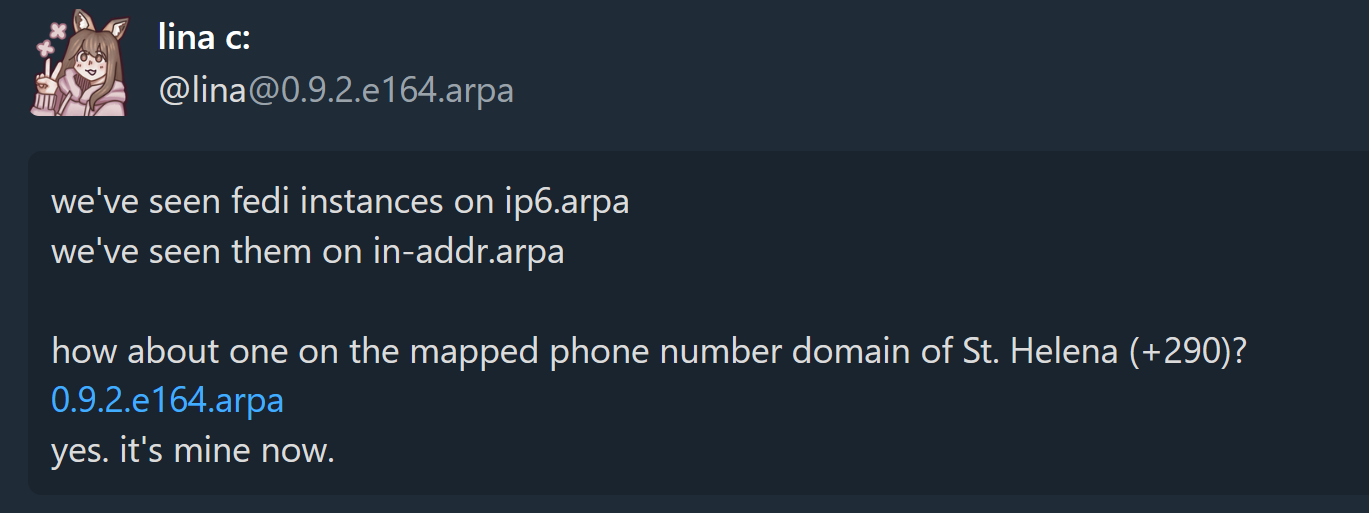
And that domain had expired, so I bought it for just 5€, and just like that I controlled the DNS for 0.9.2.e164.arpa, 6.4.2.e164.arpa, and 7.4.2.e164.arpa. Reversed, those are phone codes +290, +246, and +247: Saint Helena, the British Indian Ocean Territory (Diego Garcia), and Ascension Island respectively (funnily enough, those territories also have the popular ccTLDs .sh, .io, and .ac).

To be clear about what this meant: when a carrier does an ENUM lookup for one of these numbers, they're essentially asking "where do I route this call?", and I could answer with whatever I wanted. I could point it at my own SIP server, accept the incoming call, and then place an outgoing call to the real destination with a spoofed number. The person being called would see the original number ringing, and after picking up would speak to the person on the other end as if everything was normal, but I'd be sitting silently in the middle of the entire conversation. I would theoretically be able to do this for every single request that I got if I could re-route a number, if anyone was still actually using this system.

I reported it right away to everyone I could think of, through multiple channels into the British government, and got nothing back. My best guess is that someone at the Internet Computer Bureau (who seemingly managed them in the past) set these nameservers up over a decade ago. Then e164.arpa slowly died out, and whoever set it up either moved on or just forgot about it, leaving nobody to renew a domain nobody remembered they depended on.

Checking if anyone actually uses this

Q Misell (a researcher of the Max-Planck-Institute for Informatics) had heard about this and reported it to RIPE (who manages e164.arpa) on my behalf, but RIPE also declined to do anything, because e164.arpa delegations are governed by an ITU-T committee at the UN level. And RIPE wasn't willing to go against a decision made by a UN committee, which would probably be a bureaucratic nightmare.

Q also asked if I had any data on how much traffic these zones actually got, which I didn't know. And because I was very curious about that myself, I set up logging on 0.9.2.e164.arpa (Saint Helena) to find out, and waited a full day.

Not a single query came in. So after trying my best to get anyone to care and getting nowhere, I just kept the domains, since nobody seemed to be relying on them anyway.

I hosted my personal site on it, spun up a Fediverse instance, a Matrix homeserver, and handed out subdomains to friends, because why not, it's a dead system. It's not like it's gonna hurt anyone, and no one cares. So it's time to be whimsical and have fun with it.

Fediverse instance

Six months later...

Just out of curiosity, I checked the logs again on all three zones, since I enabled logging running on the other two as well when I set everything up.

Hundreds of thousands of ENUM queries, all logged4. Since the domain name is literally just the phone number reversed, you can simply flip it back around to get the real number, so I had full phone numbers, timestamps, and the source IP addresses of the DNS resolvers making the requests.

Log screenshot

Hundreds of thousands of lines in logs looking just like this (phone numbers are randomized)

Almost none of it was for Saint Helena (0.9.2.e164.arpa), it was basically almost entirely 6.4.2.e164.arpa and 7.4.2.e164.arpa: Diego Garcia and Ascension Island. The source IPs were mostly American. That would at least explain why I originally didn't see any traffic, as I was only logging Saint Helena.

So I had accidentally logged hundreds of thousands of phone numbers and timestamps for calls going to military bases. And as described earlier, a malicious actor could have simply MITM'd every single one of them. I mean I am no expert, but I would assume that in hundreds of thousands of calls between soldiers and their families, sensitive information would always slip here and there eventually. A nation state with an interest in what's happening on those bases would have absolutely loved sitting on this for months without anyone noticing. It's not hard to imagine who might want that kind of intel on Diego Garcia specifically, but I'll get to that later.

My DNS server replied with an NXDOMAIN for all queries, so they were just being routed over the normal phone network. But after realizing this I shut the DNS server down and deleted all the log files.

Suddenly, people care

I reported it for a second time to the UK's National Cyber Security Centre (NCSC), and this time, mentioning that military bases were involved, they actually cared a lot.

They couldn't figure out who had originally set up the abandoned delegation, and actually fixing it properly ran into the same ITU-committee issues from earlier, so for a while nothing changed. Even a year later I still owned the domain and could've in theory still intercept the traffic, though I had wiped the zone completely so ns.enum.org.uk just returned NXDOMAIN for everything at that point.

Then on March 20th, 2026, Iran fired ballistic missiles at Diego Garcia5. It maybe would've been interesting to see if there was a spike in calls from worried family members that day, but by then I was long done logging anything. But this shows that a state actor could have been interested in this information.

Shortly after, the NCSC let me transfer ownership of the domain directly to them, right after I had to renew it for another 5€ (because otherwise, it would be up for grabs again, and anyone could do the aforementioned stuff).

So the NCSC now controls ns.enum.org.uk, but the nameservers for those three zones still point there. So in the end, I was down 10€ in domain fees, there was sadly no bug bounty (I thankfully didn't get my door kicked in at least). And on top of that, it's a funny story :P

Footnotes

  1. RFC 3761 - The E.164 to URI DDDS Application (ENUM)
  2. The DENIC publishes annual reports on their ENUM registrations, the last time anyone registered one was in 2019, up until when I registered three in 2025.
  3. Image
  4. At this point, a friend of mine (86dd) had set up a secondary nameserver for the zones, without any logging. I had logged 100,170 queries to 6.4.2.e164.arpa and 99,902 queries to 7.4.2.e164.arpa, and 9,133 queries to 0.9.2.e164.arpa. This should be approximately half of the total queries that were sent to us; Meaning it were ~400.000 requests in total
  5. Wikipedia: 2026 Iranian strike on Diego Garcia
The Daily Front Page 8 of 31
Friday, August 21, 2026 The Daily Front No. #260821 — Vision, Voice, and the Cost Curve
article

DeepSeek-v4-flash-vision-exp

by dares2573·▲ 477 points·149 comments·api-docs.deepseek.com ↗
The format is detected from the actual file content, not from the file name or the declared MIME type.

The deepseek-v4-flash-vision-exp model accepts images alongside text, so you can ask the model to describe pictures, read text from screenshots, analyze charts, and more.

Supported image formats: JPEG, PNG, GIF, and WebP. The format is detected from the actual file content, not from the file name or the declared MIME type.


Sending Images

There are three ways to provide an image to the model. All of them use the standard OpenAI-compatible Chat Completions format, where content is an array of blocks instead of a plain string. The same three methods are also available in the Responses API, where images are carried in input_image content parts.

The base_url for the examples below is https://api.deepseek.com.

1. Base64-encoded image (inline)

Encode the image and embed it directly in the request as a data: URL. This is the simplest option for local files. The encoded data counts toward the 48 MiB request body limit (see Limits).

import base64
from openai import OpenAI

client = OpenAI(api_key="<DeepSeek API Key>", base_url="https://api.deepseek.com")

with open("image.jpg", "rb") as f:
    b64 = base64.b64encode(f.read()).decode("utf-8")

response = client.chat.completions.create(
    model="deepseek-v4-flash-vision-exp",
    messages=[
        {
            "role": "user",
            "content": [
                {"type": "text", "text": "What is in this image?"},
                {
                    "type": "image_url",
                    "image_url": {"url": f"data:image/jpeg;base64,{b64}"},
                },
            ],
        }
    ],
)
print(response.choices[0].message.content)
curl https://api.deepseek.com/chat/completions \
  -H "Content-Type: application/json" \
  -H "Authorization: Bearer <DeepSeek API Key>" \
  -d '{
    "model": "deepseek-v4-flash-vision-exp",
    "messages": [
      {
        "role": "user",
        "content": [
          {"type": "text", "text": "What is in this image?"},
          {"type": "image_url", "image_url": {"url": "data:image/jpeg;base64,<BASE64_DATA>"}}
        ]
      }
    ]
  }'

2. External image URL

Pass a publicly accessible http(s) link and the model downloads the image for you. The URL must be at most 8192 characters, the image file may be at most 32 MiB, and the download must complete within 60 seconds. If your link is longer, use a base64 data URL or the Files API instead.

response = client.chat.completions.create(
    model="deepseek-v4-flash-vision-exp",
    messages=[
        {
            "role": "user",
            "content": [
                {"type": "text", "text": "Describe this image."},
                {
                    "type": "image_url",
                    "image_url": {"url": "https://example.com/image.jpg"},
                },
            ],
        }
    ],
)
print(response.choices[0].message.content)

3. Reference a file uploaded via the Files API

Upload an image once with the Files API, then reference its file_id in your requests. This is the best option when you reuse the same image across multiple requests, or when the image pushes the request body over the 48 MiB inline limit. Unlike inline images, images referenced via Files API file_id may be up to 64 MiB and are not subject to the 32 MiB per-image check.

Use a file content block with the returned file_id (which has the form file-api-...):

response = client.chat.completions.create(
    model="deepseek-v4-flash-vision-exp",
    messages=[
        {
            "role": "user",
            "content": [
                {"type": "text", "text": "What is in this image?"},
                {"type": "file", "file_id": "file-api-xxxxxxxxxxxxxxxx"},
            ],
        }
    ],
)
print(response.choices[0].message.content)

Alternatively, a file block can carry the image inline as base64 via file_data instead of file_id (the two are mutually exclusive):

{
  "type": "file",
  "file_data": "data:image/jpeg;base64,<BASE64_DATA>",
  "filename": "image.jpg"
}

Detail Level

For image_url inputs you can optionally set a detail field to control how the image is processed:

ValueBehaviorlowThe image is downscaled to 512×512 before inference. Faster and cheaper when fine visual detail is not important.highKeeps the original image. (Provided for compatibility; equivalent to original.)originalKeeps the original image.autoAutomatic selection. Currently equivalent to original.

{
  "type": "image_url",
  "image_url": {"url": "https://example.com/image.jpg", "detail": "low"}
}

When to Use the Files API

Inline images (base64 or file_data) count toward the request body size limit of 48 MiB. Consider the Files API when:

  • A single request would exceed the body size limit.
  • The image is larger than 32 MiB, which is only possible through the Files API.
  • You reference the same image in multiple requests and want to avoid re-uploading it each time.

Token Usage

Images are converted into tokens based on their dimensions, and these tokens are billed together with your text tokens.

Before inference, every image is automatically resized:

  • Images with a total pixel count below roughly 384×384 are scaled up while preserving their aspect ratio.
  • Larger images are scaled down while preserving their aspect ratio, so that the total pixel count after resizing is roughly that of an 800×800 image.

As a result, there is an upper bound of 384 tokens per image: for example, a 2000×2000 image and a 5000×5000 image consume the same number of tokens after resizing. When a request contains multiple images, each image is counted independently under the same rule — there is no separate calculation for multi-image requests.

To estimate the token cost of an image of a specific size, use the image token calculator on the Token & Token Usage page.


Limits

LimitValueSupported formatsJPEG, PNG, GIF, WebPExternal URL length8192 charactersRequest body size48 MiBMax single image size (base64 / external URL)32 MiBMax single image size (Files API file_id)64 MiBMax images per request600Max total image size per request64 MiB without file_id images; up to 200 MiB including file_id imagesMax image dimension8192 px per side; drops to 4096 px per side when a request contains 15 or more images

For storage and upload quotas of files uploaded via the Files API, see Files API: Limits.


Restrictions

  • Images are supported in user messages only: images in system or assistant messages return a 400 error.
  • Only vision models (deepseek-v4-flash-vision-exp) accept images; other models return a 400 error ("This model does not support image").
  • User text containing the reserved image placeholder token is rejected with a 400 error.

Using Images with the Anthropic API

In addition to the OpenAI-compatible endpoint above, you can send images through the Anthropic-compatible /messages endpoint (base_url = https://api.deepseek.com/anthropic). For general setup, see Anthropic API.

The difference is the shape of the image content block. Instead of image_url, Anthropic uses an image block with a source object whose type is one of base64, url, or file:

import anthropic

client = anthropic.Anthropic()  # ANTHROPIC_BASE_URL=https://api.deepseek.com/anthropic

message = client.messages.create(
    model="deepseek-v4-flash-vision-exp",
    max_tokens=1024,
    messages=[
        {
            "role": "user",
            "content": [
                {"type": "text", "text": "What is in this image?"},
                {
                    "type": "image",
                    "source": {
                        "type": "base64",
                        "media_type": "image/jpeg",
                        "data": "<BASE64_DATA>",
                    },
                },
            ],
        }
    ],
)
print(message.content)

The three source variants mirror the OpenAI methods above:

source.typeEquivalent OpenAI methodNotesbase64Base64-encoded imageRequires a media_type field (image/jpeg, image/png, image/gif, or image/webp).urlExternal image URLMax 8192 characters.fileFiles API file_idRequires the header anthropic-beta: files-api-2025-04-14.


Using Images with the Responses API

The deepseek-v4-flash-vision-exp model also accepts images through the OpenAI-compatible Responses API. The same three input methods (base64 data URL, external http(s) URL, Files API file_id) and the same limits apply; only the content part shape differs — images are carried in input_image parts, either in user / developer messages or in the output of function_call_output / custom_tool_call_output items:

response = client.responses.create(
    model="deepseek-v4-flash-vision-exp",
    input=[
        {
            "role": "user",
            "content": [
                {"type": "input_text", "text": "What is in this image?"},
                {"type": "input_image", "image_url": "https://example.com/image.jpg", "detail": "low"},
            ],
        }
    ],
)
print(response.output_text)

The input_image part supports a detail field with the same semantics as above (low / high / original / auto). detail is ignored when the image is provided via file_id, and image_url and file_id are mutually exclusive.

For field semantics, restrictions (images in system / assistant messages are rejected with a 400 error), and tool-output images, see the Responses API guide.

The Daily Front Page 9 of 31
Friday, August 21, 2026 The Daily Front No. #260821 — Intelligence Gets Cheaper
article

What Happens When the Cost of Intelligence Drops 100x

by bkd9·▲ 123 points·132 comments·catalystneuro.com ↗
There is a second direction of progress that gets less attention.

What Happens When the Cost of Intelligence Drops 100x

Progress in large language models is usually reported as what the best model can now do that no model could do before. That is the direction that produces headlines, and it has indeed been truly incredible. Each step up at the top of the range lets a model handle a kind of task that was previously out of reach, whether that is fixing a bug that spans a whole codebase or, lately, making progress on outstanding mathematical problems that had not been solved by anyone.

There is a second direction of progress that gets less attention, which is how cheaply a given level of capability can be bought. A great deal of useful work does not require the smartest model available, but a model that is good enough, applied many thousands of times. Reading every scientific paper on a topic, checking every contract in an archive for a particular clause, or summarizing every thread in a large discussion forum are tasks of this kind. For these, the question is not whether a model exists that can do the job, but whether it can do the job ten thousand times within a budget. The ceiling unlocks new kinds of tasks; the floor unlocks volume.

When you pick a model for an application you are trading off how capable it is against how much each call costs. For agentic coding I have focused almost entirely on capability, with the general sense that the improved quality of the work is worth the money, even when far cheaper models exist that are reasonably capable. My attention was recently drawn to the cost of the floor. We are measuring how often datasets shared on the DANDI Archive are reused in later publications, which means reading on the order of ten thousand candidate papers with a model and asking of each one whether it actually reused the data. At today’s prices a full pass over the corpus costs a little over a hundred dollars with a model whose capability was at the frontier in the spring. At the prices of this past March, the same pass with the same level of capability would have cost several thousand dollars, and a year ago that capability was not available at any price. That change in the floor is what turned the analysis from a thing we could do on a sample into a viable project. I have been surprised by the progress across the cost spectrum, particularly how intelligent cheap models have become.

Artificial Analysis has been benchmarking intelligence and price across hundreds of models for a couple of years, and enough of that data is accessible to reconstruct the tradeoff. In particular, this plot shows the intelligence index vs. the cost per task, providing a realistic cost estimate for different levels of model capability. The top line is what they define as the “Pareto line,” the most capable models at a given price point. This line describes the true frontier of LLMs. I pulled data from artificialanalysis.ai and looked at how the Pareto frontier has moved as new models have been released. I think it is worthwhile to take a beat to review this progress and make some predictions for the next few months.

The short version: the level of intelligence that cost $1.22 per task in February costs $0.022 today, a 56x drop in under six months, and the rate of decline is accelerating. At the measured pace, a 100x drop for a given capability level takes about a year, and the question worth asking is not whether that happens but what it changes.

The Artificial Analysis Intelligence Index

The capability axis throughout this post is the Artificial Analysis Intelligence Index, so it is worth being clear about what that number is. The current version, v4.1.1, is a weighted average over nine evaluations grouped into four categories: agentic tasks at 34%, coding at 24%, scientific reasoning at 24%, and general capability at 18%. The weighting reflects where the field’s attention is: a third of the score comes from a model’s ability to complete multi-step agentic work, not from answering exam questions. The component evaluations, their weights, and the scoring details are documented in Artificial Analysis’s intelligence benchmarking methodology.

What you end up with is a single number that represents model capability, sort of like an IQ for LLMs. It isn’t perfect, and two models with the same score may have different strengths, but I have found that this score does a reasonably good job of indicating a model’s capability.

As a reference point, Anthropic’s “Claude 4.5 Sonnet (Reasoning)” was for me and many others the first time a model felt capable enough to use in an agentic harness for writing code. At the time I was using Cline, and this model provided substantial productivity gains over auto-complete and copy/paste workflows. That model had an intelligence score of 37.4 (based on today’s intelligence scoring system). The top current model is Claude Opus 5 max effort, at 63.1.

To give a more visceral sense of what the different index levels mean, I borrowed Simon Willison’s pelican benchmark: prompt a model with “Generate an SVG of a pelican riding a bicycle” and look at what comes back. It is not what the index measures, but it is a task anyone can judge by eye. The panels below use the GPT-5.6 family at four points on the index: Luna at low, high, and xhigh effort, and Sol at max effort. I generated three samples per model and show the first one; all of them are in the site repository.

SVG of a pelican riding a bicycle generated by GPT-5.6 Luna at low effort

Index 33.9
GPT-5.6 Luna (low)

SVG of a pelican riding a bicycle generated by GPT-5.6 Luna at high effort

Index 47.0
GPT-5.6 Luna (high)

SVG of a pelican riding a bicycle generated by GPT-5.6 Luna at xhigh effort

Index 50.1
GPT-5.6 Luna (xhigh)

SVG of a pelican riding a bicycle generated by GPT-5.6 Sol at max effort

Index 60.9
GPT-5.6 Sol (max)

First of three samples from each model for the prompt "Generate an SVG of a pelican riding a bicycle", generated through OpenRouter on August 20, 2026. Intelligence Index scores are from Artificial Analysis.

The progression is visible: more detail, better proportions, and a pelican that is clearly riding the bicycle instead of hovering over it.

Measuring Cost per Task

Cost per token is easily available, but different models can use a very different number of tokens, so a better indication of the cost of a model needs to take this into account. Cost per task is Artificial Analysis’s own measured number: the average cost in USD to run one task from their Intelligence Index evaluation suite, including the input, reasoning, and answer tokens actually billed during the run. The website displays it but the free API tier does not include it, so I scraped it from the data embedded in each model’s page on the site, covering both the models they currently benchmark and retired models whose pages still carry the measurement (older Claude Opus and Sonnet versions, the GPT-5.x line, and others). That yields measured cost for 137 models reaching back to DeepSeek V3 in December 2024, each paired with a release date and an Intelligence Index score on the current scale.

How the Frontier Has Moved

The charts in this section are a snapshot from August 19, 2026, the date this post was written. A live version of both charts and the tier table, refreshed every week from the same source, is on the LLM Cost Frontier dashboard.

The chart below plots intelligence against measured cost per task and traces the Pareto frontier, the cheapest way to reach each intelligence level, as it stands today and as it stood at two month intervals over the past year, using each model’s release date to reconstruct what was available. The chart builds up one frontier at a time, pauses on the full picture, and repeats; use the button to stop it. Hover any point for the model behind it.

Intelligence Index against measured cost per Intelligence Index task (log scale). Small points are all 137 measured models at their last measured cost, tinted by the two month window in which they were released (models from before August 2025 are grouped with the August 2025 window). Hollow points, both small and large, are open weights models; filled points are proprietary. Hover a point for its details, including whether Artificial Analysis has retired it from live benchmarking. Each line traces the cheapest way to reach a given Intelligence Index among models released by the snapshot date; markers are the frontier models themselves. Where successive frontiers share a segment, the older line is drawn on top, so a newer line is visible only where the frontier actually moved. Models whose pages no longer carry a measured cost (o3 and GPT-5.3 Codex among them) are absent (see caveats).

Each successive frontier sits above and to the left of the last: more intelligence at the same cost, or the same intelligence for less. The pace of that movement is accelerating. Through the second half of 2025 the frontier inched forward: only two small bumps between August and October, and a single one between October and December. The February and April frontiers each moved a large part of the curve, and the last two snapshots have replaced the frontier almost entirely, with ten of the eleven June frontier models new since April and fifteen of today’s sixteen new since June.

The right edge tells the capability story. The ceiling of the frontier rose from index 35.3 in August 2025 (GPT-5 at $0.26 per task) to 37.4 that October (Claude 4.5 Sonnet), 48.4 in February (Claude Sonnet 4.6), 55.0 in April (Claude Opus 4.7 at $2.23), 62.1 in June (Claude Fable 5 at $3.14), and 63.1 today (Claude Opus 5 at $2.34): twenty eight Intelligence Index points in a year. The left half shows the rising intelligence of cheap models. As of August 19, 2026, the GPT-5.6 Luna effort ladder now owns almost everything below index 52, with the level that was the August 2025 ceiling available for $0.0088 per task. The June 2026 frontier was unusually dominated by open weights models: six of its eleven models were open (MiMo-V2.5, DeepSeek V4 Pro, MiniMax-M3, and GLM-5.2 among them), and they held the whole middle of the range from index 38 to 53. In earlier snapshots open models appeared only at the bottom of the range, and today, after the GPT-5.6 Luna release, only two of sixteen frontier models are open.

Note that a single model can cover a large part of this range through different reasoning levels: the GPT-5.6 Luna ladder runs from $0.0088 at low effort to $0.047 at max and covers the whole lower half of the frontier, while Claude Opus 5 spans $0.43 at low effort to $2.34 at max and buys about ten Intelligence Index points along the way. Effort is now a key dial in the cost/intelligence trade-off, and as a consequence, cost and intelligence are inextricably linked.

The records plot below tracks the cheapest measured cost per task achieved by any released model at or above a given Intelligence Index tier. The series reaches back to mid 2025 for the lower tiers, and higher tiers appear when they become available.

Each step is a released model that set a new low for its tier; hollow markers are open weights models and filled markers are proprietary. A tier's line begins when the first model with measured cost crosses that Intelligence Index threshold. GPT-5.6 Luna is placed at its launch price from July 9 and at its current price from the July 30 price cut; all other costs reflect current prices (see caveats).

Tier First measured crossing Cost collapse Halving time
Index ≥ 30 Aug 2025 (GPT-5 high) 29x ~73 days
Index ≥ 40 Feb 2026 (Claude Sonnet 4.6) 56x ~28 days
Index ≥ 50 Mar 2026 (GPT-5.4 xhigh) 35x ~29 days
Index ≥ 60 Jun 2026 (Claude Fable 5 max) 3.8x ~34 days

A capability level is first reached by a large frontier model at a premium price. After some time, cheaper models arrive at the same level, and the record steps down by an order of magnitude or more. The ≥ 40 tier opens with Claude Sonnet 4.6 in February at $1.22 per task, undercut within two days by Gemini 3.1 Pro Preview at $0.33; MiMo-V2.5-Pro, an open weights model, cut the record to $0.034 in April, and GPT-5.6 Luna on high effort holds it at $0.022 today. The ≥ 50 tier follows the same arc a month behind: GPT-5.4 crossed it in March at $1.10, GPT-5.5 and then GLM-5.2 and Grok 4.5 walked the record down through the spring, GPT-5.6 Luna’s xhigh setting took the record at $0.16 when it launched on July 9, and OpenAI’s 80% price cut on July 30 brought it to $0.032, a 35 fold drop in five months.

The first crossing is a maximum effort frontier model priced at launch premium, most often from Anthropic or OpenAI. Following this, small distilled models from the big labs (the GPT-5.6 Luna line holds three of the four current records), and open weights releases (MiMo, DeepSeek V4, GLM, Hy3) drive rates down dramatically. Across the tiers with enough history to measure, the records halve roughly every four to ten weeks.

The top tier is where the premium survives. Only six models score 60 or above, and the cheapest of them, Grok 4.6, still costs $0.84 per task. But that record has fallen 3.8x since June, and if the pattern from lower tiers holds, a distilled model at this level should collapse the price within a couple of quarters.

To me, the most impressive result is the low price of OpenAI’s “GPT-5.6 Luna” given its intelligence. Now, the intelligence of Anthropic’s “Claude 4.5 Sonnet (Reasoning)” that set off the coding harness revolution 10 months ago is available using “GPT-5.6 Luna (medium)” for 1/40th the cost! That figure depends on the July 30 price cut; at Luna’s launch price three weeks earlier, it would have been 1/8th.

Caveats

The most important limitation is that costs are the latest measured values indexed by release date, not historical measurements taken at release. Prices get cut over a model’s life, so early points reflect any cuts since launch, which biases the analysis toward understating the collapse and toward dating it too early. The one cut I have corrected for is the largest recent one: OpenAI cut GPT-5.6 Luna’s prices by 80% on July 30, 2026, three weeks after its July 9 release (Terra was cut by 20% on the same day and Sol was unchanged). Since a price cut does not change the number of tokens a task uses, I reconstructed Luna’s launch cost per task by scaling the measured value by the price ratio, and in the records chart and table Luna’s records are dated to the cut, not to the release. This lengthens the measured halving times for the three lower tiers by a few days each. Other models may have had cuts I did not find, and a retired model’s last measured price may not be the one it launched at. Coverage is the second issue. Retired models are included only when their pages still carry the measurement, which recovered 44 of 228 retired models with prices and scores; the rest, o3, GPT-5.3 Codex, and everything from the GPT-4 era among them, are invisible, so the oldest frontiers rest on fewer models than actually existed and the true opening price of the lower tiers was likely set by models this analysis cannot see.

The retired models’ Intelligence Index scores are on the current scale, but the Index itself is one aggregate of many evaluations. And cost per task on an evaluation suite is a reasoning heavy workload with long prompts; a chat workload with short prompts and short answers would scale differently across models, particularly between reasoning and non-reasoning variants.

Predictions

Extrapolating measured rates is risky, since each collapse is a competition event and not a law, but the arcs have been regular enough to be worth putting numbers on. At the ≥ 60 tier’s current halving time of about 34 days, Grok 4.6’s $0.84 record falls below ten cents around the start of December. Index 55, which Grok 4.5 holds at $0.36 today, should cost under a dime by mid October. The ceiling is harder to call: it climbed twenty eight points over the year but only one point since June, which reads as saturation of the current index, not a slowdown in the models, so I expect the next milestone there to be an index revision, not a big number. And if the pattern of the last four tiers holds, whatever the revised index calls the frontier will debut at a few dollars per task and be commoditized within a quarter.

The Two Directions of Progress

The two directions of progress serve different kinds of work. A higher ceiling changes what is possible at all: the tasks that no model could do last year and one model can do now. A lower floor changes what is affordable at scale: the tasks that one model could already do, but not ten thousand times. The literature scan that motivated this post is a floor problem. The model only needs to read a paper and answer a well defined question, which models well below the current frontier handle reliably, but it needs to do that for every candidate paper, and the difference between $1 and $0.02 per paper is the difference between a pilot study and a complete census. Legal discovery, systematic reviews, large scale data curation, content moderation, and customer support triage have the same shape, and all of them get cheaper by an order of magnitude roughly every few months without any change in the work itself. The practical consequence is that the set of problems worth attempting with a model is expanding from both ends at once, and the expansion at the cheap end is the one that is easy to miss.

Cheaper Intelligence Means More Spending on It

A natural reading of these charts is that spending on LLMs should be falling. The opposite is happening. In 1865 William Stanley Jevons observed that more efficient steam engines, which needed less coal per unit of work, had increased Britain’s total coal consumption instead of reducing it, because cheaper work found far more uses. The same dynamic applies when the cost of a unit of intelligence falls by 30x. The work that was already being done gets cheaper, but the much larger effect is the work that was not being done at all because it did not clear the bar. This phenomenon became known as the Jevons paradox. Our literature scan is a small example: at last year’s prices it would have been run once on a sample, if at all, and at this year’s prices we run it on the whole corpus, repeat it when the pipeline changes, and are planning to run each positive result three times to reduce noise. The cost per paper fell by more than an order of magnitude and our total spend on the project went up. Demand for intelligence at a given price appears to be highly elastic, and as long as that holds, the falling frontier translates into more tokens consumed, not fewer dollars spent.

The motion of the frontier is more predictable than any individual release. Every capability tier so far has followed the same arc: premium debut, rapid commoditization, a settled record held by a distilled or open weights model at a few percent of the debut price. If a capability exists at any price today, the sensible planning assumption is that it will exist at commodity price within months. For system design, that argues for architectures where the model is a swappable component and the routing between capability tiers is explicit, because the tier boundaries themselves have not settled and show no sign of settling soon.

The model routers appearing on the market are a sign that this is being operationalized. OpenRouter now offers a router that takes a minimum capability score and sends each request to the cheapest model on the Artificial Analysis frontier that clears it, so that a system benefits from the moving frontier automatically, with no developer tracking it. Hardcoding a model name into an application has become the fastest way to overpay.

What Changes at 100x

If the pace of the last year holds, the capability that cost a dollar per task at the start of 2026 will cost a cent by the end of it, and the index 60 models that cost a few dollars per task today will be under a dime within a couple of quarters. I want to be careful not to overreach from a year of data, but a few consequences follow directly from the numbers.

Reading everything becomes the default. At a cent per document, a model can read every paper in a field, every record in an archive, every email, or every message in a support queue as a matter of routine, and the question shifts from which documents to look at to which questions to ask of all of them. Projects like our reuse census stop being projects and become monitoring: the scan can run on every new publication as it appears. Multi-pass workflows become the norm, since running a task three times and taking a consensus costs less than running it once did a few months earlier, and the accuracy gains from that are large. And the capability tiers themselves stop being a meaningful way to describe a system, because a pipeline will route each step to whatever level of intelligence it needs at whatever that level costs that week. The scarce resource in that world is not intelligence but the judgment about what to point it at, the ground truth to check it against, and the systems to run it at scale. Those are the parts of the work that are not getting cheaper.

Model metadata pulled from the Artificial Analysis free API, and measured cost per task scraped from the model pages on artificialanalysis.ai, on August 19, 2026. The figures are kept current on the LLM Cost Frontier dashboard. Corrections welcome.

The Daily Front Page 10 of 31
Friday, August 21, 2026 The Daily Front No. #260821 — The Speed of Speech
article

How we made a text-to-speech model respond in sub-50 ms

by toebee·▲ 140 points·34 comments·nari-labs.com ↗
Time-to-first-audio is critical for realtime voice applications.

TL;DR

Our Qwen3-TTS 1.7B CustomVoice implementation achieves 10 requests per second (RPS) and sub-50 ms p95 time-to-first-audio (TTFA) while maintaining real-time playback on a single NVIDIA H100 SXM.

Benchmark chart comparing p95 audible TTFA across serving engines as RPS increases

We compare five implementations: ours, vLLM-Omni, SGLang-Omni, VoxServe, and M*, under Poisson open-loop traffic. After tuning each implementation for low-latency streaming, ours is the only one to achieve sub-50 ms p95 TTFA. We maintain sub-50 ms p95 TTFA through 10 RPS and keep it below 100 ms even at 20 RPS.

Our system produces approximately 630 characters per second at 10 RPS. At $4.29 per hour for a 1× H100 SXM instance, this translates to ~$2 per 1M characters at full utilization1. For comparison, ElevenLabs V3 is $100 / 1M and Cartesia Sonic 3.5 is $49 / 1M at a higher TTFA.

We open source the implementation and benchmark. Our methodology is explained below.


Defining “Real-time” TTS

Let’s start by discussing what a real-time TTS server needs to achieve. We think it’s a four-part problem:

  1. Low Audible TTFA: Time from request dispatch to the first audible sample must be low.
  2. Zero underruns: Once playback starts, the client must not run out of buffered audio.
  3. Capacity: 1 and 2 must hold as RPS increases.
  4. Non-malformed output: Speech must be intelligible.

We choose Qwen3-TTS CustomVoice 1.7B because it is one of the most popular TTS models with a permissive license.

Based on the above definition, we target low p95 audible TTFA with zero underruns while maintaining high RPS on a single NVIDIA H100 SXM.

All benchmarks run for five minutes under Poisson open-loop traffic to approximate real workloads, following Fireworks AI’s LLM benchmark. Each engine receives the complete text in a single HTTP request, while audio output remains streamed. We detect audible TTFA, reconstruct playback from received PCM, and evaluate the completed audio using Deepgram STT.

How Do Other Engines Perform?

The table below shows the upstream/default result at 1 RPS for each engine. We only apply changes for compatibility in this run.

Engine p95 audible TTFA p95 leading silence Requests with underruns
vLLM-Omni 277.883 ms 90 ms 100%
SGLang-Omni 1,140.69 ms 80 ms 0%
VoxServe 315.064 ms 30 ms 0%
M* 1,159.956 ms 90 ms 0%

These defaults have substantial room for improvement. We tune each serving engine for its own latency, continuity, quality, and capacity requirements.

1. Remove leading silence

The first PCM returned by a model can contain tens of milliseconds of silence before the first sustained sound. This gap pushes audible TTFA back like so:

Diagram of TTS latency terms: time to first byte, leading silence, and audible TTFA

We add a dynamic trim. It detects sustained speech from short RMS windows, removes samples before onset, and streams the remaining audio normally. This change improves TTFA by ~80ms but does not make model inference itself faster.

2. Tune frame accumulation

We also tune how many codec frames are collected before decoding and releasing an audio chunk.

Smaller initial chunks reduce TTFA, but provide less playback headroom and create more frequent decoder work. Larger chunks are easier to batch and make continuous playback safer, but delay the first audible output. A useful configuration therefore starts with a small chunk and increases the chunk size for later output.

The exact knobs differ by engine: vLLM-Omni exposes settings such as codec_chunk_frames and codec_chunk_ramp; the other engines provide equivalent chunk or stride controls. We iterate over these values to find the config that best matches: low p95 TTFA, zero underruns and stable behavior as load increases.

Performance after tuning existing serving engines

The following table shows the selected no-underrun profile for each engine after leading-silence and frame-accumulation tuning.

Engine p95 TTFA (1 RPS) p95 TTFA (6 RPS)
vLLM-Omni 56.815 ms 93.451 ms
SGLang-Omni 120.879 ms 273.700 ms
VoxServe 49.3 ms 363.2 ms
M* 104.035 ms 179.501 ms

VoxServe reaches sub-50 ms p95 TTFA at 1 RPS, while the other three engines do not. By around 6 RPS, every engine is at roughly 100 ms p95 TTFA or higher2.


How We Optimized Qwen3-TTS

We first need to understand Qwen3-TTS architecture. It is a 3-part model performing hierarchical multi-codebook generation. The Talker predicts the first codebook token for each audio frame, the Code Predictor generates the remaining 15 codebook tokens, and the causal Codec converts codebook tokens into waveform samples.

Each module has its own compute profile, batching behavior, and latency requirements. Rather than optimizing each module in isolation, we focus on a broader question: how should a serving system coordinate these heterogeneous tasks?

1. Bringing three modules under one scheduler

Most Qwen3-TTS serving implementations are split into two stages: the Talker and Code Predictor run together, while the Codec runs separately. This separation enables token generation and waveform decoding to overlap across requests.

We take this a step further. We expose the Talker, Code Predictor, and Codec as three independently schedulable tasks. The key is not merely splitting them into parts, but bringing all three onto a shared scheduling surface managed by one scheduler. This design draws inspiration from M* (arXiv).

With this setup, the scheduler can decide whether to run the Talker, advance the Code Predictor, or prioritize a Codec job that is approaching its playback deadline. It can also batch requests waiting for the same module. Instead of following a fixed execution order, we can rearrange work according to urgency.

Combining the Talker and Code Predictor may appear more efficient because it removes an intermediate boundary. However, the combined operation can become a non-preemptible unit of work that blocks more urgent Code Predictor or Codec jobs. Keeping the modules separate creates shorter units of work and gives the scheduler more opportunities to interleave requests.

2. Scheduling around the needs of speech streaming

Speech streaming has two distinct notions of urgency.

Before the first chunk of audio arrives, every millisecond increases TTFA, so we need to prioritize this path. But once playback begins, the goal changes: the next chunk only needs to arrive before the current audio finishes playing. Producing it earlier provides no user-visible benefit.

Thus, we give high priority to requests that have not produced their first audio, while established streams become urgent only as they approach a playback deadline.

Running every urgent request alone would destroy batching efficiency. Instead, our scheduler selects an urgent request as an anchor and fills the rest of the batch with compatible work. This helps the critical request meet its deadline while making effective use of the GPU.

This policy works especially well because all three modules share a scheduling surface, allowing the scheduler to choose both the request and the pipeline stage to advance.

3. Exploiting the regular structure of the Code Predictor

The Code Predictor is an autoregressive transformer, but its execution is unusually regular. It always performs a fixed number of steps (15) per frame to fill the remaining audio codebooks.

We exploit its fixed structure to preallocate its KV cache and capture the entire frame-generation loop as a single CUDA graph. We also use a Triton attention kernel specialized for its short, bounded context.

By replacing a host-driven sequence with a fixed GPU program, we lower latency and simplify the execution system.

4. Rebuilding the Codec around cached state

The Qwen3-TTS Codec is made up of Transformers and CNNs. Generating the next audio chunk depends on both the Transformer context and convolutional state from previous chunks.

A naive implementation reprocesses the full frame history on every update, repeatedly decoding old audio as the utterance grows.

To avoid this, we use a state-cache-based Codec. Each request retains the Transformer context and convolutional state needed by the next chunk. Incremental decoding then reuses this cached state and processes only newly arrived frames instead of replaying the full history.

Initializing the state cache from the first frame adds overhead and hurts TTFA. We therefore use full decoding for the first audio, then switch to state-cached incremental decoding for efficient sustained playback.

We similarly vary chunk sizes over the course of a request. Smaller chunks let playback begin quickly, while larger chunks improve batching and GPU efficiency during sustained playback.

5. Additional serving optimizations

We capture CUDA graphs for a predefined set of batch sizes. If a ready cohort exceeds the largest captured batch size, we split it across scheduling turns rather than falling back to eager mode.

We also avoid unnecessary CPU–GPU synchronization. For example, while EOS is suppressed, generation cannot terminate, so we defer the termination check until EOS is enabled. This lets the CPU prepare and submit subsequent work without waiting for the GPU.

Finally, we support input streaming for modular speech-to-speech systems. As an upstream LLM generates tokens, the TTS model can begin synthesizing speech before receiving the complete response, reducing end-to-end latency.

What’s Next?

Qwen3-TTS is just the beginning of our work on multimodal inference. We plan to extend our scope to image, video, and world models, as well as fine-tuning. Our ultimate vision is to simulate the world 1:1 through realtime multimodal inference.

Upstream SGLang-Omni support was still incomplete at the time of testing in mid-August 2026. GitHub

1 This estimate excludes networking, idle capacity, and operational overhead.

2 Note that the only change we make outside the configuration file is leading silence trimming. Despite our effort, there might be a configuration that slightly edges out ours.

The Daily Front Page 11 of 31
Friday, August 21, 2026 The Daily Front No. #260821 — The AI Attention Deficit
article

I'm becoming AI-blind

by rcymerys·▲ 351 points·352 comments·cymerys.com ↗

AI AI AI

Recently I've been catching myself having these little moments at work, when I'm trying to read a document someone has sent me and my brain somehow refuses to analyze it. It feels like I'm reading it, but I'm unable to focus on its content.

I end up getting dragged into an endless back and forth with the sender, asking questions about things that have been covered in what they've already sent me. It's rather concerning, because I've spent the last year trying to re-learn how to focus and these situations show the exact opposite.

I sat down to analyze these situations and realized they all have a common denominator: the documents all show a strong trace to AI.

For example:

A design document that looks like a copy-paste from Claude. While it does cover the design of the specific feature in question, it also carries a lot of Claude-specific analysis and lingo. "This cuts just through it", "The first gate is real".

or

A 20-page marketing concept deck that mixes up (a rather reasonable) marketing strategy with some nonsense product technical architecture gibberish. How does it pitch the idea? "It's not selling X, it's selling Y". "The Redis backbone redefines the product".

or

A technical requirements document that describes a rather simple concept in a very verbose way. The thing is, a lot of this document reads like someone's "internal" reasoning that's not fully sure about certain decisions. Sounds like an LLM to me.

There's an ongoing discussion of whether humans are good at recognizing AI-generated text. While most research claims that humans don't really do a good job there, I disagree. It's not that difficult, at least when we're talking about the low-effort results. Florian Roth wrote a pretty good summary of the common patterns in the context of social media.

I see a similar thing happening for work-related texts. Besides the obvious choice of words, the general flow of sentences and the attempt to pitch every small detail as a breakthrough quickly give it away. If your document describes the checkboxes in an RBAC configuration view for an enterprise application, don't sell it like you've just invented fire.

I feel like I've been "pre-trained" on all the AI-generated LinkedIn posts, emails and websites that are full of text but empty on meaning. My brain learned to quickly spot signs of AI-generated content, at least the content generated with low effort, and it now ignores it and moves on without thinking much about it.

I've heard some people comparing it to "banner blindness". It's not surprising. With the amount of content being pushed at us, filtering it out is how we need to stay sane.

What's fascinating to me, is that the same AI that was supposed to make me more productive, is what's now slowing me down in an unexpected way.


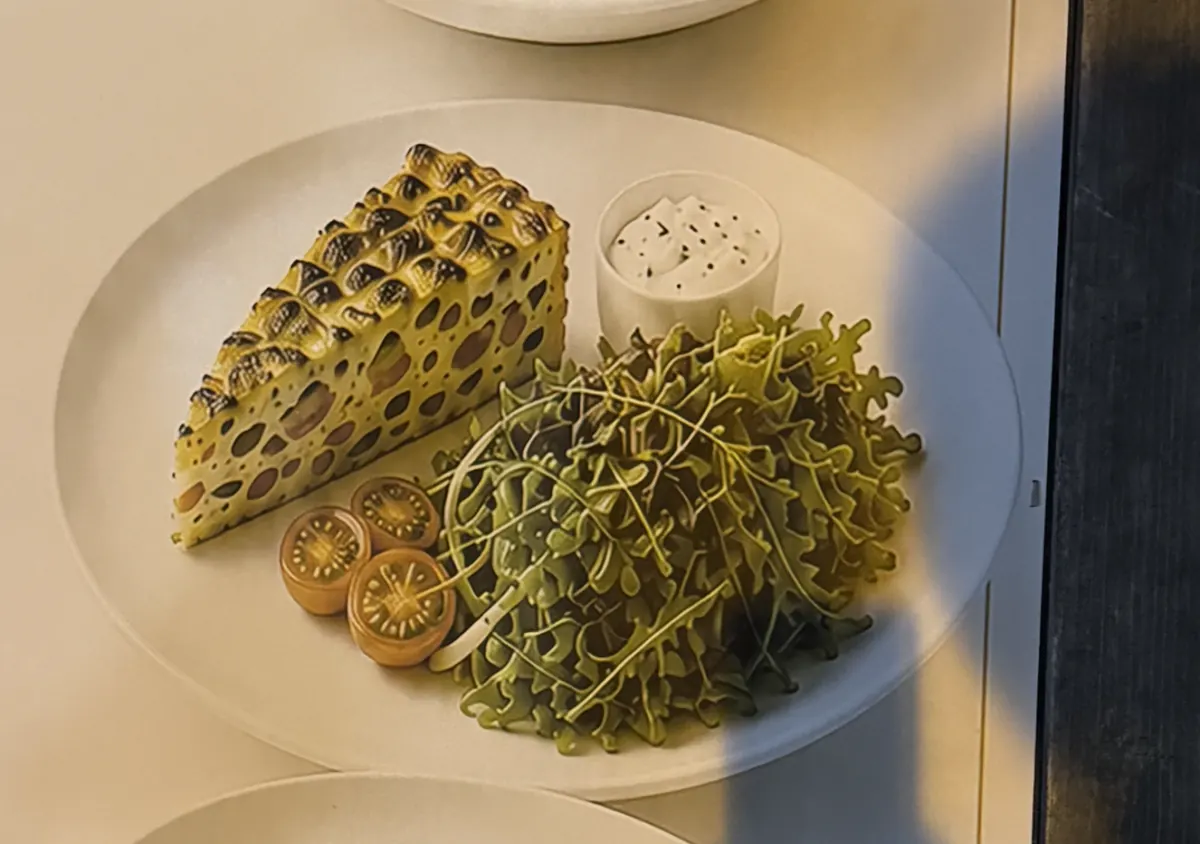
I don't usually go on vacation, but this year I really needed a break. One evening I was really hungry, walking past some restaurants on the Baltic coast. There was a single one I immediately ignored, but a minute later something in my head asked "Hey, did they really put up a photo of quiche with mold?" I walked back just to see this.

A menu photo of a quiche slice that looks like it's covered in mold

AI AI AI

The Daily Front Page 12 of 31
Friday, August 21, 2026 The Daily Front No. #260821 — The AI Attention Deficit
article

AI boosted homework scores, then exam scores dropped: Study

by Edymilson·▲ 165 points·9 comments·canews24.online ↗

A new study tracking 27,000 students in China has found that pupils who used artificial intelligence tools saw higher homework scores over time, but performed worse than their peers on exams taken without AI assistance, according to research covered by The Economist on August 18.

The Study

The research was conducted by David Stromberg of Stockholm University along with Victor Lei and Wu Yanhui of the University of Hong Kong. The study followed 27,000 pupils aged 12 to 18 in China, where adoption of AI tools among students has grown quickly. Around 80% of the students surveyed reported using AI models such as Doubao and DeepSeek, while the remaining 20%, who did not use such tools, formed a control group.

According to figures shared by The Economist, students who used AI saw their average homework scores rise by 18% across all subjects over a six-month period. However, when the same students were tested under exam conditions without access to AI tools, they scored 20% below classmates who had not used AI during the study period.

Context on AI Adoption Among Students

The study cited broader data on how widespread AI use has become among students. A survey conducted last year by ed-tech firm Chegg found that 80% of undergraduate students in wealthy countries reported using AI in their studies. More recent polling put the figure at 94% among students in Britain and 93% in Germany.

The Economist noted that teachers have reported grading formulaic, similar-sounding essays they suspect were generated by AI chatbots such as ChatGPT, but said that, prior to this study, robust evidence on AI’s actual effects on learning outcomes had been limited.

Related Research

A separate study conducted in 2024 at the University of Pennsylvania examined a similar dynamic on a smaller scale. Students attending a math lesson practiced problems using either traditional study methods, such as notes and textbooks, or AI tools including ChatGPT and an AI tutoring program. According to a summary of the research, students using AI performed better during short-term practice sessions, but the advantage did not carry over to a subsequent closed-book test.

Reactions

The Economist’s summary of the findings, shared on the social platform X, drew significant engagement, with some commenters attributing the exam score gap to students copying AI-generated answers without engaging deeply with the material. The study was also discussed on forums including Hacker News, where some users questioned aspects of the study’s design while others noted it aligned with existing concerns among educators.

A tip sheet published by the Brookings Institution earlier this year said AI can support learning when used intentionally and designed well, but cautioned that overreliance on the technology to replace thinking, social interaction, or creativity could prevent students from developing cognitive and social skills.

The Stockholm University and University of Hong Kong researchers’ full study had not been independently verified by other institutions at the time of publication.

The Daily Front Page 13 of 31
Friday, August 21, 2026 The Daily Front No. #260821 — The AI Attention Deficit
repository

Claudette: Make Claude stop talking like a BuzzFeed article

by aakil·▲ 258 points·176 comments·github.com ↗
★ 124⑂ 2 forks

A Claude Code skill (/debuzz) that pipes Claude's answers through Gemini to remove the BuzzFeed voice

Obviously it's common knowledge by now that Anthropic has solely trained claude on old Buzzfeed articles (explaining its love for 90s nostalgia). So Claude and I built a Claude Code skill (/debuzz) that takes Claude's last response and runs it through the Antigravity CLI (agy) to translate it from talking like a millennial clickbait to regular English. We're thinking of calling it "Claudette" but Cat Wu is famously litigious so it's definitely absolutely not called "Claudette".

The problem

Claudette is our solution to Claude being a great engineer with one incurable condition: it talks like it's delivering a TED talk about its own pull request. You ask why a test is flaky and you get a "load-bearing assumption," three numbered revelations, and a solemn note that the third one is the most instructive yet. Nothing is ever just a bug. There is always a kicker.

This skill accepts that no amount of prompting fully cures this, and does the honest thing instead: it hands the response to a different model, Gemini (remember gemini from last summer?) via Google's Antigravity CLI, whose only job is to say it like a human person. Claudette has pinky promised to print Antigravity's translation verbatim, because letting Claude "tidy up" the translation reintroduces exactly the voice being removed.

Before / after

Before (Claude):

Here's where it gets interesting: the retry logic isn't just a nice-to-have — it's - the - load-bearing - assumption - of - the - entire - sync - pipeline. Three things jumped out at me, and the third one is the most instructive yet. [...] And third — and this is the kicker — the dedupe key includes a timestamp, which means retries are never actually deduplicated.

After (/debuzz, colleague mode):

The sync pipeline's retry logic has three bugs. syncQueue.ts:142 swallows ETIMEDOUT instead of re-queuing the job. The backoff caps at 2 seconds, which is too low for mobile networks. And the dedupe key includes a timestamp, so retries are never deduplicated. Fix: strip the timestamp from the key, raise the cap to 30 seconds, and re-throw the timeout error.

Install

git clone https://github.com/adnanakil/nobuzz
mkdir -p ~/.claude/skills
cp -r nobuzz/debuzz ~/.claude/skills/

Requirements:

  • Claude Code
  • The Antigravity CLI (agy) — install with curl -fsSL https://antigravity.google/cli/install.sh | bash (macOS/Linux) or irm https://antigravity.google/cli/install.ps1 | iex (Windows), then run agy once to complete the Google Sign-In flow.

Usage

/debuzz [mode] [text]

Mode Audience What you get colleague (default) An engineer Same content, every file path and code block intact, zero theatrics manager A technical-adjacent manager What happened, why it matters, what's next — about a third the length, no code director An executive Three to five sentences: outcome, impact, ask. Assumes thirty seconds of attention

With no text argument it translates Claude's previous reply. Paste text after the mode to translate that instead. It also triggers on natural phrases like "say that in normal english."

How it works

No magic. Claudette writes its previous reply to a temp file and runs agy -p "$(cat <file>) <plain-English style instructions>" — agy's headless mode doesn't read stdin and won't read files outside the project, so the text goes straight into the prompt — then prints Antigravity's output verbatim. If agy errors (usually auth), you see the actual error — Claude only offers its own rewrite as a clearly labeled fallback, because a debuzzer that quietly asks the buzzer to debuzz itself is how you end up with a load-bearing translation.

License

MIT

The Daily Front Page 14 of 31
Friday, August 21, 2026 The Daily Front No. #260821 — A Reader That Runs Its Own Programs
article

Kobo can run apps now

by thepoet·▲ 526 points·186 comments·bandarlabs.github.io ↗
Every app after that installs, updates and removes on the reader itself, over Wi-Fi.

Cobalt is an open-source application platform for Kobo e-readers: a launcher, a signed App Store, a Rust SDK, and a runtime that keeps every app in its own unprivileged process.

Install it once over USB. Every app after that installs, updates and removes on the reader itself, over Wi-Fi. A reboot returns to the stock Kobo reader.

Install on your Kobo Read the source

The Cobalt launcher on a Kobo Clara BW showing Settings, App Store, Terminal, AI Chat, Audiobooks, Components, Daily Brief, Feeds and Gutenbird

The launcher on a Kobo Clara BW.

Not affiliated with Rakuten Kobo

A Kobo Clara BW running Audiobook Studio, Gutenbird, Terminal, Hacker News, Sidekick and the App Store, then installing, playing, removing and reinstalling Sudoku over Wi-Fi

Recorded on-device at 3× speed. Watch as video.

Running on a Kobo.

Every app is a static ARM binary running as its own unprivileged process on stock hardware. The App Store installs, updates and removes them over Wi-Fi, with signatures verified before anything launches.

arXiv papers and coding agents, on the panel.

These are photographs of the device, not simulator captures. The arXiv app reads the HTML rendering arXiv publishes for every paper since December 2023: abstracts, sections, math and result tables, paginated for the panel.

An arXiv preprint section titled 'A hard optimization problem and its relaxation' rendered on a Kobo Clara BW

A preprint, page 8 of 54, on the panel.

A results table from an arXiv paper comparing language models, rendered on a Kobo e-reader

A results table from the same paper.

Mathematical notation and a numbered algorithm from an arXiv paper on a Kobo e-reader

Math notation and a numbered algorithm.

Sidekick on a Kobo showing a question from Claude Code with three tappable answers and a 'Leave it for the terminal' button

Sidekick showing a question from Claude Code, with tappable answers.

Sidekick's watching screen on a Kobo, paired with a machine on the local network, showing the last answer sent

Sidekick paired over the local network, waiting for the next question.

The apps.

Every screenshot below is a capture from a Kobo Clara BW. Store apps version independently of the platform; the rest ship with the platform install.

Cobalt launcher app grid on e-ink

Launcher

Opens installed apps and always keeps a route back to the Kobo reader.

Cobalt App Store catalog listing installed and available apps

App Store

Installs, updates, removes and reinstalls signed apps over Wi-Fi.

Newest machine learning preprints listed in the arXiv app on a Kobo

arXiv

Browses a subject's newest preprints and reads the full text on the panel.

A complete 81-cell Sudoku game on a Kobo Clara BW

Sudoku

Store-only by design: installing it proves delivery of an app the USB package never contained.

The letter S filling the Kobo panel while the front light sends it in Morse

Morse

Sends a typed message in Morse on the front light, one letter across the whole panel.

An audiobook player with cover art, position and transport controls on e-ink

Audiobook Studio

Researches, writes, narrates and plays an original audiobook.

A shelf of book covers from an OPDS catalogue on a Kobo

Gutenbird

Reads any OPDS library: Project Gutenberg, Standard Ebooks, Open Library, or yours.

A ranked list of Hacker News stories on a Kobo e-reader

Hacker News

Top, New, Ask and Show stories with complete comment threads.

Subscribed feeds and articles in the Feeds app

Feeds

Discovers a site's feed and presents its articles without the site's layout.

A numbered daily news brief on e-ink

Daily Brief

Collects the day's stories in the background while you use another app.

An AI answer displayed as readable text on the Kobo panel

AI Command Center

Asks a question and turns the answer into touch-friendly reading.

A coding agent request with tappable responses in Sidekick

Sidekick

Approve or deny requests from coding agents, away from the keyboard.

A shell and touch keyboard on the Kobo display

Terminal

A panel-native shell with keys that send input immediately.

Cobalt typography and UI components on e-ink

Components

The UI toolkit's controls, layouts, typography and states, on the panel.

Battery status and hardware facts in Settings

Settings

Connectivity, hardware, and platform updates, kept separate from Store.

A persistent to-do list with completed items

Todo

A persistent list with touch entry and completed-item states.

A completed game of tic-tac-toe on e-ink

Tic-tac-toe

Two players, partial refreshes for individual cells.

The Kobo hall sensor responding to a magnet

Magnet

Locates the hall sensor behind the bezel and reports its changes.

An app is one Rust file.

Implement KoboApp, describe screens declaratively, and the runtime handles layout, e-ink refresh planning, Back navigation and lifecycle.

Apps don't open device resources; they ask. Network, storage, audio, frontlight and Wi-Fi are capability-gated, and a refusal comes back as a value the app can handle.

E-ink UI

Text, tiles, dialogs, keyboards, pagination, partial refresh planning

Simulators

Browser and runtime simulators with layout diagnostics

Async work

HTTPS, ranged downloads, cancellable tasks, scheduled wakes

State

Atomic per-app keyed storage

Shipping

Signed static ARMv7 binaries, published when an app PR merges

kobo new my-app
cd my-app
kobo dev

Read the SDK docs

use kobo_sdk::{
    ActionId, Context, KoboApp, ScreenBuilder,
};

#[derive(Default)]
struct Hello { taps: u32 }

impl KoboApp for Hello {
    fn on_start(&mut self, ctx: &mut Context) {
        self.show(ctx);
    }

    fn on_action(
        &mut self, ctx: &mut Context, a: ActionId,
    ) {
        if a == kobo_sdk::action_id("tap") {
            self.taps += 1;
        }
        self.show(ctx);
    }
}

impl Hello {
    fn show(&self, ctx: &mut Context) {
        let screen = ScreenBuilder::new("hello")
            .top_bar("Hello")
            .heading(format!("{} taps", self.taps))
            .button("tap", "Tap me")
            .build();
        ctx.set_screen(screen);
    }
}

fn main() {
    let app = Hello::default();
    let _ = kobo_sdk::run("hello", app);
}

Signed packages, verified before launch.

Store reads a signed catalog from a fixed GitHub release. Each package holds one ARM executable and a signed canonical manifest. The runtime verifies the catalog, the package, the installed manifest and the binary before an app runs.

App releases are independent of platform releases: merging an app PR builds it for ARM, signs it, and updates the catalog. No Cobalt version bump, no reinstall. The app simply appears in Store.

The Cobalt platform itself also updates over Wi-Fi, through Settings, on a channel separate from the app catalog. The USB cable is only ever needed once.

Install and catalog transactions are recovery-safe; an interrupted update leaves the reader with the version it had.

Publish your own app →

The Cobalt App Store installing an app over Wi-Fi on a Kobo Clara BW

Sudoku arriving over Wi-Fi.

Installing from source.

  1. Charge a Kobo Clara BW (N365) and connect it over USB. Other models are refused, not guessed at.
  2. Run the setup:
git clone https://github.com/BandarLabs/Cobalt.git
cd Cobalt
rustup target add armv7-unknown-linux-musleabihf
cargo run -p kobo-cli -- setup
  1. Restart the reader and open Cobalt from Kobo's menu.
  2. Open Store. Everything from here on arrives over Wi-Fi.

The complete walkthrough, including recovery steps, is in docs/INSTALL.md.

Contribute an app.

App contributions are regular pull requests. If it runs on your device and the PR shows it running, it gets merged and published.

  1. Build it. Add the app as a workspace package under apps/<app-id>/ and register it in apps/catalog.json.
  2. Test it. Add unit and layout tests, and run it in the browser and runtime simulators.
  3. Run it on your own device. A real Clara BW, not just the simulator.
  4. Open a PR with a gif or photos of it running. Once reviewed and merged, the publish workflow signs it and it appears in Store. No platform release needed.

Own a different Kobo model? Porting is welcome too; open an issue first so the device profile can be agreed. Full details in docs/CONTRIBUTING_APPS.md.

Device support and safety.

Cobalt does not replace Kobo's boot chain. Device writes are gated on an exact hardware and firmware match, and a reboot returns to the stock reader. The first installation does modify files on the user storage partition, and it is provided without warranty.

Only the Clara BW profile has been hardware-tested. Don't install on another model until it has a reviewed, hardware-tested profile. Cobalt is an independent project, not affiliated with Rakuten Kobo.

The Daily Front Page 15 of 31
Friday, August 21, 2026 The Daily Front No. #260821 — The Operating System That Might Have Been
article

Japan tried to build an operating system for the world, the US intervened

by rdmuser·▲ 361 points·211 comments·xda-developers.com ↗
There’s a version of computing history where the desktop OS that won wasn’t Windows.

1B/V3 running on a Mac, showing an opened document

There's a version of computing history where the desktop OS that won wasn't Windows. Not because the alternative was Unix-based or because Apple pulled off something different, but because an operating system designed at the University of Tokyo in 1984 was ambitious enough to try to replace the file system with a hypermedia document model, run on a custom Japanese CPU architecture, and encode 1.5 million characters, only to have a US trade report single it out as an unfair trade barrier in 1989.

That project was TRON (The Real-time Operating system Nucleus), a real, government-backed Japanese computing initiative whose desktop variant, BTRON, was named in a US trade barrier report and effectively killed before it could reach schools nationwide. Meanwhile, its embedded counterpart, ITRON, quietly became one of the most deployed operating systems in history.

TRON's history has since attracted some genuinely wild conspiracy theories, including one claiming that Japan Airlines Flight 123 was deliberately crashed in order to target the TRON developers on board, despite there being no evidence that any TRON developers were even on the flight. But the strangest part of the story isn't even a conspiracy theory: BTRON's hypermedia desktop was decades ahead of what the market could support, and SoftBank founder Masayoshi Son may have helped sink it from the inside.

Ken Sakamura designed an OS family for the whole of Japanese society

He wanted all of it, silicon included

1B/3V desktop part list

Ken Sakamura was a researcher at the University of Tokyo when he launched the TRON Project in 1984. It was an ambitious undertaking; he wanted a vertically integrated computing architecture that Japan could build its entire digital infrastructure on, from the microcontroller in a washing machine to the workstation on a desk to the telecom switch in a central office. The project had five sub-architectures: ITRON for embedded real-time systems, BTRON for personal computers, CTRON for mainframes and telecom switching, MTRON for cross-system coordination, and STRON, a hardware implementation of the real-time kernel.

The project designed its own CPU architecture, the TRON VLSI CPU, which Hitachi manufactured as the Gmicro/200 series. Hitachi actually produced and sold it, and it ended up powering some Japanese workstations and embedded systems throughout the late 1980s. Sakamura's team also drew up its own TRON keyboard layout, designed for efficient Japanese text input alongside programming symbols, and a real-time peripheral bus called micro-BTRON, based on IEEE 802.5 and intended as an alternative to MIDI for connecting "electronic stationery" peripherals, though that bus never shipped in a commercial product. The idea was that every layer, from silicon to user interface, would be designed together, with no compatibility debt to existing platforms.

The character encoding system, TRON Code, was arguably the most ambitious part. It supported multi-plane character switching via 0xFE escape codes, with 31 defined planes of 48,400 characters each, giving a theoretical capacity of 1,500,400 characters. By 1999, B-right/V R2 shipped with roughly 130,000 characters across 14 defined planes, covering JIS levels 1 and 2, Chinese GB 2312, Korean KS C 5601, Unicode's non-CJK range, and the Mojikyo collection of rare historical characters, and users could register new characters for free through the TRON Character Resource Center. To put that in perspective, Unicode 1.0 in 1991 defined 20,902 unified CJK ideographs, and TRON's CJK coverage exceeded Unicode's for well over a decade. A large part of that count came from Mojikyo, though, which separately encodes variant glyphs that Unicode unifies into single code points.

You can see the ambition from the very beginning, as the 1996 demo release includes a character-code viewer that lists its planes side by side: Japanese basic, Japanese supplementary, Chinese GB, Korean KSC, and 6-dot Braille. Braille is there as a first-class plane rather than an accessibility add-on bolted on later, and Unicode didn't encode Braille patterns at all until version 3.0 in 1999. For its time TRON Code was the best answer anyone had to a problem the rest of the industry was years from solving.

The project was backed by an actual organization: the TRON Association, established in 1986. Its members included Hitachi, Mitsubishi, Fujitsu, NEC, Matsushita, and Toshiba... basically every major Japanese electronics company of the era. On top of those domestic companies, foreign companies could join too, and several did. TRON was royalty-free and its specifications were open, which was a deliberate choice that would later allow ITRON to spread. The Japanese government, through MITI, supported the project as a national technology strategy, giving it the kind of institutional backing that most operating system projects could only dream of.

On top of all this, BTRON proposed something radical for desktops.

BTRON's desktop was decades ahead of where computing actually went

The file and the application were implementation details
04-cooking-guide-figure-2133x1200

03-code-table-list-2133x1200

05-windows-stacked-2133x1200

08-gb2312-table-2133x1200

09-jis-level1-table-2133x1200

BTRON's core idea was that the user-visible primitive on a desktop computer shouldn't be a file or the application, but the typed document part. In other words, a block of content with a stable identity and a declared type. Parts can contain other parts, and the same mechanisms that embed a figure in a report can also embed a report in a workspace, meaning that there was no special case for a top-level file.

This model could be found across the interface as well, and you can browse a container in 1B/V3 and see each entry carries its type in parentheses after the name. For example, a document called 中国・韓国料理ガイド(図形), meaning "Chinese and Korean Cuisine Guide (Graphics)", describes this file as an image. In comparison, DOS would have given you an extension.

Parts were connected by typed links, stored in a system-managed link store rather than fragile string paths. Links survived renames, edits, and reorganizations, and applications weren't owners of files but handlers for part types. According to the BTRON3 specification, the first two halfwords of an application ID are the data type it applies to, and only the third distinguishes rival handlers for the same type. When a document contained writing, a table, and a figure, opening those parts made the system launch each one's registered handler to draw its own content inside the parent document's window. If no handler exists, or the handler fails to draw, the system strikes a diagonal line through the region where the content should have been.

BTRON's document model, showing real and pseudo bodies

BTRON also used a file system model called real-body/pseudo-body, which replaced the tree-structured directory hierarchy with an arbitrary directed graph. Files can exist in multiple locations without duplication, linked by the system rather than by symlinks or shortcuts, and the dictionary that powers Japanese text input is addressed the same way a cooking guide would be. Here, the TRON Application Databus format carries structured data between applications using a chunked segment structure with a common header, so a spreadsheet cell and a paragraph of text could be composed into the same document without the user ever having to think about file formats. Applications can skip data types they don't support, making interoperability a core aspect of the system.

Arguably, this is the same concept that tools like Roam, Logseq, and Obsidian have been rediscovering over the last decade. But BTRON proposed it as the fundamental OS abstraction in the mid-1980s, paired with a custom CPU and a real-time microkernel underneath. It's not that BTRON's implementation would feel smooth by modern standards, because the hardware it ran on was too slow for that, but the architecture was doing something conceptually different from anything that shipped commercially in the West at the time.

06-microscript-figure-2133x1200

1B/V3 comes with a number of sample documents that show exactly this concept. One demonstration is a Microscript figure, which is a drawing canvas holding a green ball and a sloped surface, each a named object, with a text section dubbed SCRIPT in the same space. You can open the script and see "DEFINE 半径(ボール.W/2)", defining a radius as half the ball's width, then "SET 新Y ボール.Y+半径+速度Y/4" which advances the ball's position on each step. The script addresses the figure's contents as "ボール.X" and "斜面.W", meaning object and property, and the entire file is a single document rather than a program loading data files. Sure, a bouncing-ball simulation is a small thing to build, but the point is that it's a typed part inside the document instead of a dedicated application that owns it.

BTRON was made available in a small number of products in Japan: for example, the BrainPad TiPO PDA from Seiko Instruments had a version with a touchscreen and stylus. As well, B-right/V (also called Cho-Kanji) was available on commodity PC hardware through Personal Media Corporation, a company that still lists the software on its Japanese-language website today. This is 1B/V3, and I got the demo disk working in 86Box on an Apple Silicon Mac. All it needs, at minimum, is a mid-90s Pentium clone with 16MB of RAM and a Cirrus Logic video card.

Unfortunately, BTRON never got the distribution it needed, and by 1989 it had a much bigger problem than adoption.

The US government named TRON in a trade barrier report

Buried in Section 7

us-government-tron-operating-system-concerns

In April 1989, the Office of the US Trade Representative published its annual National Trade Estimate Report on Foreign Trade Barriers. Buried in Section 7, "Other Barriers," was a section about TRON. The report stated that the US had concerns about Japanese government market intervention to support the TRON OS and identified two specific markets where TRON was receiving government advantage.

The first advantage it was deemed to be benefiting from was in the industry of educational PCs. The Japanese Ministry of Education and MITI were developing a standard specification for computers being introduced into middle schools nationwide, and the specification was built around TRON. The second was NTT's next-generation digital communications network, which planned to adopt CTRON, the telecom variant. The report noted that while several US companies were members of the TRON Association, none were in a position to sell TRON-based products in either market.

The NTE report was an annual survey of foreign trade barriers, and it wasn't a sanctions list. The more aggressive Super 301 process, established by the 1988 Trade Act, was a separate mechanism that could escalate a dispute into investigation and negotiation, and TRON was never designated a Super 301 priority. The actual Japan designations that year were supercomputers, satellites, and forest products, as Carla Hills' May 25 statement confirms. No sanctions were ever applied to TRON, but it was clear that the US government had been spooked for some reason by the TRON project.

In fact, Ken Sakamura was surprised that it had been named at all. In an interview with Japan's Yomiuri Shimbun published in August 2026, he said: "TRON is open to the world, and American companies can use it freely. Why would it become a target of trade friction? I had no idea what was going on."

The TRON Association sent a written protest to the US government, and the US sent an inspection team to investigate as a result. By Sakamura's account, the matter was closed over a dinner where the USTR told him "On investigation, it turned out that BTRON is no harm. We are sorry for causing troubles to you if any." Unfortunately, by June 1989, the school adoption was dead.

Even though the legal reality was that TRON's naming in the survey was resolved, that mattered less than the reputational hit it took as a result. Japanese manufacturers interpreted the dispute as a signal that TRON had angered the US government, and staying associated with it could threaten their American business. Companies withdrew from TRON PC development left and right, and Yomiuri quotes an industry source describing the outcome bluntly: "TRON itself was never denied, but it became an OS with a blemish from America. We can't use it."

Funnily enough, the USTR's complaint had some validity to it. After all, the objection to TRON didn't come from it being closed off or exclusionary, but that the Japanese government was steering its procurement of two huge markets toward a domestic standard. This had the effect of excluding foreign vendors regardless of whether TRON's spec was open or not. However, what happened after, namely the reputational damage, is a lot harder to justify.

There's another side to this story, though, and it reframes things a little bit. In a book from Scott Callon in 1995, "Divided Sun: MITI and the Breakdown of Japanese High-Tech Industrial Policy," he argues that BTRON was already struggling with internal coordination problems and delayed hardware before the trade dispute, which made the controversy a convenient way to exit the market. An academic paper published in 2003, titled "Three Attempts at De-Wintelization," frames this dispute as just another event in a longer pattern of Japanese efforts to challenge the Wintel monopoly, each of which failed for a combination of political and structural reasons.

Even still, Matsushita Communication Industrial shipped the PanaCAL ET in 1990, which was a BTRON educational PC, but the momentum was well and truly gone at this stage. But there was another factor too, one that Sakamura himself would later describe as the real cause of the damage.

SoftBank's founder may have weaponized the report against BTRON

He published a book called 'The Tron Revolution' first

sakamura-son-accusation Credit: TRON 30 year anniversary page

There's a book from Japanese reporter Eiji Oshita, written in 1999 as a biography about Masayoshi Son. In the book, titled "Masayoshi Son: The Young Lion of Entrepreneurship," Oshita writes that Son had a direct incentive to sabotage the TRON project. Oshita states that Son was building a software distribution business around importing American PC software, and if TRON-based, Windows-incompatible PCs became the standard in Japanese schools (which was a captive market), then his business model would take a serious hit.

Oshita's biography further describes Son lobbying MITI officials, politicians, and business leaders to oppose TRON's adoption, arguing that TRON would isolate Japan from global computing standards. The TRON Association published an editorial in its own TRONWARE magazine in December 1999 titled "People who blocked the TRON project," which stated that "the person who destroyed BTRON using the USTR was not an American company, but a Japanese person."

Stranger still, the strongest corroboration of this allegation comes from Ken Sakamura himself. On the official TRON Project 30th Anniversary website, published sometime in 2014, Sakamura wrote a section called "An Unexpected Ending" that directly names Son. He describes how the Oshita biography details Son mobilizing every connection he had to oppose BTRON, and in Sakamura's own words: "I have to admit I was impressed by his thoroughness."

Son's SoftBank publishing division had published a book called "The Tron Revolution" in December 1988, four months before the USTR report that named TRON as a trade barrier.

All of this is from machine translations of Oshita's biography, the TRON project anniversary site, and other sources that appear to have never been published in English. It's important to know that the Yomiuri series approaches this claim far more apprehensively than Sakamura does: It says that "there was talk that Son opposed TRON," rather than outright accusing him of it. We don't know for sure if Son killed BTRON, but it's hard to dismiss Sakamura's own words as merely a rumor.

Sakamura goes further as well when he accuses Son, stating that Son used the US trade process as his way of sabotaging the project. He said that the person who destroyed BTRON did so "through what was essentially reputational damage leveraging the USTR," which isn't necessarily a claim that Son manufactured the NTE report, just that he exploited its existence. This particular detail, amongst many others, I couldn't find translated to English anywhere else, and it comes from someone who was essentially the father of the entire project.

To be fair to Sakamura as well, it actually lines up well with what happened, and explains several aspects of it. It certainly makes more sense than a claim that Son's lobbying and the US complaint were totally unrelated.

The embedded variant nobody noticed is in billions of devices

ITRON survived and became valuable infrastructure

Installing Java on Windows

While BTRON was dying, it was ITRON that was quietly spreading around the world. As an embedded real-time operating system, it didn't need a monitor, a keyboard, or a 1.5-million-character encoding space. All it needed was to be small, deterministic, and royalty-free, which it was. Remember the Java installer saying "3 billion devices run Java"? Yeah, we'll get to that in a second.

ITRON, and later T-Kernel, shipped in digital cameras, car engine control units, mobile phones, factory automation equipment, and home appliances. Casio's QV-10, the camera widely credited with sparking the digital camera revolution, ran on TRON, and Toyota even used it in engine control systems. On top of that, many first wave Japanese mobile phones ran on it too. In fact, this LinuxInsider article from 2003 calls ITRON "the most popular operating system in the world," and while nobody has published hard numbers since, the Yomiuri series reported that TRON-based operating systems still run in roughly 60% of the world's embedded devices.

TRON even got its own Java specification in the late 1990s, and it combined ITRON's real-time kernel with Sun's Java Runtime Environment. Commercial applications such as Aplix's JBlend came after, and Aplix says that JBlend shipped on more than 800 million devices. Not all 800 million of those were JTRON devices, since JBlend later became a portable Java platform that Aplix deployed across multiple operating systems, and there's no published breakdown of how many ran on ITRON. But it does mean that when that old Java installer proudly told you "3 billion devices run Java," some unknown number of those devices were almost certainly running Java alongside TRON.

A standardization effort has since cemented its longevity. In 2018, micro-T-Kernel 2.0 was adopted as IEEE standard 2050-2018, and in 2023, the IEEE recognized the TRON Real-time Operating System Family as an official Milestone, installing a plaque at the University of Tokyo. The TRON Forum, the successor to the original Association, still maintains the specifications and licenses the technology. Even more interesting is that, by Sakamura's account, Microsoft joined the TRON Project in 2003, through the efforts of its then-US vice president Furukawa. Microsoft really does seem to have a habit of supporting would-be competitors these days.

Unsurprisingly, the ambitious and politically targeted desktop variant failed. But it was the embedded variant nobody in the West paid attention to that managed to succeed to the point of becoming an important building block of day-to-day infrastructure. The same project produced what could well be the world's most-used operating system and an operating system that failed entirely, and it was the project that everyone was paying attention to that actually failed. You can still buy a BTRON implementation today if you know where to look, since Personal Media Corporation's website is still up and still selling Cho-Kanji, in Japanese only. The project's lasting mark on computing is invisible, though, running in the devices around you that you never think about as having an operating system at all.

Sakamura received the Takeda Prize jointly with Linus Torvalds and Richard Stallman, for spreading open architecture worldwide. After all, the same open approach that made TRON vulnerable in a trade dispute, the assumption that being open was protection enough, is what let ITRON spread without friction afterwards. Sakamura's apology, though, arrived after the damage had been done over dinner in 1989. The industry had already abandoned the project by that stage.

BTRON's hypermedia ideas are being rediscovered by a new generation of tools that don't know they're recreating a 40-year-old design. The character encoding is archived and the CPU is a museum piece. But the real-time kernel that nobody seemed to think of as an important piece of the puzzle still runs in places you'd never guess, and it's hard to think of a better legacy than that.

The Daily Front Page 16 of 31
Friday, August 21, 2026 The Daily Front No. #260821 — Pirates, Recovered
article

The Lost Treasure of Sid Meier's Pirates

by spankibalt·▲ 259 points·141 comments·remapradio.com ↗
Pirates was something different.

When Microprose greenlit Sid Meier's Pirates! in 1986, the company—which Meier founded along with Bill Stealey back in 1982—was mostly known for vehicle sims (Gunship, Spitfire Ace, F-15 Strike Eagle) and dry strategic wargames like Crusade in Europe.

Pirates was something different. It's hard to pin it down to a genre even today, but it certainly wasn't like previous Meier titles—even though it's the first game to be called Sid Meier's Something or Other. At the time the game came out in 1987, it was generally called an "action adventure" game; this is somewhat hard to square with the way most people today would understand the genre. It has basically nothing in common with contemporaries like Castlevania, Metroid, or The Legend of Zelda.

There's no platforming of any kind; controlling the player character directly and individually is restricted to brief sword-fighting sequences. Those have controls and mechanics that are totally unlike any other game combat I've seen. It tries to create the feeling of an Errol Flynn fencing duel with an elaborate control scheme that's more like a mutant version of a fighting game; you can thrust (which is fast) or slash (which does more damage), or parry; you can also either aim low, or high, or down the middle.

A portrait of a man with a receding hairline, ponytail, and scar over one eye. "You are a skilled and able swordsman," he concedes in the text. "I will tell you what I know. Your father is held captive on a remote plantation."

Those motions are mapped to the eight-direction joystick commonly used for games on the Commodore 64 and other eighties computers—or, if you don't have one of those, they're mapped to the keyboard numpad. Some ports of the game let you do it with the mouse, or with awkward combinations of mouse clicks and keyboard input.

This description makes the swordfighting in Pirates sound terrible and indeed it is hard to defend; the 2004 remake substantially simplified it, but that simplification only peels away its skin to reveal a strange quasi-rhythm game buried underneath. It still feels in no way like a concession to "standard" combat design.

But what you have to understand about playing this game—whether the original 1987 version, the many 1988 ports, the beautiful 1993 remaster Pirates! Gold with its 256-color graphics, or the modernized 2004 remake—is that if you encounter it at an early age it will open a rift in your brain. When I asked Nic Tringali (designer of The Banished Vault and Amberspire) about it, they put it perfectly: "Pirates! feels unstuck in genre, not quite an open-world game or a role-playing game, not only economic strategy or resource management. It has a goal for a clear thematic position for the player to inhabit and uses the systems and friction to reach that. The peculiarities of its design are unique and inseparable—the wind always blowing east comes to mind, and dueling a rival captain immediately winning a sea battle—and are not solely driven by video game genre expectations, or pre-packaged ideas redressed in a pirate theme."

Meier was working in an era where genre and mechanics were still unsettled, undefined things. In his 2020 memoir—would you believe it's called Sid Meier's Memoir!—Meier pointed out that "The good news was there were very few preconceived notions back then about what a game was supposed to be. The bad news was there were no tried-and-true conventions, either." All of Pirates is like this; a bunch of first-principles attempts at extricating game mechanics from all the half-remembered pirate tropes rattling inside Meier's brain.

A lone three masted vessel coasting southwest on an expanse of blue water next to a jungle coast.

The resulting game takes all these romanticized ideas pointing towards a genre—Treasure Island, Errol Flynn movies, Peter Pan, the centuries-old distillation of the Black Legend into anglophone culture—and treats them not as story beats to play out or as window dressing, but as the grounding rules of a clockwork world that you can poke and prod at. The game models the way silver travels on mule trains all the way from Potosí to be loaded up on ships in Panama, and from there along the ports of Gran Colombia until the Treasure Fleet, heavy with the blood of the Americas, leaves for Spain. The game models the way that a pirate's harsh life wears you down over time, each merchant ship captain or colonial guard that you fight seeming that little bit faster until you have to admit that your sword arm just isn't what it used to be. The game seeds the Caribbean with an elaborate, randomized quest to find your long-lost family, chasing down a laundry list of villainous aristocrats to rescue relative after relative from indentured servitude on obscure plantations.

To modern design sensibilities, I think there's a risk one might look at Pirates and see a bunch of minigames in a trenchcoat. In reality, what that game is expressing is a way of thinking about games that we've tamped down over the years as the medium has built up its own library of conventions, tropes, and recycled ideas.

Pirates is hewn from its underlying themes in a very raw way, but so are many other games of this era. Cinemaware, a now largely forgotten studio, made a whole very successful business out of this style of design. Their 1989 title, It Came from the Desert, gleefully jumps around in presentation and perspective—one moment a rudimentary first-person shooting gallery, the next a top-down shmup, all wrapped up in a visual novel wearing the skin of a strategy game. The original Dune video game—not Dune II, the origin point of real-time strategy as we know it—was essentially an attempt at capturing the whole scope of the 1984 David Lynch movie, oscillating between a strategy game about spice extraction and a visual novel-like adaptation of the movie's plot.

Pirates was immensely successful in its own time, and this exact style of design thinking was then adapted to Microprose's follow-ups—classics like Covert Action and Sword of the Samurai. Pirates essentially changed the studio's whole identity, something that was incredibly hard to do even in those days.

And yet, this entire era of video games feels like a hole that has been carved out of the collective memory of the medium. It is, in truth, a reflection of how niche the computer game market really was in those days; for every Amiga 500 sold, Nintendo sold 23 NESs and 45 Game Boys. The era of IBM PC consolidation and true mass adoption of PC gaming was a few years away in the late 1980s; and by the time the remade DOS version of Pirates arrived in 1993, it was competing with platform-defining games like Wolfenstein 3D. This 1982-1990 era of PC gaming is, really, better known through dubious CDs packed in with magazines, discount-bin collections put out by failing publishers, and abandonware sites.

The Daily Front Page 17 of 31
Friday, August 21, 2026 The Daily Front No. #260821 — Tomorrow, Already Here
article

New Worlds: We are living in the future of J.G. Ballard or William Gibson

by speckx·▲ 235 points·165 comments·precastreinforced.co.uk ↗
We are definitely now living in a version of the future out of J.G. Ballard or William Gibson.

A delivery robot on a city street being followed and observed by a pedestrian.

Don’t let the absence of a flying car in your garage distract you: we are definitely now living in a version of the future out of J.G. Ballard or William Gibson.

Every day I notice a news story that startles or alarms me, that feels like pure cyberpunk, nestled between reports about council bin collections and cabinet reshuffles.

“The first ever IV Drip clinic to appear in the centre of a shopping mall, our Westfield clinic is a must-stop shop when doing a bit of retail therapy. From Vitamin Drips to Instant Vitamin D Testing, Get A Drip Westfield has it all. Book your appointment today!”

Publicity for Get A Drip Limited

This made me think of Michael Moorcock’s habit of opening stories or chapters with startling newspaper clippings that revealed the future apocalypse already underway in the present, or Ballard’s typographic collages. So I began snipping.

“A video has been shared on social media with claims it shows a robotic dog patrolling the grounds of a ‘migrant hotel’. But this is false – while the footage does appear to show a robotic dog, it was filmed in the grounds of a building housing a religious group in Crewe.”

Full Fact, 4 November 2025

It’s not quite Blade Runner but it might be Robot Jox or Bubblegum Crisis.

“Soul ‘musician’ Sienna Rose has made headlines this week as suspicions mount that her music is a product of artificial intelligence… On Spotify, her sound is described as a blend of the ‘elegance of classic soul with vulnerability of modern R&B’, while she is simply referred to as ‘an anonymous neo-soul singer’. Many fans have taken note of the reference to her anonymity, which makes her 2.6million monthly listeners all the more staggering.”

NME, 17 January 2026

In the middle of a video about stationery and everyday tech on YouTube the other day there was a passing shot of two robots kickboxing in a cage; another robot was taking coffee orders at a kiosk. This was (blandly) “cool to see”.

“British police have helped seize a record nine-tonne haul of cocaine from a ‘narco sub’ in the Atlantic Ocean… The mammoth seizure weighed nearly as much as a school bus and the sub was 230 nautical miles from the Azores when it was intercepted… The semi-submersible eventually sank before authorities could take all its cargo, sending 35 of the 300 packages to the bottom of the Atlantic.”

Sky News, 27 January 2026

E-scooters scattered on a pavement.

What the visionaries got wrong, it turns out, was what would go digital. Did anybody bet on cigarettes? Or scooters? Or that neon would be replaced by LEDs?

“A humanoid robot named Edward Warchocki chased away a herd of wild boars in Warsaw, shouting ‘Go away!’ in Polish as the animals fled into the forest, in video footage released on Sunday…”

Reuters, 14 April 2026

My personal moment of future shock came when a delivery robot trundled past me on Gloucester Road in Bristol, weaving between Saturday afternoon drunks and stoners, some of whom chased it and blocked its way.

“Four child-sized humanoid robots take the stage at an arena in eastern Seoul, and as the opening beats of a song by K-pop star G-Dragon begin, they start to dance… Arms swinging, legs stepping in sync, heads bobbing, wigs and baggy clothes swishing, until – mid-performance – one of them seemingly malfunctions and has to be removed from the stage… Welcome to Galaxy Robot Park, a new 16,500 square metre facility in Gangdong district that its creators claim is the world’s first robot theme park.”

The Guardian, 25 May 2026

Chinatown in Bristol with glowing signs and wet pavements.

More often, the shock is that there is no shock. My mum uses the voice-activated computer in her house to remind herself to take the sprouts off the boil.

“[Shania] Collins had enjoyed modest success as a sprinter, with contracts from Puma and Adidas. But by 2024, with her career stalled and earnings shrunk, she retired at 29 to begin a long screening process to follow her parents into working for the [Drug Enforcement Agency]… Then organizers of the Enhanced Games, a controversial sports startup, got in touch last fall with an offer. The organizers were planning a one-day competition of sprinting, swimming and weightlifting in Las Vegas that would not only allow but encourage doping. And it paid the kind of money that might take some athletes years to make — six-figure salaries, on top of prize money of up to $250,000 for event winners and $1 million for a world record.”

NBC News, 26 May 2026

All of this technological advancement, apparently utterly mundane and running in the backgrounds of our lives, is accompanied by a sense of apocalyptic weirdness both in the climate and the culture.

“Meta has quietly embedded face-recognition technology for its smart glasses into an app downloaded to millions of phones… Code discreetly added to Meta’s AI app over multiple updates this year shows that the feature, internally called ‘NameTag’, identifies people captured by the glasses’ camera and, when activated, alerts the wearer when it recognizes someone.”

Wired, 4 June 2026

An advert on the London Underground for ABBA Voyage with the faces of the digital simulations of the members of the band and a quote from Time Out: "A spectacular vision of pop's future."

Blade Runner had its acid rain. We have wildfires taking out suburban housing estates in the English Midlands and heat buckling railway tracks.

“Two arrests have been made during a police operation using drone technology to target anti-social driving… Dorset Police said its operation on 29 May was in direct response to concerns raised by people living in Sandbanks, Poole… A police drone was deployed over the area to give a higher vantage point to spot any offences of poor driving, allowing officers to then intercept motorists on the ground, said Dorset Police.”

BBC, 6 June 2026

My brother, a data scientist, told me yesterday that it is now possible to prompt a large language model (LLM) to produce a three-dimensional digital model which you can then realise with a 3D printer. It’s not quite “Tea, Earl Grey, hot,” but it’s alarmingly close.

“While spending money on video games is not uncommon, EVE Online stands out because players’ assets can be permanently destroyed; their real-world cash outlay gone in seconds… The game’s financial system is so complex that in 2025, a former economist from the Central Bank of Iceland was hired to oversee it… Playing EVE Online can take hundreds of hours. Some see it as a second job, dedicating up to 35 hours per week to their virtual duties on top of their real-world nine-to-fives.”

BBC, 6 June 2026

At work, people send AI bots to attend meetings for them and it’s no more than an annoyance – a question of etiquette. If you’d told me this was possible when I was reading Neuromancer as a teenager in a concrete council house I’d have been awestruck.

“Stranger Than Heaven is an action-adventure game that spans fifty years… On Friday evening… Snoop Dogg took to the stage of Summer Game Fest to confirm Tupac’s involvement in Stranger Than Heaven as Amaru, which was the late rapper’s middle name. ‘The Tupac estate and my son and myself, we work very closely together,’ Snoop explained. ‘So it just made sense to put him in this game, because his likeness and his spirit still lives on. I just felt like it was so connected to what we’re doing.’

NME, 8 June 2026

A red LED sign with the word LEAVES. Above it are some actual leaves that its glow has turned red.

Another moment of future shock was when a former colleague posted on LinkedIn about his first ride in a self-driving taxi in San Francisco. It was a novelty, sure, but mostly just a fun story he could use to liven up his feed. Most people didn’t comment, they just gave it a weak “thumbs up”.

“During mealtimes, Vincent Zhang, a tech worker in Shanghai, has a habit of whipping out his phone to check on his ‘virtual parents’: a middle-aged couple online, armed with an endless stream of warm words for their imaginary child… In one of their most popular videos, the pair coos to the camera. ‘Are you tired from work and study lately? Don’t push yourself too hard. Mum and Dad know that you have endured a lot.’ … In the comments, many call the couple mum and dad, telling them about their lives and asking for birthday blessings.”

BBC, 13 June 2026

There are AI-generated posters in my local pub. My local supermarkets have signs warning shoppers that they’re using facial-recognition technology. It doesn’t feel like science fiction because everything surrounding it is so ordinary: facial recognition scanners; two for one on Doritos; images conjured from a prompt; pool, 50p a game, and roast potatoes on the bar on Sunday afternoon.

“AI-generated photos and videos featuring Russian soldiers have gained popularity on social media since mid-2025. They are most often posted by relatives of Russian servicemen fighting in Ukraine… The quality varies. In some videos, the AI generates figures without limbs or produces grotesquely distorted faces.”

BBC, 14 June 2026

How do you write science fiction in this context? Anything you come up with will seem farfetched, until it actually happens three weeks later and nobody bats an eyelid.

“US President Donald Trump celebrated his 80th and America’s 250th birthday with an Ultimate Fighting Championship (UFC) event on the White House lawn… Trump and thousands of other mixed martial arts fans watched on as American fighter Justin Gaethje beat Spanish-Georgian opponent Ilia Topuria to win the lightweight championship in the main event.”

BBC, 14 June 2026

When Moorcock and Ballard repurposed contemporary newspaper clippings they were saying, stop, look – can you believe this shit? But does stopping and looking actually help?

“The alt-pop US musician and internet personality Oliver Tree was among six people who died when the helicopter he was travelling in collided with another in Brazil… The 32-year-old had been on a world tour when the crash occurred over Rio de Janeiro on Sunday. One of the helicopters then fell onto the car park of a dealership, setting around 20 vehicles ablaze… With his distinctive bowl haircut, he was known for hits including Life Goes On, Miss You and Alien Boy.”

BBC, 15 June 2026

The human ability to resist stopping, to look away, to adjust to a new reality, absorb changes, and move on, is extremely useful.

“Banks say that criminals are engaging in more sophisticated fraud at greater volume with the use of artificial intelligence (AI)… Criminals have used AI to mimic the voices of celebrities, and even those of the victims’ family and friends, which has enabled them to carry out the crime at a greater scale.”

BBC, 15 June 2026

I’ve often wondered how long it would take me to adapt if I suddenly found myself fifty or a hundred years in the future. I suspect the answer is about 48 hours.

“The Trump administration on Tuesday announced a ban on new foreign-made humanoid robot imports to the US over ‘unacceptable risks’ to America’s national security… The move applies to advanced robots – including humanoid and four-legged machines. Many of them are made in China, which is competing with the US to develop robotics and artificial intelligence (AI).”

BBC, 29 July 2026

Because everyone around you would be totally unfussed by whatever unimaginable technological advances were occurring around them: “That? Huh. I suppose it is a bit odd, now you mention it. Do you want another HobNob?”

The Daily Front Page 18 of 31
Friday, August 21, 2026 The Daily Front No. #260821 — The Largest View
article

Scientists release biggest 2D map of the universe

by NKosmatos·▲ 198 points·55 comments·newscenter.lbl.gov ↗
The 2D map serves as the foundation for the Dark Energy Spectroscopic Instrument survey to measure the universe in 3D.

A bright spiral galaxy on a black background dotted with other stars and galaxies.

Key Takeaways

  • The DESI Legacy Imaging Surveys combined more than 263,000 telescope exposures to make the largest 2D map of the universe in visible and near-infrared light.
  • Astronomers can pair the Legacy Surveys map with their own observations to explore our universe and search for rare phenomena.
  • The 2D map serves as the foundation for the Dark Energy Spectroscopic Instrument survey to measure the universe in 3D and investigate dark energy.

Hold on to your telescopes: the DESI Legacy Imaging Surveys team has released the largest-ever 2D color map of the universe. The 5.6-trillion-pixel map contains nearly 4 billion celestial objects, primarily stars and galaxies. The data is available for all to use and publicly viewable through the Legacy Survey Sky Viewer.

Astronomers and citizen scientists can explore the map or combine it with their own observations to better understand our universe. Researchers can search for rare phenomena like gravitational lenses, observe fleeting events like supernovae, and investigate two of physics’ biggest mysteries: dark matter, the invisible substance that accounts for most of the mass in our universe, and dark energy, the force driving our universe’s accelerating expansion.

The new map builds on earlier versions from the DESI Legacy Imaging Surveys that have already proved invaluable. To date, more than 1,800 science papers that reference the Legacy Surveys data have been published.

“It’s part of the fabric of astronomy research now,” said David Schlegel, a co-lead of the Legacy Surveys and scientist at the Department of Energy’s Lawrence Berkeley National Laboratory (Berkeley Lab). “When you’re working with astronomical objects today, you often start by pulling up the Legacy Imaging Viewer to see what you’re looking at.”

Covering roughly 75% of the sky in visible and near-infrared light, the updated map provides a deep view of the extragalactic universe not blocked by the dust and stars of our own Milky Way. Researchers expect it will remain the most comprehensive 2D map of our universe for years to come.

More than 160 scientists contributed to data collection for the project, and a team of 20 produced the final dataset released today. It was built by combining 263,407 telescope exposures from three ground-based sky surveys: the Dark Energy Camera Legacy Survey (DECaLS) at NSF Cerro Tololo Inter-American Observatory, the Mayall z-band Legacy Survey (MzLS) at NSF Kitt Peak National Observatory, and the Beijing-Arizona Sky Survey (BASS) at the University of Arizona’s Steward Observatory. That was supplemented by years of data from NASA’s Wide-field Infrared Survey Explorer (WISE) satellite mission and additional public data.

“For our team, these data are fundamental to our investigation of the expansion history of the universe and the formation of our galaxy,” said Arjun Dey, co-lead of the Legacy Surveys and an astronomer at NSF NOIRLab. “But the skies belong to everyone, and this survey gives everyone the chance to explore the sky and marvel at its wonders.”

Here be galaxies

The DESI Legacy Imaging Surveys were originally conducted to prepare for the Dark Energy Spectroscopic Instrument (DESI) survey. The Legacy Surveys’ 2D map is essentially a deep photograph of the sky; it records where galaxies and stars appear and how bright they appear. This crucial step enables DESI to select objects and measure their light in different wavelengths to determine their distances, building the largest high-resolution 3D map ever made. Scientists study the way galaxies have clustered at different ages of the universe to track dark energy over time.

In April 2026, DESI completed its original five-year survey ahead of schedule and with vastly more objects than expected. The early results have shown surprising hints that dark energy’s impact may be weakening over time — a paradigm shift that could potentially shape the predicted fate of our universe. DESI expects to publish improved results using their first five years of data in 2027 and is continuing observations into 2028.

DESI was so efficient at observing galaxies, the Legacy Surveys map needed to expand. Early on, “it became clear we might run out of galaxies to look at and run out of sky, and we better start doing something about that,” said Schlegel, who also works on DESI. The new Legacy Surveys map has been used to select DESI targets since June 2026 and will guide the telescope’s operations over the coming years.

Computing the cosmos

Merging hundreds of thousands of images taken on 2,285 nights, each with unique atmospheric and telescope conditions, was a massive computational effort. It took about a year to develop the computer code and eight weeks to process all the images at the Perlmutter supercomputer at the National Energy Research Scientific Computing Center (NERSC) at Berkeley Lab.

Beyond supporting DESI, the Legacy Surveys will be a foundational reference for the next generation of telescopes. As new observatories like the NSF-DOE Vera C. Rubin Observatory (jointly funded by NSF and DOE’s Office of Science) and NASA’s Nancy Grace Roman Space Telescope come online, researchers can compare their observations with one of the deepest and most comprehensive views of the sky ever assembled.

The Legacy Surveys data will also help scientists train artificial intelligence tools to analyze petabytes of astronomical data and accelerate new discoveries. It will be among the datasets used in an astrophysics pilot project within the American Science Cloud, part of the DOE’s Genesis Mission.

Seven bright galaxies on a black background full of points of light.

The DESI Legacy Imaging Surveys are supported by the U.S. Department of Energy’s Office of High Energy Physics; the National Energy Research Scientific Computing Center, a DOE Office of Science user facility; the U.S. National Science Foundation, Division of Astronomical Sciences; and the partner institutions.

DESI is supported by the DOE Office of Science and NERSC. Additional support for DESI is provided by the NSF; the Science and Technology Facilities Council of the United Kingdom; the Gordon and Betty Moore Foundation; the Heising-Simons Foundation; the French Alternative Energies and Atomic Energy Commission (CEA); the Secretariat of Science, Humanities, Technology and Innovation (SECIHTI) of Mexico; the Ministry of Science and Innovation of Spain; and by the DESI member institutions.

The Daily Front Page 19 of 31
Friday, August 21, 2026 The Daily Front No. #260821 — Tools at the Edge of the Machine
article

Rust Glancer: Rust LSP using 100x less RAM

by matklad·▲ 161 points·34 comments·rust-glancer.github.io ↗
It can use very little memory.

I want to present a project that I've been working on for the past 4 months: an alternative Rust LSP implementation that is built with a focus on low memory usage.

It has two main features:

  • It can use very little memory (target <100mb for reasonable projects). There are caveats, these are described below.
  • It allows immediate indexing after restart: if your project was indexed, restarting the editor will not require re-indexing.

Your browser does not support embedded videos. You can download the recording instead.

Note: throughout this video, the used RAM remained under 100mb

Rust Glancer memory usage remaining below 100 MB

These features make Rust Glancer suitable for the older computers: I have tested it on my old MacBook Pro M1 2020 with 8GB RAM, and it was pretty good.

As you can imagine, 4 months is not a lot of time for a project as big as a Rust LSP. Rust Glancer is not a complete LSP yet, it has a lot of missing functionality, it has some known bugs, and it has a lot of things I want to improve.

At the same time, it is already pretty capable: it has a full indexing pipeline with type inference and a trait solver (chalk), most of the "normal" Rust syntax is supported, and most of the "normal" LSP actions do work as well: goto definition, hover, inlay hints, completions, you name it.

If you are interested, you can already try it out: just install the VS Code extension here, or, if you prefer, build and install the vsix from the repository.

The rest of the post contains the history of the project: motivation, LLM use, plans and roadmap. If you're not interested, you might want to check out the project documentation instead.

Difference with rust-analyzer

There are several reasons why rust-analyzer consumes a lot of memory:

  1. Rust workspaces genuinely have a lot of information that must be indexed: thousands of functions, structures, traits, relationships between these, function bodies and statements in them, etc. Each of these needs to be analyzed and remembered, and you can't really cheat if you want to have things like "find all references to this structure".
  2. rust-analyzer uses salsa as its database. It's an incremental query-based database, which lazily computes all the data you need without having to explicitly "record" everything. It is a very cool approach, but it's inherently tied to memory, which makes it hard to move parts of data from memory elsewhere.
  3. rust-analyzer uses rowan for syntax tree representation. The cool property here is that it allows partial invalidation: if only a part of the file changed, only the relevant bits have to be reparsed, which makes it faster than having to re-parse the whole file on each keystroke. However, the tree-like representation inside of it can cause heavy memory fragmentation (meaning that the amount of RAM taken from the OS is higher than the amount of "actually used" RAM).

(1) is something we have to live with (though there are a few optimizations we can do there which Rust Glancer does), but (2) and (3) are the consequences of the rust-analyzer architecture. rust-analyzer chose them to make the LSP faster, and it does work for that purpose.

The idea I had when I started the project: what if we don't try to make an incremental LSP? What if all we have is a frozen analysis result that gets invalidated on save? It obviously will not be as fast as rust-analyzer, but it will give us the properties we seek:

  1. analysis results can be offloaded to the filesystem and loaded to memory only when they are actually needed.
  2. saved analysis is reusable, and since it's already offloaded to the filesystem, it can be reused after the editor restart.

This is the core idea of Rust Glancer.

It indexes the workspace once and preserves results in the filesystem, and then whenever queries need something, they can load the required information for the duration of the query.

It doesn't come for free though: frozen workspace analysis is slower than lazy incremental by definition, since loading and deserializing data from filesystem is slower than loading from memory. To mitigate that, Rust Glancer has to use some tricks: for example, when you type, it doesn't perform full blown analysis on each keystroke, it instead attempts shallow analysis of the current body and reuses the previous complete index. This makes completions reasonably fast, but it also means that new items (imports, structures, traits) are not "indexed" until you save the document. Which, hopefully, should not be a problem: you really get used to it fast, and at least in my case it does not feel overly wrong after a while. If that sounds scary, I suggest to just try it, it really is not.

For people who rely on agentic workflows, Rust Glancer is also optimized for large amount of out-of-editor changes. I'm not sure why, but in rust-analyzer I've observed that when agents edit the code, inlay hints can get out of place, and I had the same problem in Rust Glancer initially, but it was resolved by implementing a custom file watcher and tweaking it somewhat. The server also has lower priority for out-of-editor changes, so agentic changes do not cause rapid re-indexing.

Still, it's important to understand that Rust Glancer has some benefits, but also has some drawbacks (besides being incomplete, obviously) compared to rust-analyzer. Maybe I will manage to solve some of them eventually, but it's highly unlikely that Rust Glancer will ever become "just like rust-analyzer, but better". I imagine that rust-analyzer will remain the default choice for projects that care about completeness and keystroke accuracy, while Rust Glancer will work for people with weaker machines or people who are ready for some sacrifices to reduce RAM usage.

How and why it happened

I have been writing Rust professionally for ~7 years, and since pretty early on I started observing how the compiler and its tooling are developed. I've made some contributions to rustc, clippy, and rust-analyzer, and I've spent dozens of hours reading its source code just to teach myself. So I was pretty much aware how big of a project a Rust LSP is.

At the same time, I have a love-hate relationship with rust-analyzer. It is absolutely beautiful except for two things: memory usage and initial indexing (especially with build scripts / proc macros enabled). These problems seem to be brought up quite a lot, but in my case they are even more drastic: I have a rather stupid workflow where I have two identical IDEs open on two displays with a bunch of projects inside a workspace. So the memory consumption is roughly 2N, and with my last set of the projects I had to work on, rust analyzer was consuming 16GB of memory that I, ugh, would prefer to have available for other uses; not to mention that each time I opened VS Code, my PC fans would go brr because of a ton of parallel indexing jobs.

At some point I thought that I am fairly confident in my Rust knowledge, so I probably don't need a full-blown LSP, and can use something simpler and more memory efficient. I decided to try building a "smart ctags for Rust". I very explicitly did not want to build an alternative LSP, because of how insane of a task it is. Little did I know...

The initial progress was going pretty smoothly: I made use of rust-analyzer's syntax library, lowered items to internal representations, then built definition maps and module structure, got all the declarations indexed. It was so surprisingly straightforward that I decided to do some primitive body lowering. Then I decided to add very very simple type propagation. Then it turned out that naive type propagation doesn't give me much -- but I already had these nice inlay hints, so I wanted more. Overall, I don't care about complex cases and nightly features, right? (Right?...). So then came naive trait resolving via impl header matching. It's quite addictive, you get it.

The illusion, however, broke when I decided that it is pretty reasonable to expect the following code to be supported as well:

1fn mul_by_two(vals: &[u8]) -> Vec<u8> {
2    vals.iter().copied().map(|v| v * 2).collect()
3}

The code is pretty simple, but in order to support it we need:

  • Slice type support
  • Closures / Fn traits
  • Trait solving
  • Associated type projection
  • A bunch of nightly stuff

the last item is funny: I wanted to avoid nightly, but I somehow didn't think that std (or sysroot in general) breathes nightly. Welp.

So all in all, one feature after another, I slowly was getting from "smart ctags" to a "real LSP". Probably, the three biggest milestones were:

  1. Declarative macro expansion (I hate declarative macros now). Thankfully, I was able to reuse most of rust-analyzer's infrastructure for that.
  2. Proper type inference engine. It was a big "oh wow" moment when I truly realized how type inference works (in short: we "link" all related type bindings in a big inference table, and then we try to get evidence from all possible places, where providing evidence can solve types for multiple places). It was the moment that probably brought me the most joy during the work on this project so far.
  3. Proper trait solving engine. I initially wrote "it's highly unlikely that we will have a trait solver in this project", but then I really wanted to get the abovementioned iterator example to work properly. I resisted integrating trait solver for a while, trying to have naive hacks like naive trait impl matching + specialized handlers for std traits, but it was getting more and more complex while working pretty poorly. Then I gave up and integrated Chalk, which turned out to be significantly simpler than the whole hierarchy I have built. Making Chalk fast was another challenge, though.

Somewhat separately, probably the thing I am most proud of (and the thing that made Rust Glancer possible -- had I not designed it early, the project would die very quickly) is a cool profiling stack that can measure performance, memory usage (both natively, tracking actual allocated objects, and with jemalloc), profile data on demand, and compare LSP against rust-analyzer, as well as a set of benchmarks running in CI. If you're interested, it's partially covered in the docs (1, 2), but I'll work on a more detailed coverage later.

Probably ~1.5 months ago I started using Rust Glancer as my daily driver instead of rust-analyzer. Now, I am happy with its state enough to present it to a larger audience.

LLM use

This project was built with heavy use of LLMs. It is not vibe coded, though. I am verifying each pull request to make sure that I am happy with the state of the codebase. If you need proofs, you can check the git history: it has PRs with 10k+ lines of diff, but these are multiple days apart despite the fact that I work on this project nearly every day since its inception. I care about the code, and tbh it would be weird for me to spend 4 months creating a Rust LSP if looking at the code wasn't something I do a lot.

I am not going to pretend that I am an experienced LSP developer and the code is perfect. It is in a state that I can work with, but I understand that some bits might not be idiomatic in terms of compiler tooling design. The code has a lot of comments, and I tried really hard to make sure that these comments are not sloppy but helpful, because I have to read them all the time; so far the quality is obviously not as good as professionally written human docs, but IMHO it's pretty helpful and not annoying to read.

A large part of the journey is learning. LLMs can be pretty good domain experts, and LLMs know about LSP design much more than I do. At the same time, LLMs are not great at building big projects. So the following loop happened multiple times during development:

  1. I build something new.
  2. LLM proposals seem reasonable, so I go with them.
  3. It works but something bugs me.
  4. I think about the design for a while and see a big flaw.
  5. I work with LLM to fix it (sometimes for a week, if the screw up was particularly big -- but the bigger the screw-up is, the more I learn).

So on one hand, if I am to attribute code ownership to the LLMs, I can complain: "LLMs tried to derail the project so many times!11". But since it's my code, I think that the code might get worse at some moments, but as I learn, I get to improve it. Which is pretty normal software development flow, just accelerated.

All in all, LLMs are just a tool, and it's one's choice to use it responsibly or outsource thinking to it. Given the amount of witch hunting today, I have just one request: do not reduce me to a clanker. It is my code, so if you consider it to be slop, call it my slop, not AI.

I am open to criticism and will happily listen to feedback: the more I learn, the more I can improve the codebase. Whether I use LLMs for that or not does not matter that much, in my opinion.

What's next

The project is already in a state where it can be a daily driver for some users, but I have rather big plans for it. So in the coming releases, you might expect:

  • Further performance optimizations
  • Some more memory optimizations (primarily during indexing, plus there are a few fragmentation issues happening after a full indexing run that I want to fix)
  • Improved type inference / syntax support.
  • Code actions (implement missing trait fields, auto-imports, etc).
  • Potentially proc macro support (I have some weird idea that will not require actual code execution, but it'll take a while to prepare).

Some features are unlikely to be supported though, such as build scripts / proc macros support via proc macro invocation (e.g. anything that requires untrusted code execution). I also don't plan to work on things that are unnecessary at the current state of the project, such as migrating to the new trait solver. Niche things like particular nightly features will likely be postponed until the project reaches some degree of maturity with stable Rust.

Additionally, there is a lot of cool little tricks I've done in Rust Glancer that I'm somewhat proud of (aligning allocation lifetimes to reduce memory fragmentation, engine-as-a-subprocess model to help with both memory fragmentation and multi-workspace projects, sharded cache, and others), so if people will be interested, I'll be happy to write some blogs telling about how Rust Glancer works under the hood. It's partially covered in the docs already (1, 2) if you want to get some info right now.

But in any case, I hope that the project can be helpful for some folks already, and for more folks in the future.

The Daily Front Page 20 of 31
Friday, August 21, 2026 The Daily Front No. #260821 — Virtual Machines, Native Hardware
article

We Rebuilt the Linux MicroVM Stack on Apple Silicon

by signa11·▲ 143 points·82 comments·encore.dev ↗
Maybe we should have just moved everyone to Linux.

Maybe we should have just moved everyone to Linux.

Encore builds and deploys backend applications, and since mid-2022 every one of those builds has run inside a Firecracker microVM. Firecracker strips the emulated hardware down to what a Linux kernel needs, giving each build the isolation of a virtual machine with startup close to the cost of a container.

Firecracker drives KVM, so it needs a Linux host with /dev/kvm, which no Mac has, and most engineers at Encore develop on a Mac. The maintainers have no plans to close that, given they turned down a working proof of concept built on Apple's Virtualization.framework and said they do not plan to support macOS any time soon.

So for four years, working on the build system meant working on it somewhere else. We wanted to run the same build system on our laptops while keeping Firecracker in production, so we built crackling, a single microVM API that drives Firecracker on Linux and Apple's hypervisor on macOS; booting the same images on both required rebuilding much of the Linux image toolchain to run on macOS.

Four years of developing on a shared remote machine

We onboarded each engineer with a script you ran once. It SSHed into the shared build machine as root, pulled your public key from https://github.com/<you>.keys and created you a user, then added you to the kvm and docker groups so you could reach the hypervisor and run containers. It copied the VM images into your ~/images and hard-linked the firecracker binary into your ~/binaries, since every user needed it under their own tree on the one box. You ended up with a personal environment in a datacentre, reachable over Tailscale, sitting next to everybody else's.

Getting a change onto that environment took a second script, which read your username and your port out of the CUE config, from a gitignored per-engineer file, because we all shared that host and had to agree not to collide. Binaries were the easy half: we cross-compiled with GOOS=linux GOARCH=amd64, rsynced the results across, and counted the transferred files to work out whether anything needed restarting.

Images were the hard half, because Firecracker boots a block device and Docker produces layers. We could not find an existing tool that converted Docker layers into a block device Firecracker could boot, so we built the conversion ourselves, half on your laptop and half over SSH:

# tools/dev-builder/deploy-dev-builder.sh
docker save -o "$imagesdir/$name.tar" "$docker_image"
tar -C "$layersdir" -xf "$imagesdir/$name.tar"          # explode the layers
tar -C "$dst/" -xf "$imagesdir/$name.tar" manifest.json

rsync -azP $layersdir  ${username}@builder:~/images/
rsync -azP "$dst"      ${username}@builder:~/images/

ssh ${username}@builder -- \
    "bash -l -s squash_layers \"images/${outputdir}\" \"images/${name}\"" < $scriptpath

That last line pipes a shell function into a login shell on the far end and runs it there. The bash was later rewritten in Go, but the pipeline and the host did not change. We had squash_layers re-extract every layer in manifest order, delete the .wh..wh..opq whiteout markers with find because tar will not apply them for us, write a hardcoded /etc/resolv.conf since the VM had no DNS otherwise, pull the image's environment variables out of the Docker config with jq, and finally call mksquashfs to produce something Firecracker could boot. We keyed a cache on the Docker image id so the whole path could be skipped when it matched. It ran whenever you had changed anything in the image, which was most of the time if you were working on the guest side.

Restarting took a third SSH, to kill your container and start its replacement:

docker run --privileged \
    -v ~/socks:/var/lib/buildsvc/socks:rw   -v ~/logs:/tmp/encore-builds:rw \
    -v ~/.keys:/.keys:ro                    -v ~/binaries:/usr/local/bin:ro \
    -v ~/images:/usr/lib/buildsvc/images:ro \
    --env-file service-envs \
    --device /dev/kvm --device /dev/net/tun \
    -p $port:9060 --name "${username}-builder" -d -t buildsvc-tester

Firecracker is running inside a Docker container there, so we had to pass --privileged, /dev/kvm and /dev/net/tun through, because the process inside that container was going to create tap devices and boot virtual machines of its own.

Firecracker expects those tap devices to attach to a host bridge, and inside a Docker container there is no host bridge. So we built one, in a shell script that ran before buildsvc, the build service itself, came up:

# tools/dev-builder/container/start.sh
ip link add docker0 type bridge
ip link set eth0 master docker0
addr=$(ip address show eth0 | grep inet | xargs | cut -d " " -f2)
ip address del $addr dev eth0
ip address add $addr dev docker0 broadcast 172.17.255.255
ip link set docker0 up
ip r add default via 172.17.0.1 dev docker0

The script builds a bridge named docker0 inside the container, enslaves the container's own eth0 to it, then moves the IP address off eth0 and onto the bridge. The tap devices then had something to attach to that looked enough like a real Docker host.

The build system ran everywhere except our laptops

The setup worked, which is why it lasted from 2022 until we finally replaced it. What it cost was harder to justify at a company whose whole pitch is that backend development should be smooth: that you should be able to write your application, run it locally, and have the infrastructure follow from the code rather than from a pile of YAML you maintain by hand. Meanwhile the part of our product that turns a git push into a running application was the one thing we could not run on the machines we write software on.

Because the build system was remote, a local breakpoint would never fire and reading logs meant tailing a file over SSH. Attaching a profiler first required copying it onto the box. Every guest-side change also went through docker save and an rsync of the exploded image, followed by extraction and mksquashfs on the shared host while other engineers ran their own builds there.

The loop was long enough that you thought twice before trying something speculative, and what we wanted was to run the build system on a Mac, natively, booting the same images, on the machine we were already sitting in front of.

One API over two hypervisors with little in common

We looked at what already existed first, and running Linux in a VM on macOS has several working implementations: Apple's own container reached 1.0 this June, Lima and Tart have been doing it for years, and podman can too, through libkrun. You can even get /dev/kvm inside a Linux VM on an M3 or later running macOS 15, which runs Firecracker unmodified.

None of them spans both hosts, though, and the nested route still leaves you inside a Linux VM on the subset of laptops that support it. Adopting any of them would have left us with a second, differently-behaved way of running builds that only exists on laptops.

Crackling is a daemon and CLI that boot OCI images as lightweight Linux VMs on both platforms, with one agent inside the guest and one protocol driving it either way. Firecracker remains the backend on Linux, and on macOS it is Apple's Virtualization.framework, or VZ, which is the prefix on every type it exports.

We kept the core crate independent of either hypervisor. It describes a machine through MachineSpec, which carries vcpus, mem, kernel, rootfs, extra_disks, nics, vsock, and per-backend extras, while MachineState tracks it at runtime.

Both backends implement MachineBackend: start, shutdown, pause, resume, snapshot, wait, dispose, and, where available, connect_vsock. Backend dispatch is static because only one can exist for a given target, while the trait gives both implementations a shared contract and lets tests substitute an in-memory backend.

Their capabilities still differ: Firecracker has host tap devices and its MMDS metadata service, while Apple's framework has a built-in NAT device, virtiofs directory sharing, and Rosetta translation for running x86 binaries in an arm64 guest. Each backend returns an error naming any requested feature it cannot implement:

// crates/crackling-core/src/backend.rs
pub enum Feature {
    Snapshot,
    /// Creating a machine from a previously captured snapshot.
    /// Distinct from `Snapshot`: VZ can capture (entitlement permitting)
    /// but crackling never restores there, while Firecracker does both.
    SnapshotRestore,
    Mmds, VirtioFs, Rosetta,   // Firecracker / VZ / VZ
    /// Host tap network device (Firecracker).
    TapNetwork,
    /// Built-in NAT network device (VZ).
    NatNetwork,
    MemoryBalloon, Entropy, Vsock,
    /// Machines outlive the controlling process and can be re-attached
    /// (Firecracker). VZ machines live in-process and can never be adopted.
    Adoption,
}

Each backend reports what it supports on the current host before any machine exists, allowing the daemon to adjust a spec before create. Requests for unavailable networking modes, adoption, or snapshot restore fail at the API boundary with the unsupported feature named.

On Linux, each VM is a separate firecracker child process, driven over its REST API on a Unix socket by a small HTTP/1.1 client written for that limited API surface. Those processes can outlive the daemon. A transient systemd scope keeps the service manager from reaping them, and we persist both the PID and its start time so PID reuse cannot make an old record point to an unrelated process. On restart, the daemon opens a pidfd and checks the instance id over the API socket. Anything it cannot identify is left running. VZ machines live inside our process and end with it, so on macOS Adoption returns an error.

Both backends are built and tested on every pull request, on an x86_64 Ubuntu runner for Firecracker and an arm64 macOS runner for VZ. The daemon's backend-agnostic logic runs against the mock backend on each runner, and the VZ tests require no hypervisor, code-signing, or guest image.

The crackling CLI drives a daemon over gRPC; the daemon boots machines through a facade that selects one of two hypervisor backends at compile time, and both talk to the same in-guest agent over vsock.

The backend is chosen at compile time; the guest agent is the same binary on both.

The one thread Apple's framework insists on

Implementing the VZ backend came with a strict threading constraint: VZVirtualMachine, VZVirtualMachineConfiguration, and the framework's device objects are !Send + !Sync, while every VM call and completion handler must run on the serial dispatch queue that created the VM. The rest of the daemon is tokio, which moves futures between worker threads whenever it likes, so no arrangement can hold a VM object across an await point and satisfy both constraints.

We create and access every VM on one process-global serial DispatchQueue, with the VM registry available only to closures dispatched onto that queue so access stays serialized and the objects never reach tokio's threads. The async half is an ordinary Send + Sync + Clone handle that dispatches a closure carrying nothing but Send data, then awaits the reply:

// crates/crackling-vz/src/reactor.rs
reactor().queue.exec_async(move || {
    match build_configuration(&cfg) {
        Ok(vm_cfg) => {
            // SAFETY: we pass the reactor's own serial queue; the VM is
            // stored and only ever used from this queue henceforth.
            let vm = unsafe {
                VZVirtualMachine::initWithConfiguration_queue(
                    VZVirtualMachine::alloc(), &vm_cfg, &reactor().queue)
            };
            let id = shared.id;
            if let Ok(mut g) = reactor().state.vms.lock() {
                g.insert(id, ReactorVm { vm, shared });
            }
            let _ = reply.send(Ok(()));
        }
        Err(e) => { /* mark Failed, then: */ let _ = reply.send(Err(e)); }
    }
});

The dispatch API requires Send + 'static closures, so the compiler prevents a !Send VM object from being captured. The registry and the reactor that holds it still need hand-written Send and Sync impls; the queue invariant depends on those two implementations.

VZVirtualMachineConfiguration is !Send too, so we split lowering into two phases: a MachineSpec becomes a structure containing only Send data on tokio, then that structure becomes a VZVirtualMachineConfiguration on the queue. A completion handler receives a raw NSError pointer that is valid only for the duration of the block, so we convert it into an owned error on the queue before replying. Dropping the last handle to a machine dispatches a dispose, because the framework requires that release on its own queue too.

Building a bootable Linux image without Linux

The VZ backend could now create and control a VM, but booting one still required replacing the Linux-only image pipeline. Turning an OCI image into a bootable root filesystem normally requires root and a loop mount, neither of which exists on macOS, while building an initramfs usually calls the cpio binary. The kernel tree's own extract-vmlinux is written for x86 bzImage and cannot unpack an arm64 kernel.

Neither hypervisor boots anything until it has an uncompressed kernel image, and the vmlinuz an arm64 distribution ships is usually an EFI zboot file, which is a small EFI executable wrapping a compressed payload that the firmware would normally decompress at boot. There is no firmware here, so we unwrap it ourselves. The MZ and zimg signatures identify the format, and the header gives us the payload's offset, size, and compression:

// crates/crackling-image/src/kernel.rs
// EFI zboot: "MZ" at offset 0 and the "zimg" signature at offset 4.
if bytes.len() > 64 && &bytes[0..2] == b"MZ" && &bytes[4..8] == b"zimg" {
    let payload_offset = u32::from_le_bytes(bytes[8..12].try_into().unwrap()) as usize;
    let payload_size = u32::from_le_bytes(bytes[12..16].try_into().unwrap()) as usize;
    let comp_end = bytes[24..32].iter().position(|&b| b == 0).unwrap_or(8);
    let compression = std::str::from_utf8(&bytes[24..24 + comp_end]).unwrap_or("");
    let end = payload_offset
        .checked_add(payload_size)
        .filter(|&e| e <= bytes.len())
        .ok_or_else(|| ImageError::Kernel("zboot payload out of range".into()))?;
    let raw = match compression {
        "gzip" => gunzip(&bytes[payload_offset..end])?,
        other => return Err(ImageError::Kernel(
            format!("unsupported zboot compression: {other:?}"))),
    };
}

Hand Virtualization.framework a compressed kernel and it fails at start with a generic internal error and no detail attached. The virtualization entitlement was our first suspect, and we lost an afternoon re-signing binaries before looking at the kernel. We now check for the ARMd signature at offset 0x38, which identifies a raw arm64 Image, and report a compressed kernel before trying to boot it.

The kernel needs a root filesystem to boot into, so we apply OCI layers entirely in userspace and honor .wh. whiteout entries as squash_layers did with find, but in-process and without a cleanup pass afterwards. Pulling the image also required a custom platform resolver because the default keys off the host OS and never matches a linux/arm64 image for a request from a Mac.

Booting the rootfs from RAM requires an initramfs: a newc-format cpio archive inside a gzip stream. We generate both layers in pure Rust, and by default the rootfs remains in memory until the VM stops.

We unpack and normalize an image once, write a .built sentinel, and publish the completed output by atomic rename so a crash leaves the existing cache untouched. Each VM clones the cached rootfs using clonefile on APFS, a per-file FICLONE reflink on Linux filesystems that support it, or a plain copy elsewhere, and the RAM path repacks that clone into the VM's own initramfs.

Getting a shell inside the VM

Once the kernel and rootfs booted, crackling needed a way to run commands and move data inside the guest. Both platforms provide vsock, and Alpine's virt kernel ships AF_VSOCK as loadable modules, so the guest /init loads vsock, vmw_vsock_virtio_transport_common and vmw_vsock_virtio_transport, among others, before anything can listen. Those modules carry a vermagic string that must match the running kernel exactly, and a mismatch fails at load with nothing useful downstream: the VM boots, the agent never comes up, and the host waits for a connection that never arrives. We fetch the kernel and its modules from one linux-virt package so they stay in step. Mounting ext4 pulls in a crc32c hash even with checksums disabled, so crc32c_generic and libcrc32c have to be loaded, and an interactive shell needs /dev/pts mounted before openpty will work.

Every VM runs the same agent, a static musl binary built for aarch64-unknown-linux-musl on the Mac and x86_64-unknown-linux-musl for amd64 hosts. It listens on AF_VSOCK and uses a small framed protocol: an 8-byte header followed by either an encoded control frame or raw bytes for bulk data, with one connection per operation. The protocol supports exec with streamed stdout and stderr, an interactive shell on a PTY, cp in both directions, and forward, which turns a connection into a tunnel to a port inside the guest.

The agent uses vsock for control, leaving the guest without manual network configuration or an SSH daemon installed by crackling. Outbound networking is a separate opt-in, while inbound access is available only through a control-plane forward authenticated with a per-VM token generated at boot.

On macOS the host end of that transport is a VZVirtioSocketDevice connection whose file descriptor has to be dup(2)ed immediately, because the framework closes the original when its Objective-C object deallocates. On Linux it is a Unix socket with a text handshake, and the reply has to be read one byte at a time:

// crates/crackling-firecracker/src/machine.rs
// Read the reply one byte at a time so we never swallow payload
// bytes past the newline (a real hazard with buffered reads).
stream.write_all(format!("CONNECT {port}\n").as_bytes()).await?;
let mut line = Vec::with_capacity(16);
loop {
    let b = stream.read_u8().await.map_err(Error::Io)?;
    if b == b'\n' { break; }
    line.push(b);
}

The macOS and Linux implementations differ, but both return a byte stream connected to the agent for crackling shell, exec and cp.

Apple does not let third parties snapshot a VM

Firecracker captures memory and device state natively through PUT /snapshot/create, and a spec carrying restore_from spawns a fresh VMM, checks the snapshot's host fingerprint, loads the snapshot paused and resumes it without booting. Upstream only restores onto a matching architecture and Firecracker version, so the fingerprint check protects the operation when we suspend an idle sandbox and resume it on another host.

Apple's framework appears to offer the same thing, since VZVirtualMachine exposes saveMachineStateToURL, and validateSaveRestoreSupport on the configuration asks whether it is eligible. We wrote the implementation and the validator returned successfully, but the save failed with VZErrorInternal. It fails even on a minimal VM carrying little more than a vsock device, which makes an unserializable device an unlikely explanation.

Running a VM needs com.apple.security.virtualization, which any developer can sign for, while saving one additionally needs com.apple.private.virtualization, which Apple does not grant to third-party applications. Since the validator does not check for the second one, the framework reports the operation as supported, fails when you call it, and returns the same generic internal error that a bad kernel produces.

What runs on a Mac now

An engineer clones the build system, runs it on their laptop, and boots the OCI images used for Encore's builds and deploys through the same agent and vsock path. The shared host is gone, along with the docker save piped through rsync and the hand-built bridge inside a privileged container, and you can put a breakpoint in the build system and hit it.

The local workflow looks like this:

$ crackling run --image alpine:3.20
0c1f8f3c-7b21-4a5e-9a10-2b4c6d8e0f11   running   alpine:3.20

$ crackling exec 0c1f8f3c-7b21-4a5e-9a10-2b4c6d8e0f11 uname -a
Linux (none) 6.6.142-0-virt ... aarch64 Linux

$ crackling shell 0c1f8f3c-7b21-4a5e-9a10-2b4c6d8e0f11
~ # cat /etc/alpine-release
3.20.10
The Daily Front Page 21 of 31
Friday, August 21, 2026 The Daily Front No. #260821 — Small Computers, Large Ambitions
article

I ran Photoshop on a £0.60 computer chip

by colinprince·▲ 129 points·39 comments·pointinthecloud.com ↗
I ran Photoshop on a 60 pence computer chip and it amazes me that this is possible.

I've always had a fascination with simpler and low power computing. This lead me to run Photoshop on a 60 pence computer chip and it amazes me that this is possible.

PXL_20260818_145443071-1.jpg Photo: A monochrome screen showing Adobe photoshop with a simple drawing running on an emulated Apple Macintosh
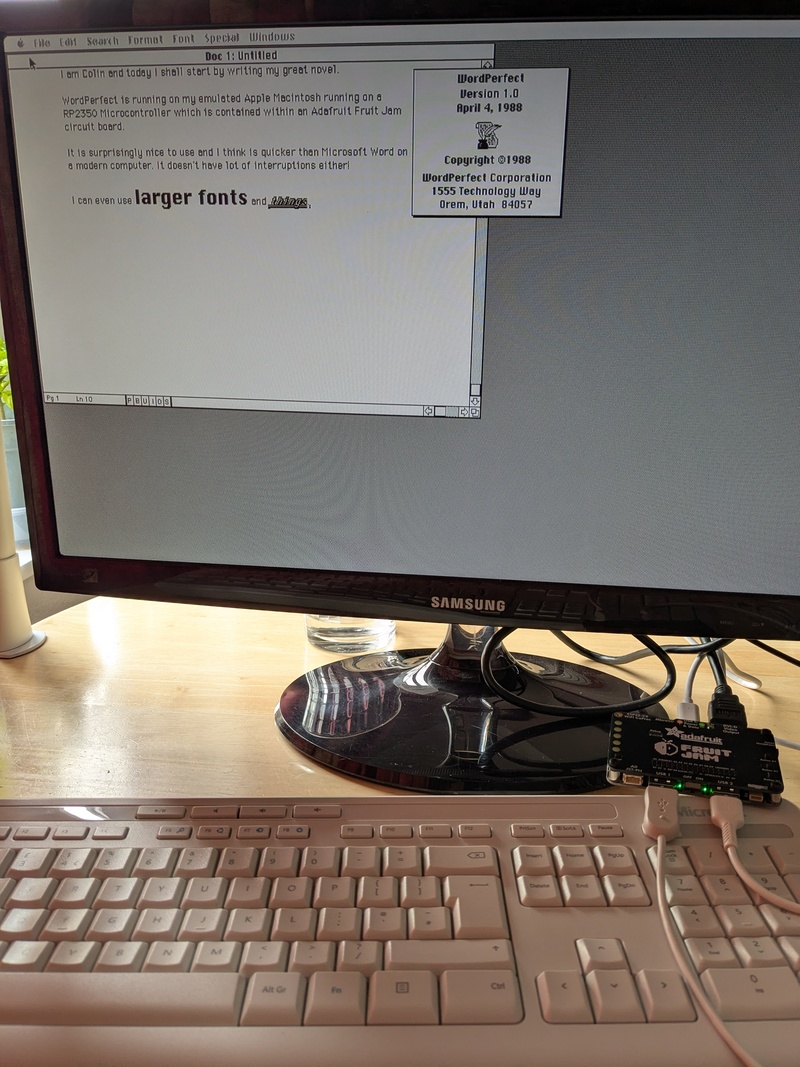
OK; this is hardly editing a full colour, highly detailed photograph but at least my "self portrait" will obviously set the illustration world on fire.

This was done by emulating an old Apple Mac on a Raspberry Pi RP2350 chip, which can be purchased for around 60p. Add the various extra parts needed and say roughly that a mid 1990s equivalent computer can be built today for a few pounds in one-off quantities. Call it the price of coffee and a cake in a European café today.

Adjusted for inflation, a roughly equivalent Macintosh SE to the one being emulated would cost £9554 today. (I found the pricing from a review in this 1989 Personal Computer World magazine online and used the Bank of England inflation calculator to convert the £3495 selling price.)

Whichever way you estimate: Computers are vastly cheaper nowadays and this computer is much cheaper than a modern PC.

The same emulated Mac can run other software - e.g. the WordPerfect word processor which was popular at the time. I found this surprisingly pleasant to type and concentrate with: It had an uncluttered interface and was distraction free when compared to my modern Macbook with its notifications and busy displays.

PXL_20260818_150820965.jpg Photo: WordPerfect 1.0 on an emulated Apple Macintosh
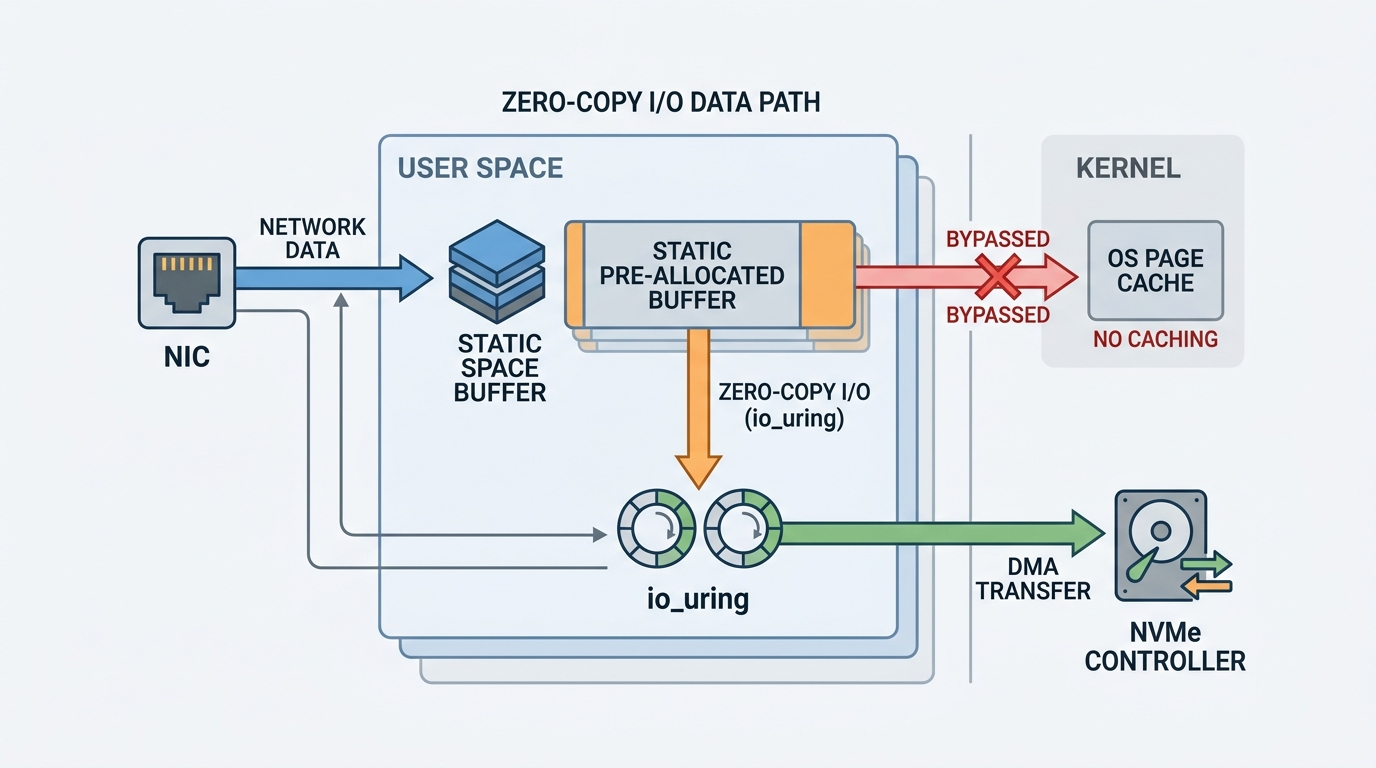
Sometimes experimenting with things can spark my imagination and create new ideas. Simple and low power computers appeal to me, so it's interesting to ask "what is the minimal viable modern computer". A 60p chip is definitely not the cheapest possible, but it is certainly has an impressive "computing power to price" ratio.

Assume this is equivalent to a mid 1990s computer (it has two 150MHz processors, and easily adds 4Mb RAM and gigabytes of storage) . This was time when people made presentations, wrote documents, ran spreadsheets, sent emails and browsed (an admittedly simpler) web - not dissimilar to a lot of our computer use today.

This provokes questions: How to provide computing for those who need to or want to spend their resources elsewhere? What could a super thin, super lightweight laptop look like? Perhaps it could have an e-paper screen to be calm on the eyes. Could it be solar powered? Could it have a calmer, less cluttered and less distracting interface than modern operating systems but still provide similar functionality? Could it be long lasting with reliable software and not have to be thrown into landfill every few years? Does this have enough processing power and quality to become part of a personal music playing or streaming system? Can this help reduce the addictiveness of modern devices and stop "doom-scrolling"?

The relative simplicity of this chip compared to more powerful ones (and the software limitations this would imply) means that the whole computer is (with effort by the right people) relatively understandable, and everything is documented, and the power consumption is lower.

If I had this computer as my phone or laptop what would I miss? If I could read web pages and write and listen to music I think this would do a lot of what I want. I'd want some kind of messaging and probably maps. I think this can probably play music. It could display maps but maybe in a simpler "A to Z atlas" style of flipping between pages. But maybe this trade-off vs power use could be useful in remote places with no smartphone charging. Maybe cycle tourists would appreciate such a thing.

It could (slowly) take and view grainy pictures, but videos and good pictures would be difficult. Saving videos to watch later on a display at home is probably a healthier way of consuming them than distracting myself with them, and maybe carrying a separate digital camera wouldn't be a sacrifice.

The modern web is sadly too complex to be viewable on such a device, but a bridging solution would be to have conversion software running on larger computers. A browser for something like Gemini would be possible. We could still have a WiFi chip on this, but the complexity of modern 4G and 5G mobile networks could be a challenge. Adafruit has An IRC messaging client demonstration running on this chip.

Maybe I'm being naive and nostalgic for a past that never existed. But I think it is important to think of the trade-offs we make with modern computers and maybe playing with some of these things can help us make computers which are kinder, as discussed by James in this blog post after our discussion. There is overlap here with some of the Solarpunk and Permacomputing communities. Having privacy respecting solar powered computers that people can tinker and mold to their own needs feels to me like an exciting, positive future.

It's interesting to imagine an alternative world where these modern chips had arrived much earlier in time, bringing un-imaginable (for then) amounts of computing power and memory for little money. How would computers have evolved and what would they look like today?

Some technical notes for anyone interested in doing this:

The same hardware used for my Commodore PET emulator can be used to run the pico-mac emulator with VGA output. I think it would need more RAM to run WordPerfect and Photoshop so would need the addition of a RAM chip.

This software can run on a Pi Pico2 with an DVI sock HDMI connector adapter and a USB adapter and an SD card adapter but I didn't do this - I would still need to order and solder the parts and the extra memory. I found some open source designs which integrate all the parts into a single board:

I opted for the Adafruit Fruit Jam which can be bought ready assembled. (An advantage for me given my questionable soldering skills).

The pros:

  • The Fruitjam comes with WiFi and infra-red remote control and a ready to use Circuit Python software image which uses the HDMI and keyboard as a terminal. I have an idea for another project which will require WiFi and infra-red.
  • The Fruitjam has a ready made Mac emulator and a very cute 3D printed case.

The cons:

  • The Fruitjam has a different circuit layout to the others. It uses different GPIO pins for the SDcard and uses the PIO to drive the USB ports. This means that software built for the other boards will not run without work. I'd like to try the Fuzix operating system and BBC Micro emulators but will have to work out how to add PIO USB support.

What did I do?

I didn't do much with the FruitJam other than follow the instructions but I customised the image to add the software:

  • I installed the 4096k-1280x720-psram-oc image onto the board.
  • I downloaded the SD card image.
  • I loaded this into the Mini vMac emulator.
  • I found an image disk with lots of software on the Macintosh repository and used the 'unar' tool to extract the compressed SIT file ("brew install unar" to install the tool onto my Mac).
  • From within the emulator I copied the software across to the main disk, and then closed the emulator.
  • I FAT formatted my SD card and copied the emulator image file onto it and renamed it to "umac0w.img". I then had to use my Linux computer to remove the other files added by my Mac, which upset the emulator (Initially it was stuck in a loop and not booting - this was the cause).

What else can it do?

Adafruit have put together a collection of software demos for the FruitJam - such as:

The Frank board has:

The Pico computer has:

Looking at the circuit diagrams, I think software between the Frank board, the Pico computer and the Olimex RP2350pc should be interchangeable.

Some interesting software to port

I wrote about blogging using an old terminal and so think it could be interesting to make another, using the similar terminal Blaze VT420 terminal emulator.

Some older self contained systems of the 1980s could run on this - for example Oberon (This RISC-V port could be a starting point). I enjoy the simplicity of the Oberon system and enjoyed the book.

Maybe porting Smalltalk could allow a Dynabook as described by Alan Kay in the paper "A Personal Computer for Children of All Ages".

A small emacs/lisp type system - zepl is a editor with lisp extension language in 2744 lines of code.

The Plan9 operating system could probably run on this hardware.

The os8088 project tries to build a simple, old-Mac-like user interface for an 8086 computer.

Running an Psion emulator could also be a possibility.

The Viewpoints Research Institute STEPS Project tried to simplify computing in 2012. Their report has some interesting ideas and outcomes.

The Daily Front Page 22 of 31
Friday, August 21, 2026 The Daily Front No. #260821 — Performance by Design
article

TigerBeetle Core System Architecture: Deconstructing Performance Engineering

by ksec·▲ 126 points·41 comments·ixuvo.com ↗
The real bottleneck is rarely the network or the query planner; it is the operating system kernel, memory fragmentation, and unpredictable tail latency.

Introduction

When evaluating high-performance database architectures, the conversation often centers on horizontal scaling, distributed partitioning, and query optimization. However, for mission-critical transactional systems like financial ledgers, the real bottleneck is rarely the network or the query planner; it is the operating system kernel, memory fragmentation, and unpredictable tail latency. TigerBeetle, a specialized financial ledger database written in Zig, challenges conventional database design by prioritizing extreme mechanical sympathy, static resource allocation, and custom zero-copy interfaces.

I have spent years analyzing distributed storage engines, and TigerBeetle’s architectural choices stand out as a masterclass in modern performance engineering. By rejecting dynamic memory allocation at runtime, bypassing the kernel cache via direct I/O, and leveraging a single-threaded execution loop backed by Viewstamped Replication (VSR), TigerBeetle achieves throughput rates exceeding hundreds of thousands of transactions per second with predictable, sub-millisecond tail latencies.

In this article, I will deconstruct the core architectural pillars of TigerBeetle. We will examine how static allocation eliminates runtime garbage collection and memory fragmentation, how custom zero-copy interfaces minimize CPU-to-memory bus overhead, and how Zig’s compile-time capabilities enforce strict safety guarantees without sacrificing raw hardware performance. My goal is to provide engineering leaders and systems architects with actionable insights into these low-level design patterns, enabling you to apply similar performance-engineering principles to your own high-throughput systems.

Static Allocation: Eliminating Runtime Memory Overhead

In traditional database systems, memory management is highly dynamic. As queries arrive, the database allocates memory for connection buffers, query plans, temporary sort buffers, and transaction state. While modern memory allocators like jemalloc or tcmalloc are highly optimized, they are not immune to thread contention, memory fragmentation, and unpredictable latency spikes during peak loads. In a financial ledger where a single delayed transaction can disrupt downstream payment pipelines, these latency spikes (often referred to as the "noisy neighbor" or "long tail" problem) are unacceptable.

TigerBeetle addresses this by completely eliminating dynamic memory allocation (malloc, free, or their equivalents) after the initialization phase. When the TigerBeetle process starts, it calculates and allocates all the memory it will ever need for its lifetime. This includes memory for network buffers, storage cache, transaction logs, and consensus state machines. Once the initialization phase is complete, the allocator is effectively frozen, and the system runs entirely within pre-allocated, static arrays and ring buffers.

This design choice has profound implications for system predictability and reliability:

  1. Zero Memory Fragmentation: Because memory is never freed and reallocated at runtime, heap fragmentation is physically impossible. The system will never run out of memory (OOM) mid-transaction due to fragmented free lists.
  2. Deterministic Tail Latency: Without a memory manager searching for free blocks or running garbage collection cycles, execution paths remain highly deterministic. Every CPU cycle is dedicated to processing transactions, not managing memory metadata.
  3. Hardware-Level Predictability: Pre-allocated memory blocks can be aligned precisely to CPU cache lines (typically 64 bytes) and page boundaries (4KB or huge pages). This alignment minimizes translation lookaside buffer (TLB) misses and cache line bouncing.

To illustrate the difference between this static paradigm and traditional dynamic database architectures, consider the following structural comparison:

Architectural Attribute Traditional Dynamic Databases TigerBeetle Static Architecture
Memory Allocation Dynamic (runtime heap allocation) Static (pre-allocated at startup)
Tail Latency (p99.99) Variable (impacted by GC/fragmentation) Deterministic (sub-millisecond bounds)
I/O Path Buffered I/O via Kernel Page Cache Direct I/O (O_DIRECT) with io_uring
Concurrency Model Multi-threaded with locks/latches Single-threaded event loop (Disruptor pattern)
Data Layout Variable-length rows/documents Fixed-size structs (128-byte accounts/transfers)
Failure Domain Dynamic out-of-memory (OOM) risks Predictable compile-time/startup-time limits

However, static allocation is not a free lunch. It introduces a major engineering trade-off: rigidity. Because all buffers are fixed in size, you must define the maximum number of concurrent connections, the maximum batch size, and the maximum storage cache size at startup or compile time. If your workload exceeds these pre-defined limits, TigerBeetle will not dynamically scale its memory usage; instead, it will apply backpressure or reject incoming requests. I find this trade-off highly acceptable for financial systems, where predictability and safety are far more valuable than elastic, unpredictable scaling.

Custom Zero-Copy Interfaces and Kernel Bypass

Even with static memory allocation, a database can easily become bottlenecked by the operating system's I/O stack. In a standard database, writing a transaction to disk involves copying data from user-space buffers to kernel-space page caches, and eventually flushing those pages to physical storage. This process involves multiple system calls, context switches, and memory copies, all of which consume precious CPU cycles and memory bandwidth.

TigerBeetle bypasses these bottlenecks by implementing a custom, zero-copy I/O path. It achieves this by combining direct I/O (O_DIRECT) with Linux’s modern asynchronous I/O interface, io_uring.

When TigerBeetle receives a batch of transactions over the network, the data is read directly into a pre-allocated static buffer. This buffer is registered directly with io_uring. When it is time to persist these transactions to the write-ahead log (WAL) on disk, TigerBeetle submits an I/O request to io_uring pointing to the exact same memory address. The kernel's storage driver reads directly from this user-space memory block and writes it to the NVMe controller via Direct Memory Access (DMA), completely bypassing the OS page cache.

This zero-copy pipeline ensures that data is never copied between different memory locations as it moves from the network interface card (NIC), through the CPU, and down to the physical storage media.

A architectural diagram illustrating TigerBeetle's zero-copy data flow from the network interface card directly to the NVMe controller via io_uring and statically allocated buffers.

To make this zero-copy mechanism highly reliable and performant, TigerBeetle structures its core data entities—Accounts and Transfers—as fixed-size, 128-byte structs. This exact sizing is highly intentional. Because 128 bytes is a multiple of standard CPU cache lines (64 bytes) and sector sizes (typically 512 bytes or 4096 bytes), TigerBeetle can pack these structs perfectly into memory pages and disk sectors. There is no need for complex serialization or deserialization protocols like JSON, Protocol Buffers, or even custom binary encoders. The memory representation of an Account struct in Zig is identical to its on-disk representation. Persisting an account is as simple as passing its memory address directly to the disk controller.

Here is a conceptual implementation of how TigerBeetle leverages Zig’s type system to define these fixed-size structs and manage zero-copy batching safely without runtime allocations:

const std = @import("std");

/// A highly optimized, 128-byte representation of a financial account.
/// Explicit alignment ensures that arrays of this struct align perfectly with CPU cache lines.
pub const Account = struct {
    id: u128,
    user_data: u128,
    reserved: [48]u8, // Pad to ensure exact 128-byte size and future-proofing
    ledger: u32,
    code: u16,
    flags: u16,
    debits_pending: u64,
    debits_posted: u64,
    credits_pending: u64,
    credits_posted: u64,
};

/// A pre-allocated batch of accounts designed for zero-copy I/O operations.
pub const AccountBatch = struct {
    const MaxEvents = 8192;
    
    // Static array allocated at startup/compile-time
    items: [MaxEvents]Account align(4096),
    count: usize,

    pub fn init() AccountBatch {
        return .{
            .items = undefined, // Left uninitialized to avoid startup overhead; populated explicitly
            .count = 0,
        };
    }

    /// Returns a direct slice of the memory to be passed to io_uring or network sockets.
    /// This operation is completely zero-copy and carries zero runtime allocation cost.
    pub fn as_bytes(self: *anyopaque) []const u8 {
        const self_typed: *AccountBatch = @ptrCast(@alignCast(self));
        const total_size = self_typed.count * @sizeOf(Account);
        const byte_ptr: [*]const u8 = @ptrCast(&self_typed.items);
        return byte_ptr[0..total_size];
    }
};

This code demonstrates how Zig allows us to enforce memory alignment (align(4096)) at the type level. By aligning the static batch to a 4KB page boundary, we satisfy the strict alignment requirements of O_DIRECT and DMA transfers. The as_bytes function performs a safe, compile-time validated pointer cast that exposes the raw backing memory of our struct array as a byte slice, ready to be transmitted over the wire or written to disk with zero copies.

The Single-Threaded Execution Loop and VSR Consensus

Many modern databases attempt to maximize throughput by parallelizing transaction execution across multiple CPU cores using complex locking mechanisms, MVCC (Multi-Version Concurrency Control), or actor models. However, parallelizing transactional state updates—especially in financial ledgers where account balances must be strictly checked and updated sequentially—introduces severe lock contention, thread synchronization overhead, and the risk of deadlocks.

TigerBeetle bypasses these issues by adopting a single-threaded execution model for its core state machine, heavily inspired by the LMAX Disruptor pattern. All transaction validation, balance checks, and ledger updates are executed sequentially on a single, dedicated CPU thread.

While a single-threaded architecture might sound like a bottleneck, it is incredibly fast when freed from the overhead of thread context switching, mutex acquisition, and cache invalidation. Because only one thread ever modifies the ledger state, TigerBeetle does not need locks, semaphores, or complex concurrency controls. The execution thread can run at maximum CPU frequency, pulling batches of transactions from a lock-free ring buffer and processing them sequentially in L1/L2 cache.

To keep this single thread fully saturated with work, TigerBeetle relies on aggressive batching and a custom consensus protocol based on Viewstamped Replication (VSR).

Instead of processing transactions one by one, TigerBeetle groups them into large batches (e.g., up to 8,192 transfers per batch). The consensus layer replicates these batches across the network to follower nodes. Once a batch is committed by the consensus quorum, it is handed off to the single-threaded execution loop. The execution loop processes the entire batch in a single pass, updating the in-memory state and writing the results to the storage engine in a single, sequential disk write. This batching strategy transforms what would be thousands of small, random disk and network I/O operations into a single, highly efficient sequential operation, maximizing the physical throughput of NVMe drives and network interfaces.

Memory Layout, Cache Locality, and Zig's Type System

At the hardware level, the speed of your code is largely determined by how efficiently you utilize the CPU's cache hierarchy. A modern CPU can access registers in less than a nanosecond and L1 cache in about one nanosecond. However, accessing main memory (RAM) takes around 50 to 100 nanoseconds—an eternity in high-performance systems. If your database engine is constantly chasing pointers across the heap (a common occurrence in languages with heavy object references like Java, Go, or Python), the CPU will spend most of its time stalled, waiting for data to arrive from RAM.

TigerBeetle is designed to maximize cache locality by keeping data contiguous in memory. Because accounts and transfers are represented as flat, fixed-size structs packed tightly into contiguous static arrays, the CPU's hardware prefetcher can easily predict memory access patterns. When the execution loop processes a batch of transfers, the CPU pre-fetches subsequent transfers into the L1/L2 cache before the execution thread even requests them, virtually eliminating CPU stalls.

Zig’s type system is uniquely suited for this style of performance engineering. Unlike C++, which allows implicit memory allocations and complex copy constructors, Zig enforces explicit control over every byte of memory. There is no hidden control flow, no implicit type coercion that could trigger a copy, and no runtime overhead from a virtual method table (vtable) unless explicitly designed.

Furthermore, Zig's compile-time execution engine (comptime) allows TigerBeetle to perform extensive validation of data structures, alignments, and system configurations at compile time rather than runtime. For example, TigerBeetle uses comptime to verify that the size of its storage blocks is a perfect multiple of the disk sector size, and that all critical structs are aligned to cache line boundaries. If an architectural change violates these performance-critical constraints, the build will fail immediately, preventing performance regressions from ever reaching production.

Conclusion

TigerBeetle’s core system architecture demonstrates that extreme performance is not achieved by adding complexity, but by systematically removing it. By rejecting dynamic memory allocation, bypassing the OS kernel with zero-copy direct I/O, and utilizing a single-threaded execution loop, TigerBeetle aligns its software architecture perfectly with the physical realities of modern hardware.

For engineering leaders and systems architects, the takeaways from TigerBeetle’s design are clear:

  • Design for Predictability First: If your system requires low tail latency, eliminate dynamic runtime allocations in favor of static, pre-allocated resource pools.
  • Embrace Batching to Amortize Overhead: Batching is the ultimate performance multiplier. It converts expensive, random I/O and network operations into highly efficient, sequential pipelines.
  • Align Software with Hardware Limits: Structure your core data models to align with CPU cache lines and disk sector boundaries to maximize hardware efficiency and minimize CPU stalls.

By adopting these mechanical sympathy principles, you can build systems that are not only orders of magnitude faster but also significantly more reliable and predictable under extreme load.

The Daily Front Page 23 of 31
Friday, August 21, 2026 The Daily Front No. #260821 — A Foundation for the Malleable Computer
article

Omacom Foundation launches with $8M

by djfergus·▲ 173 points·159 comments·omarchy.org ↗

It’s time to dream big. Omarchy Quattro has given people a chance to experience what the malleable computer of the future looks like, and they like it (a lot!). It now feels like a moral obligation to make this future more broadly available and fundamentally change how people relate to their computers for the first time in what seems like forever.

To do just that, I’m incorporating the Omacom Foundation to ensure that this mission is fully funded, durable, and ready to accelerate.

This nonprofit foundation will hold the trademarks, fund the infrastructure, promote the work, and support the open-source projects and developers Omarchy depends on.

These eight Founding Patrons are each contributing $1 million to this mission:

This is a ridiculous sum of money, so I intend to make sure it lasts a long time, and that we make the most of it. But just as important as the incredible cushion is the vote of confidence delivered by these pledges.

We’re going to make the prophecy of The Year of Linux on the Desktop come true. All the pieces are now in place. Time to go all in!

The Daily Front Page 24 of 31
Friday, August 21, 2026 The Daily Front No. #260821 — A Foundation for the Malleable Computer
repository

Codex on AWS bedrock bug causing 10x charges

by TheP1000·▲ 146 points·62 comments·github.com ↗
★ 111,868⑂ 17,204 forks Rust

Lightweight coding agent that runs in your terminal

Summary

Native Codex CLI requests to Amazon Bedrock Mantle cannot opt into GPT-5.6 Sol explicit prompt caching. On an agentic coding workload, this has produced a large volume of cache-write tokens and materially higher cost.

This is related to #35300, but adds independent production usage evidence from the native amazon-bedrock provider.

Environment

  • Codex CLI: 0.147.0
  • Provider: native amazon-bedrock
  • Endpoint: Bedrock Mantle Responses API, us-east-1
  • Model: openai.gpt-5.6-sol

Observed production usage

For the completed days 2026-08-05 through 2026-08-08, Cost Explorer usage quantities and the Bedrock rate card produced the following cache-aware estimate for Sol:

Requests Cache-write tokens Estimated cache-write cost Estimated total cost 3,656 171.94M $1,182.09 $1,386.46

Cache writes were about 85% of the model's estimated spend.

A local Codex session also reported 76 Sol requests with 6.709M cache_write_input_tokens, zero cached_input_tokens, and an average of about 88K cache-write tokens per request. There were no client errors in the corresponding CloudWatch metrics.

These are usage-derived estimates, not finalized AWS invoice amounts.

Investigation

Codex already emits a session-scoped prompt_cache_key, but the request types for both HTTP and WebSocket Responses requests do not include either:

  • prompt_cache_options
  • prompt_cache_breakpoint

The built-in Amazon Bedrock provider config exposes transport/auth settings, not structured request-body transformation, so this cannot be configured through config.toml.

AWS documents explicit cache mode for GPT-5.6 on Bedrock specifically for agentic workflows with long stable instructions/tool definitions followed by changing tool and user content. That matches the workload above.

Requested behavior

  1. Add support for serializing prompt_cache_options for GPT-5.6-capable Responses providers.
  2. Add a typed prompt_cache_breakpoint field to supported input content blocks.
  3. Provide a provider/model capability gate and a safe placement strategy at the end of Codex's measured stable instruction/tool prefix.
  4. Surface cache reads and cache writes in per-turn usage telemetry so users can diagnose costly full-prefix rewrites.

Scope

This report does not claim that every cache write is a defect. Cold starts, genuinely distinct prompts, forks, and compaction can all require writes. The issue is that native Bedrock Codex currently has no way to use the documented explicit-cache mechanism for the stable-prefix case.

The Daily Front Page 25 of 31
Friday, August 21, 2026 The Daily Front No. #260821 — Notes for the Native Web
article

Small, native web tricks worth remembering

by marcomezzavilla·▲ 218 points·54 comments·htmlcat.net ↗

Welcome to HTMLcat: small, native web tricks worth remembering.

Each post-it pairs one useful platform feature with a small example and the caveat that matters.

Some notes cover limited or experimental features. Check the support label, keep a fallback, and test with real browsers and assistive technology.

The Daily Front Page 26 of 31
Friday, August 21, 2026 The Daily Front No. #260821 — Maturity, Carefully Considered
article

Three important steps in my maturation process

by tdullien·▲ 128 points·58 comments·thomasdullien.github.io ↗
The importance of understanding your own incentive structure, and not believing everything you think.

My father passed recently, and he was twice my age. I am approximately the same age that he was when I was born, and I am now “the old generation” - there’s no one left in the generation above me.

At the same time, I recently joined a company that skews younger-than-me. When I joined Google in 2011, I had just turned 30, and was in the mainstream demographics of Google in 2011. There were a bunch of more senior folks, with the very senior ones being in their 50s and having completed stints at Bell Labs. I admired a lot of these “greybeards” (even though this is a sexist term - what’s the right female equivalent? There were a few very senior female engineers that I would love to include).

So perhaps it is natural that I am reflecting on “what were the important realizations that I made since my early 20s that had a profound impact on the way I think about the world”? In some sense: What are the insights I had that made me “more mature”, for some positive definition of “mature”?

This post tries to list them.

1. The importance of understanding your own incentive structure, and not believing everything you think.

I recently wrote a Twitter thread about the topic. Oppenheimer was very publicly guilt-ridden about the creation of the nuclear bomb, and von Neumann at some point quipped “some people profess guilt to claim credit for sin”. In my young years, particularly in situations when I had 0day that nobody else had, I agonized about the responsibility that comes with having 0day. Should I fix them? Should I use them for good? Will the world be harmed this way? Or that way?

In the end, it turns out that - while individuals matter - many ideas have a “time at which they are ripe”, and the actions of the individual matter less than the individual thinks in that moment. There is also almost no way to predict the ways in which what you do impacts the broader world.

If you were asked: “Would it be good if this 0day was used to apprehend a terrorist?” you would probably say “this is good”. If you were asked “would it be good if this 0day is used to arrest someone and then torture and waterboard him 183 times?”, you would probably say “this is bad”. So if your 0day was used to capture KSM, it is probably good? Or bad? Things get very complicated very quickly.

Is closing 0days good for society, because it makes everything safer? Or is it enabling oppression, because buggy systems are easier to bypass?

There are no good answers, and your own incentive structure will greatly influence how you choose your beliefs. In the end, people want to be the heroes of their own story, and at the same time they have basal needs for recognition, for material goods, etc. - so they will try to construct a narrative that allows them to satisfy their basal needs while also remaining the hero of their saga.

Anxiety about the impact of your work is self-flattering, and you have to recognize it as such, and keep it in check - it’s sugar for your ego, but history will largely route around you, because while individual decisions matter in specific situations, the overall flow of history is less sensitive to the individual than the individual thinks. The broader lesson, though, is: Do not believe everything you think. Examine your own incentive structures carefully. Ask yourself what alternative narratives for your behavior and beliefs could be, especially if they contradict the narrative of the heroic saga you’re constructing for yourself. Carefully weighing the question “how might I be the villain in this story?” is an important and valuable skill.

Similarly, meta-cognition - just observing your own thoughts in a detached manner, and then being able to interpret, analyze, and contextualize them with regards to your own incentive structures, is a great skill to cultivate.

2. Monocausal determinism is an illusion, and largely does not exist outside of computer debugging.

The monocausal determinism that young computer enthusiasts get used to is an illusion that generations of electrical and process engineers spent their lives perfecting and maintaining. It is because of these engineers that computer scientists could largely get away without probabilities or any empirical grounding in the past. There is an argument that you have so many natural scientists that crossed over into AI because CS education was for a long time too focused on reasoning within the deterministic monocausal illusion.

The reality is: Computing machines are physical devices, which includes wear & tear, differences in quality between items, and “probabilistically deterministic behavior”, e.g. it’ll appear deterministic most of the time if not shaken too much. If pushed a bit - be it temperature, voltage, electromagnetic fields, or even rapid memory accesses to adjacent DRAM rows - determinism has a tendency to go out of the window, the illusion collapses, and we’re dealing with a very different beast.

FWIW - this also makes me wonder about model alignment, because even a perfectly aligned model will be subject to random bit flips in inference, and it’s hard for me to imagine that you can maintain any reasonable guarantees in the presence of bit flips to inopportune values at inopportune times.

The real world is one where very few things that happen have a single reason, and very few truly deterministic transmission mechanisms. Everything is probabilistic, and everything is multicausal.

Measurement noise is real, experiment design is difficult.

Interestingly, if you think about this carefully, you also realize that the scientific method is a classifier that is intentionally biased against accepting something as true - so that we only accept things as true that are beyond any reasonable doubt true.

A somewhat fascinating corolary of this is that there exists a large class of true things that will never be scientifically shown as true.

3. The dichotomy between reason and emotion is a cultural construct, and neither grounded in neuroscience nor in logic.

With some digging, it turns out that the western belief that reason and emotion are two ends of a spectrum is a purely cultural construct, as is the belief that “higher-order” reason needs to reign in “basal” emotions, or that “emotions” intrude on “rationality”.

In most non-western cultures, achieving integration between rational deliberation and impulses and emotions is more common, and it turns out that this is much closer to the biological reality.

From a neuroscience perspective, it is clear that emotional valuation is part of a larger decision-making machinery that tends to not function properly if the emotional valuation component is damaged or removed. There is also a large component where things that your brain struggles to articulate verbally are transmitted via emotions, as well as actual feedback from your sensory organs in your body. Fun trivia: Your gut’s enteric nervous system contains as many neurons as the entire cerebral cortex of a dog. Your body also forward-deploys neurons in your muscles and extremities, as a form of latency optimization. Your body is feeding you extra information, and most of this shows up in the shape of emotions.

Which brings us to the logical argument why attempting to “remove” emotions from decision-making is a bad idea: Clearly, having the ability of leveraging more information for decision-making will improve the quality of decisions. Attempting to eliminate a particular source of information almost certainly makes the quality of your decisions worse.

This is not to say one should act on impulse alone, but it is certain that integrating the full spectrum of information - which includes emotions - in your decisions is a wise idea.

I am sure that if I think more carefully, I will come up with more insights, but these three are important enough that they show up in my life with astonishing regularity.

Hope this is helpful to someone.

The Daily Front Page 27 of 31
Friday, August 21, 2026 The Daily Front No. #260821 — Memory’s Next Decade
article

Micron announces $10B research hub in Boise

by osnium123·▲ 125 points·67 comments·investors.micron.com ↗
It’s time to dream big.

Backed by a $10 billion planned investment over the next decade, Micron Research Labs will unite academia, government, startups and industry to advance the memory and compute breakthroughs that will define the AI era

BOISE, Idaho, Aug. 20, 2026 (GLOBE NEWSWIRE) -- Micron Technology, Inc. (Nasdaq: MU) today unveiled Micron Research Labs, a U.S.-based long-horizon premier research institution headquartered in Boise and backed by a planned $10 billion investment over the next decade. Building on Micron’s technology and manufacturing leadership, the new hub will bring together customers, academia, government and the broader semiconductor ecosystem to pursue breakthroughs beyond today's technology roadmaps and help define what's possible in the decades ahead. Key research areas include critical memory technologies, advanced memory and compute architectures, packaging and future semiconductor manufacturing.

As the first dedicated memory research hub of its kind in the U.S., Micron Research Labs will center on a flagship Boise campus designed to support advanced research across critical technology domains. The planned investment will also fund extensive university collaborations, global satellite labs and deep ecosystem partnerships, creating a connected research network focused beyond the next generation of technologies for the AI era.

“The decisions we make today will determine who leads the AI economy of tomorrow, and America's AI future will be built on American-made memory," said Sanjay Mehrotra, Chairman, President and CEO of Micron Technology. "With a planned $10 billion investment in Micron Research Labs, we are looking around the corner to the memory and compute systems the future will demand, bringing together the best minds across academia, government, startups and industry. This builds on the more than $250 billion we have separately committed to manufacturing and R&D across the United States, because as the only U.S.-based manufacturer of memory, we have long believed in the future that AI is now making real.”

Micron Research Labs is founded on a simple conviction: The future of memory and compute is too important and complex to invent alone. Anchored in Boise and connected to Micron’s research and technology footprint across the U.S., Europe, Japan, India, Singapore and Taiwan, the lab will link Micron researchers with external experts and research partners to accelerate the path from scientific discovery to real-world impact.

Building on Micron’s 62,000 lifetime patents and its position as a global technology leader, Micron Research Labs will advance foundational research across memory, compute and semiconductor manufacturing. The institution will look beyond a 10-year horizon while helping build the next generation of memory researchers and technology leaders. Breakthroughs in advanced memory make AI more powerful, scalable, accessible and sustainable, extending the benefits of intelligent technology to agriculture, healthcare, education and industries around the world and advancing Micron’s vision to accelerate intelligence to enrich life for all.

This new investment builds on Micron's previously announced plans to invest more than $250 billion in manufacturing and research and development in the U.S. that will create more than 90,000 American jobs and will reinforce American leadership in memory and advanced manufacturing for years to come. This new investment draws on Micron's unique position as the only U.S.-based company developing and manufacturing leading-edge memory.

“For nearly 50 years, from four people in a Boise basement to America's memory leader, Micron has pushed the boundaries of what memory can do,” said Scott DeBoer, Executive Vice President and Chief Technology and Products Officer at Micron Technology. "Micron Research Labs gives that legacy a dedicated home for long-horizon innovation, the kind of research that sits upstream of every product we build.” 

Micron anticipates breaking ground in calendar 2027 on a state-of-the-art Micron Research Labs facility capable of hosting hundreds of researchers. The facility is expected to convene world-class research conferences, workshops, and innovation forums in Boise.

Secretary of Commerce Howard Lutnick:
"Memory is a core component of America's technological leadership, and under President Trump, the United States is advancing domestic semiconductor capabilities. Today, Micron announced the establishment of the first dedicated Memory Research Lab along with a $10 billion investment in memory research. This commitment will strengthen American innovation, create hundreds of jobs and ensure memory never limits innovation."

Director of the White House Office of Science and Technology Policy Michael Kratsios:
“Micron’s establishment of the first dedicated memory research lab in the United States advances the Trump Administration’s mission to secure our nation’s technological edge. Memory is fundamental to the AI era, and by uniting the entire innovation ecosystem here at home, we can help ensure the next generation of breakthroughs are invented, developed, and scaled in America. This investment strengthens our national competitiveness and accelerates the path to the AI-driven Golden Age of American Innovation.”

Jensen Huang, founder and CEO, NVIDIA:
"Micron is taking on one of the great challenges of the AI era — reinventing memory technologies and architectures to fuel the next generation of increasingly powerful AI systems. By bringing together advanced manufacturing and the broader technology ecosystem, Micron is helping drive the breakthroughs that will define the next era of AI and computing.”

Tim Cook, CEO, Apple: 
“For more than two decades, Micron has been an important partner, providing memory technologies for Apple's groundbreaking products that people love and use every day around the world. With the launch of Micron Research Labs, they are building on a legacy of leadership in semiconductor research to drive breakthroughs in memory and computing for decades to come. Apple believes deeply in American innovation, and we’re proud to support Micron as it expands leading-edge manufacturing and R&D in the United States.”

Gary Dickerson, President and CEO, Applied Materials:
“Sustained technology leadership requires innovation in both semiconductor research and manufacturing. As memory and computing architectures become increasingly complex, advances in new materials, equipment, process technology and chip packaging will play an essential role in turning breakthrough ideas into reality. Applied Materials has been partnering with Micron for decades, and we are excited to support the new Micron Research Labs in enabling innovations that will advance the future of AI and semiconductor technology in the United States.”

Tim Archer, President and CEO, Lam Research:
"At Lam, we've seen that breakthroughs in semiconductor performance require advances across the entire technology stack, from materials and process technologies to device architectures and system innovation. Micron Research Labs is a meaningful investment in the long-term research ecosystem that fuels these advances. By connecting leading researchers across industry, academia and government, Micron is helping to accelerate the discoveries that will keep America at the forefront of AI and computing." 

Tsu-Jae King Liu, President, National Academy of Engineering:
“Future intelligent systems will be shaped by engineers who advance the frontiers of semiconductor devices and advanced manufacturing, for more affordable and energy-efficient computing and innovative memory solutions. Micron Research Labs represents a powerful commitment to support collaborative, long-horizon research and to develop the engineering talent our nation needs. By connecting industry, universities and government, this new hub of discovery and innovation will strengthen the U.S. semiconductor ecosystem to keep America at the leading edge.”

Luc Van den hove, Chairman, Interuniversity Microelectronics Centre (imec):
"By bringing together expertise from industry, academia and government, Micron is strengthening the global innovation ecosystem that underpins semiconductor progress. The challenges facing the industry, from AI-driven computing to next-generation memory technologies, are too complex for any one organization to solve alone. At imec, we believe deeply in the power of precompetitive collaboration, and our long-standing partnership with Micron demonstrates how shared research can create impact across the broader semiconductor ecosystem. We look forward to building on that partnership and advancing the breakthroughs that will shape the future of computing.”

Jonathan Levin, President, Stanford University:
“Innovation is about turning bold ideas into discoveries that change the world. Micron Research Labs reflects the kind of long-term investment in fundamental research and innovation that is needed to keep America at the forefront. I look forward to the collaborations the Labs will enable with academic institutions to advance the science of memory and computing, and power the next era of discovery.”

Jim Davis, President, The University of Texas at Austin:
“Sustained investments in research will secure our future leadership in computing, semiconductors, and AI. As a founding member of the Texas Institute for Electronics, Micron is a strategic partner to UT Austin and a leading-edge US-based memory provider. Micron understands the power of both academic and industry research and is driving innovation in the national security sector. This investment is the kind of long-term commitment that will produce breakthroughs and unlock new opportunities for our students, researchers, and industry partners.”

About Micron Technology, Inc. 
Micron Technology, Inc. is a global leader in semiconductor memory and storage, powering AI and compute-intensive applications from cloud to edge. With a relentless focus on our customers, technology and product leadership, and manufacturing and operational excellence, Micron’s comprehensive portfolio of high-performance DRAM, NAND and NOR solutions deliver the speed, efficiency, and scale today’s workloads demand, accelerating intelligence to enrich life for all. To learn more about Micron Technology, Inc. (Nasdaq: MU), visit micron.com.

Forward-Looking Statements

This press release contains forward-looking statements, including statements regarding Micron’s manufacturing and research and development investments in U.S. and the outcome of such investments. These forward-looking statements are subject to a number of risks and uncertainties that could cause actual results to differ materially. Please refer to the documents Micron files with the Securities and Exchange Commission, specifically its most recent Form 10-K and Form 10-Q. These documents contain and identify important factors that could cause actual results to differ materially from those contained in these forward-looking statements. These certain factors can be found at https://investors.micron.com/risk-factor. Although Micron believes that the expectations reflected in the forward-looking statements are reasonable, Micron cannot guarantee future results, levels of activity, or achievements. Micron is under no duty to update any of the forward-looking statements after the date of this press release to conform these statements to actual results.

The Daily Front Page 28 of 31
Friday, August 21, 2026 The Daily Front No. #260821 — In Brief
article

Stop Making TUIs

by underdeserver·▲ 111 points·175 comments·sockpuppet.org ↗

Our field has a weird relationship with terminal and command line interfaces. The time has come to re-evaluate it.

I’m on a kick lately getting my friends to try building native user interfaces. I built my first serious Mac application a few months ago, and since then I’ve built more native UI thingies than in my entire career prior to that. Let’s take a quick tour.

MDV.app, a native macOS Markdown viewer

This is MDV.app, the greatest Markdown viewer in the world until someone else writes a serious markdown viewer. I’ve already written a bunch about MDV and won’t wear you down with more advocacy for it. It is great, though.

I had almost no hand in writing this UI code. Why would I? Like most user interfaces, MDV doesn’t break any new ground. It’s not a challenging problem. But building good UI is very hard: this kind of code is tedious, repetitive, exacting, and gated by platform conceptual knowledge. It takes years to get good at this kind of work. Which is why I would never hand-write this program. Instead, I summoned it.

Moving along:

A native calculator-style frontend for SageMath

I spent the last year doing Math Academy, from Foundations I through Machine Learning, which you can shorthand as “I taught myself calculus”. I like Math Academy a lot and have a bunch to say about it, but here it’s just the set-up to another SwiftUI app I willed into being: a native calculator-style frontend for SageMath, which is the default math system for cryptographers.

Three big things this app does for me: it automatically renders Sage output in LaTeX, which gets handier the deeper you get into multivariable calc, it point-and-click exposes Sage methods on objects like vectors, matrices, and expressions (which is much nicer than typing trig_simplify over and over again), and it provides a “little language” of shorthand inputs that make common operations (like “take the gradient of this expression”) quick to type. [1,2;3,4] is a matrix in this system; you should already be sold on it.

I’m not packaging this application up. If you want it, just screenshot this section of the post and give it to Claude. It’ll build something useful. You see where I’m going with this.

DJ Roomba, my Apple Music player

(it would be more useful if I cleaned up all my genre labels, most of which date back to the first MP3 rips I did back in 1997).This is DJ Roomba, my Apple Music player. The genre map is a dubious feature. What isn’t dubious is the embedded LLM agent, which has tool calls to read my library, my last played list, and my upcoming tracks. “I’m going to the basement shop to build a picture frame; give me a no-skips playlist to fit the mood”. Turns out the mood is “lots of Kurt Vile and Tom Petty”. No notes.

It’s backended by a SQLite database, a sane one with a reasonable schema, which was also a surprisingly useful feature.

I don’t really know what to think about programs like this. It’s an AI-assisted music player that includes 90% of the interface of Music.app. Music.app. My ever-present personal computing nemesis. This is the personal computing equivalent of slaying a dragon. But I didn’t write a single line of code in it. Am I developing software, or just configuring my computer?

Hold that thought.

Self Driving Wiki.app, my LLMwiki

This is my LLMwiki. Somebody should write a popular, widely-shared piece on how valuable a self-driving wiki is, where you feed it source material and ask it questions and it writes the wiki for you. Wildly useful idea, I’m glad I thought of it.

Self Driving Wiki.app was fun to write. Unlike DJ Roomba, which directly embeds a Responses API client, this app drives claude -p under the hood. Because I assume that agents work better with a filesystem to grovel, I summoned a macOS virtual filesystem extension, which reflects a read-only view of the backing SQLite database as a mounted filesystem inside the app’s sandbox.

Was this probably unnecessary? Does it make the app more annoying to install, for instance by requiring it for some reason to run out of /Applications/? Yes, and also yes. But these kinds of yak-shaving excursions were the joy of software development in the pre-LLM era and I’m glad to discover that I can still experience them today.

A semiautomated food macro tracker

(hyper-responder at 2.5 with zero side effects, this shit is choice)Here’s something I use constantly: a semiautomated food macro tracker. I’m glipping balls like everybody else. The app is another simple agent fronting GPT5, taking very short meal descriptions like spitball a guess on the calories ingested tasting cake batter and cream cheese frosting (but I didn't eat any cake) and translating them to intake estimates.

Thermite, a menu-bar thermometer

Here’s a menu-bar application that tracks temperatures around my house using these cheap little TP-Link temperature sensors that are giving the Chinese Communist Party access to my Apple TV. Normally after putting something like this together I’d be able to tell you a lot more about the protocols and HTTP APIs these things use to communicate, but I did none of the work to figure that out, so all I can tell you is that there are two different sign-in paths to get information from their cloud and directly from the little sensor pods.

A menu-bar Apple TV remote control

Finally, and speaking of my Apple TV, I present the holy grail of macOS native desktop software development: a working menu-bar Apple TV remote control. A couple years ago, I would have paid very good money for this, because I am exactly the kind of dork that tends to have an open MacBook on their lap while watching House Of Ninjas with his spouse.

(and to my Roku TV and my Denon receiver, since this is a universal remote)

Talking directly to an Apple TV is a pain in the ass. But it turns out people already figured this out and wrote Python libraries to do it. I don’t “use” those libraries, because this is a native Swift app, but that doesn’t matter: whatever has been written in Python might as well have been implemented in Swift, C#, and Brainfuck as well. It’s all the same to a frontier model.

I am somewhat self-aware. Preening about a bunch of SwiftUI interfaces I generated clearly invites clinical and unsparing critique of their visual design. Bring it on. But: as a longtime patron of the App Store, I’ll claim these designs are all a step ahead of replacement-level. Five years ago, if I’d had a macOS UI person on my team, I’d have been over the moon to get output of this quality.

The truth is, I barely think about these things as “apps” (I have no intention to distribute them). They’re artifacts of me making my computer do stuff for me, the way I want it to. As a Unix nerd, I’ve always been able to do this, in the language of the command line. Now, it’s just as easy to do that kind of work with graphical interfaces.

We build terminal interfaces because we have to, not because we should.

But First, A Word About CLIs and TUIs: command-line interfaces and terminal user interfaces are both products of the 1970s, shrink-wrapped around the constraints of teletype interfaces and dumb video terminals. Both tend to be outmoded, hostile, and constrained relative to graphical interfaces. But these tendencies are intrinsic to TUIs, and not to CLIs. CLIs have purposes for which they’re irreplaceable. Building a CLI is almost always a good idea. Building a TUI almost never is.

Back in 1999, Neal Stephenson wrote an essay about command line interfaces that set the field of human-computer interaction back about 20 years. In it, he depicts the priesthood of Unix nerds wielding CLIs as powerful Morlocks, holding the entire computing industry on their shoulders. The Eloi use GUIs like Microsoft Word. Because this is high-test fan-service, “In The Beginning Was The Command Line” has become one of our field’s sacred texts, despite very little of it holding up 25 years later.

In reality, terminal interfaces don’t exist because of any special machine sympathy they create between computers and their operators. Rather, TUIs exist for just two reasons: modems, and because Unix nerds didn’t want to learn Motif.

I can’t blame them. I had to do a tiny bit of Motif work in the mid-1990s and it put me off UI development for the next 29 years. Curses is no great shakes, but you can learn it inside of 5 minutes. I’m not kidding: you wouldn’t pick raw curses today for a TUI, but go ask ChatGPT to give you a brief rundown (“don’t waste time explaining concepts”) of the bare minimum you’d need to write pico. Take the code it hands you and compile it; it works. It’s clear where to go with it. There’s just not much to it.

An agent can reliably build a native macOS interface that is reasonable, by dint of using the SwiftUI frameworks the way Apple tells you to. This is a difference between native applications and web interfaces: sameyness is a good thing: native apps are supposed to look like other native apps.

But there’s one of the problems with TUIs: even with a good framework, like Ratatui, Textual, or Bubbletea, you’re fighting the terminal to come asymptotically close to what every native framework does well out of the box. Scrolling and scroll targets are an obvious example. Drag and drop another. Text selection — it gets tricky when you’re using in-band signaling to draw window borders! Multiple floating windows. All this is before we get to image handling.

You can spend an hour and get a decent version of a lot of standard controls in a TUI framework: a date picker, a secure text field, a progress bar, a text editor. But most of them won’t be as good as the system versions of the same widgets, and they won’t compose well without even more work.

All this stuff just works out of the box in native UI.

You are about to tell me, in no uncertain terms, why we’ll all be using and enjoying TUIs in 2046. Allow me to anticipate a couple of your arguments.

TUIs are economical and fast interfaces with high information density. Nerds don’t just like them for their retro aesthetics. They appreciate being able to knock out complex tasks in seconds with just a couple keystrokes.

These are all true statements, but to make that argument persuasive, I’d need to start that paragraph with the word “only”, and if I did that I’d be lying. Graphical interfaces tend not to be economical, dense, or keyboard-y. But that’s usually because they’re not designed for nerds (even on Linux, graphical interfaces are often aspirationally designed for the mythical normie Linux On The Desktop user). Nothing is stopping you from designing a dense and economical GUI. It’s been done!

To me, these TUI niceties are a powerful argument for doing more graphical work, because it’s become easy and cheap to experiment on this stuff, and I want to see a native UI built to capture everything that’s great about Magit or Lazygit (without having to build it myself).

Next: TUIs work over SSH connections. If you need a user interface on prod, it’s going to be a TUI.

The problem with this argument is that you probably don’t need a user interface on prod. You need a command line interface on prod that a user interface on your Macbook can drive. Anybody that’s ever done anything with bpftrace should know this in their bones, at least by the 3rd time they’ve built a bar chart out of hash marks. Fortunately, there’s precedent for this: check out Emacs TRAMP, which efficiently hides SSH connections and presents a native (and graphical, if that’s your bag) editor experience for remote files that even works with LSPs and Magit.

People will tell you that TUIs are accessible.

The problem with this argument is that it’s probably false. I want to be careful with this argument, because I’m not a customer of accessibility features. All I can do is go off the experiences of people who do a11y work. Like this speaker describing how screen readers read all the line-by-line updates of TUI “chrome”; hash mark, hash mark, hash mark, hash mark, dash, dash. Seems bad!

Modern native UI frameworks were designed from the jump to do accessibility well. SwiftUI keeps two UI trees, a visual one and a semantic accessibility tree. There are TUI frameworks that, admirably, try to get this right. I’m not here to tell you TUIs can’t be accessible; just that accessibility is not a reason to prefer TUIs to GUIs.

Finally, I can think of one strong argument for TUIs: they’re cross-platform.

I can get an agent to build native UI for me on Windows and Linux and I’m confident I’ll end up with something reasonable. But I don’t have Windows and Linux desktops to play with those interfaces on, and while the ground is certainly shifting below all of our feet, I think we can all agree there remains an important distinction between vibe-coding and vibe-shipping. Somebody soon is going to ship an app that they literally haven’t looked at or used. But it won’t be me.

Meanwhile, if I build a TUI, I can be reasonably sure that Linux users are going to get the same experience I have. That’s not nothing. But remember: I’m not really building applications for other people to use. I’m building them for me. TUI affordances are an awfully big hit to take to get Linux users of programs I don’t even want to publish.

A couple years ago, these arguments would have been deeply silly. Not because TUIs were good but because native UI wasn’t a reasonable ask. As evidence for that, observe that we’ve spent the better part of a decade living with Electron apps. That was because native UI was hard to do well. But it isn’t anymore, and we should be doing more of it.

I can only speak for MacOS development, and then assume that GTK 4 in Linux and WinUI 3 in Windows are comparably easy.If I’ve piqued your interest, I’m happy to say there’s not much to getting a decent native MacOS app.

What I did was to go trawling for skills, ending up taking this macOS design skill, a basic typography skill (any one you found on Github today would be better than what I’m using), and Paul Hudson’s SwiftUI skill. I also took Airbnb’s Swift language skill, because I haven’t grown out of caring whether the code I generate is idiomatic.

You want to make sure you’ve got computer-use, or whatever Codex calls it, enabled. You want to be able to fire this off, go make lunch, and come back to an app that works well enough to be pleasant to debug. That works way better when the agent can see and drive the app.

My biggest quality-of-life win is never having to open Xcode. Thankfully, my friend Josh built a purely Makefile-driven build process after trying to compile MDV for himself. I’ve just had Claude copy it to every new project I do.

In fact, that’s my entire process at this point: I copy a template app directory, open Claude or Codex in it, and tell it what I want to build. I don’t think my template is particularly good, and I think someone more competent than I am should build the truly-good SwiftUI proto-app (or, if it already exists, you should tell me about it).

I use a similar process to build TUI apps (tell your agent to use tmux to test the TUI, it works a treat). But it’s not clear to me that I’ll ever want to build a TUI again.

Frontend programmers, backend programmers, lend me your ears. I come not to bury TUIs, but rather to entreat you to stop building new ones.

I’ll cop to it right now: I’ve never really liked TUIs. Coming up in the 1990s, I was a Mutt person (after being an Elm person, and before that a Pine person) — until the moment I could stop doing that and use a graphical mail reader.

So this whole piece could be read as a snarky profession of my personal preferences. That kind of thing: not out of character for me!

(or whatever’s been passing for native these last ten years)

But the interesting thing here isn’t whether you like terminal interfaces or not. Believe it or not, I’m not trying to yuck your yum. I’m just noticing something that I think hasn’t broken through yet: after decades of dividing software development into “frontend” and “backend”, and frontend further into “web” and “native”, agents have dissolved most of those boundaries. You can reasonably default to building native user interfaces for things, and those interfaces will be kind of good.

If, like me, you’ve spent decades thinking of yourself as a systems programmer that doesn’t produce user interface code, or worse, that your station in the industry is to produce user interface code where windows are drawn out of ASCII characters, it’s time to recalibrate.

It’s one thing to just not care about user interface, or maybe even to abhor good user interface in favor of weird 1970s aesthetics. I won’t kink shame: there was a time in my life where I ran Enlightenment. But if you’re the kind of Unix Morlock who was also a secret Eloi-sympathizer, and appreciated interfaces like NetNewsWire, Transmit, Little Snitch, and Audio Hijack, stop and listen to me. If you haven’t tried your hand at turning one of your 500 throwaway CLIs into a native app, you’re doing yourself a disservice. Go build a native UI. It’ll probably change the way you think.

The Daily Front Page 29 of 31
Friday, August 21, 2026 The Daily Front No. #260821 — Also on the Front Page
The Daily Front Page 30 of 31
Friday, August 21, 2026 The Daily Front No. #260821 — Colophon

That's the Front for Today

Issue No. #260821 — Friday, August 21, 2026 — went to press 2026-08-22 at 08:30 UTC.

About This Magazine

The Daily Front is a daily digital magazine assembled from the stories that reached the front page of Hacker News on Friday, August 21, 2026. Headlines, points, and comment counts are recorded as they stood at press time. All articles remain the property of their original authors — every piece links back to its source and its discussion thread.

How It Was Made

Fetched, cleaned, and typeset by an automated pipeline. An editor model laid out the pages, chose the highlights, and briefed the cover illustrator — 31 model calls and 242k tokens in total. Set in Jacquard 12, Playfair Display, Source Serif 4, and IBM Plex Mono, all served via Google Fonts under the SIL Open Font License.

The Cover

The cover illustration was commissioned with this prompt:

A single evocative scene inside a cavernous old book warehouse at dusk: towering shelves of rare, weathered volumes surround a conveyor carrying open books beneath a soft scanning light; beyond a rain-streaked loading-bay window, a lone traveler stands at a border inspection desk beside a dark smartphone, while a small solar-powered roadside camera watches from outside. In the far background, faint constellations and a glowing network of data-like threads recede into the night sky. No text, letters, logos, or signage.

Flat-planar screenprint cover in a deliberate dusk palette of deep indigo, midnight blue, oxidized teal, burnt orange, muted saffron, and bone white: use hard-edged overlapping color fields and compact halftone dots to compress the cavernous old book warehouse, towering rare weathered volumes, and conveyor of open books under a soft scanning light; frame the rain-streaked loading-bay window with the lone traveler at a border inspection desk beside a dark smartphone, the small solar-powered roadside camera outside, and faint constellations with glowing data-like threads receding into the night. Push visible ink misregistration at field boundaries while preserving every spatial relationship; no text, letters, logos, or signage.

Absolutely no text, letters, numbers, readable symbols, or logos anywhere in the image.

Production Ledger

StageModelCallsTokens InTokens Out
extractgpt-5.6-luna 28 151,060 64,062
layoutgpt-5.6-terra 1 18,609 2,266
covergpt-5.6-luna 1 340 148
covergpt-image-2 1 274 5,488

The Publisher

Published by Johnny.

Support the Press

If The Daily Front brightens your morning, consider supporting its publisher.

Credits & Contact

All content — articles, posts, comments, and the images within them — belongs to its original authors and is reproduced here to point readers back to the source. Full credit goes to those creators; every item links to its original and its Hacker News discussion.

If you are an author and would like your content removed from an issue, write to hi@johnnys.page and it will be taken down.

Feedback is always welcome at the same address: hi@johnnys.page.

Credit where credit is due.

Every page of this issue began as someone else's work — these are the original sources, linked in full.

  1. Kagi added a setting for removing paywalled links from search results by speckx — kagi.com·HN discussion ↗
  2. AI companies destroy physical books – let's scan rare books before it's too late by darccio — annas-archive.pk·HN discussion ↗
  3. It is a sign of the times that Amazon gets to call this fair use by sonicrocketman — observationalepidemiology.blogspot.com·HN discussion ↗
  4. Grand jury declines to indict Ohio man charged with destroying Flock camera by throw7 — san.com·HN discussion ↗
  5. Felony Bench by colinprince — felonybench.com·HN discussion ↗
  6. I accidentally logged hundreds of thousands of phone calls to military bases by gavide — lina.sh·HN discussion ↗
  7. DeepSeek-v4-flash-vision-exp by dares2573 — api-docs.deepseek.com·HN discussion ↗
  8. What Happens When the Cost of Intelligence Drops 100x by bkd9 — catalystneuro.com·HN discussion ↗
  9. How we made a text-to-speech model respond in sub-50 ms by toebee — nari-labs.com·HN discussion ↗
  10. I'm becoming AI-blind by rcymerys — cymerys.com·HN discussion ↗
  11. AI boosted homework scores, then exam scores dropped: Study by Edymilson — canews24.online·HN discussion ↗
  12. Claudette: Make Claude stop talking like a BuzzFeed article by aakil — github.com·HN discussion ↗
  13. Kobo can run apps now by thepoet — bandarlabs.github.io·HN discussion ↗
  14. Japan tried to build an operating system for the world, the US intervened by rdmuser — xda-developers.com·HN discussion ↗
  15. The Lost Treasure of Sid Meier's Pirates by spankibalt — remapradio.com·HN discussion ↗
  16. New Worlds: We are living in the future of J.G. Ballard or William Gibson by speckx — precastreinforced.co.uk·HN discussion ↗
  17. Scientists release biggest 2D map of the universe by NKosmatos — newscenter.lbl.gov·HN discussion ↗
  18. Rust Glancer: Rust LSP using 100x less RAM by matklad — rust-glancer.github.io·HN discussion ↗
  19. We Rebuilt the Linux MicroVM Stack on Apple Silicon by signa11 — encore.dev·HN discussion ↗
  20. I ran Photoshop on a £0.60 computer chip by colinprince — pointinthecloud.com·HN discussion ↗
  21. TigerBeetle Core System Architecture: Deconstructing Performance Engineering by ksec — ixuvo.com·HN discussion ↗
  22. Omacom Foundation launches with $8M by djfergus — omarchy.org·HN discussion ↗
  23. Codex on AWS bedrock bug causing 10x charges by TheP1000 — github.com·HN discussion ↗
  24. Small, native web tricks worth remembering by marcomezzavilla — htmlcat.net·HN discussion ↗
  25. Three important steps in my maturation process by tdullien — thomasdullien.github.io·HN discussion ↗
  26. Micron announces $10B research hub in Boise by osnium123 — investors.micron.com·HN discussion ↗
  27. Stop Making TUIs by underdeserver — sockpuppet.org·HN discussion ↗
  28. Felony charges for citizen deleting phone data at US Border by floathub — nytimes.com·HN discussion ↗
  29. AI companies destroy physical books – let's scan rare books before it's too late by Cider9986 — annas-archive.gl·HN discussion ↗
  30. Copyright does not protect AI-generated content in EU by u1hcw9nx — mathstodon.xyz·HN discussion ↗

Browse all issues in the archive →