Citation
The Parametron, a logic element using ferrite cores and parametric oscillation, was invented in 1954 by Eiichi Goto at the University of Tokyo. 4,200 parametrons went into the PC-1, Japan’s first university-built stored-program computer which became the nation's then-fastest in 1958. The parametron’s low cost and electrical stability shaped Japan’s early computer development and scientific research, and nurtured the country's first generation of computer engineers.
Street address(es) and GPS coordinates of the Milestone Plaque Sites
Science Gallery, 1st floor (ground floor) of Building 1, Faculty of Science, The University of Tokyo. Address; 7-3-1 Hongo, Bunkyo-ku, Tokyo 113-0033 Japan.
GPS coordinates; 35.7137465,139.7608399, Science Gallery, 1st floor (ground floor) of Building 1, Faculty of Science, The University of Tokyo.Address; 7-3-1 Hongo, Bunkyo-ku, Tokyo 113-0033 Japan.GPS coordinates; 35.7137465,139.7608399
Details of the physical location of the plaque
It is placed on the wall of so-called "Science Gallery" where many displays related to science are placed. See: https://www.s.u-tokyo.ac.jp/en/gallery/
How the plaque site is protected/secured
Visitors can come to the Science Gallery without security check.
Historical significance of the work
Justification of name-in-citation
Eiichi Goto: Pioneer of Parametron Technology and Early Computers
Eiichi Goto (1931–2005), a Japanese scientist, invented the parametron in 1954 as a graduate student and spearheaded the development of the PC-1, the first fully programmable stored-program computer at a Japanese university to utilize this technology, completed in 1958. His innovations catalyzed advancements in Japan’s post-war computer industry, enhancing scientific research and industrial capabilities during a critical period of technological recovery.
Invention of the Parametron
In 1954, Eiichi Goto invented the parametron, a logic device leveraging nonlinear parametric oscillation with two ferrite cores [9, 16, P1–P2]. Unlike the vacuum tube and early transistor circuits prevalent at the time, the parametron offered remarkable stability, requiring minimal maintenance compared to vacuum tubes with short lifetime and costing significantly less than both vacuum tubes and nascent transistors. Its simplicity and reliability made it an ideal foundation for computer design. Early applications showcased its superior fault tolerance over competing technologies, such as vacuum tubes with relatively short-lifetime, slow electromechanical relays, and unstable point-contact transistors. Driven by a desire to construct an electronic computer within the constrained budget of Takahasi’s laboratory at the University of Tokyo, Goto and his mentor, Takahasi, exhaustively had explored affordable solutions; the parametron emerged as a breakthrough, laying a critical foundation for Japan’s post-war computing advancements.
Development of the PC-1 Parametron Computer
In 1957, Eiichi Goto led the development of the PC-1, a pioneering fully programmable stored-program computer powered by 4,200 parametrons [4–9, 11]. PC-1 began its operation on March 26, 1958.
Representing a significant advancement in post-war Japanese computing, the PC-1 outperformed emerging transistor-based systems in stability and featured a meticulously crafted instruction set, created by study of machines like the EDSAC ([12] The Preparation of Programs for an Electronic Digital Computer, M. V. Wilkes et al., 1951) by Goto, Takahasi and the rest of the team. The parametron’s inherent stability and multi-input capability enabled reliable, straightforward logic circuit design, exemplified by the fast arithmetic circuit that utilizes carry select mechanism, which can handle the carry propagation in O(log(N)) logic step or time where N is the bit length, that took advantage of majority logic, and the 1959 implementation of an interrupt function—among the earliest of its kind—facilitating multitasking between the main program and I/O handling. Unlike the complex, maintenance-intensive vacuum tube computers of the era (vacuum tubes had relatively short lifetime compared with other circuit element, thus the necessity of replacement of a few vacuum tubes a day for constant operation), the PC-1 achieved high reliability with fewer components, low power consumption, and exceptional fault tolerance, ensuring sustained operation in a university laboratory environment.
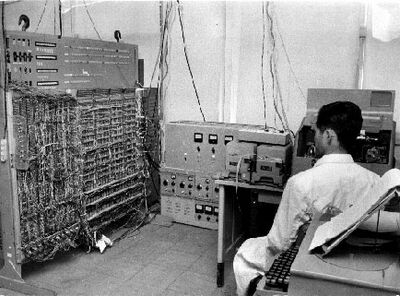
Photo 1 Eiichi Goto and the PC-1 Parametron Computer (Source: Information Processing Society of Japan)
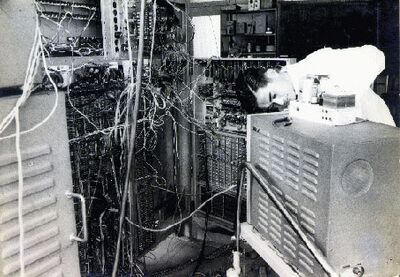
Photo 2 Eiichi Goto adjusting the memory section of Parametron computer PC-1 (Source: Information Processing Society of Japan)
PC-1 was used by many scientific researchers after it became operational in March 1958. It had profound impact on the Japanese computer industry and scientific community. Details of the PC-1, especially the software side, are thoroughly described in Eiiti Wada's lecture materials from the Parametron Memorial Lecture held in 2008, commemorating 50 years since PC-1's implementation [11]. Libraries and calculation done on PC-1 are summarized in Appendix II.
Influence of Parametron Technology and Goto's Achievements
The parametron’s affordability, minimal maintenance, and operational stability swiftly captured Japanese industry's attention following Goto’s initial presentation at a Japanese conference. Commercial entities soon adopted the technology, developing and marketing computers and calculators based on it (see Appendix I for examples). Some models sold more than 700 units back then.
At a time when vacuum tubes with the inherent short life cycle demanded frequent upkeep and early transistors proved costly and unreliable, the parametron filled a critical niche, earning Goto the prestigious IRE Browder J. Thompson Memorial Prize in 1961 [A1] for his seminal paper, “The Parametron, a Digital Computing Element Which Utilizes Parametric Oscillation” [Proc. IRE, Aug. 1959]. This award underscored the technology’s profound impression on both industry and academia, cementing Goto’s reputation as a visionary innovator.
In Japan, he was awarded the prestigious Asahi Prize in 1959. This was for his contribution to PC-1. [A2] The Asahi Prize (朝日賞, Asahi Shō), established in 1929, is a prize presented by the Japanese newspaper Asahi Shimbun and Asahi Shimbun Foundation to honor individuals and groups that have made outstanding accomplishments in the fields of arts and academics and have greatly contributed to the development and progress of Japanese culture and society at large. (from Wikipedia, https://en.wikipedia.org/wiki/Asahi_Prize).
Conclusion
The parametron profoundly shaped Japan’s post-war computer industry, with its influence extending internationally through U.S. patents [US Patent 2,948,818 and 2,948,819]. As its sole inventor, Eiichi Goto elucidated its principles in his landmark IRE paper and led the Takahasi Laboratory team at the University of Tokyo in creating the PC-1. Given his pivotal role in this enduring technological achievement, Goto’s name merits inclusion in the IEEE Milestone citation, honoring his lasting legacy in computing history.
Historical Significance
Background
The parametron is a logic element that utilizes the parametric excitation phenomenon, leveraging the non-linear magnetic response of ferrite cores. It was invented in 1954 by Eiichi Goto, who was then a graduate student at the University of Tokyo's Graduate School of Science.
In the 1950s, when computers were in their infancy, constructing a flip-flop in Japan cost around 1,000 yen for a vacuum tube and several thousand yen for a transistor. At the time, point-contact transistors were unreliable and unstable. The earliest junction-type transistors coexisted with point-contact transistors and were slow, so despite the instability, point-contact types were used for computers.
At the Takahasi Laboratory of the University of Tokyo, where Goto studied, there was a keen interest in computational machines. Various devices, such as a computer using a rotary switch from a telephone exchange and a decimal computer using decatron tubes, were examined and manually simulated. (An earlier study of information storage devices [1], and [2] are examined in Appendix IV to give an overview of the kind of theoretical and experimental study that were done before the invention of Parametron.)
Eiichi Goto's knowledge of physics and applied mathematics was invaluable during this time. Consideration was given to using ferrite cores [3], which cost only 5 yen each, leading to the concept of utilizing the parametric excitation phenomenon. Consequently, the element was named the parametron.
Inexpensive ferrite core
Back then (pre 1954), a vacuum tube cost 1,000 Japanese yen, and a transistor 8,000 yen. A ferrite core was mere 5 yen. Goto mentioned the price situation in a magazine interview (in Japanese) quoted below. The following English translation by the submitter is an excerpt from the interview in Japanese.: https://ascii.jp/elem/000/001/221/1221954/2/
   ——Why did you create parametron?

   At the time, there were no computers in Japan.*1 So we decided to
   make one at the Takahasi Laboratory at the University of
   Tokyo. But the university's research budget was not enough. At
   the time, vacuum tubes cost 1,000 yen each, and transistors cost
   8,000 yen each. Also, vacuum tubes wear out quickly. Transistors
   were still unstable. In comparison, ferrite cores, which had long
   been familiar in, say radio circuit construction, cost just 5 yen
   each. So I thought, why not use ferrite cores as the material?
   Ferrite cores are a stable material, and since they are made of
   pottery, they don't break if you make them right the first
   time. The name “parametron” was given because it uses the
   principle of parametric excitation.
   *1 The first Japanese vacuum tube stored program computer was built in 1956
   (FUJIC). https://museum.ipsj.or.jp/en/computer/dawn/0010.html
   More on FUJIC in Appendix V for speed comparison.
   The first Japanese transistor stored program  computer was
   built also in 1956  (ETL Mark III):
   https://museum.ipsj.or.jp/en/computer/dawn/0011.html
   UNIVAC 120 was the first commercial electronic computer installed
   in Japan in 1955.:
   https://museum.ipsj.or.jp/heritage/UNIVAC120.html
   So, as Goto mentioned "There were no electronic computers in Japan"
   before 1954.

   Note: The submitter thinks Goto's recollection of 1,000 yen is a
   ballpark figure.
   But the two order of magnitude difference (factor of
   200) is enough to show the cost merit of using ferrite cores.
A typical single parametric logic element used three cores (one larger core was added to merge the signals from input wires from multiple sources) , one capacitor and a resistor. Three such units were combined to create a circuit element to pass logic signal to the next parametron unit. Such a combination would NOT reach the price of a single vacuum tube alone. And the vacuum tube circuit also requires capacitors and resistors to boot. The difference of 1,000 Yen and 5 yen of main component is large.
Takahasi recalls that parametron element after assembly was sold at 500 YEN. He stated that a similar logic element device made of vacuum tubes would have costed more than 10,000 YEN, and the similar unit made of transistors would have costed too much to handle by a university laboratory (in [13], Birth of an Electronic Computer, page 62.)
Vacuum tubes and transistors were expensive, and ferrite cores were dirt cheap is the perception of Goto and others.
Structure and Principle of Parametrons
Two donut-shaped ferrite cores were each wound with a wire of the same number of turns. Two cores were required. The wire turns for two cores were configured in opposite directions, i.e. opposite directions in two cores, for exciting current and oscillation current. This is to isolate the primary and secondary parts: for example, it cancels the DC bias that changes the magnetic property of core. DC does not reach the oscillation part with the opposite twisting.
Note:This reversed turn is hard to recognize in figures at casual reading, but all the figures quoted try to stress this using various visual cues, but it is still subtle and easy to miss.

Figure 1 Parametron (Source: Information Processing Society of Japan)
Caption: Cores are visible on the vertical thick wires on the left and right (external exciting current wire), and the thin wires are signal wires.
When the resonant frequency of the circuit, composed of ferrite cores and parallel-connected capacitors, is f/2, then we apply external oscillation of frequency f to the ferrite core. These ferrite cores were connected in series. A single capacitor was connected to form a resonant circuit. An excitation wire passed through the core's hole, and when alternating current (precisely, a combination of direct current that changed the inductance of the core and alternating current) flowed through it, the magnetism of the ferrite core caused the resonant circuit to oscillate due to parametric excitation. Separate wires may be used for direct current and alternating current although most of the figures and diagrams in this application document seem to use one wire. Oscillation at half the frequency of the original external vibration is amplified and observed.
In Goto's parametron, information can be stored by correlating the logic states 0 and 1 with the difference of the phase of induced oscillation. There are two modes of oscillations that has the phase, exactly π apart. (So parametron has the inherent capability to keep a bit of information.)
Parametric oscillation can be found in many systems. For example, to move a swing in a park, we use parametric oscillation. The length of the rope or chain used to suspend the seat of a swing, or more precisely the distance between the center of the mass of the body plus the seat material and the horizontal bar from which the swing is suspended is a parameter of the oscillation. By moving our position up and down, we can change this distance of the center of the mass, thus changing the parameter of oscillation. By moving our body up and down once during a swing one way (this means we move our bodies TWICE up and down during the full one swing back and forth), we can excite the natural frequency of swing. The frequency of excitation (our body movement) is twice the frequency of swing.
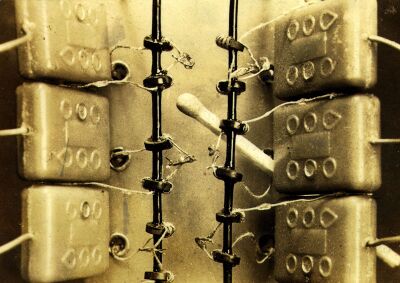
[Remarks] A matchstick is included in the photo for size comparison.
Photo 3 Parametron in PC-1 Computer (Source: Information Processing Society of Japan)
As described, in addition to the property of stabilizing into two clearly distinct states, the parametron exhibits an amplification effect where differences in the initial state during excitation determine the phase outcome. This is used for logical operation using majority logic.
The outputs from parametrons to another parametron where a new oscillation was to be started can decide the 0/1 state (the phase difference in the final stable oscillation) by majority logic, i.e., analog addition of the signals. With parametron that uses the phase of the oscillation to distinguish 0/1 value as digital signal, logical operations called "majority rule logic" can be performed. Goto and others developed the full theory of this majority rule logic based on parametron to design logic circuits. (More about the theory of majority logic in the Obstacle to overcome section.)
While parametron was developed through theoretical and experimental efforts, it was very fortunate that the very first ferrite cores used in the first experiment for parametron was a copper-zinc type, developed by Yogoro Kato and Takeshi Takei, which later turned out to be verified to be best suited for parametrons among comparable ferrite cores available at the time. Although manganese-zinc and nickel-zinc ferrite have superior properties for other applications, copper-zinc ferrite proved best for parametrons [5] [Note 8].
To facilitate large-scale use in computing machines, smaller cores were preferable for reduced power consumption, leading Tokyo Denki Kagaku (today's TDK Corporation) to manufacture cores with a diameter of 4 mm. Later, the PC-2 used a "binocular type core" specifically designed for parametrons.
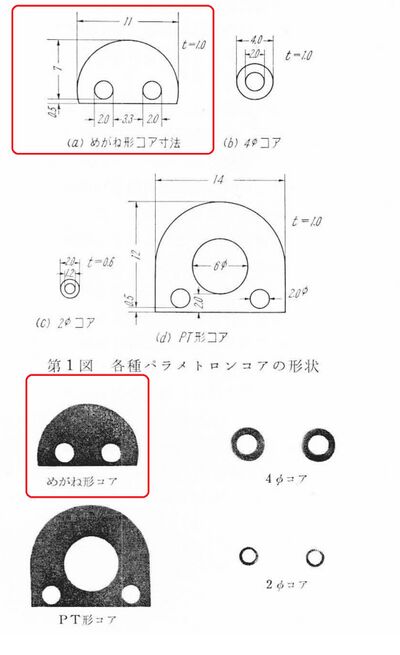
   Diagram: Parametron called as shaped like binoculars marked with red rectangle.
   4 φ core was the standard parametron initially.
   2 φ core was used for memory.
   Quoted from p.88 of Jiro Futami and Ryuji Shiozawa, "Parametron",
   Hitachi Review, Feb 1960, vol 34. p.88, Figure 1 and Figure 2.
A circuit diagram that uses the binocular type core is described in Appendix VI.
Parametron circuit
Parametrons are digital logic circuits that use nonlinear property of circuit. They were applied to the realization of logic circuits. They are characterized by high fault tolerance and low energy consumption in comparison to vacuum tubes.
Basic Structure and Operation of Parametrons
Parametrons are typically designed as two-terminal elements and are primarily constructed using capacitors and transformers. (There is also a resistor. See Appendix VI if you are curious electrical engineer.)
These elements transition between different "phase states," with the internal state changing in response to an external driving signal (input signal). Specifically, the amplitude and phase of the initial input signals, using by majority rule in the form of analog addition, determines the parametron to hold two stable states (0 and 1) distinguished by the phase difference of exactly Pi and can be used perform logical operations. (See the Goto's seminal paper [9] or slightly redacted explanation in Appendix V for more details. This application document summarizes the pros and cons of parametron in contrast to vacuum tubes, mechanical relays, and transistors for historical significance and the exact details of the operation is relegated to the original paper [9].)
The parametron circuit has the following characteristics:
(a) Nonlinear operation:
Parametrons respond non-linearly to external input signals. (The sum of the initial input signals determines the phase of the amplified induced parametric oscillation.) This property enables their use in majority logic circuits.
(b) Stability:
Parametrons are quite resistant to external noise and unstable signals, offering high fault tolerance.
(c) Low power consumption:
Parametrons consume very little power during operation, which made them particularly attractive in electronic circuits of the early days of computing. (This low power consumption is RELATIVE to the power-hungry vacuum tube of that day. It consumed much more power than today's power-efficient devices, especially when one tries to run parametron at high speed. More about this in the Obstacle to overcome section.)
Counting Circuit Using Parametrons
As a prototype of later computer, a simple counting circuit was developed using parametrons [3].
When parametrons were used to create the counting circuit, the design focused on the following key features:
(a) Counting circuits itself:
The parametron-based counting circuit combine multiple parametron elements to implement counting.
(b) Creation of Digital logic circuit:
Parametrons can serve as basic logic gates (e.g., AND, OR, NOT), which can be combined to create more complex computational circuits, such as adders and multipliers. But do note that parametron operates on the majority rule logic, not on the simple Boolean algebra. (Being unable to use Boolean algebra for parametron initially posed a slight difficulty in logic design. See Obstacle section for more detail.) Majority logic can mimic Boolean logic. So it can build any complex boolean logic circuit. What is more, sometimes, the majority logic simplifies the circuit very much: for example, the arithmetic unit that handles carry propagation quickly used the majority logic circuit to its advantage.
The success of the counting machine that used counting circuit based on parametron encouraged the people at Takahasi laboratory and thus the construction of fully programmable stored-program computer PC-1 began.
The Birth of Parametron Computer: PC-1
The PC-1 (Parametron Computer No.1) is a fully programmable stored-program computer for scientific computing, assembled in the Takahasi Laboratory, Faculty of Science, at the University of Tokyo. Using a total of 4,200 parametrons, production began in September 1957, and the first computation was performed on March 26, 1958.
   Note: A stored program computer had been created at NTT's Musasino
   Laboratory using parametrons in March 1957. One year early than
   PC-1.  It was called MUSASINO-1, and had only 32 words memory
   initially because the memory device for MUSASINO-1 came late.  32
   words were not enough for meaningful software development. The
   memory was expanded to 256 words one year later about the time
   PC-1 began full operation.  MUSASINO-1 was a handmade prototype
   and experienced many hardware failures. Thus, it caused
   significant maintenance burden. It was used only inside NTT's
   research. This usage pattern was unlike PC-1 which was used widely
   by researchers in and outside the University of Tokyo as explained
   later.  In this manner, MUSASINO-1 could not have much impact
   outside NTT whereas PC-1 had a big impact on Japanese computer
   scene.  (More information and links on this MUSASINO-1 and billing
   machine in Appendix I.)
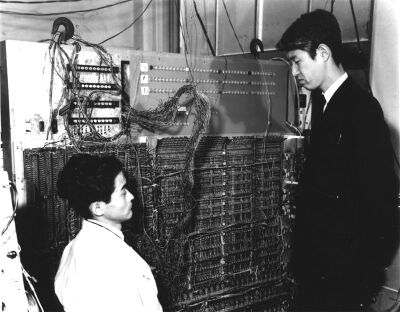
Photo 4 PC-1 Parametron Computer (Source: Information Processing Society of Japan)
[Remarks] Dr. Eiichi Goto (Left) and Prof. Hidetosi Takahasi (right) in front of Parametron computer PC-1
0016 03 l.jpg
Photo 5 Adder using parametron (Source: Information Processing Society of Japan) [This was built by Eiichi Goto himself as a prototype to build PC-1 according to the oral communication from Eiiti Wada who gave a lecture at the Plaque dedication ceremony on Nov 27, 2025.]
[Remarks] A vacuum tube is included in the photo for size comparison.
Subsequently, multiplication and division circuits were added, and finer adjustments were made to each part. Materials such as parametrons, exciters (the circuit that adds external oscillation to parametrons), and input/output devices were borrowed from the following companies.:
- Toyo Soda Industries,
- the International Telegraph and Telephone Company (today's KDDI),
- the Parametron Research Institute,
- Japan Electronics Instruments, etc.
Additionally, measuring instruments were borrowed from the Telecommunications Research Laboratory of the Nippon Telegraph and Telephone Public Corporation, and some were purchased with the Asahi Science Grant.
Such arrangement was necessary for the poor status of university laboratory back then.
It took a total of about 300 person-days to assemble the computer, with the parametron circuit wired by a worker experienced in wiring relays at Fuji Tsushinki (today's FUJITSU). The assembly and adjustment of the magnetic core memory device were performed by staff from Tokyo Denki Kagaku (Today's TDK Corporation).
The parametrons used in the PC-1 were of the early type, produced at different times and with irregular characteristics. Despite the challenge of assembling all circuits by hand in a university laboratory, there were no significant failures in 1958, except for issues with the exciter and the input/output device that used vacuum tubes.
Notably, the AC magnetic core memory device was surprisingly stable and reliable in comparison to similar devices. One reason for this stability was that, despite using 41 vacuum tubes in total, the main memory system adopted a circuit that applied error-correcting code to its operation, ensuring functionality even if one vacuum tube failed.
The performance figures of the PC-1 is detailed in the attached table. It used a binary representation internally. (Note that there were transistor-based computers that still used decimal digits representation internally at the time.) PC-1 was a fully programmable stored-program computer with fixed-point arithmetic only.
Wide Usage for Scientific Research and Training
In 1958, PC-1 was the fastest computer in Japan. *1 It was the only electronic computer available to researchers at the University of Tokyo. Thus it was used frequently by the researchers there and from other universities.
   *1: The fastest Japanese computer in terms of the speed of
   addition and multiplication by March 1958 (when PC-1 became
   operational) was FUJIC developed at Fuji Photo Film in 1956 using
   vacuum tubes. It had faster addition and multiplication
   instructions than PC-1. However, FUJIC was short-lived.  At the
   time Takahasi, Goto et al wrote "It (PC-1, proposer's comment) is
   the fastest computer in Japan at this time..."  in [5] (September
   1958), FUJIC had been mothballed to be donated to Waseda
   University in September of that year. So FUJIC was not
   operational.  FUJIC had maintenance issue because 2-3 vacuum tubes
   needed to be replaced each day [15]. This was typical maintenance
   burden of vacuum tube computers of reasonable size in that
   era. (Replacement was not cheap. Vacuum tubes were expensive!)
   Fuji Photo Film had used FUJIC for optical lens design. Once Fuji
   Photo Film decided to stop creating lenses, FUJIC was moved to one
   of its subsidies and then donated to Waseda University eventually.
   So PC-1 *WAS* the fastest operational computer of the time in
   Japan.  (See Appendix-V for more on the speed comparison and the
   history of FUJIC.)
In 1958, the PC-1 operated for 9-12 hours a day, with 5 hours dedicated to various numerical calculations for the Faculty of Science at the University of Tokyo. The remaining time was used for program research in the Takahasi Laboratory. From October 1958, about 10 hours per week were devoted to practical training for students.
Considering that PC-1 was maintained by graduate students at Takahasi laboratory, being able to run for close to half a day each day was a remarkable achievement showing the stability of parametron-based digital circuit.
In addition to using parametrons, the PC-1 had the following features [5]. (PC-2 built in 1960 is the successor of PC-1.)
Table 1 PC-1 and PC-2 Features
Parametron-PC-1-PC-2-comparison.JPG
  The characteristics of PC-2 (eventually built in 1960) in the table
  were according to the first design plan drafted in 1958. [5]
High-Speed Memory Device: AC magnetic core memory
For PC-1, an alternating current (AC) magnetic core memory device was used, a method invented in the Takahasi laboratory. Alternating current means the use of AC signal to read the data stored in core as the direction of magnetization. It used non-destructive read method as opposed to the direct-current destructive read method common to the core memory device used elsewhere in the world at the time.
The use of AC current for reading made the output quite friendly to the input to parametron device because the read signal from the core memory device was an oscillation wave, friendly to parametron, unlike the DC current reading method.
By finding excellent magnetic material suitable for this method through the help of TDK and using a address selection circuit that applied an error-correcting code at runtime, the device achieved exceptional stability and reliability. The storage device was relatively small and reported at the symposium on electronic computer storage in the fall of 1957 and the Annual Meeting of the Four Electrical Societies of Japan in May 1958.
Arithmetic Circuit
The arithmetic circuit employed a fast carry propagation circuit that handled carry separately. It was basically a carry lookahead circuit in today's parlance (maybe better called carry selection circuit that handles the carries in O(log(N)) logic step or time where N is the bit length of the number, and theoretically optimal), but back then there were some variations, and serious research was going on. Goto et al came up with their own implementation. The carry handling logic (carry selector) of PC-1 took advantage of the majority rule logic of parametron to implement such circuit in a better manner than mere boolean logic circuit. Some parametron elements in it accepted five inputs. Careful selection of the ferrite cores of the parametrons that generated the output fed to the five input parametron was necessary to make sure the majority logic worked as expected by tuning the input signal levels. (Thanks to the comment from a reviewer.)
Additionally, a control system was adopted that simultaneously managed ongoing calculations and those to be performed next. This was basically a pipelining at a very shallow depth of two. This improved the calculation speed of the parametron computer by 2 to 3 times compared to systems not using these methods, without significantly increasing the number of parametrons required. In 1958, the pipelining and other concurrent operation methods were being studied in many countries and could be applied to electronic computers using any type of logic element, not just parametrons.
Interrupt
Later in 1959, an interrupt circuit was installed in PC-1 so that the event from the attached tape reader "interrupted" the on-going execution of an instruction. When this happens, further interrupt was prohibited by a flip-flop, and then the next instruction address is saved into address 510, and a pre-installed interrupt handler whose address is in address 511 is invoked (actually basically control jumps to the address stored in 511). The flip-flop that inhibited the further interrupt was reset at the exit of the interrupt handler. In this manner, the pending input from tape reader could be handled, e.g., put into a ring buffer that is accessed both by the main program and the interrupt handler. This is basically the operation called later multi-tasking. PC-1 was one of the earliest computers to realize multi-tasking using interrupt.
Plan for PC-2
In 1958, Goto and others began planning to build a more powerful machine based on the experience and results of the PC-1. The machine was named PC-2. Although the computation and storage methods of the PC-2 were not substantially different from those of the PC-1, the plan was to increase memory capacity as shown in Table 1, provide a high-speed I/O device, and add a floating-point computing unit and an address translation mechanism.
This time, however, the construction was solely assigned to an external company.
PC-2 was completed in 1960: Funded by the Ministry of Education, it was jointly developed with Fujitsu. It was later commercialized as FACOM 202. (More information on this PC-2 and FACOM 202 in Appendix I.)
PC-2 was delivered to Takahasi laboratory. There, PC-2 continued the PC-1's tradition of wide usage by scientific researchers from all over Japan.
A commercial version of PC-2, FACOM 202, was delivered to the Institute of Solid State Physics of the University of Tokyo, and TOYOTA. At the Institute, it was used to calculate band energy of solid and contributed to the world class research. (There is a short description of how FACOM 202 was used at the Institute of Solid State Physics in the newsletter of the Institute, p. 17, No. 5, Vol 4, December 1964, in Japanese, available online at https://www.issp.u-tokyo.ac.jp/maincontents/docs/tayori/tayori04-5.pdf)
PC-1 as a research vehicle of parametron performed very well. It was finally disassembled when its power unit was rented to an exhibit done by physic students during an annual open house event at the University of Tokyo in May 1964.
Historical Impact of Parametron on Computers and others
The ability to build computers with a greatly reduced number of vacuum tubes and transistors led to the creation of many parametron-type computers in Japan at that time. Compared to relay-based systems, parametrons were faster and had no mechanical contacts that were the source of many failures, offering great advantages.
Despite the relatively short period of time while parametron enjoyed success, these computers were sold in large numbers the market. A detailed list of these commercial computers is in Appendix I. There were many. Certain model was a best seller of the time, selling more than 800 units in total.
Back in 1959 when the seminal paper of Goto [9] was published ("The Parametron, a Digital Computing Element Which Utilizes Parametric Oscillation", Proceedings of the IRE, Volume: 47, Issue: 8, pp. 1304 - 1316, August 1959), Goto mentioned the following. (Quote from the paper).
In 1954 the author discovered that a phenomenon called parametric oscillation, which had been known for many years, can be utilized to perform logical operations and memory functions, and gave the name "Parametron" to the new digital component made on this principle [1], [21]–[23].(Proposer's note: the reference numbers are original paper's.).
A digital computing circuit made of parametrons may consist only of capacitors, ferrite-core coils and resistors, while diodes and rectifiers may be dispensed with. The parametron, therefore, is considered to be extremely sturdy, stable, durable, and inexpensive. Owing to these advantages, intensive studies have started in several laboratories in Japan to apply parametrons to various digital systems. AT PRESENT, NEARLY HALF OF THE JAPANESE ELECTRONIC COMPUTERS IN OPERATION USE PARAMETRONS FOR LOGICAL ELEMENTS. (The EMPHASIS is by the proposer.) Further applications have been made to such devices as telegraphic equipment, telephone switching systems and numerical control of machine tools.
However, the rapid performance improvement of junction transistors, which became mainstream shortly afterward, outpaced parametrons in operating frequency. Transistors had broader applications, such as in radios and analog circuits also, while parametrons were dedicated to the use as logic elements. Thus the investment on R&D of transistors far outweighed that of parametron. By the mid-1960s, parametrons were almost entirely replaced by transistors and fell into disuse.
Non-computer applications of parametron
This application document so far focuses on digital computer applications of parametron. But there were digital circuits built using parametrons [13]. Here is a brief summary. In a sense, these are the devices where parametron logic element with ease of use and design, and durability shined.
- KDDI (its predecessor, KDD) built a machine to convert Morse code to Teletype character code using parametron. This converter was used for transmitting news messages from the Melbourne Olympic Games in 1956. It performed flawlessly without breakdown. Note that it was built in less than two years after parametron was invented.
The success of the converter encouraged KDDI to create further devices such as re-generative repeater for long distance transmission (to re-shape the received signal for relaying purposes), and automatic repeat-request machine (ARQ machine) for error correction/recovery of TELEX communication. The ARQ thus developed using parametron was the world's first electronic ARQ device and many ARQ units were exported. So parametrons WERE USED OUTSIDE JAPAN although the users were unaware of parametron usage. The first ARQ using parametron was created in 1956, only two years after parametron was invented. A written record exists to show that it was still in use by KDDI in 1977 at the latest, more than twenty years after its birth. It shows the robustness of parametron-based device. (More about these devices developed by KDDI in the entry of KDDI in Appendix I.)
- Numerical control of machining devices were also built using parametrons. Numerical control was used to position the machining tools precisely to create desired shapes. Before that, the machining devices mimicked the desired movement using curved template. Creating the curved template was a very time consuming task and the resulting accuracy was not quite good for modern aerospace industry, for example. Thus numerical control of machining device, initially developed and popularized by MIT researchers, was a hot topic circa 1950s and early 1960s. Numerical control device was researched and built in Japan. A device is mentioned in Hitachi's entry in Appendix I since Hitachi collaborated with the researchers at the Japanese government institute called Agency of Industrial Science and Technology to create the device in 1956. However, later devices deployed in the field used transistor and germanium and parametrons were not used.
Fujitsu also developed a numerical control unit that used parametrons in 1956 as a prototype for later deployment. But again, later models deployed and commercialized did not use parametrons. This device is discussed in Fujitsu's entry in Appendix I.
Technology landscape was changing rapidly around the year 1960.
- A very unique use was to detect the inter automobile distance to prevent car collisions. Wire loops as part of parametric oscillation were buried under the road. When a car approaches the loop, its loss of high frequency response and this was detected by the change in parametric oscillation strength and thus the distances between cars can be measured. (This is basically what is done today for car position detection although no one thinks of saying that we use parametron although Electromagnetic principle remains the same.) Unfortunately, not much information on this usage back in 1950s and 1960s is available online.
Some of the developed devices were used late into middle of the 1970s (according to a reviewer), and it is true that parametron-based ARQ by KDDI was still in use in 1977 according to the record kept at a government website. (See KDDI entry in Appendix I.)
Nurturing the new generation of computer engineers and users
Parametron's impact was also human resources and science computing via the parametron computer, PC-1. Many future computer scientists/engineers were born among the early users of PC-1, the stored-program parametron computer at the University of Tokyo. Many of them were graduate students there and at other universities. Also, many researchers created scientific computation library routines.
Only very sketchy information in the early days of PC-1 computing remains today. But there is a record of a seminar on programming organized by the Japanese Society of Physics in 1959. This is possibly one of the first such computer training seminar in Japan according to Takahasi [13].
That used PC-1 as the target computer to write programs. Below the agenda of the seminar is quoted.
Parametron-computer-training-by-Physical-Society-of-Japan.JPG
   The timetable of the seminar in 1959.

   Quoted from "TOYOTA and parametron electronic computer FACOM 202",
   Yoshihiro Ishibashi, available online at:
   https://www.toyotariken.jp/_/media/page/about/research-report/pdf/Toyota-Report_No.77_62.pdf
The seminar was held from Aug 31 to Sept 7 in 1959. Below the titles (translated in English) and speakers of the lectures are quoted. (The original printed agenda is scanned and OCR version is available in [14] IIJLAB 2008, パラメトロン計算機 PC-1 1958-2008 パラメトロン計算機記念会, "Parametron computer PC-1 1958-2008" by Parametron computer anniversary committee in Japanese, https://www.iijlab.net/~ew/pc1/pc150th.pdf)
This shows the impact PC-1 had on Japanese academia, in this case to physical sciences. The title of each lecture and the name of the lecturer is given below.
Introduction to Electronic Computing by Hidetosi Takahasi
Arithmetic Instructions for the Parametric Computer PC-1 by Eiichi Goto
Experience in using electronic calculators by Takehiko Shimanouchi
Applications to Geometric Optics, etc. by Bunji Okazaki
Application to Crystal Analysis by Yoshio Takeuchi
Numerical Analysis for Computers I (Linear Computation) by Shigeichi Moriguchi
Numerical Analysis for Computers II (Numerical Integration and Differential Equations) by Ayao Amemiya and Masataka Ariyama
How to make programs (flow charts and their examples) Yoshihiro Ishibashi
Application to Meteorology by Kikuro Miyakoda
Application to Fluid Mechanics by Isao Imai
How to program (how to use subroutines) by Takashi Soma
How to make programs (how to make tapes using R0 R1) by Keisuke Nakagawa
Electronic Computing in Universities I by Yonezo Morino
Electronic Computing in Universities II by Mitsuro Omori and Shigetoshi Katsura
Monte Carlo Method by Yoichi Fujimoto and Eiichi Goto
Applications to Quantum Mechanics by Masao Kotani
Applications in OR and Control Engineering by Koh Hosaka
How to find errors in programs by Eiiti Wada
Future computers and programming by Hidetosi Takahasi
Panel Discussion "Current Status and Future of Computers"
Chair: Takahiko Yamamouchi
Panelists Takashi Isobe (The Univ. of Tokyo), Koh Hosaka
(Technical Research Institute of the Japanese National Railways),
   Hidetosi Takahasi (The Univ. of Tokyo), Shigeichi Moriguchi (The
   Univ. of Tokyo), Masao Kotani (The Univ. of Tokyo), Hiroshi Wada
   (Electro-technical Laboratory, ETL), Zen'ichi Kiyasu (NTT),
   Takeshi Kayano (NTT)
Many names in the list of lectures would hold important positions later in the computer industry in Japan or academia, both in software and hardware area, and physical sciences and engineering. PC-1's legacy lived on after parametron fell into disuse.
The list of available routines and the type of calculations performed on PC-1 is in Appendix II.
Popular Culture
When many people in the first generation of computer industry and in academia in Japan got their first taste in programming on parametron-based computers, it had left its imprint on education as you can see from the number of parametron computers still displayed at many education institutes and research facilities today in Japan. (See Appendix I for such examples.).
Parametron also left a legacy or urban-legend memory on the mind of early electronics engineers.
Thus, it has even popped up in very popular comic lately.
"Dr. Stone" is a very popular Japanese comic (and turned into animation) with total circulation more than 18 million copies. (See Wikipedia: https://en.wikipedia.org/wiki/Dr._Stone )
The story is an SF-like one.: A mysterious catastrophe petrified all human beings and after a few thousand years, one of them somehow was revived to life and investigated the situation, and tried to re-create the human civilization with some partners he found.
Along the way, they had to create many instruments that one took for granted in everyday life. During the course of urban planning, the characters wished for a calculator and computer. Vacuum tubes are way off their manufacturing skill to say nothing of the semiconductors that required purified semiconductor crystals (in the SF story timeline, semiconductor would be available in 10 years' time, but the calculators are wanted NOW).
Then, parametron to the rescue (!). Ferrite cores could be manufactured by heating and pressing metal powder. Thus in the comic, 0.2 million parametron cores were going to be created using such crude method so that they could be used to create computers and calculators.
Dr stone-parametron-core-206th.JPG
The above drawing is from the 206th installment of Dr. Stone (August 2021).
   There is an enlarged image of a ferrite core in the upper left.
   Ferrite core is created by burning the powder of metal material in
   the lower left.
   You can read the original pages from officially sanctioned sources such
   as the following (in Japanese). https://www.mangajikan.com/chapter-104565.html
Note: The above drawing is quoted as fair use for academic purposes of the copyright material.
   (See Shueisha publishing's copyright stance (in Japanese).
   https://faq.shueisha.co.jp/faq/show/32?category_id=8&site_domain=default )
The proposer thinks there is a slight abnormality in the enlarged core shape in the drawing (upper-left). (See the enlarged photo of a rare remaining PC-1 board in Appendix VI.) Still having this comic is a great way to teach parametron existed to the youth today, and tell the general audience that the principle behind parametron is still viable as Adiabatic Quantum-Flux-Parametron (AQFP) (see "Quantum flux parametron" in Appendix III, "Parametrons in Disguise") in the 21st century.
Obstacles that needed to be overcome
The parametron, invented by Dr. Eiichi Goto in 1954, is recognized as a significant milestone in the history of logical device for electronic computing. This pioneering technology faced numerous obstacles on its path to success, spanning technical, political, and geographic challenges.
Technical Obstacles
Material Limitations
During the early 1950s, the materials available for electronic components were limited. The parametron, which relied on the parametric excitation of non-linear inductance to achieve switching, required high-quality inductors and capacitors. The scarcity of high-quality materials and the limitations in manufacturing technology posed significant challenges. Achieving the necessary precision and reliability in component fabrication was a major hurdle.
As Goto mentioned later, he was lucky to use the right ferrous material as far as the ferrite core, the essential part of his parametron device, was concerned. He picked up a ferrite core very suited to parametron in his first experiment. Had he not used the particular material, the search for the right material alone may take a couple of years, thus missing the opportunity to fill in the gap between vacuum tube and transistor with very reliable parametron device.
Design Complexity
The initial physical design of parametron was intricate and required a deep understanding of non-linear dynamics and resonance phenomena. Goto analyzed the parametric oscillation by modeling the excitation using so called Mathieu's differential equation [9]. This complexity made the design and construction of practical parametron circuits challenging. Researchers had to overcome the difficulties of designing circuits that could maintain stability and reliability under varying operational conditions.
But, once the physical circuit was designed properly with well selected proper material, parametrons performed very reliably.
This was the key reason the stored-program computer built at a university laboratory, PC-1, operated so successfully without any dedicated operator. Serious breakdown of the PC-1 computer did not occur often, The graduate students and the researchers there helped the external science researchers who ran long-running computer programs. Programs could run for a few hours unattended on PC-1, which was a feat in itself in its time.
Another key challenge in parametron design was its reliance on majority logic, which differed significantly from the binary Boolean logic prevalent in electric/electronic circuit design at the time and today. Boolean algebra, designed for binary AND, OR, and NOT operations, was inadequate for majority logic circuits.
To address this, Goto and Takahasi developed a novel approach to majority logic for Parametron-based designs.
First, they introduced a graphical representation to visualize the majority logic employed in Parametron circuits, making the interaction of majority logic more visible. The interested readers are invited to read the Goto's seminal paper where the notation is explained.[9] It is a very interesting exercise to implement various logical operations using majority rule logic of parametron. A few examples are given (taken from [14]).
Boolean-logic-by-parametron-and-full-adder.JPG
Figure - Majority rule circuit representation of Parametron
   A circle stands for one parametron element.  It can accept
   multiple input signals.
   The +/- in the circle indicates an input signal that is constantly
   set either to 1 (+), or 0 (-).
   The bar in the connection line stands for negation. In parametron,
   negation does not need a logic element. Reversing the direction
   of winding through the ferrite core achieves that.
The upper left is a Boolean AND operation. Since there is a constant 0 input (note the "-" in the circle), only when two other inputs are both 1s, the majority rule produces output 1, thus implementing Boolean AND operation.
The example at the middle in the left is boolean OR operation. Since there is a constant 1 input (note the "+" in the circle), if at least one of x or y is 1, the majority rule produces one as output, thus implementing Boolean OR operation.
The lower right is a full adder. x is a carry from the addition of lower binary digits. The circuit produces the sum, 's', of x, y, and z, and produces 'c', carry, that is needed to pass to the next higher bit calculation.
Building on this, they systematically analyzed all possible four-input majority logic configurations [13], optimizing circuits to achieve desired outputs.
Their breakthrough was the classification of majority logic circuits into self-dual equivalence classes, which groups equivalent functions to reduce design complexity ([6], “Some Theorems Useful in Threshold Logic for Enumerating Boolean Functions,” E. Goto, H. Takahasi, IFIP Congress, 1962; see also “Classification of Ternary Logic Functions by Self-Dual Equivalence Classes,” T. Soma, T. Soma, 41st IEEE International Symposium on Multiple-Valued Logic, 2011. The latter is an extension of parametron to use three valued logic, using three different phases instead of two).
This classification provided critical insights for designing logic circuits using Parametrons and other threshold logic devices. It remains relevant today, enabling efficient designs for quantum flux parametron (QFP) and its adiabatic version, AQFP, which have gained significant attention, as discussed in the “Features” section.
Thermal Management
The operation of the parametron at fast speed involved significant energy dissipation, leading to heating issues. (See Appendix VI for detailed discussion of heat dissipation, etc. for electronically inclined.) Effective thermal management was crucial to ensure the longevity and reliability of the Parametron circuits. Designing cooling mechanisms and optimizing the thermal performance of components were critical technical challenges.
In the case of the PC-1 computer mentioned in this submission, it did not push the speed limit much. Thus, this computer at the University of Tokyo, employing approximately 4200 parametrons did not suffer from catastrophic heat failure although it did not have an active cooling mechanism (except for fans).
According to a memoir by Keisuke Nakagawa (in "パラメトロン計算機 PC-1 1958-2008 パラメトロン計算機記念会,", Parametron computer PC-1 1958-2008" by Parametron computer anniversary committee in Japanese, https://www.iijlab.net/~ew/pc1/pc150th.pdf), who was a graduate student at Takahasi laboratory where PC-1 was placed, PC-1 was used as follows.
   "PC-1 came to be used by researchers of the Faculty of Science for
   their research. The computer time was made available even during
   night hours. PC-1, despite the meager 512 words storage (one word
   was 18 bits), allowed scientists to do variety of computations in
   many fields.  PC-1 operated in a room without a special air
   conditioner for it. People opened windows during summer, but
   closed the windows with steam central heating running during
   winter.  But PC-1 kept running demonstrating parametron's
   stability to the world.  However, if PC-1 showed flaky behavior,
   available graduate students followed the predefined recover steps
   so that PC-1 ran again." (in submitter's translated summary from
   the original Japanese).
Mr. Nakagawa was a graduate student back then.
Integration with Existing Technology
The Parametron was a novel technology that needed to be integrated with existing computing systems and peripherals. Ensuring compatibility with the infrastructure of the time, including input/output devices and memory systems, required innovative solutions. Researchers had to bridge the gap between the new Parametron technology and the established electronic computing landscape.
These are the issues any new logic device technology faces, so not a particular obstacle specific to parametrons.
PC-1 computer that was built with parametron was connected to a paper tape reader, and teletype writer device and so the interfaces with simple I/O devices were available.
Main memory was developed specifically for PC-1, namely the AC-drive core memory system that produced its output (1/0) in terms of oscillating signal which was very friendly to parametron that could accept such input directly.
Miniaturization
Early electronic components were bulky, and miniaturizing the parametron circuits was a daunting task. Reducing the size of the parametron while maintaining its functionality and performance required advancements in component design and fabrication techniques. This miniaturization was essential for making the parametron commercially viable and practical for real-world applications.
Binocular type parametron core mentioned in the Historical impact section was an effort for the initial miniaturization path.
Unfortunately, obviously, in the long run, there was no chance for ferrite core parametron to compete with the transistor in the miniaturization race.
However, later in the 1990s, miniaturized superconducting device was used to create a parametron-like behavior, and is a very hot topic now that the low-power consumption of AQFP attracts attention in SDGs age. (https://en.wikipedia.org/wiki/Quantum_flux_parametron, Adiabatic Quantum-Flux-Parametron: A Tutorial Review https://www.jstage.jst.go.jp/article/transele/E105.C/6/E105.C_2021SEP0003/_pdf/-char/en
Political Obstacles
Cold War Era: The development of the Parametron occurred during the Cold War, a period marked by intense geopolitical tensions between the Eastern and Western blocs. This political climate influenced research priorities and funding allocation. Gaining support and resources for parametron research in Japan, which was rebuilding its economy and technology sector after World War II, was a significant challenge.
Funding and Resources
Securing funding for innovative research was a constant struggle in post-war Japan. Government and institutional support were limited, and researchers often had to rely on private industry partnerships and international collaborations. Convincing stakeholders of the potential benefits and applications of the Parametron required substantial effort and persuasion.
In [7] ("Some Important Computers of Japanese Design", IEEE Annals of the History of Computing, Vol.2, No.4, pp. 330-337. Oct.-Dec. 1980), Professor Hidetosi Takahasi remarked in its abstract to describe the era thusly.:
   "we were on the verge of starvation in the ruin of our defeated
   country", ... "We were starved for knowledge as well as for food".
Such was the atmosphere of post-war Japan when parametron was invented.
Goto himself and the laboratory of Professor Takahasi back then was lucky to obtain a few big corporate backing after initial report of Goto on the principle and experimental result of parametron device caught the eyes and ears of the people of a big research laboratory, Musasino Laboratory of NTT, a large telephone operator Kokusai Denden (KDD, precursor of today's KDDI), and others. This backing helped parametron take off.
Still the budget was small in comparison, say to MIT's: Goto mentioned the following in a magazine interview (in Japanese). The following English translation by the submitter is an excerpt from the interview in Japanese.: https://ascii.jp/elem/000/001/221/1221954/3/
——How was the reaction to the PC-1 parametron computer?
   “It wasn't that big a deal. *1 Overseas, there were already things
   like ENIAC and EDSAC ten years earlier. Also, the processing speed
   of the parametron was slower than that of transistor
   computers. The clock speed of transistor computers was 1
   megahertz, whereas the parametron computer was at most 10 to 30
   kilohertz.

   Much later, I became friends with McCarthy from MIT, and he told
   me, “The parametron is an interesting idea, but why did you make
   such a slow element?”  He could say that out of ignorance, but
   our budget was only about one thousandth of MIT's *2. But I did feel
   a sense of achievement in having made computers available at the
   university at that time. Even though it only had 256 words of
   memory, lots of people came to use it. There weren't any other
   computers around at the time.

   *1: The submitter thinks Goto underrated PC-1 much as its creator
   because of his modesty and because he was too aware of the speed
   issue. As he mentioned, PC-1 became immensely popular among the
   academic researchers, and many commercial entities adopted
   parametron to create very successful commercial computers. In
   Goto's mind as its leader to build PC-1, the computer may not have
   had that much impact, but others and commercial enterprises in
   Japan of that era had a very different opinion.

   *2: Obviously, Goto referred to the budget of similar computer
   project, NOT the entire MIT budget.
Many private companies adopted parametron to build computers and calculators soon. Some models sold very well in the era. (See the list in Appendix I).
Also, after parametron became famous, a non-profit organization OUTSIDE the University of Tokyo was established to handle the funding and intellectual property issues, which lead to the next item.
Intellectual Property and Collaboration
Navigating intellectual property rights and fostering collaboration with international researchers were political challenges. The exchange of knowledge and technology between countries was often hindered by political considerations and restrictions. Establishing frameworks for collaboration and ensuring the protection of intellectual property were critical for advancing Parametron research.
Because the significance of parametron was so clear to the early adopters, they began helping Goto patent the inventions. To proceed with international patenting, an outside NPO called Parametron Research Laboratory (tentative English translation) was formed in Mar 8, 1957 (The birth of a computer, 1971 [13]) and the intellectual property matters were handled by this entity after that, freeing Goto, Takahasi and others at the University so that they could focus on technical inventions at hand.
Two US patents for Goto's parametron were granted.: US Patent 2,948,818 [P1] and [P2] US Patent 2.948,819. They were initially turned down with a comment, "it does not operate". ([13] p.82]). A US company, NCR licensed the patents eventually but did not produce anything after about a year and its interest seemed to have disappeared. It was too late, in a sense, since the transistors became more robust, and parametron's advantage was disappearing very fast.
Goto's mentor, Professor Takahasi wrote the following in 1971 [13] (in submitter's English summary). This is a food for thought for today's inventors/researchers.
   "Fearing the publication of the technology might invalidate the
   patent applications, we took the hush hush approach, not
   publishing the new technical results any longer. But with
   hindsight, it may have been better to adopt a more open approach
   to share technology even its current problems, with other parties
   early. Then the technology might have been used wider (Proposer's
   comment: outside Japan, too, implicitly) and problems may have
   gotten solved with more inputs from many parties.  I think this
   approach might have worked better for parametron."
Geographic Obstacles
Research Infrastructure
Japan's research infrastructure was still recovering from the devastation of World War II. Establishing well-equipped laboratories and securing access to advanced research facilities were significant geographic challenges. Researchers had to overcome the limitations of the existing infrastructure and build new capabilities from the ground up.
Although Takahasi lab was hardly a rich laboratory back when parametron was invented, it enjoyed a better than average status because the University of Tokyo was the largest nation-run university of that time.
Access to Global Knowledge
Geographic isolation posed challenges in accessing the latest research and technological advancements from other parts of the world. Japanese researchers had to find ways to stay informed about global developments in electronic computing and incorporate this knowledge into their work. Building networks and establishing communication channels with international researchers were essential for overcoming this obstacle.
The following anecdote may seem outlandish to readers in the 21st century. However, Professor Takahasi (and people in other field such as physics, etc. of that time for that matter) mentioned that he learned of transistor and other technical discoveries in the world, via magazines made available at a library established by an occupying forces stationed in post-war Japan. University libraries were not functional at all back then.
There was a library in Hibiya, Tokyo, established by the general headquarters of the occupying force in post-war Japan and that was the place to go to read the latest American magazines including technology/science ones. CIE Information Center Library was it. So being in Tokyo, the capital of Tokyo was important. (There were similar CIE libraries in other parts of Japan, but Tokyo's Hibiya one seemed to have been largest. https://ja.wikipedia.org/wiki/CIE%E5%9B%B3%E6%9B%B8%E9%A4%A8) Takahasi, Goto and others seemed to have learned of the EDSAC computer which they seemed to have studied extensively before the construction of PC-1 from learning about it through reading at this library in Hibiya. The library no longer exists.
Goto himself did not leave much about his study style in writing and the submitter could not learn much about WHERE he obtained knowledge. His research style, though, was to think hard about a topic himself very much and arrive at a solution or two, or even more before seeing other people's previous work.
Market Acceptance
Introducing a novel technology like the parametron to the global market requires overcoming geographic barriers. Domestic market in Japan accepted parametron very quickly and produced computers based on it. Some of them (NEAC-1201 and NEAC-1210) sold more than 700-800 units, which was a big number for computer sales at the time. (See Appendix I - "Detailed list of commercial Parametron computers")
Convincing international markets of the parametron's advantages and securing adoption outside Japan involved addressing cultural and logistical challenges. Establishing distribution channels and support networks in different regions were crucial for the parametron's success.
That NCR in U.S.A. licensed Goto's parametron patents was a testament to the advantage of the parametron device at the time. Whether there was a strong support network to help NCR proceed is now a question of historical interest. There was no internet, no e-mail, no international fax.
There is anecdotal evidence that European companies also monitored parametron development. But it is only in one person's memoir of parametron. ("TOYOTA and parametron electronic computer FACOM 202", Yoshihiro Ishibashi, available online at: https://www.toyotariken.jp/_/media/page/about/research-report/pdf/Toyota-Report_No.77_62.pdf) Submitter's translation of the relevant paragraph follows.:
--- Yoshihiro Ishibashi's recollection
   The author's specialty is “ferroelectric properties”, and when
   talking with foreign researchers who have the same specialty, the
   topic sometimes turns to graduate school days. When the parametron
   is mentioned in such a situation, of course it is passed over with
   “what's that?”, but there was one occasion when I got a
   reasonable response. It was from a British researcher of the same
   age, and therefore someone who knew about the situation with
   computers in the 1960s, who said, “I know about the
   parametron. Thomson (France) studied it, but it didn't work, did
   it? Did you really make a computer using parametron in Japan?” It
   seems that parametrons were not completely ignored in Europe. It
   didn't mean much, but it made me feel happy somehow.
   Note: Yoshihiro Ishibashi was a graduate student in 1958 and
   studied under the supervision of Eiichi Goto. He was still a
   graduate student when he gave a talk at the programming seminar
   hosted by Japan Physics Society using PC-1 in 1959.
These technical, political, and geographic obstacles were significant, but the dedication and ingenuity of Dr. Eiichi Goto and his team led to the successful development and implementation of the parametron. Their achievements laid the groundwork for future advancements in electronic computing in Japan and demonstrated the resilience and innovation of the scientific community in overcoming complex challenges.
Features that set this work apart from similar achievements
Features that set this work apart from similar achievements
Comparison with Other Methods
In the following, we compare the parametron with vacuum tube, electromechanical relay, and transistor types of the 1950s:
Please note that advantage and disadvantage of parametron such as speed, power consumption, etc. are discussed in the relationship with other devices in the following. For example, the power consumption of PC-1 *WAS* huge in comparison to today's power efficient computers, but was definitely smaller RELATIVE to the vacuum tube computers. PC-1 computer's power consumption was 3KVA as shown in table-1.
Pros
(a) The price is significantly lower compared to vacuum tubes (and more so than transistors).
(b) Compared to relays, it can operate at higher speeds.
(c) It is more stable