Cover illustration

TheDaily Front

Issue No. #260804 Tuesday, August 4 2026 #260804 — TUESDAY, AUGUST 4, 2026
The servers blinked, the discs sulked, and the future asked for another login.
Tuesday, August 4, 2026 The Daily Front No. #260804 — Contents
30stories
9,744points
4,621comments
234kllm tokens
Assembled with 30 model calls — 162,912 tokens read, 71,334 written.

Highlights

Xbox goes down. You can't play games you own on disc

An Xbox outage makes a pointed case that a physical disc is not necessarily an owned game when authentication remains elsewhere.

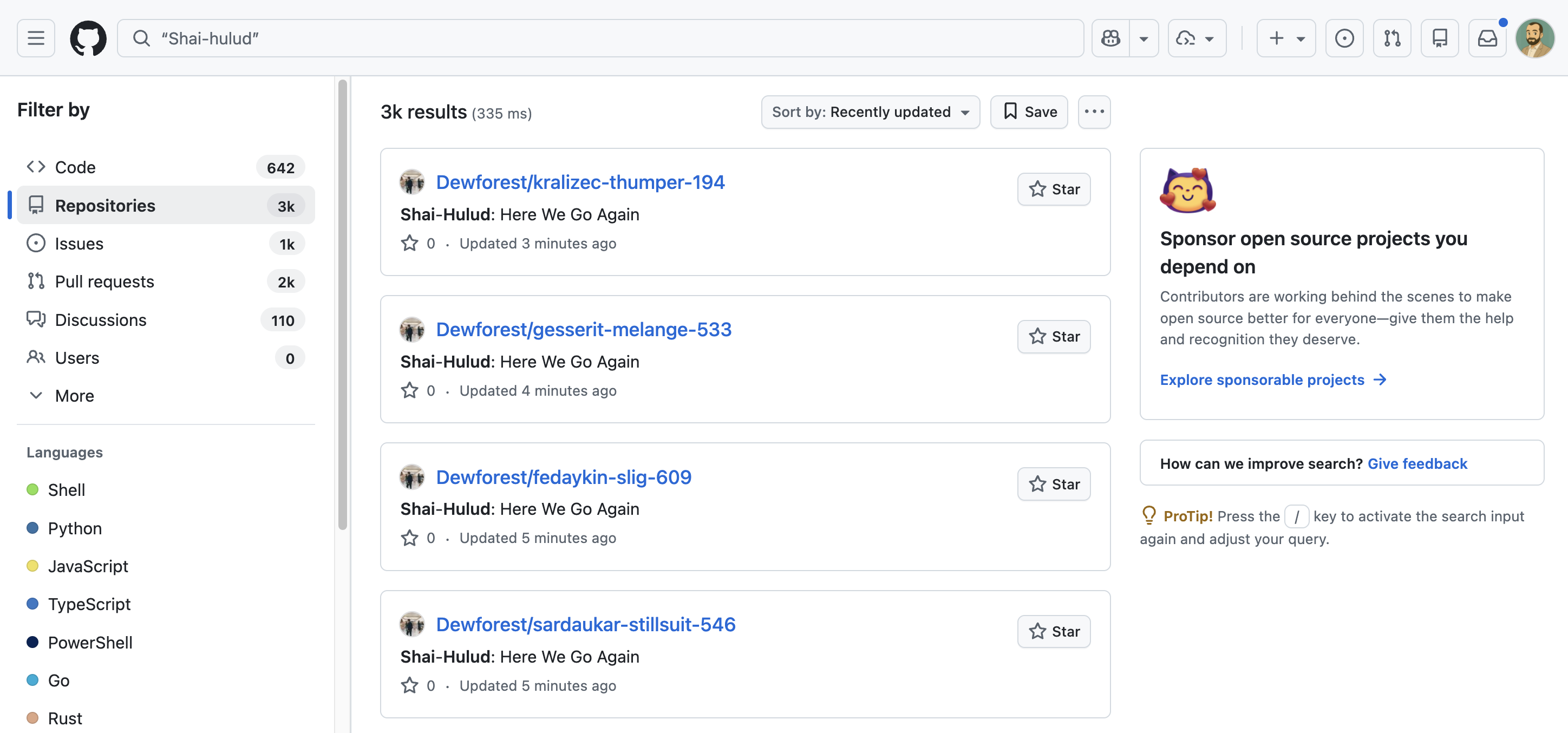
Keyv and friends compromised in active Shai-Hulud supply chain attack

A widely used family of npm caching packages is caught in an active credential-stealing supply-chain compromise.

Show HN: Simple algorithm and color space to generate diverse skin tones

A new color-space project proposes a practical, inclusive way to generate varied skin tones for digital tools and art.

Waymo in Dallas

Waymo opens fully autonomous rides to the wider Dallas public, bringing the driverless-car debate to another major city.

Twenty Years of Pandoc

Pandoc marks two decades of turning documents from one form into another, with gratitude from its devoted users.

From the Editor

The machinery of modern life asked for our trust today—and, in several cases, gave us reason to inspect the fine print. From a game disc that cannot play to packages that cannot be trusted, the old editor’s instinct holds: keep a copy, know your supplier, and do not confuse convenience with custody.

  1. Xbox goes down. You can't play games you own on disc3
  2. Show HN: Simple algorithm and color space to generate diverse skin tones4
  3. In Memory of My Wife, Elise Cawley, with Thanks for 36 Wonderful Years5
  4. Amazonian civilization had estimated 3M people in 3% of forest area5
  5. There Will Come Soft Rains (1950) [pdf]5
  6. Ray Bradbury's "There Will Come Soft Rains" is set today (2026-08-04)5
  7. DeepSeek V4 Flash on a Single AMD MI300X6
  8. Mistral's Shieldstral: 3B open-weights model for multimodal moderation7
  9. Show HN: Run an 80B Qwen in 4.3 GB of RAM on a Mac, and a 35B on an iPhone8
  10. Harness engineering for self-improvement9
  11. Keyv and friends compromised in active Shai-Hulud supply chain attack10
  12. AI-Generated Images Discourage Me from Reading Your Blog11
  13. Apple says more ex-employees may have taken confidential data to OpenAI12
  14. When AI Benchmarks Plateau: A Systematic Study of Benchmark Saturation13
  15. Twenty Years of Pandoc14
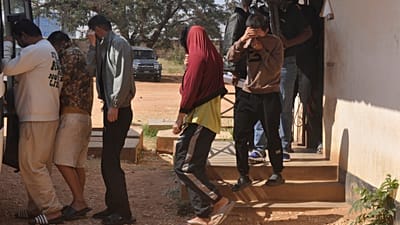
  16. AI fuels more than half of cybercrime in Africa as scams surge – Interpol15
  17. Waymo in Dallas16
  18. I am retiring from fulltime writing (& pseudonymity) to launch Guardian Angel17
  19. Oxide Computer raises $445M (SEC Form D)18
  20. libexpat now funded by the City of Munich for up to 6 months19
  21. Everything I Know (1975)20
  22. That time when I failed the Microsoft interview21
  23. Don't stop early: Case-folding source code at memory speed22
  24. FFmpeg 9.023
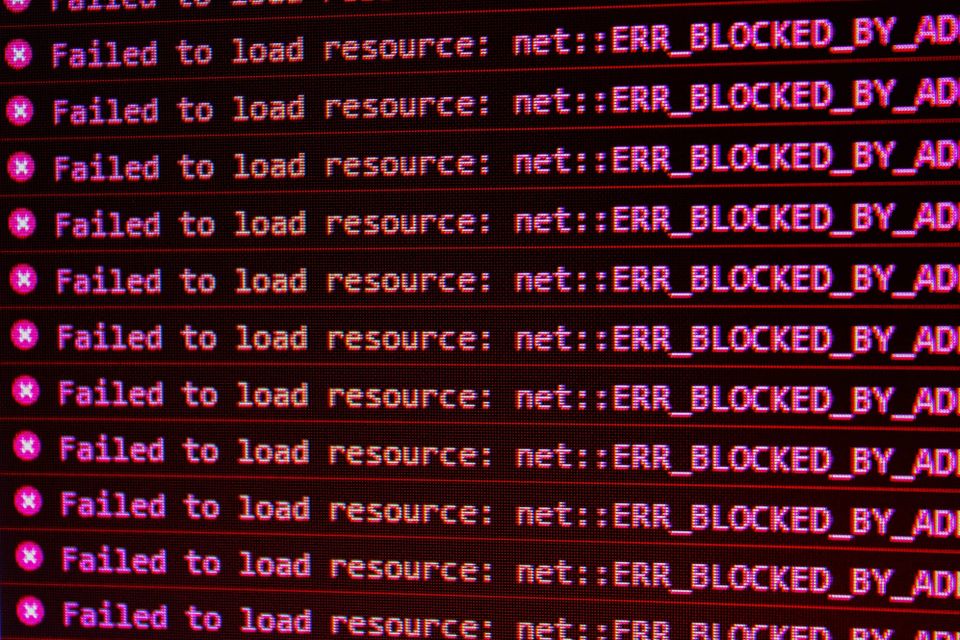
  25. Online ad giant Adform was hacked, proving once again why ad blockers are needed24
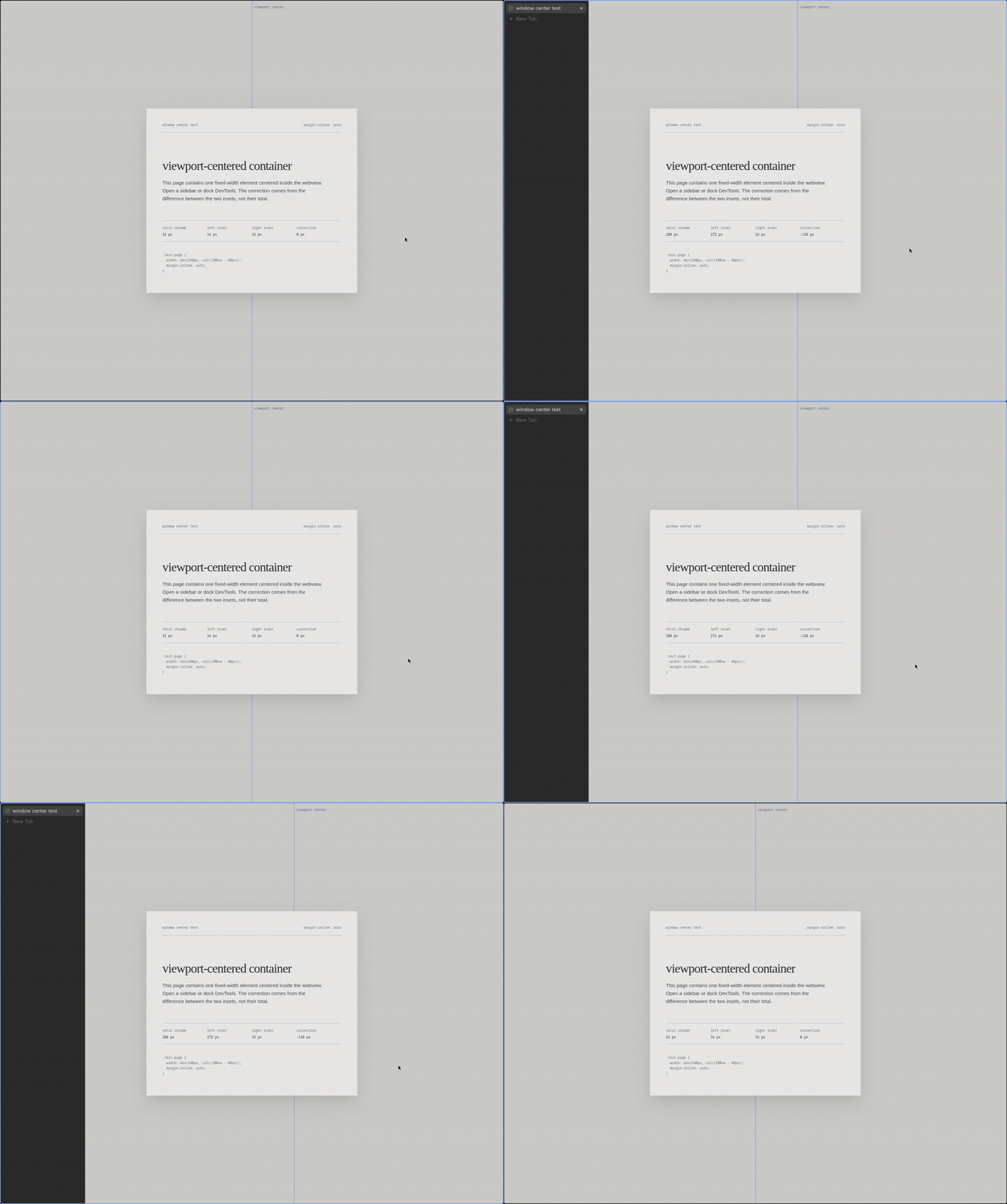
  26. We finally learned to center a div, then browsers added sidebars25
  27. Show HN: Maple-Preview – Ternary 20B MoE running at 120 tok/s on a iPhone26
  28. Video2NAND – Abusing video codecs for great computational power27
  29. Dates That Don't Exist (2015)28
  30. Thanks FedEx, This Is Why We Keep Getting Phished (2024)29
The Daily Front Page 2 of 30
Tuesday, August 4, 2026 The Daily Front No. #260804 — The Ownership Desk
article

Xbox goes down. You can't play games you own on disc

by surprisetalk·▲ 633 points·665 comments·birchtree.me ↗
it blocked people from playing their disc-based games, too.

Jay Peters: Xbox’s huge outage even blocked games on disc

An extended Xbox outage that began Sunday evening hasn’t just caused issues for people trying to play digital games — it blocked people from playing their disc-based games, too.

When Sony announced that they were discontinuing physical discs for PlayStation, I was less outraged than many. The reason I felt this way wasn't because I loved what Sony was doing. I think it came from an understanding that physical media ain't what it used to be.

I got an analog pocket a couple years ago, and I think it's an awesome product. I was able to insert my Game Boy cartridges from 20 years ago and was able to play them immediately, just like I did back then. Well, on a backlit screen with 10x the pixel density, but still.

The impression I get is that a lot of people have this vision in their head for what physical media still is today, and it simply isn't. Sure, I technically didn't own Golden Sun on the GBA. I technically had a license, but for all intents and purposes, I owned that game. And the evidence is, without Nintendo authorizing anything, I'm able to play it on a new piece of hardware, and it works great. No network downtime is gonna prevent me from doing that.

But owning a game on a disc today isn't really the same thing. It's still just a license, and Microsoft, Sony, and Nintendo can either intentionally or, in this case, unintentionally prevent you from playing that game, even if you own the physical copy. This isn't even to mention the fact that when you pop the disc in your drive, you're not playing from the disc. It's installing it to your internal hard drive and is probably installing a bunch of updates that are required to make the game actually work at all.

All I'm saying is it's all digital on the PC side of things, and has been for ages, but we have means of maintaining access to the games we love over here, and it's one of the reasons I've gravitated to the PC for quite a while now.

The Daily Front Page 3 of 30
Tuesday, August 4, 2026 The Daily Front No. #260804 — Color, Carefully Mapped
show hn

Show HN: Simple algorithm and color space to generate diverse skin tones

by automatoney·▲ 514 points·92 comments·toneyalexander.github.io ↗
feel free to take this math and go have fun depicting our diverse world!

If you're just looking for the results, below is a custom color picker based on the color space written in Javascript and a sample procedural generation algorithm in Python (Javascript equivalents are in the page source) - feel free to take this math and go have fun depicting our diverse world!

The goal of this project was to define a color space that makes it easier to build inclusive color tools for a variety of contexts - such as character creators or digital art. If you see something here that sparks your curiosity, I would love for you to stick around and read below this section to learn more!

# Plug the output of one of the select_point implementations into to_rgb(t, u, v)

def select_point(r_square: float = 2.) -> tuple[float, float, float]:
    """Uniformly sample from the sphere deterministically"""
    radius = r_square ** (1. / 2)

    phi = uniform(0, 2 * math.pi)
    costheta = uniform(-1, 1)
    n = uniform(0, 1)

    theta = math.acos(costheta)
    r = radius * (n ** (1.0 / 3))

    t = r * math.sin(theta) * math.cos(phi)
    u = r * math.sin(theta) * math.sin(phi)
    v = r * math.cos(theta)

    return (t, u, v)

def select_point(r_square: float = 2.) -> tuple[float, float, float]:
    """Uniformly sample from the sphere using rejection sampling"""
    radius = r_square ** (1. / 2)
    R = radius + 1

    while R > radius:
        t = uniform(-radius, radius)
        u = uniform(-radius, radius)
        v = uniform(-radius, radius)

        R = (t**2 + u**2 + v**2) ** (1.0 / 2)

    return (t, u, v)

def to_rgb(t, u, v) -> tuple[int, int, int]:
    x = (t - 0.15) / 0.45
    y = (v - 1.2 * t ** 2 + 0.2 * t + 0.655) / 1.84
    z = u / 3.6

    r = 28.77438370854 * x + 36.78307445559 * y - 19.69766918644 * z + 187.1436241611
    g = 35.38327306318 * x - 2.009931981182 * y + 47.93462563172 * z + 137.1073825503
    b = 36.14733717939 * x - 43.54346996173 * y - 28.50821294135 * z + 108.2241610738

    return int(r), int(g), int(b)

Overview

What colors are we? The short answer is maybe something like “brown” and the long answer is very, very long. Representing the broad range of human skin tones digitally is a hard problem. Often, a limited set of colors is presented as being good enough to cover the full spectrum of diversity. However, in using a specific set of colors, large groups of people are unable to accurately be represented, or might be unintentionally excluded.

The goal of this work is to identify the broadest inclusive range of colors in the RGB color space that correspond to plausible, but simplified skin tones. In particular, the aim was to identify simple, “good enough” equations which define that area, allowing the range to be used in a variety of contexts. Calling the equations "good enough" is intended to keep the limitations of this work at the forefront - the results are a useful starting point, but should not be taken to be authoritative.

Introduction

Although there have been improvements in the set of colors that are presented as representative of us, there's still a gap that needs to be closed. Emojis say we're 5 shades (or cartoon-yellow); a makeup brand might say 50; and a character creator might shrug and tell you to pick from all 16,777,216 options. If you look outside - or just at yourself - you'll quickly notice that none of those can compare to the variety of reality; one person is not just one color. Despite that, it can be useful to try to boil things down to fewer values. The Unicode Consortium and makeup companies can figure out their own ranges, but I believe we can find a better solution that's somewhere between "several" and "several million."

Taking the digital art world as an example, images such as the one below are often circulated in an attempt to assist other artists in identifying plausible colors.

a lumpy rectangle shape with a spectrum of skin colors smeared together

"Flesh Cloud" by Tumblr user shiroxix

In the video game world, nowadays the preset colors are often wide ranging and supplemented with a general color picker, but it would be even better if the initial experience presented better options.

a skin color picker with 18 choices and an extra spot for bringing up a generic color picker

Screenshot from character creator for the early access game Paralives

Limitations

Taking a step back to reality, this work has a number of inherent limitations.

As mentioned before, skin tones are much more complicated than a single color. They vary widely between different areas of the body and are subject to complex biological processes. The perceived color of the skin is affected by blood flow, concentrations of melanin, complex scattering of light through the layers of the skin, as well as things like vitiligo, freckles, hyperpigmentation, scarring, and other common variations.

Secondly, a variety of health conditions can cause people to have skin tones that are well outside what might be perceived as plausible. Argyria can often lead to skin that is blue-gray in color; high bilirubin can cause skin to be yellowish or greenish.

Additionally, it's important to note that I am one person, not a researcher, and subject to my own general biases on top of my own perception of color. As far as I am aware I don't have color vision deficiency, but a lot of the choices I made are completely subjective.

Finally, colors are not perceived consistently across display types and viewing environments. RGB values look different between different screens, and people look completely different under different lighting conditions.

Broadening this work to address some of these limitations would be an interesting area of further investigation - a goal of this project was to be good enough for simple use cases, but these limitations might be more problematic in other contexts. The results here will mainly be applicable in contexts that relate to generating simplified representations of people.

Methodology

What are all of those numbers, and how did you get them?

Content warning - unscientific methodology below. In other words: good enough is fine if you're an engineer.

Summary:

  1. Manually label colors in RGB in order to get a rough approximation of the dataset shape
  2. Perform a principal component analysis (PCA) with N=3 on the dataset to change the shape into something easier to work with
  3. Use your preferred graphing software to manually create equations that map a sphere in the target space onto the transformed data in the XYZ, or PCA space

Manually Labeling Colors

a webpage with sets of different colored faces on the left and right - the faces on the left have colors more like skin tones, and the ones on the right are purples, blues, and greens

Data labeling UI

Sometimes the best place to start is by doing a ton of tedious work. I didn't label every color in RGB, but there certainly were a lot. This is the UI I built for labeling - just a simple webpage where you click to move a face between the yes and no side. Initially they were just squares, but I ended up drawing a face and slapping the colors onto it. Gazing into my lumpy research assistant's eyes made it much easier to quickly go “yeah I can imagine that person walking around”.

Graphing that data, you get the following shape - for visualization it's kind of like a banana shape that swoops between 0, 0, 0 and 255, 255, 255. The curve is more towards red and away from blue.

a 3D graph of points - the colors range from darker on the bottom left to lighter on the top right

Matplotlib graph of the labeled data

This is where I got stuck for the longest. For your sake, I'm going to skip over all of my dead ends and struggles along the way. There were many. Far too many. Things involving convex hulls, regression misadventures, 4th degree polynomials, and the worst looking code I've ever written.

The result of all of that was that I decided I needed some way to transform the shape into something easier to work with: that's when I learned about principal component analysis and was immediately inspired.

Humanities Intermission

Although all of the math and technology here is fun, it's important to address the fact that technology exists in a social context. Stating things plainly: lighter skin colors have both presently and historically been celebrated and prioritized while darker skin colors have been marginalized and maligned. Racism and colorism are systemically present in many cultures, in both overt and subtle ways.

Below are some great videos, essays and projects that address these issues through a variety of lenses. I highly recommend taking a look, especially if you want a break before we get into the math.

In her video series The Darkest Shade, Nyma Tang reviews the darkest shades from a variety of makeup brands. In her own words, "It's important for makeup brands to make products for all shades and as someone with a darker skin tone, I want to be able to help others who struggle to find the same!"

In a similar vein, Kat Blaque's video (for introspective hot people) Youthforia's Blackface Foundation is about a makeup brand that released a dark shade that was literally black - far darker than what would be plausibly useful.

Finally in the makeup space, the Vox video How beauty brands failed women of color talks about the history of discrimination in the beauty industry and the limited availability of deeper shades. There's a lot of great expert interviews as well as a discussion of the intersection with Black history.

Taking a look at video games, Me, On The Screen: Race in Animal Crossing: New Leaf by Austin Walker is an excellent essay about the author's struggle to see himself represented in video games. In the years since, Animal Crossing has gotten much better about inclusivity but the essay also goes into his history of not seeing himself - or seeing characters that look like him be stuck in racist tropes.

The Humanae photography project by Angélica Dass is "an unusually direct reflection on the color of the skin, attempting to document humanity's true colors rather than the untrue labels “white”, “red”, “black” and “yellow” associated with race." In a way it's really similar to the work here - except with a focus on documenting and conversing instead of describing, and using Pantone shades over hex codes.

For more direct resources, the video It's not a Coincidence. It's Colorism. by Tee Noir gives a description of what colorism is, and a few ways it manifests in modern pop culture.

Finally, Writing With Color is an excellent blog with many resources about writing various kinds of diversity. The blog is run by a team with expertise in many different areas, and they often take reader questions. In particular I found their post Words for Skin Tone | How to Describe Skin Color really interesting. As more of a reader than a writer, it's fascinating to see behind the scenes on how to make better word choices.

Principal Component Analysis

Briefly, principal component analysis (PCA) is a way to rotate and stretch a dataset so that the main directions of variation lie along the axes of the coordinate system. To make that more concrete - recall the banana shape of my dataset from before. In its original form, the banana was sort of floating in space. PCA took that shape and placed in on the ground so that it was symmetrical about the axes and aligned nicely. It also did some slight stretching and rescaling, but that's less important.

The graph from before and after applying the PCA transformation

two 3D graphs with an arrow labeled PCA pointing left to right - on the left is a curve from the origin to the top right, and on the right is a similar curve but aligned with the axes

Aside from the modified dataset, another output of the analysis is a matrix that can be used to take a point from RGB space and translate it into the resting-on-the-floor space. I refer to this as PCA space, or XYZ space since those are the variables I use for it.

Manual Function Fitting

To summarize what we've done so far: we started with data in RGB space (the manually labeled dataset). PCA gives us a way to take points in that space and transform them into another space - XYZ space.

The dataset in XYZ space, graphed in Desmos

3D graph of a cloud of points

Now the goal is to fit some function to all of these points. Because it's a dense shape, if we can define the surface of it with an equation, we can modify that equation to include the points on the inside as well by switching the equation to being an inequality (eg from x² + y² + z² = 2 to x² + y² + z² ≤ 2).

The process for fitting the function is as follows:

  1. Start with a function for a sphere: R² = t² + u² + v² (see Adjusting R² for why a sphere is used)
  2. Define t, u, and v in terms of x, y, and z
  3. Modify how t, u, and v are defined until the sphere stretches to match up with the expected data
  4. Invert the relationships in order to define x, y, and z in terms of t, u, and v

What the graph looks like when t = x, u = y and v = z

3D graph of a cloud of points with a sphere overlapping with the middle

If you have (t = x, u = y, v = z) as a starting point, you can start to play with those relations until you start to get an intuition for how changes to the equations will end up shifting your sphere around.

So I did that! A lot. To put it plainly - I manually fit functions to my target cloud of points. There is no regression here, I literally did guess and check and eyeballed the function fit. I did this in Desmos 3D - if you haven't used Desmos in a while it's amazing how good it was for this.

What my Desmos “workspace” ended up looking like.

graphing calculator display - on the left are a set of equations, and on the right is a 3D shape that lines up with the cloud of points

The functions that relate (t, u, v) to (x, y, z) can be used to translate a point between those two spaces. Principal component analysis gave us a way to move between RGB and XYZ, and then these new equations give us a way to move between XYZ and TUV. Linking up all the transformations gives us the functions that take us between TUV to RGB.

Am I endorsing this methodology? No. But also kind of. In this specific situation it's what worked to get it done and get functional equations. It would be great to see someone do this properly, with nice clean symbolic regression and really good training data. But I figured since the training data I labeled was middling quality at best, I'd probably have a better time using my guess and check and then eyeballing the results.

And all that being said, I think I would endorse the overall method I used, if not the specifics. That being "Label Data" → "PCA" → "Fit A Spherical Equation".

Results

From the equations, the sample code at the top of the page is just a short translation away. The next section is the description of the components of the Picker UI, which also serves as an explanation of what TUV space actually looks like, and what properties it has.

Picker UI

the color picker interface from the top of the page with parts that control T, U and V labeled

Sorry - this one's not interactive

Just like how a typical color picker allows you to adjust red, green and blue values (or hue, saturation and value), this color picker also has 3 independent values to adjust - referred to in the code samples as T, U and V.

Component Aspect Variable Name
Up/Down On Square Deep/Fair T
Left/Right On Square Flushed/Ochre U
Left/Right On Slider Cool/Warm V

What's really interesting about these controls is that the concept each is adjusting is completely an output of the principal component analysis. Or in other words, I didn't know that these would be what the directions controlled until after I had made the picker. It's a really neat demonstration of what principal component analysis does - it rotates data to maximize how meaningful each axis is.

Now, if you're experienced with color spaces you might be thinking that this looks a lot like HSL/HSV. However, when I was doing my first experiments with the labeled data those color spaces didn't quite capture what I was looking for. I think in particular that although T and U seem similar to Value and Hue, they don't completely match up. And the biggest difference is between V and Saturation. V ranges from blue to orange, while Saturation would look more like gray to orange; although at some (T, U) values V might look a lot like Saturation, overall it doesn't quite correlate.

Adjusting R²

What is R²? R² is the radius of a sphere in the skin tone color space. Because one of the steps of translation from RGB to TUV involves a sphere, it makes spheres a natural shape to work with in TUV space. A lot of the cool properties that arise from that fact are just a side effect of spheres having a lot of useful properties.

To start with a visual, below is a table of R² values, and the result of using a sphere with that value:

Description Sample
0.1 Almost no variation
0.5 Minor variations
1.0 Minimum value to have decent variety when randomly picking
1.5 Good variety while maintaining realism
2.0 Potentially cartoonish - random selection will have occasional outliers
2.5 Randomly selecting in this range might give unexpected values, but useful in a picker UI
10 Maybe something for a fantasy setting? Regenerate Faces

So what's going on with that table? Because a sphere is defined by a radius, you can define useful sampling ranges using only a single value and then easily select points from within that sphere. For example, in the sample implementation of the tone generation function I use a radius of 2. This is the radius that was used when developing the color space and generally will result in a broad range of tones. However, if you find there are implausible results generated using that radius you can decrease it by a bit in order to reduce the variation in generated colors.

The fact that the sphere shrinks along a radius means that the reduction in variation actually does not result in a large reduction in representativeness. In other words, reducing the radius doesn't lead to just chopping off deep or fair skinned colors - deep skin tones, fair skin tones, flush skin tones, ochre skin tones, cool skin tones and warm skin tones are uniformly decreased in variation.

Taking R² all the way down to 0, we can identify the origin of the color space. If the space is well formed then this origin point should be a very neutral ambiguous tone. If the origin seems biased in a particular direction, then that would indicate that the space needs more fine tuning. Essentially, the origin point can be used to identify bias in the space mapping.

At the other extreme, you can increase R² in order to allow for more variation. As an example, I do this in the color picker UI. In a picker UI the user can ignore implausible colors, so there's little issue with increasing the variation too far. In a color generation context you'd likely want to avoid having implausible colors popping up. There is likely not an ideal R² value that works in all contexts, but having a single parameter to tweak makes it easy to adjust the equations to your needs.

In Summary

We have a color space, we have a picker for it, we have a procedural generation algorithm, and we have a methodology for creating new spaces or modifying the existing one. Overall, I'm thrilled with this result. It's certainly not perfect, but I don't think a simple and completely correct solution exists. I've already used the picker in a digital painting and it was exactly as I was hoping it'd be - and I'm looking forward to using the generator in my next projects.

What's Next?

First is feedback: if you at all found this interesting or useful, please let me know! Although I did this work for my own use, hearing from others is also so rewarding. Also please reach out with any questions or feedback - especially if you spot something I didn't think about.

Although I would love to post an email address for accessibility, I think the safest solution is to use the issues page of the repo for this project to contact me. But open to suggestions on alternatives for that as well!

A task for me is to clean up my code and post it to the repo for this page to make it easy for people to recreate and iterate on this work.

Future Work

Refining The Space

In defining the color space so precisely and using specific R² values, there is a risk that some colors have been excluded or marginalized. However, that same concreteness also allows for extremely precise critiques of the color space, and therefore extremely precise improvements. As mentioned before, my process involved a lot of subjective eyeballing - a great iteration on that would be to have multiple people, perhaps experts, labeling data and then measuring the output more precisely against that.

Skin Variations and Conditions

A direction mentioned earlier would be to look into modeling simplified versions of various conditions. What modification might you be able to apply to base tones to simulate that person having jaundice, or argyria, or becoming pallid? What colors are freckles, vitiligo, scars, hyperpigmentation, or stretch marks relative to a person's base tone?

Technical Improvements

From a technical direction, making the equation generation more formalized is another potential direction to go. Starting with the shape of equations I manually determined, symbolic regression on those against better training data might lead to an even better color space definition.

There's also the potential for optimizing the equations for different contexts. I've chosen to write them out in code as they are to be the most readable to a broad audience. However, keen mathematicians might notice that one of those steps looks a lot like a matrix multiplication, which can be rewritten to be more efficient in certain contexts.

It might also be interesting to see what the results look like if you transform the data into another color space before doing the principal component analysis and equation fitting. There's a chance the equations end up being simpler or more representative. Because of the sphere, the shape of the surface in the color space you build from will be maintained and it will mainly scale with R² values. For an illustration of this idea, see the graph script in the repo's code.

Thank Yous

  • My friends, for listening to me ramble and for coming up with great suggestions
  • This video, for helping to break my roadblock by explaining principal component analysis
  • All of the creators mentioned in the Humanities section, for sharing their works and thoughts
  • Tools
    • matplotlib, a library for graphing data in Python
    • scikit-learn, an ML library with an implementation of principal component analysis
    • Desmos, a free online graphing calculator
    • SymPy, a symbolic mathematics library
  • You, for reading!
The Daily Front Page 4 of 30
Tuesday, August 4, 2026 The Daily Front No. #260804 — Memory, Rain, and the Deep Past
The Daily Front Page 5 of 30
Tuesday, August 4, 2026 The Daily Front No. #260804 — One Accelerator, Full Weights
repository

DeepSeek V4 Flash on a Single AMD MI300X

by zhoutong·▲ 370 points·93 comments·github.com ↗
★ 112⑂ 8 forks Python

This repository contains the configuration and patches I use to run deepseek-ai/DeepSeek-V4-Flash-0731 on one AMD MI300X in production. It includes the Docker Compose stack, SHA-256-pinned file overlays, reference diffs against upstream, and tuning tables. The checkpoint runs as shipped, without additional weight quantization or offload.

Results from the pinned stack (vLLM ROCm nightly 0.26.1rc1.dev229+g124154a88.rocm723, AITER 0.1.19):

Metric Result Single-stream decode (median per-stream, DSpark-7) 168.6 tok/s Prefill with tuned kernels ≈ 7.9–8.5K tok/s (6,988–7,019 tok/s on fresh prompts in the shipping profile) 8 concurrent streams 542 tok/s aggregate, 90.3 tok/s median per stream 64-stream burst 830 tok/s aggregate, no OOM, no engine errors Context 256K validated (the architecture supports 1M) Weights in HBM 156.67 GiB — no additional quantization or weight offload

The official vLLM recipe targets NVIDIA and newer AMD hardware. Running the model reliably on MI300X required fixes for its FP8 format, MoE routing at high concurrency, causal speculative verification, CPU-KV synchronization, and several untuned kernel shapes. This repository collects those fixes and pins the versions used in production.

Why MI300X

The MI300X has 192 GB of HBM3 and 5.3 TB/s of memory bandwidth, with 2.4× the HBM capacity of an H100 SXM5 (AMD). Doubleword's write-up estimates that it costs roughly half as much at list price. For this 304B-parameter checkpoint, the memory capacity allows a simple single-GPU deployment:

  • The entire model fits in HBM without PCIe weight streaming or layer offload.
  • There is room for a 20 GB GPU KV pool and a 96 GiB CPU tier for evicted prefix-cache entries.
  • One card handles 2–8 typical concurrent streams and bursts of up to 64 streams.

MI300X (CDNA3) implements the AMD/Graphcore fnuz variant of E4M3, while MI325X and newer use OCP-standard FP8 (background). A kernel that assumes OCP semantics on MI300X can be wrong by a factor of two in the scale domain. Correctness on this FP8 implementation was the first priority; performance tuning came afterward.

Prior art, and what this repo adds

Fergus Finn's MI300X worklog and the accompanying Doubleword repository identified the FP8 incompatibility, missing AITER fast paths on gfx942, HIP-graph hazards in sparse MLA decode, and MoE routing bugs. The official vLLM recipe covers NVIDIA hardware and newer AMD GPUs (MI325X at 4K context and MI355X), but not a single-MI300X production configuration for the 0731 checkpoint.

This repository adds:

  1. Correctness overlays for the pinned ROCm nightly, including fixes not yet in upstream vLLM.
  2. A validated serving configuration with probabilistic DSpark drafting, block rejection, and static K=7. It uses a 2,048-token scheduler budget and a 1,024-token long-prefill cap to prevent a cold prompt from stalling other streams.
  3. AITER GEMM tuning tables for the recurring gfx942 shapes the packaged tables were missing, plus a gfx942 OGS geometry override for the MXFP4 experts.
  4. A hybrid KV strategy: 20 GB of fp8_ds_mla GPU cache + 96 GiB native CPU offload, with a load-path fencing fix that upstream issue #47282 documents but PR #47291 never merged.

Repository layout

.
├── compose.yaml         # The production stack (vLLM ROCm + Caddy), digest-pinned
├── Caddyfile.example    # Copy to Caddyfile; set hostname, email, and source CIDR
├── vllm-entrypoint.sh   # Removes stale CPU-KV mmaps from /dev/shm before start
├── SHA256SUMS           # SHA-256 pins for every runtime artifact
├── patches/
│   ├── *.py            # Byte-for-byte production overlays (mounted read-only)
│   ├── diffs/*.patch   # Unified diffs vs. the upstream base revision
│   └── README.md       # Provenance and regeneration instructions
└── tuning/
    └── *.csv            # AITER A8W8 blockscale tuning tables for gfx942

Runtime configuration

The stack uses a digest-pinned official vLLM ROCm nightly with:

  • --trust-remote-code and the DeepSeek V4 tokenizer, reasoning, and tool parsers
  • fp8_ds_mla KV cache (UE8M0 block-scaled FP8, not generic unscaled FP8) with 256-token blocks
  • VLLM_ROCM_USE_AITER=1 and --moe-backend triton; Triton OGS handles the grouped MXFP4 experts, while AITER handles attention and dense linear layers
  • DSpark-7 speculative decoding with probabilistic drafting and block rejection
  • full/breakable CUDA graph capture, giving one graph launch per token during steady decode
  • Caddy as an IP-allowlisted HTTPS proxy

Deploying it

1. Host prerequisites

One MI300X (gfx942, 304 CUs, ~192 GiB HBM), a working AMD kernel driver, recent Docker Compose, ~235 GiB RAM for the CPU KV tier, and ~500 GB disk (the model cache alone is ~156 GB).

2. Pull the pinned runtime and model

VLLM_IMAGE='vllm/vllm-openai-rocm@sha256:e68d18b2ba50298661bfc49baf01158fbf036645c2362cccf3e8a7a79fe6c69a'
MODEL='deepseek-ai/DeepSeek-V4-Flash-0731'
REVISION='7872f01b1d1fe23eabc4c98b48bffcef5a386062'

docker pull "$VLLM_IMAGE"
docker run --rm --entrypoint hf \
  -v /root/.cache/huggingface:/root/.cache/huggingface \
  "$VLLM_IMAGE" download "$MODEL" --revision "$REVISION"

3. Prepare the files

cp Caddyfile.example Caddyfile   # then set your hostname, email, and remote_ip CIDR
mkdir -p aiter-cache crash-dumps
chmod +x vllm-entrypoint.sh
sha256sum -c SHA256SUMS        # verify the overlays before first start

4. Start

docker compose config -q
docker compose up -d
docker compose logs -f inference

A healthy start takes ~5 minutes and must show all of:

Model loading took 156.67 GiB
DSpark draft model loaded: 96 params
GPU KV cache size: 1,927,444 tokens
Maximum concurrency for 262,144 tokens per request: 7.35x
Created mmap file /dev/shm/vllm_offload_...mmap (103.08 GB)
Capturing CUDA graphs (FULL)
Application startup complete

After graph capture, run rocm-smi --showmeminfo vram. The warmed high-water mark is ~204.5 GB of 205.8 GB. If only a few hundred MB remain, the server may start but fail on the first request.

5. Smoke-test

HOST='your-host.example.com'
curl -fsS "https://$HOST/v1/models"
curl -sS "https://$HOST/v1/completions" \
  -H 'Content-Type: application/json' \
  -d "{\"model\": \"deepseek-ai/DeepSeek-V4-Flash-0731\",
       \"prompt\": \"Calculate 17 * 23. Answer with the number only.\",
       \"temperature\": 0, \"max_tokens\": 32}"

The patches

Each patches/*.py file is a full-file overlay mounted read-only over its counterpart in the container; compose.yaml contains the target paths. The corresponding diffs/*.patch records the change from its upstream base. The base image remains digest-pinned, so upgrades require changing the image reference and revalidating the stack.

Overlay Mounted over Fixes Needed when gpt_oss_triton_kernels_moe.pack128-fused-silu-fast-routing.py vllm/.../fused_moe/experts/gpt_oss_triton_kernels_moe.py MXFP4 bitmatrix padding lanes + fused-SiLU grouped experts + fast DeepSeek routing Required for the MXFP4 Triton path; the mask fix is not yet upstream mxfp4.fused-silu.py vllm/.../fused_moe/oracle/mxfp4.py Gate/up interleave layout for the fused-SiLU kernel Required with the fused-SiLU overlay; skip both if you keep the standard SiLU path triton-kernels-matmul-ogs-opt-flags.dsv4-mi300x.py vllm/third_party/triton_kernels/matmul_ogs_details/opt_flags.py gfx942 MXFP4 OGS tile geometry (up to 1,536 routed rows) Performance on gfx942; the stock geometry slows sharply above 768 routed rows fused_compress_quant_cache.fnuz-shuffle.py vllm/models/deepseek_v4/common/ops/fused_compress_quant_cache.py FNUZ FP8 + 16×16 preshuffle in the Lightning Indexer cache writer Required on MI300X; MI325X/MI355X use OCP FP8 and must keep the stock bytes aiter_pa_mqa_logits.i64.py aiter/ops/triton/gluon/pa_mqa_logits.py 64-bit offsets in the ChunkK=256 paged-MQA kernels Required when KV offsets can exceed 4 GiB; skip for small KV pools rocm_aiter_mla_sparse.prefill-bh64.py vllm/v1/attention/ops/rocm_aiter_mla_sparse.py Deterministic torch.topk prefill + BLOCK_H=64 head-512 sparse prefill Determinism is required for reproducible tool calls; BLOCK_H=64 is performance rocm_aiter_mla.dspark-causal.py vllm/v1/attention/backends/mla/rocm_aiter_mla.py Causal multi-token speculative verification Required for DSpark on ROCm small-head MLA — now upstream; the overlay is the upstream file verbatim dspark-speculator.independent-draft-gumbel.py + spec-decode-utils.independent-draft-gumbel.py vllm/v1/worker/gpu/spec_decode/dspark/speculator.py + .../spec_decode/utils.py Draft-proposal Gumbel noise salted away from rejection/recovery noise Required only with draft_sample_method=probabilistic (the recipe's greedy path does not need it) kv_offload_cpu_gpu_worker.load-war.py vllm/v1/kv_offload/cpu/gpu_worker.py Fence CPU→GPU KV restores behind in-flight compute (#47282, PR #47291) Required only with --kv-offloading-backend native

Two important correctness fixes

MXFP4 routing. The MoE bitmatrix kernel pads its block columns to a Triton block size, but the padding lanes were masked against the global tensor bound instead of the logical block size. Under load, padded lanes corrupted the routing matrix, causing near-match tool names and forgotten schemas on long prompts. The one-line fix is mask = (offs_local < BLOCK_SIZE) & (offs_global < nonzero_indx_size), taken from Doubleword commit c32932bb9. The overlay also includes fused-SiLU and fast-routing changes for grouped MXFP4 experts.

FP8 format. DeepSeek V4's Lightning Indexer cache uses FP8. The stock writer emits OCP E4M3 bytes in row-major order, while AITER on MI300X consumes AMD FNUZ E4M3 bytes in a preshuffled 16×16 tile layout. In the worst case, interpreting one format as the other produces a factor-of-two scale error. The overlay selects float8e4b8 with FP8_MAX=224.0 and shuffled write offsets on ROCm, while leaving the OCP path unchanged elsewhere.

Speculative decoding

This stack uses probabilistic drafting with block rejection. The two Gumbel overlays keep draft-proposal noise independent of rejection and recovery noise.

Performance

Key optimizations in the production configuration:

Change Effect Tune 21 recurring A8W8 GEMM shapes for 304-CU gfx942 +42–62% single/double-stream decode; +10–35% at 8–64 streams Fused SiLU, fast DeepSeek routing, batch-sensitive expert tiles Native C1 decode 34.5 → 56.6 tok/s (+64%); routing kernel 42.6 → 11.9 µs/layer BLOCK_H=64 sparse-prefill tile Prefill reaches 7.9–8.5K tok/s; sparse-attention trace 317 → 142 ms per request Static K=7, probabilistic + block rejection, causal verify 119.5 tok/s single-stream with correct output 2,048-token budget + 1,024-token long-prefill cap Late short-request TTFT behind a 52K prefill: 8.2 s → 0.5 s 20 GB GPU KV + 96 GiB CPU tier 1.93M-token length-equivalent capacity; seven 256K requests admitted

Final concurrency sweep

Distinct ~400-word prompts, streaming, temperature=1.0, top_p=0.95; C1–C8 at 512 output tokens, C64 at 256:

Streams Aggregate tok/s Median per-stream decode TTFT p50 1 126.2 168.6 tok/s 1.026 s 2 145.4 152.7 0.939 s 4 316.8 108.6 0.369 s 8 542.3 90.3 1.027 s 64 830.2 16.4 2.190 s

DSpark acceptance is prompt-dependent; treat these as gates for this exact image, not universal model benchmarks.

Prefill

With the tuned kernels, uncached prefill reaches 7.9–8.5K tok/s, depending on scheduler budget: 7.90–7.99K at C1 with an 8,192-token budget and 8.46–8.51K at C4. The production profile uses a 2,048-token budget for latency isolation, giving 6,988–7,019 tok/s on fresh prompts. With the 1,024-token long-prefill cap, an 8.9K-token prompt reaches 5.20–5.29K tok/s at C1. In exchange, TTFT for a short request queued behind a 52K cold prefill drops from 8.2 s to 0.5 s. Warm recall of 380K cached tokens takes 0.64–2.65 s after a 120–125 s cold prefill.

Production notes

  • HBM headroom is limited. The warmed high-water mark is 204.5 of 205.8 GB. A 30 GB KV pool loads but fails during graph capture with HSA_STATUS_ERROR_OUT_OF_RESOURCES. Do not raise --kv-cache-memory-bytes; monitor HBM usage for growth.
  • The CPU KV tier stores cache entries, not weights. --kv-offloading-size 96 --kv-offloading-backend native maps ~103 GB in /dev/shm for evicted prefix-cache entries. The entrypoint removes stale mappings after crashes.
  • The 1,664-token scheduler warning is expected. DSpark-7 reserves draft slots from the 2,048-token budget. Raising the budget reserves more in-flight sliding-window state and reduces usable KV capacity.
  • Warm the kernels after restart. The first prefill initializes kernels and takes 5.3 s for 8.9K tokens; subsequent runs take 1.7 s. Run one uncached prefill before admitting traffic.
  • Test correctness as well as throughput. The validation suite includes two-turn tool-calling fixtures, a BFCL subset (74–76/90 exact calls), OpenCode tool-schema checks, and 380K-token needle recall on both native and DSpark paths. Cold and cached prefills can take different floating-point paths, so test both.

License and provenance

The stack, documentation, and vLLM-derived overlays are Apache-2.0 (see LICENSE); the AITER-derived overlay keeps its MIT header. Upstream base revisions for every diff are recorded in patches/README.md. The model itself is MIT-licensed.

References

All links verified 2026-08-04.

The Daily Front Page 6 of 30
Tuesday, August 4, 2026 The Daily Front No. #260804 — The Moderation Machine
article

Mistral's Shieldstral: 3B open-weights model for multimodal moderation

by riadsila·▲ 388 points·95 comments·mistral.ai ↗
it accepts plain-language policies at inference time

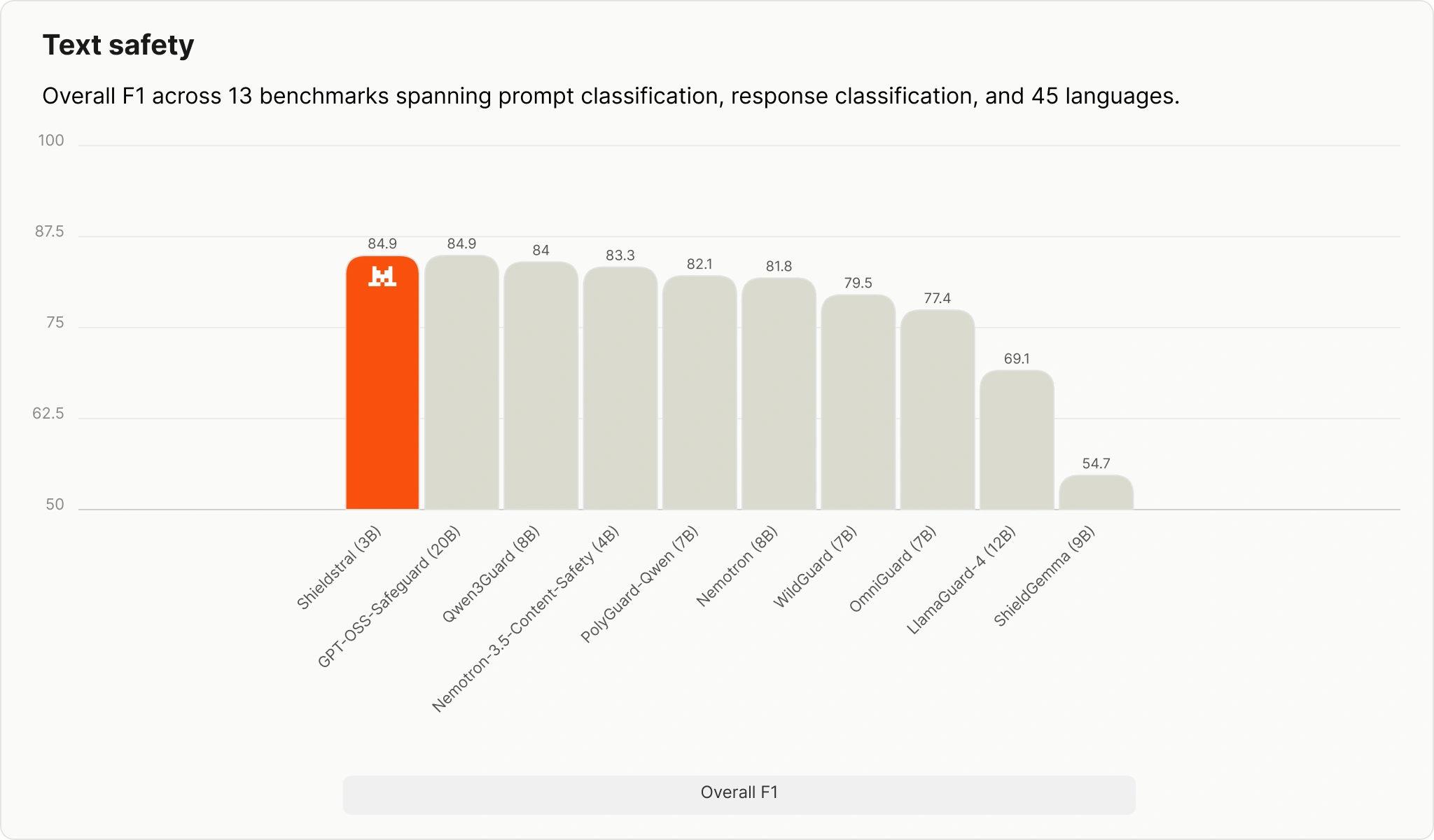
Shieldstral introduces a 3B open-weights multimodal safety classifier that outperforms models up to 7x its size by framing content moderation as a policy-adaptive question-answering task. Unlike traditional guardrail models, it accepts plain-language policies at inference time, unifying text and image safety evaluation without retraining. Released under Apache 2.0, it delivers calibrated safety scores across diverse benchmarks while running efficiently on a single 16GB NVIDIA GPU.

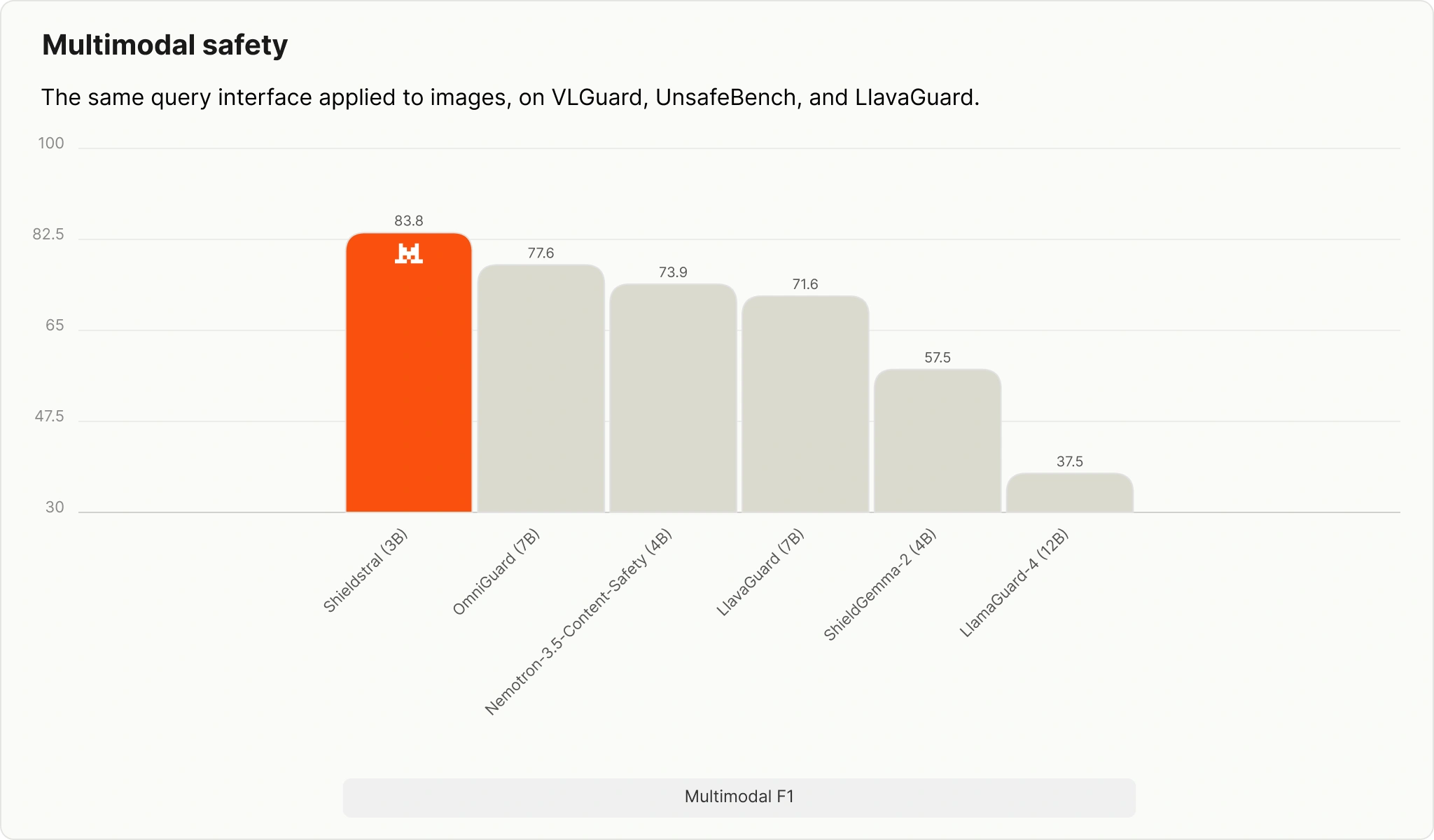
A 3B open-weights, policy-adaptive multimodal safety classifier that matches models up to 7x its size on text safety and sets a new state of the art on multimodal moderation.

“Does this content promote violence against a protected group? Is this image safe to show to a minor? Did the assistant refuse the request?”

Every product that ships a model needs to answer questions like these — but the right answer depends on the product, the audience, and the moment. The same content can be fine for a cybersecurity research tool and harmful on a mental-health platform. Most guardrail models bake a fixed taxonomy of harm categories into their weights, so re-targeting them to a new deployment context means retraining. And because safety definitions differ across applications and domains, there is no single "correct" set of categories to model in the first place.

Shieldstral takes a different approach: you write the policy as a plain-language question at inference time, and the model returns a calibrated safety score. No retraining, one interface for text and images, and a verdict from a single token. Please refer to our technical report here.

As an inaugural member of the Open Secure AI Alliance with NVIDIA and other organizations, today we're releasing Shieldstral as open weights under Apache 2.0, available for download here.

Moderation as a question

Shieldstral frames content moderation as a binary question-answering task. Each request has three parts:

  • <Instruct> — the evaluation context, strictness, and (optionally) a definition of what counts as unsafe content.
  • <Query> — a single yes/no question, e.g. "Does this content promote physical violence?"
  • <Document> — the content to judge: a prompt, a response, a prompt–response pair, or an image with optional text.

At inference the model reads out only the yes and no logits and softmax-normalizes them into a continuous safety score. This one simple formulation does a lot of work: it unifies prompt classification, response moderation, refusal detection, and toxicity detection into a single problem; it lets policies live entirely in the prompt, so one checkpoint adapts to novel policies at deployment time.

Highlights

  • Strong performance — matches or outperforms open guard models up to 7× its size across text safety, refusal detection, policy adaptability, and multimodal benchmarks.
  • Adaptive and flexible — a single natural-language interface covers text, image, and text+image content across prompts, responses, and prompt–response pairs. Policies are supplied as free-form queries and re-targeted at inference time, without retraining.
  • Small, trained on heterogeneous sources — a 3B model that runs on a single 16GB GPU, trained on real and synthetic data with diverse label formats and taxonomies, consolidated into one framework.
  • Continuous safety score — returns a calibrated yes/no probability from a single forward pass, so you can threshold or rank by confidence rather than relying on a discrete label.
  • Open — Apache 2.0 weights.

Benchmarks

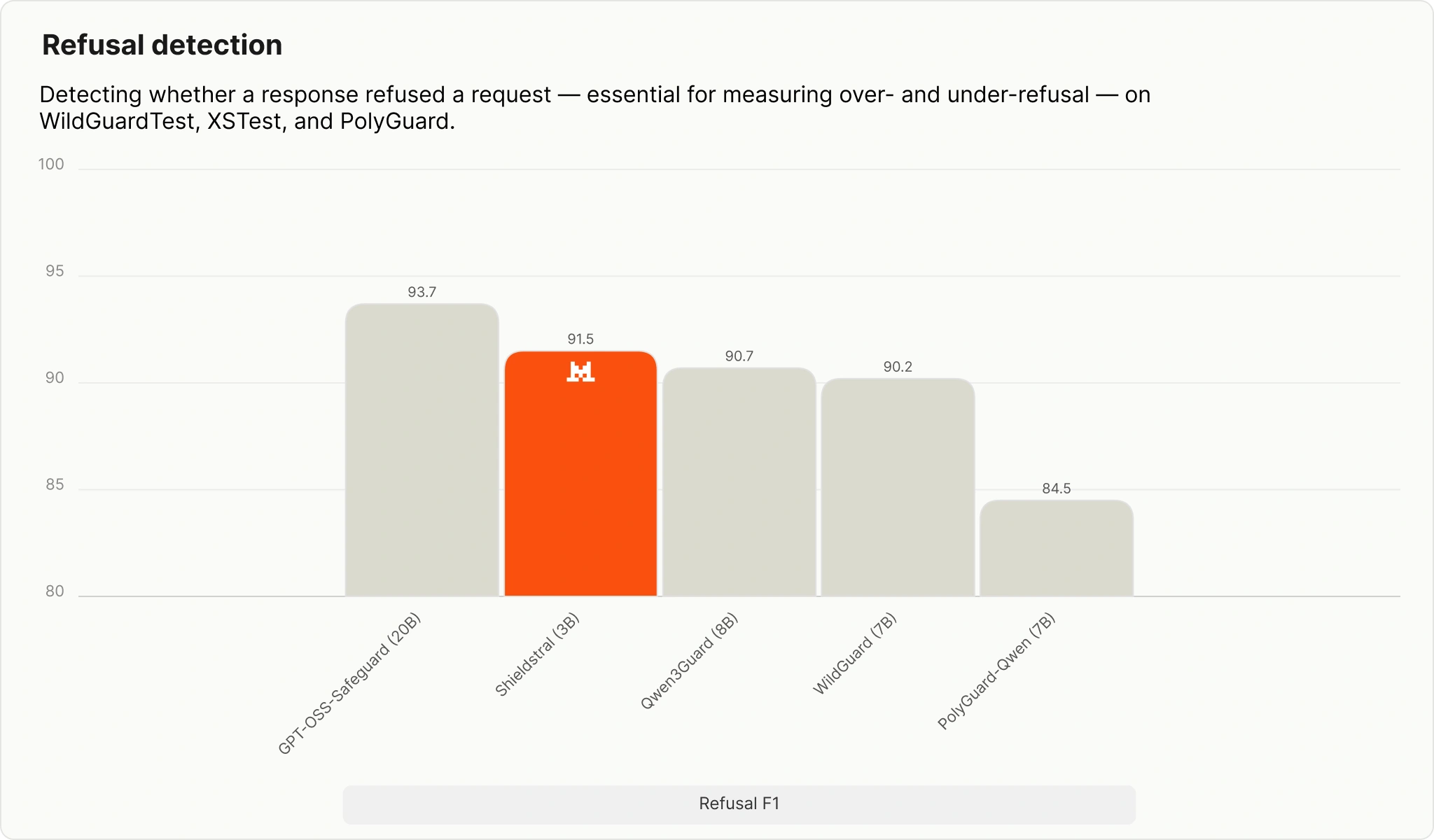
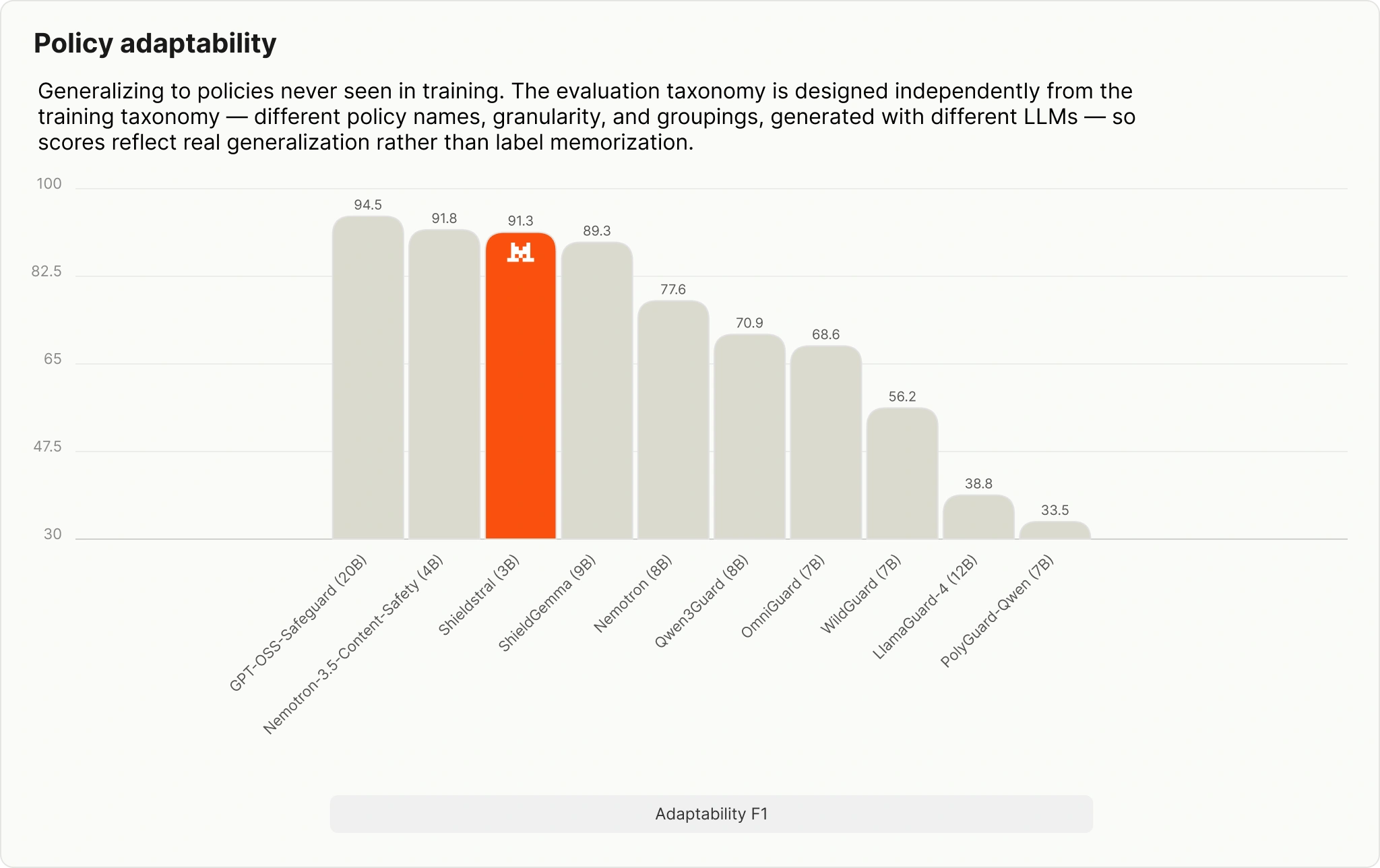
We evaluate Shieldstral against open guard models up to 7x its size across four axes. All evaluation samples are held out from training.

  • Text safety
  • Refusal detection
  • Policy adaptability
  • Multimodal safety

How we built it

The core idea is that a small model can beat much larger ones if the data is right. Getting the data right meant solving four problems:

Unify heterogeneous data. Public safety datasets disagree on taxonomies, labels, and annotation conventions — from binary safe/unsafe flags to fine-grained multi-label taxonomies. We convert every dataset into the same instruction–query–document format with a per-dataset processor, and we vary the wording of instructions, queries, and prompt–response delimiters so the model generalizes across phrasing instead of overfitting to one style. We also calibrate strictness per source — strict for adversarial jailbreaks, lenient for response-quality data — so the model learns calibrated decision boundaries. This lets us consolidate sources that would otherwise be incompatible.

Teach discrimination, not memorization. If trained on a fixed set of policy labels, a model learns only to classify those predefined policies, rather than reasoning about the precise boundaries of a given policy. This prevents generalization to novel policies. Instead, we construct sets of deliberately similar, easily confused policies and ask an LLM to rewrite safe text into contrastive pairs: each rewrite is engineered to violate one policy but not its sibling. This trains the model to distinguish which specific policy a piece of content violates, a skill that transfers to unseen, user-defined policies at inference time.

Ground safety in images. Unsafe images can't be synthezised by an LLM the way text can, so visual safety data is scarce. We supplement limited moderation datasets with general-purpose image datasets as high-quality negatives, mutate queries to augment the dataset, and filter every image–query pair through a vision–language reranker to reduce mislabeled data and hallucinations.

Combine complementary checkpoints. We fine-tune with LoRA and merge — via SLERP — a checkpoint calibrated on public data, one that adds fine-grained policy discrimination from generated data, and the base instruct model. The merge recovers common policy calibration and policy adaptability in a single model, and instruction-following from the base model transfers to the moderation task.

Forge. We built Shieldstral end to end on Forge, our platform for training, aligning, and evaluating custom models. Forge managed the infrastructure, data and model sharding, metrics, and logging on top of state-of-the-art distributed training, so the team could stay focused on the data which is what determines the safety model's quality.

What's next

Shieldstral is a step toward moderation that adapts to context instead of forcing every product through one frozen taxonomy. We're continuing to push on multilingual coverage, longer-document robustness, and broader multimodal safety — and we'd love to see what the community builds on top of it.

BTW, we're hiring! If you want to help make AI better, see our careers page.

The Daily Front Page 7 of 30
Tuesday, August 4, 2026 The Daily Front No. #260804 — Big Models, Small Memory
show hn

Show HN: Run an 80B Qwen in 4.3 GB of RAM on a Mac, and a 35B on an iPhone

by leonickson·▲ 302 points·136 comments·github.com ↗
It keeps only the small dense core of a model resident in memory and streams the routed Mixture-of-Experts weights from storage on demand.

Run 35B and 80B Qwen models on ordinary Apple devices, including iPhones.

Swiftlet is a Swift + Metal runtime for the Qwen3-Next and Qwen3.5/3.6 MoE hybrid model family. It keeps only the small dense core of a model resident in memory and streams the routed Mixture-of-Experts weights from storage on demand. The result:

Model Disk Peak RAM Decode speed (M5 Mac)
Qwen3.6-35B-A3B, 4-bit 18 GB 2.6 GB 7 to 11 tok/s
Qwen3-Next-80B-A3B, 4-bit 42 GB 4.3 GB 4.5 to 5 tok/s

The 35B also runs on an iPhone 17 in about 2.5 GB of RAM, at about 1 tok/s today. Credit where due: ANEMLL showed a 397B MoE streaming on an iPhone 17 Pro as a proof of concept in early 2026. Swiftlet's aim is the next step, making this class of model an installable app on a base iPhone, with an open runtime anyone can build on.

Status: working end to end. Both models generate correct, validated output. The current focus is kernel speed (the decode loop is dispatch bound, not IO bound, so there is clear headroom). One expectation to set honestly: only about 3B parameters are active per token, so these models chat and write like large models but recall facts like small ones.

Quick start: try it on a Mac

git clone https://github.com/leonickson1/Swiftlet.git && cd Swiftlet
swift build -c release

# Download the 35B container from Hugging Face (resumable):
.build/release/swiftlet-repack \
  --from-hf Leonickson/Qwen3.6-35B-A3B-qpack \
  --output ~/models/qwen3.6-35b.qpack

# Or the 80B (42 GB on disk, still only ~4.3 GB of RAM):
.build/release/swiftlet-repack \
  --from-hf Leonickson/Qwen3-Next-80B-A3B-qpack \
  --output ~/models/qwen3-next-80b.qpack

# Chat (applies the model chat template, disables the reasoning block,
# keeps conversation state so follow-ups prefill only the new turn):
.build/release/swiftlet chat ~/models/qwen3.6-35b.qpack \
  "Who wrote One Hundred Years of Solitude?" "What language did he write it in?"

# One-shot generation with stats:
.build/release/swiftlet generate ~/models/qwen3.6-35b.qpack \
  --gpu --chat --prompt "Explain expert streaming in one paragraph."

# OpenAI-compatible server (loopback only):
.build/release/swiftlet-server --model ~/models/qwen3.6-35b.qpack --port 8080

The same command also repacks raw MLX checkpoints (--from-hf mlx-community/... or --source /path/to/checkpoint).

Requirements: Apple Silicon, macOS 14+ or iOS 17+, free SSD space for the container (18 GB for the 35B, 42 GB for the 80B).

Try it on your phone

The 35B runs on iPhone inside Priv AI on the App Store: open Settings, then Experimental Models, and download the model. It streams from storage and chats on-device with no server involved.

The Experimental Models feature ships in the newest app version, which is still in App Store review, so it may not appear for a couple of days. If you want the phone experience today, build the app from source: the app is open source at leonickson1/localLLM. Clone this repo next to it as swiftlet, open the Xcode project, and run it on your iPhone.

How it works

These models activate only about 3B of their parameters per token. Each layer routes every token to 10 of 512 experts (80B) or 8 of 256 (35B). Swiftlet:

  • keeps the dense weights resident: attention, DeltaNet projections, routers, shared experts, embeddings. About 1.3 GB (35B) or 2.5 GB (80B) at 4-bit;
  • repacks the tens of thousands of routed experts into fixed-stride blobs in a .qpack container, so fetching one expert is exactly one pread from SSD, no mmap and no page-cache thrash;
  • caches hot experts in a bounded pool with LFU plus recency eviction. Cache size barely affects speed (measured 43 to 70 percent hit rates at the same throughput), because Apple SSDs absorb the misses;
  • runs the whole forward pass on Metal with runtime-compiled shaders, so no Metal toolchain is needed at build time and the same code ships on iOS.

75 percent of the layers use Gated DeltaNet linear attention with a fixed-size recurrent state, so there is no growing KV cache for those layers at any context length.

Four ways to use it

Swiftlet is a library first:

  1. The Swift package. Add SwiftletCore to any macOS or iOS app and use SwiftletSession for chat with streaming deltas, conversation caching, sampling with repetition control, and memory-pressure handling built in.
  2. The CLI. swiftlet chat and swiftlet generate for local use and benchmarking, swiftlet-repack to build containers from MLX checkpoints (including streaming straight from Hugging Face with resume).
  3. The server. swiftlet-server speaks the OpenAI chat-completions API on loopback, so any chat UI that talks to OpenAI-compatible endpoints can use a streamed local model.
  4. An app. Priv AI on iOS embeds SwiftletCore as its streamed-model engine. End users tap Download and chat. Nothing here is terminal-only. The app itself is open source at leonickson1/localLLM if you want to build it yourself (clone this repo next to it as swiftlet).

Correctness

Every layer of the forward pass (Gated DeltaNet recurrence, gated GQA attention, sparse MoE routing) is validated against mlx-lm reference implementations with per-layer fixtures, in f32 and int4 quantized form. Incremental decoding is verified against whole-sequence processing. Metal kernels are tested against the exact CPU reference, and the fast and scalar GPU kernels are verified to produce identical outputs. Containers are byte-verifiable against their source checkpoints. Streaming placement never changes model semantics: an expert answers identically from cache or disk.

swift test

Relationship to TurboFieldfare

TurboFieldfare proved the expert-streaming thesis for Gemma on Macs, and Swiftlet adopts several of its published design lessons with gratitude: stream experts with pread into a bounded slot pool instead of mmap, evict with LFU plus recency, pack experts at fixed stride so one fetch is one read, install by routing downloaded bytes straight into their final container positions, and compile shaders at runtime.

Everything else is built here, from scratch, in about 10k lines of Swift and Metal written against mlx-lm references rather than TurboFieldfare code:

  • support for a different model family with a fundamentally different architecture: the Qwen hybrid stack with Gated DeltaNet linear attention, gated GQA, and high-sparsity MoE with a shared expert (TurboFieldfare runs Gemma, a classical dense transformer);
  • MLX affine int4/int8 group quantization compute in Metal, byte-addressed kernels with 64-bit offsets for multi-gigabyte shards, a cooperative simdgroup GEMV fast path, and explicit hazard management;
  • a validated CPU reference implementation and the fixture infrastructure that gates every kernel change;
  • the .qpack container and repacker, the resumable Hugging Face streaming installer with stall recovery, and download cancellation;
  • the chat session layer: template handling for thinking and non-thinking Qwen variants, sampling with presence and frequency penalties and minimum-length and sentence-completion stopping, conversation caching with delta prefill, and iOS memory-pressure coordination;
  • iPhone support end to end, including the app engine integration.

colibrì informed the caching and placement policy thinking. mlx-lm is the correctness reference throughout.

Swiftlet was built with Claude Code.

License

Apache 2.0. Model weights are downloaded separately and remain governed by their own terms (Qwen models: Apache 2.0). See THIRD_PARTY_NOTICES.md.

The Daily Front Page 8 of 30
Tuesday, August 4, 2026 The Daily Front No. #260804 — Improving the Harness
article

Harness engineering for self-improvement

by tosh·▲ 311 points·73 comments·lilianweng.github.io ↗
an AI uses its current intelligence to improve the cognitive machinery that produces its intelligence.

The concept of recursive self-improvement (RSI) dates back to I. J. Good (1965), where he defined an “ultraintelligent machine” as a system that can surpass humans in all intellectual activities and design better machines to improve itself. Yudkowsky (2008) used the phrase “recursive self-improvement” for a specific feedback loop: an AI uses its current intelligence to improve the cognitive machinery that produces its intelligence.

This feedback loop in modern AI may indicate the model rewriting its own weights directly, or more broadly the model improves the training pipeline and the deployment system, which in turn enables a better successor model with improved performance across economically valuable tasks. The speed of research development in AI has been shown to drastically accelerated in frontier labs (Anthropic; OpenAI).

I explicitly mention “deployment system” because the layer between the raw model and the real-world context seems to be as important as the model’s raw intelligence (i.e. the evals right after pretraining). Harnesses are important components of AI deployment, as shown by successful coding agent products such as Claude Code and Codex. A harness is the system surrounding a base model that orchestrates execution and decides how the model thinks and plans, calls tools and acts, perceives and manages context, stores artifacts, and evaluates results.

This one post will focus on research around harness engineering and how it contributes to RSI. Much recent work on auto-research, self-improving agents, and evolutionary program search can be organized around this question. Other work on model self-play, synthetic data, test-time training and a broader theme of continual learning also matches the RSI vision (e.g. Yuan et al. 2024, Chen et al. 2024), Zhao et al. 2025, Choi et al. 2026)) but they will not be the focus of this post.

Harness Design Patterns

Compared with early agent frameworks, “agent = LLM + memory + tools + planning + action”, harnesses engineering additionally include workflow design (e.g. loop engineering), evaluation, permission controls, and persistent state management. It is no longer only prompt templates, but closer to runtime and software system design: how the model observes, acts, memorizes, checks itself, and improves.

The design should be deliberately simple and generic to enable generalization, likely with reference to existing software engineering practices to benefit from prertaining knowlege. There is also a strong analogy between operating systems and harnesses. Similar to an OS, a harness should encapsulate complicated logic while keeping the interface simple. Meanwhile, configs, tool interfaces and other protocols may gradually become standardized across the industry.

Pattern 1: Workflow Automation

Defining a workflow in which the model can operate, test, and iterate is a key design for automation. Karpathy’s autoresearch repo (https://github.com/karpathy/autoresearch) is a clean example of how such a workflow can be constructed. A common workflow follows a goal-oriented loop of plan, execute, observe/test, improve, and execute again until the goal is achieved. The process may trigger proactive requests to users for clarity in task specification or execution preference.

A simplified Codex agent loop: the agent calls tools and tool responses affect the model's next generation.
(Image source: OpenAI codex agent post)

The workflow graph also emphasizes the model analyzing its own trajectories and failure cases and then iterating on its progress through an “agent runtime” rather than a static prompt template.

Pattern 2: File System as Persistent Memory

A recurring pattern in long-horizon agent systems is simple control over rich states and artifacts. A harness should not carry the entire workflow and all logs in context; instead, it should keep durable state in files. In long-horizon agentic rollout, artifacts such as experiment logs, code diffs, paper summaries, error traces, and past rollout trajectories often grow much longer than the context window that the model has trained for.

Learning how to read, write, and edit the file system (commonly via bash commands) is a foundation skill for LLMs, and thus managing persistent memory in the simple form of files naturally benefits from improvements in core model capability.

Pattern 3: Sub-agent and Backend Jobs

A harness can spawn multiple subagents to execute in parallel and monitor backend jobs. This is useful when the main agent needs to search multiple hypotheses, run experiments concurrently, or delegate isolated subtasks without polluting the main context. The parent agent then needs a small process manager: launch jobs, inspect logs, cancel failed runs, and merge results back into the main agent thread.

The key design choice is to make parallelism explicit and inspectable. If subagent outputs only live in a transient chat context, they quickly become obselete and hidden. If they are stored as files, logs, and status records, the model can recover after interruptions and reason over its own execution history.

Case study: Coding Agent Harness

The core interface of mainstream coding agents has become stabilized across Claude Code, Codex, OpenCode, and Cursor-style agents. They commonly use a loop like:

With access to a set of tools, the coding agent is able to develop and debug issues in a given repository, similar to how human developers are equipped with IDEs.

(Not a comprenhensive list; shown for demonstration. Read this if interested.)

Group Tool definitions File system - File discovery: glob, grep, ls
- File read: read, read_many
- File modification: write (a whole new file); edit (string exact-match replacement); multi_edit; apply_patch (applies a structured patch/diff) Shell execution Run commands: bash, PowerShell IO lsp, git tools like git_status, git_diff, git_commit External context MCP tools, Skills Web search web_search, web_fetch, browser tools Artifacts Read docs, images; generate HTML, images Backend processes Such as: CronCreate, CronDelete, CronList Agent delegation Such as: spawn_agent, resume_agent, wait_agent, list_agents, close_agent, interrupt_agent, etc.

Harness Layer vs Core Intelligence?

It is hard to forecast how much the future of RSI will rely on harness engineering, but the near-term path of RSI is unlikely to start as a model directly rewriting its weights. My prediction of a practical near-term path is:

  1. Harness engineering will evolve in the direction of meta-methodology (i.e. improving the machinery for getting better answers, not just improving the answer itself). The harness system itself becomes an optimization target, with fewer heuristic rules and more general mechanisms.
  2. In turn, mature harnesses enable auto-research for model self-improvement loop and smarter models prevents harnesses from overengineering and keep the system sustainable.

Eventually it is possible that many harness improvements will be internalized into core model behavior, but the interface with external context and tools should remain. We have seen a softer version of this pattern with prompt engineering: manual prompt tricks became less central as instruction tuning and model reasoning improved, but the need to specify goals, constraints, context, and evaluation did not disappear.

Harness Optimization

The progression in the object being optimized in the harness system is roughly: instruction prompts → structured context → workflow → harness code → optimizer code. As the model becomes more intelligent and powerful, we move toward more complex targets and generic methods.

Context Engineering

Simply appending all the tool responses and model generations into the context can quickly grow out of control as the agentic job horizon increases significantly. Context management is a layer to construct a more structed and concise context for LLM and manage persistant states. There is no doubt that long-context research will keep on making progress but at the moment long-context intelligence and context engineering sometime intertwines.

Agentic Context Engineering (ACE; Zhang et al. 2025) treats context as an evolving playbook rather than an increasingly lengthening prompt. It has three components to maintain one context playbook of bullet points, each with an identifier and a description.

  1. Generator: produces task trajectories, with reference to bullet points.
  2. Reflector: distills insights from successful and failed trajectories.
  3. Curator: updates the structured context with incremental, itemized entries.

The framework of Agentic Context Engineering (ACE). (Image source: Zhang et al. 2025)

To prevent context collapse and brevity bias during iterative rewrites, one key design choice in ACE is that the curator does not rewrite a full prompt blob. It instead outputs a collection of structured, itemized bullets in the form of (identifier, description), and these bullets are merged into a structured context logbook with deterministic logic. The context items are refined and deduplicated periodically.

The fact that ACE learns insights from rollouts helps us move toward self-managed memory, but the update rules and the overall workflow are still handcrafted. To move toward a more self-improving loop, Meta Context Engineering (MCE; Ye et al. 2026) separates the mechanism (how to manage context) from the artifact content (what is in context), running skill evolution at the meta-optimization level and context optimization at the base level.

An MCE skill $s \in \mathcal{S}$ defines a context function $c_s=(\rho_s,F_s)$ and maps an input $x$ to context $c = F_s(x;\rho_s)$, where:

  • $\rho_s = {\rho_1,\dots,\rho_m}$ are static components (prompts, knowledge bases, code libraries).
  • $F_s = {F_1,\dots,F_k}$ are dynamic operators (search, selection, filtering, formatting).

The bi-level optimization is to find the best context $c_s^*$ given skill $s$ on the training data, while the outer loop finds the optimal skill that provides the best performance on the validation set:

$$ \text{Inner: }c_s^*=\arg\max_{c_s}J_\text{train}(c_s;s)\quad \text{Outer: }s^*=\arg\max_{s\in\mathcal{S}}J_\text{val}(c_s^*) $$

The skill database tracks the history of previous skills, context functions and eval metrics $\mathcal{H}{k-1} = {(s_i,c_i,J_i^\text{train}, J_i^\text{val})}{i=1}^{k-1}$. A meta-level agent performs agentic crossover over prior skills to create a new skill given a task $\tau$: $s_k=\text{crossover}(\tau,\mathcal{H}_{k-1})$.

Then a base-level context engineer executes the skill $s_k$ and learns the context function from rollout feedback $\mathcal{R}k$, guided by the current skill: $c_k=\text{engineer}(\tau,s_k;c{k-1}^*,\mathcal{R}_k)$.

The framework of Meta Context Engineering (MCE): meta-level skill evolution searches over context-management mechanisms, while the base level optimizes the task context. (Image source: Ye et al. 2026)

MCE does not enforce a heuristic rule for how to structure context as ACE does. It uses free-form skills to store the most important knowledge for a task, and evolves the skill and the skill-conditioned context iteratively together. Implementation-wise, a context function $c$ is instantiated as a collection of files in a dedicated directory, including both static (skill.md) and dynamic (context and data rollouts) components. Both meta-level and base-level optimization are executed in agentic coding envs with a standard tool set,

$$\mathcal{T}={\texttt{Read},\texttt{Write},\texttt{Edit},\texttt{Bash},\texttt{Glob},\texttt{Grep},\texttt{TodoWrite}}$$

Meta-Harness (Lee et al. 2026) moves another level deeper: the optimized object is the code that determines and optimizes what information should be stored, retrieved, and presented to the model. “Meta-” in its name means it is a harness for optimizing harnesses.

The Meta-Harness outer-loop optimization algorithm. (Image source: Lee et al. 2026)

The proposer for creating a new harness is itself a coding agent and the final output is a collection of harness candidates on the Pareto frontier.

  • The entire execution history is accessible via a file system, and thus the coding agent uses commands like grep or cat to read through it instead of shoveling everything into a single prompt context.
  • The proposed harness is a dictionary in the file system containing its own source code, scores, rollout trajectories, and state updates.
  • The mete-harness loop iteratively creates new harnesses, and only qualified ones are kept.

The performance of Meta-Harness on (Left) text classification with a small number of iterations and (Right) TerminalBench-2. Note that the search in the TerminalBench-2 experiment is initialized from Terminus-KIRA and Terminus-2, two very strong harnesses. (Image source: Lee et al. 2026)

Still, the important lesson is clear: once harness design becomes an executable search space, a strong coding agent can exploit the same design space human engineers use.

Workflow Design

Workflow design in harness engineering can be handcrafted by domain experts. Taking auto-research as an example, various frameworks have been proposed and tested. The AI Scientist system (Lu et al. 2026) builds a pipeline to propose research ideas, write code, run experiments, analyze results, write a manuscript, and perform peer review. Meng et al. (2026) make verifiability the central design constraint in ScientistOne, where every claim (citation, numerical, methodological, conclusion) must trace to an evidence source and is audited by Chain-of-Evidence checks.

AI Scientist pipeline for idea generation, experimentation, paper writing, and review. (Image source: Lu et al. 2026)

The Autodata agent (Kulikov et al. 2026) is designed to work as a data scientist for generating training and evaluation data. The main agent manages a challenger that proposes problems, a weak solver, a strong solver, and a verifier/judge, aiming to synthesize data at the “just right” level of difficulty, meaning that the strong solver succeeds but the weak solver fails.

In Autodata, the challenger prompt is updated iteratively according to feedback from the solvers and verifier. The limitation here is that synthesized tasks are used to fine-tune weak solvers but not strong solvers; if the loop cannot iteratively improve the strong model, it is more like indirect distillation over a generated prompt distribution, with less RSI flavor.

Autodata agentic workflow design for generating synthetic training and evaluation data around challenger, solver, and verifier roles. (Image source: Kulikov et al. 2026)

The design space for workflow is enormous, and naturally we can think of workflow design as a search problem, and therefore we should be able to find good solutions by algorithms rather than only manually craft them. Following this direction, Automated Design of Agentic Systems (ADAS; Hu et al. 2025) formulates agent design itself as an optimization problem, “meta-agent search” where a meta-agent proposes new designs of agentic workflows.

  1. Initialize an archive of agentic workflows with simple agents such as CoT and self-refine.

  2. Ask a meta-agent to program new agents, all in code, inspired by existing solutions in the archive.

    • The meta-agent first generates a high-level description of the new workflow, and then implements it in code.
    • The draft program then goes through two self-refine steps (i.e. ask the model to provide feedback and then ask the same model to refine the previously generated outputs based on the feedback; Madaan et al. 2023) by the meta-agent to check its novelty.
  3. Evaluate each new candidate and add successful ones back to the archive.

  4. Repeat steps 2-3 until the maximum iteration count is reached.

Illustration of Automated Design of Agentic Systems (ADAS).
(Image source: Hu et al. 2025)

AFlow (Zhang et al. 2025) represents an agentic workflow as a graph, where nodes represent LLM-invoking actions and edges implement logical operations in code. The workflow optimization relies on MCTS (Monte Carlo Tree Search):

  1. Initialize the starting workflow $W_0$ in the tree with a template.
  2. Select a workflow node using a soft mixture of score and uniform exploration.
  3. Expand it by asking an LLM to produce a modified workflow conditioned on its evaluation performance.
  4. Execute and evaluate the new workflow.
  5. Add it back to the tree if the new workflow shows improvement within a budget of $N$ rounds.
  6. Repeat steps 2-5 and stop when the top-$k$ average score plateaus or hit the budget.

AFlow optimization process over a tree of workflow candidates. (Image source: Zhang et al. 2025)

Experiments of AFlow in QA, code, and math tasks showed decent improvement of AFlow over manually designed workflows and ADAS.

AFlow experiments in comparison to manual methods and ADAS. (Image source: Zhang et al. 2025)

Self-Improving Harness

Either context engineering or workflow design is only one part of a harness. We need to search through the entire design space and optimize context-management logic, workflow, permissions, and many other harness components together. As we have seen in work like Meta-Harness, ADAS, and AFlow, ✨code✨ is a universal language for defining programs and systems. In simple words, a harness is code that programs how prompts, tool calls, subagents, control flow, memory, and workflow logic work together. If an LLM can optimize the code that executes agents, it can access a much larger design space than hand-written prompts.

Self-Taught Optimizer (STOP; Zelikman et al. 2023) is one of the early examples of recursive scaffolding improvement. A seed improver $I_0$ at step $t=0$ takes an initial solution $s$, a utility function $u$, and a black-box language model $M$, and returns an improved solution $s’$, that is, $s’ = I(u, s; M)$. The goal of STOP is not directly to improve $s$ but to improve the improver $I$ itself.

First, let’s define the meta-utility as the average utility of a given improver function $I$ over a collection of downstream tasks $\mathcal{D}$:

$$ \hat{u}(I) \triangleq \frac{1}{\vert\mathcal{D}\vert}\mathbb{E}_{(u,s)\sim \mathcal{D}}[u(I(u,s; M))] $$

Because improving the improver function is an optimization problem itself, we can recursively get a new version of $I_t$ based on $I_{t-1}$’s performance measured by meta-utility via a self-improvement update:

$$ I_t=I_{t-1}(\hat{u},I_{t-1};M) $$

Algorithm of Self-Taught Optimizer (STOP). (Image source: Zelikman et al. 2023)

In their experiments, the improved improver discovered various strategies, such as genetic algorithms, decomposing and improving parts, multi-armed prompt bandits, simulated annealing, varying temperature, and beam/tree search. This is analogous to how a harness workflow can be represented as an object for optimization.

Examples of self-improvement strategies discovered by STOP. (Image source: Zelikman et al. 2023)

A cautionary result in Zelikman et al. (2023)’s findings is that STOP improved mean downstream performance across iterations with GPT-4 but degraded with weaker models like GPT-3.5 and Mixtral. Recursive structure alone is not enough. The base model must be capable enough to improve the mechanism. This implies that harness improvement enables better deployment of the model but intelligence is still the core.

Lin et al. (2026) investigated the dependency of harness evolution on model capabilities in more details. They disentangled two axes: (1) harness-updating refers to the capability of producing useful harness edits and (2) harness-benefit denotes the capability of utilizing the updated harness, to achieve better task solving. Interestingly a range of model of different sizes and core intelligence, from Qwen3.5-9B to Claude Opus 4.6, were observed in their experiments to show similar harness updating capability; the 9B harness proposer/evolver is able to write a skill procedurally isomorphic to Opus. To best utilize a harness, a model needs to invoke skills/tools correctly and timely and be good at long-horizon instruction following.

Main results: (A) harness updating capability is measured flat across a range of models from Qwen2-32B to Opus 4.6; (B) harness benefit capability is non-monotonic where middle tier models benefit the most. (Image source: Lin et al. 2026)

A more recent work, Self-Harness (Zhang et al. 2026), relies on LLM agents to improve their own harness via a propose-evaluate-accept loop.

Self-Harness uses a loop of weakness mining, bounded harness proposal, and validation to update a harness. (Image source: Zhang et al. 2026)

The loop in Self-Harness has three stages:

  1. Weakness mining: cluster failures into verifier-grounded failure patterns.

    • The current harness $h_t$ is used to evaluate on tasks and execution traces are collected for analysis.
    • Note that two runs can share the same verifier outcome in the error logs on the surface, such as timeout or missing artifact, while having different causal mechanisms. Therefore we need a failure record of rich information, containing the terminal verifier-level cause, the causal status of the relevant agent behavior, and the abstract agent mechanism exposed by the trace, to uncover the root causes.
  2. Harness proposal: propose bounded harness edits based on mined failure patterns.

    • The same model is invoked under $h_t$ as a proposer.
    • The model is provided with a bounded proposal context: (1) the editable surfaces of the current harness, (2) the verifier-grounded failure patterns from the evaluation system, (3) records of passing behaviors that should be preserved, and (4) summaries of previously attempted edits.
    • Harness edits should prefer recurrent error patterns that are addressable (e.g. not task-specific difficulty) and can be resolved by narrow changes.
    • Harness edit candidates should be distinct and diverse.
  3. Proposal validation: validate and merge qualified edits to create a new harness $h_{t+1}$.

    • Candidate edits are evaluated by regression tests on held-in $D_\text{in}$ (for testing whether the weakness is resolved) and held-out $D_\text{out}$ (for checking whether other unknown issues were introduced) splits.
    • Candidates are accepted only if they have no regression on both held-in and held-out data.
    • Accepted candidates are merged to update the harness to $h_{t+1}$, while rejected candidates are logged without changing the active harness.

When running MiniMax M2.5, Qwen3.5-35B-A3B, and GLM-5 on Terminal-Bench-2, Self-Harness was shown to learn model-specific harness instructions that target at different weaknesses of different base models and improve held-out pass rates.

Self-harness type of work does raise my concerns that if a program is allowed to edit the OS system, abstraction boundaries are broken. The editable surface needs to be properly designed and the permission control and security layers need to live outside this loop. All the challenges around reward hacking still remain.

Agentic Harness Engineering (AHE; Lin et al. 2026) see the bottlenecks of harness evolution are around observability—that is, when a rollout fails, we need to know which component is responsible for that and every edit should be grounded by evidence.

The framework creates a closed loop with 3 observability pillars:

  1. Component observability: every editable harness component has a representation in the file system so the action space is explicit and tracable.

    • A harness contains 7 components: system prompt, tool description, tool implementation, middleware, skill, sub-agent configuration, and long-term memory.
    • Each failure pattern is mapped to one component so the edit can be more targeted.
  2. Experience observability: analysize and summarize a large amount of raw trajectories into a hierarchy of evidence and failure patterns.

    • Each harness generates $k$ traces.
    • Use an agent (“Agent debugger”) to analysis the trajectories each stored in one file and generate per-task analysis report on the root cause for the failure or success.
    • All the per-task reports are aggregated into a benchmark overview for the next step, and raw traces can be accessed if needed. This layered access structure is more token efficient.
  3. Decision observability: every edit is paired with a prediction for the next round to validate.

    • An agent (“Evolve agent”) reads the repo and decides which component to edit, and then produces the edit and the reasoning behind it.

    • Every edit is a file-level, falsifiable claim and can be verified in the next round, under two constraints:

      • (1) Edits are only applied to the harness workspace. the runs directory, tracer, verifier, and LLM configuration are read-only, which disables a set of reward hacking (e.g disabling the verifier, swapping the model, or raising the reasoning budget) and thus it can keep every recorded gain attributable to harness edits.
      • (2) Edits are evidence-driven, with a manifesto entry: the failure evidence’s name, the inferred root cause, the targeted fix, and a predicted impact comprising both expected fixes and at-risk regressions.

On Terminal-Bench-2, AHE achieved better than human-designed harness (OpenCode, Terminus-2, Codex) except for Hard tier and a few other self-evolve baselines (ACE, TF-GRPO). The same frozen harness, without further evolving, transfers to SWE-bench-verified, indicating that the evolved harness is able to encode engineering experience into harness components rather than doing benchmark-specific optimization.

Evolutionary Search

Evolutionary search is an optimization method inspired by natural selection (see my old post on evolutionary algorithm). It evolves a population of solutions by mutating them and only keeping those with high “fitness” in the crowd. Evolutionary search comes in handy when (1) the search space is extensive or weirdly shaped; and (2) it is hard to optimize directly with gradients but easy to evaluate solutions. Harness search seems to be a good fit here.

Evolutionary search has been used in prompt engineering in the past studies. Promptbreeder (Fernando et al. 2023) optimizes task-specific prompts through a rich set of mutation operations, and interestingly the mutation prompts (i.e. instructions to an LLM to mutate a task prompt) are themselves also improved through evolution. GEPA (Agrawal et al. 2025) combines reflection-based prompting with evolutionary search and uses natural language reflection over trajectories of trial and error to propose prompt updates.

Novikov et al. (2025) introduced AlphaEvolve as a coding-agent evolutionary search system, which stores a pool of candidate programs and prompts frozen LLMs to generate diffs for improvement. As the system repeatedly evaluates child programs and keeps successful ones, it discovers better solutions in time.

How AlphaEvolve works. (Image source: Novikov et al. 2025)

A few details matter in the design of AlphaEvolve:

  • The prompt includes parent programs, results, instructions, and sometimes meta information.
  • The coding agent has access to the full repo, but code regions for improvement are explicitly marked with # EVOLVE-BLOCK-START and # EVOLVE-BLOCK-END.
  • Meta-prompt co-evolves with instructions and context as suggested by LLM, in a similar way as how we evolve solution programs.

Ablations show the evolution procedure, context in prompts, meta-prompts, full-file evolution and the use of stronger LLMs.

Ablations show the value of everal designs in AlphaEvolve. (Image source: Novikov et al. 2025)

Recent variants such as ThetaEvolve (Wang et al. 2025) combines evolutionary search with RL and in-context learning, and DemoEvolve (Che, et al. 2026) augments the self-rollout archive with human expert demonstrations as reference experience for harness-level diagnosis and editing. ShinkaEvolve (Lange et al. 2025), on the other hand, introduced three new components to improve LLM sampling efficiency:

  • More sample-efficient exploration by designing parent sampling to balance performance rank and offspring count.
  • Code-novelty rejection sampling by discarding candidates that are too similar to the existing population based on embedding-based cosine similarity.
  • Identifying good patterns in successful solutions in a meta-scratchpad to guide future mutation.

Unlike the methods above, which focus on solution improvement, Darwin Gödel Machine (DGM; Zhang et al. 2025) explicitly targets the evolution of an editable harness-code repository with an LLM-based coding agent. Precisely, this agent is allowed to modify its own harness. A follow-up work on Hyperagents (Zhang et al. 2026) introduced a meta-agent to control how to modify existing task agents to create new ones.

  1. Start with one coding agent in the pool.
  2. In each iteration, pick one parent with a probability proportional to its performance and inversely to the number of children it has, to modify and branch off to produce new agents.
  3. The selected parent agent examines its own benchmark evaluation log and then proposes improvements to its own harness codebase to generate a new version of the coding agent. Code editing is implemented with two basic tools: (1) bash (args: <bash_command>) and (2) editor (args: view/create/edit <file_path>).
  4. New coding agents are evaluated, and only those with sufficiently high performance are added back into the pool.
  5. Repeat steps 2-4 until some stop criteria hit.

DGM is harness evolution under a fixed model. In experiments with Claude 3.5 Sonnet as the base LLM and simple initial harness configs, the DGM-discovered agents are comparable to or outperform handcrafted agents on SWE-bench Verified (20% to 50%) and Polyglot (14.2% to 30.7%).

This family of methods works well when candidate solutions are automatically evaluable and candidate fitness is easy to quantify, such as matrix multiplication, GPU kernel optimization, algorithm contests, datacenter scheduling. It struggles with domains where evaluation is slow, ambiguous, or mostly heuristic-based. The compute efficiency and effectiveness of evolution are also concerns.

Joint Optimization with Model Weights

Harness evolution changes the non-parametric system around the model. To enable full self-improvement, the model can totally be allowed to update its own weights at the same time. The weight update can be implemented via improvements in the model training pipeline or continual learning at test time. The topic of continual learning is worthy of its own post in the future.

SIA (Hebbar et al. 2026) is an early attempt to combine harness improvement and model-parameter updates in the same optimization loop, with three components in the design:

  • Meta-Agent: proposes the initial harness.
  • Task-Specific Agent: executes the task.
  • Feedback-Agent: chooses whether to update the harness or the model weights based on recent trajectories.

The Feedback-Agent in SIA decides the next iteration type. (Image source: Hebbar et al. 2026)

There are a few confounding choices in SIA’s experiments that make the results hard to interpret. For example, the task-specific agent is much weaker than the models used for the Meta-Agent and Feedback-Agent (gpt-oss-120b vs Claude Sonnet 4.6), and the baselines are too weak to cross-reference cleanly against related methods. I would consider the direction interesting, but the evidence provisional. Yet many challenges, such as training stability and Goodhart effect, still remain open.

Continual Harness (Karten et al. 2026) experimented in long-horizon gameplay setting with harness updating and co-learning a policy model by distilling a strong teacher model’s labels on low-reward trajectories.

Future Challenges

The AI Scientist line of work is a strong demonstration that an expert-designed harness can coordinate a large portion of auto-research loop, experimented in the form of writing research papers. But paper production is not identical to scientific discovery. A system can write a plausible manuscript while still having fabricated citations, implementation drift, or weak experimental results.

Trehan & Chopra (2026) tested whether LLMs can go from a research idea to a paper with minimal scaffolding and basic tools (i.e., read_file, write_file, llm_search, list_files). Each idea had a dedicated workspace where agents could generate and read documents as part of context. They experimented in three domains (world models, multi-agent RL, AI safety & alignment), with each domain containing 45-50 high-quality seed documents to inspire new ideas. Only four ideas were selected by human experts to run through the full pipeline, and only one was fully executed into a paper. They observed six recurring failure modes in the experiments:

  • Bias toward training-data defaults: use old libraries, stale commands, standard formats, or assumptions not grounded in the actual repository or dataset.
  • Implementation drift under execution pressure: when implementation becomes technically complex, the model may move toward a common simpler solution rather than the proposed method.
  • Memory and context degradation: long-horizon projects lose critical details unless logs are written as persistent artifacts.
  • Over-optimism: the model declares success despite noisy or failed experiments, similarly observed as “p-hacking and eureka-ing” pattern by Bubeck et al. (2025) where models can introduce “numerical duct tape” and declare victory when signals are still noise.
  • Insufficient domain intelligence: the model lacks tacit craft knowledge, e.g. predicting implementation complexity, judging whether an experimental result is plausible, or knowing which baselines matter.
  • Weak scientific taste: experiments may be executable but fail to answer the right question.

Toward full RSI, researchers have made real progress, but several bottlenecks remain.

1. Weak and fuzzy evaluators. Many research claims do not have a fast and precise verifier, and the same is true for many real-world tasks. Current self-improvement loops work best for tasks when evaluation metrics are measurable and objective, similar as how RL works.

Research taste, novelty, and long-term scientific value are much harder to measure. For example, research taste often mixes problem framing, experimental design, and judgment about which surprising results are worth pursuing and which failure cases are worth retries.

2. Context and memory lifecycle. Memory grows as AI agents become more autonomous and independent. A useful harness needs to manage context and memory to complement existing limitation in long-context generation while still maximizing the success of long-horizon tasks. Since humans are able to maintain memory through our life time, I see an anoloy here that context engineering will and should become a core part of intelligence, rather than staying in the software system layer.

3. Negative results. Researchers are incentivized to publish successful results and thus literature is biased toward successes. LLMs trained on a vast amount of data (mostly human created, at least for now, lol) may be bad at deciding when to abandon a hypothesis, report a negative result, or even acknowledge a failure due to the imablance of success vs failure cases in data. A research harness should make failed attempts easy to preserve, as learning from failure is the best way to trim down the task search space.

4. Diversity collapse. Evolutionary and RL loops tend to exploit known high-reward patterns. We need mechanisms to prevent the population from collapsing into variants of the same solution. This is especially critical for open-ended research, where the best path may initially look worse under the current evaluator.

5. Reward hacking. A self-improvement loop optimizes whatever signal it is given. If the reward comes from unit tests, the agent may overfit to tests; if it comes from a judge model, it may learn reward hacking tricks specific to this judge; if it comes from benchmark scores, it may exploit benchmark artifacts.

The evaluator and permission control should likely sit outside the loop that evolves harness, with held-out tests, trace audits, and human review at decision points that matter—how much oversight can be scaled up and automated remains an open research area.

6. Long-term success. An extrinsic loop of optimization works on rewards outside of individual rollouts that we can simulate in training sandbox.

Take coding agent as an example. Coding agents have already increased daily productivity in software engineering, but many optimization goals are still too short-term. It can often complete the task at hand, but less obvious how it should protect the long-term health of a repo collectively maintained by hundreds or thousands of engineers. Standard sandbox-based RLVR-style training rarely captures maintainability, ownership boundaries, migration cost, backwards compatibility, or future debugging burden.

7. The role of humans. Humans should move up the stack, not be removed from the loop, meaning that human should provide oversight at the right time, at the right abstraction level and our system design should consider when and how to set up such touch points.

Many challenges listed above need human’s feedback and steering. After all, we are building the technology for better future of humanity, not other way around.

Citation

Please cite this work as:

Weng, Lilian. “Harness Engineering for Self-Improvement”. Lil’Log (Jul 2026). https://lilianweng.github.io/posts/2026-07-04-harness/

Or use the BibTeX citation:

@article{weng2026harness,
  title = {Harness Engineering for Self-Improvement},
  author = {Weng, Lilian},
  journal = {lilianweng.github.io},
  year = {2026},
  month = {July},
  url = "https://lilianweng.github.io/posts/2026-07-04-harness/"
}

Appendix: Some useful benchmarks

  • PaperBench: replicate 20 ICML 2024 Spotlight and Oral papers from scratch, including understanding paper contributions, developing a codebase, and successfully executing experiments.

    • Each replication task is decomposed into smaller, individually gradable tasks.
    • 8,316 rubrics in total, co-developed with the paper authors.
    • The best model at the time (Claude 3.5 Sonnet, ~21%) does not outperform ML PhDs.
    • Includes PaperBench, PaperBench Code-Dev (a lighter version), and JudgeEval.
  • CORE-Bench: evaluate computational reproducibility of published research.

    • 270 tasks based on 90 scientific papers across computer science, social science, and medicine.
    • Tasks involve reproducing results from provided code and data.
    • Includes multiple difficulty levels and both language-only and vision-language tasks.
    • The best reported agent at the time (GPT-4o and GPT-4o-mini) achieved only 21% accuracy on the hardest task.
  • ScienceAgentBench: evaluate LLM agents for data-driven scientific discovery.

    • Extracts 102 tasks from 44 peer-reviewed publications in four disciplines (math, chemistry, biology, geography).
    • Covers basic data-science tasks in these domains: data processing, model development, data analysis, and information visualization.
  • RE-Bench: evaluate frontier AI agents on realistic ML research-engineering envs against human experts.

    • 7 challenging, open-ended ML research-engineering environments.
    • Each environment = (scoring function, starting solution, reference solution); each can be run with 8 or fewer H100 GPUs.
    • Examples: optimize a kernel, run a scaling-law experiment, fix an embedding, fine-tune GPT-2 for QA, etc.
    • Includes data from 71 eight-hour attempts by 61 distinct human experts.
    • Human experts achieved non-zero score in 82% of 8-hour attempts; 24% matched or exceeded strong reference solutions.
    • Best AI agents scored 4× higher than humans at a 2-hour budget, but humans had better returns to longer budgets and exceeded agents at 8-hour and 32-hour settings.
  • MLE-bench: evaluate ML engineering agents on offline Kaggle competitions.

    • Contains 75 ML-engineering competitions curated from Kaggle.
    • Tests training models, preparing datasets, running experiments, and submitting predictions to grading scripts.
    • Uses Kaggle public leaderboards as human baselines.
    • Best setup in the paper, o1-preview with AIDE scaffolding, reached at least Kaggle bronze-medal level in 16.9% of competitions.
    • Includes resource-scaling and contamination analyses.
  • KernelBench: evaluate correctness and speed for generated GPU kernels.

    • 250 PyTorch tasks to evaluate whether LLM can write fast and correct kernels.
    • The evaluation metric fast_p = the percentage of generated kernels that are correct and faster than baseline.

References

[1] Good, I. J. “Speculations Concerning the First Ultraintelligent Machine.” Advances in Computers, 6:31–88, 1965.

[2] Yudkowsky, Eliezer. “Recursive Self-Improvement.” LessWrong, 2008.

[3] Choi, et al. “Anchored Self-Play for Code Repair.” ICML 2026.

[4] Zhao, et al. “Absolute Zero: Reinforced Self-play Reasoning with Zero Data.” arXiv preprint arXiv:2505.03335, 2025.

[5] Yuan, et al. “Self-Rewarding Language Models.” arXiv preprint arXiv:2401.10020, 2024.

[6] Chen, et al. “Self-Play Fine-Tuning Converts Weak Language Models to Strong Language Models.” ICML 2024.

[7] Zhang, et al. “Agentic Context Engineering: Evolving Contexts for Self-Improving Language Models.” ICLR 2026.

[8] Ye, et al. “Meta Context Engineering via Agentic Skill Evolution.” arXiv preprint arXiv:2601.21557, 2026.

[9] Lee, et al. “Meta-Harness: End-to-End Optimization of Model Harnesses.” arXiv preprint arXiv:2603.28052, 2026.

[10] Lu, et al. “Towards end-to-end automation of AI research.” Nature, 651:914–919, 2026.

[11] Meng, et al. “ScientistOne: Towards Human-Level Autonomous Research via Chain-of-Evidence.” arXiv preprint arXiv:2605.26340, 2026.

[12] Kulikov, et al. “Autodata: An agentic data scientist to create high quality synthetic data.” arXiv preprint arXiv:2606.25996, 2026.

[13] Hu, Lu, and Clune. “Automated Design of Agentic Systems.” ICLR 2025.

[14] Madaan, et al. “Self-Refine: Iterative Refinement with Self-Feedback.” NeurIPS 2023.

[15] Zhang, et al. “AFlow: Automating Agentic Workflow Generation.” ICLR 2025.

[16] Zelikman, et al. “Self-Taught Optimizer (STOP): Recursively Self-Improving Code Generation.” COLM 2024.

[17] Zhang, et al. “Self-Harness: Harnesses That Improve Themselves.” arXiv preprint arXiv:2606.09498, 2026.

[18] Fernando, et al. “Promptbreeder: Self-Referential Self-Improvement Via Prompt Evolution.” arXiv preprint arXiv:2309.16797, 2023.

[19] Agrawal, A. et al. “GEPA: Reflective Prompt Evolution Can Outperform Reinforcement Learning.” arXiv preprint arXiv:2507.19457, 2025.

[20] Novikov, et al. “AlphaEvolve: A coding agent for scientific and algorithmic discovery.” arXiv preprint arXiv:2506.13131, 2025.

[21] Lange, Imajuku, and Cetin. “ShinkaEvolve: Towards Open-Ended And Sample-Efficient Program Evolution.” arXiv preprint arXiv:2509.19349, 2025.

[22] Wang, et al. “ThetaEvolve: Test-time Learning on Open Problems.” arXiv preprint arXiv:2511.23473, 2025.

[23] Zhang, et al. “Darwin Gödel Machine: Open-Ended Evolution of Self-Improving Agents.” arXiv preprint arXiv:2505.22954, 2025.

[24] Zhang, et al. “Hyperagents.” arXiv preprint arXiv:2603.19461, 2026.

[25] Yuksekgonul, et al. “Learning to Discover at Test Time.” arXiv preprint arXiv:2601.16175, 2026.

[26] Riaz, et al. “Epistemic Uncertainty for Test-Time Discovery.” arXiv preprint arXiv:2605.11328, 2026.

[27] Hebbar, et al. “SIA: Self Improving AI with Harness & Weight Updates.” arXiv preprint arXiv:2605.27276, 2026.

[28] Trehan and Chopra. “Why LLMs Aren’t Scientists Yet: Lessons from Four Autonomous Research Attempts.” arXiv preprint arXiv:2601.03315, 2026.

[29] Bubeck, et al. “Early science acceleration experiments with GPT-5.” arXiv preprint arXiv:2511.16072, 2025.

[30] Starace, et al. “PaperBench: Evaluating AI’s Ability to Replicate AI Research.” ICML 2025.

[31] Wijk, et al. “RE-Bench: Evaluating frontier AI R&D capabilities of language model agents against human experts.” ICML 2025.

[32] Chan, et al. “MLE-bench: Evaluating Machine Learning Agents on Machine Learning Engineering.” arXiv preprint arXiv:2410.07095, 2024.

[33] Chen, et al. “ScienceAgentBench: Toward Rigorous Assessment of Language Agents for Data-Driven Scientific Discovery.” ICLR 2025.

[34] Siegel, et al. “CORE-Bench: Fostering the Credibility of Published Research Through a Computational Reproducibility Agent Benchmark.” TMLR 2024.

[35] Ouyang, et al. “KernelBench: Can LLMs Write Efficient GPU Kernels?” arXiv preprint arXiv:2502.10517, 2025.

[36] Lin, et al. “Harness Updating Is Not Harness Benefit: Disentangling Evolution Capabilities in Self-Evolving LLM Agents.” arXiv preprint arXiv:2605.30621, 2026.

[37] Lin, et al. “Agentic Harness Engineering: Observability-Driven Automatic Evolution of Coding-Agent Harnesses.” arXiv preprint arXiv:2604.25850, 2026.

[38] Karten, et al. “Continual Harness: Online Adaptation for Self-Improving Foundation Agents.” arXiv preprint arXiv:2605.09998, 2026.

[39] Che, et al. “DemoEvolve: Overcoming Sparse Feedback in Agentic Harness Evolution with Demonstrations.” arXiv preprint arXiv:2605.24539, 2026.


The Daily Front Page 9 of 30
Tuesday, August 4, 2026 The Daily Front No. #260804 — The Package Worm
article

Keyv and friends compromised in active Shai-Hulud supply chain attack

by cimi_·▲ 242 points·129 comments·aikido.dev ↗
attackers compromised the GitHub account of the maintainer behind `keyv`

On August 4, 2026, attackers compromised the GitHub account of the maintainer behind keyv, a key-value storage library with roughly 127 million weekly npm downloads, and used that access to inject a credential-stealing worm across the entire package family. The same maintainer owns cacheable (29M downloads/month), flat-cache (565M downloads/month), file-entry-cache (557M downloads/month), and several other widely-used caching utilities, all of which were swept up in the same attack.

The compromise was carried out by pushing malicious files directly to the main branch and then immediately cutting a new release, meaning the poisoned versions were published to npm with valid provenance signed by GitHub Actions.

The compromised packages include:

  • keyv 6.0.0 (604M/month)
  • flat-cache 6.1.24 (580M/month)
  • file-entry-cache 11.1.6 (571M/month)
  • cacheable-request 13.0.20 (137M/month)
  • cacheable 2.5.1 (30M/month)
  • @cacheable/memory 2.2.1 (28M/month)
  • cache-manager 7.2.10 (16M/month)
  • @cacheable/node-cache 3.1.2 (6M/month)
  • @cacheable/utils 2.5.1 (34M/month)
  • @cacheable/net 2.1.1 (3.7K/month)
  • ecto 5.0.1 (4.5K/month)

We are also also seeing very active community spread of this supply chain worm to other maintainers and packages, including major organizations:

  • @deliveroo/reevent 1.0.1
  • @or-sdk/invitations 1.4.9
  • @picsart/ai-sdk 3.32.2
  • @qlik/embed-runtime 1.6.4
  • picasso.js 2.11.6

Update — August 4, 2026, 13:37 CEST: At least 434 packages (across 1381 versions) have been compromised by the worm, with a combined total of over 2 billion monthly installs at the time of writing.

What happened

Every package in the family received two new files, setup.mjs and Math_Symbol.js, along with a "preinstall": "node setup.mjs" entry added to each package.json. Anyone who ran npm install against an affected version would have had setup.mjs execute automatically before their install completed.

setup.mjs is a heavily obfuscated dropper. Its only job is to silently download the Bun JavaScript runtime from github[.]com/oven-sh/bun/releases/download/bun-v1.3.13/ and use it to execute the real payload, Math_Symbol.js:

execFileSync(<bun binary>, ['<script_dir>/Math_Symbol.js'], {
  stdio: 'inherit',
  cwd: <script_dir>
})

The Math_Symbol.js is a heavily obfuscated 728 KB JavaScript file containing credential stealers that harvest secrets from the victim's environment, encrypt the findings, and exfiltrate them to a public GitHub repository whose description reads "Shai-Hulud: Here We Go Again". The payload also contains worm-like propagation functionality to infect packages of other maintainers that have installed one of the compromised packages.

What it steals

The Math_Symbol.js file implements a set of credential extractors, each targeting a different secret store on the victim machine.

npm tokens

Reads ~/.npmrc and scans the filesystem for any other .npmrc files. Extracts authToken values and any //registry.*:_authToken=... entries. Validates each token live against registry.npmjs[.]org/-/whoami before exfiltrating.

GitHub tokens

Three token formats are targeted: classic PATs (ghp_...) and OAuth tokens (gho_...), GitHub App server-to-server tokens (ghs_...), and JWT OIDC tokens. Sources include ~/.config/gh/hosts.yml, environment variables, and a filesystem scan.

On GitHub Actions runners, the payload also executes a shell command that reads the runner process memory directly to dump the entire secret store. It reads ACTIONS_ID_TOKEN_REQUEST_TOKEN and ACTIONS_ID_TOKEN_REQUEST_URL to steal OIDC tokens used for npm publishing.

AWS credentials

  • ~/.aws/credentials and ~/.aws/config, parsing all named profiles
  • AWS_ACCESS_KEY_ID, AWS_SECRET_ACCESS_KEY, and AWS_SESSION_TOKEN environment variables
  • EC2 Instance Metadata Service at 169.254.169.254, trying IMDSv2 first with a fallback to IMDSv1
  • ECS container metadata endpoint at 169.254.170.2
  • AWS Secrets Manager, calling secretsmanager:ListSecrets across multiple regions to enumerate and exfiltrate all secrets stored there

Kubernetes secrets

Reads the service account token, CA certificate, and namespace from /var/run/secrets/kubernetes.io/serviceaccount/. Uses the service account token to query the Kubernetes API directly and retrieve all secrets in the namespace. Also targets KUBECONFIG and ~/.kube/config.

HashiCorp Vault tokens

Checks six sources in priority order: the VAULT_TOKEN environment variable, ~/.vault-token, the GitHub Actions runner path /home/runner/.vault-token, several well-known container paths, a Kubernetes auth login using the stolen service account JWT, and Vault's AWS IAM auth endpoint using any stolen AWS credentials. After obtaining a token, it enumerates all KV stores via /v1/sys/mounts and reads every secret from KV v1 and v2 paths.

Stripe and Slack tokens

Scans for Stripe API keys (both test and live, sk_ and pk_ prefixes) and Slack tokens (xox[baprs]-...) across all files touched by the filesystem scanner.

Generic filesystem scan

A platform-aware scanner (macOS vs Linux) runs roughly 200 glob patterns across the filesystem, targeting among other things:

  • .env, .env.*, and .envrc files
  • Private key files (*.pem, *.key, *.p12, *.pfx, *.jks)
  • SSH keys and config (id_rsa, id_ed25519, .ssh/config)
  • Terraform state files and .tfvars
  • Docker registry credential files (docker/config.json)
  • KeePass databases (*.kdbx)
  • VPN configs (*.ovpn)
  • IDE config files including .vscode/tasks.json and .claude/settings.json

Files over 5 MB are skipped. Up to 64 concurrent reads are used. A generic regex engine is also applied across all scanned files, flagging PEM private keys, SSH public keys, Azure storage keys, database connection strings with embedded credentials, and generic key=value patterns matching common secret field names.

Exfiltration

Once credentials are harvested, the payload encrypts the entire bundle before sending it anywhere. Only the attacker, who holds the corresponding RSA private key, can decrypt what gets uploaded. This means the stolen data sits in plain sight on public infrastructure but is unreadable to anyone else.

The primary exfiltration destination is a public GitHub repository whose description contains the string "Shai-Hulud: Here We Go Again". At the time of writing, GitHub contains roughly 1,300 public repositories matching that string, each serving as a drop point for a victim's encrypted credential bundle.

Screenshot

If the GitHub upload fails, the payload falls back to https://npm-cache[.]com:443/router, a domain registered on 2026-05-22 that appears to serve no legitimate purpose. This domain is fetched dynamically from an Ethereum smart contract at 0xE1f2395ee43e45A1556EC6438a88c31B83493103, allowing the attacker to rotate infrastructure at any time without touching the payload.

Self-replicating worm

Beyond stealing credentials, the payload actively uses them to spread the malware to other maintainers and repositories. It has two distinct infection vectors.

npm tarball infection

Using the stolen npm token, the payload calls https://registry.npmjs[.]org/-/npm/v1/tokens to list every package that token has publish rights to, then fetches and unpacks the current tarball for each one. Before republishing, it makes the following modifications:

  • Bumps the patch version by one (e.g. 1.2.3 becomes 1.2.4)
  • Adds "preinstall": "node setup.mjs" to the package scripts
  • Injects setup.mjs and math_init.js (functionally identical to Math_Symbol.js) into the package

It then repacks and publishes the modified tarball to the registry.

This is how the worm propagates beyond the original maintainer. After the initial compromise of the keyv maintainer, we observed over 400 packages being infected through community spread. These second-generation infections are identifiable by the use of math_init.js rather than Math_Symbol.js, since they were seeded by the npm tarball injection worm.

GitHub repo infection

When the payload finds a ghs_ token, it commits into every branch it can reach, up to 50 branches per repo, working through the most recently active branches first and skipping dependabot and copilot branches. It adds malicious hooks to .claude/settings.json and .vscode/tasks.json so that the payload executes automatically the next time any developer opens the repository in VS Code or starts a Claude Code session inside it, with no npm install required. The commits are authored as claude with the email claude@users.noreply.github[.]com and carry the message chore: update config, blending in with real commits.

How Aikido detects this

If you are an Aikido user, check your central feed and filter on malware issues. This will surface as a 100/100 critical issue. Aikido rescans nightly, but we recommend triggering a manual rescan now.

If you are not yet an Aikido user, you can create an account and connect your repos. Our malware coverage is included in the free plan, no credit card required.

For broader coverage across your whole team, Aikido's Device Protection gives you visibility and control over the software packages installed on your team's devices. It covers browser extensions, code libraries, IDE plugins, and build dependencies, all in one place. Stop malware before it gets installed.

For future protection, consider Aikido Safe Chain (open source). Safe Chain sits in your existing workflow, intercepting npm, npx, yarn, pnpm, and pnpx commands and checking packages against Aikido Intel before install.

Indicators of Compromise (IOCs)

Files

  • setup.mjs
    • SHA-256 54dc7ea54a1317cca0e890a2770630cf7fa6c97813e0cb9d2caa93012b350668
  • setup.mjs (community-spread version)
    • SHA-256 fd3ca4007b225fdf8de7af4345a19179d5efa8c4bb9205f88cda806e5684b1eb
  • Math_Symbol.js and math_init.js
    • SHA-256 9fc2570b7cef51c1b8df116d144d11ff4096357be7d2c4c6367cfc2509cf1bcc

Network

  • https://npm-cache[.]com:443/router — exfiltration endpoint
  • eth-mainnet.nodereal[.]io request containing 0xE1f2395ee43e45A1556EC6438a88c31B83493103

Other

  • Any public GitHub repository with description containing "Shai-Hulud: Here We Go Again" — these are the attacker-controlled repos used for credential exfiltration.
The Daily Front Page 10 of 30
Tuesday, August 4, 2026 The Daily Front No. #260804 — AI’s Trust Problem
article

AI-Generated Images Discourage Me from Reading Your Blog

by meysamazad·▲ 756 points·440 comments·nelson.cloud ↗

I have a growing hatred for AI-generated images in blogs. It makes me wonder if the text in the blog posts is AI-generated to some extent. It’s always disappointing seeing these images in blogs run by individuals. I expect this from corporate blogs but not indie blogs.

I’d rather see a shitty Microsoft Paint drawing as opposed to some AI image.

I know there are plenty of things you can roast my blog for but at least you know for a fact you’re getting the thoughts of a real human being and not some LLM.

If you run a personal blog, please avoid AI-generated images.


Discussion over at Hacker News

The Daily Front Page 11 of 30
Tuesday, August 4, 2026 The Daily Front No. #260804 — AI’s Trust Problem
article

Apple says more ex-employees may have taken confidential data to OpenAI

by thewebguyd·▲ 361 points·260 comments·techcrunch.com ↗

Sam Altman, chief executive officer of OpenAI Inc., left, and Tim Cook, chief executive officer of Apple Inc.

Apple says more ex-employees may have taken confidential data to OpenAI

Apple is now seeking a preliminary injunction in its trade secrets case against OpenAI, which aims to stop the AI model maker from moving forward with developing an AI device or other products based on Apple’s technology. The iPhone maker also claims that more of its former employees may be involved with the trade secrets theft.

In a new filing, Apple is requesting expedited discovery from the accused OpenAI employees, senior systems engineer Chang Liu and Chief Hardware Officer Tang Yew Tan; OpenAI, and its foundation; and io, the device startup co-founded by Apple’s former lead designer Jony Ive.

Apple also notes that its continued investigation has so far revealed 11 other former Apple employees beyond Liu and Tan may have been witnesses or otherwise involved in the case, and others who were previously named in the original complaint, like OpenAI employee Yu-Ting Peng.

The filing marks an escalation in Apple’s legal battle with OpenAI, as it suggests Apple has uncovered new evidence that the misconduct goes beyond the former employees named in the original complaint.

“For example, another former Apple employee seems to have met with Mr. Liu and Ms. Peng in advance of Ms. Peng’s interview at OpenAI and discussed with them during that meeting Apple proprietary information relating to unannounced products,” the filing states. “Yet another former Apple employee took screenshots of confidential Apple documents relating to an unannounced Apple product before an interview at OpenAI.”

“And, after Apple filed its complaint, multiple former Apple employees now working at OpenAI reached out to discuss returning Apple-issued work devices they kept when they left Apple,” Apple claims, suggesting there were more who were possibly involved with the scheme.

Apple is pushing the court to allow for expedited discovery because it believes it has good cause to suspect that there are others involved in the theft of its intellectual property. The company noted that its motion for a preliminary injunction is also pending.

OpenAI responded publicly to Apple’s latest, saying in a blog post that Apple’s request for a preliminary injunction is “both based on false information and completely unnecessary because we do not have, nor want, any of their trade secrets.”

“We’re much more interested in building innovative products and technologies that push the frontier,” OpenAI’s statement reads.

The AI model maker also pointed to earlier mistakes Apple made, which had been reported, including that Apple emailed the wrong person when it made contact with OpenAI after confusing two similar surnames. OpenAI also alleges that Apple lied about discussing matters with its general counsel. And, the company said that Apple didn’t admit to the claim that the “residual access” allowing former employees to access Apple’s system was the result of poor security procedures on Apple’s part.

The Daily Front Page 12 of 30
Tuesday, August 4, 2026 The Daily Front No. #260804 — AI’s Trust Problem
article

When AI Benchmarks Plateau: A Systematic Study of Benchmark Saturation

by doppp·▲ 93 points·94 comments·arxiv.org ↗

Artificial intelligence benchmarks are an important mechanism for measuring model progress and guiding deployment decisions. However, benchmarks quickly "saturate", making it difficult to differentiate models and diminishing their long-term value. In this study, we define benchmark saturation and analyze it across 60 language model benchmarks using 14 properties that relate to saturation. We find that nearly half of the our benchmarks exhibit saturation, with rates increasing with age. Further, we find that resilience to saturation is impacted by expert-curation, not by public test data. Our results suggest that design choices can extend benchmark longevity and inform more durable evaluation approaches.

The Daily Front Page 13 of 30
Tuesday, August 4, 2026 The Daily Front No. #260804 — Twenty Years of Conversion
article

Twenty Years of Pandoc

by fiddlosopher·▲ 399 points·51 comments·pandoc.org ↗
by writing N parsers (“readers”) and M renderers (“writers”), one could support N × M conversions.

On August 3, 2006, I uploaded the first version of pandoc to my website, releasing it under the free GPL license. Pandoc 0.1 consisted of about 3000 lines of Haskell code, with no dependencies aside from GHC’s standard library. It could convert Markdown, reStructuredText, HTML, and LaTeX documents into any of these formats, plus RTF or S5. I had no idea at the time that this would just be the first of over two hundred releases over the next twenty years; that the project would become the most popular program written in Haskell; that I would spend countless hours on bug-fixes, improvement, and project management; that I would collaborate with programmers in many other countries; that pandoc would come to support over fifty document formats; that it would allow automatic generation of citations and bibliographies; that it would become integrated into academic writing tools like Quarto and Jupyter Notebook; that it would be installed on millions of computers around the world.

How did this happen? I want to take advantage of pandoc’s birthday to tell the story of the project, as best I can remember it.

Prehistory

People often ask: Why is pandoc written in Haskell? There could have been good answers to this question: Haskell is a very good language for writing this kind of application. But in fact, I didn’t decide to write a document converter, then decide to use Haskell for it. I decided to use Haskell, and then decided to write a document converter in it.

I had heard about Haskell from the blog of a philosophical logician friend, Greg Restall. Of an introductory book on Haskell, he said: “I’m glad that this wasn’t the textbook in my introductory computer science course, long ago in 1986. If it were, I may have fallen in love with computing and never become a philosopher” (consequently.org).

Intrigued by this (and not heeding Restall’s warning about the potential effects on my future philosophical productivity), I read A Gentle Introduction to Haskell to get a basic understanding of the language. But the only way to really learn a programming language is to write something in it. I saw that Haskell was good for writing parsers and compilers, and it came with a really nice parser combinator library (parsec), so I decided to write a Markdown parser.

At that time, there were implementations of Markdown in Perl, Python, Ruby, and PHP; they all transformed Markdown directly to HTML through a sequence of regex transformations. Pandoc took a different approach. It parsed the Markdown using parser combinators and produced a real abstract syntax tree (AST), which it could then render to HTML or another format. This was a more reliable architecture (avoiding many quirks of the regex versions). It was also a more extensible one: by writing N parsers (“readers”) and M renderers (“writers”), one could support N × M conversions. Soon I added a reader for reStructuredText, because I kept a lot of my lecture notes and handouts in that format. And I added a writer for LaTeX, because I wanted to be able to produce PDFs. Then I added a writer for Markdown, so I could start to convert my reStructuredText notes to Markdown. And from there the project just snowballed.

Thus, a project that started out as nothing more than the product of procrastination was nurtured by the joy of writing in Haskell and by its increasing usefulness for my own academic work.

First releases (2006–8)

In August 3, 2006, I decided to make the source code available on my website. By now pandoc supported HTML, LaTeX, RST, and Markdown as input and output formats, and RTF as an output format; also PDF via LaTeX.

The first release

The first release

I made no attempts to advertise the project, other than emailing two friends. This was before social media (which I’ve never used anyway), before GitHub, and before Hackage, the Haskell package repository. But apparently some people stumbled across it on my website and started using it. In October I was contacted by a Turkish developer, Recai Oktaş, who was trying to get certified as a Debian developer and wanted to package pandoc for Debian linux. So I worked with him to do that. This was a great learning experience for me and it greatly increased the visibility of the project.

During 2007, I continued to improve pandoc, largely guided by my own needs. Version 0.3 added the DocBook writer and the now-standard syntax for footnotes in Markdown. Version 0.4 added support for Markdown tables, definition lists, super/subscript, strikeout, and enhanced ordered lists, as well as writers for groff man pages and ConTeXt. This was the first release to go on the Hackage Haskell package repository, which was started in 2007. The Hackage archive and the new cabal-install tool, which automatically resolved and fetched dependencies, opened up the possibility of depending on external packages.

Pandoc 1 (2008–17)

Pandoc 1.0 was released in September 2008, with new writers for MediaWiki, GNU Texinfo (contributed by Peter Wang), OpenDocument (contributed by Andrea Rossato), ODT, and delimited code blocks (now called “fenced”) with automatic syntax highlighting. Support for ODT requires the ability to create a zip archive, and at the time there was no Haskell package for this, so I created one (zip-archive), using the excellent binary package for binary parsing and serialization. Support for syntax highlighting required a syntax highlighting library, which also did not exist in Haskell. For this, I wrote highlighting-kate, which parsed the XML syntax definitions used by the Kate text editor and turned them into Haskell code highlighters. This allowed pandoc to support a large number of syntaxes right off the bat. This version also contained support for automatic generation of citations and a bibliography using CSL style, using Andrea Rossato’s citeproc-hs library.

Throughout this period, I was involved in discussions with other Markdown implementers on the (now defunct) markdown-discuss mailing list. The syntax for delimited code blocks, which pandoc supported long before GitHub popularized fenced code blocks, was worked out in collaboration with Michel Fortin, the maintainer of PHP Markdown Extra. I took care when adding extensions to pandoc’s Markdown to pay attention to prior art, for example copying PHP Markdown Extra’s definition list syntax. During this period, I also became aware of many ambiguities in Markdown’s syntax—a situation I would later try to improve in the commonmark project.

The next big change to pandoc came in version 1.4 (released in January 2010), which introduced a flexible template system, replacing hard-coded headers and making pandoc’s output much more customizable.

In 2010, we moved from Google Code to GitHub, which would do even more to increase the visibility of the project. Further releases in 2010 and 2011 added support for EPUB output, Org-mode output (due to Puneeth Chaganti), and Textile input (due to Paul Rivier). Pandoc also gained support for converting TeX math to MathML (for DocBook or HTML), via my texmath library.

Pandoc 1.9, published in 2012, finally made it possible to produce Word docx output. To handle the equations properly, I added support for Word’s OMML format to texmath. This release also added an AsciiDoc writer and support for Beamer and DZSlides, and in 1.9.3 we gained a DocBook reader (with contributions from Mauro Bieg, who became a long-time contributor).

In 2013, we focused on several features that made pandoc much more flexible and customizable. The first was a fine-grained system of Markdown “extensions,” allowing support for the many variants of Markdown that were then proliferating. The second was the ability to include YAML metadata blocks in Markdown, with arbitrary structured fields that populate template variables. The third was the ability to create custom writers in Lua, allowing ad hoc output formats to be supported by users. The fourth was the introduction of JSON filters—user-created programs that transform a JSON serialization of the pandoc AST, allowing the document to be customized between the parsing phase and the rendering phase. Citation processing was moved from the core of pandoc into an external filter, pandoc-citeproc.

This era saw the addition of reveal.js, EPUB v3, DokuWiki, and FictionBook2 output; OPML input and output; and Haddock and MediaWiki input. Notable contributors include David Lazar (Haddock) and Sergey Astanin (FictionBook2).

The year 2014 saw the arrival of three new contributors who would go on to make many contributions to the project. Albert Krewinkel added support for Org-mode input; Jesse Rosenthal added a Word docx reader (complete with track-changes awareness); and Matthew Pickering (at the time a student at Oxford whom I “advised” as a Google Summer of Code Student) added support for EPUB and Txt2Tags as input formats. Supporting EPUB input required being able to convert MathML equations, so Pickering also worked on texmath. We were in very different time zones, and I remember waking up every morning to find all the work Pickering had done during the night. (Pickering has gone on to become one of the core maintainers of the ghc compiler.) All of these contributions were released in pandoc 1.13, together with Clare Macrae’s DokuWiki writer.

Since 2012, I had been involved in a working group that aimed to produce an unambiguous specification of Markdown’s syntax, initiated by Jeff Atwood and including representatives from GitHub, Reddit, and Stack Overflow. The group held intensive discussions in 2012, which petered out in 2013. I still believed in the project and didn’t want to let the work we’d done go to waste, so I sat down in August 2014, before the academic year began, and wrote up a spec for Markdown, as well as parsers in JavaScript and C. I sent the draft spec to John Gruber for comment and did not get a response, so a few weeks later we posted the spec. At this point, Gruber strongly objected and demanded that we not call the project “Standard Markdown,” so we changed the name to “commonmark.” The project has been a success, in that with a few exceptions, most Markdown processors implement the commonmark spec for their core rules. (Commonmark does not concern itself with extensions.)

Pandoc 1.14 (2015) added support for commonmark and a number of extensions (at first via bindings to the C library libcmark, but later, in 2020, via my Haskell packages commonmark, commonmark-extensions, and commonmark-pandoc). I intend eventually to replace pandoc’s legacy Markdown parser with a commonmark core, but there are still a few key extensions that have not been implemented, so pandoc users must still choose between parsing their documents as markdown (Markdown with pandoc’s extensions) or as gfm or commonmark or commonmark_x (commonmark with a number of extensions). Ironically, although I was the author of the commonmark spec, pandoc still uses a pre-commonmark Markdown parser!

The next year brought some important changes in the pandoc AST, with the addition of image and link attributes, a SoftBreak element (enabling pandoc to preserve line breaks from the original source, or wrap, depending on a command line setting), and a LineBlock element. MarLinn added an ODT reader, Chris Forster added a TEI writer, and Ivo Clarysse added support for DocBook 5.

Pandoc 2 (2017–23)

Pandoc 2.0 (released in 2017) brought some big architectural changes, worked out in collaboration with Jesse Rosenthal. In the past, most of pandoc’s readers (parsers) and writers (renderers) had been “pure” (that is, they had Haskell types that prevented them from having any side effects, including I/O operations). But some formats needed to be able to do I/O for a fully faithful conversion. (For example, reStructuredText has a syntax for including files, so the parser needs to be able to read files; in some other formats, images require explicit sizes, so a renderer has to be able to read image files, perhaps fetching them using HTTP, and determine their sizes.) We designed a system that allowed pandoc readers and writers to run in any instance of the PandocMonad typeclass, and we provided both a pure instance (which could be used for controlled testing, and in situations where we wanted to forbid I/O) and an instance that allowed I/O operations. The system also provided a way to handle images included as resources in formats like docx or EPUB.

The other big change was the introduction of Lua filters: filters running in an embedded Lua interpreter and operating directly on the pandoc AST, requiring no software other than pandoc itself and offering far better performance than JSON filters. This was made possible by the massive efforts of Albert Krewinkel, building on the hslua, a Haskell-Lua bridge library.

In addition, pandoc 2.0 introduced the raw attribute syntax in pandoc’s Markdown, and support for GitHub-flavored Markdown, Emacs Muse (Alexander Krotov), TikiWiki, Vimwiki (Yuchen Pei), Creole (Sascha Wilde), groff ms, and JATS. The old highlighting-kate was replaced by the new skylighting, which offered better performance and more accurate interpretation of KDE syntax definitions. A PowerPoint writer (due to Jesse Rosenthal) soon followed, as well as support for FictionBook2 (Krotov) and man (Yan Pashkovsky and me) as input formats.

In 2018, the project received a generous $100,000 donation from Handshake, which we used over the next five years to give small stipends to the most active maintainers.

In 2019, support for ipynb (Jupyter notebooks) was added, allowing pandoc to be used in data science workflows, and Jira wiki markup was supported as an output format. With pandoc 2.8, it became possible to specify collections of default options using defaults files.

Users had long complained that pandoc’s model of a table was too restrictive, not even supporting row and colspans. After extensive discussion of what was needed in a table format, Christian Despres designed the new types for tables and modified all of the readers and writers to use it (a big job).

At this point pandoc had supported citation resolution for many years, by means of the pandoc-citeproc filter that used Andrea Rossato’s citeproc-hs. This was slow and somewhat buggy, and Rossato had long since disappeared from the scene, so I wrote a Haskell citeproc library from scratch, using just the CSL spec and test cases. Pandoc 2.11 depended on this library and offered far better citation support: faster, more faithful to CSL, and with no need for an external filter. In order to get citations to sort properly, I had to write a another library (unicode-collation) implementing the Unicode Collation algorithm in pure Haskell.

During this era Pandoc came to support conversions between bibliography database formats: BibTeX, BibLaTeX, and CSL JSON, EndNote XML and RIS; conversion from CSV and TSV to pandoc table formats; conversion to Markua; and conversion from RTF. With pandoc 2.15 a --sandbox option was added, which guarantees that pandoc’s parsers and renderers have no I/O side effects. (This was possible because of the PandocMonad abstraction we added back in pandoc 2.0.) With pandoc 2.16.2 it became possible to write custom readers in Lua to complement the custom Lua writers that had been added in 2013. And with pandoc 2.19.1 it became possible to run pandoc as a web server exporting an API.

Pandoc 3 (2023–present)

By 2023, pandoc had become a very big, monolithic project. Some users wanted a leaner program, one that didn’t include a full web server and Lua interpreter. So with the pandoc 3.0 release, we split pandoc into four parts: pandoc remained the Haskell library, pandoc-lua-engine brought the Lua integration, and pandoc-server exposed the library over HTTP as an API. The command-line program, now in the pandoc-cli package, could optionally be compiled without server or Lua support. We also introduced a native Figure element in the AST and a “chunked HTML” writer for multi-chapter HTML books and documentation.

The first versions of Typst, a modern LaTeX competitor with incremental compilation, were released in 2023. I wanted to help the project by providing an easy on- and off-ramp, making it easy for others to try Typst. It turned out that creating a Typst reader for pandoc required implementing an interpreter for a fairly full-featured programming language. The result was the typst package on Hackage. Typst support was added in pandoc 3.1.3.

In 2018 I had published an essay “Beyond Markdown” in which I described the six features of Markdown that I thought had created the most difficulties, both for writing a spec and for implementations, and I explained how I thought these flaws could be fixed in a future Markdown-like light markup syntax. In 2022, I published a syntax description for such a syntax, djot, together with code in Lua, JavaScript and (later) Haskell. Pandoc 3.1.12, published in 2024, added djot as both an input and output format.

Subsequent releases in 2024 and 2025 saw the addition of an ANSI writer for formatted terminal output and a reader for the mdoc and POD formats (all due to Evan Silberman), a reader and writer for an XML representation of the pandoc AST (massifrg), a vimdoc writer (reptee), a PowerPoint reader (Anton Antich), an Excel spreadsheet reader (Anton Antich), and a BBCode writer (reptee), and an AsciiDoc reader (supported by my asciidoc package).

Pandoc 3.9, released in February 2026, included support for compiling pandoc to WASM, which allowed a full-featured version of pandoc to run in the browser. Most of the key work was done by TerrorJack. The GUI interface “pandoc for the people” was designed with the help of Claude Opus.

I still work on pandoc almost every day. Most of this work doesn’t involve the kind of new features or architectural changes I have focused on in this narrative. Mostly it consists in fixing small bugs, making tiny improvements, reviewing issues and pull requests, repairing infrastructure (continuous integration, building releases, code signing, website), improving documentation, and engaging in discussions with maintainers and users.

Statistics

Pandoc currently supports 51 input formats and 76 output formats, thus 3876 distinct conversions (not counting the variants that are possible by adjusting extensions).

Pandoc’s conversions

Pandoc’s conversions

The four core packages (pandoc, pandoc-lua-engine, pandoc-server, pandoc-cli) consist of 85,684 lines of Haskell code, not including tests. If one includes dependencies that exist mainly for the sake of pandoc (texmath, typst, djot, commonmark, asciidoc, citeproc, and the pandoc/Lua interface packages), this number approximately doubles.

On GitHub, 7346 issues have been resolved.

Over 600 people have contributed to pandoc over the years. The top twenty contributors (measured by numbers of source lines changed) are:

Contributor Lines changed Years active John MacFarlane 372,317 2006– Albert Krewinkel 77,136 2014– Jesse Rosenthal 39,664 2014– Christian Despres 15,314 2019–2021 Alexander Krotov 8,657 2017–2019 Matthew Pickering 6,919 2014–2015 MarLinn 4,142 2015 Evan Silberman 3,478 2024– Nikolay Yakimov 3,362 2014–2020 Mauro Bieg 3,044 2012–2020 Emily Bourke 2,196 2021 Yan Pas 2,035 2018 reptee 1,732 2025 Anton Antich 1,552 2025 massifrg 1,171 2025– Nathan Gass 1,011 2010–2011 Tuong Nguyen Manh 801 2022– Joseph C. Sible 767 2020–2024 Clare Macrae 759 2013–2015 Sergey Astanin 718 2011–2012

Here are the twenty contributors who have contributed over the longest spans of time:

Contributor Years active John MacFarlane 2006–2026 Albert Krewinkel 2014–2026 Andrew Dunning 2015–2026 Nikolay Yakimov 2014–2025 Thomas Hodgson 2015–2026 Mauro Bieg 2012–2022 Kolen Cheung 2016–2025 Pablo Rodríguez 2014–2023 Pascal Wagler 2019–2026 Felix Yan 2016–2023 Sergei Trofimovich 2011–2018 Tristano Ajmone 2017–2024 Frerich Raabe 2015–2022 Salim B 2017–2024 Yihui Xie 2014–2020 Sascha Wilde 2017–2023 Jose Luis Duran 2013–2019 Jesse Rosenthal 2014–2020 John Muccigrosso 2016–2022 Jan Tojnar 2020–2026 Brian Leung 2018–2023

Retrospective: the choice of Haskell

As I noted at the beginning, I didn’t choose Haskell because I judged it to be the best language to use for a project like pandoc. But was it?

It’s hard to answer this confidently, because I’m not very familiar with what would now be the most obvious alternative: Rust. But I have created and maintained significant projects in a number of languages, including Pascal, C, Ruby, and JavaScript/TypeScript. I don’t think I would have been able to manage a project like this in my spare time if it had been written in one of these languages.

Haskell has a number of features that have been very helpful in developing pandoc:

  • Its algebraic data types give us a very clean, ergonomic representation of a structured document
  • Its strong type system, which gives you a compiler error if you don’t combine the types of things in the right way, allows one to make big changes to the program with confidence that you’re not breaking anything; the compiler will show you everything that needs to be changed, and when the code compiles, you are very often done. When working with languages without a strong type system, e.g. Python and JavaScript, the lack of these safeguards always make me afraid to make big changes, especially when I am maintaining code long after I’ve written it.
  • Haskell is a pure language; nothing can have side effects that aren’t explicitly allowed for in the types. If you have a pure function, you know it won’t create a file or delete one or make a web request or launch missiles or change a global variable. This is extremely useful for preventing bugs. In pandoc we also use it to give us a really strong guarantee that, when run in sandbox mode, the readers and writers won’t touch the file system.
  • The choice of Haskell has also led to a high quality and low volume of contributors (a combination that is good for a project without a lot of resources).

From what I have seen, Rust appears to have many of the good features of Haskell, while producing faster, more memory-efficient, and more compact code. But Haskell still strikes me as more “ergonomic,” better suited to express abstractions, and just closer to the ideal of a language that helps the developer think.

Whither Pandoc

I plan to continue improving pandoc. There are many ways in which it can be improved. But sometimes I wonder how long such a tool will continue to be necessary.

Just as current LLMs can do a very good job translating from one human language to another, they can do a decent job translating from one document format to another. In my small tests, ChatGPT did a good job translating from Markdown to HTML, and a decent (but notably worse) job converting to reStructuredText. My guess is that you could write a document in a light markup language you just had invented, and an LLM could do a decent job guessing your intent and translating it to HTML or another format.

Perhaps, then, in the future, people will no longer have a need for tools like pandoc. As things stand now, though, I think that using pandoc to convert texts has several large advantages over relying on an LLM. The first is ecological; it simply requires far less energy for the same conversion. The second is that pandoc’s output is deterministic; if you convert your text with pandoc, you’ll always get the same result, and you’ll be able to predict what that result is. The third is that, for the moment at least, pandoc’s conversions are going to be more reliable. But that could change in the coming years. Indeed, a time may come when LLMs can produce more reliable conversions than pandoc or anything that works like it.

In designing the commonmark spec, we had the goal of interpreting complex strings in the way that a human would naturally interpret them. This turns out to be quite difficult to achieve: witness the complex rules for emphasis. What we found is that, no matter how complex we made the rules for nested emphasis, it was always possible to come up with cases where the algorithm diverges from the meaning a human would naturally find in the string. In such cases, I would often remark, “until our programs have AI, we are going to have edge cases like this; at some point we have to accept that and stop trying to develop more complex rules.” Interestingly, now we do have tools that can understand (or at least simulate understanding) of the meaning and intent of the text, and can potentially do better at recognizing the formatting intended by the author than any light markup syntax that could be designed.

Whatever the future may bring, I am proud of the 20-year history of this project, which has saved people all over the world countless hours of drudgery. Happy 20th birthday, pandoc!


In honor of this occasion, I have produced some pandoc mugs and stickers:

The Daily Front Page 14 of 30
Tuesday, August 4, 2026 The Daily Front No. #260804 — Scams at Machine Scale
article

AI fuels more than half of cybercrime in Africa as scams surge – Interpol

by bookofjoe·▲ 215 points·165 comments·africanews.com ↗
Artificial intelligence is now powering more than half of reported cybercrime across Africa

AI fuels more than half of cybercrime in Africa as digital scams surge, INTERPOL

Artificial intelligence is now powering more than half of reported cybercrime across Africa, allowing criminals to launch faster, more convincing and larger-scale attacks, according to INTERPOL's African Cyberthreat Assessment Report 2026.

The report found that 55% of cybercrime cases recorded across the continent involve the use of AI, raising concerns as Africa's digital economy continues to expand.

With more than 1.1 billion mobile subscribers in 2025, millions of people are relying on digital services, creating new opportunities for both innovation and cybercriminals.

Based on data from 36 African countries, the 40-page assessment says cybercrime has evolved into a highly organised, cross-border industry that is becoming harder for authorities to detect and stop.

Online scams remain Africa's biggest cyber threat

According to the report, online scams remained the most common form of cybercrime in 2025. Criminals increasingly used artificial intelligence alongside social media platforms and mobile money services to target victims.

INTERPOL said cybercrime-related financial losses have risen sharply over the past year, climbing from $192 million in 2024 to $484 million. Investigators attribute the increase to AI-powered fraud, stolen login credentials and sophisticated social engineering attacks.

The report also found that 72% of surveyed countries identified scam centres operating within their borders, with the highest concentration in West and Southern Africa.

Different regions face different cyber risks

The report highlights distinct cybercrime trends across the continent.

In East Africa, mobile money fraud and ransomware attacks targeting critical infrastructure are among the biggest threats.

West and Central Africa continue to experience high levels of business email compromise and romance scams affecting both companies and individuals.

Meanwhile, Southern Africa's advanced digital connectivity has made the region an attractive target for international cybercriminal networks seeking to maximise disruption.

AI is making cybercrime more convincing

INTERPOL warned that artificial intelligence is transforming the way cybercriminals operate.

Deepfake technology and AI-generated content are increasingly being used in digital sextortion and online harassment campaigns. One of INTERPOL's technology partners, TrendAI, detected around 600,000 sextortion cases linked to these tactics.

The report also noted a sharp rise in Business Email Compromise (BEC) scams, where criminals use AI to produce realistic emails that imitate trusted contacts.

Some Africa-based cybercriminal groups have targeted businesses and individuals in Europe and North America, using infrastructure spread across several countries to hide their activities.

Another growing concern is the use of synthetic identities. Rather than simply stealing personal information, cybercriminals are combining genuine data with fabricated details to create entirely new digital identities.

These fake profiles have reportedly been used to open bank accounts, obtain mobile loans and register SIM cards while evading some biometric verification systems.

Gaps in cooperation leave financial systems exposed

INTERPOL said weak coordination between banks, telecom companies and law enforcement agencies continues to hamper efforts to combat cybercrime.

The absence of real-time information sharing creates opportunities for criminals to move stolen funds quickly and exploit weaknesses across multiple jurisdictions before authorities can respond.

The report also found that many African law enforcement agencies are still not adequately prepared to respond to AI-driven cyber threats, despite the rapid pace at which the technology is being adopted by criminal networks.

Countries step up efforts against cybercrime

Despite the growing threat, the report points to progress across the continent.

In 2025, 17 African countries introduced or updated cybercrime legislation. Senegal also launched an online reporting platform designed to improve responses to online offences involving children.

INTERPOL said joint international operations have also delivered significant results. Four major operations, Operation Serengeti 2.0, Operation Contender 3.0, Operation Sentinel and Operation Red Card 2.0, led to more than 1,500 arrests, the seizure of hundreds of electronic devices and the recovery of over $100 million linked to cybercrime.

The Daily Front Page 15 of 30
Tuesday, August 4, 2026 The Daily Front No. #260804 — On the Road and Off the Record
article

Waymo in Dallas

by xnx·▲ 287 points·493 comments·waymo.com ↗

Starting today, anyone in Dallas can download the Waymo app and hail a fully autonomous ride. Since opening our service in February, we’ve welcomed nearly 150,000 riders in Dallas from our interest list to experience the safety, reliability, and magic of Waymo, and now we’re offering our service to everyone.

We’ve proudly helped Dallasites run errands, commute to work, and celebrate nights out with friends. Now, we’re going a step further to unlock a new way for tourists and other visitors to get around the city. We continue fully autonomous testing at Dallas Love Field Airport terminals and look forward to serving travelers there soon. And to get there efficiently, we’ll soon begin fully autonomous testing on Dallas freeways, which is the final step before offering these routes to public riders.

The Dallas community has embraced Waymo as a vital resource for expanding accessible and reliable transportation options across the region. Chris Justl, CEO, Epilepsy Foundation Texas, shared, "Waymo autonomous vehicles are not just the future—they’re a transformational step forward for the epilepsy community and anyone living with medical conditions that limit their ability to drive, creating a new pathway to safe, independent travel. At Epilepsy Foundation Texas, we’re proud to partner with Waymo to help bring this future to life across Texas.”

Rolling with Waymo in Dallas has never been easier. Simply download the Waymo app and ride today!

The Daily Front Page 16 of 30
Tuesday, August 4, 2026 The Daily Front No. #260804 — On the Road and Off the Record
The Daily Front Page 17 of 30
Tuesday, August 4, 2026 The Daily Front No. #260804 — On the Road and Off the Record
article

Oxide Computer raises $445M (SEC Form D)

by depr·▲ 240 points·131 comments·sec.gov ↗

Notice of Exempt Offering of Securities

1. Issuer's Identity

CIK (Filer ID Number): 0001795071

Entity Type: Corporation

Name of Issuer: Oxide Computer Co
Jurisdiction of Incorporation/Organization: Delaware
Year of Incorporation/Organization: Over Five Years Ago

2. Principal Place of Business and Contact Information

Name of Issuer: Oxide Computer Co
Street Address: 1251 Park Ave.
City: Emeryville
State: California
ZIP/Postal Code: 94608
Phone Number: 510-922-1392

3. Related Persons

Steven Tuck

Address: 1251 Park Ave., Emeryville, California 94608
Relationship: Executive Officer; Director

Bryan Cantrill

Address: 1251 Park Ave., Emeryville, California 94608
Relationship: Executive Officer; Director

Seth Winterroth

Address: 1251 Park Ave., Emeryville, California 94608
Relationship: Director

Gaetano Crupi

Address: 1251 Park Ave., Emeryville, California 94608
Relationship: Director

Scott Orn

Address: 1251 Park Ave., Emeryville, California 94608
Relationship: Executive Officer

4. Industry Group

Industry Group: Other Technology

Is the issuer registered as an investment company under the Investment Company Act of 1940? No

5. Issuer Size

Revenue Range: Decline to Disclose
Aggregate Net Asset Value Range: Decline to Disclose

6. Federal Exemption(s) and Exclusion(s) Claimed

Securities Act: Rule 506(b)

7. Type of Filing

Type: New Notice
Date of First Sale: 2026-07-20

8. Duration of Offering

Does the Issuer intend this offering to last more than one year? No

9. Type(s) of Securities Offered

Securities Offered: Equity

10. Business Combination Transaction

Is this offering being made in connection with a business combination transaction, such as a merger, acquisition or exchange offer? No

11. Minimum Investment

Minimum investment accepted from any outside investor: $0 USD

12. Sales Compensation

Recipient: None
(Associated) Broker or Dealer: None

13. Offering and Sales Amounts

Total Offering Amount: $444,999,052 USD
Total Amount Sold: $444,999,052 USD
Total Remaining to be Sold: $0 USD

14. Investors

Total number of investors who already have invested in the offering: 15

15. Sales Commissions & Finder's Fees Expenses

Sales Commissions: $0 USD
Finders' Fees: $0 USD

16. Use of Proceeds

Amount of gross proceeds proposed to be used for payments to executive officers, directors, or promoters: $0 USD

Signature and Submission

Each Issuer identified above has read this notice, knows the contents to be true, and has duly caused this notice to be signed on its behalf by the undersigned duly authorized person.

Issuer: Oxide Computer Co
Name of Signer: Steven Tuck
Title: President
Date: 2026-08-04

The Daily Front Page 18 of 30
Tuesday, August 4, 2026 The Daily Front No. #260804 — Civic Maintenance & Big Thinking
article

libexpat now funded by the City of Munich for up to 6 months

by spyc·▲ 254 points·39 comments·blog.hartwork.org ↗

For readers new to Expat:

libexpat is a fast streaming XML parser. Alongside libxml2, Expat is one of the most widely used software libre XML parsers written in C, specifically C99. It is cross-platform and licensed under the MIT license.

Starting 2026-08-01, the "security vacation" of the project has ended and(!) I will be be paid to work on maintaining libexpat for up to 6 months thanks to the City of Munich under the umbrella of their Open Source Sabbatical program.
What does that mean?

For much of the past 10 years, working on libexpat has been competing with my regular occupation as a software engineer, chores, social life and re-creation. For the first time, I am now being employed to work on maintaining libexpat as my "regular job" for a limited period of time. My top priorities will be:

Yesterday and today most of my time went into fixing a vulnerability uncovered by Mozilla.

Technically, I am being employed by digitial@M now for of up 6 months with a regular working contract, including cancellation by either party, remotely from home. There is plenty to do.

Unvalidated AI slop submissions will still not be apprecated, but for everything else: if you want to throw intelligence at finding further vulnerabilities in libexpat and send them my way, the coming months will be the best chance at getting things fixed in reasonable time. Queueing theory and laws of physics still apply.

Wish me luck!

PS: If anyone managed to combine Clang-based MinGW with AddressSanitizer and Wine without crashing at launch, please show me how and drop me an e-mail. Thank you!

Best, Sebastian

The Daily Front Page 19 of 30
Tuesday, August 4, 2026 The Daily Front No. #260804 — Civic Maintenance & Big Thinking
article

Everything I Know (1975)

by simonebrunozzi·▲ 139 points·33 comments·bfi.org ↗
These thinking out loud lectures span 42 hours and examine in depth all of Fuller’s major inventions and discoveries.

During the last two weeks of January 1975 Buckminster Fuller gave an extraordinary series of lectures concerning his entire life’s work.

Introduction

These thinking out loud lectures span 42 hours and examine in depth all of Fuller’s major inventions and discoveries from the 1927 Dymaxion house, car and bathroom, through the Wichita House, geodesic domes, and tensegrity structures, as well as the contents of Synergetics. Autobiographical in parts, Fuller recounts his own personal history in the context of the history of science and industrialization.

The stories behind his Dymaxion car, geodesic domes, World Game and integration of science and humanism are lucidly communicated with continuous reference to his synergetic geometry. Permeating the entire series is his unique comprehensive design approach to solving the problems of the world. Some of the topics Fuller covered in this wide ranging discourse include: architecture, design, philosophy, education, mathematics, geometry, cartography, economics, history, structure, industry, housing and engineering.

The “Everything I Know” video series is also available online at archive.org/details/buckminsterfuller.

Un-Edited, Un-Cut

The printed work below is a transcript of those lectures. Painstakingly typed word for word from audiotapes, these transcripts are minimally edited and maximally Fuller. In that vein you will run into unique Bucky-isms: special phrases, terminology, unusual sentence structures, etc. Because of this, as well as the sheer volume of words, we expect you may find places that need editing, refining and improving. Therefore, we invite you to participate! We hope that by your using it as an active resource you can, through your comments, suggestions and feedback, become a participant in the process of annotating, editing, footnoting, updating and illustrating the information it contains. This way it will become progressively more useful to more and more people. The more it is used the more useful it can become! Send us your edits by simply sending us a copy of the page(s) that you think need changes, marked with your suggestions and edits by email on our contact page. We will then make the appropriate adjustments to be integrated and published in the newer versions of the work over time.

We are grateful to make this work available and look forward to its evolution into an evermore useful, refined, and expanded document.

— The Buckminster Fuller Institute

Acknowledgments

We would like to gratefully acknowledge and thank JoAnne Ishimine, whose care and dedication in transcribing the entire 42 hours of the “Everything I Know” series as a volunteer was an inspiration in getting this project off the ground. Her contribution is a striking example of what one individual can do, and in this project she has made a big difference.

We would also like to acknowledge Ed Applewhite for his foresight and commitment in producing the outstanding outline which he prepared while in attendance at the lectures, and for which he has over the years allowed us to include as part of the “Everything I Know” publications.

In addition we would like to thank dedicated volunteers Russell Chu, Jim Morrisett, Robert Orenstein and the many BFI staff members who assisted in various aspects of the preparation of materials.

Copyright

First Edition

Published by the Buckminster Fuller Institute
Contact us for more Information

Copyright © 1997 Estate of R. Buckminster Fuller

Sections

01

Section 1

Everything I know: Section 1 Part 1 We tried to think about the most primitive information we have regarding our extraordinary experience, is that, I think we choose the fact that, all humanity has always been born …

02

Section 11

Everything I Know: Section 11 Part 1 Somebody asked me last night, just at the end if I was going to talk about love. And I said, I’m bound to talk about love. And Andy, one of you, was married, at Christmas …

03

Section 10

Everything I Know: Section 10 Part 1 I went into many angles of the developing of the omni-medium transport and experiences that I had, I did speak to you about the problem of the men who worked for me not daring …

04

Section 9

Everything I Know: Section 9 Part 1 As you know, we’ve been through now about 26 hours, and I’ve been able to keep a picture of what I have said for 26 hours, and the I haven’t used any notes, but …

05

Section 8

Everything I Know: Section 8 Part 1 I made a diagram last summer of the trigonometric functions, and I thought I would complete it for you, and in trying to get it run to your head, because I am a little slower at …

06

Section 7

Everything I Know: Section 7 Part 1 We left off at the experience of witnessing the every sphere in closest packing, changing and becoming a space, and a space becoming a sphere. We’ve been through …

07

Section 6

Everything I Know: Section 6 Part 1 I’ve been covering really very large patterns with you very deliberately, and many people ask me a question about being a comprehensivist, and then being competent. And …

08

Section 5

Everything I know: Section 5 Part 1 At our first meeting I reviewed what I could remember of my conscious input of what it is I am conscious of when I say I am thinking. Remember we came out then with the …

09

Section 4

Everything I know: Section 4 Part 1 You recall that I talked a great deal about Pattern Integrity, and there was one episode in my life that I think really dramatizes the pattern integrity. In 1930, I was asked to …

10

Section 3

Everything I know: Section 3 Part 1 I talked quite a lot last time about technology and the at present very popular viewpoint that technology is something that has been introduced to our life on our planet here by …

11

Section 2

Everything I know: Section 2 Part 1 I think it’s important for all of you to share very intimately with me what I do in the way of conscious disciplining of myself as we meet. I am an experientialist. My …

12

Section 12

Everything I Know: Section 12 Part 1 Cynde gave me a very beautiful drawing and quotation from Cheyenne Indians on it was a marriage in the north and a marriage in the south, and then the east and the west concepts …

The Daily Front Page 20 of 30
Tuesday, August 4, 2026 The Daily Front No. #260804 — The Interview File
article

That time when I failed the Microsoft interview

by wofo·▲ 137 points·297 comments·ochagavia.nl ↗
I had spent a few months contributing to open source and my confidence levels were high

The year was 2015, halfway through my Computer Science bachelor’s degree. I had spent a few months contributing to open source and my confidence levels were high, so I thought: why not aim for a summer internship at Microsoft?

Microsoft, of all places, might sound like a weird company to target in 2026. Back then, however, they were cool (in my book at least). I was impressed by their work on Typescript, and also by their open source rewrite of the C# compiler. I dreamed of working together with people like Anders Hejlsberg, Joe Duffy and Eric Lippert1.

Somewhat naively, I sent an email to someone listed on the Microsoft job portal. I didn’t know which internship to choose and I hoped talking to a person on their end would enlighten me. I attached my resume just in case that would be relevant.

My naiveté was rewarded when, about a month later, I received an email from a member of their university recruiting team. The subject was “You’re Invited to Microsoft Phone Interviews”. They wanted to talk to me!

What now? First thing was to book a spot. I lived in The Netherlands and was 9 hours ahead of the Microsoft people (they were on Pacific Time). There wasn’t much choice, then; it would be an evening call on my end, morning on theirs.

With scheduling out of the way, the next step was to start preparing. Internet lore unambiguously recommended “Cracking the Coding Interview”, a book where Big Tech interviewing practices of the time were unveiled to the uninitiated. Drawing from the book’s advice, I prepared answers for so-called behavioral questions, made sure my knowledge of data structures was fresh, and even went through a bunch of brain teasers.

Then came the day of the interview. I found a quiet room for the call, laid my interviewing notes next to my laptop, and joined the meeting with a mix of curiosity and nervousness. Guess what? “Cracking the Coding Interview” proved astoundingly accurate. Behavioral questions came in the expected flavors, and my notes allowed me to answer them without breaking a sweat. I even got a brain teaser straight from the book! It was something along the lines of:

You have 12 marbles and a balance scale. One of the 12 marbles is inconsistent with the others, meaning it could be heavier or lighter than its peers of normal weight. You are allowed to use the balance scale exactly 3 times to identify which of the 12 marbles is irregular AND determine whether it is heavier or lighter than normal.

(source)

Now I faced a dilemma. On one hand I could pretend I didn’t know the riddle, put on an act of thinking out loud, and let the interviewer believe I had arrived at the solution on the spot. On the other hand, I really didn’t feel like pretending! Besides, isn’t honesty more valuable than the ability to solve riddles under time pressure? If a company is unable to see that, then that’s their loss, I thought.

You can already see where this is going to end! I told the interviewer I already knew the riddle, and I asked for another one. She was a bit surprised, but after a short pause gave me the new riddle I had just asked for. This one was not in the book… this one I was unable to solve under the pressure of the interview. How uncomfortable!

Be that as it may, the interview continued until its natural end. After the call I was left wondering: will they value the boldness I displayed when it came to the brain teaser? I laughed a bit at my own idealism, made peace with either outcome, and decided to tone down my expectations just in case.

As it turns out, my toned-down expectations were duly met a month later, when I received a follow-up email:

We have carefully considered your qualifications and skills.  In light of our current opportunities, we will be pursuing other candidates whose background and abilities more closely match our needs at this time. If you have any questions, please contact your school recruiter.

Oops!

Maybe Microsoft did want interns to solve riddles as part of their job. Or maybe I screwed up something else. I’m afraid I’ll never know!


  1. Eric had already left Microsoft, but I loved his blog and thought well of the company for having employed one of my programming heroes. ↩︎
The Daily Front Page 21 of 30
Tuesday, August 4, 2026 The Daily Front No. #260804 — At Memory Speed
article

Don't stop early: Case-folding source code at memory speed

by sbulaev·▲ 67 points·27 comments·github.blog ↗
a branch-free loop and byte-space arithmetic let GitHub case-fold every byte of code search at >45 GiB/s on a single core.

How a branch-free loop and byte-space arithmetic let GitHub case-fold every byte of code search at >45 GiB/s on a single core.

Geometric background featuring cubes with the GitHub invertocat logo and related icons.

Suppose a user searches for café and your corpus contains CAFÉ, or they type straße and you’ve stored STRASSE. To make these count as matches, you need a canonical form that erases case distinctions, so that two strings which differ only in case compare equal. That form is case folding, and it shows up wherever text is matched rather than displayed: search engines, regex (?i) flags, case-insensitive usernames and hostnames.

It’s a basic operation, but at GitHub we run it a lot. Blackbird, GitHub’s code search engine, indexes over 180 million repositories—more than 480TB of source code. Every byte is case-folded before we extract ngrams and build the index, and for every potential query result, another (implicit or explicit) case folding operation is needed to locate matches. At that scale, the speed of even a basic operation starts to matter.

This post is about how we made it fast, and it starts somewhere counterintuitive: the biggest win in the ASCII fast path came from removing an optimization, not adding one. It turns out to be faster to sweep the whole buffer with no branches than to stop early at the first non-ASCII byte. We open-sourced the result as a Rust crate called casefold.

Folding is not lowercasing

It is tempting to reach for str::to_lowercase, but lowercasing and folding are different operations with different goals:

Lowercasing is for display, and it’s locale- and context-sensitive: Greek final sigma lowercases to ς at the end of a word and σ elsewhere, and Turkish I lowercases differently than English I. Case folding is for comparison, and it’s deliberately context-free and locale-independent. The point is a relation that stays stable and symmetric, so that if A folds to match B, B folds to match A in any locale. The Unicode Character Database ships an explicit CaseFolding.txt for exactly that.

The two operations diverge on real characters—ß, İ, final sigma—which is why lowercasing as a stand-in silently produces wrong matches. This crate implements only the simple (1-to-1) folds—statuses C and S in CaseFolding.txt—and not the multi-character “full” folds (ß → ss) or Turkic locale folds (the dotted İ). This isn’t an unusual choice: common tools and regex engines like ripgrep make the same restriction, and being consistent across tools is important.

The counterintuitive core: Don’t stop early

We deal mostly with source code, so the text we fold is overwhelmingly ASCII and making it run at memory speed is the single most important thing we can do. Everything else just has to keep the rare non-ASCII path from spoiling it.

The fold of an ASCII letter is trivial—A..=Z map to a..=z, everything else is unchanged—so the ASCII pass is really just “sweep the buffer, lowercase in place.” Ask any LLM for it and you might get something like this:

let bytes = s.as_bytes_mut(); 
for (i, b) in bytes.iter_mut().enumerate() { 
    if *b >= 0x80 { 
        break; // non-ASCII at index i: hand the rest to the Unicode path 
    } 
    if b.is_ascii_uppercase() { 
        *b += 32; // 'A'..='Z' → 'a'..='z' 
    } 
}

It looks ideal: do the cheap byte work, and the instant you hit a non-ASCII byte, break and let the “real” Unicode path take over: “only do the cheap work until you have to.” On an Apple M4 this runs at about 3 GiB/s. That sounds fine in isolation, but it is more than 15× short of “optimal” because of the if branches.

Let’s delete every branch, line by line:

  • if b >= 0x80 { break } → don’t stop at all. OR every byte into an accumulator and test it once, after the loop: high_bit_acc |= *b. Same information (was there any non-ASCII byte?), zero branches in the body.
  • The A..=Z range test → make it arithmetic. b.wrapping_sub(b'A') < 26 is true exactly for A..=Z (any other byte wraps to ≥ 26), yielding a 0/1 mask with no branch.
  • The conditional write → fold the mask into the store. | (is_upper << 5) sets bit 5—turning an upper-case letter lower-case and being a no-op on everything else—the byte is always written, never branched on.

What’s left has no branch in its body and no early exit:

let mut high_bit_acc: u8 = 0; 
for b in &mut bytes { 
    high_bit_acc |= *b; // detect any non-ASCII byte 
    let is_upper = b.wrapping_sub(b'A') < 26; // branchless A..=Z test 
    *b |= u8::from(is_upper) << 5; // set bit 5 → lowercase, else no-op 
} 
if high_bit_acc & 0x80 == 0 { 
    return bytes; // pure ASCII: already folded in place, no second buffer 
}

A loop with no data-dependent control flow is trivially vectorizable: LLVM emits 16-byte-at-a-time NEON and the whole thing runs at > 45 GiB/s—essentially memory bandwidth. And we come out of the pass already knowing, from high_bit_acc, whether there’s any non-ASCII work left to do.

How much did each step matter? Measuring the cumulative ladder on pure ASCII (Apple M4, 5.7 KB buffer):

Version Throughput Vectorized?
naive (break + branch test) 3.1 GiB/s no (0 vector instrs)
→ branchless test/write, keep break 2.6 GiB/s no (0 vector instrs)
→ drop the early-exit break 7.6 GiB/s partially (25 vector instrs)
→ branchless test + write (the loop) >45 GiB/s fully (41 vector instrs)

The early-exit is what gates vectorization: keep the break but make the body perfectly branch-free and you still get zero vector instructions (~2.6 GiB/s); a data-dependent loop exit is enough on its own to keep the loop scalar. Only once the break is gone can the compiler vectorize. The final step—making the upper-case fold branchless—then turns a partially vectorized loop (which still compiles the conditional store to a compare-blend-masked-store, ~7.6 GiB/s) into the straight-line arithmetic that hits memory bandwidth.

Note: Branchless is a pessimization in scalar code. Look again at the table: making the body branchless while keeping the break (2.6 GiB/s) is actually slower than the naive branchy loop (3.1 GiB/s). The asm explains why. The branchy version only stores a byte when it actually changes one; its conditional strb is skipped for every lowercase letter, digit and space (the vast majority of real text), and the well-predicted branch that guards it is nearly free. The branchless version replaces that rarely taken store with an unconditional strb every iteration, writing back all ~5,700 bytes instead of just the handful of upper-case ones. Extra write traffic for no benefit. Branchless-write only wins once the loop vectorizes, because then the store becomes a single 16-byte vector write regardless of content, and the per-byte cost disappears. The lesson: a branchless body is worth it only as the enabler for vectorization. On its own, in scalar code, it can cost you.

There’s also a middle ground, and it’s what standard libraries use. Instead of testing one byte at a time, [u8]::is_ascii scans a machine word at a time—on a 64-bit target it tests 16 bytes per iteration by OR-ing two u64 lanes and checking all their high bits with a single & 0x8080_8080_8080_8080 mask. You can build the ASCII fast path on top of that: chunk-scan to find the ASCII prefix, then run the branchless (vectorizable) convert over it. That keeps the early-exit ability—it still bails on the first non-ASCII block—while letting both halves go fast. The catch is that it reads the data twice (once to scan, once to convert), landing at about 23 GiB/s—roughly half of the single-pass branchless sweep, and ~7× the naive break loop. A solid, general-purpose default; just not the absolute ceiling when you control the whole loop and can fold detection and conversion into one branch-free pass.

Wouldn’t fusing the two passes be faster? It’s the obvious next thought: keep the chunked early-exit but convert each 16-byte block right after you’ve confirmed it’s ASCII, reading the data only once. Measured, it’s ~2.6× slower—8.7 GiB/s versus the two-pass 23. The inner block convert still vectorizes to a single 16-byte op, but now there’s a data-dependent early-exit branch every 16 bytes, and that branch pins the loop to one block at a time: the compiler doesn’t unroll or software-pipeline across blocks, and each iteration pays the full load→test→branch→convert→store latency with nothing to hide it behind. Split into two passes, each one is clean: the scan is a branch-light, store-free word scan that races through memory, and the convert is the fully-vectorized branch-free sweep at >45 GiB/s. Two fast, branch-free passes beat one branchy fused pass—even though the fused version touches the data half as many times. It’s the same lesson one more time: in the hot loop, the branch is the enemy.

Avoiding the heap

Forty-Five GiB/s also means doing zero unnecessary allocation. simple_fold takes the input String by value, owning the heap buffer it can mutate and return it. If the OR-accumulator’s high bit was clear, the input was pure ASCII already folded in place. We hand the same allocation straight back, no second buffer and no copy. Otherwise, we memchr to the first non-ASCII byte and scan the tail from there, leaving the output buffer unallocated (a null write cursor) until we hit a character that folds to different bytes. Text whose multibyte content never folds—CJK, Hangul, Kana, Arabic, Hebrew, symbols—also returns the original allocation untouched, never copying a byte.

Why a second buffer rather than rewriting in place like the ASCII pass? Because folding can make the string longer: almost every fold preserves the UTF-8 length or shrinks it, but two outliers grow—U+023A (Ⱥ) and U+023E (Ɀ) are 2 bytes each yet fold to 3-byte characters (ⱥ, ɀ). Once one appears, the output no longer fits in the input’s bytes, and we need somewhere new to write.

We allocate that buffer once, sized for the worst case, rather than growing it as more folds appear. Incremental reserve calls would mean re-checking capacity, occasionally reallocating, copying everything written so far, and juggling extra length/capacity bookkeeping; a single up-front allocation lets a raw write cursor run straight to the end with none of that. And since the cursor is null until that first growing/changing fold, it doubles as the “have we allocated the extra buffer yet?” flag.

Sizing it needs a bound on growth, and those same two outliers give it: every 2 input bytes yield at most 3 output bytes, capping the output at 1.5× the input—exactly the capacity we reserve:

out = Vec::with_capacity(bytes.len() + bytes.len() / 2 + 4); 

After that the loop writes through a raw pointer with no capacity checks and calls set_len once at the end. Two more details keep it branch-light. The run of unchanged bytes between two folds is moved with a single copy_nonoverlapping rather than byte by byte. And each fold unconditionally writes all 4 bytes of a little-endian word before bumping the cursor by only the folded length (1–4)—dropping a branch on the output length from the hot path, with the + 4 in the reservation as the headroom that makes the final character’s over-store safe.

Making Unicode cheap too

When a character does fold, we still don’t want to fall off a cliff—decode UTF-8, hash lookup, re-encode. Unicode 16.0 has 1484 simple-fold mappings, but they’re a very sparse and *very structured relation. Four observations shrink them to 1776 bytes and let the fold run without ever decoding a full character.

Even on the non-ASCII path, the overwhelming majority of characters do not fold. The hot operation isn’t really “fold this character,” it’s “does this character fold?” Almost always no. The table has to make that negative test as cheap as possible; the actual folding is the rare case on an already-rare path. That priority is what shapes the layout below—the page bitmap exists precisely so a non-folding character is rejected in a single bit test, straight from its leading UTF-8 bytes, without decoding or scanning anything.

This is exactly why a HashMap<u32, u32> is the wrong shape for the job, not just a bigger one. A hash map is optimized for the hit: it finds a present key in roughly one probe, and only spends extra work (more probes, full key comparison) when load factor or collisions bite. But our workload is dominated by misses—characters that aren’t in the table at all—and a miss is a hash map’s least favorite query: it still has to hash the key, jump to a bucket, and walk the probe sequence far enough to prove absence.

Foldable code points cluster into 64-code-point “pages”

Foldable code points bunch together. Slice the code space into 64-code-point “pages” and the ~1484 folds touch just 59 of ~1960 possible pages. A one-bit-per-page presence bitmap answers the negative test on its own: a clear bit is a definitive “no fold”—copy through, done—which is what makes fold-free scripts cheap. Only on a set bit do we consult a second structure, a cumulative-popcount side table that ranks the page (how many populated pages precede it) to find its slice of entries, storing nothing for the ~1900 empty pages.

let (word_idx, bit_idx, c_len) = if lead < 0xE0 { 
    (0usize, lead & 0x1F, 2usize) // 2-byte: word 0 
} else if lead < 0xF0 { 
    ((lead & 0x0F) as usize, bytes[read + 1] & 0x3F, 3) // 3-byte: word = nibble 
 
} else { 
    ( 
        (((lead & 0x07) as usize) << 6) | (bytes[read + 1] & 0x3F) as usize, 
        bytes[read + 2] & 0x3F, 
        4usize, 
    ) // 4-byte: merge 2 bytes 
}; 
// reject without decoding: clear bit ⇒ no fold 
if word_idx >= PAGE_BITMAP.len() || (PAGE_BITMAP[word_idx] >> bit_idx) & 1 == 0 { 
    read += c_len; 
    continue; 
} 

Because word_idx depends only on the lead byte (and, for four-byte sequences, the first continuation byte), the bitmap load can be issued early.

Within a page, folds come in runs

A set page bit tells us something on this page folds, but not which code points or to what. The obvious encoding is one entry per foldable code point—but that is both bulky and slow to search: a page can hold dozens of folds, and we’d have to scan them all to find the one matching the current code point. The structure of the data rescues us again. Adjacent code points overwhelmingly share the same delta to their fold: A–Z all map +32, and Latin Extended is full of alternating runs like 0x0100, 0x0102, 0x0104, … where every second code point folds. Instead of per-code-point entries we store runs—start, end, stride, delta—and a 1-bit stride flag covers both the contiguous and the every-other case. This interval compression collapses the ~1484 individual folds into just 238 runs across the 59 pages (≈four per page), leaving the within-page search only a handful of entries to look at instead of dozens. This range-with-delta encoding (including the stride trick) is borrowed from Go’s unicode package, whose CaseRange records store a Lo/Hi range plus per-case deltas, with an UpperLower sentinel marking the alternating blocks. Runs are split at the page boundaries so a run never straddles two pages.

A run record is two clean bytes

With both endpoints inside one page they fit in 6 bits, split across two arrays: RUN_END_LOW[i] = end & 0x3F (the scan key) and RUN_START_STRIDE[i] = (start & 0x3F) | ((stride − 1) << 6) (read only on a hit). Because each key is one clean byte, the within-page search can go wide: rather than comparing cp & 0x3F against the runs one at a time, we load 8 end_low bytes into a single u64 and test all of them at once with one branchless SWAR step—(chunk | 0x80…80) − broadcast(low) & 0x80…80 sets the top bit of every lane whose key is ≥ cp & 0x3F. A single bit-scan of that mask (the keys are sorted, so the first set lane is the run we want) finds the slot. A page holds ~4 runs on average; that one 8-wide compare almost always resolves the entire search in a single step. One unlucky page does hold 30 runs, which puts the compare inside a short loop that strides eight keys at a time—but that loop trips at most a handful of times on exactly one page in all of Unicode, and never on the common ones. Either way: no per-run branch, and no code-point reconstruction anywhere.

/// Offset of the first run with `end_low >= low_v` in a page of `n` runs, 
/// or `n` if none. Scans 8 `end_low` bytes at a time via SWAR. 
#[inline] 
fn scan_end_low(lo: usize, n: usize, low_v: u8) -> usize { 
    const HIGH: u64 = 0x8080_8080_8080_8080; 
    const ONES: u64 = 0x0101_0101_0101_0101; 
    let bcast = (low_v as u64).wrapping_mul(ONES); 
    let mut base = 0; 
    while base < n { 
        // RUN_END_LOW is padded by 8 bytes so this read is always in bounds. 
        let chunk = u64::from_le_bytes( 
            RUN_END_LOW[lo + base..lo + base + 8] 
                .try_into() 
                .expect("8-byte slice"), 
        ); 
        // `(b | 0x80) - low_v` keeps its high bit iff `b >= low_v` (no 
        // cross-lane borrow). The first set lane is the first run `>= low_v`. 
        let ge = (chunk | HIGH).wrapping_sub(bcast) & HIGH; 
        if ge != 0 { 
            let j = base + (ge.trailing_zeros() / 8) as usize; 
            return if j < n { j } else { n }; 
        } 
        base += 8; 
    } 
    n 
} 

Folding is a little-endian byte addition

On a little-endian machine the folded character’s UTF-8 bytes, read as a u32, equal the source bytes (as a u32) plus a per-run constant. A parallel BYTE_DELTA[i] table then turns the whole fold into a masked load, one wrapping_add, and a 4-byte store:

let word = u32::from_le_bytes(next_four_bytes) & length_mask; // keep this char's bytes 
let folded = word.wrapping_add(BYTE_DELTA[i]); // the fold, as one byte add 
write_u32_le(dst, folded); // store all 4 bytes... 
dst += utf8_len(folded); // ...advance by the folded length

Both lengths in that snippet—the length_mask for the source character and the advance by the folded length for the destination—come from one more tiny trick. A UTF-8 sequence’s length is fixed by the top four bits of its lead byte, letting the 16 possible lengths pack one nibble each into a single 64-bit constant (0x4322_1111_1111_1111); the length is then a shift and a mask, (LEN_BITS >> (4 * (lead >> 4))) & 0xF—no if chain, no table memory, nothing for the predictor to get wrong. (A count leading ones(!lead).leading_zeros()—would also work, since a lead byte carries one leading 1-bit per byte of the sequence.)

/// Number of bytes in the UTF-8 sequence whose lead byte is `lead`. 
#[inline]
pub fn utf8_len(lead: u8) -> usize { 
    const UTF8_LEN_BY_LEAD: u64 = 0x4322_1111_1111_1111; 
    ((UTF8_LEN_BY_LEAD >> (4 * (lead >> 4))) & 0xF) as usize 
}

Because we advance by the folded length, this even handles length-changing folds—U+212A KELVIN SIGN (3 bytes) → k (1 byte), or U+023A Ⱥ (2 bytes) → U+2C65 ⱥ (3 bytes)—by writing fewer or more bytes than were read. That’s the part we believe is genuinely new: every other folder we looked at—ICU, Go’s unicode, Rust’s regex, CPython, glibc—decodes UTF-8 to a code point, applies the fold there, and re-encodes (even SIMD folders decode first). Doing the arithmetic in byte space skips both the decode and the encode, which is exactly why this path can outrun a hash map that already has the answer tabulated—the hash map still has to decode its key and encode its result. The byte-space arithmetic assumes the input is well-formed, shortest-form UTF-8—every code point encoded with the minimal number of bytes. Reading the source bytes as a u32 and adding a per-run delta only lands on the correct folded encoding when the source is in canonical form; an overlong encoding (a code point padded into more bytes than necessary, e.g. / as 0xC0 0xAF) has a different byte pattern and would break the length_mask and the delta arithmetic. This is not a real restriction in Rust—&str/String are guaranteed to hold valid UTF-8, which by definition rejects overlong sequences—but a caller feeding raw bytes from elsewhere must validate (or otherwise normalize) them first.

The ASCII shortcut in the tail loop

One more shortcut rounds out the tail loop. Remember the first pass already lowercased every ASCII byte, so when the scan meets an ASCII byte in the tail it advances a single byte and moves on—no page probe, no table touch at all. And it doesn’t copy that byte either: unmodified bytes (ASCII and non-folding multibyte alike) aren’t moved one at a time. The scan just keeps walking until it reaches a character that actually folds, then flushes the whole unchanged run between the last fold and this one with a single copy_nonoverlapping. Mixed text—CJK with ASCII spaces and punctuation, or code with the occasional accented identifier—therefore races through the ASCII filler and only consults the bitmap for genuine multibyte characters, copying in bulk rather than byte by byte.

Putting it together: the whole table

Component Bytes
PAGE_BITMAP (1 bit per 64-cp page) 248
POPCNT_SAMPLES (cumulative popcount) 32
PAGE_OFFSET (per populated page) 60
RUN_END_LOW (scan key, end & 0x3F, +8 pad) 246
RUN_START_STRIDE (start & 0x3F | stride) 238
BYTE_DELTA (little-endian fold delta per run) 952
Total 1776

That’s 9.6 bits per fold entry, over half of it the BYTE_DELTA side table we trade for the decode-free path; the index + run records alone are ~4.4 bits/entry.

Next to the obvious alternatives, that 1776 bytes is an order of magnitude or more smaller—and unlike most of them, it never decodes a character:

Representation Size
Naïve [(u32, u32); 1484] ~11.6 KB
regex-syntax’s case_folding_simple table ~70 KB
Go’s unicode.SimpleFold (orbit + ASCII + ranges) ~7.3 KB
A runtime HashMap<u32, u32> ~17 KB
This crate (paged bitmap + packed runs) 1776 B

Where it lands against the alternatives

On the common case, ASCII, folding runs at memory bandwidth (>45 GiB/s), more than an order of magnitude ahead of other real folders and more than 50% faster than the (non-equivalent) str::to_lowercase function. To get a rough “upper bound” for the non-ASCII case, we measured the optimized Utf8 decoding + encoding round trip without performing any actual case folding using the simdutf crate. This experiment achieves consistently about 2GB/sec and is only about twice as fast than our solution for the worst case all-folding input. A naive hash map trails everything on all workloads.

The three columns are real case folders that produce identical output: simple_fold (this crate), simd_normalizer (the simd-normalizer crate), and HashMap (naive CaseFolding.txt lookup). The workload rows are chosen to simulate different scenarios from typical to worst case:

Workload (input size) simple_fold simd_normalizer HashMap (byte path)
Pure ASCII (5.7 KB) >45 GiB/s 1.21 GiB/s 213 MiB/s
Chinese/Japanese/Korean, no folds (8.1 KB) 2.95 GiB/s 1.97 GiB/s 558 MiB/s
Symbols / Myanmar, no folds (9.0 KB) 2.96 GiB/s 1.56 GiB/s 410 MiB/s
Worst case: Latin/Greek/Cyrillic (Unicode U+0000–U+FFFF), all folding (8.8 KB) 869 MiB/s 922 MiB/s 334 MiB/s
Length-changing folds (1.7 KB) 1.26 GiB/s 716 MiB/s 233 MiB/s

Treat the absolute figures as illustrative, not portable: the whole design leans on auto-vectorization, SWAR, and little-endian byte arithmetic, so the numbers—and even the ratios between rows—can shift substantially on a different microarchitecture (a wider or narrower vector unit, different memory bandwidth, a big-endian target, x86 vs ARM).

More details can be found in the performance section of the README.

Take this with you

Case folding is about as basic as text operations get, which is exactly why it was worth the effort: we run it across every byte we index. The wins came from two ideas that both cut against instinct—sweep the whole buffer branch-free instead of stopping early, and do the fold as byte-space arithmetic instead of decoding to a code point. Together they let the common case run at memory bandwidth and the rare fold run without a decode, in a table small enough (1776 bytes) to stay resident. The decode-free byte-space fold is the piece we believe is genuinely new; it’s why this path can beat a hash map that already has the answer.

There’s surely more to find here, and we’d like to see it. The crate is casefold; the generated table and full design notes live alongside the source.

The Daily Front Page 22 of 30
Tuesday, August 4, 2026 The Daily Front No. #260804 — Tools, Browsers, and Small Wonders
repository

FFmpeg 9.0

by gyan·▲ 439 points·94 comments·github.com ↗
★ 62,870⑂ 14,094 forks C

Mirror of https://git.ffmpeg.org/ffmpeg.git

┌────────────────────────────────────┐
│ RELEASE NOTES for FFmpeg 9.0 "Lei" │
└────────────────────────────────────┘

The FFmpeg Project proudly presents FFmpeg 9.0 "Lei", about 4 months after the release of FFmpeg 8.1.

A complete Changelog is available at the root of the project, and the complete Git history on https://git.ffmpeg.org/gitweb/ffmpeg.git

We hope you will like this release as much as we enjoyed working on it, and as usual, if you have any questions about it, or any FFmpeg related topic, feel free to join us on the #ffmpeg IRC channel (on irc.libera.chat) or ask on the mailing-lists.

The Daily Front Page 23 of 30
Tuesday, August 4, 2026 The Daily Front No. #260804 — Tools, Browsers, and Small Wonders
article

Online ad giant Adform was hacked, proving once again why ad blockers are needed

by speckx·▲ 227 points·82 comments·this.weekinsecurity.com ↗

The hacked digital advertiser was caught serving malicious ads that allowed hackers to steal a victim's cryptocurrency.

a screenshot of red text from a browser console log, which reads "Failed to load resource: net::ERR_BLOCKED_BY_AD" signifying the use of an ad-blocker.

Photo by David Pupăză / Unsplash.

Online ads provider Adform was hacked. On July 27, the company began serving ads containing malicious code. The company says in its latest annual report that its serves 1.5 billion ads to people's devices daily.

According to security researcher Kevin Beaumont, who first revealed the incident, some of the code that Adform used to load its ads on its customers' websites was maliciously altered. The code was designed to trigger when it loaded in a victim's web browser.

The malicious code replaced a victim's crypto wallet address in their computer's clipboard with crypto wallet addresses controlled by the hacker. The code replaces the crypto addresses in the clipboard every three seconds, all but guaranteeing that the victim will inadvertently paste in the attacker's crypto wallet address and send their crypto to the hacker instead of its intended destination.

Per Beaumont's blog:

"This allows end user devices of downstream websites to be compromised with crypto stealing malware. Meaning if you visit example.com and they use Adform, example.com will compromise your device."

If you've ever needed another reason to use an ad-blocker, this is it. By blocking ads, you can prevent pervasive tracking, surveillance, and yes, even malware, from landing on your computer.

Adform has now disclosed the breach, but the company didn't say how it was initially compromised or how many people may have been affected. When I reached out to the company with questions about the incident, a spokesperson referred me instead to its public statement.

Per its statement, Adform said it was still investigating if the hackers also took information about which websites a person visited; Adform said the code suggests this was possible.

I went to check out Adform's statement but couldn't at first, in large part because my ad blocker (uBlock Origin on desktop; Filtr/Wipr on iPhone) prevented Adform's entire domain from loading. Even had I visited a website that contained the malicious Adform code, this shows my ad blocker would have prevented the code from loading.

Practice safe browsing, use an ad-blocker.

The Daily Front Page 24 of 30
Tuesday, August 4, 2026 The Daily Front No. #260804 — Tools, Browsers, and Small Wonders
article

We finally learned to center a div, then browsers added sidebars

by seg6·▲ 118 points·99 comments·seg6.space ↗

centering a page in the browser window instead of the webview.

Centering a div used to require this little ritual:

.thing {
  position: absolute;
  top: 50%;
  left: 50%;
  transform: translate(-50%, -50%);
}

These days, it is almost disappointingly easy:

body {
  display: grid;
  min-height: 100dvh;
  place-items: center;
}

I used that for the .site div you’re reading. It looked centered until I opened it in a browser with the sidebar visible.

This is a fairly specific itch. I use one browser window tiled directly in front of me, usually with its sidebar open. When a site deliberately centers a narrow layout, I want it at the dead center of that window, not the space left over beside the sidebar.

the div following the webview center as the sidebar opens

The .site div was still perfectly centered, just inside the wrong rectangle. I figured the fix would be simple enough: JavaScript knows the width of both the webview and the browser window.

window.innerWidth // the webview
window.outerWidth // the whole browser window
const browserChrome = window.outerWidth - window.innerWidth;

With the sidebar on the left, I could move .site back by half of that difference:

const shift = -browserChrome / 2;
.site {
  translate: var(--window-center-shift, 0px);
}

The sidebar still narrows the webview and the page still reflows normally. This only repositions the container that was already centered. If there is not enough visible space for it, the correction should stop rather than hide content.

That worked, right up until I opened DevTools.

devtools ruins the easy fix

Mine is docked on the right, so the width difference now included browser UI on both sides. It gave me the total, but no way to tell how that total was split.

What finally gave me the missing coordinate was the pointer. A trusted pointer event knows where it is on the screen and where it is inside the webview, which is enough to locate the webview inside the window:

const viewportLeft = event.screenX - event.clientX * scale;
const viewportRight = viewportLeft + innerWidth * scale;

const left = viewportLeft - window.screenX;
const right = window.screenX + outerWidth - viewportRight;
const shift = (right - left) / (2 * scale);

Firefox exposes the same viewport position directly. Chromium does not, so the extension starts with the selected sidebar position and corrects it as soon as the pointer enters the page.

center, actually

I wanted to try the same fix on pages I do not control, so I made center, actually. It tries to find the centered element itself; if it guesses wrong, you can pick one. This is where the preference belongs: opt-in, rather than chosen by a site for everyone. The demo is the simplest place to see the difference.

the extension moving the div to the window center as the sidebar opens

The Daily Front Page 25 of 30
Tuesday, August 4, 2026 The Daily Front No. #260804 — Tools, Browsers, and Small Wonders
The Daily Front Page 26 of 30
Tuesday, August 4, 2026 The Daily Front No. #260804 — Logic by Codec
article

Video2NAND – Abusing video codecs for great computational power

by firer·▲ 60 points·11 comments·sharedobject.blog ↗
we’ll explore a much more exotic substrate: the video codec.

Much has been written about turning NAND gates into computers, yet knowledge of how to build these NAND gates is not as common. You may think that it’s in the realm of transistors and electrical engineering, but we’ll explore a much more exotic substrate: the video codec.

Specifically, we’ll talk about the VP8 video codec and how to abuse its prediction mechanisms to simulate combinatorial logic. Our goal is to build up a set of composable “gadgets” which can construct arbitrary logic circuits.

A Tiny Bit About Video Codecs

Video codecs are standards which describe a method of encoding a video (a series of images) into some bitstream, and how to decode that bitstream back into the original video. Instead of prescribing exactly how to encode a video, they usually define a general structure and some set of primitives which can be used to encode the video. As such, different video encoder implementations (or even the same encoder with different settings) may encode the same video differently, but all decoders are expected to be able to reconstruct the video regardless.

We will not explain the whole inner-workings of VP8, our video codec of choice, and instead focus on a subset relevant to our purposes. Furthermore, the following explanations are not entirely accurate, in an attempt to simplify the prerequisite knowledge to its essence. If you are interested in learning more about video codecs, I’d recommend reading the Theora spec, which is surprisingly readable.

You can also read this follow-up post which describes some glossed over details.

In a sense, a video is just a series of images. In video codec jargon, these images are called “frames” where each frame is grid of pixels. Frames are generally divided into to two kinds: key-frames and inter-frames.

A frame divided into 8x8 blocks of pixels

Key-frames are frames which are encoded independently of other frames. All data required to reconstruct the image is contained within the representing frame. The pixel data may be encoded directly into the frame, or predicate using intra-frame prediction. Intra-frame prediction allows the encoder to state that a certain block of the image can be predicted from another nearby block.

Since VP8 decodes these blocks row-by-row, from the top-left down to the bottom-right, the intra-frame prediction primitives it offers allow predicting a block using the row above it, the column to the left of it, and the top-left pixel between them.

A block and the pixels it uses for prediction

Inter-frames are frames which exploit the fact that subsequent frames don’t change much, and allow predicting blocks of pixels based on previously decoded frames. They offer the same encoding primitives as key-frames, as well as allowing inter-frame prediction: describing a block by referencing a block from a previous frame.

We will build our combinatorial circuits purely using key-frames. Partly because the semantics of combinatorial-vs-sequential logic map well to key-frames-vs-inter-frames, and partly because the extra challenge of a limited toolkit is more interesting.

Wires and Gates

Combinatorial circuits are built up out of inputs, outputs, wires and gates. In our case, instead of electrical current representing True and False, each block in the frame will either be completely white (all pixel values set to 255) or completely black (all pixels values set to 0), respectively.

And we’ll model wires going right or down using H_PRED and V_PRED prediction modes. H_PRED stands for “horizontal prediction”, and means that every pixel value in the block is predicted by copying the value of the pixel to the left of it. Similarly, V_PRED stands for “vertical prediction”, and copies the value from above instead.

Drawing the frame as a grid of blocks:

Wiring example

Inputs will be represented as non-predicted blocks, set to a constant value of either completely white or completely black. Outputs are simply labeled wire blocks:

Inputs and outputs

At this point, only logic gates are left. In order for our system to be functionally complete, meaning it can describe any truth-table, it is enough to construct two gates: NOT and AND. We could have chosen a different functionally complete set of gates, such as just a NAND, but as we’ll see these gates are trivial to construct.

Both gates will gate constructions will use the TM_PRED prediction mode. It stands for “True Motion prediction”, and is only slightly more complex than the prediction modes we’ve seen so far. In a TM_PRED block, the value of each pixel is computed as the sum of the corresponding pixel in the above row and the corresponding pixel in the left column, minus the value of the top-left pixel. So for a pixel with row i and column j, the value will be left[i] + top[j] - top_left.

TM prediction calculation at block cell (2,1)

All of our blocks are homogeneous - either completely black or white. This means that top[0] = top[1] = top[2] = ... and likewise left[0] = left[1] = left[2] = .... Leading to a simplified calculation of a TM_PRED block: left + top - top_left:

Simplified TM prediction

Since pixel values are clamped between 0 and 255, a NOT gate is equivalent to the formula 255 - INPUT (verify for yourself by substituting INPUT with either 0 or 255). We can represent this formula using a TM_PRED block. Assume the input is the top_left pixel, set the top row to all 255, and the left column to all 0 (or vice-versa). The output of the gate is the right and bottom of the TM_PRED block, which can be propagated further using the wire blocks we’ve described above.

NOT gate

Similarly, we can construct an AND gate by setting top_left to 255, the first input to the top row and the second input to the left column. A TM_PRED block in such a setup will represent the formula A + B - 255. Plugging in all the possible input values of A and B, we can see that the output is exactly an AND gate:

AND gate

Now that we’ve constructed all the basic gadgets, we can combine them to create various other gates and circuits, including the venerable NAND:

NAND gate

Wrapping Up

Hopefully you’ve enjoyed this cross-domain journey, and learned something about video codecs, combinatorial logic or weird machines. We’ve only just scratched the surface, there are still a lot of open questions and directions we can take this in. Could we optimize the gadgets to be smaller? What about integrating these ideas into a synthesis tool, possibly enabling synthesis of Verilog down to VP8 frames? Or maybe, explore sequential logic and how we could implement it using inter-frames?

The Daily Front Page 27 of 30
Tuesday, August 4, 2026 The Daily Front No. #260804 — The Missing Days
article

Dates That Don't Exist (2015)

by EndXA·▲ 118 points·79 comments·blog.yossarian.net ↗
This new calendar shortened the length of the year from `365.25` days to `365.2425`

Calendars and Missing Dates#

In 1582, under the inter gravissimas papal bull, the Catholic world transitioned from the Julian Calendar to the Gregorian Calendar. This new calendar shortened the length of the year from 365.25 days to 365.2425, a reduction of just 0.002%.

One side effect of this is the modern leap year system, in which every fourth and 400th year is a leap year, but no other year divisible by 100 is. For example, this means that 1900 was a normal year, 1904 was a leap year, and 2000 was also a leap year.

Another side effect (and the topic of today’s post) was that the Julian and Gregorian calendars no longer agreed on the date. Calculating each from 1 to to 1582 AD, the Julian calendar had slowly accumulated “drift” relative to the Gregorian calendar, lagging eleven days behind it.

To correct for this drift, ten days had to be removed from the 1582 year, converting the entire system from Julian to Gregorian. Selecting an appropriate 10-day span took nearly 20 years (owing in no small part to the Catholic church’s reluctance to skip any holidays and desire to correct the Easter drift), but eventually the span of October 5 to October 14 was chosen.

The end result? On the fourth of October, 1582, citizens of the Catholic world* went to sleep and woke up ten days later, on the fifteenth of October, with a new calendar.

In essence, then, those ten days in 1582 never happened and simply do not exist within the Gregorian calendar system used almost universally in the West today.

So, how well do programming languages handle this range of dates?

Ruby#

Right off the bat, Ruby does the right thing - it simply does not allow a DateTime with an impossible Gregorian date to be created:

1
2
3
4
5
6
7
irb(main):001:0> require 'date'
=> true
irb(main):002:0> DateTime.new(1582, 10, 5) # October 5, 1582
ArgumentError: invalid date
	from (irb):2:in `new'
	from (irb):2
	from /usr/bin/irb:12:in `<main>'

This can be traced to the datetime_s_civil function in ext/date/date_core.c:

1
2
3
4
if (!valid_gregorian_p(y, m, d,
		       &nth, &ry,
		       &rm, &rd))
    rb_raise(rb_eArgError, "invalid date");

Python#

Python’s datetime module, despite claiming to represent a date object in “the current Gregorian calendar,” sadly does not do so:

1
2
3
4
5
6
7
8
Python 2.7.6 (default, Mar 22 2014, 22:59:56)
[GCC 4.8.2] on linux2
Type "help", "copyright", "credits" or "license" for more information.
>>> from datetime import date
>>> date(1582, 10, 5) # October 5, 1582
datetime.date(1582, 10, 5)
>>> date(1582, 10, 5).ctime() # October 5, 1582
'Tue Oct  5 00:00:00 1582'

This is the case for both Python 2 and Python 3.

Perl#

Perl has no standard analog to Ruby’s DateTime or Python’s date, so I opted for the common DateTime module from the CPAN instead. Unfortunately, like Python, a proper error message for impossible Gregorian dates is notably absent:

1
2
3
4
5
6
7
#!/usr/bin/env perl

use DateTime;

my $dt = DateTime->new(year => 1582, month => 10, day => 5);

print $dt->ymd('/'), "\n"

This example runs without error (which is the error) on Perl 5.18, with DateTime 1.19.

Summary#

Despite the fact that dates between the 5th and 14th of October in 1582 are impossible to represent on the Gregorian calendar, two out of the three languages tested allow programmers to create “Gregorian” dates for those days.

This is certainly no Y2K or Unix epoch problem, but it’s a good indicator of how far we’ve come with respect to plain and simple correctness in date and time implementations. Even if it means adding an extra check to make sure that nobody creates a date within a 10-day range nearly 500 years ago.

I hope you’ve enjoyed this quick little exploration into calendars and their intricacies. If you’re still interested, there are a ton of cool mathematical formulas and historical justifications for the current calendar system (Zeller’s Congruence, Pre-Julian Calendars) worth taking a look at.

Happy Hacking!

Afternotes:

* As one might suspect, the non-Catholic churches (and religions) were less than inclined to obey an official papal bull. As a result, although the “official” calendar reform took place in the October of 1582, many protestant churches continued to use the Julian calendar well into the 18th century. The Eastern Orthodox church even continued well after that, only switching to the Gregorian calendar in 1929. These later switches required their own 10+ day removals in order to synchronize the Julian and Gregorian calendars.

P.S.:

On a whim, I checked ncal(1)’s Gregorian correctness. Interestingly enough, it may be the most correct of all. Instead of assuming that the Catholic adjustment is the most correct one, it takes a country code with the -s flag and attempts to determine when that country performed their adjustment.

For example, Italy (ncal -s IT 10 1582):

1
2
3
4
5
6
7
8
    October 1582
Su    17 24 31
Mo  1 18 25
Tu  2 19 26
We  3 20 27
Th  4 21 28
Fr 15 22 29
Sa 16 23 30

…and Great Britain (ncal -s GB 9 1752):

1
2
3
4
5
6
7
8
    September 1752
Su    17 24
Mo    18 25
Tu  1 19 26
We  2 20 27
Th 14 21 28
Fr 15 22 29
Sa 16 23 30

Although this likely takes a great deal of work, it’s by far the most correct of all.

Addendum 2026-06-30: John Costello points out that ncal(1) is still not perfectly correct, since it misses Sweden’s calendar shifts in the 1700s. Here’s a verbatim Gist of his analysis; thanks John!

The Daily Front Page 28 of 30
Tuesday, August 4, 2026 The Daily Front No. #260804 — Training the Phishers
article

Thanks FedEx, This Is Why We Keep Getting Phished (2024)

by stymaar·▲ 281 points·72 comments·troyhunt.com ↗
I don't fall for the scams because I look for the warning signs

I've been getting a lot of those "your parcel couldn't be delivered" phishing attacks lately and if you're a human with a phone, you probably have been too. Just as a brief reminder, they look like this:

These get through all the technical controls that exist at my telco and they land smack bang in my SMS inbox. However, I don't fall for the scams because I look for the warning signs: a sense of urgency, fear of missing out, and strange URLs that look nothing like any parcel delivery service I know of. They have a pretty rough go of convincing me they're from Australia Post by putting "auspost" somewhere or other within each link, but I'm a smart human so I don't fall for this (that's a joke, read why humans are bad at URLs).

However... I am expecting a parcel. It's well into the 2020's and post COVID so I'm always expecting a parcel, because that's just how we buy stuff these days. And so, when I received the following SMS earlier this week I was expecting a parcel and I was expecting phishing attacks:

So... which is it? Parcel or phish? Let's see what the people say:

Referring to the parent tweet, is this message legit and should I pay the duty and taxes?

— Troy Hunt (@troyhunt) February 20, 2024

Whoa - that's an 87% "dodgy AF" vote from over 4,000 respondents so yeah, that's pretty emphatic. Why such an overwhelmingly suspicious crowd? Let's break that message down into 7 "dodgy AF" signs:

  1. Phishers commonly make typos in their messaging and I know "FedEx" always capitalises the "E". And what's with the "-Exp"? Dodgy AF!
  2. Why does the shipment number look so short? And why is it identical to the requested payment below? Dodgy AF!
  3. Ah, so it's urgent is it? Urgency is a core tenet of social engineering as it encourages people to act without properly thinking it though. Dodgy AF!
  4. Why are the "D" and the "T" capitalised? Dodgy AF!
  5. This is a US-headquartered global delivery parcel service, why aren't they telling me the currency? Or even using a dollar sign? Dodgy AF!
  6. Does this even need explaining? What's this "bpoint.com.au" service? It's definitely not a FedEx domain nor an Aussie gov one if we're talking duty and taxes. Dodgy AF!
  7. So... you're going to give me the contact details for any "query" (not "queries", so there's another grammatical red flag), the very practice we're now moving away from for one simple reason: because it's dodgy AF!

And so, I was with the 87% of other people. However... I was expecting a package. From FedEx. Coming from outside Australia so it may attract duty and taxes. And I really want to get this package because it's a new 3D printer from Prusa, and they're awesome!

There's a sage piece of advice that's always relevant in these cases and it's very simple: if in doubt, go the website in question and verify the request yourself. So, I went to the purchase confirmation from Prusa, found the shipping details and followed the link to the FedEx website. Now it was simply a matter of finding the section that talks about tax, except...

Dodgy. A. F.

I went all through that page and couldn't find a single reference to duty, nor for anything tax related. Try as I might, I couldn't establish the authenticity of the SMS by going directly to the (alleged) source. But what I could easily establish is that if you follow that link in the SMS, you can change the tracking number, the customer name and the amount to absolutely anything you want!

This is all done by simply changing the URL parameters; I'm not modifying the browser DOM or intercepting traffic or doing anything fancy, it's literally just query string parameter tampering reflected XSS style. This feels like every phishing site ever, not a payment service run by Australia's largest bank. Seriously, BPOINT is provided by the Commonwealth Bank and after the experience above, I'm at the point of reaching out to them and making a disclosure. Except that this is how the system was obviously designed to work and it's a completely parallel issue to phishy FedEx SMSs. Speaking of which, the very next morning I got another one from the same sender:

I don't know if this makes it better or worse 🤦‍♂️ Let's just jump into the highlights, both good and bad:

  1. My shipping number is now actually in the text of the email - yay!
  2. The words "duty" and "taxes" are now represented in the correct case - yay!
  3. The words "PAY NOW" are capitalised which seems... dodgy AF!
  4. And my favourite bit of all: the "link" isn't actually a link at all because it contains no scheme, no domain and no path, just the query string parameters! Dodgy AF!

It's quite unbelievable what they've done with the link because it makes the SMS entirely unactionable. It's impossible to click anywhere and pay the money. And while I'm here, why are all the query string parameter names now capitalised? It's like there's a completely different (broken) process somewhere generating these links. Or scammers just aren't consistent...

Because "dodgy AF" is the prevailing theme, I needed to dig deeper, so I searched for the 1800 number. One of the first results was for a Reverse Australia page for that number which upon reading the first 3 comments, perfectly summed up the sentiment so far:

And the more you read both on that site and other top links in the search results, the more people are totally confused about the legitimacy of the messages. There's only one thing to do - call FedEx. Not by the number in the (still potentially phishy) SMS, but rather via the number on their website. So, click the "Support" menu item, down to "Customer Support" and we end up here:

I'll save you the pain of reading the response that ensued, suffice to say that it only referred to email communications and boiled down to suggesting you read the domain of the sender. But I did manage to pin the system down on a phone number which as you'll see, is completely different to the one in the SMS messages:

So, I call the number and follow the voice prompts, selecting options via the keypad to route me through to the duty and taxes section. But eventually, several steps deep into the process, the system stops responding to key presses! "1" doesn't work and neither does "2" so without a response, the same message just repeats. But it does offer an alternative and suggestions I call 132610. That's the number I called in the first place to get stuck in this infinite loop!

I try again, this time following a different series of prompts that eventually asks for a tracking number and then proceeds to tell me precisely what the website already does! But it also provides the option to speak to a customer service operator and I'm actually promptly put through. The operator explains that my shipment is valued at US$799 which converts to AU$1,215.97 and it therefore subject to some inbound fees. "Great, but how much and does it match what's in the phishy SMSs I've received?" He promises someone will call be back shortly...

And then, out of the blue 3 days after the initial phishy SMS arrived, an email landed in my inbox:

The dollar figure, the BPOINT address and the messaging all lined up with the SMSs, but that's just merely correlation and if someone had both my phone number and email address they could easily attempt to phish both with the same details. But then, I looked at the attachment to the email and found this:

IT'S THE MISSING LINK!!!

My complete Prusa invoice was attached along with the order number, price and shipping details. In other words, 87% of you were wrong 😲

On a more serious note, Aussies alone are losing north of AU$3B annually to scams, and that's obviously only a drop in the ocean compared to the global scale of this problem. Our Australian Communications and Media Authority body (ACMA) recently reported 336M blocked scam SMSs and technical controls like these are obviously great, but absent from their reporting was the number of scam messages they didn't block. There's an easy explanation for this omission: they simply don't know how many are sent. But if I were to take a guess, they've merely blocked the tip of the iceberg. This is why in addition to technical controls, we reply on human controls which means helping people identify the patterns of a scam: requests for money, a sense of urgency, grammar and casing that's a bit off, odd looking URLs. You know, stuff like this:

What makes this situation so ridiculous is that while we're all watching for scammers attempting to imitate legitimate organisations, FedEx is out there imitating scammers! Here we are in the era of burgeoning AI-driven scams that are becoming increasingly hard for humans to identify, and FedEx is like "here, hold my beer" as they one-up the scammers at their own game and do a perfect job of being completely indistinguishable from them.

Ah well, as I ultimately lament in these situations, it's a good time to be in the industry 😊

The Daily Front Page 29 of 30
Tuesday, August 4, 2026 The Daily Front No. #260804 — Colophon

That's the Front for Today

Issue No. #260804 — Tuesday, August 4, 2026 — went to press 2026-08-05 at 08:20 UTC.

About This Magazine

The Daily Front is a daily digital magazine assembled from the stories that reached the front page of Hacker News on Tuesday, August 4, 2026. Headlines, points, and comment counts are recorded as they stood at press time. All articles remain the property of their original authors — every piece links back to its source and its discussion thread.

How It Was Made

Fetched, cleaned, and typeset by an automated pipeline. An editor model laid out the pages, chose the highlights, and briefed the cover illustrator — 30 model calls and 234k tokens in total. Set in Jacquard 12, Playfair Display, Source Serif 4, and IBM Plex Mono, all served via Google Fonts under the SIL Open Font License.

The Cover

The cover illustration was commissioned with this prompt:

A dramatic twilight scene in a warmly lit living room: a child sits before a dark television holding a physical game disc, while the console’s faint indicator light has gone out; behind the room, the wall dissolves into a vast, shadowy network of server racks, tangled supply-chain cables, autonomous cars on a distant city street, and ghostly pixelated images fading into a tropical rainforest ruin. Classical newspaper-illustration mood, cinematic chiaroscuro, detailed ink-and-gouache texture, no text, letters, logos, or symbols.

Render the cover as neo-noir graphic-novel art in a severe Dutch angle: a twilight living room glows with controlled amber light around the child seated before the dark television, physical game disc in hand, while the console’s indicator remains visibly extinguished. Let the rear wall rupture into a vast shadowed infrastructure vista—server racks, tangled supply-chain cables, autonomous cars on a distant city street, and ghostly pixel fragments dissolving into a tropical rainforest ruin—unified by pooled ink blacks and rain-streak textures. Use a deliberate palette of ember amber, electric cyan, acid magenta, and toxic chartreuse against near-black indigo, with fluorescent accents restricted to technological and spectral details; retain tactile gouache-and-ink surfaces, dramatic twilight depth, and cinematic contrast without any text, lettering, logos, or symbols.

Absolutely no text, letters, numbers, readable symbols, or logos anywhere in the image.

Production Ledger

StageModelCallsTokens InTokens Out
extractgpt-5.6-luna 26 124,920 60,251
layoutgpt-5.6-terra 2 37,366 5,314
covergpt-5.6-luna 1 324 281
covergpt-image-2 1 302 5,488

The Publisher

Published by Johnny.

Support the Press

If The Daily Front brightens your morning, consider supporting its publisher.

Credits & Contact

All content — articles, posts, comments, and the images within them — belongs to its original authors and is reproduced here to point readers back to the source. Full credit goes to those creators; every item links to its original and its Hacker News discussion.

If you are an author and would like your content removed from an issue, write to hi@johnnys.page and it will be taken down.

Feedback is always welcome at the same address: hi@johnnys.page.

Credit where credit is due.

Every page of this issue began as someone else's work — these are the original sources, linked in full.

  1. Xbox goes down. You can't play games you own on disc by surprisetalk — birchtree.me·HN discussion ↗
  2. Show HN: Simple algorithm and color space to generate diverse skin tones by automatoney — toneyalexander.github.io·HN discussion ↗
  3. In Memory of My Wife, Elise Cawley, with Thanks for 36 Wonderful Years by jdcampolargo — writings.stephenwolfram.com·HN discussion ↗
  4. Amazonian civilization had estimated 3M people in 3% of forest area by marojejian — science.org·HN discussion ↗
  5. There Will Come Soft Rains (1950) [pdf] by pmg101 — users.wpi.edu·HN discussion ↗
  6. Ray Bradbury's "There Will Come Soft Rains" is set today (2026-08-04) by askvictor — short-stories.co·HN discussion ↗
  7. DeepSeek V4 Flash on a Single AMD MI300X by zhoutong — github.com·HN discussion ↗
  8. Mistral's Shieldstral: 3B open-weights model for multimodal moderation by riadsila — mistral.ai·HN discussion ↗
  9. Show HN: Run an 80B Qwen in 4.3 GB of RAM on a Mac, and a 35B on an iPhone by leonickson — github.com·HN discussion ↗
  10. Harness engineering for self-improvement by tosh — lilianweng.github.io·HN discussion ↗
  11. Keyv and friends compromised in active Shai-Hulud supply chain attack by cimi_ — aikido.dev·HN discussion ↗
  12. AI-Generated Images Discourage Me from Reading Your Blog by meysamazad — nelson.cloud·HN discussion ↗
  13. Apple says more ex-employees may have taken confidential data to OpenAI by thewebguyd — techcrunch.com·HN discussion ↗
  14. When AI Benchmarks Plateau: A Systematic Study of Benchmark Saturation by doppp — arxiv.org·HN discussion ↗
  15. Twenty Years of Pandoc by fiddlosopher — pandoc.org·HN discussion ↗
  16. AI fuels more than half of cybercrime in Africa as scams surge – Interpol by bookofjoe — africanews.com·HN discussion ↗
  17. Waymo in Dallas by xnx — waymo.com·HN discussion ↗
  18. I am retiring from fulltime writing (& pseudonymity) to launch Guardian Angel by mattsterett — twitter.com·HN discussion ↗
  19. Oxide Computer raises $445M (SEC Form D) by depr — sec.gov·HN discussion ↗
  20. libexpat now funded by the City of Munich for up to 6 months by spyc — blog.hartwork.org·HN discussion ↗
  21. Everything I Know (1975) by simonebrunozzi — bfi.org·HN discussion ↗
  22. That time when I failed the Microsoft interview by wofo — ochagavia.nl·HN discussion ↗
  23. Don't stop early: Case-folding source code at memory speed by sbulaev — github.blog·HN discussion ↗
  24. FFmpeg 9.0 by gyan — github.com·HN discussion ↗
  25. Online ad giant Adform was hacked, proving once again why ad blockers are needed by speckx — this.weekinsecurity.com·HN discussion ↗
  26. We finally learned to center a div, then browsers added sidebars by seg6 — seg6.space·HN discussion ↗
  27. Show HN: Maple-Preview – Ternary 20B MoE running at 120 tok/s on a iPhone by edwardbzhang — deepgrove.ai·HN discussion ↗
  28. Video2NAND – Abusing video codecs for great computational power by firer — sharedobject.blog·HN discussion ↗
  29. Dates That Don't Exist (2015) by EndXA — blog.yossarian.net·HN discussion ↗
  30. Thanks FedEx, This Is Why We Keep Getting Phished (2024) by stymaar — troyhunt.com·HN discussion ↗

Browse all issues in the archive →