Cover illustration

TheDaily Front

Issue No. #260727 Monday, July 27 2026 #260727 — MONDAY, JULY 27, 2026
Open weights, heavy debates, and a few fires making their own weather.
Monday, July 27, 2026 The Daily Front No. #260727 — Contents
30stories
10,779points
6,014comments
292kllm tokens
Assembled with 33 model calls — 197,347 tokens read, 94,789 written.

Highlights

US citizen charged after GrapheneOS phone wipes during airport search

A federal case tests the line between device security and evidence preservation after a GrapheneOS phone wipes during an airport search.

Judge Rejects Google's Attempt to DMCA Its Way Out of Being Scraped

A judge throws out Google’s DMCA gambit against SERP scrapers, underscoring the awkwardness of suing over a tactic that built the company.

French firefighters face 'pyrocumulonimbus' for first time

France confronts a rare ‘pyrocumulonimbus’—a wildfire so intense it makes its own storm system.

Scriptc by Vercel: TypeScript-to-Native compiler, no JavaScript engine in binary

Vercel’s Scriptc compiles TypeScript to tiny native executables—no JS engine inside.

We have proof automation now

LLMs meet theorem provers, hinting at proof automation that could nudge formal methods into everyday engineering.

From the Editor

Some days the front page reads like a tug-of-war between openness and control—today is one of them. Open-weights models grab the spotlight while policymakers, lawyers, and engineers argue over costs, risks, and who gets to hold the keys. In the margins: fires that generate their own weather, clocks that set themselves, and a reminder that clever glue and careful garbage collectors can still surprise us.

  1. Kimi-K3 on HuggingFace3
  2. Our position on open-weights models4
  3. US citizen charged after GrapheneOS phone wipes during airport search5
  4. How is the Bun rewrite in Rust going?6
  5. We have proof automation now7
  6. Watching Go's new garbage collector move through the heap8
  7. French firefighters face 'pyrocumulonimbus' for first time9
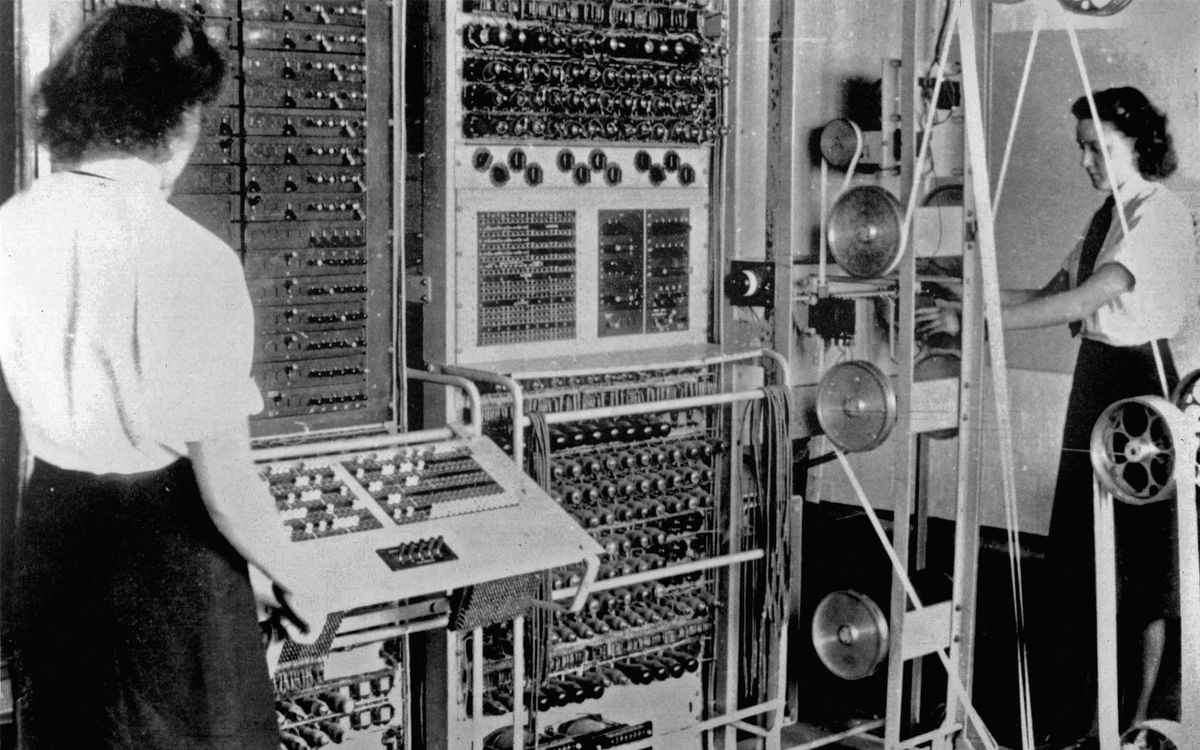
  8. The computer that helped win World War II10
  9. Judge Rejects Google's Attempt to DMCA Its Way Out of Being Scraped11
  10. Modern email can be built from borrowed parts12
  11. I wanted a clock that never needed setting. Things escalated13
  12. Magnolias are so old that they're pollinated by beetles, not bees (2025)14
  13. Glue bonds to nonstick surfaces and wipes clean with ethanol15
  14. Exploiting Volvo/Eicher's fleet platform to gain control over all users/vehicles16
  15. Ray tracing massive amounts of animated geometry using tetrahedral cages17
  16. Should you wash your solar panels?18
  17. Removing React.js from the codebase and adapting Htmx for UI interactivity (2023)19
  18. Scriptc by Vercel: TypeScript-to-Native compiler, no JavaScript engine in binary20
  19. Libsm64: Mario 64 as a library for use in external game engines21
  20. Kimi-K3 Technical Report [pdf]21
  21. Self-contained highly-portable Python distributions21
  22. PGSimCity - How PostgreSQL Works21
  23. VLC for Unity now supported on Linux21
  24. MAI-Cyber-1-Flash inside MDASH22
  25. AI companies are shredding rare books23
  26. Paged Out #9 [pdf]23
  27. Fonts In Use – Find out where a font is used23
  28. The Usefulness of Useless Knowledge (1939) [pdf]23
  29. Show HN: Physically accurate black hole you can put in your room23
  30. Launch HN: Rise Reforming (YC S26) – Turning Waste Gases into Valuable Chemicals24
The Daily Front Page 2 of 25
Monday, July 27, 2026 The Daily Front No. #260727 — Frontier Goes Open-Weights
article

Kimi-K3 on HuggingFace

by nateb2022·▲ 1,335 points·526 comments·huggingface.co ↗
“It is the world's first open 3T-class model, designed for frontier intelligence across long-horizon coding, knowledge work, and reasoning.”

1. Model Introduction

Kimi K3 is an open-weight, native multimodal agentic model and our most capable model to date. It is a 2.8T-parameter model built on Kimi Delta Attention (KDA) and Attention Residuals (AttnRes), with native vision capabilities and a 1-million-token context window. It is the world's first open 3T-class model, designed for frontier intelligence across long-horizon coding, knowledge work, and reasoning.

Key Features

  • New Architecture: Kimi K3 is built on Kimi Delta Attention (KDA) and Attention Residuals (AttnRes), and scales up MoE sparsity with a Stable LatentMoE framework that activates 16 out of 896 experts — yielding an approximate 2.5× improvement in overall scaling efficiency over Kimi K2.
  • Long-Horizon Coding: Operating with minimal human oversight, Kimi K3 sustains long engineering sessions, navigates massive repositories, and orchestrates terminal tools — from GPU kernel optimization and compiler development to vision-in-the-loop game dev, CAD, and even chip design.
  • Agentic Knowledge Work: Kimi K3 advances end-to-end knowledge work, producing deep research with interactive visualizations, widgets and dashboards, and motion design and video editing, powered by its native multimodal architecture.
  • Native Multimodality & Long Context: Kimi K3 understands text, images, and video within the same model, and supports a 1-million-token context window.
  • Open Frontier Weights: We release the full Kimi K3 model weights under the Kimi K3 License, making frontier intelligence openly available for research, deployment, and further innovation.

2. Model Summary

Architecture Mixture-of-Experts (MoE) Total Parameters 2.8T Activated Parameters 104B Number of Layers 93 Number of Dense Layers 1 Attention-Layer Composition 69 KDA + 24 Gated MLA Attention Hidden Dimension 7168 Number of Attention Heads 96 Latent MoE Dimension 3584 MoE Hidden Dimension (per Expert) 3072 Number of Experts 896 Selected Experts per Token 16 Number of Shared Experts 2 Vocabulary Size 160K Context Length 1048576 Attention Mechanism KDA & Gated MLA Activation Function SiTU-GLU Vision Encoder MoonViT-V2 Parameters of Vision Encoder 401M Quantization MXFP4 weights / MXFP8 activations
(quantization-aware training) Modality Text, Image

3. Evaluation Results

Benchmark Kimi K3
(max) Claude Fable 5
(max, w/ fallback) GPT-5.6 Sol
(max) Claude Opus 4.8
(max) GPT-5.5
(xhigh) GLM-5.2
(max) Reasoning & Knowledge GPQA Diamond 93.5 92.6 94.1 91.0 93.5 91.2 CritPt 23.4 28.6 32.3 20.9 27.1 20.9 AA-LCR 74.7 70.0 73.7 67.7 74.3 71.3 HLE-Full 43.5 / 56.0 53.3 / 63.0 44.5 / 58.0 49.8 / 57.9 41.4 / 52.2 — Coding DeepSWE 67.5 70.0 73.0 59.0 67.0 46.2 ProgramBench 77.8 76.8 77.6 71.9 70.8 63.7 Terminal-Bench 2.1 88.3 88.0 88.8 84.6 83.4 82.7 FrontierSWE 81.2 86.6 71.3 66.7 64.9 67.3 SWE-Marathon 42.0 35.0 39.0 40.0 14.0 13.0 PostTrainBench 36.6 41.4 34.6 34.1 28.4 34.3 MLS-Bench-Lite 48.3 49.9 46.2 42.8 35.5 40.4 SciCode 58.7 60.2 56.1 53.5 56.1 50.5 Kimi Code Bench 2.0 72.9 76.9 64.8 71.7 69.0 64.2 Agentic BrowseComp 91.2 88.0 90.4 84.3 84.4 — DeepSearchQA (F1) 95.0 94.2 — 93.1 — — ResearchRubrics 76.2 — 73.8 73.5 64.0 71.1 GDPval-AA v2 (Elo) 1686 1747 1736 1593 1491 1510 Toolathlon-Verified 76.5 77.9 74.9 76.2 73.5 59.9 MCPMark-Verified 94.5 87.4 92.9 76.4 92.9 — MCP-Atlas 84.2 84.7 83.6 83.6 82.8 82.6 AutomationBench 30.8 29.1 29.7 27.2 22.7 12.9 JobBench 54.3 57.4 45.4 48.4 38.3 43.4 AA-Briefcase (Elo) 1548 1583 1495 1354 1158 1260 Agents' Last Exam 28.3 25.7† 29.6 27.0 26.6 20.4 APEX-Agents 41.0 43.3 39.9 39.4 38.5 35.6 OfficeQA Pro 63.3 69.9 63.2 63.9 60.9 41.4 SpreadsheetBench 2 34.8 34.7 32.4 31.6 29.1 28.1 OSWorld-Verified 84.8 85.0 83.0 83.4 79.0 — OSWorld 2.0 58.3 66.1 62.6 55.7 49.5 — SaaS-Bench 60.1 — 61.4 56.1 43.8 — τ³-Banking 33.4 26.8 33.0 27.6 31.3 26.8 Harvey Lab-AA 94.6 93.6 87.2 91.1 86.3 91.0 CorpFin v2 71.6 71.8 64.4 66.7 68.4 66.1 Finance Agent v2 54.4 56.3 53.8 53.9 51.8 49.7 Legal Research Bench 44.2 49.5 48.1 43.8 40.4 31.3 Vision WorldVQA ForceAnswer 51.0 56.7 41.8 39.1 38.5 — OmniDocBench 91.1 89.8 85.8 87.9 89.4 — PerceptionBench 58.5 57.2 59.7 47.2 55.8 — Video-MME (w. sub) 90.0 — 89.5 86.0 89.3 — MMVU 82.1 — 81.2 79.2 81.7 — BabyVision w/ python 85.7 90.5 88.9 81.2 83.6 — MMMU-Pro 81.6 / 83.4 81.2 / 86.5 83.0 / 84.6 78.9 / 82.7 81.2 / 83.2 — CharXiv (RQ) 84.8 / 91.3 88.9 / 93.5 84.6 / 89.1 80.5 / 89.9 84.1 / 89.0 — MathVision 94.3 / 97.8 94.8 / 98.6 95.8 / 97.8 86.7 / 97.1 92.2 / 96.8 — ZeroBench (pass@5) 23.0 / 41.0 23.0 / 46.0 17.0 / 35.0 17.0 / 34.0 22.0 / 41.0 —

Footnotes

All Kimi K3 results are obtained with reasoning effort set to 'max' and temperature = 1.0. For single-step tasks, such as GPQA Diamond, HLE-Full, and vision benchmarks without tools, we set top-p = 0.95; for agentic tasks, we set top-p = 1.0. For HLE-Full, MMMU-Pro, CharXiv (RQ), MathVision, and ZeroBench, each cell reports the scores without and with tool augmentation (general tools for HLE-Full, Python for the vision benchmarks), in that order.

  1. Reasoning & knowledge benchmarks

  2. Coding benchmarks

    • DeepSWE. Kimi K3 is evaluated with the Kimi Code harness. The GLM-5.2 score is taken from the GLM-5.2 release blog; all remaining scores are from the official DeepSWE leaderboard, under which Kimi K3 attains 67.3 with the mini-SWE-agent harness. We report the DeepSWE v1.1 tasks.
    • Terminal-Bench 2.1. Kimi K3 is evaluated with the Kimi Code harness. For all other models, we report the best score across harnesses: GLM-5.2 with Claude Code (GLM-5.2 release blog); Claude Opus 4.8 and Claude Fable 5 with Terminus 2 (Artificial Analysis); GPT-5.5 and GPT-5.6 Sol with Codex (OpenAI).
    • ProgramBench. Kimi K3 is evaluated with the Kimi Code harness. The GLM-5.2 score is from the GLM-5.2 release blog; all other scores are from Vals AI.
    • SWE-Marathon. Kimi K3, Claude Opus 4.8, and Claude Fable 5 are evaluated with the Claude Code harness; GPT-5.6 Sol is evaluated with the Codex harness. The GLM-5.2 score is from the GLM-5.2 release blog. Our evaluation is based on an H20-calibrated branch of the official tasks as of July 9, 2026, prior to the final v1.1 release: the Docker images, performance gates, and reference oracles for the GPU tasks have been recalibrated for H20, while the correctness and anti-cheat validators remain unchanged. Additionally, Claude Fable 5 hit fallbacks on 35% of the tasks in our evaluation, which may have negatively impacted its measured performance.
    • FrontierSWE. Kimi K3 is evaluated with the Kimi Code harness and GPT-5.6 Sol with the Codex harness; all other results are from FrontierSWE. Dominance scores are recomputed from the raw scores using the official evaluation script and are current as of July 16, 2026.
    • PostTrainBench. Scores for GLM-5.2, GPT-5.5, and Claude Opus 4.8 are adopted from the official PostTrainBench results. Kimi K3, Claude Fable 5, and GPT-5.6 Sol are evaluated with the official Harbor implementation at maximum reasoning effort, averaged over three runs on H20 GPUs (instead of H100 in the official setting) — Kimi K3 and Claude Fable 5 with the Claude Code harness, and GPT-5.6 Sol with the Codex harness.
    • MLS-Bench-Lite. Kimi K3 is evaluated with the Kimi Code harness; GLM-5.2 and the Claude models with the Claude Code harness; GPT-5.5 and GPT-5.6 Sol with the Codex harness.
    • SciCode. Scores are cited from Artificial Analysis as of July 23, 2026.
    • Kimi Code Bench 2.0 (in-house). Kimi K3 is evaluated with the Kimi Code harness (it attains 73.7 with the Claude Code harness); GLM-5.2, Claude Opus 4.8, and Claude Fable 5 with the Claude Code harness; GPT-5.5 and GPT-5.6 Sol with the Codex harness. All models are evaluated at maximum reasoning effort, except GPT-5.5, which uses the "xhigh" setting. As the benchmark includes cybersecurity and safety-related tasks, we also disclose the fraction of refused or fallback tasks: Claude Fable 5 hit 13 fallbacks and 1 refusal out of 80 tasks; 10 refusals out of 80 tasks entered GPT-5.6 Sol's cyber guard; GPT-5.5 had 3 refusals out of 80 tasks.
  3. Agentic benchmarks

    • OfficeQA Pro. Each test case provides the agent with the entire PDF corpus, with all PDFs rendered as images and no machine-readable text available.
    • OfficeQA Pro and SpreadsheetBench 2. Kimi K3, GLM-5.2, Claude Opus 4.8, and Claude Fable 5 are evaluated with the Claude Code harness; GPT-5.5 and GPT-5.6 Sol are evaluated with the Codex harness.
    • MCP-Atlas. All models are evaluated on the 500-task public subset with a 100-turn limit, using Gemini 3.1 Pro as the judge.
    • AutomationBench. All models are evaluated on the 600-task public subset, following the official GitHub setup in all other respects.
    • BrowseComp. We adopt a context-compaction strategy triggered at 300K tokens. When evaluated with the full 1M-token context window and no context management, Kimi K3 achieves a score of 90.4. The results of Claude Fable 5, Claude Opus 4.8, GPT-5.6 Sol, and GPT-5.5 are cited from Anthropic and OpenAI.
    • GDPval-AA v2, AA-Briefcase, τ³-Banking, Harvey Lab-AA, and APEX-Agents. Scores are cited from Artificial Analysis and the APEX-Agents leaderboard as of July 23, 2026. For Harvey Lab-AA, we report the criterion pass rate.
    • CorpFin v2, Finance Agent v2, and Legal Research Bench. Scores are cited from Vals AI.
    • Agents' Last Exam. Scores are cited from the official leaderboard as of July 23, 2026; we report the leaderboard's primary pass-rate metric. On the leaderboard, each model is paired with a specific harness: Kimi K3 with Kimi Code; GPT-5.6 Sol and GPT-5.5 with Codex; Claude Fable 5, Claude Opus 4.8, and GLM-5.2 with Claude Code. † The Claude Fable 5 entry runs at xhigh effort with 40% of tasks annotated as downgraded.
  4. Multimodal benchmarks

    • Except for ZeroBench, which follows the official setting and is run five times, all multimodal scores are averaged over three runs. MMMU-Pro is evaluated following the official protocol, preserving the original input order and prepending images to the text input.
    • PerceptionBench is an in-house benchmark that focuses on atomic visual perception capabilities.

4. Native MXFP4 Quantization

Kimi K3 applies quantization-aware training from the SFT stage onward, using MXFP4 weights with MXFP8 activations for broad hardware compatibility.

5. Deployment

You can access Kimi K3's API on https://platform.kimi.ai by selecting kimi-k3, and we provide OpenAI/Anthropic-compatible API for you. Currently, Kimi K3 is recommended to run on the following inference engines:

6. Model Usage

Kimi K3 always has thinking enabled, and will return reasoning_content. Thinking effort is configured with the top-level reasoning_effort request field, which supports "low", "high", and "max" (default "max").

Kimi K3 was trained in the preserved thinking history mode. For multi-turn conversations and tool calls, Kimi K3 requires the complete assistant message returned by the API to be passed back to messages as-is — including reasoning_content and tool_calls, not just content:

import openai

def chat_with_preserved_thinking(client: openai.OpenAI, model_name: str):
    messages = [
        {
            "role": "user",
            "content": "Tell me three random numbers."
        },
        {
            "role": "assistant",
            "reasoning_content": "I'll start by listing five numbers: 473, 921, 235, 215, 222, and I'll tell you the first three.",
            "content": "473, 921, 235"
        },
        {
            "role": "user",
            "content": "What are the other two numbers you have in mind?"
        }
    ]

    response = client.chat.completions.create(
        model=model_name,
        messages=messages,
        stream=False,
        max_tokens=4096,
        reasoning_effort="max",
    )
    # the assistant should mention 215 and 222 that appear in the prior reasoning content
    print(f"response: {response.choices[0].message.reasoning}")
    return response.choices[0].message.content

For full guides and examples (vision input, structured output, partial mode, tool choice, dynamic tool loading, context caching), see the Kimi K3 Quickstart and Thinking Effort.

Coding Agent Framework

Kimi K3 works best with Kimi Code CLI as its agent framework. We warmly invite you to give it a try — run Kimi Code in your terminal and select Kimi K3 using the /model command. We hope you enjoy building with Kimi K3, and we would love to hear your feedback!

7. License

Both the code repository and the model weights are released under the Kimi K3 License.

8. Contact Us

If you have any questions, please reach out at support@moonshot.ai.

The Daily Front Page 3 of 25
Monday, July 27, 2026 The Daily Front No. #260727 — Open-Weights, Open Questions
article

Our position on open-weights models

by surprisetalk·▲ 799 points·1,128 comments·anthropic.com ↗
“Reports suggest that some US officials are considering banning the use of Chinese open-weights models by US companies.”

Over the last few days there has been a lot of discussion about open-weights models, especially those from China. Reports suggest that some US officials are considering banning the use of Chinese open-weights models by US companies. In response, many tech companies have signed a letter supporting open-weights models, and some people have even accused Anthropic of wanting to ban open-weights models as a means of protecting our business. Anyone who has read my past writing should know that I don’t regard such bans as a useful measure, but let me state it clearly so that there is no doubt: Anthropic has never advocated for a ban on open-weights models.

Open-weights models that don’t have dangerous capabilities are a public good: they don’t cost anything besides the compute needed to run them, and they provide value to businesses, developers, and researchers.

Protectionist bans would not address my most serious national security concerns. Specifically, I am worried about two nightmare scenarios. I laid these out in my essay The Adolescence of Technology six months ago1, and have held these positions consistently for many years:

  1. My primary concern is the risk that authoritarian governments—not solely the Chinese Communist Party (CCP), although the CCP is clearly the most capable threat—build AI models that are more powerful than those built by the US, and use them to achieve permanent military superiority or perpetrate incredibly deep repression of their own people. This concern is widely shared within the US government: Vice President Vance warned in Paris last year that “authoritarian regimes have stolen and used AI to strengthen their military, intelligence, and surveillance capabilities,” and the Intelligence Community’s 2026 Annual Threat Assessment found that “other global powers’ robust progress in AI is challenging US economic competitiveness and national security advantages.” It is irrelevant whether these models are released with open weights, and certainly irrelevant whether they are used by US businesses. In fact, the most dangerous model may be one that is trained in secret and handed only to the People’s Liberation Army for use in drones and the Ministry of State Security for surveillance and repression.
  2. My secondary concern is the risk that powerful AI models may be misused to carry out cyberattacks or biological attacks, and may have serious alignment problems. Open-weights models—it does not matter whether they come from China or anywhere else—do potentially present a higher risk than closed models, because it is very difficult to apply guardrails to them or monitor their usage, and once weights are released they cannot be withdrawn2. But banning the use of these models by US businesses does nothing to address this risk, because bad actors are unlikely to be legitimate US businesses. It would protect US AI companies from competition, but that has never been my goal.

To address these concerns, I do support the following three measures, which I and Anthropic have consistently advocated for:

  • We should not sell powerful chips or chipmaking equipment to China, and we should crack down on the rampant smuggling3 and workarounds used to obtain access to such chips. China has limited domestic production capacity, and therefore, due to the scaling laws, cannot build more powerful models than the US without US chips. This is the most efficient and direct way to block threat #1, and by hampering the training of models that are out of reach of US law, it also indirectly helps with threat #2.
  • We should crack down on industrial-scale distillation operations. Distillation is a much more compute-efficient process than training models from scratch. It allows China to build much better models than its number of chips would ordinarily enable, and thus partially evade chip bans. Distillation does not allow the CCP to obtain equivalent or superior AI capabilities to the US, but it can bring the Chinese frontier to within a few months of the US frontier. It is true that many of the companies carrying out these operations release open-weights models—but the open weights are far less relevant than the fact that the operations are backed by an authoritarian state seeking to overtake the US at the frontier. We should have policy interventions to deter this behavior. A blanket ban on open-weights models is neither the correct remedy nor something we have called for4.
  • All sufficiently capable models, open and closed, should go through mandatory safety testing. The best way to address threat #2 is to just directly test models for cyber, biological, and alignment risks before release. I think this idea is actually close to a consensus: I have been heartened both that the Trump administration has moved in this direction in recent months, and by recent industry proposals that would apply such testing to the most capable models regardless of their country of origin or whether they are open or closed (while exempting less capable models, such as those from startups and academia, entirely). Whether open models do or don’t pose an increased risk, and whether that risk can be mitigated, is something that should emerge from testing, rather than be decided in advance—and there may be promising methods for improving the safety of open-weights models, including recent research from Anthropic on modular training strategies. Note that to be effective, testing would need to be global, which means even the CCP would need to be on board. I think this may actually be possible: as I wrote in The Adolescence of Technology, limited cooperation around preventing AI biological weapons may be possible because it is in China’s interest too.

This brings me to the open letter. I agree with much of it: open weights expand access to the AI economy, they strengthen competition at least for some use cases, and they give customers greater control. Concerns about distillation should be addressed through targeted legal and commercial frameworks—the same measure I described above. But I don’t agree with the letter’s assertions that open-weights models necessarily make it easier to develop safeguards or that broad access to capabilities necessarily helps defenders more than attackers. It seems at least as likely to me that the opposite will be true. For example, I worry that biology will have a strong attacker-defender asymmetry, where sufficiently capable models may be able to quickly weaponize pandemic-level viruses with widely available materials, whereas defense against these agents is a multi-year operational task in the best case (as we saw with Operation Warp Speed)5. Questions like this should be empirically answered by rigorous pre-release testing, not assumed in advance.

To summarize my and Anthropic’s position, we have not and are not advocating for a ban on open-weights models as a category. We should instead focus on keeping powerful chips out of authoritarian hands, stopping industrial-scale distillation, and requiring safety testing of all sufficiently capable models, open and closed.

Footnotes

  1. See Sections 3 and 2 of that essay for discussion of misuse for seizing power and discussion of biological risks, respectively.
  2. See this report from the UK AI Security Institute, specifically: “The same openness underpinning these benefits precludes many of the safety measures that closed model developers can use to detect and disrupt misuse, iterate on safeguards as vulnerabilities emerge, control user access and withdraw models. Once open-weight models are released, these options are lost permanently: safeguards can be removed, and copies can be downloaded, redistributed, and run on private systems beyond monitoring. For models with dangerous capabilities – including highly cyber-capable models – open weight release therefore creates a persistent and irreversible risk of misuse.”
  3. See also here, here, and here for more reports from the US Department of Justice.
  4. At Anthropic we’re committed to cracking down on industrial-scale distillation through our own practices, including identifying and banning accounts that use our models in this way. This is challenging—for instance, the relevant accounts can often only be identified after substantial distillation has occurred, and distillation often involves creating large numbers of fake accounts that form a moving target. The practices of any individual company cannot entirely solve the problem, which is why we have called for policy on this issue.
  5. See Section 2 of The Adolescence of Technology for a more detailed discussion of biological threats and the offense-defense balance. To summarize, what I believe currently keeps us safe in biology is not “defenders”, or even the availability of materials, but a negative correlation between intellectual capability and desire to commit catastrophic harm. Previous technologies like internet search or even DNA synthesis were nowhere near powerful enough to break this correlation, but I worry that at its current rate of progress, AI will do so very soon. Another way to say it is that a sufficiently powerful technology removes all barriers and exposes whether the attacker or defender has an inherent structural advantage, and I worry in biology it is the attacker.
The Daily Front Page 4 of 25
Monday, July 27, 2026 The Daily Front No. #260727 — Seizure vs. Secrecy
article

US citizen charged after GrapheneOS phone wipes during airport search

by eecc·▲ 1,277 points·1,019 comments·techspot.com ↗
“The Department of Justice is attempting to prosecute under a statute criminalizing destruction of property to prevent seizure.”

A hot potato: A federal case in Atlanta is raising questions about a privacy-focused mobile operating system, with prosecutors arguing that its features were used to erase evidence. The US Department of Justice is attempting to prosecute Atlanta resident Sam Tunick under a federal statute that makes it a crime to destroy property in an effort to prevent it from being seized.

The case centers on Tunick's use of GrapheneOS, an open-source operating system that works on Google Pixel phones and lets users enter a passcode to wipe a device clean.

Experts said the legal approach is unusual and may be the first time the law has been aimed at an operating system. "It's concerning – and sends the message that [GrapheneOS] is criminal by default," said Christophe Boutry, a cybersecurity and surveillance expert. Boutry and Bill Buddington, senior staff technologist at the Electronic Frontier Foundation, both said they had not seen a similar case.

The incident began at Hartsfield-Jackson Atlanta International Airport on January 24 of last year. Tunick had just returned from a trip to the Dominican Republic when he was stopped for questioning. According to court testimony, federal agents had already circulated his name and photo internally, saying he was under investigation for "suspected terrorism activities" because of his alleged association with the movement against Cop City.

Tunick was taken to a secondary screening room, where multiple agents questioned him. A motion filed by his defense argues the interrogation focused on child sexual abuse material as a pretext for investigating his connections to the protest movement. The motion also states that Tunick asked four times to speak with a lawyer and was denied each time. According to the same filing, agents did not present a warrant or read him his rights.

Government attorneys and agents pushed back during Monday's hearing. They described the encounter as a routine airport inspection. Larry Findley, a Customs and Border Protection officer, said agents were "looking for anything that's prohibited."

During the questioning, agents repeatedly asked Tunick to unlock his phone and warned they would seize it if he refused. When he finally provided a passcode, the phone appeared to restart. The defense motion states that "the screen went blank, flashed several times, and the phone appeared to restart," resulting in the loss of data.

The wipe is now central to the case. Prosecutors are treating it as an intentional act to destroy evidence, while the defense argues that the search violated Tunick's constitutional rights and that the evidence should be suppressed.

The case raises questions about which constitutional rights apply at US borders, including international airports, where authorities have broader search powers. A judge is not expected to rule on the defense motion until at least late October.

GrapheneOS is designed to improve privacy and security on Pixel phones. Supporters say those tools are legitimate security protections, not evidence of criminal intent. Boutry pointed to France and Spain, where authorities have struggled to gain access to secured devices. He said authorities have treated the use of GrapheneOS itself as suspicious. In Catalonia, Spain, police have been profiling people carrying Pixel phones, assuming they have GrapheneOS installed and are drug dealers or gang members.

"The main goal [of the operating system] is protection of privacy," Boutry said. "They're our phones and the state can't tell us how to use them."

The case is tied to ongoing opposition to Cop City, a $109 million police training facility that opened last spring. The project has drawn opposition from activists concerned about police militarization and environmental impacts. Law enforcement officials have defended it as necessary for training and recruitment.

Previous attempts to prosecute protesters at the state level have foundered, while federal authorities have more recently stepped in, including a separate indictment announced last month.

The Daily Front Page 5 of 25
Monday, July 27, 2026 The Daily Front No. #260727 — Can You Rewrite a Runtime?
article

How is the Bun rewrite in Rust going?

by tomlockwood·▲ 464 points·367 comments·lockwood.dev ↗
“It’s important to be very Canny when someone makes a claim that supports a company’s large valuation.”

I think it’s important to be very Canny when someone makes a claim that supports a company’s large valuation.

The Bun rewrite seems well positioned as proof-positive that AI and specifically Anthropic’s AI can do the work of open-source maintainers, for some money, but faster.

image

On the 8th of July 2026 Jarred Summner of Bun fame posted about “Rewriting Bun in Rust”. At the time, I felt pretty Canny, having already read about Anthropic’s C compiler and Cursor’s FastRender web browser. It seems like there is a lot of valuation money riding on the coding capabilities of AI, and a lot of marketing about those capabilities.

It’s not a huge stretch to link the acquisition of Bun by Anthropic with the choice to rewrite Bun with an Anthropic tool. In his article Jarred claims that over 11 days (between 3rd and 14th May 2026) and at a cost of $165,000 for Anthropic API calls the rewrite was done and then merged to main. This represents a cost of $15,000 dollars a day, a cost well outside the means of many open source maintainers. This number doesn’t seem to include the leviathan whirring of the CI/CD in the org’s Buildkite cluster, which appears to have been constantly whirring ever since the “rewrite” was “completed”.

Why do I put those two words in scare quotes?

Well, on the 9th of July a peer of mine in a group chat said something unsurprising given our current environment - breathlessly proclaiming that the era of AI had emerged, and its herald was the “Rewriting Bun in Rust” blog post. So, I decided to look into this. Since the 9th I’ve been having a closer look at the claims and the code, and today I cloned the Bun repo:

Receiving objects: 100% (1200304/1200304), 1.23 GiB | 11.97 MiB/s, done.

As of today, the 27th of July 2026, a six week period after the rewrite was merged to main, there’s still no release tag. It’s now been 11 weeks since the last Bun release tag:

2026-05-12 15:12:49 -0700  (tag: bun-v1.3.14)

The last time there wasn’t a Bun release in a month was between the 26th of October 2022 and the 7th of December 2022 when there was a gap of six weeks and November was skipped, between v0.2.2 and v0.3.0:

2022-12-07 00:37:40 -0800  (tag: bun-v0.3.0)
2022-10-26 21:06:02 -0700  (tag: bun-v0.2.2)

On the 9th of July, the number of open pull requests from robobun (a proxy for PRs made by claude code) was 1277. As of this moment, on the 27th of July that number is 2475 open PRs. I don’t claim to know for sure but as far as I can see the process of merging to main with Buildkite checks completed seems to take 40-ish minutes (sometimes it looks like it takes up to an hour and a half). At this rate if we want to merge all the open Claude PRs it’ll only take running the pipeline for 86 days, continuously.

Generously, some of these PRs don’t deal with Rust code. Further investigation was warranted. I initially clicked through some of the PRs and found some extremely reviewed ones.

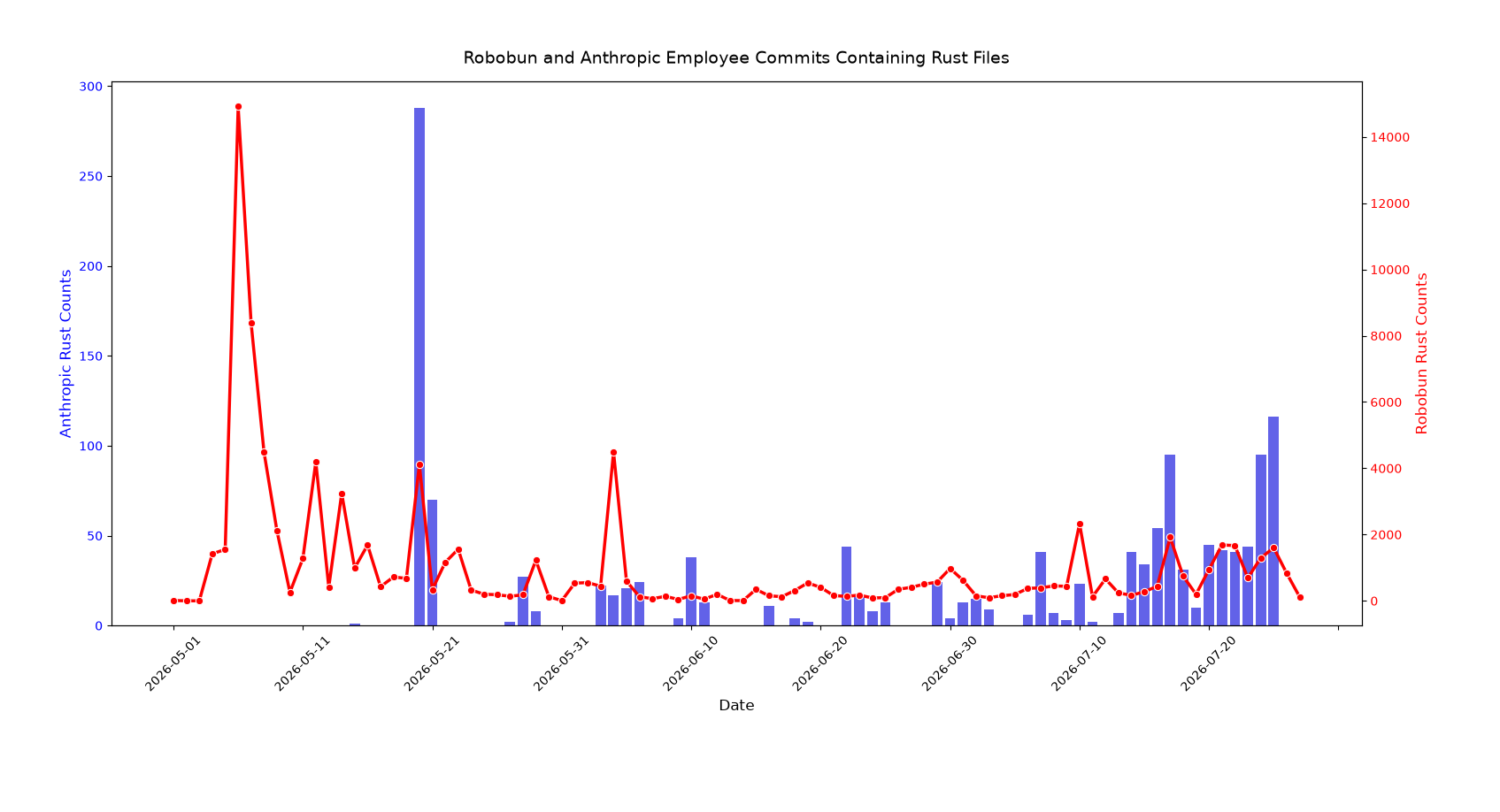
At this point I began to suspect that much of the cost of the rewrite was off the books. While $15k a day in tokens widened my eyes a little (and maybe I’m naive, maybe that’s low), I hadn’t seen the numbers for the CI/CD costs of Buildkite, and as you might have noticed from above, some PRs were written by Anthropic employees. When I did analysis of the data it became clear to me that the project was ticking along with more Claude credits and more Anthropic employee involvement:

image

One of the assumptions I’ve made here is that Jarred Summner’s commits during the rewrite were using Claude.

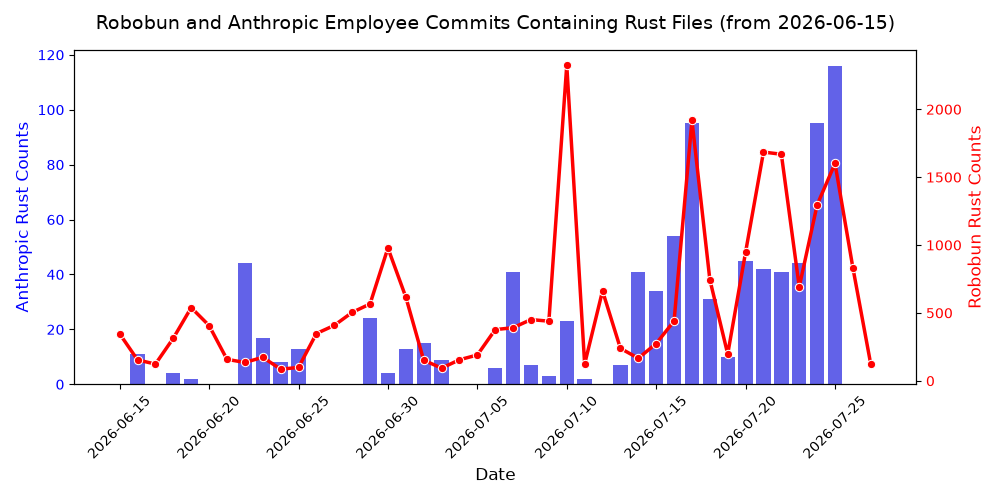
It’s pretty clear that there was a big spike in Claude usage when the rewrite began. It seems like, now, Anthropic employee and Robobun involvement in Rust is ramping up:

image

It’s nice to see that the Anthropic employees involved seemed to have a good work-life balance, taking breaks on the weekend. But, it looks like that period is over. It seems like we’re ramping up to something, and there’s still no release tag.

What’s pretty obvious to me is that we can’t take it at face value that the rewrite is “done” or that it was “done” for $165k USD. The Bun team never made that claim, but I’ve seen and heard those breathless claims that the rewrite is proof of something, and I do still think we need to be Canny about claims that support a large valuation. Anthropic is dogfooding this, the machine is still ticking along, and Anthropic employees are directly involved. If we imagine that the rewrite is still costing $10k a day, we’re approaching $800k in money spent on this rewrite.

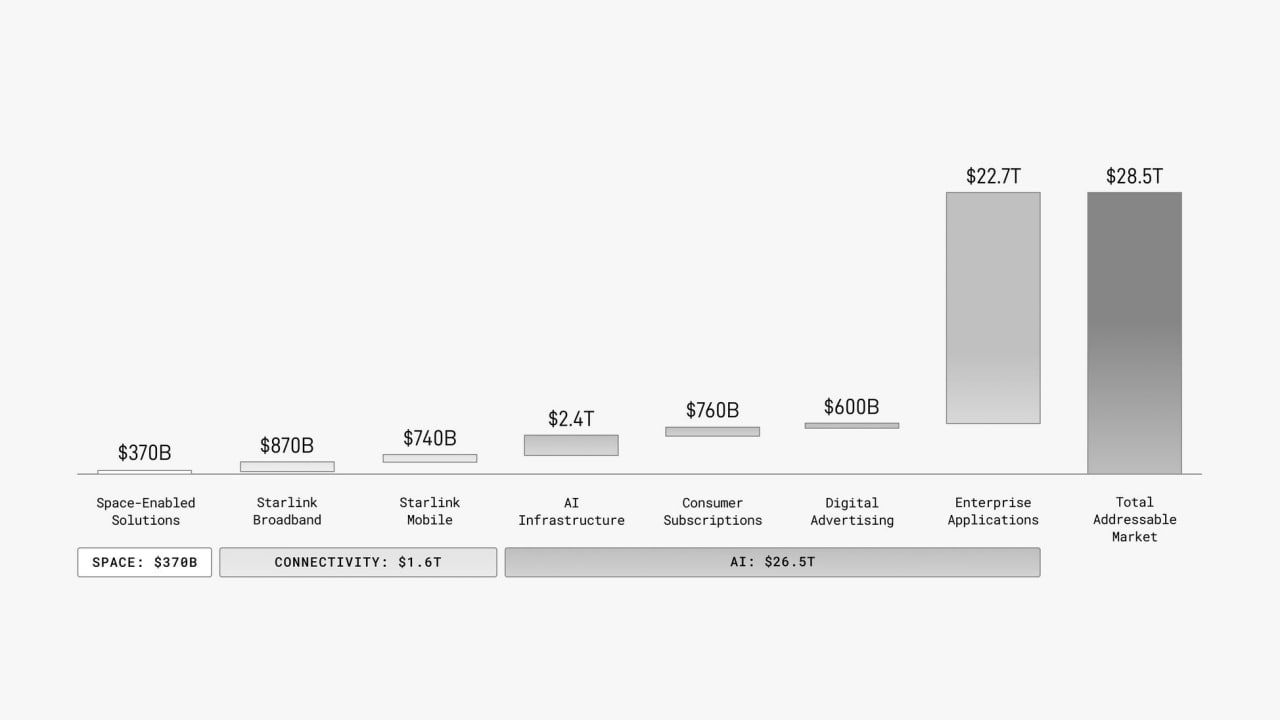
I’m not a primitivist when it comes to AI. Work I’ve done on ML and AI has been some of the work I’ve been most proud of. This current hype cycle is, however, the worst I’ve ever seen the hype get. Back in 2015 I had to plead with management, trying to get them to understand that a black-box bunch of linear algebra that was better than humans at a quantitative task was, just, better. Now it seems like the world has completely reversed, and management is so forthright in their belief that AI is good, that they want it rubbed on everything. And those valuations are sometimes contingent on AI eating everything:

image

In my tiniest mouse voice ever I want to ask probably the most relevant question one can ask about a Business Thing: Was it worth the money and are the companies worth the valuation?

Are we done yet?

P.S. Anthropic’s C compiler and Cursor’s FastRender web browser haven’t had any commits for months.

P.P.S. I’m looking for a job.

The Daily Front Page 6 of 25
Monday, July 27, 2026 The Daily Front No. #260727 — Proofs at Scale
article

We have proof automation now

by zdw·▲ 224 points·104 comments·imperialviolet.org ↗
“They offer the possibility of a type system capable of encoding and enforcing arbitrarily subtle invariants.”

We have proof automation now

I've long had a soft spot for dependently-typed languages like Coq Rocq and Lean. They offer the possibility of a type system capable of encoding and enforcing arbitrarily subtle invariants. The sort of thing that, in regular languages, ends up (at best) as a comment, and which quickly gets lost as the size of the team grows. Then you get subtle misunderstandings and components that don't quite fit together. It's often the case that those components have grown to a sufficient size that, when the problem is noticed, aligning either of them is a wearying prospect. Perhaps, say dependent types seductively, you could write those invariants formally and have a machine check them.

(p.s. Coq changed its name! I remember many years ago at a Coq conference in Princeton, I tried suggesting that, in an English-speaking world, having a programming language called Coq was an impediment. I don't think the audience agreed at the time. I also joked that many of the talks there sounded like a speech by Tyrion Lannister, there being so many Coqs and Hoares. A joke that was hilarious and timely, even though it fell completely flat, coming as it did before the final season of that show and our collective memory-holing of it.)

The problem has always been that with great type-system power comes great proof effort. I can certainly attest to entire days spent proving really quite simple things. Doing proofs is actually quite fun: it's challenging, interactive, and there's a clear goal. But gosh, does it take a lot of time, especially if, like me, you don't know what you're doing. There's also the periodic, galling experience, at the end of many hours of effort, where you realise that the goal that you're trying to prove is, in fact, false. The classic result here is the retrospective from the seL4 effort that found that, even though the project was large enough for the engineers to develop considerable experience, they spent about 10 times as much time proving as they did designing and implementing. They ended up with more than 20 times as many lines of proof code as they did C code.

That overhead has made programming in dependently-typed languages extremely niche. It has also spurred people to try and automate it away. The attempt I'm passingly familiar with is F*, where the system tries to have an SMT solver automatically discharge the obligations. That certainly works for simple cases, but it's very easy to craft something that causes the SMT solver to go off into space and run for hours, leaving you wondering whether it's ever going to finish. I've seen that people who use these languages a lot have to develop a sixth sense for what is going to make the solver happy, and then craft everything around that. It can help, but to an extent it converts the problem into mysticism: you end up serving a complex and fickle god.

A critical fact is that, at least in theory, once the statement is correct, the contents of its proof are irrelevant: only its existence matters. This is not entirely true because of two complicating factors: first, what the seL4 group called “proof engineering”: the need to structure proofs so that the effort of realigning them after code changes is reduced. And, second, sufficiently complicated proofs can cause even type checkers to blow up and consume vast amounts of memory.

We now have LLMs which, combined with proof irrelevance, promise to be an extremely capable form of proof automation. With sufficient amounts of automation perhaps you don't need to worry about proof engineering nearly so much. You still need to avoid blowing up the type checker but, in my limited tests, LLMs can avoid that. Potentially, LLMs suddenly make dependent-type systems dramatically more practical. I wanted to play around with this so built a Zstandard decompressor in Lean, mostly because I was also curious about Zstandard.

Zstandard seems like it's winning the competition to replace gzip as the canonical compression utility. It's another LZ77-style compressor, but it offers better entropy coding and a careful design that allows it to achieve very impressive decompression speeds. It will never be as beautiful as bzip2, but the shining elegance of the Burrows–Wheeler transform doesn't count for too much in the face of significant practical advantages:

(Measurements taken on the standard reference computer, i.e. whatever the author was using at the time. And note the log scale on the y-axis: gzip and Zstandard are in their own speed class. This is an Apple machine and Apple's gzip is especially optimised; expect gzip to be slower elsewhere.)

Zstandard (by Yann Collet, building on the seminal ANS work by Jarek Duda) has an RFC, but it is quite terse. It contains all the information you need to implement a decompressor, but unless you're already quite familiar with compression, I think you'll need to re-read it a few times to understand what's going on. I, at least, had to read section 4.1 half a dozen times before I felt that I had a decent grasp of it. Too late into this process, I discovered that my colleague, Nigel Tao, has written a better write-up of Zstandard than I was going to manage anyway. So, if you want to understand Zstandard, you should read that. I'm just going to give an explanation of the most interesting bit, the entropy encoder, and mix that in with some evangelism about Lean.

The job of an entropy encoder is, given a set of symbols with non-uniform probabilities, to encode a sequence of those symbols using the fewest number of bits. The classic entropy coder is a Huffman encoder. Huffman encoders build a binary tree with symbols at the leaf nodes, and Huffman showed that a very simple algorithm produces an optimal prefix-tree: you take the list of symbols, you find the two with the least probability, and you form a tree node with them as children. That tree node then has a probability that is the sum of its two children, and then you repeat the algorithm with two fewer symbols, but now with a tree node in the mix. Obviously each step of this algorithm reduces the size of the set of elements by one, so it terminates, and it also produces an optimal tree. Huffman trees are very fast because you can build a table indexed by the next n bits (where n is the length of the longest code). The table entry tells you what symbol you've decoded and how many bits to unread. The drawback of Huffman trees is that they can only use a whole number of bits for each symbol: if you have a symbol where -log2(p) = 2.3 then ideally you want to use 2.3 bits to encode it. But Huffman forces you either to round up to 3 bits or to round down, which will force some other symbols to consume more bits.

Zstandard uses Huffman trees, but it also has a higher-compression entropy encoder called FSE. FSE is a state machine. There are more states than symbols, and each symbol gets a fraction of the states that mirrors its probability of occurrence in the stream. So if there's some symbol that is expected to appear 50% of the time, it gets ~50% of the states. Each state has three values: the symbol for that state, a number of bits to read from the bitstream when in that state, and a baseline state number that is added to those bits to get the next state. Now, if you recall, the problem with Huffman trees was that they could only use a whole number of bits, and these states also read a whole number of bits. But the trick is that if you are aiming to read one and a half bits for a given symbol, then half of its states will read one bit and half of them will read two bits. Then you hit your target on average. The table of states is never transmitted. The RFC prescribes an algorithm for building the table from a list of symbol probabilities, and so only the probabilities need to be transmitted.

Let's do an example. Let's say we have four symbols and we're going to use 16 states. So we have to approximate the symbol probabilities in terms of 16ths. (If you want a more accurate approximation of the probabilities, you can use a larger number of states; zstd actually never uses fewer than 32 states.)

Any symbol may follow any other symbol, and a symbol might only have a single state. So every symbol must be able to reach every state. Take a look at state three, which is the only state for symbol D. Because it's the only one, it has to read four bits, which is sufficient to encode any other state. But if you look at a symbol like B, its states only demand that you read one or two bits. However, the set of 16 possible next states is exactly partitioned between those states for symbol B. So, for any particular state, there is exactly one state for symbol B that can reach it.

FSE decoding table cells tiling the state space. A 16-cell decoding table with symbol B occupying states 2, 5, 8, 11 and 15. Arrows connect each of B's cells to its destination range below: state 11 covers next states 0 to 1, state 15 covers 2 to 3, state 2 covers 4 to 7, state 5 covers 8 to 11, and state 8 covers 12 to 15. Together the five ranges cover all sixteen states.

Again, consider symbol B, which we said had a probability of 5/16. The ideal number of bits to encode that symbol is -log2(5/16) = 1.68. There are three symbol B states that read two bits and two that read one bit. The states aren't used equally often and, weighted by how often they're used, the average comes out to almost exactly the right value for the quantised probabilities. If you want to capture the true symbol probabilities with more accuracy, use a bigger table.

The central trick is that, by giving multiple states to more common symbols, the encoder doesn't just pick a symbol: it also picks which of that symbol's states to land in, and that choice carries information forward to the next symbol. That's where the fractional bits of information go. But this entropy encoder is still just table based, and so it runs very quickly.

The wrinkle is that you can't work forwards. Assume that you want to encode C, D. Which C state do you start in? Well, D only has one state so it has to be the C state which can reach that one. If D had multiple states then you would need to worry about what came after D to know which of those you needed. FSE forces you to start at the end of the sequence and work backwards. (That's not too bad because you usually need to know the whole sequence in order to calculate the symbol probabilities anyway.) Furthermore, a Zstandard compressor thus encodes symbols back-to-front, but writes output incrementally, so the decompressor has to seek to the end of a block and read the bits backwards in order to straighten it out! That's getting into broader details of the format that I'm not going to cover; see Nigel's piece.

Basic entropy encoders do not care about inter-symbol probabilities. I.e. they can't use the fact that the letter Q is disproportionately followed by the letter U (in English). There has to be some other encoding that is exploiting those redundancies. In Zstandard, that's a traditional Lempel–Ziv structure where it encodes either literal bytes or back references to previously decoded data. So FSE is primarily used for efficiently encoding these back reference offsets and lengths.

Lean

Let's talk about Lean! Above I said that it's a dependently-typed language, and that is a concept better articulated in examples than in a complicated definition. So here's the type of a function that reads n bytes from a stream and, if it doesn't throw, returns a byte array that the type system knows is n bytes long.

def IO.FS.Stream.readExact (st : Stream) (n : Nat) :
    IO {ba : ByteArray // ba.size = n} := …

Here is a function that returns two numbers and a byte array such that the first number is prime, the sum of the two numbers is divisible by six, and the byte array is at least as long as the smaller of those two numbers.

def getResult :
    IO (Σ a b : Nat, { bytes : ByteArray //
      Nat.Prime a ∧
      6 ∣ a + b ∧
      Nat.min a b ≤ bytes.size }) := …

That is not a type that anyone will ever need. It's just demonstrating that you can go as wild with this as you want. Dependently-typed languages are sufficient to encode even very complicated mathematical structures, and Lean's dominant use at the moment is as a formal language for stating and proving mathematics. The recent book, The Proof in the Code, is a short, well-written articulation of the story of how Lean came to be. The author does completely butcher constructive mathematics for a few paragraphs but, other than that, I enjoyed it!

Lean is a purely functional language like Haskell, although it has a few properties that make it potentially a lot more convenient as a programming language. Firstly, Lean is strict, while Haskell is lazy. Strictness means that arguments to functions are evaluated before the call happens, whereas in Haskell the evaluation of arguments is deferred until the value is actually required. So in Haskell it's free to write expensive expressions and pass them into functions, because they'll only actually be computed if they end up being used. But it also means that computation can happen in very surprising places in the program. This is a contentious topic but, while I appreciate the elegance of laziness, boy, it can make the performance of programs hard to reason about.

Next, Lean has some nice helpings of sugar. Its monadic do notation contains for loops and return statements and break statements. If you want to program in an imperative style, you can do so pretty reasonably!

Lastly, Lean has an optimisation where it will make mutating updates to objects as long as their reference count is equal to one. So you can mutate an array in place as efficiently as in an imperative language, as long as you are careful not to have a reference to it someplace else. Unfortunately, Lean does not have any aspects of a linear type system that I'm aware of, so it does not help you in ensuring that there is only a single reference to a value. It's a bit of a sharp edge that a seemingly minor tweak to the code can completely crater its performance by holding on to a reference to a large array somewhere inconspicuous. But it does mean that if you are trying to optimise the performance of something, you have a lot more tools at your disposal.

Here's an example of some of this, from the zstd decoder I sketched:

while true do
    let some blockHeaderBytes ← input.readExactOrEof 3 | break
    let some blockHeader := BlockHeader.fromBytes blockHeaderBytes frameHeader
      | throw (.userError "invalid block header")
    let blockBytes ← input.readExact blockHeader.contentSize

    match hty : blockHeader.type with
    | .rle =>
      let b := blockBytes.val[0]'(by
        rw [blockBytes.property, blockHeader.contentSize_rle hty]; omega)

Focus on line 9. There's an array index there, which is exactly the sort of place that implicit invariants live: blockBytes had better not be empty! C-like languages will give you undefined behaviour in that case. Modern languages will throw at run-time, or only give you an optional value to avoid that. Lean has another option: prove that it's not empty. That's what line 10 does. blockBytes.property is the fact that it's as long as the requested read, i.e. exactly blockHeader.contentSize bytes long. blockHeader.contentSize_rle is this:

theorem BlockHeader.contentSize_rle (h : BlockHeader) (hty : h.type = .rle) :
    h.contentSize = 1 := by
  simp [contentSize, hty]

That's a proof that, when the type is rle, the contentSize is always one. With those facts, Lean can figure out the rest.

It's a really short proof and probably I could have figured that out myself, but we can aim much higher:

I wrote an implementation of the FSE table construction algorithm from the RFC. The RFC contains “test vectors” for it: three sample outputs from given probabilities. Obviously those go into unit tests. But, in Lean, we can also prove universal properties of the function:

theorem ofDistribution_wellFormed (h : ofDistribution accuracyLog probs = some t) :
    t.entries.size = 2 ^ accuracyLog ∧
    (∀ s : Fin probs.size,
      t.entries.toList.countP (fun e => e.symbol == s.val) = probCells probs[s]) ∧
    (∀ (i : Nat) (hi : i < t.entries.size) (v : Nat), v < 2 ^ (t.entries[i]'hi).nbBits →
      (t.entries[i]'hi).baseline + v < 2 ^ accuracyLog) ∧
    (∀ (s : Fin probs.size), 0 < probCells probs[s] → ∀ x < 2 ^ accuracyLog,
      ∃! i : Nat, ∃ hi : i < t.entries.size,
        (t.entries[i]'hi).symbol = s.val ∧ (t.entries[i]'hi).baseline ≤ x ∧
          x < (t.entries[i]'hi).baseline + 2 ^ (t.entries[i]'hi).nbBits) := …

Repeating that, in words:

Assuming that the table construction function, when given the “accuracy” constant and a list of symbol probabilities, produces a value, then:

  1. The table has the correct size for that accuracy.
  2. The number of states for a given symbol is correct given its probability.
  3. For all states, reading nbBits bits and adding the baseline value for that state produces a valid state number.
  4. For all symbols with non-zero probability, and for all target states, there's exactly one state for that symbol which can reach the target state.

These are the subtle assumptions that an optimised decoding inner-loop requires, and things that can only ever be implicit or mere comments in weaker type systems. Proving strong statements like that is part of the 10× effort that the seL4 retrospective described, and a major barrier to the adoption of dependent types in regular software. Several LLMs can do it automatically now in about 20 minutes, and using only a fraction of a $20/month subscription quota. It'll probably be table-stakes next year. I must admit that they needed to change the table-generating code when doing so: I had used too much Id.run (i.e. dropping into imperative mode) and that's harder for the proof machinery to work with. (But Lean are working on it.) I confirmed that the proofs type-check and that there are no sorrys.

Combining dependent types and LLMs is not a new idea, but not much has been done on applying the combination to quotidian software engineering. Lots more experience would be needed. Very strong types can amplify the scope of changes as they have to be propagated out through all the derived types. Perhaps the proof effort scales poorly in larger systems, such that even modern LLMs can't keep up. Lean is a high-level language, and that's not suited to everything. (My toy Zstandard decoder is 10× slower than zstd on the command line.) Still, proof automation is here now and we, practically speaking, have a new type of programming language available to us. That's exciting!

(I'm not publishing the code because, frankly, for a small, well-defined case such as this, the LLMs can probably do a better job than I did. I did this to learn Lean a little and I don't hold my explorations up as an exemplar. This was inspired by lean-zip which does much more, includes a compressor, and proves round-tripping!)

Aside: verified assembly

AWS made LNSym: a semantics and simulator for AArch64. That's cool. Perhaps we could use it to show equivalence between an optimised assembly implementation of some functions, and their Lean counterparts, and then use the assembly code at run-time? Then we could let LLMs rip at optimisation and they couldn't introduce any functional bugs. Verified assembly is well-trodden in crypto implementations, but perhaps now it could be cheap?

I put some (mostly LLM) time into trying this. The small popcount example from the repo uses bv_decide, which is a certifying SAT solver, and that example requires more memory than my system has, which doesn't bode well. Tiny functions do work, and it is possible to get an equivalence proof to tiny Lean functions, and then to use extern to call them at run-time! But I, and a few LLMs, couldn't get it to scale any further.

The Daily Front Page 7 of 25
Monday, July 27, 2026 The Daily Front No. #260727 — Tracing Green Tea
article

Watching Go's new garbage collector move through the heap

by matheusmoreira·▲ 207 points·23 comments·theconsensus.dev ↗
“We observe its cache-friendliness with perf, visualize the heap, and poke at a sparse-page problem.”

Go 1.26 made Green Tea the default GC. We observe its cache-friendliness with perf, visualize the heap to see how Go allocates, and poke at a sparse-page problem a non-moving collector like Go's struggles with.

Go 1.25, released last year, introduced a new garbage collector: Green Tea. And in Go 1.26, released a few months ago, Green Tea became the default. That linked article is excellent. We’ll recap it and take a look at a few programs that benefit the most. And we’ll look at some programs that don’t benefit, that trigger Go’s residual garbage collector bugaboo: its non-moving collector cannot reclaim sparse pages.

Taking a step back, Go manages memory by allocating objects of the same size class (an object’s size is rounded up to the nearest size class) within a contiguous chunk (or span in Go terminology) of one or more 8KiB pages. Size-segregated allocation is common in some malloc implementations (like tcmalloc, which Go’s allocator descends from).

Let’s observe this happening in Go, and then compare it with C#. We’ll randomly allocate objects of three different sizes (small, medium and large). Then we’ll check their heap addresses, walk the address space and print out when we hit one of our objects, one character printed out for each 32-bytes we walk.

First install Go and C#.

sudo apt update -y
sudo apt-get install -y dotnet-sdk-10.0
curl -fsSL https://go.dev/dl/go1.26.0.linux-amd64.tar.gz | sudo tar -C /usr/local -xz
export PATH=$PATH:/usr/local/go/bin

Here’s the pseudocode we’re going for.

struct Small  { a [32]byte }
struct Medium { a [64]byte }
struct Large  { a [128]byte }

constructors = [Small, Medium, Large]
live = [] # stop objects from being collected
for i in range(100):
  live.push(new constructors[rand() % len(constructors)])

for pass in [0, 1]:
  if pass == 1:
    runtime.gc() # trigger the GC

  records = []
  for obj in live:
    records.push((runtime.addressof(obj), runtime.typeof(obj), runtime.sizeof(obj)))
  records.sort(key = r -> r.address)

  cell = 32
  cursor = records[0].address
  for (addr, typ, size) in records:
    while cursor < addr: # no object of ours here
      print("."); cursor += cell
    head = typ.name[0]
    print(upper(head) + "-" * (size/cell - 1)) # "S" / "M-" / "L---"
    cursor += size

Let’s build it in Go.

package main

import (
	"bytes"
	"cmp"
	"fmt"
	"math/rand"
	"reflect"
	"runtime"
	"slices"
)

type (
	Small  struct{ _ [32]byte }  // 32 bytes
	Medium struct{ _ [64]byte }  // 64 bytes
	Large  struct{ _ [128]byte } // 128 bytes
)

type object struct {
	addr uintptr
	size int
	name byte // 'S' / 'M' / 'L'
}

func main() {
	allocs := []func() any{
		func() any { return new(Small) },
		func() any { return new(Medium) },
		func() any { return new(Large) },
	}
	live := make([]any, 100) // keep refs so GC can't reclaim, and so we know each type
	for i := range live {
		live[i] = allocs[rand.Intn(len(allocs))]()
	}

	for pass := 0; pass < 2; pass++ {
		if pass == 1 {
			runtime.GC() // Go never moves objects: pass 1 is identical to pass 0
		}
		objs := make([]object, len(live))
		for i, o := range live {
			t := reflect.TypeOf(o).Elem()
			objs[i] = object{reflect.ValueOf(o).Pointer(), int(t.Size()), t.Name()[0]}
		}
		slices.SortFunc(objs, func(a, b object) int { return cmp.Compare(a.addr, b.addr) })

		fmt.Printf("\n=== pass %d (base 0x%x) ===\n", pass, objs[0].addr)
		draw(objs)
	}
}

func draw(objs []object) {
	const cell, width = 32, 60

	last := objs[len(objs)-1]
	base := objs[0].addr
	grid := make([]byte, int((last.addr+uintptr(last.size)-base)/cell))
	for i := range grid {
		grid[i] = '.'
	}
	for _, o := range objs {
		c0 := int((o.addr - base) / cell)
		grid[c0] = o.name
		for k := 1; k < o.size/cell; k++ {
			grid[c0+k] = '-'
		}
	}

	prev := -1
	for off := 0; off < len(grid); off += width {
		row := grid[off:min(off+width, len(grid))]
		if len(bytes.Trim(row, ".")) == 0 { // row holds none of our objects
			continue
		}
		if prev >= 0 && off != prev+width {
			fmt.Println("             ...")
		}
		fmt.Printf("0x%09x  %s\n", base+uintptr(off)*cell, row)
		prev = off
	}
}

heapwalk.go

Run it and you’ll see something like this.

$ go run heapwalk.go

=== pass 0 (base 0xba4841580c0) ===
0xba4841580c0  M-M-M-M-M-M-M-M-M-M-M-M-M-M-M-M-M-M-M-M-M-M-M-M-M-M-M-M-M-M-
0xba484158840  M-M-M-M-....................................................
             ...
0xba48415bcc0  ............................SSSSSSSSSSSSSSSSSSSSSSSSSSSSSSSS
             ...
0xba4841add40  ..........................L---L---L---L---L---L---L---L---L-
0xba4841ae4c0  --L---L---L---L---L---L---L---L---L---L---L---L---L---L---L-
0xba4841aec40  --L---L---L---L---L---L---L---L---L---L---

=== pass 1 (base 0xba4841580c0) ===
0xba4841580c0  M-M-M-M-M-M-M-M-M-M-M-M-M-M-M-M-M-M-M-M-M-M-M-M-M-M-M-M-M-M-
0xba484158840  M-M-M-M-....................................................
             ...
0xba48415bcc0  ............................SSSSSSSSSSSSSSSSSSSSSSSSSSSSSSSS
             ...
0xba4841add40  ..........................L---L---L---L---L---L---L---L---L-
0xba4841ae4c0  --L---L---L---L---L---L---L---L---L---L---L---L---L---L---L-
0xba4841aec40  --L---L---L---L---L---L---L---L---L---L---

So even though we allocated randomly among objects of different sizes, we can observe the Go runtime fitting objects of each size next to each other.

And even after we ran the garbage collector it didn’t move anything around.

Now let’s take a look at C#.

using System;
using System.Collections.Generic;
using System.Runtime.CompilerServices;

var allocs = new Func<object>[] { () => new Small(), () => new Medium(), () => new Large() };
var live = new object[100]; // keep refs so GC can't reclaim, and so we know each type
var rnd = new Random();
for (int i = 0; i < live.Length; i++) live[i] = allocs[rnd.Next(allocs.Length)]();

// A reference on 64-bit .NET is a plain 8-byte pointer, so reinterpreting one
// with Unsafe.As gives the object's address. Object sizes are measured from
// the heap: allocate several, the smallest gap between consecutive addresses
// is the (aligned) object size, header included.
var size = new Dictionary<Type, int>();
foreach (var make in allocs)
{
    var keep = new object[16];
    var a = new nint[keep.Length];
    for (int i = 0; i < keep.Length; i++) keep[i] = make();
    for (int i = 0; i < keep.Length; i++) a[i] = Unsafe.As<object, nint>(ref keep[i]);
    Array.Sort(a);
    nint best = nint.MaxValue;
    for (int i = 1; i < a.Length; i++)
        if (a[i] - a[i - 1] > 0 && a[i] - a[i - 1] < best) best = a[i] - a[i - 1];
    size[keep[0].GetType()] = (int)best;
}

for (int pass = 0; pass < 2; pass++)
{
    if (pass == 1) GC.Collect();

    // An address is only valid until the next collection, so pause the GC
    // while we take them.
    var addrs = new nint[live.Length];
    GC.TryStartNoGCRegion(1 << 20);
    for (int i = 0; i < live.Length; i++) addrs[i] = Unsafe.As<object, nint>(ref live[i]);
    GC.EndNoGCRegion();

    var objs = new (nint Addr, int Size, char Name)[live.Length];
    for (int i = 0; i < live.Length; i++)
        objs[i] = (addrs[i], size[live[i].GetType()], live[i].GetType().Name[0]);
    Array.Sort(objs, (x, y) => x.Addr.CompareTo(y.Addr));

    Console.WriteLine($"\n=== pass {pass} (base 0x{(long)objs[0].Addr:x}) ===");
    Draw(objs);
}

static void Draw((nint Addr, int Size, char Name)[] objs)
{
    const int cell = 32, width = 60; // cell = the smallest object's size

    var last = objs[^1];
    nint b = objs[0].Addr;
    var grid = new char[(last.Addr + last.Size - b) / cell];
    Array.Fill(grid, '.');
    foreach (var o in objs)
    {
        int c0 = (int)((o.Addr - b) / cell);
        grid[c0] = o.Name;
        for (int k = 1; k < o.Size / cell; k++) grid[c0 + k] = '-';
    }

    int prev = -1;
    for (int off = 0; off < grid.Length; off += width)
    {
        var row = new string(grid, off, Math.Min(width, grid.Length - off));
        if (row.Trim('.').Length == 0) continue; // row holds none of our objects
        if (prev >= 0 && off != prev + width) Console.WriteLine("             ...");
        Console.WriteLine($"0x{(long)b + (long)off * cell:x9}  {row}");
        prev = off;
    }
}

class Small  { public long a, b; }
class Medium { public long a, b, c, d, e, f; }
class Large  { public long a, b, c, d, e, f, g, h, i, j, k, l, m, n; }

HeapWalk.cs

Build and run it.

$ dotnet run HeapWalk.cs
=== pass 0 (base 0x7aea1080a1e0) ===
0x7aea1080a1e0  L---L---L---M-M-SL---L---SM-M-M-M-SL---L---L---L---M-L---SSL
0x7aea1080a960  ---L---M-M-L---M-SL---L---SM-L---M-L---L---L---M-L---L---M-L
0x7aea1080b0e0  ---SL---SSL---L---M-L---L---M-L---L---L---SM-SL---L---SL---L
0x7aea1080b860  ---L---SSSL---L---M-SL---SM-L---SL---M-L---M-L---M-L---SSL--
0x7aea1080bfe0  -L---SSSM-SM-L---M-M-L---M-L---

=== pass 1 (base 0x7aea1080a1e0) ===
0x7aea1080a1e0  L---L---L---M-M-SL---L---SM-M-M-M-SL---L---L---L---M-L---SSL
0x7aea1080a960  ---L---M-M-L---M-SL---L---SM-L---M-L---L---L---M-L---L---M-L
0x7aea1080b0e0  ---SL---SSL---L---M-L---L---M-L---L---L---SM-SL---L---SL---L
0x7aea1080b860  ---L---SSSL---L---M-SL---SM-L---SL---M-L---M-L---M-L---SSL--
0x7aea1080bfe0  -L---SSSM-SM-L---M-M-L---M-L---

And we immediately notice that objects of the same size are not grouped together. (Later on, in a different workload, we'll also notice C# moving objects around in memory.)

The documentation for Go and C# will tell you as much about the behavior of both, but I think it’s nice to also see it demonstrated like this.

Now that we’ve seen how Go memory is allocated, let’s look at how it’s cleaned up.

Mark and sweep

The garbage collector starts at specific roots (e.g. globals and locals) and, historically in Go, follows each pointer until the GC visits all accessible objects. The mark phase. Then, in a second pass, the GC frees any allocated objects that have not been visited. Since these now-freed objects were not accessible from the root tree in the mark phase, they are by definition dead. The sweep phase.

A challenge arises when you have objects A that point to objects B/C/D of different sizes. Objects of different sizes are allocated in different sections of memory in Go. Or even if you have objects A that point to other objects A that were created at very different times; they’re going to exist in very different parts of memory. In both cases, the GC following pointers now introduces random memory access which is measurably less cache friendly.

In Green Tea, Go now scans a memory span for objects and pointers and queues up future spans for scanning based on pointers it has found, rather than following every pointer roughly as it sees one. And while we can’t show this random access behavior happening without applying patches to Go itself (so that we could observe the mark path as it visits each object), we can observe it happening with perf showing both fewer cache misses (per kilo instruction) and faster overall program runs.

Here’s the pseudocode for our workload.

struct Node {a,b,c,d *Node}

mode = packed | scattered

nodes = new [2_000_000]*Node
for i in 0..nodes.len:
  nodes[i] = Node{
    a: nodes[(mode == packed ? i + 1 : rand()) % nodes.len],
    b: nodes[(mode == packed ? i + 2 : rand()) % nodes.len],
    c: nodes[(mode == packed ? i + 3 : rand()) % nodes.len],
    d: nodes[(mode == packed ? i + 4 : rand()) % nodes.len]
  }

for i in 0..100:
  trigger_gc()

keepalive(nodes) # prevent `nodes` from being garbage collected

In order to make the program measurement a little fairer (the scattered version has to do significant work generating random numbers) we’ll separate out the generation of node index offsets:

import array
import random
import sys

n = 2_000_000
order = sys.argv[1] if len(sys.argv) > 1 else ""

if order == "packed":
    a = array.array("I", ((i + k) % n for i in range(n) for k in (1, 2, 3, 4)))
elif order == "scattered":
    r = random.Random(1)
    a = array.array("I", (r.randrange(n) for _ in range(n * 4)))
else:
    sys.exit("usage: gen.py packed|scattered")

assert a.itemsize == 4 and sys.byteorder == "little"  # matches Go's uint32 cast
with open(order+".idx", "wb") as f:
  a.tofile(f)

generate_indexes.py

And the Go workload becomes:

package main

import (
        "io"
        "os"
        "runtime"
        "unsafe"
)

type Node struct {
        a, b, c, d *Node
}

func main() {
        n := 2_000_000

        raw, err := io.ReadAll(os.Stdin)
        if err != nil {
                panic(err)
        }
        idx := unsafe.Slice((*uint32)(unsafe.Pointer(&raw[0])), n*4)

        nodes := make([]*Node, n)
        for i := range nodes {
                nodes[i] = &Node{}
        }
        for i, nd := range nodes {
                nd.a = nodes[idx[i*4]]
                nd.b = nodes[idx[i*4+1]]
                nd.c = nodes[idx[i*4+2]]
                nd.d = nodes[idx[i*4+3]]
        }

        for i := 0; i < 100; i++ {
                runtime.GC()
        }

        runtime.KeepAlive(nodes) // keep `nodes` from seeming to fall out of scope
}

readorder.go

Now generate the index files from the Python script. Then build two versions of the Go workload: one with Green Tea and one without.

python3 generate_indexes.py scattered
python3 generate_indexes.py packed
go build -o readorder_greentea readorder.go
GOEXPERIMENT=nogreenteagc go build -o readorder_oldgc readorder.go

Let’s time the two garbage collectors and the two workloads with perf while collecting information on cache misses.

$ for bin in readorder_oldgc readorder_greentea; do
  for input in packed.idx scattered.idx; do
    echo "=== $bin < $input ==="
    perf stat -e cache-references,cache-misses -r 5 \
      sh -c "exec ./$bin < $input" > /dev/null
  done
done

=== readorder_oldgc < packed.idx ===

 Performance counter stats for 'sh -c exec ./readorder_oldgc < packed.idx' (5 runs):

     1,130,709,755      cache-references                                                        ( +-  0.70% )
       290,434,782      cache-misses                     #   25.69% of all cache refs           ( +-  1.02% )

             4.230 +- 0.145 seconds time elapsed  ( +-  3.44% )

=== readorder_oldgc < scattered.idx ===

 Performance counter stats for 'sh -c exec ./readorder_oldgc < scattered.idx' (5 runs):

    13,247,268,612      cache-references                                                        ( +-  0.38% )
     2,325,799,796      cache-misses                     #   17.56% of all cache refs           ( +-  0.15% )

            11.052 +- 0.154 seconds time elapsed  ( +-  1.39% )

=== readorder_greentea < packed.idx ===

 Performance counter stats for 'sh -c exec ./readorder_greentea < packed.idx' (5 runs):

       481,414,281      cache-references                                                        ( +-  0.27% )
       257,894,055      cache-misses                     #   53.57% of all cache refs           ( +-  0.04% )

           2.69560 +- 0.00385 seconds time elapsed  ( +-  0.14% )

=== readorder_greentea < scattered.idx ===

 Performance counter stats for 'sh -c exec ./readorder_greentea < scattered.idx' (5 runs):

     3,398,491,016      cache-references                                                        ( +-  1.02% )
     2,195,902,796      cache-misses                     #   64.61% of all cache refs           ( +-  0.10% )

            6.9610 +- 0.0108 seconds time elapsed  ( +-  0.16% )

We see very clear improvement for each workload with the new GC. But cache misses seem to have increased with the new GC? That’s not what we expected.

There are two things at play here. First, cache-references and cache-misses in perf usually correspond to L3 cache. So while the percentage of L3 cache misses in the new GC might have gone up, it doesn’t really tell us anything about behavior at the L1 or L2 cache level. And again, we saw the speedup ourselves. So we’re missing something.

Second, the program runtime largely changed between the old GC and the new GC and we haven’t normalized that. perf has an instructions metric we can key on to calculate a standard normalized metric: Misses Per Kilo Instructions (MPKI).

So let’s run perf again and ask for instructions too and calculate MPKI ourselves.

import json, subprocess

for binary in ["readorder_oldgc", "readorder_greentea"]:
    for inp in ["packed.idx", "scattered.idx"]:
        out = subprocess.run(
            ["perf", "stat", "-j", "-e", "instructions,cache-misses", "-r", "5",
             "sh", "-c", f"exec ./{binary} < {inp}"],
            stdout=subprocess.DEVNULL, stderr=subprocess.PIPE, text=True).stderr

        c = {}
        for line in out.splitlines():
            line = line.strip().lstrip("[").rstrip("],")
            if line.startswith("{"):
                r = json.loads(line)
                c[r["event"].split(":")[0]] = float(r["counter-value"])

        print(f"{binary:<20} {inp:<14} {1000 * c['cache-misses'] / c['instructions']:6.2f} MPKI")

perf.py

Run it.

$ python3 perf.py
readorder_oldgc      packed.idx       1.59 MPKI
readorder_oldgc      scattered.idx   12.70 MPKI
readorder_greentea   packed.idx       1.81 MPKI
readorder_greentea   scattered.idx   15.39 MPKI

And we’re still not seeing what we expect! L3 MPKI actually went up with the new GC. But we saw the performance improvements ourselves!

At this point if you want to keep hunting for the cache improvements to show up you’re going to need to switch to a bare metal x86/amd64 Linux machine because most virtual machines do not expose PMU counters needed for L1 events.

I grabbed myself a Vultr bare metal machine and kept going. We will ask perf for L1-dcache-loads and L1-dcache-load-misses to get L1 metrics. Then we’ll calculate MPKI for both the L1 cache and the L3 cache.

import json, statistics, subprocess

print(f"{'binary':<21}{'ordering':<12}{'elapsed(s)':>10}{'L1miss%':>9}"
      f"{'L1-MPKI':>9}{'L3miss%':>9}{'L3-MPKI':>10}")
print("-" * 80)

for binary in ["readorder_oldgc", "readorder_greentea"]:
    for order in ["packed", "scattered"]:
        runs = []
        for _ in range(5):
            out = subprocess.run(
                ["perf", "stat", "-j", "-e",
                 "instructions,duration_time,L1-dcache-loads,L1-dcache-load-misses,"
                 "cache-references,cache-misses",
                 "sh", "-c", f"exec ./{binary} < {order}.idx"],
                stdout=subprocess.DEVNULL, stderr=subprocess.PIPE, text=True).stderr
            c = {}
            for line in out.splitlines():
                line = line.strip().lstrip("[").rstrip("],")
                if line.startswith("{"):
                    r = json.loads(line)
                    c[r["event"].split(":")[0]] = float(r["counter-value"])
            runs.append(c)

        secs = [r["duration_time"] / 1e9 for r in runs]
        ins = statistics.fmean(r["instructions"] for r in runs)
        l1 = statistics.fmean(r["L1-dcache-load-misses"] for r in runs)
        l1l = statistics.fmean(r["L1-dcache-loads"] for r in runs)
        l3 = statistics.fmean(r["cache-misses"] for r in runs)
        l3r = statistics.fmean(r["cache-references"] for r in runs)
        el = f"{statistics.fmean(secs):.2f}±{statistics.stdev(secs):.2f}"
        print(f"{binary:<21}{order:<12}{el:>10}"
              f"{100 * l1 / l1l:>9.1f}{1000 * l1 / ins:>9.2f}"
              f"{100 * l3 / l3r:>9.1f}{1000 * l3 / ins:>10.2f}")

perf2.py

Give it a run.

$ python3 perf2.py
binary               ordering    elapsed(s)  L1miss%  L1-MPKI  L3miss%   L3-MPKI
--------------------------------------------------------------------------------
readorder_oldgc      packed       4.47±0.32      0.9     2.23     26.2      1.61
readorder_oldgc      scattered   11.44±0.85     12.9    31.57     17.5     12.76
readorder_greentea   packed       2.70±0.01      1.0     1.98     53.8      1.81
readorder_greentea   scattered    7.01±0.04      7.3    14.06     63.2     15.37

And now we finally start to see what we’re expecting: while L1 cache miss percentages stay the same or decrease, L1 MPKI more markedly decreases. More of the reads fit into L1 (and possibly L2) cache and didn't even need to get to the L3 cache. The L3 cache misses stop mattering as much. So here, concretely, is at least one of the areas that the Green Tea GC improved on.

Now let’s take a look at one of the areas where the Go garbage collector still struggles.

Worst-case cleanup

Because Go will never move memory around to compact or defragment it, we can easily get into a seemingly-ridiculous scenario where we free up a huge percentage of our objects but Go cannot entirely reclaim unused memory.

Let’s go back to our initial program drawing out memory allocation for S/M/L objects. This time, after we allocate our objects, we’ll free 90% of them. We’d hope for memory usage to shrink 90%, but we’ll see it actually does not happen because Go does not compact or move objects around.

package main

import (
	"bytes"
	"cmp"
	"fmt"
	"math/rand"
	"reflect"
	"runtime"
	"runtime/debug"
	"slices"
)

type (
	Small  struct{ _ [32]byte }  // 32 bytes
	Medium struct{ _ [64]byte }  // 64 bytes
	Large  struct{ _ [128]byte } // 128 bytes
)

type object struct {
	addr uintptr
	size int
	name byte // 'S' / 'M' / 'L'
}

func main() {
	allocs := []func() any{
		func() any { return new(Small) },
		func() any { return new(Medium) },
		func() any { return new(Large) },
	}
	live := make([]any, 50000) // keep refs so GC can't reclaim, and so we know each type
	for i := range live {
		live[i] = allocs[rand.Intn(len(allocs))]()
	}

	for pass := 0; pass < 2; pass++ {
		if pass == 1 {
			for i := range live {
				if i%10 != 0 { // free 90% of the objects
					live[i] = nil
				}
			}
			runtime.GC()         // but the survivors can't be moved,
			debug.FreeOSMemory() // so nothing closes up and nothing goes back
		} else {
			runtime.GC()
		}
		objs := make([]object, 0, len(live))
		for _, o := range live {
			if o == nil {
				continue
			}
			t := reflect.TypeOf(o).Elem()
			objs = append(objs, object{reflect.ValueOf(o).Pointer(), int(t.Size()), t.Name()[0]})
		}
		slices.SortFunc(objs, func(a, b object) int { return cmp.Compare(a.addr, b.addr) })

		fmt.Printf("\n=== pass %d (%d live, base 0x%x) ===\n", pass, len(objs), objs[0].addr)
		draw(window(objs, 16*1024)) // first 16 KiB of the heap, same region both passes
		stats(objs)
	}
	runtime.KeepAlive(live)
}

// window returns the objects sitting in the first n bytes of the heap.
func window(objs []object, n uintptr) []object {
	end := objs[0].addr + n
	for i, o := range objs {
		if o.addr >= end {
			return objs[:i]
		}
	}
	return objs
}

func stats(objs []object) {
	const span = 8192 // Go's span/page granularity

	liveBytes := 0
	spans := map[uintptr]bool{}
	for _, o := range objs {
		liveBytes += o.size
		spans[o.addr&^(span-1)] = true
	}

	var m runtime.MemStats
	runtime.ReadMemStats(&m)
	kib := func(x uint64) float64 { return float64(x) / 1024 }

	fmt.Printf("  live data      %8.1f KiB\n", float64(liveBytes)/1024)
	fmt.Printf("  spans pinned   %8d      (%d if the survivors were packed)\n",
		len(spans), (liveBytes+span-1)/span)
	fmt.Printf("  runtime        HeapInuse %.1f KiB | HeapIdle %.1f KiB | HeapReleased %.1f KiB\n",
		kib(m.HeapInuse), kib(m.HeapIdle), kib(m.HeapReleased))
}

func draw(objs []object) {
	const cell, width = 32, 60

	last := objs[len(objs)-1]
	base := objs[0].addr
	grid := make([]byte, int((last.addr+uintptr(last.size)-base)/cell))
	for i := range grid {
		grid[i] = '.'
	}
	for _, o := range objs {
		c0 := int((o.addr - base) / cell)
		grid[c0] = o.name
		for k := 1; k < o.size/cell; k++ {
			grid[c0+k] = '-'
		}
	}

	prev := -1
	for off := 0; off < len(grid); off += width {
		row := grid[off:min(off+width, len(grid))]
		if len(bytes.Trim(row, ".")) == 0 { // row holds none of our objects
			continue
		}
		if prev >= 0 && off != prev+width {
			fmt.Println("             ...")
		}
		fmt.Printf("0x%09x  %s\n", base+uintptr(off)*cell, row)
		prev = off
	}
}

heapwalk_free.go

Run it.

$ go run heapwalk_free.go

=== pass 0 (50000 live, base 0x10a2674ac000) ===
0x10a2674ac000  L---L---L---L---L---L---L---L---L---L---L---L---L---L---L---
0x10a2674ac780  L---L---L---L---L---L---L---L---L---L---L---L---L---L---L---
0x10a2674acf00  L---L---L---L---L---L---L---L---L---L---L---L---L---L---L---
0x10a2674ad680  L---L---L---L---L---L---L---L---L---L---L---L---L---L---L---
0x10a2674ade00  L---L---L---L---....L---L---L---L---L---L---L---L---L---L---
0x10a2674ae580  L---L---L---L---L---L---L---L---L---L---L---L---L---L---L---
0x10a2674aed00  L---L---L---L---L---L---L---L---L---L---L---L---L---L---L---
0x10a2674af480  L---L---L---L---L---L---L---L---L---L---L---L---L---L---L---
0x10a2674afc00  L---L---L---L---L---L---L---
  live data        3639.9 KiB
  spans pinned        464      (455 if the survivors were packed)
  runtime        HeapInuse 6320.0 KiB | HeapIdle 5520.0 KiB | HeapReleased 5488.0 KiB

=== pass 1 (5000 live, base 0x10a2674acc00) ===
0x10a2674acc00  L---..........................L---............................
0x10a2674ad380  ................L---............................L---........
0x10a2674adb00  L---....................................................L---
0x10a2674ae280  ................L---........L---............L---............
0x10a2674aea00  ............L---............................................
0x10a2674af180  ........L---............L---....................L---........
0x10a2674af900  ............................L---
  live data         364.6 KiB
  spans pinned        463      (46 if the survivors were packed)
  runtime        HeapInuse 6320.0 KiB | HeapIdle 5552.0 KiB | HeapReleased 5512.0 KiB

The interesting thing is that (in simple scenarios) we can “move” (well, copy) objects ourselves to avoid fragmentation and to recover memory.

package main

import (
	"bytes"
	"cmp"
	"fmt"
	"math/rand"
	"reflect"
	"runtime"
	"runtime/debug"
	"slices"
	"unsafe"
)

type (
	Small  struct{ _ [32]byte }  // 32 bytes
	Medium struct{ _ [64]byte }  // 64 bytes
	Large  struct{ _ [128]byte } // 128 bytes
)

type object struct {
	addr uintptr
	size int
	name byte // 'S' / 'M' / 'L'
}

func main() {
	allocs := []func() any{
		func() any { return new(Small) },
		func() any { return new(Medium) },
		func() any { return new(Large) },
	}
	live := make([]any, 50000) // keep refs so GC can't reclaim, and so we know each type
	for i := range live {
		live[i] = allocs[rand.Intn(len(allocs))]()
	}
	// pass 2 moves the survivors in here, by hand
	var packedS []Small
	var packedM []Medium
	var packedL []Large

	for pass := 0; pass < 3; pass++ {
		switch pass {
		case 1:
			for i := range live {
				if i%10 != 0 { // free 90% of the objects
					live[i] = nil
				}
			}
		case 2:
			for i, o := range live {
				switch v := o.(type) {
				case *Small:
					packedS = append(packedS, *v)
				case *Medium:
					packedM = append(packedM, *v)
				case *Large:
					packedL = append(packedL, *v)
				}
				live[i] = nil
			}
		}
		runtime.GC()
		debug.FreeOSMemory()

		objs := make([]object, 0, len(live))
		for i := range packedS {
			objs = append(objs, object{uintptr(unsafe.Pointer(&packedS[i])), 32, 'S'})
		}
		for i := range packedM {
			objs = append(objs, object{uintptr(unsafe.Pointer(&packedM[i])), 64, 'M'})
		}
		for i := range packedL {
			objs = append(objs, object{uintptr(unsafe.Pointer(&packedL[i])), 128, 'L'})
		}
		for _, o := range live {
			if o == nil {
				continue
			}
			t := reflect.TypeOf(o).Elem()
			objs = append(objs, object{reflect.ValueOf(o).Pointer(), int(t.Size()), t.Name()[0]})
		}
		slices.SortFunc(objs, func(a, b object) int { return cmp.Compare(a.addr, b.addr) })

		fmt.Printf("\n=== pass %d (%d live, base 0x%x) ===\n", pass, len(objs), objs[0].addr)
		draw(window(objs, 16*1024)) // first 16 KiB of the survivors' range
		stats(objs)
	}
	runtime.KeepAlive(live)
	runtime.KeepAlive(packedS)
	runtime.KeepAlive(packedM)
	runtime.KeepAlive(packedL)
}

// window returns the objects sitting in the first n bytes of the range.
func window(objs []object, n uintptr) []object {
	end := objs[0].addr + n
	for i, o := range objs {
		if o.addr >= end {
			return objs[:i]
		}
	}
	return objs
}

func stats(objs []object) {
	const span = 8192 // Go's span/page granularity

	liveBytes := 0
	spans := map[uintptr]bool{}
	for _, o := range objs {
		liveBytes += o.size
		spans[o.addr&^(span-1)] = true
	}

	var m runtime.MemStats
	runtime.ReadMemStats(&m)
	kib := func(x uint64) float64 { return float64(x) / 1024 }

	fmt.Printf("  live data      %8.1f KiB\n", float64(liveBytes)/1024)
	fmt.Printf("  spans pinned   %8d      (%d if the survivors were packed)\n",
		len(spans), (liveBytes+span-1)/span)
	fmt.Printf("  runtime        HeapInuse %.1f KiB | HeapIdle %.1f KiB | HeapReleased %.1f KiB\n",
		kib(m.HeapInuse), kib(m.HeapIdle), kib(m.HeapReleased))
}

func draw(objs []object) {
	const cell, width = 32, 60

	last := objs[len(objs)-1]
	base := objs[0].addr
	grid := make([]byte, int((last.addr+uintptr(last.size)-base)/cell))
	for i := range grid {
		grid[i] = '.'
	}
	for _, o := range objs {
		c0 := int((o.addr - base) / cell)
		grid[c0] = o.name
		for k := 1; k < o.size/cell; k++ {
			grid[c0+k] = '-'
		}
	}

	prev := -1
	for off := 0; off < len(grid); off += width {
		row := grid[off:min(off+width, len(grid))]
		if len(bytes.Trim(row, ".")) == 0 { // row holds none of our objects
			continue
		}
		if prev >= 0 && off != prev+width {
			fmt.Println("             ...")
		}
		fmt.Printf("0x%09x  %s\n", base+uintptr(off)*cell, row)
		prev = off
	}
}

heapwalk_free_manual.go

And run it.

$ go run heapwalk_free_manual.go

=== pass 0 (50000 live, base 0xa615561a0c0) ===
0xa615561a0c0  M-M-M-M-M-M-M-M-M-M-M-M-M-M-M-M-M-M-M-M-M-M-M-M-M-M-M-M-M-M-
0xa615561a840  M-M-M-M-M-M-M-M-M-M-M-M-M-M-M-M-M-M-M-M-M-M-M-M-M-M-M-M-M-M-
0xa615561afc0  M-M-M-M-M-M-M-M-M-M-M-M-M-M-M-M-M-M-M-M-M-M-M-M-M-M-M-M-M-M-
0xa615561b740  M-M-M-M-M-M-M-M-M-M-M-M-M-M-M-M-M-M-M-M-M-M-M-M-M-M-M-M-M-M-
0xa615561bec0  M-M-M-......................................................
             ...
0xa615561dcc0  ............................SSSS
  live data        3654.9 KiB
  spans pinned        465      (457 if the survivors were packed)
  runtime        HeapInuse 6224.0 KiB | HeapIdle 5680.0 KiB | HeapReleased 5632.0 KiB

=== pass 1 (5000 live, base 0xa615561a0c0) ===
0xa615561a0c0  M-..........................M-......M-......................
0xa615561a840  ..M-......M-..M-......M-..........M-........................
0xa615561afc0  ..............M-..................................M-........
0xa615561b740  ....M-
  live data         373.0 KiB
  spans pinned        465      (47 if the survivors were packed)
  runtime        HeapInuse 6232.0 KiB | HeapIdle 5672.0 KiB | HeapReleased 5672.0 KiB

=== pass 2 (5000 live, base 0xa6155710000) ===
0xa6155710000  M-M-M-M-M-M-M-M-M-M-M-M-M-M-M-M-M-M-M-M-M-M-M-M-M-M-M-M-M-M-
0xa6155710780  M-M-M-M-M-M-M-M-M-M-M-M-M-M-M-M-M-M-M-M-M-M-M-M-M-M-M-M-M-M-
0xa6155710f00  M-M-M-M-M-M-M-M-M-M-M-M-M-M-M-M-M-M-M-M-M-M-M-M-M-M-M-M-M-M-
0xa6155711680  M-M-M-M-M-M-M-M-M-M-M-M-M-M-M-M-M-M-M-M-M-M-M-M-M-M-M-M-M-M-
0xa6155711e00  M-M-M-M-M-M-M-M-M-M-M-M-M-M-M-M-M-M-M-M-M-M-M-M-M-M-M-M-M-M-
0xa6155712580  M-M-M-M-M-M-M-M-M-M-M-M-M-M-M-M-M-M-M-M-M-M-M-M-M-M-M-M-M-M-
0xa6155712d00  M-M-M-M-M-M-M-M-M-M-M-M-M-M-M-M-M-M-M-M-M-M-M-M-M-M-M-M-M-M-
0xa6155713480  M-M-M-M-M-M-M-M-M-M-M-M-M-M-M-M-M-M-M-M-M-M-M-M-M-M-M-M-M-M-
0xa6155713c00  M-M-M-M-M-M-M-M-M-M-M-M-M-M-M-M-
  live data         373.0 KiB
  spans pinned         48      (47 if the survivors were packed)
  runtime        HeapInuse 2768.0 KiB | HeapIdle 9104.0 KiB | HeapReleased 9040.0 KiB

Which is kind of neat.

Let’s compare it though to if we take our C# sample and clean up 90% of the objects.

#nullable enable
using System;
using System.Collections.Generic;
using System.Runtime.CompilerServices;

var allocs = new Func<object>[] { () => new Small(), () => new Medium(), () => new Large() };

// A reference on 64-bit .NET is a plain 8-byte pointer, so reinterpreting one
// with Unsafe.As gives the object's address. Object sizes are measured from
// the heap: allocate several, the smallest gap between consecutive addresses
// is the (aligned) object size, header included.
var size = new Dictionary<Type, int>();
foreach (var make in allocs)
{
    var keep = new object[16];
    var a = new nint[keep.Length];
    for (int i = 0; i < keep.Length; i++) keep[i] = make();
    for (int i = 0; i < keep.Length; i++) a[i] = Unsafe.As<object, nint>(ref keep[i]);
    Array.Sort(a);
    nint best = nint.MaxValue;
    for (int i = 1; i < a.Length; i++)
        if (a[i] - a[i - 1] > 0 && a[i] - a[i - 1] < best) best = a[i] - a[i - 1];
    size[keep[0].GetType()] = (int)best;
}

var live = new object?[50_000]; // the only refs to our objects: nulling one frees it
var rnd = new Random();
for (int i = 0; i < live.Length; i++) live[i] = allocs[rnd.Next(allocs.Length)]();

for (int pass = 0; pass < 2; pass++)
{
    if (pass == 1)
        for (int i = 0; i < live.Length; i++)
            if (i % 10 != 0) live[i] = null; // free 90% of the objects

    // Full compacting collection that also returns freed memory to the OS.
    GC.Collect(GC.MaxGeneration, GCCollectionMode.Aggressive);

    int n = 0;
    foreach (var o in live) if (o != null) n++;

    var addrs = new nint[n];
    GC.TryStartNoGCRegion(1 << 20); // addresses are only valid until the next GC
    for (int i = 0, j = 0; i < live.Length; i++)
        if (live[i] != null) addrs[j++] = Unsafe.As<object?, nint>(ref live[i]);
    GC.EndNoGCRegion();

    var objs = new (nint Addr, int Size, char Name)[n];
    for (int i = 0, j = 0; i < live.Length; i++)
        if (live[i] != null)
        {
            objs[j] = (addrs[j], size[live[i]!.GetType()], live[i]!.GetType().Name[0]);
            j++;
        }
    Array.Sort(objs, (x, y) => x.Addr.CompareTo(y.Addr));

    int w = 0; // the objects sitting in the first 16 KiB of the range
    while (w < objs.Length && objs[w].Addr < objs[0].Addr + 16 * 1024) w++;

    Console.WriteLine($"\n=== pass {pass} ({n} live, base 0x{(long)objs[0].Addr:x}) ===");
    Draw(objs[..w]);
    Stats(objs);
}
GC.KeepAlive(live); // keep `live` from seeming to fall out of scope

static void Draw((nint Addr, int Size, char Name)[] objs)
{
    const int cell = 32, width = 60; // cell = the smallest object's size

    var last = objs[^1];
    nint b = objs[0].Addr;
    var grid = new char[(last.Addr + last.Size - b) / cell];
    Array.Fill(grid, '.');
    foreach (var o in objs)
    {
        int c0 = (int)((o.Addr - b) / cell);
        grid[c0] = o.Name;
        for (int k = 1; k < o.Size / cell; k++) grid[c0 + k] = '-';
    }

    int prev = -1;
    for (int off = 0; off < grid.Length; off += width)
    {
        var row = new string(grid, off, Math.Min(width, grid.Length - off));
        if (row.Trim('.').Length == 0) continue; // row holds none of our objects
        if (prev >= 0 && off != prev + width) Console.WriteLine("             ...");
        Console.WriteLine($"0x{(long)b + (long)off * cell:x9}  {row}");
        prev = off;
    }
}

static void Stats((nint Addr, int Size, char Name)[] objs)
{
    const int chunk = 8192; // 8KiB = Go's span size, for an apples-to-apples density measure

    long liveBytes = 0;
    var chunks = new HashSet<nint>();
    foreach (var o in objs)
    {
        liveBytes += o.Size;
        chunks.Add(o.Addr & ~(nint)(chunk - 1));
    }

    Console.WriteLine($"  live data      {liveBytes / 1024.0,8:f1} KiB");
    Console.WriteLine($"  8KiB chunks    {chunks.Count,8}      ({(liveBytes + chunk - 1) / chunk} if the survivors were packed)");
}

class Small  { public long a, b; }                                     // 32 bytes: 16-byte header + 2 longs
class Medium { public long a, b, c, d, e, f; }                         // 64 bytes
class Large  { public long a, b, c, d, e, f, g, h, i, j, k, l, m, n; } // 128 bytes

HeapWalkFree.cs

Compile and run it.

$ dotnet run HeapWalkFree.cs

=== pass 0 (50000 live, base 0x7e928000aad0) ===
0x7e928000aad0  M-M-L---M-M-SSL---M-L---M-M-L---M-L---M-M-SM-L---L---SM-M-M-
0x7e928000b250  SM-SL---L---L---L---SM-L---SM-SM-M-M-M-L---SSM-L---L---L---L
0x7e928000b9d0  ---M-SM-M-M-SSL---M-SSL---L---L---SM-M-M-M-SL---M-M-SL---M-L
0x7e928000c150  ---M-SL---M-L---L---L---L---M-L---SM-SM-L---M-L---L---L---L-
0x7e928000c8d0  --M-SL---M-M-SSSL---M-SL---SM-L---L---L---L---M-SM-M-M-M-M-L
0x7e928000d050  ---L---SL---L---M-SL---SSSL---M-L---M-SM-M-L---SL---L---SL--
0x7e928000d7d0  -.L---M-M-L---SSL---SL---L---M-SL---M-SM-L---M-M-SM-SM-M-SSS
0x7e928000df50  SL---M-M-M-M-SM-M-L---L---M-M-M-SL---L---M-SSM-L---L---M-M-S
0x7e928000e6d0  L---L---L---M-SM-SM-SM-M-L---L---
  live data        3646.1 KiB
  8KiB chunks         458      (456 if the survivors were packed)

=== pass 1 (5000 live, base 0x7e9282c0aa70) ===
0x7e9282c0aa70  M-M-L---L---M-M-SL---M-M-M-M-M-SL---SSSM-M-L---L---M-SL---SS
0x7e9282c0b1f0  M-L---M-L---M-L---L---L---SL---SSM-L---L---SSL---L---SM-SSL-
0x7e9282c0b970  --SSSM-L---SSSSSL---M-SL---SSM-L---M-M-L---SSM-SSL---M-M-L--
0x7e9282c0c0f0  -M-SSM-SM-M-SSM-M-M-M-L---L---L---SM-M-SSL---L---M-M-M-M-L--
0x7e9282c0c870  -SM-L---L---M-L---M-SL---SSM-L---L---SL---L---M-L---L---SM-S
0x7e9282c0cff0  M-L---L---M-SL---SL---SSM-M-SL---L---M-L---SSSSL---SM-M-SSM-
0x7e9282c0d770  M-L---L---L---M-M-L---L---SL---SM-SSM-SM-L---SL---M-M-SL---L
0x7e9282c0def0  ---L---SM-SM-SM-SM-M-L---L---L---L---SL---SM-SSM-SM-SM-L---L
0x7e9282c0e670  ---L---M-M-M-M-SM-SSL---SL---L---
  live data        364.6 KiB
  8KiB chunks          47      (47 if the survivors were packed)

Which looks pretty good!

The Daily Front Page 8 of 25
Monday, July 27, 2026 The Daily Front No. #260727 — When Fires Make Their Own Weather
article

French firefighters face 'pyrocumulonimbus' for first time

by saaaaaam·▲ 451 points·358 comments·france24.com ↗
“The gigantic wildfire ravaging southwest France has created an extremely dangerous ‘pyrocumulonimbus.’”

The gigantic wildfire ravaging southwest France has created an extremely dangerous "pyrocumulonimbus" -- a phenomenon never before seen in the country -- the spokesman for the country's National Firefighters Federation of France (FNSPF) told AFP.

The main wildfire burning in France's southwest has created a 'fire cloud', which generates its own winds

The main wildfire burning in France's southwest has created a 'fire cloud', which generates its own winds © ROMAIN PERROCHEAU / AFP/File

Such a formation, also called a cumulonimbus flammagenitus cloud, can be seen during volcanic eruptions -- or, as in this case, when a wildfire roasts the air near the ground, causing it to rise quickly.

The rising air cools and becomes a cloud, or fire cloud: a turbulent mass that can generate its own winds that worsen fires. If it becomes very large it can even generate lightning.

Hitherto, they have only really been seen in wildfire-prone Australia and North America. NASA calls them the "fire-breathing dragon of clouds".

What causes them?

FNSPF spokesman Lieutenant Colonel Eric Brocardi:

"The rise in ground temperature at the heart of the blaze is so extreme that the intense heat surges upward in a column, meeting cooler air masses at the top. This contact creates a pyrocumulonimbus -- or fire cloud -- though unfortunately one devoid of moisture. This smoke cloud generates its own weather system, causing anything in its path to spontaneously combust.

"Lightning forms within the cloud, striking the embers on the ground and further fuelling the fire ... It produces a low, rumbling sound.

"While this type of fire occurs regularly in Canada and Australia, it is unprecedented in France."

Can it be brought under control?

"We are dealing with a so-called 'convective' fire that creates its own winds -- winds that constantly shift direction, unlike a standard fire that spreads in a conical pattern. The result is that it spreads in every direction and develops multiple fire fronts, making the situation completely unpredictable.

"We don't know how the blaze will spread; the fire front is constantly shifting. We cannot fight it directly. It's a David-versus-Goliath scenario: the idea is that, at some point, we'll find a weak spot and strike there.

"Salvation will come either from the sky -- in the form of rain, though it would need to pour heavily for three days -- or by finding a way to steer the fire toward a place where it will die out on its own. The sea, for example."

Do the firefighters have any hope?

"We have reached a point of 'operational impossibility' that requires us to accept the need for strategic retreat -- to understand and acknowledge a natural force beyond our control.

"It calls for ... knowing what can be done and, above all, what cannot. The situation on the ground is defensive rather than offensive; it is a war-like scenario where we are under constant bombardment and must get everyone to safety.

"We realise we are facing a situation where we are powerless. Yet, that powerlessness leaves no room for despair. It is certain that all the efforts being made will yield results. It is out of the question for the firefighters to feel that their work on the ground is in vain.

"Every single action -- defending critical sites, rescuing animals -- breathes new life into their efforts, driven by their fierce determination. There is a support force ready to relieve them.

"However, not all firefighters from across France can simply converge here, because the risk exists everywhere. We have to hold the line."

(Interviewed by AFP journalist Juliette Collen)

The Daily Front Page 9 of 25
Monday, July 27, 2026 The Daily Front No. #260727 — Colossus at War
article

The computer that helped win World War II

by baruchel·▲ 197 points·77 comments·spectrum.ieee.org ↗
“Colossus— the world’s first large-scale programmable electronic digital computer.”

Colossus cracked Germany’s encrypted communications

Black and white image of two women operating a wall-sized 1940s computer.

Operators Dorothy Du Boisson and Elsie Booker working Colossus, the world’s first large-scale programmable electronic digital computer, at Bletchley Park in England.

Geopix/Alamy

One summer day in 1941, a British radio operator was monitoring German military frequencies and heard something unexpected in her headphones. A later report called it “strange new music.” Sounding unlike the familiar Morse dit-dit-dah of enciphered messages sent over the German Enigma network, the “new music” was a rhythmic warble of binary teletype code being transmitted at high speed.

Germany’s wartime engineers had developed a radically new encryption and transmission system. It was way more advanced than Enigma, which was patented in 1920.

To break the complex new cipher, engineer Tommy Flowers built Colossus, the world’s first large-scale programmable electronic digital computer. Flowers previously built Enigma-related codebreaking equipment for Alan Turing, the British mathematician.

Colossus was installed in the British codebreaking headquarters at Bletchley Park, about 80 kilometers from London. The room-size machine weighed around a tonne.

The computer is being commemorated as an IEEE Milestone. The dedication ceremony is scheduled to be held 29 September at Bletchley Park.

Decrypting Germany’s strange new music

Britain’s top codebreakers were quickly all over the new “music” being picked up by the intercept stations. Identifying it as encrypted teletype code was the easy part. The real problem was figuring out how the encryption machine worked. Its manufacturer was discovered at the end of the war: Berlin engineering firm C. Lorenz.

But in 1941, the Lorenz machine was just a black box to the British. They codenamed it “Tunny,” a British term for tuna fish. The Enigma breakers had set a precedent for using piscine codenames such as Dolphin, Lumpsucker, and Porpoise.

Enigma had three or four encrypting wheels. The codebreakers guessed that the Tunny machine also used a system of rotating wheels to encrypt messages. An important clue was that all the intercepted messages shared a curious feature: Each began with an uncoded list of 12 common German names, including Anton, Bertha, Conrad, and Dora. The codebreakers guessed that Tunny had 12 wheels and that the 12 names and their order somehow told the receiving operator which combination they should twist the wheels to before decrypting the message.

Then the British had an extraordinary piece of good fortune. John Tiltman, head of the research section at Bletchley Park, started analyzing a pair of intercepted messages, each around 1,200 characters long. Unusually, both began with the same sequence of names. The second message turned out to be a retype of the first, with minor differences in punctuation, a few abbreviations, and other small divergences. Tiltman managed to decrypt the two ciphertexts using a mixture of educated guesswork and intuition. The resulting 1,200 or so pairings of ciphertext and plaintext characters proved to be enough information to deduce the workings of the Tunny machine.

That was thanks to Bill Tutte, a quiet young codebreaker who spent weeks poring over the pairings. One day, he shyly announced to his superiors how Tunny worked. His description was uncannily accurate.

The next step in the Tunny machine’s downfall was achieved by Turing, fresh from his successes against Enigma.

Knowledge of how the Tunny machine worked was not enough to decrypt the messages. Codebreakers also required detailed information about how the wheels of the sender’s machine had been set up. There were adjustable pins around the circumference of each wheel: In one of its two possible positions, a pin would contribute a 1 to the encryption process, and in the other, a 0. The pins were reset from time to time.

The codebreakers also needed to know the wheels’ positions at the start of the message—which the German operators gave away in the list of 12 names.

Turing invented a tricky method, called “Turingery,” that enabled codebreakers to deduce the positions of the pins from nothing but intercepted ciphertext.

After that, the message could be decrypted, using the list of names and a British replica of the Tunny machine.

The basis of Turingery was a procedure that Turing introduced, called “delta-ing” (from the Greek letter delta). Also known as “differencing,” the process used “sideways” addition: To delta the four letters ABCD, you add (at the bit level) A to B, B to C, and C to D. Turing used delta-ing to reveal information about the wheels.

Tunny messages, often signed by Adolph Hitler himself, turned out to be pure gold for the Allies. The machine was used in Berlin by the Armed Forces High Command to communicate with front-line generals directing the war in the Eastern and Western theaters.

Once the system was broken, the Allies could eavesdrop on lengthy back-and-forth communications between the architects of Germany’s battle plans.

Turingery was the codebreakers’ only weapon against Tunny for a year, during which they managed to decrypt 1.5 million letters of ciphertext.

But everything changed when those helpful lists of names at the start of each message disappeared.

At the same time, Turingery was becoming less effective. Turing’s method depended on the German sender mistakenly using the same wheel settings to encrypt two differing messages. As security tightened across the Tunny network, the blunder became rarer.

Fortunately, Tutte had been at work devising a different decryption method, based on Turing’s delta-ing but taking a novel approach.

Building the Colossus computer

Tutte had found a way of deducing wheel information from ciphertext, with no list of names or blunders by the German operators required. His method made use of statistical properties of the Tunny machine itself.

At first, it wasn’t clear how to apply his statistical method, however. The Tunny breakers worked by hand. Applying Turingery to a message was like solving a monster Sudoku or crossword puzzle.

Tutte’s statistical method required scads of routine binary math, as well as a colossal amount of counting long binary sequences. If the process were done by hand, one message could take months to decrypt. What was needed was a machine to automate the process.

Black and white portrait of a man with short gelled hair in a suit jacket, tie and eyeglasses. Engineer Thomas H. Flowers developed Colossus to break a complex new German cipher.Pictorial Press/Alamy

The first plan was to build a machine from electromagnetic relays, adding a couple of dozen vacuum tubes to speed up the counting. Electronic tubes were much faster than electromagnetic relays, which had slow-moving metal components. Problems with the circuit design bedeviled the machine’s relay-based logic unit, however.

Flowers was recommended by Turing and brought in to troubleshoot. He was on loan to Bletchley Park from the Post Office Research Station in London, where he had spent the prewar years designing experimental switching equipment involving thousands of vacuum tubes.

At the time, it was commonly believed that tubes could not be used in large numbers because each one contained a hot filament. This meant tubes were prone to sudden death. In a large installation, it would not be long before one tube blew and things stopped working properly.

Flowers discovered that switching tubes on and off stressed them, but leaving them on continuously made them more reliable than relays. He offered to build Bletchley Park a high-speed, all-electronic machine containing around 2,000 tubes.

Bletchley Park’s advisors rejected the idea, convinced that such a machine would never work reliably. But Flowers, confident of his proposed design, retreated to his London laboratory and quietly built the electronic machine that he believed the codebreakers needed. He and his small team of engineers worked day and night for 10 months to create Colossus.

In January 1944 some of his engineers showed up at Bletchley Park with the world’s first large-scale programmable electronic digital computer packed onto the back of a truck. Colossus was reassembled and functional in about two weeks, and it notched up its first German message on 5 February 1944.

The machine read the input—Tunny ciphertext—photoelectrically from a large loop of punched paper tape. The output—information about the wheels—went to a primitive printer that Flowers’ engineers had created from a manual typewriter, fitting relays to automate the keys. Once Colossus had cracked enough of the Tunny machine’s wheels, the information was passed on to the hand-breakers, who took over.

The codebreakers were astonished by Colossus.

“I don’t think they understood very clearly what I was proposing until they actually had the machine,” Flowers said in a 1977 interview. “They just couldn’t believe it!”

Colossus was described in almost loving terms in a since-declassified report written at Bletchley Park in 1945:

It is regretted that it is not possible to give an adequate idea of the fascination of a Colossus at work: its sheer bulk and apparent complexity; the fantastic speed of thin paper tape round the glittering pulleys; the childish pleasure of not-not, span, print main heading and other gadgets; the wizardry of purely mechanical decoding letter by letter (one novice thought she was being hoaxed); the uncanny action of the typewriter in printing the correct scores without and beyond human aid; the stepping of display; periods of eager expectation culminating in the sudden appearance of the longed-for score; and the strange rhythms characterizing every type of run: the stately break-in, the erratic short run, the regularity of wheel-breaking, the stolid rectangle interrupted by the wild leaps of the carriage-return, the frantic chatter of a motor run, even the ludicrous frenzy of hosts of bogus scores.

The demand for more Colossi

Bletchley Park’s managers, no longer leery of Flowers’s ideas, soon wanted additional Colossi. He finished building the second one in June 1944, days before D-Day and the Allied invasion of Europe. With 2,400 vacuum tubes—around 800 more than in Colossus I—Colossus II processed Tunny messages at an eye-watering speed of 25,000 characters per second.

Its maximized timing-pulse rate was not far short of the performance of the first Intel microprocessor chip from the 1970s, more than 30 years later.

Flowers conceded that “Colossus bore about as much resemblance to a modern computer as Stephenson’s [1829] Rocket locomotive did to the Royal Scot,” a state-of-the-art 20th-century train operating between London and Glasgow. But he emphasized that, nevertheless, Colossus “embodied all the basic features of a modern computer.” In Colossus, Flowers had pioneered clock pulses, bit-stream generators, control circuits, loops, counters, shift registers, interrupts, parallel processing, and more.

As the Allies slowly fought their way toward Germany, the Colossi poured out wheel information, and the codebreakers provided the military with an unparalleled view of German strategies, strengths, weaknesses, and tactical intentions.

Even with that mass of detailed intelligence, it took the Allies almost a year to move from Northern France to the German heartland. No one can say for sure how much longer the fighting would have lasted if the intelligence breakthrough had not occurred. But if Colossus and the codebreakers shortened the war even by only six months, the number of lives saved was in the millions.

There were 10 Colossi at Bletchley Park by the end of the war, housed in two vast, steel-frame, bombproof buildings, running day and night. Although concealed behind a thick veil of secrecy, Bletchley Park accommodated the world’s first electronic computing facility. It was directed by Max Newman, the mathematician who mentored Turing in prewar Cambridge.

I don’t think they understood very clearly what I was proposing until they actually had the machine. They just couldn’t believe it!”—Tommy Flowers

When the fighting ended, authorities decided that ultrasecrecy must be maintained, and orders were issued to break up the Colossi. Only two were spared.

“All that was left were the deep holes in the floor where the machines had stood,” Colossus operator Dorothy Du Boisson recalled in an interview for the book Colossus: The Secrets of Bletchley Park’s Codebreaking Computers. Norman Thurlow, one of Flowers’s engineers who was also interviewed, remembered being told in a staff memo that if the secrecy was ever lifted, he and his colleagues might be able to tell their grandchildren about Colossus and “the tapes that span on silver wheels.”

IEEE Milestone dedication at Bletchley Park

The Milestone plaque recognizing Colossus is to be displayed outside Block H at Bletchley Park, near Milton Keynes, England.

The plaque is to read:

Six Colossus codebreaking computers operated in this building in 1944–1945. Designed by Thomas H. Flowers of the British Post Office, they enabled deciphering of encrypted radio messages transmitted between German commands across occupied Europe, North Africa, and the Soviet Union. The resulting military intelligence saved countless lives and helped shorten World War II. As the first successful large-scale application of digital electronics to computing, Colossus anticipated subsequent computer developments.

The IEEE United Kingdom and Ireland Section sponsored the nomination.

Reviewed by the IEEE History Committee and awarded by the IEEE Board of Directors, IEEE Milestones recognize outstanding technical developments around the world that are at least 25 years old. The Milestone program is administered by the IEEE history and heritage group.

To learn more about historical figures in engineering, IEEE Milestones, and IEEE History Center programs and events, check out our IEEE Tech History collection. IEEE Spectrum also covers aspects of tech history.

The Daily Front Page 10 of 25
Monday, July 27, 2026 The Daily Front No. #260727 — Scraping the Scraper
article

Judge Rejects Google's Attempt to DMCA Its Way Out of Being Scraped

by cdrnsf·▲ 295 points·118 comments·techdirt.com ↗
“Google’s entire business was built on scraping the web.”

Back in December we called out Google for filing a DMCA 1201 lawsuit over companies scraping Google’s results. Almost everything about the lawsuit seemed problematic, not the least of which is that Google’s entire business was built on scraping the web. To sue another company for scraping Google just felt… obnoxious. And now a judge has dismissed the lawsuit, though leaving it open for Google to refile.

Some background: now that we’re in the age of AI, access to all kinds of data has become more precious, which means we’re seeing more and more attempts to put a toll booth on parts of the open web, primarily aimed at AI companies. But the rest of us get locked out along the way. SerpAPI is one of the players in the space which (as its name implies) basically tries to create an unauthorized API for search engine result pages.

Last fall, Reddit sued SerpAPI and some others (including search AI company Perplexity), claiming that because SerpAPI was allowing others (like Perplexity) to access Reddit content via its scrape of Google, it was violating the DMCA’s anti-circumvention (DMCA 1201) clause. We found the whole thing to be an attack on the principles of the open web. It really seemed weird. Reddit had no copyright interest in its users’ posts (the users hold the copyright) and SerpAPI was scraping Google, not Reddit. Reddit has an API deal with Google, but none of the parties being sued were parties to that deal. The whole thing was just “we don’t like that this is happening, so we’re suing.”

Google’s case came a few months later and was quite similar, focused on SerpAPI. And while at least in this case (unlike Reddit) they could point out that SerpAPI was scraping their own site, it still makes no sense to claim that scraping an open website can be a 1201 anti-circumvention violation, no matter what “technological protection measures” you throw up to try to block scraping. The Reddit case continues to move forward with the defendants filing motions to dismiss, but the Google case has lapped them a bit, with the judge already dismissing the complaint, and pointing out (correctly!) that Google has no legitimate copyright claim to make here.

While SerpAPI tried a variety of different ways to kill the lawsuit, what seemed to stick is that Google was clearly stretching the way the DMCA 1201 is supposed to work. Remember, 1201 is the “anti-circumvention” part of the DMCA, and was initially written to protect DRM so that if people broke DRM (or even talked about how to break DRM) they could still be held liable for copyright infringement just for the act of circumventing the “technological protection measure.” This very broad and poorly worded law has created huge messes in its wake, including blatant abuses like companies arguing that you can’t use third-party printer ink or third-party garage door openers because of flimsy “technological protection measures” put into those devices, even though the underlying circumvention had nothing to do with copyright.

The court also looks at one of those earlier cases (regarding Lexmark’s printers), but concludes it doesn’t apply here — long story, not worth the detail, except to note that the precedent that mattered against Lexmark came from trademark law, not the DMCA, even though Lexmark had also tried (and failed) to use Section 1201 itself.

However, SerpAPI (rightly) also pointed out that Google is overclaiming what “SearchGuard” — the “technological protection measure” — actually protects here. As the court explains it, SearchGuard is basically a kind of CAPTCHA:

SearchGuard works by sending a JavaScript “challenge” to search queries that Google receives from unrecognized sources to confirm that they come from real users as opposed to automated software. Id. ¶ 29. Google’s computer system transmits JavaScript code that calls upon the user’s browser to send Google a “solve” for the challenge, i.e., to send Google specific information regarding the browser and user generating the request. Id. ¶ 29. For human users, the “solve” is relatively straightforward; their browsers run the JavaScript code and send back the required information seamlessly, without disrupting the user experience. Id. ¶ 29. However, automated systems that submit automated queries at a massive scale typically cannot solve the SearchGuard challenge. Id. As a result, SearchGuard denies them access to Google’s Search results.

But, as SerpAPI highlighted, SearchGuard has little to do with copyright. And that, at least, gets the court’s attention:

SerpApi contends that Google’s claims under the DMCA are subject to dismissal because SearchGuard is designed and functions to control access to and prevent the scraping of Google Search results regardless of whether they contain a copyrighted component, and because SearchGuard is not reasonably tailored to control access only with respect to any copyrighted component that may be included in Google Search results.

The Court agrees with SerpApi in part. To the extent that Google Search results do not contain any copyrighted content, SearchGuard cannot be said to effectively control access to a work protected under the Copyright Act. Here, Google alleges that Google Search results are compilations of publicly-available information that Google obtains from the internet and organizes for presentation to users on* google.com based on relevance. See Compl. ¶¶ 13, 14, 27. SearchGuard controls access to Google Search results because its “purpose” is “to prevent unauthorized third parties from automatically accessing Google’s Search results” to scrape them, as such scraping activities impose a “deadweight loss” on Google. See id. ¶¶ 24, 26-27, 29. However, Google does not allege that google.com or the Google Search results displayed therein are protected under the Copyright Act. Importantly, Google alleges that Google Search results are “often” accompanied by a “Knowledge Panel” that may contain some copyrighted content that Google licenses from third parties, such as copyrighted images. Google does not allege that the “Knowledge Panel” is always included in Google Search results, or that the Knowledge Panel, if included in the Search results, always contains copyrighted content. See id. ¶¶ 14-16. Accordingly, Google’s allegations indicate a mix of content, some with copyrighted material and others without.

And that cuts against Google’s argument here:

Thus, because the DMCA does not apply where the work controlled by a technological measure is not protected under the Copyright Act, Google’s claims under 17 U.S.C. § 1201(a)(1)(A) and 17 U.S.C. § 1201(a)(2) are subject to dismissal as a matter of law to the extent that they are premised on instances where SearchGuard controls access to Google Search results that do not contain any copyrighted content.

Even more damning for Google is that when it’s using SearchGuard, that has literally nothing to do with “effectively controlling access to a [copyright-protected] work.” And that’s the entire point of 1201.

SerpApi argues that Google’s claims under the DMCA fail because it does not allege that it implemented SearchGuard to protect a copyrighted work with the “authority of the copyright owner” as required under 17 U.S.C. § 1201(a)(3)(B)….

The Court agrees. The plain language of 17 U.S.C. § 1201(a)(3)(B) makes clear that, for a technological measure to “effectively control[] access to a work” it must, among other things, “require[] the application of information, or a process or a treatment, with the authority of the copyright owner, to gain access to the work.” See 17 U.S.C. § 1201(a)(3)(B). The Ninth Circuit has interpreted the “with the authority of the copyright owner” element as requiring a plaintiff to allege and later prove that the technological measure in question was implemented and functioned with the authority of the copyright owner.

Google tried to argue that it somehow has the support of copyright holders to protect their work with SearchGuard, but the court is not impressed.

Google’s arguments do not compel a different conclusion. It contends that it is not required to allege facts indicating that it had the authority of the copyright owners to implement SearchGuard because the phrase “with the authority of the copyright owner” defines who may circumvent a technological measure to gain access to protected work and does not define who may deploy a technological measure to control access to a protected work…. This argument is unavailing. Google’s authorities interpret a different provision of the DMCA, namely 17 U.S.C. § 1201(a)(3)(A), which defines what it means to “circumvent a technological measure.” See Disney Enters., Inc. v. VidAngel, Inc., 869 F.3d 848, 863 (9th Cir. 2017) (“Section 1201(a)(3)(A) exempts from circumvention liability only those whom a copyright owner authorizes to circumvent an access control measure, not those whom a copyright owner authorizes to access the work.”) (citation and internal quotation marks omitted); Universal City Studios, Inc. v. Corley, 273 F.3d 429, 444 (2d Cir. 2001) (“[S]ubsection 1201(a)(3)(A) frees an individual to traffic in encryption technology designed or marketed to circumvent an encryption measure if the owner of the material protected by the encryption measure authorizes that circumvention.”). These authorities do not address the issue here, which is whether a technological measure must function “with the authority of the copyright owner” in order to “effectively control[] access to a work” under 17 U.S.C. § 1201(a)(3)(B).

Some of SerpAPI’s other arguments fail, but for now all the DMCA claims are dismissed, though Google can (and almost certainly will) refile regarding some more narrow claims. Specifically, Google cannot file claims regarding search results for which it does not hold the copyright, but could file more narrow claims regarding content where it does (such as the Knowledge Panel). That’s much more limited, and about the only reason to keep the case going is to be a nuisance to SerpAPI.

That might be worth it to Google, which really seems to dislike SerpAPI being out there and scraping their results. But it would be a much narrower case, and (in theory) SerpAPI could simply change its scraping to avoid Google-produced content. Either way, all of this remains quite silly. Google’s entire business was built on scraping the web. Suing someone else for scraping Google sure feels like pulling up the open internet ladder up after themselves.

SerpAPI’s comments on the dismissal make this point explicitly:

We’re pleased that the court rejected Google’s attempts to expand the DMCA to assert control over access to public pages. The internet’s founding principle – open access to usable information – is essential to driving innovation and ensuring everyone benefits from the promise of data. SerpApi will continue supporting developers, AI companies, researchers, and businesses that rely on access to public search information.

One would hope that this initial dismissal from the court gets the company to rethink this anti-open-internet strategy, but somehow I fear the old adage of “young companies innovate, old companies litigate” is starting to seep into Google.

The Daily Front Page 11 of 25
Monday, July 27, 2026 The Daily Front No. #260727 — Rethinking Email
article

Modern email can be built from borrowed parts

by andros·▲ 184 points·112 comments·en.andros.dev ↗
“Let’s design the successor to email on top of HTTP.”

Let's design the successor to email on top of HTTP, fixing the design flaws SMTP has been dragging along for 40 years. Piece by piece. The goal is not to replace the current mail system, heaven forbid!, but to learn, have fun and discover current technologies to swap out every element: sending, receiving, gateway, keys, and so on. The system will never talk to Gmail or any classic email provider: it only talks to itself. The only thing we are going to keep is the shape of the addresses, user@domain. Everything else gets reinvented.

Since it is a mail system over HTTP, a good name for the protocol would be HMTP: Hypertext Mail Transfer Protocol (the S for Simple in SMTP gives up its seat to the H for HTTP).

Now it's time to prepare the tech stack: HTTP, TLS, WebFinger, ActivityPub, Webmention, Ed25519, HPKE, sigchains, etc.

The bill of materials

This design doesn't invent a single technology: everything already exists.

Choosing HTTP is not just pragmatism. It solves, right out of the gate, several things any new protocol would have to build at some point:

  • TLS, virtual hosting and SNI: for free.
  • Status codes: the catalog a mail protocol needs already exists in HTTP. 202 Accepted (queued for delivery), 429 Too Many Requests + Retry-After (rate control), 404/410 (mailbox unknown/gone), 3xx (mailbox moved), 413 (too large). Even paid anti-spam has had a code reserved since 1997: 402 Payment Required.
  • Existing infrastructure: proxies, load balancers, Nginx, libraries in every language. The protocol stops being a new server and becomes a convention over HTTP, like Webmention or Micropub.

Let's move to the next level: how do we discover a user, verify their identity, deliver the message, sign it and encrypt it, all over HTTP?

1. Discovery and delegation (a better MX)

Delegation is solved with a static document:

GET https://example.com/.well-known/hmtp/ana
{
  "inbox": "https://mail.migadu.example/hmtp/inbox/ana",
  "keys": { ... },
  "devices": [ ... ]
}

The inbox can live on another host: that is the MX record, but without touching DNS. A static blog on GitHub Pages can delegate its mail to a provider by serving a JSON file. And it allows something MX never did: per-user delegation (each mailbox of a domain on a different provider). We wouldn't even need to invent the route: WebFinger (RFC 7033) does exactly this, and Mastodon has already proven it scales.

2. Identity that survives key rotation

Identity cannot be a key (they get lost, they expire); it has to be something that keys back. A proposal with two anchors:

  • Cryptographic continuity: the discovery document publishes the current key and a chain of rotations, where each new key is signed by the previous one. Anyone who knew you with key N can verify key N+1 without trusting anybody. It's a sigchain, what ATProto does with DIDs or what Keybase used to do.
  • Domain control as a fallback: if you lose the key without a signed rotation (your laptop gets stolen), the domain declares a new key without a chain, with a mandatory announcement period (say 30 days) during which the servers that knew you show the warning "identity re-anchored by domain, not by signature".

However, domain-anchored identity has its own Achilles heel: a domain is not owned, it is rented. If you stop paying, it expires and someone registers it, the new owner publishes their keys in your .well-known and from that moment on they receive your mail and sign as you. Nobody can tell the legitimate heir from the squatter. It's the problem ATProto tries to solve by separating identity from the domain with DIDs, at the price of another piece of infrastructure. We know it's a real problem with a known solution. Now let's move on.

3. Delivery with a queue (store-and-forward)

Delivery is a POST to the recipient's inbox:

POST /hmtp/inbox/ana HTTP/1.1
Host: mail.migadu.example
Content-Type: application/hmtp+json

The key is not the request, it's who makes it. Your client doesn't deliver directly to the recipient, but to your own server (an authenticated POST to your outbox), and it is your server that queues, retries with exponential backoff and honors Retry-After. It's admitting that SMTP's MUA/MSA/MTA separation was right. One of email's quiet strokes of genius is that if the destination server is down, your server retries for days and you forget about it.

But let's add an improvement SMTP never had. Every message carries an ID that is the hash of its content, so retries are idempotent. The receiving server deduplicates by ID and the classic "duplicate email because the ACK failed" disappears by construction.

The full cycle of a delivery, with the destination node down on the first attempt:

sequenceDiagram
    autonumber
    participant Ana as Ana's client
    participant SA as Ana's server
    participant SB as Bob's server

    Ana->>SA: POST /outbox (signed message)
    SA-->>Ana: 202 queued
    SA->>SB: GET /.well-known/hmtp/bob
    SB-->>SA: Bob's inbox and keys
    SA->>SB: POST /hmtp/inbox/bob (envelope + sealed body)
    Note over SB: down: no response
    Note over SA: queue: retries with exponential backoff
    SA->>SB: POST /hmtp/inbox/bob (retry, same id)
    SB->>SA: GET /.well-known/hmtp/ana
    SA-->>SB: Ana's signing key
    Note over SB: signature verified, deduplicated by id
    SB-->>SA: 201 delivered

Notice that the diagram contains the entire protocol: the two GETs to .well-known are discovery and verification, the POST is the delivery, and the queue lives where it should, on the sender's server.

4. Signing and encrypting with the keys we already have

The message is a signed object, not loose text:

{
  "id": "sha256:9f2c...",
  "from": "ana@example.com",
  "to": ["bruno@example.org"],
  "date": "2026-07-26T10:00:00Z",
  "in_reply_to": "sha256:11ab...",
  "subject": "Re: that idea",
  "body": { "type": "text/markdown", "content": "<encrypted>" },
  "signature": "..."
}

This buys us a lot of things:

  • Authenticity at rest: stored mail carries its cryptographic proof. A forward keeps the original signature. Forging the sender becomes impossible even through chains of forwards.
  • Sender verification without DKIM: the receiving server GETs the .well-known of the from domain and checks that the key signs. It's the same move as Webmention verification. The proof is fetched at the source.
  • E2E: the discovery document publishes encryption keys (X25519); the body is sealed with HPKE. The envelope (from, to, id, date) stays visible for routing and filtering; the content, only for the recipient.
  • Threads: in_reply_to and references by content hash. Conversations reconstructed without heuristics.
  • Attachments: outside the message. An attachment is {hash, url, size} pointing to the sender's server; the receiver downloads it on demand and their server can mirror it. No more base64 bloating mailboxes.

5. Layered anti-spam

Like in any system, this is a complex problem that needs several layers of defense. With HMTP we could start with three:

  1. Identity cost: signing as ana@example.com requires serving the key document at example.com. Identity is anchored to a domain, and domains cost money. It's the sybil cost that self-signed identities don't have. However, a domain gives you infinite subdomains and mailboxes, so the cost slows down the mass creation of independent identities, not of addresses. We work at the root level.
  2. First-contact consent: an unknown sender doesn't get into the mailbox; they land in a "requests" box with their first message visible (like Signal's message requests). You accept, and the thread opens forever. A stranger can knock on your door, which is the essential property of mail, but they can't fill up your living room.
  3. Optional postage for strangers: the server can answer a first contact with a 402. Configurable per mailbox; the cost of cold spamming stops being zero.

6. Reading gets specified too

Email standardized sending (SMTP) and reading (IMAP/POP) as separate worlds. We don't need to invent anything: reading, synchronizing and searching mailboxes over JSON/HTTP is already solved and standardized by the IETF. It's called JMAP. HMTP would define delivery; reading is JMAP with one new object type. Push to the client with SSE or WebPush. The full cycle (send, deliver, read, sync) stays on HTTP.

The conclusion

Every problem of email has a solution deployed and working: discovery in Mastodon, delivery in ActivityPub, verification in the IndieWeb, rotatable identity in Bluesky, reading in Fastmail, consent in Signal. An upgrade to email already exists, but nobody has assembled it.

We solve many problems with elegant, modern solutions:

  • Reputation and social permission (SPF, DKIM, DMARC, reverse PTR, blocklists, months of warming up an IP): replaced by cryptographic verification on every message, one signature and one GET to the sender's .well-known. A property that can be verified doesn't need reputation.
  • Sender spoofing: impossible by construction. The receiver checks the signature against the key published on the from domain, and the signature travels with the message even when forwarded.
  • Mail delegation (the MX record): a static document in .well-known, with per-user delegation and no DNS changes.
  • Content privacy (the PGP nobody ever got around to configuring): end-to-end encryption by default; the receiving server stores a body it cannot read.
  • Spam (statistical filters after the fact): first-contact consent (strangers knock on the door, they don't walk into the mailbox), costly identity anchored to a domain, and optional postage with 402.
  • Duplicates on retry: the message id is the hash of its content, so retries are idempotent and the receiver deduplicates by construction.
  • Threads rebuilt with heuristics: in_reply_to points to the hash of the parent message; the conversation is a verifiable graph.
  • Light mailboxes: attachments by reference (hash + URL), downloaded on demand.
  • Simple, familiar infrastructure: everything travels over standard HTTPS, behind the same Nginx and the same certificate that already serve your website.
  • Key rotation (DKIM's operational nightmare): one command. Since nobody pins your key, the new one is trusted instantly and the stolen one becomes useless just as fast.

Talk is cheap, so I implemented a working prototype in Python: github.com/tanrax/hmtp. All in a single file. The prototype covers the full transport: signed delivery, verification at the source, end-to-end encryption, first-contact consent, deduplication, threads, a queue with exponential backoff and key rotation in one command. It deliberately leaves out the pieces at the periphery: the chain of signed rotations (receivers fetch your key live on every delivery instead of pinning it, so the chain only starts paying off once nodes cache keys), the 402 postage, attachments by reference and JMAP reading. The README has the quickstart (your first message in two minutes, mailing yourself), a demo of two nodes exchanging encrypted mail on your machine, and the full production guide, from DNS to systemd. Remember it's a design experiment with unaudited cryptography; don't use it for secrets anyone depends on. Although it could be a lightweight communication system for whatever ecosystem comes to your mind.

I hope you enjoyed the ride. And if you ever send your first HMTP message, I'd love to hear about it.

This work is under a Attribution-NonCommercial-NoDerivatives 4.0 International license.

License by-nc-nd

The Daily Front Page 12 of 25
Monday, July 27, 2026 The Daily Front No. #260727 — A Clock That Sets Itself
article

I wanted a clock that never needed setting. Things escalated

by lee_ars·▲ 174 points·167 comments·arstechnica.com ↗
“I wanted a clock that never needed setting. Things escalated.”

Let’s be clock bros

I wanted a clock that never needed setting. Things escalated.

I wanted a clock that, annoyingly, didn’t seem to exist.

Since childhood, my bedside clocks have been a series of red, seven-segment LED clock-radio specials from Walmart or Target. They are invariably cheap, simple, and long-lived—but they require manual intervention at the start and end of Daylight Saving Time and whenever the power flickers. After a recent power flicker, as I found myself standing by the sideboard holding down “TIME” and mashing the “HOUR” button, frustration boiled over, and I thought to myself, “We’re a quarter of the way through the 21st century. There has to be a better way!”

My perfect clock would be self-setting. It would offer auto-DST adjustment (or not, depending on how this bill fares!). It would manage drift and always show the exact sub-second time. It would show that time on a red seven-segment display—not blue, not green, not yellow, and absolutely not white. And I shouldn’t have to install any privacy-destroying garbage apps to make it work.

Simple? No. While many bedside clocks meet one or perhaps two of these requirements, I couldn’t find anything that meets them all. Battery-backed self-setting “atomic” clocks that get their updates via the cosmic ether have been a thing for years and get me most of the way there, but damned if I could find one with a red seven-segment display that I liked (maybe someone else’s search kung-fu is better than mine?).

For a time, despair won out. But as I closed dozens of browser tabs featuring fruitless searches and close-but-no-cigar product pages, I thought to myself, “Wait a second. I’ve got a 3D printer. I’m, like, smart and stuff. Why not buy a seven-segment display and make my own clock?”

And so, standing on the shoulders of giants stacked up so high that I could practically touch the Moon, I did.

Photograph of Lee's clock

This is the clock, doing clock-y things.

Credit: Lee Hutchinson

O brave new world, that has such clocks in’t

For folks who aren’t interested in several thousand rambling words about process, here’s the finished repo. It contains my bill of materials with prices and purchase locations, the software, and the 3D printer files.

There were two potential paths this hilariously overengineered weekend project masquerading as a clock could have shambled down. One, the path not taken, started with an Arduino or Arduino-like microcontroller. The other began with a Raspberry Pi or Pi-like computer-y thing. I went with the Pi, variously using both a Raspberry Pi Zero W and Zero 2 W.

My reasoning was that a Pi gave me the security blanket of a Debian-based operating system, complete with Wi-Fi and NTP for the “the clock sets and updates itself” requirement, along with the usual Linux remote management routine I already know.

Picking a seven-segment display was easy: Adafruit makes awesome clock-face style LED displays with 1.2-inch high numerals, and it sells a kit that bundles the display I want with a “backpack” board containing the HT16K33 controller needed to drive the LEDs. I ordered three and ended up using all of them for testing, assembly, and figuring out how to solder.

Photograph of an Adafruit 7-segment disply and backpack

The display, from Adafruit’s product page.

Credit: Adafruit

Ah, yes, soldering. I’d never done it before, but the seven-segment display had to be soldered to its backpack board, so I grabbed a baby’s-first-soldering-iron kit from Amazon and a roll of 60/40 solder. (I also had to buy a desktop magnifying lens, because as I found out when I got in there, these old eyes can’t focus up close like they once could.)

Setting aside the matter of the clock’s enclosure—I felt sure that someone else had already designed a 3D-printed case compatible with the Adafruit display, and I was right—I sat down with my new Pi Zero and began poking at the software it would have to run in order to speak clock. I quickly realized I was in over my head. As I’ve said on these pages so often, I put the “ops” in “devops"… somebody else needs to bring the “dev.”

A clock past the wit of man

The RPi image loader got me going, and I was able to log into my Pi Zero. After thinking about things for a bit, I distilled my software requirements down to a list:

  • The clock host should be LAN-only and not accessible from the Internet
  • The clock host should get its updates from a LAN-only apt mirror
  • The clock host should get its NTP sync from a LAN-only NTP server
  • The clock service should be a systemd service running unprivileged under a dedicated service account context
  • The clock service should use the system time, so the host OS handles NTP and keeps us in sync with whatever DST is or isn’t doing
  • The clock service should be able to turn the display on and off on a schedule so it’s off for most of the day when I’m not in the bedroom
  • The clock service should also be able to brighten/dim its display on a schedule
  • The clock service should have some way of being controlled via the CLI for terminal connections, too
  • The display should be controllable via HomeKit, because I live in iOS-land
  • The clock service and its dependencies should be installable via a single script
  • Once installed, everything should be deployable so I can push updates if needed rather than having to log in and reinstall

Many of these items were easy and well within my typical ops wheelhouse. I fell back on good ol’ systemd timers and services for a big chunk of things—I’m actually coming to quite like systemd, God help me. The LAN NTP and apt-mirror sources already existed (I know, I know, I should be using apt-cacher-ng instead). The deployment pipeline would use Gitea actions and would be more or less exactly like one I’d already set up for another project, so I cribbed from Past Lee there. HomeKit integration looked like it was going to basically be a bolt-on thanks to HAP-python.

But I started to worry when I looked up examples of how to communicate with the clock display via I2C. My much-atrophied Python muscles were already straining and would absolutely not be able to meet this challenge. This was the point where the project stopped feeling fun and started feeling impossibly hard.

So I shoved the coding tasks off onto an LLM.

“You taught me language; and my profit on’t is, I know how to code”

Seeking an LLM’s help when one can’t really verify the outputs can be fraught, but fortunately, I recall just enough Python to follow-flail my way through the results, with the help of the inline comments. Claude Code proved more than capable enough to tackle this project—first with Opus 4.8 and then later with the new fancy Fable model, whose world-ending powers I harnessed and used on what is probably in truth an intern-level coding project.

It was a bit like unleashing the full power of the Death Star on a mosquito, but it definitely did the trick. The result was a tidy collection of Python files and a nice little test suite. The LLM did such a good job that I also had it do the HomeKit integration, the install routine, some specifics around the deployment pipeline, and most of the repo documentation.

I know this admission may be anathema to many among the Ars commentariat, but it is what it is—without the LLM, I wouldn’t have finished the project. I would have gotten annoyed, angry, or just tired of endlessly reading StackOverflow posts criticizing what I’m trying to do for being dumb and wrong.

Screenshot of VSCode showing Lee's "PiClock" project

The project workspace. This is a slightly different version than the public GitHub repo, with some Lee-specific defaults and a Gitea action.

Credit: Lee Hutchinson

The application side is a proper systemd service, and it listens for commands from HomeKit; it can also be controlled locally via a Unix socket if you want to make the display do things from a terminal session. The service runs under a non-privileged service account. Deployment works via a Gitea action, whereby I push a tag to my local Gitea repo and a runner creates a release artifact and shoves it onto the Pi via a separate local service account that can only do deployment-related things. (The deployment workflow is included in the project’s GitHub repo as an adaptable template, in case someone out there has my exact setup and wants to use that as well.)

Full fathom five Autodesk lies

On the physical side, I did indeed find a Creative Commons-licensed 3D-printable enclosure designed around the same Adafruit display I was using, but it wasn’t quite right.

Modifying the model meant doing battle with the absurdly user-hostile nightmare that is Autodesk Fusion, so I girded my loins and dove in—and hit another wall. Parametric modeling, especially when weighted down with decades of AutoCAD’s stupid UI/UX choices, was even harder than programming.

Screenshot of the case in Autodesk Fusion

Autodesk Fusion, we meet again. (Thanks to Boosted for the initial design.)

Credit: Lee Hutchinson

But Fusion now ships with an MCP server, so I could potentially let an LLM remote control the application and make the modifications for me. Could it be that easy?

Screenshot of OpenCode working with Fusion via MCP

Locally hosted Qwen3.6-35B-A3B-NVFP4 operating Fusion via OpenCode and Fusion’s MCP server. It mostly worked!

Credit: Lee Hutchinson

The answer turned out to be both “yes” and “not quite.” I first tried my modifications with a quantized version of Qwen 3.6-35B (this one, specifically), running locally on a GB10-powered Acer Veriton GN100 that I’m writing a long-term Ars review about.

Qwen 3.6 was almost up to the task, making one of my changes but flubbing the other; I fell back on Claude Code and Fable to handle most of the model adjustments. Still, the local model was intriguing, and I’ll be returning to it in a future piece.

Such stuff as prototypes are made on

Once the software began to take shape and the package deliveries were done, it was time to start prototyping. I took over the kitchen table, set up my new soldering iron, and attempted to assemble my first Adafruit display and backpack without destroying them both—and I was mostly successful!

Photograph of a messy work bench with soldering iron, with an Adafruit display (apparently) successfully soldered and operational.

Don’t judge my workspace. (And by “workspace,” I mean “the kitchen table.”)

Credit: Lee Hutchinson

Emboldened by not screwing up the soldering too badly and now having a live display to mess with, I pressed on. The next thing to deal with was that while the Adafruit display is dimmable, even at minimum dimness, it still proved too bright for a dark bedroom. This meant I would need something in front of it to block light.

Photograph of Lee's desk while prototyping this clock, with a display plus Pi visible in foreground

Even at its dimmest, the Adafruit display is hella bright at night. This was me experimenting with combinations of smoked acrylic and NDF material.

Credit: Lee Hutchinson

B&H Photo came to the rescue, as it has rolls of neutral density filter material for relatively cheap. This proved fragile and very prone to collecting fingerprints, though, so I ended up pairing the NDF with some smoked acrylic, which meant finding a vendor that would sell me small quantities of cut-to-size acrylic material. (I actually found two—this place and this one.)

One acrylic piece plus one strip of 12 percent NDF knocked the display back to just about the perfect dimness, comparable to my existing cheap bedside clock.

The next issue was iterating through all the model changes necessary to incorporate the acrylic and NDF into the clock case. I ended up (via LLM MCP magic) splitting the existing design into a few more separate pieces and cutting out a pocket for the acrylic face; I also had the LLM add guide pins and holes for each piece. This was all doable without creating any overhangs, so the whole thing still prints without needing supports.

Screenshot of Bambu Studio preparing to print the clock's enclosure

The entire enclosure, sliced and ready to print.

Credit: Lee Hutchinson

I iterated through at least three major revisions of the whole thing, and I’m very happy with the endpoint I arrived at. The final version mostly holds itself together, though the front bezel requires either some electrical tape or a couple dabs of superglue to stay attached. I could fix this by altering the guide pins so they snap in instead of merely sitting there, but tape works well enough for me.

The hour’s now come

The end result exactly matched my expectations—the best criterion for success that I can think of. With an LLM providing the heavy code lifting and the CAD work, I think I spent more time waiting on supplies to arrive than on anything else—something attributable to my lack of planning and the ease of next-day delivery.

Here’s the finished device, first in pieces and then all assembled:

Photograph of the clock's disassembled components

The clock before assembly…

Lee Hutchinson

Photograph of the clock's assembled components

…and after!

Lee Hutchinson

And, look! HomeKit support!

Screenshot of the clock's systemd journal while I move the brightness slider in homekit

Tailing the clock systemd service’s journal while I move the brightness slider in the iOS Home app. The seven-segment display’s 16 brightness levels are automatically mapped to the slider’s 0–100 percent scale. Display response is basically instantaneous.

Credit: Lee Hutchinson

And it deploys!

Screenshot of Gitea actions showing completed deployments

I run a LAN-only Gitea server because it’s fun, and because deploying things via Gitea Actions makes me feel like a real sysadmin.

Credit: Lee Hutchinson

For anyone who may be thinking of following in my footsteps and forging their own 3D-printed bedside embodiment of recklessly unchecked horological overindulgence—perhaps because you have no adults nearby to tell you not to—there are many different ways to approach the task. The use of LLM code is a choice, obviously, and you can make a different one. Raspberry Pi units of any flavor are extremely scarce right now, so someone with better coding chops or with a more outsized sense of adventure might try this with an ESP32 microcontroller instead of a Pi Zero. In fact, the ESP32 is probably the smarter choice for controlling the Adafruit display, and it comes with Wi-Fi and I2C support without dragging Debian along for the ride.

Either way, this was a great hobby project. I got to solder stuff, which was both harder and easier than I expected. I used miles of filament while printing and re-printing different iterations of the case. And I learned a ton.

I spent… well, a lot more money than I intended to, between a couple of false starts, the soldering iron and kit, and extra supplies for redundancy and do-overs. And I could have compromised and gotten a regular clock that does most of what I want. But the experience was fun, and the joy of having exactly what I want is priceless.

For folks wanting to see how the code works or to adapt anything in it to their own needs, here’s the repo. Enjoy! I’ll just be over here, doing CI/CD with my bedroom clock, which is totally a normal and fine thing that normal people do!

The Daily Front Page 13 of 25
Monday, July 27, 2026 The Daily Front No. #260727 — Older Than Bees
article

Magnolias are so old that they're pollinated by beetles, not bees (2025)

by speckx·▲ 259 points·97 comments·mymodernmet.com ↗
“Magnolias are so old they are pollinated by beetles instead of bees.”

Magnolias are so old they are pollinated by beetles instead of bees

Photo: nm737/Depositphotos

Many people begin to notice the arrival of spring with the large, beautiful blooms of the magnolia flower. Magnolia trees can be found in many parts of the world, and their beautiful forms have symbolic, medicinal, and visual meaning across cultures—and have for centuries. If you’re ever near a magnolia tree, though, look closely: you’ll notice that beetles, instead of bees, will be moving amongst the flowers.

So, why beetles over bees? The answer is simpler than you might think. Magnolias are so ancient that they were around long before bees came into existence. They’ve been around for over 100 million years, in fact, and beetles have existed for even longer , approximately 300 million years.

Named after the French botanist Pierre Magnol, magnolias belong to one of the oldest lineages of flowers on Earth. (Dinosaurs still walked the Earth at this time, to put it into perspective!) Given this ancient setting, the pollinators we’re most familiar with, butterflies and bees, had not yet evolved. Beetles were the primary insect pollinators for the time, and so they became the de facto agents for the magnolia’s survival.

This partnership between the flower and the beetle reveals itself in the magnolia’s look and scent. The flowers are large and shaped like a bowl, which is ideal for beetles to climb into. Their petals also boast more muted colors, as their partner pollinators navigate better through scent than sight. Which leads to the next, and perhaps most iconic, trait of the magnolia flower: its intoxicating scent that attracts beetles to it, meant to mimic the smell of fermenting or ripening fruit.

Another aspect of the magnolia that shows its advanced evolution is the sturdiness of the petals. Where many flowers usually have reputations for being delicate, the magnolia has developed thick, leathery petals. This is to withstand the beetle’s movement within its center, which can be clumsy and at times, rough.

As far as pollinators go, the beetle isn’t the most sophisticated. They can’t hover to collect nectar (or collect nectar at all) or perform more advanced pollinating behaviors. The way they pollinate is more of a happy accident. In their search for food, beetles will plow through petals of flowers, often leaving a mess behind. But in this process, they also get coated in pollen, which they carry on to the next flower, and the one after that, as they continue their search.

The beetle's method of pollinating, though not as sophisticated as that of bees or butterflies, has stood the test of time, at least for our dear magnolias. The ancient flower’s partnership with beetles is a testament to both of these agents’ ancient origins and resilience. With sturdy petals and a rich scent, the magnolia continues to thrive today, just as it did millions of years ago: through simple, time-tested evolution.

Magnolias, the beautiful pink and white flowers that bloom in early spring, have been around since dinosaurs roamed the Earth.

Magnolias are so old they are pollinated by beetles instead of bees

Photo: courtyardpix/Depositphotos

They're so old, in fact, that they rely on beetles instead of bees to pollinate them.

Magnolias are so old they are pollinated by beetles instead of bees

Photo: Reinhold Möller via Wikimedia Commons (CC BY-SA 4.0)

Beetles, who have been around for even longer than magnolias, predate bees by hundreds of millions of years.

Magnolias are so old they are pollinated by beetles instead of bees

Photo: wasnoch/Depositphotos

The arrangement, makeup, and scent of magnolia flowers reflect their unique and ancient partnership with beetles.

Magnolias are so old they are pollinated by beetles instead of bees

Photo: matenchuk/Depositphotos

Sources: Magnolias are so ancient they’re pollinated by beetles — because bees didn’t exist yet; The Botany of Magnolias

The Daily Front Page 14 of 25
Monday, July 27, 2026 The Daily Front No. #260727 — Stick, Then Unstick
article

Glue bonds to nonstick surfaces and wipes clean with ethanol

by gmays·▲ 169 points·95 comments·cen.acs.org ↗
“This glue bonds to nonstick surfaces and wipes clean with ethanol.”

The environmental impact of the fluorinated molecule should be studied, outside experts say

The structure of <sup>Cyclic</sup>FP-fmoc, with a large ring on the left with many F atoms and with three connected rings on the right.

A new small-molecule glue can be removed with ethanol.

Materials scientists are on the hunt for an adhesive that binds strongly to diverse surfaces and can be easily removed and reused. Conventional polymers like epoxies achieve high strength through rigid, cross-linked networks, but they are brittle and prone to sudden, catastrophic failure under stress. Conversely, adhesives used in tapes offer ductility but lack the strength for heavy-duty bonding.

Small-molecule glues utilize noncovalent bonds for adhesion, allowing the glues to be removed easily and to leave pristine surfaces behind. But they too lack tough adhesion, which is achieved when a material has both high ductility and high adhesive strength.

Now researchers have developed a small-molecule glue that not only bonds strongly to nonstick surfaces but is easily removed with ethanol (J. Am. Chem. Soc. 2026, DOI: 10.1021/jacs.6c07886). “It combines adhesive strength and ductility together with easy washability, which is needed for recycling the adhesive as well as reusing the adhered objects,” Takuzo Aida, a polymer chemist at the University of Tokyo, says in an email.

The white crystalline adhesive, synthesized by Aida’s team, is a fluoro-crown ether phosphate called CyclicFP-fmoc. To test its adhesive strength, researchers first glued two untreated polytetrafluoroethylene (PTFE) plates by sandwiching molten CyclicFP-fmoc between them and letting it cool at room temperature for 10 min. The plates, glued to each other by a tiny contact patch of just 7 cm2, were able to hoist an 8 kg weight and registered a staggering 1.3 ± 0.1 MPa on lap-shear tensile tests, eclipsing the 0.1–0.7 MPa limits of commercial epoxies, acrylics, and silicones.

CyclicFP-fmoc binds to Teflon via strong, interfacial fluorine-fluorine (F–F) interactions, solid-state NMR spectroscopy confirmed. Meanwhile, the glue molecules hold on to each other inside the adhesive layer via hydrogen bonding between urethane units and π-π stacking of the fluorenyl rings.

Remarkably, a simple ethanol wash completely stripped CyclicFP-fmoc from the target PTFE plates, leaving no trace behind. The recovered adhesive proved repeatedly reusable, reliably maintaining its adhesive strength of ~1.2 ± 0.1 MPa across multiple cycles.

Two metal dumbbell-shaped weights hang by a hook from a white strip of material. The white strip is made of two pieces that overlap in the center.

Two polytetrafluoroethylene plates joined with a new glue, called CyclicFP-fmoc, are able to lift 8 kg of weight. Credit: Kohei Kikkawa

“Since ethanol is the main component of hand sanitizer, we believe it is possible to de-bond and recycle the adhesive by using hand sanitizer as a substitute in certain real-world situations,” Aida says. He explains that due to the noncovalent bonds, recycling the adhesive simply involves a breaking of those bonds, yielding the original monomer, which can be reused with no loss of adhesive strength. “In general, this can’t be achieved by using polymer adhesives,” he adds.

Mechanical engineer Alban Sauret and bioengineer Phillip Messersmith, who were not involved in the study, both stress that it is imperative to study this molecule’s environmental fate and impact before pressing it into service.

Sauret, at the University of Maryland, found the adhesive’s combination of strength, ductility, and ethanol removability “quite unusual.” “The removable and recyclable nature of the adhesive is promising, as we would reuse fluoropolymer parts instead of discarding them,” he says. He finds it likely to be a member of the family of per- and polyfluoroalkyl substances (PFAS) based on its fluorinated structure, “but whether it behaves like a problematic ‘forever chemical’ is a separate question.”

Messersmith, at the University of California, Berkeley, notes that existing polymer adhesives “complicate recycling efforts . . . by making it hard or impossible to separate materials in a recycling stream.” If this new adhesive is not an environmentally harmful compound, he says, “the approach could allow for easy separation and recycling of adhesively bonded materials in the future.”

The Daily Front Page 15 of 25
Monday, July 27, 2026 The Daily Front No. #260727 — Fleet Hacks
article

Exploiting Volvo/Eicher's fleet platform to gain control over all users/vehicles

by EatonZ·▲ 147 points·49 comments·eaton-works.com ↗
“Exploiting a fleet platform to gain control over all users and vehicles.”

Key Points / Summary

  • VE Commercial Vehicles, a joint venture between the Volvo Group and Eicher Motors, builds and maintains a fleet management system called My Eicher for Indian commercial vehicle customers.

    • “My Eicher is a complete fleet management & vehicle GPS tracking system designed for commercial vehicle owners, fleet managers, & operators. With our highly advanced telematics platform, you can take control of your fleet like never before.”
  • A vulnerability was found in the APIs that made it possible to discover hidden, unauthenticated internal/admin APIs. These APIs could be used to gain high-level access to systems and even enable account takeover.

  • Account takeover made it possible to gain control over a person’s (or company’s) entire fleet, which could consist of hundreds of vehicles.

  • Exposed data by the numbers. As of November 2024, it was announced that 275k vehicles and 115k customers are registered. It is unclear why some of these numbers pulled from the API are significantly higher.

    • 748k customers
    • 174k users
    • 186k persons
    • 676k vehicles
    • 76k documents (Aadhaar cards, driving licenses, etc)

Welcome to my next blockbuster automotive hack! This one has been in the works for a long time with roots going back to early 2024 when I disclosed the Toyota insurance company hack. Fun fact: I was actually trying to find a vulnerability in My Eicher at that time, but was unsuccessful. It wasn’t until more than a year later in 2025 that I stumbled upon a breakthrough that cracked My Eicher wide open.

My Eicher

Unless you are in India, you probably haven’t heard of My Eicher before. It is an app/website that lets commercial vehicle customers track and manage their fleets of trucks and buses. You can do fun things like real-time-track vehicles, view the live gauge clusters, set geofences, and so much more. The website is here, and there is an Android and iPhone app.

The vulnerabilities being disclosed here only impact commercial vehicles and customers in India.

A lucky breakthrough

The vulnerability was incredibly simple and discovered through sheer luck. Here is an API that is used on the homepage of the website to check your mobile #: https://www.myeicher.in/cepauthmgr/user/validateMobileNo

The Javascript on the website has many other APIs like that. There were some other interesting ones, but nothing that could be used to hack the entire platform. Then, just randomly one day, I decided to try going to this endpoint on my browser: https://www.myeicher.in/cepauthmgr/user/

In 99% of cases, walking up the API path results in an HTTP error. This time, it revealed a big list of all the user-related APIs:

You can view the full list here.

Even better, they were unauthenticated! I found a “customers” endpoint and it revealed a massive list of 748k customers:

There were also “users” and “persons”:

It even returned the password to you. It was encrypted though, so it couldn’t be used. This was still a massive breakthrough – it was no longer difficult to find people who use this system. These APIs gave me the entire list of accounts. If there was some sort of login exploit, it would be game over for everyone in here.

All your OTPs are mine

My luck continued to grow: there was an API that returned the entire list of 2.5 million OTPs going back to 2021:

There were also more specific APIs to return OTPs for specific mobile #s:

You can probably guess where this is going. The stage has been set for an account takeover!

Step 1: Pick a mobile # from the user list and send the OTP. I picked one linked to a large engineering company.

Step 2: Use the API to find the OTP by mobile #:

Step 3: Plug it in. This technique gave me full control over any user account, and by extension, the vehicles/fleets.

The side effect of all this is that you tip off the person by actually sending them the OTP, so it’s unfortunately not a silent account takeover. However, there was a second account takeover method! There are APIs to update the password on the account, so you could set one and then log in using password. The user presumably would not be notified, but I am not 100% sure.

Exploring

Here’s some additional screenshots documenting what kind of things I had access to.

This is the response from the vehicles API. There were 676k!

This is a map that lets you track all your vehicles:

Here are the individual tracking details of specific vehicles:

The live vehicle cluster, which supposedly is representative of what the driver sees:

Here are many other features:

Sensitive Data

It gets worse! There were a few APIs relating to documents that revealed 76k documents and images people have uploaded. This includes very sensitive ID documents like Aadhaar cards and driving licenses.

Timeline

I found someone who had reported a vulnerability to VECV in the past and they gave me their infosec email address.

  • November 3, 2025: Reported.
  • November 10, 2025: No response, followed up.
  • November 17, 2025: No response, followed up and copied some additional people on the thread.
  • November 20, 2025: It was no longer possible to access any of the internal APIs. The primary vulnerability was now fixed.
  • July 27, 2026: Published

After November 2025, I had some additional concerns that I attempted to relay to them, including over the general customer support line, but was unsuccessful in getting in contact with anyone there who cared enough to investigate them. After a few months of waiting, I gave up on these other concerns. At least they fixed the primary vulnerability.

The Daily Front Page 16 of 25
Monday, July 27, 2026 The Daily Front No. #260727 — Animating Rays at Scale
article

Ray tracing massive amounts of animated geometry using tetrahedral cages

by LorenDB·▲ 97 points·12 comments·gpuopen.com ↗
“Ray tracing has become practical, but animated geometry still presents a difficult scaling problem.”

The animation scaling problem

Ray tracing has become a practical part of real-time graphics, but animated geometry still presents a difficult scaling problem. The paper Ray Tracing Massive Amounts of Animated Geometry by Gruen et al., winner of the third-place Wolfgang Straßer Award (Best Paper) at High-Performance Graphics 2026, tackles a common production case: scenes with many complex objects that all deform differently. In a conventional ray-tracing pipeline, every uniquely animated mesh may require both its vertices and its acceleration structure to be updated each frame. That computational cost grows with triangle density, so geometrically dense foliage, grass, crowds, or creatures can quickly consume the frame budget. As each unique animated object may need to store its own set of bounding volume hierarchy, memory consumption may become prohibitively high.

Ray Tracing Massive Amounts Animated Geometry 01Figure 1. Animated scene with roughly 585 million animated triangles @ 60 frames per second (AMD Radeon™ RX 9070 XT GPU at 1080p)
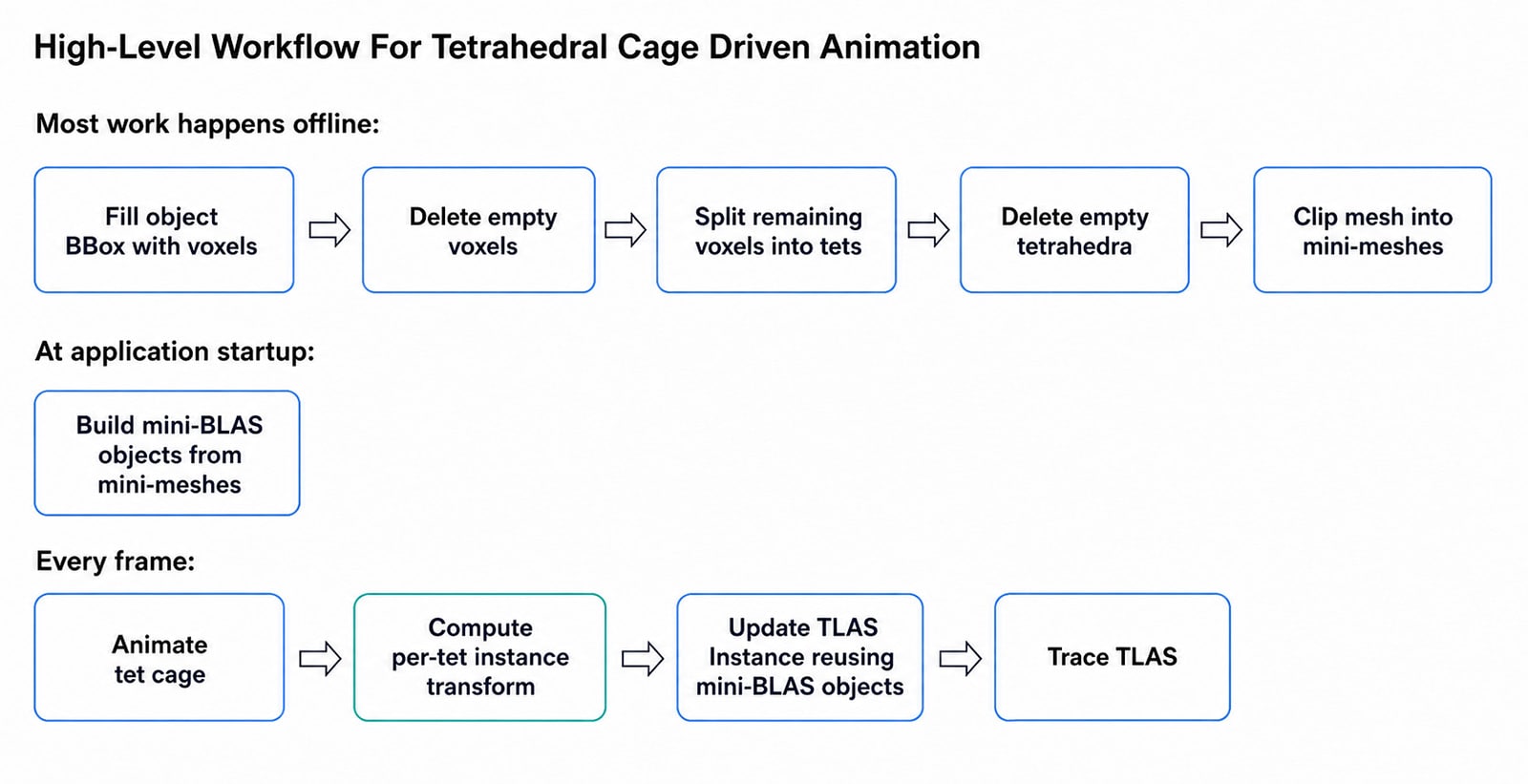
Decoupling animation and triangles

The central idea of the paper is to decouple animation cost from triangle count. Instead of applying animation directly to every triangle, the method builds a low-resolution tetrahedral cage around the original, non-animated mesh. During preprocessing, the mesh is split into small, disjoint pieces associated with the tetrahedra. Static mini-BLASes are then built for these pieces once and reused. At runtime, only the cage is animated. Rays that enter an animated tetrahedron are transformed into the corresponding rest-pose space, where they can intersect the static geometry. The resulting motion is an approximation: vertex movement is represented by a piecewise-linear deformation induced by the cage, rather than by a smooth global bend or by full per-vertex animation.

This makes the approach especially attractive for massive scenes where many copies of the same asset are animated in unique ways. Each unique deformation needs its own animated cage, but it can share the same rest-pose mini-meshes and mini-BLASes. The paper demonstrates this with trees, grass patches, and frogs, and shows a combined scene of roughly 585 million animated triangles rendered at 60 frames per second on an AMD Radeon RX 9070 XT graphics card at 1080p. The key message is not that tetrahedral cages replace every animation technique, but that they provide an additional new low-cost option when acceleration-structure updates, animation time, or memory footprint become the bottleneck. The paper also sits alongside similar independent work by Luton and Tricard (2026), which explores tetrahedral indirection but uses multiple hardware rays and no clipping step. Please note that tetrahedron-cage driven animations can be combined with the Microsoft DirectX® Raytracing (DXR) Functional Spec, Part 2 – e.g. partitioned top-level acceleration structures – and can also coexist with cluster level acceleration structures.

Ray Tracing Massive Amounts Animated Geometry 02Figure 2. High-level workflow.

The trade-off is control over quality versus performance. A coarser cage is cheaper and smaller, while a finer cage can follow the original animation more closely. The method is best suited to connectivity-preserving animation, such as swaying vegetation, grass, crowds, distant characters, or animation level of detail. It is less appropriate for cases where topology changes, very small-scale motion, or sharp character deformations are the visual focus. Please note though that tetrahedron-cage driven animations can also be used in the context of partitioned top-level structures and can also coexist with cluster level acceleration structures.

What’s next for tetrahedral cages

Overall, the paper presents tetrahedral cages as a practical bridge between rich animated content and hardware-accelerated ray tracing. By animating a compact proxy and reusing static rest-pose geometry, it opens the door to scenes that would otherwise be too expensive to update every frame. Future work will focus on improving cage generation and animation quality, as well as integration with modern ray-tracing pipelines. Please note that we are hard at work to create DXR samples and a header-only C++ library that allows building high-quality tetrahedral cages for skinned objects, keyframe-animated objects, and static objects. If you’re working on animated geometry at scale, we encourage you to dive into the full paper below, and stay tuned to GPUOpen as this research continues to evolve.

Footnotes

Links to third party sites are provided for convenience and unless explicitly stated, AMD is not responsible for the contents of such linked sites and no endorsement is implied. GD-97.

DirectX is a trademark of the Microsoft group of companies.

The Daily Front Page 17 of 25
Monday, July 27, 2026 The Daily Front No. #260727 — Shiny Panels, Real Watts
article

Should you wash your solar panels?

by surprisetalk·▲ 233 points·231 comments·incoherency.co.uk ↗
“I think I got a 2%–5% increase in power output from cleaning the panels.”

I have a small solar farm and the panels have got visibly dusty. Is cleaning them worthwhile? How much difference does it make? Let's find out.

I know that my panels have not been cleaned in the last year. I expect they also weren't cleaned in the year prior to that (why would you clean them when you're about to sell the house?). But beyond that I don't know when they were last cleaned.

Summary

The short answer is that I think I got a 2%-5% increase in power output from my solar farm due to cleaning the panels, which will work out to about £60-£150/yr, decaying to 0 over the course of a few years. So, probably just about worthwhile.

Methodology

There are 16 panels in total, connected up to the inverter as 2 banks of 8 panels each. The inverter reports the power output from each bank individually, so the plan is to take a bunch of readings before starting, then wash all of the panels in one bank, taking readings in between and at the end.

Our hypothesis is that cleaning the panels will increase power output.

We can test whether washing the panels has made any difference by looking at the ratio of power output from the 2 banks. If we just looked at raw power output then it would be confounded by changing cloud cover, sun angle, etc.

There is still the fact that the 2 banks of panels are physically separate and plausibly one bank is better positioned for sun 45 minutes later than the other. Ideally I would have been measuring the ratio of power output for several days prior to see how it varies throughout the day.

This is how the first row of panels looks after I've washed 3 of them, you can see the furthest one is noticeably grubbier:

So they were "visibly dusty", but not massively dirty. If your panels are dirtier than mine were, then your benefit from cleaning them will be greater than mine was.

Results

My results for cleaning one bank of panels are shown in this chart:

We see that the initial power ratio is very stable before the panels are washed.

We then step up to having washed "half" a panel (I initially tried to wash them with window cleaner and a paper towel, but this was ineffective so I then walked away to get a bucket of soapy water and a cloth, and then took a reading which I labelled as 50% washed).

For some reason the power ratio drops significantly when the first panel is washed, I'm unsure why.

And then the power ratio increases as more panels are washed as we'd expect.

But once all the panels are washed, the power ratio drops off again while nothing changes. I am unsure whether this is because as the surface water evaporates off the panels get slightly opaque again? Like the "frosted glass effect", where you can see through frosted glass when it is wet but it gets opaque again when dry. Maybe beyond cleaning the panels I ought to be polishing them?

Anyway it looks like cleaning the panels was about a 2%-5% improvement, depending on what you think is going on at the end.

Tingle

I got a bit of a tingle when I was cleaning one of the panels. At first I thought I was getting an electric shock from the wet panel, but I inspected my finger and found a tiny thistle splinter in it. After I removed the splinter it seemed fine.

But a bit later I got another tingle from another panel! There definitely wasn't a splinter in my finger any more, but the tingle was in the same place. I think the tingle actually was coming from the electricity, but I was only able to feel it at the point where the thistle had already pierced the skin.

ChatGPT convinced me that there could just be a tiny "capacitive leakage" from an "inverter with no transformer", so I'm not going to worry about it. But if I clean the panels again I will wait until dark lol.

Upgrading

The next question is should I be upgrading the solar farm? I think mine was installed about 15 years ago, and generates (at peak output) 3.7 kW from 16 panels.

Correct me if I'm wrong on any of this:

Replacing the panels with more modern ones would increase the power output by about 60%, at a cost of about £5000, which would pay for itself in about 3 years, which seems like a no-brainer.

However, due to the fact that my solar farm was installed so long ago, it benefits from a feed-in tariff, which means that not only do I get paid an absurdly high rate, but it is paid also based on the electricity I generate rather than what I export.

If I increase the power output of the system then the additional capacity will not be eligible for the feed-in tariff and will revert to present-day prevailing tariff which is about 4x worse before you even consider that I currently get to use electricity and still get paid for generating it.

This is the yin and yang of market-distorting incentives. Today's incentive to install solar becomes tomorrow's disincentive to upgrading it.

The Daily Front Page 18 of 25
Monday, July 27, 2026 The Daily Front No. #260727 — Simpler Web UIs
article

Removing React.js from the codebase and adapting Htmx for UI interactivity (2023)

by Ralfp·▲ 241 points·176 comments·misago-project.org ↗
“Removing React.js from the codebase and adapting HTMX for UI interactivity.”

Here's how Misago works currently:

  1. You request https://misago-project.org.
  2. Django view gathers data to render list of threads.
  3. Django view renders template that contains almost complete HTML with list of threads, but also includes a JSON with same data used to render this HTML. And there is no interactivity because forms are disabled.
  4. JavaScript downloads.
  5. JavaScript runs, reads JSON embedded in the page's body and replaces most of HTML rendered from Django templates with HTML from React.js components. Buttons become active, and timestamps in UI swap.

This approach has some problems:

  • A lot of pages in Misago are implemented twice: as Django templates and React.js components.
  • People who start customizing HTML get burned because they edit Django templates and see their changes flash for a second on a site before being replaced by React.js HTML which they didn't know they also need to customize.
  • Every view accessible to both users and guests needs to be done twice: as Django view with templates, and as React.js route with components. It also requires an API and JSON serializers to power data fetching.
  • JSON serialization to pre-bake data for React.js app slows down response generation.
  • A large part of translation messages is duplicated, living in both django.po and djangojs.po files. JavaScript translation files also increase the initial download size.
  • Lots of JavaScript can kill performance, especially on older and slower mobile devices.
  • Enabling plugins to replace or inject custom HTML to the page requires for those plugins to implement both Django templates and React.js components. And Misago will need to implement a JavaScript build step as part of site build in misago-docker. Plugin devs need to know both.

I've considered two solutions to this problem:

  1. Drop Django views and templates, only keep those in minimal versions to keep search engine bots happy. Focus on implementing an API and having all UI as React.js app.
  2. Reduce Django to API and use JavaScript framework with serverside rendering, eg. Next.js or Remix.run.

But here's a thing: there's a lot of forum software out there that still does the old way of rendering as much as possible on the server and using some JavaScript on client to improve its interactivity here and there. And people are happy with that. And this approach has none of the above issues.

Internet forum software has plenty of interactivity, but this interactivity is isolated to specific places on the page. Moderation actions, watching a thread, writing a reply, seeing last notifications, voting in a poll. All this stuff can be achieved without React.js and was achieved without it for years before we've decided that full page reload is something that needs to be avoided.

Now, what's HTMX? HTMX is a tiny library that lets developers specify parts of HTML as dynamic islands that can be swapped by new server-rendered HTML on interaction. For example, list of actual threads is one such (large) island. With little bit of HTMX included in Django template, changing current category on threads list could pull new HTML from Django only for new threads list for selected category, while keeping rest of the page's HTMX (eg. already loaded search results in navbar) unchanged. Misago's backend code would only need to be changed to return only the HTML for this island when request comes from HTMX, instead of full page. There's no need to do any JSON serialization or write dedicated JavaScript or React.js.

HTMX is declarative way of doing $.get("url", "#outlet") we've did in jQuery 20 years ago. Or Rails Turbolinks. I can't believe I am writing this, but this is the way for forum software if you hate endless scrolling or want to keep things simple otherwise.

GitHub issue: #1674

I've also decided against moving the admin panel to SPA. Currently I have a bunch of reusable Django views that take care of 90% of work, and adding new page to admin requires one to pick right base view, fill in blanks, define one or few forms and write very basic templates for those. Rest happens automagically and I like it.

The effort required to move away from React.js and to HTMX will be a big one, but it can be done as multiple small steps. Eg. one release could move Navbar to HTMX, other threads list, next thread page, another user profiles, etc. etc. But plugins/permissions/new parser still have to happen first. So HTMX migration will have to wait until later 2024. I am fine with that becasue I would also want to move to latest Bootstrap, and those guys are cooking some crazy stuff in it.

I also need to give a warning that we will likely have a transition period where parts of Misago will have no React.js, but also no HTMX either, effectively making them "multi-page application". This may sound scary but it only means that clicking a link or submitting a form in, say, user options page will cause a full page reload. But I will still write a placeholder AJAX (or just use the HTMX) where full page reload will be absolutely unbearable, eg. for liking posts or voting in polls.

For the record, JS sizes from Misago 0.39:

vendor.js: 679kb, 214kb gzipped
misago.js: 615kb, 124kb gzipped
django-i18n.js: 102kb, 25.4kb gzipped

Misago JS also includes lazily loaded:

hljs.js: 144kb, 49kb gzipped
zxcvbn.js: 820kb, 430kb gzipped

I plan to return to those numbers once I start removing React.js (and other JS dependencies) from Misago.

"Forum options" page has been replaced with "Account settings". This new page is done fully with Django views, and uses HTMX on some pages for dynamic updates.

JS size change:

misago.js: 578kb, 107kb gzipped (37kb/17kb less)

Threads lists have been rewritten almost from scratch to use Django views and HTMX instead of React.js.

JS size change:

misago.js: 530kb, 99kb gzipped (48kb/8kb less)

The Daily Front Page 19 of 25
Monday, July 27, 2026 The Daily Front No. #260727 — Zero‑Runtime TypeScript
repository

Scriptc by Vercel: TypeScript-to-Native compiler, no JavaScript engine in binary

by maxloh·▲ 275 points·152 comments·github.com ↗
★ 1,898⑂ 34 forks TypeScript

TypeScript-to-Native Compiler

Zero-runtime TypeScript. scriptc compiles ordinary TypeScript into small, fast native executables — no Node, no V8, no JavaScript engine in the binary.

$ cat fib.ts
function fib(n: number): number {
  return n < 2 ? n : fib(n - 1) + fib(n - 2);
}
console.log(fib(30));

$ scriptc run fib.ts
832040

$ scriptc build fib.ts && ls -la fib
-rwxr-xr-x  178K  fib        # a self-contained native binary, ~2ms startup

No changes to your code. No annotations, no dialect — the same TypeScript you run on Node, type-checked by the real TypeScript compiler and compiled to native. What compiles behaves byte-for-byte like Node.

Install

$ npm install -g scriptc

Requires clang (preinstalled with Xcode Command Line Tools). macOS arm64 is the primary platform; Linux and Windows binaries build by cross-compilation, each verified by its own differential test lane.

The idea: staticness you can see

Most TypeScript is far more static than the ecosystem assumes. scriptc decides, construct by construct, what can compile to native code — and tells you:

$ scriptc coverage app.ts

  statements analyzed   4481
  compile statically    4451  (99%)

  blockers:
      ×2  functions with optional parameters as values   SC1090
      ×1  Promise.reject                                 SC2020

Three tiers, always explicit:

  1. Compiled statically — native code, no engine. The default, and the only mode unless you opt out.
  2. Runs dynamically (--dynamic) — an embedded JavaScript engine (quickjs-ng, ~620KB) executes what can't be static: npm dependencies' shipped JS, any-typed code. Every value crossing back into static code is validated at runtime — a lying type throws a catchable TypeError instead of corrupting memory.
  3. Rejected — everything else fails with a specific error code, a code frame, and usually a rewrite hint. Nothing is ever silently miscompiled.

What compiles

The static surface covers the language and the standard library real programs use:

  • The language — classes with single inheritance and true dynamic dispatch (devirtualized when provably safe), closures with JS capture semantics, generics (monomorphized), discriminated unions as tagged values driven by TypeScript's own narrowing, async/await on stackful fibers with JS-exact scheduling, exceptions with finally, destructuring, spread, optional/default/rest parameters, getters/setters, iterators over strings/arrays/Maps/Sets, template literals, regular expressions (the engine is the same ECMAScript-exact bytecode interpreter QuickJS uses, linked only into regex-using binaries).
  • The standard library — strings with UTF-16-exact semantics, arrays/Maps/Sets with JS-exact ordering and identity, JSON with runtime-validated casts, Math, typed arrays and Buffer, Error hierarchies with typed catch.
  • Node's API surfacefs (sync and promises), path (byte-exact port), process, child_process with piped streams, os, crypto, url/URL, zlib, timers and signal handlers on a dependency-free event loop — and the server stack: net, http, https, tls (vendored mbedTLS), dgram, dns, fs.watch, readline. Real proxy servers compile.
  • fetch and the WHATWG web subset (streams, Headers, AbortSignal) over the same native net/TLS stack — redirects, gzip, AbortSignal.timeout, Node-shaped error causes; no libcurl, no system HTTP dependency.
  • npm dependencies (with --dynamic) — packages resolve with Node's own algorithm, typecheck against their shipped .d.ts, and their JS is embedded into the binary at build time. Binaries never read node_modules at runtime.

Programs typecheck against TypeScript's real es2025 lib (plus @types/node when your project has it), and your tsconfig.json governs checker strictness. Anything reached that has no lowering is a precise diagnostic, never a surprise.

Correctness

Two enforcement mechanisms run on every change:

  • Differential testing — every corpus program (800+ tests) runs under Node and as a native binary; stdout, stderr, and exit codes must match byte-for-byte. Number formatting is JS-exact (shortest-roundtrip, fuzz-verified against Node on a million doubles). Servers are tested with live client drivers against both implementations.
  • Memory-safety lane — the entire corpus re-runs under AddressSanitizer with a reference-count audit; leaks and use-after-free are build failures.

The deliberate divergences from Node (there are a few dozen, mostly around timing internals and error-object properties) are documented and numbered; nothing diverges silently.

Performance

Measured on Apple M-series against the same workloads in Node, Go, Rust, and Zig (all byte-identical output, verified):

dimension scriptc context startup ~2.4ms Node: ~47ms; on par with Zig, ahead of Go/Rust binary size 170–200KB static, ~3MB with --dynamic + embedded deps Go: ~2MB; Node SEA: 60–100MB memory (RSS) 1–4MB typical Node: 67–116MB runtime JS-faithful f64 semantics; competitive with the systems languages on most workloads integer inference and ownership analysis are on the roadmap

Escape hatches

  • comptime(() => ...) runs TypeScript at build time (in an isolated VM inside the compiler) and bakes the result into the binary as a literal.
  • Native FFI (--ffi) binds signature-only TypeScript declarations to direct C ABI calls and links manifest-declared archives, objects, and system libraries. The boundary is explicit and length-delimited; see the Native FFI guide.
  • --dynamic embeds the engine for npm deps and any code. scriptc coverage --dynamic reports exactly which statements run where and what the remaining blockers are. Static stays the default: a binary never silently grows an engine.
  • Checked castsJSON.parse(...) as Config inserts a runtime validation that throws a catchable error naming the offending path (expected number at $.port, got string). TypeScript's as is a promise; scriptc verifies it.

Architecture

flowchart LR
    TS[TypeScript] -->|tsc: parse + typecheck| L[lowering]
    L --> IR[typed IR]
    IR --> C[C]
    C -->|clang| BIN[native executable]

Loading

  • packages/compiler — frontend (tsc API → IR), the IR with validator/serializer, the LLVM and C backends. The IR is the only interface between the ends; LLVM is the default code generator (with a transparent fallback for programs outside its tier), and C is the reference backend forever (readable, source-line-annotated output via --backend c).
  • packages/runtime — the C runtime: refcounted values with a cycle collector, stackful fibers and the event loop (kqueue), the server stack, JS-exact number formatting. Feature units are link-gated: binaries pay only for what they use.
  • packages/cliscriptc build | run | coverage.

Development

$ pnpm install && pnpm build
$ pnpm test                      # differential corpus + diagnostics snapshots
$ SCRIPTC_SAN=1 pnpm test        # the same corpus under ASan + RC audit
$ pnpm scriptc build x.ts --emit-ir   # keep .scriptc/x.c and x.ir.json

Every feature lands with differential tests; both lanes green is the merge bar.

The Daily Front Page 20 of 25
Monday, July 27, 2026 The Daily Front No. #260727 — Dev Tools & Engines
repository

Libsm64: Mario 64 as a library for use in external game engines

by klaussilveira·▲ 189 points·24 comments·github.com ↗
★ 902⑂ 51 forks C

Mario 64 as a library for use in external game engines

The purpose of this project is to provide a clean interface to the movement and rendering code which was reversed from SM64 by the SM64 decompilation project, so that Mario can be dropped in to existing game engines or other systems with minimal effort. This project produces a shared library file containing mostly code from the decompilation project, and loads an official SM64 ROM at runtime to get Mario's texture and animation data, so any project which makes use of this library must ask the user to provide a ROM for asset extraction.

The entire external-facing API of the shared library can be found in libsm64.h. Any client project making use of the library must only include that header and load the library. There's a minimal example project under the test directory as well, demonstrating usage of the library.

Bindings and plugins

Building on Mac and Linux

  • Ensure python3 is installed.
  • Ensure the SDL2 and GLEW libraries are installed if you're building the test program (on Ubuntu: libsdl2-dev, libglew-dev).
  • Run make to build. If you want to link musl libc instead of glibc run LIBSM64_MUSL=1 make instead.
  • To run the test program you'll need a SM64 US ROM in the root of the repository with the name baserom.us.z64.

Building on Windows

  • Follow steps 1-4 for setting up MSYS2 MinGW 64 here, but replace the repository URL with https://github.com/libsm64/libsm64.git
  • Ensure the SDL2 and GLEW libraries are installed if you're building the test program.
    • 64 bits: pacman -S mingw-w64-x86_64-SDL2 mingw-w64-x86_64-glew.
    • 32 bits: pacman -S mingw-w64-i686-SDL2 mingw-w64-i686-glew.
  • Run make to build
  • To run the test program you'll need a SM64 US ROM in the root of the repository with the name baserom.us.z64.

Building for Emscripten (Web) (WIP)

Run emmake make CC=emcc.

If you want libsm64 standalone to call from JS (may not be that useful?), then run emcc dist/libsm64.so -o libsm64.js afterward to emit libsm64.wasm and libsm64.js.

Otherwise, dist/libsm64.so should be a compiled WebAssembly object that you can link into your own C project.

Make targets (all platforms)

  • make lib: (Default) Build the dist directory, containing the shared object or DLL and public-facing header.
  • make test: Builds the library dist directory as well as the test program.
  • make run: Build and run the SDL+OpenGL test program.
article

Self-contained highly-portable Python distributions

by jcbhmr·▲ 136 points·29 comments·gregoryszorc.com ↗

This project produces self-contained, highly-portable Python distributions. These Python distributions contain a fully-usable, full-featured Python installation: most extension modules from the Python standard library are present and their library dependencies are either distributed with the distribution or are statically linked.

The Python distributions are built in a manner to minimize run-time dependencies. This includes limiting the CPU instructions that can be used and limiting the set of shared libraries required at run-time. The goal is for the produced distribution to work on any system for the targeted architecture.

Some distributions ship with their build artifacts (object files, libraries, etc) along with rich metadata describing the distribution and how it was assembled. The build artifacts can be recombined by downstream repackagers to derive a custom Python distribution, possibly without certain features like SQLite and OpenSSL. This is useful for embedding Python in a larger binary. See the PyOxidizer sister project for such a downstream repackager.

Many users of these distributions might be better served by the PyOxy sister project. PyOxy takes these Python distributions and adds some Rust code for enhancing the functionality of the Python interpreter. The official PyOxy release binaries are single file executables providing a full-featured Python interpreter.

Contents:

article

PGSimCity - How PostgreSQL Works

by jonbaer·▲ 901 points·88 comments·nikolays.github.io ↗

PGSimCity is an independent, non-commercial educational visualization of PostgreSQL internals. It is not affiliated with, sponsored, endorsed, or approved by Electronic Arts Inc. SimCity is a trademark of Electronic Arts Inc.

A working model of the PostgreSQL engine

loading the city code…

Early, unreviewed prototype. It almost certainly contains inaccuracies in both the model and explanations. Found one? Open an issue or send a pull request.

The Daily Front Page 21 of 25
Monday, July 27, 2026 The Daily Front No. #260727 — AI Red Teams
article

MAI-Cyber-1-Flash inside MDASH

by migmartri·▲ 228 points·109 comments·microsoft.ai ↗
“World-class performance at 50% of the cost of leading models.”

Abstract illustration of three overlapping shield shapes in blue, pink, and purple tones on a beige background.

Today we’re announcing MAI-Cyber-1-Flash inside of MDASH, our multi-agent vulnerability identification and remediation harness. Together they deliver world-class performance at 50% of the cost of leading models.

Progress in AI has been startling and so has the new generation of cyber threats it’s unleashing. Attackers now wield increasingly powerful capabilities, probing an ever-growing mountain of code for just a single weakness that lets them in.

As the cost of finding a flaw collapses, the old model of security, where you scan occasionally and patch eventually, is now obsolete. If we’re to unlock the true benefits of AI, we must first build outstanding cyber models that help all of us harden the software the world runs on.

That’s the motivation behind MAI-Cyber-1-Flash, which has been built to find challenging vulnerabilities in complex codebases. It’s been deeply integrated into MDASH, honed by the best cybersecurity experts in the industry and hardened across the largest security estate on the planet.

This combined expertise delivers exceptional security protection, beating Mythos, Gemini and GPT on CyberGym, the gold standard benchmark for evaluating how systems reason over large codebases to find real vulnerabilities in the code.

Bar chart titled "CyberGym Evaluation" comparing success rates of five models, with MDASH: MAI-Cyber-1-Flash + GPT-5.4 leading at 95.95%, and other four models ranging between 83.2% and 85.6%.

Picking the right model for the task

Security is an always-on mission, and given the enormous volume of inbound attacks, token cost is now the real constraint for defenders. MAI-Cyber-1-Flash was designed to efficiently handle up to 90% of all tasks, enabling MDASH to use the larger and most costly models in our fleet (in this case GPT-5.4) for the 10% of exceptionally hard tasks that truly need them.

The result is that the unified system of MDASH with MAI-Cyber-1-Flash delivers 96% on CyberGym (+12 pt above Mythos).

This combination delivers a 50% cost saving when compared against our best offering in MDASH today (GPT 5.4 + 5.4 mini + 5.3 codex). That’s the power of a well-tuned, multi-model system with access to uniquely rich historical training data. It ensures you always have the best model at the best price for every task.

In this new environment, being able to go from identifying a new vulnerability to addressing it in real-time is critical. And while AI remediation of software vulnerabilities is now a key security workflow, there are many jobs to be done by Security practitioners themselves.

That’s why today we’re also launching Perception, our agentic security systems, that provides teams of agents for a variety of security workflows in MDASH, to continuously monitor, patch, and close new threat vectors. Perception will also soon use MAI-Cyber-1-Flash for many more security workflows, beyond the software vulnerability work.

Three things matter today: Model. Data. Harness.

We have jointly optimized our world-class models, our unmatched historic data, and our expert-tuned harness to ensure that our customers have a uniquely powerful security offering.

Model. MAI-Cyber-1-Flash is a compact, code-heavy security model derived from the MAI-Thinking-1 lineage, which was built from scratch, in-house, on the highest quality data. Details in our technical report.

Data. Our deepest advantage. Decades of building world-class security systems now give us trillions of daily signals across identity, endpoint, cloud, and network, and an unmatched record of real exploits and remediations. No one can manufacture this history.

Harness. MDASH, our multi-agent vulnerability identification and remediation harness, is tuned by the best security experts in the industry, who have created 100+ agents using multiple leading models to find, validate, and remediate vulnerabilities. Agentic code scanning is a critical function in the Security Operating Center and feeds Project Perception, our new agentic security system.

Built with safety first

Because MAI-Cyber-1-Flash is Microsoft’s first cyber model, we built trust into every layer of the system, from model training to customer deployment. The model was developed with a security-first calibration, rigorously evaluated by Microsoft’s AI Red Team, tested through automated and expert-led adversarial exercises, and independently assessed by a third party.

Trust extends beyond the model itself. Through MDASH, customers get enterprise-grade controls including Role-Based Controls, tenant isolation, encryption, auditability, and sandboxed execution environments with no internet access. The result is a cyber model that delivers powerful capabilities to defenders while maintaining the governance, security, and control enterprises expect from Microsoft.

Our hill-climbing machine

Cybersecurity is not just a data-rich domain; it is a live reinforcement learning loop. Every day, defenders investigate threats, triage alerts, hunt adversaries, remediate vulnerabilities, deploy protections, and learn from the outcome.

Microsoft sees that loop end to end: vulnerabilities through Microsoft Security Response Center; attacks and defenses across identity, endpoint, cloud, data, browser, and applications; more than 100 trillion security signals every day; and operational insight from 1.6 million customers. Because we can connect actions to outcomes; what was exploitable, what was contained, what was blocked, and what actually worked; we have more than data.

Our MAI reinforcement learning loop gives us the foundation to build cyber models that improve continuously and become expert cyber defenders. That’ll remain our commitment to our customers for years to come.

Build the Future With Us

We’re a lean, talent-dense team of explorers, researchers, and full-stack engineers. We move fast, sweat the details, and operate at frontier scale with a roadmap to build the world’s most powerful AI models. Most importantly, we’re united by the belief that doing this right is the only way to do it at all. If our mission resonates with you, we’d love to talk.

Explore all jobs

The Daily Front Page 22 of 25
Monday, July 27, 2026 The Daily Front No. #260727 — Culture & Curios
The Daily Front Page 23 of 25
Monday, July 27, 2026 The Daily Front No. #260727 — New Ventures
article

Launch HN: Rise Reforming (YC S26) – Turning Waste Gases into Valuable Chemicals

by george_rose25·▲ 70 points·30 comments·rise-reforming.com ↗

Unlocking resilience for the chemical industry

Chemical production is centralized and fossil fuel- dependent, making it vulnerable to geopolitical events and natural disasters

Biogas is the ideal domestic feedstock: the U.S. produces enough biogas to make over $20 billion worth of chemicals annually, but 60% is wasted or flared in low-margin applications

We convert stranded biogas from wastewater plants, farms, and landfills on-site into valuable chemicals like dimethyl ether (DME), methanol, and dimethyl carbonate (DMC)

Supply-Secure

We convert domestic raw biogas into chemicals, removing the reliance on fossil fuels and vulnerable supply chains.

Modular

Our technology fits inside a shipping container, allowing for rapid and in-situ deployment, quicker payback, streamlined permitting, and access to the cheapest biogas.

Scalable

We can scale with your facility, easily adding or subtracting modules, ensuring long-term financial growth.

Price Competitive

Our proprietary process enables us to produce DME that competes pricewise with petrochemical DME and the cheapest green methanol & DMC available.

Low-Carbon

Our modules utilize waste gases to produce chemicals without the extraction, processing, and transportation of fossil fuels as raw materials.

Pilot container has arrived at our host site (Chicagoland wastewater plant), officially kicking off construction.

Learn more

July 2026

Rise Reforming joins Y Combinator’s S26 batch to accelerate scale-up and time to market.

Learn more

May 2026

Signed a binding supply agreement and multiple MOUs with biogas producers. Signed a conditional DME offtake agreement for our first commercial unit.

April 2026

Proof-of-concept complete after 1800+ hours of stable syngas production. Next, with pilot plant designs ready, we're taking our technology to live biogas.

March 2026

Pre-seed round of funding closed ($650k) towards completing proof-of-concept, filing process IP, and finalizing our plans for the pilot plant.

December 2025

Rise Reforming plants its roots at Illinois Institute of Technology's incubator lab to continue R&D. Nina Kritikos joins as the first hire.

August 2025

Funding secured from UChicago accelerators. CEO George Rose named Climate Fellow by the 776 Foundation, led by Reddit Co-Founder Alexis Ohanian. 

Learn more

May 2025

The team takes home the European Aerosols Federation 2025 Start-Up Award and breaks boundaries as the youngest presenters at Paris Packaging Week.

Learn more

January 2025

Latest

Here's what we've been up to

Partner With Us

We are looking for visionary collaborators and investors to scale our low-carbon chemical production. 

Email us at contact@rise-reforming.com

The Daily Front Page 24 of 25
Monday, July 27, 2026 The Daily Front No. #260727 — Colophon

That's the Front for Today

Issue No. #260727 — Monday, July 27, 2026 — went to press 2026-07-28 at 07:52 UTC.

About This Magazine

The Daily Front is a daily digital magazine assembled from the stories that reached the front page of Hacker News on Monday, July 27, 2026. Headlines, points, and comment counts are recorded as they stood at press time. All articles remain the property of their original authors — every piece links back to its source and its discussion thread.

How It Was Made

Fetched, cleaned, and typeset by an automated pipeline. An editor model laid out the pages, chose the highlights, and briefed the cover illustrator — 33 model calls and 292k tokens in total. Set in Jacquard 12, Playfair Display, Source Serif 4, and IBM Plex Mono, all served via Google Fonts under the SIL Open Font License.

The Cover

The cover illustration was commissioned with this prompt:

Side-on view through a narrow aisle of towering server racks, framing a colossal balance scale in the far distance. The neural lattice monolith hovers on the elevated right pan; the left pan hangs close to the viewer, tangled with fiber-optic cables that lead beyond the frame. Blank pages sweep through the aisle like a wind tunnel, dissolving into abstract data particles.

High-contrast, cinematic depth, surreal scale, etched detail, risograph grain. No text, letters, numbers, logos, or readable symbols.

Production Ledger

StageModelCallsTokens InTokens Out
extractgpt-5-mini 32 178,735 82,805
layoutgpt-5 1 18,612 11,984

The Publisher

Published by Johnny.

Support the Press

If The Daily Front brightens your morning, consider supporting its publisher.

Credits & Contact

All content — articles, posts, comments, and the images within them — belongs to its original authors and is reproduced here to point readers back to the source. Full credit goes to those creators; every item links to its original and its Hacker News discussion.

If you are an author and would like your content removed from an issue, write to hi@johnnys.page and it will be taken down.

Feedback is always welcome at the same address: hi@johnnys.page.

Credit where credit is due.

Every page of this issue began as someone else's work — these are the original sources, linked in full.

  1. Kimi-K3 on HuggingFace by nateb2022 — huggingface.co·HN discussion ↗
  2. Our position on open-weights models by surprisetalk — anthropic.com·HN discussion ↗
  3. US citizen charged after GrapheneOS phone wipes during airport search by eecc — techspot.com·HN discussion ↗
  4. How is the Bun rewrite in Rust going? by tomlockwood — lockwood.dev·HN discussion ↗
  5. We have proof automation now by zdw — imperialviolet.org·HN discussion ↗
  6. Watching Go's new garbage collector move through the heap by matheusmoreira — theconsensus.dev·HN discussion ↗
  7. French firefighters face 'pyrocumulonimbus' for first time by saaaaaam — france24.com·HN discussion ↗
  8. The computer that helped win World War II by baruchel — spectrum.ieee.org·HN discussion ↗
  9. Judge Rejects Google's Attempt to DMCA Its Way Out of Being Scraped by cdrnsf — techdirt.com·HN discussion ↗
  10. Modern email can be built from borrowed parts by andros — en.andros.dev·HN discussion ↗
  11. I wanted a clock that never needed setting. Things escalated by lee_ars — arstechnica.com·HN discussion ↗
  12. Magnolias are so old that they're pollinated by beetles, not bees (2025) by speckx — mymodernmet.com·HN discussion ↗
  13. Glue bonds to nonstick surfaces and wipes clean with ethanol by gmays — cen.acs.org·HN discussion ↗
  14. Exploiting Volvo/Eicher's fleet platform to gain control over all users/vehicles by EatonZ — eaton-works.com·HN discussion ↗
  15. Ray tracing massive amounts of animated geometry using tetrahedral cages by LorenDB — gpuopen.com·HN discussion ↗
  16. Should you wash your solar panels? by surprisetalk — incoherency.co.uk·HN discussion ↗
  17. Removing React.js from the codebase and adapting Htmx for UI interactivity (2023) by Ralfp — misago-project.org·HN discussion ↗
  18. Scriptc by Vercel: TypeScript-to-Native compiler, no JavaScript engine in binary by maxloh — github.com·HN discussion ↗
  19. Libsm64: Mario 64 as a library for use in external game engines by klaussilveira — github.com·HN discussion ↗
  20. Kimi-K3 Technical Report [pdf] by vinhnx — github.com·HN discussion ↗
  21. Self-contained highly-portable Python distributions by jcbhmr — gregoryszorc.com·HN discussion ↗
  22. PGSimCity - How PostgreSQL Works by jonbaer — nikolays.github.io·HN discussion ↗
  23. VLC for Unity now supported on Linux by martz — code.videolan.org·HN discussion ↗
  24. MAI-Cyber-1-Flash inside MDASH by migmartri — microsoft.ai·HN discussion ↗
  25. AI companies are shredding rare books by anon373839 — twitter.com·HN discussion ↗
  26. Paged Out #9 [pdf] by laurensr — pagedout.institute·HN discussion ↗
  27. Fonts In Use – Find out where a font is used by open_ — fontsinuse.com·HN discussion ↗
  28. The Usefulness of Useless Knowledge (1939) [pdf] by jxmorris12 — faculty.lsu.edu·HN discussion ↗
  29. Show HN: Physically accurate black hole you can put in your room by aplavin — blackhole.plav.in·HN discussion ↗
  30. Launch HN: Rise Reforming (YC S26) – Turning Waste Gases into Valuable Chemicals by george_rose25 — rise-reforming.com·HN discussion ↗

Browse all issues in the archive →